

Submitted:
28 April 2026
Posted:
29 April 2026
You are already at the latest version
Abstract
Electron configurations are known to provide (valuable) insights into the electronic structure and behavior of atoms. They specify which and how the electronic (sub-) shells are occupied, and is thus an essential ingredient for most atomic observables. When combined with the shell model and the successive filling of shells, these configurations help explain the Periodic Table and much of chemical binding. They also establish a qualitative framework for analyzing excitation, ionization and relaxation processes and may facilitate–a wide range of–astrophysical and plasma simulations. — Here, we review the role of electron configurations for understanding atomic behavior in interactions with particles and radiation. In particular, we identify several central requirements for an efficient treatment of configuration lists and define a domain-specific language in order to generate, manipulate and analyze such lists as well as to extract physically relevant information. We also demonstrate the implementation of this language in Jac, the Jena Atomic Calculator. An efficient handling of configurations will refine the coupling of structure codes with the spectral synthesis of plasma radiation, the setup of ionic cascades or even non-LTE plasma simulations. This common framework for dealing with electron configurations therefore improves consistency, reproducibility and scalability of atomic modeling.
Keywords:
atomic fine-structure
; atomic behavior
; domain-specific language
; electron configuration
; ionic excitation
; ionization and relexation
; Jena Atomic Calculator
; plasma simulations
; shell model
; shells and subshells
1. Introduction
Electron configurations are frequently displayed in the literature in order to specify which orbitals are occupied and how many electrons reside in each atomic (sub-) shell. These configurations provide a rather compact notation of the electronic structure of atoms and ions and, hence, help explain most of their observables, at least qualitatively [1,2]. They also help classify atomic excitation, ionization and relaxation processes by means of well-defined changes in the occupation of shells. In the modeling of atomic cascades [3], moreover, electron configurations permit a natural decomposition of the atomic computations into tractable steps. Therefore, (extended lists of) configurations form a quite natural bridge between elaborate atomic structure calculations as well as atomistic plasma simulations of various kind, whenever level-resolved data are needed for different charge states.
Indeed, electron configurations underpin the atomic shell model that explains the quantized nature of matter at atomic scales. In its simplest form, perhaps, this model readily reveals the structure of hydrogen-like ions and their spectral line series, such as Lyman and Balmer. Today, the atomic shell model forms the foundation of modern atomic-structure theory, and also explains the Periodic Table as well as much of the chemistry of elements. For example, this model predicts that elements from the same group in this table have a homologue valence-shell structure and, hence, a (very) similar chemical behavior. In addition, the shell model supports effective theories in modern quantum optics [4], plasma physics [5,6] or semiconductor design [7].
Historically, one or just a few electron configurations have often been utilized to classify and compute atomic level structures. Configuration list of increasing size have later been employed especially in various restricted active space (RAS) methods in order to realize accurate calculations of levels and excitation energies [8,9]. These RAS computations are particularly useful for medium- and high-Z atoms where full configuration interaction is too costly [10,11]. Different radiative properties of atoms and ions, such as electric-dipole (E1), magnetic-dipole (M1) and further transition matrix elements, Einstein A coefficients and oscillator strengths have been calculated reliably within RAS frameworks [12,13]. This framework also allows calculations of hyperfine constants [14], isotope shifts [15], and other nuclear-dependent observables [16], including relativity, leading quantum-electrodynamical and correlation contributions. In practice, therefore, RAS calculations usually help balance accuracy, computational cost and transparency in atomic-structure and plasma studies [17,18,19].
Beside detailed level calculations, electron configurations support modeling the excitation and decay (dynamics) of atoms and ions through multiple charge states [20]. In these "chains" of atomic de-excitation processes, electron configurations easily map the possible transitions between ionic charge states and, hence, indicate where vacancies or holes occur, until the ground state (configuration) is reached. For an efficient treatment of such excitation and decay cascades, however, the implementation of a proper domain-specific language (DSL) is required to deal with the extended size and variation of the underlying lists of configurations. Basic features of such a DSL should include the sorting and writing of configurations in an accessible form, identifying closed and open subshells or to extract details on the occupation or coupling of shells, just on demand. Additional features refer to the generation of excited or ionized configurations, relative to some given reference configuration(s) or to the identification of allowed transitions, based on selection rules as well as to multiple display modes for a transparent work with such electron configurations.
Here, we review the role of electron configurations in atomic structure and collision theory, where they have been widely used in standard atomic-structure programs. Often, the occupation of these configurations are encoded as ordered lists of occupied orbitals with well-defined principal and angular-momentum quantum numbers. Until the present, however, most codes treat configurations just as generators of configuration-state functions (CSF), the basis states of the many-electron Hilbert space, but not as independent physical objects. Only a few modern implementation make these configurations explicit enough to control the (virtual) excitation of configurations or the growths of active spaces systematically. This is quite in contrast to the needs of many applications that rely on long lists of configurations for some detailed atomic and plasma modeling. To handle these demands efficiently, we have developed a (reduced) DSL for configuration lists. This DSL has been implemented in Jac, the Jena Atomic Calculator [21], and now facilitates (1) reference-based generation of configurations, (2) extraction of electron numbers, open shells, term symbols, etc. as well as (3) multiple display modes, including the compact notation of the electronic core or mean occupation.
In the next section, we first recall the (potential) use of electron configurations in different research fields. For this purpose, we briefly recall the use of configurations and how they describe atomic behavior across different situations; cf. Figure 1. Applications include the transformation of atomic states between coupling schemes and the modeling of atomic cascades. Configurations also provide a natural bridge to plasma modeling and help reduce the complexity in physics simulations. Section 3 later discusses the implementation within the Jac toolbox, including the distinction of themes and the explicit data handling. In particular, we show how configurations can be generated or manipulated, and how relevant information can be extracted efficiently. Finally, Section 4 presents a summary and outlook for future applications and developments.
2. Role and Promise of Dealing with Electron Configurations
2.1. Electron Configurations and Equivalent Electrons
Electron configurations readily specify how the electrons are distributed among the atomic (sub-) shells and, hence, are often seen as a blueprint of the atomic shell model. For instance, oxygen (with nuclear charge ) has a ground configuration , whereas sulphur from the same group of the periodic table possesses the homologue configuration . These configurations simply classify the atomic shell structure in terms of equivalent electrons with identical principal and orbital angular-momentum quantum numbers [1]. Figure 1 displays selected electron configurations in the atomic decay cascade that follow the photoionization of Kr+ ions. In addition to the occupation of the electron shells, open-shell configurations give rise to the geometrically determined fine-structure of atomic and ionic levels with well-defined term symbols and symmetry properties. This is shown in this figure for two configurations that readily occur in the subsequent Auger cascade. These configurations illustrate the rapidly increasing complexity in the fine-structure of ions, if additional inner-shell excitations get involved.
The geometrically fixed coupling of the open shells usually determine the behavior of most ions, atoms and (small) molecules. If inner-shell excitations occur, these electron configurations enable tracking of the excitation and decay dynamics by identifying the principal decay paths. Apart from their explicit fine-structure, these electron configurations help classify the relevant transitions or to recognize and model weak processes with two or more electrons in the continuum [31,32,33]. Table 1 summarizes several further research topics that centrally rely on the concept of electron configurations.
2.2. Transformation and Analysis of Coupling Schemes
Perhaps the most straightforward use of electron configurations refer to RAS computations that are usually performed for improving the ionic level structure systematically. In non-relativistic theory, these configurations define how electron angular momenta couple to form terms, levels or individual states. This simple categorization of energy levels by their (allowed) L, S and J values has been found crucial also for understanding atomic spectra by means of level structures and selection rules. Many atomic calculations therefore begin from a reference set of configurations to generate relevant subspaces of the many-electron Hilbert space. By using different coupling schemes, the interpretation and synthesis of these spectra can be simplified by reducing the number of relevant terms in the computations [1].
Different coupling schemes can be chosen according to the dominant interactions in the atom or ion. (or Russell–Saunders) coupling applies, when the Coulomb repulsion among the electrons exceed the spin-orbit interaction, as it is usually the case in light atoms. In this coupling scheme, the individual orbital angular momenta of each shell of equivalent electrons, e.g. the so-called symmetry-adopted shell states, are first combined to a total L, similar as for the shell spins to a total S, and before they are coupled to each other to form the total angular momentum J[1]. In heavier atoms, spin-orbit interactions often dominate and then favor -coupling, where the total (sub-) shell angular momenta of the equivalent electrons are directly combined to a total J of the given fine-structure level [2].
Not much need to be said about all the quantum numbers above that characterize the different coupling schemes in the notation (and construction) of atomic and ionic levels. These quantum numbers are well conserved only for nearly pure (many-electron) states, but which rarely occur in nature at all. Although the transformation between orthogonal bases of different coupling schemes is widely-known to be achieved by a "unitary matrix", the explicit evaluation of such transformation matrices still remains a challenge for general shell structures and coupling schemes. Despite their known limitations, therefore, - and -coupling are the most commonly used schemes in modern atomic theory.
In spite of the similar notation of subshells in both schemes, the anti-symmetrized shell states in - and -coupling refer to different basis sets in the irreducible representations of the rotation group for a given total angular momentum J. This distinction is readily seen already from the splitting of all non-relativistic shells (apart from shells) into two subshells. The lack of providing a fast and proper spectroscopic notation in various (semi-) relativistic computations has hampered the spectroscopic level classification of medium and heavy elements as well as the interpretation and analysis of inner-shell processes [34,35]. Here, an efficient treatment of electron configurations may help advance Jac to incorporate additional coupling schemes and to enhance the level classification of open-shell atoms and ions in the analysis of inner-shell processes for medium and heavy elements [24].
2.3. Modeling Atomic Cascades
Atomic cascades are ubiquitous in nature and arise whenever an inner-shell electron is excited or ionized, quite independent of how the initial hole has been formed before. While the photoemission, associated to these cascades, can be observed quite readily, the autoionization often dominate the relaxation and must be taken into account in the modeling of all cascades [3]. The photon and electron peaks in the observed spectra first of all reflect the underlying electron configurations, because the fine-structure of the open-shell configurations can hardly be resolved in practice; cf. Figure 1. Beyond the study of inner-shell phenomena, cascades play a crucial role in plasma modeling where they are known to determine the ionization balance and radiation losses. The cascades from inner-shell excited ions also affect the (x-ray) line emission in astrophysical spectra [36] and the radiation damage of biological and material systems [37,38], though often with special emphasis upon the Auger electrons in the latter application.
Indeed, electron configurations provide the proper "building blocks" for addressing atomic cascades since they readily indicate (a) the orbitals to be vacated or filled as well as (b) the transitions that become allowed during the relaxation process. In this stabilization, the cascade is mainly driven by the inner-shell holes, and which are filled by electrons from higher shells. The ordering of shells in the underlying configuration already reflect the sequence in which they are likely filled in course of the first, second or any later step of the relaxation. The consequent use of electron configurations allows a systematic description of the essential spectroscopic features and enables one to divide the overall cascade into well-defined computational steps or multiple decay paths, which can be characterized by branching ratios.
Systematically generated lists of electron configuration, based on the photoemission and autoionization of ions make atomic-cascade modeling feasible, and including the initial excitation processes. These lists therefore provide a structured framework for dealing with the excitation and decay of atoms. The concept of atomic cascades can be further expanded in order to imitate atomic behavior under quite different circumstances. This concept has been found useful especially for modeling photoabsorption [39], generating synthetic spectra and for computing a broad classes of plasma rate coefficients [40]. Different cascade schemes have been compiled and discussed in Jac in order to predict cross sections, rate coefficients, electron and photon spectra as well as ion distributions, related to the recombination or (auto-) ionization of ions. Quantitative analysis of cascades often failed in the past simply because their inherent complexity. By using electron configurations and various predefined cascade schemes, an extended framework has been introduced and made such computations feasible. These recent developments constitute a major step forward in modeling atomic cascades and will facilitate the interpretation of forthcoming observations [3,41].
2.4. A Domain-Specific Language for Dealing with Electron Configurations
The diverse research topics in Table 1 suggest and motivate the development of a DSL for dealing with electron configurations. Such a DSL should cluster features, such as (1) the generation and manipulation of configuration lists, (2) extraction of information for groups of configurations, or (3) the display of electron configurations in a compact or graphical format [42,43]. In contrast to general-purpose languages, a DSL is typically restricted in scope and optimized for a narrowly defined domain, and it is built upon established conventions. The rather precise definition of a DSL also ensures minimal ambiguity as well as high readability. In practice, DSL are often efficient for expert users but may appear less transparent to incomers [44,45].
To deal efficiently with electron configurations, such a domain-specific language must provide a compact and distinct notation for shells, subshells, occupancies and coupling schemes. Moreover, it might provide systematic rules to describe and deal with parameterized configuration sets. A DSL on electron configurations should support also the extraction of term symbols, multiplicities, the (numbers of) closed or open shells or further details about the terms or fine-structure levels as associated with one or a list of configurations. Table 2 summarizes several central features that appears necessary for an efficient handling of configuration in practice.
2.5. From Atomic Configurations to Astro and Plasma Applications
Astrophysical spectra typically arise from transitions between atomic energy levels in dilute plasmas. In these spectra, the observed line intensities depend not only on the radiative rates or branching ratios but also on the level population and the strength of various collisional processes. The limited spectral resolution of observations often hampers the resolution of fine-structure in many measurements [46]. In the analysis of astrophysical spectra, therefore, levels are often combined into effective states such that the total population is retained. Electron configurations guide the grouping of levels due to their symmetry or sharing of similar decay channels. This grouping should still capture the population kinetics, radiative transfer and the ratio of diagnostic lines. Such a reduction also establishes a practical bridge between atomic detail, the synthesis of useful spectra and the computational costs [47,48].
In plasma physics, (so-called) superconfigurations have been applied to group ordinary configurations with similar shell occupations into some coarse-grained entities [49]. These superconfigurations may link the electronic structure of atoms and ions to the modeling of plasma at finite temperature and density [50]. In most plasma simulations, only a limited set of bound levels is retained to reduce either again the costs or to just model a modest number of charge states by rate equations.
Finally, the configuration concept can be combined also with the popular average-atom model by replacing the explicit configurations in terms of occupation numbers, averaged over statistical ensembles [51,52]. Configuration-averaged approaches treat shells collectively and neglect any detailed configuration interaction, level mixing or fine-structure contributions. Obviously, this averaging provides efficiency but removes detailed spectroscopic resolution.
3. Implementation and Use of Electron Configurations within the Jac Toolbox
3.1. A Brief Overview to Jac
Jac is a computational toolbox developed to calculate atomic transition amplitudes and properties for a wide range of excitation and decay processes [21]. It is applicable for atoms and ions with open shells and has been designed to provide a general, easy-to-use platform for the atomic physics community by integrating different atomic processes within a single program. Key design principles of the Jac toolbox include: (1) an intuitive user interface to express the input in quite natural form, (2) the support of atoms and ions with general shell structure and (3) a transparent data flow, independent of some particular application. Since Jac’s initial release in 2019, we have steadily expanded the number of atomic properties and processes it can handle. The toolbox ensures high self-consistency in the generated data and allows an efficient, reproducible and scalable modeling of atoms and ions with complex shells.
Jac differs from other atomic codes by providing a simplified handling and control of atomic processes, approximations and shell structures. Its implementation in the Julia programming language leverages modern features for efficient and flexible computations. The use of Jac requires indeed minimal prior knowledge of the code. Recently, moreover, the Jac toolbox has been opened also towards plasma applications [53], atomic strong-field processes [54] as well as the time-evolution of atomic density matrices, based on Liouville’s equation. Users can readily control the computations by using well-designed notations and data structures that improve the reproducibility of the computations, when compared to traditional atomic program.
In Jac, for example, an electron configuration is encoded by the datatype Configuration, which defines a (non-relativistic) configurations in terms of shell labels, such as "1s", "2s", "2p", and the corresponding occupation numbers. Figure 2 illustrates the internal structure and definition of an electron configuration within Jac. The order of shells is irrelevant for this data type, and their number does not reflect the (total) orbital space in the given computations. Different constructors are provided to facilitate the specification of closed cores, such as "[He]" or "[Ne]" or even of bare ions.
In Jac, a (still reduced) DSL for electron configurations provides a compact and unambiguous notation for dealing with the underlying shells, subshells, occupancies or coupling schemes. It implements systematic rules to display, manipulate and extract information from configurations. Implicit defaults and inheritance are used, for instance, to omit closed shells or to define parameterized configuration sets. Key functionalities of this DSL include the reference-based generation of configurations through excitation, ionization or hole creation; extraction of information, such as the numbers of electrons, open shells or term symbols; and various display modes for a compact notation.
With the present implementation of a DSL for electron configurations, we here provide tools for a compact and unambiguous notation for dealing with all these details. Implicit defaults and inheritance are used, for instance, to omit closed shells from the specification or to define whole lists of configurations. Table 3 briefly explains the Jac functions that support these manipulations. The function Basics.extractFromConfiguration function allows a theme-based extraction of rather specific information about one or several configurations. Other, more advanced features enable the analysis, computation and ordering of physical processes, including spectra, cascades, ionization and chemical bonding.
3.2. Different Themes for Dealing with Electron Configurations
In a DSL, different themes distinguish recurring concepts and operations that are needed to provide useful functionality within the domain. These themes organize the language semantically and enables us to implement, document and extend the code in a systematic manner [55]. Many themes are implemented with additional parameters to control their behavior. Table 4, for instance, displays the themes in Jac that help extract individual configurations or information about them from basis functions, the representation of levels or multiplets, or simply from lists of configurations. These theme’s are (concrete) subtypes of the abstract data type Basics.AbstractConfigurationTheme and are all defined in the module Basics. The use of these themes (data structures) improves readability, reduces errors and facilitates efficient processing of configuration data [56].
A number of themes, compiled in Table 5, help generate lists of configurations for selected atomic processes by starting from one or several reference configurations. These lists can be used to assemble and construct cascade models of different depth and complexity. Further themes are provided to simply add or remove electrons from certain shells in the given reference configurations. Table 6, finally, lists themes which can be utilized in the classification and display of electron configurations. In the following sections, we shall show how these themes can be utilized in practice.
3.3. Generation and Extraction of Electron Configurations in Jac
Many interactions of atoms with external particles or fields lead to the excitation, de-excitation, ionization or capture of electrons. If inner-shell electrons become exited, atoms often autoionize under the emission of electrons, to release the excess energy. To understand this relaxation of inner-shell excited atoms and ions, the initial hole (or reference) configuration must be modified stepwise by de-exciting and removing electrons until the system has been stabilized, or if simply a number of electrons were removed from the initial. Even if the rules for such modifications are often simple, long lists may arise and are difficult to handle in practice. Table 5 briefly explains the themes provided for such manipulations. Each theme hereby comes with one or several subfields that specify the relevant shells and operations explicitly. Therefore, efficient tools are required to generate, modify and utilize these configuration sets in a transparent way.
Let us illustrate the use of these themes in the Jac toolbox. In the K-shell photoionization of krypton, for instance, a electron is ionized and the photoion is left in the Kr+ configuration as displayed in Figure 1. By starting from this hole configuration in our example, we can easily generate all configurations that may arise in a single step of the subsequent autoionization or photoemission. This is simply achieved by the short Julia script:
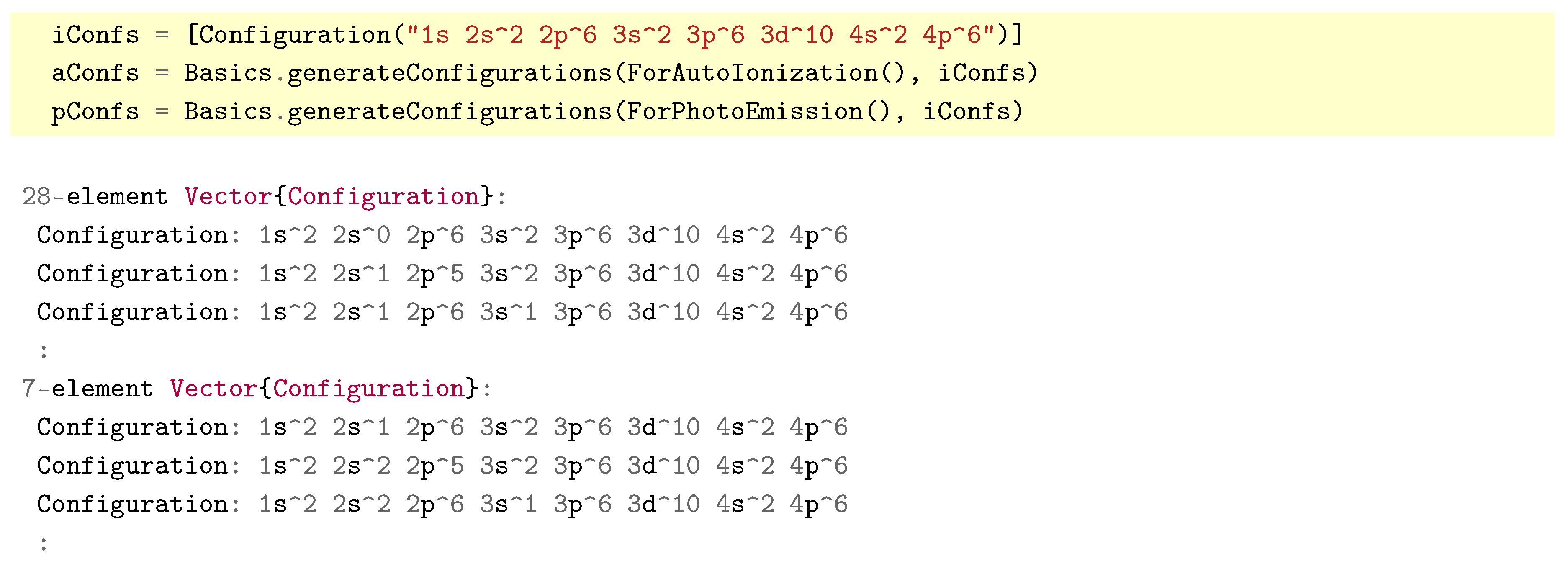
All proper displacements of electrons are taken into account in these lists and result into 28 autoionizing as well as 7 other configurations that may follow due to photoemission. Similar calls can be made for several other processes, such as the dielectronic capture or photorecombination, if shells are specified for the captured electron. With the theme ForStepwiseDecay, moreover, several of these decay steps can be combined and treated together. If we allow two subsequent steps in the autoionization of the Kr+ ions, we shall find of course a whole cascade (tree) of configurations which occur in different decay paths

Obviously, this list should include now configurations with 35, 34 and 33 electrons and with single and/or multiple holes in different shells. An analogue call for the release of up to 4 electrons in the cascade results in a list of 428 configurations, and which includes the two decay configurations shown in Figure 1.
3.4. Scrutinize and Display Electron Configurations. Extract Selected Information
Electron configurations represent the shell structure of atoms and ions and, therefore, provide a natural framework in order to report about atomic behavior in different contexts. Apart from their role in atomic-structure and collision theory, or for modeling atomic cascades, configurations form a conceptual bridge to other fields, such as astrophysics, plasma modeling or the analysis and simplification of complex physical systems. In most atomic-structure codes, configurations are encoded as lists of quantum numbers for characterizing the shells and occupation, and with the sole purpose to construct CSF for the setup and diagonalization of the Hamiltonian matrix. Modern frameworks, such as the Jac toolbox, treat configurations as explicit objects in order to control active spaces, excitations or atomic behavior in a more systematic fashion.
Once a configuration is specified, therefore, one should readily be able to extract its key properties as, for instance, the total electron number, the open subshells, possible term symbols due to the coupling of open shells, their spin multiplicity and parity, or several other information. The efficient extraction and handling of such information becomes indeed a central requirement for all applications that are based on configurations.
Among other demands, cascade processes are one of the most frequent applications, in which electron configurations serve for an efficient bookkeeping of different processes, steps and (decay) paths in the overall change of the system. Since an electron configuration defines first of all the shell occupation, they also indicate the orbitals that need to be filled or emptied, and the transitions that remain (likely) allowed. Many cascades are driven by the vacancies in inner shells, since electrons from higher shells wish to relax into these holes and do release energy by photon emission or electron ejection. A proper list of configurations therefore displays which electrons are removed or rearranged in the first, second or some later step of the cascade. In practice, these extended lists of configurations must be generated automatically and can then serve as starting point to group related configurations into so-called cascade blocks. Indeed, such blocks provide a compact representation of typical decay trees and facilitate the construction of efficient cascade models [41,59].
With this short reminder how configurations appear in applications, we can use the themes in Table 5 to extract information about (lists of) configurations. For example, we can determine the number of electrons, the closed and open shells of the configurations in the list dConfs:


From the printout of these function calls, we find configurations with 35, 34 and 33 electrons as expected after a photoemission and/or autoionization has happened twice. We also see that all shells are filled in at least one configuration, even if the shell order does not follow their natural sequence here. If averaged over all the configurations, finally, only the shell is filled, while a fractional occupation applies to all other shells. In addition to these simple requests, other themes can be utilized but may require a valid representation of an atomic level or many-electron basis in order to obtain the desired results. No needs occur to make all these features explicit, whose implementation can be easily understood from Julia’s help facilities [58].
Let us explore instead the fine-structure and multiplicity of the second (open-shell) configuration in Figure 1 as it may arise after two autoionizing steps in the decay cascade. For the multiplet of this configuration, we can analyze the fine-structure and hyperfine levels in different but obvious representations. If we run the short script
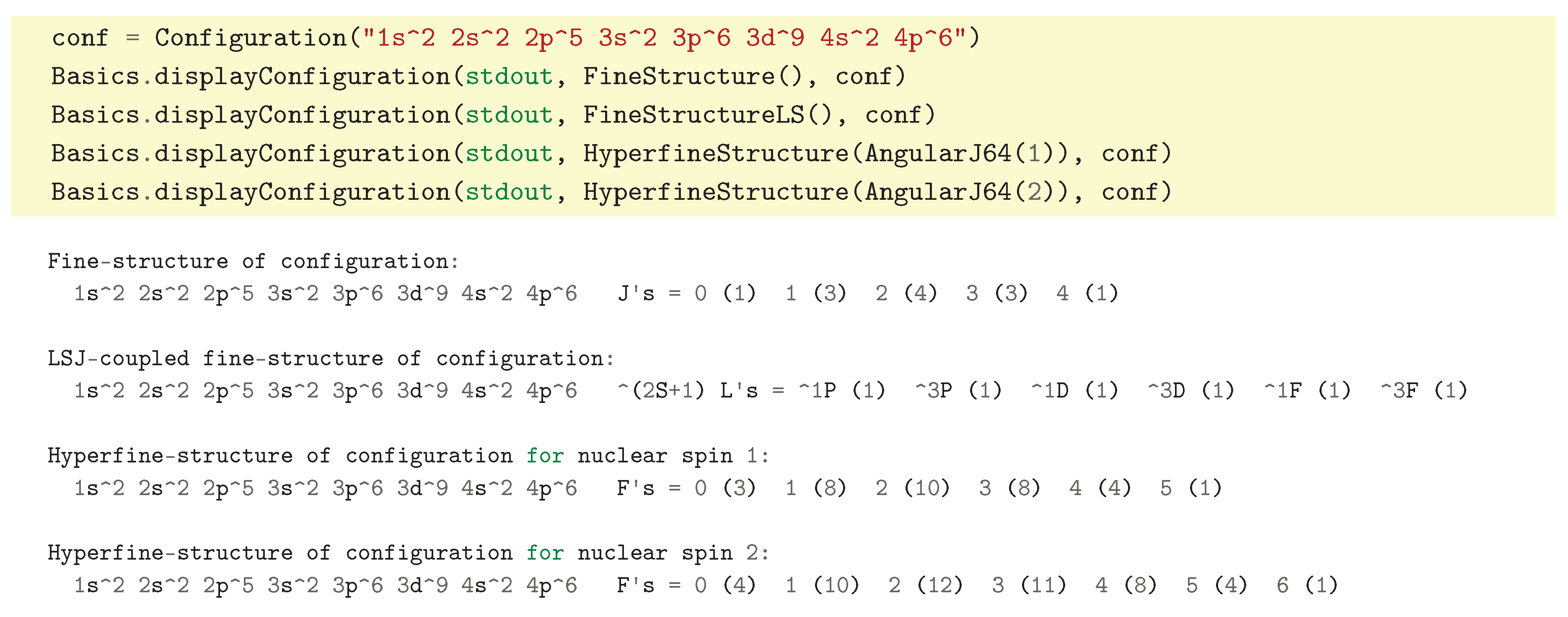
We first obtain the fine- and term-structure along with the degeneracy of each symmetry. In the last two calls, we have specified in addition also the nuclear spin to obtain the degeneracy and values of the total angular momentum F. This display of the (hyper-) fine-structure of configurations help understand the role of levels in different spectra. This quite simple example already shows how rapidly the fine-structure increases, if configurations with several open shells occur. Of course, the same or very similar calls have "generated" all numbers in Figure 1. They demonstrate the advantages of a DSL for dealing with electron configurations, as deriving these symmetries by hand is already at the limit of what appears feasible to do manually. A fast and reliable access to, and inspection of, these symmetries and quantum numbers can therefore also aid in the interpretation of a wide variety of spectra.
4. Summary and Conclusions
Electron configurations aggregate our knowledge about the (sub-) shell population structure of atoms and ions and, hence, provide first insights into their (electronic) structure and behavior. Nearly all atomic observables can be understood, at least qualitatively, by starting from this distribution of electrons among the shells. An efficient treatment of electron configurations therefore supports applications from (accurate) atomic-structure and collision calculations to spectroscopy, to the realm of inner-shell phenomena, and up to astrophysical and plasma modeling, to account just a few.
This work reviews the role of electron configurations with emphasis on atomic processes and interactions. In particular, we have identified central requirements for an efficient use of extended lists of configuration in modern computations. A DSL has been introduced to generate, manipulate and analyze such configurations, and to extract physically relevant information about them. With the implementation of this language into the Jac toolbox, we demonstrate how such a language can be integrated into a unified computational framework. This implementation also improves consistency, reproducibility as well as the scalability in modeling atomic systems and behavior.
Whereas a DSL just establishes the formal concepts and operations, which are needed to deal with such configurations, its practical implementation translates these concepts into working code with functions, data structures and interfaces. With the current implementation in Jac, we wish to supports the generation and manipulation of configuration lists even if neither more advanced correlation models nor any automatic transformation between coupling schemes has (yet) been incorporated. Nonetheless, this implementation provides a robust and transparent framework for the handling of large configuration sets. In forthcoming years, we expect to integrate further atomic processes, improve efficiency and to facilitate the coupling with ongoing astrophysical and plasma simulations.
Author Contributions
Methodology, S.F., N.M.H., A.K.S.; software, S.F., N.M.H., T.L.; writing—review and editing, S.F., H.H., A.K.S. All authors have read and agreed to the published version of the manuscript.
Acknowledgments
During the preparation of this manuscript, the authors used GPT-5 for the purposes of English improvement and consistency checks. The authors have reviewed and edited the output and take full responsibility for the content of this publication.
Conflicts of Interest
The author declares no conflict of interest.
References
- Cowan, R. D. The Theory of Atomic Structure and Spectra; University of California Press, 2023. [Google Scholar]
- Grant, I. P. Relativistic Quantum Theory of Atoms and Molecules: Theory and Computation; Springer, 2007. [Google Scholar]
- Fritzsche, S.; Palmeri, P.; Schippers, S. Atomic cascade computations. Symmetry 2021, 13, 520. [Google Scholar] [CrossRef]
- Celi, A.; Sanpera, A.; Ahufinger, V.; Lewenstein, M. Quantum optics and frontiers of physics: the third quantum revolution. Phys. Scr. 2017, 92, 013003. [Google Scholar] [CrossRef]
- Fitzgerald, J. M.; Narang, P.; Craster, R. V.; Maier, S. A.; Giannini, V. Quantum plasmonics. Proc. IEEE 2016, 104, 2307. [Google Scholar] [CrossRef]
- Saha, B.; Fritzsche, S. Influence of dense plasma on the low-lying transitions in Be-like ions: Relativistic multiconfiguration Dirac-Fock calculation. J. Phys. B 2007, 40, 259. [Google Scholar] [CrossRef]
- National Academies of Sciences, Engineering, and Medicine Manipulating Quantum Systems: An Assessment of Atomic, Molecular, and Optical Physics in the United States; National Academies Press: Washington, DC, USA, 2020.
- Guo, M.; Sørensen, L. K.; Delcey, M. G.; Pinjari, R. V.; Lundberg, M. Simulations of iron K pre-edge X-ray absorption spectra using the restricted active space method. Phys. Chem. Chem. Phys. 2016, 18, 3250. [Google Scholar] [CrossRef]
- Fischer, C. F.; Godefroid, M.; Brage, T.; Jönsson, P.; Gaigalas, G. Advanced multiconfiguration methods for complex atoms: I. Energies and wave functions. J. Phys. B 2016, 49, 182004. [Google Scholar] [CrossRef]
- Fritzsche, S. Large-scale accurate structure calculations for open-shell atoms and ions. Phys. Scr. 2002, T100, 37. [Google Scholar] [CrossRef]
- Casanova, D. Efficient implementation of restricted active space configuration interaction with the hole and particle approximation. J. Comput. Chem. 2013, 34, 720. [Google Scholar] [CrossRef]
- Kramida, A. Evaluation of uncertainties in atomic data on spectral lines and transition probabilities. Eur. Phys. J. D. 2024, 78, 36. [Google Scholar] [CrossRef]
- Andrews, J. S.; et al. Ab initio multiconfigurational calculations of experimentally significant energy levels and transition rates in Lr I (Z=103). Phys. Rev. A 2025, 112, 062802. [Google Scholar] [CrossRef]
- Yordanov, D. T.; et al. Spins, electromagnetic moments and isomers of 107--129Cd. Phys. Rev. Lett. 2013, 110, 192501. [Google Scholar] [CrossRef]
- Cheal, B.; Cocolios, T. E.; Fritzsche, S. Laser spectroscopy of radioactive isotopes: Role and limitations of accurate isotope-shift calculations. Phys. Rev. 2012, A86, 042501. [Google Scholar] [CrossRef]
- Lu, B.; Zhang, T.; Chang, H.; Li, J.; Wu, Y.; Wang, J. Reevaluation of the nuclear electric quadrupole moment for 87Sr by hyperfine structures and relativistic atomic theory. Phys. Rev. A 2019, 100, 012504. [Google Scholar] [CrossRef]
- Bieron, J.; et al. Ab initio MCDHF calculations of electron-nucleus interactions. Phys. Scr. 2015, 90, 054011. [Google Scholar] [CrossRef]
- Michel-Dansac, L.; et al. RASCAS: radiation scattering in astrophysical simulations. Astron. Astrophys. 2020, 635, A154. [Google Scholar] [CrossRef]
- Klene, M.; Robb, M. A.; Blancafort, L.; Frisch, M. J. A new efficient approach to the direct restricted active space self-consistent field method. J. Chem. Phys. 2003, 119, 713. [Google Scholar] [CrossRef]
- Schippers, S.; et al. Near K-edge photoionization and photoabsorption of singly, doubly, and triply charged silicon ions. Astrophys. J. 2022, 931, 100. [Google Scholar] [CrossRef]
- Fritzsche, S. A fresh computational approach to atomic structures, processes and cascades. Comp. Phys. Commun. 2019, 240 1. [Google Scholar] [CrossRef]
- Kelleher, D. E.; et al. The new NIST atomic spectra database. Phys. Scr. 1999, T83, 158. [Google Scholar] [CrossRef]
- Gaigalas, G.; Zalandauskas, T.; Fritzsche, S. Spectroscopic LSJ notation for atomic levels as obtained from relativistic calculations. Comput. Phys. Commun. 2004, 157, 239. [Google Scholar] [CrossRef]
- Gaigalas, G. Coupling: The program for searching optimal coupling scheme in atomic theory. Comput. Phys. Commun. 2020, 247, 106960. [Google Scholar] [CrossRef]
- Crasemann, B. Atomic inner-shell threshold excitation phenomena. J. Phys. Colloq. 1987, 48, C9. [Google Scholar] [CrossRef]
- Miron, C.; Morin, P. High-resolution inner-shell photoionization, photoelectron and coincidence spectroscopy. In Handbook of High-Resolution Spectroscopy; Wiley, 2011; Vol. 3, p. 1655. [Google Scholar]
- Hikosaka, Y.; Fritzsche, S. Amplified collective Auger decay of double inner-shell vacancy in Xe. Phys. Rev. Lett. 2025, 134, 103001. [Google Scholar] [CrossRef]
- Klapisch, M.; Bar-Shalom, A.; Oreg, J.; Colombant, D. Recent developments in atomic physics for the simulation of hot plasmas. Phys. Plasmas 2001, 8, 1817. [Google Scholar] [CrossRef]
- Hubeny, I.; Hubeny, V. Non-LTE models and theoretical spectra of accretion disks in active galactic nuclei. II. Vertical structure of the disk. Astrophys. J. 1998, 505, 558. [Google Scholar] [CrossRef] [PubMed]
- Amarsi, A. M.; et al. The 3D non-LTE solar nitrogen abundance from atomic lines. Astron. Astrophys. 2020, 636, A120. [Google Scholar] [CrossRef]
- Engelns, A.; Klar, H.; Malcherek, A. W. Two-electron atoms in double continua: Asymptotic wavefunctions. J. Phys. B 1997, 30, L811. [Google Scholar] [CrossRef]
- Linusson, P.; Fritzsche, S.; Eland, J. H. D.; Mucke, M.; Feifel, R. Single-photon multiple ionization forming double vacancies in the 2p subshell of argon. Phys. Rev. A 2013, 87, 043409. [Google Scholar] [CrossRef]
- Schippers, S.; et al. Multiple photodetachment of oxygen anions via K-shell excitation and ionization: Direct double-detachment processes and subsequent deexcitation cascades. Phys. Rev. A 2022, 106, 013114. [Google Scholar] [CrossRef]
- Crasemann, B. Atomic inner-shell physics; Springer, 2013. [Google Scholar]
- Müller, A.; et al. The role of L-shell single and double core-hole production and decay in m-fold (m=1,2,…,6) photoionization of the Ar+ ion. Phys. Rev. A 2021, 104, 033105. [Google Scholar] [CrossRef]
- Rosner, R.; Golub, L.; Vaiana, G. S. On stellar X-ray emission. Annu. Rev. Astron. Astrophys. 1985, 23, 413. [Google Scholar] [CrossRef]
- Cosslett, V. E. Radiation damage in the high resolution electron microscopy of biological materials: A review. J. Microsc. 1978, 113, 113. [Google Scholar] [CrossRef] [PubMed]
- Jiang, N. Electron beam damage in oxides: A review. Rep. Prog. Phys. 2016, 79, 016501. [Google Scholar] [CrossRef]
- Fritzsche, S.; Sahoo, A. K.; Sharma, L.; Schippers, S. Simulated photoabsorption spectra for singly and multiply charged ions. Atoms 2025, 13, 77. [Google Scholar] [CrossRef]
- Huang, H. K.; et al. Absolute rate coefficients for dielectronic recombination of sodium-like iron ions: Experiment and theory. Astrophys. J. Suppl. Ser. 2025, 278, 44. [Google Scholar] [CrossRef]
- Fritzsche, S.; Sahoo, A.K.; Sharma, L.; Wu, Z.W.; Schippers, S. Merits of atomic cascade computations. Eur. Phys. J. D. 2024, 78, 75. [Google Scholar] [CrossRef]
- Hudak, P. Domain-specific languages. In Handbook of Programming Languages; Academic Press, 1997; Vol. 3, p. 39. [Google Scholar]
- Louboutin, M.; et al. Devito (v3.1.0): An embedded domain-specific language for finite differences and geophysical exploration. Geosci. Model Dev. 2019, 12, 1165. [Google Scholar] [CrossRef]
- Shen, L.; Chen, X.; Liu, R.; Wang, H.; Ji, G. Domain-specific language techniques for visual computing: A comprehensive study. Arch. Comput. Methods Eng. 2021, 28, 3113. [Google Scholar] [CrossRef]
- Hellert, T.; Montenegro, J.; Pollastro, A. PhysBERT: A text embedding model for physics scientific literature. APL. Mach. Learn. 2024, 2. [Google Scholar] [CrossRef]
- Hell, N.; et al. Highly charged ions in a new era of high-resolution X-ray astrophysics. X-Ray Spectrom. 2020, 49, 218. [Google Scholar] [CrossRef]
- Woo, J. W.; Forrey, R. C.; Cho, K. Astrophysical extended X-ray absorption fine-structure analysis. Astrophys. J. 1997, 477, 235. [Google Scholar] [CrossRef]
- Shen, K. J.; et al. Non-local thermodynamic equilibrium radiative transfer simulations of sub-Chandrasekhar-mass white dwarf detonations. Astrophys. J. Lett. 2021, 909, L18. [Google Scholar] [CrossRef]
- Peyrusse, O. On the superconfiguration approach to model NLTE plasma emission. J. Quant. Spectrosc. Radiat. Transf. 2001, 71, 571. [Google Scholar] [CrossRef]
- Bauche, J.; Bauche-Arnoult, C.; Peyrusse, O. Plasma simulations. In Atomic Properties in Hot Plasmas: From Levels to Superconfigurations; Springer: Cham, 2015; p. 297. [Google Scholar]
- Filevich, J.; et al. Prediction and observation of tin and silver plasmas with index of refraction greater than one in the soft X-ray range. Phys. Rev. E 2006, 74, 016404. [Google Scholar] [CrossRef] [PubMed]
- Johnson, W. R.; Nilsen, J. Average-atom treatment of relaxation time in X-ray Thomson scattering from warm dense matter. Phys. Rev. E 2016, 93, 033205. [Google Scholar] [CrossRef]
- Fritzsche, S. Atomic input for modeling ionic mixtures in astrophysical plasma. Eur. Phys. J. A 2025, 61, 63. [Google Scholar] [CrossRef]
- Fritzsche, S.; Böning, B. Strong-field ionization amplitudes for atomic many-electron targets. Atoms 2022, 10, 70. [Google Scholar] [CrossRef]
- Kosar, T.; Bohra, S.; Mernik, M. Domain-specific languages: A systematic mapping study. Inf. Softw. Technol. 2016, 71, 77. [Google Scholar] [CrossRef]
- Strembeck, M.; Zdun, U. An approach for the systematic development of domain-specific languages. Softw. Pract. Exp. 2009, 39, 1253. [Google Scholar] [CrossRef]
- Fritzsche, S. JAC: User Guide, Compendium & Theoretical Background. 2026. Available online: https://github.com/OpenJAC/JAC.jl.
- Julia comes with a full-featured interactive and command-line REPL (read-eval-print loop) that is built into the executable of the language.
- Schippers, S.; et al. Multiple photodetachment of oxygen anions via K-shell excitation and ionization: Direct double-detachment processes and subsequent deexcitation cascades. Phys. Rev. A 2022, 106, 013114. [Google Scholar] [CrossRef]
Figure 1.
Selected electron configurations in the atomic decay cascade that follows the photoionization of Kr+ ions. Apart from the initial hole configuration with 35 electrons, (just) two electron configurations are shown that readily occur in the subsequent Auger cascade. These configurations illustrate the rapidly increasing complexity in the fine-structure of ions, if inner-shell excitations are involved. In addition to the occupation of the electrons shells (orange), we also display the numbers of electrons (cyan), fine-structure levels (pink), symmetry blocks with well-defined total angular momentum J and parity P (blue), terms (green) as well as the explicit terms along with their degeneracy (sand). All this information can be readily extracted from Jac by using the functions below. See text for further explanations.
Figure 1.
Selected electron configurations in the atomic decay cascade that follows the photoionization of Kr+ ions. Apart from the initial hole configuration with 35 electrons, (just) two electron configurations are shown that readily occur in the subsequent Auger cascade. These configurations illustrate the rapidly increasing complexity in the fine-structure of ions, if inner-shell excitations are involved. In addition to the occupation of the electrons shells (orange), we also display the numbers of electrons (cyan), fine-structure levels (pink), symmetry blocks with well-defined total angular momentum J and parity P (blue), terms (green) as well as the explicit terms along with their degeneracy (sand). All this information can be readily extracted from Jac by using the functions below. See text for further explanations.
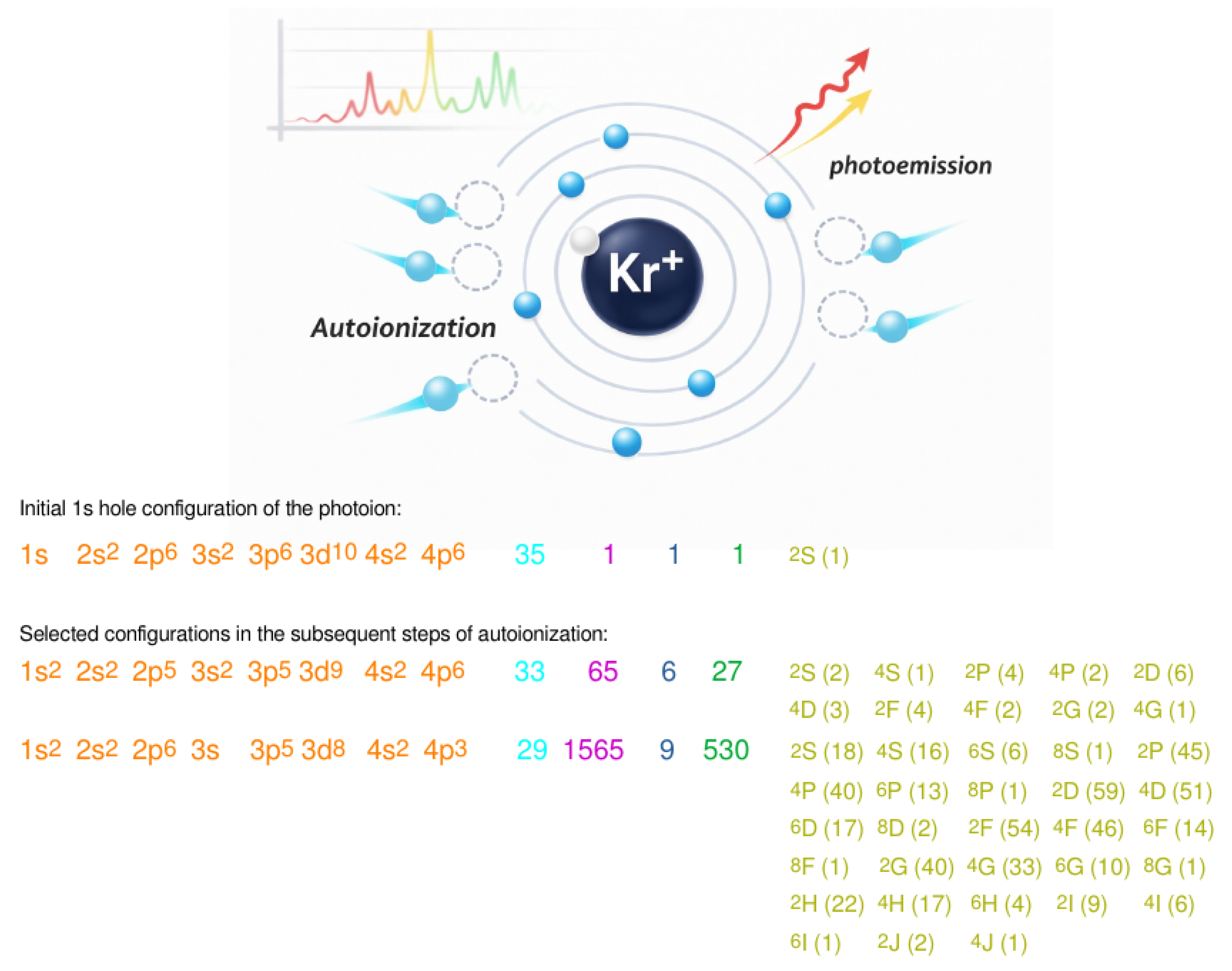
Figure 2.
Definition of the data structure Basics.Configuration to enter and deal with electron configurations within the Jac toolbox.
Figure 2.
Definition of the data structure Basics.Configuration to enter and deal with electron configurations within the Jac toolbox.
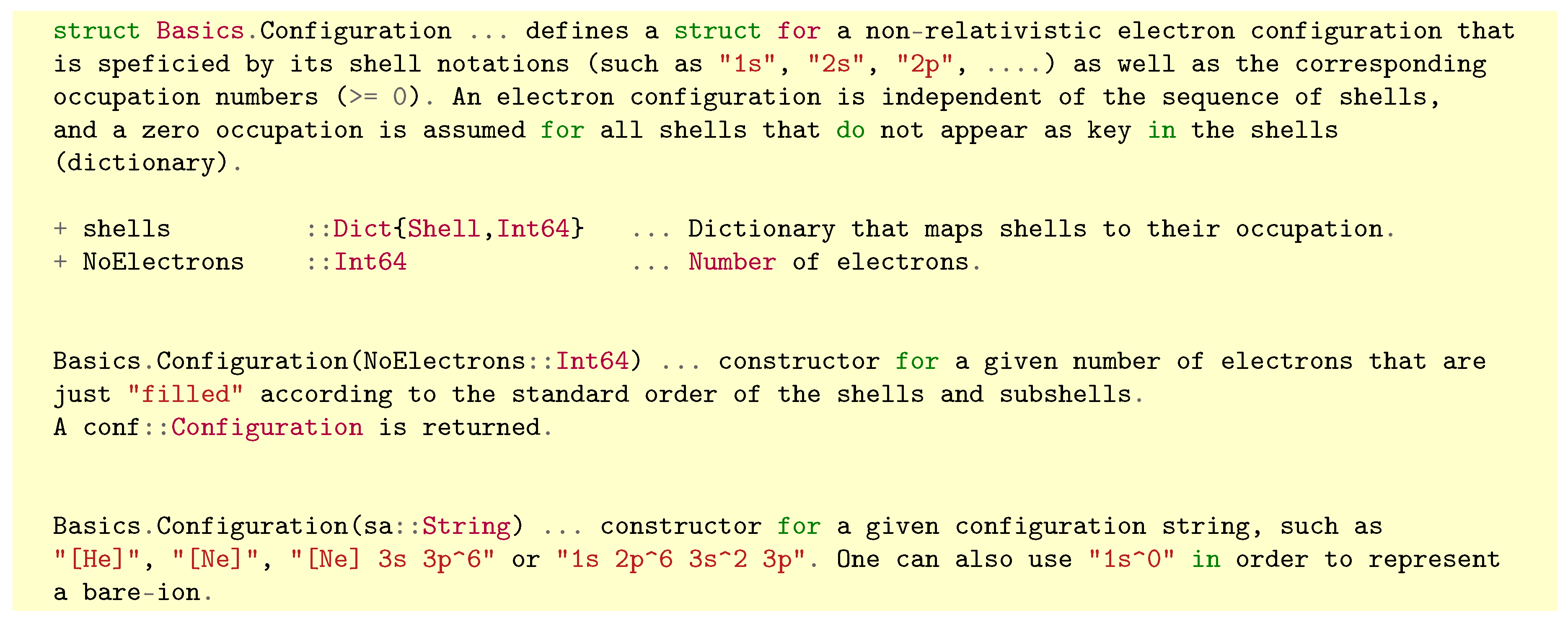

Table 1.
Research topics that depend on and heavily use electron configurations and, hence, require their efficient handling and manipulation.
Table 1.
Research topics that depend on and heavily use electron configurations and, hence, require their efficient handling and manipulation.
| topic & brief explanation. |
| Term and level structure of atoms and ions: The knowledge of the term and fine-structure of the low-lying levels has been found crucial for interpreting atomic spectra of different kind and origin, or for validating atomic data, such as compiled in the NIST database [22]. Electron configurations reveal these structures and help identify missing levels or inconsistencies in spectroscopic observations. |
| Restricted active-space (RAS) atomic computations: Lists of configurations are often generated from given reference configurations by allowing virtual excitations of electrons to predefined active shells. Layer-based RAS schemes then control these excitations by restricting the number of electrons that may occupy different orbital layers or by employing selection rules for parity and angular momentum. This procedure enables one to select compact and physically relevant configuration spaces for accurate atomic-structure calculations. |
| Transformation between coupling schemes: Transformations between coupling schemes allow the representation of atomic levels in terms of different bases, such as or -coupled CSF. All unitary transformations always act upon subspaces as defined by shell structure of the underlying configurations [23,24]. |
| Relaxation of inner-shell holes´: Ions with inner-shell holes arise when atoms absorb energetic photons or collide with fast particles [25,26]. The relaxation of these unstable hole states proceeds through characteristic x-ray emission and non-radiative Auger or Coster-Kronig decays. Identifying the dominant decay paths clarifies which configurations and charge states appear during the cascade and may help understand radiation damage. This relaxation is closely related also to the setup and analysis of cascade models, if the relaxation proceeds via several decay steps. |
| Relevance of weak, second-order processes: Selection rules help identify configurations that mediate weak or two-electron processes, such as the collective Auger decay [27]. These configurations classify the allowed intermediate paths between initial and final states and are particularly important for modeling all processes with two or more electrons in the continuum. |
| Ions in plasma: In most plasma simulations, the electronic structure is simplified by grouping excited states into superlevels, or if just a few bound levels are considered explicitly [28]. This simplification is useful and necessary because most plasma properties depend primarily on averaged populations and rate coefficients, rather than on individual fine-structure levels. |
| Modeling of astrophysical observations: In non-LTE simulations, the reduced level structures can often be entirely based on electron configurations, they still preserve the overall opacity and emissivity, while reducing the number of transitions [29,30]. Electron configurations remain essential for identifying the allowed transitions. |
| Generation and maintenance of atomic databases: Electron configurations serve typically as the key organizing principle for generating and structuring atomic databases. They allow the systematic labeling of levels, terms and transitions, and thus help extract and compare the data in different applications. |
Table 2.
Important features for handling individual and multiple electron configurations. Each feature has a specific scope and requires basic familiarity with the notion of configurations but enhances clarity and readability in applications. Table 3, Table 4 and Table 5 below illustrate how these features are implemented within the Jac framework.
Table 2.
Important features for handling individual and multiple electron configurations. Each feature has a specific scope and requires basic familiarity with the notion of configurations but enhances clarity and readability in applications. Table 3, Table 4 and Table 5 below illustrate how these features are implemented within the Jac framework.
| feature & brief explanation. |
| Extract information from a configuration: Often, a direct and simple access is needed to all properties that are encoded in a configuration, including the shell occupation and subshell structure. Other information comprises parity, spin multiplicity and possible (total) angular momenta of the levels. A fast access enables a rapid classification of atomic states and transitions. |
| Derive details about configurations: Atomic levels need to be analyzed with respect to their leading configuration or (sub-) dominant configuration components. Such information help clarify configuration mixing and to interpret spectroscopic data. |
| Generation of configuration list: The systematic creation of excited, ionized or recombined configurations, relative to some chosen reference configuration is crucial for most applications. These lists define the accessible configuration space for atomic-structure or cascade calculations. |
| Condense configuration lists under given criteria: Configurations from large configuration sets need to be divided according to well-defined criteria. Typical reductions must enable the user to distinguish between relativistic and non-relativistic configurations, or to select subsets relevant for specific processes. This feature help keep calculations feasible also for complex atoms and ions. |
| Display (lists of) configurations: A clear and visual presentation of single configurations or extended configuration lists is mandatory. A simple display allows the inspection, comparison and validation of configurations in the input for atomic-structure or plasma applications. It also supports the analysis, how individual configurations affect the behavior of atoms and ions. |
Table 3.
Functions of the Jac toolbox that support the generation, manipulation and display of individual or lists of configurations. All these functions are based on predefined themes and are implemented in the modules Basics. Here, we just provide a brief explanation of these functions, whereas further details are given in the documentation of Jac [57] or from Julia’s help facilities [58]. See Table 4 and Table 5 for supported themes in the given implementation.
Table 3.
Functions of the Jac toolbox that support the generation, manipulation and display of individual or lists of configurations. All these functions are based on predefined themes and are implemented in the modules Basics. Here, we just provide a brief explanation of these functions, whereas further details are given in the documentation of Jac [57] or from Julia’s help facilities [58]. See Table 4 and Table 5 for supported themes in the given implementation.
| function & brief explanation. |
| displayConfiguration: to display a given list of configurations in a compact format; additional details about these configurations can be extracted and printed as well. The optional argument longForm::Bool decides whether all shells are displayed explicitly, or only the valence-shells are shown as typical for medium and heavy elements. |
| displayConfiguration: to display the same but for a list of configurations. An optional argument details::String enables the user to provide further information to the printout. |
| extractConfiguration: to extract a single — relativistic or non-relativistic — configuration due to some given theme; cf. Table 4. |
| extractConfigurations: to extract one or several configurations from a basis, level or given multiplet due to some suitable theme. |
| extractFromConfiguration: to extract detailed information from or about a given configuration due to some suitable theme. |
| extractFromConfigurations: to extract the same but from a list of configuration due to some suitable theme. |
| generateConfigurations: to generate a list of electron configurations for a given set of (reference) configurations as well as for some suitable theme. |
Table 4.
Themes to extract individual configurations or information about such configurations from basis functions, the representation of levels and multiplets, or from lists of configurations. Each theme is a (concrete) subtype of the abstract data type Basics.AbstractConfigurationTheme and may come with own subfield data. All these themes are defined in the module Basics. Apart from a brief explanation in this table, further details can be found in the documentation of Jac [57] or from Julia’s help facilities [58].
Table 4.
Themes to extract individual configurations or information about such configurations from basis functions, the representation of levels and multiplets, or from lists of configurations. Each theme is a (concrete) subtype of the abstract data type Basics.AbstractConfigurationTheme and may come with own subfield data. All these themes are defined in the module Basics. Apart from a brief explanation in this table, further details can be found in the documentation of Jac [57] or from Julia’s help facilities [58].
| theme & brief explanation. |
| ByMultipoles(): ... to extract configurations that are connected to some reference configuration in terms of the well-known multipole selection rules. |
| ByParity(P::Parity): ... to extract all configurations of given parity P. |
| ClosedCore(): ... to extract the closed core from one or several configurations. |
| ClosedShells(): ... to extract the shells that are filled in one or several configurations. |
| ClosedSubshells(): ... to extract the same but applied to explicit subshells. |
| FromBasis(): ... to extract all configuration that contribute to a given many-electron basis::Basis. |
| FromNonrelativisticBasis(): ... to extract all configurations from a non-relativistic basis::BasisNR. |
| GeneralizedConfigurations(): ... to extract the generalized configuration of a given set of configurations as often applied in plasma physics. |
| GetParity(): ... to determine the parity of either a relativistic or non-relativistic configuration. |
| IsOccupied(): ... to determine whether a shell or subshell is occupied in one or several configuration(s). |
| LeadingConfiguration(): ... to extract the leading configuration in the representation of a given level::Level. |
| LeadingConfigurationR(): ... to extract the same but in terms of leading relativistic configuration. |
| Multiplicity(): ... to determine the multiplicity of a configuration. |
| NumberOfElectrons(): ... to determine the numbers of electrons of one or several configurations. |
| OccupationDifference(): ... to extract the differences in the occupation numbers between two given — either relativistic or non-relativistic — configurations. |
| OpenShells(): ... to return all open shells of one or several configurations. |
| OpenSubshells(): ... to extract the same but for open subshells. |
| TotalAM(): ... to determine the total angular momenta J that are associated with the fine-structure of the given configuration. |
| ValenceOccupation(): ... to extract the occupation of all valence shells in a given configurations with regard to some core configuration. |
Table 5.
Themes which are frequently used for the generation of configuration lists by starting from one or several reference configurations. Apart from the addition, excitation or removal of electrons, these themes refer to selected processes and, hence, to the set-up of cascade models of different depth and complexity. All other details are analogue to Table 4.
Table 5.
Themes which are frequently used for the generation of configuration lists by starting from one or several reference configurations. Apart from the addition, excitation or removal of electrons, these themes refer to selected processes and, hence, to the set-up of cascade models of different depth and complexity. All other details are analogue to Table 4.
| theme & brief explanation. |
| AddElectrons(): ... to add one or several electrons in specified shells to the given (reference) configurations. |
| ExciteElectrons(): ... to excite one or several electrons w.r.t. the given (reference) configurations. |
| RemoveElectrons(): ... to remove one or several electrons in specified shells from the given (reference) configurations. |
| ForAutoIonization(): ... to generate all those configurations that are related to given (reference) configurations by autoionization, i.e. by a single de-excitation and the removal of an electron. However, no tests are made that such an autoionization is energetically indeed possible. |
| ForDielectronicCapture(): ... to do the same but for the dielectronic capture into the given (reference) configuration; this includes the excitation of one electron and capture of another electron into one of the specified shells. |
| ForElectronCapture(): ... to do the same but for the capture of an electron into specified shells and with regard to one or several (reference) configurations. |
| ForHollowIons(): ... to do the same but for the multiple capture into (high-n) shells and with regard to one or several (reference) configuration. |
| ForPhotoEmission(): ... to do the same but for photoemission and related to one or several (reference) configurations. |
| ForPhotoIonization(): ... to do the same but for photoionization, i.e. the removal of an electron, and related to one or several (reference) configurations. |
| ForPhotoRecombination(): ... to do the same but for the capture of an electron, e.g. the (radiative) recombination of one electron into specified shells, and related to one or several (reference) configurations. |
| ForStepwiseDecay(): ... to do the same but for the release of electrons due to the stepwise photoemission and autoionization, and related to one or several (reference) configurations. |
Table 6.
Themes which are used in the classification and display of electron configurations. All other details are analogue to Table 4.
Table 6.
Themes which are used in the classification and display of electron configurations. All other details are analogue to Table 4.
| theme & brief explanation. |
| FineStructure(): ... to display the fine-structure levels of a configuration in terms of the total J and their degeneracy but without the computation of energies. |
| FineStructureLS(): ... to display the total terms and their degeneracy but (again) without the computation of energies. |
| GroundConfiguration(): ... to generate the ground configuration of an ion with nuclear charge Z and for just a given number of electrons. |
| HyperfineStructure(): ... to display the hyperfine levels of the configuration for a given nuclear spin I in terms of the total F and their degeneracy but without the computation of energies. |
| MeanConfiguration(): ... to generate the mean configuration for a given set of configurations, i.e. a configuration with mean occupation numbers. |
| RelativisticConfigurations(): ... to refer to the use and analysis of relativistic configurations. |
| SuperConfiguration(): ... to generate all configurations that are described by some given super-configuration (not yet well supported). |
Disclaimer/Publisher’s Note: The statements, opinions and data contained in all publications are solely those of the individual author(s) and contributor(s) and not of MDPI and/or the editor(s). MDPI and/or the editor(s) disclaim responsibility for any injury to people or property resulting from any ideas, methods, instructions or products referred to in the content. |
© 2026 by the authors. Licensee MDPI, Basel, Switzerland. This article is an open access article distributed under the terms and conditions of the Creative Commons Attribution (CC BY) license (http://creativecommons.org/licenses/by/4.0/).
Copyright: This open access article is published under a Creative Commons CC BY 4.0 license, which permit the free download, distribution, and reuse, provided that the author and preprint are cited in any reuse.