

Submitted:
28 April 2026
Posted:
29 April 2026
You are already at the latest version
Abstract
Background/Objectives: This study aimed to quantify the kinetic demands of multiple hops in series, movement tasks that are commonly used in strength and conditioning and physiotherapeutic practice. Focus was placed on comparing the demands of a quintuple-hop task to a triple-hop task, with particular focus on quantifying the eccentric braking stretch-load demands. Methods: Forty-four male university athletes (age 20.1 ± 1.4 years; body mass 71.2 ± 8.6 kg; stature 171.9 ± 5.1 cm) completed the hopping tasks across track-embedded force platforms, where braking and propulsion kinetics were measured across 54x track-embedded force platforms. Results: Significant (p < 0.001) averaged in-creases in maximal vertical (~32%) and horizontal braking impulses (~56%) for both TH and QH tasks were noted across hops. The last two hops of the QH task were found to have greater averaged vertical (~58%) and horizontal (~180%) stretch-load demands than the two initial hops (p < 0.001). Conclusions: This is the first study in which an extensive summary of kinetic measures for both triple and quintuple hops has been reported. The findings highlight the biomechanical, stretch-load aspects of these exercises, which can help practitioners better prescribe and program hops for injury prevention, rehabilitation, and performance enhancement.
Keywords:
stretch-shorten cycle
; triple hop
; quintuple hop
; eccentric braking
; injury risk
1. Introduction
The ability to express cyclical and rapid stretch-shortening (eccentric-concentric) muscular actions like jumping, landing, and change-of-direction is beneficial for athletic performance [1]. Jumps and hops are commonplace in athletic training and during physical assessment, not only because of their reliability [2,3,4,5] but also due to their strong relationship with these high-demand athletic qualities, likely because they mimic the speed of contraction, neuromuscular firing patterns, and kinetic energy transfer [6,7,8,9,10,11,12]. ‘Stretch-load’ refers to the physical demand associated with these actions, and practitioners should pay considerable attention to prepare athletes to manage the large forces associated with such loading successfully and without fear or increased risk of injury [13,14].
Multiple hops in series appear to have a stronger relationship with acceleration and time to maximum speed in sprinting performance than vertically orientated jumping assessments, likely due to similarities in force vector orientation [12]. Consequently, triple hop (TH) and quintuple hop (QH) tests have attracted interest for their associations with sprint performance [6,15,16,17], with researchers typically reporting moderate-to-large negative correlations (r = -0.89 to -0.24). However, despite evidence supporting the relevance of the TH, very few researchers have examined the performance utility of the QH. For example, Nesser et al. reported very large correlations (r = -0.81) of 5-step jump test with 40 m sprint time [6]. yet the biomechanical demands underpinning such relationships remain poorly understood. More specifically, there is a lack of comparative data describing the kinematic and kinetic demands of multiple hop tasks, and no study to date has quantified differences in physical demand between the TH and QH across successive hops.
A substantial proportion of the literature on horizontally displaced hopping has focused on rehabilitation contexts [18,19], particularly following anterior cruciate ligament (ACL) knee injuries [20,21,22]. Hop tests are frequently incorporated into return-to-sport (RTS) assessment batteries to evaluate limb asymmetry [23], functional capacity, and reinjury risk. However, the relationship between hopping and athletic performance in healthy athletes has received surprisingly little attention [24]. While limb asymmetry is an intuitive concern, researchers have recently suggested that limb symmetry assessments should be used cautiously, as they do not always give a complete picture of preparedness and may underestimate deficits [25]. Measures such as total hop distance may offer insight into lower-limb performance [26], however, their determining components (ground contact and flight phase kinematics and kinetics) could provide greater understanding of reactive strength capability [21] and preparedness for high stretch-load activity in the lower limb [20]. Additionally, understanding the stretch-load demands of such hops performed over short time-frames, is essential in the management and programming of athletes [27].
Despite their widespread use, the intensity and progression of stretch-load demands across multiple hops in series remain largely unquantified. Understanding how ground reaction forces and impulses evolve over successive hops is critical for informed exercise prescription, particularly when managing high mechanical loads over short time frames, conditions synonymous with both athletic performance and rehabilitation programming. Given the evident application of both TH and QH tests across performance and clinical settings, a clearer understanding of their biomechanical demands is required to guide safe progression and appropriate task selection. Therefore, the aim of this study was to quantify and compare the stretch-load demands of triple and quintuple horizontal hop tasks, with a specific focus on the progression of eccentric braking and propulsive kinetics across successive hops. By addressing this gap, the findings should provide practitioners with a biomechanical rationale for prescribing and progressing multiple hop tasks in both performance and rehabilitation contexts.
2. Materials and Methods
2.1. Experimental Approach to the Problem
A cross-sectional design, which included a repeated measures within-subject approach, was used to determine the differences in the braking and propulsive kinetics of multiple hops in series (TH and QH). Subjects attended the laboratory on two occasions: the first occasion to familiarize themselves with the testing procedures and capture participants’ information (age, height, body mass, sport participation, limb dominance), and the second occasion to capture ground reaction forces (GRF) during TH and QH tests. The maximum vertical force, vertical impulse, vertical braking impulse, vertical propulsive impulse, net anterior-posterior impulse, horizontal impulse, horizontal braking impulse, and horizontal propulsive impulse were quantified and statistically analyzed.
2.2. Participants
Forty-four male athletes (age 20.1 ± 1.4 years; body mass 71.2 ± 8.6 kg; stature 171.9 ± 5.1 cm) from across various university sports (kendo, baseball, rowing, track athletics, field athletics, windsurfing, cycling, soccer, basketball) volunteered to participate. All participants were required to be healthy and injury-free at the time of testing. Potential participants were excluded if they had significant historic injuries (e.g., previous ruptures or tears to major tendons or ligaments [Achilles, ACL]), regardless of the post-injury training time. The study procedures followed the Declaration of Helsinki, and ethical approval was granted by the Auckland University of Technology Review Board (reference: 17/133) and the National Institute of Fitness and Sports in Kanoya Review Board (reference: 8-123). Informed consent was obtained before inclusion in the study. Body mass was measured to the nearest 0.1 kg, and stature was measured according to the methodology set out by the International Society for the Advancement of Kinanthropometry [123] on a digital scale and stadiometer (Tanita DC-217A, Tokyo, Japan).
2.2. Testing Procedures
Each participant attended a familiarization session a minimum of three days before the first testing session. The session included a standardised warm-up protocol repeated before the testing session. The warm-up included dynamic limb flexibility exercises (upper and lower), general movement to raise body temperature, explosive bounding movements to mimic test demands, and progressive intensity sprinting over 30 m. The testing process started five minutes after the warm-up was completed.
The TH test protocol involved three hops on the same leg, while the QH test involved five hops on the same leg (Figure 1). Because of the very high stretch-load demands placed on the body by this test, three trials for TH and two trials for QH were completed in a randomised order for dominant and non-dominant limbs, minimising the risk of injury, reducing acute overloading, and reducing fatigue effects. There was a two-minute rest period between the efforts before hopping on the other leg.
Each hop began with the subject balancing on their hopping leg before propelling themselves forward for the number of contacts specified in the test. For all tests, the subjects landed on two feet after the final hop; contact with the ground with their hands after landing was permitted if the hopping foot did not move further forward during landing. This was performed to encourage each subject to achieve maximal horizontal displacement. Upper-limb motion was permitted during the hops, replicating the motor patterns associated with athletic movements. Each subject was instructed to “reach the furthest horizontal distance in the shortest possible time”. The hop trials were conducted on an indoor synthetic track surface (Hasegawa Sports Facilities, Tokyo, Japan) that covered 54x inground force platforms in series (TF-90100, Tec Gihan, Kyoto, Japan) and were linked to a single computer that collected GRFs at a sampling rate of 1000 Hz. Force plate data were captured for each trial, exported, tagged, and stored for later analysis. The GRF signals collected during the hop trials were filtered using a 4th-order Butterworth low-pass digital filter with a 50 Hz cutoff frequency, and horizontal and vertical hop propulsive and braking kinetics were determined, with associated impulses calculated via the integration of force for each of the required periods. All variables were computed using a custom algorithm (MATLAB R2021a, Mathworks Inc., Natick, MA, USA). Figure 1 depicts the force and distance signals obtained during a QH trial.
2.3. Validation of Stretch-Load
When defining the ‘stretch-load’ experienced by each participant (absolute measures), vertical braking impulse was thought to be the variable of most interest and the period of stretch-load classified as the moment of initial heel strike to the point of center of pressure crosses the zero axis at the anterior-posterior transition, assuming that the subject’s centre of mass (CoM) was directly above the foot at this point, as previously described [114,118]. This classification was internally validated with high consistency using a MAC3-D motion capture system (Motion Analysis Corp., Santa Rosa, CA, USA; 250 Hz) to determine agreement between the instance of the participant’s center of gravity and maximal knee flexion, with the instance of a switch from horizontal braking to horizontal propulsive force and the second peak of the vertical GRF. Both vertical and horizontal braking impulses were determined as the time integration of the GRF during the same period, from the moment of the initial heel strike until the moment the force time curve crossed the zero axis in the anterior-posterior waveform (see Figure 1) and therefore are indicative of the stretch-load associated with each hop.
2.3. Statistical Analysis
Statistical analyses were conducted using an online spreadsheet (Microsoft Excel version 16.82) and Jeffrey’s Amazing Statistics Program (JASP) software (version 0.18.3; Amsterdam, Netherlands). Using descriptive statistics (means and standard deviations), centrality and spread were calculated and are presented in the tables. Assumptions of univariate normality, outliers, and sphericity were assessed. Outlier analysis was conducted using boxplots, and values larger than three standard deviations were manually omitted from further analysis. The Shapiro-Wilk test [145] was used for testing normality, and Q-Q plots were used to assess kurtosis and skewness visually.
The kinetic variables of Steps 1 and 2 in TH were compared using a pairwise sampled t-test. Statistical significance was set at a p < 0.05. ES were reported using Cohen’s d and categorized as very small (< 0.2), small (0.21-0.5), moderate (0.51-0.79), and large (> 0.8) [36]. A repeated measures analysis of variance (ANOVA) with one within-subject factor was conducted to determine whether there were significant differences between Steps 1 to 4 in QH. Mauchly’s test was used to assess the assumption of sphericity [102]; if the assumption of sphericity was violated, then Greenhouse-Geisser corrections were applied [66]. Bonferroni post hoc comparisons were used to test the differences in the estimated marginal means for each combination of within-subject effects. ES were reported using partial eta squared (η2p) and categorized as small (0.01), medium (0.06), and large (0.14). The percentage change in the mean was calculated using the following equation:
3. Results
A summary of the absolute kinetic data for all variables measured for TH and QH is provided in Table 1. The step-to-step variations in QH and their statistical significance are listed in Table 2. A graphical representation of the raw kinetic measures and their trends, with raincloud plots showing the probability of spread and density of distribution, and box plots showing the central tendency, medians, and quartile ranges, are shown in Figure 2 and Figure 3.
There was a large increase of 27.5% (p < 0.001; ES = 2.03) in the maximum vertical force between Steps 1 and 2 of the TH. The maximum vertical force during the QH increased across steps with each ground contact (p < 0.001; η2p = 0.78). The largest percentage changes were observed between Steps 1 and 2 (22.8%), and similar increases (12.0 - 12.8%) were observed between Steps 2 and 3, and Steps 3 and 4. The distribution of measures of the maximum vertical force increased across each step, with the most extensive spread observed in Step 4 (Figure 2a).
A small increase in the net vertical impulse of 3.5% (p < 0.001; ES = 0.80) was observed between Steps 1 and 2 of the TH. Small increases (7.20%) were observed across Steps 1-4 for net vertical impulse of the QH (p < 0.001; η2p = 0.50). Step-to-step increases ranged from 0.53 to 4.55%, with no change observed between Step 1 and Step 2 (p = 1.000), and small but significant change in Steps 2-3 and Steps 3-4. There was little change in the mean, median, and data spread across the steps, as shown in Figure 2b.
Significant increases of 98.7% (ES = 1.62) in the vertical braking impulse were observed between Steps 1 and 2 of the TH. Vertical braking impulse increased during QH and differed significantly across steps, the step-to-step changes ranging from 28.1 to 96.8%, with the largest percentage changes seen in the early steps (p < 0.001; 2p = 0.86). A percentage change of 241% was observed between Steps 1 and 4, reflecting the amplified demand of increasing the number of hops in series. The spread in the braking impulse data was similar across the steps, with the largest spread observed in Step 4 (Figure 2c).
The vertical propulsive impulse decreased 23.9% (p < 0.001; ES = -1.56) between Steps 1 and 2 of the TH. The vertical propulsive impulse also decreased (15.6 to 21.0%) during the QH (p < 0.001; 2p = 0.87). The spread in the propulsive impulse data was consistent across Steps 1-4 (Figure 2d).
A significant decrease of 57.0% (p < 0.001; ES = 1.85) in the net anterior-posterior impulse was seen between Steps 1 and 2 of the TH. Net anterior-posterior impulse also decreased during QH and differed across steps (p < 0.001; 2p = 0.88), with the largest change observed in the final step ( = 128.5%). The net anterior-posterior impulse data distribution was similar across steps, with the largest spread observed in Step 4 (Figure 3a).
Significant increases of 291.8% (ES = -2.22) in the horizontal braking impulse were observed between Steps 1 and 2 of the TH. The horizontal braking impulse also increased (~1160%) during the QH across steps (p < 0.001; 2p = 0.87), with significant differences seen and percentage changes between steps (231.2%, 12.0%, 67.0%). The spread in the horizontal braking impulse data gradually dispersed across the steps, with the largest spread observed in Step 4 (Figure 3b).
A decrease in horizontal propulsive impulse of 40.0% (p < 0.001; ES = -1.60) was observed between Step 1 and 2 of TH. The horizontal propulsive impulse also decreased (57.0%) during QH between steps (p < 0.001; 2p = 0.84), with the spread of horizontal propulsive impulse measures greater in Steps 1 and 4 (Figure 3c).
4. Discussion
Whilst the kinematic measures of multiple hops in series have previously been reported [4,5,21,28], and kinetic measures specific to joint work have been quantified [29,30,31,32], to the best of our knowledge, this is the first study in which an extensive summary of kinetic measures for both TH and QH have been reported. Researchers quantifying exercise intensity through mechanical stress have largely focused on vertically oriented jumping tasks, as well as single-leg standalone jumping movements, using both peak GRF [33,34,35,36] and impulse [33,34,36]. Impulse is an important variable to understand, as effective impulse determines the velocity of the CoM and therefore hop distance [37,38] i.e., impulse-momentum relationship, and has been shown to be a reliable measure when determining plyometric intensity [34]. As the net vertical and net horizontal (anterior-posterior) impulse measures provide the summed impulses from the braking and propulsive phases, these variables will provide much of the focus of this discussion and will be used to provide insight into changes in the stretch-load between hops.
With this context in mind, the aim of this study was to quantify the kinetics of both triple (TH) and quintuple (QH) horizontal hops, with an emphasis on understanding the increasing stretch-load demands of the QH. The maximum vertical force across the triple and quintuple jumps increased from ~2300 N (32 N/kg) to 3600 N (51 N/kg), translating to an average increase of ~14% across successive hops. The vertical braking impulses increased (~75 – 249 Ns), whereas the vertical propulsive impulses decreased (~308 – 17[29–322 Ns) across hops. The net effect of these differences was little change (~6%) in net vertical impulse between hops across both jumps, with values ranging from ~386-412 Ns. With successive hops, there appears to be an average increase of ~32% in hop vertical braking impulses, indicating a substantial and progressive overload to the tissues responsible for vertical eccentric braking of the downward momentum of the body, namely the plantar-flexor and vasti groups of the lower limb. The average reduction (~19%) in vertical propulsive impulses across hops and jumps might suggest reduced concentric force production in multiple hops or, most likely, less time to produce that force given the increasing velocity of the CoM.
The horizontal braking impulses increased (~-2 to -30 Ns), whereas horizontal propulsive impulses decreased (~58 – 25 Ns) across hops. The net effect of these differences was a substantial change (~90%) in the net anterior-posterior impulse between hops across both jumps, with values ranging from ~55 to -5 Ns. With successive hops, there appears to be a ~56% average increase in hop horizontal braking impulses, most likely attributed to the greater horizontal and downwards velocities with ensuing hops, but also indicating that the foot during landing is touching down further in front of the line of CoM, most likely due to the system’s need to produce greater forces to prevent collapse to the ground.
Of interest was the comparison of demands between the TH with the QH and how stretch-load increased with ensuing hops. This increase in stretch-load can be, at least in part, explained by increases in the maximal vertical force and vertical and horizontal braking impulses. As can be observed in Table 1 and Figure 1 of the QH sequence, the maximum vertical force, which occurs in the initial ‘shock’ eccentric/stretch phase, steadily increased with successive hops, with the increases between hops on average ~14%. Furthermore, it can be concluded that the final two hops of the QH offer a significantly higher stretch-load than the initial steps in a QH or that of a TH. The addition of further hops in series also resulted in less propulsive demand and greater braking demand, ~58% greater averaged vertical force and ~180% horizontal forces than the initial two hops. The percentage contribution and changes across hops of these vertical and horizontal forces as a percentage of net vertical and anterior-posterior forces can be seen in Figure 4. The subject’s ability to maintain or improve performance with increasing hop numbers and an increase in associated vertical forces may be determined by their ability to handle higher system stretch load demands. These increases in the vertical and horizontal braking impulses are a function of higher forces over shorter ground contact periods. One possible outcome is a change in horizontal braking impulse because of a modified movement strategy in which the subject’s heel strikes in front of its CoM, to slow down the system. The resultant ‘backwards’ position of the shank and the longer period of ground contact rely on greater muscular force demand of the vasti group to arrest impact, and the hip extensors to subsequently ‘pull’ the CoM of the subject forwards. Conversely, it is conceivable that coaching the athlete to position the foot under the CoM could reduce the horizontal braking impulse and lend itself to a more positive anterior-posterior impulse and greater hop performance, although with increased reliance on a reactive Achilles-calf complex and hip extension torque.
Horizontal braking impulse was highly variable, particularly in Step 4 of QH (see Figure 2), and was most likely attributable to a limited and diminishing stretch-load capacity that was unable to meet the increasing vertical demands of the system. Another possible explanation for this movement variability is the possible strategy adopted in preparation for the ultimate final leap, as was evidenced in both the TH and QH. The position of the heel strike was likley adjusted in front of the CoM, and the braking focus was increased to assimilate the greatest propulsive impulse and maximize the distance jumped. This could be determined in future studies using additional kinematic analyses such as 3D motion capture.
The magnitude of the increasing stretch-load demand is important to understand if these jumps are used for assessment and training purposes. For example, competency with TH assessments or training would be a sensible progression prior to using a high-stretch-load movement, such as the QH for assessment or training purposes, as evidenced in the increase in vertical demand expressed in body weights seen in Figure 5. In recognition of the increase in force demand with each additional hop, a clinician should acknowledge whether the recovering ‘return to play’ (RTP) athlete has the capacity to manage this level of supra-maximal load and whether they are at risk of injury when progressing from TH to QH training or assessments.
5. Conclusions
Given the scarcity of literature on the kinetic demands of triple and quintuple hops, as well as their obvious application in athlete rehabilitation and physical preparation, the findings of this study are novel and provide practitioners with valuable insights into the increasing stretch-load demands of multiple hops in series. When selecting a suitable multiple-hop test for rehabilitation or performance, there are nuances that may distinguish their applications. The significant increases in maximum vertical force and braking impulses across hops clearly differentiate their stretch-load demand; therefore, careful implementation in programming for gradual load tolerance in a rehabbing athlete is critical in order to not overload the lower limb and trunk joints and tissues excessively and injuriously.
When utilizing hops for performance enhancement, it seems intuitive that increasing the athlete’s capacity to resist and reorganize vertical eccentric forces quickly should result in a higher percentage of the period of ground contact used to produce propulsive forces. This likely greater propulsive impulse could potentiate further hop distances (impulse-momentum relationship).
The high variability in the horizontal braking impulse observed in this study also suggests differences in movement strategies among the cohort tested. While it is recognized that individual movement strategy and physical characteristics both play a role in optimizing performance that may not be easily de-coupled, an effective coaching strategy to encourage the athlete to both position the foot under the CoM could reduce horizontal braking impulse, resulting in a more positive anterior-posterior impulse and improved hop performance. However, this could only be achieved if the athlete had the physical capacity to handle an increase in stretch-load demand owing to increasingly larger vertical forces over shorter periods. A combined kinetic (strengthening) and kinematic (technique cueing) approach would most likely be the best approach to optimize multiple-hop performance.
Author Contributions
The individuals who contributed to this paper are listed as follows: Conceptualization, A.S. and J.C.; Methodology, A.S., J.C. and J.N.; software, J.N. and R.N.; formal analysis, A.S. and J.C.; investigation, A.S., J.N. and R.N.; resources, R.N. and T.W.; data curation, J.N. and R.N.; writing—original draft preparation, A.S. and J.C.; writing—review and editing, A.S. and J.C.; visualization, A.S. and J.N.; supervision, J.C.; project administration, T.W. All authors have read and agreed to the published version of the manuscript.
Funding
This research received no external funding.
Institutional Review Board Statement
The study was conducted according to the guidelines of the Declaration of Helsinki and approved by the Auckland University of Technology Ethics Committee (17/133 approved 1 November 2018) and by the National Institute of Fitness and Sports in Kanoya (8-123 approved 30 January 2018).
Informed Consent Statement
Informed consent was obtained from all subjects involved in the study.
Data Availability Statement
The raw data supporting the conclusions of this article will be made available by the authors on request.
Acknowledgments
The authors thank all subjects for their participation in this study.
Conflicts of Interest
The authors declare no conflicts of interest.
References
- Baker, D.G.; Newton, R.U. Comparison of lower body strength, power, acceleration, speed, agility, and sprint momentum to describe and compare playing rank among professional rugby league players. J. Strength Cond. Res. 2008, 22, 153–158. [Google Scholar] [CrossRef]
- Stolberg, M.; Sharp, A.P.; Comtois, A.S.; Lloyd, R.S.; Oliver, J.L.; Cronin, J. Triple and quintuple hops: Utility, reliability, asymmetry, and relationship to performance. Strength Cond. J. 2016, 38, 18–25. [Google Scholar] [CrossRef]
- Newton, R.U.; Gerber, A.; Nimphius, S.; Shim, J.K.; Doan, B.K.; Robertson, M.; Pearson, D.R.; Craig, B.W.; Hakkinen, K.; Kraemer, W.J. Determination of functional strength imbalance of the lower extremities. J. Strength Cond. Res. 2006, 20, 971–977. [Google Scholar] [PubMed]
- Davey, K.; Read, P.; Coyne, J.; Jarvis, P.; Turner, A.; Brazier, J.; Šarabon, N.; Jordan, M.J.; Bishop, C. An assessment of the hopping strategy and inter-limb asymmetry during the triple hop test: A test–retest pilot study. Symmetry 2021, 13, 1890. [Google Scholar] [CrossRef]
- Sharp, A.P.; Neville, J.; Diewald, S.N.; Oranchuk, D.J.; Cronin, J.B. Videographic variability of triple and quintuple horizontal hop performance. J. Sport Rehabil. 2024, 33, 570–581. [Google Scholar] [CrossRef]
- Nesser, T.W.; Latin, R.W.; Berg, K.; Prentice, E. Physiological determinants of 40-meter sprint performance in young male athletes. J. Strength Cond. Res. 1996, 10, 263–267. [Google Scholar]
- Young, W.; McLean, B.; Ardagna, J. Relationship between strength qualities and sprinting performance. J. Sports Med. Phys. Fitness. 1995, 35, 13–19. [Google Scholar]
- Young, W.B.; James, R.; Montgomery, I. Is muscle power related to running speed with changes of direction? J. Sports Med. Phys. Fit. 2002, 42, 282–288. [Google Scholar]
- Cronin, J.B.; Hansen, K.T. Strength and power predictors of sports speed. J. Strength Cond. Res. 2005, 19, 349–357. [Google Scholar] [PubMed]
- Holm, D.J.; Stalbom, M.; Keogh, J.W.; Cronin, J. Relationship between the kinetics and kinematics of a unilateral horizontal drop jump to sprint performance. J. Strength Cond. Res. 2008, 22, 1589–1596. [Google Scholar] [CrossRef]
- Schuster, D.; Jones, P.A. Relationships between unilateral horizontal and vertical drop jumps and 20 m sprint performance. Phys. Ther. Sport. 2016, 21, 20–25. [Google Scholar] [CrossRef] [PubMed]
- Jarvis, P.; Turner, A.; Read, P.; Bishop, C. Reactive strength index and its associations with measures of physical and sports performance: a systematic review with meta-analysis. Sports Med. 2022, 52, 301–330. [Google Scholar] [CrossRef] [PubMed]
- McFarlane, B. Special strength: Horizontal or vertical. Strength Cond. J. 1985, 6, 64–66. [Google Scholar] [CrossRef]
- Vittori, C. Monitoring the training of the sprinter. New Stud. Athl. 1995, 10, 39–44. [Google Scholar]
- Maulder, P.S.; Bradshaw, E.J.; Keogh, J. Jump kinetic determinants of sprint acceleration performance from starting blocks in male sprinters. J. Sports Sci. Med. 2006, 5, 359–366. [Google Scholar]
- Maulder, P.; Cronin, J. Horizontal and vertical jump assessment: reliability, symmetry, discriminative and predictive ability. Phys. Ther. Sport. 2005, 6, 74–82. [Google Scholar] [CrossRef]
- Habibi, A.; Shabani, M.; Rahimi, E.; Fatemi, R.; Najafi, A.; Analoei, H.; Hosseini, M. Relationship between jump test results and acceleration phase of sprint performance in national and regional 100m sprinters. J. Hum. Kinet.. 2010, 23, 29–35. [Google Scholar] [CrossRef]
- Bolgla, L.A.; Keskula, D.R. Reliability of lower extremity functional performance tests. J. Orthop. Sports Phys. Ther. 1997, 26, 138–142. [Google Scholar] [CrossRef]
- Fitzgerald, G.K.; Lephart, S.M.; Hwang, J.H.; Wainner, R.S. Hop tests as predictors of dynamic knee stability. J. Orthop. Sports Phys. Ther. 2001, 31, 588–597. [Google Scholar] [CrossRef]
- Kotsifaki, A.; Van Rossom, S.; Whiteley, R.; Korakakis, V.; Bahr, R.; Sideris, V.; Smith, P.G.; Jonkers, I. Symmetry in triple hop distance hides asymmetries in knee function after acl reconstruction in athletes at return to sports. Am. J. Sports Med. 2022, 50, 441–450. [Google Scholar] [CrossRef]
- Lloyd, R.S.; Oliver, J.L.; Kember, L.S.; Myer, G.D.; Read, P.J. Individual hop analysis and reactive strength ratios provide better discrimination of ACL reconstructed limb deficits than triple hop for distance scores in athletes returning to sport. Knee 2020, 27, 1357–1364. [Google Scholar] [CrossRef]
- Noyes, F.R.; Barber, S.D.; Mangine, R.E. Abnormal lower limb symmetry determined by function hop tests after anterior cruciate ligament rupture. Am. J. Sports Med. 1991, 19, 513–518. [Google Scholar] [CrossRef]
- Reid, A.; Birmingham, T.B.; Stratford, P.W.; Alcock, G.K.; Giffin, J.R. Hop testing provides a reliable and valid outcome measure during rehabilitation after anterior cruciate ligament reconstruction. Phys. Ther. 2007, 87, 337–349. [Google Scholar] [CrossRef] [PubMed]
- Cesar, G.M.; Edwards, H.T.; Hasenkamp, R.M.; Burnfield, J.M. Prediction of athletic performance of male and female athletes measured by triple hop for distance. Trends Sport Sci. 2017, 24, 19–25. [Google Scholar]
- Gokeler, A.; Welling, W.; Benjaminse, A.; Lemmink, K.; Seil, R.; Zaffagnini, S. A critical analysis of limb symmetry indices of hop tests in athletes after anterior cruciate ligament reconstruction: A case control study. Orthop. Traumatol. Surg. Res. 2017, 103, 947–951. [Google Scholar] [CrossRef] [PubMed]
- Hamilton, R.T.; Shultz, S.J.; Schmitz, R.J.; Perrin, D.H. Triple-hop distance as a valid predictor of lower limb strength and power. J. Athl. Train. 2008, 43, 144–151. [Google Scholar] [CrossRef]
- Brearley, S.; Wild, J.; Agar-Newman, D.; Cizmic, H. How to monitor net plyometric training stress: Guidelines for the coach. Prof. Strength Cond. 2017, 47, 15–24. [Google Scholar]
- Sharp, A.P.; Cronin, J.B.; Neville, J.; Diewald, S.N.; Stolberg, M.; Draper, N.; Walter, S. Comparison of multiple hop test kinematics between force-platforms and video footage – a cross sectional study. Int. J. Kinesiol. Sports Sci. 2023, 11, 23–28. [Google Scholar] [CrossRef]
- Kotsifaki, A.; Van Rossom, S.; Whiteley, R.; Korakakis, V.; Bahr, R.; Sideris, V.; Jonkers, I. Single leg vertical jump performance identifies knee function deficits at return to sport after ACL reconstruction in male athletes. Br. J. Sports Med. 2022, 56, 490–498. [Google Scholar] [CrossRef]
- Kotsifaki, A.; Van Rossom, S.; Whiteley, R.; Korakakis, V.; Bahr, R.; Sideris, V.; Smith, P.G.; Jonkers, I. Symmetry in triple hop distance hides asymmetries in knee function after ACL reconstruction in athletes at return to sports. Am. J. Sports Med. 2022, 50, 441–450. [Google Scholar] [CrossRef]
- Sugisaki, N.; Okada, J.; Kanehisa, H. Intensity-level assessment of lower body plyometric exercises based on mechanical output of lower limb joints. J. Sports Sci. 2013, 31, 894–906. [Google Scholar] [CrossRef]
- Van Lieshout, K.G.; Anderson, J.G.; Shelburne, K.B.; Davidson, B.S. Intensity rankings of plyometric exercises using joint power absorption. Clin. Biomech. 2014, 29, 918–922. [Google Scholar] [CrossRef] [PubMed]
- Ebben, W.P.; Fauth, M.L.; Garceau, L.R.; Petushek, E.J. Kinetic quantification of plyometric exercise intensity. J. Strength Cond. Res. 2011, 25, 3288–3298. [Google Scholar] [CrossRef] [PubMed]
- Jarvis, M.M.; Graham-Smith, P.; Comfort, P. A methodological approach to quantifying plyometric intensity. J. Strength Cond. Res. 2016, 30, 2522–2532. [Google Scholar] [CrossRef] [PubMed]
- Kossow, A.J.; Ebben, W.P. Kinetic analysis of horizontal plyometric exercise intensity. J. Strength Cond. Res. 2018, 32, 1222–1229. [Google Scholar] [CrossRef]
- Donoghue, O.A.; Shimojo, H.; Takagi, H. Impact forces of plyometric exercises performed on land and in water. Sports Health 2011, 3, 303–309. [Google Scholar] [CrossRef]
- Molla, R.Y.; Fatahi, A.; Khezri, D.; Ceylan, H.I.; Nobari, H. Relationship between impulse and kinetic variables during jumping and landing in volleyball players. BMC Musculoskelet. Disord. 2023, 24, 619. [Google Scholar] [CrossRef]
- Ruddock, A.D.; Winter, E.M. Jumping depends on impulse not power. J. Sports Sci. 2016, 34, 584–585. [Google Scholar] [CrossRef]
Figure 1.
Force plate signals of the QH.
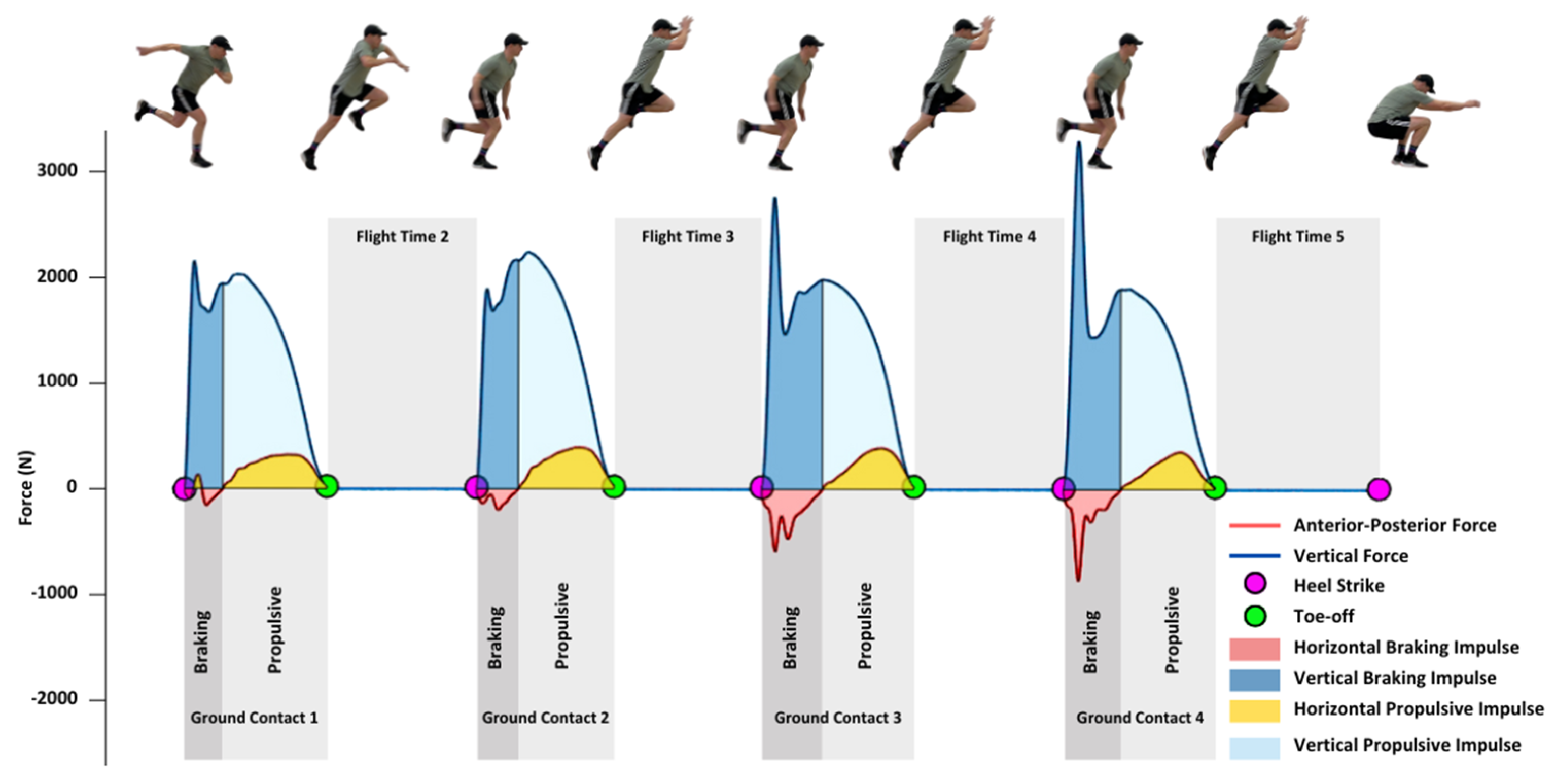
Figure 2.
Raincloud and boxplots for QH vertical kinetic variables depicting density, spread and measures of central tendency across Steps 1-4.
Figure 2.
Raincloud and boxplots for QH vertical kinetic variables depicting density, spread and measures of central tendency across Steps 1-4.
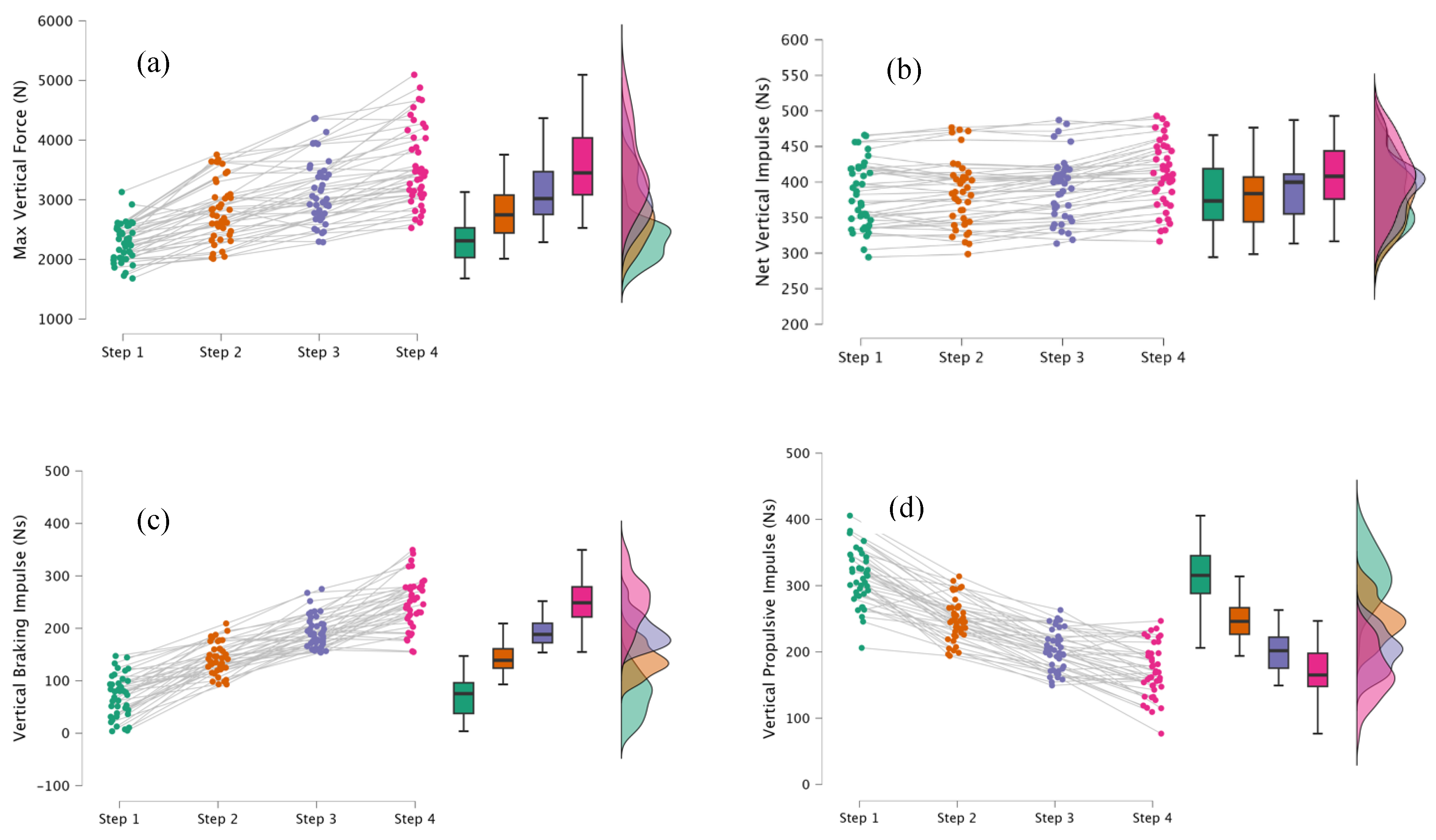
Figure 3.
Raincloud and boxplots for QH horizontal kinetic variables depicting density, spread and measures of central tendency across Steps 1-4.
Figure 3.
Raincloud and boxplots for QH horizontal kinetic variables depicting density, spread and measures of central tendency across Steps 1-4.
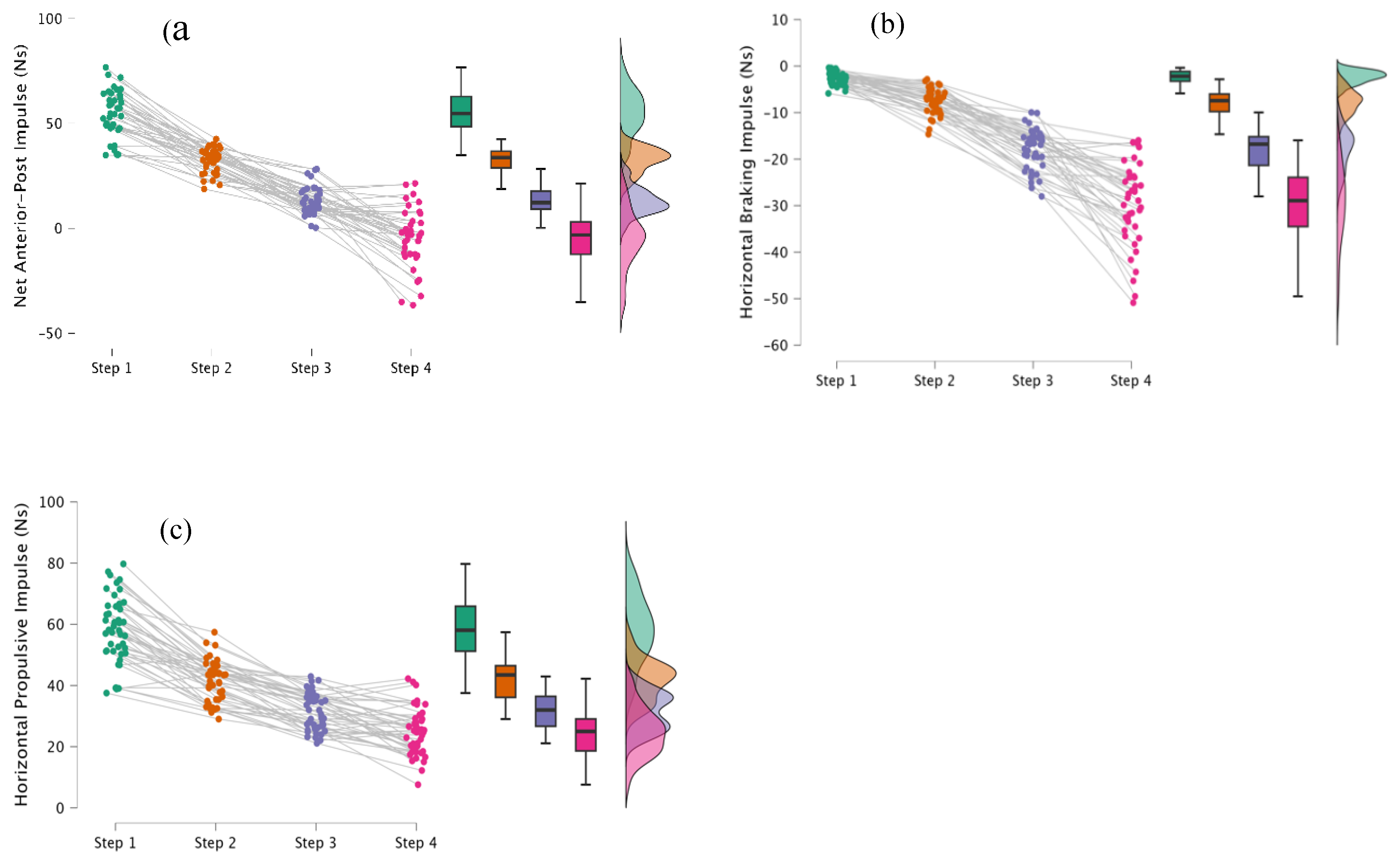
Figure 4.
Percentage contribution of vertical and horizontal propulsive and braking impulse towards net vertical and anterior-posterior impulse across hops.
Figure 4.
Percentage contribution of vertical and horizontal propulsive and braking impulse towards net vertical and anterior-posterior impulse across hops.
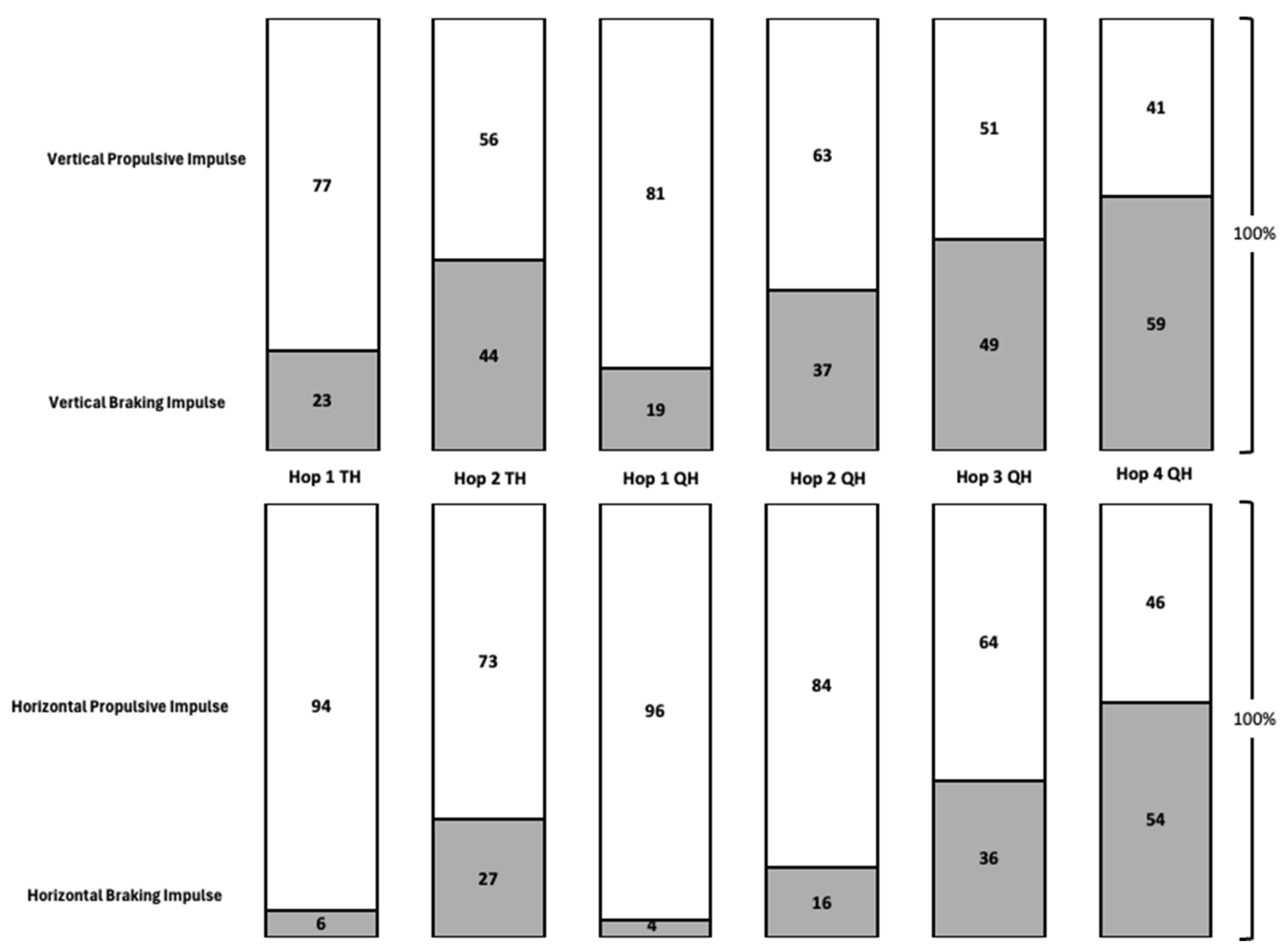
Figure 5.
Maximal vertical force shown in bodyweights across hops.
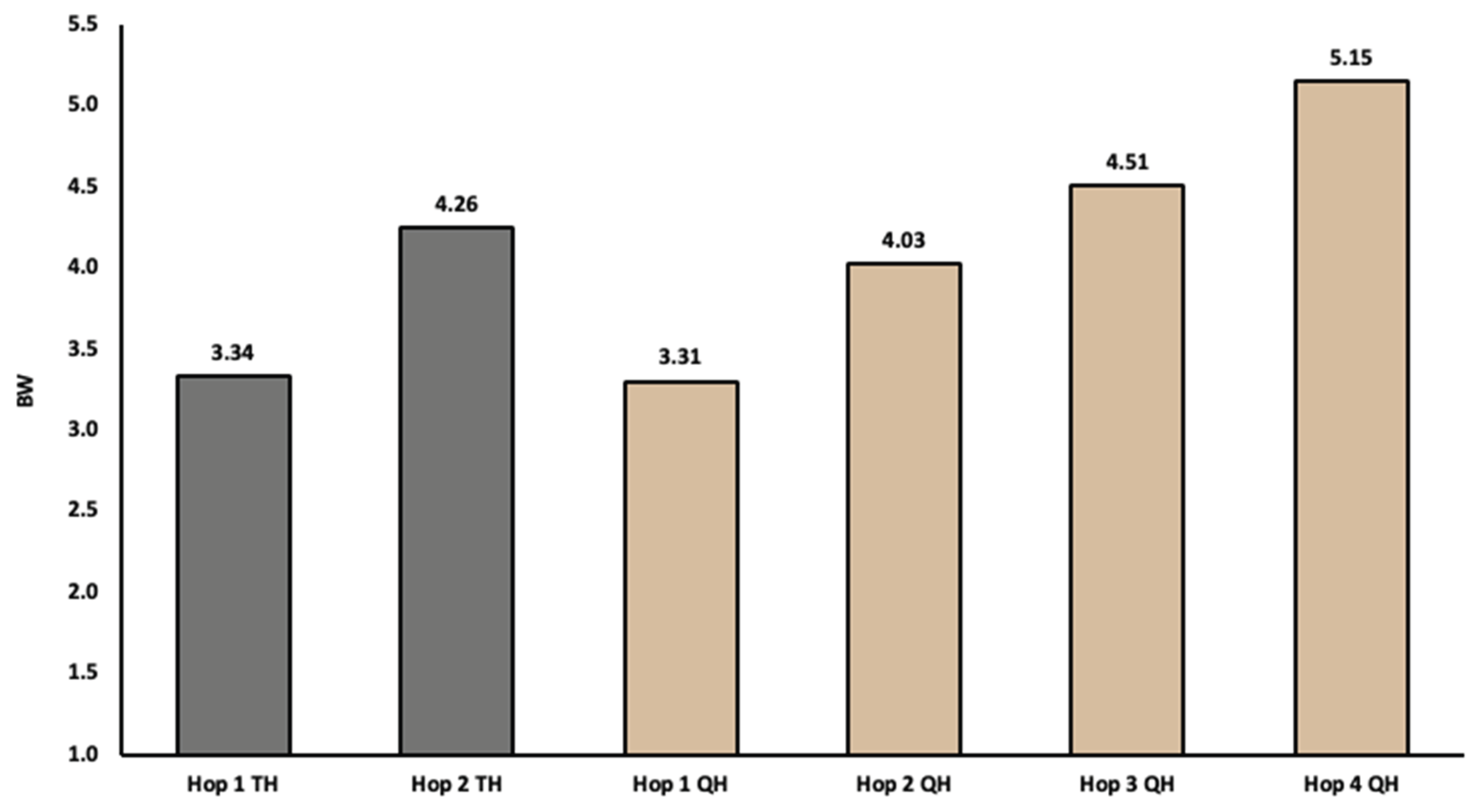

Table 1.
Absolute kinetic data for the TH and QH.
| TH Mean ± SD | QH Mean ± SD | |
|---|---|---|
| Step 1 | ||
| Maximal Vertical Force (N) | 2329 ± 377.1 | 2307 ± 338.2 |
| Net Vertical Impulse (Ns) | 400.1 ± 50.80 | 386.4 ± 50.58 |
| Vertical Braking Impulse (Ns) | 93.80 ± 47.09 | 74.23 ± 41.88 |
| Vertical Propulsive Impulse (Ns) | 308.0 ± 44.12 | 317.3 ± 44.09 |
| Net Anterior-Posterior Impulse (Ns) | 49.87 ± 12.26 | 55.54 ± 11.55 |
| Horizontal Braking Impulse (Ns) | 3.410 ± 1.590 | 2.370 ± 1.360 |
| Horizontal Propulsive Impulse (Ns) | 53.74 ± 11.10 | 58.20 ± 10.97 |
| Step 2 | ||
| Maximal Vertical Force (N) | 2971 ± 518.6 | 2814 ± 504.4 |
| Net Vertical Impulse (Ns) | 411.4 ± 47.83 | 388.6 ± 51.28 |
| Vertical Braking Impulse (Ns) | 187.0 ± 40.07 | 144.8 ± 32.77 |
| Vertical Propulsive Impulse (Ns) | 236.1 ± 43.34 | 248.4 ± 31.14 |
| Net Anterior-Posterior Impulse (Ns) | 21.46 ± 10.02 | 32.25 ± 6.000 |
| Horizontal Braking Impulse (Ns) | 13.56 ± 4.080 | 8.200 ± 3.010 |
| Horizontal Propulsive Impulse (Ns) | 35.48 ± 8.340 | 41.67 ± 6.560 |
| Step 3 | ||
| Maximal Vertical Force (N) | 3150 ± 549.5 | |
| Net Vertical Impulse (Ns) | 393.8 ± 46.22 | |
| Vertical Braking Impulse (Ns) | 194.8 ± 30.51 | |
| Vertical Propulsive Impulse (Ns) | 203.5 ± 32.29 | |
| Net Anterior-Posterior Impulse (Ns) | 13.98 ± 6.890 | |
| Horizontal Braking Impulse (Ns) | 17.90 ± 4.380 | |
| Horizontal Propulsive Impulse (Ns) | 31.67 ± 6.040 | |
| Step 4 | ||
| Maximal Vertical Force (N) | 3596 ± 710.0 | |
| Net Vertical Impulse (Ns) | 412.4 ± 50.01 | |
| Vertical Braking Impulse (Ns) | 249.3 ± 48.49 | |
| Vertical Propulsive Impulse (Ns) | 172.9 ± 41.27 | |
| Net Anterior-Posterior Impulse (Ns) | -4.790 ± 14.34 | |
| Horizontal Braking Impulse (Ns) | 29.55 ± 8.930 | |
| Horizontal Propulsive Impulse (Ns) | 24.88 ± 7.720 |
Key: SD = standard deviation; N = newtons; Ns = newton seconds.
Table 2.
The marginal means contrasts for each combination of within-subject variables during QH for repeated measures ANOVA.
Table 2.
The marginal means contrasts for each combination of within-subject variables during QH for repeated measures ANOVA.
| Mean Difference (95% CI) | %Δ | p | ES | |
|---|---|---|---|---|
| TH Maximal Vertical Force (N) | ||||
| Step 2 – Step 1 | 525.76 (359.79 – 691.72) | 22.8 | <0.001 | 1.01 |
| Step 3 – Step 2 | 336.44 (170.48 – 502.40) | 12.0 | 0.001 | 0.64 |
| Step 4 – Step 3 | 403.07 (237.11 – 569.04) | 12.8 | <0.001 | 0.77 |
| TH Vertical Impulse (Ns) | ||||
| Step 2 – Step 1 | 2.057 (-5.513 – 9.627) | 0.53 | 1.000 | 0.05 |
| Step 3 – Step 2 | 7.851 (0.281 – 15.421) | 2.02 | 0.038 | 0.17 |
| Step 4 – Step 3 | 17.917 (10.347 – 25.487) | 4.55 | <0.001 | 0.39 |
| TH Vertical Braking Impulse (Ns) | ||||
| Step 2 – Step 1 | 71.87 (52.99 – 90.75) | 96.8 | <0.001 | 1.89 |
| Step 3 – Step 2 | 52.15 (33.27 – 71.03) | 36.0 | <0.001 | 1.37 |
| Step 4 – Step 3 | 54.79 (35.91 – 73.67) | 28.1 | <0.001 | 1.44 |
| TH Vertical Propulsive Impulse (Ns) | ||||
| Step 2 – Step 1 | -66.65 (-80.87 – -52.42) | 21.0 | <0.001 | -1.84 |
| Step 3 – Step 2 | -46.02 (-60.25 – -31.80) | 18.5 | <0.001 | -1.27 |
| Step 4 – Step 3 | -31.73 (-45.95 – -17.51) | 15.6 | <0.001 | -0.88 |
| TH Net Anterior-Posterior Impulse (Ns) | ||||
| Step 2 – Step 1 | -22.30 (-28.21 – -16.39) | 40.2 | <0.001 | -2.25 |
| Step 3 – Step 2 | -19.26 (-25.17 – -13.35) | 59.7 | <0.001 | -1.94 |
| Step 4 – Step 3 | -17.97 (-23.88 – -12.05) | 128.5 | <0.001 | -1.81 |
| TH Horizontal Braking Impulse (Ns) | ||||
| Step 2 – Step 1 | -5.48 (-8.23 – -2.70) | 231.2 | <0.001 | -1.07 |
| Step 3 – Step 2 | -10.09 (-12.87 – -7.31) | 123.0 | <0.001 | -1.96 |
| Step 4 – Step 3 | -11.99 (-14.77 – -9.21) | 67.0 | <0.001 | -2.33 |
| TH Horizontal Propulsive Impulse (Ns) | ||||
| Step 2 – Step 1 | -16.53 (-20.18 – -12.89) | 28.4 | <0.001 | -2.05 |
| Step 3 – Step 2 | -10.00 (-3.54 – -6.36) | 24.0 | <0.001 | -1.24 |
| Step 4 – Step 3 | -6.79 (-10.43 – -3.14) | 21.4 | <0.001 | -0.84 |
Key: CI = confidence interval; N = newtons; Ns = newton seconds; %Δ = percentage change. Note: Post-hoc Bonferroni.
Disclaimer/Publisher’s Note: The statements, opinions and data contained in all publications are solely those of the individual author(s) and contributor(s) and not of MDPI and/or the editor(s). MDPI and/or the editor(s) disclaim responsibility for any injury to people or property resulting from any ideas, methods, instructions or products referred to in the content. |
© 2026 by the authors. Licensee MDPI, Basel, Switzerland. This article is an open access article distributed under the terms and conditions of the Creative Commons Attribution (CC BY) license (http://creativecommons.org/licenses/by/4.0/).
Copyright: This open access article is published under a Creative Commons CC BY 4.0 license, which permit the free download, distribution, and reuse, provided that the author and preprint are cited in any reuse.


