

Submitted:
27 April 2026
Posted:
29 April 2026
You are already at the latest version
Abstract
Rivers are the main source of water supply for the Crimean Peninsula, making their chemical status crucial for the regional water security. The study is based on results of geochemical surveys conducted in 2015 – 2018 during different hydrological phases in rivers of the northern macroslope of the Crimean Mountains (the Salgir, Belbek, Kacha, and Alma) and the southern coast (the Derekoyka, Ulu-Uzen, Demerdzhi, and Uchan-Su). Background levels of most elements in water and suspended matter are comparable to their global averages. In impacted areas metal contents exceed background by up to 10–20 times. Dissolved metal contamination is typical during low-water periods, whereas increased values in suspended matter is primarily associated with flood events. Suspended matter is enriched in Bi, Cd, Sb, Zn, Cu, Sn, Pb, W, and Mn, consistent with the geochemical signature of urban road dust in Crimean cities. Among the rivers of the northern part of Crimea, the highest pollution is typical for the Salgir River, on the southern coast - for the Uchan-Su River. Metal(loid)s inputs to suspended matter is predominantly controlled by natural sources, the highest anthropogenic impact is related to construction activities (releasing calcareous dust), urban wastewater, vehicle emissions, and agricultural practices, particularly vineyards.
Keywords:
river waters
; geochemistry
; dissolved forms
; suspended matter
; regional background
; pollution
; source identification
1. Introduction
Despite the rapid growth of groundwater consumption, rivers of the Crimean Peninsula remain the principal source of water for domestic, industrial, and agricultural use. Their critical importance for regional water supply necessitates continuous monitoring of water quality and the development of measures to reduce anthropogenic pressures on aquatic systems.
In recent years, numerous studies addressed the hydrology and hydrochemistry of Crimean rivers, focusing on both quantitative flow characteristics and water quality parameters. The influence of climatic factors on hydrological regimes was analyzed, and cyclic fluctuations in annual river discharge were identified [1]. The relationship between specific discharge and river basin area was established [2], and the quantitative characteristics of extreme erosional processes, including flash floods in mountainous and foothill regions of Crimea, was determined [3]. Long-term data on heavy metal distribution in the waters of the Bodrak River for the period 2003–2022 also was reported [4].
Water quality assessments for the Chernaya, Kacha, Belbek, and Salgir rivers were conducted using a combinatorial pollution index that incorporates concentrations of selected heavy metals in dissolved form (Fe, Cu, Zn, Mn, Ni) together with organic and biogenic substances [5]. According to the results of the study, the Chernaya River was classified as conditionally clean, while the Belbek and Kacha rivers were considered slightly polluted (class 2), mainly due to elevated concentrations of petroleum products (in the Belbek river) and iron (in the Kacha river). The Salgir River was assigned to pollution class 4 [6], reflecting elevated biochemical oxygen demand BOD₅, high phosphate and nitrite levels associated with wastewater discharge from Simferopol city. In the article [7] showed that the Chernaya River had generally low concentrations of most trace elements (V, Co, Ni, Cu, As, Se, Mo, Cd, Pb) in the dissolved load, with the exception of Zn, whose concentrations exceeded global averages by a factor of 2–5. Within the framework of these studies, research was largely focused on biogenic and organic pollutants, whereas the occurrence and behavior of a wide range of heavy metals and metalloids—particularly in suspended sediments—remained less understood.
Regular river water quality observations are conducted in frames of the state environmental monitoring at hydrological stations. The observation network of the Crimean Administration for Hydrometeorology and Environmental Monitoring includes 14 rivers and six water reservoirs [8]. According to the integral water pollution index calculated from 12 hydrochemical indicators, the waters of the Alma, Kacha, and Belbek rivers are classified as relatively clean, while the Demerdzhi, Ulu-Uzen, and Derekoyka rivers are classified as slightly polluted. The Salgir River, downstream of Simferopol, is categorized as polluted. Routine hydrochemical monitoring includes measurements of dissolved forms of 5 to 7 metals; copper concentrations occasionally exceed the maximum permissible levels by up to 1.5-fold.
Most cities and towns in Crimea experience deficiencies in wastewater collection and treatment infrastructure, resulting in the discharge of insufficiently treated effluents into surface waters. The main anthropogenic sources of heavy metals and metalloids (HMMs) in Crimean rivers include municipal and industrial wastewater, discharges from housing and utility services, industrial and thermal power facilities, stormwater runoff, and leachates from solid waste disposal sites. Urban wastewater typically contains a wide range of HMMs, including Pb, Zn, Cu, Cd, Hg, As, Ag, Cr, Bi, V, Ni, Co, Sr, and Mo [9,10,11,12,13,14].
Agricultural runoff from cultivated lands and horticultural areas, which are widespread in Crimea, also contributes to river pollution. Increased levels of Cu, Zn, Cd, Hg, Sn, Cr, Br, U, Sr, Ni, B, and other elements are associated with the application of fertilizers and pesticides [15,16,17]. In viticultural regions, both surface and groundwater are frequently enriched in copper due to the repeated use of copper (II) sulfate–based fungicides [18,19,20,21].
This study aims to evaluate the concentrations of a wide range of heavy metals and metalloids in Crimean rivers and to investigate their spatiotemporal variability under natural and anthropogenic influences. Specific objectives include: (1) determining background values of chemical elements in river waters; (2) assessing anthropogenic impacts on the dissolved and suspended loads of HMMs during different hydrological phases; (3) assessing the partitioning of chemical elements between suspended and dissolved phases in river water; and (4) identifying the main natural and anthropogenic sources of metals and metalloids in the rivers. It is based on environmental and geochemical surveys carried out from 2015 to 2018 within the framework of the Crimean Expedition of the Russian Geographical Society.
2. Study Area
The Crimean Mountains consist of parallel ridges with a gentle northern slope and steep southern cliffs toward the Black Sea. The system includes inner, middle, and outer ridges, mainly composed of crystalline and limestone rocks, with numerous river valleys and karst features. This study focused on rivers of the northern macroslope (the Belbek, Kacha, Alma, and Salgir) and of the southern coast (the Derekoyka, Ulu-Uzen, Uchan-Su, and Demerdzhi) (Figure S1). The upper reaches of these rivers lie within the main and inner ridges, where calcareous rocks are widespread. Together with relatively low anthropogenic pressure, thе geological setting of the upper reaches results in low background concentrations of most metals and metalloids. In the middle and lower reaches, where terrigenous rocks dominate the river basins, heavy metals exhibit higher content and higher mobility [22].
The lower reaches of the rivers are influenced by major urban settlements, which increase anthropogenic pressure on the watercourses. In its middle reaches, the Kacha River receives waters from the Churuk-Su tributary, which flows through Bakhchisaray. The lower Belbek River affected by the proximity of Sevastopol, while the Alma River basin is characterized by intensive agricultural activity. Among the Crimean rivers, the Salgir and its tributaries could experience the highest anthropogenic impact [8,23,24], as it flows through Simferopol, a major industrial and transport hub with a population of approximately 330,000. The Salgir basin also encompasses numerous urban and rural settlements, including Belogorsk, Gvardeiskoye, Novoandreyevka, and Zuya. Its lower plain reaches, located in Steppe Crimea, are almost entirely under cultivation.
The rivers’ hydrological regime is characterized by a winter rainy-flood season and a summer–autumn low-water period. The lowest precipitation occurs in July–August, ranging from 40–50 mm in Yalta (72 m a.s.l.) to 50–60 mm on Ai-Petri (1180 m). Maximum precipitation is observed in December–January, reaching 80–90 mm in Yalta and 100–150 mm on Ai-Petri [25]. In recent decades, the seasonal distribution of precipitation has become increasingly uneven [26], with prolonged dry periods alternating with episodes of heavy rainfall [3,27]. Spring–summer showers are often associated with catastrophic floods.
3. Field Sampling and Laboratory Methods
To assess the ecological status of the rivers, field surveys were conducted. Samples were collected during different hydrological periods: the summer–autumn low-water period (June–September 2016, June 2017 and 2018), the winter flood period (February 2015, 2016, and 2018), and an extreme summer flood event (June 2015), allowing assessment of river conditions under both low and high water discharges. 8 rivers with tributaries were studied, and more than 200 water samples were collected and analyzed. Sampling covered the upper, middle, and lower reaches, river mouths, and major tributaries, with consideration of the main anthropogenic sources. River water samples were collected from a depth of 30–50 cm in pre-cleaned 1.5-liter plastic bottles. At each sampling station, portable HANNA Instruments devices were used to measure conductivity, pH, redox potential (Eh), temperature, and both absolute and relative oxygen content. At the main gauging stations, river discharge was measured using an ISP-1 hydrometric rotor.
The water samples were subjected to vacuum filtration through Millipore membrane filters (0.45 µm pore size). The concentrations of Al, As, Ba, Bi, Ca, Cd, Co, Cr, Cu, Fe, Li, Mg, Mn, Mo, Na, Ni, Pb, Rb, Sb, Sc, Sn, Sr, U, V, W, Zn, Zr, and other elements in the filtrate and in the particulate matter retained on the filter were determined using inductively coupled plasma mass spectrometry (ICP-MS) and inductively coupled plasma atomic emission spectrometry (ICP-AES) on an iCAP Qc mass spectrometer (Thermo Fisher Scientific, USA) and an Optima-4300 DV atomic emission spectrometer (Perkin Elmer, USA) at the laboratory of the All-Russian Scientific Research Institute of Mineral Resources named after N.F. Fedorovsky. Analyses were performed using certified methods (NSAM No. 499 AES/MS, 2015) with the use of clean samples and standard reference materials, including SGM-2 (aluminosilicate loose sediment, GSO 3784-86), SGD-2a (essexite-gabbro, GSO 8671-2005), CS-2a (trap rock, GSO 8671-2005) from the V.V. Vinogradov Institute of Geochemistry, Siberian Branch, Russian Academy of Sciences, as well as AGV-2 (andesite) and BHVO-2 (basalt) from the United States Geological Survey (USA). The laboratory is accredited in the international Analytics system (AAS.A.00255) and the national accreditation system (RA.RU.21GP11) and complies with the requirements of the International Organization for Standardization (ISO Guide 34:2009 and ISO/IEC 17025:2017).
The content of major ions (Ca²⁺, Mg²⁺, Na⁺, K⁺, HCO₃⁻, Cl⁻, SO₄²⁻) in river waters was analyzed at the laboratory of the Faculty of Geography, Lomonosov Moscow State University, using ion chromatography (Stayer ion chromatograph). The particle size distribution of the river suspended matter was determined in the same laboratory using a laser particle analyzer, Analysette 22 Comfort (Fritsch, Germany).
4. Data Treatment
The results were obtained using environmental geochemical approaches, including analysis of chemical element concentrations in aquatic compartments in comparison with upper continental crust (UCC) values and global averages; assessment of river water pollution by dissolved and particulate phases of metals and metalloids using geochemical indices; and evaluation of variations in the distribution of chemical elements between dissolved and particulate phases under different hydroclimatic conditions and anthropogenic impact.
Concentrations of dissolved elements were compared with global river averages [28], whereas concentrations in suspended matter were compared with upper continental crust (UCC) values [29] and world averages in suspended matter [30,31]. To determine regional background levels, samples from the upper reaches of rivers within the Crimean Nature Reserve were used. Contamination of river water and suspended matter was assessed using the concentration factor (CF), calculated relative to regional background levels:
where Ci is the concentration of the element in a sample, Cb is the background concentration of the element.
CF = Ci / Cb,
The enrichment factor EF [32] was calculated for suspended matter as the ratio of the concentration of a given element Ci to that of a reference element, normalized to the same ratio in the upper continental crust [29]. Aluminum, a conservative lithophilic element with low mobility and high analytical precision, served as the reference:
EF = (Ci / CAl) / (UCCi / UCCAl),
Normalizing pollutants to Al and other lithophilic elements minimizes the influence of sediment granulometry on HMMs content and enables a clearer assessment of the anthropogenic impact [33,34].
In environmental geochemistry, the enrichment factor (EF) is commonly used to assess contamination in soils, sediments, and other solid-phase materials [35,36,37,38,39,40,41]. To evaluate contamination of riverine suspended matter, we applied the classification originally proposed for bottom sediments [42]: EF < 1.5 — no enrichment; 1.5–3.0 — slight enrichment; 3.0–5.0 — moderate enrichment; 5.0–10 — substantial enrichment; 10–25 — high enrichment; >25 — extreme enrichment.
In assessing river contamination by metals and metalloids (HMMs), an important step is D,S analysis [43,44,45,46]. It quantifies the partitioning of elements in river water between suspended and dissolved loads based on the ratio of the volumetric concentration of the suspended form (Cvs) to the combined concentration of suspended (Cvs) and dissolved (Cvd) forms:
DS = Cvs / (Cvs + Cvd),
Elements were ranked in descending order by the DS coefficient (%), grouped into quartiles (<25%, 25–50%, 50–75%, >75%), and arranged in a matrix. Suspended forms predominate at DS > 50%, whereas dissolved forms predominate at DS < 50%.
Statistical data processing was performed using the Statistica 10 software package and included the calculation of mean and median values, standard deviations, and coefficients of variation. Principal component analysis (PCA) was applied to identify patterns in the distribution of metals and metalloids in river systems, providing insight into their potential sources [35,47,48,49]. PCA was applied to three data sets of suspended sediments: from rivers on the northern slope (the Belbek, Alma, Kacha), from rivers on the southern coast of Crimea (the Uchan-Su, Derekoyka, Demerdzhi, Ulu-Uzen), and separately from the Salgir River and its tributaries. All data sets included concentrations of 19 HMMs at all sampling sites. Prior to analysis, the data were standardized using Z-normalization.
is the concentration of the i-th chemical element in sample k, is the mean concentration of the i-th element, is the standard deviation.
PCA data processing was performed using the Varimax rotation method [50]. Only principal components (PCs) explaining more than 5% of the total variance of the data set and having eigenvalues greater than 1 (Kaiser criterion) were considered and interpreted as sources of HMMs.
To assess the contribution of each source to HMM concentrations, principal component analysis combined with absolute principal component scores and multiple linear regression (PCA/APCS-MLR) was used. This method identifies independent factors by decomposing the matrix of pairwise correlations between compound concentrations into eigenvectors [51,52]. The model distributes the total mass of each НМM among the components obtained via PCA, i.e., among different sources. The PCA/APCS-MLR methodology is described in detail by [49] and has been successfully applied to assess НMM sources in soils, road dust, and riverine sediments [35,47,53].
5. Results and Discussion
The levels of chemical elements in river waters are determined primarily by the lithogeochemical features of the catchment areas. The transport of elements by river waters depends on many factors, including hydrodynamic regime, total suspended and dissolved solids, pH and redox conditions [54,55,56].
Crimean rivers exhibit a flood-dominated regime [4,57]. The annual hydrological cycle comprises two main periods: a flood period from December to April, driven by snowmelt and precipitation, and a low-water period from May to November. During the summer low-water season, some rivers may dry out completely. Rainfall-induced floods develop rapidly, over several days or even hours, during which a significant portion of the annual water and sediment discharge can occur, occasionally exceeding the average annual flow [27].
Belbek is a river of the northern group with the highest long-term average annual water flow, equal to 2.05 m³/s. During the winter flood, water flow increased to 2.7 m³/s (Table S1). Average discharges in the Kacha, Alma, and Salgir rivers range from 0.7 to 1.8 m³/s, similar values are typical for the rivers of the southern coast of Crimea. Maximum discharges can exceed 100 m³/s [58]. During our study in June 2015, the Crimean Mountains received the equivalent of two months’ precipitation within a short period, leading to extreme river rises and catastrophic flooding: discharges in the Kacha and Alma rivers reached 40–50 m³/s, and in the Belbek River 20 m³/s.
Reservoirs, which are primarily filled during the winter, exert a significant influence on the seasonal dynamics of river discharge and suspended matter transport. Flow in rivers downstream of reservoirs is markedly reduced, and channels in river mouths may dry out during low-water periods. The discharge of the Salgir River upstream of Simferopol is controlled by the reservoir, whereas downstream it is largely sustained by urban wastewater [59], which adversely affects water quality in the middle and lower reaches of the river [8,24].
The pH of river waters (Figure 1) ranged from weakly alkaline to alkaline, generally between 7.5 and 8.0, and up to 9.0 in the lower reaches. Such conditions are favorable for the migration of anionic elements (Mo, Se, Sb, As, U, et al.). The oxygen environment dominates in river waters. The highest redox potential (Eh), exceeding +250 mV, was observed in mountainous sections, whereas the lowest values occurred in slow-flowing stretches. In river mouths during the summer low-water period, oxygen concentrations declined due to reduced flow, limited gas exchange, and elevated temperatures, leading to redox potential values dropping to 50–70 mV.
Content of the total suspended solids (TSS) was found lowest during the summer low-water period, generally not exceeding 10 mg/L (Table S1). Higher levels were recorded in the middle (20–40 mg/L) and lower (70–100 mg/L) reaches of the Salgir River (Figure 2). During the winter flood of 2015, TSS in the upper reaches of the Salgir River increased to 100–130 mg/L following rainfall. In the extreme summer flood of 2015, it rose to 150 mg/L in the Belbek River, 250–300 mg/L in the Kacha and Salgir rivers, and exceeded 300 mg/L in the Alma River. Precipitation-driven increases in TSS are primarily due to intensified catchment erosion, and also anthropogenic inputs, including stormwater runoff and road dust, further elevating river turbidity [13,60,61].
The particle size distribution of suspended matter in most samples was dominated by fine particles smaller than 50 μm. In the lower reaches and river mouth areas the content of particles in the 1–50 μm range of size often increased up to 100%. Among these size fractions, the fine particles (1–5 μm) were particularly abundant, representing 30–35% of the total suspended matter.
5.1. Dissolved Forms of HMMs
To determine the regional geochemical background, we analyzed samples collected at higher altitudes in the upper forest belt, where anthropogenic influence on river systems is minimal, but HMMs concentrations remain above detection limits due to weathering, soil leaching, and biological cycling of the elements. Rivers in the upper reaches exhibited low TSS (<10 mg/L) and generally low concentrations of most HMMs, reflecting both minimal human impact and the naturally low content of elements in the limestone catchments, with the exception of Sr and B. Comparison of background concentrations of dissolved HMMs (Table 1) with global averages [28] allowed the identification of three distinct groups of chemical elements.
The first group comprised Zn, Sr, B, and Li with background values considerably higher than the global averages. The background level of Zn (4.7 µg/L) was over 7 times the global average of 0.6 µg/L [28]. We found Zn content higher than the global averages in different areas, including the Volga Delta (50 µg/L; [56], the Don Delta (17.7 µg/L) and the Kuban Delta (3.6 µg/L) [63], as well as the Pur River (3.1 µg/L; [64]). Similarly, higher mean Zn levels were determined by [65] – 0.5–15 µg/L (unpolluted freshwater), [66] – 20–40 µg/L (groundwater of the weathering zone), and [62] – 20 µg/L (river waters). These observations indicate that the global average for Zn may be underestimated, and that the higher concentrations found in Crimean rivers are consistent with natural geochemical and hydrological conditions rather than anthropogenic pollution.
Increased values of Sr, B, and Li in Crimean river waters relative to global averages can be attributed to their abundances in calcareous rocks [67,68], the high solubility of their salts, and weak sorption by river sediments due to the low clay content in mountainous river reaches. In particular, dissolved Sr content was approximately 3 times higher than the global average in the upper Kacha River, 6 times higher in the Ulu-Uzen River, and 8.5 times higher in the Alma River.
The second group includes elements whose background concentrations were close to global averages: Br, P, As, Sb, and U — anion-forming elements that can be leached from calcareous rocks and soils and transported in river waters in dissolved form — as well as Cu, Ni, Co, and Pb, heavy metals capable of forming stable complexes. Under the alkaline conditions typical of Crimean rivers, these metals can migrate as complex species [69,70].
The third group comprises elements with concentrations below global averages, including Fe, Mn, Cd, Rb, and Mo, which are likely related to their low abundance in calcareous rocks within the catchment areas. The low Fe and Mn concentrations in the dissolved load may also reflect their limited mobility in the calcareous weathering mantle, where alkaline and predominantly oxidizing conditions promote oxidation, hydrolysis, and precipitation as poorly soluble oxide and hydroxide phases.
Spatiotemporal variability. The content of dissolved HMMs compared to the regional background (Figure 3) indicated only minor enrichment of river waters. In rivers draining the southern slopes of the Crimean Mountains, median values of most elements did not exceed the regional background levels, while average concentration factors CF ranged from 1 to 2. The catchments are largely composed of limestones and shales, lack evaporate deposits, and are subject to comparatively low anthropogenic influence relative to other rivers. Higher CF values, up to 4, were observed for Sr in the Uchan-Su River, whose catchment consists of calcareous rocks, and for Pb in the Demerdzhi and Ulu-Uzen rivers (up to 5), which drain shales with naturally high Pb content [71].
In northern rivers, CF values were substantially higher, particularly for P, which enters the rivers through municipal and agricultural effluents. Additionally, in the lower reaches, CF increased for Br, Mo, and U, reflecting higher salinity of groundwater that feeds the rivers during low-flow periods. The highest values of the CF of metals and metalloids were determined in the Salgir River, which experiences the greatest anthropogenic impact and flows for a significant distance through the flat steppe of Crimea. The average contents of many elements are higher than the median ones, which is explained by the presence of sections of the river with significant excess of background levels. The strong variability of concentrations is reflected in the coefficients of variation of the elements, which for Mn, P, Cu, Zn, Cd, Pb, Br, Mo in the northern rivers exceed 100% (Table 1).
HMM contents are subject to seasonal variability. Periods of intense rainfall lead to rising water level, increased surface runoff, and higher concentrations of dissolved elements. Therefore, when assessing river water pollution, it is important to take into account hydrological characteristics and the season of sampling.
The winter flood of 2015 was associated with significant contamination of the Salgir and Kacha rivers with Zn, Cd, Mo, As, and P (Figure 4). The highest Zn concentrations were observed in the Kacha River, ranging from 20 to 35 µg/L along most of its course and decreasing to 10 µg/L only near the mouth, with similar values recorded in the Salgir River and most of its tributaries. In the middle reaches of the Kacha River, Cd showed a maximum of 0.08 µg/L, whereas in the Salgir River it did not exceed 0.03–0.04 µg/L. In the lower reaches of both rivers, As concentrations were approximately five times above background levels, while Mo concentrations were about ten times higher than background.
Phosphorus exhibited a distinct distribution pattern. Content of P in the Belbek and Alma Rivers, as well as Salgir tributaries, remained near the background level (22 µg/L), while in the lower Kacha River it reached 150 µg/L, and in the Salgir River downstream of Simferopol rose up to 800–1200 µg/L. The distribution of Sr and B largely reflected water sources. Their highest concentrations were found in the middle and lower reaches of the Alma and Salgir Rivers, where highly mineralized and enriched in mobile elements groundwater dominates during low-water periods [23,24].
Extreme flooding in June 2015 led to a substantial decrease in HMM content in the rivers due to dilution by rainwater. Compared to the winter period, Zn content declined in most samples to 1 µg/L and less; only in the mouth section of the Kacha River it remained at 9–10 µg/L. Increased levels at the Kacha estuary were also characteristic of Cd and Cu, whose concentrations were several times higher than winter values. This is attributed to their accumulation in the soils and sediments of the river catchment during the winter–spring period and subsequent leaching by heavy rainfall and floodwaters.
Flooding significantly reduced water contamination in the Salgir River near Simferopol, and the zone of maximum concentrations shifted downstream. In all rivers of the northern macroslope, the predominance of rain-fed discharge and high water levels resulted in concentrations of mobile elements—Sr, B, As, and Mo—close to background levels. Only in the lower reaches of the Salgir did the concentrations of these elements increase two- to threefold under the influence of saline groundwater. Dissolved phosphorus levels in the Salgir and other rivers were minimal.
The extreme flood of June 2015 resulted in a pronounced decline in trace metal concentrations in the rivers due to dilution by rainwater. Compared to the winter period, Zn concentrations decreased in most samples and did not exceed 1 µg/L, except in the mouth section of the Kacha River, where values reached 9–10 µg/L. As with Zn, the Kacha estuary also exhibited elevated Cd and Cu concentrations, several fold higher than in winter. This pattern likely reflects the seasonal storage of these metals in the soils and sediments of the Kacha River catchment during the winter–spring period, followed by their mobilization and flushing during intense rainfall and flood events.
Flooding substantially reduced water contamination in the Salgir River near Simferopol, accompanied by a downstream shift of the concentration maxima. In the rivers of the northern macroslope, the dominance of rainfall-driven runoff combined with elevated water levels resulted in concentrations of mobile elements (Sr, B, As, and Mo) close to background levels. In the lower reaches of the Salgir, concentrations of these elements increased two- to threefold due to the influence of saline groundwater. The concentrations of phosphorus in the dissolved load of the Salgir and the other rivers were very low.
During the summer low-water period 2016, river discharge was minimal, with groundwater and subsurface flow serving as the main sources of river water. As a result, concentrations of mobile elements in river waters increase. In August 2016, Sr reached maximum levels, particularly in the lower river reaches, where concentrations ranged from 1000 to 2000 µg/L. Boron concentrations were approximately twice those observed during flood conditions. The highest As concentration recorded throughout the entire monitoring period—12 µg/L—occurred in the lower reaches of the Alma River. Anthropogenic impact on river water quality was especially pronounced under low-flow conditions. Influenced by wastewater inputs, phosphorus concentrations increased to 2200 µg/L in the Salgir River downstream of Simferopol and to 3750 µg/L in the lower Alma River, corresponding to 100 and 170 times the background values, respectively. Under these hydrological conditions, heavy metals remain largely immobile, resulting in minimal concentrations in river waters. Localized Zn and Cd contamination was detected only in the Salgir River, downstream of Simferopol.
In summary, average concentrations of dissolved HMMs in the Crimean rivers are comparable to their global averages. Increased levels are typically observed in river mouths and in proximity to anthropogenic sources, including roads, bridges, and settlements. Seasonal variations are pronounced, with concentrations of dissolved metals increasing during low-water periods.
5.2. Suspended Forms of HMMs
Regional background values of HMMs in suspended matter of the rivers were compared with abundances (clarke values) in other solid-phase reservoirs: the upper continental crust [29], clays and shales [72], and suspended matter of rivers worldwide [30,31].
According to [31], average HMM concentrations in the suspended matter of uncontaminated rivers worldwide are 1.5–3 times lower than the global river average. Background sites in Crimean rivers experience negligible anthropogenic contamination; therefore, concentrations of a large group of HMMs (Cd, As, Bi, Sb, Zn, Cu, Sn, Mn, Ni, Co) were below global averages (Table 2). At the same time, fine-grained particles in river suspended matter exhibit high sorption capacity [55,73,74], which results in many HMMs having higher concentrations in the suspended matter than in the continental crust.
Compared with the upper continental crust (UCC), the suspended matter of Crimean rivers in the background areas was slightly enriched in As, Bi, Pb, Sb, Cu, and Cd (1.5–2.5 times), while concentrations of Ca, Mn, Fe, V, Cr, Zn, U, W, Rb, Ni, Co, Sn, Al, Sc, Y, and Be were close to UCC values. Ba, Sr, and Zr were lower than UCC by a factor of 2–2.5. Comparison with shales [72], which are widespread in the region, showed that the background suspended matter of Crimean rivers most closely resembled these lithologies, with the exception of Pb and Cd. When compared with shales, Pb content in the suspended matter was relatively elevated (1.5–2.7 times), whereas Cd was depleted (2.3–5.6 times). Lead is strongly sorbed by organic and mineral microparticles in the suspended matter, while cadmium exhibits much higher mobility and is predominantly transported in dissolved form [75].
Spatiotemporal variability. Most chemical elements in the suspended matter of rivers on the northern and southern macroslopes of the Crimean Mountains showed near-background levels, with CF values ranging from 0.5 to 1.5 (Figure 5). Higher CFs were observed for Sr, Mn, Cd, and Zn. For Sr and Mn, this reflects the calcareous nature of catchment soils and bedrock. CF values for these elements were higher in the rivers on the southern slope, due to the greater prevalence of limestone and lower proportion of loose sedimentary rocks in the catchment lithologies. Elevated levels of Cd and Zn may be due to anthropogenic inputs and high content in soils and road dust of the urban areas [61,71]. Rivers on the southern slope also showed higher Sb and W, reflecting their enrichment in the catchment soils [71,76].
In the Belbek River, CF values in suspended matter ranged from 0.7 to 1.1 for all elements except Sr (1.5). Slightly higher CFs were observed for As, Mn, and Bi in the Kacha River, and for Sr, Mn, Zn, and As in the Alma River (CF ≈ 2). Overall, HMM concentrations in suspended matter increased in the following order: Belbek → Kacha → Alma.
In the Salgir River, strongly affected by Simferopol, the highest CFs (1.5–3.2) were recorded for Bi, Cd, Zn, Sn, and Mn. In the Uchan-Su River, whose catchment includes the Ai-Petri limestone massif, CF for Sr exceeded the background level by 4.5–5 times. The Derekoyka River, nearly twice the length and basin area of the Uchan-Su and draining both limestone and flysch, displayed lower Sr in suspended matter than the Uchan-Su.
Large parts of the Derekoyka catchment and the lower Uchan-Su lie within Yalta, a major resort city with high anthropogenic and recreational pressure (Bezberdaya et al., 2024). This resulted in 1.8–2.6-fold increases in mean concentrations of Cd, Zn, Sn, and Sb in the Derekoyka suspended load, and 1.6–1.9-fold increases in Mn, Zn, W, and Sb in the Uchan-Su suspended load. The enrichment pattern strongly resembles the geochemical signature of Yalta road dust [71], which enters rivers via stormwater runoff and represent a major sources of sediment contamination. CF values for other elements remain close to 1.
The Ulu-Uzen and Demerdzhi rivers flow through Alushta, a small resort town located east of Yalta. Their catchments predominantly composed of terrigenous Tauric flysch. Carbonate rocks are less common in these areas, resulting in lower average Sr content in suspended load compared to the Uchan-Su and Derekoyka rivers. Overall, these rivers exhibit HMM concentrations closest to the background levels. In the Ulu-Uzen River, Mn, Cd, and W were slightly elevated (CF 1.5–2.0), while in the Demerdzhi River, moderate increases were observed for Zn and W (CF 1.3–1.6).
Seasonal variability of suspended HMMs pronounced less than dissolved ones (Figure 6). The most noticeable changes were registered for Cu, whose concentrations declined several-fold during the summer low-water period. This pattern likely reflects the minimal input of soil particles from vineyards in the dry season, when erosion processes are least active.
The decline in Sr concentrations in suspended matter during the summer low-water period may be attributed to reduced erosion of strontium-bearing carbonate rocks within the catchments. A less pronounced yet still evident decrease in Pb, Bi, Zn, and Cd concentrations during this period is likely driven by a substantial reduction in stormwater runoff from urban areas under dry conditions. These elements are known to accumulate in road dust as a result of non-exhaust traffic emissions [35,55]. As a result of the influence of this source Cd exhibited higher concentrations in suspended matter during the summer flood compared to the winter flood, possibly reflecting increased traffic intensity in Crimea during the tourist season.
Enrichment factor (EF). In the suspended matter of the Belbek and Kacha rivers, mean EF values of HMMs were close to the background ones, with moderate enrichment observed only for As and Cd (Figure 7). In the Alma River, As showed high enrichment, whereas Pb, Cd, Zn, and Mn exhibited moderate enrichment. The Salgir River was characterized by the greatest number of elements with EF > 3 (Pb, Cd, Zn, Mn, Bi, Sn, As, Sb), as well as the highest EF values for Bi (8) and Cd (13), indicating substantial to high enrichment.
Among the rivers of the southern coast of Crimea, the Yalta rivers—the Uchan-Su and Derekoyka—exhibited the highest EF values, pointing to substantial anthropogenic pressure from resort activities on surrounding landscapes [71]. EF values exceed 3 for Cd, Zn, Cu, W, and As, and 5 for Mn, Sr, and Sb. Rivers in the Alushta area showed generally lower EF values. The lowest enrichment was observed in the Demerdzhi River, likely reflecting the relatively limited anthropogenic influence within its catchment. By contrast, the Ulu-Uzen River experiences a more pronounced urban impact from Alushta, as indicated by EF values exceeding 3 for Cd, Mn, and As.
Correlation analysis. The most comprehensive dataset on the chemical composition of suspended load was obtained during the peak flood in June 2015, when river water turbidity reached its maximum (Table S2). These data were used for correlation analysis, which revealed two well-defined elemental associations characterized by high pairwise correlation coefficients. The first, lithogenic association—Fe, Al, Co, Ni, Cr, V, W, Li, Rb, Cs, Be, Ba, As, and U—included the major elements Fe and Al, which are components of clay minerals and (hydr)oxides derived from rocks and soils, as well as trace elements that are typically transported in forms sorbed onto these minerals. The second, anthropogenic association—Pb, Cd, Zn, Cu, Bi, Sn, and Sb—comprised priority pollutants commonly found in urban soils and road dust in Crimean cities such as Alushta and Yalta [71,76], where vehicular traffic is the primary source. These elements showed weak correlations with Fe and Al, suggesting that their transport in forms sorbed onto secondary minerals is limited. Instead, their accumulation in microparticles generated by tire wear, brake pad abrasion, and other vehicle-related mechanical processes appears to play a more significant role. These particles are subsequently delivered to rivers via stormwater runoff from road surfaces [24,25].
The concentrations of chemical elements in riverine suspended matter are typically related to water turbidity [79]; however, this relationship depends on the relative contributions of suspended material sources. Correlation coefficients between elemental concentrations and turbidity for two rivers on the northern slope—the Kacha and the Salgir—during the extreme flood of 2015 are shown in Figure 8. In the Kacha River, relatively strong correlation with suspended matter content was observed for Fe, Mn, Ni, Co, Zr, Ba, Li, and Rb—lithophile elements—indicating the dominance of natural sources of suspended material during this period. In contrast, the Salgir River exhibited a totally different association of elements closely correlated with turbidity: Cu, Cd, Zn, Bi, Cr, Sn, Sb, and Pb. These are priority pollutants in urban soils and road dust [71,76], pointing to the leading role of anthropogenic sources in shaping the composition of suspended matter.
Overall, the analysis of HMM content, along with concentration factors (CF) and enrichment factors (EF), indicated increasing anthropogenic influence along the river sequence the Belbek→the Kacha→the Alma→ the Salgir. The elements showing the greatest accumulation in suspended matter were Bi, Cd, Zn, Mn, Pb, Cu, Sn, As, and Sb. The composition of the priority pollutant assemblage in suspended matter closely resembled that of road dust, highlighting the predominant role of vehicular traffic in the contamination of riverine suspended material.
5.3. Partitioning of Chemical Elements Between Dissolved and Suspended Loads (DS Analysis)
The relative proportions of elemental transport forms in fluvial systems were characterized by the DS coefficients, defined as the fraction of suspended forms relative to the sum of suspended and dissolved forms [44]. Numerous studies on the geochemistry of riverine suspended matter [28,80,81,82] demonstrated that suspended transport is the dominant mode of metal migration in river waters. This generalization primarily applies to global flux estimates, where the mean turbidity of river water is assumed to be approximately 460 mg/L [74] or 350 mg/L [28]. Our investigations in the Selenga, Volga, Don, and Pur River basins showed that in low-turbidity lowland rivers, the contribution of dissolved forms to elemental transport is substantially higher. Based on DS analysis, three groups of chemical elements were identified: D-elements (e.g., Sr, Na, Mo, Sb, U, B), characterized by the predominance of dissolved transport; S-elements (primarily low-mobility lithophiles such as Fe, Al, Zr, Y, Cs, and Pb), for which suspended transport is the main migration pathway; and an intermediate group, DS-elements (including Zn, Mn, Ni, Co, and Cu), in which the ratio of suspended to dissolved forms varies widely depending on hydroclimatic runoff conditions [43,44,64,83,84]. The assignment of elements to a given group is largely controlled by their intrinsic properties, whereas variations in their behavior within groups—expressed as changes in DS values—are driven primarily by hydroclimatic and anthropogenic factors.
In Crimean rivers, DS analysis revealed a strong relationship between turbidity and the partitioning of metals and metalloids (НMMs) between dissolved and suspended loads. During the winter flood, in rivers with low turbidity (<10 mg/L; the Belbek and the Alma), the fraction of suspended forms was reduced. For D-elements such as Sr, Mo, Sb, U, and Ba, this fraction was below 10%, slightly higher for Li and As (Figure 9). Dissolved forms also dominated transport for the DS-elements. For Mn, Ni, Co, Cu, and Rb, the share of suspended forms (S) ranged from 25 to 50%. S-elements were transported almost entirely in the suspended form, accounting for 80–100%. In the Kacha River, with turbidity between 20 and 40 mg/L, the fraction of dissolved forms of the elements were higher across all groups. This trend was particularly pronounced for DS-elements, where Mn, Co, and Rb were predominantly transported as suspended matter. The increase in the fraction of suspended forms was even more pronounced in the Salgir basin, which exhibited high turbidity (up to 100 mg/L). Here, the average fraction of dissolved transport for most D-elements increased to 20–30%, while for DS-elements it reached 50–80%.
During the summer extreme flood, an increase in water turbidity to 200–300 mg/L led to a distinct rise in the fraction of suspended forms. Only for Sr and Mo the fraction of the suspended forms remained below 25%, while the share of dissolved forms for other D-elements increased to 25–50% in the Belbek and Alma rivers and to 50–75% in the Kacha River. For DS-elements, suspended transport clearly dominated. The substantial increase in the share of dissolved forms for As, reaching 50–75% and higher, can be attributed to anthropogenic influence, as As typically behaves as a D-element. In the upper reaches of the Salgir River, which were relatively unaffected by storm floods and did not experience a significant increase in turbidity, the share of dissolved forms remained largely unchanged; dissolved forms predominated for all D-elements and for some DS-elements (Ni, Co, Cu). During the summer low-flow period, when river turbidity was minimal, the mean proportions of dissolved forms for all D-elements fell below 20%. Transport of D,S-elements also occurred predominantly in the dissolved form.
Anthropogenic influence on the Salgir River was clear from the spatiotemporal variability in HMM partitioning (Figure 9b). Intense winter precipitation in the upper reaches increased water turbidity, producing the highest share of dissolved forms. For most DS-elements, it exceeded 90%, and suspended transport became dominant for the majority of D-elements as well. Downstream of the reservoir, decreasing turbidity was accompanied by suspended transport decline to 20–60% for DS-elements and less 20% for D-elements. Further downstream, below Simferopol, the influence of urban wastewater reduced dissolved transport to its minimum. In the lower reaches of the Salgir, extending to the river mouth, dissolved transport predominated for both D- and DS-elements.
The extreme summer flood was characterized by a substantial increase in the share of suspended forms of HMMs downstream of Simferopol, driven by the intensive wash-off of road dust and other microparticles from urban areas via stormwater runoff [59]. Elevated river discharge during this period allowed the urban turbidity plume to extend several tens of kilometers downstream. By contrast, the summer low-flow period was marked by low turbidity (~5 mg/L) and a decline in the share of suspended transport to minimum levels; dissolved transport predominated for all HMMs except S-elements. Downstream of the city, turbidity gradually increased, and in the lower reaches suspended transport again became the dominant migration pathway for DS-elements.
Overall, three groups of chemical elements could be distinguished in the rivers of Crimea according to their transport modes: D-elements (e.g., Sr, Na, Mo, Sb, U, B), S-elements (Fe, Al, Zr, Y, Cs, Pb), and intermediate DS-elements (Zn, Mn, Ni, Co, Cu). Although the share of suspended forms varied considerably with hydroclimatic conditions and anthropogenic pressure, the fundamental grouping of elements remained stable.
5.4. Identification of Sources of Heavy Metals and Metalloids
The APCS-MLR model was applied to three distinct datasets: (A) rivers of the northern slope of Crimean Mountains, including the Belbek, Alma, and Kacha Rivers; (B) rivers of the southern coast, namely the Uchan-Su, Derekoyka, Ulu-Uzen, and Demerdzhi; and (C) the Salgir River along with its tributaries. In each case, four factors were extracted, collectively accounting for 70% of the total variance in the northwestern rivers, 85% in the Salgir River, and 72% in the southern coastal rivers (Table S3). Three of these factors were interpreted consistently across all rivers, while the fourth factor was interpreted differently for the southern coastal rivers. Source attribution was based on a comprehensive review of the literature on pollutant emission profiles across different landscape components [85,86,87,88,89,90,91]. The contribution of all factors to the composition of suspended matter in Crimean rivers is shown in the Figure 10.
Natural and mixed sources (F1). Natural and mixed sources, which include contaminated soils, were identified across all three river groups. In the suspended matter of the northwestern rivers, F1 accounted for 39% of the total variance and exhibited high factor loadings (>0.7) for Al, Sc, V, Co, Ni, W, Bi, Sn, and U. This source contributes more than 70% to the concentrations of Al, Sc, and U — lithophile elements that are constituents of silicate minerals in rocks and soils [35,88,92,93] — as well as anthropogenic tracer elements (V, Co, Ni, Bi, and Sn). The co-occurrence of these elements with lithophile elements generally indicates their input from contaminated soils [94,95]. The elemental signature of this factor therefore supports its classification as mixed, reflecting combined contributions from uncontaminated soils, parent materials, and bedrock, as well as from contaminated soils.
In the suspended matter of the Salgir River, F1 explains 47% of the total variance and, according to APCS-MLR results, contributes 50–70% to the concentrations of Al, Sc, Co, V, Pb, W, and U. A comparable geochemical profile, explaining 45% of the variance, was identified for the Setun River in Moscow, Russia [35].
Suspended matter in the rivers of the southern coast of Crimea is predominantly controlled by natural sources, which accounted for 31% of the total variance. This factor contributes approximately 75% to Al, Sc, Co, V, and U concentrations, whereas the influence of the elements indicative of anthropogenic impact is relatively low.
In all three river groups, the composition of suspended matter is predominantly controlled by natural and mixed sources, accounting for 31–47% of the total variance. These sources include rocks, riverbank sediments, and alluvial soils, which contribute solid material to fluvial systems through water and wind erosion, as reported for other rivers [35,96,97]. Factor 1 is responsible for the formation of stable lithophile (Al–Sc–U) and anthropogenic (Co–V) element associations across all three river groups, which exhibit strong inter-element correlations (r > 0.85). These elements also displayed the lowest enrichment factors (EF < 5) and low variability (<50%), supporting the interpretation of Factor 1 as representing natural or mixed sources. The contribution of this factor to the formation of the elemental composition of suspended matter is greatest in the Salgir River (47% of the total variance), which has a lowland channel section, compared to the mountainous rivers of the southern coast (31%), where the influence of other sources increases.
Carbonate dust (F2) was identified as a source of HMMs in the suspended matter of all three river groups. In the northwestern rivers, southern coast rivers, and the Salgir River, this factor explained 12%, 11%, and 7% of the total variance, respectively, with r = 0.68 between elements (Table S2). Sr and Ca exhibited the highest factor loadings (>0.7). In all river groups, carbonate rocks serve as the primary source of carbonate dust enriched with Ca and Sr. The upper reaches of the rivers under study are located in the foothills of the Main and Inner Ranges of the Crimean Mountains, composed of Upper Jurassic and Triassic limestones. These carbonate rocks are notable for their high Ca content, as well as Sr, which replaces Ca isomorphically in the crystal lattice of carbonate minerals and is a characteristic trace element for limestones. Additionally, karst systems are well-developed in these areas, contributing to the influx of Ca and Sr into the rivers.
In addition to carbonate rocks, the urban area has numerous anthropogenic sources of carbonate dust. This dust is generated during municipal and road construction, building repair, weathering of buildings and structures [85,98,99,100]. The enrichment of river sediments in Ca and Sr due to construction activities was identified in the Setun River basin, Moscow using the APCS-MLR model [35]. Construction-related processes, particularly cement production, emit particles enriched in As, Zn, Cd, Sn, and Pb [101]. This likely explains the substantial contribution of this factor to Cd (45%) input in the northwestern rivers, Pb and Sb (30-35%) in the Salgir River, and Mn, Sn, and Ni (45-70%) in the southern coast rivers. The influence of construction activities on sediment composition is more pronounced in the southern coast rivers than in the Salgir or northwestern rivers, likely reflecting intensified construction over the past 5–7 years in the resort cities along the Black Sea coast [102,103]. Moreover, Alushta and Yalta, through which the Uchan-Su, Derekoyka, Demerdzhi, and Ulu-Uzen rivers flow, host numerous concrete, cement, and construction material production facilities [104].
Sewage water (F3 – for datasets A and B). This factor was identified for the suspended matter of the northwestern rivers and the Salgir River, accounting for 8% and 14% of the total variance, respectively. In both river groups, it predominantly controls the input of As and Mn, contributing approximately 75–80% of their concentrations in the suspended matter of the northwestern rivers and 50–60% in the Salgir River. Additionally, this factor explains the significant input of Cr, W, Pb (35–50%) into the rivers of the northwestern group and Ni (30%) into the Salgir River. Typically, As, Cr, W, and Pb are frequently found in wastewater from treatment plants and domestic sewage, while Ni is present in industrial wastewater [105]. It has been determined that the rivers of the northwestern group and the Salgir River experience considerable anthropogenic pressure due to the discharge of untreated or poorly treated wastewater [106,107]. This is attributed to the high level of wear (approximately 70%) of the peninsula's sewage treatment facilities, which fail to adequately treat wastewater [108]. The Salgir River flowing through the large city of Simferopol receives a significant contribution to its pollution from the discharge of sewage and industrial wastewater (including unauthorized discharges) from the city and its suburbs [6,109]. The Belbek and Kacha rivers often experience the discharge of municipal wastewater from settlements in their mouth areas [110], while the Alma receives wastewater along its entire course from source to sink due to impact of numerous unsewered settlements [107]. Furthermore, the basins of the Salgir, Alma, and Belbek rivers contain landfills with buried agrochemicals, from which Hg, As, Cr, Pb, Zn, Ni, and other pollutants can enter river waters through surface and subsurface runoff [111].
Agriculture – vineyards (F3 – for dataset C). Agriculture, particularly viticulture, was identified as a source of НММs only in the suspended matter of the southern coast rivers, where the region’s largest vineyards are located. This factor accounted for 15% of the total variance and was associated with high loadings of Cu, as well as As, Cr, and W. These elements enter rivers via surface and subsurface runoff from vineyards and through irrigation practices. Previous soil studies under vineyards in Yalta and Alushta reported elevated Cu concentrations due to the use of fungicides containing this metal [59,71]. Similar enrichment patterns have been observed in agricultural soils across Southern Europe, where Cu levels can reach up to four times the background concentrations [112]. Arsenic (as H₃AsO₄) and copper compounds (e.g., CuSO₄·5H₂O applied in lime milk, Ca(OH)₂, and soda ash) are commonly used in agriculture to control pests and plant diseases [113]. The contribution of As, Cr, and W to suspended matter may also be linked to the use of wastewater or household residues for irrigation, which are often enriched in these elements [104].
Traffic (F4). Traffic-related sources make a relatively minor contribution to the contamination of suspended matter in the northwestern rivers, accounting for 7% of the total variance, but are more significant in the southern coast rivers (13%) and the Salgir River (17%). In the southern coast rivers, F4 contributed 50–60% of Sb, Cd and Zn, and 25–30% of Pb and Sn concentrations. In the Salgir River, this factor accounted for 70% of Cd, 50% of Bi, Sn, and Cu, and 30% of Zn. The associations with high loadings of this factor indicate anthropogenic inputs primarily associated with vehicular traffic [71,76]. Specifically, solid particles generated from the abrasion of brake pads, tires, paint layers, and road surfaces are transported to rivers via stormwater runoff, moving downstream with suspended particles [114]. The contribution of traffic-derived particles is greatest in urban areas with extensive impervious surfaces and high traffic density, which explains the stronger influence of this source on the Salgir River, flowing through Simferopol, and on the southern coast rivers, which pass through the resort cities of Yalta and Alushta, where both tourism and traffic volumes increase annually [115,116].
Overall, the concentrations of HMMs in the suspended matter of Crimean rivers are influenced by five factors: (1) erosion of rocks, riverbanks, and soils; (2) input of calcareous dust from carbonate rocks and municipal and road construction activities; (3) input from municipal and industrial wastewater; (4) vehicular emissions and abrasion of road surfaces; (5) runoff from vineyards and agricultural fields. Each factor contributes differently across river groups, reflecting both catchment lithology, hydroclimatic conditions and anthropogenic impacts.
6. Conclusions
1. The study highlights the key factors controlling the concentrations and transport mode of heavy metals and metalloids in the rivers of Crimea, providing insights into both natural factors and anthropogenic impacts. Mean contents of dissolved HMMs in the Crimean rivers are comparable to their global averages. Increased levels are typically observed in river mouths and in proximity to anthropogenic sources, including roads, bridges, and settlements. In anthropogenically impacted areas, HMM concentrations may exceed background levels by 10–20 times. The most significant levels of pollution were noted for Zn, Cd, Mo, As, and P. Seasonal changes may include an increase in pollutant levels during both low-water periods and flood periods.
2. During low-flow periods, pollution is dominated by dissolved forms, whereas during flood events, it is primarily associated with suspended matter. Suspended matter is particularly enriched in pollution-indicator elements—Bi, Cd, Sb, Zn, Cu, Sn, Pb, W, and Mn. This reflects the important role of road dust in contaminating the solid-phase components of river systems. Among northern slope rivers, the Salgir River is most affected, especially in its middle reaches, while on the Southern Coast, Uchan-Su experiences the highest anthropogenic impact.
3. DS-analysis distinguishes three groups based on the transport mode:
– D-elements, predominantly transported in dissolved form (e.g., Sr, Mo, Sb, U, As);
– S-elements, mainly transported in suspended form (e.g., Fe, Al, Zr, Pb);
– DS-elements, with different transport mode depending on hydroclimatic conditions and anthropogenic pressure (e.g., Zn, Ni, Co, Cu).
4. The HMM content in suspended matter of Crimean rivers is primarily controlled by natural sources, including erosion of rocks, riverbanks, and soils. Among anthropogenic sources, the most important are construction activities (addition of calcareous dust), municipal and industrial wastewater, vehicular traffic (road dust), and runoff from agricultural fields and vineyards.
5. Considering the scarcity of water resources in Crimea and the widespread use of river water for domestic, agricultural, and industrial purposes, management efforts should focus on reducing anthropogenic HMM inputs. This includes controlling road dust, optimizing wastewater treatment, and implementing best practices in agriculture and construction to protect water quality and ensure sustainable use of river water.
Supplementary Materials
The following supporting information can be downloaded at: Preprints.org. Figure S1: Study area and river sampling sites; Table S1: Hydrological characteristics at river mouths during field campaigns; Table S2: Correlation matrix of chemical element concentrations in suspended matter, June 2015; Table S3: Principal factor loadings controlling the variability of HMM concentrations in suspended sediments of Crimean rivers.
Author Contributions
M. Yu. Lychagin: field sampling, data analysis, writing and editing, project administration; A. N. Tkachenko: field sampling, data analysis, writing; L. A. Bezberdaya: data analysis, writing; E. S. Prilipova: field sampling, data analysis; E. N. Aseyeva: review and editing; O. V. Chernitsova: GIS analysis; N.S. Kasimov: conceptualization, methodology, review and editing, funding acquisition.
Funding
This research was supported by the grant implemented under the Agreement №075-15-2025-008 date 27.02.2025.
Data Availability Statement
The data presented in this study are available on request from the corresponding author.
Conflicts of Interest
The authors declare no conflicts of interest.
References
- Obyazov, V.A.; Vinogradov, A.Yu. Changes in the flow of rivers of the Crimean peninsula in the second half of the XX and early XXI centuries (In Russ.). Hydrosphere Hazard. Process. Phenom. 2022, 4, 38–51. [CrossRef]
- Minkovskaya, R.Ya.; Narivonchik, S.V.; Svischeva, I.A.; Antonenkov, D.A.; Demidov, A.N. Assessment of River Runoff in Southwestern Crimea Considering Natural and Anthropogenic Changes (In Russ.). 2024, 6, 191–213.
- Kuksina, L.V.; Golosov, V.N.; Zhdanova, E.Yu.; Tsyplenkov, A.S. Hydrological and climatological factors of extreme erosion events in the Crimean Mountains (In Russ.). Lomonosov Geogr. J. 2021, 36–50.
- Kayukova, E.P. About the formation of chemical composition of river waters of the north-western slope of the Crimean Mountains. Water Resour. 2024, 51, 851–870.
- Kucherik, G.V.; Omelchuk, Yu.A. Integrated ecological assessment of water quality of small rivers in the Sevastopol region (In Russ.). Energy Install. Technol. 2019, 5, 166–174.
- Kovrigina, N.P.; Borisova, D.S.; Ovechko, S.V.; Ryabushko, V.I. Hydrochemical State of the Waters of the Salgir and Biyuk-Karasu Rivers (Crimean Peninsula) in Summer 2023. Ecol. Saf. Coast. Shelf Zones Sea 2024, 139–148.
- Malakhova, L.V.; Proskurnin, V.Yu.; Egorov, V.N.; Chuzhikova-Proskurnina, O.D.; Bobko Trace Elements in the Chernaya River Water and Evaluation of Their Income with the Riverine Inflow into the Sevastopol Bay in Winter 2020 (In Russ.). Ecol. Saf. Coast. Shelf Zones Sea 2020, 77–94.
- Report on the State and Protection of the Environment in the Republic of Crimea in 2022. (In Russ.) Available online: https://meco.rk.gov.ru/uploads/txteditor/meco/attachments/d4/1d/8c/d98f00b204e9800998ecf8427e/phpvaCfNy_1.pdf (accessed on 13 April 2026).
- Boateng, T.K.; Opoku, F.; Acquaah, S.O.; Akoto, O. Pollution Evaluation, Sources and Risk Assessment of Heavy Metals in Hand-Dug Wells from Ejisu-Juaben Municipality, Ghana. Environ. Syst. Res. 2015, 4, 18. [CrossRef]
- Xia, F.; Qu, L.; Wang, T.; Luo, L.; Chen, H.; Dahlgren, R.A.; Zhang, M.; Mei, K.; Huang, H. Distribution and Source Analysis of Heavy Metal Pollutants in Sediments of a Rapid Developing Urban River System. Chemosphere 2018, 207, 218–228. [CrossRef]
- Nkinahamira, F.; Suanon, F.; Chi, Q.; Li, Y.; Feng, M.; Huang, X.; Yu, C.-P.; Sun, Q. Occurrence, Geochemical Fractionation, and Environmental Risk Assessment of Major and Trace Elements in Sewage Sludge. J. Environ. Manage. 2019, 249, 109427. [CrossRef]
- Zamora-Ledezma, C.; Negrete-Bolagay, D.; Figueroa, F.; Zamora Ledezma, E.; Ni, M.; Alexis, F.; Guerrero, V. Heavy Metal Water Pollution: A Fresh Look about Hazards, Novel and Conventional Remediation Methods. Environ. Technol. Innov. 2021, 22, 101504. [CrossRef]
- Kasimov, N.S.; Kosheleva, N.E.; Popovicheva, O.B.; Vlasov, D.V.; Shinkareva, G.L.; Erina, O.N.; Chalov, S.R.; Chichaeva, M.A.; Kovach, R.G.; Zavgorodnyaya, Yu.A.; et al. Moscow Megacity Pollution: Monitoring of Chemical Composition of Microparticles in the Atmosphere–Snow–Road Dust–Soil–Surface Water System. Russ. Meteorol. Hydrol. 2023, 48, 391–401. [CrossRef]
- Yanin, E.P. Technogenic river sediments (formation conditions, material composition, geochemical features) (In Russ.); ARSO: Moscow, 2018;
- Zhang, L.; Xue, W.; Sun, H.; Sun, Q.; Hu, Y.; Wu, R.; Du, Y.; Liu, S.; Zou, G. Heavy Metal(Loid)s Accumulation and Human Health Risk Assessment in Wheat after Long-Term Application of Various Urban and Rural Organic Fertilizers. Sci. Total Environ. 2025, 961, 178389. [CrossRef]
- Kobechinskaya, V.G.; Pyshkin, V.B.; Ulchitskaya, V.N. Assessment of soil quality under vineyards considering fertilizer and chemical usage in steppe Crimea (In Russ.). Sci. Notes Crime. Fed. Univ. Named VI Vernadsky Biol. Chem. 2020, 6 (72), 85–98.
- Zhang, Y.; Yin, C.; Cao, S.; Cheng, L.; Wu, G.; Guo, J. Heavy Metal Accumulation and Health Risk Assessment in Soil-Wheat System under Different Nitrogen Levels. Sci. Total Environ. 2018, 622–623, 1499–1508. [CrossRef]
- Sklyar, S.I.; Valin, D.N.; Lipieva, N.N. Content of mobile forms of trace elements in the soils of the Republic of Crimea and its significance (In Russ.). News Agric. Sci. Tavrida 2021, 5–18.
- Brunetto, G.; Bastos de Melo, G.W.; Terzano, R.; Del Buono, D.; Astolfi, S.; Tomasi, N.; Pii, Y.; Mimmo, T.; Cesco, S. Copper Accumulation in Vineyard Soils: Rhizosphere Processes and Agronomic Practices to Limit Its Toxicity. Chemosphere 2016, 162, 293–307. [CrossRef]
- Toth, G.; Hermann, T.; Da Silva, M.R.; Montanarella, L. Heavy Metals in Agricultural Soils of the European Union with Implications for Food Safety. Environ. Int. 2016. [CrossRef]
- Pietrzak, U.; McPhail, D.C. Copper Accumulation, Distribution and Fractionation in Vineyard Soils of Victoria, Australia. Geoderma 2004, 122, 151–166. [CrossRef]
- Baraboshkina, T.A.; Berezkin, V.Yu.; Korobova, E.M.; Karpova, E.A.; Kutsenogiy, K.P.; Savchenko, T.I. Ecological and geochemical conditions of the Bodrak River basin (Crimean-Caucasian mountain zone) (In Russ.). Vestn. Russ. Univ. Peoples Friendsh. Ser. Ecol. Life Saf. 2008, 93–105.
- Ivanyutin, N.M.; Podovalova, S.V.; Dzhaparova, A.M. Integral assessment of drinking water from underground sources of the Salgir river basin (In Russ.). Hyg. Sanit. 2022, 101, 493–502. [CrossRef]
- Volkova, N.E.; Ivanyutin, N.M.; Podovalova, S.V. Assessment of the hydroecological state of water bodies in the Maly Salgir River basin (In Russ.). Vestn. Mosk. Univ. Seriya 5 Geogr. 2021, 27–36.
- Klimadiagramme Weltweit - Ukraine, Moldawien Available online: https://klimadiagramme.de/pics/st_ukr.html (accessed on 10 April 2026).
- Evstigneev, V.P.; Naumova, V.A.; Voronin, D.Y.; Kuznetsov, P.N.; Korsakova, S.P. Severe Precipitation Phenomena in Crimea in Relation to Atmospheric Circulation. Atmosphere 2022, 13, 1712. [CrossRef]
- Vyshkvarkova, E.; Voskresenskaya, E.; Martin-Vide, J. Spatial Distribution of the Daily Precipitation Concentration Index in Southern Russia. Atmospheric Res. 2018, 203, 36–43. [CrossRef]
- Gaillardet, J.; Viers, J.; Dupré, B. Trace Elements in River Waters. 2013, 195–235. [CrossRef]
- Rudnick, R.L.; Gao, S. Composition of the Continental Crust. In Treatise on Geochemistry; Elsevier, 2014; pp. 1–51 ISBN 978-0-08-098300-4.
- Viers, J.; Dupré, B.; Gaillardet, J. Chemical Composition of Suspended Sediments in World Rivers: New Insights from a New Database. Sci. Total Environ. 2009, 407, 853–868. [CrossRef]
- Savenko, V.S. Chemical Composition of World River’s Suspended Matter (In Russ.); GEOS,: Moscow, 2006;
- Horowitz, A.J. A Primer on Trace Metal-Sediment Chemistry; U.S. Geological Survey Water Supply Paper 2277, 1985; p. 72;.
- Schiff, K.C.; Weisberg, S.B. Iron as a Reference Element for Determining Trace Metal Enrichment in Southern California Coastal Shelf Sediments. Mar. Environ. Res. 1999, 48, 161–176. [CrossRef]
- Azoulay, A.; Garzon, P.; Eisenberg, M.J. Comparison of the Mineral Content of Tap Water and Bottled Waters. J. Gen. Intern. Med. 2001, 16, 168–175. [CrossRef]
- Kasimov, N.S.; Vasil’chuk, J.Y.; Tereshina, M.A.; Chalov, S.R.; Erina, O.N.; Kosheleva, N.E.; Shinkareva, G.; Sokolov, D.I.; Vlasov, D.; Konoplev, A.V. Metals and Metalloids Pollution Levels, Partitioning, and Sources in the Environmental Compartments of a Small Urban Catchment in Moscow Megacity. Environ. Pollut. 2025, 367, 125552. [CrossRef]
- Birch, G.F. A Review and Critical Assessment of Sedimentary Metal Indices Used in Determining the Magnitude of Anthropogenic Change in Coastal Environments. Sci. Total Environ. 2023, 854, 158129. [CrossRef]
- Vlasov, D.; Vasil’chuk, J.; Kosheleva, N.; Kasimov, N. Dissolved and Suspended Forms of Metals and Metalloids in Snow Cover of Megacity: Partitioning and Deposition Rates in Western Moscow. Atmosphere 2020, 11, 907. [CrossRef]
- Bern, C.R.; Walton-Day, K.; Naftz, D.L. Improved Enrichment Factor Calculations through Principal Component Analysis: Examples from Soils near Breccia Pipe Uranium Mines, Arizona, USA. Environ. Pollut. 2019, 248, 90–100. [CrossRef]
- Ediagbonya Tf, N.E. Identification and Quantification of Heavy Metals, Anions and Coliforms in Water Bodies Using Enrichment Factors. J. Environ. Anal. Chem. 2015, 02. [CrossRef]
- Reimann, C.; de Caritat, P. Distinguishing between Natural and Anthropogenic Sources for Elements in the Environment: Regional Geochemical Surveys versus Enrichment Factors. Sci. Total Environ. 2005, 337, 91–107. [CrossRef]
- Schropp, S.J.; Lewis, F.G.; Windom, H.L.; Ryan, J.D.; Calder, F.D.; Burney, L.C. Interpretation of Metal Concentrations in Estuarine Sediments of Florida Using Aluminum as a Reference Element. Estuaries 1990, 13, 227–235. [CrossRef]
- Birch, G.F.; Lee, J.-H.; Tanner, E.; Fortune, J.; Munksgaard, N.; Whitehead, J.; Coughanowr, C.; Agius, J.; Chrispijn, J.; Taylor, U.; et al. Sediment Metal Enrichment and Ecological Risk Assessment of Ten Ports and Estuaries in the World Harbours Project. Mar. Pollut. Bull. 2020, 155, 111129. [CrossRef]
- Kasimov, N.; Shinkareva, G.; Lychagin, M.; Kosheleva, N.; Chalov, S.; Pashkina, M.; Thorslund, J.; Jarsjö, J. River Water Quality of the Selenga-Baikal Basin: Part I—Spatio-Temporal Patterns of Dissolved and Suspended Metals. Water 2020, 12, 2137. [CrossRef]
- Kasimov, N.; Shinkareva, G.; Lychagin, M.; Chalov, S.; Pashkina, M.; Thorslund, J.; Jarsjö, J. River Water Quality of the Selenga-Baikal Basin: Part II—Metal Partitioning under Different Hydroclimatic Conditions. Water 2020, 12, 2392. [CrossRef]
- Chalov, S.; Moreido, V.; Sharapova, E.; Efimova, L.; Efimov, V.; Lychagin, M.; Kasimov, N. Hydrodynamic Controls of Particulate Metals Partitioning Along the Lower Selenga River—Main Tributary of The Lake Baikal. Water 2020, 12, 1345. [CrossRef]
- Kasimov, N.S.; Lychagin, M.Yu.; Chalov, S.R.; Shinkareva, G.L. Paragenetic associations of chemical elements in landscapes (In Russ.). Lomonosov Geogr. J. 2019, 20–28.
- Aminiyan, M.M.; Baalousha, M.; Mousavi, R.; Aminiyan, M.F.; Hosseini, H.; Heydariyan, A. The Ecological Risk, Source Identification, and Pollution Assessment of Heavy Metals in Road Dust: A Case Study in Rafsanjan, SE Iran. Environ. Sci. Pollut. Res. Int. 2018, 25, 13382–13395. [CrossRef]
- Song, Y.; Xie, S.; Zhang, Y.; Zeng, L.; Salmon, L.G.; Zheng, M. Source Apportionment of PM2.5 in Beijing Using Principal Component Analysis/Absolute Principal Component Scores and UNMIX. Sci. Total Environ. 2006, 372, 278–286. [CrossRef]
- Thurston, G.D.; Spengler, J.D. A Quantitative Assessment of Source Contributions to Inhalable Particulate Matter Pollution in Metropolitan Boston. Atmospheric Environ. 1967 1985, 19, 9–25. [CrossRef]
- Guo, H.; Wang, T.; Louie, P.K.K. Source Apportionment of Ambient Non-Methane Hydrocarbons in Hong Kong: Application of a Principal Component Analysis/Absolute Principal Component Scores (PCA/APCS) Receptor Model. Environ. Pollut. 2004, 129, 489–498. [CrossRef]
- Thurston, G.D.; Ito, K.; Lall, R. A Source Apportionment of U.S. Fine Particulate Matter Air Pollution. Atmos. Environ. 2011, 45, 3924–3936. [CrossRef]
- Prakash, J.; Lohia, T.; Mandariya, A.K.; Habib, G.; Gupta, T.; Gupta, S.K. Chemical Characterization and Quantitativ e Assessment of Source-Specific Health Risk of Trace Metals in PM1.0 at a Road Site of Delhi, India. Environ. Sci. Pollut. Res. Int. 2018, 25, 8747–8764. [CrossRef]
- Fei, X.; Xiao, R.; Christakos, G.; Langousis, A.; Ren, Z.; Ya, T.; Lv, X. Comprehensive Assessment and Source Apportionment of Heavy Metals in Shanghai Agricultural Soils with Different Fertility Levels. Ecol. Indic. 2019, 106, 105508. [CrossRef]
- Miranda, L.S.; Wijesiri, B.; Ayoko, G.A.; Egodawatta, P.; Goonetilleke, A. Water-Sediment Interactions and Mobility of Heavy Metals in Aquatic Environments. Water Res. 2021, 202, 117386. [CrossRef]
- Kasimov, N.S.; Kosheleva, N.E.; Popovicheva, O.B.; Chalov, S.R.; Bezberdaya, L.A.; Vlasov, D.V.; Erina, O.N.; Lychagin, M.Yu.; Chichaeva, M.A.; Shinkareva, G.L. Ecogeochemistry of microparticles in the environment. Lomonosov Geogr. J. 2025, 80, 3–23. [CrossRef]
- Kasimov, N.S.; Kasatenkova, M.S.; Tkachenko, A.N.; Lychagin, M.Yu.; Kroonenberg, S.B. Geochemistry of the Caspian lagoon-marsh and deltaic landscapes: In 100 Years since the Birth of A.I. Perelman (In Russ.); Liga-Vent: Moscow, 2016;
- Ovsyany, E.I.; Orekhova, N.A. Hydrochemical Regime of the River Chernaya (Crimea):Environmental Aspects. Phys. Oceanogr. 2018, 25, 77–89. [CrossRef]
- Oliferov, A.N.; Timchenko, Z.V. Rivers and Lakes of Crimea (In Russ.); Dolya: Simferopol, 2005;
- Kasimov, N.S.; Bezberdaya, L.A.; Lychagin, M.Yu.; Tkachenko, A.N.; Kotvitsa, M.A.; Malygin, E.V.; Chernitsova, O.V. Eco-geochemistry of cities and rivers of Crimea (Proceedings of the Crimean Comprehensive Expedition, Vol. 1) (In Russ.); Faculty of Geography, Lomonosov Moscow State University.; Moscow, 2022;
- Shinkareva, G.; Erina, O.; Tereshina, M.; Sokolov, D.; Lychagin, M.; Kasimov, N. Anthropogenic Factors Affecting the Moskva River Water Quality: Levels and Sources of Nutrients and Potentially Toxic Elements in Moscow Metropolitan Area. Environ. Geochem. Health 2023, 45, 3113–3141. [CrossRef]
- Kasimov, N.S.; Vlasov, D.V.; Kosheleva, N.E. Enrichment of Road Dust Particles and Adjacent Environments with Metals and Metalloids in Eastern Moscow. Urban Clim. 2020, 32, 100638. [CrossRef]
- Dobrovolsky, V.V. Fundamentals of Biogeochemistry (In Russ.); Akademiya.; Moscow, 2003; ISBN 978-5-7695-1098-4.
- Tkachenko, A.N.; Tkachenko, O.V.; Lychagin, M.Yu.; Kasimov, N. S. Heavy Metal Flows in Aquatic Systems of the Don and Kuban River Deltas. Dokl. Earth Sci. 2017, 474, 587–590. [CrossRef]
- Lychagin, M.; Porsheva, S.; Sokolov, D.; Erina, O.; Krastyn, E.; Efimov, V.; Dubrovskaya, T.; Kotov, D.; Kasimov, N. Levels, D,S-Patterns and Source Identification of Metals and Metalloids in River Waters of the Gas-Producing Region in the North of Western Siberia (Pur River Basin). Geogr. Environ. Sustain. 2024, 17, 121–145. [CrossRef]
- Moore, J.W.; Ramamoorthy, S. Heavy Metals in Natural Waters; Springer Series on Environmental Management; Springer: New York, NY, 1984; ISBN 978-1-4612-9739-0.
- Shvartsev, S.L. Hydrogeochemistry of the Hypergenesis Zone. Geochem. Int. 2000, 38, 260–276.
- Censi, V.; Zuddas, P.; Sposito, F.; Cangemi, M.; Inguaggiato, C.; Piazzese, D. Boron and Lithium Behaviour in River Waters under Semiarid Climatic Conditions. Chemosphere 2022, 306, 135509. [CrossRef]
- Adeel, M.; Zain, M.; Shakoor, N.; Ahmad, M.A.; Azeem, I.; Aziz, M.A.; Tulcan, R.X.S.; Rathore, A.; Tahir, M.; Horton, R.; et al. Global Navigation of Lithium in Water Bodies and Emerging Human Health Crisis. Npj Clean Water 2023, 6, 33. [CrossRef]
- Caporale, A.G.; Violante, A. Chemical Processes Affecting the Mobility of Heavy Metals and Metalloids in Soil Environments. Curr. Pollut. Rep. 2016, 2, 15–27. [CrossRef]
- Kraynov, S.R.; Ryzhenko, V.N.; Shvets, V.M. Geochemistry of groundwater (In Russ.); Nauka.; Moscow, 2004;
- Bezberdaya, L.; Chernitsova, O.; Lychagin, M.; Aseeva, E.; Tkachenko, A.; Kasimov, N. Pollution of a Black Sea Coastal City: Potentially Toxic Elements in Urban Soils, Road Dust, and Their PM10 Fractions. J. Soils Sediments 2024, 24, 3485–3506. [CrossRef]
- Grigoriev, N.A. Distribution of chemical elements in the upper continental crust (In Russ.); Ural Branch of RAS.; Yekaterinburg, 2009; ISBN 978-5-7691-2083-1.
- Djukić, A.; Lekić, B.; Rajaković-Ognjanović, V.; Veljović, D.; Vulić, T.; Djolić, M.; Naunovic, Z.; Despotović, J.; Prodanović, D. Further Insight into the Mechanism of Heavy Metals Partitioning in Stormwater Runoff. J. Environ. Manage. 2016, 168, 104–110. [CrossRef]
- Gordeev, V.V. Geochemistry of the river–sea system (In Russ.); Matushkina, I.I.: Moscow, 2012;
- Nakaya, S.; Chi, H.; Muroda, K.; Masuda, H. Forms of Trace Arsenic, Cesium, Cadmium, and Lead Transported into River Water for the Irrigation of Japanese Paddy Rice Fields. J. Hydrol. 2018, 561, 335–347. [CrossRef]
- Kasimov, N.S.; Bezberdaya, L.A.; Vlasov, D.V.; Lychagin, M.Yu. Metals, Metalloids, and Benzo[a]Pyrene in PM10 Particles of Soils and Road Dust of Alushta City. Eurasian Soil Sci. 2019, 52, 1608–1621. [CrossRef]
- Acosta, J.A.; Faz, Á.; Kalbitz, K.; Jansen, B.; Martínez-Martínez, S. Heavy Metal Concentrations in Particle Size Fractions from Street Dust of Murcia (Spain) as the Basis for Risk Assessment. J. Environ. Monit. JEM 2011, 13, 3087–3096. [CrossRef]
- Vlasov, D.; Kosheleva, N.; Kasimov, N. Spatial Distribution and Sources of Potentially Toxic Elements in Road Dust and Its PM10 Fraction of Moscow Megacity. Sci. Total Environ. 2021, 761, 143267. [CrossRef]
- Chalov, S.; Shkolnyi, D.; Promakhova, E.; Leman, V.N.; Romanchenko, A. Formation of the Sediment Yield in Areas of Mining of Placer Deposits. Geogr. Nat. Resour. 2015, 36, 124–131. [CrossRef]
- Krickov, I.V.; Lim, A.G.; Manasypov, R.M.; Loiko, S.V.; Vorobyev, S.N.; Shevchenko, V.P.; Dara, O.M.; Gordeev, V.V.; Pokrovsky, O.S. Major and Trace Elements in Suspended Matter of Western Siberian Rivers: First Assessment across Permafrost Zones and Landscape Parameters of Watersheds. Geochim. Cosmochim. Acta 2020, 269, 429–450. [CrossRef]
- Gordeev, V.V.; Lisitzin, A.P. Geochemical Interaction between the Freshwater and Marine Hydrospheres. Russ. Geol. Geophys. 2014, 55, 562–581. [CrossRef]
- Martin, J.-M.; Meybeck, M. Elemental Mass-Balance of Material Carried by Major World Rivers. Mar. Chem. 1979, 7, 173–206. [CrossRef]
- Lychagin, M.; Chalov, S.; Kasimov, N.; Shinkareva, G.; Jarsjö, J.; Thorslund, J. Surface Water Pathways and Fluxes of Metals under Changing Environmental Conditions and Human Interventions in the Selenga River System. Environ. Earth Sci. 2017, 76, 1. [CrossRef]
- Kur’yakova, A.N. Balance of Heavy Metals in the Volga River Delta. Dokl. Earth Sci. 2011, 439, 1186–1189. [CrossRef]
- Popovicheva, O.; Diapouli, E.; Chichaeva, M.; Kosheleva, N.; Kovach, R.; Bitukova, V.; Eleftheriadis, K.; Kasimov, N. Aerosol Characterization and Peculiarities of Source Apportionment in Moscow, the Largest and Northernmost European Megacity. Sci. Total Environ. 2024, 918, 170315. [CrossRef]
- Rai, P.K.; Lee, S.S.; Zhang, M.; Tsang, Y.F.; Kim, K.-H. Heavy Metals in Food Crops: Health Risks, Fate, Mechanisms, and Management. Environ. Int. 2019, 125, 365–385. [CrossRef]
- Zheng, J.; Zhan, C.; Yao, R.; Zhang, J.; Liu, H.; Liu, T.; Xiao, W.; Liu, X.; Cao, J. Levels, Sources, Markers and Health Risks of Heavy Metals in PM2.5 Over a Typical Mining and Metallurgical City of Central China. Aerosol Sci. Eng. 2018, 2, 1–10. [CrossRef]
- Pernigotti, D.; Belis, C.A.; Spanò, L. SPECIEUROPE: The European Data Base for PM Source Profiles. Atmospheric Pollut. Res. 2016, 7, 307–314. [CrossRef]
- Grigoratos, T.; Martini, G. Brake Wear Particle Emissions: A Review. Environ. Sci. Pollut. Res. 2015, 22, 2491–2504. [CrossRef]
- Pant, P.; Baker, S.J.; Shukla, A.; Maikawa, C.; Godri Pollitt, K.J.; Harrison, R.M. The PM10 Fraction of Road Dust in the UK and India: Characterization, Source Profiles and Oxidative Potential. Sci. Total Environ. 2015, 530–531, 445–452. [CrossRef]
- Thorpe, A.; Harrison, R.M. Sources and Properties of Non-Exhaust Particulate Matter from Road Traffic: A Review. Sci. Total Environ. 2008, 400, 270–282. [CrossRef]
- Konstantinova, E.; Minkina, T.; Konstantinov, A.; Sushkova, S.; Antonenko, E.; Kurasova, A.; Loiko, S. Pollution Status and Human Health Risk Assessment of Potentially Toxic Elements and Polycyclic Aromatic Hydrocarbons in Urban Street Dust of Tyumen City, Russia. Environ. Geochem. Health 2022, 44, 409–432. [CrossRef]
- Petrotou, A.; Skordas, K.; Papastergios, G.; Filippidis, A. Factors Affecting the Distribution of Potentially Toxic Elements in Surface Soils around an Industrialized Area of Northwestern Greece. Environ. Earth Sci. 2012, 65, 823–833. [CrossRef]
- Manousakas, M.; Papaefthymiou, H.; Diapouli, E.; Migliori, A.; Karydas, A.G.; Bogdanovic-Radovic, I.; Eleftheriadis, K. Assessment of PM2.5 Sources and Their Corresponding Level of Uncertainty in a Coastal Urban Area Using EPA PMF 5.0 Enhanced Diagnostics. Sci. Total Environ. 2017, 574, 155–164. [CrossRef]
- Li, T.; Sun, G.; Yang, C.; Liang, K.; Ma, S.; Huang, L.; Luo, W. Source Apportionment and Source-to-Sink Transport of Major and Trace Elements in Coastal Sediments: Combining Positive Matrix Factorization and Sediment Trend Analysis. Sci. Total Environ. 2019, 651, 344–356. [CrossRef]
- Devereux, O.H.; Prestegaard, K.L.; Needelman, B.A.; Gellis, A.C. Suspended-Sediment Sources in an Urban Watershed, Northeast Branch Anacostia River, Maryland. Hydrol. Process. 2010, 24, 1391–1403. [CrossRef]
- Dabrin, A.; Bégorre, C.; Bretier, M.; Dugué, V.; Masson, M.; Le Bescond, C.; Le Coz, J.; Coquery, M. Reactivity of Particulate Element Concentrations: Apportionment Assessment of Suspended Particulate Matter Sources in the Upper Rhône River, France. J. Soils Sediments 2021, 21, 1256–1274. [CrossRef]
- Amato, F.; Alastuey, A.; Karanasiou, A.; Lucarelli, F.; Nava, S.; Calzolai, G.; Severi, M.; Becagli, S.; Gianelle, V.L.; Colombi, C.; et al. AIRUSE-LIFE+: A Harmonized PM Speciation and Source Apportionment in Five Southern European Cities. Atmospheric Chem. Phys. 2016, 16, 3289–3309. [CrossRef]
- Bernardoni, V.; Vecchi, R.; Valli, G.; Piazzalunga, A.; Fermo, P. PM10 Source Apportionment in Milan (Italy) Using Time-Resolved Data. Sci. Total Environ. 2011, 409, 4788–4795. [CrossRef]
- Amato, F.; Pandolfi, M.; Escrig, A.; Querol, X.; Alastuey, A.; Pey, J.; Perez, N.; Hopke, P.K. Quantifying Road Dust Resuspension in Urban Environment by Multilinear Engine: A Comparison with PMF2. Atmos. Environ. 2009, 43, 2770–2780. [CrossRef]
- Demetriades, A.; Birke, M. URBAN GEOCHEMICAL MAPPING MANUAL: Sampling, Sample Preparation, Laboratory Analysis, Quality Control Check, Statistical Processing and Map Plotting 2015.
- Social-Economic Passport of Alushta. (In Russ.) Available online: https://alushta.rk.gov.ru/uploads/txteditor/alushta/attachments//d4/1d/8c/d98f00b204e9800998ecf8427e/phpLrP4wa_1.pdf (accessed on 13 April 2026).
- Social-Economic Passport of Yalta. (In Russ.) Available online: https://yalta.rk.gov.ru/documents/f88bfce3-1d1b-4b7f-af03-48532df7acee (accessed on 13 April 2026).
- Report on the State and Protection of the Environment in the Republic of Crimea in 2020. (In Russ.) Available online: https://meco.rk.gov.ru/structure/2b487c83-93d6-48dd-a4af-b55d4274b741 (accessed on 13 April 2026).
- Haghnazar, H.; Hudson-Edwards, K.A.; Kumar, V.; Pourakbar, M.; Mahdavianpour, M.; Aghayani, E. Potentially Toxic Elements Contamination in Surface Sediment and Indigenous Aquatic Macrophytes of the Bahmanshir River, Iran: Appraisal of Phytoremediation Capability. Chemosphere 2021, 285, 131446. [CrossRef]
- Tabunshchik, V.A.; Timchenko Z.V.,; Chernov J.I. Water pollution in the rivers of the northwestern slope of the Crimean Mountains (using the example of the basins of the Zapadnyy Bulganak, Alma, Kacha, Belbek, Chernaya rivers). (In Russ). Geopolit. Ecogeodynamics Reg. 2024, 20, 202–217.
- Ivanyutin N.M; Podovalova S.V. The pollution of water bodies in the Crimea by wastewater. (In Russ.). Ecol. Constr. 2018, 4–8. [CrossRef]
- Zakharov R.Ju; Volkova N.E. Irrigation as a method of disposal of treated wastewater in the Republic of Crimea. (In Russ.). Econ. Constr. Environ. Manag. 2016, 54–61.
- Ivanyutin, N.M.; Podovalova, S.V.; Volkova, N.E. Research of Spatial-Temporal Transformation of the Qualitative Composition of the River Salgir Waters. (In Russ). Ecol. Ind. Russ. 2020, 24, 65–71. [CrossRef]
- Lomakin P.D.; Chepyzhenko A.I.; Popov M.A. Features of the water structure in the mouth sections of the Crimean rivers Belbek and Kacha in low water. (In Russ.). Biodivers. Sustain. Dev. 2025, 10, 82–89.
- Malakhova, L.; Malakhova, T.; Statkevich, S.; Chesnokova, I.; Kurshakov, S.; Karpova, E. Persistent Organic Pollutants in Hydrobionts in River Ecosystems of Crimea. Limnol. Freshw. Biol. 2025, 8, 554–565. [CrossRef]
- Ballabio, C.; Panagos, P.; Lugato, E.; Huang, J.-H.; Orgiazzi, A.; Jones, A.; Fernández-Ugalde, O.; Borrelli, P.; Montanarella, L. Copper Distribution in European Topsoils: An Assessment Based on LUCAS Soil Survey. Sci. Total Environ. 2018, 636, 282–298. [CrossRef]
- Ruyters, S.; Salaets, P.; Oorts, K.; Smolders, E. Copper Toxicity in Soils under Established Vineyards in Europe: A Survey. Sci. Total Environ. 2013, 443, 470–477. [CrossRef]
- Liu, A.; Ma, Y.; Gunawardena, J.M.; Egodawatta, P.; Ayoko, G.A.; Goonetilleke, A. Heavy Metals Transport Pathways: The Importance of Atmospheric Pollution Contributing to Stormwater Pollution. Ecotoxicol. Environ. Saf. 2018, 164, 696–703.
- Abramova L.S.; Trotsenko O.I. Problems and prospects of tourism development in Crimea and Sevastopol. (In Russ.). Vector Econ. 2020, 50.
- Report on the State and Protection of the Environment in the Republic of Crimea in 2019. (In Russ.) Available online: https://meco.rk.gov.ru/uploads/txteditor/meco/attachments/d4/1d/8c/d98f00b204e9800998ecf8427e/phpCCpsTg_1.pdf (accessed on 13 April 2026).
Figure 1.
pH values in river waters during the summer low-water period.
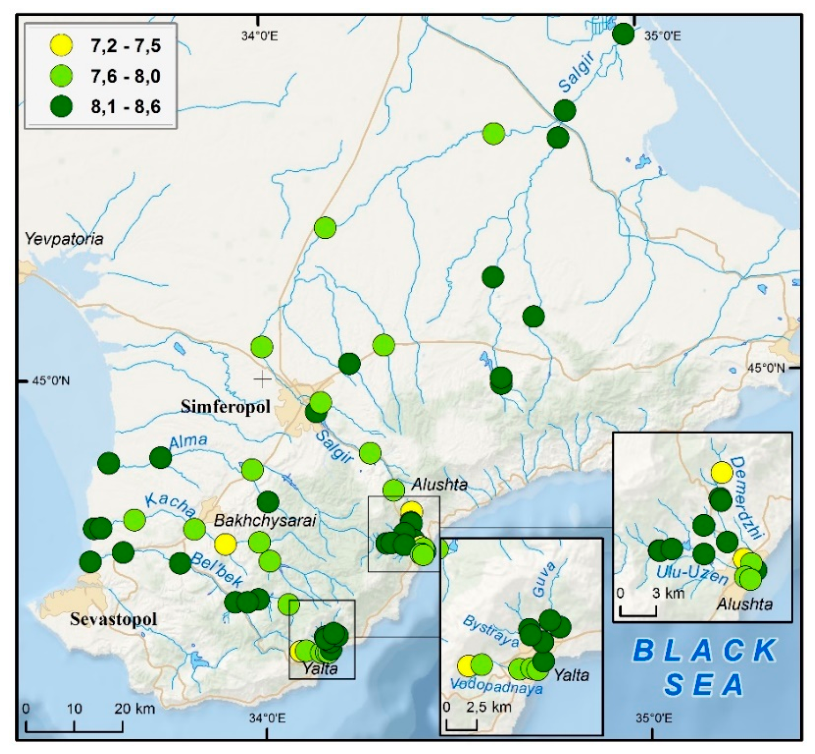
Figure 2.
Total suspended solids (mg/L) in river waters during (a) the winter flood, (b) the summer flood, and (c) the summer low-water period.
Figure 2.
Total suspended solids (mg/L) in river waters during (a) the winter flood, (b) the summer flood, and (c) the summer low-water period.
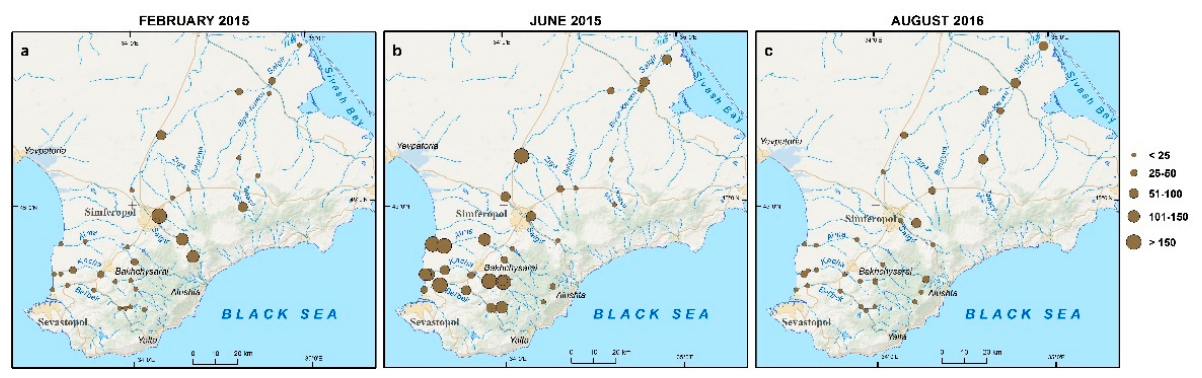
Figure 3.
Concentration factors (CF) of dissolved НMMs in Crimean rivers. The lower boundary of the box is Q1 (25th percentile), the upper boundary of the box is Q3 (75th percentile), the line inside the box is the median (Q2, 50th percentile), and the cross is the mean. The height of the box corresponds to the interquartile range (IQR = Q3 – Q1). Whiskers (lines from the box) extend to the minimum and maximum values within 3 × IQR; outliers are indicated by dots outside these limits.
Figure 3.
Concentration factors (CF) of dissolved НMMs in Crimean rivers. The lower boundary of the box is Q1 (25th percentile), the upper boundary of the box is Q3 (75th percentile), the line inside the box is the median (Q2, 50th percentile), and the cross is the mean. The height of the box corresponds to the interquartile range (IQR = Q3 – Q1). Whiskers (lines from the box) extend to the minimum and maximum values within 3 × IQR; outliers are indicated by dots outside these limits.
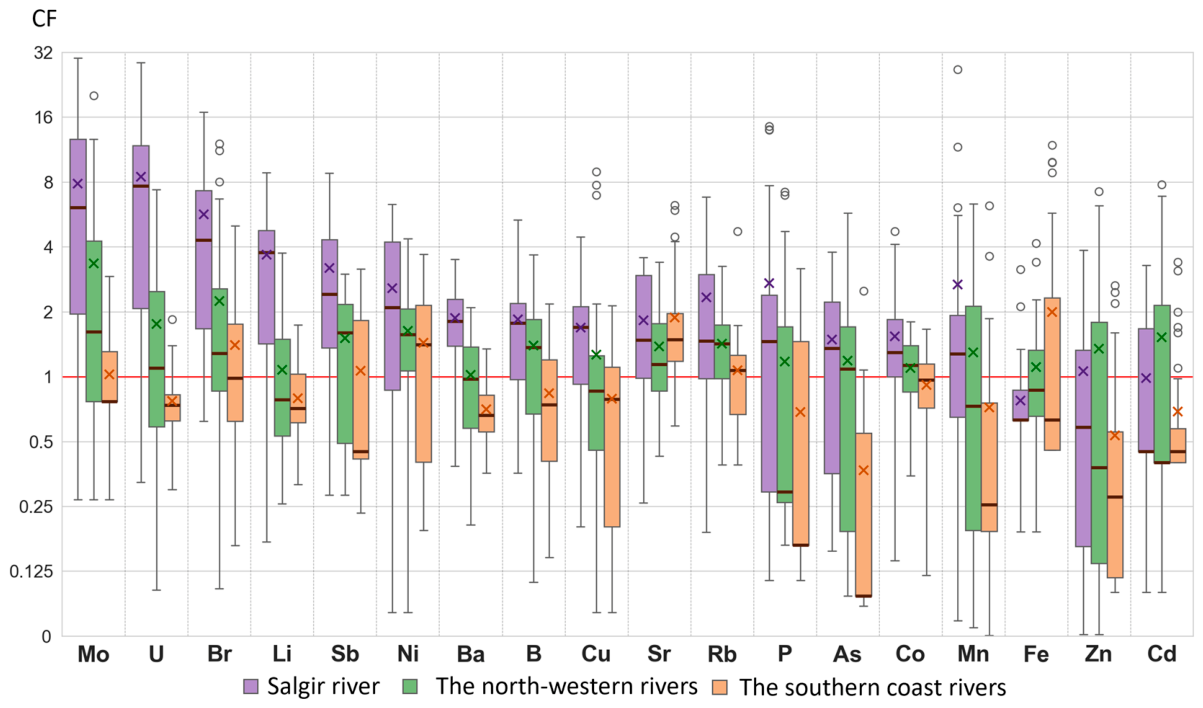
Figure 4.
Seasonal variations of dissolved forms of HMMs in Crimean rivers.
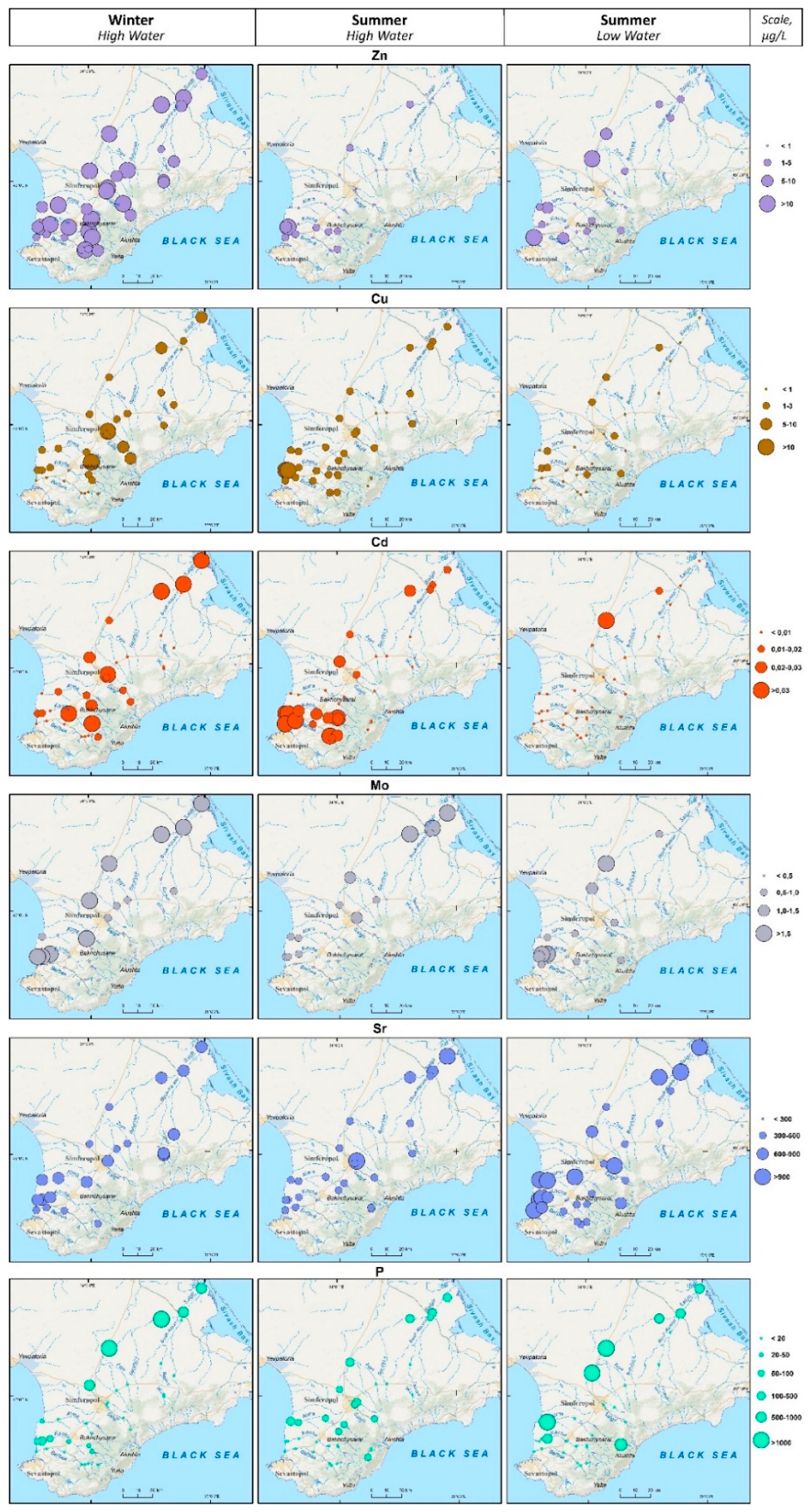
Figure 5.
Concentration factors (CF) of suspended НMMs in Crimean rivers. The lower boundary of the box is Q1 (25th percentile), the upper boundary of the box is Q3 (75th percentile), the line inside the box is the median (Q2, 50th percentile), and the cross is the mean. The height of the box corresponds to the interquartile range (IQR = Q3 – Q1). Whiskers (lines from the box) extend to the minimum and maximum values within 3 × IQR; outliers are indicated by dots outside these limits.
Figure 5.
Concentration factors (CF) of suspended НMMs in Crimean rivers. The lower boundary of the box is Q1 (25th percentile), the upper boundary of the box is Q3 (75th percentile), the line inside the box is the median (Q2, 50th percentile), and the cross is the mean. The height of the box corresponds to the interquartile range (IQR = Q3 – Q1). Whiskers (lines from the box) extend to the minimum and maximum values within 3 × IQR; outliers are indicated by dots outside these limits.
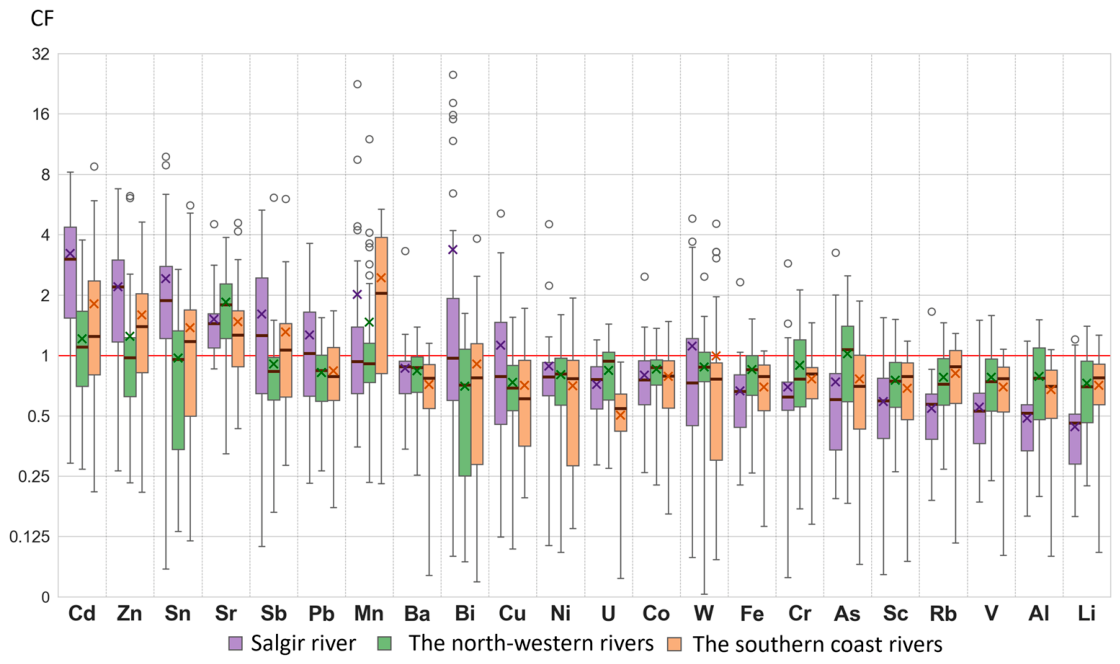
Figure 6.
Seasonal changes in content of HMMs in suspended load of Crimean rivers.
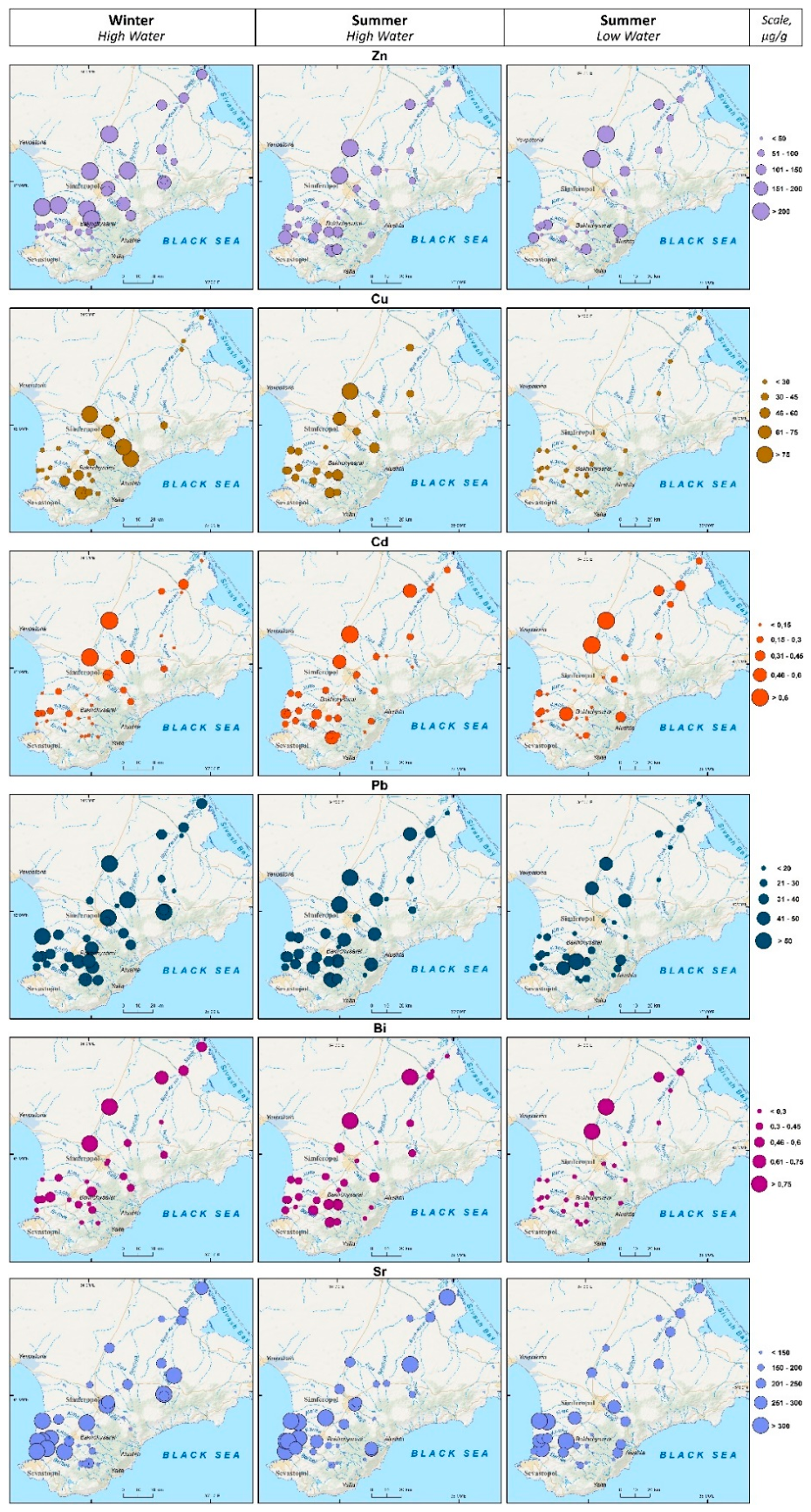
Figure 7.
Enrichment factors EF of heavy metals and metalloids in suspended matter.
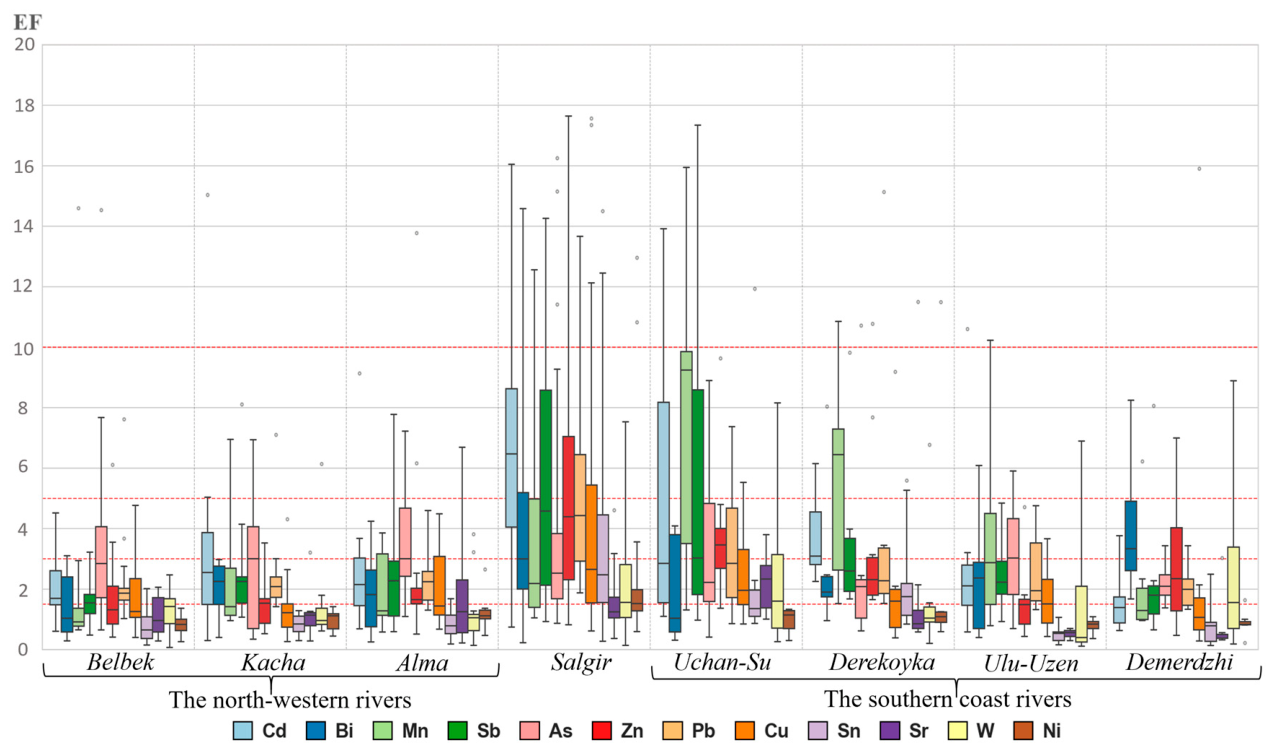
Figure 8.
Correlation coefficients between trace HMMs concentrations and river water turbidity: (a) Kacha; (b) Salgir.
Figure 8.
Correlation coefficients between trace HMMs concentrations and river water turbidity: (a) Kacha; (b) Salgir.
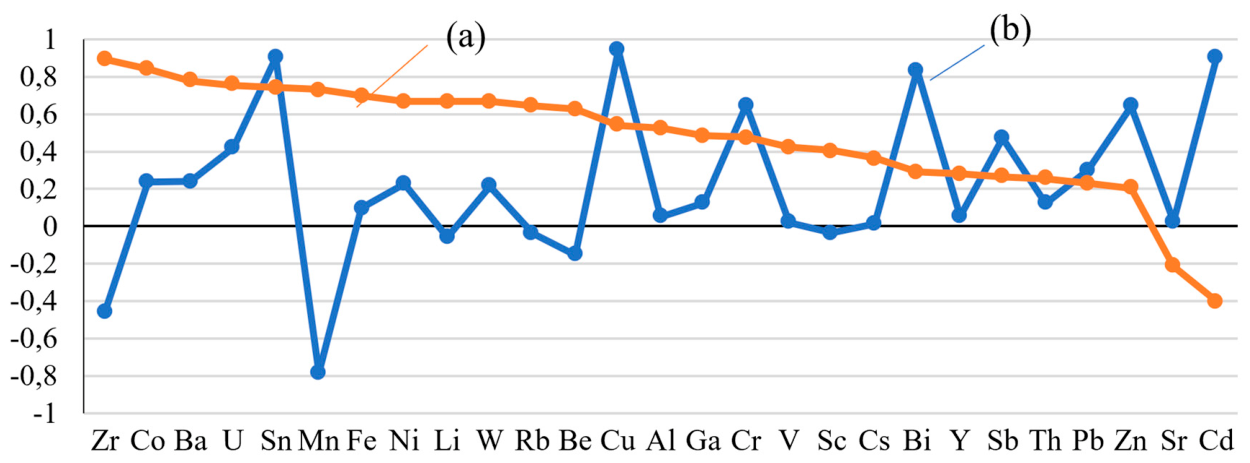
Figure 9.
DS matrix for average HMM contents in the rivers of northern Crimea (a) and along the Salgir River (b). Values indicate the percentage of suspended forms to total (dissolved + suspended) content
Figure 9.
DS matrix for average HMM contents in the rivers of northern Crimea (a) and along the Salgir River (b). Values indicate the percentage of suspended forms to total (dissolved + suspended) content
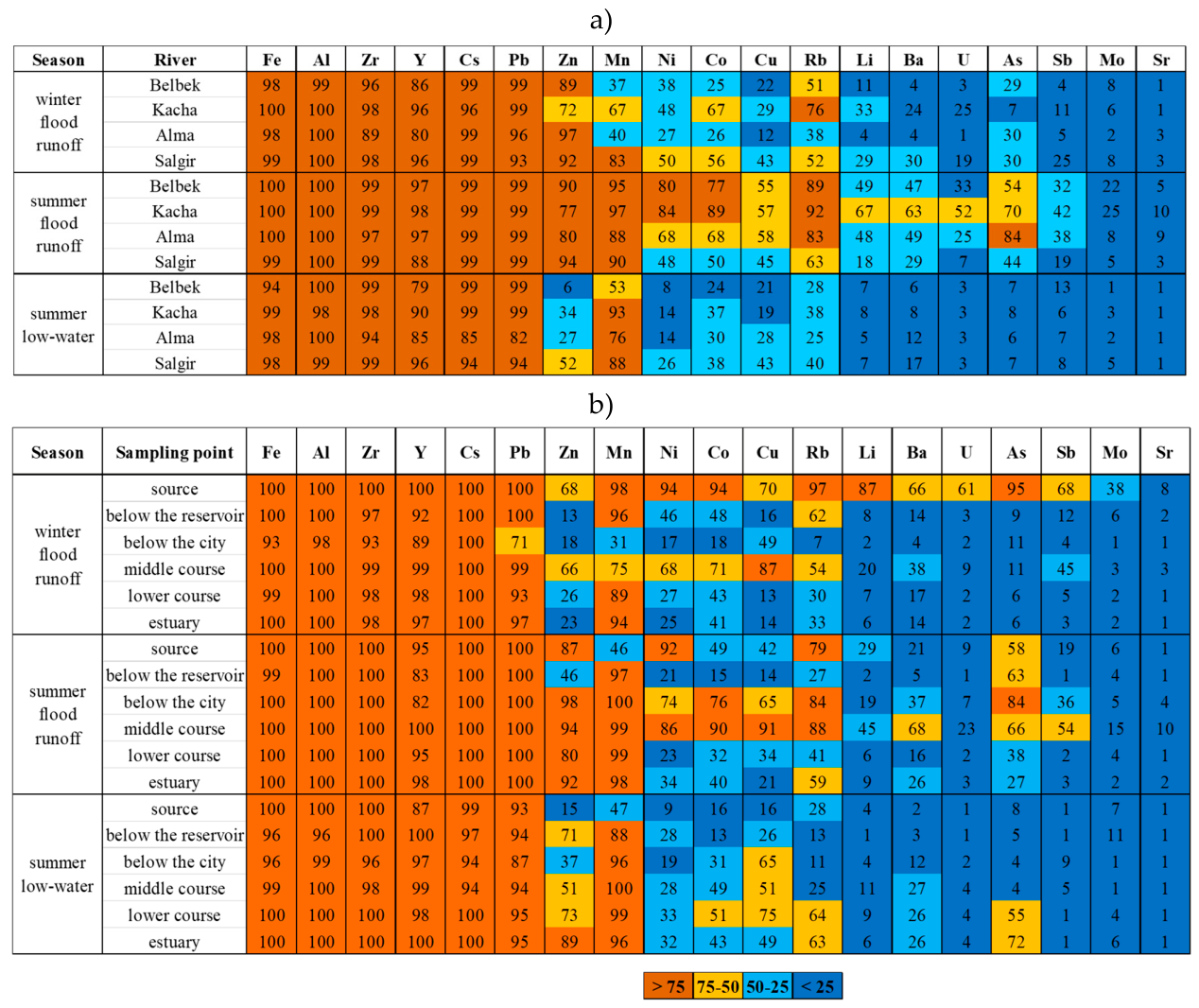
Figure 10.
Source contributions to metals and metalloids content in the suspended matter.
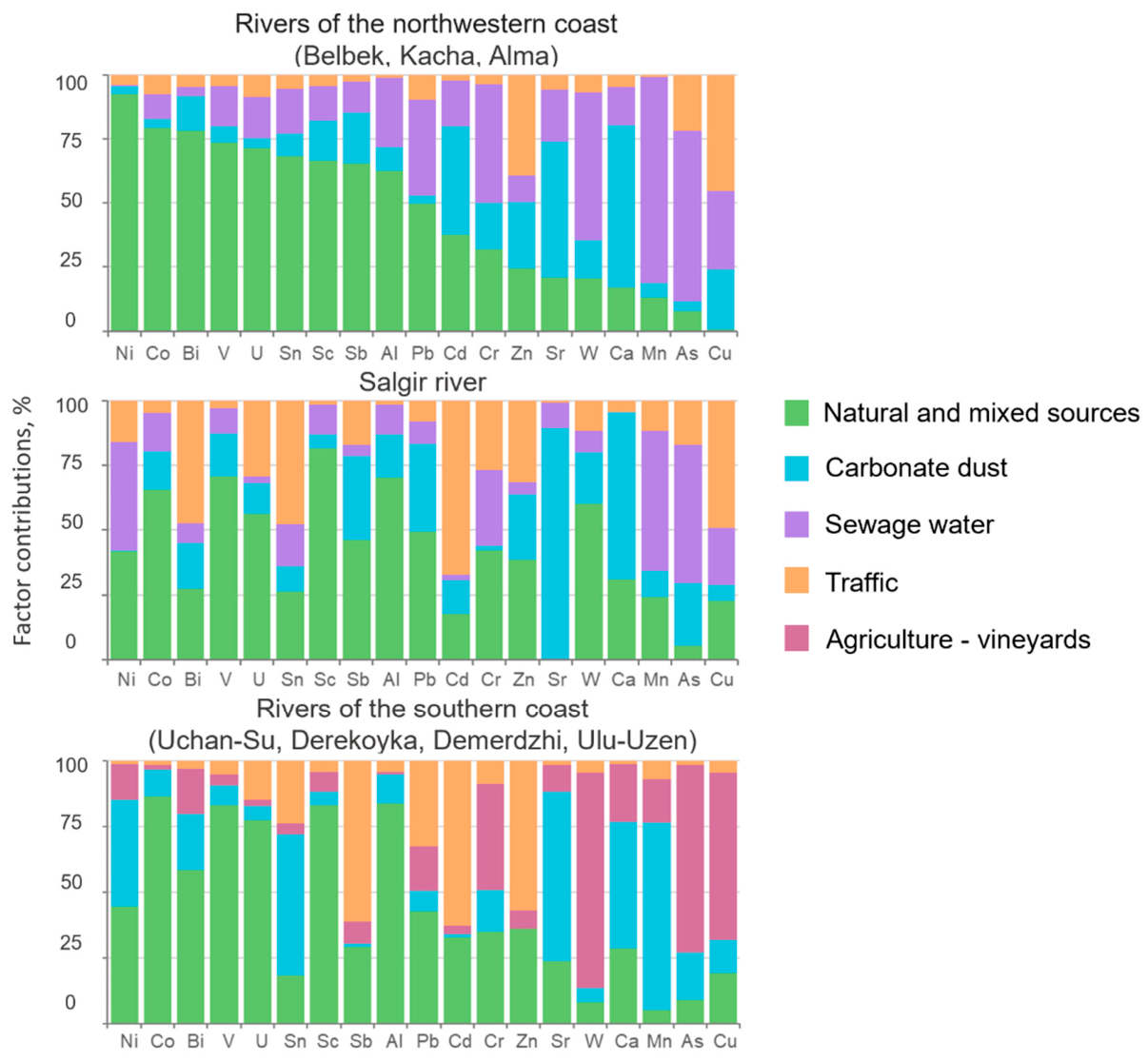

Table 1.
Dissolved forms of chemical elements and regional geochemical background of Crimean rivers (µg/L).
Table 1.
Dissolved forms of chemical elements and regional geochemical background of Crimean rivers (µg/L).
| Element | Li | B | P | Mn | Co | Ni | Cu | Zn | As | Br | Rb | Sr | Mo | Cd | Sb | Ba | Pb | U |
|---|---|---|---|---|---|---|---|---|---|---|---|---|---|---|---|---|---|---|
| Belbek (18)* | ||||||||||||||||||
| Mean | 4.0 | 63 | 6 | 3.0 | 0.17 | 0.89 | 0.96 | 2.0 | 0.44 | 35 | 0.56 | 380 | 0.21 | 0.014 | 0.08 | 26 | 0.013 | 0.5 |
| Median | 3.2 | 58 | 6 | 2.7 | 0.17 | 0.93 | 0.73 | 1.2 | 0.29 | 30 | 0.57 | 339 | 0.15 | 0.006 | 0.06 | 25 | 0.010 | 0.4 |
| Min | 1.4 | 14 | 4 | 0.3 | 0.12 | 0.05 | 0.10 | 0.1 | 0.05 | 18 | 0.29 | 216 | 0.04 | 0.001 | 0.03 | 10 | 0.005 | 0.2 |
| Max | 8.3 | 169 | 6 | 8.9 | 0.25 | 2.71 | 2.68 | 8.8 | 1.12 | 82 | 0.95 | 837 | 0.70 | 0.046 | 0.16 | 49 | 0.025 | 1.0 |
| V** (%) | 52 | 63 | 22 | 81 | 23 | 76 | 70 | 125 | 86 | 52 | 32 | 41 | 80 | 108 | 62 | 39 | 64 | 53 |
| Kacha (21) | ||||||||||||||||||
| Mean | 3.9 | 60 | 34 | 4.6 | 0.15 | 1.15 | 1.90 | 8.0 | 0.96 | 53 | 0.64 | 394 | 0.63 | 0.038 | 0.11 | 21 | 0.021 | 0.5 |
| Median | 2.3 | 64 | 6 | 1.4 | 0.15 | 1.07 | 1.21 | 1.9 | 0.83 | 29 | 0.59 | 297 | 0.22 | 0.017 | 0.12 | 19 | 0.010 | 0.2 |
| Min | 1.1 | 1 | 4 | 0.1 | 0.06 | 0.10 | 0.10 | 0.1 | 0.05 | 3 | 0.16 | 132 | 0.04 | 0.004 | 0.02 | 5 | 0.005 | 0.1 |
| Max | 10.6 | 142 | 158 | 19.4 | 0.22 | 2.42 | 9.63 | 34.1 | 2.99 | 270 | 1.34 | 993 | 2.62 | 0.370 | 0.18 | 38 | 0.110 | 1.4 |
| V (%) | 67 | 61 | 136 | 116 | 30 | 43 | 128 | 133 | 66 | 119 | 51 | 64 | 111 | 202 | 49 | 53 | 116 | 86 |
| Alma (14) | ||||||||||||||||||
| Mean | 6.0 | 82 | 39 | 5.5 | 0.18 | 1.01 | 1.83 | 3.8 | 0.34 | 80 | 0.54 | 528 | 0.41 | 0.006 | 0.08 | 26 | 0.017 | 1.2 |
| Median | 5.5 | 80 | 6 | 0.9 | 0.21 | 0.90 | 1.36 | 0.3 | 0.15 | 58 | 0.60 | 463 | 0.36 | 0.004 | 0.09 | 24 | 0.025 | 0.9 |
| Min | 1.3 | 5 | 4 | 0.0 | 0.05 | 0.05 | 0.10 | 0.1 | 0.05 | 3 | 0.19 | 147 | 0.04 | 0.001 | 0.02 | 8 | 0.005 | 0.1 |
| Max | 15.8 | 177 | 104 | 24.1 | 0.27 | 2.19 | 11.10 | 22.9 | 1.01 | 289 | 0.93 | 1048 | 1.65 | 0.022 | 0.13 | 50 | 0.025 | 3.0 |
| V (%) | 69 | 63 | 106 | 129 | 38 | 61 | 145 | 172 | 97 | 99 | 42 | 44 | 103 | 90 | 50 | 56 | 54 | 86 |
| Salgir (34) | ||||||||||||||||||
| Mean | 15.5 | 86 | 129 | 9.6 | 0.23 | 1.59 | 2.09 | 4.7 | 0.78 | 136 | 0.96 | 563 | 1.28 | 0.010 | 0.19 | 45 | 1.075 | 3.4 |
| Median | 15.9 | 83 | 32 | 4.2 | 0.20 | 1.30 | 2.11 | 2.4 | 0.71 | 104 | 0.60 | 456 | 0.80 | 0.005 | 0.15 | 43 | 0.025 | 3.1 |
| Min | 0.7 | 2 | 3 | 0.1 | 0.02 | 0.05 | 0.25 | 0.1 | 0.08 | 15 | 0.08 | 80 | 0.01 | 0.001 | 0.02 | 9 | 0.005 | 0.1 |
| Max | 37.2 | 257 | 873 | 101.4 | 0.71 | 3.92 | 5.53 | 18.2 | 1.97 | 406 | 2.80 | 1103 | 10.6 | 0.033 | 0.53 | 84 | 6.900 | 11.5 |
| V (%) | 67 | 62 | 185 | 189 | 65 | 77 | 57 | 116 | 74 | 88 | 84 | 56 | 146 | 86 | 72 | 36 | 200 | 80 |
| Derekoyka (13) | ||||||||||||||||||
| Mean | 2.9 | 19 | 9 | 2.0 | 0.13 | 0.61 | 1.03 | 2.4 | 0.09 | 28 | 0.39 | 506 | 0.17 | 0.009 | 0.06 | 18 | 0.198 | 0.3 |
| Median | 2.6 | 16 | 3 | 0.9 | 0.14 | 0.47 | 0.98 | 1.0 | 0.05 | 19 | 0.39 | 411 | 0.17 | 0.006 | 0.03 | 18 | 0.120 | 0.3 |
| Min | 1.5 | 2 | 3 | 0.2 | 0.00 | 0.12 | 0.25 | 0.1 | 0.05 | 9 | 0.21 | 182 | 0.09 | 0.004 | 0.01 | 10 | 0.025 | 0.2 |
| Max | 5.4 | 51 | 32 | 6.9 | 0.22 | 1.65 | 2.22 | 10.3 | 0.29 | 117 | 0.53 | 1093 | 0.38 | 0.031 | 0.18 | 29 | 0.730 | 0.5 |
| V (%) | 38 | 64 | 127 | 106 | 45 | 75 | 59 | 126 | 92 | 98 | 26 | 52 | 45 | 82 | 89 | 28 | 107 | 22 |
| Uchan-Su (10) | ||||||||||||||||||
| Mean | 5.2 | 38 | 23 | 1.0 | 0.14 | 0.72 | 1.18 | 3.0 | 0.17 | 30 | 0.53 | 1073 | 0.16 | 0.009 | 0.10 | 21 | 0.608 | 0.3 |
| Median | 4.7 | 36 | 18 | 0.7 | 0.16 | 0.48 | 1.43 | 1.5 | 0.11 | 31 | 0.58 | 941 | 0.16 | 0.005 | 0.10 | 19 | 0.145 | 0.3 |
| Min | 4.2 | 22 | 3 | 0.1 | 0.02 | 0.25 | 0.10 | 0.1 | 0.05 | 15 | 0.22 | 582 | 0.04 | 0.004 | 0.02 | 15 | 0.025 | 0.1 |
| Max | 7.3 | 58 | 70 | 3.2 | 0.20 | 1.42 | 2.65 | 12.5 | 0.44 | 42 | 0.71 | 1929 | 0.25 | 0.034 | 0.19 | 30 | 4.020 | 0.4 |
| V (%) | 22 | 28 | 95 | 101 | 47 | 64 | 64 | 122 | 83 | 35 | 26 | 46 | 45 | 100 | 57 | 23 | 190 | 23 |
| Demerdzhi (11) | ||||||||||||||||||
| Mean | 3.3 | 72 | 76 | 5.4 | 0.13 | 1.33 | 1.31 | 2.7 | 0.14 | 43 | 0.60 | 437 | 0.11 | 0.006 | 0.04 | 17 | 0.819 | 0.4 |
| Median | 3.1 | 71 | 4 | 1.6 | 0.12 | 1.34 | 1.13 | 1.6 | 0.05 | 43 | 0.47 | 446 | 0.10 | 0.004 | 0.03 | 16 | 0.440 | 0.4 |
| Min | 2.6 | 42 | 4 | 0.1 | 0.00 | 0.25 | 0.67 | 0.5 | 0.05 | 4 | 0.34 | 270 | 0.10 | 0.004 | 0.03 | 9 | 0.025 | 0.2 |
| Max | 4.6 | 105 | 726 | 23.7 | 0.25 | 2.30 | 2.35 | 11.6 | 0.56 | 120 | 1.94 | 708 | 0.18 | 0.020 | 0.11 | 32 | 5.140 | 0.7 |
| V (%) | 18 | 20 | 273 | 129 | 51 | 46 | 37 | 118 | 118 | 71 | 72 | 26 | 23 | 82 | 68 | 35 | 171 | 40 |
| Ulu-Usen (12) | ||||||||||||||||||
| Mean | 2.3 | 33 | 20 | 1.0 | 0.08 | 0.94 | 0.47 | 0.9 | 0.37 | 35 | 0.27 | 378 | 0.09 | 0.004 | 0.05 | 12 | 0.858 | 0.3 |
| Median | 2.3 | 26 | 18 | 0.9 | 0.09 | 0.98 | 0.25 | 0.6 | 0.40 | 26 | 0.24 | 358 | 0.10 | 0.004 | 0.03 | 12 | 0.170 | 0.3 |
| Min | 1.3 | 13 | 4 | 0.1 | 0.00 | 0.25 | 0.10 | 0.1 | 0.05 | 4 | 0.16 | 256 | 0.04 | 0.004 | 0.00 | 9 | 0.025 | 0.2 |
| Max | 4.5 | 80 | 52 | 3.1 | 0.19 | 1.97 | 1.31 | 2.3 | 1.30 | 96 | 0.49 | 498 | 0.17 | 0.005 | 0.14 | 16 | 3.790 | 0.4 |
| V (%) | 91 | 83 | 6 | 42 | 38 | 87 | 70 | 21 | 74 | 85 | 37 | 30 | 151 | 22 | 60 | 73 | 85 | 22 |
| Regional background (20) | ||||||||||||||||||
| Mean | 4.2 | 48 | 22 | 3.8 | 0.15 | 0.62 | 1.24 | 4.7 | 0.52 | 24 | 0.41 | 308 | 0.13 | 0.01 | 0.06 | 24 | 0.07 | 0.4 |
| Global river averages** | ||||||||||||||||||
| World rivers*** | 1.8 | 10 | 20 | 34 | 0.15 | 0.8 | 1.48 | 0.6 | 0.62 | 20 | 1.63 | 60 | 0.42 | 0.08 | 0.07 | 23 | 0.08 | 0.37 |
Table 2.
Suspended forms of chemical elements and the regional geochemical background of Crimean rivers (µg/g).
Table 2.
Suspended forms of chemical elements and the regional geochemical background of Crimean rivers (µg/g).
| Element | V | Cr | Mn | Co | Ni | Cu | Zn | As | Sr | Cd | Sn | Sb | W | Pb | Bi | U |
|---|---|---|---|---|---|---|---|---|---|---|---|---|---|---|---|---|
| Belbek (13)* | ||||||||||||||||
| Mean | 99 | 115 | 997 | 10 | 35 | 38 | 84 | 13 | 248 | 0.15 | 1.6 | 0.6 | 2.0 | 30 | 0.21 | 2.6 |
| Median | 87 | 110 | 718 | 10 | 39 | 35 | 76 | 15 | 218 | 0.14 | 0.9 | 0.5 | 2.0 | 29 | 0.12 | 2.7 |
| Min | 46 | 40 | 315 | 0 | 5 | 11 | 27 | 3 | 129 | 0.05 | 0.2 | 0.1 | 0.1 | 12 | 0.04 | 1.0 |
| Max | 189 | 226 | 3899 | 19 | 70 | 73 | 151 | 24 | 407 | 0.28 | 3.7 | 1.0 | 3.5 | 49 | 0.59 | 4.5 |
| V (%) | 43 | 46 | 88 | 44 | 55 | 49 | 49 | 48 | 35 | 52 | 83 | 51 | 41 | 40 | 89 | 36 |
| Kacha (15) | ||||||||||||||||
| Mean | 105 | 102 | 1327 | 13 | 42 | 30 | 78 | 10 | 278 | 0.23 | 1.6 | 1.0 | 2.1 | 34 | 0.31 | 2.8 |
| Median | 108 | 79 | 1070 | 13 | 42 | 31 | 79 | 9 | 279 | 0.19 | 1.7 | 0.7 | 2.0 | 35 | 0.38 | 3.1 |
| Min | 64 | 55 | 842 | 9 | 10 | 5 | 32 | 2 | 136 | 0.04 | 0.3 | 0.4 | 0.8 | 18 | 0.03 | 1.1 |
| Max | 151 | 196 | 3726 | 19 | 72 | 58 | 125 | 19 | 428 | 0.56 | 3.3 | 4.9 | 5.6 | 58 | 0.47 | 4.1 |
| V (%) | 24 | 47 | 56 | 18 | 34 | 47 | 30 | 59 | 29 | 59 | 45 | 112 | 49 | 29 | 47 | 30 |
| Alma (12) | ||||||||||||||||
| Mean | 100 | 65 | 2507 | 11 | 41 | 36 | 157 | 14 | 342 | 0.15 | 1.5 | 0.6 | 1.7 | 28 | 0.22 | 2.7 |
| Median | 102 | 68 | 1100 | 12 | 44 | 34 | 89 | 14 | 334 | 0.15 | 0.8 | 0.7 | 1.8 | 28 | 0.16 | 2.9 |
| Min | 31 | 18 | 251 | 3 | 12 | 9 | 19 | 4 | 50 | 0.04 | 0.2 | 0.1 | 0.1 | 10 | 0.02 | 0.9 |
| Max | 206 | 114 | 12918 | 18 | 79 | 71 | 520 | 30 | 606 | 0.27 | 4.4 | 1.2 | 3.3 | 57 | 0.56 | 4.6 |
| V (%) | 52 | 49 | 134 | 33 | 50 | 46 | 108 | 48 | 53 | 49 | 91 | 42 | 55 | 48 | 74 | 44 |
| Salgir (39) | ||||||||||||||||
| Mean | 72 | 74 | 2163 | 11 | 44 | 53 | 183 | 9 | 237 | 0.48 | 3.9 | 1.3 | 2.4 | 48 | 1.16 | 2.3 |
| Median | 69 | 66 | 1003 | 10 | 38 | 37 | 183 | 7 | 226 | 0.45 | 3.1 | 1.0 | 1.5 | 39 | 0.30 | 2.5 |
| Min | 24 | 8 | 376 | 4 | 6 | 6 | 22 | 2 | 134 | 0.04 | 0.1 | 0.1 | 0.0 | 9 | 0.02 | 0.9 |
| Max | 195 | 307 | 24227 | 34 | 223 | 239 | 566 | 39 | 708 | 1.23 | 15.9 | 4.3 | 10.9 | 136 | 9.13 | 3.9 |
| V (%) | 47 | 62 | 184 | 47 | 76 | 91 | 65 | 82 | 43 | 71 | 90 | 83 | 101 | 67 | 179 | 33 |
| Derekoyka (10) | ||||||||||||||||
| Mean | 85 | 69 | 3323 | 10 | 45 | 29 | 142 | 6 | 256 | 0.38 | 3.7 | 1.5 | 1.5 | 32 | 0.24 | 1.7 |
| Median | 100 | 84 | 3367 | 12 | 49 | 29 | 137 | 6 | 204 | 0.26 | 3.2 | 1.0 | 1.6 | 30 | 0.26 | 2.0 |
| Min | 31 | 15 | 861 | 4 | 8 | 10 | 31 | 3 | 191 | 0.15 | 1.3 | 0.6 | 0.4 | 15 | 0.08 | 0.5 |
| Max | 128 | 112 | 5011 | 15 | 95 | 56 | 315 | 11 | 650 | 1.31 | 9.1 | 4.9 | 2.3 | 45 | 0.37 | 2.4 |
| V (%) | 38 | 43 | 43 | 34 | 52 | 52 | 51 | 45 | 52 | 84 | 57 | 82 | 38 | 28 | 38 | 33 |
| Uchan-Su (8) | ||||||||||||||||
| Mean | 75 | 70 | 3504 | 9 | 28 | 35 | 153 | 7 | 386 | 0.23 | 2.7 | 1.2 | 2.3 | 29 | 0.19 | 1.6 |
| Median | 82 | 66 | 4141 | 9 | 29 | 40 | 140 | 8 | 334 | 0.14 | 2.2 | 0.7 | 1.9 | 25 | 0.08 | 1.7 |
| Min | 41 | 42 | 803 | 5 | 7 | 18 | 53 | 1 | 250 | 0.05 | 0.6 | 0.3 | 0.3 | 11 | 0.03 | 0.3 |
| Max | 101 | 116 | 5761 | 12 | 48 | 50 | 309 | 14 | 717 | 0.59 | 8.3 | 2.4 | 7.4 | 53 | 0.52 | 3.0 |
| V (%) | 31 | 31 | 58 | 30 | 52 | 30 | 57 | 52 | 37 | 78 | 83 | 75 | 93 | 51 | 99 | 54 |
| Demerdzhi(7) | ||||||||||||||||
| Mean | 105 | 90 | 990 | 12 | 32 | 31 | 140 | 11 | 128 | 0.19 | 1.1 | 0.6 | 2.9 | 28 | 0.58 | 1.6 |
| Median | 117 | 90 | 876 | 12 | 38 | 28 | 128 | 12 | 124 | 0.16 | 0.7 | 0.6 | 2.0 | 29 | 0.45 | 1.8 |
| Min | 13 | 79 | 541 | 2 | 9 | 9 | 30 | 6 | 104 | 0.05 | 0.3 | 0.2 | 0.3 | 7 | 0.06 | 0.3 |
| Max | 140 | 99 | 1725 | 17 | 46 | 63 | 385 | 17 | 169 | 0.41 | 2.3 | 0.9 | 7.5 | 39 | 1.39 | 2.1 |
| V (%) | 37 | 6 | 35 | 38 | 45 | 57 | 79 | 32 | 16 | 67 | 68 | 39 | 77 | 38 | 70 | 37 |
| Ulu-Uzen (8) | ||||||||||||||||
| Mean | 99 | 100 | 2282 | 13 | 31 | 37 | 92 | 12 | 132 | 0.24 | 0.9 | 0.8 | 2.6 | 37 | 0.33 | 1.5 |
| Median | 106 | 95 | 1859 | 11 | 36 | 26 | 79 | 10 | 138 | 0.16 | 0.9 | 0.8 | 0.6 | 34 | 0.34 | 1.6 |
| Min | 38 | 33 | 247 | 6 | 12 | 15 | 17 | 4 | 68 | 0.03 | 0.2 | 0.3 | 0.2 | 7 | 0.02 | 0.6 |
| Max | 126 | 156 | 5619 | 20 | 53 | 81 | 245 | 22 | 169 | 0.89 | 2.3 | 1.5 | 10.3 | 63 | 0.70 | 2.4 |
| V (%) | 26 | 36 | 73 | 35 | 48 | 65 | 74 | 57 | 22 | 108 | 67 | 53 | 137 | 49 | 75 | 32 |
| Regional background (10) | ||||||||||||||||
| Mean | 130 | 106 | 1073 | 14 | 49 | 47 | 83 | 12 | 156 | 0.15 | 1.62 | 0.8 | 2.3 | 38 | 0.36 | 3.2 |
| Upper continental crust [29] | ||||||||||||||||
| Abundance | 97 | 92 | 775 | 17 | 47 | 28 | 67 | 5 | 320 | 0.09 | 2.1 | 0.4 | 1.9 | 17 | 0.16 | 2.7 |
| Shale [72] | ||||||||||||||||
| Abundance | 120 | 110 | 800 | 19 | 49 | 36 | 89 | 9 | 240 | 0.91 | 3.5 | 1.3 | 2.6 | 14 | 0.38 | 4.3 |
| Global rivers’averages [30] | ||||||||||||||||
| Abundance | 129 | 130 | 1679 | 23 | 75 | 76 | 208 | 36 | 187 | 1.55 | 4.57 | 2.19 | 2 | 61 | 0.85 | 3.3 |
| Unpolluted rivers worldwide [31] | ||||||||||||||||
| Abundance | 120 | 85 | 1150 | 19 | 50 | 45 | 130 | 14 | 150 | 0.5 | 2.9 | 1.4 | 1.4 | 25 | 0.29 | 2.4 |
Disclaimer/Publisher’s Note: The statements, opinions and data contained in all publications are solely those of the individual author(s) and contributor(s) and not of MDPI and/or the editor(s). MDPI and/or the editor(s) disclaim responsibility for any injury to people or property resulting from any ideas, methods, instructions or products referred to in the content. |
© 2026 by the authors. Licensee MDPI, Basel, Switzerland. This article is an open access article distributed under the terms and conditions of the Creative Commons Attribution (CC BY) license (http://creativecommons.org/licenses/by/4.0/).
Copyright: This open access article is published under a Creative Commons CC BY 4.0 license, which permit the free download, distribution, and reuse, provided that the author and preprint are cited in any reuse.


