

Submitted:
27 April 2026
Posted:
28 April 2026
You are already at the latest version
Abstract
Sandy beaches in the Central Region of Veracruz (RCV) face constant anthropogenic pressure from port and urban activities. This study aimed to evaluate total hydrocar-bon (TH) concentrations in the intertidal interstitial water of five beaches in the RCV, analyzing their variability by depth (15 and 30 cm) and seasonality (northerly winds, dry, and rainy seasons). TH determination was performed using gas chromatography (GC-FID), following the NMX-AA-117-SCFI-2001 and NOM-138-SEMARNAT/SSA1-2012 standards. Results showed concentrations ranging from 0.86 to 6.53 µg L⁻¹. Significant spatial differences were identified (p < 0.05); An-tepuerto beach presented the highest levels due to its proximity to the port, while Far-allón showed the lowest concentrations, confirming its role as a reference site. No sig-nificant variations were detected by depth or season (p > 0.05), indicating temporal stability associated with continuous anthropogenic inputs. Although levels comply with Mexican regulations, the continuous presence of TH represents a potential risk to benthic biota and the integrity of the Veracruz Reef System (SAV). This study pro-vides a critical baseline for strengthening coastal ecosystem management strategies in the Gulf of Mexico.
Keywords:
interstitial water
; intertidal zone
; total hydrocarbons
; anthropogenic pressure
; Gulf of Mexico
1. Introduction
The Gulf of Mexico is a region of high ecological and economic relevance due to the heterogeneity of its coastal systems [1]. On the coast of Veracruz, this environmental diversity has led to the development of urban settlements linked to port, industrial and tourist activities [2]. Particularly in the Central Region of Veracruz (RCV), these activities exert constant anthropogenic pressure on sandy beaches.
These ecosystems are dynamic and provide critical ecosystem services; they function as factors of tourism and recreational production, in addition to being vital sites for the nesting, feeding and reproduction of various species [3]. However, the coast between Punta Gorda and Antón Lizardo is characterized by the presence of sland lands that alter the natural sedimentary dynamics by disipating the energy of the waves, favoring the deposit of fine materials and sludge, which increases the vulnerability of these sites to the accumulation of pollutants [4,5].
Within the coastal morphology, the intertidal zone constitutes an environment of land-sea transition controlled by tides, waves and currents [6]. In the RCV, this area is impacted by structural modifications that have decreased its natural purification capacity [7]. In this context, total hydrocarbons (HT) emerge as key indicators of pollution, derived from natural filtration, accidental spills, urban runoff, wastewater and naval activities [8,9].
The dynamics of HTs in the marine environment is complex: although some compounds are degraded by microorganisms [10], persistent fractions are associated with suspended particles, flocculate and sediment towards the water-sediment interface [11]. By integrating into the interstitial medium, these pollutants become bioavailable, with a high potential for bioaccumulation in lipid tissues of the benthic biota and latent risks to human health [12,13]. Recent studies have indicated that hydrocarbons in urbanized coastal areas have a high spatial and temporal variability, associated with land discharges and port activities [14,15].
Previous studies in the RCV have identified punctual and non-punct sources of pollution, including waste deposits, rainwater drains and wastewater discharges linked to port and urban growth [16]. Despite its importance, there is a lack of information on the seasonal variability of hydrocarbons in the interstitial water of these beaches.
Therefore, the objective of this study was to evaluate the concentrations of total hydrocarbons in the interstitial water of the intertide zone on five beaches of the RCV, analyzing their variation according to the depth (15 and 30 cm) and the climatic seasons (north, rain and rain). This study seeks to generate a baseline that contributes to the strengthening of management and protection strategies for these coastal ecosystems.
2. Materials and Methods
2.1. Study Area and Climatic Context
The study was carried out on five sandy beaches of the Central Region of Veracruz Antepuerto (Puerto de Veracruz), Villa del Mar (Veracruz), Mocambo (Boca del Río), Arroyo Giote (Alvarado) and Farallón (Actopan), the latter used as a reference site (Figure 1). The stations were selected based on their distance from the port of Veracruz and the degree of anthropogenic pressure and marine dynamics to which they are subject.
The climatic seasonality of the region is divided into three periods: dry (February to May), rains (June to October), characterized by tropical depressions, and nortes (October to February), defined by cold fronts and intense winds [17].
2.2. Sampling Design
The intertidal zone was delimited considering the supraplaya, mesoplaya and infraplaya (Figure 2), an area governed by a semi-day tide regime (two high tides and two low tides every 12 hours). The sampling was carried out during the months of February, May and September, selecting the days with the least tide variation according to the official tables, in a schedule from 06:00 to 11:00 h.
A sampling site was established on each beach with three transects perpendicular to the coastline, separated by 5 m from each other (Figure 3). In each transect there were three stations corresponding to the intertial limits mentioned. Two samples of 50 mL of interstitial water were collected at two depths: 15 and 30 cm, obtaining a total of 90 samples (18 for each beach).
2.3. Sample Collection and Preservation
To obtain the interstitial water, a metal nucleator (20 cm in diameter x 40 cm high) was used to extract a sediment core, generating a vacuum that allowed the water to emerge. This was collected with 100 mL syringes and transferred to previously labeled amber glass jars.
In the laboratory, the samples were preserved following the NMX-AA-117-SCFI-2001 standard [18], adjusting the pH to ≤ 2 by adding HCl 1:1. Subsequently, they were filtered using a vacuum pump and glass microfiber filters (Whatman, 55 mm) to remove suspended solids.
2.4. Chemical Analysis and Hydrocarbon Extraction
The determination of total hydrocarbons was carried out by gas chromatography with flame ionization detector (GC-FID), in accordance with the provisions of NOM-138-SEMARNAT/SSA1-2012 [19].
The sample extraction was carried out using recovery columns; for Fraction I, 50 mL of hexane was used, while for Fraction II a mixture of hexane-dichloromethane was used (1:1, v/v). Subsequently, the extracts were concentrated in a rota evaporator at 60 °C and 30 rpm until reaching an approximate volume of 2 mL.
The quantification was carried out by analysis in a gas chromatograph equipped with a flame ionization detector (FID). The technical specifications of the chromatographic system are presented in the Table 1.
2.5. Statistical Analysis
The data were processed using descriptive and analytical statistics. The normality of the concentrations was verified and the Student's t test was applied to compare differences between depths (15 vs. 30 cm). To evaluate the variability between beaches and climatic seasons, a one-factor variance analysis (ANOVA) was carried out. Subsequently, Tukey's multiple comparison test was applied to identify specific differences between groups. All analyses were performed with a significance level of α = 0.05, using the software Statistica 8.0 (StatSoft, Inc., Tulsa, OK, USA) and Microsoft Excel (Microsoft Corp., Redmond, WA, USA).
3. Results
The concentrations of total hydrocarbons (HT) in the interstitial water of the intertide zone showed a moderate spatial and temporal variation among the beaches studied. The values ranged between 0.86 and 6.53 μg L−¹ (Table 2), without exceeding the maximum permissible limits established in NOM-138-SEMARNAT/SSA1-2012, used as a technical reference to evaluate the presence of these compounds in the sediment-water matrix, in the absence of specific regulations in Mexico for hydrocarbons in interstitial beach water.
The average values and their standard deviation by beach, season and depth are presented in Table 2. In general, the concentrations remained within the range observed for the set of beaches, with punctual variations between sites and sampling seasons.
Globally, the average concentrations were similar between depths (15 and 30 cm), as well as between climatic seasons, with no statistically significant differences (p > 0.05). However, variations were observed in the maximum values and in the dispersion of the data, which shows a heterogeneity in the distribution of hydrocarbons in the interstitial system.
In particular, some records showed concentrations close to 0 μg L−¹, while others reached values above 5 μg L−¹, showing variability within each beach.
3.1. Variation with Depth
In the rainy season, there was a slight increase in the average concentrations of HT at a depth of 15 cm, compared to the northern and rainy seasons. In contrast, at 30 cm deep, the concentrations tended to be lower during the rainy season compared to the other seasons evaluated.
In general terms, the average concentrations were similar between both depths (15 and 30 cm), without showing a consistent pattern of increase or decrease associated with the depth.
No statistically significant differences were observed between depths (Student's t, p > 0.05), indicating that the variation in HT concentration does not depend on the sampling depth on the evaluated scale.
The data showed a moderate dispersion in both depths, with the presence of minimum values close to zero and maximum values greater than 5 μg L−¹, which reflects heterogeneity in the distribution of hydrocarbons within the intertide system, with superposition of interquartile and median ranges between depths (Figure 4).
3.2. Temporal Variation
No statistically significant differences were observed in the concentration of hydrocarbons between climatic seasons (ANOVA, p > 0.05), indicating a relative temporal stability in the levels recorded during the study period.
Although there were occasional variations between sampling seasons, they did not follow a consistent pattern associated with a specific season. In general terms, there was a slight trend of increasing concentrations during the rainy season, without this difference being statistically significant.
4.3. Spatial Variability Between Beaches
At the spatial level, statistically significant differences were observed in the concentration of total hydrocarbons between beaches (ANOVA, p < 0.05).
Antepuerto beach presented the highest concentrations, reaching values of up to 6.53 μg L−¹, while Farallón showed the lowest levels, reflecting a clear contrast between sites.
The multiple comparison analysis (Tukey, p < 0.05) indicated that Farallón presented significantly lower concentrations compared to Antepuerto, Villa del Mar, Mocambo and Arroyo Giote, while no significant differences were detected between the latter.
The spatial distribution of the concentrations shows variations between the beaches evaluated, where a greater variability of the sites with greater anthropogenic influence and lower and consistent values in the reference sites is observed (Figure 5).
The analysis of the beach × season interaction showed that Farallón maintained consistently lower concentrations in all seasons (p < 0.05), while the other beaches presented similar values regardless of the time of year.
3.4. General System Trend
Overall, the results indicate that spatial variability has a greater weight than temporal and depth variability in the distribution of total hydrocarbons. The highest concentrations were associated with sites with greater urban and port activity, while the lowest values corresponded to areas with less anthropogenic intervention, evidencing a gradient associated with environmental pressure.
4. Discussion
4.1. Influence of Geomorphology and Anthropogenic Activity
The highest concentrations recorded on Antepuerto beach (6.53 µg L−¹) contrast significantly with the minimum levels of Farallón (0.86 µg L−¹). This gradient responds directly to what was proposed by Hidalgo et al. [3], who identify an increase in pollutants as the proximity to the urban and port centers of the central region of Veracruz increases.
Antepuerto beach, being a partially confined area and adjacent to industrial activity, has a reduced hydrodynamics. According, with Salas-Pérez and Granados-Barba [17] the configuration of the currents and the presence of infrastructure such as espills alter the natural dispersion of materials, this favors that hydrocarbons, which tend to be associated with fine particles and sediment [13], are trapped in the intertidal system. In contrast, the open sea nature in Farallón allows efficient self-purification through constant waves, maintaining baseline levels similar to those reported for pristine areas of the Gulf of Mexico [8].
The concentrations recorded in this study are comparable to those reported in coastal areas with moderate anthropogenic influence in different geographical contexts. Recent studies have documented that in urbanized coastal environments total hydrocarbons have similar ranges, associated with diffuse discharges, maritime traffic and port activities [14,15]. In contrast, higher concentrations have been reported in areas with direct industrial impacts or acute contamination events, suggesting that the evaluated system presents continuous pressure, but of moderate intensity.
This spatial pattern coincides with conceptual models of pollutant retention in semi-enclosed coastal systems, where the reduction of hydrodynamic energy favors the accumulation of hydrophobic compounds in the water-sediment interface, acting these areas as environmental sinks.
4.2. Temporal Dynamics and Terrestrial Contributions
Although no global statistical differences were found between seasons, the tendency to increase the surface (15 cm) during the rainy season suggests a punctual entry mechanism. This phenomenon coincides with what is described by Jiménez-Pérez et al. [16] who point out that land runoff is the main transport route of pollutants to the coastal ecosystems of Veracruz.
The increase in HT in rainfall indicates that the washing of urban areas drags oils and combustion waste to the intertide zone. However, at 30 cm deep, the relative stability of the values could be due to filtration and retention processes in the sediment matrix, where hydrocarbons tend to persist due to their low solubility in water [13]. This dynamic is consistent with what was exposed by Zaghden et al. [20], who associate these surface peaks with the phenomenon of "first flush" or first rainwash in coastal cities.
This behavior has been widely reported in coastal environments where the variability of hydrocarbons is controlled by runow events and episodic urban discharges, rather than by defined seasonal patterns [21,22]. In this sense, the absence of significant differences does not reflect environmental stability, but a complex dynamic in which pollutants are continuously mobilized and redistributed by coastal hydrodynamics.
This behavior suggests that hydrocarbon inputs in the region do not respond to strict seasonality, but to episodic pollution pulses associated with runoff events, which reinforces the importance of considering high-resolution time scales in coastal monitoring studies.
4.3. Environmental Implications and Risk in the SAV
It is essential to note that, although the values obtained comply with Mexican regulations (NOM-138-SEMARNAT/SSA1-2012), the constant presence of these compounds must be analyzed from an ecosystem perspective. As Castilla-Bertel et al. [9] point out, the persistence of hydrocarbons in interstitial water facilitates their availability for benthic biota.
Since these beaches serve as transition zones, the retention of pollutants represents a risk to the physicochemical stability of the region. Various studies have shown that the pollutants associated with sediments and interstitial water represent a key route of exposure for benthic organisms, favoring their accumulation and transfer in the trophic network [23]. This transport of pollutants to nearby reef formations could compromise the health of corals, reinforcing the need for monitoring that considers chronic toxicity beyond the legal limits in force [15].
Recent studies have shown that chronic exposure to low concentrations of hydrocarbons can generate subletal effects in marine organisms, including alterations in metabolism, oxidative stress and effects on reproductive processes [24,25]. These effects can manifest even when concentrations do not exceed the regulatory limits, which shows that regulatory criteria do not always reflect the real ecological risk. In this context, the persistent presence of hydrocarbons in interstitial water represents a continuous source of exposure for benthic biota, with potential implications for the structure and functioning of the coastal ecosystem.
In this sense, the results of this study show that, even in conditions where normative limits are not exceeded, the persistent presence of hydrocarbons reflects a continuous anthropogenic pressure that can compromise the ecological integrity of coastal systems in the long term.
This scenario highlights the need to complement regulatory approaches with assessments based on ecological risk, especially in tropical coastal systems where biodiversity and ecosystem connectivity amplify vulnerability to persistent pollutants.
Although this study provides a relevant baseline, it is recommended to develop future research that incorporates greater temporal resolution and specific analysis of sources, in order to understand in greater detail the dynamics of hydrocarbons in the region.
5. Conclusions
The analysis of the concentrations of total hydrocarbons in the interstitial water of the sandy beaches of the Central Region of Veracruz showed that spatial variability is the main factor that controls its distribution, in close relation to the degree of anthropogenic intervention. Beaches near urban and port areas showed higher concentrations, while reference sites showed low and more stable levels.
In contrast, depth and seasonality did not show a significant influence, which suggests that hydrocarbons in the intertide system respond to continuous and localized contributions, rather than to dominant temporal or vertical processes. This behavior indicates a dynamic controlled by persistent sources of pollution and coastal hydrodynamics.
Although the recorded concentrations do not exceed the regulatory limits, the constant presence of these compounds in the interstitial water shows a continuous environmental pressure. This condition represents a potential risk for the benthic biota due to processes of chronic exposure and bioaccumulation.
This study provides a relevant baseline for environmental monitoring of tropical coastal systems, highlighting the need to incorporate evaluation approaches that consider not only concentration levels, but also the persistence and long-term ecological effects of pollutants.
These results reinforce the importance of integrating pollution indicators in unconventional matrices, such as interstitial water, within environmental monitoring programs in the Gulf of Mexico.
Author Contributions
, Conceptualization, D.S.M.-V., M.R.C.-C., M.L.F.-P. and R.E.Z.-A.; methodology, D.S.M.-V. and M.L.F.-P.; software, M.L.F.-P.; validation, A.G.-B., F.L.-R., A.I.A.-E. and R.E.Z.-A.; investigation, D.S.M.-V., A.G.-B., F.L.-R., A.I.A.-E., M.L.F.-P. and R.E.Z.-A.; resources, D.S.M.-V., A.G.-B., F.L.-R. and M.R.C.-C.; writing—original draft preparation, D.S.M.-V., M.R.C.-C., M.L.F.-P. and R.E.Z.-A.; writing—review and editing, D.S.M.-V., A.G.-B., F.L.-R. and R.E.Z.-A.; visualization, F.L.-R., M.R.C.-C. and R.E.Z.-A.; supervision, A.G.-B., F.L.-R. and M.R.C.-C.; project administration, M.R.C.-C. and R.E.Z.-A. All authors have read and agreed to the published version of the manuscript.
Funding
This research received no external funding.
Data Availability Statement
The original contributions presented in the study are included in the article; further inquiries can be directed to the corresponding author.
Acknowledgments
The authors express their gratitude to the Secretaría de Ciencias, Humanidades, Tecnología e Innovación of Mexico (formerly CONAHCYT) for granting the scholarship that enabled this dissemination; as well as to the Tecnológico Nacional de México for the support and the scholarship-commission granted to complete this research.
Conflicts of Interest
The authors declare no conflicts of interest.
Abbreviations
The following abbreviations are used in this manuscript:
| ANOVA | Analysis of Variance |
| CRV | Central Region of Veracruz |
| FID | Flame Ionization Detector |
| GC | Gas Chromatography |
| GC-FID | Gas Chromatography with Flame Ionization Detector |
| HCI | Hydrochloric Acid |
| NOM | Official Mexican Standard (Norma Oficial Mexicana) |
| NMX | Mexican Standard (Norma Mexicana) |
| SAV | Veracruz Reef System (Sistema Arrecifal Veracruzano) |
| TH | total hydrocarbons |
References
- Caso, M.; Pisanty, I.; Ezcurra, E. Diagnóstico ambiental del Golfo de México. In Instituto Nacional de Ecología; Harte Research Institute for Gulf of Mexico Studies: México, 2004. [Google Scholar]
- Benseny, G. El espacio turístico litoral. Aport. Trans. 2006, 10, 102–122. [Google Scholar]
- Hidalgo, G.; Castañeda-Chávez, M.R.; Granados-Barba, A.; Brenda Elizabeth, B.E. Environmental variability of tropical sandy beaches across an anthropic gradient: The case of central Veracruz (Southwestern Gulf of Mexico). Int. J. Environ. Res. 2016, 10, 481–490. [Google Scholar]
- Ortiz-Lozano, L.; Granados-Barba, A.; Solís-Weiss, V.; García-Salgado, M. Environmental evaluation and development problems of the Mexican coastal zone. Ocean Coast. Manag. 2005, 48, 171–176. [Google Scholar] [CrossRef]
- Bernal-Ramírez, R.G.; Granados-Barba, A. Caracterización del litoral veracruzano comprendido entre Punta Gorda y Barrancones, Veracruz. Congreso Nacional de Oceanografía y II Reunión Internacional de Ciencias Marinas, Boca del Río, Veracruz, México, 2008. [Google Scholar]
- Carranza-Edwards, A.; Caso-Chávez, M. Zonificación del perfil de playa. GEO UNAM 1994, 2, 26–32. [Google Scholar]
- Ortiz-Lozano, L.D.; Arceo-Briseño, P.; Granados-Barba, A.; Salas-Monreal, D.; Jiménez-Badillo, M.D.L. Zona costera. In Diagnóstico ambiental del Golfo de México; 2010. [Google Scholar]
- Vélez, G.P.; Botello, A.V. Niveles de hidrocarburos en el Golfo de México. In Golfo de México: Contaminación e impacto ambiental; Botello, A.V., Ed.; 2005; p. 269. [Google Scholar]
- Castilla-Bertel, D.; Marrugo-Negrete, J.; Paternina-Uribe, R. Contaminación por hidrocarburos en aguas y sedimentos en la bahía de Cartagena, Colombia. Rev. Int. Contam. Ambient. 2013, 29, 123–134. [Google Scholar]
- Salleh, A.B.; Ghazali, F.M.; Rahman, R.N.A.; Basri, M. Bioremediation of petroleum hydrocarbon pollution. Indian J. Biotechnol. 2003, 2, 411–425. [Google Scholar]
- Reddy, C.M.; Quinn, J.G.; King, J.W. Fate of petroleum hydrocarbons in marine sediments: Processes and implications. Annu. Rev. Mar. Sci. 2017, 9, 69–95. [Google Scholar]
- Hong, H.; Xu, L.; Zhang, L.; Chen, J.C.; Wong, Y.S.; Wan, T.S.M. Environmental fate and chemistry of organic pollutants in sediments of Xiamen harbor and Victoria harbor. Mar. Pollut. Bull. 1995, 31, 229–236. [Google Scholar] [CrossRef]
- Tolosa, I.; Bayona, J.M.; Albaigés, J. Aliphatic and aromatic hydrocarbons in sediments from the Western Mediterranean Sea. Mar. Pollut. Bull. 2004, 48, 1025–1035. [Google Scholar] [CrossRef] [PubMed]
- Wang, Z.; Fingas, M. Development of oil hydrocarbon fingerprinting and identification techniques. Mar. Pollut. Bull. 2021, 163, 111965. [Google Scholar] [CrossRef] [PubMed]
- Liu, Y.; Wang, X.; Li, Y.; Zhang, H. Distribution and ecological risk assessment of petroleum hydrocarbons in coastal sediments under anthropogenic influence. Sci. Total Environ. 2022, 806, 150537. [Google Scholar] [CrossRef]
- Jiménez, J.C.P.; Jiménez, C.M.; Reynoso, F.L.; Chávez, M.D.R.C. Fuentes de contaminación terrestres con impactos en arrecifes coralinos de la zona centro del Golfo de México. Biocyt 2023, 16, 1146–1152. [Google Scholar] [CrossRef]
- Salas-Pérez, J.D.J.; Granados-Barba, A. Oceanographic characterization of the Veracruz reefs system. Atmósfera 2008, 21, 281–301. [Google Scholar]
- Secretaría de Economía. NMX-AA-117-SCFI-2001, Análisis de agua - Determinación de hidrocarburos totales del petróleo en aguas naturales, residuales y residuales tratadas - Método de prueba. In Diario Oficial de la Federación; México, 2001. [Google Scholar]
- SEMARNAT (Secretaría de Medio Ambiente y Recursos Naturales). NOM-138-SEMARNAT/SSA1-2012, Límites máximos permisibles de hidrocarburos en suelos y lineamientos para el muestreo en la caracterización y especificaciones para la remediación; Diario Oficial de la Federación: México, 2013. [Google Scholar]
- Zaghden, H.; Kallel, M.; Louati, A.; Elleuch, B.; Oudot, J.; Saliot, A. Hydrocarbons in Coastal Sediments from the Sfax Coast (Tunisia): Sources and Distribution. Environ. Sci. Pollut. Res. 2017, 24, 19190–19202. [Google Scholar]
- Adeniji, A.O.; Okoh, O.O.; Okoh, A.I. Petroleum hydrocarbon profiles of water and sediment of Algoa Bay, South Africa. Mar. Pollut. Bull. 2017, 120, 278–292. [Google Scholar] [CrossRef] [PubMed]
- Sarker, S.; Islam, M.S.; Uddin, M.J. Distribution, sources and ecological risk of petroleum hydrocarbons in coastal sediments. Environ. Pollut. 2020, 258, 113713. [Google Scholar] [CrossRef]
- Silva, D.C.C.; Marques, J.C.; Gonçalves, A.M.M. Polycyclic aromatic hydrocarbons in commercial marine bivalves: Abundance, impacts and implications for human health. Mar. Pollut. Bull. 2024, 117295. [Google Scholar] [CrossRef] [PubMed]
- Bellas, J.; Saco-Álvarez, L.; Nieto, Ó.; Beiras, R. Ecotoxicological evaluation of polycyclic aromatic hydrocarbons using marine invertebrate embryos and larvae. Mar. Pollut. Bull. 2016, 113, 514–520. [Google Scholar] [CrossRef]
- Sørensen, L.; Meier, S.; Booth, A.M.; Altin, D.; Fok, L.; Farmen, E.; Grung, M. Toxicity of Polycyclic Aromatic Hydrocarbons (PAHs) in Marine Organisms: A Review. Environ. Toxicol. Chem. 2019, 38, 165–178. [Google Scholar] [CrossRef]
Figure 1.
Map of the Central Region of Veracruz with identified sandy beaches.
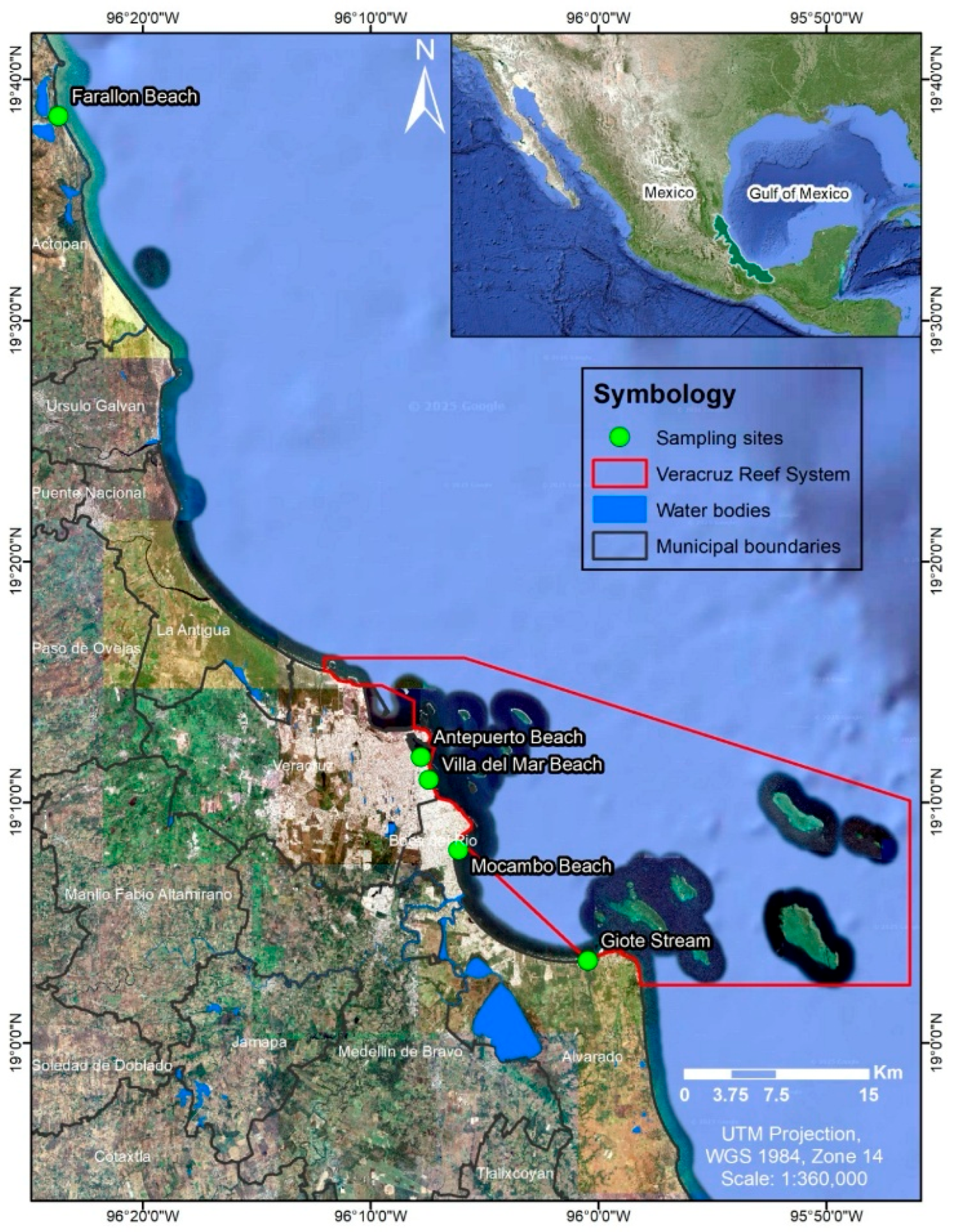
Figure 2.
Scheme of beach boundaries to establish the Intermareal Zone.
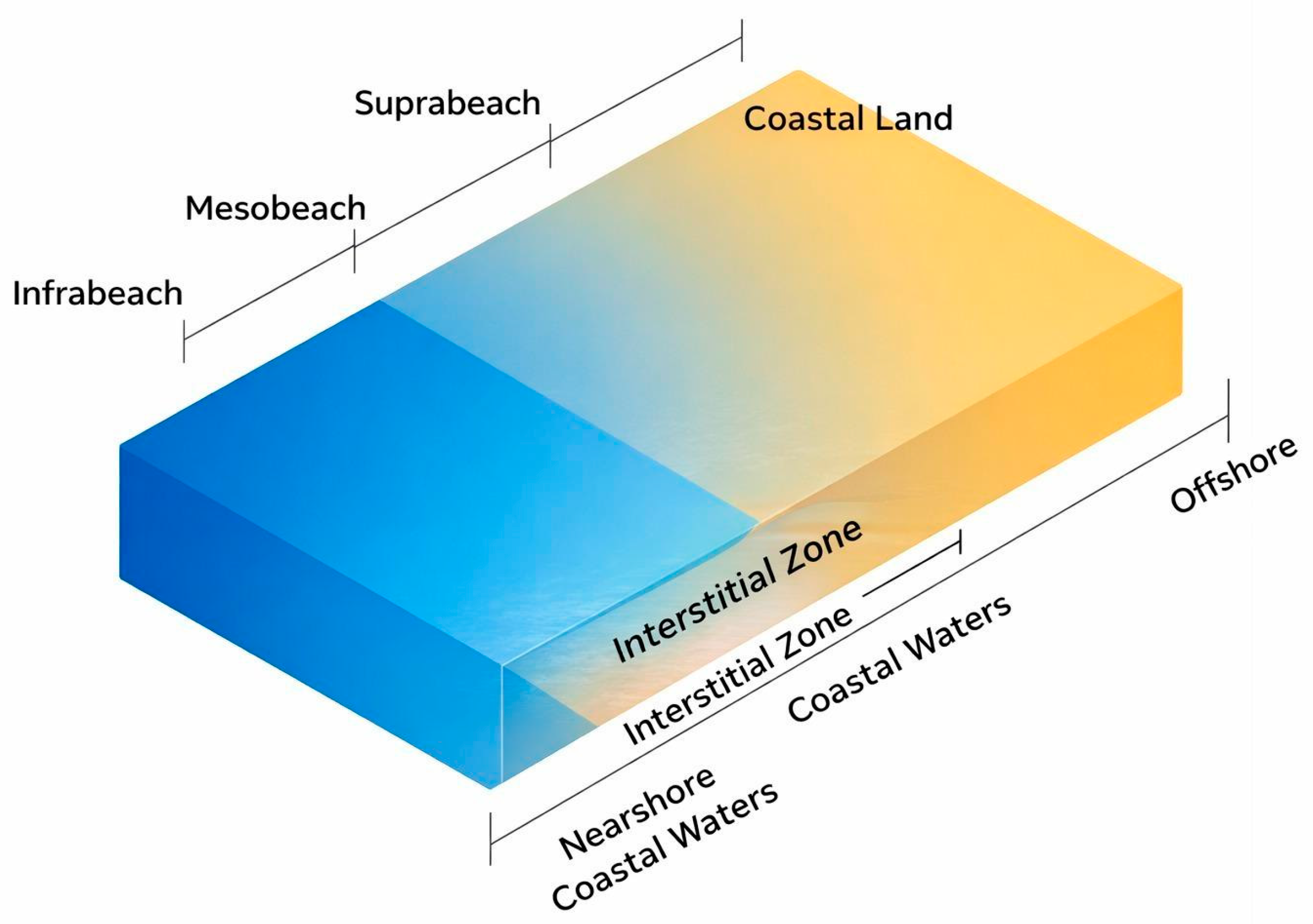
Figure 3.
Scheme of transects according to the intertide limits.
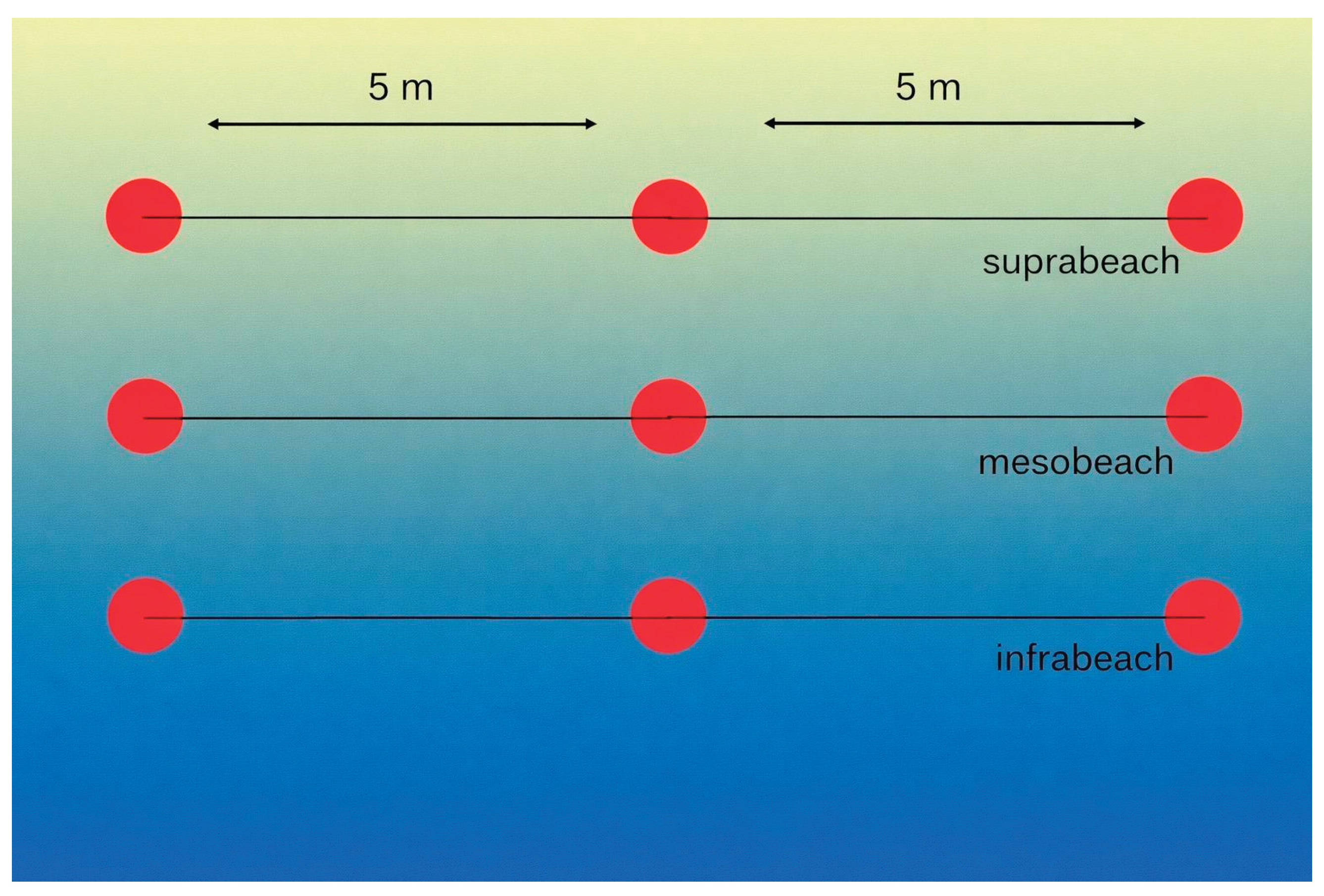
Figure 4.
Concentration of total hydrocarbons by depth (15 and 30 cm). Median, interquartile range (25–75%), and min–max values are shown.
Figure 4.
Concentration of total hydrocarbons by depth (15 and 30 cm). Median, interquartile range (25–75%), and min–max values are shown.
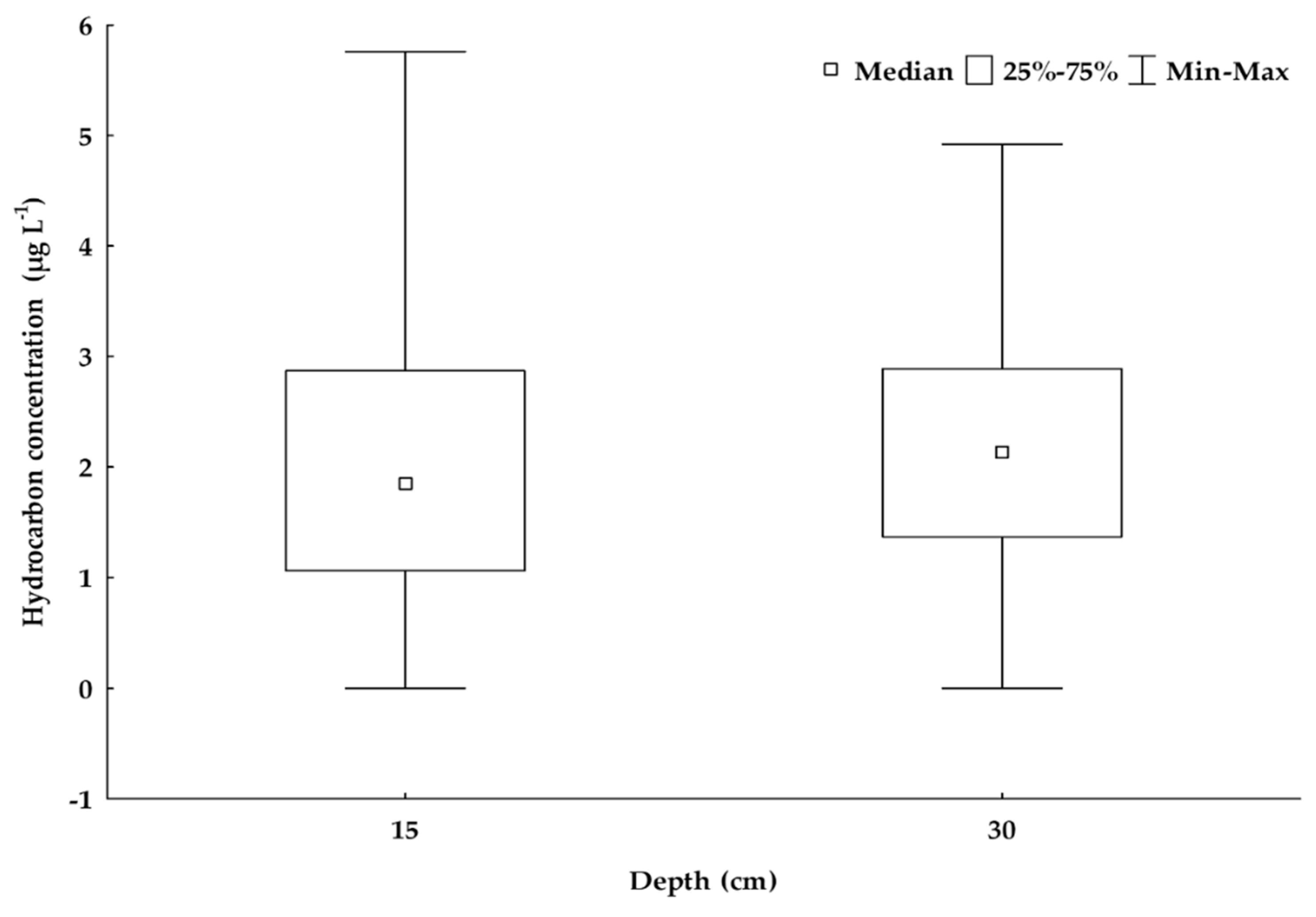
Figure 5.
Spatial variation of the concentration of total hydrocarbons by beaches.
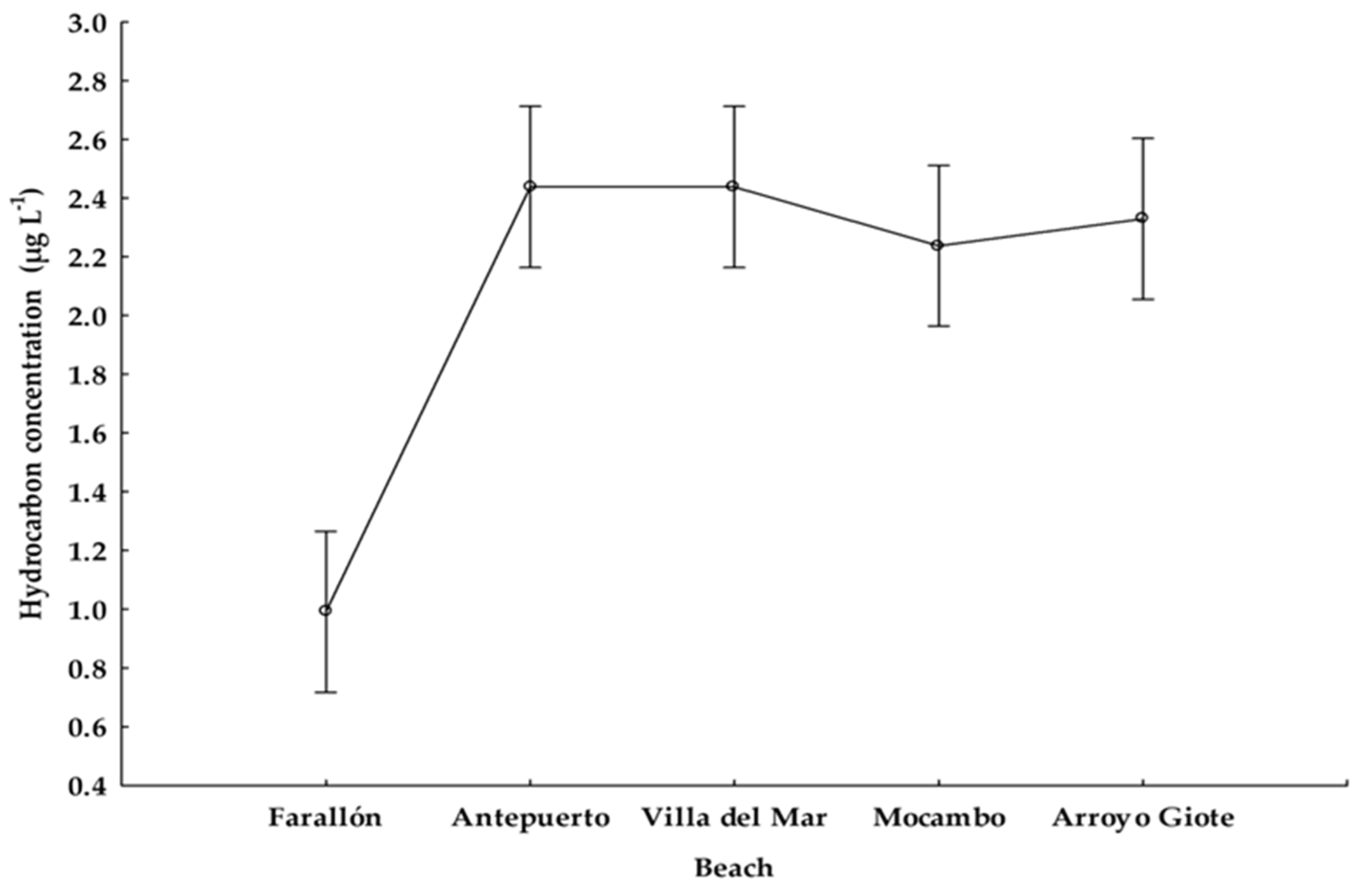

Table 1.
Specifications of the gas chromatograph for the detection of total hydrocarbons.
| Parameter | FID (Flame Ionization) | ECD (Electron Capture) |
|---|---|---|
| Column | Capillary 30 m × 0.32 mm, 25 µm, fused silica, stationary phase 5% phenyl-methyl siloxane | Capillary 25 m × 0.2 mm, 0.33 µm, fused silica stationary phase 5% phenyl-methyl siloxane |
| Carrying gas (mL/min) | Nitrogen 1.5 | Nitrogen 1.1 |
| Filling gas (mL/min) | Nitrogen 28.5 | Nitrogen 18.1 |
| Injection temperature (°C) | 280 | 275 |
| Detection temperature (°C) | 300 | 325 |
Table 2.
Mean concentration of total hydrocarbons (µg L-1) in interstitial water from five beaches, by climatic season and sampling dept.
Table 2.
Mean concentration of total hydrocarbons (µg L-1) in interstitial water from five beaches, by climatic season and sampling dept.
| Beach | Season | 15 cm (Mean ± SD) | 30 cm (Mean ± SD) |
| Farallón | Nortes | 0.93 ± 0.63 | 0.86 ± 0.65 |
| Dry | 0.93 ± 0.63 | 0.86 ± 0.66 | |
| Rainy | 1.04 ± 0.55 | 1.34 ± 0.63 | |
| Antepuerto | Nortes | 4.99 ± 1.79 | 6.53 ± 1.29 |
| Dry | 4.99 ± 1.79 | 6.53 ± 1.29 | |
| Rainy | 5.85 ± 1.95 | 6.39 ± 1.77 | |
| Villa del Mar | Nortes | 2.28 ± 1.03 | 2.45 ± 0.78 |
| Dry | 2.28 ± 1.03 | 2.45 ± 0.78 | |
| Rainy | 2.53 ± 1.57 | 2.62 ± 0.75 | |
| Mocambo | Nortes | 2.07 ± 0.82 | 2.13 ± 0.72 |
| Dry | 2.07 ± 0.82 | 2.13 ± 0.72 | |
| Rainy | 2.13 ± 1.10 | 2.88 ± 1.25 | |
| Arroyo Giote | Nortes | 2.62 ± 1.81 | 1.83 ± 0.69 |
| Dry | 2.62 ± 1.81 | 1.83 ± 0.69 | |
| Rainy | 2.79 ± 2.79 | 2.28 ± 1.12 |
Disclaimer/Publisher’s Note: The statements, opinions and data contained in all publications are solely those of the individual author(s) and contributor(s) and not of MDPI and/or the editor(s). MDPI and/or the editor(s) disclaim responsibility for any injury to people or property resulting from any ideas, methods, instructions or products referred to in the content. |
© 2026 by the authors. Licensee MDPI, Basel, Switzerland. This article is an open access article distributed under the terms and conditions of the Creative Commons Attribution (CC BY) license (http://creativecommons.org/licenses/by/4.0/).
Copyright: This open access article is published under a Creative Commons CC BY 4.0 license, which permit the free download, distribution, and reuse, provided that the author and preprint are cited in any reuse.


