

Submitted:
27 April 2026
Posted:
28 April 2026
You are already at the latest version
Abstract
People with disabilities face disproportionate climate-related risks, yet disability is rarely incorporated into composite climate vulnerability indices. To date, no exiting index — at any geographic scale — incorporates disability as a primary dimension. This study develops the Disability-Inclusive Climate Vulnerability (DICLIV) Index for Chile’s 16 regions, integrating four dimensions: disability and dependency vulnerability (D1), climate hazards and exposure (D2), adaptive capacity (D3), and resilience and response capacity (D4). Seventeen indicators were selected from Chilean regional data sources. A sensitivity analysis assessed the contribution of the disability dimension by re-estimating the index, excluding D1. Findings reveal a distinct south-central vulnerability cluster — Ñuble (0.391), Biobío (0.350), and the Metropolitan Region (0.318) — driven by high disability prevalence, climate hazard exposure, and limited adaptive capacity. Atacama (0.115) ranked least vulnerable, despite its harsh desert environment, reflecting low population density and stronger adaptive capacity. When D1 was excluded, the gap between the first and third-ranked region narrowed, confirming that disability indicators sharpen, but do not create a different geography of climate vulnerability. The DICLIV is the first composite index to treat disability as a core dimension, supporting disability-inclusive climate adaptation aligned with the UN Convention on the Rights of Persons with Disabilities and the Sendai Framework.
Keywords:
disability
; climate change
; climate vulnerability
; resilience
; sustainability
; adaptive capacity
Introduction
Climate change is increasingly recognised as a major threat to population health, with rising temperatures, extreme weather events, and environmental degradation affecting communities worldwide. These impacts are not distributed evenly: climate-related hazards tend to exacerbate existing social and health inequities, disproportionately affecting populations that already face structural disadvantages [1,2]. Vulnerability of ecosystems and people to climate risks is shaped not only by exposure to hazards but also by socioeconomic conditions, health status, marginalisation, and access to resources that enable adaptation, resilience and recovery. As a result, populations with limited access to healthcare, lower socioeconomic status, or higher care needs often experience greater difficulties in preparing for, responding to, and recovering from climate-related shocks [2,3].
People with disabilities represent one population group facing heightened climate-related risks [4,5,6,7,8]. Approximately 16% of the world’s population, that is more than 1,3 billion people, lives with some form of disability [9]. According to Article 1 of the United Nations Convention on the Rights of Persons with Disabilities (UNCRPD), people with disabilities “include those who have long-term physical, mental, intellectual or sensory impairments which in interaction with various barriers may hinder their full and effective participation in society on an equal basis with others” [10]. People with disabilities often face the effects of structural disadvantage, leading to increased rates of poverty, lower educational levels, lower employment compared to the general population, as well as to increased barriers related to mobility, communication, access to health services, and reliance on assistive technologies or caregiving support [9,11,12]. Inequities experienced by people with disabilities vary substantially across countries and regions, reflecting differences in socioeconomic development, health system capacity, infrastructure, and social protection policies [9,13,14,15,16,17].
Resilience is understood as the capacity to prepare for, absorb, and recover from adverse events, and even to emerge stronger, and it encompasses individual, community, and institutional dimensions [18]. The increase of the probabilities of future natural disasters induced by climate change in almost every latitude of the planet [19,20,21,22] makes even more important the resilience of people with disabilities to these climatic events. Evidence demonstrates that people with disabilities face greater vulnerability during climate-related events and have lower resilience capacity compared to the general population, with impacts extending across health, food security, water availability, and access to resources [5].
Structural factors — mobility and communication barriers, dependence on healthcare services and assistive devices, reduced access to emergency infrastructure — amplify vulnerability, affecting evacuation, access to early warning systems, continuity of care, and access to essential services during crises [6,23]. Emerging evidence highlights the disproportionate heat vulnerability of people with disabilities: two large-scale studies using national healthcare data from South Korea found that disability was the single strongest predictor of heat-related illness risk, with relative risks ranging from 4,33 to 5,08, surpassing those associated with older age, low income, and outdoor occupation [24,25]. Furthermore, people with disabilities are two to four times more likely to die or be injured in climate emergencies, including heatwaves, hurricanes, and floods [26]. Despite this evidence, disability is rarely explicitly incorporated into climate vulnerability assessments, which typically rely on general proxies such as age, income, or infrastructure without accounting for disability-specific functional and support needs [7,8,27].
Several composite indices have been developed to measure climate vulnerability and disaster risk. In the United States, for example, the Federal Emergency Management Agency (FEMA) created the National Risk Index (NRI) that identifies the counties most at risk from 18 natural hazards, by combining Expected Annual Loss (economic damage), Social Vulnerability (population susceptibility), and Community Resilience (coping capacity) [28]. Moreover, the CDC/ATSDR Social Vulnerability Index (SVI) in the United States is used to identify communities that may need support before, during, or after disasters; it uses 16 variables to cover four major areas of social vulnerability—socioeconomic status, household characteristics (disability is included in this dimension), racial and ethnic minority status, and housing type and transportation [29].
The Notre Dame Global Adaptation Initiative Country Index (ND-GAIN-CI) rates 182 countries on their vulnerability to climate change in combination with their readiness to improve resilience, with the objective of informing investment and equitable action; this index operates at the national scale and does not include disability indicators [30]. The WorldRiskIndex (WRI) assesses disaster risk for 193 countries by combining exposure to natural hazards with societal capacities to respond, using more than 100 indicators; it does not incorporate disability [31]. Another index is the Baseline Resilience Index for Communities (BRIC), proposed by Cutter et al. [32] and further developed by Cutter et al. [33], which combines six dimensions of resilience: community capital, economic resilience, institutional resilience, infrastructure resilience, and environmental resilience.
For Chile — one of the world’s most disaster-exposed countries — Bronfman et al. [34] developed a national disaster resilience index using 49 variables, according to the country’s five macrozones, based on the BRIC model; the findings of this study showed that the highest levels of resilience are concentrated in the central macrozone. Inostroza et al. [35] constructed a heat vulnerability index for Santiago, incorporating a disability variable in the sensitivity dimension; this study showed that heat vulnerability in the capital is highly asymmetrical in terms of spatial distribution, primarily affecting the poorest urban areas.
In Chile, 17,6% of the adult population has a type of disability, with higher prevalence among women (21,9% vs. 13,1% for men) and older adults (32,6% for those over 60 years, compared with 9,9% for those in the 18-29 age group) [36]. Regarding dependency—that is, the requirement for assistance of one or more people in their environment to improve functioning, carry out activities, and participate in society—9,8% of the Chilean population needs such assistance [36]. Research in the Chilean context has also evidenced the existence of inequities concerning education, health, employment, and social inclusion of people with disabilities, inequities that are further exacerbated at the intersection of disability with other characteristics, for example, women, older people, children or migrants with disabilities [37,38,39].
Chile has experienced significant climatic changes in recent decades: rising temperatures, intensifying droughts, increased wildfire occurrence, and extreme precipitation events. The decade 2011-2020 was the warmest (+0,72 degrees C) and driest (-19%) since 1961, and the year 2024 was the fourth warmest on record [40]. These trends intersect with the disability and dependency burden in ways that are not captured by any existing sub-national vulnerability tool for the country.
In this study, we develop the Disability-Inclusive Climate Vulnerability (DICLIV) Index, which integrates disability and dependency indicators with measures of climate hazard and exposure, and adaptive and resilience capacities, disaggregated across Chile’s 16 regions. To the best of our knowledge, this index is the first composite index to explicitly incorporate disability as core dimension of climate vulnerability and resilience, providing a structured, reproducible tool for identifying the regions where people with disabilities face the greatest climate-related risk. The objective of this article is to present and apply the DICLIV Index to examine regional patterns of vulnerability in Chile and to highlight the importance of integrating disability considerations into climate adaptation and disaster risk reduction policies.
Materials and Methods
Study Area
Chile is a country located in Southwestern South America, bordered by Peru to the north, Bolivia to the northeast, Argentina to the east, and the Pacific Ocean to the west. It covers a total area of 756.096 km2, extending approximately 4.300 km from north to south, while averaging 177 km in width, making it one of the longest and narrowest countries in the world [41]. This extreme latitudinal range produces a remarkable variety of landscapes, including the Atacama Desert in the north—one of the driest places on Earth—a fertile central valley, temperate forests and lakes in the south, and Patagonian fjords and glaciers in the far south [41]. Administratively, Chile is organised into 16 regions, 56 provinces, and 346 communes [42].
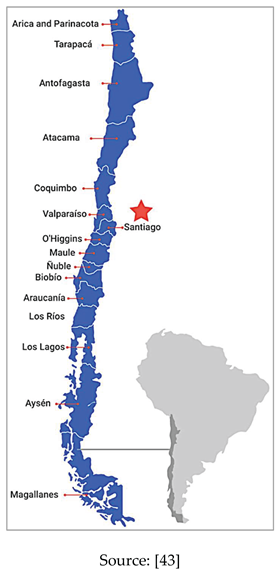
According to the 2024 Population and Housing Census, Chile has a population of approximately 18,5 million people; the population has been ageing progressively from 6,6% of people aged 65 and above in 1992 to 14% in 2024 [44]. The capital and largest city is Santiago, located in the Metropolitan Region, which alone concentrates approximately 40% of the population [44]. In economic terms, Chile’s gross domestic products (GDP) reached USD 330,3 billion in 2024, with a GDP per capita or USD 16.710, reflecting an annual growth of 2,6% [45]. Chile is also the most developed country in Latin America according to the United Nations Human Development Index (HDI), achieving its highest historical score of 0,878 in 2024 and ranking 45th worldwide, placing it in the ‘very high human development’ category [46].
Conceptual Framework
Our Disability-Inclusive Climate Vulnerability (DICLIV) Index is a composite regional-level index developed to assess climate-related vulnerability and resilience through a disability-inclusive lens. Informed by the Intergovernmental Panel on Climate Change (IPCC) climate risk framework, the index conceptualises climate-related vulnerability and resilience as shaped by the interaction between population vulnerability, climate hazards and exposure, adaptive capacity, and response capacity. We developed the DICLIV Index with the specific purpose to addressing a key limitation of the existing climate vulnerability measures, which rarely account explicitly for disability, dependency, and other forms of functional vulnerability, especially at a regional level. To address this gap, the index comprises four dimensions:
- (1)
- Disability and Dependency Vulnerability, capturing people with disabilities and individuals requiring assistance with daily activities, who may face heightened vulnerability to climate hazards;
- (2)
- Climate Hazards and Exposure, reflecting major climate threats and exposure that may generate health, economic, and social risks;
- (3)
- Adaptive Capacity, representing the longer-term social, infrastructural, and territorial resources that may enable populations and systems to anticipate, prepare for, and adjust to climate-related risks; and
- (4)
- Resilience and Response Capacity, capturing the ability of regions and systems to absorb, respond to, and recover from climate-related shocks while maintaining essential functions.
Together, these four dimensions provide a disability-inclusive framework for identifying spatial inequalities in climate-related vulnerability and resilience across Chilean regions. Incorporating resilience as an additional dimension into the DICLIV index broadens not only its temporal scope, but it also extends the index’s implicit concern and purpose—ensuring the protection and safety of people with disabilities—beyond the immediate periods before and after the risk situations they may face.
Data Sources and Indicator Selection
The indicators included in each dimension were selected based on their conceptual relevance to climate vulnerability, disability-inclusive risk assessment, and resilience, as well as on the availability of reliable data at the regional level in Chile. Figure 1 displays the Disability-Inclusive Climate Vulnerability (DICLIV) Index with its four dimensions, each composed of indicators capturing population vulnerability, climate hazards, regional capacity to adapt, and resilience capacity.
Table 1 provides information on the indicators, including definitions, justification for their inclusion in the index, and data sources in the Chilean context.
Index Construction and Analysis
To ensure comparability across indicators measured on different scales, all variables were normalised using min–max scaling to a 0–1 range: . Indicators were oriented so that higher values consistently reflected greater climate vulnerability. For consistency, indicators where higher values represent greater capacity (for example, healthcare density and internet access) were reverse-coded, so that higher values correspond to lower adaptive capacity. The adaptive capacity dimension therefore represents lack of adaptive capacity and was directly aggregated with the other dimensions. Furthermore, concerning the drought intensity indicator, as negative values of the Standardised Precipitation Index (SPI) indicate drier-than-normal conditions, these values were inverted (that is, multiplied by -1), so that higher values represent greater drought exposure, before inclusion in the index. Higher values of all indicators of the fourth dimension represent higher resilience and response capacity; therefore, this dimension was subtracted.
After normalisation, indicators were aggregated within each dimension by calculating the arithmetic mean of the standardised indicators belonging to that dimension. This produced four dimensions scores representing Disability and Dependency Vulnerability, Climate Hazards and Exposure, Adaptive Capacity, and Resilience and Response Capacity. The final DICLIV Index score for each region was calculated employing the following formula:
where , , and D4 represent the standardised scores for the four dimensions. Each dimension was assigned equal weight, reflecting the importance of population vulnerability, climate exposure, adaptive capacity, and resilience capacity in shaping climate-related risks.
The resulting index values were calculated for the sixteen regions of Chile and mapped to visualise spatial patterns of disability-inclusive climate vulnerability. Regional comparisons were conducted to identify areas with high levels of population vulnerability, high occurrence and exposure to climate hazards, and limited adaptive and resilience capacity. A sensitivity analysis was conducted to assess the robustness of the index to the inclusion of the disability-related indicators. An alternative version of the index was calculated after removing D1 indicators, allowing us to examine whether and how their inclusion influenced regional climate vulnerability rankings.
Results
Table 2 presents the results of the DICLIV Index for the 16 regions of Chile, both per dimension and also the final score.
According to Table 1, the Region of Ñuble received the highest score in the DICLIV Index, signifying that it is the region with the highest disability-adjusted climate vulnerability (0,391), followed by the Region of Biobío (0,350), the Metropolitan Region (0,318), the O’Higgins Region (0,308), and the Region of La Araucanía (0,296). The least vulnerable region was the Region of Atacama (0,115). The entire table, with the standardised values for all indicators, can be found in Appendix 1.
Figure 2a shows the regional ranking based on the DICLIV Index score, while Figure 1b to 1e show the regional rankings per dimension.
As shown in Figure 2b–e, some regions consistently occupy the highest positions across the different dimensions of the Index, but there are also noticeable shifts in the ranking between dimensions. Regarding D1 (disability and dependency vulnerability), the most vulnerable regions are: Ñuble (0,829), La Araucanía (0,753), Los Ríos (0,739), Atacama (0,598), and Biobío (0,593), while the least vulnerable region is Antofagasta (0,162). Concerning D2 (climate hazards and exposure), the regions showing higher incidence of climate hazards and exposure are: Biobío (0,628), Ñuble (0,611), La Araucanía (0,578), Metropolitan (0,560), and O’Higgins (0,538), whereas the region with the least incidence is Arica y Parinacota (0,123). The regions with the least adaptive capacity (D3) are: Ñuble (0,675), La Araucanía (0,652), Biobío (0,621), Los Lagos (0,619), and O’Higgins (0,587), while the region with the highest capacity is Aysén (0,275). Finally, with regards to D4 (resilience and response capacity), the regions with the highest capacity are: Los Ríos (0,845), La Araucanía (0,799), Atacama (0,599), Maule (0,555), and Ñuble (0,550), whereas the region with the lowest capacity is Arica y Parinacota (0,178).
To assess the influence of disability on the DECLIV index, we performed a sensitivity analysis, where we re-estimated the index after removing Dimension 1 entirely (see Appendix 2). In the full index, the most vulnerable regions are Ñuble, Biobío, Metropolitan Region, O’Higgins, and La Araucanía; contrarily, Atacama, Tarapacá, Magallanes and Antofagasta show the lowest values. In both reduced indexes, the broad spatial pattern is preserved, with the four most vulnerable regions–that is, Ñuble, Biobío, Metropolitan Region, and O’Higgins–being at the top, albeit in different positions and with changes in the relative distance. In the full index, Ñuble clearly ranks first, whereas in the three-dimension index, Biobío and Metropolitan Region move ahead of Ñuble. Notable changes can be observed within the middle- and low-vulnerability tiers; in both indexes, the Atacama Region is in the last position.
Discussion
The DICLIV Index findings reveal a distinct south-central vulnerability cluster encompassing Ñuble (0,391), Biobío (0,350), Metropolitan Region (0,318), O’Higgins (0,308), and La Araucanía (0,296). This pattern reflects a combination of elevated disability and dependency burden (D1), high incidents and exposure to climate hazards (D2), limited adaptive capacity (D3), as well as limited resilience and response capacity (D4). Ñuble’s leading position is particularly pronounced: it records the highest D1 score (0,829), the second highest D2 score (0,611), and the greatest lack of adaptive capacity (D3 = 0,675); in this case, disability-related sensitivity, coupled with climate hazards vulnerability, and structural disadvantage reinforce one another to a degree unmatched elsewhere in Chile. These findings agree with previous Chilean vulnerability research — Bronfman et al. (34) found the south-central macrozone scored lowest on composite disaster resilience — by demonstrating that this pattern persists across a multidimensional framework that explicitly incorporates disability.
On the other hand, northern regions received comparatively low DICLIV scores (Atacama 0,115; Tarapacá 0,116; Antofagasta 0,124). This does not reflect an absence of climate risk: the Atacama and Tarapacá deserts are among the driest environments on Earth, and aridification trajectories under climate change are well documented [60,61]. However, their low overall vulnerability reflects lower disability prevalence (Antofagasta records the lowest D1 score: 0,162), higher urbanisation and internet access rates (D2), better-developed infrastructure, as well as better resilience capacity (as observed, by Atacama’s third place in D3) — factors that suppress D1 and D3 scores. These findings underscore the IPCC AR6 principle that exposure alone does not determine risk: sensitivity and adaptive capacity are equally important [2].
At the international level, our results align with previous research showing that disability prevalence is a robust predictor of disaster risk. Harrati et al. [62] demonstrated that US counties with higher disability rates face significantly elevated natural hazard risk, a relationship that persisted after controlling for income and rurality. Similarly, Kang et al. [4,25]reported that people with disabilities face a higher relative risk of heat-related morbidity than the general population — a finding that amplifies the precariousness of Ñuble’s and Biobío’s positions given their compounding climate hazard exposure. The scoping review of Lindsay et al. [5] evidenced the impacts of extreme weather events on people with different types of disabilities living in different geographic contexts, further supporting the view that disability should not be treated as a mere sub-indicator in a large list of vulnerability indicators, but as a primary analytical dimension.
The sensitivity analysis provides direct evidence for the added value of the disability dimension. When D1 is removed and the index is re-estimated using only D2–4, Biobío rises to first position (0,269), the Metropolitan Region to second (0,253), and Ñuble falls to third (0,245). In this instance, the gap between the first- and third-ranked region is 0,024; however, the same gap in the full index is 0,073 — a roughly three-fold increase. Ñuble’s drop from first to third place when disability is excluded confirms that its leading vulnerability is driven primarily by its disability and dependency factors, not by climate exposure alone. Thus, a tool that omits disability would underestimate the relative urgency of policy attention for this region by a measurable margin.
These findings show that disability and dependency indicators widen the vulnerability gradient among the most affected regions and elevate specific territories—particularly Ñuble—within the national ranking. The broad spatial pattern is preserved in both versions, indicating that disability amplifies existing inequities rather than creating a different geography of climate vulnerability. King and Gregg (6) argue, within a critical realist model of disability and climate vulnerability, that many of the consequences of climate change arise from a disproportionate experience of climate social determinants of health, and are the result of the social and political inequities faced by people with disabilities.
DICLIV Index is essential for identifying those regions where people with disabilities face disproportionately high climate-related risks. In fact, our findings have direct implications for Chile’s National Climate Change Action Plan (PANCC) and for the resource allocation of the National Disaster Prevention and Response Service (SENAPRED). Based on the regional ranking of the climate hazard and exposure dimension (D2), the regions of Ñuble, Biobío, and La Araucanía should be prioritised for disability-inclusive emergency planning, including early warning systems, accessible evacuation routes, and protocols regarding continuity of care, particularly for device-dependent people with disabilities. Moreover, in the case of the La Araucanía region, its high D4 score (0,799) indicates a strong resilience infrastructure that buffers its overall score; this advantage should be maintained and explicitly made disability-accessible, as a high response capacity does not automatically translate into disability-inclusive practice. These recommendations align with international frameworks, such as the United Nations Convention on the Rights of Persons with Disabilities – CRPD (10), which emphasises the need to ensure the protection and safety of people with disabilities in situations of risk, such as natural disasters (Article 11), and the Sendai Framework for Disaster Risk Reduction, which recognises people with disabilities as a priority group in disaster preparedness, response, and recovery [63].
Several limitations should be noted. The DICLIV Index is cross-sectional, capturing vulnerability at a single time point, and it is, therefore, unable to track dynamic changes. Operating at the regional level, the index is subject to the ecological fallacy: findings should not be interpreted as reflecting the vulnerability of specific individuals, as they capture aggregate regional conditions only. All indicators were selected due to their importance to the index and data availability at a regional level; other relevant indicators, for instance, mental health access, social network density, percentage of soil with potential erosion, could not be included since no regional information was available. Other indicators have known measurement limits, for instance SPI-12 may underestimate groundwater depletion, while wildfire counts do not capture severity.
On the other hand, the paper has several strengths. The DICLIV Index is, to our knowledge, the first composite climate vulnerability index to incorporate disability as a primary dimension, allowing its contribution to be quantified rather than diluted within broader social vulnerability categories. It draws on nationally representative, recent Chilean data, and aligns with the IPCC AR6 risk framework—which defines risk as a function of hazard, exposure and vulnerability—while explicitly adding disability and dependency as a separate dimension. While many indexes operate at a national level, the DICLIV Index operates at a sub-national (NUTS-2) level suitable for regional policy targeting, distinguishing it from national-level indices that mask spatial heterogeneity. This may be crucially important for Chile, a country characterised by a highly centralised institutional, administrative, fiscal and political structure [64,65,66,67].
With regards to future directions, research could advance toward a county-level disaggregation, as well as a longitudinal analysis as successive waves of population-level surveys are made available. Furthermore, a participatory research approach could be employed, where people with disabilities, particularly in highly vulnerable regions, are included to validate findings and co-design adaptation strategies, resonating Kim et al. [8], who argue that people with disabilities should be incorporated into climate research and planning as a group with specific needs. The index could also be extended, and adapted accordingly, to other countries in the Latin American region or internationally, that have disability, climate, adaptation, and resilience indicators available. Finally, the index could be linked to administrative health data to monitor whether high-vulnerability regions experience disproportionate morbidity and mortality during extreme event, as called for by the WHO Global Report on Health Equity for Persons with Disabilities [9].
Conclusion
This study developed the Disability-Inclusive Climate Vulnerability (DICLIV) Index, the first composite climate vulnerability index to incorporate disability as a primary, standalone dimension, applied across Chile’s sixteen regions. Findings reveal a pronounced south-central vulnerability cluster, driven by high disability and dependency burden, climate hazards and exposure, and limited adaptive capacity. The sensitivity analysis confirmed that disability sharpens, but does not create, regional inequities, demonstrating that assessments which omit disability systematically underestimate risk for specific populations and territories. The DICLIV Index provides a transparent, replicable framework to inform disability-inclusive climate adaptation, emergency preparedness, and early warning systems, and offers a model for other countries seeking to advance equity-centred approaches to climate resilience.
Supplementary Materials
The following supporting information can be downloaded at the website of this paper posted on Preprints.org.
Author Contributions
ESR: Conceptualisation; Data curation; Formal analysis; Investigation; Methodology; Project administration; Resources; Supervision; Validation; Visualization; Writing – original draft; and Writing – review & editing. EFB: Investigation; Validation; Writing – original draft; and Writing – review & editing. All authors have read and agreed to the published version of the manuscript.
Funding
This research was supported by internal funding from Universidad San Sebastián, Chile.
Data Availability Statement
No new data were created or analyzed in this study.
Conflicts of Interest
The authors declare no conflict of interest.
References
- Romanello, M.; McGushin, A.; Di Napoli, C.; Drummond, P.; Hughes, N.; Jamart, L.; et al. The 2021 report of the Lancet Countdown on health and climate change: Code red for a healthy future. The Lancet 2021, 398, 1619–1662. [Google Scholar] [CrossRef] [PubMed]
- Intergovernmental Panel on Climate Change - IPCC. Climate Change 2022: Impacts, Adaptation and Vulnerability. Working Group II Contribution to the Sixth Assessment Report of the Intergovernmental Panel on Climate Change; Cambridge University Press, 2023. [Google Scholar]
- Ebi, K.L.; & Hess, J.J. Health risks due to climate change: Inequity in causes and consequences. Health Aff. 2020, 39, 2056–2062. [Google Scholar] [CrossRef] [PubMed]
- Kang, Y.; Park, J.; Jang, D.-H. Compound impact of heatwaves on vulnerable groups considering age, income, and disability. Sci. Rep. 2024, 21. [Google Scholar] [CrossRef]
- Lindsay, S.; Hsu, S.; Ragunathan, S.; Lindsay, J. The impact of climate change related extreme weather events on people with pre-existing disabilities and chronic conditions: a scoping review. Disabil. Rehabil. 2023, 45, 4338–4358. [Google Scholar] [CrossRef] [PubMed]
- King, M.; Gregg, M.A. Disability and climate change: A critical realist model of climate justice. Sociol. Compass 2022, 16. [Google Scholar] [CrossRef]
- Morales, D.X. Natural disaster vulnerability among people with disabilities: Insights from the 2024 Household Pulse Survey. Disabil. Health J. 2025, 18. [Google Scholar] [CrossRef]
- Kim, S.; Kim, Y.; Park, J.; et al. Leave no one behind: a call to include people with disabilities in climate change and health research. Lancet Planet Health 2026. [Google Scholar] [CrossRef]
- World Health Organization. Global Report on Health Equity for Persons with Disabilities; Geneva, 2022. [Google Scholar]
- United Nations. Convention on the Rights of Persons with Disabilities and Optional Protocol; United Nations, 2007. [Google Scholar]
- Krahn, G.; Walker, D.; Correa-De-Araujo, R. Persons with disabilities as an unrecognized health disparity population. Am. J. Public Health 2015, 198–206. [Google Scholar] [CrossRef]
- Pinilla-Roncancio, M.; & Alkire, S. How Poor Are People With Disabilities? Evidence Based on the Global Multidimensional Poverty Index. J. Disabil. Policy Stud. 2021, 31, 206–216. [Google Scholar] [CrossRef]
- Olsson, L.; Opondo, M.; Tschakert, P. Livelihoods and Poverty. Climate Change 2014—Impacts, Adaptation and Vulnerability: Part A: Global and Sectoral Aspects; Cambridge University Press, 2014; pp. 793–832 p. [Google Scholar]
- Good, G.A.; Phibbs, S.; & Williamson, K. Disoriented and Immobile: The Experiences of People with Visual Impairments during and after the Christchurch, New Zealand, 2010 and 2011 Earthquakes. J. Vis. Impair Blind. 2016, 110, 425–435. [Google Scholar] [CrossRef]
- Bright, T.; & Kuper, H. A Systematic Review of Access to General Healthcare Services for People with Disabilities in Low and Middle Income Countries. Int. J. Env. Res. Public Health 2018, 15. [Google Scholar] [CrossRef]
- Rotarou, E.S.; Sakellariou, D.; Kakoullis, E.J.; & Warren, N. Disabled people in the time of COVID-19: identifying needs, promoting inclusivity. In J Glob Health; 2021. [Google Scholar]
- Shakespeare, T.; Ndagire, F.; Seketi, Q. Triple jeopardy: disabled people and the COVID-19 pandemic. The Lancet 2021, 397. [Google Scholar] [CrossRef] [PubMed]
- American Psychological Association. Resilience. Adapted from the APA Dictionary of Psychology; 2026. [Google Scholar]
- Rädler, A.T. Invited perspectives: how does climate change affect the risk of natural hazards? Challenges and step changes from the reinsurance perspective. Nat. Hazards Earth Syst. Sci. 2022, 22, 659–664. [Google Scholar] [CrossRef]
- Martinez-Villalobos, C.; & Neelin, J.D. Regionally high risk increase for precipitation extreme events under global warming. Sci. Rep. 2023, 13. [Google Scholar] [CrossRef] [PubMed]
- de Vries, I.; Schillinger, M.; Fischer, E.; et al. Precipitation disaster hotspots depend on historical climate variability. Nat. Commun. 2026, 17. [Google Scholar] [CrossRef]
- World Meteorological Organization. State of the Global Climate 2025; Geneva, 2026. [Google Scholar]
- Stough, L.M.; & Kang, D. The Sendai Framework for Disaster Risk Reduction and Persons with Disabilities. Int. J. Disaster Risk Sci. 2015, 6, 140–149. [Google Scholar] [CrossRef]
- Kang, Y.; Park, J.; Jang, D.H. Compound impact of heatwaves on vulnerable groups considering age, income, and disability. Sci. Rep. 2024, 14. [Google Scholar] [CrossRef] [PubMed]
- Kang, Y.; Baek, I.; Park, J. Assessing heatwave effects on disabled persons in South Korea. Sci. Rep. 2024, 14. [Google Scholar] [CrossRef]
- Reed, R. Disability in a Time of Climate Disaster. In Harvard Law Today; 2023. [Google Scholar]
- Kelman, I.; Gaillard, J.C.; & Mercer, J. Climate Change’s Role in Disaster Risk Reduction’s Future: Beyond Vulnerability and Resilience. Int. J. Disaster Risk Sci. 2015, 6. [Google Scholar] [CrossRef]
- Federal Emergency Management Agency. National Risk Index for Natural Hazards. 2025.
- Agency for Toxic Substances and Disease Registry. Social Vulnerability Index. 2024. [Google Scholar]
- University of Notre Dame. Notre Dame Global Adaptation Initiative (ND-GAIN) Country Index. 2026. [Google Scholar]
- Bündnis Entwicklung Hilft / IFHV. WorldRiskReport 2025; Berlin, 2025. [Google Scholar]
- Cutter, S.L.; Burton, C.G.; Emrich, C.T. Disaster Resilience Indicators for Benchmarking Baseline Conditions. J. Homel. Secur Emerg. Manag. 2010, 7. [Google Scholar] [CrossRef]
- Cutter, S.L.; Ash, K.D.; Emrich, C.T. The Geographies of Community Disaster Resilience. Glob. Env. Change 2014, 29, 65–77. [Google Scholar] [CrossRef]
- Bronfman, N.C.; Castañeda, J.V.; Guerrero, N.F.; Cisternas, P.; Repetto, P.B.; Martínez, C.; Chamorro, A. A Community Disaster Resilience Index for Chile. Sustainability 2023, 15. [Google Scholar] [CrossRef]
- Inostroza, L.; Palme, M.; de la Barrera, F. A Heat Vulnerability Index: Spatial Patterns of Exposure, Sensitivity and Adaptive Capacity for Santiago de Chile. PLoS ONE 2016, 11. [Google Scholar] [CrossRef]
- Ministry of Social Development and Family. ENDIDE - Disability and dependency survey; Santiago, 2023. [Google Scholar]
- Espinoza, F. Panorama de la discapacidad en Chile: Una revisión a la encuesta Casen 2022; Santiago, 2023. [Google Scholar]
- Martínez, C.; Perticara, M.; & Smith, R. The double gap: Disability and intra-household dynamics in parental employment. Rev. Econ. Househ. 2025. [Google Scholar] [CrossRef]
- Vial, B.; Martínez, C. Discapacidad en adultos en Chile: menores ingresos del trabajo y mayores gastos. Estud Publicos 2023, 169, 69–120. [Google Scholar] [CrossRef]
- Chilean Meteorological Agency. Climate change in Chile. 2026. [Google Scholar]
- Encyclopedia Britannica. Chile; 2026. [Google Scholar]
- World Observatory on Subnational Government Finance and Investment (SNG-WOFI); Chile, 2026.
- Freepik. Map of Chile with regions; Freepik, 2026. [Google Scholar]
- Institute of National Statistics (INE). The first results of the 2024 Census: 18,480,432 people enumerated in Chile and an increasing trend in population aging. 2025. [Google Scholar]
- World Bank. Chile: GDP. 2026. [Google Scholar]
- United Nations Development Programme. Human Development Report 2025; New York, 2025. [Google Scholar]
- National Statistics Institute. 2024 Census: Main indicators. 2025.
- Directorate General of Civil Avia. Heatwave monitoring. 2026. [Google Scholar]
- Center for Climate and Resilience Research. DataClima – Climate Platforms CR2. 2025.
- National Forest Corporation. Historical statistics of wildfires. 2026. [Google Scholar]
- Oom, D.; de Rigo, D.; Pfeiffer, H.; Branco, A.; Ferrari, D.; Grecchi, R.; et al. Pan-European wildfire risk assessment; Luxembourg, 2022. [Google Scholar]
- National Forest Corporation. CONAF. Actualización Análisis Nacional de Amenaza y Riesgo por Incendios Forestales. 2024. [Google Scholar]
- Infrastructure of Geospatial Data. Healthcare facilities. 2026.
- Ministry of Social Development and Family. Encuesta de caracterización socioeconómica nacional – CASEN 2022. 2023. [Google Scholar]
- Subsecretary of Telecommunications and CADEM. XXII survey on Internet access, usage, and users in Chile; Santiago, 2025. [Google Scholar]
- Firefighters of Chile. Fire stations. 2026. [Google Scholar]
- Ministry of Health; Department of Statistics and Health Information - DEIS. List of healthcare facilities. 2024. [Google Scholar]
- Ministry of Health; Department of Statistics and Health Information - DEIS. Hospital beds. 2022. [Google Scholar]
- Ministry of Public Works. Red vial nacional: Dimensionamiento y características. 2023. [Google Scholar]
- Ritter, B.; Wennrich, V.; Medialdea, A.; et al. Climatic fluctuations in the hyperarid core of the Atacama Desert during the past 215 ka. Sci. Rep. 2019, 9. [Google Scholar] [CrossRef]
- Meseguer-Ruiz, O.; Serrano-Notivoli, R.; Núñez-Hidalgo, I.; Sarricolea, P. General dry trends according to the standardized precipitation evapotranspiration index in mainland Chile. Front Earth Sci. 2024, 12. [Google Scholar] [CrossRef]
- Harrati, A.; Bardin, S.; & Mann, D.R. Spatial distributions in disaster risk vulnerability for people with disabilities in the U.S. Int. J. Disaster Risk Reduct. 2023, 87. [Google Scholar] [CrossRef] [PubMed]
- United Nations Office for Disaster Risk Reduction - UNISDR. Sendai Framework for Disaster Risk Reduction 2015-2030; Geneva, 2015. [Google Scholar]
- World Bank. Chile — Country Partnership Framework for the Period FY24-FY27; Washington DC, 2023. [Google Scholar]
- Navarrete-Yánez, B.E.; & Higueras-Seguel, V. Chile desde la Teoría secuencial de la descentralización, 1990-2010. Convergencia 2014, 21, 179–202. [Google Scholar]
- Valenzuela, A. Political Brokers in Chile: Local Government in a Centralized Polity; Duke University Press: Durham, N.C., 1977. [Google Scholar]
- Falleti, T.G. A Sequential Theory of Decentralization: Latin American Cases in Comparative Perspective. Am. Political Sci. Rev. 2005, 99, 327–346. [Google Scholar] [CrossRef]
Figure 1.
Structure of the Disability-Inclusive Climate Vulnerability (DICLIV) Index.
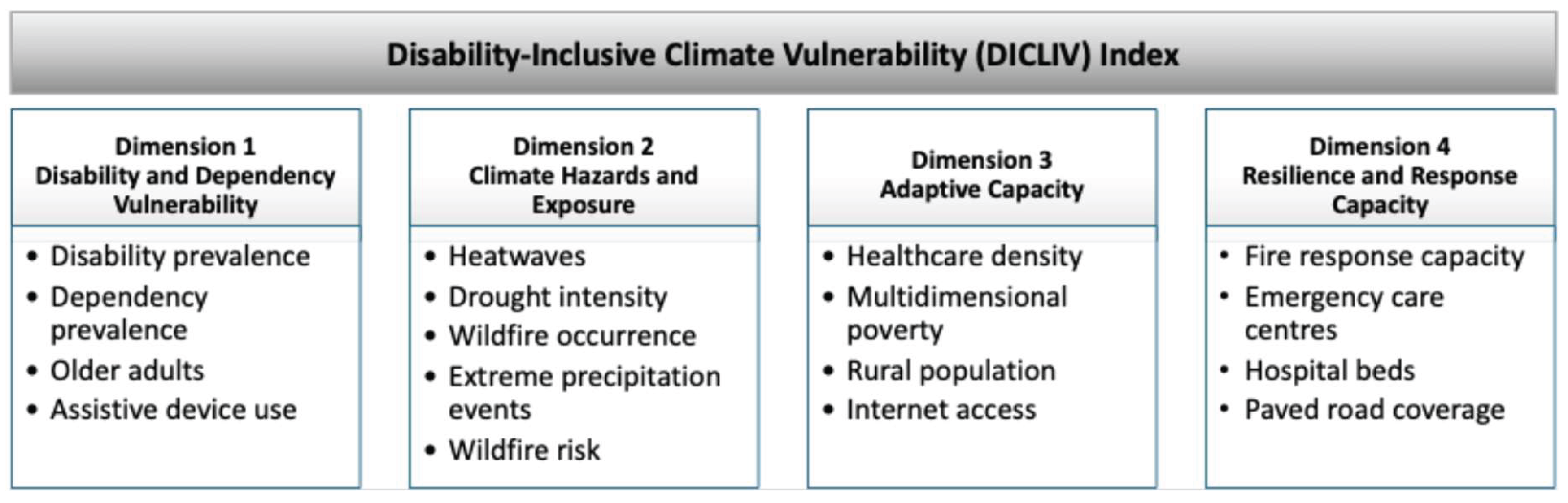
Figure 2.
The DICLIV Index score (Figure 2a) and regional rankings per dimension (Figure 2b–e). Note. Figure 1a - DICLIV Index: Disability-Inclusive Climate Vulnerability (DICLIV) Index score (darker colour indicates greater overall vulnerability); Figure 2b - Dimension 1: Disability and dependency vulnerability (darker colour indicates higher vulnerability); Figure 2c - Dimension 2: Climate hazards and exposure (darker colour indicates higher incidence of hazards and exposure); Figure 2d - Dimension 3: Adaptive capacity (darker colour indicates less adaptive capacity); and Figure 2e - Dimension 4: Resilience and response capacity (darker colour indicates more resilience and response capacity).
Figure 2.
The DICLIV Index score (Figure 2a) and regional rankings per dimension (Figure 2b–e). Note. Figure 1a - DICLIV Index: Disability-Inclusive Climate Vulnerability (DICLIV) Index score (darker colour indicates greater overall vulnerability); Figure 2b - Dimension 1: Disability and dependency vulnerability (darker colour indicates higher vulnerability); Figure 2c - Dimension 2: Climate hazards and exposure (darker colour indicates higher incidence of hazards and exposure); Figure 2d - Dimension 3: Adaptive capacity (darker colour indicates less adaptive capacity); and Figure 2e - Dimension 4: Resilience and response capacity (darker colour indicates more resilience and response capacity).
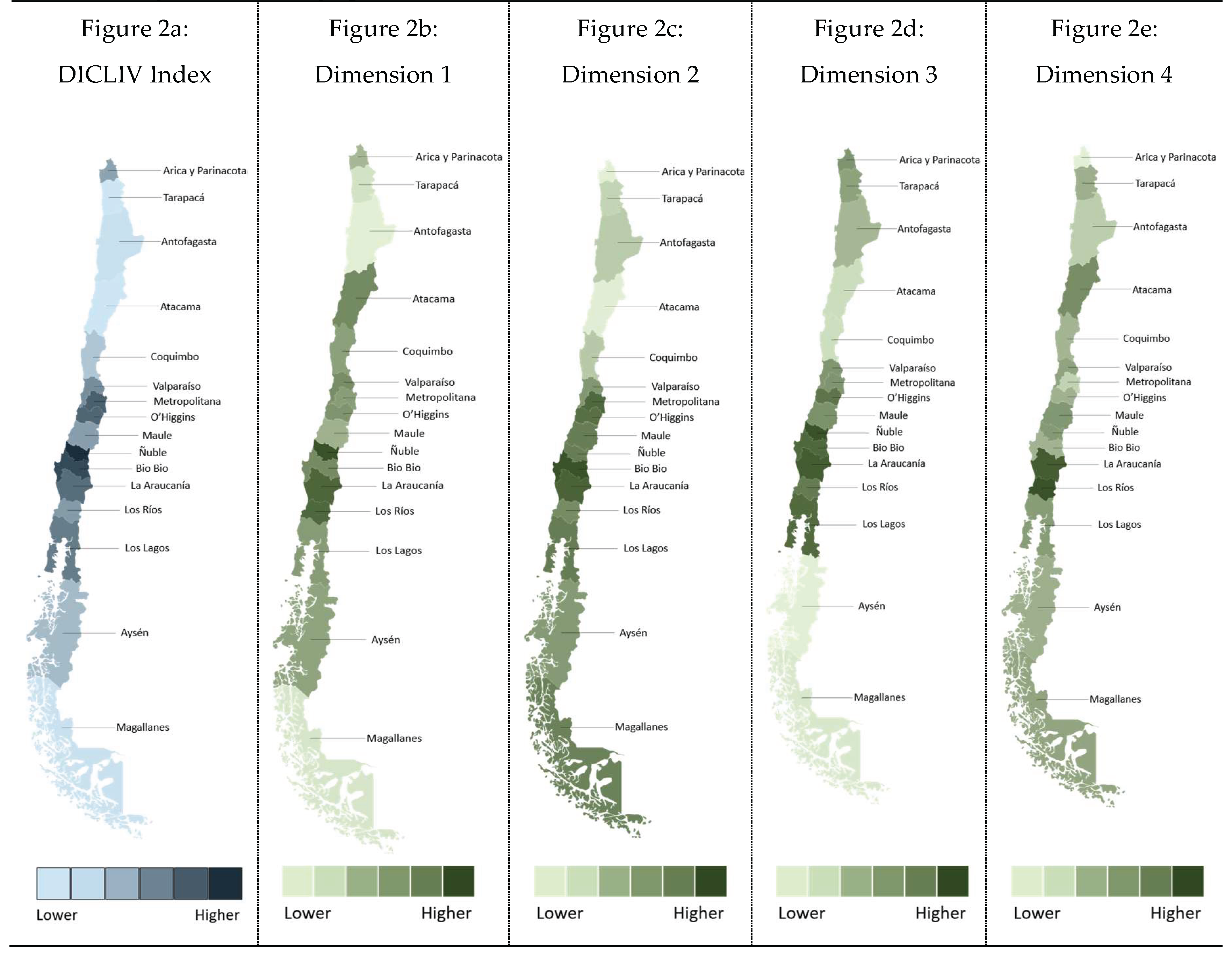

Table 1.
DICLIV Index indicators.
| Indicator | Definition | Justification | Source |
|---|---|---|---|
| Dimension 1: Disability and Dependency Vulnerability | |||
| Disability prevalence | Proportion (%) of the population with disabilities, according to national disability classification (2 years and above) | Higher prevalence of disability may indicate a greater proportion of individuals with functional limitations that could affect evacuation, mobility, communication, and access to services during climate-related events. | 2022 ENDIDE - Disability and Dependency Survey [36] |
| Dependency prevalence | Proportion (%) of the population classified as having moderate or severe dependency, defined as requiring assistance from other person(s) to perform daily activities (18 years and above). | Dependency reflects the need for assistance from others to perform daily activities, which may increase vulnerability during emergencies when caregiving networks or support services are disrupted. | 2022 ENDIDE - Disability and Dependency Survey [36] |
| Older adults | Proportion (%) of the population aged 65 years or older. | Older populations tend to experience higher rates of disability, chronic conditions, and heat-related health risks, making them particularly vulnerable to climate-related hazards. | 2024 Census [47] |
| Assistive device use | Proportion (%) reporting the use of assistive devices (2 years and above) | Reliance on assistive devices may increase vulnerability during disasters due to barriers related to mobility, infrastructure disruptions, or access to electricity and maintenance. | 2022 ENDIDE - Disability and Dependency Survey [36] |
| Dimension 2: Climate Hazards and Exposure | |||
| Heatwaves | Frequency of ≥3 consecutive days where daily maximum temperature exceeds the 90th percentile of the historical distribution for that location (average for the 2020-2025 period). | Heatwaves are associated with increased mortality, dehydration, and exacerbation of chronic conditions, particularly affecting populations with higher health and care needs. | Heatwave monitoring [48] |
| Drought intensity | Severity of drought conditions reflecting prolonged precipitation deficits that reduce water availability and affect ecosystems and human activities. Standardised Precipitation Index (SPI 12) measures the number of standard deviations by which observed precipitation deviates from the long-term mean precipitation (average for the 2020-2025 period). | Drought affects water availability, agricultural production, and livelihoods, potentially increasing socioeconomic vulnerability and affecting access to essential resources. | DataClima – Climate Platforms CR2 [49] |
| Wildfire occurrence | Number of wildfire events (average for the 2020-2025 period). | This indicator captures the frequency of wildfire events, reflecting the observed burden of wildfire-related climate hazards across regions. | National Forest Corporation [50] |
| Extreme precipitation events | Number of days in a year in which daily precipitation exceeds the 95th percentile of wet-day precipitation (≥1 mm), calculated from the historical distribution of precipitation at the study location. | Heavy rainfall events can lead to flooding, landslides, and infrastructure disruption, creating barriers to mobility, access to healthcare, and emergency response (including evacuation). | DataClima – Climate Platforms CR2 [49] |
| Wildfire risk | Likelihood and potential consequences of wildfires by considering the interaction between hazard, exposure, and vulnerability across human, ecological, and economic systems [51]. High and very high risk (%). | This indicator captures the risk to which regional populations and territories are exposed to potentially harmful wildfire conditions, including risks of displacement, service disruption, and damage during climate-related emergencies. | National Forest Corporation [52] |
| Dimension 3: Adaptive Capacity | |||
| Healthcare density | Number of healthcare centres per 100.000 people. | Greater availability of healthcare services may facilitate access to treatment, continuity of care, and emergency response during climate-related events. | Healthcare facilities [53] & 2024 Census [47] |
| Multidimensional poverty | Proportion (%) of the population experiencing simultaneous deprivations across multiple domains of well-being, including education, employment and social security, health, and housing and living conditions. | Multidimensional poverty provides a broader measure of vulnerability than income-based poverty alone and is widely used to assess social inequalities and development conditions that influence the capacity of individuals and communities to prepare for, respond to, and recover from climate-related hazards. | 2022 National Socioeconomic Characterisation Survey – CASEN [54] |
| Rural population | Proportion (%) of the population residing in rural areas. | Rural areas may face greater barriers related to geographic isolation, limited infrastructure, and reduced access to health and emergency services. | 2022 National Socioeconomic Characterisation Survey – CASEN [54] |
| Internet access | Proportion (%) of households with access to the internet through fixed or mobile connections. | Access to the internet can enhance adaptive capacity by facilitating communication, access to information, and coordination during climate-related events. It may also support telehealth and remote assistance, which can be particularly important for people with disabilities who rely on continuous access to healthcare and support services. | XXII Survey on Internet Access, Usage, and Users in Chile [55] |
| Dimension 4: Resilience and Response Capacity | |||
| Fire response capacity | Number of fire stations per 100.000 inhabitants. | It captures the availability of fire response infrastructure, which is critical for managing wildfires and other emergencies, reducing damage, and supporting timely evacuation and response during climate-related events. | Firefighters of Chile [56] |
| Emergency care centres | Number of emergency or urgent healthcare facilities per 100.000 inhabitants. | This indicator reflects the availability of immediate medical response services, which are essential for treating injuries and acute health conditions arising during and after climate-related shocks, such as wildfires, heatwaves, and floods. | Ministry of Health, Department of Statistics and Health Information-DEIS [57] |
| Hospital beds | Number of available hospital beds per 100.000 inhabitants. | This indicator represents the capacity of the healthcare system to absorb surges in demand during emergencies, supporting treatment, hospitalisation, and continuity of care during and after climate-related events. | Ministry of Health, Department of Statistics and Health Information-DEIS [58] |
| Paved road coverage | Proportion (%) of the regional road network that is paved. | This indicator captures territorial accessibility and mobility, which are essential for emergency response, evacuation, and access to critical services during and after climate-related shocks. | Ministry of Public Works [59] |
Table 2.
DICLIV Index for Chile.
| Ranking | Region | Dimension 1 | Dimension 2 | Dimension 3 | Dimension 4 | DICLIV Index score |
| 1 | Ñuble | 0,829 | 0,611 | 0,675 | 0,550 | 0,391 |
| 2 | Biobío | 0,593 | 0,628 | 0,621 | 0,442 | 0,350 |
| 3 | Metropolitan | 0,514 | 0,560 | 0,509 | 0,311 | 0,318 |
| 4 | O’Higgins | 0,553 | 0,538 | 0,587 | 0,444 | 0,308 |
| 5 | La Araucanía | 0,753 | 0,578 | 0,652 | 0,799 | 0,296 |
| 6 | Los Lagos | 0,522 | 0,494 | 0,619 | 0,535 | 0,275 |
| 7 | Valparaíso | 0,582 | 0,412 | 0,507 | 0,506 | 0,249 |
| 8 | Los Ríos | 0,739 | 0,444 | 0,574 | 0,845 | 0,228 |
| 9 | Maule | 0,434 | 0,489 | 0,519 | 0,555 | 0,222 |
| 10 | Arica y Parinacota | 0,405 | 0,123 | 0,509 | 0,178 | 0,215 |
| 11 | Aysén | 0,492 | 0,404 | 0,275 | 0,457 | 0,179 |
| 12 | Coquimbo | 0,502 | 0,249 | 0,327 | 0,432 | 0,161 |
| 13 | Antofagasta | 0,162 | 0,241 | 0,423 | 0,329 | 0,124 |
| 14 | Magallanes | 0,215 | 0,478 | 0,299 | 0,502 | 0,122 |
| 15 | Tarapacá | 0,229 | 0,220 | 0,475 | 0,458 | 0,116 |
| 16 | Atacama | 0,598 | 0,131 | 0,329 | 0,599 | 0,115 |
Note. Dimension 1: Disability and dependency vulnerability; Dimension 2: Climate hazards and exposure; Dimension 3: Adaptive capacity; and Dimension 4: Resilience and response capacity.
Disclaimer/Publisher’s Note: The statements, opinions and data contained in all publications are solely those of the individual author(s) and contributor(s) and not of MDPI and/or the editor(s). MDPI and/or the editor(s) disclaim responsibility for any injury to people or property resulting from any ideas, methods, instructions or products referred to in the content. |
© 2026 by the authors. Licensee MDPI, Basel, Switzerland. This article is an open access article distributed under the terms and conditions of the Creative Commons Attribution (CC BY) license (http://creativecommons.org/licenses/by/4.0/).
Copyright: This open access article is published under a Creative Commons CC BY 4.0 license, which permit the free download, distribution, and reuse, provided that the author and preprint are cited in any reuse.


