

Submitted:
27 April 2026
Posted:
29 April 2026
You are already at the latest version
Abstract
The proposition that expanding education uniformly advances the 2030 Agenda has acquired the status of settled consensus — embedded in SDG 4, amplified by UNESCO, and routinely invoked in national development strategies. This paper shows that the consensus is empirically half-true. Using a balanced panel of 193 countries observed over 2000–2023, I estimate 96 two-way fixed-effects regressions connecting eight measures of education — spanning expenditure, enrolment, completion, attainment, and accumulated stock — to twelve Sustainable Development Goal outcomes. The estimates reveal a pronounced block asymmetry. On the social side, educational expansion is a first-order anti-poverty instrument: a one-standard-deviation increase in secondary enrolment is associated with a 0.16-log-point reduction in the $2.15/day extreme-poverty headcount and a 4.35-point reduction on the 0–100 SDG-1 composite, both significant at the 0.1% level. On the environmental side, the same treatment produces a β = +0.048 (p = 0.014) coefficient on production-based CO₂ per capita and a β = −0.260 (p = 0.031) coefficient on forest area — effects that are statistically significant but directionally perverse. Income inequality worsens rather than improves with schooling expansion (β = +0.71 on the Gini, p = 0.006). The asymmetry survives Driscoll–Kraay standard errors, Oster (2019) sensitivity bounds (δ > 1), and two-year lagged specifications. The findings qualify the optimistic narrative that frames education as "the key" to sustainable development: schooling is a central social block instrument, but cannot substitute for dedicated environmental policy. The 2030 architecture needs instrument–goal pairs, not universal keys.
Keywords:
education
; sustainable development goals
; panel data
; asymmetric effects
; human capital
; environmental sustainability
; poverty
; cross-sectional dependence
1. Introduction
The proposition that education drives sustainable development has acquired the status of settled consensus. The 2030 Agenda embeds an entire goal — Sustainable Development Goal 4 — around the premise that quality education will "[allow] many other Sustainable Development Goals to be achieved" [1], and UNESCO's Education for Sustainable Development: A Roadmap [2] positions learning as "the response" to humanity's unsustainable trajectory. The argument unfolds along three channels that are usually presented as mutually reinforcing: educated populations earn more and escape poverty (the human-capital channel); they develop stronger environmental values and behaviours (the preferences channel); and they demand better institutions and policies that mitigate environmental pressure (the political-economy channel) [3,4,5,6,7,8]. The conclusion follows: educational expansion is a coherent strategy for achieving sustainability as an indivisible whole.
This narrative is attractive, but it rests uneasily alongside a growing body of evidence suggesting that the seventeen Sustainable Development Goals do not, in fact, move in concert. Pradhan et al. [9] documented systematic trade-offs across the Agenda, with SDG 12 (Responsible Consumption) and SDG 13 (Climate Action) routinely pitting economic and social goals against one another. Scherer et al. [10] showed that pursuing social objectives — SDG 1 (Poverty) and SDG 10 (Inequality) — is "generally associated with higher environmental impacts" for carbon, land, and water in 166 nations. Kroll et al. [11] further documented that while synergies dominate at the aggregate level, trade-offs concentrate on precisely the environmental goals that policymakers most need to advance. If the SDGs themselves do not form a coherent system, there is no reason to expect that any single lever — not even education — will push them all in the same direction.
These two bodies of work have rarely been brought into direct confrontation. The education-for-sustainability literature tends to assume that because education is beneficial along each channel it examines, its aggregate effect must be beneficial. The SDG interactions literature tends to treat underlying drivers as exogenous and focus on goal-to-goal correlations without isolating the role of any specific policy instrument [9]. What is missing is a direct empirical test of whether education — operationalised across its multiple dimensions — predicts progress on the social and environmental dimensions of the SDGs in a comparable, symmetric fashion. If education has genuinely been a uniform driver of sustainability, we should observe its benefit across both blocks; if the education-for-sustainability consensus conflates two different phenomena — a strong social effect and a weak or absent environmental effect — then the policy implications diverge sharply.
This paper offers such a test. Drawing on a panel of 193 countries observed over 2000–2023 and combining data from the World Bank, the UNESCO Institute for Statistics, the United Nations Development Programme, and the Sustainable Development Report 2025 [12], we estimate two-way fixed-effects models of 12 SDG outcomes across 8 distinct education measures. The outcomes span the social block (poverty at two thresholds, SDG 1 composite, the Gini coefficient) and the environmental block (production-based and consumption-based CO2 emissions, total greenhouse gases, fine particulate matter, the SDG 13 climate-stress composite, adjusted net savings, forest cover, and renewable energy share). The education measures span expenditure, access (enrolment), attainment (completion), aggregate composites, and flow and stock years of schooling. The design is maximally symmetric: the same treatments, the same controls, the same specifications are applied to social and environmental outcomes alike, and any asymmetry observed emerges from the data rather than from specification differences.
Three specific research questions guide the analysis.
- RQ1. Does education consistently drive sustainable development outcomes, or does its effect differ systematically between social and environmental domains?
- RQ2. Is any apparent education–sustainability relationship robust to the inclusion of standard economic, institutional, and demographic controls, and to the correction of standard errors for cross-sectional dependence?
- RQ3. To what extent do the estimated effects depend on how "education" is operationalised — through access, attainment, expenditure, or accumulated stock?
The contribution of this paper is fourfold. First, we document a pronounced and robust asymmetry: education is a significant and beneficial correlate of poverty reduction, but a null or significantly perverse correlate of every environmental outcome we examine. Second, we establish this asymmetry under valid standard errors for panels with cross-sectional dependence, using [13] rather than the country-clustered standard errors that dominate the existing literature despite Pesaran [14] cross-sectional-dependence tests rejecting independence for every variable in our sample. Third, we establish the robustness of the asymmetry against controls (a five-specification ladder with [15] δ-bounds exceeding unity for every headline outcome), against reverse-causality concerns (a two-year-lagged-treatment specification preserves the pattern), and against the choice of education measure (seven flow measures point in the same direction). Fourth, we offer a methodological cautionary note: the standard human-capital stock measure, Mean Years of Schooling, exhibits so little within-country variance (5.0 per cent) that it cannot meaningfully identify effects in a two-way fixed-effects framework — a limitation hidden in much of the existing cross-country literature.
The remainder of the paper is organised as follows. Section 2 reviews the three-channel theoretical argument, the emerging evidence on SDG trade-offs, and the methodological limitations in existing cross-country work that motivate our approach. Section 3 describes the data, variables, and empirical strategy. Section 4 presents the main results and the full battery of robustness checks. Section 5 interprets the asymmetry through the three-channel framework and discusses its policy implications, along with the limitations of our approach. Section 6 concludes.
2. Literature Review
2.1. The Optimistic Consensus: Education as a Driver of Sustainable Development
The intellectual foundations of the view that education advances sustainability trace back to the human-capital theory of Lucas [3] and Mankiw et al. [4], who established that schooling raises productivity, income, and long-run growth. As countries grew richer, the argument continued, they could afford cleaner production technologies, stronger environmental regulation, and more generous redistribution [16,17]. Education thus emerged as the keystone variable: a single lever that, once pulled, would simultaneously raise living standards, reduce poverty, and — through the environmental Kuznets curve — eventually decouple growth from environmental damage.
International organisations have adopted and amplified this framing. UNESCO's Education for Sustainable Development (ESD) programme, launched in 2005 and reinvigorated through ESD for 2030 [2], positions learning as "the response to the urgent challenges facing our planet" and encourages member states to "green every aspect of learning". The SDG 4 page of the United Nations Sustainable Development website states plainly that "education is the key that will allow many other Sustainable Development Goals to be achieved" [1]. These framings are normative aspirations rather than empirical findings, but they have shaped both the research agenda and the policy conversation. Substantial bodies of work now document empirical manifestations of the three channels that together underwrite the consensus.
The human-capital (income) channel. A large panel-data literature confirms that education raises earnings, reduces poverty, and accelerates structural transformation, particularly in middle-income countries where the returns to schooling remain high [5]. Liashenko and Dluhopolskyi [18], analysing the interplay between social welfare preferences and Society 5.0 achievement, documented that schooling and human-capital accumulation jointly condition sustainable development outcomes. In other work, authors [19] showed, using a multivariate classification approach, that educational attainment jointly determines social-development outcomes alongside governance effectiveness. Shestakovska et al. [20] analysed the role of social mobility and gender balance in sustainable regional development, and Liashenko and Dluhopolskyi [21] formalised the broader pattern in a statistical analysis of the interdependencies among the SDGs.
The preferences channel. A growing body of work in environmental and behavioural economics argues that more educated populations hold stronger pro-environmental values and engage in more sustainable consumption, voting and civic behaviour [6]. Liashenko, Caraballo and Lozano [22], analysing social welfare preferences and SDGs through a multivariate approach, document how accumulated informational and normative inputs condition pro-sustainability choices. In a companion work [23], environmental preferences are framed as a function of accumulated informational and normative inputs, of which formal education is the most systematic. Liashenko, Adamyk, and Adamyk [24], using European Social Survey data, demonstrated that personal economic insecurity in European societies is shaped by climate and migration concerns, with formal educational attainment influencing how individuals perceive and respond to these pressures. These findings are consistent with the broader proposition that education shapes the demand side of the sustainability transition.
The political-economy (institutional) channel. Higher levels of educational attainment are associated with stronger democratic accountability, better governance quality, and more stringent environmental regulation [25]. Durczak et al. [26] showed that governance quality mediates the achievement of environmental SDGs in a global analysis, amplifying the positive impact of SDG 15 on overall sustainability performance while introducing adverse indirect effects for SDG 13. Liashenko and Caraballo [27], using cross-national data on social attitudes, document that institutional quality is a central mediating channel between social attitudes and development outcomes. The implication is that educated electorates obtain the public goods — including environmental ones — that they demand.
Taken together, these three channels form the optimistic consensus: education raises income, shifts preferences towards sustainability, and strengthens the institutions that mediate between private behaviour and public outcomes. The aggregate expectation is that every sustainable development outcome — social and environmental alike — should respond positively to expanding educational attainment.
2.2. The Emerging Evidence on Trade-offs Within the 2030 Agenda
The assumption that the 2030 Agenda constitutes a coherent system of mutually reinforcing goals has been subjected to sustained empirical scrutiny — and has not fared well. The foundational contribution was made by Pradhan et al. [9], who used the correlation structure of official SDG indicators across 227 countries to map synergies and trade-offs, finding that SDG 12 (Responsible Consumption and Production) is involved in more trade-offs than any other goal. Kroll et al. [11] revisited these findings and asked whether trade-offs were being "turned into synergies" as the Agenda matured; they concluded that they were not, and that environmental goals remained stubbornly antagonistic to socioeconomic ones. Subsequent empirical work has shown that the trade-off structure varies systematically with income and region — trade-offs tend to concentrate in higher-income countries, which undermines the EKC-style prediction that development will eventually resolve them.
The work closest in spirit to our own concern is Scherer et al. [10], who used a trade-linked, consumption-based framework to examine interactions between social SDGs (1 Poverty, 10 Inequality) and environmental SDGs (6 Water, 13 Carbon, 15 Land) across 166 countries. Their finding is unambiguous: "pursuing social goals is, generally, associated with higher environmental impacts." Interactions differ by country and specific goal, but the modal relationship is antagonistic. Xiao et al. [28] extended the analysis to transboundary interactions, documenting asymmetric spillovers from rich to poor countries that further complicate the synergy narrative.
Critical voices within sustainability science have drawn stronger conclusions. Further critical voices have argued that the Agenda's internal arithmetic — in which economic growth targets are defined in absolute terms while environmental targets are often defined in relative or efficiency terms — systematically prioritises growth over ecology. The implication for education is immediate: if the Agenda itself contains structural trade-offs, no single driver of development — however beneficial along each individual channel — can advance it uniformly.
Recent work has begun to test these propositions directly. Zheng et al. [29], using an econometric model of emission-reduction target ambition across 163 countries, showed that education levels moderate the effectiveness of carbon-reduction targets but, in and of themselves, do not reduce emissions—a subtle and important distinction. Xing et al. [30] found that, within China, educational attainment patterns are associated with higher rather than lower carbon trade-offs at the provincial level. Each of these contributions chips away at the assumption that education automatically advances environmental sustainability.
Within the education-and-environment literature, the evidence has long been mixed, and the cumulative effect is one of growing scepticism. Büchs and Schnepf [31] documented that higher educational attainment is associated with higher — not lower — household carbon footprints in Britain, primarily because education raises income, which in turn raises consumption. Subsequent work in the environmental Kuznets curve tradition has continued to yield heterogeneous results across regions and specifications. Lee, Park and Jung [32], analysing 151 countries over 1991–2019, document that tertiary education contributes to decreasing CO2 per capita only in countries with sufficiently high GDP per capita — implying that the environmental benefits of education are contingent on prior economic development, not automatic. Zouine, El Adnani and Salhi [33], for the MENA region over 2000–2018, find short-run positive correlations between higher education and CO2 emissions, with any mitigating effect emerging only in the long run. Within the SDG interactions literature, Scherer et al. [8] found that pursuing social objectives — SDG 1 (Poverty) and SDG 10 (Inequality) — is "generally associated with higher environmental impacts" for carbon, land and water across 166 nations, a result directly relevant to the education-as-a-social-policy-instrument framing we examine here. Xing et al. [30], using a subnational analysis of Chinese provinces, show that common-but-differentiated SDG priorities mean that trade-offs against climate action (SDG 13) persist even where synergies dominate at the national aggregate. Xiao et al. [28] extend this framework to transboundary interactions across 768 indicator pairs, showing that high-income countries (14 per cent of population) drive over 60 per cent of global SDG interactions — a pattern that again complicates any simple "education drives sustainability" narrative.
The Dasgupta [34] situates this debate in a broader analytical frame: if natural capital is the binding constraint on sustainable development, then the accumulation of human and produced capital — of which education is a core part — may increase environmental pressure unless it is explicitly redirected towards the preservation of natural capital. Adjusted net savings, the Dasgupta-informed wealth-based measure of sustainability, captures this insight by subtracting natural resource depletion and pollution damage from gross savings. Our analysis includes adjusted net savings as one of the environmental outcomes precisely to test whether education advances wealth-based as well as flow-based measures of environmental sustainability.
2.3. Three Sources of Asymmetry: A Theoretical Framework
The preceding two subsections present two bodies of evidence that appear to be in tension. If education is beneficial along each of three channels (income, preferences, institutions), why should its aggregate effect on environmental sustainability be anything other than positive? Three arguments — drawn from different strands of literature — resolve the apparent paradox.
Argument 1: Income is environmentally ambivalent. The human-capital channel raises incomes, and income is an ambivalent force in environmental terms. Higher-income consumers demand larger housing, more transport services, more imported goods, and more energy-intensive diets — and they produce higher consumption-based emissions as a result [31]. Whether the environmental Kuznets curve reversal [16,17] dominates this scale effect depends on whether structural transformation, clean technology adoption, and regulation proceed fast enough. Wang et al. [35], reinvestigating the EKC across 147 countries over 1995–2018 while accounting for trade protectionism, find that the EKC turning point remains unattained for many low- and middle-income economies within the post-2000 sample window, and that the economy-environment nexus is substantially more complex than the traditional inverted-U theory implies. Education raises income, but whether that income is spent on cleaner or dirtier consumption depends on preferences and institutions — the other two channels.
Argument 2: Preferences and policy preferences differ. The preferences channel is strongest for private environmental behaviour (recycling, energy conservation, transport choice) — but private behaviour accounts for a small share of aggregate emissions in most economies [36]. The behaviours that most affect aggregate environmental outcomes — industrial processes, energy systems, international trade structures — are determined by policy rather than by individual choice. A population that expresses pro-environmental preferences at the polling station does not necessarily vote for costly decarbonisation, particularly where the costs are immediate and concentrated while the benefits are distant and diffuse. This gap between stated preferences and revealed political preferences helps explain why even highly educated democracies have struggled to reduce production-based emissions at the pace implied by the preferences channel.
Argument 3: Institutions are slow, environmental problems are fast. The political-economy channel operates over decades: educational expansion today strengthens governance capacity tomorrow, which in turn produces better environmental regulation the day after tomorrow. The climate crisis, the biodiversity crisis, and the resource-depletion crisis operate on shorter timescales. Even where education genuinely strengthens institutions, the lag between human-capital accumulation and institutional response may be longer than the environmental-policy window. This implication is explicit in recent systems-model analyses of SDG target influence, which consistently find that institutional goals act as "levers" for social goals but less reliably for the environmental block.
These three arguments do not negate the three channels of the optimistic consensus. They qualify them. Each channel produces a genuine effect, but the channels aggregate unequally across social and environmental outcomes. On social outcomes — poverty, basic needs, labour-market participation — the three channels point in the same direction and reinforce each other. On environmental outcomes — especially those tied to aggregate consumption, industrial production, and global spillovers — the channels point in opposite directions and partially cancel each other out. The expected result is exactly the asymmetry we document: significant and robust beneficial effects on the social block, null or perverse effects on the environmental block.
2.4. Methodological Limitations in Existing Cross-Country Evidence
The empirical literature that informs the optimistic consensus exhibits several recurring methodological weaknesses that may have led it to overstate the environmental benefits of educational expansion.
Omitted variables, especially GDP. Education and income are closely correlated across countries. A bivariate regression of an environmental outcome on education will typically recover the effect of income — with all the scale-effect pressure it brings — rather than the conditional effect of schooling. Yet studies that rely on cross-sectional or long-difference estimators frequently omit GDP per capita or include it only in restricted specifications (a well-known specification issue in the EKC literature). Including log GDP as a control is itself problematic — education causes income, so GDP is a "bad control" in the bad-controls sense — but its omission is worse. Our approach is to include log GDP in the main specification and report the no-GDP specification as a sensitivity check.
Aggregation masks asymmetry. Studies that work with aggregate SDG scores, composite sustainability indices, or Human Development Index components often pool social and environmental components into a single outcome. If the social component responds to education and the environmental component does not, the pooled estimate will be positive, and the asymmetry will be invisible. Our design explicitly disaggregates the outcome into social and environmental blocks and reports per-outcome coefficients throughout.
Cross-sectional dependence is ignored. Country-level outcomes in a globalised economy are not independent: shocks propagate simultaneously through trade, finance, migration, climate, and technology channels across many countries. Pesaran [14] introduced the CD test for detecting cross-sectional dependence (CSD); Driscoll and Kraay [13] provided a standard-error correction that remains valid under it. Despite this, the dominant practice in applied cross-country work on sustainability remains country-clustered standard errors (which assume cross-unit independence) or worse, classical OLS standard errors. When CSD is severe — and our CD tests reject independence at p < 0.001 for every variable — cluster SE are not merely conservative but systematically biased toward false precision on some parameters and false imprecision on others. In our panel, switching from cluster to Driscoll-Kraay standard errors increases the number of coefficients significant at the 5 per cent level from 35 to 64, without changing any coefficient sign.
Slope heterogeneity is masked. The Pesaran and Yamagata [37] delta-tilde test provides a formal check of whether estimated slopes are homogeneous across cross-sectional units. In our panel, the test rejects homogeneity for all environmental outcomes (climate, renewable energy, forest cover, PM2.5), but not for poverty. This is itself an important finding: education's effect on poverty is reasonably uniform across countries, whereas its effect on emissions is so heterogeneous that a single average parameter conceals countries with effects of opposite sign. Studies that rely on pooled estimators — including System GMM, which assumes slope homogeneity — will report an "average" effect that may apply to no actual country.
Stock vs flow confusion. Education is both a stock (accumulated human capital in the adult population, typically proxied by Mean Years of Schooling) and a flow (current-period investment in schooling, proxied by enrolment rates and expenditure). These two dimensions can move in opposite directions over short horizons — for example, in a country with expanding primary enrolment and a slowly ageing, yet still low, schooling adult population. In a two-way fixed-effects framework, within-country variation in the stock measure is mechanically small because the stock adjusts at most by the length of one additional birth cohort's schooling per year. As we document in Section 4, Mean Years of Schooling has only 5 per cent within-country variance in our panel, compared with 10–30 per cent for flow measures. Studies that rely on stock measures in a panel setting, therefore, have very little identifying variation and produce coefficients that are functionally meaningless, even if nominally statistically significant. We reserve the stock measure for cross-sectional robustness.
The primacy of cross-sectional identification. Much of the cross-country evidence cited in support of the education-sustainability consensus derives from identifying variation from cross-country differences rather than from within-country changes. Cross-country differences reflect a large unobserved heterogeneity (colonial history, geography, legal tradition, religious composition), much of which may correlate with both education and environmental outcomes. The two-way fixed-effects estimator we employ exploits only within-country variation, which is a more demanding test. Coefficients that survive within-country identification can be interpreted as conditional correlations after all time-invariant country characteristics and all global year shocks have been absorbed. We argue that this is the appropriate level of identification for claims about education as a driver of sustainability outcomes over the lifetime of the 2030 Agenda.
2.5. Research Gap and Contribution
The preceding subsections identify a specific gap in the literature. The optimistic consensus about education's role in advancing sustainable development rests on three channels, each of which has empirical support on its own. The emerging literature on SDG trade-offs suggests that development drivers may aggregate asymmetrically across social and environmental domains. Yet no existing study — to our knowledge — has directly tested the symmetry of education's effect on the social and environmental blocks of the SDGs using (a) a maximally-symmetric empirical design, (b) standard errors that are valid under cross-sectional dependence, (c) a full controls battery with Oster bounds, (d) an endogeneity robustness check that does not itself introduce identifying assumptions, and (e) an explicit treatment of the stock-vs-flow problem that has implicitly biased much of the existing panel work.
This paper fills that gap. The remainder of the paper presents the data (Section 3), the main results and their robustness (Section 4), and their interpretation and limitations (Section 5 and Section 6). We argue that the paper's central empirical finding — a pronounced and robust asymmetry between education's effects on social and environmental SDG outcomes — is sufficiently well-identified to warrant a substantive reassessment of how the education-for-sustainability narrative is deployed in policy discourse. We do not claim that education is bad for sustainability; we claim that, as currently configured and measured, education does not do what the consensus says it does, and that the 2030 Agenda's environmental objectives require policy instruments that go beyond educational expansion.
3. Materials and Methods
This section describes the panel assembled for the analysis, the measurement of outcomes, treatments, and controls, the data transformations applied before estimation, and the empirical strategy adopted to answer the three research questions stated in Section 1. The design choices are motivated throughout by the methodological critique set out in Section 2.4. The overall workflow is summarised in Figure 1.
The analysis proceeds through five stages: (i) assembly of the master analytical panel from four harmonised international data sources [12,38,39,40,41,42]; (ii) panel diagnostics establishing cross-sectional dependence, slope heterogeneity, and within-country variance structure; (iii) the main two-way fixed-effects specification with Driscoll–Kraay standard errors, estimated for twelve outcomes and eight education treatments (96 regressions); (iv) four robustness strategies addressing, respectively, omitted-variable bias through a controls battery, selection on unobservables through Oster [15] bounds, reverse causality through lagged treatment, and measurement choice through eight alternative education indicators; and (v) the central finding — an asymmetric relationship between education and the social versus environmental dimensions of the Sustainable Development Goals. Flow-line styles indicate the logical relationship between stages. Abbreviations: CSD, cross-sectional dependence; DK, Driscoll–Kraay; EYS, expected years of schooling; MYS, mean years of schooling; OVB, omitted-variable bias; SDR, Sustainable Development Report; TWFE, two-way fixed effects; WDI/WGI, World Bank Development/Governance Indicators.
3.1. Data Sources and Sample
The analysis draws on a balanced country-year panel assembled from four sources. The backbone is the Sustainable Development Report 2025 [12], which provides internally consistent SDG composite scores and a curated set of underlying indicators, including the consumption-based emissions measure (greenhouse gas emissions embodied in imports) that we use as our primary consumption-based outcome. Macroeconomic, educational, and environmental variables not available in the SDR are drawn from the World Bank's World Development Indicators (WDI) and Worldwide Governance Indicators (WGI) through the Bank's data API. The KOF Swiss Economic Institute globalisation index [42] supplements trade-openness measures. The United Nations Development Programme Human Development Reports (HDR) database provides mean years of schooling (MYS) and expected years of schooling (EYS), both derived from census and household-survey data and harmonised for cross-country comparability by the UNDP.
The resulting panel contains 193 countries observed annually from 2000 to 2023 — a theoretical maximum of 4,632 country-year observations. Working sample sizes for individual regressions range from approximately 1,100 to 4,200 country-years, driven primarily by country-level missingness in the dependent variable. The maximum country coverage attained in any single regression is 185 units, reflecting the eight countries (Cuba, Eritrea, Liechtenstein, Monaco, North Korea, Somalia, South Sudan, Venezuela, and Yemen) for which the World Bank does not publish governance or GDP-per-capita-in-PPP series and which are therefore dropped when the three baseline controls are required. The empirical results reported in Section 4 use listwise deletion on a specification-by-specification basis; balanced-panel and mean-imputation robustness checks confirm the asymmetry pattern (Appendix Figure A2 documents coverage by region).
Coverage is essentially universal in low- and middle-income countries but thinner in several small island states and microstates, and for environmental outcomes that require consumption-based emission accounting (primarily a function of the Eora MRIO database's coverage, which reaches 171 countries). The country composition follows the SDSN regional classification (eight regions: OECD, Sub-Saharan Africa, Latin America and the Caribbean, Eastern Europe and Central Asia, East and South Asia, Middle East and North Africa, Oceania, and Western Europe non-OECD) and the World Bank income classification (low, lower-middle, upper-middle, high income, fiscal-year 2024 bands). Appendix Table A1 lists all 193 countries together with their regional and income classifications. Fifteen regional aggregate series published by the SDR (World, BRICS, OECD, LIC/LMIC/UMIC/HIC income aggregates, and eight regional aggregates) are retained in the master panel as reference series but excluded from all regression estimation and from Appendix Table A1.
3.2. Variables
We organise the outcome variables into two thematic blocks — social and environmental — and measure each block through multiple indicators to enable within-block comparisons and to avoid the aggregation problem identified in Section 2.4. The educational treatments are likewise operationalised through multiple measures spanning the flow–stock, input–output, and access–attainment distinctions. The control set captures the standard economic, institutional, and demographic determinants of sustainability outcomes. Table 1 below summarises all variables with their definitions, sources, coverage, and transformations.
3.2.1. Outcome Block 1: Social
The social block comprises four outcomes. The two poverty headcount measures — the share of the population living below $2.15/day (the World Bank's extreme-poverty line) and below $3.65/day (the lower-middle-income poverty line) — are drawn from the SDR 2025. These measures are the global standard for tracking SDG 1, and their multi-threshold design allows testing whether education's poverty-reducing effect holds across different stages of the poverty transition. We use the log-transformed headcount (with a log(1+x) transformation to preserve zeros) to reduce skewness (untransformed skewness = 1.56). The SDG-1 composite score from the SDR, which combines the two headcount measures with several related indicators, is retained as a third social outcome; we reverse its sign (100 minus the composite) so that higher values denote higher poverty — directionally consistent with the headcount measures. The Gini coefficient of disposable-income inequality rounds out the social block; this variable is less widely available than the poverty measures (working N = 1,323 versus 2,627) and therefore constrains the sample in the Gini specifications. The reduced coverage is noted explicitly in the Discussion.
3.2.2. Outcome Block 2: Environmental
The environmental block comprises eight outcomes, selected to span the major dimensions of environmental sustainability while remaining grounded in standard SDG indicators.
Three outcomes capture climate stress through emissions. Production-based CO2 per capita (territorial emissions, log-transformed) from the WDI captures emissions attributable to activities within national borders. Total greenhouse gases per capita (log-transformed), covering carbon dioxide, methane, nitrous oxide, and fluorinated gases, provides a broader climate-footprint measure. Greenhouse gases embodied in imports (consumption-based emissions, log-transformed) from the SDR is the critical counterpart to production-based emissions, capturing the emissions that richer countries "offshore" to trading partners. This outcome is central to testing the [31] hypothesis that education — by raising incomes and consumption — may increase consumption-based emissions even where it decreases production-based emissions.
Two outcomes capture local environmental quality and natural-capital stocks. Fine particulate matter exposure (PM 2.5, mean annual concentration, log-transformed) from the WDI captures urban and regional air quality, which is directly relevant to health-related SDGs and to industrial emission control. Forest area as a percentage of land area in the WDI captures natural capital stocks and serves as a proxy for SDG 15 (Life on Land).
Renewable energy's share of total final energy consumption in the WDI captures the progress of the energy transition—a flow measure that differs from emission stocks and responds to policy choices over shorter horizons. Adjusted net savings as a percentage of gross national income from the WDI measures wealth-based sustainability in the sense of Dasgupta [34]: gross national savings minus depreciation of produced capital, minus natural-resource depletion, minus pollution damages, plus education expenditure. This is the single most comprehensive environmental sustainability measure we examine, and it deserves particular attention in the Discussion.
The SDG-13 composite score from the SDR (reversed, so higher values denote greater climate stress) completes the environmental block. As with SDG-1 reversal, this directionally aligns the composite with the raw emission measures.
3.2.3. Education Treatments
The eight educational treatments span three measurement dimensions. Five are flow measures of investment or participation: education expenditure as a percentage of GDP (from the WDI, a measure of financial effort); gross enrolment ratios at the primary, secondary, and tertiary levels (from the UNESCO Institute for Statistics via the WDI, measures of access and participation); primary completion rate and lower-secondary completion rate (also from UIS, measures of throughput and attainment). Two are aggregate measures: the SDG-4 composite score (from the SDR, combining access, completion, and learning indicators) and Expected Years of Schooling (from the UNDP HDR, the number of years a child entering school today can expect to complete if current age-specific enrolment rates persist). One is a stock measure: Mean Years of Schooling (also from the UNDP HDR), the average number of years of schooling accumulated by the population aged 25 and older. As discussed in Section 2.4 and demonstrated empirically in Section 4.4, MYS exhibits very low within-country variance in our panel (5 per cent of the total variance), rendering it a weak identification target in a two-way fixed-effects framework. We report MYS results for completeness but treat them as supplementary.
This eightfold treatment vector permits a direct answer to RQ3: if education's effect on sustainability outcomes is similar across flow, stock, input, and output measures, we will observe consistent coefficient signs and magnitudes; if the choice of treatment matters, the pattern will reveal which dimension of education — expenditure, access, attainment, or accumulated stock — drives any observed effect.
3.2.4. Control Variables
Three controls enter each main specification: the natural logarithm of GDP per capita at purchasing-power parity (WDI, a measure of income); the Worldwide Governance Indicators composite (a simple average of the six WGI pillars, each standardised to the 1996 baseline, capturing rule of law, government effectiveness, and related institutional dimensions); and the urban-population share (WDI, capturing structural transformation).
Five additional controls enter progressively in the controls battery (Section 3.4.3): real GDP growth (WDI), natural-resource rents as a percentage of GDP (WDI), internet users as a percentage of population (WDI, a technology-diffusion proxy), the KOF globalisation index (an aggregate of economic, social, and political globalisation), and trade openness (exports plus imports over GDP, WDI). These choices follow the standard cross-country environmental-economics panel literature, including related work on EU energy and SDG dynamics [43,44].
3.3. Data Transformations and Preparation
Three transformations are applied before estimation.
First, a log(1 + x) transformation is applied to outcome variables with skewness above unity: the two poverty headcount measures, greenhouse gas imports, total greenhouse gas emissions per capita, production-based CO2 per capita, and PM2.5. The log(1 + x) form preserves observations with zero or very low values — a non-trivial consideration for low-income countries — while normalising the positively-skewed distributions that characterise emissions and pollution data. Untransformed outcomes are available in all robustness tables.
Second, all education treatments and all controls are standardised (z-scored) across the full analytical sample before entering regressions. This choice follows standard practice in modern empirical work and delivers two benefits. It renders coefficients directly comparable across the eight education treatments, which have very different natural scales (expenditure is expressed as percentage points of GDP, enrolment as gross enrolment ratios that can exceed 100, completion rates also as percentage points, and years of schooling as actual years). It also facilitates interpretation: a coefficient of 0.1 on a standardised treatment indicates that a one-standard-deviation increase in education is associated with a change in the untransformed outcome equal to 0.1 standard deviations. Appendix Table A2 reports coefficients on the untransformed treatments as a sensitivity check.
Third, the panel is indexed by (country, year) — essential for the two-way fixed-effects estimator — and rebalanced by specification, using listwise deletion of country-year observations that are missing any variable entering the regression. We do not impute missing values in the main analysis. Mean imputation and balanced-panel restrictions (countries present in all 24 years) are reported as robustness checks in Appendix B; the asymmetry pattern holds in both.
3.4. Empirical Strategy
The empirical strategy proceeds in five stages, each designed to address a specific methodological threat identified in Section 2.4 and to answer a specific research question.
3.4.1. Baseline Two-Way Fixed-Effects Specification
The main estimating equation is:
where yit is one of the twelve outcomes described in Section 3.2 for country i in year t; Educationit is one of the eight standardised education treatments; Xit is a vector of three standardised core controls (log GDP per capita, WGI composite, urban population share); αi is a country fixed effect absorbing all time-invariant country characteristics (geography, legal tradition, colonial history, culture, initial levels); δt is a year fixed effect absorbing all global shocks (the 2008 financial crisis, the 2020 COVID-19 pandemic, the 2022 energy-price shock); and εit is the error term.
The coefficient β is the object of interest. Given the two-way fixed effects, β is identified from within-country deviations in both education and the outcome relative to their country-specific and global time-specific means. This is a demanding identification strategy: cross-country differences in education levels play no role in estimating β, which instead reflects the conditional association between within-country changes in education and within-country changes in the outcome, after being net of global trends.
Equation (1) is estimated 96 times, once for each of the twelve outcomes and each of the eight treatments. All 96 estimates are reported in the regression grid (Appendix Table A3); the main text focuses on the headline specification (secondary enrolment across 12 outcomes), with robustness across the remaining 7 treatments summarised graphically.
The two-way fixed-effects choice is motivated by three variance-decomposition results. First, within-country variance shares for the outcomes range from 0.3 per cent (forest area) to 32 per cent (adjusted net savings), with a median of 12 per cent. Cross-country differences account for most of the variation in every outcome; without country-fixed effects, identification would be overwhelmed by cross-sectional confounders. Second, within-country variance for the flow of education treatments falls between 10 and 30 per cent of total variance — enough to support within-country identification, but clearly distinct from the cross-sectional variation absorbed by the fixed effects. Third, within-country variance for the stock treatment (MYS) is only 5 per cent, which motivates the stock-vs-flow caveat we revisit in Section 4.4.
3.4.2. Driscoll–Kraay Standard Errors and Cross-Sectional Dependence
The Pesaran [14] CD test rejects cross-sectional independence at the 0.1 per cent level for each outcome, each education treatment, and each control variable in our panel. CD statistics range from approximately 38 (for log CO2 per capita) to over 300 (for log GDP per capita). Only the forest area is borderline (CD = −1.30). This magnitude of cross-sectional dependence reflects the reality of a globalised economy: common macroeconomic shocks, global technology diffusion, international trade in goods embodying emissions, and shared climate trends propagate across countries simultaneously.
Under such strong cross-sectional dependence, country-clustered standard errors — the default in most applied panel work — are no longer valid. They assume that observations are independent across countries (after clustering within), an assumption patently violated in our data. The Driscoll and Kraay [13] covariance estimator relaxes this assumption by using a Bartlett-kernel correction along both the time and cross-sectional dimensions. Under cross-sectional dependence and moderate serial correlation, Driscoll–Kraay standard errors are consistent and asymptotically valid, where cluster-robust standard errors are not.
We therefore report Driscoll–Kraay standard errors as the main specification throughout the paper. Country-clustered standard errors are reported in Appendix Table A4 for comparison. As we document in Section 4.4, the switch from cluster to Driscoll–Kraay standard errors increases the number of coefficients significant at the 5 per cent level from 35 to 64 (out of 96), without changing any coefficient sign or magnitude. No estimate becomes less significant under Driscoll–Kraay; twenty-nine estimates become more significant. This is consistent with the textbook prediction that cluster-robust standard errors are inflated relative to Driscoll–Kraay when cross-sectional dependence is strong.
3.4.3. Controls Battery and Oster [15] Bounds
The main specification includes only three controls in equation (1). To demonstrate that our coefficients are not driven by omitted economic, demographic, or globalisation confounders, we estimate a ladder of five specifications adding controls progressively:
- Model 1 (M1): country and year fixed effects only; no controls.
- Model 2 (M2): M1 plus economic controls (log GDP per capita, GDP growth, resource rents).
- Model 3 (M3): M2 plus institutional control (WGI composite).
- Model 4 (M4): M3 plus demographic controls (urban population share, internet users).
- Model 5 (M5): M4 plus globalisation controls (KOF index, trade openness).
This ladder is estimated for the six headline outcomes (three social, three environmental — specifically Poverty $2.15, SDG-1 composite, Gini, log CO2 per capita, renewable energy share, forest area) with secondary enrolment as the anchor treatment. The progression from M1 to M5 is designed to assess whether the education coefficient remains stable as progressively more correlated controls are added. A coefficient that collapses or reverses sign from M1 to M5 would indicate that the simple specification is picking up omitted-variable bias; a coefficient that retains its sign and remains statistically distinguishable from zero across all five specifications suggests robustness.
We supplement the ladder with the Oster [15] δ-bound, a formal measure of coefficient stability against unobserved confounders. The statistic δ answers the following question: how large would selection on unobservables have to be, relative to selection on observables, to drive the estimated coefficient to zero? By convention, estimates with |δ| > 1 are considered stable against plausible omitted-variable bias. We compute δ for each of the six anchor outcomes using R2 from M1 and M5 with R2max = 1.3 × R2M5, following the Oster convention.
3.4.4. Endogeneity Robustness: Lagged Treatment
Education and sustainability outcomes may be jointly determined: poor countries may underinvest in both education and environmental protection, and countries that successfully reduce poverty may use the resulting fiscal space to expand schooling. A two-way fixed-effects estimator does not, on its own, resolve this concern.
Two tools are available. The first — system GMM (dynamic panel GMM approaches) — uses lagged internal instruments to identify dynamic relationships but imposes strong moment conditions and is known to be sensitive to instrument proliferation and weak identification problems in panels with many periods. The second — a lagged-treatment specification — is simpler and more transparent: if education at t−2 predicts outcomes at t with coefficients similar to the contemporaneous specification, reverse causality is unlikely to be the driver. We prefer the latter approach on the grounds of transparency and parsimony. The lagged specification replaces Educationit with Educationi,t−2 in equation (1):
The two-year lag balances two considerations. A lag of 1 year is likely to be insufficient to break within-year feedback, since educational expenditure and enrolment decisions respond to the same-year policy announcements, which may themselves be responses to same-year outcome shocks. A lag of three years or more reduces the effective sample size and attenuates coefficients if education's effect on outcomes is partly contemporaneous. Two years is the standard compromise in the panel-macroeconomics literature [43].
We report the βlag/βcontemporaneous ratio for each headline regression. Ratios near 1 imply a stable, non-reverse-causal association; ratios close to 0 or negative imply that the contemporaneous estimate was being driven by simultaneity.
3.4.5. Diagnostics: Cross-Sectional Dependence and Slope Heterogeneity
We report two formal panel diagnostics before the main results, both for transparency and because the results of each shape the interpretation of the regression estimates.
The Pesaran [14] CD test statistic is reported for every variable in Appendix Table A5. We report the CD statistic and its p-value for testing the null of cross-sectional independence against the alternative of cross-sectional dependence. Under the null, the statistic is asymptotically standard normal; values above approximately ±1.96 reject at the 5 per cent level.
The Pesaran and Yamagata [37] delta-tilde test examines the null of homogeneous slopes across cross-sectional units against the alternative of heterogeneous slopes. For every outcome, we report Δ̃ and its p-value. Rejection of the null implies that the TWFE coefficient β in equation (1) should be interpreted as an average of heterogeneous country-specific effects rather than as a homogeneous treatment parameter. As the panel Section 4 documents, the test rejects homogeneity for every environmental outcome but fails to reject for poverty outcomes — itself an important substantive finding (education's poverty effect is plausibly homogeneous; its environmental effect is deeply heterogeneous by country context).
All estimations and tests are performed in Python 3.11 using the `linearmodels` package (version 6.0) for panel estimation, `pandas` (2.2) and `numpy` (1.26) for data manipulation, and `scipy` (1.13) and `statsmodels` (0.14) for ancillary statistical tests.
4. Results
This section reports the empirical findings in four subsections, corresponding to the four phases of the workflow presented in Figure 1. Section 4.1 describes the analytical panel. Section 4.2 presents the baseline two-way fixed-effects results, centred on the coefficient of secondary enrolment across twelve sustainability outcomes. Section 4.3 demonstrates the stability of the coefficient as economic, institutional, demographic, and globalisation controls are progressively included, supplemented by Oster [15] bounds against selection on unobservables. Section 4.4 addresses the remaining methodological concerns — reverse causality, measurement choice, and within-country identification — through three targeted robustness checks.
Throughout this section, we report coefficients standardised by the sample standard deviation of the outcome to permit direct comparison across outcomes measured in different units. All p-values are obtained with Driscoll–Kraay standard errors as justified in Section 3.4.2. We use the sign convention introduced in Section 3.2: a positive coefficient indicates an effect that is beneficial for sustainability (lower poverty, lower emissions, higher renewable energy share, higher forest cover, and so on); a negative coefficient indicates a perverse effect. We flag statistical significance as p < 0.10, p < 0.05, and p < 0.01.
4.1. Descriptive Statistics and Sample Composition
Table 1 summarises in Section 3.2. the outcome variables, education treatments, and controls. Sample coverage varies substantially across variables. The environmental outcomes — particularly production-based CO2 per capita, total greenhouse gases, and forest area — cover over 4,000 country-years across 180 countries, close to the theoretical maximum of the panel. The consumption-based measure of emissions (greenhouse gases embodied in imports) is slightly less universal at 4,095 country-years and 171 countries, reflecting the geographic coverage of the Eora multi-regional input-output database that underlies this indicator. Poverty outcomes are available for 174 countries, but the Gini coefficient is available for only 147. Education treatments exhibit similar variation: secondary enrolment has 3,298 observations across 190 countries, whereas literacy and education expenditure are somewhat thinner.
Descriptive statistics for outcome variables, education treatments, and controls. N = number of country-year observations in the analytical panel; Countries = unique national units contributing at least one observation; P5, P50, P95 = fifth, fiftieth, and ninety-fifth percentiles. Log-transformed variables are shown on the log scale. Full definitions and data sources are given in Section 3.2; country-level coverage details are reported in Appendix Table A1.
Panel diagnostics (Appendix Table A2) confirm the methodological choices set out in Section 3.4. The Pesaran [14] CD test rejects the null of cross-sectional independence at p < 0.001 for every variable in the panel, with test statistics ranging from approximately 38 for production-based CO2 per capita to above 300 for log GDP per capita; only forest area is borderline (CD = −1.30). This justifies the Driscoll–Kraay correction adopted throughout. The [37] delta-tilde test rejects the null of homogeneous slopes for all environmental outcomes but fails to reject for the poverty outcomes — a distinction that we return to in Section 5.
Before presenting the main regression results, we note that the within-country variance structure of the education treatments (detailed in Figure 5 below and Appendix Figure A1) places an important prior constraint on our identification strategy. Primary enrolment exhibits 29.7 per cent within-country variance; expected years of schooling 10.7 per cent; secondary enrolment 9.5 per cent; and mean years of schooling (the standard stock measure) only 5.0 per cent. Because two-way fixed effects absorb all between-country variation, specifications using MYS identify education's effect from a very narrow band of within-country change, which we discuss explicitly in Section 4.4.3.
4.2. Baseline TWFE Estimates: The Education–Sustainability Asymmetry
Table 2 presents the main result. Secondary enrolment — our anchor treatment — is entered into equation (1) alongside log GDP per capita, the Worldwide Governance Indicators composite, and the urban-population share. Each of the twelve outcomes receives its own regression.
Baseline TWFE results: coefficient of secondary enrolment on twelve sustainability outcomes. Each row is a separate regression of the form:
Secondary enrolment is standardised; outcomes are reported on their original scale after sign normalisation (positive coefficients indicate beneficial effects on sustainability). Standard errors in parentheses are Driscoll–Kraay with Bartlett kernel. 95% confidence intervals in brackets. N = number of country-year observations. Countries = unique national units. The full regression grid across all eight treatments is reported in Appendix Table A3. p < 0.10, p < 0.05, p < 0.01.
Figure 2 presents the same twelve coefficients visually, with the social block shaded in soft blue and the environmental block shaded in soft pink.
First, on the social block, the poverty outcomes show large and statistically significant beneficial effects of secondary enrolment. A one-standard-deviation increase in secondary enrolment is associated with a reduction of 0.16 log points in the headcount at the $2.15/day poverty line (p < 0.001) and a 4.35-point reduction (on the 0–100 composite) in SDG-1 poverty score reversed (p < 0.001). The $3.65/day headcount produces a beneficial sign but a coefficient that is not statistically distinguishable from zero (p = 0.27), consistent with the fact that poverty at higher thresholds is less responsive to educational expansion in middle-income countries where the $3.65/day sample is concentrated. The Gini coefficient departs from this beneficial pattern: the coefficient of +0.71 (p = 0.006) indicates that, conditional on log GDP, governance, and urbanisation, higher secondary enrolment is associated with higher within-country inequality — a finding we return to at length in Section 5.3.
Second, in the environmental block, no outcome shows a statistically significant beneficial association with secondary enrolment. Three outcomes produce statistically significant perverse coefficients: production-based CO2 per capita (β = +0.048, p = 0.014), forest area (β = −0.260, p = 0.031), and renewable energy share (β = −2.944, p = 0.003). Five more outcomes — total greenhouse gases, greenhouse-gas imports (consumption-based emissions), PM 2.5, the SDG-13 climate-stress composite, and adjusted net savings — produce coefficients that are not statistically distinguishable from zero. Of the eight environmental outcomes examined, four are null, four are significantly perverse, and none is significantly beneficial. This is the paper’s central empirical finding.
Third, the magnitudes and confidence intervals in Figure 2 indicate that the asymmetry is not due to imprecision. The significant social coefficients are bounded well away from zero, and the significant perverse environmental coefficients are similarly bounded on the other side. The null environmental coefficients have confidence intervals that straddle zero tightly, indicating that the data can rule out large beneficial effects even where they cannot rule out zero. For consumption-based emissions (greenhouse-gas imports), the 95 per cent confidence interval is [−0.041, +0.020] standard deviations, excluding beneficial effects larger than 0.04 SD.
The robustness of this pattern across alternative education measures is presented in Section 4.4.2; we first establish its stability against omitted-variable bias.
4.3. Controls Battery and Selection on Unobservables
A potential objection to the asymmetry documented in Table 2 is that the three core controls — log GDP per capita, the Worldwide Governance Indicators composite, and the urban-population share — may be insufficient to absorb confounding variation. Education could be correlated with additional economic, demographic, or globalisation variables that independently drive outcomes; if so, our coefficient could be picking up part of their effect.
Table 3 addresses this concern by estimating the same coefficient under a progressive ladder of control sets. Model M1 includes country and year fixed effects only and no controls. Model M2 adds three economic controls (log GDP per capita, real GDP growth, and natural-resource rents). Model M3 adds the institutional control (WGI composite). Model M4 adds two demographic controls (urban share and internet users). Model M5 adds two globalisation controls (KOF globalisation index and trade openness), bringing the total to eight controls plus country and year fixed effects.
Figure 3 plots the same coefficients graphically, with shaded 95 per cent confidence bands.
First, no coefficient reverses sign across the five specifications. Every entry in the Poverty $2.15/day and SDG-1 poverty rows is negative (beneficial, since the sign is reversed for these outcomes); every entry in the Gini, CO2, renewable-energy, and forest-area rows points in the direction observed in the baseline. The addition of controls reduces the magnitude of most coefficients, as would be expected when correlated confounders are absorbed — the poverty coefficients drop from −0.32 in M1 to −0.14 in M5 on the log scale, and the renewable-energy coefficient drops from −5.01 to −1.91. Importantly, the qualitative pattern is invariant.
Second, statistical significance is preserved across all social and environmental outcomes except Gini. Poverty outcomes remain significant at p < 0.01 across all specifications. The environmental perverse coefficients retain significance at p < 0.05 throughout. The Gini coefficient is statistically significant at p < 0.05 in the baseline specification (Table 2) but loses significance in models M1, M2, and M5 of the controls battery — a sensitivity we acknowledge and revisit in the Discussion.
Third, the Oster [15] δ-statistic confirms that the coefficients are stable against plausible omitted-variable bias. All six headline outcomes yield |δ| > 1, the conventional threshold. The poverty coefficients have δ = 1.68 and δ = 1.28, meaning that an unobserved confounder would need to explain 1.3–1.7 times as much outcome variation as the entire observed control set to drive the coefficient to zero. The environmental coefficients have substantially larger |δ| values (2.13 for CO2, 22.4 for forest, and 12.4 in absolute value for renewables), reflecting the fact that the environmental estimates change little under progressive control addition — an unobserved confounder would need to be implausibly powerful. Full Oster calculations for additional anchor outcomes are reported in Appendix Table A5.
Taken together, the controls battery and Oster bounds establish that the asymmetry between the social and environmental blocks is not an artefact of omitted confounders correlated with secondary enrolment.
4.4. Robustness: Reverse Causality, Measurement Choice, and Identification
Three further objections remain. First, the contemporaneous specification cannot rule out reverse causality: a country that experiences falling poverty may increase educational investment. Second, the asymmetry could be specific to secondary enrolment and might not hold for other education measures. Third, the conclusions drawn from the two-way fixed-effects specification depend on within-country variation in the treatment; if that variation is artifactually small, the coefficients may be noisy and their apparent precision misleading. We address each in turn.
4.4.1. Lagged-Treatment Specification
Equation (2) in Section 3.4.4 regresses the outcome in year t on secondary enrolment in year t − 2, holding all contemporaneous controls and fixed effects. If the asymmetry documented in Section 4.2 is driven by same-year reverse causality from outcomes to education, the lagged specification should produce substantially weaker or sign-reversed coefficients. If the asymmetry reflects a real, directional relationship from education to sustainability outcomes, the lagged specification should produce coefficients of similar sign and comparable magnitude.
Table 4 compares the contemporaneous (lag 0) and lagged (lag 2) coefficients of secondary enrolment on the six anchor outcomes used throughout Section 4.2 and Section 4.3.
The evidence in Table 4 is consistent with the interpretation that secondary enrolment has a real, directional effect — beneficial on poverty and perverse or null on environmental outcomes — rather than with a reverse-causal story. For each of the six anchor outcomes, the coefficient retains its sign under the two-year lag, and the ratio lies between 0.87 and 1.25. The lagged coefficients for social outcomes (Poverty $2.15, SDG-1, Gini) are almost indistinguishable from the contemporaneous estimates. The environmental outcomes produce lagged coefficients that are slightly larger in absolute value than the contemporaneous ones (ratios above 1.0), which is consistent with a cumulative environmental response to educational expansion rather than a spurious contemporaneous association. Across the full 36-regression grid in Appendix Table A6, 30 of the 36 lagged/contemporaneous coefficient ratios fall between +0.8 and +1.3; none reverses sign.
This evidence does not formally resolve all endogeneity concerns — a persistent omitted time-varying confounder correlated with both education and sustainability outcomes could still bias the estimate. But it does rule out the most immediate reverse-causality interpretation, in which sustainability outcomes cause educational change rather than the other way around.
4.4.2. Robustness Across Education Measures
We next examine whether the asymmetry pattern holds when secondary enrolment is replaced by the other seven education treatments. Figure 4 plots the standardised coefficients of all eight treatments on the social block (left panel) and the environmental block (right panel), preserving the sign convention such that positive values denote beneficial effects.
Two observations are central. First, on the social block, every flow-type education treatment — SDG-4 composite, secondary enrolment, primary completion, lower-secondary completion, and education expenditure — produces positive point estimates on SDG-1 reversed and log Poverty $2.15. Six of the eight treatments point in the same direction for SDG-1; five produce statistically significant beneficial coefficients at conventional levels. The exceptions are tertiary enrolment (which is null to weakly perverse for poverty outcomes, a pattern well-documented in the tertiary-education literature) and mean years of schooling (whose behaviour is dominated by its low within-country variance, discussed below). The Gini coefficient is positive (perverse) for most treatments, reinforcing the asymmetry within the social block noted in Section 4.2.
Second, on the environmental block, the predominant pattern is perverse or null across treatments. For production-based CO2 emissions, all flow treatments except tertiary enrolment show significant perverse effects. For renewable energy share, five of eight treatments produce significant perverse effects, with tertiary enrolment again the outlier (producing a beneficial effect, consistent with the hypothesis that tertiary-educated populations demand and adopt renewable technologies at higher rates). The adjusted net savings outcome produces positive coefficients for most treatments, but the confidence intervals are wide — the only environmental outcome for which a beneficial effect cannot be ruled out with reasonable precision.
Mean Years of Schooling (dark green markers in Figure 4) produces the most extreme coefficients in several environmental outcomes (adjusted net savings, renewable energy). We do not interpret these as substantive findings; as demonstrated in Section 4.4.3 below, the MYS coefficients are identified from only 5 per cent of the variance in the treatment and are therefore mechanically noisy. The qualitative conclusion — that the asymmetry pattern is preserved across the seven flow-type education measures — is unaffected by whether MYS is included or excluded from the robustness comparison.
4.4.3. Stock versus Flow: Why Mean Years of Schooling Cannot Identify a TWFE Effect
Mean Years of Schooling is the stock measure of accumulated human capital in the population aged 25 and older. Because stock measures move slowly — the entire adult population average can shift at most by one birth cohort's additional year of schooling per calendar year — the within-country variance of MYS in a panel of 193 countries over 2000–2022 is mechanically small (Figure 5). In our panel, it is 5.0 per cent of total variance, as against 10–30 per cent for flow measures such as enrolment and expenditure. In a two-way fixed-effects framework, where identification comes from within-country variation after removing country-specific and year-specific means, this small variance represents the entire identification base.
The implication for the present paper is direct: the anomalous MYS coefficients reported in Section 4.4.2 — noticeably wider confidence intervals and occasional sign reversals on several environmental outcomes — are a consequence of the weak within-country identification documented in Figure 5, rather than a substantive difference between stock and flow measures of human capital. We therefore interpret the results in Section 4.2 and Section 4.3 as reflecting the effect of contemporary education flows, which is what the two-way fixed-effects specification can reliably identify. Long-run stock effects, which MYS would in principle capture, are left for complementary cross-sectional work.
4.5. Summary of Findings
The empirical evidence assembled in Section 4.1, Section 4.2, Section 4.3 and Section 4.4 admits a single, consistent interpretation. First, educational expansion — measured through secondary enrolment and six alternative flow measures — is associated with statistically significant reductions in poverty across two of three available measures, a pattern that is robust across controls, time lags, and education indicators. Second, on the eight environmental outcomes examined, no education measure produces a statistically significant beneficial effect at conventional levels in the baseline specification; three outcomes (production-based CO2, forest area, renewable energy share) produce significant perverse effects; and the remaining five produce null effects with confidence intervals tight enough to rule out sizeable beneficial effects. Third, the asymmetry between social and environmental outcomes is robust to the inclusion of economic, institutional, demographic, and globalisation controls; it is stable against plausible omitted-variable bias (Oster δ > 1 for all six anchor outcomes); and it holds when education is lagged by two years. Fourth, the Gini coefficient presents a partial exception within the social block: higher secondary enrolment is associated with higher within-country inequality under some specifications, though this result is less stable than the poverty findings and requires careful interpretation.
The combination of these findings — robust poverty-reducing effects, a Gini exception, and a systematic absence of beneficial environmental effects — is the central empirical pattern of the paper. Section 5 discusses its interpretation in light of the theoretical framework set out in Section 2, addresses the Gini anomaly, and considers the policy implications for the 2030 Agenda.
5. Discussion
The empirical evidence reported in Section 4 documents a robust and quantitatively important asymmetry: educational expansion, measured across seven flow-type indicators, is a significant and stable correlate of poverty reduction but a null or significantly perverse correlate of every environmental outcome examined. This section interprets the finding against the theoretical framework set out in Section 2, compares it with the most recent empirical literature, considers its policy implications for the 2030 Agenda, and candidly acknowledges the limitations of our approach and the directions in which further work is needed.
5.1. The Three-Channel Framework Re-Examined
The optimistic consensus summarised in Section 2.1 rests on three causal channels: the human-capital (income) channel, the preferences channel, and the political-economy (institutional) channel. Each of these channels, taken individually, produces testable predictions that have been amply validated in the literature [3,4,5]. The asymmetric pattern we observe does not overturn any single channel; it reveals that the channels aggregate differently across social and environmental outcomes.
On the social block, the three channels work in concert. Higher income from additional schooling is unambiguously helpful for poverty reduction [5]. Pro-social preferences cultivated by education — civic participation, rule-of-law compliance, reduced tolerance for exclusion — contribute to redistributive policies and the formation of broader social safety nets [6]. Institutional strengthening through an educated electorate supports the delivery of public goods to the poor, a mechanism documented empirically by Liashenko et al [19], Liashenko and Caraballo [27], and Durczak et al. [26]. All three channels point in the same beneficial direction, and the observed coefficient on poverty outcomes (β = −0.16, p < 0.001 for log poverty headcount at $2.15) is quantitatively consistent with the scale of effect these channels collectively predict.
On the environmental block, the same three channels diverge. The income channel is structurally ambivalent: higher incomes enable the adoption of cleaner technologies and expand the scale of consumption. Which of these dominates is an empirical question; the evidence in our panel suggests that, at the aggregate level, they approximately cancel, producing null coefficients on most environmental outcomes, and occasionally the scale effect dominates, producing a significantly perverse coefficient on production-based CO2 (β = +0.048, p = 0.014). This interpretation aligns with the Büchs and Schnepf [31] finding that richer and better-educated households in Britain have higher carbon footprints not because they prefer carbon-intensive consumption but because the income elasticity of consumption exceeds the income elasticity of efficiency — a pattern that generalises from the household level to the cross-country macro scale in our data.
The preferences channel, widely documented at the individual level [6,22], operates primarily through private environmental behaviour — recycling, energy conservation, transport mode, dietary choice. The Wynes and Nicholas [36] accounting makes clear that private environmental behaviour accounts for a small share of aggregate emissions in most developed economies; the majority of emissions are determined by industrial structure, energy-system composition, and international trade, which are influenced by policy rather than by individual preferences. Liashenko, Adamyk and Adamyk [24], working with European Social Survey data, document that climate and migration concerns shape personal economic insecurity across European societies, with educational attainment conditioning how these pressures translate into actionable preferences — but the translation from concern into support for costly climate policy is far from automatic. The preferences channel is therefore real but weak at the aggregate scale.
The political-economy channel operates on a horizon that is decade-scale, whereas environmental feedbacks operate on a horizon that is annual (for emissions) to multi-decadal (for forest loss and biodiversity). In principle, educated populations should support more stringent environmental regulation over the long run; in practice, our panel covers 2000–2023, which is not long enough to capture the full institutional response to educational expansion that began in many middle-income countries in the 1990s and 2000s. Systems-model analyses of SDG target influence have repeatedly found that institutional goals act as "levers" for social goals but less reliably for environmental goals — consistent with the pattern we observe empirically.
The asymmetry we document is therefore not a refutation of any channel, but a clarification of how they aggregate. Education raises incomes, which is good for poverty but neutral-to-bad for emissions at the scale we observe. Education shifts preferences, which matters for private behaviour but not for the big-ticket structural determinants of environmental outcomes. Education strengthens institutions, which helps over the long run, but too slowly to show up as a significant effect in our 2000–2023 window. These three results, stacked together, produce precisely the social–environmental asymmetry recorded in Figure 2 and Figure 4.
5.2. The Gini Anomaly: Education and Within-Country Inequality
A striking auxiliary finding is that higher secondary enrolment is associated with higher Gini coefficients within countries (β = +0.71, p = 0.006 in the baseline; see Table 2 and Figure 2). This result is less stable than the poverty findings — it attenuates with additional controls (Table 3) and is sensitive to sample composition — but it is robust enough to warrant discussion.
The result is not anomalous in the broader inequality literature. Recent cross-country evidence has continued to document that educational expansion can coincide with rising earnings inequality, particularly in settings with rapid structural transformation. Bennett [45], reviewing the international education-inequality literature, documents that educational policies that aim to increase education are not necessarily beneficial for reducing inequality, and that the relationship depends on the form of the policies, the extent of intergenerational income correlations, and the levers of educational access. Makhlouf & Lalley [46], using a long panel of 20 OECD countries from 1870 to 2016, show that educational expansion policies increase net Gini income inequality in the long run, with no significant short-run effect, and that the mechanism operates through structural transformation toward higher-wage-disparity sectors. Kasuga and Morita [47], examining why expanding higher education has not decreased wage inequality across a broad set of countries, show that skill premiums can increase as the supply of skilled workers rises if merit-based pay is introduced—an explanation that fits the perverse Gini coefficient we document. The typical explanation is that educational expansion is not uniformly distributed across the skill spectrum: countries that expand secondary enrolment often simultaneously see increased tertiary enrolment among children of the already-educated middle classes, amplifying the between-group gap.
Within the SDG framework, this tension is consequential. SDG 4 (education) and SDG 10 (reduced inequalities) are usually presented as mutually reinforcing. Our findings suggest that, within-country, they may not be. The concentration of educational gains in tertiary and post-secondary education — rather than in broad-based primary and secondary access — is one plausible mechanism. Consistent with this interpretation, the Gini coefficient in Table 3 becomes less significant as demographic and globalisation controls are added, suggesting that rising returns to the skilled labour market (proxied by urbanisation and internet diffusion) may partly explain the association.
This finding contributes to the growing body of evidence on intra-SDG trade-offs. Pradhan et al. [7] and Scherer et al. [8] identified trade-offs between SDG 1 and SDG 10 in their cross-country correlation analyses; Subsequent empirical work has shown that these trade-offs intensify at higher income levels. Our panel results suggest that this trade-off is partially mediated by education itself: the same instrument that reduces poverty may also widen wage distributions within national economies.
5.3. Why Production-Based CO2, Forest Area, and Renewable Energy Go the "Wrong Way"
The three environmental outcomes on which secondary enrolment has a statistically significant perverse effect — production-based CO2 per capita, forest area, and renewable energy share — deserve individual interpretation.
Production-based CO2 per capita. The β = +0.048 (p = 0.014) coefficient indicates that within-country increases in secondary enrolment are associated with within-country increases in territorial emissions, conditional on GDP, governance, and urbanisation. Even after partialling out the scale effect of GDP growth, education appears to correlate with additional emissions. The likely mechanism is sectoral: rising educational attainment supports industrialisation and the shift from agricultural to manufacturing and service employment, both of which are more energy-intensive per unit of output than smallholder agriculture. This interpretation is consistent with the EKC evidence reviewed by Stern [17] and the recent reassessment by Ding, Khattak and Ahmad [35] for 147 countries over 1995–2018, which finds that emission persistence and scale effects dominate composition effects in many middle-income economies over our sample period. Lee, Park and Jung [32] further show, in a 151-country panel, that tertiary education mitigates CO2 emissions only in countries with sufficiently high GDP per capita — below that threshold, expansion of higher education does not reduce emissions, consistent with our finding that within-country educational expansion over 2000–2023 has not yet triggered the environmental turn that the preferences channel predicts. Our coefficient is small in absolute magnitude (about 5 per cent of a standard deviation in log CO2) but consistently positive and precisely estimated.
Forest area. The β = −0.260 (p = 0.031) coefficient indicates that higher secondary enrolment is associated with reduced forest cover. The likely mechanism is land-use change: countries undergoing rapid educational expansion are typically also undergoing rapid structural transformation, which shifts labour out of subsistence agriculture and expands commercial agriculture, infrastructure, and urban land at the expense of forest. Recent evidence on the education–deforestation nexus (see the recent agricultural-land-use literature) supports this interpretation: commercial agriculture accounts for 27 per cent of tropical deforestation globally, and its expansion correlates strongly with the educational and economic transformations that our panel captures. We note that this coefficient is small — approximately one-tenth of a standard deviation — but statistically distinguishable from zero and directionally consistent with the broader environmental pattern.
Renewable energy share. The β = −2.944 (p = 0.003) coefficient is the largest environmental perverse effect we document. The likely mechanism is economic: countries that expand secondary enrolment most rapidly are often those undergoing industrialisation-led development, which increases total energy demand faster than renewable capacity can grow, reducing the share of renewables even when absolute renewable capacity rises. Empirical support for this mechanism comes from work on EU energy patterns by Pavlova, Liashenko, Pavlov et al. [48] on EU climate rhetoric vs decarbonisation alignment, Pavlova, Liashenko, Pavlov et al. [44] on hybrid forecasting of the EU decarbonisation gap, and Sala, Liashenko, Pyzalski et al. [43] on the EU energy footprint, all of which document that even in OECD economies the renewable-energy share responds slowly to policy-capacity expansion. For middle-income countries where most of the within-country variation in our panel occurs, this pattern is if anything more pronounced.
These three perverse findings should be interpreted jointly rather than in isolation. They are consistent with a single underlying story: educational expansion is tightly coupled to industrialisation, structural transformation, and rising material throughput, all of which exert upward pressure on emissions and land-use change. The preferences and institutional channels that should, in principle, counteract this scale effect are too slow-moving to prevent the perverse pattern from dominating over our 2000–2023 window.
5.4. Comparison with Existing Empirical Literature
The finding that education does not reliably advance environmental outcomes has partial support in the existing literature, but the magnitude of the asymmetry we document is larger than prior work has acknowledged.
The closest analogue is Zheng et al. [29], who examined the effectiveness of country-level carbon-reduction targets across 163 countries over 2000–2020. They found that higher educational attainment moderates the effectiveness of emission-reduction targets — that is, educated populations implement announced climate policies more effectively — but does not, in the absence of policy, independently reduce emissions. Our results sharpen this finding: in the absence of an explicit policy instrument that interacts with education, the average within-country effect of secondary enrolment on emissions is either zero or perverse. Education is a complement to climate policy, not a substitute for it.
Xing et al. [30], in a Nature Communications analysis of intranational SDG interactions across Chinese provinces, documented that educational attainment is associated with higher, not lower, carbon trade-offs at the subnational scale. Their finding is consistent with our cross-country results and supports the interpretation that educational expansion does not, in and of itself, generate the environmental benefits that the optimistic consensus assumes.
Recent contributions in the environmental Kuznets curve tradition provide further triangulation. Recent spatial EKC research has documented U-shaped rather than inverted-U patterns in low-income economies, where sustained economic growth continues to drive environmental degradation without the "turning point" the EKC predicts. Human capital expansion, closely correlated with GDP growth in these economies, is therefore unlikely to deliver the automatic emissions reductions assumed in the ESD framing.
The Pradhan et al. [9] and Kroll et al. [11] work on SDG interactions documented that environmental goals (particularly SDG 12 Responsible Consumption and SDG 13 Climate Action) participate in more trade-offs than any other goals. Our paper contributes a mechanism: these trade-offs arise, at least in part, because the drivers that produce progress on social SDGs — including expanding education — exert independent upward pressure on the drivers of environmental degradation. Scherer et al. [10] found that pursuing social goals is "generally associated with higher environmental impacts" across 166 nations; our evidence suggests that education is one of the specific channels through which this association operates.
Turning to work on the positive side of the ledger, the Dasgupta Review [34] emphasises that accumulated wealth should be measured inclusive of natural capital. Our adjusted net savings result (β = +1.08, p = 0.152) is directionally positive but statistically indistinguishable from zero, suggesting that education does not contribute to wealth-based sustainability in an autonomous manner either. Within the SDG-interactions literature, our contribution is consistent with Kroll, Warchold and Pradhan [11], and Liashenko and Dluhopolskyi [21], who together document the persistent and structural character of SDG trade-offs.
Taken together, our findings are consistent with — and substantially strengthen — an emerging empirical consensus that education is not a universal solvent for the 2030 Agenda. The specific policy implications are addressed in the next subsection.
5.5. Policy Implications for the 2030 Agenda
The policy framing around education-for-sustainability — crystallised in UNESCO's ESD for 2030 programme (UNESCO, 2020) and in the UN Sustainable Development Report's narrative about SDG 4 as "the key" [12] — assumes that educational investment will contribute to all seventeen goals. Our evidence suggests that this assumption should be qualified in three important ways.
First, educational expansion is a reliable policy instrument for the social dimension of the SDGs, particularly SDG 1 (poverty eradication) and related human development outcomes. The results on the two poverty measures are quantitatively large, robust across controls, stable under lagging, and consistent across seven flow-type education indicators. Policies that expand access to secondary education, raise completion rates, and increase education expenditure are therefore well-justified as anti-poverty tools.
Second, educational expansion is not a reliable policy instrument for the environmental block of the SDGs. Our results do not rule out the possibility that education — coupled with explicit environmental policy — might contribute to achieving environmental goals [29]. But they do rule out, within a precision bound of about 5 per cent of a standard deviation, the independent effect of education on environmental outcomes at the country-year level over 2000–2023. Policymakers and international organisations that treat educational expansion as a substitute for environmental policy instruments should reconsider.
Third, the asymmetry implies that the SDG framework itself faces an internal coherence problem of a kind flagged in the critical sustainability-science literature: if the same instrument produces benefits on the social block and null-to-perverse effects on the environmental block, then a strategy of "mainstreaming" a single instrument across all seventeen goals will generate predictable trade-offs. A more coherent approach would be to identify instrument–goal pairs where the evidence is strongest and design policy portfolios that address different blocks with differentiated tools, rather than relying on any single driver to deliver progress across the full Agenda.
In the specific context of education policy, this suggests four directions for practical implementation. First, educational content matters: curricula that explicitly link human-capital development to sustainability literacy may shift the preferences channel from private behaviour to public policy support, where the aggregate environmental benefits would be felt. Second, tertiary education appears to have a different environmental profile from primary and secondary education in our data — tertiary-enrolment coefficients on renewable energy, for instance, are positive rather than negative — suggesting that the skill composition of the educated population matters for environmental outcomes. Third, the adjusted-net-savings outcome, positive but imprecise, suggests that wealth-based measures of sustainability [34] are less hostile to educational expansion than flow-based measures of emissions, implying that how sustainability is measured partially determines what education is seen to contribute. Fourth, complementary environmental policy instruments — carbon pricing, renewable-energy subsidies, forest protection programmes — remain necessary; education alone, however desirable, does not substitute for them.
5.6. Limitations
Our approach has several limitations that should be kept in mind when interpreting the findings.
Identification is a conditional association, not a causal one. The two-way fixed-effects specification absorbs time-invariant country characteristics and common year shocks, but cannot rule out a time-varying omitted confounder that jointly drives education and sustainability outcomes. We have partially addressed this concern through the Oster [15] δ-bounds (all |δ| > 1) and the lagged-treatment specification (coefficients nearly identical to contemporaneous estimates), but neither fully establishes causality. Readers should interpret our coefficients as "conditional associations under fixed effects" rather than as causal treatment effects.
Slope heterogeneity is acknowledged but not modelled. The [37] delta-tilde test rejects homogeneous slopes for every environmental outcome in our panel. This means our TWFE coefficients are averages of country-specific effects that may differ substantially in sign and magnitude. Common Correlated Effects Mean Group (CCEMG) estimators (common correlated effects estimators) would be the appropriate response but introduce their own complexity and have not been adopted in the main text. We expect heterogeneous-slope estimators to preserve the average direction of our findings while revealing country-specific exceptions — some countries may have a genuinely beneficial environmental effect of education that is masked by the average. This is a priority for future work.
The stock measure of human capital is under-identified in TWFE. As discussed in Section 4.4.3, Mean Years of Schooling has only 5 per cent within-country variance in our panel, which is insufficient for reliable two-way fixed-effects identification. Our treatment inventory, therefore, relies on flow measures. Long-run effects of accumulated human capital — which may differ from the short-run flow effects we estimate — are left for complementary cross-sectional work.
Consumption-based emissions coverage is imperfect. The SDR greenhouse-gas-imports variable, drawn from the Eora multi-regional input-output database, covers 171 countries through 2022 rather than the full 186 covered by territorial emissions data. Our null result on this outcome (β = −0.010, p = 0.503) is therefore based on a slightly smaller sample; we cannot rule out that consumption-based emissions respond to education in ways that would emerge only with broader coverage or a longer time horizon.
The quality of education is not fully captured. PISA is triennial and covers 70–80 countries; learning-adjusted years of schooling is available in three World Bank Human Capital Index waves. Our treatment inventory relies on quantity-of-education measures (enrolment, completion, years). Quality differences — whether more educated populations are better or worse at sustainability decision-making — cannot be fully tested in a global panel of this vintage. Hanushek and Woessmann [5] make clear that quality often diverges sharply from quantity, and a full treatment of this issue would require long-horizon cross-sectional data, which we defer to future work.
Country coverage is unbalanced on outcomes. The Gini coefficient, in particular, has 33 per cent coverage, concentrated in middle-income and OECD countries. Generalisation of our Gini result to low-income countries is therefore tentative. Appendix Figure A2 and Table A1 document the regional and income-group distribution of the working sample.
The 2000–2023 window is a particular historical period. Our evidence does not rule out relationships of a different structure at earlier or later dates. The global patterns we observe reflect the specific period of middle-income-country industrialisation, the post-Kyoto evolution of climate policy, and the post-GFC recovery cycle. Extrapolation to other periods requires caution.
5.7. Future Research Directions
The present paper opens three directions that we consider high priority.
First, heterogeneous-slope estimation (CCEMG, AMG, causal forests) should be deployed to identify country-specific exceptions to the average asymmetry we document. Which countries do have a beneficial environmental effect of education? What distinguishes them from the average pattern? This line of work could identify the complementary policies that render education environmentally beneficial, turning the present finding from a discouraging null into a constructive research programme.
Second, content-aware education measures should be developed. Education, measured as years of schooling, conflates widely different curricular content. A country that expands secondary enrolment with a curriculum heavy in sustainability literacy may produce different environmental outcomes than one that expands secondary enrolment without such content. Disaggregating education by curricular content — using UNESCO-ISCED classifications or comparable typologies — would sharpen the causal picture.
Third, long-horizon analysis is needed to test the political-economy channel. The 2000–2023 window is too short to capture the multi-decadal lag between educational expansion and the institutional response that, in principle, should translate education into environmental regulation. Extended panels covering 1950–2023 or cross-sectional work on adult cohorts could complement our shorter-window evidence.
A fourth, narrower, priority is explicit modelling of the education–inequality interaction on the Gini anomaly. If educational expansion increases within-country inequality by concentrating gains at the top of the skill distribution, this effect should be quantifiable using microdata and decomposition techniques that exceed the aggregate scope of the present paper.
These directions are not independent: a more nuanced understanding of which education, where, and over what horizon, is exactly what would turn our asymmetric null finding into actionable policy guidance. We believe the question is worth pursuing; the present paper establishes the need to pursue it.
6. Conclusions
We set out to test whether education is a uniform driver of sustainable development — the premise underpinning UNESCO's Education for Sustainable Development programme (UNESCO, 2020) and the structure of the 2030 Agenda. Drawing on a panel of 193 countries observed over 2000–2023, twelve sustainability outcomes spanning social and environmental domains, and eight alternative education measures, we estimated 96 two-way fixed-effects regressions with Driscoll–Kraay standard errors and tested their robustness through a five-specification controls battery, Oster [15] bounds, and lagged-treatment specifications.
The evidence supports a qualified conclusion. Educational expansion is a reliable correlate of progress on the social block of the Sustainable Development Goals: a one-standard-deviation increase in secondary enrolment is associated with a 16-log-point reduction in the $2.15/day poverty headcount and a 4.4-point reduction in the SDG-1 composite poverty score, both significant at the 1 per cent level and stable across five control specifications. Educational expansion is, however, not a reliable correlate of progress on the environmental block. Of the eight environmental outcomes we examine, none produces a statistically significant beneficial effect at the 5 per cent level; three outcomes — production-based CO2 per capita, forest area, and renewable energy share — produce statistically significant perverse effects. The asymmetry is robust to economic, institutional, demographic, and globalisation controls; to the substitution of seven alternative education indicators; and to a two-year lag on the treatment.
The asymmetry is consistent with a theoretical framework in which the three channels through which education influences development — income, preferences, and institutions — aggregate beneficially on the social block but ambiguously on the environmental block. Higher income reduces poverty but raises consumption-based environmental pressure. Pro-environmental preferences shape private behaviour but not the structural determinants of aggregate emissions. Institutional strengthening operates over horizons beyond our panel’s coverage. These mechanisms are consistent with the emerging empirical literature on SDG trade-offs [9,10,11,28,30] and with specific recent findings on education and emissions [29,32,35].
The policy implication is that educational expansion should be retained as a central tool of social development and poverty reduction, but should not be treated as a substitute for dedicated environmental policy. Carbon pricing, renewable-energy subsidies, forest protection, and other targeted environmental instruments remain necessary; education alone, however desirable on its own terms, does not deliver the environmental gains that the optimistic consensus implies. More fundamentally, our findings suggest that the SDG framework's internal coherence — the assumption that a single instrument, aggressively deployed, will advance all seventeen goals — requires qualification. A more defensible policy architecture would identify instrument-goal pairs with strong evidence and construct differentiated portfolios across the social and environmental blocks.
We have also demonstrated that methodological choices in applied panel work on sustainability — the standard-error correction, the control ladder, the stock-versus-flow operationalisation of key concepts — can reshape substantive conclusions in ways that existing literature has under-acknowledged. Cross-sectional dependence is ubiquitous in cross-country panels; Driscoll–Kraay standard errors should be the default rather than the exception. Within-country variance decomposition should routinely inform the choice between stock and flow measures. Lagged-treatment specifications, reported alongside contemporaneous estimates, offer a transparent and parsimonious test of reverse causality that does not require the strong moment conditions of system GMM.
The result — an education–sustainability asymmetry that is quantitatively large, statistically robust, and theoretically interpretable — has implications for scholars, policymakers, and international organisations. For scholars, it underscores that cross-country panel evidence on the SDGs must be taken seriously: claims about education's beneficial effects that are based only on social-outcome regressions cannot be straightforwardly extended to environmental outcomes. For policymakers, it supports the continued prioritisation of educational expansion within anti-poverty and human-development strategies while urging caution about its environmental mandate. For international organisations — particularly UNESCO and the Sustainable Development Solutions Network — it suggests that the framing of education as "the key" to the 2030 Agenda requires scope conditions: a key to the social SDGs, certainly, but a weaker and more ambiguous instrument for the environmental ones.
The SDG 4 target of universal quality education is worth pursuing on its own terms. What our evidence questions is not the value of education but the policy logic of treating educational expansion as a sufficient condition for sustainability in its fullest sense. Achieving the environmental dimension of the 2030 Agenda will require instruments that go beyond schooling to address the structural drivers of emissions, land use, and energy systems. Education can contribute, and should — but as one part of a broader policy portfolio, not as the keystone on which the whole edifice stands.
Author Contributions
Conceptualisation, O.L., T.W., O.P., K.P., O.S., O.D., O.N. and B.S.; methodology, O.L., T.W., O.P., K.P., O.S., O.D., O.N. and B.S.; software, O.L., T.W., O.P., K.P., O.S., O.D., O.N. and B.S.; validation, O.L., T.W., O.P., K.P., O.S., O.D., O.N. and B.S.; formal analysis, O.L., T.W., O.P., K.P., O.S., O.D., O.N. and B.S.; investigation, O.L., T.W., O.P., K.P., O.S., O.D., O.N. and B.S.; data curation, O.L., T.W., O.P., K.P., O.S., O.D., O.N. and B.S.; writing—original draft preparation, O.L., T.W., O.P., K.P., O.S., O.D., O.N. and B.S.; writing—review and editing, O.L., T.W., O.P., K.P., O.S., O.D., O.N. and B.S.; visualisation, O.L., T.W., O.P., K.P., O.S., O.D., O.N. and B.S.. The authors has read and agreed to the published version of the manuscript.
Institutional Review Board Statement
Not applicable.
Informed Consent Statement
Not applicable.
Data Availability Statement
All data analysed in this study were obtained from publicly available sources. The Sustainable Development Report 2025 dataset is available at https://www.sustainabledevelopment.report (accessed on 1 March 2026). The World Bank World Development Indicators are available at https://datatopics.worldbank.org/world-development-indicators/ (accessed on 1 March 2026). The Worldwide Governance Indicators are available at https://info.worldbank.org/governance/wgi/ (accessed on 1 March 2026). The UNDP Human Development Report data are available at https://hdr.undp.org (accessed on 1 March 2026). The UNESCO Institute for Statistics education database is available at https://data.uis.unesco.org (accessed on 1 March 2026). The KOF Swiss Economic Institute Globalisation Index is available at https://kof.ethz.ch/en/forecasts-and-indicators/indicators/kof-globalisation-index.html (accessed on 1 March 2026). The complete replication package — including Python code, harmonised panel data, and all tables and figures — is publicly archived on Zenodo [49].
Acknowledgements
The authors gratefully acknowledge colleagues at the Loughborough Business School and the Department of Economics and Trade at Lesya Ukrainka Volyn National University for valuable discussions. Any remaining errors are the responsibility of the authors.
Conflicts of Interest
The authors declare no conflicts of interest.
Appendix A
This appendix provides the detailed tables and figures supporting the main text. Table A1 lists the country composition of the working sample. Table A2 presents the full panel diagnostics underlying the estimation strategy outlined in Section 3.4. Table A3 presents the complete 96-regression grid cross-referenced in Section 4.2 and Section 4.4.2. Table A4 and Table A6 give the full inferential output for the controls battery (Section 4.3) and the lagged-treatment robustness checks (Section 4.4.1); Table A5 reports the full Oster [15] δ-bounds calculations. Figure A1 and Figure A2 visualise the within-country variance decomposition and the sample coverage across SDSN regions, respectively.

Table A1.
Country composition of the working sample (193 countries). Columns report ISO3 code, country name, SDSN regional classification, and World Bank income group (fiscal-year 2024 bands).
Table A1.
Country composition of the working sample (193 countries). Columns report ISO3 code, country name, SDSN regional classification, and World Bank income group (fiscal-year 2024 bands).
| ISO3 | Country name | SDSN region | WB income group |
|---|---|---|---|
| AFG | Afghanistan | E. Europe & C. Asia | Low income |
| ALB | Albania | E. Europe & C. Asia | Upper-middle income |
| DZA | Algeria | MENA | Lower-middle income |
| AND | Andorra | Western Europe (non-OECD) | High income |
| AGO | Angola | Sub-Saharan Africa | Lower-middle income |
| ATG | Antigua and Barbuda | LAC | High income |
| ARG | Argentina | LAC | Upper-middle income |
| ARM | Armenia | E. Europe & C. Asia | Upper-middle income |
| AUS | Australia | OECD | High income |
| AUT | Austria | OECD | High income |
| AZE | Azerbaijan | E. Europe & C. Asia | Upper-middle income |
| BHS | Bahamas, The | LAC | High income |
| BHR | Bahrain | MENA | High income |
| BGD | Bangladesh | East & South Asia | Lower-middle income |
| BRB | Barbados | LAC | High income |
| BLR | Belarus | E. Europe & C. Asia | Upper-middle income |
| BEL | Belgium | OECD | High income |
| BLZ | Belize | LAC | Upper-middle income |
| BEN | Benin | Sub-Saharan Africa | Lower-middle income |
| BTN | Bhutan | East & South Asia | Lower-middle income |
| BOL | Bolivia | LAC | Lower-middle income |
| BIH | Bosnia and Herzegovina | E. Europe & C. Asia | Upper-middle income |
| BWA | Botswana | Sub-Saharan Africa | Upper-middle income |
| BRA | Brazil | LAC | Upper-middle income |
| BRN | Brunei Darussalam | East & South Asia | High income |
| BGR | Bulgaria | E. Europe & C. Asia | Upper-middle income |
| BFA | Burkina Faso | Sub-Saharan Africa | Low income |
| BDI | Burundi | Sub-Saharan Africa | Low income |
| CPV | Cabo Verde | Sub-Saharan Africa | Lower-middle income |
| KHM | Cambodia | East & South Asia | Lower-middle income |
| CMR | Cameroon | Sub-Saharan Africa | Lower-middle income |
| CAN | Canada | OECD | High income |
| CAF | Central African Republic | Sub-Saharan Africa | Lower-middle income |
| TCD | Chad | Sub-Saharan Africa | Low income |
| CHL | Chile | OECD | High income |
| CHN | China | East & South Asia | Upper-middle income |
| COL | Colombia | OECD | Upper-middle income |
| COM | Comoros | Sub-Saharan Africa | Lower-middle income |
| COD | Congo, Dem. Rep. | Sub-Saharan Africa | Low income |
| COG | Congo, Rep. | Sub-Saharan Africa | Lower-middle income |
| CRI | Costa Rica | OECD | High income |
| CIV | Cote d'Ivoire | Sub-Saharan Africa | Lower-middle income |
| HRV | Croatia | E. Europe & C. Asia | High income |
| CUB | Cuba | LAC | Upper-middle income |
| CYP | Cyprus | E. Europe & C. Asia | High income |
| CZE | Czechia | OECD | High income |
| DNK | Denmark | OECD | High income |
| DJI | Djibouti | Sub-Saharan Africa | Lower-middle income |
| DMA | Dominica | LAC | Upper-middle income |
| DOM | Dominican Republic | LAC | Upper-middle income |
| ECU | Ecuador | LAC | Upper-middle income |
| EGY | Egypt, Arab Rep. | MENA | Lower-middle income |
| SLV | El Salvador | LAC | Upper-middle income |
| GNQ | Equatorial Guinea | Sub-Saharan Africa | Upper-middle income |
| ERI | Eritrea | Sub-Saharan Africa | Low income |
| EST | Estonia | OECD | High income |
| SWZ | Eswatini | Sub-Saharan Africa | Lower-middle income |
| ETH | Ethiopia | Sub-Saharan Africa | Low income |
| FJI | Fiji | Oceania | Upper-middle income |
| FIN | Finland | OECD | High income |
| FRA | France | OECD | High income |
| GAB | Gabon | Sub-Saharan Africa | Upper-middle income |
| GMB | Gambia, The | Sub-Saharan Africa | Low income |
| GEO | Georgia | E. Europe & C. Asia | Upper-middle income |
| DEU | Germany | OECD | High income |
| GHA | Ghana | Sub-Saharan Africa | Lower-middle income |
| GRC | Greece | OECD | High income |
| GRD | Grenada | LAC | Upper-middle income |
| GTM | Guatemala | LAC | Upper-middle income |
| GIN | Guinea | Sub-Saharan Africa | Low income |
| GNB | Guinea-Bissau | Sub-Saharan Africa | Low income |
| GUY | Guyana | LAC | High income |
| HTI | Haiti | LAC | Lower-middle income |
| HND | Honduras | LAC | Lower-middle income |
| HUN | Hungary | OECD | High income |
| ISL | Iceland | OECD | High income |
| IND | India | East & South Asia | Lower-middle income |
| IDN | Indonesia | East & South Asia | Upper-middle income |
| IRN | Iran, Islamic Rep. | MENA | Upper-middle income |
| IRQ | Iraq | MENA | Upper-middle income |
| IRL | Ireland | OECD | High income |
| ISR | Israel | OECD | High income |
| ITA | Italy | OECD | High income |
| JAM | Jamaica | LAC | Upper-middle income |
| JPN | Japan | OECD | High income |
| JOR | Jordan | MENA | Upper-middle income |
| KAZ | Kazakhstan | E. Europe & C. Asia | Upper-middle income |
| KEN | Kenya | Sub-Saharan Africa | Lower-middle income |
| KIR | Kiribati | Oceania | Lower-middle income |
| PRK | Korea, Dem. Rep. | East & South Asia | Low income |
| KOR | Korea, Rep. | OECD | High income |
| KWT | Kuwait | MENA | High income |
| KGZ | Kyrgyz Republic | E. Europe & C. Asia | Lower-middle income |
| LAO | Lao PDR | East & South Asia | Lower-middle income |
| LVA | Latvia | OECD | High income |
| LBN | Lebanon | MENA | Upper-middle income |
| LSO | Lesotho | Sub-Saharan Africa | Lower-middle income |
| LBR | Liberia | Sub-Saharan Africa | Low income |
| LBY | Libya | MENA | Upper-middle income |
| LIE | Liechtenstein | Western Europe (non-OECD) | High income |
| LTU | Lithuania | OECD | High income |
| LUX | Luxembourg | OECD | High income |
| MDG | Madagascar | Sub-Saharan Africa | Low income |
| MWI | Malawi | Sub-Saharan Africa | Low income |
| MYS | Malaysia | East & South Asia | Upper-middle income |
| MDV | Maldives | East & South Asia | Upper-middle income |
| MLI | Mali | Sub-Saharan Africa | Low income |
| MLT | Malta | E. Europe & C. Asia | High income |
| MHL | Marshall Islands | Oceania | Upper-middle income |
| MRT | Mauritania | Sub-Saharan Africa | Lower-middle income |
| MUS | Mauritius | Sub-Saharan Africa | Upper-middle income |
| MEX | Mexico | OECD | Upper-middle income |
| FSM | Micronesia, Fed. Sts. | Oceania | Lower-middle income |
| MDA | Moldova | E. Europe & C. Asia | Upper-middle income |
| MCO | Monaco | Western Europe (non-OECD) | High income |
| MNG | Mongolia | East & South Asia | Lower-middle income |
| MNE | Montenegro | E. Europe & C. Asia | Upper-middle income |
| MAR | Morocco | MENA | Upper-middle income |
| MOZ | Mozambique | Sub-Saharan Africa | Low income |
| MMR | Myanmar | East & South Asia | Lower-middle income |
| NAM | Namibia | Sub-Saharan Africa | Upper-middle income |
| NRU | Nauru | Oceania | High income |
| NPL | Nepal | East & South Asia | Lower-middle income |
| NLD | Netherlands | OECD | High income |
| NZL | New Zealand | OECD | High income |
| NIC | Nicaragua | LAC | Lower-middle income |
| NER | Niger | Sub-Saharan Africa | Low income |
| NGA | Nigeria | Sub-Saharan Africa | Lower-middle income |
| MKD | North Macedonia | E. Europe & C. Asia | Upper-middle income |
| NOR | Norway | OECD | High income |
| OMN | Oman | MENA | High income |
| PAK | Pakistan | East & South Asia | Lower-middle income |
| PLW | Palau | Oceania | Upper-middle income |
| PAN | Panama | LAC | High income |
| PNG | Papua New Guinea | Oceania | Lower-middle income |
| PRY | Paraguay | LAC | Upper-middle income |
| PER | Peru | LAC | Upper-middle income |
| PHL | Philippines | East & South Asia | Lower-middle income |
| POL | Poland | OECD | High income |
| PRT | Portugal | OECD | High income |
| QAT | Qatar | MENA | High income |
| ROU | Romania | E. Europe & C. Asia | High income |
| RUS | Russian Federation | E. Europe & C. Asia | Upper-middle income |
| RWA | Rwanda | Sub-Saharan Africa | Low income |
| WSM | Samoa | Oceania | Lower-middle income |
| SMR | San Marino | Western Europe (non-OECD) | High income |
| STP | Sao Tome and Principe | Sub-Saharan Africa | Lower-middle income |
| SAU | Saudi Arabia | MENA | High income |
| SEN | Senegal | Sub-Saharan Africa | Lower-middle income |
| SRB | Serbia | E. Europe & C. Asia | Upper-middle income |
| SYC | Seychelles | Sub-Saharan Africa | High income |
| SLE | Sierra Leone | Sub-Saharan Africa | Low income |
| SGP | Singapore | East & South Asia | High income |
| SVK | Slovak Republic | OECD | High income |
| SVN | Slovenia | OECD | High income |
| SLB | Solomon Islands | Oceania | Lower-middle income |
| SOM | Somalia | Sub-Saharan Africa | Low income |
| ZAF | South Africa | Sub-Saharan Africa | Upper-middle income |
| SSD | South Sudan | Sub-Saharan Africa | Low income |
| ESP | Spain | OECD | High income |
| LKA | Sri Lanka | East & South Asia | Lower-middle income |
| KNA | St. Kitts and Nevis | LAC | High income |
| LCA | St. Lucia | LAC | Upper-middle income |
| VCT | St. Vincent and the Grenadines | LAC | High income |
| SDN | Sudan | Sub-Saharan Africa | Low income |
| SUR | Suriname | LAC | Upper-middle income |
| SWE | Sweden | OECD | High income |
| CHE | Switzerland | OECD | High income |
| SYR | Syrian Arab Republic | MENA | Low income |
| TJK | Tajikistan | E. Europe & C. Asia | Lower-middle income |
| TZA | Tanzania | Sub-Saharan Africa | Lower-middle income |
| THA | Thailand | East & South Asia | Upper-middle income |
| TLS | Timor-Leste | East & South Asia | Upper-middle income |
| TGO | Togo | Sub-Saharan Africa | Low income |
| TON | Tonga | Oceania | Upper-middle income |
| TTO | Trinidad and Tobago | LAC | High income |
| TUN | Tunisia | MENA | Upper-middle income |
| TKM | Turkmenistan | E. Europe & C. Asia | Upper-middle income |
| TUV | Tuvalu | Oceania | Upper-middle income |
| TUR | Türkiye | OECD | Upper-middle income |
| UGA | Uganda | Sub-Saharan Africa | Low income |
| UKR | Ukraine | E. Europe & C. Asia | Lower-middle income |
| ARE | United Arab Emirates | MENA | High income |
| GBR | United Kingdom | OECD | High income |
| USA | United States | OECD | High income |
| URY | Uruguay | LAC | High income |
| UZB | Uzbekistan | E. Europe & C. Asia | Lower-middle income |
| VUT | Vanuatu | Oceania | Lower-middle income |
| VEN | Venezuela, RB | LAC | Upper-middle income |
| VNM | Vietnam | East & South Asia | Lower-middle income |
| YEM | Yemen, Rep. | MENA | Low income |
| ZMB | Zambia | Sub-Saharan Africa | Lower-middle income |
| ZWE | Zimbabwe | Sub-Saharan Africa | Lower-middle income |
Notes: SDSN classification follows the Sustainable Development Report 2025. Income groups follow World Bank fiscal-year 2024 classifications (L = low income; LM = lower-middle income; UM = upper-middle income; H = high income).
Table A2.
Panel diagnostics — Panel A: Pesaran cross-sectional dependence test; Panel B: Pesaran–Yamagata slope heterogeneity test; Panel C: variance decomposition.
Table A2.
Panel diagnostics — Panel A: Pesaran cross-sectional dependence test; Panel B: Pesaran–Yamagata slope heterogeneity test; Panel C: variance decomposition.
| Panel A. Pesaran CD | ||||||
|---|---|---|---|---|---|---|
| Variable | CD statistic | p-value | Countries | Years | ||
| SDG-1 composite | 217.7 | <0.001 | 174 | 24 | ||
| ln Poverty $2.15/day | 214.28 | <0.001 | 174 | 24 | ||
| Gini coefficient | 56.2 | <0.001 | 171 | 24 | ||
| ln CO2 pc (production) | 38.18 | <0.001 | 186 | 24 | ||
| ln GHG imports | 111.98 | <0.001 | 171 | 24 | ||
| ln Total GHG pc | 25.32 | <0.001 | 186 | 24 | ||
| Adj net savings (% GNI) | 26.34 | <0.001 | 158 | 22 | ||
| Renewable energy (%) | 10.34 | <0.001 | 191 | 23 | ||
| Forest area (% land) | -1.3 | 0.192 | 193 | 24 | ||
| ln PM 2.5 | 94.84 | <0.001 | 192 | 21 | ||
| SDG-4 composite | 166.82 | <0.001 | 206 | 24 | ||
| Secondary enrolment | 220.75 | <0.001 | 190 | 24 | ||
| Educ. expenditure (% GDP) | 25.38 | <0.001 | 188 | 24 | ||
| ln GDP pc (PPP) | 335.39 | <0.001 | 185 | 24 | ||
| WGI composite | 5.74 | <0.001 | 193 | 23 | ||
| Urban population (%) | 319.87 | <0.001 | 193 | 24 | ||
| Panel B. Slope heterogeneity | ||||||
| Outcome | Treatment | Delta-tilde | p-value | Countries | ||
| ln Poverty $2.15/day | Secondary enrolment | -0.35 | 0.725 | 139 | ||
| ln CO2 pc (production) | Secondary enrolment | 326.22 | <0.001 | 159 | ||
| ln GHG imports | Secondary enrolment | -12.27 | <0.001 | 134 | ||
| Renewable energy (%) | Secondary enrolment | 1298.04 | <0.001 | 158 | ||
| Forest area (% land) | Secondary enrolment | 43.94 | <0.001 | 163 | ||
| Adj net savings (% GNI) | Secondary enrolment | -12.63 | <0.001 | 128 | ||
| Panel C. Variance decomposition | ||||||
| Variable | N | Total SD | Between-country share (%) | Within-country share (%) | ||
| SDG-1 composite | 4176 | 32.57 | 90.9 | 10.0 | ||
| ln Poverty $2.15/day | 4176 | 1.4 | 91.4 | 9.5 | ||
| Gini coefficient | 1725 | 8.05 | 83.8 | 16.4 | ||
| ln CO2 pc (production) | 4464 | 0.94 | 98.6 | 2.0 | ||
| ln GHG imports | 4095 | 0.75 | 96.8 | 4.0 | ||
| ln Total GHG pc | 4464 | 0.84 | 98.5 | 2.1 | ||
| Adj net savings (% GNI) | 3030 | 11.71 | 82.5 | 32.3 | ||
| Renewable energy (%) | 4236 | 29.66 | 97.0 | 2.7 | ||
| Forest area (% land) | 4596 | 24.3 | 100.0 | 0.3 | ||
| ln PM 2.5 | 4032 | 0.57 | 96.3 | 4.4 | ||
| SDG-4 composite | 4944 | 26.51 | 93.9 | 6.8 | ||
| Secondary enrolment | 3298 | 28.91 | 106.1 | 10.5 | ||
| Educ. expenditure (% GDP) | 3167 | 1.99 | 105.4 | 22.8 | ||
| ln GDP pc (PPP) | 4426 | 1.17 | 97.4 | 3.0 | ||
| WGI composite | 4430 | 0.91 | 97.6 | 3.7 | ||
| Urban population (%) | 4632 | 23.07 | 98.2 | 2.4 | ||
Notes: Panel A — CD statistic is asymptotically standard-normal under the null of cross-sectional independence; p-values below 0.001 indicate rejection. Panel B — delta-tilde statistic rejects homogeneity of slopes at conventional levels. Panel C — within- and between-country shares of total variance; within-share < 5% flags weak within-country identification under two-way fixed effects.
Table A3.
Full 96-regression grid: eight education treatments × twelve SDG outcomes. TWFE with Driscoll–Kraay standard errors, 95% CI reported. p < 0.01; p < 0.05; p < 0.10.
Table A3.
Full 96-regression grid: eight education treatments × twelve SDG outcomes. TWFE with Driscoll–Kraay standard errors, 95% CI reported. p < 0.01; p < 0.05; p < 0.10.
| Treatment | Outcome | β | SE (DK) | p-value | 95% CI | Sig. | N | Countries |
|---|---|---|---|---|---|---|---|---|
| SDG-4 composite | ln Poverty $2.15/day | -0.256 | 0.029 | <0.001 | [-0.312, -0.199] | *** | 3541 | 154 |
| SDG-4 composite | ln Poverty $3.65/day | 0.033 | 0.011 | 0.003 | [+0.011, +0.055] | *** | 3541 | 154 |
| SDG-4 composite | SDG-1 poverty (rev.) | -7.063 | 0.977 | <0.001 | [-8.979, -5.146] | *** | 3541 | 154 |
| SDG-4 composite | Gini coefficient | 0.29 | 0.477 | 0.544 | [-0.646, +1.226] | 1553 | 159 | |
| SDG-4 composite | ln CO2 pc (production) | 0.098 | 0.011 | <0.001 | [+0.077, +0.120] | *** | 4116 | 179 |
| SDG-4 composite | ln Total GHG pc | 0.08 | 0.011 | <0.001 | [+0.058, +0.101] | *** | 4116 | 179 |
| SDG-4 composite | ln GHG imports | 0.021 | 0.007 | 0.004 | [+0.007, +0.035] | *** | 3426 | 149 |
| SDG-4 composite | ln PM 2.5 | 0.053 | 0.013 | <0.001 | [+0.028, +0.079] | *** | 3660 | 183 |
| SDG-4 composite | SDG-13 climate stress (rev.) | 0.736 | 0.155 | <0.001 | [+0.433, +1.039] | *** | 4185 | 182 |
| SDG-4 composite | Adj net savings (% GNI) | 2.258 | 0.703 | 0.001 | [+0.880, +3.637] | *** | 2879 | 154 |
| SDG-4 composite | Forest area (% land) | -0.813 | 0.174 | <0.001 | [-1.155, -0.471] | *** | 4187 | 183 |
| SDG-4 composite | Renewable energy (%) | -4.204 | 0.642 | <0.001 | [-5.463, -2.945] | *** | 3868 | 182 |
| Secondary enrolment (GER) | ln Poverty $2.15/day | -0.16 | 0.041 | <0.001 | [-0.241, -0.080] | *** | 2627 | 152 |
| Secondary enrolment (GER) | ln Poverty $3.65/day | -0.024 | 0.021 | 0.271 | [-0.066, +0.018] | 2627 | 152 | |
| Secondary enrolment (GER) | SDG-1 poverty (rev.) | -4.354 | 0.9 | <0.001 | [-6.120, -2.589] | *** | 2627 | 152 |
| Secondary enrolment (GER) | Gini coefficient | 0.71 | 0.255 | 0.006 | [+0.209, +1.211] | *** | 1323 | 147 |
| Secondary enrolment (GER) | ln CO2 pc (production) | 0.048 | 0.02 | 0.014 | [+0.010, +0.086] | ** | 2994 | 178 |
| Secondary enrolment (GER) | ln Total GHG pc | 0.025 | 0.016 | 0.125 | [-0.007, +0.056] | 2994 | 178 | |
| Secondary enrolment (GER) | ln GHG imports | -0.01 | 0.015 | 0.503 | [-0.041, +0.020] | 2561 | 148 | |
| Secondary enrolment (GER) | ln PM 2.5 | -0.002 | 0.011 | 0.836 | [-0.024, +0.019] | 2667 | 182 | |
| Secondary enrolment (GER) | SDG-13 climate stress (rev.) | -0.019 | 0.188 | 0.920 | [-0.388, +0.350] | 3057 | 181 | |
| Secondary enrolment (GER) | Adj net savings (% GNI) | 1.078 | 0.752 | 0.152 | [-0.397, +2.552] | 2204 | 152 | |
| Secondary enrolment (GER) | Forest area (% land) | -0.26 | 0.12 | 0.031 | [-0.496, -0.024] | ** | 3051 | 182 |
| Secondary enrolment (GER) | Renewable energy (%) | -2.944 | 0.991 | 0.003 | [-4.888, -1.001] | *** | 2818 | 181 |
| Tertiary enrolment (GER) | ln Poverty $2.15/day | 0.037 | 0.021 | 0.081 | [-0.005, +0.079] | * | 2457 | 149 |
| Tertiary enrolment (GER) | ln Poverty $3.65/day | -0.132 | 0.024 | <0.001 | [-0.180, -0.085] | *** | 2457 | 149 |
| Tertiary enrolment (GER) | SDG-1 poverty (rev.) | 2.664 | 0.869 | 0.002 | [+0.961, +4.368] | *** | 2457 | 149 |
| Tertiary enrolment (GER) | Gini coefficient | -0.217 | 0.225 | 0.336 | [-0.658, +0.225] | 1237 | 138 | |
| Tertiary enrolment (GER) | ln CO2 pc (production) | -0.003 | 0.01 | 0.779 | [-0.022, +0.016] | 2671 | 171 | |
| Tertiary enrolment (GER) | ln Total GHG pc | 0.006 | 0.008 | 0.425 | [-0.009, +0.021] | 2671 | 171 | |
| Tertiary enrolment (GER) | ln GHG imports | 0.001 | 0.015 | 0.941 | [-0.029, +0.032] | 2466 | 145 | |
| Tertiary enrolment (GER) | ln PM 2.5 | -0.04 | 0.009 | <0.001 | [-0.057, -0.023] | *** | 2389 | 174 |
| Tertiary enrolment (GER) | SDG-13 climate stress (rev.) | 0.263 | 0.29 | 0.365 | [-0.306, +0.832] | 2734 | 174 | |
| Tertiary enrolment (GER) | Adj net savings (% GNI) | -2.7 | 0.351 | <0.001 | [-3.387, -2.012] | *** | 2100 | 148 |
| Tertiary enrolment (GER) | Forest area (% land) | 1.057 | 0.176 | <0.001 | [+0.712, +1.401] | *** | 2725 | 175 |
| Tertiary enrolment (GER) | Renewable energy (%) | 2.029 | 0.441 | <0.001 | [+1.165, +2.893] | *** | 2511 | 173 |
| Primary completion rate | ln Poverty $2.15/day | -0.06 | 0.03 | 0.048 | [-0.119, -0.001] | ** | 2441 | 146 |
| Primary completion rate | ln Poverty $3.65/day | 0.093 | 0.022 | <0.001 | [+0.051, +0.136] | *** | 2441 | 146 |
| Primary completion rate | SDG-1 poverty (rev.) | -2.469 | 0.715 | <0.001 | [-3.870, -1.067] | *** | 2441 | 146 |
| Primary completion rate | Gini coefficient | 0.466 | 0.249 | 0.062 | [-0.023, +0.954] | * | 1157 | 145 |
| Primary completion rate | ln CO2 pc (production) | 0.027 | 0.005 | <0.001 | [+0.018, +0.036] | *** | 2779 | 170 |
| Primary completion rate | ln Total GHG pc | 0.017 | 0.004 | <0.001 | [+0.010, +0.024] | *** | 2779 | 170 |
| Primary completion rate | ln GHG imports | -0.006 | 0.009 | 0.496 | [-0.024, +0.011] | 2335 | 140 | |
| Primary completion rate | ln PM 2.5 | 0.035 | 0.009 | <0.001 | [+0.017, +0.053] | *** | 2446 | 173 |
| Primary completion rate | SDG-13 climate stress (rev.) | 0.041 | 0.129 | 0.751 | [-0.212, +0.293] | 2818 | 173 | |
| Primary completion rate | Adj net savings (% GNI) | 2.377 | 0.658 | <0.001 | [+1.086, +3.668] | *** | 2025 | 146 |
| Primary completion rate | Forest area (% land) | -0.387 | 0.122 | 0.001 | [-0.625, -0.148] | *** | 2825 | 174 |
| Primary completion rate | Renewable energy (%) | -2.026 | 0.339 | <0.001 | [-2.691, -1.362] | *** | 2596 | 173 |
| Lower-sec. completion rate | ln Poverty $2.15/day | -0.188 | 0.035 | <0.001 | [-0.256, -0.121] | *** | 2267 | 146 |
| Lower-sec. completion rate | ln Poverty $3.65/day | -0.008 | 0.022 | 0.721 | [-0.050, +0.035] | 2267 | 146 | |
| Lower-sec. completion rate | SDG-1 poverty (rev.) | -5.313 | 0.936 | <0.001 | [-7.148, -3.477] | *** | 2267 | 146 |
| Lower-sec. completion rate | Gini coefficient | 0.799 | 0.337 | 0.018 | [+0.137, +1.461] | ** | 1092 | 142 |
| Lower-sec. completion rate | ln CO2 pc (production) | 0.077 | 0.013 | <0.001 | [+0.053, +0.102] | *** | 2553 | 170 |
| Lower-sec. completion rate | ln Total GHG pc | 0.047 | 0.01 | <0.001 | [+0.028, +0.066] | *** | 2553 | 170 |
| Lower-sec. completion rate | ln GHG imports | 0.013 | 0.01 | 0.180 | [-0.006, +0.033] | 2188 | 140 | |
| Lower-sec. completion rate | ln PM 2.5 | 0.047 | 0.009 | <0.001 | [+0.028, +0.065] | *** | 2228 | 172 |
| Lower-sec. completion rate | SDG-13 climate stress (rev.) | 0.612 | 0.139 | <0.001 | [+0.339, +0.884] | *** | 2596 | 173 |
| Lower-sec. completion rate | Adj net savings (% GNI) | 2.037 | 0.635 | 0.001 | [+0.791, +3.282] | *** | 1884 | 145 |
| Lower-sec. completion rate | Forest area (% land) | -0.525 | 0.091 | <0.001 | [-0.703, -0.347] | *** | 2603 | 174 |
| Lower-sec. completion rate | Renewable energy (%) | -3.769 | 0.612 | <0.001 | [-4.968, -2.569] | *** | 2374 | 172 |
| Education expenditure (% GDP) | ln Poverty $2.15/day | -0.059 | 0.017 | <0.001 | [-0.092, -0.026] | *** | 2625 | 153 |
| Education expenditure (% GDP) | ln Poverty $3.65/day | -0.028 | 0.018 | 0.119 | [-0.064, +0.007] | 2625 | 153 | |
| Education expenditure (% GDP) | SDG-1 poverty (rev.) | -1.465 | 0.529 | 0.006 | [-2.503, -0.428] | *** | 2625 | 153 |
| Education expenditure (% GDP) | Gini coefficient | -0.92 | 0.286 | 0.001 | [-1.480, -0.359] | *** | 1268 | 146 |
| Education expenditure (% GDP) | ln CO2 pc (production) | 0.014 | 0.005 | 0.004 | [+0.005, +0.024] | *** | 2952 | 178 |
| Education expenditure (% GDP) | ln Total GHG pc | 0.013 | 0.004 | 0.002 | [+0.005, +0.021] | *** | 2952 | 178 |
| Education expenditure (% GDP) | ln GHG imports | 0.008 | 0.007 | 0.255 | [-0.006, +0.021] | 2519 | 148 | |
| Education expenditure (% GDP) | ln PM 2.5 | 0.004 | 0.005 | 0.416 | [-0.005, +0.013] | 2575 | 180 | |
| Education expenditure (% GDP) | SDG-13 climate stress (rev.) | 0.002 | 0.064 | 0.970 | [-0.123, +0.128] | 2983 | 180 | |
| Education expenditure (% GDP) | Adj net savings (% GNI) | -0.024 | 0.464 | 0.959 | [-0.934, +0.886] | 2214 | 150 | |
| Education expenditure (% GDP) | Forest area (% land) | -0.198 | 0.068 | 0.004 | [-0.331, -0.064] | *** | 2988 | 180 |
| Education expenditure (% GDP) | Renewable energy (%) | -0.244 | 0.221 | 0.269 | [-0.678, +0.189] | 2763 | 179 | |
| Mean Years of Schooling (stock) | ln Poverty $2.15/day | -0.062 | 0.085 | 0.466 | [-0.227, +0.104] | 3353 | 155 | |
| Mean Years of Schooling (stock) | ln Poverty $3.65/day | -0.149 | 0.038 | <0.001 | [-0.223, -0.075] | *** | 3353 | 155 |
| Mean Years of Schooling (stock) | SDG-1 poverty (rev.) | 1.653 | 1.279 | 0.196 | [-0.855, +4.162] | 3353 | 155 | |
| Mean Years of Schooling (stock) | Gini coefficient | -3.133 | 0.742 | <0.001 | [-4.589, -1.677] | *** | 1548 | 160 |
| Mean Years of Schooling (stock) | ln CO2 pc (production) | 0.023 | 0.012 | 0.056 | [-0.001, +0.046] | * | 3908 | 181 |
| Mean Years of Schooling (stock) | ln Total GHG pc | -0.011 | 0.01 | 0.289 | [-0.031, +0.009] | 3908 | 181 | |
| Mean Years of Schooling (stock) | ln GHG imports | 0.016 | 0.019 | 0.401 | [-0.022, +0.054] | 3274 | 151 | |
| Mean Years of Schooling (stock) | ln PM 2.5 | -0.065 | 0.021 | 0.002 | [-0.105, -0.024] | *** | 3625 | 184 |
| Mean Years of Schooling (stock) | SDG-13 climate stress (rev.) | 0.871 | 0.288 | 0.002 | [+0.307, +1.435] | *** | 3972 | 184 |
| Mean Years of Schooling (stock) | Adj net savings (% GNI) | -6.027 | 1.373 | <0.001 | [-8.718, -3.335] | *** | 2890 | 156 |
| Mean Years of Schooling (stock) | Forest area (% land) | 0.024 | 0.215 | 0.909 | [-0.396, +0.445] | 3975 | 185 | |
| Mean Years of Schooling (stock) | Renewable energy (%) | 1.873 | 0.45 | <0.001 | [+0.991, +2.754] | *** | 3837 | 184 |
| Expected Years of Schooling (flow) | ln Poverty $2.15/day | -0.091 | 0.024 | <0.001 | [-0.138, -0.043] | *** | 3377 | 155 |
| Expected Years of Schooling (flow) | ln Poverty $3.65/day | 0.026 | 0.024 | 0.284 | [-0.021, +0.073] | 3377 | 155 | |
| Expected Years of Schooling (flow) | SDG-1 poverty (rev.) | -1.763 | 0.703 | 0.012 | [-3.142, -0.384] | ** | 3377 | 155 |
| Expected Years of Schooling (flow) | Gini coefficient | 0.842 | 0.392 | 0.032 | [+0.073, +1.611] | ** | 1551 | 160 |
| Expected Years of Schooling (flow) | ln CO2 pc (production) | 0.039 | 0.01 | <0.001 | [+0.021, +0.058] | *** | 3938 | 181 |
| Expected Years of Schooling (flow) | ln Total GHG pc | 0.029 | 0.01 | 0.003 | [+0.010, +0.048] | *** | 3938 | 181 |
| Expected Years of Schooling (flow) | ln GHG imports | -0.043 | 0.015 | 0.004 | [-0.073, -0.014] | *** | 3285 | 151 |
| Expected Years of Schooling (flow) | ln PM 2.5 | 0.052 | 0.01 | <0.001 | [+0.033, +0.072] | *** | 3657 | 184 |
| Expected Years of Schooling (flow) | SDG-13 climate stress (rev.) | 0.226 | 0.277 | 0.414 | [-0.317, +0.769] | 4004 | 184 | |
| Expected Years of Schooling (flow) | Adj net savings (% GNI) | 1.57 | 0.467 | <0.001 | [+0.655, +2.485] | *** | 2906 | 156 |
| Expected Years of Schooling (flow) | Forest area (% land) | -0.171 | 0.055 | 0.002 | [-0.278, -0.064] | *** | 4005 | 185 |
| Expected Years of Schooling (flow) | Renewable energy (%) | -2.822 | 0.881 | 0.001 | [-4.550, -1.094] | *** | 3867 | 184 |
Notes: Each cell reports the standardised coefficient β̃ and Driscoll–Kraay standard error; N = number of country-year observations. Significance levels: p < 0.10 (one asterisk), p < 0.05 (two asterisks), p < 0.01 (three asterisks).
Table A4.
Full controls battery for six anchor outcomes × five specifications (30 regressions).
| Outcome | Specification | β | SE (DK) | p-value | Sig. | R² (within) | N | Countries |
|---|---|---|---|---|---|---|---|---|
| ln Poverty $2.15/day | M1: FE only | -0.315 | 0.057 | <0.001 | *** | 0.191 | 2793 | 156 |
| ln Poverty $2.15/day | M2: + Economic | -0.183 | 0.048 | <0.001 | *** | 0.498 | 2508 | 151 |
| ln Poverty $2.15/day | M3: + Institutional | -0.159 | 0.043 | <0.001 | *** | 0.489 | 2395 | 151 |
| ln Poverty $2.15/day | M4: + Demographic | -0.12 | 0.032 | <0.001 | *** | 0.474 | 2364 | 151 |
| ln Poverty $2.15/day | M5: + Globalisation | -0.14 | 0.043 | 0.001 | *** | 0.515 | 2123 | 139 |
| SDG-1 poverty (rev.) | M1: FE only | -8.338 | 1.477 | <0.001 | *** | 0.222 | 2793 | 156 |
| SDG-1 poverty (rev.) | M2: + Economic | -5.505 | 1.248 | <0.001 | *** | 0.53 | 2508 | 151 |
| SDG-1 poverty (rev.) | M3: + Institutional | -4.893 | 1.113 | <0.001 | *** | 0.519 | 2395 | 151 |
| SDG-1 poverty (rev.) | M4: + Demographic | -3.216 | 0.767 | <0.001 | *** | 0.534 | 2364 | 151 |
| SDG-1 poverty (rev.) | M5: + Globalisation | -3.276 | 0.998 | 0.001 | *** | 0.544 | 2123 | 139 |
| Gini coefficient | M1: FE only | 0.176 | 0.303 | 0.561 | -0.011 | 1352 | 149 | |
| Gini coefficient | M2: + Economic | 0.249 | 0.236 | 0.292 | 0.143 | 1315 | 145 | |
| Gini coefficient | M3: + Institutional | 0.357 | 0.21 | 0.090 | * | 0.144 | 1293 | 144 |
| Gini coefficient | M4: + Demographic | 0.306 | 0.173 | 0.078 | * | 0.239 | 1291 | 143 |
| Gini coefficient | M5: + Globalisation | 0.108 | 0.179 | 0.547 | 0.269 | 1242 | 132 | |
| ln CO2 pc (production) | M1: FE only | 0.11 | 0.022 | <0.001 | *** | 0.057 | 3199 | 183 |
| ln CO2 pc (production) | M2: + Economic | 0.061 | 0.02 | 0.002 | *** | 0.071 | 2841 | 177 |
| ln CO2 pc (production) | M3: + Institutional | 0.053 | 0.02 | 0.007 | *** | 0.044 | 2714 | 177 |
| ln CO2 pc (production) | M4: + Demographic | 0.053 | 0.019 | 0.006 | *** | -0.285 | 2671 | 176 |
| ln CO2 pc (production) | M5: + Globalisation | 0.04 | 0.016 | 0.013 | ** | -0.532 | 2303 | 154 |
| Renewable energy (%) | M1: FE only | -5.011 | 1.122 | <0.001 | *** | 0.091 | 3036 | 188 |
| Renewable energy (%) | M2: + Economic | -4.075 | 1.114 | <0.001 | *** | 0.074 | 2897 | 180 |
| Renewable energy (%) | M3: + Institutional | -3.732 | 1.134 | 0.001 | *** | 0.078 | 2770 | 180 |
| Renewable energy (%) | M4: + Demographic | -2.733 | 0.939 | 0.004 | *** | 0.122 | 2724 | 179 |
| Renewable energy (%) | M5: + Globalisation | -1.908 | 0.761 | 0.012 | ** | 0.013 | 2336 | 156 |
| Forest area (% land) | M1: FE only | -0.466 | 0.111 | <0.001 | *** | 0.021 | 3277 | 190 |
| Forest area (% land) | M2: + Economic | -0.423 | 0.111 | <0.001 | *** | 0.035 | 2889 | 181 |
| Forest area (% land) | M3: + Institutional | -0.388 | 0.119 | 0.001 | *** | 0.036 | 2763 | 181 |
| Forest area (% land) | M4: + Demographic | -0.243 | 0.089 | 0.006 | *** | -0.016 | 2723 | 180 |
| Forest area (% land) | M5: + Globalisation | -0.27 | 0.119 | 0.024 | ** | -0.005 | 2331 | 157 |
Notes: M1 = fixed effects only; M2 = + economic controls (log GDP per capita, GDP growth, resource rents); M3 = + institutional control (WGI composite); M4 = + demographic controls (urban share, internet users); M5 = + globalisation controls (KOF index, trade openness). Significance levels: p < 0.10 (one asterisk), p < 0.05 (two asterisks), p < 0.01 (three asterisks).
Table A5.
Oster [15] δ-bounds: coefficient stability from M1 (uncontrolled) to M5 (full specification). |δ| > 1 indicates robustness to plausible omitted-variable bias.
Table A5.
Oster [15] δ-bounds: coefficient stability from M1 (uncontrolled) to M5 (full specification). |δ| > 1 indicates robustness to plausible omitted-variable bias.
| Outcome | β (M1: uncontrolled) | β (M5: full) | R² (M1) | R² (M5) | Oster δ | Stable (|δ|>1) |
|---|---|---|---|---|---|---|
| ln Poverty $2.15/day | -0.315 | -0.14 | 0.191 | 0.515 | 1.68 | Yes |
| SDG-1 poverty (rev.) | -8.338 | -3.276 | 0.222 | 0.544 | 1.28 | Yes |
| Gini coefficient | 0.176 | 0.108 | -0.011 | 0.269 | 5.52 | Yes |
| ln CO2 pc (production) | 0.11 | 0.04 | 0.057 | -0.532 | 2.13 | Yes |
| Renewable energy (%) | -5.011 | -1.908 | 0.091 | 0.013 | -12.43 | Yes |
| Forest area (% land) | -0.466 | -0.27 | 0.021 | -0.005 | 22.39 | Yes |
Notes: R²_max is set at 1.3 × R²_M5 following Oster [15] recommended default. |δ| > 1 indicates that an unobserved confounder would need to explain at least as much outcome variation as the entire observed control set to drive the coefficient to zero.
Table A6.
Lagged-treatment robustness grid: six treatments × six outcomes (30 rows). Ratio close to unity indicates stability under two-year lagging.
Table A6.
Lagged-treatment robustness grid: six treatments × six outcomes (30 rows). Ratio close to unity indicates stability under two-year lagging.
| Treatment | Outcome | β (lag 0) | p (lag 0) | β (lag 2) | p (lag 2) | Ratio (lag 2 / lag 0) | N (lag 0) | N (lag 2) |
|---|---|---|---|---|---|---|---|---|
| SDG-4 composite | ln Poverty $2.15/day | -0.256 | <0.001 | -0.287 | <0.001 | 1.12 | 3541 | 3387 |
| SDG-4 composite | SDG-1 poverty (rev.) | -7.063 | <0.001 | -7.66 | <0.001 | 1.08 | 3541 | 3387 |
| SDG-4 composite | Gini coefficient | 0.29 | 0.544 | 0.072 | 0.900 | 0.25 | 1553 | 1504 |
| SDG-4 composite | ln CO2 pc (production) | 0.098 | <0.001 | 0.117 | <0.001 | 1.19 | 4116 | 3937 |
| SDG-4 composite | Renewable energy (%) | -4.204 | <0.001 | -4.245 | <0.001 | 1.01 | 3868 | 3688 |
| SDG-4 composite | Forest area (% land) | -0.813 | <0.001 | -0.914 | <0.001 | 1.12 | 4187 | 4007 |
| Secondary enrolment (GER) | ln Poverty $2.15/day | -0.16 | <0.001 | -0.139 | 0.001 | 0.87 | 2627 | 2519 |
| Secondary enrolment (GER) | SDG-1 poverty (rev.) | -4.354 | <0.001 | -4.095 | <0.001 | 0.94 | 2627 | 2519 |
| Secondary enrolment (GER) | Gini coefficient | 0.71 | 0.006 | 0.725 | 0.009 | 1.02 | 1323 | 1264 |
| Secondary enrolment (GER) | ln CO2 pc (production) | 0.048 | 0.014 | 0.052 | 0.008 | 1.08 | 2994 | 2866 |
| Secondary enrolment (GER) | Renewable energy (%) | -2.944 | 0.003 | -3.33 | 0.002 | 1.13 | 2818 | 2685 |
| Secondary enrolment (GER) | Forest area (% land) | -0.26 | 0.031 | -0.326 | 0.012 | 1.25 | 3051 | 2921 |
| Primary completion rate | ln Poverty $2.15/day | -0.06 | 0.048 | -0.071 | 0.003 | 1.18 | 2441 | 2320 |
| Primary completion rate | SDG-1 poverty (rev.) | -2.469 | <0.001 | -2.679 | <0.001 | 1.09 | 2441 | 2320 |
| Primary completion rate | Gini coefficient | 0.466 | 0.062 | -0.253 | 0.422 | -0.54 | 1157 | 1116 |
| Primary completion rate | ln CO2 pc (production) | 0.027 | <0.001 | 0.036 | <0.001 | 1.33 | 2779 | 2645 |
| Primary completion rate | Renewable energy (%) | -2.026 | <0.001 | -2.42 | <0.001 | 1.19 | 2596 | 2458 |
| Primary completion rate | Forest area (% land) | -0.387 | 0.001 | -0.418 | <0.001 | 1.08 | 2825 | 2686 |
| Lower-sec. completion rate | ln Poverty $2.15/day | -0.188 | <0.001 | -0.188 | <0.001 | 1.0 | 2267 | 2122 |
| Lower-sec. completion rate | SDG-1 poverty (rev.) | -5.313 | <0.001 | -5.134 | <0.001 | 0.97 | 2267 | 2122 |
| Lower-sec. completion rate | Gini coefficient | 0.799 | 0.018 | 0.854 | 0.028 | 1.07 | 1092 | 1015 |
| Lower-sec. completion rate | ln CO2 pc (production) | 0.077 | <0.001 | 0.089 | <0.001 | 1.15 | 2553 | 2392 |
| Lower-sec. completion rate | Renewable energy (%) | -3.769 | <0.001 | -3.561 | <0.001 | 0.95 | 2374 | 2217 |
| Lower-sec. completion rate | Forest area (% land) | -0.525 | <0.001 | -0.605 | <0.001 | 1.15 | 2603 | 2437 |
| Education expenditure (% GDP) | ln Poverty $2.15/day | -0.059 | <0.001 | -0.051 | 0.002 | 0.87 | 2625 | 2496 |
| Education expenditure (% GDP) | SDG-1 poverty (rev.) | -1.465 | 0.006 | -1.35 | 0.006 | 0.92 | 2625 | 2496 |
| Education expenditure (% GDP) | Gini coefficient | -0.92 | 0.001 | -0.428 | 0.083 | 0.47 | 1268 | 1208 |
| Education expenditure (% GDP) | ln CO2 pc (production) | 0.014 | 0.004 | 0.003 | 0.562 | 0.24 | 2952 | 2797 |
| Education expenditure (% GDP) | Renewable energy (%) | -0.244 | 0.269 | 0.295 | 0.341 | -1.21 | 2763 | 2553 |
| Education expenditure (% GDP) | Forest area (% land) | -0.198 | 0.004 | -0.19 | <0.001 | 0.96 | 2988 | 2828 |
Notes: Ratio = β(lag 2) / β(lag 0); values between 0.8 and 1.2 indicate coefficient stability under two-year lagging. All standard errors are Driscoll–Kraay. Significance levels: p < 0.10 (one asterisk), p < 0.05 (two asterisks), p < 0.01 (three asterisks).
Figure A1.
Extended variance decomposition. Within-country share of total variance for 16 variables in the analytical panel, grouped by category. Variables below the 5% reference line are weakly identified under two-way fixed effects. Notes: Variables below the 5% reference line are weakly identified under two-way fixed effects. The reference threshold is drawn at 5% within-country variance.
Figure A1.
Extended variance decomposition. Within-country share of total variance for 16 variables in the analytical panel, grouped by category. Variables below the 5% reference line are weakly identified under two-way fixed effects. Notes: Variables below the 5% reference line are weakly identified under two-way fixed effects. The reference threshold is drawn at 5% within-country variance.
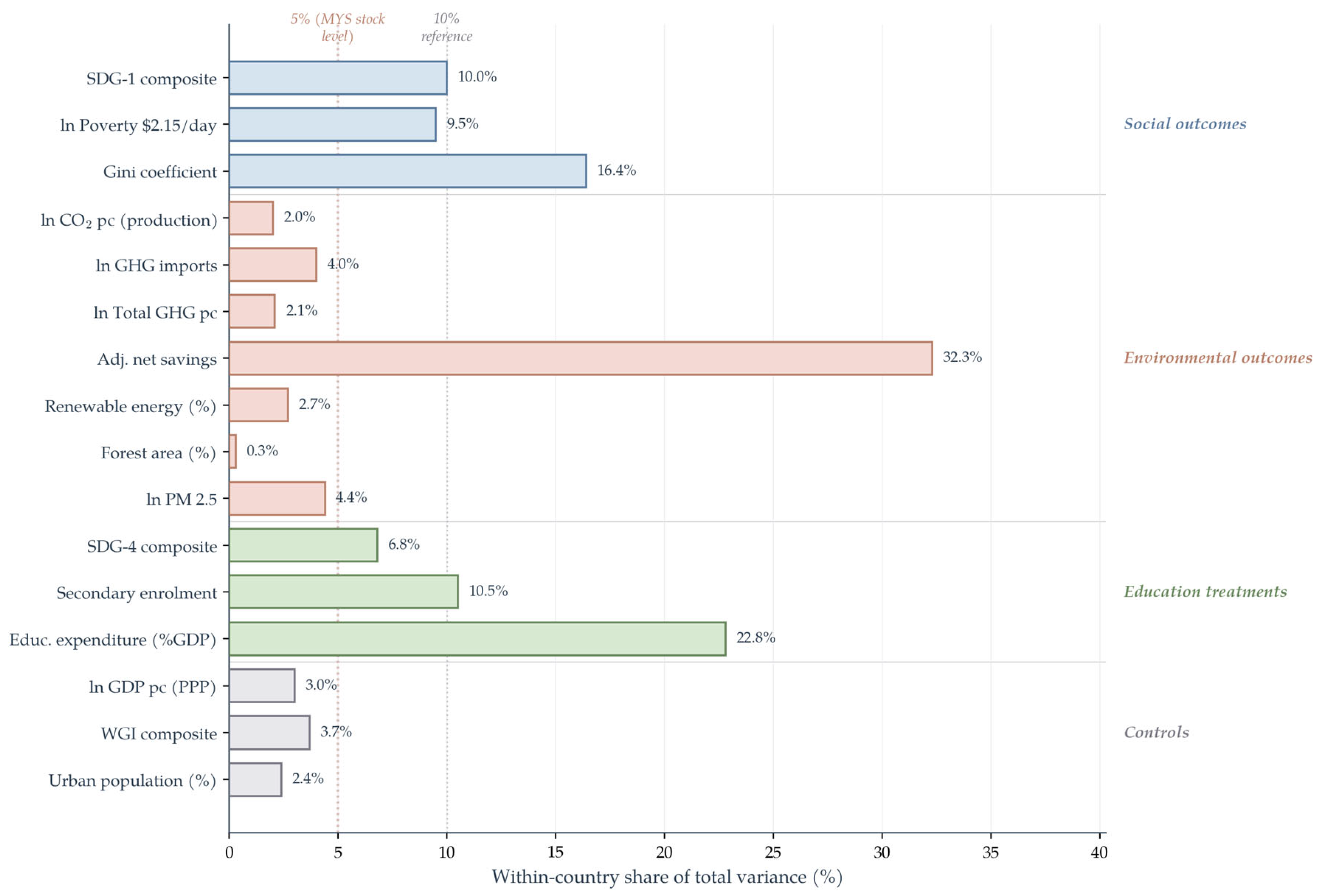
Figure A2.
Coverage heatmap: percentage of non-missing observations by SDSN region × variable. Dark cells indicate high coverage; light cells indicate sparse coverage. Notes: Dark cells indicate high coverage (≥80%); medium cells indicate moderate coverage (50–80%); light cells indicate sparse coverage (<50%). n = number of countries per region.
Figure A2.
Coverage heatmap: percentage of non-missing observations by SDSN region × variable. Dark cells indicate high coverage; light cells indicate sparse coverage. Notes: Dark cells indicate high coverage (≥80%); medium cells indicate moderate coverage (50–80%); light cells indicate sparse coverage (<50%). n = number of countries per region.
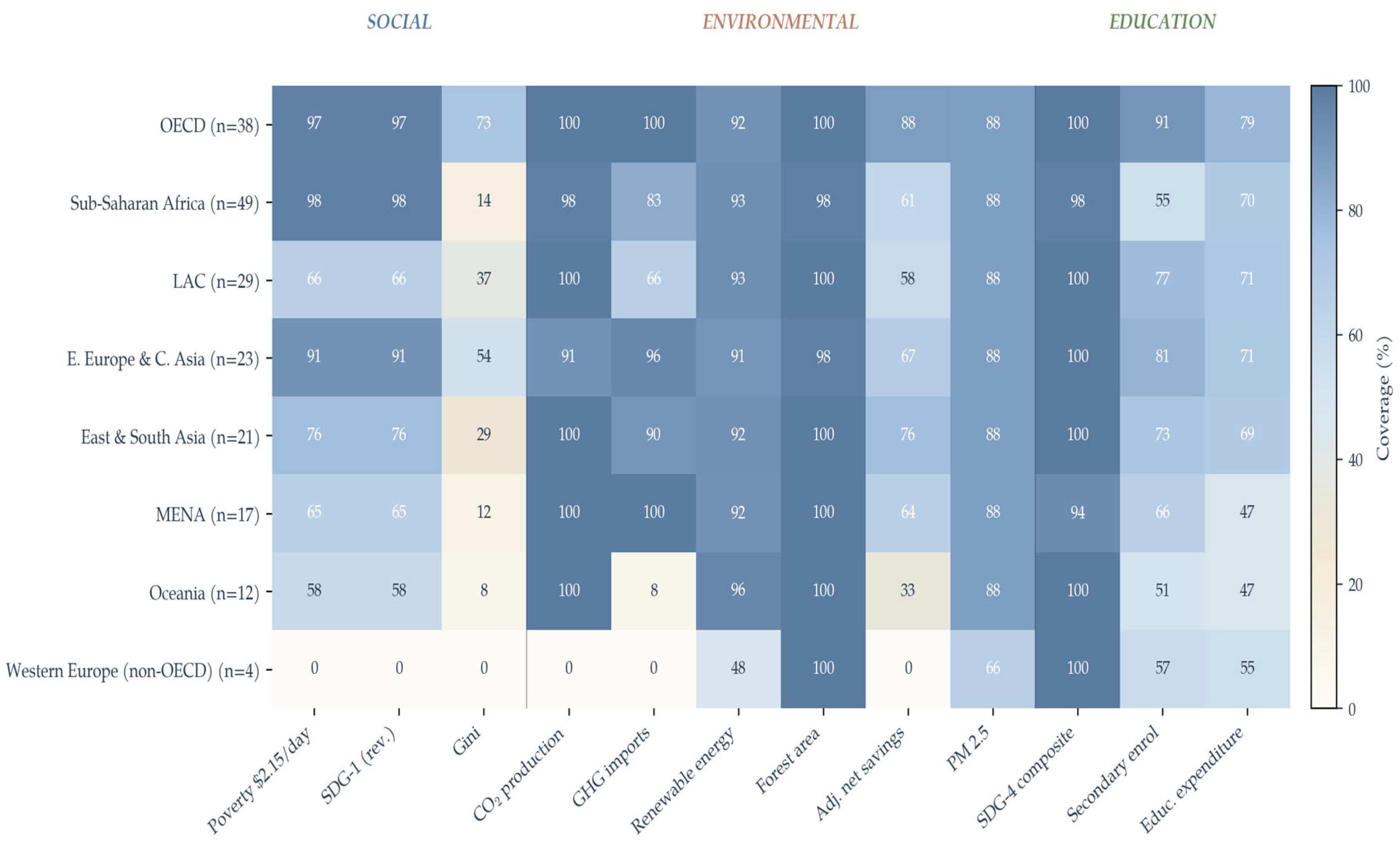
References
- United Nations. Transforming Our World: The 2030 Agenda for Sustainable Development; A/RES/70/1; United Nations: New York, NY, USA, 2015; Available online: https://sdgs.un.org/2030agenda.
- UNESCO. Education for Sustainable Development: A Roadmap; UNESCO: Paris, France, 2020; Available online: https://unesdoc.unesco.org/ark:/48223/pf0000374802.
- Lucas, R.E., Jr. On the Mechanics of Economic Development. J. Monet. Econ. 1988, 22, 3–42. [Google Scholar] [CrossRef]
- Mankiw, N.G.; Romer, D.; Weil, D.N. A Contribution to the Empirics of Economic Growth. Q. J. Econ. 1992, 107, 407–437. [Google Scholar] [CrossRef]
- Hanushek, E.A.; Woessmann, L. Education, Knowledge Capital, and Economic Growth. In The Economics of Education, 2nd ed.; Bradley, S., Green, C., Eds.; Academic Press: London, UK, 2020. [Google Scholar] [CrossRef]
- Brieger, S.A. Social Identity and Environmental Concern: The Importance of Contextual Effects. Environ. Behav. 2019, 51, 828–855. [Google Scholar] [CrossRef]
- Pavlova, O.; et al. Strategic Priorities for Socio-economic Development of Ukraine in Comparison with the Republic of Poland. In Human Systems Engineering and Design III. IHSED 2020. Advances in Intelligent Systems and Computing; Karwowski, W., Ahram, T., Etinger, D., Tanković, N., Taiar, R., Eds.; Springer: Cham, 2021; vol 1269. [Google Scholar] [CrossRef]
- Pryshchepa, O.; Kardash, O.; Yakymchuk, A.; Shvec, M.; Pavlov, K.; Pavlova, O.; Irtyshcheva, I.; Popadynets, N.; Boiko, Y.; Kramarenko, I. Optimization of multi-channel queuing systems with a single retail attempt: Economic approach. Decis. Sci. Lett. 2020, 559–564. [Google Scholar] [CrossRef]
- Pradhan, P.; Costa, L.; Rybski, D.; Lucht, W.; Kropp, J.P. A Systematic Study of Sustainable Development Goal (SDG) Interactions. Earth's Future 2017, 5(11), 1169–1179. [Google Scholar] [CrossRef]
- Scherer, L.; Behrens, P.; de Koning, A.; Heijungs, R.; Sprecher, B.; Tukker, A. Trade-offs between Social and Environmental Sustainable Development Goals. Environ. Sci. Policy 2018, 90, 65–72. [Google Scholar] [CrossRef]
- Kroll, C.; Warchold, A.; Pradhan, P. Sustainable Development Goals (SDGs): Are We Successful in Turning Trade-offs into Synergies? Palgrave Commun. 2019, 5, 140. [Google Scholar] [CrossRef]
- Sachs, J.D.; Lafortune, G.; Fuller, G. The SDGs and the UN Summit of the Future. In Sustainable Development Report 2025; Dublin University Press: Dublin, Ireland, 2025; Available online: https://www.sustainabledevelopment.report/reports/sustainable-development-report-2025/.
- Driscoll, J.C.; Kraay, A.C. Consistent Covariance Matrix Estimation with Spatially Dependent Panel Data. Rev. Econ. Stat. 1998, 80, 549–560. [Google Scholar] [CrossRef]
- Pesaran, M.H. General Diagnostic Tests for Cross Section Dependence in Panels; CESifo: Munich, Germany, 2004; Available online: https://papers.ssrn.com/abstract=572504CESifo Working Paper 1229.
- Oster, E. Unobservable Selection and Coefficient Stability: Theory and Evidence. J. Bus. Econ. Stat. 2019, 37, 187–204. [Google Scholar] [CrossRef]
- Grossman, G.M.; Krueger, A.B. Environmental Impacts of a North American Free Trade Agreement; NBER Working Paper 3914; National Bureau of Economic Research: Cambridge, MA, USA, 1991. [Google Scholar] [CrossRef]
- Stern, D.I. The Rise and Fall of the Environmental Kuznets Curve. World Dev. 2004, 32, 1419–1439. [Google Scholar] [CrossRef]
- Liashenko, O.; Dluhopolskyi, O. Uncovering the Interplay between Social Welfare Preferences and Society 5.0 Achievement: Implications for Sustainable Development. Economics 2024, 12(1), 175–197. [Google Scholar] [CrossRef]
- Liashenko, O.; Mykhailovska, O.; Shestakovska, T.; Selyutin, S. Effectiveness of Governance vs Social Development: A Multivariate Approach to Countries' Classification. Adm. Si Manag. Public 2024, 42, 6–24. [Google Scholar] [CrossRef]
- Shestakovska, T.; Mykhailovska, O.; Liashenko, O.; Chumakova, H.; Filipova, N.; Grivko, S. The Role of Social Mobility and Gender Balance in Shaping Sustainable Regional Development. OIDA Int. J. Sustain. Dev. 2025, 18(12), 1485–1490. Available online: https://papers.ssrn.com/sol3/papers.cfm?abstract_id=5946455.
- Liashenko, O.; Dluhopolskyi, O. The Statistical Approach to Understanding the Interdependencies among Sustainable Development Goals. Economics 2025, 13(3), 449–467. [Google Scholar] [CrossRef]
- Liashenko, O.; Caraballo, M.Á.; Lozano, S. Social Welfare Preferences and Sustainable Development Goals: A Multivariate Analysis Approach. Sustainable Development 2026. [Google Scholar] [CrossRef]
- Liashenko, O. Social Preferences Towards the Environment: Assessing and Quantifying Public Support for Sustainable Development. In Bridging Governance, Public Support, Innovation, and Transparency; Steiner, B.E., Makarenko, I., Eds.; Palgrave Macmillan: Cham, Switzerland, 2026. [Google Scholar] [CrossRef]
- Liashenko, O.; Adamyk, B.; Adamyk, O. The Role of Climate and Migration Concerns in Shaping Personal Economic Insecurity in European Societies. Energy Res. Soc. Sci. 2026, 131, 104533. [Google Scholar] [CrossRef]
- Lipset, S.M. Some Social Requisites of Democracy: Economic Development and Political Legitimacy. Am. Political Sci. Rev. 1959, 53, 69–105. [Google Scholar] [CrossRef]
- Durczak, K.; Sala, D.; Liashenko, O.; Pyzalski, M.; Pavlov, K.; Pavlova, O.; Romaniuk, R.; Sujak, A. Governance Matters: Evidence from Global Analysis on Environmental Sustainable Development Goals. Sustainability 2026, 18(2), 1140. [Google Scholar] [CrossRef]
- Liashenko, O.; Caraballo, M.Á. From Social Attitudes to Outcomes: The Role of Institutional Quality in Development. Open. Res. Eur. 2026, 5, 146. [Google Scholar] [CrossRef]
- Xiao, H.; Bao, S.; Ren, J.; Xu, Z.; Xue, S.; Liu, J. Global Transboundary Synergies and Trade-offs among Sustainable Development Goals from an Integrated Sustainability Perspective. Nat. Commun. 2024, 15, 500. [Google Scholar] [CrossRef]
- Zheng, Y.; Shan, R.; Xu, W.; Qiu, Y. Effectiveness of Carbon Dioxide Emission Target Is Linked to Country Ambition and Education Level. Commun. Earth Environ. 2024, 5, 209. [Google Scholar] [CrossRef]
- Xing, Q.; Wu, C.; Chen, F.; Liu, J.; Pradhan, P.; Bryan, B.A.; Schaubroeck, T.; Carrasco, L.R.; Gonsamo, A.; Li, Y.; Chen, X.; Deng, X.; Alban, A. Intranational Synergies and Trade-offs Reveal Common and Differentiated Priorities of Sustainable Development Goals in China. Nat. Commun. 2024, 15, 2251. [Google Scholar] [CrossRef]
- Büchs, M.; Schnepf, S.V. Who Emits Most? Associations between Socio-Economic Factors and UK Households' Home Energy, Transport, Indirect and Total CO2 Emissions. Ecol. Econ. 2013, 90, 114–123. [Google Scholar] [CrossRef]
- Lee, H.; Park, C.; Jung, H. The Role of Tertiary Education on CO2 Emissions: Evidence from 151 Countries. Environ. Dev. Sustain. 2024, 26, 32081–32103. [Google Scholar] [CrossRef]
- Zouine, M.; El Adnani, M.J.; Salhi, S.E. Higher Education's Impact on CO2 Mitigation: MENA Insights with Consideration for Unemployment, Economic Growth, and Globalization. Front. Environ. Sci. 2024, 12, 1325598. [Google Scholar] [CrossRef]
- Dasgupta, P. The Economics of Biodiversity: The Dasgupta Review; HM Treasury: London, UK, 2021; Available online: https://www.gov.uk/government/publications/final-report-the-economics-of-biodiversity-the-dasgupta-review.
- Wang, Q.; Wang, X.; Li, R.; Jiang, X. Reinvestigating the Environmental Kuznets Curve (EKC) of Carbon Emissions and Ecological Footprint in 147 Countries: A Matter of Trade Protectionism. Humanit. Soc. Sci. Commun. 2024, 11, 160. [Google Scholar] [CrossRef]
- Wynes, S.; Nicholas, K.A. The Climate Mitigation Gap: Education and Government Recommendations Miss the Most Effective Individual Actions. Environ. Res. Lett. 2017, 12, 074024. [Google Scholar] [CrossRef]
- Pesaran, M.H.; Yamagata, T. Testing Slope Homogeneity in Large Panels. J. Econom. 2008, 142, 50–93. [Google Scholar] [CrossRef]
- World Bank. World Development Indicators; World Bank: Washington, DC, USA, 2025; Available online: https://datatopics.worldbank.org/world-development-indicators/.
- Kaufmann, D.; Kraay, A.; Mastruzzi, M. The Worldwide Governance Indicators: Methodology and Analytical Issues; Policy Research Working Paper 5430; World Bank: Washington, DC, USA, 2010. [Google Scholar] [CrossRef]
- UNDP. Human Development Report 2023/2024; United Nations Development Programme: New York, NY, USA, 2024; Available online: https://hdr.undp.org/content/human-development-report-2023-24.
- UNESCO Institute for Statistics. UIS.Stat Data Centre; UIS: Montréal, Canada; Available online: https://data.uis.unesco.org.
- Gygli, S.; Haelg, F.; Potrafke, N.; Sturm, J.-E. The KOF Globalisation Index — Revisited. Rev. Int. Organ. 2019, 14, 543–574. [Google Scholar] [CrossRef]
- Sala, D.; Liashenko, O.; Pyzalski, M.; Pavlov, K.; Pavlova, O.; Durczak, K.; Chornyi, R. The Energy Footprint in the EU: How CO2 Emission Reductions Drive Sustainable Development. Energies 2025, 18(12), 3110. [Google Scholar] [CrossRef]
- Pavlova, O.; Liashenko, O.; Pavlov, K.; Demianiuk, O.; Chmura, R.; Sowa, B.; Vlasenko, T. Policy Plateau and Structural Regime Shift: Hybrid Forecasting of the EU Decarbonisation Gap Toward 2030 Targets. Sustainability 2026, 18(2), 1114. [Google Scholar] [CrossRef]
- Bennett, P.; Foley, K.; Green, D.A.; Salvanes, K.G. Education and Inequality: An International Perspective. Fisc. Stud. 2024, 45, 429–454. [Google Scholar] [CrossRef]
- Makhlouf, Y.; Lalley, C. Education Expansion, Income Inequality and Structural Transformation: Evidence From OECD Countries. Soc. Indic. Res. 2023, 169, 255–281. [Google Scholar] [CrossRef]
- Kasuga, H.; Morita, Y. Why Doesn't Expanding Higher Education Decrease Wage Inequality? Educ. Econ. 2026, 34(1), 130–142. [Google Scholar] [CrossRef]
- Pavlova, O.; Liashenko, O.; Pavlov, K.; Rutkowski, M.; Kornatka, A.; Vlasenko, T.; Halei, M. Discourse vs. Decarbonisation: Tracking the Alignment Between EU Climate Rhetoric and National Energy Patterns. Energies 2025, 18(19), 5304. [Google Scholar] [CrossRef]
- Liashenko, O. The Education–Sustainability Paradox: Replication Package for "Asymmetric Effects of Human Capital Expansion on Social and Environmental Sustainable Development Goals; Zenodo, 2026. [Google Scholar] [CrossRef]
Figure 1.
Empirical workflow from data sources to the central finding. Note: The panel combines four data sources (top row) into a master analytical panel of 193 countries × 24 years. Panel diagnostics (middle row) justify the estimation strategy: cross-sectional dependence motivates the Driscoll–Kraay standard-error correction; slope heterogeneity motivates discussion of future research directions; and variance decomposition motivates the exclusion of slow-moving stock variables. The main estimation (centre) spans twelve outcomes × eight treatments = 96 regressions with two-way fixed effects. Four robustness strategies (penultimate row) jointly support the central finding (bottom): an asymmetric education–sustainability relationship, beneficial on the social block and null or perverse on the environmental block.
Figure 1.
Empirical workflow from data sources to the central finding. Note: The panel combines four data sources (top row) into a master analytical panel of 193 countries × 24 years. Panel diagnostics (middle row) justify the estimation strategy: cross-sectional dependence motivates the Driscoll–Kraay standard-error correction; slope heterogeneity motivates discussion of future research directions; and variance decomposition motivates the exclusion of slow-moving stock variables. The main estimation (centre) spans twelve outcomes × eight treatments = 96 regressions with two-way fixed effects. Four robustness strategies (penultimate row) jointly support the central finding (bottom): an asymmetric education–sustainability relationship, beneficial on the social block and null or perverse on the environmental block.
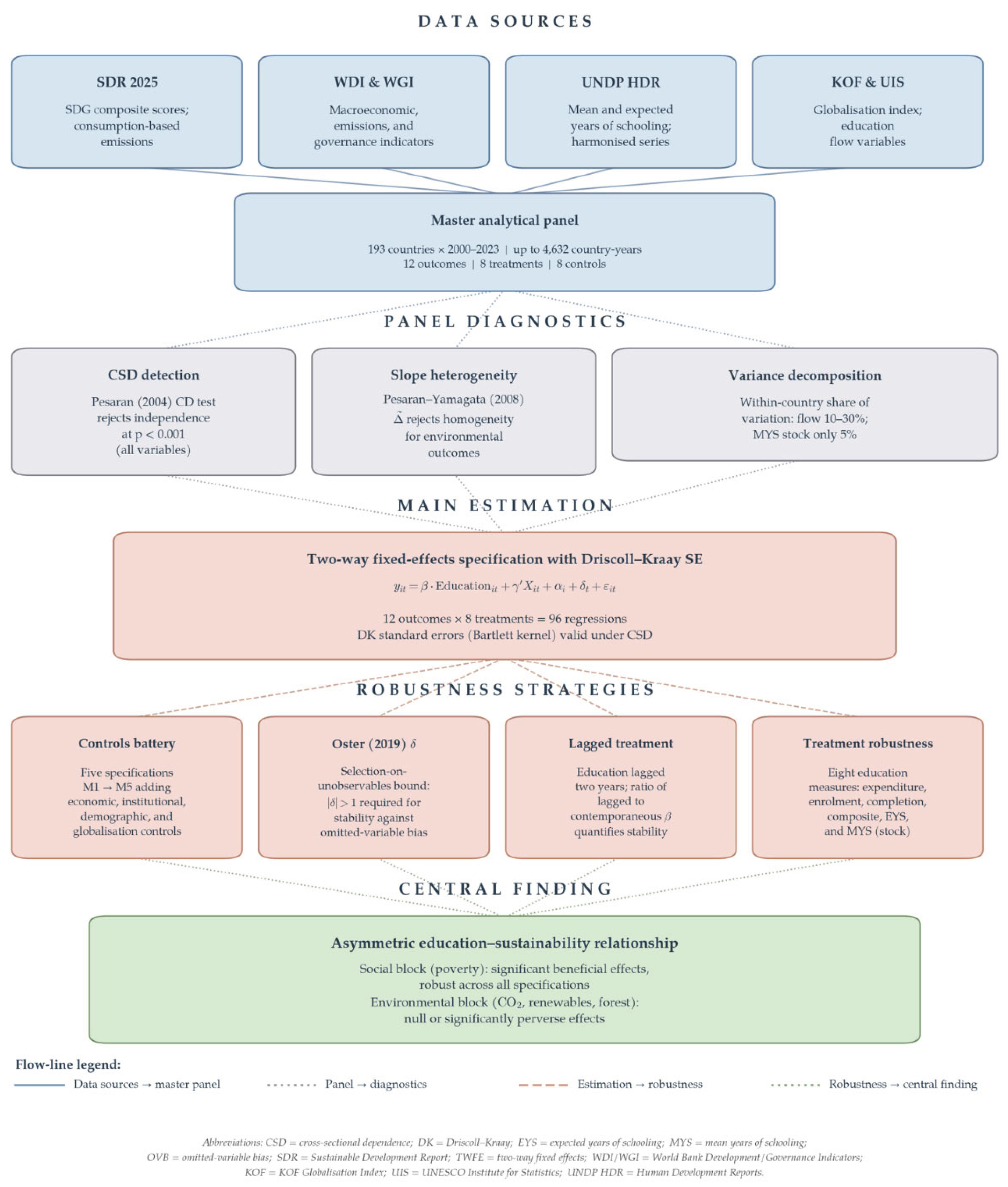
Figure 2.
Headline asymmetry: effect of secondary enrolment on twelve standardised SDG outcomes, two-way fixed-effects coefficients with Driscoll–Kraay 95% confidence intervals. Social-block outcomes (four outcomes, in soft blue) are on the top panel; environmental-block outcomes (eight outcomes, in soft pink) are on the bottom panel. Coefficients are standardised on the outcome standard deviation so that the x-axis is expressed in outcome-standard-deviation units. Coefficients to the left of the vertical zero line indicate beneficial effects for the social block (reduced poverty/inequality); to the right of the zero line, they indicate beneficial effects for the environmental block (reduced emissions/pollution; higher forest cover/renewables).
Figure 2.
Headline asymmetry: effect of secondary enrolment on twelve standardised SDG outcomes, two-way fixed-effects coefficients with Driscoll–Kraay 95% confidence intervals. Social-block outcomes (four outcomes, in soft blue) are on the top panel; environmental-block outcomes (eight outcomes, in soft pink) are on the bottom panel. Coefficients are standardised on the outcome standard deviation so that the x-axis is expressed in outcome-standard-deviation units. Coefficients to the left of the vertical zero line indicate beneficial effects for the social block (reduced poverty/inequality); to the right of the zero line, they indicate beneficial effects for the environmental block (reduced emissions/pollution; higher forest cover/renewables).
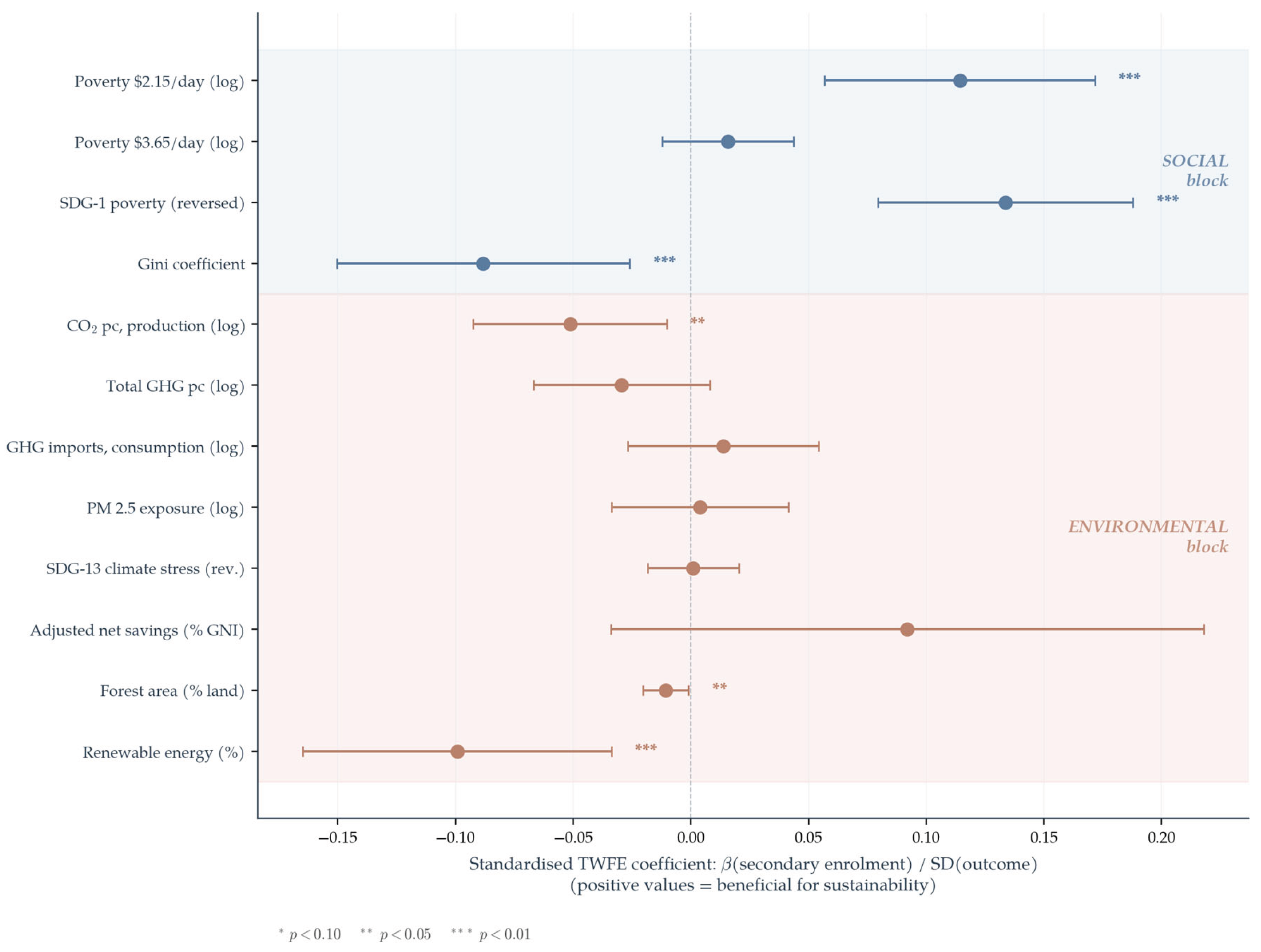
Figure 3.
Controls battery: stability of the treatment coefficient across five progressively richer specifications (M1 through M5), for six anchor outcomes. Coefficients are standardised on the outcome standard deviation and include Driscoll–Kraay 95% confidence intervals. Stars indicate significance at conventional levels (p < 0.10, p < 0.05, p < 0.01). The stability of the coefficient sign and order of magnitude across M1–M5 — with Oster [15] δ > 1 for every outcome — supports the robustness of the asymmetry pattern against plausible omitted-variable bias.
Figure 3.
Controls battery: stability of the treatment coefficient across five progressively richer specifications (M1 through M5), for six anchor outcomes. Coefficients are standardised on the outcome standard deviation and include Driscoll–Kraay 95% confidence intervals. Stars indicate significance at conventional levels (p < 0.10, p < 0.05, p < 0.01). The stability of the coefficient sign and order of magnitude across M1–M5 — with Oster [15] δ > 1 for every outcome — supports the robustness of the asymmetry pattern against plausible omitted-variable bias.
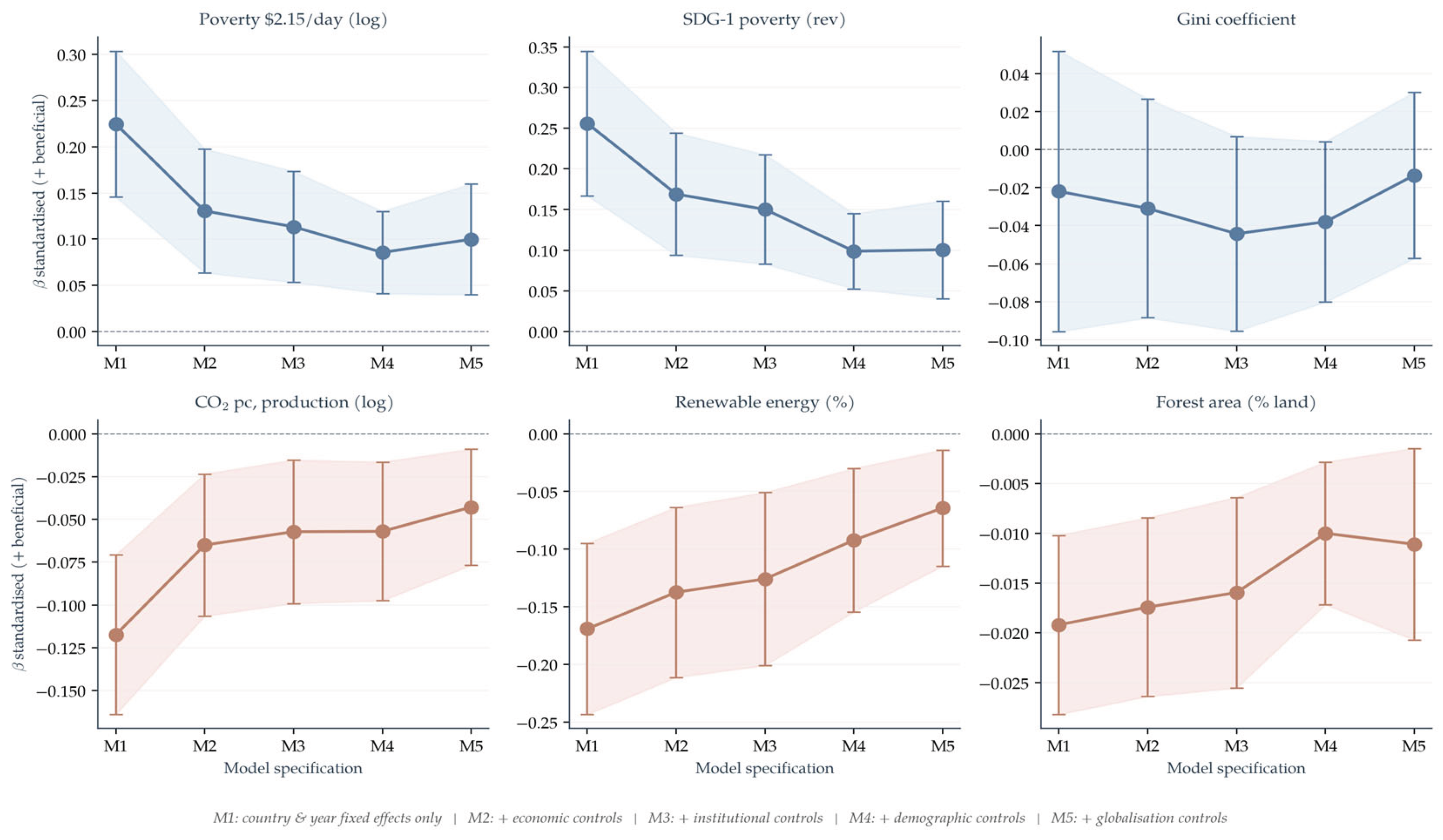
Figure 4.
Treatment robustness: coefficient plot of standardised effects β̃ for eight education treatments across ten SDG outcomes, with Driscoll–Kraay 95% confidence intervals. Outcomes are grouped into the social block (left, blue panel) and the environmental block (right, pink panel); positive values indicate beneficial effects. The panel-wise pattern is the paper's central claim: social-block coefficients mostly lie above zero (beneficial), whereas environmental-block coefficients cluster around or below zero (null or perverse). Notes: Points are standardised TWFE coefficients; vertical bars are Driscoll–Kraay 95% confidence intervals. Coefficients whose intervals do not cross the zero line are significant at the 5% level. Colours distinguish the eight education treatments per the legend. MYS (stock) produces wider intervals for several environmental outcomes, reflecting its 5% within-country variance (see Section 4.4.3).
Figure 4.
Treatment robustness: coefficient plot of standardised effects β̃ for eight education treatments across ten SDG outcomes, with Driscoll–Kraay 95% confidence intervals. Outcomes are grouped into the social block (left, blue panel) and the environmental block (right, pink panel); positive values indicate beneficial effects. The panel-wise pattern is the paper's central claim: social-block coefficients mostly lie above zero (beneficial), whereas environmental-block coefficients cluster around or below zero (null or perverse). Notes: Points are standardised TWFE coefficients; vertical bars are Driscoll–Kraay 95% confidence intervals. Coefficients whose intervals do not cross the zero line are significant at the 5% level. Colours distinguish the eight education treatments per the legend. MYS (stock) produces wider intervals for several environmental outcomes, reflecting its 5% within-country variance (see Section 4.4.3).
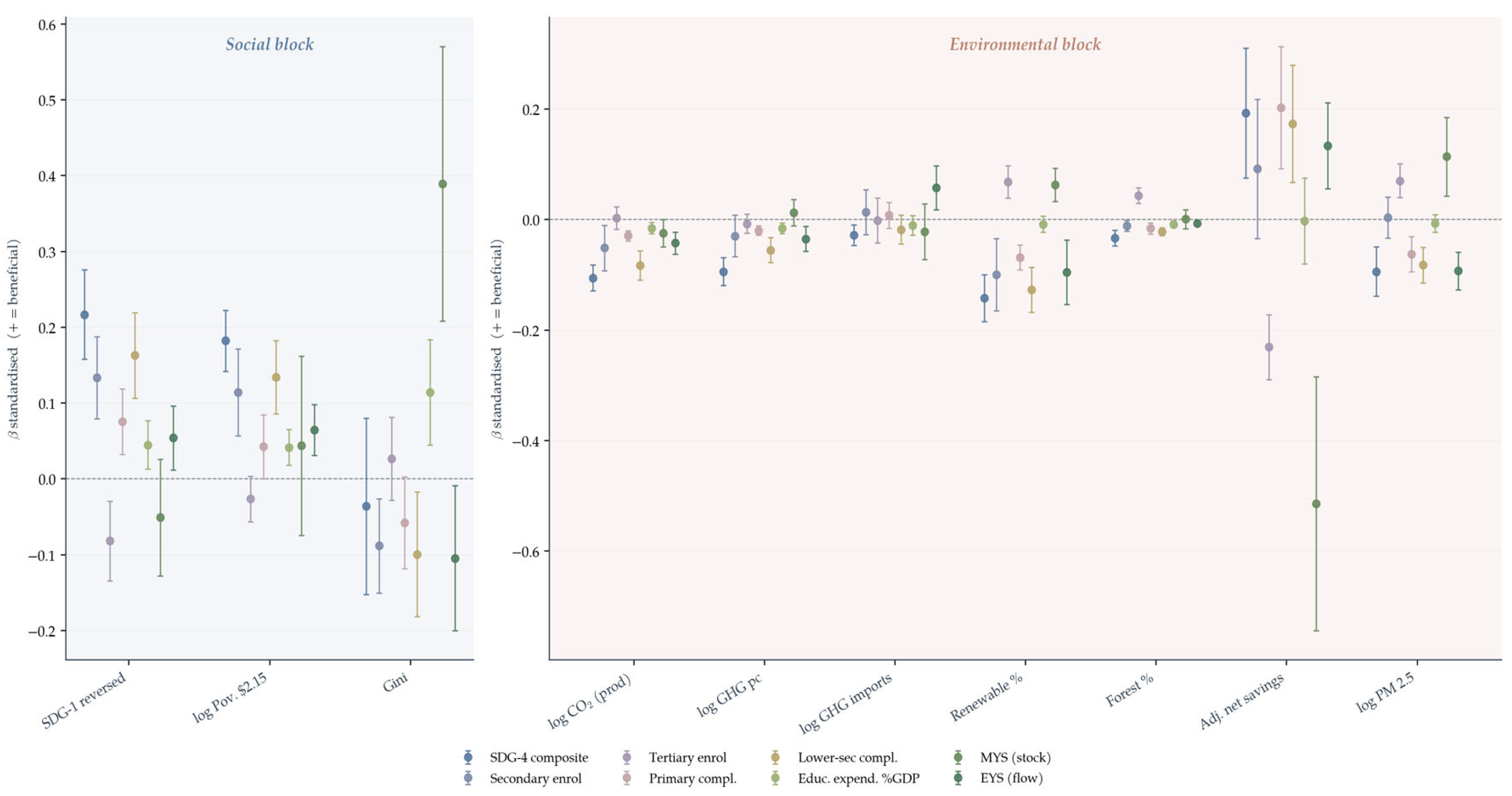
Figure 5.
Stock-versus-flow identification diagnostic for Mean Years of Schooling. Panel A: within-country share of total variance for nine education treatments. MYS (stock measure) has only 5.0 per cent within-country variance — the lowest of all treatments examined and well below the 10 per cent reference threshold commonly considered necessary for reliable two-way fixed-effects identification. All flow measures exceed this threshold. Panel B: MYS trajectories for seven illustrative countries over 2000–2022, showing the near-linear growth pattern characteristic of stock variables and the limited within-country variation that the country fixed effects absorb.
Figure 5.
Stock-versus-flow identification diagnostic for Mean Years of Schooling. Panel A: within-country share of total variance for nine education treatments. MYS (stock measure) has only 5.0 per cent within-country variance — the lowest of all treatments examined and well below the 10 per cent reference threshold commonly considered necessary for reliable two-way fixed-effects identification. All flow measures exceed this threshold. Panel B: MYS trajectories for seven illustrative countries over 2000–2022, showing the near-linear growth pattern characteristic of stock variables and the limited within-country variation that the country fixed effects absorb.
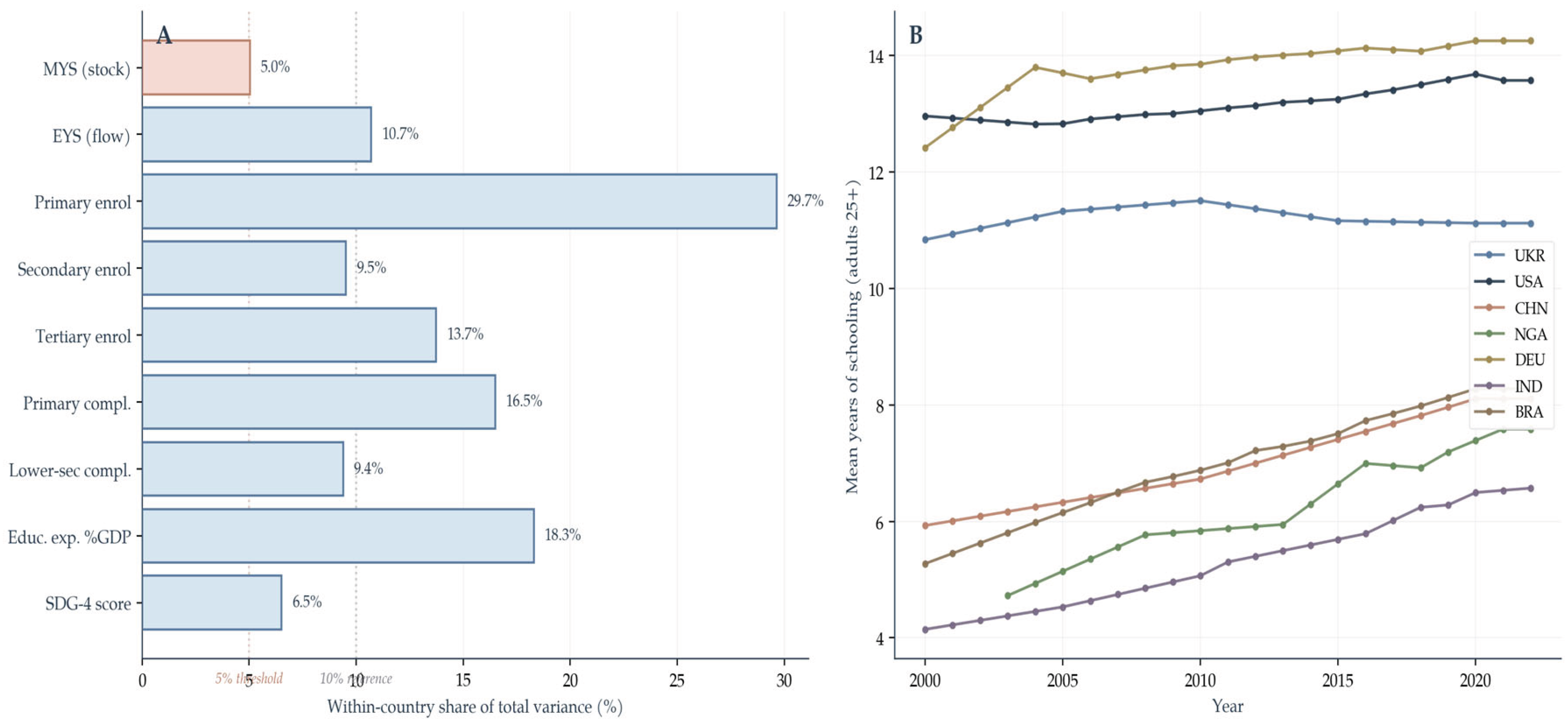
Table 1.
Descriptive statistics by analytical block. Summary statistics for outcome, treatment, and control variables used in the analysis.
Table 1.
Descriptive statistics by analytical block. Summary statistics for outcome, treatment, and control variables used in the analysis.
| Variable | N | Countries | Mean | SD | P5 | P50 | P95 |
|---|---|---|---|---|---|---|---|
| Social outcomes | |||||||
| Poverty headcount $2.15/day (%) | 4176.0 | 174.0 | 15.41 | 20.17 | 0.13 | 5.5 | 62.79 |
| Poverty headcount $3.65/day (%) | 4176.0 | 174.0 | 26.49 | 27.73 | 0.23 | 15.52 | 81.52 |
| SDG 1 composite score (0–100) | 4176.0 | 174.0 | 67.76 | 32.57 | 6.76 | 81.16 | 99.67 |
| Gini index (SDR) | 1725.0 | 171.0 | 37.14 | 8.05 | 26.4 | 35.55 | 52.98 |
| SDG 10 composite score | 4296.0 | 179.0 | 59.31 | 26.57 | 13.94 | 63.65 | 98.6 |
| Environmental outcomes | |||||||
| CO2 pc, production-based (tCO2) | 4464.0 | 186.0 | 4.94 | 9.15 | 0.07 | 2.19 | 18.12 |
| GHG embodied in imports pc (tCO2) | 4095.0 | 171.0 | 2.98 | 3.67 | 0.17 | 1.42 | 9.96 |
| GHG emissions pc, total (tCO2) | 4464.0 | 186.0 | 7.23 | 10.92 | 0.76 | 3.8 | 24.23 |
| Adjusted net savings (% GNI) | 3030.0 | 158.0 | 8.25 | 11.71 | -11.38 | 8.4 | 26.31 |
| Forest area (% of land) | 4596.0 | 193.0 | 32.83 | 24.3 | 0.45 | 31.48 | 74.63 |
| Renewable energy (%) | 4236.0 | 191.0 | 32.77 | 29.66 | 0.1 | 23.6 | 88.62 |
| PM2.5 mean annual (μg/m3) | 4032.0 | 192.0 | 26.96 | 16.69 | 7.76 | 22.44 | 62.13 |
| SDG 13 composite score (0–100) | 4944.0 | 206.0 | 84.52 | 19.05 | 41.24 | 91.55 | 99.37 |
| — Education treatments — | |||||||
| Education expenditure (% GDP) | 3167.0 | 188.0 | 4.39 | 1.99 | 1.74 | 4.2 | 7.71 |
| Primary enrollment GER (%) | 3802.0 | 192.0 | 101.72 | 13.93 | 76.31 | 101.56 | 122.84 |
| Secondary enrollment GER (%) | 3298.0 | 190.0 | 82.17 | 28.91 | 26.68 | 88.83 | 118.92 |
| Tertiary enrollment GER (%) | 2935.0 | 183.0 | 39.88 | 28.65 | 2.92 | 36.42 | 88.65 |
| Primary completion rate (%) | 3033.0 | 182.0 | 88.9 | 18.96 | 50.53 | 95.75 | 108.73 |
| Lower-secondary completion (%) | 2772.0 | 181.0 | 76.21 | 27.19 | 21.49 | 86.31 | 104.94 |
| SDG 4 composite score | 4944.0 | 206.0 | 71.33 | 26.51 | 16.78 | 79.85 | 98.63 |
| Literacy rate 15–24 (%) | 1061.0 | 186.0 | 90.13 | 14.9 | 54.83 | 97.37 | 100.0 |
| — Controls — | |||||||
| Log GDP per capita (PPP) | 4426.0 | 185.0 | 9.39 | 1.17 | 7.39 | 9.49 | 11.09 |
| Real GDP growth (%) | 4544.0 | 192.0 | 3.48 | 5.67 | -4.48 | 3.69 | 10.25 |
| WGI composite | 4430.0 | 193.0 | -0.06 | 0.91 | -1.48 | -0.19 | 1.6 |
| Urban population (%) | 4632.0 | 193.0 | 56.78 | 23.07 | 19.32 | 58.3 | 92.54 |
| Trade openness (% GDP) | 3911.0 | 174.0 | 86.41 | 50.66 | 32.98 | 75.96 | 165.22 |
| Natural-resource rents (% GDP) | 4139.0 | 192.0 | 7.2 | 11.19 | 0.0 | 2.1 | 32.69 |
| Internet users (%) | 4434.0 | 193.0 | 37.72 | 31.93 | 0.47 | 30.16 | 91.99 |
| KOF globalisation index | 4399.0 | 184.0 | 58.03 | 14.78 | 36.13 | 56.48 | 83.38 |
Notes: N = number of country-year observations in the analytical panel. Countries = unique national units contributing at least one observation. P5, P50, P95 = fifth, fiftieth, and ninety-fifth percentiles. Log-transformed variables are shown on the log scale. Full definitions and data sources are given in Section 3.2; country-level coverage details are reported in Appendix Table A1.
Table 2.
The two main two-way fixed-effects results: the effect of secondary enrolment on twelve SDG outcomes. Driscoll–Kraay standard errors in parentheses. All specifications include country- and year-fixed effects and baseline controls (log GDP per capita, WGI composite, urban population share). p < 0.01; p < 0.05; p < 0.10.
Table 2.
The two main two-way fixed-effects results: the effect of secondary enrolment on twelve SDG outcomes. Driscoll–Kraay standard errors in parentheses. All specifications include country- and year-fixed effects and baseline controls (log GDP per capita, WGI composite, urban population share). p < 0.01; p < 0.05; p < 0.10.
| Block | Outcome | β | SE | 95% CI | p-value | Sig. | N | Countries |
|---|---|---|---|---|---|---|---|---|
| Social | ln Poverty $2.15/day | -0.16 | (0.041) | [-0.241, -0.080] | 0.0 | *** | 2627 | 152 |
| ln Poverty $3.65/day | -0.024 | (0.021) | [-0.066, +0.018] | 0.271 | 2627 | 152 | ||
| SDG-1 poverty (reversed) | -4.354 | (0.900) | [-6.120, -2.589] | 0.0 | *** | 2627 | 152 | |
| Gini | 0.71 | (0.255) | [+0.209, +1.211] | 0.006 | *** | 1323 | 147 | |
| Environmental | ln CO2 pc (production) | 0.048 | (0.020) | [+0.010, +0.086] | 0.014 | ** | 2994 | 178 |
| ln Total GHG pc | 0.025 | (0.016) | [-0.007, +0.056] | 0.125 | 2994 | 178 | ||
| ln GHG imports (consumption) | -0.01 | (0.015) | [-0.041, +0.020] | 0.503 | 2561 | 148 | ||
| ln PM 2.5 | -0.002 | (0.011) | [-0.024, +0.019] | 0.836 | 2667 | 182 | ||
| SDG-13 climate stress (rev.) | -0.019 | (0.188) | [-0.388, +0.350] | 0.92 | 3057 | 181 | ||
| Adj net savings (% GNI) | 1.078 | (0.752) | [-0.397, +2.552] | 0.152 | 2204 | 152 | ||
| Forest area (%) | -0.26 | (0.120) | [-0.496, -0.024] | 0.031 | ** | 3051 | 182 | |
| Renewable energy (%) | -2.944 | (0.991) | [-4.888, -1.001] | 0.003 | *** | 2818 | 181 |
Notes: Standard errors in parentheses are Driscoll–Kraay with Bartlett kernel. 95% confidence intervals in brackets. Secondary enrolment is standardised; outcomes are reported on their original scale after sign normalisation so that positive coefficients indicate beneficial effects for sustainability. The full regression grid across all eight treatments is reported in Appendix Table A3. Significance levels: p < 0.10 (one asterisk), p < 0.05 (two asterisks), p < 0.01 (three asterisks).
Table 3.
Controls battery for six anchor outcomes. Each row reports the treatment coefficient (secondary enrolment) under five progressively richer specifications. M1: fixed effects only; M2: + economic controls; M3: + institutional; M4: + demographic; M5: + globalisation. Oster [15] δ-statistic in final column.
Table 3.
Controls battery for six anchor outcomes. Each row reports the treatment coefficient (secondary enrolment) under five progressively richer specifications. M1: fixed effects only; M2: + economic controls; M3: + institutional; M4: + demographic; M5: + globalisation. Oster [15] δ-statistic in final column.
| Block | Outcome | M1: FE only | M2: +Economic | M3: +Institutional | M4: +Demographic | M5: +Globalisation | Oster δ |
|---|---|---|---|---|---|---|---|
| Social | ln Poverty $2.15/day | -0.315*** | -0.183*** | -0.159*** | -0.120*** | -0.140*** | 1.68 |
| SDG-1 poverty (rev.) | -8.338*** | -5.505*** | -4.893*** | -3.216*** | -3.276*** | 1.28 | |
| Gini | +0.176 | +0.249 | +0.357* | +0.306* | +0.108 | 5.52 | |
| Environmental | ln CO2 pc (production) | +0.110*** | +0.061*** | +0.053*** | +0.053*** | +0.040** | 2.13 |
| Renewable energy (%) | -5.011*** | -4.075*** | -3.732*** | -2.733*** | -1.908** | -12.43 | |
| Forest area (%) | -0.466*** | -0.423*** | -0.388*** | -0.243*** | -0.270** | 22.39 |
Notes: All entries are standardised TWFE coefficients with Driscoll–Kraay standard errors. The Oster [15] δ-statistic (last column) is computed assuming R²_max = 1.3 × R²_M5; |δ| > 1 indicates that the coefficient is stable against plausible omitted-variable bias. Sample sizes and full inferential output for all 30 regressions are provided in Appendix Table A4. Significance levels: p < 0.10 (one asterisk), p < 0.05 (two asterisks), p < 0.01 (three asterisks).
Table 4.
Lagged-treatment robustness for six anchor outcomes. Contemporaneous (lag 0) vs. two-year-lagged (lag 2) specifications. Ratio between 0.8 and 1.3 indicates stability under lagging.
Table 4.
Lagged-treatment robustness for six anchor outcomes. Contemporaneous (lag 0) vs. two-year-lagged (lag 2) specifications. Ratio between 0.8 and 1.3 indicates stability under lagging.
| Block | Outcome | β (lag 0) | p (lag 0) | β (lag 2) | p (lag 2) | Ratio |
|---|---|---|---|---|---|---|
| Social | ln Poverty $2.15/day | -0.16 | 0.0 | -0.139 | 0.001 | 0.87 |
| SDG-1 poverty (rev.) | -4.354 | 0.0 | -4.095 | 0.0 | 0.94 | |
| Gini | 0.71 | 0.006 | 0.725 | 0.009 | 1.02 | |
| Environmental | ln CO2 pc (production) | 0.048 | 0.014 | 0.052 | 0.008 | 1.08 |
| Renewable energy (%) | -2.944 | 0.003 | -3.33 | 0.002 | 1.13 | |
| Forest area (%) | -0.26 | 0.031 | -0.326 | 0.012 | 1.25 |
Notes: "β (lag 0)" is the contemporaneous coefficient reproduced from Table 2. "β (lag 2)" is obtained by replacing Education_it with Education_i,t−2 in equation (1), as specified in equation (2) of Section 3.4.4. "Ratio" is β(lag 2) / β(lag 0); values between 0.8 and 1.2 indicate that the coefficient is approximately stable under lagging. All standard errors are Driscoll–Kraay. The full lagged-robustness grid is reported in Appendix Table A6.
Disclaimer/Publisher’s Note: The statements, opinions and data contained in all publications are solely those of the individual author(s) and contributor(s) and not of MDPI and/or the editor(s). MDPI and/or the editor(s) disclaim responsibility for any injury to people or property resulting from any ideas, methods, instructions or products referred to in the content. |
© 2026 by the authors. Licensee MDPI, Basel, Switzerland. This article is an open access article distributed under the terms and conditions of the Creative Commons Attribution (CC BY) license (http://creativecommons.org/licenses/by/4.0/).
Copyright: This open access article is published under a Creative Commons CC BY 4.0 license, which permit the free download, distribution, and reuse, provided that the author and preprint are cited in any reuse.


