
Submitted:
27 April 2026
Posted:
28 April 2026
You are already at the latest version
Abstract
Background: Decentralised clinical trials (DCTs) have emerged as a transformative approach to improve accessibility, inclusivity, and efficiency in clinical research. However, evidence on their feasibility and implementation readiness in low- and middle-income countries remains limited. This study aimed to assess stakeholder awareness, perceptions, and system readiness for DCT implementation in Sri Lanka. Methods: A cross-sectional survey was conducted among 87 stakeholders, including academics, healthcare professionals, researchers, and regulatory personnel. Data were collected using a structured questionnaire assessing awareness, attitudes, perceived benefits and barriers, and readiness for DCT implementation. Descriptive statistics summarised responses, while bivariate analyses (chi-square and Fisher’s exact tests) and multivariable logistic regression were used to identify factors associated with perceived preparedness. Results: Awareness of DCTs was moderate (62.1%), and most participants recognised their potential to improve trial participation (88.5%). However, only 31.0% reported feeling adequately prepared to engage in DCTs. Institutional readiness was limited, with low availability of infrastructure (31.0%) and policies (16.1%). Regulatory familiarity (13.8%) and confidence in ethical guidance (10.3%) were also low. Key barriers included technological limitations (64.4%), data privacy concerns (58.6%), and patient safety issues (56.3%). Preparedness was significantly associated with prior training (p = 0.019) and institutional infrastructure (OR 3.31, 95% CI 1.21–9.09), but not with level of understanding. Conclusion: Stakeholders in Sri Lanka demonstrate strong conceptual support for DCTs but limited operational readiness. Implementation is constrained by system-level gaps rather than attitudinal barriers. Context-specific investment in infrastructure, training, and regulatory frameworks is essential to ensure equitable and sustainable adoption of decentralised clinical trials.
Keywords:
decentralised clinical trials
; low- and middle-income
; cross-sectional
; feasibility
; readiness
; Sri Lanka
; DARWIN
|
Research in context Evidence before this study: We searched the worldwide web and the published literature for studies on decentralised clinical trials, with particular attention to stakeholder readiness, implementation barriers, and low- and middle-income country settings. The identified literature was dominated by studies from high-income or digitally mature environments, including a systematic review of DCT methods, European regulatory perspectives, Canadian patient and public perceptions, and Danish policy stakeholder perspectives. We also identified a qualitative study from sub-Saharan Africa and a cross-sectional analysis of global DCT implementation, both of which highlighted important implementation and governance challenges. However, we did not identify a peer-reviewed published study specifically assessing stakeholder readiness for DCT implementation in Sri Lanka. Added value of this study: This study provides, to our knowledge, the first empirical assessment of stakeholder readiness for decentralised clinical trials in Sri Lanka. Unlike much of the existing literature, which focuses on technological promise, regulatory discussion, or stakeholder perspectives in high-income settings, this study evaluates DCTs through a systems-readiness lens in a lower-middle-income country. It shows that stakeholders are broadly supportive of DCTs in principle, but that implementation is constrained by deficits in infrastructure, training, institutional policy, regulatory familiarity, and ethical confidence. The study therefore shifts the discussion from innovation uptake to implementation readiness, showing that the main barriers are structural rather than attitudinal. Implications of all the available evidence: Taken together, the available evidence suggests that DCTs should not be treated as universally transferable models. Their success in high-income settings appears to depend on system-level capacities that are often implicit and underexamined in the published literature. This study adds evidence from South Asia showing that stakeholder support alone is insufficient; implementation requires coordinated investment in digital infrastructure, workforce development, governance, and equity-sensitive regulation. For global health, the implication is clear: if decentralised trial models are to contribute to more inclusive research, they must be adapted to local system capacity rather than exported as ready-made solutions. |
Background
Clinical trials underpin evidence-based medicine by generating the empirical foundation for evaluating the safety, efficacy, and implementation of medical interventions [1,2,3]. However, conventional site-based trial models remain structurally constrained. They rely on repeated in-person visits to centralised research facilities, creating logistical burdens that limit geographic reach and systematically exclude individuals who are unable to travel, have limited mobility, or reside in underserved settings [4,5]. These constraints have important methodological consequences, restricting representativeness and contributing to persistent inequities in evidence generation, thereby limiting the external validity and generalisability of clinical research.
These limitations are reflected in the global distribution of clinical trial activity. As illustrated in Figure 1, interventional clinical trials remain disproportionately concentrated in high-income countries [6]. Between 2009 and 2022, 536,916 trial-country counts (70.1%) were located in high-income settings, compared with 228,991 (29.9%) in low-income and middle-income countries. This imbalance is particularly evident in Europe and the Americas, which account for the majority of high-income trial activity, whereas LMIC participation is concentrated in a smaller number of regions, notably the Western Pacific, South-East Asia, and the Eastern Mediterranean, with Africa contributing comparatively few trial-country counts overall. Because multicountry trials are counted once per participating country, these figures represent the distribution of trial sites rather than unique protocols, and therefore provide an indication of where research is conducted and who has realistic opportunities to participate. This persistent geographic concentration highlights a fundamental misalignment between the global burden of disease and the locations in which clinical evidence is generated, reinforcing longstanding inequities in research representation and access.
Decentralised clinical trials (DCTs) have emerged as a response to these limitations, representing a fundamental shift in how clinical research is designed and delivered [7]. By leveraging digital health technologies, remote monitoring systems, and patient-centred approaches, DCTs enable trial-related activities to be conducted partially or entirely outside traditional clinical sites [8,9]. Core components include electronic informed consent, telemedicine consultations, wearable devices, and home-based data collection. These approaches redistribute the locus of research from institutions to participants, reducing logistical barriers and offering the potential to improve inclusivity [10,11]. The rapid adoption of decentralised methods during the COVID-19 pandemic further demonstrated their capacity to sustain research activity under conditions where conventional trial models were disrupted [12,13].
Evidence from high-income settings suggests that DCTs can improve recruitment, retention, and participant diversity, while enabling more continuous and ecologically valid data capture [14]. They also offer potential efficiencies in cost and scalability through reduced reliance on physical infrastructure. However, these benefits are contingent on the presence of enabling systems. The implementation of DCTs introduces complex challenges, including ensuring data integrity, maintaining patient safety in remote environments, and navigating regulatory and ethical uncertainties related to digital consent and decentralised oversight [15,16]. Furthermore, reliance on digital technologies raises concerns regarding data privacy, cybersecurity, and unequal access to technological resources [17].
These challenges are likely to be amplified in LMICs, where health systems often operate under resource constraints and digital infrastructure is unevenly distributed. The distributional imbalance shown in Figure 2 underscores that the global evidence base for clinical trials, including decentralised approaches, is disproportionately generated in high-income, digitally mature contexts. As such, the apparent success of DCTs may reflect not only the intrinsic advantages of decentralisation, but also the presence of underlying system-level capacities technological, regulatory, and organisational that are not readily transferable [11]. Without context-specific evaluation, the adoption of DCTs in LMICs risks being misaligned with local system capacity, potentially leading to ineffective implementation or the exacerbation of existing inequities, particularly among populations with limited digital access [18].
Within this context, Sri Lanka represents a strategically important setting in which to examine the feasibility and acceptability of decentralised clinical trials. The country has a well-established public health system, high literacy rates, and a growing digital health ecosystem, alongside an active clinical research environment supported by institutional ethics review committees and university-affiliated research units. However, clinical trials remain predominantly site-centric, and the infrastructure required for decentralised approaches is still emerging. Variability in internet connectivity, limited integration of digital tools into research workflows, and evolving regulatory frameworks present potential barriers to implementation.
At the same time, there are opportunities for contextually adapted models of decentralisation. Existing community-based healthcare systems, including established public health outreach networks, provide a foundation for hybrid approaches that combine digital technologies with local, in-person support. National investments in mobile and digital health further strengthen this potential. However, realising these opportunities depends on system readiness, including workforce capability, institutional capacity, regulatory clarity, and ethical governance.
There remains a lack of empirical evidence examining stakeholder perspectives on decentralised clinical trials within LMIC settings [19]. This gap is critical, as the global expansion of decentralised models is occurring in the absence of context-specific evidence on feasibility, acceptability, and implementation readiness [20]. The DARWIN pilot phase was therefore designed as a foundational assessment of decentralised clinical trial readiness in Sri Lanka, with the aim of generating empirical evidence on stakeholder understanding, identifying structural and regulatory barriers, and informing the development of contextually adapted, equity-sensitive trial models for broader implementation in LMIC settings.
Methods
Study Design and Reporting Framework
This study was a cross-sectional survey conducted to assess stakeholder awareness, perceptions, and readiness for the implementation of decentralised clinical trials in Sri Lanka. The study was designed and reported in accordance with the Strengthening the Reporting of Observational Studies in Epidemiology (STROBE) statement for cross-sectional studies, with particular attention to transparent reporting of sampling, variable definition, and statistical methods.
Setting and Participants
Participants were recruited from academic, clinical, research, and regulatory settings within Sri Lanka. Eligible participants were adults aged 18 years or older who were engaged in research-related activities, including academics, healthcare professionals, clinical researchers, and regulatory personnel. A purposive sampling approach was used to capture a diverse range of stakeholders with varying levels of experience in clinical research and trial delivery. Recruitment was conducted electronically through professional networks and institutional contacts. A total of 87 participants completed the survey and were included in the analysis. No formal sample size calculation was undertaken, as the study was exploratory and aimed to generate preliminary evidence on stakeholder readiness within a resource-constrained setting.
Data Collection Instrument
Data were collected using a structured, self-administered questionnaire developed to capture domains relevant to decentralised clinical trials. The instrument included sections on demographic characteristics, professional background, prior exposure to clinical trials, awareness and understanding of DCTs, perceptions of feasibility and suitability, and readiness for implementation. The questionnaire incorporated a combination of variable types, including dichotomous, ordinal categorical, nominal categorical variables, and multi-response items. Multi-response questions assessed perceived components of DCTs, anticipated benefits, barriers to implementation, training requirements, infrastructure gaps, and ethical considerations. The instrument was reviewed for face validity and clarity prior to distribution.
Variables and Outcomes
The primary outcome was perceived preparedness to participate in decentralised clinical trials, measured as a categorical variable and subsequently recoded into a binary outcome for inferential analysis. Secondary outcomes included openness to participating in DCTs, perceived suitability of DCT implementation in Sri Lanka, and perceived adequacy of existing ethical guidelines.
Explanatory variables included prior awareness of DCTs, self-reported level of understanding, prior DCT-related training, previous participation in clinical trials, institutional infrastructure availability, presence of institutional policies, familiarity with regulatory guidance, years of professional experience, and professional role category. Multi-response variables were decomposed into individual binary indicators representing the presence or absence of each selected option.
Data Processing and Management
Data were exported into a statistical analysis environment and underwent systematic cleaning and standardisation. Free-text entries for age were converted into numeric values, and categorical variables were harmonised to ensure consistency in coding. Professional roles, initially captured as multiple and free-text responses, were recoded into broader analytical categories to address sparsity and improve interpretability. Multi-response variables were transformed into separate binary variables for each response option. Non-standard or non-informative responses were excluded from categorical aggregation where appropriate. Missing data were minimal and handled using complete case analysis.
Data Cleaning and Recoding
The dataset underwent systematic cleaning prior to analysis. Age entries containing text were standardised into numeric values. Dichotomous variables were harmonised to binary categories by resolving inconsistencies in capitalisation. Professional roles, which were initially fragmented due to multiple selections and free-text entries, were recoded into broader analytical categories: academics, healthcare professionals, clinical researchers, regulatory personnel, and mixed-role respondents. Multi-response variables were disaggregated into binary indicators for each response option, enabling frequency-based analysis. Non-standard responses were excluded from categorical aggregation where they did not align with predefined constructs. No substantial missing data were observed; therefore, complete case analysis was applied.
Statistical Analysis
Descriptive statistics were used to summarise participant characteristics and survey responses. Continuous variables were assessed for distributional properties and summarised using mean and standard deviation or median and interquartile range, as appropriate. Categorical variables were summarised using frequencies and percentages. For inferential analysis, categorical variables were compared using chi-square tests of independence. Where expected cell counts were less than five, Fisher’s exact test was applied. To improve statistical stability, selected ordinal variables were collapsed into binary categories, including understanding, preparedness, openness, infrastructure availability, and regulatory familiarity.
Associations between stakeholder characteristics and key outcomes were examined using bivariate analyses. Effect sizes for chi-square tests were reported using Cramér’s V. For continuous variables, non-parametric test of Mann–Whitney U were used where appropriate. Correlations between ordinal variables were assessed using Spearman’s rank correlation coefficient. An exploratory multivariable logistic regression model was constructed to identify factors independently associated with preparedness for DCT participation. Candidate predictors included level of understanding, prior DCT training, and institutional infrastructure availability. Variables were selected a priori based on conceptual relevance and bivariate findings. Model fit was assessed using likelihood ratio testing, and results were reported as odds ratios with 95% confidence intervals. Model complexity was restricted to maintain parsimony given the sample size. All statistical tests were two-sided, and a p-value of less than 0.05 was considered statistically significant. Analyses were conducted using standard statistical software.
Results
Participant Characteristics
A total of 87 stakeholders completed the survey and were included in the analysis. Following data cleaning, all age entries were standardised to numeric values. Age ranged from 24 to 62 years, with a mean of 38.0 years (SD 9.6) and a median of 37.0 years (IQR 30.0–43.0). Women comprised 63.2% of the sample (55/87), and men 36.8% (32/87). After collapsing fragmented professional role responses, the largest group was academic participants (42.5%, 37/87), followed by healthcare professionals (24.1%, 21/87), mixed-role respondents (12.6%, 11/87), research personnel (10.3%, 9/87), regulatory personnel (8.0%, 7/87), and a small residual other category (2.3%, 2/87). Professional experience was variable, with 36.8% (32/87) reporting more than 10 years in role and 26.4% (23/87) reporting 4–6 years. Previous clinical trial participation was reported by 36.8% (32/87) (Table 1).
Awareness, Perceptions, and Readiness Regarding Decentralised Clinical Trials
Overall, 62.1% of respondents (54/87) had heard of decentralised clinical trials before the survey. Self-rated understanding was nevertheless limited, with most respondents reporting either basic understanding (51.7%, 45/87) or no understanding (16.1%, 14/87). Moderate understanding was reported by 25.3% (22/87), and comprehensive understanding by 6.9% (6/87). Perceived potential benefit was high: 88.5% (77/87) either agreed or strongly agreed that DCTs could improve patient participation in clinical trials. Views on data quality were more cautious, with 43.7% (38/87) unsure whether DCTs compromise data quality, 34.5% (30/87) believing that they do, and 21.8% (19/87) believing that they do not.
Willingness to engage with DCTs was generally favourable. Just over half of respondents (52.9%, 46/87) reported that they were open to participating in a DCT in their professional capacity, while 40.2% (35/87) selected maybe and 6.9% (6/87) selected no. Perceived national suitability was also positive overall, with 65.5% (57/87) considering DCTs suitable for the Sri Lankan healthcare context, although 28.7% (25/87) remained unsure.
In contrast, indicators of operational readiness were substantially weaker. Only 31.0% (27/87) felt adequately prepared to participate in DCTs, while 44.8% (39/87) were unsure and 24.1% (21/87) reported that they were not prepared. Institutional capacity was similarly limited. Only 31.0% (27/87) believed their institution had the necessary infrastructure to support DCTs, and only 16.1% (14/87) reported that relevant institutional policies were in place. Familiarity with Sri Lankan DCT regulatory guidelines was low at 13.8% (12/87), and only 10.3% (9/87) believed that current ethical guidelines adequately addressed the nuances of DCTs (Table 2).
Multi-Response Analysis of Perceived Components, Objectives, Barriers, and Implementation Requirements
When asked to identify components typically involved in DCTs, respondents most commonly selected remote patient monitoring (83.9%, 73/87), telemedicine consultations (71.3%, 62/87), electronic informed consent (70.1%, 61/87), and mobile health applications (69.0%, 60/87). Home delivery of investigational products was selected by 58.6% (51/87). These responses indicate broad recognition of the digital and remote-delivery features that characterise DCT models.
The most frequently perceived objectives of DCT implementation were enhancing patient recruitment and retention (78.2%, 68/87), increasing trial accessibility (70.1%, 61/87), and reducing trial costs (62.1%, 54/87). Improving data accuracy was selected less often (34.5%, 30/87), suggesting that respondents primarily framed DCTs in terms of access and efficiency rather than measurement performance.
Perceived barriers were dominated by technological challenges (64.4%, 56/87), data security and privacy concerns (58.6%, 51/87), and patient safety concerns (56.3%, 49/87). Regulatory compliance was selected by 39.1% (34/87). Additional training needs were consistently high across all proposed domains, particularly use of digital tools (70.1%, 61/87), data management (64.4%, 56/87), regulatory compliance (63.2%, 55/87), and patient communication (60.9%, 53/87). Similarly, the most frequently reported infrastructure gaps were trained personnel (75.9%, 66/87), access to digital tools (67.8%, 59/87), data security systems (63.2%, 55/87), and reliable internet connectivity (43.7%, 38/87).
Ethical concerns were also prominent. Data privacy was the most frequently selected concern (78.2%, 68/87), followed by informed consent processes (66.7%, 58/87), patient autonomy (62.1%, 54/87), and equity (54.0%, 47/87). Taken together, these findings indicate that respondents perceived DCT implementation as promising but contingent on substantial investment in workforce capability, digital systems, governance, and ethical safeguards (Table 3).
Bivariate Associations with Readiness and Governance-Related Perceptions
For inferential testing, selected variables were collapsed to improve analytical stability. Understanding was recoded as no/basic versus moderate/comprehensive. Preparedness, institutional infrastructure, suitability, and ethical adequacy were each recoded to yes versus unsure/no, while openness was recoded to yes versus maybe/no.
There was no statistically significant association between higher self-rated understanding and preparedness, although the direction of effect suggested greater readiness among respondents with moderate or comprehensive understanding. Specifically, 42.9% (12/28) of those with moderate or comprehensive understanding reported preparedness, compared with 25.4% (15/59) among those with no or basic understanding (χ2=2.70, df=1, p=0.101, Cramér’s V=0.176).
Previous DCT-related training was significantly associated with preparedness. Among trained respondents, 61.5% (8/13) reported feeling prepared, compared with 25.7% (19/74) among those without training (Fisher’s exact p=0.019, Cramér’s V=0.276). Familiarity with regulatory guidelines was also significantly associated with perceptions that ethical guidelines were adequate. Among those familiar with regulatory guidance, 41.7% (5/12) considered ethical guidance adequate, compared with 5.3% (4/75) among those unfamiliar with regulatory guidance (Fisher’s exact p=0.002, Cramér’s V=0.411).
Role group was strongly associated with regulatory familiarity (χ2=22.77, df=5, p<0.001, Cramér’s V=0.512). Regulatory and research personnel were more likely than academic and healthcare respondents to report familiarity with DCT regulatory guidance. No significant association was identified between prior awareness of DCTs and openness to participate (χ2=2.33, df=1, p=0.127, Cramér’s V=0.164), nor between perceived infrastructure availability and views on the suitability of DCTs in Sri Lanka (χ2=0.41, df=1, p=0.523, Cramér’s V=0.068). Age did not differ significantly by preparedness status on Mann–Whitney testing (p=0.424). In contrast, years of experience showed a modest positive correlation with higher understanding of DCTs (Spearman’s ρ=0.318, p=0.003) (Table 4).
Exploratory Logistic Regression of Preparedness for DCT Participation
A parsimonious logistic regression model was fitted with preparedness for DCT participation as the dependent variable, defined as yes versus unsure/no. The model included higher self-rated understanding, prior DCT-related training, and perceived institutional infrastructure availability as predictors. This model was statistically significant overall (likelihood ratio p=0.006) and accounted for a modest proportion of the variance in preparedness (pseudo-R2=0.114).
Perceived infrastructure availability was independently associated with preparedness. Respondents who reported that their institution had the necessary infrastructure had over threefold higher odds of reporting preparedness than those who did not or were unsure (OR 3.31, 95% CI 1.21–9.09, p=0.020). Prior DCT-related training was associated with higher odds of preparedness, although this did not reach conventional statistical significance in the adjusted model (OR 3.14, 95% CI 0.81–12.11, p=0.097). Higher self-rated understanding was not independently associated with preparedness after adjustment (OR 1.51, 95% CI 0.52–4.40, p=0.449) (Table 5).
The results showed a consistent pattern of high conceptual support for decentralised clinical trials but substantially lower operational readiness. Respondents broadly recognised the participatory and access-related benefits of DCTs and were generally receptive to their use in Sri Lanka. However, this positive orientation coexisted with major gaps in training, institutional policy, infrastructure, regulatory familiarity, and confidence in the adequacy of existing ethical guidance. Across the inferential analyses, preparedness was more closely linked to practical and modifiable system factors, particularly training exposure and institutional infrastructure, than to demographic characteristics alone.
Discussion
This study provides the first empirical assessment of stakeholder readiness for decentralised clinical trials (DCTs) in Sri Lanka and identifies a fundamental misalignment between conceptual acceptance and operational capacity. Stakeholders demonstrated high levels of recognition of the potential benefits of DCTs, including improved access, recruitment, and efficiency, alongside moderate openness to participation. However, these favourable perceptions were not accompanied by readiness for implementation. Preparedness was low, institutional infrastructure and policy support were limited, and both regulatory familiarity and confidence in ethical guidance were markedly constrained. Crucially, inferential analyses showed that preparedness was not associated with demographic characteristics or professional experience, but rather with modifiable system-level factors, particularly training exposure and institutional infrastructure, with the latter independently predicting readiness. These findings indicate that the primary barrier to DCT implementation is not attitudinal resistance or lack of awareness, but a broader failure of system readiness across technological, regulatory, and organisational domains.
This distinction has important conceptual implications and challenges prevailing assumptions in the DCT literature. Evidence from high-income countries has largely framed decentralisation as an innovation that can be scaled through technological adoption and professional upskilling, often assuming that awareness and acceptance are key precursors to implementation. The present findings contest this assumption. The absence of a significant association between understanding and preparedness suggests that knowledge diffusion alone is insufficient to enable decentralised trial delivery in resource-constrained settings. Instead, readiness is structurally determined, dependent on the presence of integrated infrastructure, regulatory clarity, and institutional capacity. This highlights a critical limitation in the current global evidence base, which is heavily derived from digitally mature health systems where these enabling conditions are often implicit and therefore underexamined. As a result, the apparent success of DCTs in high-income settings may reflect not only the inherent advantages of decentralisation, but also the presence of underlying system architectures that are not readily transferable. The uncritical application of such models in low- and middle-income countries risks creating a form of implementation mismatch, whereby innovation is introduced without the necessary structural conditions to support it. In this context, decentralisation is not a universally applicable solution, but a contingent model whose effectiveness depends on alignment with local system capacity.
Recent conceptual and methodological frameworks for decentralised clinical trials have provided important insights into the potential for digitally enabled trial delivery, particularly in relation to efficiency, scalability, and participant-centred design [21,22]. However, these models are largely derived from high-income or technologically mature environments and implicitly assume the presence of enabling infrastructure, regulatory clarity, and institutional capacity. In contrast, the present study provides empirical evidence demonstrating that these assumptions do not hold in lower-resource settings. While prior work has emphasised the theoretical feasibility of decentralised approaches, our findings indicate that readiness is fundamentally constrained by system-level deficits. This distinction is critical, as it suggests that the challenge in LMIC contexts is not one of adoption, but of structural alignment. As such, existing frameworks may require substantial recalibration to account for variability in infrastructure, governance maturity, and workforce capability across settings.
The findings also underscore the central role of governance in shaping DCT readiness. The strong association between regulatory familiarity and perceived adequacy of ethical guidance suggests that implementation confidence is closely tied to the clarity and maturity of regulatory frameworks. Ethical concerns identified in this study, particularly those related to data privacy, informed consent, and equity, are consistent with global debates but take on heightened significance in settings where regulatory pathways are evolving and digital access is uneven. This raises important questions about the ethical translation of DCT models across contexts. Without context-specific governance structures, decentralisation may inadvertently exacerbate existing inequities by privileging populations with access to digital technologies while excluding those who are digitally marginalised. The findings therefore support a shift from viewing DCTs as a purely technological innovation to recognising them as a complex socio-technical intervention that requires coordinated alignment across policy, infrastructure, and workforce capability.
From a global health perspective, this study contributes to a growing body of work calling for a more critical and context-sensitive approach to innovation diffusion in clinical research. Current DCT adoption is largely driven by high-income priorities, and without adaptation risks reinforcing existing inequities.
An additional and underexamined dimension of decentralised clinical trial readiness relates to the structure of participant recruitment pathways. In many low- and middle-income settings, clinical research remains anchored within academic or tertiary care institutions, which often lack direct and sustained access to the broader population. This model introduces a structural limitation, whereby recruitment is mediated through institutional reach rather than community proximity, thereby constraining representativeness. In contrast, decentralised and hybrid trial models offer the potential to expand recruitment beyond traditional academic settings to include private healthcare providers, community-based services, and non-clinical public environments. Settings such as primary care facilities, community health networks, and culturally embedded spaces, including places of worship, may provide more direct access to populations that are otherwise under-represented in clinical research. The integration of these recruitment pathways has the potential to enhance inclusivity, improve external validity, and mitigate structural inequities in trial participation. However, this approach also introduces additional governance, ethical, and logistical considerations, particularly in relation to consent processes, data protection, and oversight across non-traditional research environments. As such, recruitment diversification should be conceptualised not as an operational adjustment, but as a core component of system readiness for decentralised trials.
The implications for practice and policy are therefore clear. First, efforts to implement DCTs in Sri Lanka and similar settings should prioritise system-level capacity building rather than individual-level awareness. This includes investment in digital infrastructure, development of clear regulatory and ethical frameworks, and the establishment of institutional policies that support decentralised workflows. Second, training programmes should be designed not as standalone interventions, but as part of a broader ecosystem that integrates technical, regulatory, and ethical competencies. Third, hybrid models that combine decentralised technologies with existing community-based healthcare structures may offer a pragmatic pathway for implementation, leveraging local strengths while mitigating infrastructural limitations. Finally, there is a need for iterative, evidence-informed implementation strategies, beginning with pilot studies that can be used to test, refine, and scale contextually appropriate DCT models.
These findings can be further contextualised through comparison with large-scale global initiatives such as the MARIE (large-scale, multi-country research initiative designed to investigate the physical, psychological, and sociocultural dimensions of women’s health, particularly across the menopause transition) and PLATO (large-scale, multi-country research initiative designed to explore menstrual health practices, physical and psychological menstrual symptoms, period poverty, and related health behaviours) projects, which are actively implementing decentralised and hybrid trial models across diverse settings. While these programmes demonstrate the feasibility of distributed trial delivery, they also highlight key operational challenges inherent to decentralisation. A notable issue is the occurrence of mismatched coding between baseline and follow-up data entries, reflecting inconsistencies in data capture systems, variable definitions, and platform integration across sites. Such discrepancies complicate longitudinal data linkage, threaten data integrity, and necessitate additional layers of data cleaning and reconciliation. Addressing these challenges requires robust data governance frameworks, standardised coding structures, and coordinated multidisciplinary teams capable of managing cross-site variability. In addition, these experiences underscore the importance of targeted workforce training in digital systems, data management, and protocol adherence. Collectively, these system-level considerations reinforce the central finding of this study: that decentralised clinical trials depend not only on technological innovation but on the alignment of infrastructure, data systems, and human resource capacity to ensure reliable and equitable implementation.
The findings of this study are consistent with global empirical evidence. While 62.1% of respondents reported prior awareness of DCTs, most indicated only basic or limited understanding. This reflects patterns observed globally, where awareness has increased significantly following the COVID-19 pandemic but depth of knowledge remains uneven. For example, a survey among clinical researchers in India found substantially higher familiarity (70.5%), indicating that awareness can vary depending on exposure to active DCT implementation [23]. Similarly, global analyses highlight rapid expansion of DCTs, with increasing integration of digital tools across clinical trials [24].
The finding that 88.5% of respondents believe DCTs improve patient participation is strongly supported by global literature. International evidence consistently identifies: Improved recruitment and retention, increased accessibility to remote populations and greater patient convenience. For instance, global reports highlight that DCTs enhance participant diversity and accessibility while reducing trial burden [25]. Similarly, studies show that over 77% of researchers perceive improved access to diverse patient populations and better compliance in DCTs [23].
However, in this study, only 34.5% associated DCTs with improved data accuracy. This contrasts with global findings that highlight real-time data capture and reduced missing data as key advantages [26]. This discrepancy suggests a confidence gap in digital data systems within the Sri Lankan context.
The main barriers identified in this study, technology limitations, data privacy concerns, and patient safety are highly consistent with international findings. Globally, studies consistently report similar concerns, including limitations in technological infrastructure, risks related to data privacy and security, and regulatory uncertainty. For example, research from India found that 84.8% of respondents identified infrastructure and data privacy as major barriers [23]. Additionally, global analyses highlight that reliance on digital technologies may exclude populations without reliable internet or digital access, raising equity concerns [27].
A critical contribution of this study is the identification of a clear gap between positive perception and actual readiness. Global inequality research further shows that participation in clinical trials is heavily determined by country-level infrastructure and capacity, accounting for over 90% of variation worldwide [28]. This supports our findings that readiness is not merely an individual-level issue but a systemic challenge.
Our study provides strong empirical evidence that training significantly improves preparedness (p = 0.019), while institutional infrastructure increases preparedness by more than threefold (OR = 3.31). This aligns with global implementation literature, which emphasises that capacity building and digital infrastructure are the most critical enablers of DCT adoption. Importantly, self-rated understanding was not independently associated with preparedness. This is consistent with international perspectives that knowledge alone is insufficient without institutional and technological support.
The study highlights very low familiarity with regulatory (13.8%) and ethical frameworks (10.3%), representing a major barrier. Globally, regulatory clarity is recognised as a key driver of DCT adoption. Recent guidance from agencies such as the U.S. FDA and international organisations emphasises the importance of data governance, ethical oversight, and standardised protocols [29,30]. Moreover, global analyses highlight that DCTs introduce new challenges in data security, patient privacy, and trial oversight, requiring updated regulatory frameworks [10]. The strong association found in our study between regulatory familiarity and perceived ethical adequacy reinforces the global understanding that trust in DCTs is closely linked to governance structures.
Future research should build on these findings through larger, representative studies and longitudinal evaluations that assess the real-world implementation of decentralised trials in diverse settings. In addition, qualitative inquiry will be essential to deepen understanding of the sociocultural and organisational factors that shape stakeholder engagement and trust. Ultimately, the successful integration of DCTs into global clinical research will depend not on the universal applicability of the model, but on its ability to be adapted to the specific needs, capacities, and priorities of different health systems. This study provides a critical step in that direction by reframing decentralised clinical trials not simply as an innovation to be adopted, but as a system-level transformation that must be designed, governed, and implemented with equity at its core.
Limitations
This study has limitations. The sample size was modest and derived through purposive sampling, which may limit generalisability. Findings are based on self-reported perceptions rather than observed implementation outcomes, and therefore may not fully reflect real-world operational performance. In addition, the cross-sectional design does not allow causal inference. However, the study provides important early evidence on system readiness in an under-researched context.
Conclusions
Decentralised clinical trials represent a significant opportunity to transform clinical research in Sri Lanka by improving accessibility, inclusivity, and efficiency. This study demonstrates that while stakeholders are conceptually supportive of DCTs, substantial gaps in training, infrastructure, regulatory familiarity, and ethical preparedness constrain implementation readiness. The findings highlight that adoption is not limited by attitudinal resistance but by modifiable system-level barriers that require coordinated investment and policy attention. Addressing these gaps through targeted capacity building, governance development, and context-specific implementation strategies is essential to ensure equitable and sustainable integration of DCTs. A phased, evidence-informed approach to implementation will be critical to translating global innovation into locally effective and inclusive research practice. Without deliberate alignment between innovation and system capacity, decentralised clinical trials risk reinforcing, rather than reducing, global inequities in research participation.
Supplementary Materials
The following supporting information can be downloaded at the website of this paper posted on Preprints.org.
Author Contributions
GD developed the ELEMI program and the DARWIN project. This was furthered by VP and submitted and secured the ethics approval for the study in Sri Lanka. VP and JD collected data. GD conducted the data analysis. GD and VP accessed and verified the underlying data. GD and VP wrote the first draft and was furthered by all other authors. VP edited and formatted all versions of the manuscript. All authors critically appraised, reviewed and commented on all versions of the manuscript. All authors read and approved the final manuscript. All authors consented to publish this manuscript.
Funding
No funding was received.
Institutional Review Board Statement
Ethical approval was obtained from the Ethics Review Committee of the Faculty of Allied Health Sciences, University of Sri Lanka (Ref No:2025.08.541). All participants provided informed consent prior to the commencement of the study. The study was conducted in accordance with the Declaration of Helsinki.
Informed Consent Statement
Not applicable.
Data Availability Statement
Data is available on a reasonable request from the corresponding author.
Conflicts of Interest
The authors declare no competing interests. All authors report no conflict of interest.
References
- Sackett, D.L.; Rosenberg, W.M.; Gray, J.M.; Haynes, R.B.; Richardson, W.S. Evidence based medicine: what it is and what it isn’t. British Medical Journal Publishing Group 1996, 312, 71–72. [Google Scholar] [CrossRef]
- Subbiah, V. The next generation of evidence-based medicine. Nat. Med. 2023, 29(1), 49–58. [Google Scholar] [CrossRef]
- Garattini, S.; Jakobsen, J.C.; Wetterslev, J.; Bertelé, V.; Banzi, R.; Rath, A.; Neugebauer, E.A.; Laville, M.; Masson, Y.; Hivert, V. Evidence-based clinical practice: overview of threats to the validity of evidence and how to minimise them. Eur. J. Intern. Med. 2016, 32, 13–21. [Google Scholar] [CrossRef]
- Santa-Ana-Tellez, Y.; Lagerwaard, B.; de Jong, A.J.; Gardarsdottir, H.; Grobbee, D.E.; Hawkins, K.; Heath, M.; Zuidgeest, M.G.; Consortium, T.H. Decentralised, patient-centric, site-less, virtual, and digital clinical trials? From confusion to consensus. Drug. Discov. Today 2023, 28(4), 103520. [Google Scholar] [CrossRef]
- Lipinska, K.; van Weelij, D.; Lagerwaard, B.; Rutgrink, L.; Vardianu, E.; Naster, P.; Pérez-Breva, L.; Bodfish, P.; Heath, M.; van Rijswick, Y. Selecting and preparing clinical sites for the successful conduct of decentralized clinical trial activities–findings from the trials@ home RADIAL proof-of-concept trial. Clin. Pharmacol. Ther. 2025, 118(5), 1057–1066. [Google Scholar] [CrossRef] [PubMed]
- Organization WH. International Clinical Trials Registry Platform. In.
- Underhill, C.; Freeman, J.; Dixon, J.; Buzza, M.; Long, D.; Burbury, K.; Sabesan, S.; McBurnie, J.; Woollett, A. Decentralized clinical trials as a new paradigm of trial delivery to improve equity of access. JAMA Oncol. 2024, 10(4), 526–530. [Google Scholar] [CrossRef] [PubMed]
- Alhejaili, M.M.; Alrahidi, A.B.; Alrohaily, A.D.; Aljohani, T.I.F.; Al Yunbawi, M.O.S.; Al Sulymani, O.H.S.; Almutairi, M.S.M.; Almalki, K.H.H.; Almuzaini, H.A.M.; Al-Otaibi, M.J.S. Decentralized Clinical Trials (Dcts): Opportunities, Challenges And The Future Of Remote Research. Rev. Diabet. Stud. 2024, 269–285. [Google Scholar]
- Gamble, E.; Heavin, C.; Linehan, C. Adaptation of clinical research staff to decentralized clinical trials and impacts on the patient-centered experience: Qualitative interview study. J. Med. Internet Res. 2025, 27, e62947. [Google Scholar] [CrossRef]
- Chen, J.; Di, J.; Daizadeh, N.; Lu, Y.; Wang, H.; Shen, Y.L.; Kirk, J.; Rockhold, F.W.; Pang, H.; Zhao, J. Decentralized clinical trials in the era of real -world evidence: a statistical perspective. Clin. Transl. Sci. 2025, 18(2), e70117. [Google Scholar] [CrossRef]
- de Jong, A.J.; Shahid, N.; Zuidgeest, M.G.; Santa-Ana-Tellez, Y.; Hogervorst, M.; Goettsch, W.; Traore, H.; de Boer, A.; Gardarsdottir, H.; Consortium, T.H. Opportunities and challenges for decentralized clinical trial approaches: European health technology assessment perspective. Value Health 2024, 27(3), 294–300. [Google Scholar] [CrossRef] [PubMed]
- Price, J.; Goodson, N.; Warren, E.J.; Wicks, P.; Reites, J. Resilient design: decentralized trials recovered faster from the impact of COVID-19 than traditional site-based designs. Expert Rev. Med. Devices 2021, 18(sup1), 1–4. [Google Scholar] [CrossRef]
- Suman, A.; van Es, J.; Gardarsdottir, H.; Grobbee, D.E.; Hawkins, K.; Heath, M.A.; Mackenzie, I.S.; van Thiel, G.; Zuidgeest, M.G. com THChwt: A cross-sectional survey on the early impact of COVID-19 on the uptake of decentralised trial methods in the conduct of clinical trials. Trials 2022, 23(1), 856. [Google Scholar] [CrossRef]
- Aiyegbusi, O.L.; Cruz Rivera, S.; Kamudoni, P.; Anderson, N.; Collis, P.; Denniston, A.K.; Harding, R.; Hughes, S.E.; Khunti, K.; Kotecha, D. Recommendations to promote equity, diversity and inclusion in decentralized clinical trials. Nat. Med. 2024, 30(11), 3075–3084. [Google Scholar] [CrossRef]
- Han, L.; Ooi, K.H.; Balakrishnan, K.V.; Phan, C.W. Ethical Challenges and Considerations in Decentralized Clinical Trials (DCTs): Insights from a Scoping Review. Ther. Innov. Regul. Sci. 2026, 1–21. [Google Scholar] [CrossRef]
- Vayena, E.; Blasimme, A.; Sugarman, J. Decentralised clinical trials: ethical opportunities and challenges. Lancet Digit. Health 2023, 5(6), e390–e394. [Google Scholar] [CrossRef] [PubMed]
- Sinha, S.D.; Sriramadasu, S.C.; Raphael, R.; Roy, S. Decentralisation in clinical trials and patient centricity: benefits and challenges. Pharm. Med. 2024, 38(2), 109–120. [Google Scholar] [CrossRef] [PubMed]
- Nebie, E.I.; Sawadogo, H.N.; van Eeuwijk, P.; Signorell, A.; Reus, E.; Utzinger, J.; Burri, C. Opportunities and challenges for decentralised clinical trials in sub-Saharan Africa: A qualitative study. BMJ Open. 2023, 13(9), e075903. [Google Scholar] [CrossRef]
- Joseph, P.D.; Caldwell, P.H.; Tong, A.; Hanson, C.S.; Craig, J.C. Stakeholder views of clinical trials in low-and middle-income countries: a systematic review. Pediatrics 2016, 137(2), e20152800. [Google Scholar] [CrossRef]
- Biswas, A.; Dalal, J. Building bridges in decentralized clinical trials: A qualitative exploration of stakeholder collaboration and implementation strategies. Perspect. Clin. Res. 2026, 10, 4103. [Google Scholar] [CrossRef] [PubMed]
- Phiri, P.; Shi, J.Q.; Cavalini, H.; Yardley, L.; Barnard-Kelly, K.; Sajid, S.; Raymont, V.; Rathod, S.; Delanerolle, G. An Evidence-Based Methodological Framework for Pandemic Preparedness to Support the Clinical Trial Unit Workforce. medRxiv. 2023:2023.2003. 2017.23287311. [CrossRef]
- Delanerolle, G.; Hu, J.; Cavalini, H.; Yardley, L.; Barnard-Kelly, K.; Elliot, K.; Raymont, V.; Rathod, S.; Shi, J.Q.; Phiri, P. Impact of SARS-Cov-2 on Clinical Trial Unit workforce in the United Kingdom; An observational study. medRxiv 2022:2022.2006. 2030.22277052. 2022.
- Patil, S.A.; Krishnamurthy, P.T. A Cross-Sectional Survey among Clinical Researchers to Assess the Perceived Benefits and Barriers in Adoption and Implementation of Decentralized Clinical Trials in India.
- Kijewski, S.; McBride, C.; Owens, E.; Bernheim, E.; Vayena, E. Decentralized clinical trials: A comprehensive analysis of trends, technologies, and global challenges. PLoS Digit. Health 2026, 5(1), e0001191. [Google Scholar] [CrossRef]
- IQVIA. Seizing Opportunities: Overcoming the Challenges of Decentralized Clinical Trials in Asia Pacific; 2023. [Google Scholar]
- Stern, A.; Trusheim, M. Decentralized clinical trials and digital health technologies. Transformation of the Clinical Trial Enterprise: Lessons Learned from the COVID-19 Pandemic: Final Report 2024.
- Marra, C.; Chaiyachati, K.H.; Washington, V.; Abernethy, A.P. Advancing decentralized and pragmatic clinical trials as a path toward improved representativeness and greater generalizability of clinical trial evidence. Clin. Ther. 2025. [Google Scholar] [CrossRef] [PubMed]
- Lou, W.; Diaz-Faes, A.A.; He, J.; Liu, Z.; Lariviere, V. Global Inequalities in Clinical Trials Participation. medRxiv. 2026:2026.2001. 2008.26343653. [CrossRef]
- Suhag, D. Regulatory and ethical considerations. In Handbook of Biomaterials for Medical Applications, Volume 2: Applications; Springer, 2024; pp. 355–372. [Google Scholar]
- Shaikh, K.; Thanki, R.; Shaikh, A. Regulatory, Ethical, and Data Challenges. In Artificial Intelligence in Drug Discovery and Development; Springer, 2026; pp. 119–137. [Google Scholar]
Figure 1.
Global distribution of registered interventional trials by WHO region and income grouping 2009-2022.
Figure 1.
Global distribution of registered interventional trials by WHO region and income grouping 2009-2022.
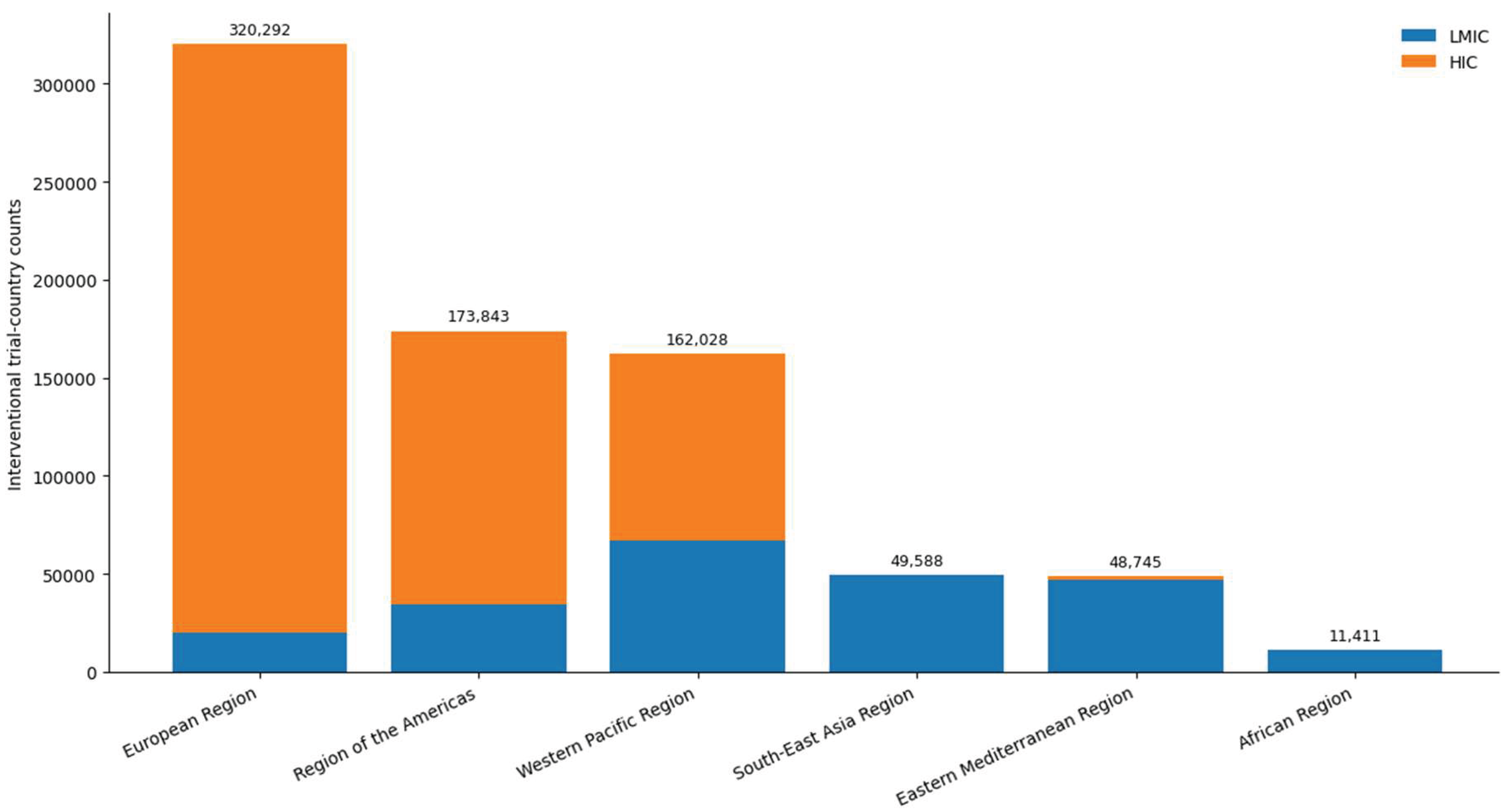

Table 1.
Sample characteristics.
| Characteristic | Category | n (%) |
| Age, years | Mean (SD) | 38.0 (9.6) |
| Median (IQR) | 37.0 (30.0–43.0) | |
| Range | 24–62 | |
| Gender | Female | 55 (63.2) |
| Male | 32 (36.8) | |
| Professional role | Academic | 37 (42.5) |
| Healthcare professional | 21 (24.1) | |
| Mixed-role | 11 (12.6) | |
| Research personnel | 9 (10.3) | |
| Regulatory personnel | 7 (8.0) | |
| Other | 2 (2.3) | |
| Years of experience | Less than 1 year | 8 (9.2) |
| 1–3 years | 16 (18.4) | |
| 4–6 years | 23 (26.4) | |
| 7–10 years | 8 (9.2) | |
| More than 10 years | 32 (36.8) | |
| Previous clinical trial participation | Yes | 32 (36.8) |
| No | 55 (63.2) |
Table 2.
Awareness, perceptions, and readiness indicators.
| Variable | Category | n (%) |
| Heard of DCTs before survey | Yes | 54 (62.1) |
| No | 33 (37.9) | |
| Self-rated understanding of DCTs | No understanding | 14 (16.1) |
| Basic understanding | 45 (51.7) | |
| Moderate understanding | 22 (25.3) | |
| Comprehensive understanding | 6 (6.9) | |
| DCTs can improve patient participation | Strongly agree | 22 (25.3) |
| Agree | 55 (63.2) | |
| Neutral | 10 (11.5) | |
| DCTs compromise data quality compared with traditional trials | Yes | 30 (34.5) |
| Unsure | 38 (43.7) | |
| No | 19 (21.8) | |
| Open to participating in a DCT | Yes | 46 (52.9) |
| Maybe | 35 (40.2) | |
| No | 6 (6.9) | |
| DCTs are suitable for Sri Lanka | Yes | 57 (65.5) |
| Unsure | 25 (28.7) | |
| No | 5 (5.7) | |
| Received DCT-related training | Yes | 13 (14.9) |
| No | 74 (85.1) | |
| Feel adequately prepared to participate in DCTs | Yes | 27 (31.0) |
| Unsure | 39 (44.8) | |
| No | 21 (24.1) | |
| Institution has necessary infrastructure | Yes | 27 (31.0) |
| Unsure | 40 (46.0) | |
| No | 20 (23.0) | |
| Institutional policies in place to facilitate DCTs | Yes | 14 (16.1) |
| Unsure | 53 (60.9) | |
| No | 20 (23.0) | |
| Familiar with Sri Lankan DCT regulatory guidelines | Yes | 12 (13.8) |
| No | 75 (86.2) | |
| Current ethical guidelines adequately address DCTs | Yes | 9 (10.3) |
| Unsure | 57 (65.5) | |
| No | 21 (24.1) |
Table 3.
The multi-response analysis.
| Domain | Item | n (%) |
| Components recognised | Remote patient monitoring | 73 (83.9) |
| Telemedicine consultations | 62 (71.3) | |
| Electronic informed consent (eConsent) | 61 (70.1) | |
| Use of mobile health applications | 60 (69.0) | |
| Home delivery of investigational products | 51 (58.6) | |
| Perceived objectives | Enhancing patient recruitment and retention | 68 (78.2) |
| Increasing trial accessibility | 61 (70.1) | |
| Reducing trial costs | 54 (62.1) | |
| Improving data accuracy | 30 (34.5) | |
| Perceived concerns | Technological challenges | 56 (64.4) |
| Data security and privacy | 51 (58.6) | |
| Patient safety | 49 (56.3) | |
| Regulatory compliance | 34 (39.1) | |
| Additional training needs | Use of digital tools | 61 (70.1) |
| Data management | 56 (64.4) | |
| Regulatory compliance | 55 (63.2) | |
| Patient communication | 53 (60.9) | |
| Infrastructure gaps | Trained personnel | 66 (75.9) |
| Access to digital tools | 59 (67.8) | |
| Data security systems | 55 (63.2) | |
| Reliable internet connectivity | 38 (43.7) | |
| Ethical concerns | Data privacy | 68 (78.2) |
| Informed consent processes | 58 (66.7) | |
| Patient autonomy | 54 (62.1) | |
| Equity | 47 (54.0) |
Table 4.
The principal bivariate analyses.
| Association | Test | Statistic | df | p-value | Cramér’s V |
| Understanding vs preparedness | Chi-square | 2.70 | 1 | 0.101 | 0.176 |
| Training vs preparedness | Fisher’s exact | 6.64 | 1 | 0.019 | 0.276 |
| Awareness vs openness | Chi-square | 2.33 | 1 | 0.127 | 0.164 |
| Regulatory familiarity vs ethical adequacy | Fisher’s exact | 14.72 | 1 | 0.002 | 0.411 |
| Infrastructure vs suitability | Chi-square | 0.41 | 1 | 0.523 | 0.068 |
| Role group vs regulatory familiarity | Chi-square | 22.77 | 5 | <0.001 | 0.512 |
Table 5.
The regression model.
| Predictor | Adjusted OR | 95% CI | p-value |
| Higher understanding of DCTs | 1.51 | 0.52–4.40 | 0.449 |
| Received DCT-related training | 3.14 | 0.81–12.11 | 0.097 |
| Institution has necessary infrastructure | 3.31 | 1.21–9.09 | 0.020 |
Disclaimer/Publisher’s Note: The statements, opinions and data contained in all publications are solely those of the individual author(s) and contributor(s) and not of MDPI and/or the editor(s). MDPI and/or the editor(s) disclaim responsibility for any injury to people or property resulting from any ideas, methods, instructions or products referred to in the content. |
© 2026 by the authors. Licensee MDPI, Basel, Switzerland. This article is an open access article distributed under the terms and conditions of the Creative Commons Attribution (CC BY) license (http://creativecommons.org/licenses/by/4.0/).
Copyright: This open access article is published under a Creative Commons CC BY 4.0 license, which permit the free download, distribution, and reuse, provided that the author and preprint are cited in any reuse.


