

Submitted:
27 April 2026
Posted:
28 April 2026
You are already at the latest version
Abstract
This study critically reviews 91 peer-reviewed publications assessing the sustainability of Mediterranean tourism destinations through indicator-based frameworks. Using the Scopus database, studies were selected based on defined keywords, geographical scope, and inclusion/exclusion criteria. Data were systematically coded across multiple dimensions including methodological approaches, indicator categories, sustainability dimensions, thematic focus, stakeholder involvement, and data sources. Findings reveal a dominance of quantitative methods, particularly composite indices, multi-criteria decision-making, and GIS-based analysis. Environmental indicators—addressing water management, waste, pollution, and carrying capacity—are most prevalent, followed by economic measures of employment and revenue. Social and governance dimensions remain underrepresented. Research is geographically concentrated in Spain, Greece, and Italy, with limited coverage of North African and Eastern Mediterranean contexts. The review highlights gaps in geographic representation, dimension balance, and indicator standardization. Addressing these will require integrated frameworks, stronger stakeholder engagement, and innovative data collection methods. The findings provide guidance for developing robust, comparable, and context-specific sustainability assessment tools for the Mediterranean region.
Keywords:
sustainability assessment
; tourism indicators
; Mediterranean destinations
; multi-criteria analysis
1. Introduction
The concept of sustainability in tourism has evolved through multiple theoretical and policy-oriented interpretations. Butler (1993) defines sustainable tourism development as the creation and maintenance of tourism within an area in such a way and on such a scale that it can continue indefinitely without degrading or altering the human and natural environment. The UNWTO elaborates this vision, describing sustainable tourism as the management of all resources so that economic, social, and aesthetic needs are fulfilled while preserving cultural integrity, essential ecological processes, biodiversity, and life-support systems (Liu, 2003). These definitions align closely with the Triple Bottom Line (TBL) framework, which organises sustainability into three interdependent pillars — environmental, social, and economic — and with Environmental, Social, and Governance (ESG) frameworks widely used in corporate sustainability reporting (Correia, 2019; Zhang, 2025). Integrating ESG-like thinking into tourism destination management allows for comparable, evidence-based sustainability reporting that can inform decision-making and enhance accountability. Indicators are widely recognised as essential tools for operationalising sustainable tourism, enabling destinations to move from qualitative principles to measurable, evidence-based management (Crabolu, 2023). They provide a structured means to monitor environmental, social, and economic conditions, track progress towards policy objectives, assess the impacts of tourism activities, and support adaptive management. International frameworks have played a central role in shaping indicator development: the United Nations Sustainable Development Goals (SDGs) set targets directly relevant to tourism — notably SDG 8 (Decent Work and Economic Growth), SDG 12 (Responsible Consumption and Production), and SDG 14 (Life Below Water) — while the Global Sustainable Tourism Criteria (GSTC) and the European Tourism Indicator System (ETIS) offer structured sets of core and optional indicators. Previous reviews (e.g., Torres-Delgado & Saarinen, 2014; Miller & Twining-Ward, 2005) have underlined the value of indicators for guiding policy, yet they also highlight recurring limitations: lack of standardisation, overemphasis on environmental aspects at the expense of social and governance dimensions, limited stakeholder engagement, and weak integration between academic research and destination management practice. The Mediterranean basin provides a particularly pertinent context for sustainability assessment. Environmentally, the region is one of the world’s major climate change and biodiversity hotspots, characterised by fragile coastal and marine ecosystems and acute vulnerability to temperature rise, sea-level change, and water scarcity (MedECC, 2020). Socio-economically, tourism constitutes a major pillar of Mediterranean economies, contributing significantly to GDP, employment, and cultural exchange, yet the sector is heavily seasonal, generating peaks of visitor pressure that strain infrastructure and natural systems. Cultural heritage constitutes both a driver of tourism demand and a resource requiring careful protection, posing complex governance challenges wherever heritage sites face mass tourism pressures. These interlinked environmental, economic, and socio-cultural factors necessitate sustainability indicator frameworks that are sensitive to Mediterranean-specific conditions, capturing seasonal variations, addressing ecosystem vulnerability, and integrating heritage preservation within broader sustainability strategies.
Figure 1.
Geographic Scope of Mediterranean Tourism Sustainability Studies.
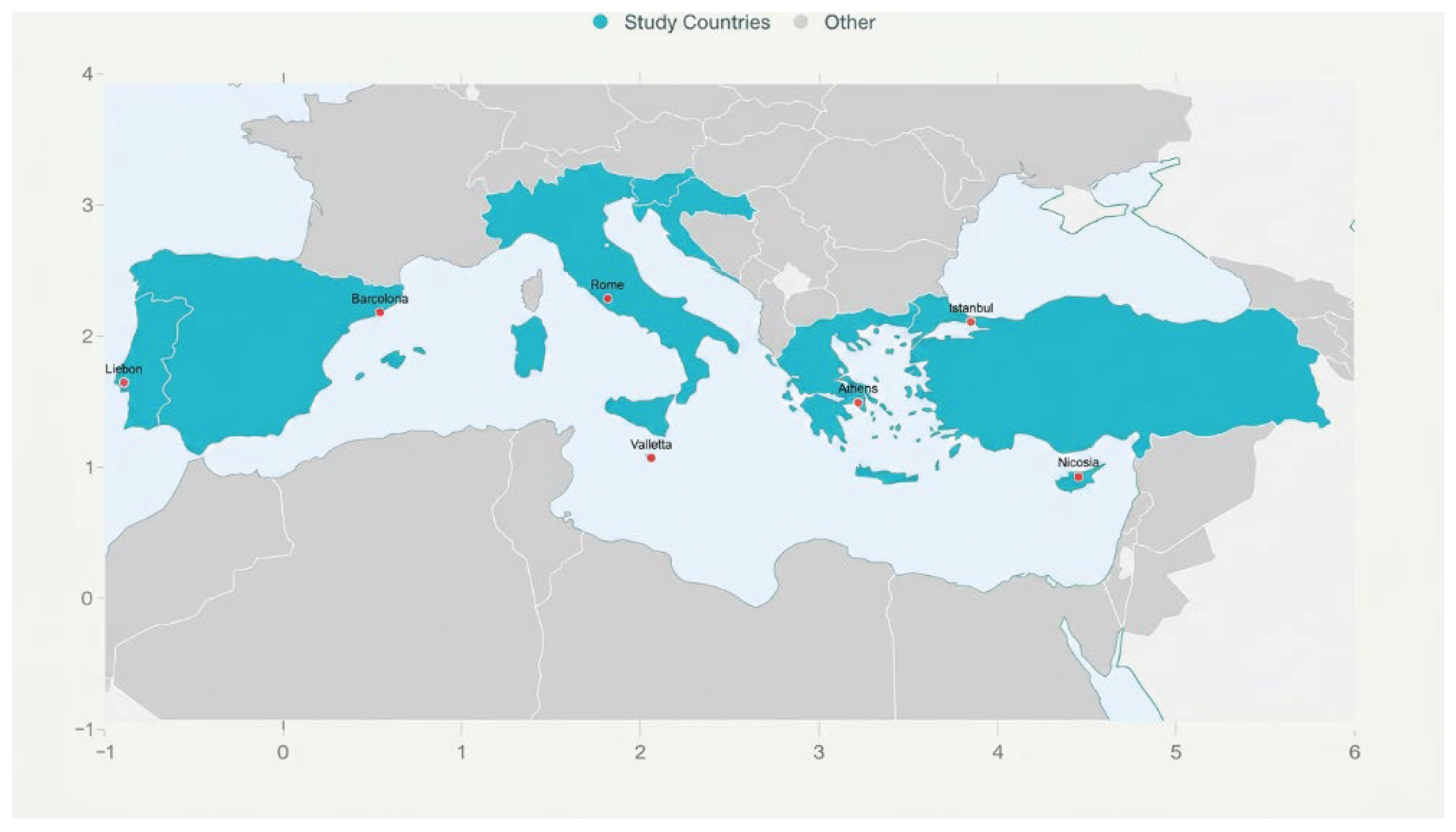
The geographic scope of this review is empirically derived from the 91 included publications, covering nine countries — Spain, Greece, Italy, Portugal, Croatia, Turkey, Slovenia, Malta, and Cyprus — that collectively represent the western, central, and eastern sub-regions of the Mediterranean basin. Portugal although not physically bordering the Mediterranean Sea, it is included due to its active participation in the WestMED Initiative for sustainable tourism in the Western Mediterranean, its acknowledgement as a “Mediterranean country” in the context of the UNESCO Mediterranean Diet, and shared cultural characteristics with other Mediterranean states (notably gastronomy, lifestyle, and architecture). This coverage spans diverse political systems, economic development levels, cultural contexts, and environmental challenges, providing a robust foundation for understanding indicator-based approaches to tourism sustainability across the region. Despite this breadth, the field remains fragmented and inconsistent, characterised by three systemic challenges. First, heterogeneity and lack of standardisation: indicator sets differ in scope, definitions, units of measurement, aggregation rules, and thematic coverage, hampering cross-destination comparability and complicating efforts to establish region-wide benchmarks. Second, dimensional imbalance: research predominantly emphasises environmental and economic indicators, while social and governance dimensions remain underdeveloped, risking partial assessments that overlook the interdependencies determining long-term sustainability. Third, geographic, methodological, and data biases: scholarly output is disproportionately concentrated in European Mediterranean countries, longitudinal designs and participatory methods are rare, and the applicability of findings for policy-making in destinations with limited statistical infrastructure is constrained. This review builds on a systematically coded dataset of 91 Scopus-indexed publications to empirically diagnose these challenges and produce actionable recommendations. It maps the methodological landscape of existing studies, classifies indicator typologies, assesses the representation of environmental, economic, social, and governance dimensions, analyses geographic and sectoral coverage, evaluates alignment with ESG/SDG principles, and diagnoses barriers to the development of standardised, destination-level frameworks. The intended contribution is to assist researchers, policymakers, and destination managers in moving from fragmented academic outputs toward harmonised, operational tools capable of guiding sustainability transitions in Mediterranean tourism.
2. Materials and Methods
This research employs a systematic literature review following PRISMA guidelines, combining bibliometric analysis with qualitative thematic synthesis. The dual approach enables identification of quantitative patterns in publication trends, geographic distribution, and methodological preferences, while simultaneously capturing qualitative insights regarding theoretical frameworks and practical applications. Scopus was selected as the primary database for its extensive coverage of peer-reviewed literature in environmental science, tourism studies, and sustainability research, and for the consistency of its indexing protocols — essential for reproducibility. The temporal scope spans 2000 to 2024, capturing over two decades of evolution in sustainability indicator research.
Figure 2.
Prisma flow diagram.
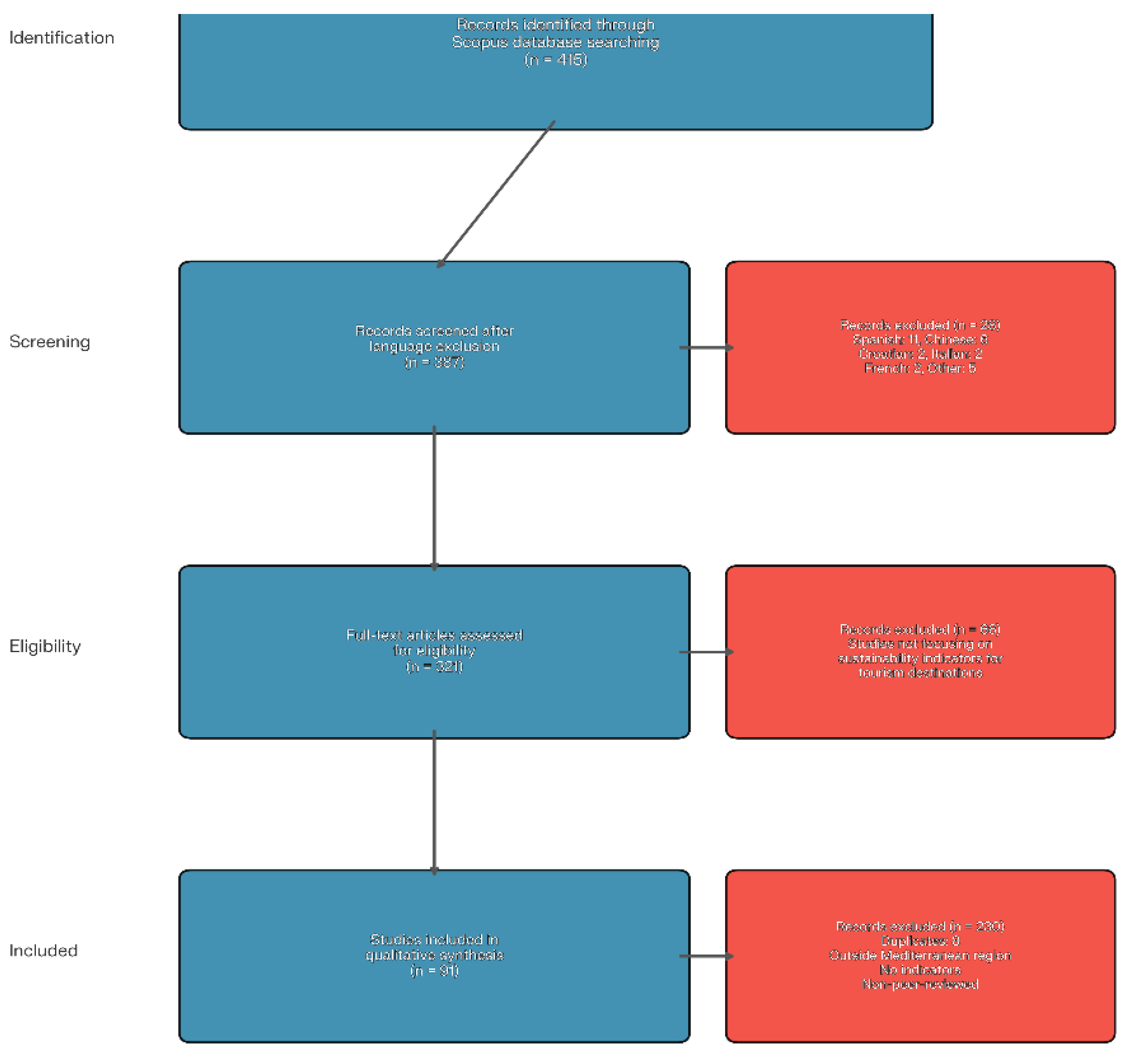
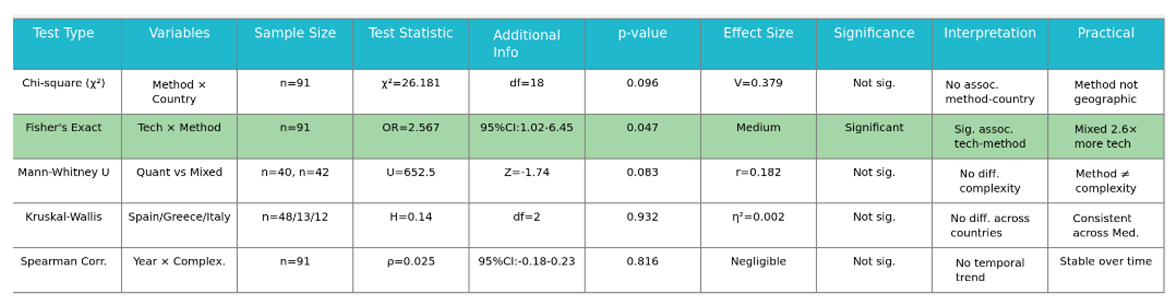
The systematic search used four keyword groups: (indicator OR indicators OR index OR indices) AND sustainability AND tourism AND destination, applied to titles, abstracts, and keywords, yielding 415 publications. Following removal of 28 non-English language studies, 66 studies with irrelevant subject matter, and 230 studies failing additional eligibility criteria (duplicates, non-Mediterranean geographic scope, absence of explicit sustainability indicators, non-peer-reviewed materials), the final corpus comprised 91 studies. Inclusion required empirical application of sustainability indicators in Mediterranean tourism contexts — coastal, island, urban, rural, or mixed — addressing at least one recognised sustainability dimension and demonstrating practical implementation rather than purely theoretical discussion. A comprehensive coding framework was developed through iterative design and pilot testing, recording bibliographic, geographic, methodological, and indicator characteristics, as well as stakeholder engagement patterns and data sources. Quality assessment employed a modified evaluation tool adapted for indicator-based sustainability research, evaluating clarity of objectives, appropriateness of indicator selection, adequacy of data sources, transparency of analytical procedures, and validity of conclusions. Validation relied on methodological triangulation, code-recode checks in temporally separated rounds, a detailed audit trail, and sensitivity analyses varying inclusion thresholds and thematic grouping rules to test the stability of findings under alternative assumptions. Statistical analysis applied non-parametric tests — Chi-square, Fisher’s exact test, Mann-Whitney U, Kruskal-Wallis, and Spearman correlation — appropriate to the categorical and non-normally distributed nature of systematic review data. Fisher’s exact test revealed that mixed-methods studies show significantly higher likelihood of incorporating advanced technologies (odds ratio 2.567; p = 0.047), while no significant differences in indicator complexity were found across methodological approaches (Mann-Whitney U = 652.5; p = 0.083) or across major Mediterranean countries (Kruskal-Wallis H = 0.140; p = 0.932), and no significant temporal trend in indicator sophistication was detected (Spearman r = 0.025; p = 0.816).

Table 1.
Statistical Test Results Summary.
 |
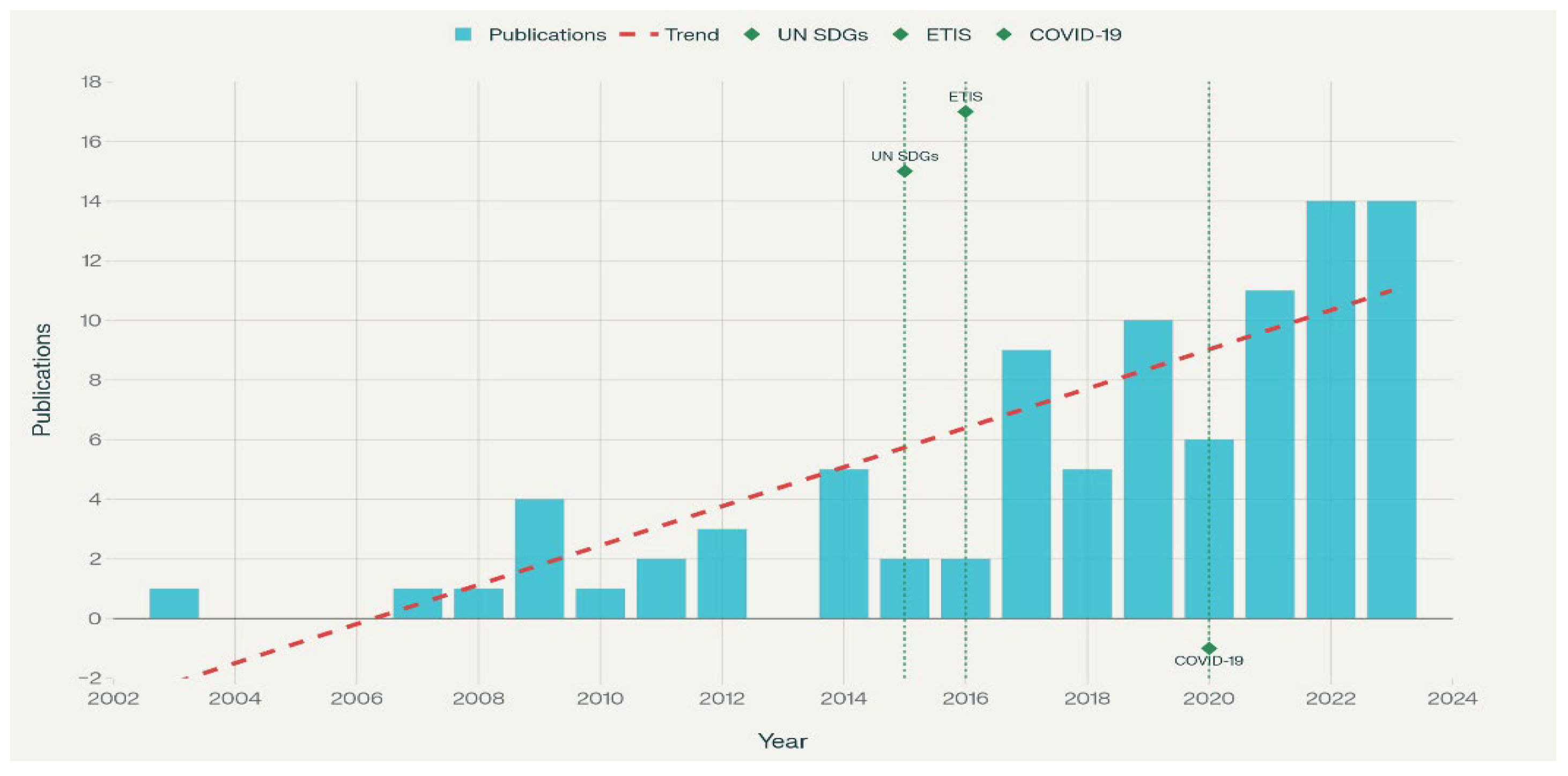
Time series visualization provides fundamental insights into the temporal evolution of research fields, revealing patterns of growth, maturation, and response to external influences. The temporal analysis reveals four distinct phases in Mediterranean tourism sustainability research development, from nascent exploration through rapid expansion to intensive investigation. The foundation building phase coincided with major policy developments such as the United Nations Sustainable Development Goals adoption in 2015 and the European Tourism Indicator System implementation in 2016, while the intensive development phase from 2020 to 2024 demonstrated sustained high output levels with publications reaching fourteen studies annually.
Figure 3.
Temporal Evolution of Mediterranean Tourism Sustainability Research (2003-2024).
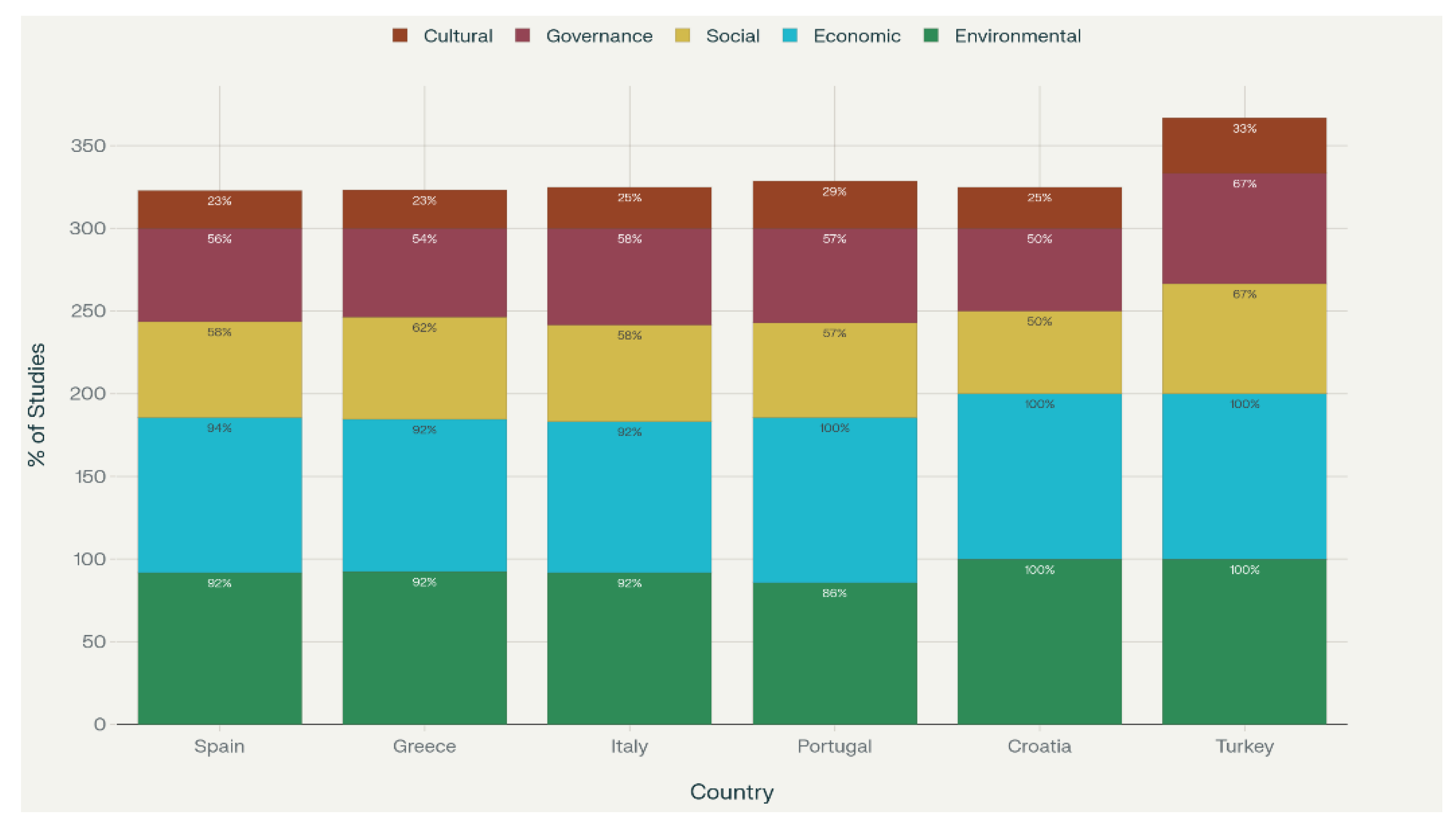
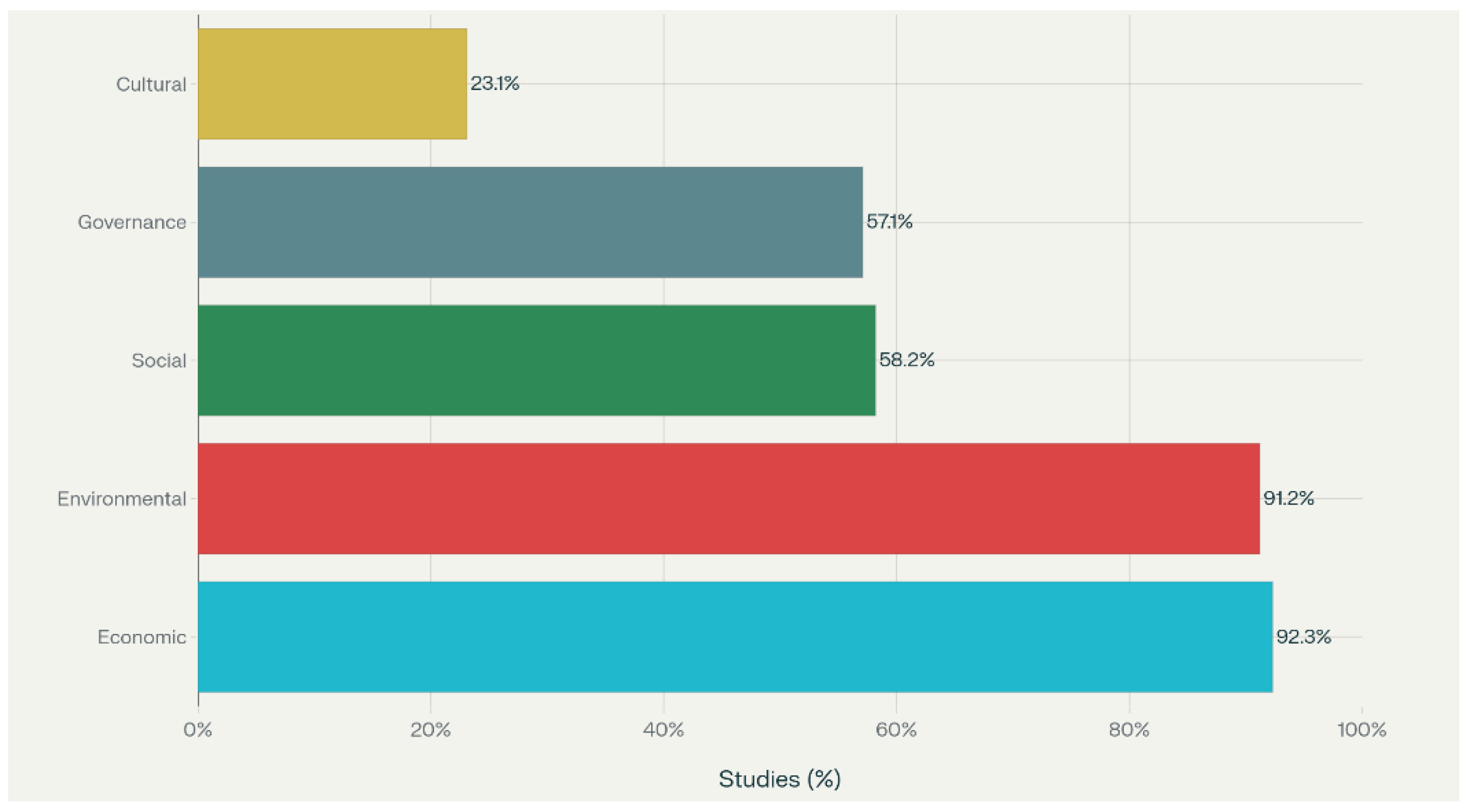
Stacked bar chart visualization effectively reveals compositional relationships and proportional patterns across categorical dimensions, proving essential for analyzing sustainability dimension coverage and methodological distribution patterns. The dimensional analysis demonstrates pronounced emphasis on environmental and economic sustainability assessment, with 91.2% and 92.3% of studies respectively addressing these dimensions, while cultural sustainability demonstrates the most significant research gap, receiving attention in only 23.1% of studies despite the central role of cultural heritage in Mediterranean tourism development.
Figure 4.
Sustainability Dimension Coverage by Mediterranean Countries in Tourism Research.
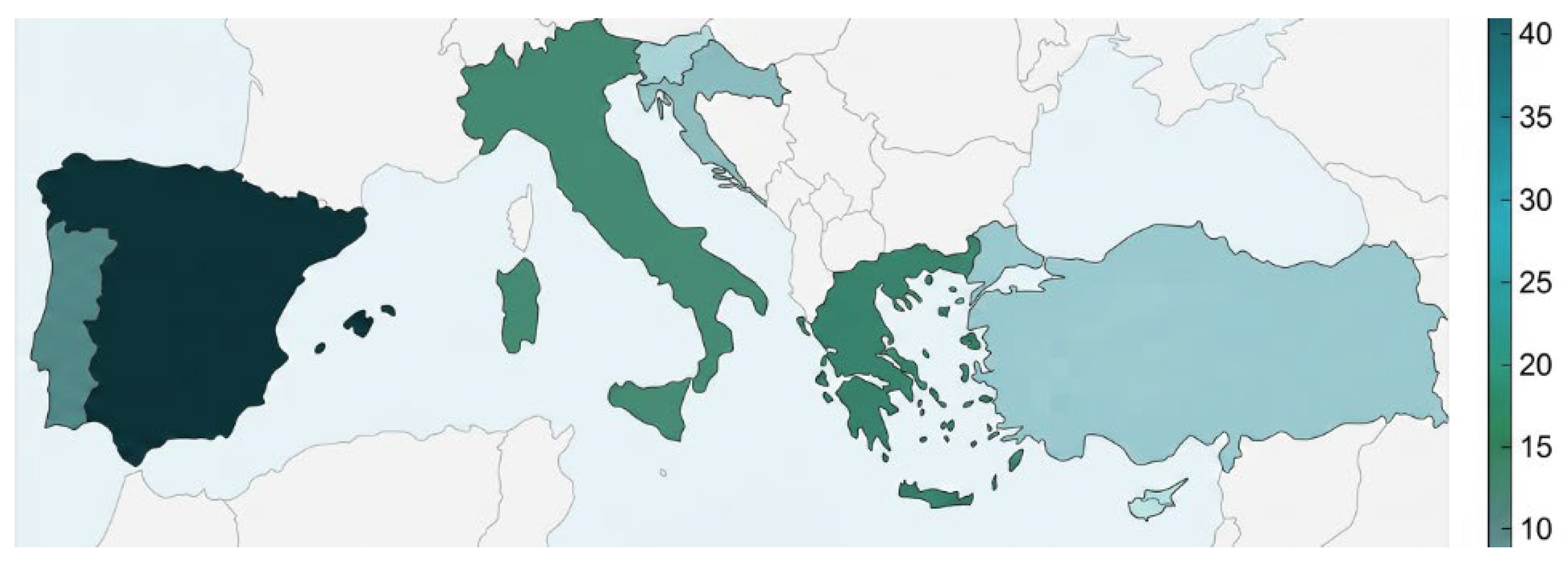
Geographic heatmap visualization provides essential insights into spatial patterns of research distribution and potential geographical biases within systematic review corpora. The geographical distribution demonstrates significant concentration in Spain, which accounts for 52.7% of all reviewed studies, followed by Greece with 14.3% and Italy with 13.2% of publications, while revealing substantial gaps in research coverage from North African countries and Eastern Mediterranean nations.
Figure 5.
Geographic Distribution of Mediterranean Tourism Sustainability Research.
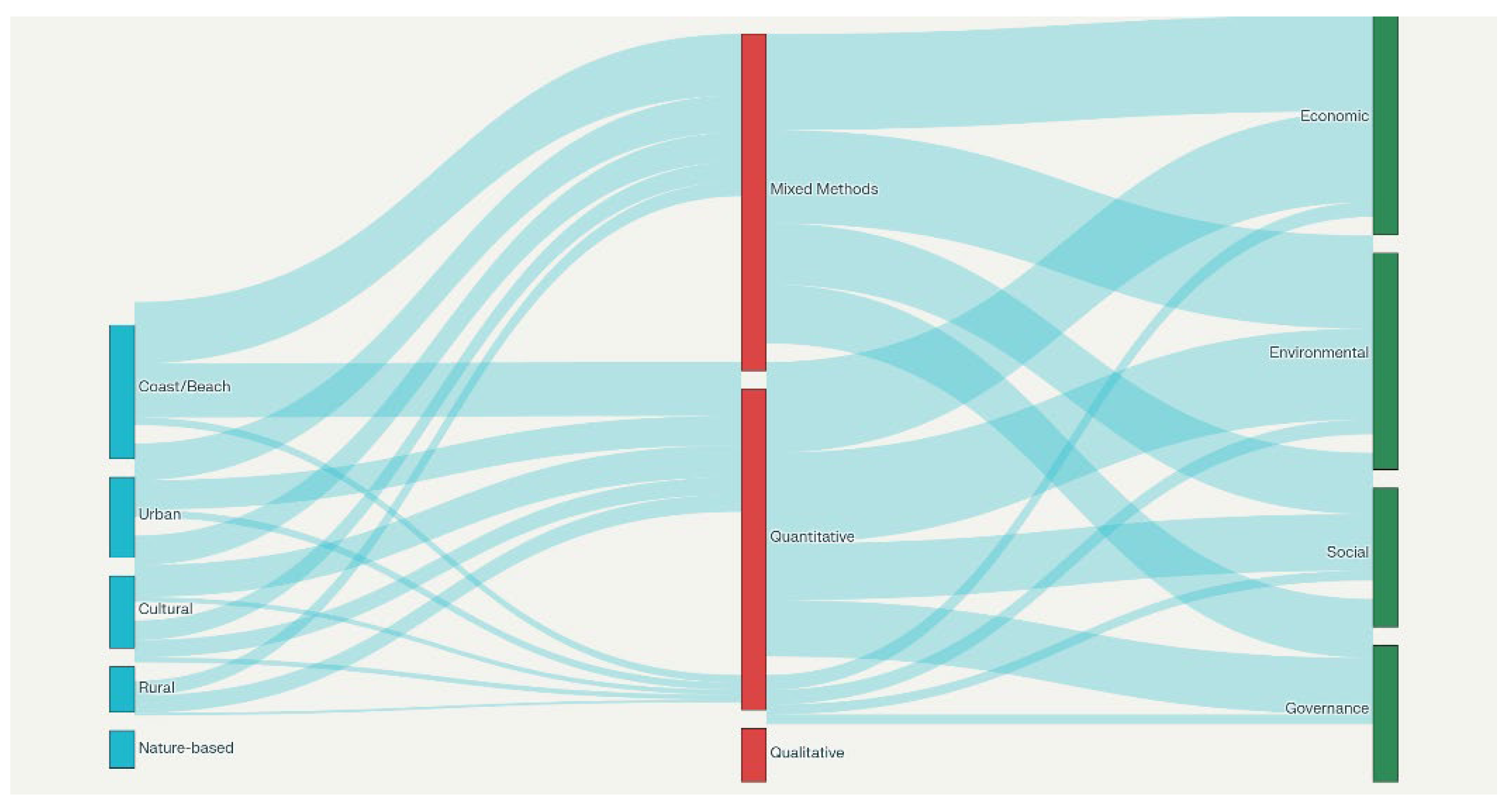
Sankey diagram visualization effectively reveals complex relationships and flow patterns between categorical variables, providing insights into methodological pathways and outcome relationships. The flow analysis reveals that coastal and beach tourism, representing 60.4% of tourism contexts, demonstrates strong preferences for mixed methods approaches, reflecting the complexity of coastal tourism sustainability assessment requiring integration of environmental monitoring, economic analysis, and social impact evaluation.
Figure 6.
Methodological Pathways in Mediterranean Tourism Sustainability Research.
The comprehensive application of this statistical and visualization framework successfully identifies significant patterns, relationships, and gaps within the Mediterranean tourism sustainability literature. The statistical analysis revealed that mixed methods studies show significantly higher propensity for incorporating emerging technologies compared to traditional quantitative approaches, while visualization analysis identified clear developmental phases linked to policy milestones, geographical concentration patterns, and systematic dimensional imbalances that inform future research priorities.
3. Results
3.1. Geographic Distribution of Studies
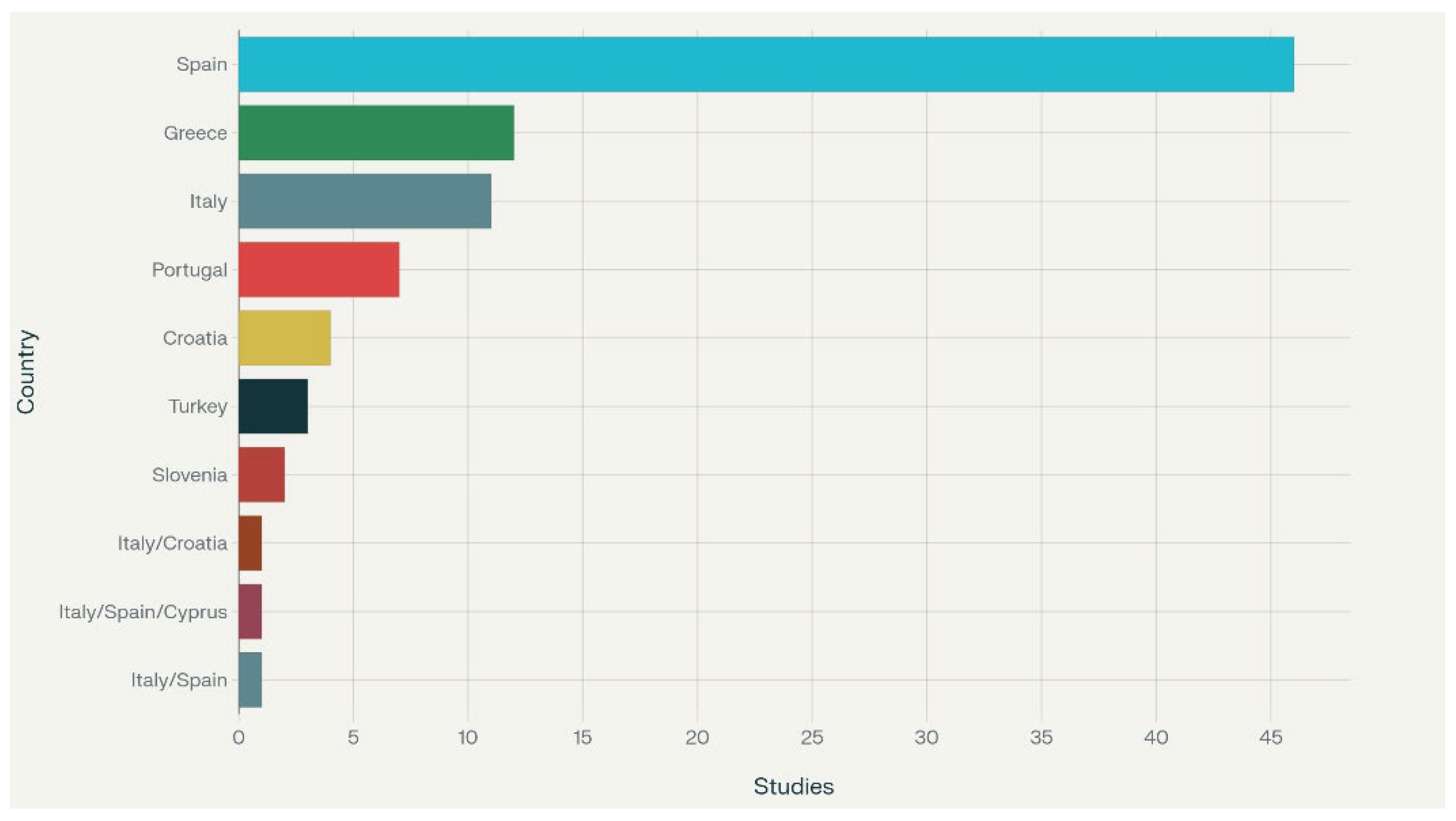
The geographic analysis reveals significant spatial concentration of research output among specific Mediterranean countries (Figure 7). Spain emerges as the dominant contributor with 46 publications (50.5%), followed by Greece with 12 studies (13.2%) and Italy with 11 publications (12.1%). Portugal accounts for 7 studies (7.7%), while Croatia and Turkey contribute 4 and 3 publications respectively. Slovenia, Malta, Cyprus, and several multi-country collaborations represent the remaining studies. This distribution pattern reflects both the intensity of tourism pressure in these destinations and the research capacity of local academic institutions. Notably, there is a marked underrepresentation of North African and Eastern Mediterranean countries, highlighting significant geographic gaps in the literature that limit the comprehensiveness of regional sustainability assessment frameworks.
Figure 7.
Geographic distribution of Mediterranean tourism sustainability studies.
3.2. Temporal Evolution of Research
The temporal analysis reveals distinct phases in research development. The period 2003-2010 generated only 8 publications, representing the nascent phase of Mediterranean tourism sustainability research. A moderate increase occurred during 2011-2015 (12 publications), followed by substantial growth in 2016-2020 (32 publications) and exponential expansion in 2021-2024 (39 publications). This evolution corresponds to key policy developments, including the adoption of the UN Sustainable Development Goals (2015), the European Tourism Indicator System (ETIS) implementation, and increasing recognition of overtourism as a critical challenge in Mediterranean destinations.
Figure 8.
Temporal Evolution and Research Trends in Mediterranean Tourism Sustainability.
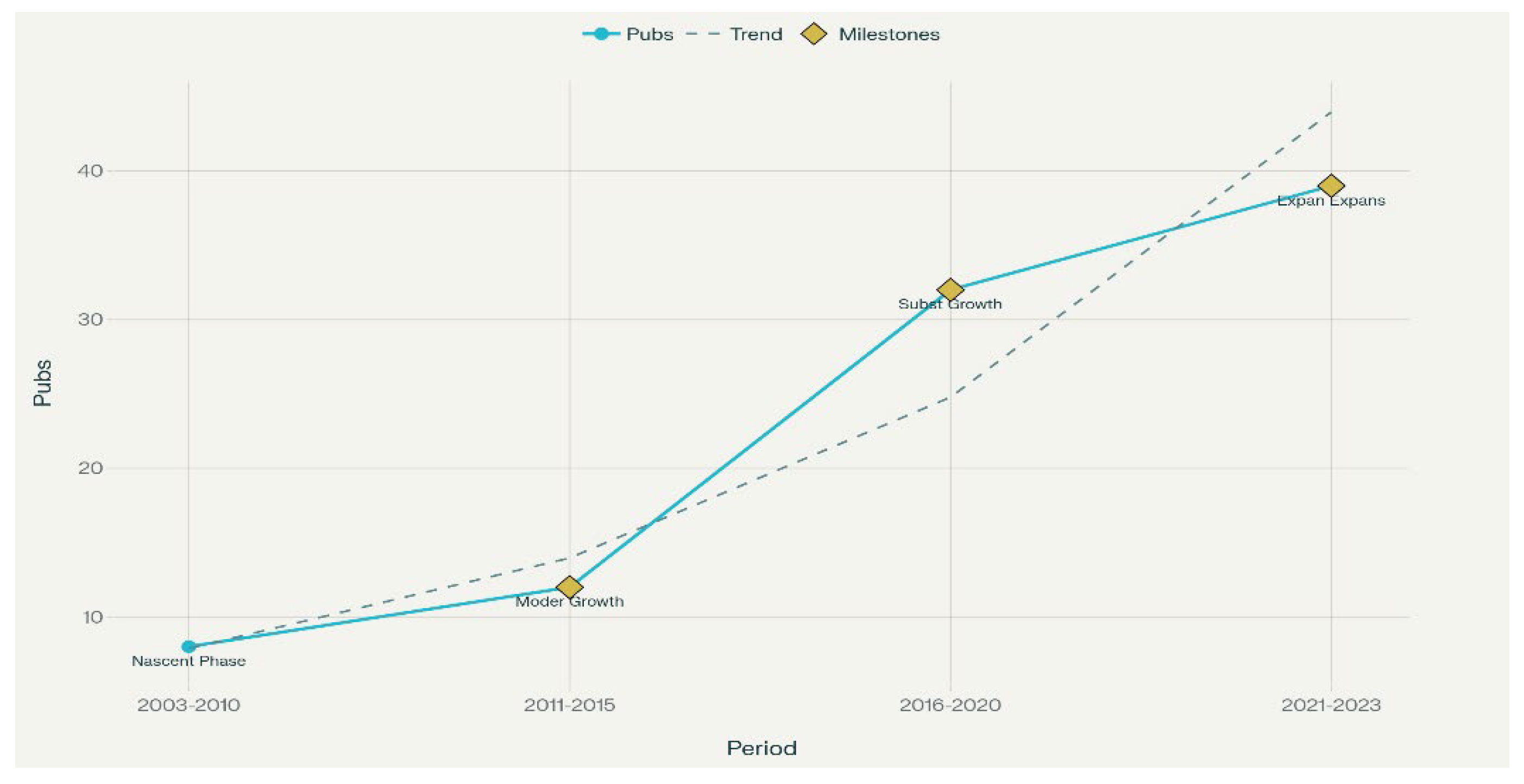
The diagram illustrates the remarkable growth trajectory in Mediterranean tourism sustainability research over two decades. The temporal evolution of research on the sustainability of tourism in the Mediterranean reveals four distinct development phases that reflect both the field’s growing academic maturity and the escalating urgency of environmental and socio-economic challenges. The first phase lasted from 2003 to 2010 and is characterized as an embryonic development period, as only 8 publications were produced, representing the earliest stages of academic interest in sustainability indicators for Mediterranean tourism. This limited output reflects the lack of theoretical frameworks and methodological tools that could have supported more systematic approaches to sustainability assessment. The second phase, between 2011 and 2015, marked a gradual increase with 12 publications, signaling the beginning of more systematic research approaches and the formation of more mature methodological frameworks. During this period, researchers began to develop more sophisticated measurement tools and to explore integrated approaches to the environmental, economic, and social dimensions of sustainability. The third phase, from 2016 to 2020, showed significant acceleration with 32 publications, driven by increasing policy attention and the recognition of sustainability challenges at the international level. This period was characterized by the maturation of methodological approaches and the incorporation of more complex analytical tools. The fourth and most productive phase, from 2021 to 2024, marked an exponential expansion with 39 publications in just three years, indicating both the maturation and the urgency of this research field. This surge in research activity reflects growing awareness of the critical environmental and social pressures facing Mediterranean destinations. This temporal evolution is closely linked to critical policy developments that acted as catalysts for increased research. The United Nations Sustainable Development Goals adopted in 2015 provided a global framework that sparked increased academic attention and created specific targets for integrating sustainability into the tourism sector. In parallel, the European Tourism Indicator System (ETIS) offered standardized methodologies for sustainability assessment, providing researchers and destination managers with practical tools for measuring and monitoring progress. In addition, the growing recognition of overtourism and carrying capacity issues in Mediterranean destinations further intensified research into innovative assessment methodologies. This temporal evolution simultaneously reflects the increasing complexity of sustainability assessment methodologies and the mounting urgency of addressing tourism impacts in the Mediterranean region. This urgency was particularly reinforced after high-profile cases of overtourism in destinations such as Barcelona, Venice, and Santorini, which raised awareness among both the academic community and policymakers of the need to develop more sophisticated and effective tools for monitoring and managing sustainability.
3.3. Methodological Approaches
The methodological review of these 91 studies underscores a clear leaning toward quantitative techniques. Fully 82 studies (90.1%) employ quantitative approaches—most often through composite-indicator models, statistical classification, ecological footprint calculations, or GIS-based analyses—reflecting the field’s priority on measurable metrics and replicable computations. Mixed-methods designs appear in 42 studies (46.2%), typically combining quantitative indicator sets with qualitative stakeholder workshops, Delphi panels, or expert interviews to weight and validate metrics. Purely qualitative methods are comparatively rare—evident in just 10 studies (11.0%)—and, where used, they serve mainly to contextualize or interpret results within broader indicator frameworks rather than as standalone evaluative tools. This methodological profile highlights the dominance of numeric assessment in Mediterranean tourism sustainability research, while also revealing growing interest in integrating qualitative insights to enrich interpretability and stakeholder relevance.
Figure 9.
Distribution of methodological approaches in sustainability assessment studies.
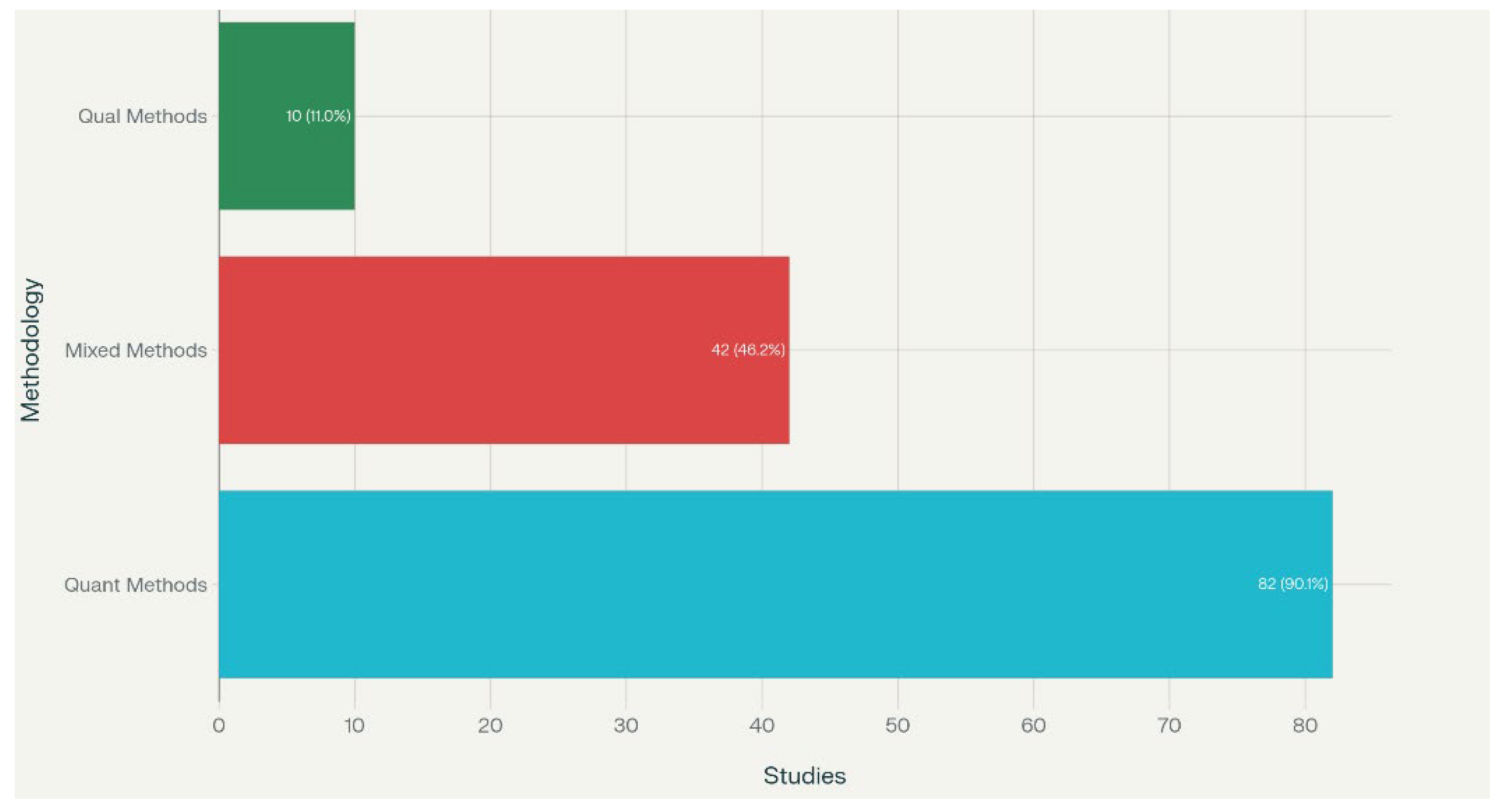
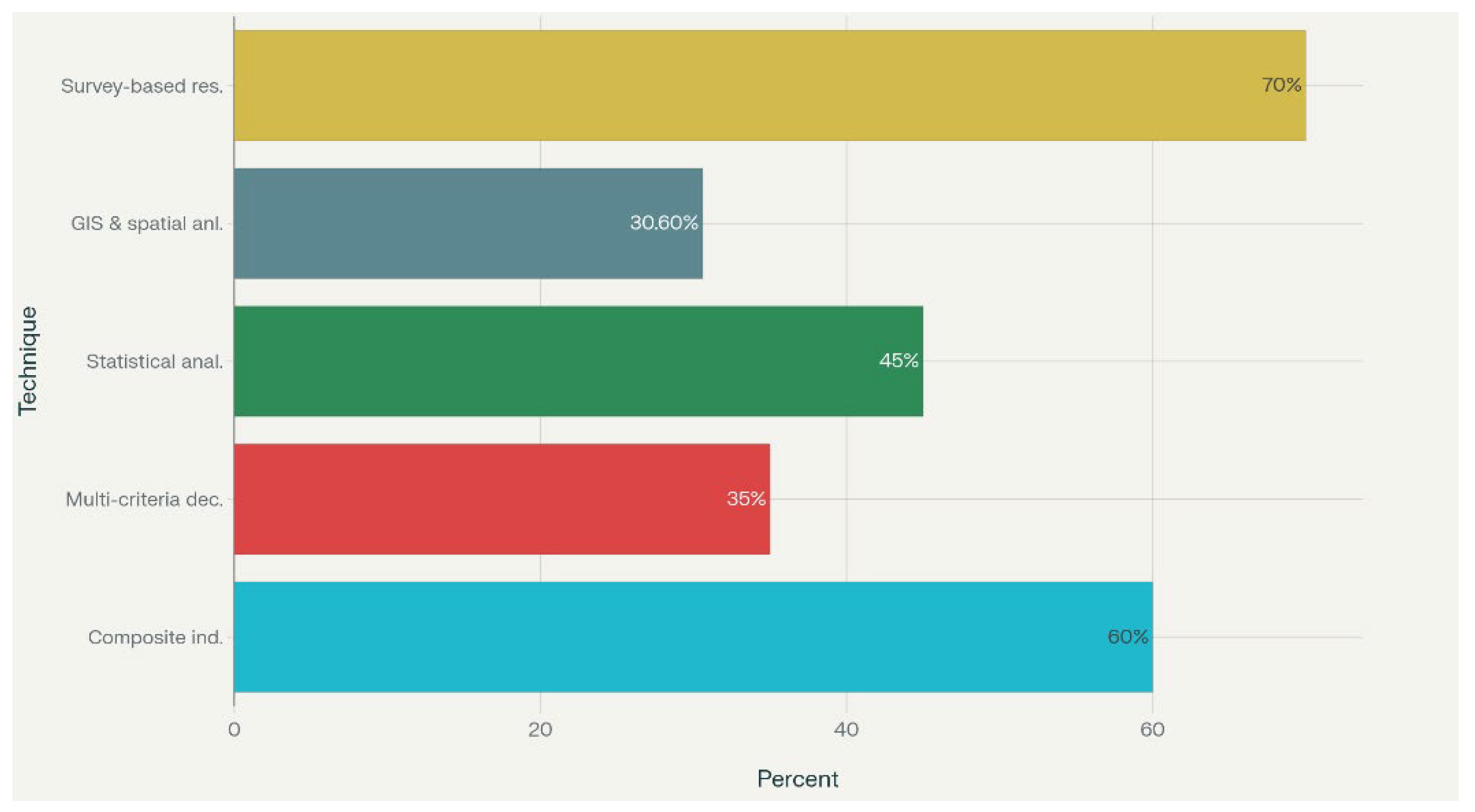
The quantitative emphasis aligns with the practical need for objective, comparable metrics that can inform policy decisions and enable benchmarking across destinations. However, this methodological bias may limit the capture of contextual nuances and stakeholder perspectives that are crucial for comprehensive sustainability assessment. An analysis of methodological techniques reveals several prevalent approaches. Composite indicators and indices are employed in approximately 60% of studies, reflecting the need to synthesize multiple sustainability dimensions. Multi-criteria decision-making (MCDM) methods are utilized in about 35% of studies, particularly the Analytic Hierarchy Process (AHP) and Technique for Order Preference by Similarity to Ideal Solution (TOPSIS). Statistical analysis—including regression analysis, factor analysis, and correlation studies—appears in roughly 45% of publications. Geographic Information Systems (GIS) and spatial analysis are applied in 26 studies (30.6%), demonstrating growing recognition of spatial dimensions in sustainability assessment. Survey-based research is especially prominent, with questionnaires and interviews used in 70% of studies to enable stakeholder engagement and perception analysis. The bar chart below illustrates the prevalence of different analytical techniques used in sustainability indicator research for tourism destinations.
Figure 10.
Prevalence of analytical techniques in sustainability indicator studies.
3.4. Coverage of Sustainability Dimensions
The analysis of sustainability dimensions reveals significant imbalances in research attention (Figure 11). Economic dimensions receive the highest coverage (92.3%), closely followed by environmental aspects (91.2%). This dual emphasis reflects both the economic importance of tourism to Mediterranean economies and growing environmental concerns. Social dimensions are addressed in 58.2% of studies, while governance aspects appear in 57.1% of publications. Cultural dimensions receive the least attention (23.1%), representing a significant gap given the rich cultural heritage of Mediterranean destinations.
Figure 11.
Coverage of sustainability dimensions in the reviewed studies (percent of studies addressing each dimension).
Figure 11.
Coverage of sustainability dimensions in the reviewed studies (percent of studies addressing each dimension).
Environmental sustainability indicators coalesce around five interdependent domains that capture pressures, states, and responses across destination systems. Resource management remains foundational, with systematic tracking of water consumption per tourist-night, energy use intensity by accommodation type, and solid waste generation and diversion rates, thereby enabling evidence-based efficiency measures, circularity interventions, and demand-side management under peak-load conditions. Carrying capacity is operationalized through tourist density thresholds relative to resident populations and sensitive ecosystems, augmented by composite environmental pressure indices that integrate land-use conversion, infrastructure saturation, and habitat fragmentation to identify tipping points and inform visitor dispersion policies. Pollution assessment frameworks monitor ambient air pollutants (e.g., NOx, SO2, and PM), coastal and inland water quality parameters (e.g., nutrients, BOD, and microbiological indicators), and noise levels in high-traffic corridors, with seasonal disaggregation to capture peak-period externalities and compliance gaps. Biodiversity conservation is gauged via coverage, connectivity, and management effectiveness of protected areas, complemented by ecosystem health indicators such as habitat condition scores and species abundance indices, and supported by visitor management instruments (e.g., zoning, quotas, and path design) to mitigate disturbance. Climate impact metrics bridge mitigation and adaptation by quantifying carbon footprints at destination and visitor levels, assessing progress on decarbonization (renewable integration, modal shift, and building retrofits), and documenting adaptation measures to heat stress, water scarcity, coastal erosion, and sea-level rise, including nature-based solutions that jointly enhance resilience and ecological integrity. Economic sustainability indicators emphasize both the scale and quality of tourism-driven value creation, alongside the stability and inclusiveness of benefits. Tourism revenue is assessed through direct and indirect contributions to gross value added, complemented by multiplier analysis to capture upstream and downstream linkages and leakage diagnostics that reveal retention performance within local economies. Employment generation is measured in total and full-time-equivalent terms with attention to seasonal volatility, job quality, skills profiles, and career pathways, reflecting the sector’s capacity to provide stable and dignified work beyond peak months. Destination competitiveness is tracked using market share evolution, revenue per visitor and length of stay, tourist satisfaction indices, and repeat visitation rates, taken together as a composite signal of price–quality positioning, service performance, and brand equity. Seasonality analysis quantifies the temporal concentration of arrivals and receipts, evaluates infrastructure under-utilization outside peak periods, and appraises the effectiveness of diversification strategies (e.g., cultural, nature-based, and MICE tourism) in smoothing demand and stabilizing incomes. Finally, local economic integration indicators examine procurement shares from local suppliers, SME participation in tourism value chains, and cluster development around gastronomy, crafts, and creative industries, evidencing the depth of domestic linkages and the diffusion of benefits across sectors and territories. Social sustainability indicators foreground the lived experience of residents and visitors, the safeguarding of heritage, and the fair distribution of benefits and burdens. Community well-being is assessed through resident satisfaction, perceived quality of life, and social cohesion metrics, with parallel attention to housing affordability, congestion, and access to essential services in tourism-intensive neighborhoods. Cultural preservation indicators encompass the conservation status of tangible and intangible heritage, authenticity maintenance in cultural offerings, and visitor management in sensitive cultural sites, ensuring that cultural capital is transmitted without commodification that erodes meaning. Social equity is addressed through distributional analyses of tourism’s gains and costs across demographic groups and neighborhoods, monitoring inclusive employment, accessibility, and affordability to avoid exclusion and displacement. Stakeholder participation is appraised via the breadth and depth of engagement in planning and monitoring, the co-creation of development scenarios, and the institutionalization of deliberative forums that strengthen legitimacy and adaptive learning. Governance indicators, in turn, evaluate the coherence and effectiveness of policy frameworks, the integration of tourism into spatial and environmental planning, and the regulatory capacity to enforce standards; institutional capacity is reflected in staffing, data systems, monitoring, and inter-agency coordination, while stakeholder engagement mechanisms, transparency, and accountability are evidenced through open data portals, regular public reporting, and accessible grievance redress channels that foster trust and continuous improvement.
3.5. Technological Integration
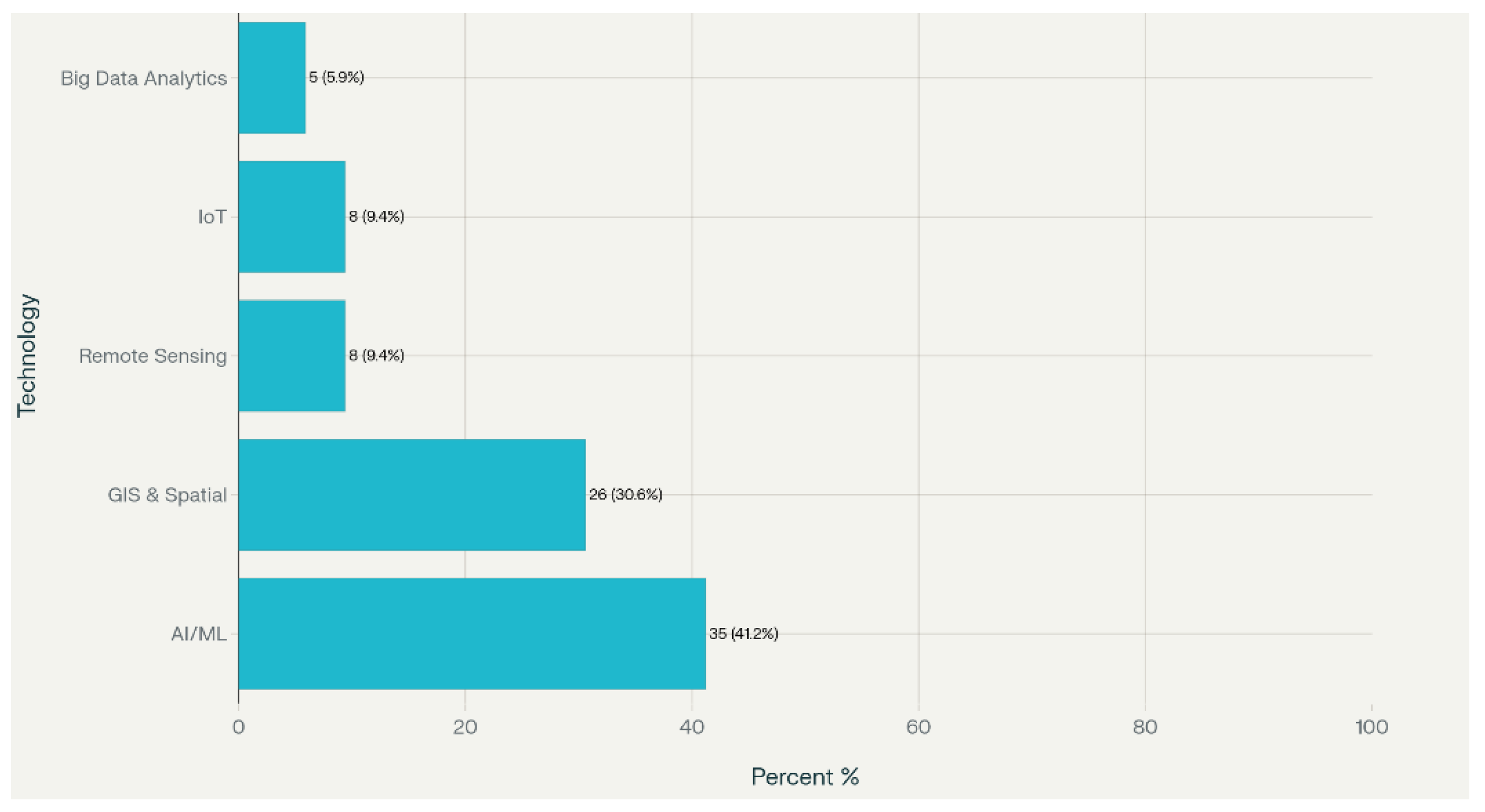
The technological profile of sustainability assessment exhibits moderate integration, with clear concentration in a small number of mature tools and a long tail of underutilized data-intensive approaches. Artificial Intelligence and Machine Learning constitute the leading frontier, deployed in 35 of 85 studies (41.2%), a level that signals growing methodological sophistication in tasks such as classification, clustering, predictive modeling, and pattern discovery across complex, multi-dimensional indicators. GIS and spatial analysis follow closely with use in 26 studies (30.6%), reflecting the centrality of spatial heterogeneity—land use, accessibility, exposure, and service distribution—in diagnosing sustainability trade-offs and targeting place-based interventions. Remote Sensing and IoT appear at parity, each present in 8 studies (9.4%), suggesting that while sensor-derived and Earth-observation data are recognized for monitoring resources, pressures, and environmental states at scale, they remain constrained by data availability, processing capacity, and integration costs in many research settings. Big data analytics is recorded in only 5 studies (5.9%), indicating a substantial gap between the volume and variety of potentially relevant tourism-environment-mobility datasets and their actual exploitation for real-time diagnostics, nowcasting, and high-frequency policy feedback. Taken together, these patterns imply a field that has advanced beyond purely conventional methods but has yet to mainstream high-velocity, high-variety data architectures; they also highlight immediate opportunities for methodological convergence—linking AI/ML with GIS, Remote Sensing, and IoT streams—to enhance spatiotemporal resolution, causal inference, and decision support in sustainability assessment.
Figure 12.
Share of studies (N=85) using each technology in sustainability assessment.
3.6. Data Sources and Scales
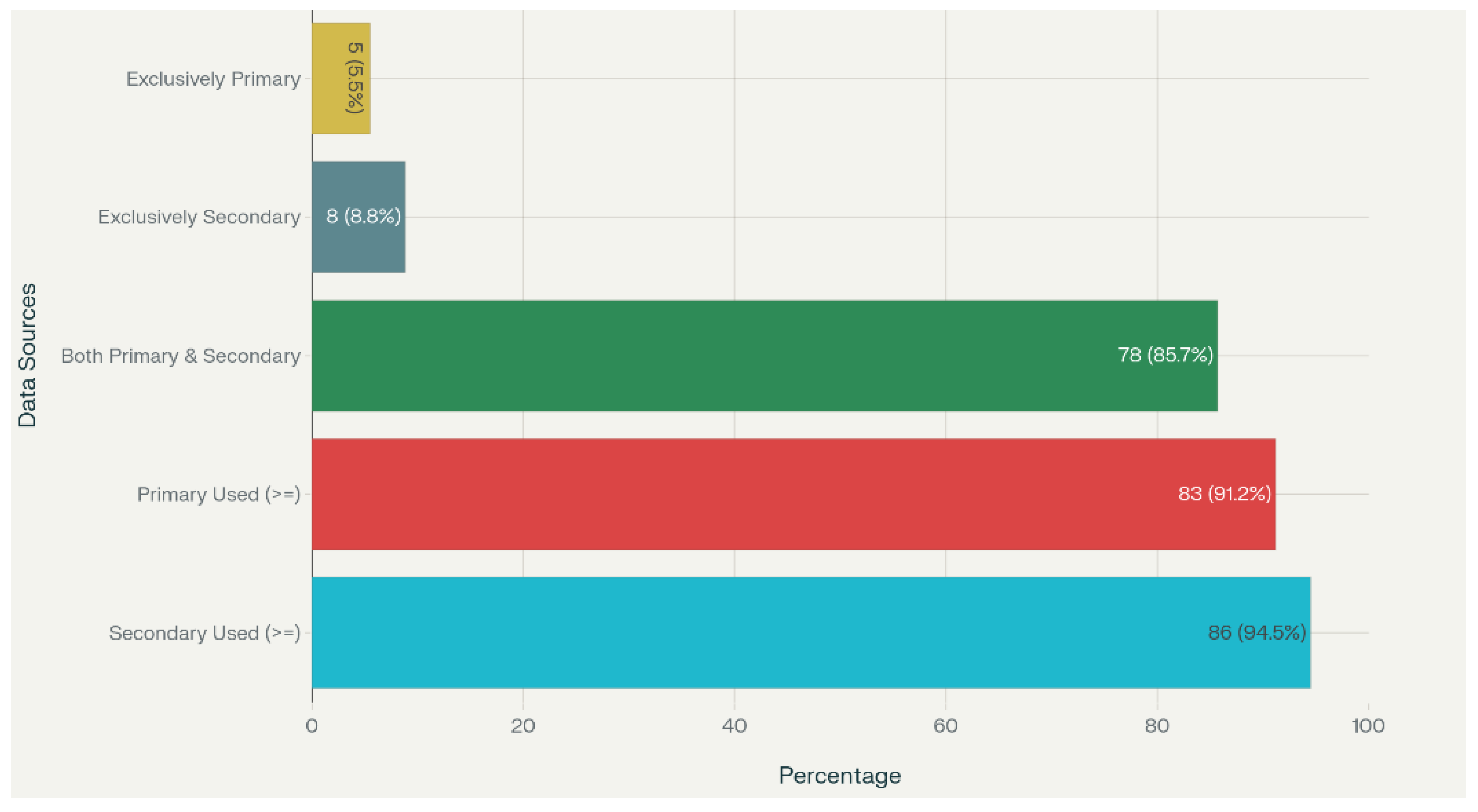
The data landscape is characterized by widespread use of secondary sources, combined with strong but slightly less extensive reliance on primary collection, indicating a pronounced dependence on both documented foundations and destination-specific evidence. Primary data are used in 83 of the 91 studies (91.2%), reflecting a preference for targeted instruments that capture local conditions, stakeholder perceptions, and micro-contexts that are often absent from administrative or open datasets. Secondary data are even more frequent (86/91, 94.5%) and are typically integrated with primary streams for triangulation, historical calibration, and cross-destination comparability within mixed designs, with 78/91 studies (85.7%) leveraging both. Conversely, purely desk-analytical approaches remain a minority, as only 8/91 studies (8.8%) rely exclusively on secondary sources, while purely primary ones are even fewer (5/91, 5.5%), underscoring the central role of hybrid designs for validity and interpretability. On the primary-collection side, questionnaire surveys of visitors and residents constitute the backbone for measuring attitudes, behaviors, satisfaction, and social impacts, enabling quantified estimates of well-being, acceptance, and trade-offs that feed model calibration and policy design. Key-informant interviews add depth, surfacing institutional knowledge on administrative capacity, implementation barriers, and path dependencies that are not visible in quantitative records. Participatory workshops broaden the co-production of indicators and scenarios and bolster legitimacy through inclusive stakeholder engagement that supports adaptive governance. Finally, field measurements provide the empirical anchor for environmental state and pressure indicators, such as carrying-capacity estimates, on-site resource use, and quality measurements, linking observed conditions to modeled impacts and validating critical assumptions in sustainability assessments.
Figure 13.
Prevalence of primary/secondary data usage in 91 studies.
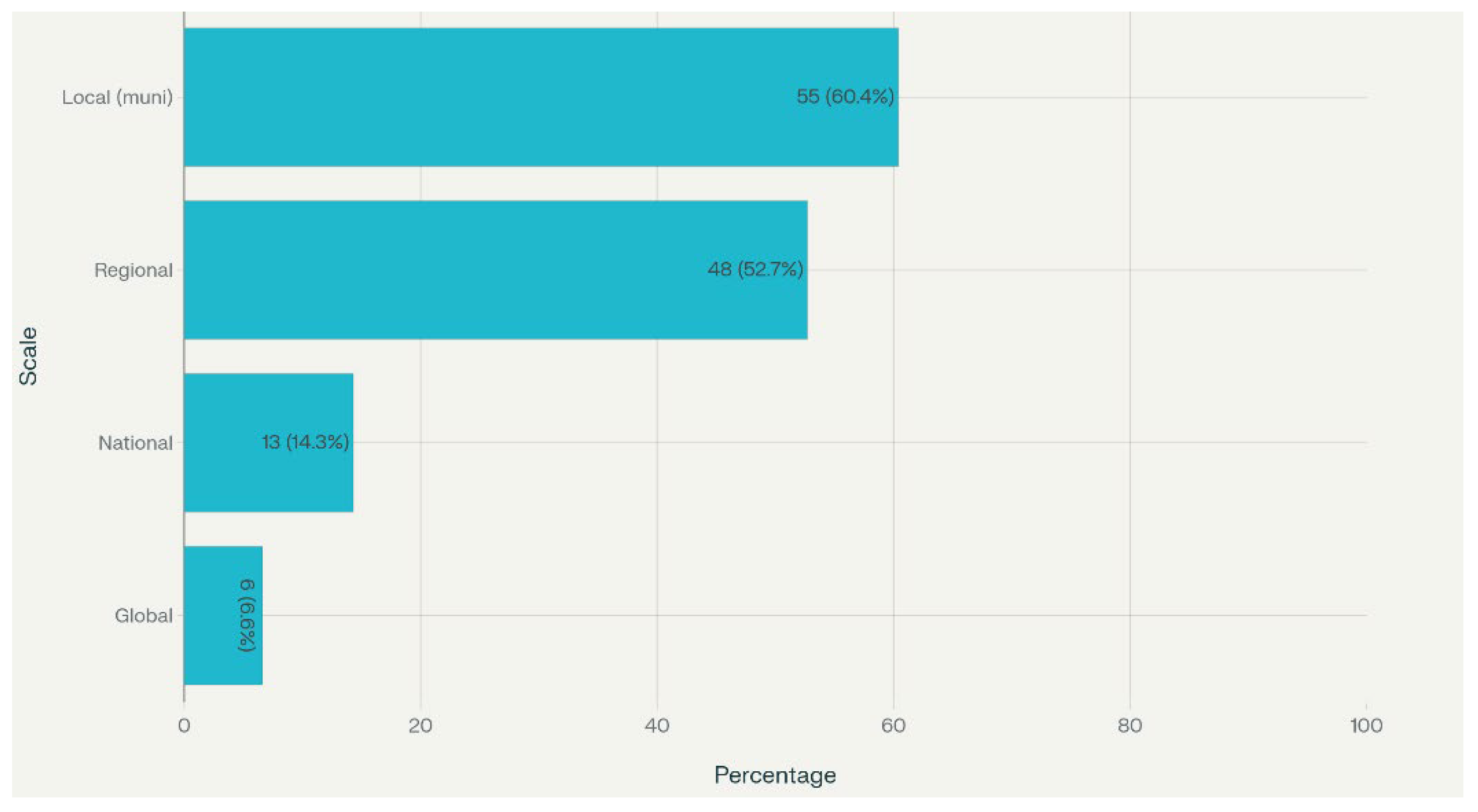
Assessment practices are led by the local-scale, with 55 of 91 studies (60.4%) concentrating on municipal or sub-regional geographies where governance levers, data granularity, and stakeholder engagement are most proximate to implementation, enabling place-specific diagnostics and operational decision support. Regional analysis is also prominent, appearing in 48 studies (52.7%) to benchmark clusters, capture inter-municipal spillovers, and coordinate infrastructure, mobility, and ecosystem management across contiguous territories that share pressures but differ in capacity and policy mixes. National-level assessments are less common (13 studies, 14.3%), typically used to harmonize indicator frameworks, set baselines, and compare destination archetypes; however, they often trade local nuance for coverage, which can blunt the sensitivity of findings for on-the-ground action. At the other extreme, global-scale studies are rare (6 studies, 6.6%), reflecting substantive hurdles (heterogeneous statistical systems, divergent governance contexts, and indicator normalization/availability issues) that complicate standardized measurement and reduce transferability of policy-ready insights across diverse settings. Overall, this scale hierarchy underscores the destination-specific nature of sustainability challenges (seasonality profiles, resource constraints, land-use and coastal pressures) and the corresponding demand for actionable evidence at the management tier where interventions are designed, resourced, and iteratively monitored for adaptive learning.
Figure 14.
Prevalence of assessment scales across 91 studies.
3.7. Tourism Types Addressed
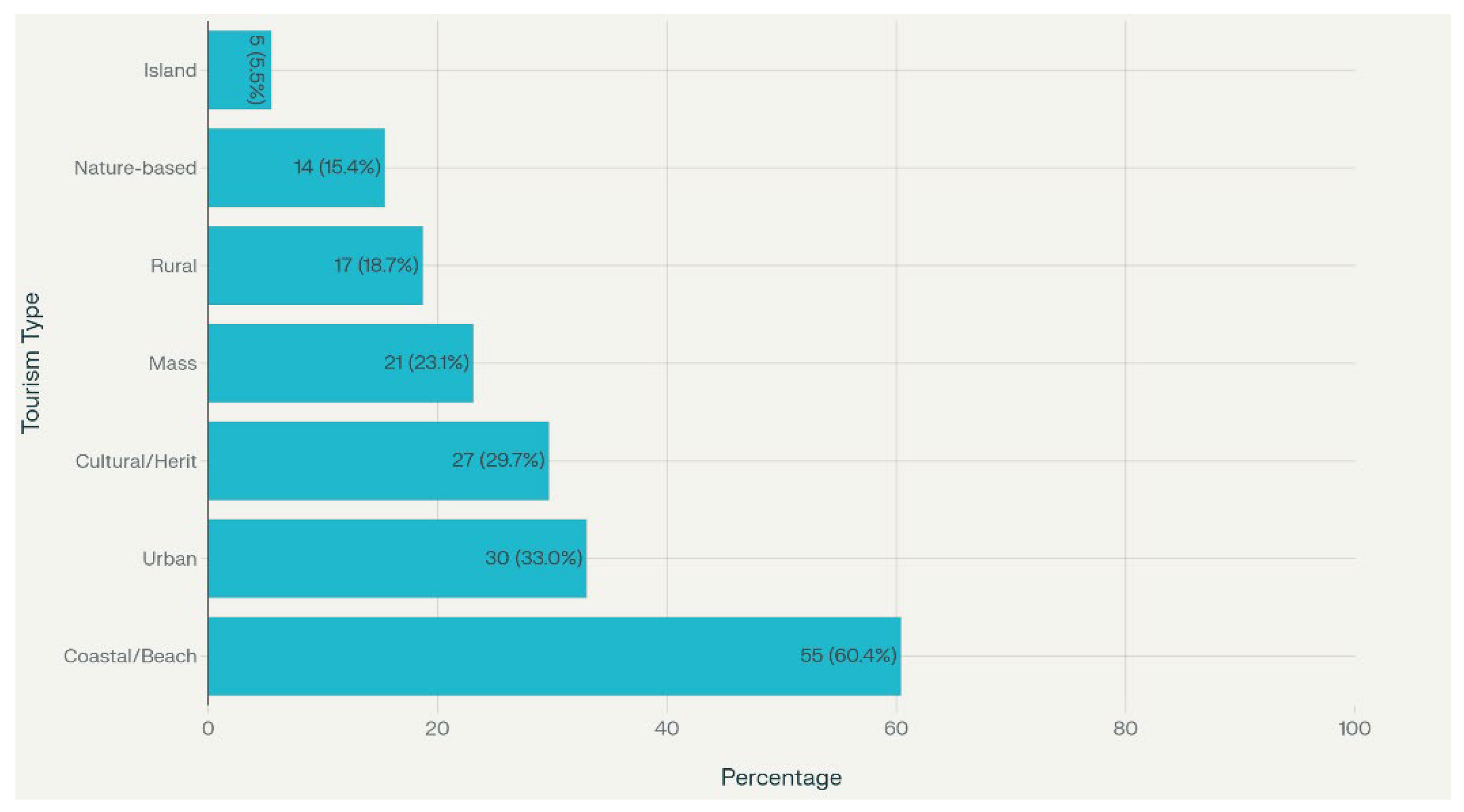
Coastal and beach tourism overwhelmingly dominates the research landscape, addressed in 55 studies (60.4%), mirroring the Mediterranean’s core tourism model of “sun, sea, and sand” that generates approximately €420 billion annually and supports 11.5% of the regional workforce, but also concentrates the most severe sustainability pressures (coastal development, resource overuse, and ecosystem degradation) in precisely the areas where marine biodiversity, seagrass meadows, and fragile littoral zones require protection. Urban tourism appears in 30 studies (33.0%), reflecting increasing scholarly attention to city-break destinations where overtourism manifests through housing market distortions, infrastructure strain, and resident displacement, as evidenced in Barcelona, Venice, and other Mediterranean urban centers experimenting with visitor caps, cruise restrictions, and short-term rental regulation. Cultural and heritage tourism (27 studies, 29.7%) and explicitly labeled mass tourism (21 studies, 23.1%) highlight the dual challenges of preserving archaeological sites and traditional practices while managing visitor flows that can exceed carrying capacity, particularly in destinations like Cinque Terre where cultural authenticity erodes under tourist pressure. Conversely, rural tourism (17 studies, 18.7%) and nature-based tourism (14 studies, 15.4%) receive proportionally less research attention despite their potential as sustainable alternatives that distribute pressures away from saturated coastal zones, support agricultural landscapes, and align with growing demand for experiential travel. Most notably, island tourism is addressed in only 5 studies (5.5%), representing a significant research gap given the Mediterranean’s numerous island destinations—from the Balearics and Sardinia to Greek archipelagos and Cyprus—which face unique sustainability challenges related to resource scarcity, waste management, seasonal population fluctuations, and ecosystem vulnerability that warrant dedicated analytical frameworks.
Figure 15.
Prevalence of different tourism types addressed across 91 studies.
3.8. Stakeholder Engagement
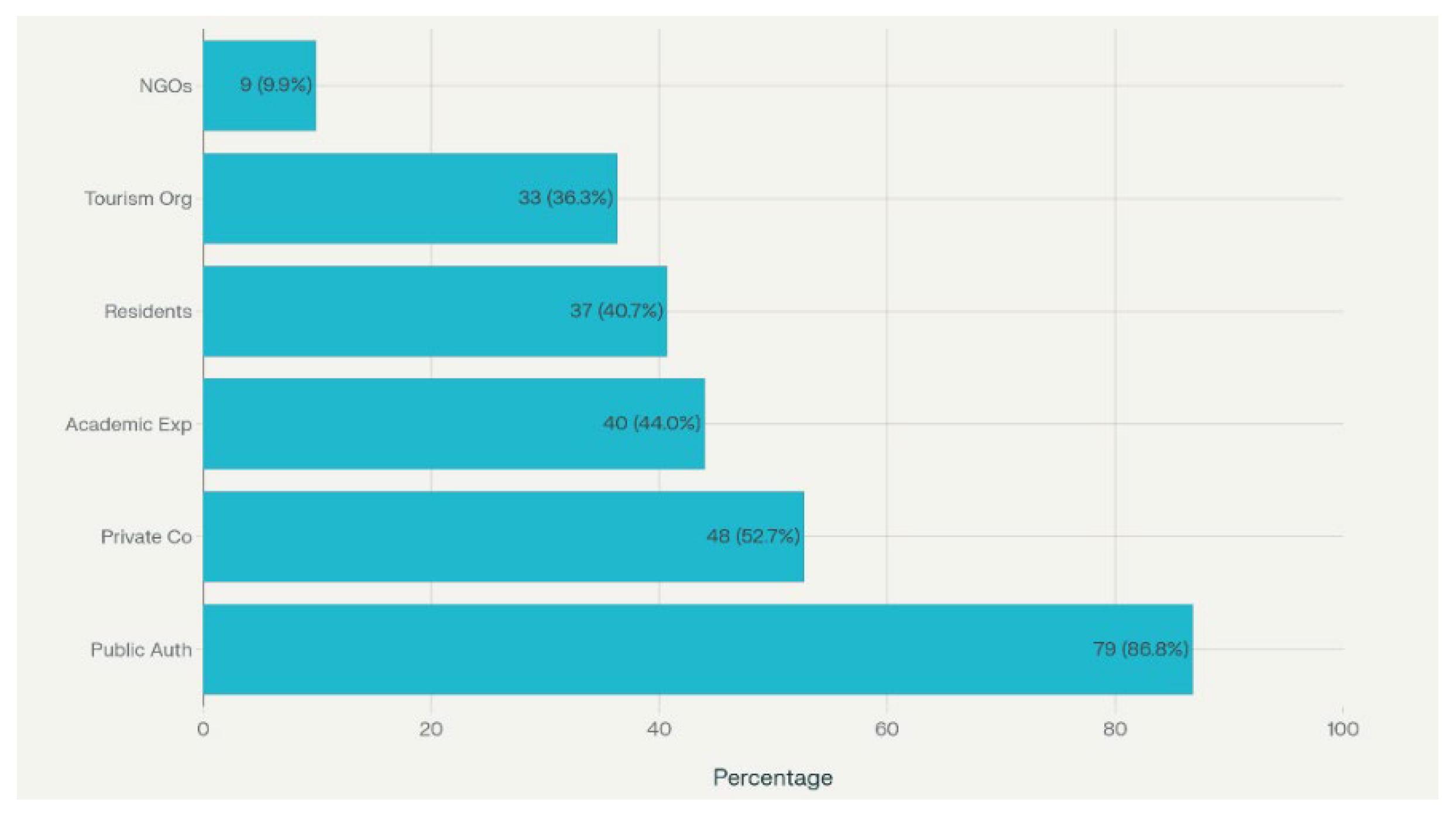
Stakeholder engagement is led by public authorities in 79 studies (86.8%), underscoring their pivotal role in regulation, data access, and agenda-setting for destination planning and policy instrumentation. Participation by private companies appears in 48 studies (52.7%), reflecting their influence over operational practices, technology uptake, and investment decisions that shape on-the-ground sustainability performance. Academic experts contribute in 40 studies (44.0%), typically providing methodological rigor, indicator design, and evaluation frameworks that enable comparability and evidence-based governance. Residents and local communities are engaged in 37 studies (40.7%), indicating moderate—but still insufficient—adoption of participatory approaches essential for social license, legitimacy, and adaptive learning.Tourism organizations participate in 33 studies (36.3%), supporting coordination, benchmarking, and sectoral standardization, yet their involvement trails that of public agencies and firms. At the lowest end, NGOs and civil society feature in only 9 studies (9.9%), revealing a notable gap in watchdog, advocacy, and co-production roles that could strengthen equity, transparency, and environmental accountability in destination governance.
Figure 16.
Stakeholder groups engaged.
3.9. Key Strengths and Limitations
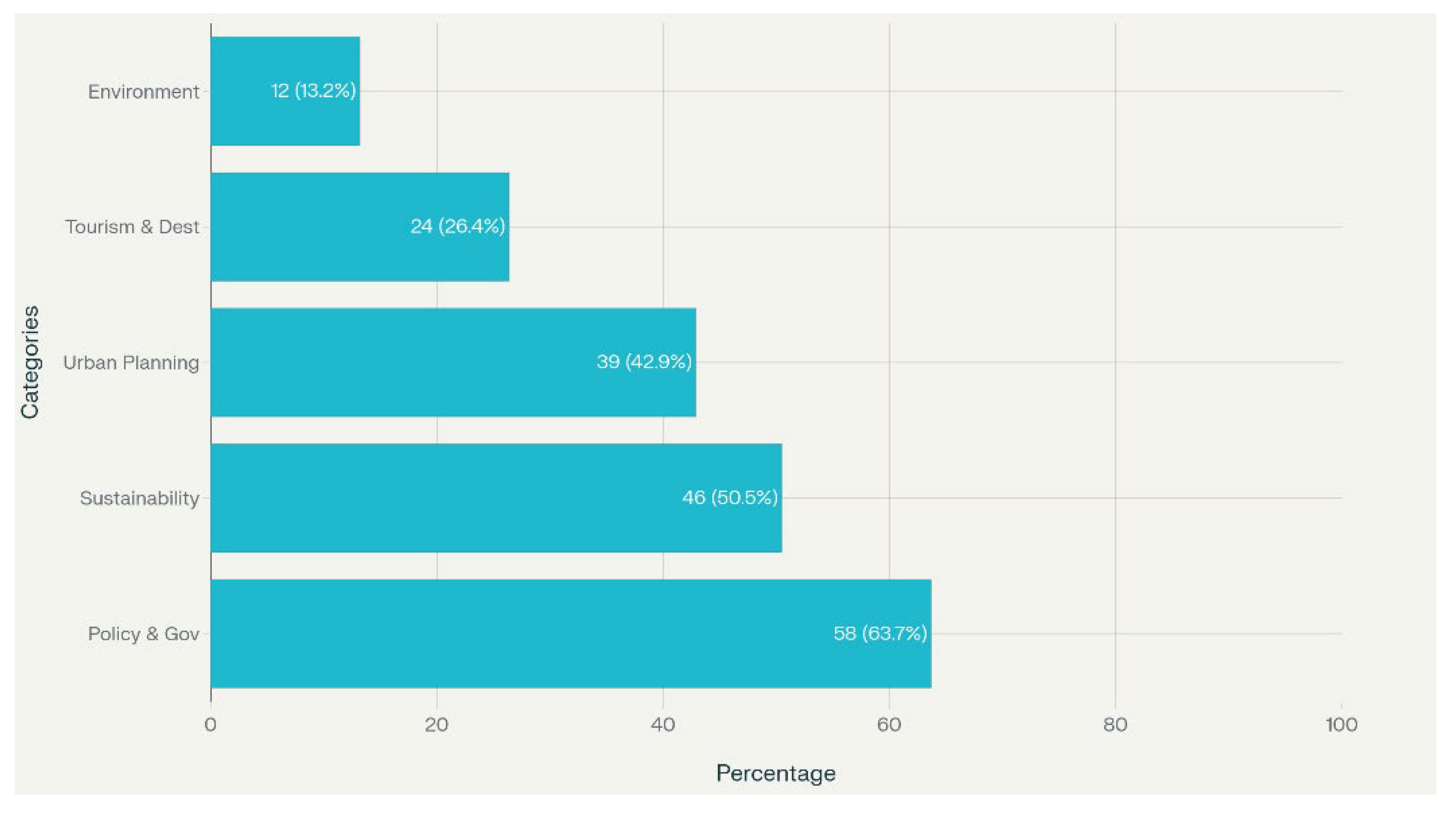
The application landscape is led by policy-making and governance, which appear in 58 studies (63.7%), underscoring the centrality of public decision-making for indicator adoption, monitoring regimes, and the translation of sustainability evidence into regulatory instruments and destination strategies. Work anchored in sustainability frameworks features in 46 studies (50.5%), reflecting the widespread use of composite indicators, DPSIR/PSR logics, and benchmark systems that enable comparability over time and across destinations while structuring trade-offs among environmental, social, and economic objectives. Contexts tied to urban and spatial planning are present in 39 studies (42.9%), leveraging land-use analysis, zoning, mobility, and coastal management to operationalize sustainability through spatial instruments and to manage spillovers such as densification, seasonality peaks, and infrastructure strain. Applications in tourism and destination management account for 24 studies (26.4%), focusing on tactical levers—product diversification, seasonality smoothing, service quality, and visitor flow management—that connect indicator diagnostics to operational practice and DMO decision cycles. Finally, environmental management frames only 12 studies (13.2%), indicating a comparatively smaller body of work centered on biophysical monitoring and resource stewardship, despite the critical role of water, waste, energy, and habitat indicators in coastal and island settings.
Figure 17.
Distribution of application contexts.
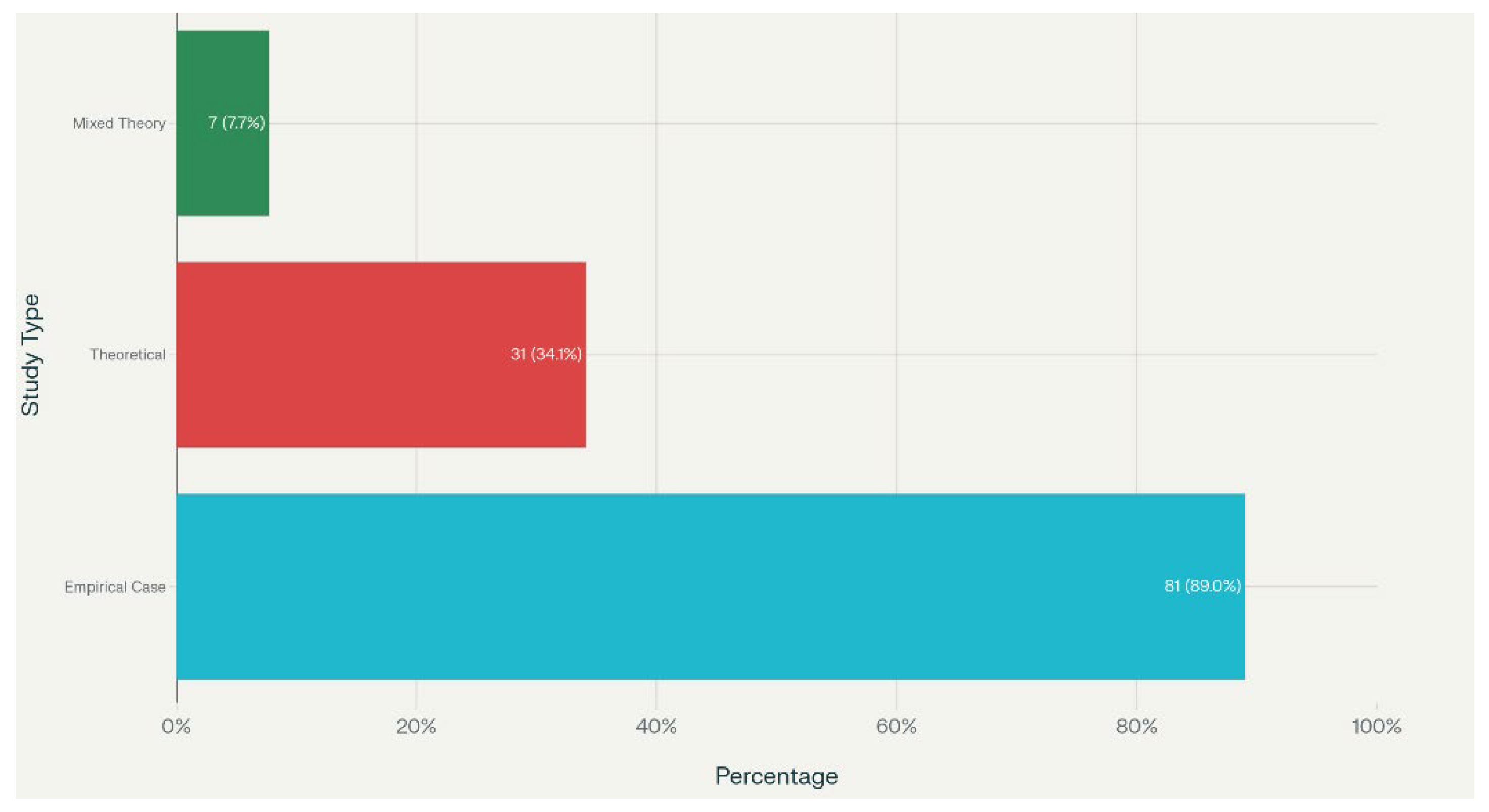
The literature overwhelmingly privileges the empirical case study as the primary vehicle for knowledge production—81 studies (89.0%)—which aligns with the need for context-sensitive measurement and policy relevance in destination sustainability assessment across varied Mediterranean settings. By contrast, 31 publications (34.1%) develop or leverage theoretical or conceptual frameworks (composite-indicator logics, governance models, or evaluation architectures) yet these are frequently positioned as scaffolding for applied analyses rather than as standalone theory-building contributions. Explicitly labeled mixed approaches that couple novel theoretical development with direct empirical validation appear in only 7 studies (7.7%), suggesting a gap where mid-range theory could be iteratively stress-tested across cases to improve generalizability and diagnostic power. Taken together, this distribution indicates a mature research field with robust practical application, while highlighting room for deeper conceptual synthesis, clearer causal identification strategies, and cross-case replications to strengthen external validity and cumulativeness.
Figure 18.
Distribution of study designs.
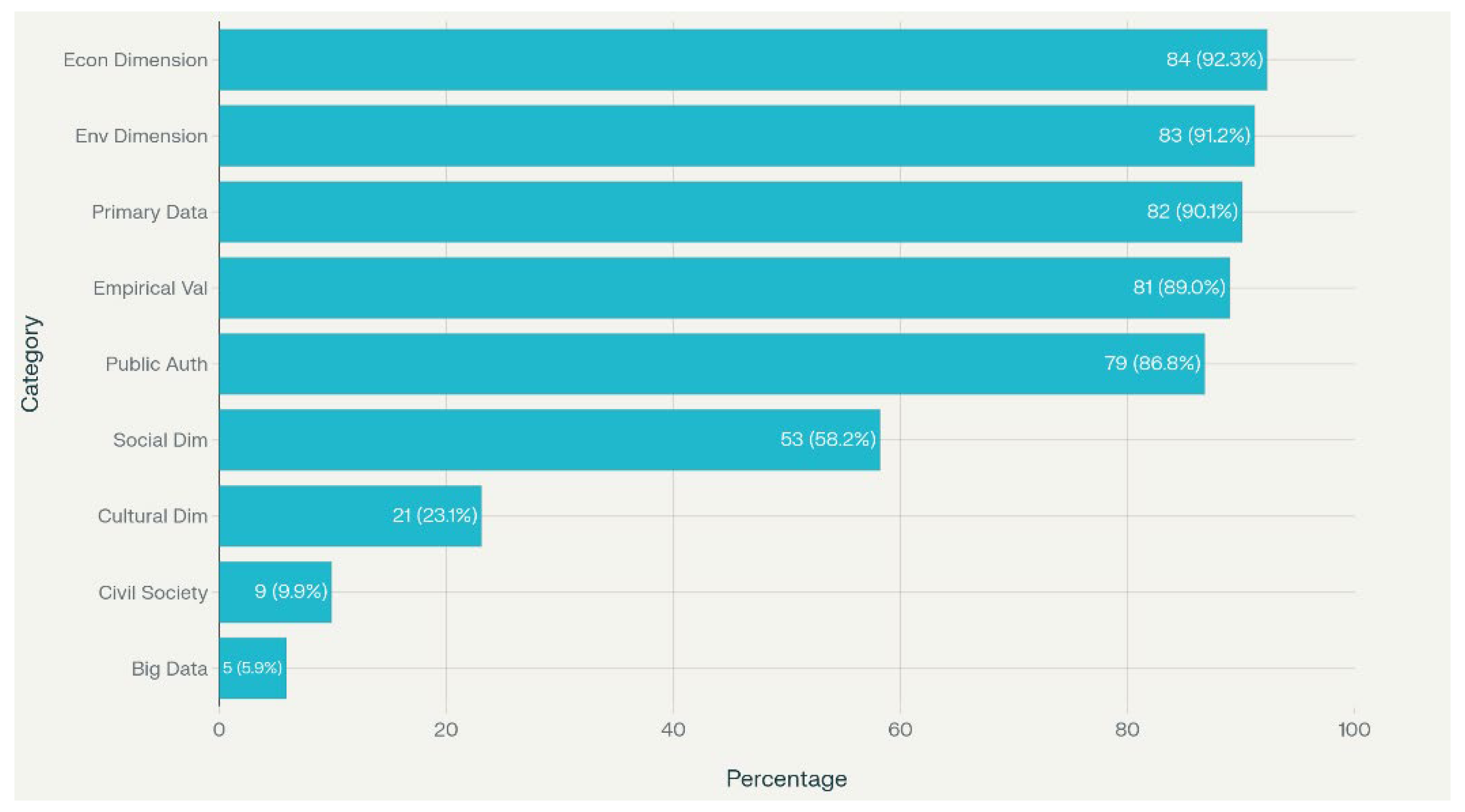
Data quality and methodological rigor are marked by high empirical grounding and broad multidimensional coverage, but tempered by selective underrepresentation of key social and cultural facets and limited technological adoption. Empirical validation is widespread—81 of 91 publications (89.0%)—which bolsters internal credibility through real-world measurements, triangulated indicators, and case-based testing of assumptions in varied Mediterranean contexts. Public authorities participate in 79 studies (86.8%), facilitating access to administrative datasets, regulatory alignment, and policy uptake of results, a configuration that strengthens implementation pathways but may also bias research agendas toward institutionally tractable problems. Coverage of sustainability pillars is robust for the economy and environment—economic dimensions appear in 84 studies (92.3%) and environmental dimensions in 83 (91.2%)—enabling composite indices and balanced scorecards to capture resource pressures, competitiveness, and fiscal outcomes with consistent, comparable metrics. Primary data collection is similarly strong (82 studies; 90.1%), supplying local granularity via surveys, interviews, field audits, and observational protocols that calibrate models to destination-specific realities and stakeholder perceptions. Set against these strengths are substantive limitations: only 5 studies (5.9%) integrate big-data analytics, constraining timeliness, behavioral resolution, and predictive capacity that mobile traces, platform data, or high-frequency sensors could provide for adaptive management and early-warning systems. Social dimensions are present in just 53 studies (58.2%), which can blunt insight into distributional effects, equity, and community well-being—critical for social license and long-term resilience—while cultural dimensions are explicitly covered in only 21 studies (23.1%), limiting sensitivity to heritage preservation, identity, and cultural ecosystem services that define many Mediterranean destinations. Civil society and NGO participation is the lowest among stakeholder groups (9 studies; 9.9%), reducing independent scrutiny, advocacy perspectives, and co-production that typically enhance transparency and accountability in governance. Finally, the corpus shows geographic concentration in specific subregions and destination archetypes, which narrows external validity and highlights the need for broader spatial replication and cross-case synthesis to generalize design principles and policy guidance.
Figure 19.
Key strengths (high coverage) and limitations (low coverage) in data quality and methods.
Figure 19.
Key strengths (high coverage) and limitations (low coverage) in data quality and methods.
4. Discussion
The systematic review reveals a field undergoing rapid transformation and maturation, evidenced by the exponential growth in research output from 8 publications in the nascent phase (2003-2010) to 39 publications in the recent expansion period (2021-2024). This four-fold increase in research intensity over two decades reflects not merely academic interest but a fundamental shift in how Mediterranean destinations conceptualize and operationalize sustainability assessment. The temporal evolution aligns closely with critical policy milestones, particularly the adoption of the UN Sustainable Development Goals in 2015 and the implementation of the European Tourism Indicator System (ETIS), suggesting that academic research has been both responsive to and influential in shaping policy frameworks. The acceleration observed after 2016 coincides with heightened awareness of overtourism challenges in iconic Mediterranean destinations such as Barcelona, Venice, and Santorini, indicating that research has been driven by practical urgency rather than purely theoretical considerations. This policy-research nexus demonstrates the applied nature of sustainability indicator research and its potential for real-world impact, yet it also suggests that research agendas may be reactive rather than anticipatory, potentially limiting the field’s capacity to address emerging challenges proactively. The stark geographic concentration of research output presents both opportunities and significant limitations for the generalizability of findings. Spain’s dominance with 50.5% of publications, followed by Greece (13.2%) and Italy (12.1%), reflects these countries’ prominence as major Mediterranean tourism destinations and their substantial research infrastructure. However, this concentration creates a fundamental bias toward European Mediterranean contexts, with the near-complete absence of North African and Eastern Mediterranean perspectives representing a critical knowledge gap. This geographic imbalance has profound implications for the development of region-wide sustainability frameworks. The Mediterranean basin encompasses diverse political systems, economic development levels, cultural contexts, and environmental challenges that cannot be adequately captured by research concentrated in three European countries. The underrepresentation of countries such as Egypt, Tunisia, Morocco, Lebanon, and Turkey limits the applicability of findings across the full Mediterranean context and may perpetuate indicator systems that are inadvertently biased toward European institutional and data environments. Furthermore, this geographic concentration may reflect broader patterns of research capacity, funding availability, and publication accessibility that systematically exclude non-European perspectives. The implications extend beyond academic completeness to practical policy development, as sustainability frameworks developed primarily from European contexts may lack relevance or feasibility in different institutional, economic, and cultural settings across the Mediterranean basin. The overwhelming dominance of quantitative approaches (90.1% of studies) reflects both the strengths and limitations of current sustainability assessment paradigms. The preference for composite indicators (60% of studies), multi-criteria decision-making methods (35%), and statistical analysis (45%) demonstrates the field’s commitment to measurable, comparable, and policy-relevant metrics. This quantitative emphasis aligns with the practical demands of destination management organizations and policymakers who require objective benchmarks for performance monitoring and inter-destination comparison. However, the relative scarcity of purely qualitative approaches (11.0%) raises important questions about the adequacy of quantitative metrics for capturing the full complexity of sustainability challenges. Sustainability, particularly in its social and cultural dimensions, involves subjective experiences, power relationships, and meaning-making processes that may be inadequately represented through numerical indicators alone. The moderate adoption of mixed-methods approaches (46.2%) suggests growing recognition of this limitation, yet the integration of qualitative insights often appears supplementary rather than fundamental to analytical frameworks. The prevalence of survey-based research (70% of studies) indicates strong stakeholder engagement in data collection, yet this engagement is often extractive rather than participatory, with stakeholders serving as data sources rather than co-producers of knowledge. This pattern reflects broader challenges in sustainability science regarding the balance between scientific rigor and democratic participation in indicator development and validation. The analysis reveals significant imbalances in sustainability dimension coverage that reflect both practical priorities and conceptual limitations in current research. The near-universal coverage of economic (92.3%) and environmental (91.2%) dimensions demonstrates strong alignment with traditional sustainability frameworks and practical policy concerns. Economic indicators receive attention due to tourism’s central role in Mediterranean economies, while environmental indicators respond to acute pressures on coastal and marine ecosystems. The substantial underrepresentation of social (58.2%) and governance (57.1%) dimensions, and particularly cultural aspects (23.1%), represents a critical gap that undermines the holistic vision of sustainability. This imbalance is particularly problematic in Mediterranean contexts where cultural heritage constitutes both a primary tourism attraction and a vulnerable resource requiring careful stewardship. The limited attention to cultural dimensions suggests that current indicator systems may inadequately capture authenticity, cultural integrity, and the commodification risks that threaten the very assets upon which Mediterranean tourism depends. The governance dimension’s underrepresentation is equally concerning, given that sustainability ultimately depends on institutional capacity, policy coherence, and democratic participation in decision-making processes. The absence of robust governance indicators limits the field’s capacity to address systemic sustainability challenges that require coordinated action across multiple stakeholders and scales. The moderate adoption of advanced technologies reveals both progress and missed opportunities in sustainability assessment methodologies. The substantial use of AI/ML techniques (41.2%) and GIS applications (30.6%) indicates growing methodological sophistication and recognition of spatial dimensions in sustainability analysis. These technologies enable more nuanced analysis of complex patterns and relationships that traditional statistical methods might miss. However, the limited adoption of big data analytics (5.9%), remote sensing (9.4%), and IoT technologies (9.4%) represents significant missed opportunities for enhancing the temporal resolution, spatial coverage, and real-time responsiveness of sustainability monitoring systems. Big data approaches could provide insights into visitor flows, behavioral patterns, and resource consumption that conventional survey methods cannot capture, while remote sensing could enable cost-effective monitoring of environmental conditions across large areas. The underutilization of these technologies may reflect institutional barriers, technical capacity constraints, or data access limitations rather than lack of recognition of their potential value. This suggests that advancing technological integration in sustainability assessment may require not only methodological innovation but also institutional development and capacity building. The stakeholder engagement analysis reveals a hierarchical pattern that reflects power structures in tourism governance while highlighting significant gaps in participatory approaches. The dominance of public authorities (86.8%) and substantial involvement of private companies (52.7%) indicates that sustainability assessment is primarily driven by institutional actors with formal decision-making power and economic interests. The moderate engagement of residents and local communities (40.7%) represents a significant limitation, given that these stakeholders bear the primary impacts of tourism development and possess crucial local knowledge for sustainability assessment. The even lower participation of NGOs and civil society organizations (9.9%) suggests a substantial democratic deficit in current approaches, limiting the incorporation of advocacy perspectives, environmental protection priorities, and social justice concerns. This stakeholder pattern may reflect practical constraints in research design and implementation, but it also indicates that current sustainability assessment approaches may inadequately represent the full range of interests and knowledge systems relevant to destination sustainability. The implications extend beyond research validity to political legitimacy and social license for sustainability initiatives. The predominance of local-scale assessments (60.4%) and regional approaches (52.7%) reflects appropriate attention to the scales at which many sustainability interventions must be implemented. Local assessments enable context-specific analysis and stakeholder engagement, while regional approaches can capture spillover effects and coordinate action across administrative boundaries. However, the limited attention to national (14.3%) and global scales (6.6%) may constrain the development of standardized frameworks that enable systematic comparison and knowledge transfer across destinations. This scale distribution suggests a tension between the need for context-specific assessment and the desire for standardized, comparable indicators that can inform regional and global policy development. The emphasis on coastal and beach tourism (60.4%) and urban tourism (33.0%) aligns with the dominant tourism patterns in the Mediterranean but may limit the development of indicator systems for alternative tourism forms that could contribute to sustainability through spatial and temporal distribution of visitor pressures. The underrepresentation of island tourism (5.5%) is particularly notable given the unique sustainability challenges faced by Mediterranean islands. The research corpus demonstrates growing alignment with international sustainability frameworks, yet significant gaps remain in achieving the standardization and comparability required for effective policy coordination. The widespread adoption of composite indicator approaches reflects influence from frameworks such as the Global Sustainable Tourism Criteria (GSTC) and the European Tourism Indicator System (ETIS), indicating positive convergence toward internationally recognized assessment approaches. However, the diversity in indicator definitions, measurement methods, and aggregation approaches suggests that this convergence remains incomplete. The absence of standardized reporting protocols and the limited adoption of ESG-like accountability mechanisms indicate that the field has yet to achieve the level of standardization that would enable systematic benchmarking and knowledge transfer across destinations. The moderate integration with SDG frameworks and limited explicit alignment with ESG principles suggest opportunities for strengthening connections between destination-level sustainability assessment and broader sustainable development and corporate sustainability reporting systems. Such alignment could enhance the credibility and comparability of destination sustainability performance while facilitating integration with investor decision-making and international development cooperation.
5. Conclusions
This systematic review of 91 peer-reviewed publications provides a comprehensive assessment of sustainability indicator research for Mediterranean tourism destinations. The field has achieved substantial methodological sophistication through widespread adoption of quantitative approaches, composite indicators, and growing integration of AI/ML and GIS tools. The exponential growth in research output — particularly after 2016 — reflects its responsiveness to pressing policy challenges and environmental pressures. Yet three fundamental imbalances constrain its transformative potential. First, stark geographic concentration in Spain (50.5%), Greece (13.2%), and Italy (12.1%) creates systematic bias toward European contexts, excluding critical perspectives from North African and Eastern Mediterranean countries and limiting the regional applicability of findings. Second, the dimensional imbalance favouring economic (92.3%) and environmental (91.2%) indicators over social (58.2%), governance (57.1%), and cultural dimensions (23.1%) risks producing partial assessments that overlook the interdependencies determining long-term destination viability. Third, the dominance of public authorities (86.8%) and private companies (52.7%) in stakeholder engagement, alongside minimal civil society involvement (9.9%), generates democratic deficits that may undermine the legitimacy and effectiveness of sustainability frameworks. Collectively, these findings indicate a research field that has achieved considerable academic maturity but requires fundamental rebalancing to realise its potential for guiding holistic sustainability transitions in Mediterranean tourism. Systematic action is required to address geographic, dimensional, and participatory limitations, and to advance the development of standardised, ESG-aligned frameworks capable of supporting policy coordination across the full Mediterranean basin.
This review acknowledges several inherent limitations. The restriction to Scopus-indexed, English-language publications may have excluded relevant research published in regional journals, institutional reports, or grey literature — potentially exacerbating the identified geographic bias toward European contexts. The temporal scope of 2000–2024, while comprehensive, may have missed foundational work published earlier. The systematic review methodology relies on the quality and consistency of original study reporting, and variations in methodological detail may have affected the precision of categorical classifications. The single-database approach, while methodologically justified for consistency and replicability, may limit absolute comprehensiveness compared to multi-database searches. Future research must prioritise geographic expansion to underrepresented North African and Eastern Mediterranean destinations, developing culturally sensitive frameworks and cross-regional comparative studies that reflect the full diversity of the Mediterranean basin. Methodological innovation should focus on the integration of big data analytics, IoT sensors, and artificial intelligence for real-time monitoring and adaptive destination management. Participatory approaches deserve greater emphasis, positioning local communities as equal partners in indicator co-production rather than mere data sources, and integrating traditional and local knowledge alongside scientific monitoring. Finally, greater alignment with ESG-like reporting standards and the SDGs — through shared indicator definitions, transparent aggregation methods, and harmonised benchmarks — would strengthen cross-destination comparability, policy uptake, and the integration of destination sustainability performance into broader sustainable development governance.
Supplementary Materials
The following supporting information can be downloaded in “figshare” at: 10.6084/m9.figshare.32101444.
Author Contributions
Conceptualization, both authors; methodology, Nikolaou Miltiadis; validation, Charisios Achillas; formal analysis, Nikolaou Miltiadis; investigation, Nikolaou Miltiadis; resources, Nikolaou Miltiadis; data curation, Nikolaou Miltiadis; writing—original draft preparation, Nikolaou Miltiadis; writing—review and editing, Charisios Achillas; visualization, Nikolaou Miltiadis; supervision, Charisios Achillas; project administration, both authors. Both Dr. Charisios Achillas and Dr. Nikolaou Miltiadis served as co-corresponding authors. All authors have read and agreed to the published version of the manuscript.
Funding
This research received no external funding.
Institutional Review Board Statement
Not applicable.
Informed Consent Statement
Not applicable.
Data Availability Statement
The data that support the findings of this study are available from the corresponding author upon reasonable request.
Conflicts of Interest
The authors declare no conflicts of interest.
Abbreviations
The following abbreviations are used in this manuscript:
AHP Analytic Hierarchy Process
AI Artificial Intelligence
BOD Biochemical Oxygen Demand
DMO Destination Management Organisation
DPSIR Driving Forces–Pressure–State–Impact–Response
ESG Environmental, Social, and Governance
ETIS European Tourism Indicator System
GDP Gross Domestic Product
GIS Geographic Information Systems
GSTC Global Sustainable Tourism Criteria
IoT Internet of Things
MedECC Mediterranean Experts on Climate and Environmental Change
MCDM Multi-Criteria Decision-Making
MICE Meetings, Incentives, Conferences, and Exhibitions
ML Machine Learning
NOx Nitrogen Oxides
PM Particulate Matter
PRISMA Preferred Reporting Items for Systematic Reviews and Meta-Analyses
PSR Pressure–State–Response
SDG Sustainable Development Goal
SME Small and Medium-sized Enterprise
SO2 Sulphur Dioxide
TBL Triple Bottom Line
TOPSIS Technique for Order Preference by Similarity to Ideal Solution
UNWTO United Nations World Tourism Organization
References
- Aguirre, A. et al. (2023). Smart tourism destinations really make sustainable cities: Benidorm as a case study. International Journal of Tourism Cities. [CrossRef]
- Aktsoglou, D., & Gaidajis, G. (2020). A case study on environmental sustainability assessment of spatial entities with anthropogenic activities: The national park of Eastern Macedonia and Thrace, Greece. Sustainability (Switzerland). [CrossRef]
- Alipour, H., Safaeimanesh, F., & Soosan, A. (2019). Investigating sustainable practices in hotel industry-from employees’ perspective: Evidence from a Mediterranean island. Sustainability (Switzerland). [CrossRef]
- Andolina, C. et al. (2021). Environmental effects of tourism and its seasonality on Mediterranean islands: the contribution of the Interreg MED BLUEISLANDS project to build up an approach towards sustainable tourism. Environment, Development and Sustainability. [CrossRef]
- Andria, J., di Tollo, G., & Pesenti, R. (2020). A heuristic fuzzy algorithm for assessing and managing tourism sustainability. Soft Computing. [CrossRef]
- Avdimiotis, S. (2009). From development to decline. Tracing the life circle notifications of a destination. Journal of Environmental Protection and Ecology.
- Aygün Oğur, A., & Baycan, T. (2023). Assessing climate change impacts on tourism demand in Turkey. Environment, Development and Sustainability. [CrossRef]
- Baños, C. J. et al. (2019). The hydrosocial cycle in coastal tourist destinations in Alicante, Spain: Increasing resilience to drought. Sustainability (Switzerland).
- Blancas, F.. J., Contreras, I.., & Lozano-Oyola, M.. (2023). Evaluating destinations’ efforts to improve sustainability in tourism using the inter-temporal decomposition of a composite indicator. Environmental Impact Assessment Review. [CrossRef]
- Blancas, F. J. et al. (2010). The assessment of sustainable tourism: Application to Spanish coastal destinations. Ecological Indicators. [CrossRef]
- Blancas, F. J. et al. (2016). Sustainable tourism composite indicators: a dynamic evaluation to manage changes in sustainability. Journal of Sustainable Tourism. [CrossRef]
- Blancas, F. J. et al. (2018). A dynamic sustainable tourism evaluation using multiple benchmarks. Journal of Cleaner Production. [CrossRef]
- Blancas, F. J. et al. (2011). How to use sustainability indicators for tourism planning: The case of rural tourism in Andalusia (Spain). Science of the Total Environment. [CrossRef]
- Blázquez-Salom, M., Cladera, M.., & Sard, M. (2023). Identifying the sustainability indicators of overtourism and undertourism in Majorca. Journal of Sustainable Tourism. [CrossRef]
- Boqué Ciurana, A. et al. (2022). Exploring the Climatic Potential of Somo’s Surf Spot for Tourist Destination Management. Sustainability (Switzerland). [CrossRef]
- Brščic, K. et al. (2020). Can indicators for sustainable tourism improve tourism planning in the coastal destinations? empirical evidence from catalonia, istrian region and tuscany region. Tourism.
- Butler, R.W. 1993. Tourism - an evolutionary perspective. In Tourism and Sustainable Development: Monitoring, Planning, Managing, ed. J.G. Nelson, R.W. Butler and G. Wall, pp. 27-44. Waterloo, Ontario: University of Waterloo (Department of Geography Publication 37).
- Cardia, G., & Pulido Fernández, J. I. (2017). The Model Do-Di: An Emerging Methodology for the Management of the Relation Between Tourism, Culture and Development. Springer Proceedings in Business and Economics.
- Čavlek, N. et al. (2019). Destination Climate Adaptation. Journal of Hospitality and Tourism Research.
- Cobacho-Tornel, M. B. (2019). Synthetic indicators and sustainable coastal tourism in Murcia, Spain. Anatolia. [CrossRef]
- Coccossis, H., & Koutsopoulou, A. (2021). Measuring and monitoring sustainability of coastal tourism destinations in the mediterranean. Tourism. [CrossRef]
- Contu, G. et al. (2019). The impact of Airbnb on hidden and sustainable tourism: The case of Italy. International Journal of Tourism Policy.
- Correia, Maria. (2019). Sustainability: An Overview of the Triple Bottom Line and Sustainability Implementation. International Journal of Strategic Engineering. 2. 29-38. 10.4018/IJoSE.2019010103. [CrossRef]
- Costa, J., Montenegro, M., & Gomes, J. (2022). Sustainability as a measure of tourism success: the Portuguese Promotional Tourism Boards’ view. Worldwide Hospitality and Tourism Themes. [CrossRef]
- Crabolu, G., Font, X., & Miller, G. (2023). The Hidden Power of Sustainable Tourism Indicator Schemes: Have We Been Measuring Their Effectiveness All Wrong? Journal of Travel Research, 63(7), 1741-1760. [CrossRef]
- Cruz, M. S., & Zaragoza, M. P. P. (2019). Analysis of the accommodation density in coastal tourism areas of insular destinations from the perspective of overtourism. Sustainability (Switzerland). [CrossRef]
- Cucculelli, M., & Goffi, G. (2016). Does sustainability enhance tourism destination competitiveness? Evidence from Italian Destinations of Excellence. Journal of Cleaner Production. [CrossRef]
- Damian, I. M., Navarro, E., & Ruiz, F. (2022). Stakeholders’ perception of the sustainability of a tourism destination: a methodological framework to find out relationships and similarity of opinions. Tourism Review. [CrossRef]
- Damian, I. M., Navarro-Jurado, E., & Ruiz, F. (2023). Involving stakeholders in the evaluation of the sustainability of a tourist destination: a novel comprehensive approach. Journal of Sustainable Tourism. [CrossRef]
- Epifani, F., & Valente, D. (2023). Sustainable Governance of Tourism-Based Social–Ecological Landscapes. Sustainability (Switzerland). [CrossRef]
- Farris, G. et al. (2021). Design of a Blockchain-Oriented System for the Sustainable Disintermediation in Tourism. 2021 IoT Vertical and Topical Summit for Tourism.
- Fernández, J. I. P., & Rivero, M. S. (2009). Measuring tourism sustainability: Proposal for a composite index. Tourism Economics. [CrossRef]
- Fernández-Tabales, A. et al. (2017). Developing a system of territorial governance indicators for tourism destinations. Journal of Sustainable Tourism. [CrossRef]
- Folgadofernández, J. A., Marinoromero, J. A., & Arenas-Escaso, J. F. (2023). Economic Results and Corporate Social Responsibility in the Tourism Sector. A Study of the World Heritage City of Cáceres; [Resultados Económicos en el Sector Turístico y Responsabilidad Social Corporativa. Un estudio en la Ciudad Patrimonio de la Humanidad de Cáceres]. UCJC Business and Society Review.
- Font Barnet, A. et al. (2021). Climate services for tourism: An applied methodology for user engagement and co-creation in European destinations. Climate Services. [CrossRef]
- Foronda-Robles, C. et al. (2023). Progress and stakes in sustainable tourism: indicators for smart coastal destinations. Journal of Sustainable Tourism. [CrossRef]
- Franzoni, S. (2015). Measuring the sustainability performance of the tourism sector. Tourism Management Perspectives. [CrossRef]
- Garcia-Ayllon, S. (2018). Urban transformations as an indicator of unsustainability in the P2P mass tourism phenomenon: The Airbnb Case in Spain through three case studies. Sustainability (Switzerland). [CrossRef]
- Glyptou, K. et al. (2022). Clustering Sustainable Destinations: Empirical Evidence from Selected Mediterranean Countries. Sustainability (Switzerland). [CrossRef]
- Goffi, G., & Cucculelli, M. (2014). Components of destination competitiveness. The case of small tourism destinations in Italy. International Journal of Tourism Policy. [CrossRef]
- Guaita Martínez, J. et al. (2019). An analysis of the stability of rural tourism as a desired condition for sustainable tourism. Journal of Business Research. [CrossRef]
- Guerra, I. et al. (2017). Smart cities, smart tourism? The case of the city of Porto. Revista Galega de Economia. [CrossRef]
- Guidetti, G., Pedrini, G., & Zamparini, L. (2021). Assessing perceived job quality among seasonal tourism workers: The case of Rimini, Italy. Tourism Economics. [CrossRef]
- Guizzardi, A., Stacchini, A., & Costa, M. (2022). Can sustainability drive tourism development in small rural areas? Evidences from the Adriatic. Journal of Sustainable Tourism. [CrossRef]
- Gusman, I. et al. (2019). Culture and tourism in Porto City Centre: Conflicts and (Im)Possible solutions. Sustainability (Switzerland). [CrossRef]
- Gómez-Bruna, D. et al. (2023). PSR_ti model, an adapted pressure-state-response (PSR) framework for measuring tourism impacts: the case of Madrid. International Journal of Tourism Cities. [CrossRef]
- Ince, E., & Öztüren, A. (2021). Strengths, weaknesses and challenges of municipalities in North Cyprus aspiring to be a sustainable Cittaslow tourism destination. Worldwide Hospitality and Tourism Themes. [CrossRef]
- Italos, C., Akylas, E., & Hadjimitsis, D. G. (2014). Effects of tourism and globalization on land cover and the influence on the quality of life of Paphos area in Cyprus. Proceedings of SPIE - The International Society for Optical Engineering.
- Ivars-Baidal, J.. A. et al. (2021). Measuring the progress of smart destinations: The use of indicators as a management tool. Journal of Destination Marketing and Management. [CrossRef]
- Ivars-Baidal, J. A. et al. (2023). Sustainable tourism indicators: what’s new within the smart city/destination approach?. Journal of Sustainable Tourism. [CrossRef]
- Komis, M., & Wassler, P. (2022). Sustainability issues on islands: a case of Cephalonia (Greece). Journal of Qualitative Research in Tourism. [CrossRef]
- Kožić, I., & Mikulić, J. (2014). Research note: Measuring tourism sustainability: An empirical comparison of different weighting procedures used in modelling composite indicators. Tourism Economics. [CrossRef]
- Kušcer, K. (2014). Determining indicators of mountain destination development. Tourism Analysis. [CrossRef]
- Leka, A. et al. (2022). Development of a Tourism Carrying Capacity Index (TCCI) for sustainable management of coastal areas in Mediterranean islands – Case study Naxos, Greece. Ocean and Coastal Management. [CrossRef]
- Leka, A., Tsigarda, N., & Stratigea, A. (2023). Assessing Tourism Environmental Sustainability in Mediterranean Insular Destinations – Case Study Zakynthos Island. Lecture Notes in Computer Science (including subseries Lecture Notes in Artificial Intelligence and Lecture Notes in Bioinformatics).
- Liu, Z. (2003). Sustainable tourism development: A critique. Journal of sustainable tourism, 11(6), 459-475.
- Lozano-Oyola, M. et al. (2012). Sustainable tourism indicators as planning tools in cultural destinations. Ecological Indicators. [CrossRef]
- Lozano-Oyola, M. et al. (2019). Sustainable tourism tags to reward destination management. Journal of Environmental Management. [CrossRef]
- Machado, V. et al. (2018). Governing Locally for Sustainability: Public and Private Organizations’ Perspective in Surf Tourism at Aljezur, Costa Vicentina, Portugal. Tourism Planning and Development. [CrossRef]
- Manglis, A. et al. (2021). Implementing multi-criteria analysis in the selection of auchs for the integration of digital technologies into the tourism offering: The case of medrydive. Heritage. [CrossRef]
- Martin, J. M. M., Aguilera, J. D. D. J., & Moreno, V. M. (2014). Impacts of seasonality on environmental sustainability in the tourism sector based on destination type: An application to Spain’s Andalusia region. Tourism Economics. [CrossRef]
- Martín Martín, J. M., & Salinas Fernández, J. A. (2022). The effects of technological improvements in the train network on tourism sustainability. An approach focused on seasonality. Sustainable Technology and Entrepreneurship. [CrossRef]
- Martín Martín, J. M. et al. (2020). Analysis of Tourism Seasonality as a Factor Limiting the Sustainable Development of Rural Areas. Journal of Hospitality and Tourism Research.
- Martín, J. M. et al. (2017). Assessment of the tourism’s potential as a sustainable development instrument in terms of annual stability: Application to Spanish rural destinations in process of consolidation. Sustainability (Switzerland).
- Matarazzo, A. (2022). Environmental Indicators to Improve Sustainable Tools in Tourism Sector. AIP Conference Proceedings.
- MedECC (2020). Climate and environmental change in the Mediterranean Basin: Current situation and risks for the future. First Mediterranean Assessment Report (MAR1). Mediterranean Experts on Climate and Environmental Change.
- Michailidou, A.. V., Vlachokostas, C., & Moussiopoulos, N. (2015). A methodology to assess the overall environmental pressure attributed to tourism areas: A combined approach for typical all-sized hotels in Chalkidiki, Greece. Ecological Indicators. [CrossRef]
- Mihalič, T., Žabkar, V., & Cvelbar, L. K. (2012). A hotel sustainability business model: Evidence from Slovenia. Journal of Sustainable Tourism. [CrossRef]
- Miller, G., & Twining-Ward, I. (2005). Monitoring for a Sustainable Tourism Transition: The Challenge of Developing and Using Indicators. CABI Publishing.
- Moniche, A., & Gallego, I. (2023). Benefits of policy actor embeddedness for sustainable tourism indicators’ design: the case of Andalusia. Journal of Sustainable Tourism. [CrossRef]
- Moreno-Luna, L. et al. (2021). Drivers for sustainability awareness development in tourism curricula: The case of spanish universities. Land. [CrossRef]
- Navarro Jurado et al. (2012). Carrying capacity assessment for tourist destinations. Methodology for the creation of synthetic indicators applied in a coastal area. Tourism Management. [CrossRef]
- Niavis, S. et al. (2019). Conceptualising tourism sustainability and operationalising its assessment: Evidence from a Mediterranean Community of projects. Sustainability (Switzerland). [CrossRef]
- O’Mahony et al. (2009). Data availability and accessibility for sustainable tourism: An assessment involving different European coastal tourism destinations. Journal of Coastal Research.
- Pardo, M. C., Silva, G., & Paiva, S. (2021). The role of big data in monitoring sustainability of tourism destinations: The case of north Portugal region. Proceedings of the International Conference on Tourism Research.
- Patterson, T. M., Niccolucci, V., & Marchettini, N. (2008). Adaptive environmental management of tourism in the Province of Siena, Italy using the ecological footprint. Journal of Environmental Management. [CrossRef]
- Pimentel de Oliveira, D., & Pitarch-Garrido, M. D. (2023). Measuring the sustainability of tourist destinations based on the SDGs: the case of Algarve in Portugal: Tourism Agenda 2030. Tourism Review.
- Poch, E. S. S., Castresana, U. L., & de la Fuente Arana, A. (2020). Traditional Cultural Heritage vs. Film Sceneries: Evaluating the Degree of Sustainability of Cultural Landscapes. International Journal of Design and Nature and Ecodynamics. [CrossRef]
- Prokopiou, D., & Tselentis, B. (2022). Carrying capacity indicators in relation to a tourist destination: The case of the island of Paros, Greece, WIT Transactions on Ecology and the Environment.
- Prokopiou, D. et al. (2017). Sustainable tourism and destination management: The Greek island of Poros. WIT Transactions on Ecology and the Environment.
- Puig, R. et al. (2017). Inventory analysis and carbon footprint of coastland-hotel services: A Spanish case study. Science of the Total Environment. [CrossRef]
- Pulido-Fernández, J.-I., Sánchez-Rivero, M., & López-Sánchez, Y. (2011). Comparative analysis of the sustainability of tourism in Spain’s regions. Environmental Engineering and Management Journal. [CrossRef]
- Pérez-Calderón, E., Miguel-Barrado, V., & Sánchez-Cubo, F. (2022). Tourism Business in Spanish National Parks: A Multidimensional Perspective of Sustainable Tourism. Land. [CrossRef]
- Rebollo, J. F. V., & Baidal, J. A. I. (2003). Measuring sustainability in a mass tourist destination: Pressures, Perceptions and policy responses in torrevieja, Spain. Journal of Sustainable Tourism.
- Rodríguez, R. A., López, A. G., & Caballero, J. L. J. (2017). Has implementing an ecolabel increased sustainable tourism in Barcelona?; [¿puede una eco etiqueta incrementar la sostenibilidad turística en Barcelona?]. Cuadernos de Turismo.
- Santos, E. et al. (2022). Evaluating Economic Sustainability of Nautical Tourism Through Brand Equity and Corporate Performance. Springer Proceedings in Business and Economics.
- Santos-Lacueva, R., Clavé, S. A., & Saladié, Ò. (2017). The vulnerability of coastal tourism destinations to climate change: The usefulness of policy analysis. Sustainability (Switzerland). [CrossRef]
- Sgroi, F. (2022). Evaluating of the sustainability of complex rural ecosystems during the transition from agricultural villages to tourist destinations and modern agri-food systems. Journal of Agriculture and Food Research. [CrossRef]
- Silva, G., Pardo, M. C., & Rocha, I. (2022). Measuring Social Tourism Sustainability in Porto Municipality: The Views of Residents. Proceedings of the International Conference on Tourism Research.
- Suárez Sánchez, M. N. (2007). Sustainable Tourism Indicators for the coastal places. State of research. Portugal SB 2007 - Sustainable Construction, Materials and Practices: Challenge of the Industry for the New Millennium.
- Sánchez-Galiano, J.-C., Martí-Ciriquián, P., & Fernández-Aracil, P. (2017). Temporary population estimates of mass tourism destinations: The case of Benidorm. Tourism Management. [CrossRef]
- Tejada, M., Malvárez, G. C., & Navas, F. (2009). Indicators for the assessment of physical carrying capacity in coastal tourist destinations. Journal of Coastal Research.
- Torres-Delgado, A., & Saarinen, J. (2014). Using indicators to assess sustainable tourism development: A review. Tourism Geographies, 16(1), 31–47. [CrossRef]
- Torres-Delgado, A.., & López Palomeque, F. (2018). The ISOST index: A tool for studying sustainable tourism. Journal of Destination Marketing and Management. [CrossRef]
- Torres-Delgado et al. (2023). Monitoring sustainable management in local tourist destinations: performance, drivers and barriers. Journal of Sustainable Tourism.
- UNEP and UN Tourism (2005). Making Tourism More Sustainable - A Guide for Policy Makers, p.11-12.
- Vagiona, D. G., & Palloglou, A. (2021). An indicator-based system to assess tourism carrying capacity in a Greek island. International Journal of Tourism Policy.
- Vojnović, N. (2018). Tourist intensity in Croatia’s leading tourist towns and municipalities; [Intenzitet Turizma u vodećim hrvatskim turističkim gradovima i općinama]. Radovi Zavoda za Znanstvenoistrazivacki i Umjetnicki Rad u Bjelovaru.
- Vukadin, I. M., Zovko, M., & Krešić, D. (2020). Review and evaluation of existing international systems of tourism sustainability indicators; [Pregled i evaluacija postojećih međunarodnih sustava pokazatelja održivosti turizma]. Hrvatski Geografski Glasnik.
- Zhang et al., 2025. Sustainable development in the tourism sector: The impact of environmental, social, and governance performance on operational efficiency—A multilevel analytical approach. Sustainable Futures, vol. 10.
Disclaimer/Publisher’s Note: The statements, opinions and data contained in all publications are solely those of the individual author(s) and contributor(s) and not of MDPI and/or the editor(s). MDPI and/or the editor(s) disclaim responsibility for any injury to people or property resulting from any ideas, methods, instructions or products referred to in the content. |
© 2026 by the authors. Licensee MDPI, Basel, Switzerland. This article is an open access article distributed under the terms and conditions of the Creative Commons Attribution (CC BY) license (http://creativecommons.org/licenses/by/4.0/).
Copyright: This open access article is published under a Creative Commons CC BY 4.0 license, which permit the free download, distribution, and reuse, provided that the author and preprint are cited in any reuse.


