
Submitted:
24 April 2026
Posted:
28 April 2026
You are already at the latest version
Abstract
Recent advances in CRISPR technology have expanded beyond traditional double-strand break–based genome editing to include base editors and prime editors, enabling precise and programmable sequence modifications. This evolution marks a shift from conventional mutation correction toward platform-based therapeutic systems capable of targeting a broad spectrum of pathogenic variants. Such versatility holds promise for treating over 90% of known disease-causing mutations in rare monogenic disorders. This review will discuss the technological progression of CRISPR systems, highlighting the principles, applications, and limitations of emerging editing modalities. We will explore their translation into personalized gene therapies, emphasizing delivery challenges, off-target safety, and the need for regulatory innovation. The paper will also introduce the concept of interventional genetics, an emerging medical framework linking genomic diagnosis directly to therapeutic intervention through adaptive gene-editing platforms. Finally, we will outline strategies for establishing unified, scalable, and regulatory-ready editing platforms that can accelerate the clinical implementation of individualized therapies for rare diseases.
Keywords:
CRISPR
; gene editing
; monogenic disorders
; interventional genetics
; personalized medicine
1. Introduction
Monogenic disorders arise from pathogenic variants in single genes. Despite their individually low prevalence, these disorders collectively affect approximately 4% of the human population [1]. The low prevalence of individual conditions, combined with their biological complexity and limited commercial incentives, has significantly constrained therapeutic development, leaving many patients without access to appropriate treatments and placing a considerable economic burden on healthcare systems [2,3,4]. In this context, gene-editing approaches, particularly CRISPR-based technologies, have emerged as a promising strategy to address the underlying genetic causes of rare monogenic diseases [5,6]. Since CRISPR platforms are inherently modular and reprogrammable, they enable correction of distinct pathogenic variants across different disorders and offer the potential for durable, long-lasting therapeutic effects following a single intervention [7,8]. Importantly, recent advances in CRISPR engineering, including the development of base editors and prime editors, have enabled more precise and predictable sequence modifications, overcoming several limitations associated with conventional double-strand break–dependent CRISPR approaches [9]. Together, these technological advancements have prompted renewed consideration of how personalized gene-editing therapies could be systematically developed and implemented as standard-of-care interventions for rare diseases, contributing to the emergence of a new clinical therapeutic field referred to as interventional genetics [10]. As a result, in this review, we aim to highlight the relevance and current status of CRISPR gene-editing therapeutics for rare monogenic diseases, and to preview the roadmap towards a new era of personalized medicine. Finally, we discuss current challenges in the development of CRISPR-based gene-editing therapeutics and outline new strategies to accelerate the clinical implementation of individualized therapies for rare diseases.
2. CRISPR Mechanisms of Action and Toolkits
Clustered regularly interspaced short palindromic repeats (CRISPR) associated enzymes (Cas) is a naturally occurring adaptive immune system protecting bacterial and archaeal organisms from exogenous nucleic acids [11,12,13,14]. The mechanism of action of CRISPR-Cas immune response involves three key steps: adaptation, expression, and interference [11,12,15]. In the adaptation phase, short exogenous viral DNA fragments, known as spacers, are captured and integrated into the CRISPR locus [11,12,15]. Next, a single transcript of the CRISPR array carrying the spacers, called pre-CRISPR RNA (pre-crRNA), is transcribed and subsequently undergoes a series of modifications, ultimately maturing into distinct CRISPR RNAs (crRNAs) [11,12,15]. Finally, in the interference phase, the generated crRNA serves as a reference guide for Cas enzymes to recognize the exogenous sequence for cleavage and inactivation [11,12,15].
CRISPR systems can be classified into two main classes according to the organization of the effector modules [13]. Class 1 systems are composed of multiple Cas protein effector modules, while class 2 systems consist of single-multidomain Cas effector modules and occur predominantly in bacteria [11,13,14]. CRISPR-Cas class 2 systems have been widely studied due to their potential in gene editing and genetic screening applications, with the CRISPR/Cas9 system being the most recognized and widely adopted for genetic engineering [7,16]. As a result, CRISPR-Cas nucleases have been engineered to mediate targeted genetic alterations across diverse animal and cell systems [14]. This versatility has driven the development of CRISPR as a powerful genome editing tool and its implementation as an emerging therapeutic for genetic disorders [7,17]. In this case, the key to this adaptability lies mainly in the ease of programmability of Cas enzymes, which use a single guide RNA (sgRNA) to direct the Cas protein to a specific genomic target near a PAM (protospacer adjacent motif) region [13,14].
2.1. Double-Strand Break–Dependent CRISPR Systems
Traditional gene-editing CRISPR systems, such as CRISPR/Cas9, work by searching for a specific genomic sequence and inducing a double-stranded DNA break (DSB) at the targeted region via the Cas enzyme’s nuclease activity [7]. Following the DSB, the cleaved region can be repaired by non-homologous end-joining (NHEJ) or homology-directed repair (HDR) [7,18]. In the first mechanism, NHEJ can generate small insertions and deletions (indels), enabling highly efficient gene disruption [18,19]. In contrast, the HDR mechanism can result in precise modifications, as a specific DNA sequence is inserted using a homologous DNA template [19,20]. However, inducing efficient HDR remains a critical challenge, as it relies on slower kinetics than NHEJ and is restricted to mitotically active cells (in S and G2 phases), limiting its efficiency in quiescent and postmitotic cells [18]. Here, some new innovations to improve HDR efficiency have been developed, such as adding short RAD51-binding DNA sequence “modules” to single-stranded DNA (ssDNA) donors [21]. However, another critical limitation of traditional DSB-based CRISPR systems is that DSBs can cause cytotoxicity, p53 pathway activation, and large chromosomal rearrangements [22,23].
2.2. Base Editing Systems
In parallel, other CRISPR-based technologies, such as base and prime editors, offer a new way to induce small and precise genetic modifications without requiring DSBs [24]. Base editing involves inducing single-base transition mutations using base editors to correct or introduce genomic mutations [25]. The most common and widely characterized classes of base editors are adenine base editors (ABEs), which install A-T to G-C base-pair conversions, and cytosine base editors (CBEs), which install C-G to T-A conversions [7,25,26]. Both classes of base editors share a similar structure, where a deactivated Cas enzyme (dCas) or a nickase Cas9 enzyme (nCas), unable to catalyze DSBs, is conjugated to a DNA deaminase enzyme and a sgRNA molecule that provides specificity for the target site [25,26]. nCas enzymes have largely replaced dCas enzymes, given that target strand nicking has been shown to activate cellular repair pathways, thereby improving editing efficiency [27,28]. Base editing depends on the hybridization of the sgRNA spacer to the target sequence, creating an R-loop in which nucleotides on the non-target strand distal to the PAM are exposed as ssDNA [26,29]. This exposure renders them accessible to the base editor’s deaminase domain within a region called the base editing activity window [26,29]. However, a current challenge is that base editors cannot distinguish targeted from non-targeted bases when multiple editable bases are present within or near this activity window, leading to undesired base modifications, referred to as bystander single-nucleotide conversions [30]. Because precise base editing depends on delimiting the activity window, controlled by the base editor’s structure, research has focused on developing a new generation of base editors with narrower activity windows to address bystander single-nucleotide conversions [31]. For example, Tan et al. developed more precise base editors by fine-tuning linker sequences between the deaminase and Cas domains [32].
2.3. Prime Editing Systems
Prime editors are another high-precision genome-editing CRISPR tool that enables all 12 possible nucleotide conversions and small insertions and deletions without requiring DSBs [24]. As with base editors, the prime editing system is built around a nCas enzyme; however, in this context, the nickase is fused to a murine leukemia virus reverse transcriptase (MMLV-RT) and paired with a modified sgRNA designated as a prime editing gRNA (pegRNA), which serves a dual function by conferring target specificity and encoding the intended genomic modification [7,24,33]. Unlike classic sgRNA molecules, pegRNAs are distinguished by an extended 3’ end that harbours both a primer binding site (PBS), complementary to the protospacer sequence, and an RT template that encodes for the desired modification [7,24,33]. Prime editor systems work by introducing a single-strand break in the non-targeted strand via an nCas enzyme, leaving a 3’-ssDNA flap free to hybridize with the PBS of the pegRNA [7,24,33]. Hybridization of pegRNA with 3’-ssDNA flap allows RT to extend 3’-ssDNA using RT template encoded in the pegRNA, producing an edited 3’-ssDNA flap [7,24,33]. The extended 3’ ssDNA flap is subsequently incorporated into a heteroduplex, which is resolved through ligation and DNA mismatch repair (MMR), yielding the desired genomic modification [7,24,33]. As with other Cas-derived gene editing systems, editing efficiency remains a primary limiting factor in prime editing [34]. Consequently, novel strategies have aimed to optimize enzyme domains and pegRNA architecture, such as the incorporation of structured RNA motifs at the 3’ end of pegRNAs, which has been shown to enhance prime editing efficiency across multiple human cell lines [35].
2.4. Delivery Systems for CRISPR Machinery
Therapeutic translation of gene-editing systems, such as base and prime editors, requires the efficient delivery of editing molecules (Cas enzymes and sgRNAs/pegRNAs) across both ex vivo contexts (where transplantable cells are targeted) and in vivo settings involving tissues and organs [36,37]. Delivery systems can be classified into two main types: (1) Viral vectors and (2) non-viral vectors [36,37]. Viral vectors such as retroviruses, adenoviruses (AdVs), or adeno-associated viruses (AAVs) exploit viral mechanisms to deliver nucleic acids into the cell nucleus, substituting viral genomes with gene-editing molecules [38]. Notably, high-capacity recombinant AdVs (HC-rAdVs) have demonstrated the ability to transduce complete base-editing and prime-editing complexes [36]. More recently, virus-like particles (VLPs) have emerged as an alternative delivery strategy, in which the expression of structural proteins derived from viral capsids or envelopes drives the self-assembly of particles that resemble the outer or whole viral structures, which can be harnessed as delivery vectors [36,39]. Meanwhile, non-viral vectors include electroporation (mainly used for ex vivo therapies), lipid nanoparticles (LNPs), synthetic or polymeric nanoparticles, extracellular vesicles (EVs), and inorganic nanoparticles [36]. In particular, LNPs have been used for various purposes, from mRNA vaccines against SARS-CoV-2 to gene-editing therapies [40]. As a result, LNPs have been actively investigated to design and fine-tune LNPs formulations that can improve encapsulation, stability, and delivery efficiency [36,40].
3. Personalized Medicine Applications
The development of therapeutics to treat rare diseases, referred to as orphan drugs, is a major healthcare challenge, as it is estimated that over 7,000 rare diseases encompassing metabolic, neuromuscular, blood, and immunological disorders still lack appropriate treatment [41,42]. In this context, gene-editing therapies based on CRISPR/Cas systems represent a promising strategy for developing new therapeutics for rare monogenic disorders by targeting the root molecular cause of disease [22,41]. Here, we focus on non-DSB mediating CRISPR/CAS gene-editing systems, such as base editors or prime editors, that can induce precise modifications tailored to the desired therapeutic effect and the specific patient mutation, as shown in Figure 1. CRISPR-based therapies enable the correction of specific point mutations or small genomic variants, as exemplified by the recently reported N-of-1 in vivo base-editing treatment for carbamoyl-phosphate synthetase 1 (CPS1) deficiency [43]. As well, they can modulate gene expression by disrupting gene sequences or modifying key regulatory elements, such as promoters and splicing sites (Figure 1) [44]. This is the case for an ex vivo cell therapy for sickle cell disease (SCD) that modifies the promoters of the HBG1/2 genes to disrupt the BCL11A transcriptional repressor binding sites, leading to increased fetal hemoglobin production [45,46]. Moreover, owing to their intrinsic versatility and programmability, CRISPR/Cas systems hold the potential to tailor therapeutic interventions to each patient’s unique mutational profile, opening the window to a new era of personalized medicine [46,47]. Together, these attributes position CRISPR/Cas-based platforms as a compelling strategy for developing personalized, single-dose, and long-lasting treatments for rare monogenic disorders [16,48]. Beyond monogenic conditions, CRISPR/Cas gene editing therapies also show potential for addressing polygenic human diseases, including cancer, through approaches such as CAR-T cell immunotherapy, as well as neurological disorders such as Alzheimer’s and Parkinson’s disease [22,49].
4. CRISPR-Based Gene Editing Therapies Case Studies
Over the recent years, genomic medicine, has accelerated the investigation of novel genetic therapies to treat rare diseases [50]. Further progress has been driven by the implementation of incentive policies that fund research and support N-of-1 (single-subject) clinical trials for ultra-rare monogenic diseases, such as the Food and Drug Administration (FDA) orphan drug designation policy, collectively driving the development of new genetic therapeutic strategies [51,52]. Here, as previously discussed, the greatest potential of CRISPR-based gene editing treatments lies in their versatility to induce precise modifications to address different monogenic diseases and the patients’ mutational heterogeneity within specific diseases. This therapeutic potential has recently been tested in clinical trials for various diseases, including the following cases. Table 1 lists current CRISPR-based gene-editing therapies in clinical trials.
4.1. Base Editing for the Treatment of CSP1 Deficiency
Carbamoyl-phosphate synthetase 1 (CPS1) is a critical and rate-limiting enzyme in the urea cycle, which catalyzes the condensation of ammonia and bicarbonate into carbamoyl-phosphate [53]. CSP1 deficiency is an autosomal recessive monogenic urea cycle defect (UCD) caused by mutations in the CPS1 gene located at 2q34 [53,54]. CSP1 deficiency is extremely rare, with an estimated prevalence of 1 in 1300000 people [54]. Moreover, CSP1 deficiency can be classified by symptom onset as neonatal or late-onset [55]. Neonatal CSP1 deficiency is characterized by more severe symptoms that can be life-threatening [55]. Recently, a personalized lipid nanoparticle-delivered CRISPR base-editing therapy called “kayjayguran abengcemeran” was used to rescue the Q335X variant (c.1003C→T) in the CPS1 gene present in a neonatal patient [43]. Here, in a single-patient expanded-access investigational new drug application, an adenine base editor (NGC-ABE8eV106W) mRNA and a gRNA targeting the adenine in the eighth position of its protospacer sequence to rescue the Q335X variant were encapsulated in lipid nanoparticles and then administered to the patient in two doses [43]. Early findings show that treatment with this personalized base-editing therapy enabled the patient to increase his protein intake and reduce the nitrogen scavenger medication used to lower ammonia levels, suggesting patient’s improvement [43]. However, further studies are yet to determine the safety profile and long-term effects of the therapy, as well as whether germline editing occurred in the patient.
4.2. Base Editing for the Treatment of Duchenne Muscular Dystrophy
Duchenne muscular dystrophy (DMD) is a recessive X-linked genetic disorder characterized by progressive muscle degeneration [56]. DMD is caused by mutations in the DMD gene located on chromosome Xp21, which encodes dystrophin, a critical protein for muscle cells [56]. DMD-causing mutations are primarily nonsense and frameshift mutations that disrupt the reading frame of DMD transcripts, resulting in the absence of functional dystrophin in muscle cells due to protein truncation [56]. Importantly, approximately 25–35% of patients carry point mutations that could be rescued by patient-tailored base-editing therapies [57]. Beyond correcting point mutations, base-editing approaches can also modulate splicing by targeting splicing regulatory elements, thereby promoting the skipping of specific exons to restore the reading frame and recover dystrophin function in the mutant DMD gene, a strategy analogous to that employed by currently approved antisense oligonucleotide therapies for DMD [57,58].
HG302 is a base-editing therapy under a Phase 1 clinical trial (NCT06594094) developed by HuidaGene Therapeutics [59]. HG302 is a single-AAV-delivered CRISPR/hfCas12Max system designed to skip exon 51 by targeting the exon 51 splice donor site [60]. Notably, this therapy holds great potential, as it is estimated that ~14% of DMD patients can be treated by skipping exon 51 [61]. HG302 preclinical testing in humanized DMD mice showed significant dystrophin restoration in muscle fibers and improved muscle function [59]. Although the study is completed, the results of the phase 1 clinical trial have yet to be formally reported.
Another therapeutic recently developed is GEN6050X, which is a cytosine-based editing therapeutic delivered by a dual single-stranded adeno-associated virus serotype 9 (ss.AAV9) vector [62]. GEN6050X targets the skipping of exon 50 by modifying the 5’ splicing site of exon 50 to rescue the reading frame, which is lost due to the complete deletion of exon 51, multiexon deletions, or small mutations within exon 50. Findings of the phase 1 clinical trial (NCT06392724) are yet to be posted [62]. However, preclinical studies using cardiomyocytes derived from induced pluripotent stem cells carrying an exon 51 deletion showed that treatment with base editing could skip exon 50 in almost all the DMD transcripts in the edited cardiomyocytes, restore dystrophin production with similar functional properties as full-length dystrophin [63].
4.3. Prime Editing for the Treatment of p47phox-Deficient Chronic Granulomatous Disease
Chronic granulomatous disease (CGD) is a rare monogenic immunodeficiency disease affecting approximately 1 in 200,000 people in the US [64]. CGD is caused by mutations in genes critical for proper NADPH oxidase activity (CYBB, CYBA, NCF1, NCF2, NCF4, RAC1, RAC2, or CYBC1) [65]. NADPH oxidase is a multimeric complex composed of different enzymes (gp91phox, p22phox, p40phox, p47phox, p67phox, and GTPase RAC) playing a critical role in the production of superoxide anion (O-) to kill microorganisms in phagocytic leukocytes [64,65]. As a result, patients with CGD have a high susceptibility to acquiring infections, which can be life-threatening. Autosomal recessive p47phox-deficient CGD is caused by mutations in the NCF1 gene encoding p47phox, a cytosolic component of NADPH oxidase [64]. CGD caused by p47phox-deficiency accounts for 25% of CGD patients, where a two-nucleotide deletion in exon 2 (ex2delGT) is the most common mutation found in ~80% p47phox-deficient CGD patients [66]. Recently, an ex vivo stem cell therapy called PM359 was developed in which autologous CD34+ hematopoietic stem cells are modified via prime editing to correct ex2delGT in the NCF1 gene or its pseudogenes (NCF1B and NCF1C) or both [66]. This represents the first prime editing therapy tested in humans, where an open-label, single-arm, multicenter phase 1/2 study (NCT06559176) is currently active to assess its safety and efficacy in p47phox CGD patients [67]. The latest shared results showed that treatment with autologous prime-edited CD34+ cells in two patients restored NADPH oxidase activity and corrected neutrophil function [66]. Further observation of treated patients is needed to confirm sustained therapeutic effects and the therapy’s safety profile.
4.4. Base-Editing for the Treatment of Familial Hypercholesterolemia
Familial hypercholesterolemia (FH) is an autosomal dominant disorder characterized by elevated low-density lipoprotein cholesterol (LDL-C) levels and a high risk of developing atherosclerotic cardiovascular disease (ASCVD) [68,69]. FH is the most prevalent genetic disorder of lipid metabolism affecting around 1 in 250-300 individuals. FH can be classified by the number of pathogenic variants into heterozygous FH (single pathogenic variant and late disease onset) and homozygous FH (two pathogenic variants and early disease onset) [68,69]. Heterozygous FH is commonly caused by mutations in three genes involved in the LDL-C clearance pathway: LDLR (most common cause in patients), APOB, and PCSK9 [70]. PCSK9 is a key regulator of cholesterol metabolism that binds to the LDL receptor and promotes its degradation, ultimately leading to elevated plasma LDL-C levels [71].
VERVE-101 and its successor VERVE-102 represent newly developed CRISPR-based base-editing therapeutic candidates aiming to inactivate PCSK9 expression in the liver by introducing a precise modification at the PCSK9 splice donor site, with the ultimate goal of reducing plasma LDL-C levels [72,73]. VERVE-102 is formulated as an adenine base editor mRNA paired with a guide RNA targeting the PCSK9 locus, and is delivered via a GalNAc-conjugated lipid nanoparticle (LNP) designed for liver-specificity, mediating an A-T-to-G-C nucleotide conversion at the PCSK9 splice donor site [72,73]. Here, a Phase I clinical trial (NCT05398029) administered VERVE-101 (VERVE 102 predecessor, not conjugated with GalNAc) at different dosages to heterozygous FH patients, showing significant reductions in both PCSK9 and LDL-cholesterol levels [74,75]. However, in April 2024, Verve Therapeutics (sponsor) announced that it would halt enrollment in this clinical trial after a patient who received 0.45 mg/kg of VERVE-101 experienced a serious drug-related adverse event (ALT elevation and thrombocytopenia) [74,75]. Currently, a Phase 1 clinical trial (NCT06164730) is evaluating the safety and efficacy of VERVE-102. Interim data from the company showed a LDL-C dose-dependent reduction, with an average 53% reduction in the 0.6 mg/kg dose group, and no serious drug-related adverse events have been reported [76].
Moreover, another base editing therapy called YOLT-101, which induces an A-to-G substitution to disrupt the splicing of PCSK9 mRNA and silence the PCSK9 gene [77]. Similar to VERVE-102, YOLT-101 consists of a gRNA targeting the PSCK9 and hpABE5 encoding mRNA, encapsulated in GalNAc-LNPs for specific liver delivery [77]. Here, a phase 1 clinical trial (NCT06458010) is underway to evaluate the safety and tolerability of YOLT-101 in patients with heterozygous FH [77]. An early report of the clinical trial shows that a single treatment with YOLT-101 induced dose-dependent, long-lasting reductions in circulating PCSK9 and LDL-C of 74.4% and 52.3%, respectively, in the 0.6 mg/kg cohort [77]. However, infusion-related reactions and elevations in liver enzymes were reported as drug-related adverse events, suggesting that close monitoring of patients is needed to ensure safety.
5. Challenges in Platform Development of CRISPR-Based Gene Editing Therapies
Despite the great potential and significant progress in CRISPR-based gene editing therapies for the treatment of monogenic disorders, four critical challenges remain: (1) delivery barriers, (2) off-target effects, (3) ethical concerns, and (4) scalability and regulatory legislation.
5.1. Delivery Barriers
CRISPR-based gene-editing therapies rely on the delivery of genetic material (sgRNAs and mRNAs encoding the editing machinery) into target cells. However, a major challenge with these therapeutics is effective intracellular delivery, since nucleic acids are susceptible to degradation and cannot cross the lipid bilayers of the cell membrane or the subcellular compartments, such as the nucleus [8,78]. Among non-viral delivery systems, electroporation stands out for its high transfection efficiency, making it the method of choice for ex vivo therapies [8]. For in vivo applications, however, it is not viable, and alternative delivery systems (viral and non-viral) must be employed, each carrying its own set of advantages and limitations [79].
5.1.1. Viral Vectors
Viral vectors, such as rAAVs and lentiviruses, have received regulatory approvals for the treatment of various monogenic disorders, including DMD and hemophilia B, due to their relatively low immunogenicity across patients [37,80]. However, a major challenge lies in the fact that viral-vector delivered therapies show a “one-try” limitation due to host immune response against the viral vector after exposure to initial treatment and are not applicable for patients with previous exposure to the vector [81]. Moreover, another major limitation concerns long-term efficacy and safety, as viral vectors can still induce immunogenic responses and persist in cells via double-stranded circular episomes that can be lost after several mitotic events [82]. In this context, new modifications to different rAAV vectors have been studied to optimize effect longevity and safety, such as reducing CpG levels in the vector genome, since it has been reported that CpG dinucleotides within the transgene can induce innate Toll-like Receptor 9 (TLR9)-mediated cytotoxic CD8+ T-cell response [83,84]. Another major concern with viral vectors is the risk of insertional mutagenesis, which can drive the formation of malignancies [85]. This is particularly relevant for viruses that integrate their DNA into the host genome during their life cycle, such as lentiviruses [85]. Here, several modifications to the viral genome have been implemented to reduce the risk of insertions, such as deletions in the 3’ long terminal repeat (LTR) in lentivirus vectors to produce self-inactivating lentiviral vectors [86]. However, a limited number of malignancies following viral vector-mediated delivery have been reported, some of which have been attributed to external factors [37,86]. Nevertheless, continued monitoring of patients treated with viral vector-based therapies is needed to comprehensively assess their long-term safety profile.
5.1.1. Lipid Nanoparticles
LNPs represent another major vehicle system for delivering nucleic acids into cells [78]. LNPs have been widely used in recent mRNA vaccines and gene-editing therapies due to their low immunogenicity, protection against degradation, targeted delivery via conjugation with targeting ligands, and simple preparation [78,87,88]. However, because LNPs enter the cell via endocytosis, endosomal escape of LNP contents remains a central barrier to efficient nucleic acid delivery, as it is estimated that only 1–2% of internalized nucleic acids reach the cytoplasm [89]. In this context, research must focus on designing more efficient formulations that yield higher endosomal release rates [8,78,90]. For example, Li et al. investigated a new LNP design using ionizable lipid–coated gold nanoparticles (IC-AuNPs), which led to more efficient endosomal escape and cytoplasmic mRNA diffusion [91]. Another critical challenge with LNPs is that some of their components, such as polyethylene glycol (PEG) lipids, have been reported to induce immunogenic and anaphylactic reactions [92]. Thus, further immunological studies elucidating the complete mechanisms underlying LNP-induced immune responses are needed to develop new strategies and LNP designs that can modulate the immune response against LNPs. Finally, LNPs have an intrinsic liver-specificity due to their association with certain serum proteins, like apolipoprotein E, that direct them to receptors in liver cells [90]. As a result, LNPs accumulate mainly in the liver, which can reduce therapeutic efficacy and induce hepatotoxicity driven by liver sinusoidal endothelial cells and Browicz-Kupffer cells [93]. Here, new LNPs formulations, such as zwitterionic pyridine carboxybetaine ionizable lipids, have been reported to reduce liver accumulation by ~70% in animal models [94]. Suggesting that the investigation of new LNPs formulations can address this critical limitation.
5.2. Off-Target Effects
A major concern in the clinical translation of CRISPR-based gene-editing therapies is the potential for off-target genotoxicity [95]. Despite sgRNAs providing genomic specificity to the different CRISPR/Cas systems, unintended modifications can occur at other loci due to high sequence identity to on-target sites or tolerance of DNA and RNA base bulges in CRISPR-Cas complexes [95]. This can lead to diverse deleterious genetic modifications, reducing the safety of CRISPR-based gene editing therapies. To address this challenge, the development of in silico prediction tools can help design more specific gRNAs that minimize off-target effects, as demonstrated by Zhang et al., who developed deep learning models to predict editing efficiency and potential off-targets of base editors [96]. In addition, other strategies, such as hybrid gRNAs, which add DNA nucleotides to the spacer sequence, have been shown to be effective at reducing off-target effects [97]. Lastly, the generation of new, more specific and efficient base and prime editors over the past few years has yielded substantial progress in minimizing off-target effects [28].
5.3. Ethical Concerns
Another major challenge is the ethical concerns about the accessibility and affordability of these new therapeutics. The price range of the recently approved CRISPR therapeutics ranges from 2.2 to 4 million USD, making them unaffordable for most people [98,99]. Moreover, therapy access is mainly restricted to high-income and developed countries, resulting in patients living outside these countries without the means to access appropriate treatment [98]. As a result, new manufacturing methods and business models that can reduce the production costs of CRISPR therapeutics, and government intervention with public funds are needed to guarantee equitable access to gene editing therapies [98,100,101,102]. For example, the introduction of LNPs as a delivery system of gene editing therapies represents a more cost-effective approach than viral vectors, which a study showed to account for 48% of the cost of currently available gene therapies [103].
5.4. Scalability and Regulatory Legislation
Mutational heterogeneity within monogenic disorders poses a significant scalability challenge for CRISPR-based gene editing therapies, as each variant requires the development and testing of specific sgRNAs or pegRNAs in dedicated in vitro and/or in vivo models. Therefore, developing new CRISPR-based gene-editing therapies is often both resource-intensive and time-consuming [104]. One promising solution is the generation of multi-variant cell lines capable of evaluating multiple sgRNAs and editing strategies within a single system [104]. For example, Quigley et al. recently reported the development of immortalized HuH-7 human hepatoma cells harbouring the six most common phenylketonuria (PKU)-causing variants, enabling streamlined assessment of base editors and sgRNAs across multiple PKU variants simultaneously [104,105].
In addition, the manufacturing process of CRISPR therapeutics implicates another major challenge for the clinical application and scalability of gene editing therapies. Currently, the FDA and other National agencies, such as the European Medicines Agency (EMA), have a set of general guidelines for the development of new human gene therapy and genome editing therapeutics, including information on product design, manufacturing and testing, nonclinical safety assessment, and clinical trial design [106,107]. Here, investigational new drug (IND) applications must provide substantial information and ensure the drug product’s manufacturing quality [106,107]. This creates a major challenge for the production and distribution of CRISPR therapeutics, as good manufacturing practice (cGMP) facilities are scarce and new cGMP facilities require significant investment [99,108].
Furthermore, the establishment of new regulatory policies specifically designed for personalized gene-editing therapies targeting monogenic disorders holds considerable potential to accelerate and reduce the costs associated with the approval process [10,108]. Such policies should provide greater flexibility in conducting clinical trials and enable the integration of a single therapeutic platform that can address multiple patient-specific mutations within a unified application, leveraging the inherent modularity of CRISPR-based tools [10,108]. In this context, in February 2026, the FDA announced a novel regulatory framework for the development of individualized therapies for genetic disorders, encompassing gene-editing therapeutics [109]. This framework permits the initiation of first-in-human (FIH) studies based on sufficient proof-of-concept evidence derived from preclinical investigations, while also allowing for the inclusion of new targets within a single biologics license application (BLA) [109]. Collectively, regulatory initiatives of this nature have the potential to accelerate the development of novel therapeutics and expand access to tailored treatments for patients affected by monogenic disorders for which no cure is currently available.
6. Interventional Genetics
The introduction of genetic therapies to treat monogenic disorders revolutionized the clinical field, offering new treatments to patients without options [110]. However, developing therapeutics to address the heterogeneity of mutations and the diversity of monogenic disorders remains a major challenge for meeting treatment demand [111]. Here, CRISPR-based gene-editing therapies represent a promising solution to address this challenge due to their specificity and programmability. As a result, CRISPR-based gene-editing therapies have the potential to serve as a platform for personalized therapeutics to treat monogenic disorders [48,110]. This possibility of generating efficient and safe therapeutics using CRISPR tools and other genetic strategies, such as antisense oligonucleotides, has led to the creation of a new clinical framework called “interventional genetics” [10,112,113]. This medical framework aims to oversee the development and implementation of new, precise, personalized therapies, including gene-editing therapeutics, based on a patient’s genetic diagnosis [10,112,113]. It is proposed that clinicians specialized in interventional genetics will be able to manage diseases with a clear genetic cause, guide treatment with this new generation of genetic therapies, and help develop new therapies for patients without available treatments [10,112,113]. However, interventional genetics is a relatively new medical framework, and a clear plan to connect all stakeholders involved in the research, regulatory agencies, and the clinical stage is needed to make genetic therapies the new standard of care for monogenic disorders.
7. Conclusions
Overall, current under investigation CRISPR-based gene-editing therapies highlight the versatility of CRISPR, enabling precise correction of disease-causing mutations across a wide range of monogenic disorders. As a result, these therapies represent a transformative approach to addressing monogenic conditions lacking effective treatment options. Interventional genetics represents a new medical framework in which advances in diagnosing rare monogenic disorders can inform the development and implementation of new genetic therapies, such as CRISPR-based gene-editing therapies. Building on this, these genetic therapies have the potential to become the standard of treatment for patients with monogenic diseases. However, further research is still required to optimize therapeutics and delivery vehicles to ensure efficacy and long-lasting therapeutic effects. Moreover, continuous patient follow-up in clinical trials is needed to assess the safety and long-term effects of these new therapies.
Supplementary Materials
No supplementary materials are available for this manuscript.
Author Contributions
Conceptualization, S.H.R and T.Y; methodology, S.H.R and T.Y; investigation S.H.R.; data curation S.H.R.; writing—original draft preparation, S.H.R.; writing—review and editing, T.Y; supervision, T.Y; project administration, T.Y; funding acquisition, T.Y. All authors have read and agreed to the published version of the manuscript.
Funding
This project received no external funding.
Institutional Review Board Statement
Not applicable.
Informed Consent Statement
Not applicable.
Data Availability Statement
No new data were created or analyzed in this study. All referenced data is available from the original publications, as listed in the references section.
Acknowledgments
We thank the University of Alberta Faculty of Medicine and Dentistry, the Canadian Institute of Health Research, the Friends of Garrett Cumming Research Funds, HM Toupin Neurological Science Research Funds, Muscular Dystrophy Canada, and the Women and Children’s Health Research Institute for their support.
Conflicts of Interest
The authors declare no conflicts of interest.
References
- Wu, D.W.; Bernstein, J.A.; Bejerano, G. Discovering monogenic patients with a confirmed molecular diagnosis in millions of clinical notes with MonoMiner. Genet. Med. 2022, 24(10), 2091–2102. [Google Scholar] [CrossRef] [PubMed]
- Zhang, Y.; Wu, Z.-Y. Gene therapy for monogenic disorders: challenges, strategies, and perspectives. J. Genet. Genom. 2024, 51(2), 133–143. [Google Scholar] [CrossRef]
- Wang, Y.; et al. Gene therapy strategies for rare monogenic disorders with nuclear or mitochondrial gene mutations. Biomaterials 2021, 277, 121108. [Google Scholar] [CrossRef] [PubMed]
- Yang, G.; et al. The national economic burden of rare disease in the United States in 2019. Orphanet J. Rare Dis. 2022, 17(1), 163. [Google Scholar] [CrossRef]
- Pavel-Dinu, M.; Borna, S.; Bacchetta, R. Rare immune diseases paving the road for genome editing-based precision medicine. In Frontiers in Genome Editing; 2023; pp. 5–2023. [Google Scholar]
- Pradhan, A.; Kalin, T.V.; Kalinichenko, V.V. Genome Editing for Rare Diseases. Curr. Stem Cell. Rep. 2020, 6(3), 41–51. [Google Scholar] [CrossRef]
- Anzalone, A.V.; Koblan, L.W.; Liu, D.R. Genome editing with CRISPR–Cas nucleases, base editors, transposases and prime editors. Nat. Biotechnol. 2020, 38(7), 824–844. [Google Scholar] [CrossRef]
- Yang, X.; et al. Exploring the Potential and Challenges of CRISPR Delivery and Therapeutics for Genetic Disease Treatment. Adv. Funct. Mater. 2024, 34(38), 2402630. [Google Scholar] [CrossRef]
- Newby, G.A.; Liu, D.R. Mol. Ther. 2021; 29, 11, pp. 3107–3124.
- Ahrens-Nicklas, R.C.; Musunuru, K. How to create personalized gene editing platforms: Next steps toward interventional genetics. Am. J. Hum. Genet. 2025, 112(12), 2826–2829. [Google Scholar] [CrossRef]
- Amitai, G.; Sorek, R. CRISPR–Cas adaptation: insights into the mechanism of action. Nat. Rev. Microbiol. 2016, 14(2), 67–76. [Google Scholar] [CrossRef]
- Nussenzweig, P.M.; Marraffini, L.A. Molecular Mechanisms of CRISPR-Cas Immunity in Bacteria. Annu. Rev. Genet. 2020, 2020. 54((Volume 54), 93–120. [Google Scholar] [CrossRef] [PubMed]
- Hille, F.; et al. The Biology of CRISPR-Cas: Backward and Forward. Cell 2018, 172(6), 1239–1259. [Google Scholar] [CrossRef]
- Jiang, F.; Doudna, J.A. CRISPR–Cas9 Structures and Mechanisms. Annu. Rev. Biophys. 2017, 46((Volume 46), 505–529. [Google Scholar] [CrossRef]
- Staals, R.H.J.; et al. Interference-driven spacer acquisition is dominant over naive and primed adaptation in a native CRISPR–Cas system. Nat. Commun. 2016, 7(1), 12853. [Google Scholar] [CrossRef]
- Li, T.; et al. CRISPR/Cas9 therapeutics: progress and prospects. Signal Transduct. Target. Ther. 2023, 8(1), 36. [Google Scholar] [CrossRef]
- Saber Sichani, A.; et al. A Review on Advanced CRISPR-Based Genome-Editing Tools: Base Editing and Prime Editing. Mol. Biotechnol. 2023, 65(6), 849–860. [Google Scholar] [PubMed]
- Liao, H.; et al. CRISPR-Cas9-mediated homology-directed repair for precise gene editing. Mol. Ther. Nucleic Acids 2024, 35(4). [Google Scholar]
- Fichter, K.M.; Setayesh, T.; Malik, P. Strategies for precise gene edits in mammalian cells. Mol. Ther. Nucleic Acids 2023, 32, 536–552. [Google Scholar] [CrossRef] [PubMed]
- Liao, Q.; et al. Global prevalence of myotonic dystrophy: an updated systematic review and meta-analysis. Neuroepidemiology 2022, 56(3), 163–173. [Google Scholar] [CrossRef]
- Jin, Y.-Y.; et al. Enhancing homology-directed repair efficiency with HDR-boosting modular ssDNA donor. Nat. Commun. 2024, 15(1), 6843. [Google Scholar] [CrossRef]
- Mengistu, G.; et al. CRISPR–Cas Systems in Human Disease Therapy: Advances, Clinical Applications, Limitations, and Future Directions. J. Gene Med. 2026, 28(4), e70091. [Google Scholar] [CrossRef]
- Lee, J.; Kweon, J.; Kim, Y. Emerging trends in prime editing for precision genome editing. Exp. Mol. Med. 2025, 57(7), 1381–1391. [Google Scholar] [CrossRef]
- Zhao, Z.; et al. Prime editing: advances and therapeutic applications. Trends Biotechnol. 2023, 41(8), 1000–1012. [Google Scholar] [CrossRef]
- Rees, H.A.; Liu, D.R. Base editing: precision chemistry on the genome and transcriptome of living cells. Nat. Rev. Genet. 2018, 19(12), 770–788. [Google Scholar] [CrossRef]
- Mawson, S.J.; et al. Precision genome editing with DNA base editors. Nat. Rev. Methods Prim. 2026, 6(1), 23. [Google Scholar] [CrossRef]
- Lee, J.; et al. Prime editing with genuine Cas9 nickases minimizes unwanted indels. Nat. Commun. 2023, 14(1), 1786. [Google Scholar] [CrossRef] [PubMed]
- Gao, H.; et al. Research progress of base editing and prime editing tools based on the CRISPR/Cas system. Mol. Ther. Nucleic Acids 2025, 36(4). [Google Scholar] [CrossRef] [PubMed]
- Porto, E.M.; et al. Base editing: advances and therapeutic opportunities. Nat. Rev. Drug. Discov. 2020, 19(12), 839–859. [Google Scholar] [CrossRef]
- Perrotta, R.M.; et al. Engineered base editors with reduced bystander editing through directed evolution. Nat. Biotechnol. 2025. [Google Scholar] [CrossRef] [PubMed]
- Valdez, I.; et al. A streamlined base editor engineering strategy to reduce bystander editing. Nat. Commun. 2025, 16(1), 8115. [Google Scholar] [CrossRef]
- Tan, J.; et al. Engineering of high-precision base editors for site-specific single nucleotide replacement. Nat. Commun. 2019, 10(1), 439. [Google Scholar] [CrossRef]
- Murray, J.B.; Harrison, P.T.; Scholefield, J. Prime editing: therapeutic advances and mechanistic insights. Gene Ther. 2025, 32(2), 83–92. [Google Scholar] [CrossRef]
- Brooks, I.R.; et al. Prime editing in mammals: From promise to practicalities. Mol. Ther. Nucleic Acids 2025, 36(4). [Google Scholar] [CrossRef]
- Zhang, G.; et al. Enhancement of prime editing via xrRNA motif-joined pegRNA. Nat. Commun. 2022, 13(1), 1856. [Google Scholar] [CrossRef]
- Cavazza, A.; et al. Advanced delivery systems for gene editing: A comprehensive review from the GenE-HumDi COST Action Working Group. Mol. Ther. Nucleic Acids 2025, 36(1), 102457. [Google Scholar] [CrossRef] [PubMed]
- Geng, G.; et al. Viral and non-viral vectors in gene therapy: current state and clinical perspectives. eBioMedicine 2025, 118. [Google Scholar] [CrossRef] [PubMed]
- Bulcha, J.T.; et al. Viral vector platforms within the gene therapy landscape. Signal Transduct. Target. Ther. 2021, 6(1), 53. [Google Scholar] [CrossRef]
- Mohsen, M.O.; Bachmann, M.F. Virus-like particle vaccinology, from bench to bedside. Cell. Mol. Immunol. 2022, 19(9), 993–1011. [Google Scholar] [CrossRef] [PubMed]
- Hou, X.; et al. Lipid nanoparticles for mRNA delivery. Nat. Rev. Mater. 2021, 6(12), 1078–1094. [Google Scholar] [CrossRef]
- The Lancet Global, H. The landscape for rare diseases in 2024. Lancet Glob. Health 2024, 12(3), e341. [Google Scholar] [CrossRef]
- Fermaglich, L.J.; Miller, K.L. A comprehensive study of the rare diseases and conditions targeted by orphan drug designations and approvals over the forty years of the Orphan Drug Act. Orphanet J. Rare Dis. 2023, 18(1), 163. [Google Scholar] [CrossRef]
- Musunuru, K.; et al. Patient-Specific In Vivo Gene Editing to Treat a Rare Genetic Disease. N. Engl. J. Med. 2025, 392(22), 2235–2243. [Google Scholar] [CrossRef]
- Kluesner, M.G.; et al. CRISPR-Cas9 cytidine and adenosine base editing of splice-sites mediates highly-efficient disruption of proteins in primary and immortalized cells. Nat. Commun. 2021, 12(1), 2437. [Google Scholar] [CrossRef]
- Fontana, L.; et al. Multiplex base editing of BCL11A regulatory elements to treat sickle cell disease. Cell. Rep. Med. 2025. 6, 10. [Google Scholar] [CrossRef] [PubMed]
- Levesque, S.; Bauer, D.E. CRISPR-based therapeutic genome editing for inherited blood disorders. Nat. Rev. Drug. Discov. 2025, 24(12), 907–925. [Google Scholar] [CrossRef] [PubMed]
- Zebanaz, A.; et al. Personalized Medicine in Treating Rare Genetic Disorders: A Review. J. Pharm. Bioallied Sci. 2025. 17, (Suppl 1), S59–S62. [Google Scholar] [CrossRef] [PubMed]
- Cabré-Romans, J.-J.; Cuella-Martin, R. CRISPR-dependent base editing as a therapeutic strategy for rare monogenic disorders. In Frontiers in Genome Editing; 2025; pp. 7–2025. [Google Scholar]
- Wu, T.; Hu, Y.; Tang, L.V. Gene therapy for polygenic or complex diseases. Biomark. Res. 2024, 12(1), 99. [Google Scholar] [CrossRef]
- Khan, A.; et al. Genomic medicine and personalized treatment: a narrative review. Ann. Med. Surg. 2025, 87(3), 1406–1414. [Google Scholar] [CrossRef]
- Abbas, A.; et al. Orphan drug policies in different countries. J. Pharm. Health Serv. Res. 2019, 10(3), 295–302. [Google Scholar] [CrossRef]
- Kim-McManus, O.; et al. A framework for N-of-1 trials of individualized gene-targeted therapies for genetic diseases. Nat. Commun. 2024, 15(1), 9802. [Google Scholar] [CrossRef]
- Dong, H.; et al. Clinical features and CPS1 variants in Chinese patients with carbamoyl phosphate synthetase 1 deficiency. BMC Pediatr. 2024, 24(1), 539. [Google Scholar] [CrossRef]
- Zhang, L.; et al. Unraveling the therapeutic potential of carbamoyl phosphate synthetase 1 (CPS1) in human diseases. Bioorganic Chem. 2023, 130, 106253. [Google Scholar] [CrossRef]
- Wang, S.; et al. Clinical and genetic analysis of a case of late onset carbamoyl phosphate synthase I deficiency caused by CPS1 mutation and literature review. BMC Med. Genom. 2023, 16(1), 145. [Google Scholar] [CrossRef]
- Duan, D.; et al. Duchenne muscular dystrophy. Nat. Rev. Dis. Prim. 2021, 7(1), 13. [Google Scholar] [CrossRef]
- Haque, U.S.; Yokota, T. Gene editing for duchenne muscular dystrophy: from experimental models to emerging therapies. Degener. Neurol. Neuromuscul. Dis. 2025, 17–40. [Google Scholar] [CrossRef]
- Echevarría, L.; Aupy, P.; Goyenvalle, A. Exon-skipping advances for Duchenne muscular dystrophy. Hum. Mol. Genet. 2018, 27(R2), R163–R172. [Google Scholar] [CrossRef] [PubMed]
- HuidaGene Therapeutics Co., L. NCT06594094; An Open-label, Multidose Dose-escalation Study to Understand the Safety of CRISPR Gene-editing Therapy and Its Long-Lasting Effects in DMD Patients (MUSCLE). cited. 2026.
- Shimizu-Motohashi, Y. Gene therapy for Duchenne muscular dystrophy. Brain Dev. 2025, 47(5), 104424. [Google Scholar] [CrossRef]
- Aartsma-Rus, A.; et al. The Dilemma of Choice for Duchenne Patients Eligible for Exon 51 Skipping The European Experience. J. Neuromuscul. Dis. 2023, 10(3), 315–325. [Google Scholar] [CrossRef]
- A Single-arm, Open-label, Single-center Study to Evaluate the Safety and Tolerability of Intravenous GEN6050X Gene Therapy in Ambulatory Boys With Duchenne Muscular Dystrophy (DMD). 2024.
- Jin, M.; et al. Correction of human nonsense mutation via adenine base editing for Duchenne muscular dystrophy treatment in mouse. Mol. Ther. Nucleic Acids 2024, 35(2). [Google Scholar] [CrossRef]
- Yu, H.-H.; Yang, Y.-H.; Chiang, B.-L. Chronic Granulomatous Disease: a Comprehensive Review. Clin. Rev. Allergy Immunol. 2021, 61(2), 101–113. [Google Scholar] [CrossRef] [PubMed]
- Chiriaco, M.; et al. Chronic granulomatous disease: clinical, molecular, and therapeutic aspects. Pediatr. Allergy Immunol. 2016, 27(3), 242–253. [Google Scholar] [CrossRef] [PubMed]
- Gori, J.L.; et al. Prime Editing for p47phox-Deficient Chronic Granulomatous Disease. N. Engl. J. Med. 2026, 394(12), 1195–1203. [Google Scholar] [CrossRef]
- A Phase 1/2 Study Evaluating Gene Therapy by Transplantation of Autologous CD34+ Stem Cells Modified Ex Vivo Using Prime Editing (PM359) in Participants With Autosomal Recessive Chronic Granulomatous Disease Due to Mutations in the NCF1 Gene. 2024.
- Varghese, M.J. Familial hypercholesterolemia: A review. Ann. Pediatr. Cardiol. 2014, 7(2), 107–117. [Google Scholar] [CrossRef]
- Abifadel, M.; Boileau, C. Genetic and molecular architecture of familial hypercholesterolemia. J. Intern. Med. 2023, 293(2), 144–165. [Google Scholar] [CrossRef]
- Futema, M.; et al. Comparison of the mutation spectrum and association with pre and post treatment lipid measures of children with heterozygous familial hypercholesterolaemia (FH) from eight European countries. Atherosclerosis 2021, 319, 108–117. [Google Scholar] [CrossRef]
- Bao, X.; et al. Targeting proprotein convertase subtilisin/kexin type 9 (PCSK9): from bench to bedside. Signal Transduct. Target. Ther. 2024, 9(1), 13. [Google Scholar] [CrossRef] [PubMed]
- Flight, P.; et al. † VERVE-102, a clinical stage in vivo base editing medicine, leads to potent and precise inactivation of PCSK9 in preclinical studies. J. Clin. Lipidol. 2025. 19, (3 Supplement, e68. [Google Scholar] [CrossRef]
- Horie, T.; Ono, K. VERVE-101: a promising CRISPR-based gene editing therapy that reduces LDL-C and PCSK9 levels in HeFH patients. Eur. Heart J.-Cardiovasc. Pharmacother. 2024, 10(2), 89–90. [Google Scholar] [CrossRef] [PubMed]
- Open-label, Phase 1b, Single-ascending Dose and Optional re Dosing Study to Evaluate the Safety of VERVE-101 Administered to Patients With Heterozygous Familial Hypercholesterolemia, Atherosclerotic Cardiovascular Disease, and Uncontrolled Hypercholesterolemia. 2022.
- Hooper, A.J.; Tang, X.L.; Burnett, J.R. VERVE-101, a CRISPR base-editing therapy designed to permanently inactivate hepatic PCSK9 and reduce LDL-cholesterol. Expert Opin. Investig. Drugs 2024, 33(8), 753–756. [Google Scholar] [CrossRef]
- Inc., V.T. Verve 102. 2026. Available online: https://www.vervetx.com/our-programs/verve-102.
- Wan, P.; et al. In vivo base editing gene therapy for heterozygous familial hypercholesterolemia: a phase 1 trial. Nat. Med. 2026, 32(3), 1045–1051. [Google Scholar] [CrossRef] [PubMed]
- Mollé, L.M.; et al. Nanoparticles for vaccine and gene therapy: Overcoming the barriers to nucleic acid delivery. WIREs Nanomed. Nanobiotechnology 2022, 14(6), e1809. [Google Scholar] [CrossRef]
- Raguram, A.; Banskota, S.; Liu, D.R. Cell 2022, 185(15), 2806–2827.
- Wang, J.-H.; et al. Adeno-associated virus as a delivery vector for gene therapy of human diseases. Signal Transduct. Target. Ther. 2024, 9(1), 78. [Google Scholar] [CrossRef]
- Zhao, Z.; Anselmo, A.C.; Mitragotri, S. Viral vector-based gene therapies in the clinic. Bioeng. Transl. Med. 2022, 7(1), e10258. [Google Scholar] [CrossRef]
- Batty, P.; Lillicrap, D. Adeno-associated viral vector integration: implications for long-term efficacy and safety. J. Thromb. Haemost. 2024, 22(11), 2945–2960. [Google Scholar] [CrossRef]
- Glenn, J.D.; et al. The presence of CpGs in AAV gene therapy vectors induces a plasmacytoid dendritic cell-like population very early after administration. Cell. Immunol. 2024, 399-400, 104823. [Google Scholar] [CrossRef]
- Mehta, N.; et al. Optimization of adeno-associated viral (AAV) gene therapies vectors for balancing efficacy, longevity and safety for clinical application. Gene Ther. 2025, 32(3), 197–210. [Google Scholar] [CrossRef] [PubMed]
- Bushman, F.D. Retroviral Insertional Mutagenesis in Humans: Evidence for Four Genetic Mechanisms Promoting Expansion of Cell Clones. Mol. Ther. 2020, 28(2), 352–356. [Google Scholar] [CrossRef] [PubMed]
- Parman, T.; et al. Mutagenesis and Carcinogenesis Risk Evaluation for AAV and Lentiviral Gene Therapies. Int. J. Toxicol. 2025, 44(3), 183–195. [Google Scholar] [CrossRef] [PubMed]
- Xu, L.; et al. Lipid Nanoparticles for Drug Delivery. Adv. NanoBiomed Res. 2022, 2(2), 2100109. [Google Scholar] [CrossRef]
- Zhang, H.; et al. Novel Lipid Nanoparticle (LNP) Delivery Systems Enabling the Advancement of RNA Therapeutics. Adv. Healthc. Mater. n/a(n/a), e05340.
- Jozić, A.; et al. In vivo endosomal escape assay identifies mechanisms for efficient hepatic LNP delivery. Nat. Biotechnol. 2026. [Google Scholar] [CrossRef] [PubMed]
- Hu, M.; et al. Physiological barriers and strategies of lipid-based nanoparticles for nucleic acid drug delivery. Adv. Mater. 2024, 36(22), 2303266. [Google Scholar] [CrossRef] [PubMed]
- Li, T.; et al. Engineered internal architecture of core-shell lipid nanoparticles promotes efficient mRNA endosomal release. Nat. Commun. 2026, 17(1), 2187. [Google Scholar] [CrossRef]
- Lee, Y.; et al. Immunogenicity of lipid nanoparticles and its impact on the efficacy of mRNA vaccines and therapeutics. Exp. Mol. Med. 2023, 55(10), 2085–2096. [Google Scholar] [CrossRef] [PubMed]
- Skorzynski, M.; Krol, M.; Braniewska, A. Hepatotoxicity of nanoparticle-based anti-cancer drugs: insights into toxicity and mitigation strategies. Int. J. Nanomed. 2025, 11697–11715. [Google Scholar] [CrossRef]
- Zhao, Y.; et al. Replacing cholesterol and PEGylated lipids with zwitterionic ionizable lipids in LNPs for spleen-specific mRNA translation. Sci. Adv. 2025, 11(41), eady6460. [Google Scholar] [CrossRef]
- Kalter, N.; et al. Off-target effects in CRISPR-Cas genome editing for human therapeutics: Progress and challenges. Mol. Ther. Nucleic Acids 2025, 36(3), 102636. [Google Scholar] [CrossRef]
- Zhang, C.; et al. Prediction of base editor off-targets by deep learning. Nat. Commun. 2023, 14(1), 5358. [Google Scholar] [CrossRef]
- Donohoue, P.D.; et al. Conformational control of Cas9 by CRISPR hybrid RNA-DNA guides mitigates off-target activity in T cells. Mol. Cell. 2021, 81(17), 3637–3649.e5. [Google Scholar] [CrossRef]
- Rueda, J.; de Miguel Beriain, Í.; Montoliu, L. Affordable Pricing of CRISPR Treatments is a Pressing Ethical Imperative. Cris. J. 2024, 7(5), 220–226. [Google Scholar]
- Witkowsky, L.; et al. Towards affordable CRISPR genomic therapies: a task force convened by the Innovative Genomics Institute. Gene Ther. 2023, 30(10), 747–752. [Google Scholar] [CrossRef]
- Lee, T.-L.; Sawai, T. Navigating equity in global access to genome therapy expanding access to potentially transformative therapies and benefiting those in need requires global policy changes. In Frontiers in Genetics; 2024; pp. 15–2024. [Google Scholar]
- Gaviglio, A.M.; et al. Gene-targeted therapies: Towards equitable development, diagnosis, and access. In American Journal of Medical Genetics Part C: Seminars in Medical Genetics; Wiley Online Library, 2023. [Google Scholar]
- Cornetta, K.; et al. Equitable access to gene therapy: a call to action for the American Society of gene and cell therapy. Mol. Ther. 2018, 26(12), 2715–2716. [Google Scholar] [CrossRef]
- Coquerelle, S.; et al. Innovative Curative Treatment of Beta Thalassemia: Cost-Efficacy Analysis of Gene Therapy Versus Allogenic Hematopoietic Stem-Cell Transplantation. Hum. Gene Ther. 2019, 30(6), 753–761. [Google Scholar] [CrossRef]
- Nicosia, L. Balancing personalized medicine and scalability in base editing for phenylketonuria. Mol. Ther. Nucleic Acids 2026, 37(1), 102824. [Google Scholar] [CrossRef]
- Quigley, A.; et al. Base editing strategies for in vivo correction of two highly recurrent phenylketonuria variants. Mol. Ther. Nucleic Acids 2025, 36(4). [Google Scholar] [CrossRef] [PubMed]
- Tavridou, A.; et al. Genome-editing medicinal products: the EMA perspective. Nat. Rev. Drug. Discov. 2024. [Google Scholar] [CrossRef]
- Human Gene Therapy Products Incorporating Human Genome Editing; 2024.
- Kliegman, M.; et al. A roadmap for affordable genetic medicines. Nature 2024, 634(8033), 307–314. [Google Scholar] [CrossRef] [PubMed]
- Considerations for the use of the Plausible Mechanism Framework to Develop Individualized Therapies that Target Specific Genetic Conditions with Known Biological Cause. 2026.
- Schambach, A.; et al. A new age of precision gene therapy. The Lancet 2024, 403(10426), 568–582. [Google Scholar] [CrossRef] [PubMed]
- Lekstrom-Himes, J.; et al. Moving away from one disease at a time: Screening, trial design, and regulatory implications of novel platform technologies. Am. J. Med. Genet. Part C. Semin. Med. Genet. 2023, 193(1), 30–43. [Google Scholar] [CrossRef]
- Giannikopoulos, P.; et al. Interventional Genomics: Bridging Germline Diagnosis and Therapeutic Action; Elsevier, 2026; p. 102532. [Google Scholar]
- Wenger, T.L.; Adam, M.P. Commentary: Interventional Genetics. Am. J. Med. Genet. Part C. Semin. Med. Genet. 2025, 199(3), 151–153. [Google Scholar] [CrossRef]
Figure 1.
Schematic of CRISPR gene editing mechanisms to treat monogenic diseases. (a) Restoration of a point mutation within the target gene by prime or base editing to rescue normal gene expression; (b) Targeted mutagenesis of regulatory elements of the target gene to induce modifications in gene expression; (c) Targeted mutagenesis of splicing elements using prime or base editing to induce changes in splicing mechanisms (exon inclusion or exon skipping). (d) Representation of CRISPR versatility and modularity to treat different monogenic diseases by developing and testing different sgRNAs and base editors/prime editors.
Figure 1.
Schematic of CRISPR gene editing mechanisms to treat monogenic diseases. (a) Restoration of a point mutation within the target gene by prime or base editing to rescue normal gene expression; (b) Targeted mutagenesis of regulatory elements of the target gene to induce modifications in gene expression; (c) Targeted mutagenesis of splicing elements using prime or base editing to induce changes in splicing mechanisms (exon inclusion or exon skipping). (d) Representation of CRISPR versatility and modularity to treat different monogenic diseases by developing and testing different sgRNAs and base editors/prime editors.
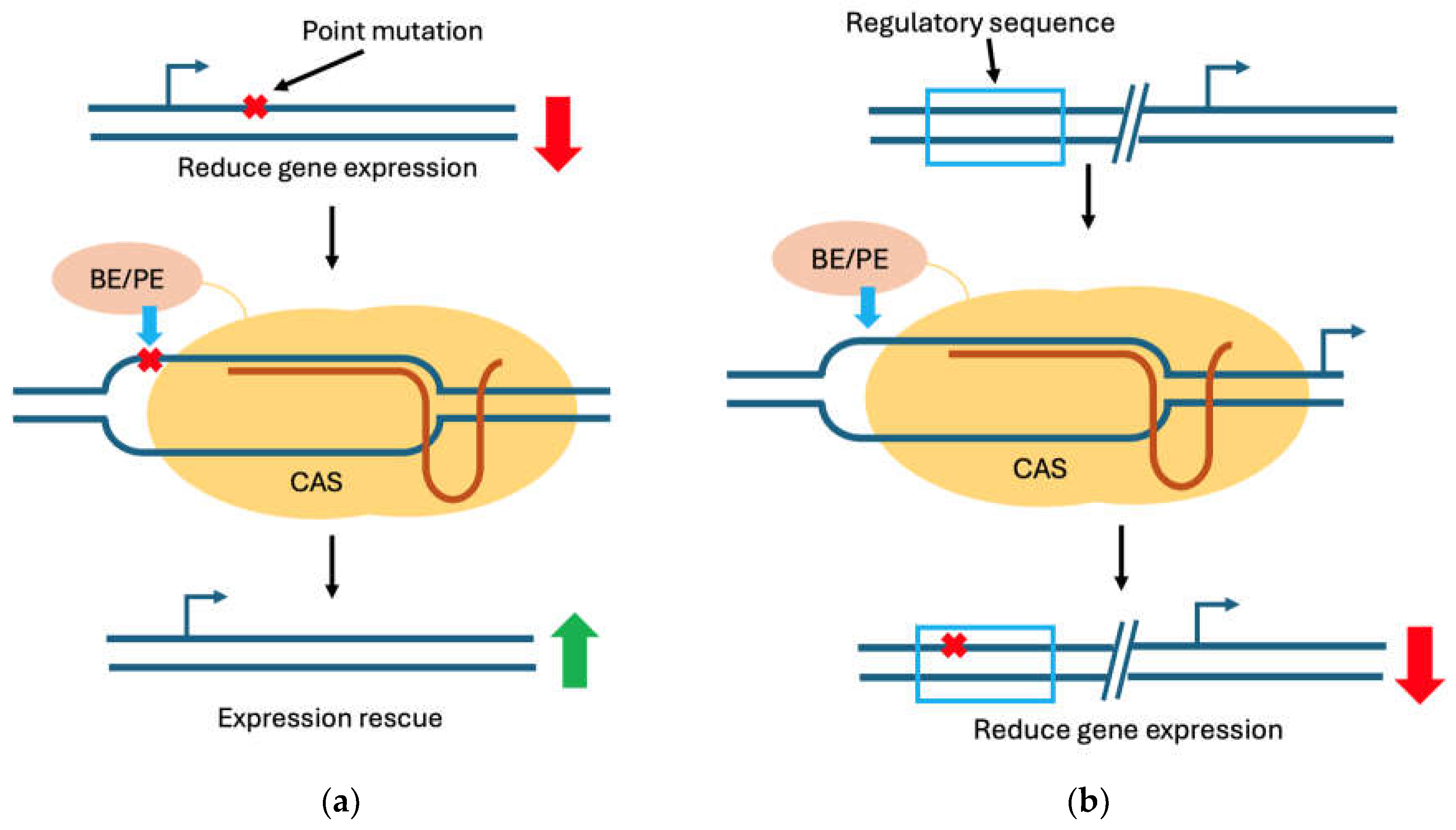
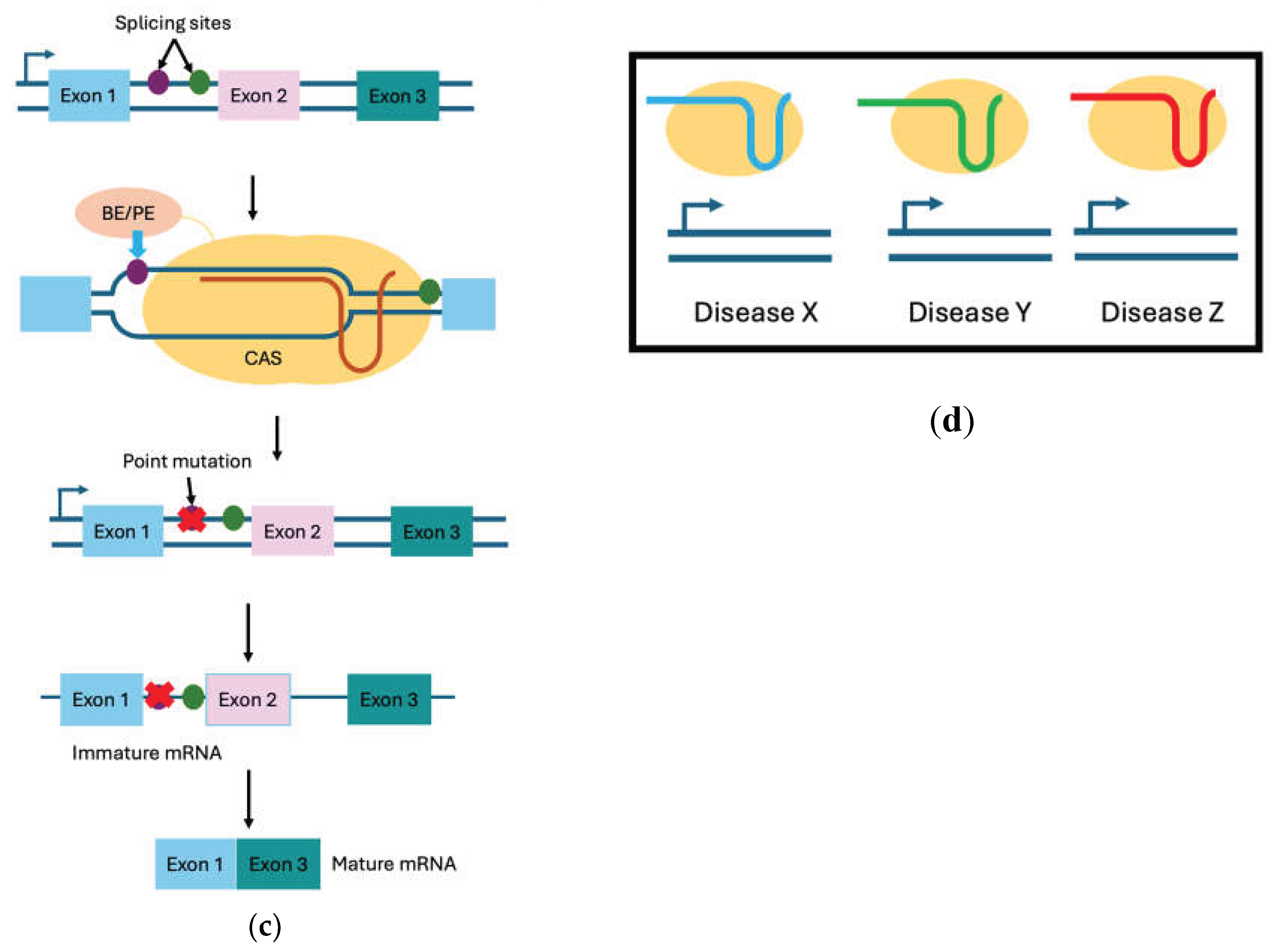

Table 1.
Overview of CRISPR-based gene-editing therapies currently evaluated through clinical trials used treat monogenic diseases. Data was obtained ClinicalTrials.gov online database.
Table 1.
Overview of CRISPR-based gene-editing therapies currently evaluated through clinical trials used treat monogenic diseases. Data was obtained ClinicalTrials.gov online database.
| Trial ID | Phase | Study design | Number of participants | Status | Target disease and gene (mutation if applicable) | Delivery system | Brief description |
|---|---|---|---|---|---|---|---|
| NCT06860672 | Phase 1 | Open label, single group assignment | 1 | Recruiting | Snijders Blok-Campeau syndrome Heterozygous mutation of c.3073C>T, p. (Arg1025Trp) in the CHD3 gene |
Dual Vector AAV | In vivo dual AAV delivery base editing therapy. Aim to rescue the mutant A-T base pair via a TadA-embedded adenine base editor (TeABE). |
| NCT06559176 | Phase 1/2 | Open-label, single-arm, multicenter | 12 | Recruiting by invitation | Autosomal recessive Chronic Granulomatous Disease Deletion mutation (c.75_76delGT) in the NCF1 gene |
Electroporation | Prime Editing autologous CD34+ stem cells ex vivo therapy. Aim to rescue exon 2 del GT mutation in the NCF1 gene, encoding p47phox protein. |
| NCT06959771 | Phase 1/2 | Open label, single group assignment | 1 | Recruiting | X-linked hyper-IgM (HIGM) syndrome Point mutation (c.658C>T; p.Q220X) in CD40L gene |
Electroporation | Base editing autologous hematopoietic stem/progenitor cells (HSPC) and T cells (BE T) ex vivo therapy. Aim to restore CD40L expression by rescuing c.658C>T point mutation |
| NCT07176923 & NCT07371767 |
Phase 1 | Open-label, single-arm, dose-escalation | 15 | Recruiting | Familial chylomicronemia syndrome (FCS) & Hyperchylomicronemia APOC3 gene. |
Lipid nanoparticles | In vivo base editing therapy delivered by lipid nanoparticles targeting APOC3 gene. Aim to introduce mutations that can reduce ApoC3 expression to reduce triglyceride serum levels and lowering pancreatitis risk. |
| NCT06325709 | Phase 1/2 | Open label, single group assignment | 10 | Recruiting | Chronic Granulomatous Disease Missense mutation (c.676C>T) in CYBB gene |
Electroporation | Base editing autologous hematopoietic stem and progenitor cells (HSPCs) ex vivo therapy. Aim to restore mutations in CYBB gene in HSPCs and later engraft into patients. Modify HSPCs can differentiate into functional phagocytes with restored NADPH oxidase activity. |
| NCT06851767 | Phase 1/2 | Non-randomized, open label, single group assignment | 18 | Enrolling by invitation | X-linked severe combined immunodeficiency IL2RG gene |
Electroporation | Base editing autologous hematopoietic stem and progenitor cells (HSPCs) ex vivo therapy. Aim to rescue mutations in the IL2RG gene in different patients. |
| NCT06065189, NCT07000318, NCT06565026, NCT06024876, & NCT06479616 | Phase 1 | Open label, single-arm | 5 | Active or recruiting | Major β – thalassemia and Severe sickle cell disease BCL11A binding site in Hemoglobin Subunit Gamma (HBG) promoter |
Electroporation | Base editing autologous hematopoietic stem cell transplantation (HSPCs) ex vivo therapy. Aim to modify HBG promoter in BCL11A binding site to prevent BCL11A inhibitory effect in γ-globin chain synthesis. This to increase the concentration of fetal hemoglobin in the blood. |
| NCT06025032 | Phase 1 | Open-label, multiple-cohort, dose-finding | 0 | Withdrawn due to lack of patients in China | Auditory neuropathy (hearing loss) Nonsense mutation c.2485C>T (p. Q829X) in OTOF gene |
AAV9 vector | In vivo AAV9 delivered CRISPR/Cas13 RNA base-editing therapy. Aim to restore otoferlin expression in the sensory inner hair cells. |
| NCT07489196 | Phase 2 | Open label, single-arm | 20 | Not yet recruiting | Major β – thalassemia BCL11A binding site in Hemoglobin Subunit Gamma (HBG) promoter |
Electroporation | Base editing autologous hematopoietic stem cell transplantation (HSPCs) ex vivo therapy. Aim to modify HBG promoter in BCL11A binding site to prevent BCL11A inhibitory effect in γ-globin chain synthesis. This to increase the concentration of fetal hemoglobin in the blood. |
| NCT06594094 |
Phase 1 | Open-label, multidose, dose-escalation | 4 | Completed | Duchenne muscular dystrophy Exon 51 splice donor site of DMD gene |
AAV vector |
In vivo AAV delivered CRISPR/hfCas12Max base-editing therapy. Aim to modify DMD exon 51 splice donor site to induce skipping of exon 51. Exon 51 skipping can restore the reading frame and recover dystrophin production in patients carrying different single and multi-exon deletions. |
| NCT05398029 | Phase 1 | Open-label, single-ascending dose | 13 | Completed | Heterozygous familial hypercholesterolemia PCSK9 gene (Splicing site) |
Lipid nanoparticles | In vivo LNP delivered CRISPR/ABE base-editing therapy. Aim to induce point mutation in PCSK9 splicing site to impair PSCK9 expression levels and reduce LDL-C levels in blood. |
| NCT06735755 | Phase 1 & 2 | Open-label, single ascending-dose, multicenter | 36 | Recruiting | Glycogen storage disease type-Ia (von Gierke disease) Missense mutation c.247C > T (p.R83C) in the G6PC1 gene |
Lipid nanoparticles | In vivo LNP delivered CRISPR/ABE base-editing therapy. Aim to correct c.247C > T missense mutation on G6PC1 gene to rescue glucose-6-phosphatase-α production. |
| NCT05456880 | Phase 1 & 2 | Open-label, single-arm, multicenter | 15 | Recruiting | Sickle Cell Disease and Severe Vaso-Occlusive Crises HBG1/2 gene promoters |
Electroporation | Base editing autologous CD34+ hematopoietic stem cells ex vivo therapy. Aim to disrupt BCL11A binding sites in HBG1/2 gene promoters |
| NCT06389877 | Phase 1 & 2 | Open-label, multicenter, dose-exploration and dose expansion | 106 | Recruiting | Alpha-1 antitrypsin deficiency (AATD) Missense mutation (E342K) in the SERPINA1 gene |
Lipid nanoparticles | In vivo LNP delivered CRISPR/ABE base-editing therapy. Aim to rescue α1-antitrypsin expression by amending E342K point mutation. |
| NCT06164730 | Phase 1 | Open-label, single-ascending Dose | 85 | Recruiting | Familial Hypercholesterolemia or Premature Coronary Artery Disease PCSK9 gene (Splicing site) |
Lipid nanoparticles conjugated with GalNAc | In vivo LNP delivered CRISPR/ABE base-editing therapy. Aim to induce point mutation in PCSK9 splicing site to impair PSCK9 expression levels and reduce LDL-C levels in blood. |
| NCT06461702, & NCT06458010 | Phase 1 | Open-label, single arm, single dose escalation | 13 & 20 | Recruiting | Familial Hypercholesterolemia. Exon 1 splice donor site of PCSK9. |
Lipid nanoparticles conjugated with GalNAc | In vivo LNP delivered CRISPR/ hpABE5 base-editing therapy. Aim to induce point mutation in PCSK9 splicing site to impair PSCK9 expression levels and reduce LDL-C levels in blood. |
| NCT06451770 | Phase 1 | Open-label, single-ascending dose | 36 | Recruiting | Familial Hypercholesterolemia and Refractory Hyperlipidemia ANGPTL3 gene |
Lipid nanoparticles conjugated with GalNAc | In vivo LNP delivered CRISPR/ ABE8.8 base-editing therapy. Aim to inactivate the expression of the ANGPTL3 gene and reduce LDL-C and triglycerides levels in blood. |
| NCT06392724 | Phase 1 | Open-label, single-arm, single-center | 3 | Active, not recruiting | Duchenne muscular dystrophy 5’ splicing site of exon 50 of the DMD gene |
Dual ss.AAV9 vector | In vivo AAV delivered CRISPR/CBE base-editing therapy. Aim to modify DMD exon 50 5’ splice site to induce skipping of exon 50. Exon 50 skipping can restore the reading frame and recover dystrophin production in patients carrying different single and multi-exon deletions. |
| N/A | N/A | Single-patient expanded-access Investigational New Drug application, | 1 | N/A | Carbamoyl-phosphate synthetase 1 (CPS1) deficiency Missense mutation c.1003C→T (p.Gln335Ter) in CPS1 gene |
Lipid nanoparticles | In vivo personalized lipid nanoparticle delivered CRISPR/ NGC-ABE8eV106W base-editing therapy. Aim to rescue carbamoyl-phosphate synthetase 1 production by restoring c.1003C→T point mutation. |
Disclaimer/Publisher’s Note: The statements, opinions and data contained in all publications are solely those of the individual author(s) and contributor(s) and not of MDPI and/or the editor(s). MDPI and/or the editor(s) disclaim responsibility for any injury to people or property resulting from any ideas, methods, instructions or products referred to in the content. |
© 2026 by the authors. Licensee MDPI, Basel, Switzerland. This article is an open access article distributed under the terms and conditions of the Creative Commons Attribution (CC BY) license (http://creativecommons.org/licenses/by/4.0/).
Copyright: This open access article is published under a Creative Commons CC BY 4.0 license, which permit the free download, distribution, and reuse, provided that the author and preprint are cited in any reuse.


