

Submitted:
21 April 2026
Posted:
27 April 2026
You are already at the latest version
Abstract
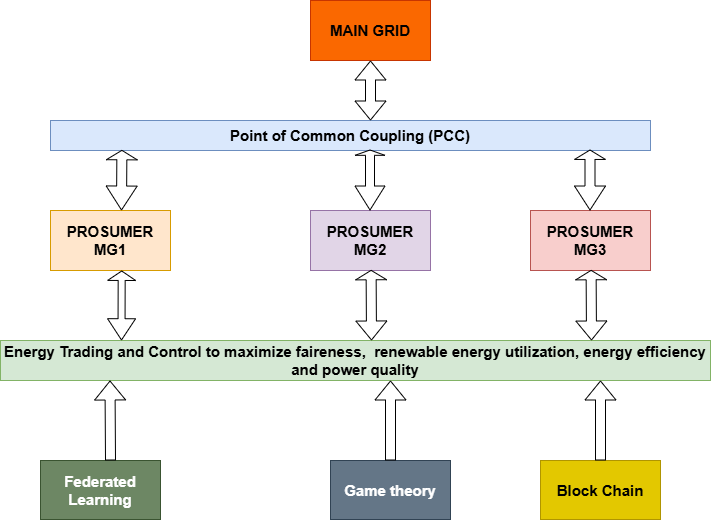
The increasing penetration of distributed renewable energy resources and electric vehicles has transformed microgrids into complex multi-prosumer systems that require coordinated control. Traditional centralized and local independent control strategies fail to exploit distributed flexibility and often lead to sub-optimal renewable utilization and inefficient energy management. This paper proposes a new method for coordinating these multi-prosumer microgrids using a hybrid coordination framework that utilizes Federated Learning for forecasting, game theory for energy trading, and blockchain for transaction recording through a decentralized network of peer to peer transactions between prosumers. Additionally, using the principles of model predictive control the battery algorithm was trained to make optimal decisions about present and probable future conditions of each microgrid node. By conducting simulations on heterogeneous networks of multi-prosumer microgrids, the system demonstrated a significant increase in renewable energy utilization by up to 91.2% and provided for greater coordination across three (3) microgrids through energy trading, fairness, and energy efficiency while also maintaining adequate levels of voltage regulation and power quality. In comparison, the baseline controller only achieved a lower operational cost. The results revealed essential trade-offs between local optimality and system coordination leading to the design of next generation decentralized microgrids.
Keywords:
prosumer
; microgrids
; federated learning
; game theory
; block chain
Copyright: This open access article is published under a Creative Commons CC BY 4.0 license, which permit the free download, distribution, and reuse, provided that the author and preprint are cited in any reuse.


