
Submitted:
24 April 2026
Posted:
28 April 2026
You are already at the latest version
Abstract
This article examines the robust determinants of firm-level innovation in developing countries to understand why firms in these economies exhibit different propensities to innovate. The hypotheses are empirically tested using a representative sample of 10,500 small, medium, and large firms across the manufacturing, retail, and other service sectors in 14 developing countries. The study employs Bayesian Model Averaging to overcome the issue of model uncertainty. We linked firms’ propensity to innovate to five broad determinants: firm characteristics, innovation efforts, access to finance, business environment and technological capabilities. The results reveal that most of the conventional determinants of innovation identified by the existing literature are not as important as previously thought. Furthermore, our analysis presents new evidence that only variables capturing innovation efforts and technological capabilities at the firm- and country-levels can be classified as robust determinants of innovation. These findings link to the firm's knowledge-based view, emphasising that technological capabilities and innovation efforts are forms of knowledge management practices that can augment firms’ absorptive capacity and organisational memory.
Keywords:
developing countries
; model uncertainty
; product innovation
; innovation capacity
1. Introduction
For both developed and developing countries, innovation is generally considered as one of the main channels through which economic growth and competitiveness can be achieved (Piscilello and Thakur., 2023; Radosevic., 2022; Divella and Sterlacchini., 2021). This is particularly crucial in a dynamic world economy, where tougher business competition, driven by globalisation, means that firms without an innovative edge are less likely to survive at the local, national and global levels. Nonetheless, evidence shows that firms in developing countries tend to be poorly resourced and managed, while at the same time operating in hostile business environments with poor institutions, lack of access to finance, complex and distorted regulatory regimes, and macroeconomic instability (Shi et al., 2023; Han et al., 2021; Barasa et al., 2017). Yet, some firms in these economies display different propensities to innovate with some seemingly more able to overcome the challenges inherent in a developing economy.
The bulk of the existing literature over the last decade and a half has sought to identify the robust determinants of firm-level innovation, mainly in the context of advanced economies (Zhu et al., 2023; Ortiz and Fernandez, 2021; Barasa et al., 2017; McAdam et al., 2014). Most of these studies identify firm-level resources as the principal antecedent of innovation, while downplaying technological capabilities at the firm and national levels, as well as the environment in which firms operate (Srholec, 2011). Due to their structural, economic and institutional differences, findings based on advanced economies may have limited applicability and policy relevance for developing countries (Piscilello and Thakur., 2023; Bripi et al., 2023; Radosevic, 2022; Bradley et al., 2012). In addition, the limited studies on developing countries tend to suffer from potential model misspecification, for example, the ad hoc inclusion of explanatory variables (Singh et al., 2023; Han et al., 2021; Barasa et al., 2017; Geldes et al., 2017, among others). This reflects a gap in the literature, which this paper seeks to fill by undertaking a rigorous econometric investigation using a unique and rich firm-level dataset to analyse the factors that impede firms' innovative behaviour in developing countries. More specifically, the paper addresses the following two research questions:
- RQ1: What are the robust determinants of firm-level innovation in developing countries?
- RQ2: To what extent do the robust determinants of firm-level innovation explain variation in propensities to innovate across developing countries?
In examining these two broad research questions, the paper makes three significant contributions to the modest yet growing literature on innovation in developing countries. First, it addresses the crucial issue of model uncertainty, which is fairly common when examining complex phenomena such as innovation. More specifically, empirical researchers usually face uncertainty on two fronts. On the one hand, uncertainty may arise because the parameter values of interest depend on a given model. On the other hand, it may result from the empirical model's adopted specification. While the first can be identified and accounted for in empirical studies, the latter is usually ignored (Moral-Benito, 2015). This is particularly true given that, in most cases, theory does not specify a particular empirical model but rather the general cause or effect of a certain phenomenon (Raftery, 1995). Empirical researchers, therefore, often test the underlying theory using different specifications of empirical models and variations of datasets. For example, the literature on firm-level innovation tends to present one particular model specification (and some variations of it for checking the robustness of this base model) and then draws inferences or conclusions based on this single specification (Goedhuys, 2007; Srholec, 2011; Wang and Lin, 2012; Goedhuys and Veugelers, 2012; Barasa et al., 2017; Geldes et al., 2017; Nathan and Rosso, 2022). Hence, to minimise the potential risks of false positives and, in some ways, to reconcile the conflicting results produced by previous studies on innovation in developing countries, it is important to address the issue of model uncertainty, which this paper does.
Second, due to model uncertainty, the existing literature has so far failed to identify the robust drivers of innovation in developing economies. This is unfortunate for at least two key reasons: 1) the identification of the robust determinants of innovation is useful for policy-makers and managers alike as this would enable them to draw appropriate policy and managerial implications, and 2) in the context of developing economies where there are resource constraints, it would be helpful to know the core antecedents of innovation so that governments and relevant stakeholders could prioritise these. This paper addresses these concerns through statistically identifying the robust drivers of firm-level innovation in developing countries.
Third, it is standard practice in the empirical literature (Ayyagari et al., 2011; Barasa et al., 2017; Edeh and Acedo, 2021) to model innovation as an outcome – i.e., whether a particular firm has introduced a new or significantly improved product or service - which we also do in this study. However, unlike most of the existing literature, we go beyond by attempting to capture the ‘capacity to innovate’, which is much closer to the spirit of the theoretical propositions on innovation. For instance, the dynamic capabilities approach (Eisenhardt and Martin, 2000), which is an extension of the resource-based view (Barney, 1991) and the knowledge-based view of the firm (Grant, 1996), emphasises the existence of particular factors that can augment and enhance firms’ ability to utilise knowledge resources effectively. Therefore, it is crucial to understand why some firms are more committed to improving their capacity to innovate than their competitors.
Combining the World Bank Enterprise Surveys and the Innovation Follow-up dataset of 2013-14 with the Global Information Technology database of the World Economic Forum, we test our hypotheses, developed based on a critical review of the existing literature, on a representative sample of over 10,500 small, medium and large firms across manufacturing, retail and other service sectors. The dataset covers all 14 developing countries included in the Innovation Follow-up Survey (i.e., 10 Sub-Saharan African countries and 4 South Asian countries).
Methodologically, this paper extends the innovation literature by employing a two-stage empirical strategy. In the first stage, we uncover the robust determinants of innovation using 42 explanatory variables clustered into five broad factors, namely, firm characteristics, business environment, innovation effort, technological capabilities, and access to finance. In selecting these factors, we have been agnostic and have included them based on a holistic literature review of previous studies that identify them as potentially related to firm-level innovation. In that we do not take an a priori stance on the determinants of innovation and instead include all possible determinants of innovation based on a wider literature search and review, from which we statistically identify the most robust determinants of innovation, which we refer to as robust determinants in our paper. For this purpose, we apply the Bayesian Model Averaging (BMA) approach, which enables us to estimate/model combinations to identify determinants with 99% or better probability of affecting innovation. Once we identify the robust determinants of innovation, in the second stage we estimate standard and fractional probit models that include only the variables identified in the first stage. Hence, our model specification attempts to address model uncertainty by averaging more than four trillion model combinations. Additionally, as a robustness check, we address the potential source of endogeneity, namely sample selection, while controlling for industry, regional and country differences.
The rest of the paper is organised as follows. Section 2 explores the existing literature with the aim of identifying the broad factors likely to influence firms’ propensity to innovate. Section 3 details data and methodology issues. Section 4 presents the results, while the final section concludes the article.
2. Theoretical Background and Research Hypothesis
Studies examining the determinants of firm-level innovation in developing countries have become increasingly relevant, given that innovation has been identified as one of the most vital ways through which firms can increase market share, gain competitive advantage and play a bigger role in the process of economic development (Piscilello and Thakur, 2023; Radosevic, 2022; Geldes et al., 2017; Cornaggia et al., 2015; Ayyagari et al., 2011; Crossan and Apaydin, 2010). In what follows, we identify the broad factors likely to influence firms’ propensity to innovate, drawing on the existing literature. Based on the review of this existing literature, we organise these factors into five broad clusters and emphasise the basic premise that innovation has both enablers and inhibitors. In the discussion section that follows the analysis and results, we reflect on how our identified robust determinants, drawn from the broader set discussed in this section, nurture or hinder innovation, and illustrate the channels through which they influence innovation. Additionally, we outline the major policy and managerial implications.
It should be emphasised that our objective in this study is not to assess (previous or new) theoretical propositions or test original hypotheses. Rather, our purpose is to identify determinants of innovative behaviour at the firm level in developing countries, using 99% or higher inclusion probabilities. We therefore formulate our testable hypotheses based on a review of the existing literature to answer our research questions. We have organised the broad determinants of innovation into five clusters, yielding a set of five testable hypotheses. Our approach can be contrasted with meta-analysis, which may suffer from the so-called “file drawer problem,” in which studies that conform to the existing narrative are favoured at the expense of those that may yield unconventional results (Rosenthal, 1979; Ferguson and Brannick, 2012). This may be detrimental to the plurality and heterogeneity of knowledge.
2.1. Firm Characteristics
It is widely recognised that export orientation is one of the most important determinants of innovation as export-oriented firms tend to face a stiffer competition than their domestic counterparts, which incentivises them to continuously upgrade their products and services (Hashi and Stojcic, 2013). Similarly, firm size has been found to be positively related to innovation. Evidence suggests that larger firms tend to operate in mature and competitive markets, while possessing more tangible and intangible resources, and thus the necessary economies of scale and scope needed for innovative ventures than smaller firms (Bhandari et al., 2023; Hsieh et al., 2010; Barasa et al., 2017; Odei et al., 2021). The evidence on the impact of firm age on innovation is mixed. On the one hand, younger firms are more likely to introduce new products and services to gain a larger market share (Ayyagari et al., 2011). However, they may also lack the required knowledge and expertise. On the other hand, older firms may suffer from organisational inertia that impedes their ability to innovate (Coad et al., 2016). Nonetheless, over time, established firms are more likely to build deep-rooted relationships with key stakeholders, making them more effective at securing innovative ideas (Sinkula, 1994).
The legal status of firms and the way in which they are governed can influence their propensity to innovate. For instance, family-owned and shareholder-owned enterprises are more likely to engage in innovation activities than state-owned firms (Ayyagari et al., 2011). There is some evidence that family-owned businesses are more likely to overcome agency problems, while shareholder-owned enterprises tend to have greater scope for accountability. Similarly, evidence suggests that firms owned or managed by women are more likely to engage in innovative behaviours. As highlighted by Aterido et al. (2011), this is because of their favourable features, including resilience and the ability to overcome institutional barriers. A segment of the literature emphasises that women tend to adopt leadership styles that are more transformational and participatory than those of their male counterparts, due to their higher social and communication skills (Stelter, 2002; Hooijberg and DiTomaso, 1996). These leadership styles tend to galvanise and motivate staff members to initiate and implement innovative ventures (Damanpour and Schneider, 2006). In general, managerial experience is considered an important driver of innovation, as managers with long tenure in the same sector are more likely to acquire new and valuable information, as they have access to a larger network (Ayyagari et al., 2011). Moreover, experienced managers are more likely to possess the legitimacy and knowledge needed to influence their employees to achieve desired outcomes (Damanpour and Aravind, 2012).
Since the seminal contributions by Schumpeter (1939), product market competition has been considered to be an important determinant of innovation as it tends to incentivise firms, not only to be as efficient as possible, but also to put in place strategies that are designed to keep the firm in operation, including innovative ventures (Ayyagari et al., 2011). In developing countries, firms in the informal sector pose the greatest challenge to established firms in the formal sector, given that the former operate in a largely unregulated environment with little administrative burdens, regulatory pressures, or tax liabilities. Hence, intense competition may encourage innovative behaviours. Similarly, firms that are more productive and efficient, and those with favourable financial performance (i.e., high sales figures), may have both the means and the motivation to innovate. Human capital, an important component of absorptive capacity, is another variable that can play a critical role in innovation (Harris and Yan, 2019; Barasa et al., 2017). Thus, a well-educated workforce has the potential to boost firms' innovation rates.
Based on the above review, our first set of testable hypotheses in the context of innovation is:
H1:
Firm characteristics are robust determinants of firm-level innovation in developing countries
Specifically, based on the above review of the existing literature, we include several indicators that capture a range of firm characteristics (e.g. size, age, export orientation, performance, human capital, manager tenure, ownership, gender, nature of competition, etc.).
2.2. Innovation Effort
It is well established in the literature that firms employ various knowledge management practices and strategies in order to enhance their existing pool of explicit and tacit knowledge, which in turn is aimed at improving their innovation capacity (Piscilello and Thakur, 2023; Santiago et al., 2017; Donate and de Pablo, 2015). Specifically, these management practices include greater allocation of resources to innovation activities, risk-taking, an appropriate organisational culture, proactiveness, and a vigorous commitment to novel ideas (Adams et al. 2006). Thus, we would expect that efforts such as higher spending on R&D, internal and external R&D, investments in fixed assets and machinery and equipment, and formal staff training for the purpose of innovative ventures to be strong indicators that the firm is committed to innovation (Urbig et al., 2022).
This gives rise to the second set of testable hypotheses regarding firm innovation in developing countries.
H2:
Innovation efforts of firms are a robust determinant of firm-level innovation in developing countries.
Specifically, based on our review above, we include several indicators that capture different aspects of innovation effort (e.g., internal and external R&D, investment in fixed assets, innovation-specific training and opportunities, R&D spending, and training of permanent staff).
2.3. Finance
While there is a definite association between innovation, economic growth, and competitiveness, innovation nonetheless carries the risk of failure due to the costs involved in undertaking it (Simpson et al. 2006). Thus, access to finance plays a critical role in enabling innovation at the firm level. The literature on finance and growth emphasises the idea that a well-functioning financial system can alleviate firms’ credit constraints by reducing the costs of external capital whilst improving the allocation of resources and facilitating capital accumulation (Rajan and Zingales, 1998; Ayyagari et al., 2011; Hasan et al. 2016; Edeh and Acedo, 2021;). Moreover, the financial sector is well-resourced to appraise innovative projects, mitigate risk and monitor managers (Hsu et al. 2014). Consequently, good access to checking and savings accounts, credit lines and overdraft facilities can be important determinants of innovation.
This gives rise to the next set of testable hypotheses on the determinants of innovation:
H3:
Finance is a robust determinant of firm-level innovation in developing countries.
Specifically, we include several indicators that reflect access to finance (e.g., credit line, overdraft facility, banking facility).
2.4. Technological Capabilities
Technology plays a pivotal role in augmenting the firm’s absorptive capacity – i.e. its ability to access valuable information, transform and apply it for commercial use (Barbieri et al., 2022; Zhou and Wu, 2010). As emphasised by Kleis et al. (2012), there are three important channels through which information technology influences innovation. First, it enhances the firm’s ability to manage knowledge by providing the infrastructure for innovation, including the collection, transformation, and sharing of knowledge. Second, it is indispensable at different stages of the innovation process (i.e., opportunity identification, concept development, design, and commercial production). Finally, information technology facilitates coordination within the organisation and the wider innovation environment.
Technology can also have positive spillover effects, and its diffusion can occur, for example, through the internet (Fu et al. 2011). In developing countries, mobile technology has improved both market and productive efficiency by reducing search costs and facilitating better coordination among economic agents (Barbieri et al., 2022; Dosi and Soete, 2022; Aker and Mbiti, 2010). We postulate that the firm's technological capability is a function of two factors: the firm's ability to utilise basic technologies such as the internet, email, etc., and the quality and affordability of mobile and other technological infrastructures at the country level.
This gives rise to the following set of testable hypotheses in relation to firm-level innovation:
H4:
Technological capabilities are a robust determinant of firm-level innovation in developing countries.
Specifically, we include several indicators that capture various aspects of technological capabilities (e.g., telecom, email usage, own website, internet connectivity, etc.).
2.5. Business Environment
The general business environment in which firms operate has profound implications for their behaviour. For instance, a restrictive business environment characterised by burdensome regulations, weak institutional quality (e.g. corruption and political instability), inefficient legal systems and poor infrastructure can undermine firms’ ability and appetite for business expansion and innovation (World Bank, 2017). This is because an adverse business environment is closely linked to higher risks and uncertainty, and thus to lower future returns (Hearn et al., 2023; Jiménez-Jiménez and Sanz-Valle, 2011; Chege and Wang, 2020).
Similarly, the business environment can not only influence firm performance, but also the wider economy. Evidence suggests that, in the context of developing countries, poorly-designed licensing and business registration rules, excessive customs procedures, cumbersome court systems, rigid market entry rules, and inflexible labour and credit markets can add significant costs to firms (Schiffer and Weder, 2001), undermining formalisation and employment growth (Bruhn, 2011; Monteiro and Assuncao, 2012), efficient allocation of resources (Cirera et al. 2017), entrepreneurship and firm formation (Branstetter et al. 2013), export performance (Freund and Rocha, 2011; Martincus et al. 2015; Edeh et al., 2020; Dong et al., 2022), foreign direct investment (Lawless, 2013) and firm growth (Beck et al. 2005).
Based on the above review, we identify the following set of testable hypotheses:
H5:
The business environment is a robust determinant of firm-level innovation in developing countries.
Specifically, we control for different dimensions of the business environment using the World Bank Enterprise Survey, which captures the extent to which firms perceive particular factors as being an obstacle to their daily operations (e.g. workforce quality, labour regulations, licensing, political instability, rule of law, access to land, crime level, corruption, etc.).
3. Data and Methods
3.1. Data and Sources
To establish the robust determinants of innovation in developing economies, we associate it, as described in section two above, to five main clusters of determinants (giving rise to five sets of testable hypotheses), namely – firm characteristics (H1), innovation effort (H2), finance (H3), technological capabilities (H4) and business environment (H5). The dataset we use comes from three sources, as detailed in Table A1. Most of the variables capturing firm characteristics, business environment and finance are sourced from the World Bank Enterprise Surveys. The indicators measuring innovation effort come from the World Bank innovation follow-up survey, conducted during 2013-14. The follow-up survey covers 10 African countries (Congo, Ghana, Kenya, Malawi, Namibia, Nigeria, Sudan, Tanzania, Uganda and Zambia) and four South Asian countries (Bangladesh, India, Nepal and Pakistan)1. To measure country-level quality of information technology, we use the Global Information Technology Report of the same time period published by the World Economic Forum (Bilbao-Osorio et al. 2013). The combined dataset covers a representative sample of over 10,500 small, medium, and large firms from all regions of the 14 countries and across all main sectors of economic activity (i.e., manufacturing, retail, and other services).
We view innovation as an output for our first dependent variable, following the standard practice in the existing literature (see Ayyagari et al., 2011; Barasa et al., 2017). Hence, we use a binary (dummy) variable measuring whether a particular firm has introduced any new or significantly improved product or service. However, we argue that this variable may not be an ideal measure of firm-level innovation given that innovation itself is a long-run process with various stages characterised by unpredictability and potential failures (Holmstrom, 1989; Hsu et al., 2014). Hence, in the context of developing countries, it is crucial to capture innovation not only as an ex post construct but also as an ex ante phenomenon. In other words, it is important to assess whether or not firms have attempted to augment their capacity to utilise knowledge resources through innovation. As the business environment is much more challenging in developing countries, one should expect fewer realisations of innovative ventures, but that does not necessarily imply that the firm is not engaging in innovative behaviour.
For this purpose, we attempt to capture the ‘capacity to innovate’ – i.e., whether or not firms have actively pursued the means to innovate2. To proxy for this, we combine three indicators, namely – whether the firm has: 1) an internationally-recognised quality certification, 2) purchased new equipment, machinery or software to develop or produce any innovative products/services or processes, or 3) whether the firm has purchased or licensed any patented or non-patented inventions or other types of knowledge for the development of innovative products/services or processes. Because the responses yield three discrete outcomes (“yes” or “no”), we transform them into a continuous index measuring the fraction of these characteristics a particular firm possesses. Thus, the final score has the advantage of being between 0 and 1, indicating the differential capacity of firms in innovation.
While the latter two components of our innovation capacity indicator are self-explanatory, the first one requires some elaboration. The acquisition of an internationally recognised quality certification (e.g., ISO 9000) signifies that the firm’s products/services or materials conform to international standards and that it possesses the proficiency and workforce necessary for accreditation (Guasch et al. 2007). Kesidou and Snijders (2012), who also use quality certification as an appropriate measure of innovation, emphasise that it is one of the main distinguishing features of firms with high-quality organisational, managerial and business practices – all of which are closely associated with innovation.
3.2. Econometric Modelling
Addressing Model Uncertainty: Bayesian Model Averaging (BMA)
In the first stage of our analysis, we attempt to overcome the concern of model uncertainty, which tends to plague the existing literature on innovation. Typically, the vast majority of researchers working on the determinants of innovation in the context of developing countries tend to utilise a single (benchmark) model and then draw inferences based on it (see, for example, Goedhuys, 2007; Srholec, 2011; Wang and Lin, 2012; Goedhuys and Veugelers, 2012; Barasa et al., 2017; Geldes et al., 2017). In reality, one should expect multiple competing models and specifications. To this end, we use BMA, which provides a statistically robust approach to selecting the most important determinants of innovation (Raftery, 1995; Zeugner and Feldkircher, 2015; Feldkircher and Zeugner, 2011; Moral-Benito, 2015).
With 42 candidate variables, enumerating all possible combinations is computationally challenging, as we would have more than 4 trillion model combinations. To solve this, BMA uses a Markov Chain Monte Carlo (MCMC) model-sampling tool. Based on the Metropolis-Hastings algorithm, the MCMC sampler inspects the entire model space, choosing in each round, models with the highest marginal likelihoods. To draw candidate models, we use the so-called birth-death sampler, which randomly picks a potential explanatory variable to add to the prior probability model, if it is not already included, and drops it if it is.
We consider the following linear regression model with a constant term (β0):
 where y is the dependent variable (either product innovation or innovation capacity as defined in section 3.1), ε is a vector of normally distributed IID error terms with zero mean and variance σ2, and X is a matrix of 42 explanatory variables clustered into five potential determinants of innovation: firm resources and characteristics (13 variables), technological capabilities (6 variables), innovation effort (7 variables), business environment (12 variables), and finance (4 variables), summarised in Table A1.
As we have 42 candidate explanatory variables, BMA estimates 242 variable combinations (and therefore 242 models) and then takes a weighted average of them. The weights stem from posterior model probabilities (PMPs) based on Bayes’ theorem:
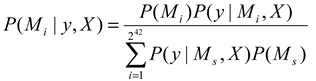 where P(Mi) is the prior probability model, Mi and P(y|Mi,X) is the marginal likelihood of y given Mi. The PMPs and thus the model weighted posterior distribution for any statistic – for example β – is given by:

The point estimates can be generated by taking the expected value of both sides of Eq. (3):
 where E(β|y,X) is the averaged coefficient and E(βi|Mi,y,X) is the estimate of the βi coefficient from Mi. The main strength of BMA is that it allows us to generate the so-called posterior inclusion probabilities (PIP) for each explanatory variable. This statistic signifies the probability that a particular explanatory variable (q) indeed belongs in the “true” model.

For the coefficient βi, one tends to rely on the so-called ‘Zellner’s g prior’ where the value of g reflects the degree of prior uncertainty3. According to Zeugner and Feldkircher (2015), a model-specific (parameter) prior, such as the so-called hyper-g prior, is more appropriate than fixed priors common to all models, as it yields more robust estimates. Thus, we use hyper-g priors, but our results are robust to different parameter prior specifications.
Besides the priors on the parameter space, in the context of BMA, researchers also need to choose prior model probabilities, P(Mi), on the model space. For robustness, we use three alternative model priors. Similar to, among others, Fernandez et al. (2001) and Hasan et al. (2016), we first employ a ‘uniform’ model prior, in which each explanatory variable is included in the model with equal probability, and thus all models have equal probability. A particular weakness of the uniform model prior highlighted by Zeugner and Feldkircher (2015) is that it tends to over-use particular model combinations. Therefore, following Sala-i-Martin et al. (2004), we also report results based on a ‘fixed’ model prior, which assigns a common fixed inclusion probability to each explanatory variable. However, similar to the uniform model prior, the fixed model prior tends to impose a fairly concentrated distribution around the prior model size (Zeugner and Feldkircher, 2015). Thus, our preferred model prior is the so-called ‘random’ model prior proposed by Ley and Steel (2009). This model prior puts a hyperprior on the inclusion probability based on a Beta distribution and thus generates a prior distribution that offers greater flexibility regarding the expected model size and better reflects model uncertainty.
With 42 candidate variables, enumerating all possible combinations is computationally challenging, as we would have more than 4 trillion model combinations. To solve this, BMA uses a Markov Chain Monte Carlo (MCMC) model-sampling tool. Based on the Metropolis-Hastings algorithm, the MCMC sampler inspects the entire model space, choosing in each round, models with the highest marginal likelihoods. To draw candidate models, we use the so-called birth-death sampler, which randomly picks a potential explanatory variable to add to the prior probability model, if it is not already included, and drops it if it is.
3.3. Addressing Sample Selection
In the second stage of our analysis, we retain only the variables identified by the BMA as robustly related to innovation, while also addressing other potential issues. Using i =1,2,...,N to index firms, denote Li the utility associated with undertaking innovation by firm i:
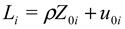 where Z0i is a vector of independent variables while ρ is a vector of unknown coefficients, capturing the decision of whether to innovate or not, and ui is an IID error term. Clearly, our outcome variable is observed only for a subgroup of firms – those that undertake innovation. Consequently, our findings may be subject to omitted-variable bias that could affect the probability of entering the sample (Kennedy, 2008). To overcome this, we use Heckman’s two-stage approach (Heckman, 1979). In the second stage, we estimate an outcome equation using the inverse Mills ratio from the first stage to correct for the potential selection issue (Greene, 2012).
Another issue, relevant to our innovation capacity variable, is that we have a continuous outcome variable in the range and a vector of independent variables (x). Thus, unless we restrict the conditional mean E(y|x) in the [0,1] range, the coefficients would likely be outside the unit interval. This may increase the likelihood of the model being misspecified (Papke and Wooldridge, 1996). To overcome this, we use the fractional response estimator (FRE) developed by Papke and Wooldridge (1996). Based on the probit mean function/, this estimator employs a quasi-maximum likelihood approach that is computationally simple while also accounting for unobserved heterogeneity.
4. Empirical Results
4.1. BMA Findings
Table 1 summarises the BMA results for product innovation based on the ‘hyper-g’ parameter prior and three different model priors. The table presents three statistics: posterior inclusion probability (PIP), posterior mean of the coefficients (Post mean), and posterior standard deviation (Post SD). As explained previously, PIP essentially signifies the explanatory power of each independent variable. We follow Raftery (1995) and classify PIP values as below 0.50 (not robust), 0.50–0.75 (weakly robust), 0.75–0.95 (robust), and 0.95–0.100 (strongly robust).
Our results suggest that product innovation in developing countries is mainly driven by two clusters of robust determinants, namely innovation efforts (H2) and technological capabilities (H4). More specifically, the robust determinants that capture innovation efforts are internal R&D and spending on formal R&D. In contrast, those that capture technological capabilities are mobile technology infrastructure, the availability of the latest technologies, and telecommunications obstacles. These indicators within the two clusters (H2 and H4) have all 100% inclusion probability.
These findings are consistent with the existing literature, given that investments in R&D and internal R&D have both been identified as key factors responsible for successful innovation (Raymond and St-Pierre, 2010; Ganotakis and Love, 2010; Sun and Du, 2010; Hung and Chou, 2013; Tarighi and Shavvalpour, 2021; Urbig et al., 2022). Prior research suggests that internal R&D is one of the most significant drivers of innovation in China and that it not only plays a pivotal role in facilitating original innovations but also in higher absorption of external knowledge and technology (Sun and Du, 2010). Our results provide clear evidence that this is also the case in other developing countries.
Both mobile technology infrastructure and the availability of the latest technology have significant encouraging effects on product innovation. On the other hand, as the degree to which poor telecommunications becomes an obstacle increases, the propensity to innovate decreases significantly. As emphasised before, this is to be expected, as information technology is indispensable for collecting, transforming and sharing knowledge. It also improves coordination and underpins the innovation process itself.
Table 2 presents the findings from the innovation capacity model. According to the BMA results, three clusters (H1, H2 and H4) of robust determinants are robustly related to innovation capacity. Within these three clusters, ten indicators have average posterior inclusion probabilities of 99% or higher, indicating that these variables have a 99% probability of influencing innovation capacity. Specifically, these indicators are: firm size (revenue) and external audit, capturing firm characteristics (H1), internal and external R&D, investments on fixed assets, innovation-specific training and training of permanent staff, capturing innovation efforts (H2), and own website, mobile technology infrastructure and mobile affordability, capturing technological capabilities (H4).
These results generally align with our previous findings in that innovation is mainly driven by variables capturing innovation effort and technological capabilities. As shown, investments in fixed assets, internal and external R&D, and formal and innovation-specific training programmes are all positively associated with innovation capacity. Similarly, having a website and a strong mobile technology infrastructure also positively influences innovation, whereas mobile cellular tariffs are inversely related to innovation. This highlights that both the quality and affordability of technology are critical to innovation in developing countries. The results also suggest that larger firms (by revenue) are more likely to improve their capacity to innovate. Finally, firms whose annual financial statements are checked and certified by an external auditor are more likely to engage in innovation. This is to be expected, as external financial scrutiny may act as an effective monitoring device, thereby decreasing the likelihood that owners or managers manipulate financial statements.
Overall, based on our BMA analysis on both of our measures of innovation, namely, product innovation and innovation capacity, we find overwhelming evidence to conclude that innovation efforts (H2), and technological capabilities (H4) are core drivers of firm-level innovation in developing countries. Additionally, our analysis of innovation capacity provides evidence that some firm characteristics (H1) play a significant role in driving innovation.
4.2. Regression Results
Table 3 presents the regression results based on model specifications that are wholly informed by the BMA analysis in the preceding sub-section. As discussed earlier, the BMA analysis in the first stage allowed us to identify variables robustly related to innovation, with inclusion probabilities of 99% or higher across 242 model combinations. Recall that we have used several models and parameter priors to ensure robust results. In this second stage, we retain these variables identified by the BMA analysis to estimate their marginal effects on innovation.
Panel A of Table 3 summarises the results of the product innovation model based on the probit estimator. Similar to the BMA results, we find that the probability of product innovation for a typical firm increases with R&D, the quality of mobile technology infrastructure, and the availability of the latest technologies. However, the probability decreases with the extent to which firms view telecommunications as an obstacle to their operations. Panel B of Table 3 shows the innovation capacity model based on the fractional response estimator. The firm's innovation capacity is positively and significantly related to firm size, the extent to which the firm uses external financial auditors, its innovation effort (i.e., R&D, investments in fixed assets, and staff training), and technological capabilities at the firm and country levels. Our results also indicate that it is not only the availability of mobile technology infrastructure but also its affordability. In particular, higher mobile cellular tariffs tend to undermine the firm's innovation capacity – a finding which is statistically significant at the 1% level. Columns 2 and 3 of Table 3 show that our results are not sensitive to the inclusion of country- or industry-fixed effects. Thus, we can be confident that our results hold regardless of whether we account for country and industry differences.
4.3. Robustness Tests
To correct for potential sample selection bias, we apply a general-to-specific procedure in which we first specify a general model that includes as many potential determinants of the decision to innovate as possible. However, we retain only variables that have a significant effect on the decision to engage in innovation. The resulting selection model is consistent with, among others, Hashi and Stojcic (2013) and accounts for firm size (measured by the natural logarithm of number of permanent employees), a dummy variable for being part of a group, a culture of innovative behaviour (proxied by dummy variables capturing abandoned or ongoing innovations, and whether the firm engaged in marketing and organisational innovations in the previous three years), cost factors (measured by access to finance as an obstacle), geographical scope (captured by the share of national sales in total sales) and industry-specific characteristics.
Table 4 shows the results of the selection model. Overall, we find that the probability of engaging in innovation is positively and significantly related to firm size and culture of innovative behaviour. Firm size signifies higher resource endowments and economies of scope, but also more intense competition, which can incentivise firms to innovate. On the other hand, the decision to innovate is also closely linked to new and previous designs/infrastructures, recently acquired organisational processes and practices, and feedback from primary stakeholders (i.e., customers). As expected, poor access to finance reduces the probability of innovating with new products or improving existing ones, while being part of a group increases the likelihood of improving the capacity to innovate. A larger geographical scope (i.e., higher national rather than local/regional sales) positively affects the probability of improving the firm’s innovation capacity, likely due to stiffer competition.
Column 1 of Table 5 summarises the results of the outcome model. The coefficient of the inverse Mills’ ratio (Heckman’s lambda) is statistically significant, suggesting that there is a selection bias. Once we control for selectivity, our previous results remain robust in both sign and significance.
Finally, for robustness, we account for the fact that the firms in our dataset are nested within approximately 60 regions across the 14 sample countries. As established in the regional economics literature, geographical and spatial proximity are associated with a higher probability of creating and diffusing innovative ideas through knowledge spillovers and information externalities (Kesidou and Snijders, 2012; De Dominicis et al., 2013; Agosin and Retamal, 2021; Piscilello and Thakur, 2023). Thus, it is important to control for geography by allowing for different levels of nested random effects. To this end, column 2 of Table 5 presents the results of the outcome model, estimated using a two-level mixed-effects probit model with a random intercept. One thing to note is that the likelihood-ratio test is highly significant in both the product innovation model and the innovation capacity model, implying that there may be important regional differences. Thus, the two-level probit estimator is more appropriate in our case. Interestingly, our robustness analysis reveals that, once regional variations are accounted for, both mobile technology infrastructure and telecommunications as an obstacle lose statistical significance in the product innovation model. This is to be expected, as country-level differences account for most of the variation in these variables. In the innovation capacity model, the variable capturing whether the firm has held any formal training programme for its employees over the past year loses significance, while external R&D is almost significant at the 10% level. Taken together, these findings emphasise the importance of considering national, regional, and industry differences.
5. Toward a Greater Understanding of Innovation in Developing Countries
Developing countries are increasingly becoming an important source of innovative products that have subsequently been adopted by advanced economies (Govindarajan and Trimble, 2012; Van der Boor et al., 2014; Ortiz and Fernandez, 2021; Piscilello and Thakur, 2023). This “reverse innovation”, while undoubtedly aided by the rapid accessibility and diffusion of information and communication technologies (ICTs) within developing countries, has occurred in an environment of structural, economic, and institutional weaknesses (Bradley et al., 2012).
Although numerous studies have examined why firms in developing countries exhibit different innovation propensities, our understanding remains rudimentary. What are the robust drivers of innovation in these economies? This question is particularly interesting if the objective is to devise appropriate pro-innovation policies in an environment of limited budgets. As far as we know, this study is one of the first attempts to identify the core drivers of innovation in developing countries using the BMA approach.
Our study reveals several interesting findings that shed light on the main factors that nurture or hinder innovation in developing countries. Focusing on product innovation, we find that the conventional determinants emphasised in the existing literature still matter in developing countries. For instance, factors such as the age and size of the firm (in terms of workforce), export orientation, market competition, human capital (i.e., the size of the educated workforce), management experience (i.e., tenure), access to finance, and ownership exert some influence on product innovation. However, these determinants, along with many others, display relatively low posterior inclusion probabilities below 50%. Our findings point to two main clusters of determinants as the most significant drivers of innovation in our sample of developing countries – namely, innovation efforts (H2) and technological capabilities (H4) at both the firm and country levels. More specifically, spending on R&D, internal and external R&D, investments in fixed assets (machinery and equipment), and formal training programmes for employees all have inclusion probabilities of 99% or above across both our product innovation and innovation capacity models. Similarly, using 99% as a cut-off, we find that national-level mobile technology infrastructure and its affordability, the extent to which firms perceive telecommunications as an obstacle to their daily operations and whether the firm has its own website are robustly related to innovation. These findings clearly address the first research question we stated in the introduction: ‘What are the robust determinants of firm-level innovation in developing countries?’
Our findings are consistent with the theoretical proposition that the raison d'être of the firm is the conception, integration and exploitation of knowledge (Grant, 1996; Alavi and Leidner, 2001; Edeh and Acedo, 2021; Piscilello and Thakur, 2023). Firms, particularly entrepreneurial ones, employ various knowledge management practices and strategies to acquire, store and apply knowledge to enhance their pre-existing pool of explicit and tacit knowledge and thus become more innovative (Alavi and Leidner, 2001; Donate and de Pablo, 2015). To acquire knowledge and thereby enhance their knowledge base, innovative firms engage in various knowledge management practices – chief among them, greater allocation of effort and resources to innovation activities (e.g., R&D). In addition, ICTs can be viewed as important facilitators of the creation, storage, transfer, and sharing of knowledge (Alavi et al., 2006; Dosi and Soete, 2022; Piscilello and Thakur, 2023) and thus can strengthen firms’ “organisational memory” (Donate and de Pablo, 2015). Organisational memory can also be enhanced by nurturing employees’ knowledge pool, for example, through staff training.
The above discussion allows us to reflect on the channels through which our main findings relate to innovation in developing countries. First, it seems that innovation efforts enhance firms' innovation capacity, as they signify a larger pool of internal knowledge. This in turn, allows firms to become more innovative. Second, improved technological capabilities, aided by the rapid accessibility and diffusion of ICTs within developing countries, have a significant influence on innovation, for example, by improving organisational memory. This can, in turn, promote more exploratory as well as exploitative initiatives – both of which are necessary conditions for innovation to take place. These explanations behind firm-level innovation in developing countries clearly address the second research question we stated in the introduction: ‘Can robust determinants of firm-level innovation explain variation in the propensities to innovate across developing countries?’
This study has attempted to account for model uncertainty, measured innovation capacity, used a comprehensive list of potential determinants, and controlled for industry-, regional-, and country-level differences while explicitly addressing the potential issue of sample selection. Nonetheless, our study has an important limitation that we hope future studies will address. The main caveat is that the three datasets we combine do not allow us to empirically analyse the mediating variables and the specific channels through which the five broad clusters of determinants influence innovation in developing countries. We have therefore endeavoured to hypothesise about the specific channels, drawing on existing theoretical models (e.g., the knowledge-based view of the firm). Moreover, we acknowledge that innovation in developing countries is shaped by strategic, organisational, national, and industry-level dynamics, including government regulations and the existence and quality of vertical and horizontal forward and backward linkages across industries. Thus, future studies with more comprehensive datasets are more likely to provide us with an even richer understanding of innovation in developing countries.
6. Conclusions
This paper is one of the first quantitative empirical studies to explore the robust determinants of firm-level innovation in developing countries. The paper identifies the robust determinants of firm-level innovation in developing countries and explains variation in the propensity to innovate across developing countries. In examining these issues, the paper explicitly addresses model uncertainty, which has both policy and practical implications for firms, given that innovation can enable them to increase their market share, gain a competitive advantage, and play a bigger role in economic development. The paper finds that particular technological capabilities (at both firm and country levels) and innovation efforts (at the firm level) deeply influence both product innovation and firms' innovation capacity. We link these findings to the knowledge-based view of the firm and emphasise that both technological capabilities and innovation effort are forms of knowledge management practices. Additionally, firm characteristics such as firm size and external auditor matter for innovation capacity.
Based on our findings, we can identify several policy prescriptions. First, developing countries should improve their ICT infrastructure by expanding their mobile network coverage and the availability of digital content via reliable Internet servers. Second, to create an innovation-conducive environment, both affordability and accessibility should be improved. Finally, the availability of the latest technologies is crucial so that firms can absorb them and become more innovative. Our results are consistent with the view that good ICT infrastructure can act as a general-purpose technology, thereby galvanising the innovativeness and ingenuity of firms. Accordingly, policy-makers in developing countries should take (further) steps to reduce the digital divide both within and across different sectors of the economy. In the same vein, they should incentivise firms (e.g. via subsidies or tax relief) so that many more of them are encouraged to allocate greater effort and resources towards innovation activities. An important managerial implication emanating from our study is that firms should pursue active knowledge management initiatives to enhance their knowledge pool and organisational memory.
As a final point, though we can show that our results, despite our agnostic approach, are consistent with theoretical expectations and that they are based on 242 model combinations and other robustness analyses, the fact remains that comprehensive panel datasets are needed to effectively model the complexity of innovative behaviour in the context of emerging and developing economies. However, the current study further deepens our understanding of the robust determinants of innovation in developing countries.
Institutional Review Board Statement
Not applicable.
Informed Consent Statement
Not applicable.
Acknowledgments
The authors used AI-assisted tools solely for clarity, grammar, and phrasing improvements. No AI was used to generate new scholarly content, ideas, or arguments.
Appendix A

Table A1.
Description of variables.
| Variable | Description and Definition |
| Firm characteristics | |
| Firm size (revenues) | Log of total sales |
| Firm age | Number of years in operation |
| Firm size (workforce) | Number of full time employees |
| Export orientation | International market as a share of total market |
| Firm performance | Gross profits (difference between total revenue and total costs) |
| Manager tenure | Number of years of experience by top manager |
| Size of educated workforce | Percentage of FT permanent workers who completed secondary school |
| Shareholder ownership | “1” if the firm is owned by shareholders, “0” otherwise |
| Female ownership | “1” if the firm is owned by female, “0” otherwise |
| Female top manager | “1” if top manager is female, “0” otherwise |
| Market competition | “1” if firm faces competition against unregistered or informal firms, “0” otherwise |
| External financial audit | “1” annual financial statement of the firm is certified by an external auditor, “0” otherwise |
| Productive efficiency | Capacity utilisation, i.e. percentage of output produced as a portion of total output possible utilising all available resources |
| Technological capabilities | |
| Telecom as an obstacle | Measured on a scale of 0 – 4 (0 being no obstacle and 4 being a very severe obstacle) |
| Availability of latest technologies# | The extent to which latest technologies are available (1 = not available, 7 = widely available) |
| Own website | “1” if firm currently has own website, “0” otherwise |
| Internet connectivity | “1” if firm currently has internet, “0” otherwise |
| Mobile technology infrastructure# | The extent to which the country’s mobile infrastructure is good, measures network coverage as % of population. |
| Mobile cellular tariff# | The extent to which the country’s mobile infrastructure is affordable, measured in terms of PPP $/minute. |
| Innovation effort | |
| Internal R&D | “1” if firm has conducted any internal R&D over the past year, “0” otherwise |
| External R&D | “1” if firm has conducted any external R&D over the past year, “0” otherwise |
| Investments | “1” if firm has purchased any fixed assets (e.g. machinery, equipment etc.) over the past year, “0” otherwise |
| Innovation-specific training | “1” if firm has provided formal training to employees specifically for innovative ventures over the past year, “0” otherwise |
| Innovation-specific opportunity | “1” if firm has given employees some time to develop or try out new approaches/ideas over the past three years, “0” otherwise |
| Spending on R&D | “1” if firm has spent any money on R&D activities during the last three years, “0” otherwise |
| Formal training programmes | “1” if firm has held formal training programmes for its permanent, FT employees over the past year, “0” otherwise |
| Business environment | |
| Quality of workforce as an obstacle | Measured on a scale of 0 – 4 (0 being no obstacle and 4 being a very severe obstacle) |
| Labour regulation as an obstacle | Measured on a scale of 0 – 4 (0 being no obstacle and 4 being a very severe obstacle) |
| Licensing/permits as an obstacle | Measured on a scale of 0 – 4 (0 being no obstacle and 4 being a very severe obstacle) |
| Political instability as an obstacle | Measured on a scale of 0 – 4 (0 being no obstacle and 4 being a very severe obstacle) |
| Rule of law as an obstacle | Measured on a scale of 0 – 4 (0 being no obstacle and 4 being a very severe obstacle) |
| Access to land as an obstacle | Measured on a scale of 0 – 4 (0 being no obstacle and 4 being a very severe obstacle) |
| Crime & theft as an obstacle | Measured on a scale of 0 – 4 (0 being no obstacle and 4 being a very severe obstacle) |
| Tax regime as an obstacle | Measured on a scale of 0 – 4 (0 being no obstacle and 4 being a very severe obstacle) |
| Corruption as an obstacle | Measured on a scale of 0 – 4 (0 being no obstacle and 4 being a very severe obstacle) |
| Electricity as an obstacle | Measured on a scale of 0 – 4 (0 being no obstacle and 4 being a very severe obstacle) |
| Courts as an obstacle | Measured on a scale of 0 – 4 (0 being no obstacle and 4 being a very severe obstacle) |
| Insufficient water supply | “1” if firm experienced insufficient water supply for production over the past year, “0” otherwise |
| Finance | |
| Overdraft facility | “1” if firm has overdraft facility, “0” otherwise |
| Line of credit | “1” if firm has credit line or a loan from a financial institution, “0” otherwise |
| Banking facility | “1” if firm has checking or savings account, “0” otherwise |
| Access to finance as an obstacle | Measured on a scale of 0 – 4 (0 being no obstacle and 4 being a very severe obstacle) |
Sources: #These variables are sourced from the Global Information Technology Report (World Economic Forum) while the rest are from the World Bank Enterprise and Innovation Follow-up Surveys.
References
- Adams, R.; Bessant, J.; Phelps, R. Innovation management measurement: A review. Int. J. Manag. Rev. 2006, 8(1), 21–47. [Google Scholar] [CrossRef]
- Agosin, M.; Retamal, Y. A model of diversification and growth in open developing economies. Struct. Change Econ. Dyn. 2021, 58, 455–470. [Google Scholar] [CrossRef]
- Aker, J.C.; Mbiti, I.M. Mobile phones and economic development in Africa. J. Econ. Perspect. 2010, 24(3), 207–232. [Google Scholar] [CrossRef]
- Alavi, M.; Leidner, D.E. Knowledge management and knowledge management systems: Conceptual foundations and research issues. MIS Q. 2001, 25(1), 107–136. [Google Scholar] [CrossRef]
- Alavi, M.; Kayworth, T.R.; Leidner, D.E. An empirical examination of the influence of organisational culture on knowledge management practices. J. Manag. Inf. Syst. 2005, 22(3), 191–224. [Google Scholar] [CrossRef]
- Aterido, R.; Beck, T.; Iacovone, L. Gender and finance in Sub-Saharan Africa: Are women disadvantaged? In Policy Research Working Paper WPS 5571; World Bank: Washington, DC, 2011. [Google Scholar]
- Ayyagari, M.; Demirgüç-Kunt, A.; Maksimovic, V. Firm innovation in emerging markets: the role of finance, governance, and competition. J. Financ. Quant. Anal. 2011, 46(6), 1545–1580. [Google Scholar] [CrossRef]
- Barasa, L.; Knoben, J.; Vermeulen, P.; Kimuyu, P.; Kinyanjui, B. Institutions, resources and innovation in East Africa: A firm level approach. Res. Policy 2017, 46(1), 280–291. [Google Scholar] [CrossRef]
- Barbieri, P.; Boffelli, A.; Elia, S.; Fratocchi, L.; Kalchschmidt, M. How does Industry 4.0 affect international exposure? The interplay between firm innovation and home-country policies in post-offshoring relocation decisions. Int. Bus. Rev. 2022, 31(4), 101992. [Google Scholar] [CrossRef]
- Barney, J. Firm resources and sustained competitive advantage. J. Manag. 1991, 17(1), 99–120. [Google Scholar] [CrossRef]
- Beck, T.; Demirgüç-Kunt, A.S.L.I.; Maksimovic, V. Financial and legal constraints to growth: Does firm size matter? J. Financ. 2005, 60(1), 137–177. [Google Scholar] [CrossRef]
- Bhandari, K. R.; Zámborský, P.; Ranta, M.; Salo, J. Digitalisation, internationalisation, and firm performance: A resource-orchestration perspective on new OLI advantages. Int. Bus. Rev. 2023, 32(4), 102135. [Google Scholar] [CrossRef]
- Bilbao-Osorio, B.; Dutta, S.; Lanvin, B. Global information technology report 2013: Growth and jobs in a hyperconnected world; Geneva: World Economic Forum and INSEAD. (http://www3.weforum.org/docs/WEF_GITR_Report_2013.pdf). Retrieved July 20, 2017.
- Bradley, S.W.; McMullen, J.S.; Artz, K.; Simiyu, E.M. Capital is not enough: Innovation in developing economies. J. Manag. Stud. 2012, 49(4), 684–717. [Google Scholar] [CrossRef]
- Branstetter, L.; Lima, F.; Taylor, L.J.; Venâncio, A. Do entry regulations deter entrepreneurship and job creation? Evidence from recent reforms in Portugal. Econ. J. 2014, 124(577), 805–832. [Google Scholar] [CrossRef]
- Bripi, F.; Bronzini, R.; Gentili, E.; Linarello, A.; Scarinzi, E. Structural Change And Firm Dynamics In Southern Italy. In Structural Change and Economic Dynamics; 2023. [Google Scholar]
- Bruhn, M. License to sell: the effect of business registration reform on entrepreneurial activity in Mexico. Rev. Econ. Stat. 2011, 93(1), 382–386. [Google Scholar] [CrossRef]
- Chege, S.M.; Wang, D. The impact of entrepreneurs' environmental analysis strategy on organisational performance. J. Rural Stud. 2020, 77, 113–125. [Google Scholar] [CrossRef]
- Cirera, Xavier; Jaef, Roberto N. Fattal; Maemir, Hibret B. Taxing the Good? Distortions, Misallocation, and Productivity in Sub-Saharan Africa. Policy Research Working Paper 7949, Washington, DC, 2017; World Bank. [Google Scholar]
- Coad, A.; Segarra, A.; Teruel, M. Innovation and firm growth: Does firm age play a role? Res. Policy 2016, 45(2), 387–400. [Google Scholar] [CrossRef]
- Cornaggia, J.; Mao, Y.; Tian, X.; Wolfe, B. Does banking competition affect innovation? J. Financ. Econ. 2015, 115(1), 189–209. [Google Scholar] [CrossRef]
- Crossan, M.M.; Apaydin, M. A multi-dimensional framework of organisational innovation: A systematic review of the literature. J. Manag. Stud. 2010, 47(6), 1154–1191. [Google Scholar] [CrossRef]
- Damanpour, F.; Aravind, D. Managerial innovation: Conceptions, processes, and antecedents. Manag. Organ. Rev. 2012, 8(2), 423–454. [Google Scholar] [CrossRef]
- Damanpour, F.; Schneider, M. Phases of the adoption of innovation in organisations: Effects of environment, organisation and top managers. Br. J. Manag. 2006, 17(3), 215–236. [Google Scholar] [CrossRef]
- De Dominicis, L.; Florax, R.J.; de Groot, H.L. Regional clusters of innovative activity in Europe: are social capital and geographical proximity key determinants? Appl. Econ. 2013, 45(17), 2325–2335. [Google Scholar] [CrossRef]
- Divella, M.; Sterlacchini, A. Determinants of sustainable & responsible innovations: A firm-level analysis for Italy. Struct. Change Econ. Dyn. 2021, 59, 360–374. [Google Scholar]
- Donate, M.J.; de Pablo, J.D.S. The role of knowledge-oriented leadership in knowledge management practices and innovation. J. Bus. Res. 2015, 68(2), 360–370. [Google Scholar] [CrossRef]
- Dong, G.; Kokko, A.; Zhou, H. Innovation and export performance of emerging market enterprises: The roles of state and foreign ownership in China. Int. Bus. Rev. 2022, 31(6), 102025. [Google Scholar] [CrossRef]
- Dosi, G.; Soete, L. On the syndemic nature of crises: A Freeman perspective. Res. Policy 2022, 51(1), 104393. [Google Scholar] [CrossRef]
- Edeh, J.N.; Acedo, F.J. External supports, innovation efforts and productivity: Estimation of a CDM model for small firms in developing countries. Technol. Forecast. Soc. Change 2021, 173, 121189. [Google Scholar] [CrossRef]
- Edeh, J.N.; Obodoechi, D.N.; Ramos-Hidalgo, E. Effects of innovation strategies on export performance: New empirical evidence from developing market firms. Technol. Forecast. Soc. Change 2020, 158, 120167. [Google Scholar] [CrossRef]
- Eisenhardt, K.M.; Martin, J.A. Dynamic capabilities: what are they? Strateg. Manag. J. 2000, 21(10/11), 1105–1121. [Google Scholar] [CrossRef]
- Feldkircher, M.; Zeugner, S. Bayesian Model Averaging with BMS. R-package vs. 0.3. 0, URL: http://cran. r-project. org/web/packages/BMS.
- Fernandez, C.; Ley, E.; Steel, M.F. Model uncertainty in cross-country growth regressions. J. Appl. Econom. 2001, 16(5), 563–576. [Google Scholar] [CrossRef]
- Freund, C.; Rocha, N. What constrains Africa's exports? World Bank. Econ. Rev. 2011, 25(3), 361–386. [Google Scholar] [CrossRef]
- Fu, X.; Pietrobelli, C.; Soete, L. The role of foreign technology and indigenous innovation in the emerging economies: technological change and catching-up. World Dev. 2011, 39(7), 1204–1212. [Google Scholar] [CrossRef]
- Ferguson, C.J.; Brannick, M.T. Publication bias in psychological science: prevalence, methods for identifying and controlling, and implications for the use of meta-analyses. Psychol. Methods 2012, 17(1), 120–128. [Google Scholar] [CrossRef]
- Ganotakis, P.; Love, J.H. R&D, product innovation, and exporting: evidence from UK new technology based firms. Oxf. Econ. Pap. 2010, 63(2), 279–306. [Google Scholar] [CrossRef]
- Geldes, C.; Felzensztein, C.; Palacios-Fenech, J. Technological and non-technological innovations, performance and propensity to innovate across industries: The case of an emerging economy. Ind. Mark. Manag. 2017, 61, 55–66. [Google Scholar] [CrossRef]
- Goedhuys, M.; Veugelers, R. Innovation strategies, process and product innovations and growth: Firm-level evidence from Brazil. Struct. Change Econ. Dyn. 2012, 23(4), 516–529. [Google Scholar] [CrossRef]
- Goedhuys, M. Learning, product innovation, and firm heterogeneity in developing countries; Evidence from Tanzania. Ind. Corp. Change 2007, 16(2), 269–292. [Google Scholar] [CrossRef]
- Govindarajan, V.; Trimble, C. Reverse innovation: Create far from home, win everywhere; Harvard Business Review Press: New York, 2012. [Google Scholar]
- Grant, R.M. Toward a knowledge-based theory of the firm. Strateg. Manag. J. 1996, 17(S2), 109–122. [Google Scholar] [CrossRef]
- Greene, W.H. Econometric analysis, 7th Edition ed; Pearson Education, 2012. [Google Scholar]
- Guasch, J. L.; Racine, J. L.; Sanchez, I.; Diop, M. Quality Systems and Standards for a Competitive Edge; World Bank: Washington, DC, 2007. [Google Scholar]
- Han, M.S.; Chen, W. Determinants of eco-innovation adoption of small and medium enterprises: An empirical analysis in Myanmar. Technol. Forecast. Soc. Change 2021, 173, 121146. [Google Scholar] [CrossRef]
- Harris, R.; Yan, J. The measurement of absorptive capacity from an economics perspective: definition, measurement and importance. J. Econ. Surv. 2019, 33(3), 729–756. [Google Scholar] [CrossRef]
- Hasan, I.; Horvath, R.; Mares, J. What type of finance matters for growth? Bayesian model averaging evidence. World Bank. Econ. Rev. 2016, lhw029. [Google Scholar] [CrossRef]
- Hashi, I.; Stojčić, N. The impact of innovation activities on firm performance using a multi-stage model: Evidence from the Community Innovation Survey 4. Res. Policy 2013, 42(2), 353–366. [Google Scholar] [CrossRef]
- Hearn, B.; Oxelheim, L.; Randøy, T. The influence of business groups on board composition in offshore financial multinational enterprises. Int. Bus. Rev. 2023, 32(3), 102084. [Google Scholar] [CrossRef]
- Heckman, J. Sample selection bias as a specification error. Econometrica 1979, 47(1), 153–161. [Google Scholar] [CrossRef]
- Holmstrom, B. Agency costs and innovation. J. Econ. Behav. Organ. 1989, 12(3), 305–327. [Google Scholar] [CrossRef]
- Hooijberg, R.; DiTomaso, N. Leadership in and of demographically diverse organisations. Leadersh. Q. 1996, 7(1), 1–19. [Google Scholar] [CrossRef]
- Hsieh, T.J.; Yeh, R.S.; Chen, Y.J. Business group characteristics and affiliated firm innovation: The case of Taiwan. Ind. Mark. Manag. 2010, 39(4), 560–570. [Google Scholar] [CrossRef]
- Hsu, P.H.; Tian, X.; Xu, Y. Financial development and innovation: Cross-country evidence. J. Financ. Econ. 2014, 112(1), 116–135. [Google Scholar] [CrossRef]
- Hung, K.P.; Chou, C. The impact of open innovation on firm performance: The moderating effects of internal R&D and environmental turbulence. Technovation 2013, 33(10), 368–380. [Google Scholar] [CrossRef]
- Jiménez-Jiménez, D.; Sanz-Valle, R. Innovation, organisational learning, and performance. J. Bus. Res. 2011, 64(4), 408–417. [Google Scholar] [CrossRef]
- Kennedy, P. A guide to Econometrics, 6th Edition ed; MIT Press: Cambridge, MA, 2008. [Google Scholar]
- Kesidou, E.; Snijders, C. External knowledge and innovation performance in clusters: empirical evidence from the Uruguay software cluster. Ind. Innov. 2012, 19(5), 437–457. [Google Scholar] [CrossRef]
- Kleis, L.; Chwelos, P.; Ramirez, R.V.; Cockburn, I. Information technology and intangible output: The impact of IT investment on innovation productivity. Inf. Syst. Res. 2012, 23(1), 42–59. [Google Scholar] [CrossRef]
- Lawless, M. Do complicated tax systems prevent foreign direct investment? Economica 2013, 80(317), 1–22. [Google Scholar] [CrossRef]
- Ley, E.; Steel, M.F. On the effect of prior assumptions in Bayesian model averaging with applications to growth regression. J. Appl. Econom. 2009, 24(4), 651–674. [Google Scholar] [CrossRef]
- Martincus, C.V.; Carballo, J.; Graziano, A. Customs. J. Int. Econ. 2015, 96(1), 119–137. [Google Scholar] [CrossRef]
- McAdam, R.; Reid, R.; Shevlin, M. Determinants for innovation implementation at SME and inter SME levels within peripheral regions. Int. J. Entrep. Behav. Res. 2014, 20(1), 66–90. [Google Scholar] [CrossRef]
- Monteiro, J.C.; Assunção, J.J. Coming out of the shadows? Estimating the impact of bureaucracy simplification and tax cut on formality in Brazilian microenterprises. J. Dev. Econ. 2012, 99(1), 105–115. [Google Scholar] [CrossRef]
- Moral-Benito, E. Determinants of economic growth: a Bayesian panel data approach. Rev. Econ. Stat. 2012, 94(2), 566–579. [Google Scholar] [CrossRef]
- Moral-Benito, E. Model averaging in economics: An overview. J. Econ. Surv. 2015, 29(1), 46–75. [Google Scholar] [CrossRef]
- Nathan, M.; Rosso, A. Innovative events: product launches, innovation and firm performance. Res. Policy 2022, 51(1), 104373. [Google Scholar] [CrossRef]
- Odei, S.A.; Stejskal, J.; Prokop, V. Revisiting the Factors Driving Firms’ Innovation Performances: the Case of Visegrad Countries. J. Knowl. Econ. 2021, 12(3), 1331–1344. [Google Scholar] [CrossRef]
- Ortiz, R.; Fernández, V. Business perception of obstacles to innovate: Evidence from Chile with pseudo-panel data analysis. In Research in International Business and Finance; 2021; p. 101563. [Google Scholar]
- Papke, L.E.; Wooldridge, J.M. Econometric methods for fractional response variables with an application to 401(k) plan participation rates. J. Appl. Econom. 1996, 11(6), 619–632. [Google Scholar] [CrossRef]
- Piscitello, L.; Thakur-Wernz, P. Impact of domestic and foreign knowledge mechanisms on the innovation performance of Indian firms. Int. Bus. Rev. 2023, 32(4), 102107. [Google Scholar] [CrossRef]
- Radosevic, S. Techno-economic transformation in Eastern Europe and the former Soviet Union–A neo-Schumpeterian perspective. Res. Policy 2022, 51(1), 104397. [Google Scholar] [CrossRef]
- Raftery, A. Bayesian Model Selection in Social Research. Sociol. Methodol. 25 1995, 111–163. [Google Scholar] [CrossRef]
- Rajan, R.G.; Zingales, L. Financial Dependence and Growth. Am. Econ. Rev. 1998, 88(3), 559–586. [Google Scholar]
- Raymond, L.; St-Pierre, J. R&D as a determinant of innovation in manufacturing SMEs: An attempt at empirical clarification. Technovation 2010, 30(1), 48–56. [Google Scholar] [CrossRef]
- Rosenthal, R. The file drawer problem and tolerance for null results. Psychol. Bull. 1979, 86(3), 638. [Google Scholar] [CrossRef]
- Sala-i-Martin, X. I just ran two million regressions. Am. Econ. Rev. 1997, 87(2), 178–183. [Google Scholar]
- Sala-i-Martin, X.; Doppelhofer, G.; Miller, R. I. Determinants of long-term growth: A Bayesian Averaging of Classical Estimates (BACE) approach. Am. Econ. Rev. 2004, 94(4), 813–835. [Google Scholar] [CrossRef]
- Santiago, F.; De Fuentes, C.; Dutrénit, G.; Gras, N. What hinders innovation performance of services and manufacturing firms in Mexico? Econ. Innov. New Technol. 2017, 26(3), 247–268. [Google Scholar] [CrossRef]
- Schiffer, M.; Weder, B. Firm size and the business environment: Worldwide survey results. IFC Discussion Paper number 43, 2001. [Google Scholar]
- Schumpeter, J. A. Business cycles: A theoretical, historical and statistical analysis of the capitalist process; McGraw-Hill: New York and London, 1939. [Google Scholar]
- Shi, X.; Zeng, Y.; Wu, Y.; Wang, S. Outward foreign direct investment and green innovation in Chinese multinational companies. Int. Bus. Rev. 2023, 102160. [Google Scholar] [CrossRef]
- Singh, A. K.; Raza, S. A.; Nakonieczny, J.; Shahzad, U. Role of financial inclusion, green innovation, and energy efficiency for environmental performance? Evidence from developed and emerging economies in the lens of sustainable development. Struct. Change Econ. Dyn. 2023, 64, 213–224. [Google Scholar]
- Simpson, P.M.; Siguaw, J.A.; Enz, C.A. Innovation orientation outcomes: The good and the bad. J. Bus. Res. 2006, 59(10), 1133–1141. [Google Scholar] [CrossRef]
- Sinkula, J.M. Market information processing and organisational learning. J. Mark. 1994, 58(1), 35–45. [Google Scholar]
- Srholec, M. A multilevel analysis of innovation in developing countries. Ind. Corp. Change 2011, 20(6), 1539–1569. [Google Scholar] [CrossRef]
- Stelter, N.Z. Gender differences in leadership: Current social issues and future organisational implications. J. Leadersh. Stud. 2002, 8(4), 88–99. [Google Scholar] [CrossRef]
- Sun, Y.; Du, D. Determinants of industrial innovation in China: Evidence from its recent economic census. Technovation 2010, 30(9), 540–550. [Google Scholar] [CrossRef]
- Tarighi, S.; Shavvalpour, S. Technological development of E&P companies in developing countries: An integrative approach to define and prioritise customised elements of technological capability in EOR. Resour. Policy 2021, 72, 102051. [Google Scholar]
- Urbig, D.; Procher, V. D.; Steinberg, P. J.; Volkmann, C. The role of firm-level and country-level antecedents in explaining emerging versus advanced economy multinationals' R&D internationalisation strategies. Int. Bus. Rev. 2022, 31(3), 101954. [Google Scholar]
- Van der Boor, P.; Oliveira, P.; Veloso, F. Users as innovators in developing countries: The global sources of innovation and diffusion in mobile banking services. Res. Policy 2014, 43(9), 1594–1607. [Google Scholar] [CrossRef]
- Wang, C.C.; Lin, G.C. Dynamics of innovation in a globalising china: regional environment, inter-firm relations and firm attributes. J. Econ. Geogr. 2012, 13(3), 397–418. [Google Scholar] [CrossRef]
- Zeugner, S.; Feldkircher, M. Bayesian model averaging employing fixed and flexible priors: The BMS package for R. J. Stat. Softw. 2015, 68(4), 1–37. [Google Scholar] [CrossRef]
- Zhou, K.Z.; Wu, F. Technological capability, strategic flexibility, and product innovation. Strateg. Manag. J. 2010, 31(5), 547–561. [Google Scholar] [CrossRef]
- Zhu, F.; Shi, Q.; Balezentis, T.; Zhang, C. The impact of e-commerce and R&D on firm-level production in China: Evidence from manufacturing sector. Struct. Change Econ. Dyn. 2023, 65, 101–110. [Google Scholar]
| 1 | Both surveys can be accessed via: http://microdata.worldbank.org/index.php/catalog/enterprise_surveys
|
| 2 | By this we mean firms with certain ‘capacity’ activities are more likely to be successful in their pursuit of future innovation. |
| 3 | As 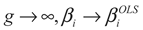
|
Table 1.
Product innovation model estimation based on different model priors.
| Variable | Mprior = Uniform | Mprior = Fixed | Mprior = Random | Overall Outcome | ||||||
| PIP | Post Mean | Post SD | PIP | Post Mean | Post SD | PIP | Post Mean | Post SD | ||
| Spending on formal R&D | 1.00 | 0.084 | 0.018 | 1.00 | 0.084 | 0.018 | 1.00 | 0.085 | 0.018 | Strongly robust |
| Internal R&D | 1.00 | 0.110 | 0.017 | 1.00 | 0.110 | 0.017 | 1.00 | 0.112 | 0.018 | Strongly robust |
| Mobile technology infrastructure | 1.00 | 0.004 | 0.001 | 1.00 | 0.004 | 0.001 | 1.00 | 0.005 | 0.001 | Strongly robust |
| Availability of latest technology | 1.00 | 0.129 | 0.028 | 1.00 | 0.128 | 0.028 | 1.00 | 0.126 | 0.027 | Strongly robust |
| Telecom (obstacle) | 1.00 | -0.039 | 0.009 | 1.00 | -0.039 | 0.009 | 1.00 | -0.039 | 0.009 | Strongly robust |
| Firm size (revenues) | 0.85 | 0.005 | 0.003 | 0.85 | 0.005 | 0.003 | 0.76 | 0.005 | 0.004 | Robust |
| External R&D | 0.83 | 0.056 | 0.035 | 0.83 | 0.056 | 0.035 | 0.73 | 0.050 | 0.038 | Robust |
| Banking facility | 0.81 | 0.068 | 0.045 | 0.82 | 0.069 | 0.044 | 0.75 | 0.065 | 0.047 | Robust |
| Electricity (obstacle) | 0.81 | 0.013 | 0.009 | 0.79 | 0.013 | 0.009 | 0.63 | 0.010 | 0.009 | Robust |
| Tax regime (obstacle) | 0.76 | -0.013 | 0.010 | 0.74 | -0.013 | 0.010 | 0.64 | -0.011 | 0.010 | Robust |
| Own website | 0.74 | 0.029 | 0.023 | 0.72 | 0.028 | 0.023 | 0.65 | 0.026 | 0.024 | Weakly robust |
| Internet connectivity | 0.72 | 0.037 | 0.030 | 0.72 | 0.037 | 0.030 | 0.62 | 0.032 | 0.031 | Weakly robust |
| Labour regulation (obstacle) | 0.57 | -0.009 | 0.010 | 0.57 | -0.009 | 0.010 | 0.44 | -0.007 | 0.010 | Weakly robust |
| External financial audit | 0.56 | -0.021 | 0.024 | 0.56 | -0.021 | 0.024 | 0.40 | -0.015 | 0.022 | Weakly robust |
| Line of credit | 0.55 | -0.016 | 0.019 | 0.55 | -0.017 | 0.019 | 0.41 | -0.012 | 0.018 | Weakly robust |
| Shareholder ownership | 0.52 | -0.021 | 0.026 | 0.52 | -0.021 | 0.026 | 0.42 | -0.017 | 0.025 | Weakly robust |
| Political instability (obstacle) | 0.48 | 0.006 | 0.008 | 0.49 | 0.006 | 0.008 | 0.36 | 0.004 | 0.007 | Not robust |
| Female ownership | 0.44 | -0.013 | 0.020 | 0.41 | -0.012 | 0.019 | 0.33 | -0.010 | 0.018 | Not robust |
| Firm age | 0.42 | 0.000 | 0.001 | 0.40 | 0.000 | 0.001 | 0.29 | 0.000 | 0.000 | Not robust |
| Market competition | 0.39 | 0.009 | 0.015 | 0.38 | 0.009 | 0.015 | 0.27 | 0.006 | 0.013 | Not robust |
| Licensing and permits (obstacle) | 0.39 | 0.005 | 0.008 | 0.38 | 0.005 | 0.008 | 0.28 | 0.004 | 0.007 | Not robust |
| Manager tenure | 0.38 | 0.000 | 0.001 | 0.36 | 0.000 | 0.001 | 0.24 | 0.000 | 0.001 | Not robust |
| Access to land (obstacle) | 0.28 | -0.002 | 0.005 | 0.28 | -0.002 | 0.005 | 0.19 | -0.001 | 0.004 | Not robust |
| Productive efficiency | 0.27 | 0.000 | 0.000 | 0.27 | 0.000 | 0.000 | 0.21 | 0.000 | 0.000 | Not robust |
| Investments in fixed assets | 0.26 | 0.004 | 0.011 | 0.25 | 0.004 | 0.011 | 0.19 | 0.003 | 0.010 | Not robust |
| Firm performance | 0.24 | 0.000 | 0.000 | 0.25 | 0.000 | 0.000 | 0.17 | 0.000 | 0.000 | Not robust |
| Courts (obstacle) | 0.23 | 0.002 | 0.005 | 0.24 | 0.002 | 0.005 | 0.18 | 0.001 | 0.004 | Not robust |
| Innovation-specific opportunity | 0.22 | 0.003 | 0.010 | 0.22 | 0.003 | 0.010 | 0.17 | 0.002 | 0.009 | Not robust |
| Crime and theft (obstacle) | 0.22 | -0.001 | 0.005 | 0.22 | -0.001 | 0.005 | 0.16 | -0.001 | 0.004 | Not robust |
| Size of educated workforce | 0.22 | 0.000 | 0.000 | 0.23 | 0.000 | 0.000 | 0.16 | 0.000 | 0.000 | Not robust |
| Mobile cellular tariff | 0.21 | -0.013 | 0.056 | 0.22 | -0.014 | 0.058 | 0.16 | -0.011 | 0.050 | Not robust |
| Insufficient water supply | 0.20 | -0.004 | 0.015 | 0.21 | -0.004 | 0.015 | 0.18 | -0.004 | 0.014 | Not robust |
| Corruption (obstacle) | 0.20 | 0.000 | 0.003 | 0.18 | 0.000 | 0.003 | 0.14 | 0.000 | 0.003 | Not robust |
| Innovation-specific training | 0.19 | 0.001 | 0.007 | 0.19 | 0.001 | 0.007 | 0.14 | 0.001 | 0.006 | Not robust |
| Quality of workforce (obstacle) | 0.19 | 0.000 | 0.004 | 0.19 | 0.000 | 0.004 | 0.12 | 0.000 | 0.003 | Not robust |
| Female top manager | 0.19 | 0.002 | 0.012 | 0.19 | 0.002 | 0.012 | 0.13 | 0.001 | 0.010 | Not robust |
| Access to finance (obstacle) | 0.18 | 0.000 | 0.003 | 0.18 | 0.000 | 0.003 | 0.14 | 0.000 | 0.003 | Not robust |
| Overdraft facility | 0.18 | 0.001 | 0.008 | 0.17 | 0.001 | 0.007 | 0.13 | 0.001 | 0.007 | Not robust |
| Export orientation | 0.17 | -0.001 | 0.009 | 0.18 | -0.001 | 0.009 | 0.13 | -0.001 | 0.007 | Not robust |
| Formal training programme | 0.17 | 0.001 | 0.007 | 0.18 | 0.001 | 0.007 | 0.14 | 0.001 | 0.007 | Not robust |
| Firm size (workforce) | 0.17 | 0.000 | 0.000 | 0.16 | 0.000 | 0.000 | 0.13 | 0.000 | 0.000 | Not robust |
| Rule of law | 0.16 | 0.000 | 0.003 | 0.19 | 0.000 | 0.004 | 0.12 | 0.000 | 0.003 | Not robust |
Notes: The BMA results reported are based on ‘hyper-g’ parameter prior. The columns contain; Posterior inclusion probability (PIP), Posterior mean, and standard deviation, respectively. We follow Raftery (1995) and define PIP values of: below 0.50 (not robust), 0.50 – 0.75 (weak), 0.75 – 0.95 (robust), and 0.95 – 0.100 (strongly robust). Regressors with average PIPs above 0.99 are highlighted in bold as they are viewed as having robust effects on product innovation.
Table 2.
Innovation capacity model estimation based on different priors.
| Variable | Uniform | Fixed | Random | Overall Outcome | ||||||
| PIP | Post Mean | Post SD | PIP | Post Mean | Post SD | PIP | Post Mean | Post SD | ||
| Firm size (revenues) | 1.00 | 0.009 | 0.001 | 1.00 | 0.009 | 0.001 | 1.00 | 0.009 | 0.001 | Strongly robust |
| Internal R&D | 1.00 | 0.089 | 0.009 | 1.00 | 0.089 | 0.009 | 1.00 | 0.090 | 0.009 | Strongly robust |
| Innovation-specific training | 1.00 | 0.073 | 0.008 | 1.00 | 0.073 | 0.008 | 1.00 | 0.073 | 0.008 | Strongly robust |
| Own website | 1.00 | 0.083 | 0.009 | 1.00 | 0.084 | 0.009 | 1.00 | 0.084 | 0.009 | Strongly robust |
| Investments in fixed assets | 1.00 | 0.058 | 0.008 | 1.00 | 0.058 | 0.008 | 1.00 | 0.058 | 0.008 | Strongly robust |
| Mobile technology infrastructure | 1.00 | 0.002 | 0.000 | 1.00 | 0.002 | 0.000 | 1.00 | 0.002 | 0.000 | Strongly robust |
| Mobile cellular tariff | 1.00 | -0.245 | 0.058 | 1.00 | -0.245 | 0.058 | 1.00 | -0.246 | 0.058 | Strongly robust |
| External financial audit | 1.00 | 0.041 | 0.010 | 1.00 | 0.041 | 0.010 | 1.00 | 0.041 | 0.010 | Strongly robust |
| Formal training programme | 0.99 | 0.031 | 0.009 | 0.99 | 0.032 | 0.009 | 0.99 | 0.032 | 0.009 | Strongly robust |
| External R&D | 0.99 | 0.049 | 0.014 | 0.99 | 0.050 | 0.014 | 0.99 | 0.050 | 0.014 | Strongly robust |
| Manager tenure | 0.93 | -0.001 | 0.000 | 0.93 | -0.001 | 0.000 | 0.93 | -0.001 | 0.000 | Robust |
| Insufficient water supply | 0.90 | -0.038 | 0.018 | 0.91 | -0.038 | 0.018 | 0.90 | -0.038 | 0.018 | Robust |
| Electricity (obstacle) | 0.89 | -0.009 | 0.004 | 0.90 | -0.009 | 0.004 | 0.89 | -0.009 | 0.004 | Robust |
| Corruption (obstacle) | 0.89 | 0.009 | 0.005 | 0.88 | 0.009 | 0.005 | 0.88 | 0.009 | 0.005 | Robust |
| Crime and theft (obstacle) | 0.85 | -0.010 | 0.006 | 0.86 | -0.011 | 0.006 | 0.84 | -0.010 | 0.006 | Robust |
| Tax regime (obstacle) | 0.82 | -0.008 | 0.005 | 0.81 | -0.008 | 0.005 | 0.81 | -0.008 | 0.005 | Robust |
| Size of educated workforce | 0.65 | 0.000 | 0.000 | 0.65 | 0.000 | 0.000 | 0.64 | 0.000 | 0.000 | Weakly robust |
| Spending on formal R&D | 0.44 | 0.008 | 0.010 | 0.46 | 0.008 | 0.010 | 0.43 | 0.007 | 0.010 | Not robust |
| Availability of latest technology | 0.42 | -0.011 | 0.016 | 0.43 | -0.011 | 0.016 | 0.42 | -0.011 | 0.016 | Not robust |
| Internet connectivity | 0.34 | 0.007 | 0.011 | 0.32 | 0.006 | 0.011 | 0.33 | 0.006 | 0.011 | Not robust |
| Firm size (workforce) | 0.28 | 0.000 | 0.000 | 0.26 | 0.000 | 0.000 | 0.28 | 0.000 | 0.000 | Not robust |
| Firm performance | 0.28 | 0.000 | 0.000 | 0.26 | 0.000 | 0.000 | 0.28 | 0.000 | 0.000 | Not robust |
| Access to finance (obstacle) | 0.27 | 0.001 | 0.003 | 0.25 | 0.001 | 0.003 | 0.27 | 0.001 | 0.003 | Not robust |
| Productive efficiency | 0.24 | 0.000 | 0.000 | 0.25 | 0.000 | 0.000 | 0.25 | 0.000 | 0.000 | Not robust |
| Licensing and permits (obstacle) | 0.22 | -0.001 | 0.003 | 0.23 | -0.001 | 0.003 | 0.22 | -0.001 | 0.003 | Not robust |
| Telecom (obstacle) | 0.20 | 0.001 | 0.003 | 0.19 | 0.001 | 0.003 | 0.19 | 0.001 | 0.003 | Not robust |
| Export orientation | 0.19 | 0.002 | 0.006 | 0.18 | 0.002 | 0.006 | 0.19 | 0.002 | 0.006 | Not robust |
| Access to land (obstacle) | 0.18 | 0.001 | 0.002 | 0.18 | 0.001 | 0.002 | 0.18 | 0.001 | 0.002 | Not robust |
| Shareholder ownership | 0.16 | 0.002 | 0.006 | 0.14 | 0.001 | 0.005 | 0.15 | 0.001 | 0.005 | Not robust |
| Political instability (obstacle) | 0.16 | 0.000 | 0.002 | 0.15 | 0.000 | 0.002 | 0.16 | -0.001 | 0.002 | Not robust |
| Labour regulation (obstacle) | 0.16 | -0.001 | 0.002 | 0.16 | -0.001 | 0.002 | 0.16 | -0.001 | 0.002 | Not robust |
| Female ownership | 0.15 | -0.001 | 0.005 | 0.16 | -0.001 | 0.005 | 0.16 | -0.001 | 0.005 | Not robust |
| Quality of workforce (obstacle) | 0.14 | 0.000 | 0.002 | 0.13 | 0.000 | 0.002 | 0.13 | 0.000 | 0.002 | Not robust |
| Firm age | 0.13 | 0.000 | 0.000 | 0.13 | 0.000 | 0.000 | 0.14 | 0.000 | 0.000 | Not robust |
| Courts (obstacle) | 0.12 | 0.000 | 0.002 | 0.12 | 0.000 | 0.002 | 0.13 | 0.000 | 0.002 | Not robust |
| Innovation-specific opportunity | 0.12 | 0.000 | 0.003 | 0.11 | 0.000 | 0.003 | 0.12 | 0.000 | 0.003 | Not robust |
| Market competition | 0.11 | 0.000 | 0.003 | 0.11 | 0.000 | 0.003 | 0.11 | 0.000 | 0.003 | Not robust |
| Rule of law | 0.11 | 0.000 | 0.002 | 0.12 | 0.000 | 0.002 | 0.13 | 0.000 | 0.002 | Not robust |
| Female top manager | 0.11 | -0.001 | 0.005 | 0.11 | -0.001 | 0.005 | 0.12 | -0.001 | 0.005 | Not robust |
| Banking facility | 0.11 | 0.000 | 0.006 | 0.10 | 0.000 | 0.006 | 0.10 | 0.000 | 0.005 | Not robust |
| Overdraft facility | 0.11 | 0.000 | 0.003 | 0.10 | 0.000 | 0.003 | 0.10 | 0.000 | 0.003 | Not robust |
| Line of credit | 0.10 | 0.000 | 0.003 | 0.11 | 0.000 | 0.003 | 0.11 | 0.000 | 0.003 | Not robust |
Notes: The BMA results reported are based on ‘hyper-g’ parameter prior. The columns contain; Posterior inclusion probability (PIP), Posterior mean, and standard deviation, respectively. We follow Raftery (1995) and define PIP values of: below 0.50 (not robust), 0.50 – 0.75 (weak), 0.75 – 0.95 (robust), and 0.95 – 0.100 (strongly robust). Regressors with average PIPs above 0.99 are highlighted in bold as they are viewed as having robust effects on the capacity to innovate.
Table 3.
Core determinants of product innovation: marginal effects.
| [1] | [2a] | [3b] | |
| Panel A: Product innovation model | |||
| Spending on R&D | 0.104 [0.011]*** |
0.106 [0.011]*** |
0.105 [0.012]*** |
| Internal R&D | 0.185 [0.011]*** |
0.177 [0.011]*** |
0.169 [0.011]*** |
| Mobile technology infrastructure | 0.002 [0.000]*** |
0.002 [0.000]*** |
0.002 [0.000]*** |
| Availability of latest technologies | 0.156 [0.012]*** |
0.124 [0.013]*** |
0.153 [0.013]*** |
| Telecom (obstacle) | -0.028 [0.005]*** |
-0.021 [0.005]*** |
-0.028 [0.005]*** |
| Observations | 9402 | 9402 | 8816 |
| Panel B: Innovation capacity model | |||
| Firm size (revenues) | 0.009 [0.001]*** |
0.009 [0.001]*** |
0.008 [0.001]*** |
| Internal R&D | 0.093 [0.006]*** |
0.093 [0.006]*** |
0.078 [0.006]*** |
| Innovation-specific training | 0.083 [0.005]*** |
0.083 [0.005]*** |
0.079 [0.006]*** |
| Own website | 0.072 [0.005]*** |
0.072 [0.005]*** |
0.074 [0.005]*** |
| Investments in fixed assets | 0.039 [0.005]*** |
0.039 [0.005]*** |
0.039 [0.005]*** |
| Mobile technology infrastructure | 0.001 [0.000]*** |
0.001 [0.000]*** |
0.001 [0.000]*** |
| Mobile cellular tariff | -0.298 [0.021]*** |
-0.343 [0.034]*** |
-0.232 [0.024]*** |
| External financial audit | 0.041 [0.006]*** |
0.041 [0.006]*** |
0.044 [0.006]*** |
| Formal training programme | 0.030 [0.005]*** |
0.030 [0.005]*** |
0.033 [0.006]*** |
| External R&D | 0.039 [0.009]*** |
0.039 [0.009]*** |
0.035 [0.009]*** |
| Observations | 8388 | 8388 | 7943 |
Notes: Robust standard errors in brackets, clustered at the firm level; * p<0.10, ** p<0.05, *** p<0.01; a controls for country fixed effects; b controls for industry fixed effects.
Table 4.
Results of the selection equation.
| Product Innovation | Innovation Capacity | |
| Firm size (workforce) | 0.042 [0.007]*** |
0.051 [0.004]*** |
| Abandoned or ongoing innovations | 0.150 [0.018]*** |
0.091 [0.009]*** |
| Marketing innovation | 0.092 [0.017]*** |
0.044 [0.009]*** |
| Organisational innovation | 0.102 [0.018]*** |
0.040 [0.009]*** |
| Access to finance as an obstacle | -0.020 [0.007]*** |
|
| Part of a group |
|
0.030 [0.010]*** |
| Geographical scope |
|
0.049 [0.010]*** |
| Agricultural-based industries | -0.026 [0.023] |
0.044 [0.013]*** |
| Mineral-based industries | 0.058 [0.025]** |
0.101 [0.013]*** |
| Capital-intensive industries | 0.080 [0.025]*** |
0.114 [0.013]*** |
| Observations | 3072 | 2918 |
Notes: Robust standard errors in brackets, clustered at the firm level; * p<0.10, ** p<0.05, *** p<0.01, respectively.
Table 5.
Results of the outcome equation and two-level mixed-effects model: marginal effects.
| [1c] | [2d] | |
| Product innovation model | ||
| Spending on R&D | 0.078 [0.020]*** |
0.050 [0.019]** |
| Internal R&D | 0.125 [0.019]*** |
0.122 [0.019]*** |
| Mobile technology infrastructure | 0.004 [0.001]*** |
0.001 [0.001] |
| Availability of latest technologies | 0.038 [0.024] |
0.131 [0.053]** |
| Telecom (obstacle) | -0.019 [0.008]** |
-0.004 [0.009] |
| Heckman’s lambda | -0.433 [0.038]*** |
-0.359 [0.042]*** |
| Variance of the random intercept at regional level | 0.321 [0.077] |
|
| Chi_bar squared | 246.06*** | |
| Observations | 2867 | 2867 |
| Innovation capacity model | ||
| Firm size (revenues) | 0.004 [0.001]*** |
0.005 [0.002]*** |
| Internal R&D | 0.066 [0.010]*** |
0.056 [0.019]*** |
| Innovation-specific training | 0.067 [0.010]*** |
0.086 [0.017]*** |
| Own website | 0.051 [0.009]*** |
0.074 [0.016]*** |
| Investments in fixed assets | 0.041 [0.009]*** |
0.075 [0.016]*** |
| Mobile technology infrastructure | 0.001 [0.000]*** |
0.001 [0.001]* |
| Mobile cellular tariff | -0.121 [0.044]*** |
-0.309 [0.093]*** |
| External financial audit | 0.043 [0.011]*** |
0.067 [0.019]*** |
| Formal training programme | 0.013 [0.009] |
0.010 [0.017] |
| External R&D | 0.018 [0.015] |
0.051 [0.034] |
| Heckman’s lambda | -0.284 [0.022]*** |
-0.339 [0.039]*** |
| Variance of the random intercept at regional level | 0.112 [0.036] |
|
| Chi_bar squared | 59.36*** | |
| Observations | 2658 | 2658 |
Notes: Robust standard errors in brackets, clustered at the firm level; * p<0.10, ** p<0.05, *** p<0.01; c outcome model which controls for sample selection via Heckman’s two-stage approach; d multilevel approach in the form of a two-level random intercept model (firm and regional levels) which also controls for sample selection.
Disclaimer/Publisher’s Note: The statements, opinions and data contained in all publications are solely those of the individual author(s) and contributor(s) and not of MDPI and/or the editor(s). MDPI and/or the editor(s) disclaim responsibility for any injury to people or property resulting from any ideas, methods, instructions or products referred to in the content. |
© 2026 by the authors. Licensee MDPI, Basel, Switzerland. This article is an open access article distributed under the terms and conditions of the Creative Commons Attribution (CC BY) license (http://creativecommons.org/licenses/by/4.0/).
Copyright: This open access article is published under a Creative Commons CC BY 4.0 license, which permit the free download, distribution, and reuse, provided that the author and preprint are cited in any reuse.


