

Submitted:
24 April 2026
Posted:
28 April 2026
You are already at the latest version
Abstract
Systematic surveillance of World Organization for Animal Health (WOAH)-listed protozoan parasites is essential for maintaining sanitary status for seafood export and detecting the introduction of exotic pathogens into coastal ecosystems. In 2023, we examined wild Mediterranean mussels Mytilus galloprovincialis and Pacific oysters Crassostrea gigas collected from small harbors adjacent to ten major trading ports along the west and south coasts of Korea to assess the occurrence of WOAH-listed protozoan parasites and emerging Perkinsus species. A total of 1,080 mussels and 1,080 oysters from 18 sites were sampled in spring and autumn, and gill and digestive gland tissues were pooled from six individuals for DNA extraction. Species-specific PCR assays targeting Perkinsus marinus, P. olseni, P. beihaiensis, Bonamia ostreae, B. exitiosa, and Marteilia refringens were performed using previously validated primer sets and positive controls. All PCR assays were negative for the six protozoan parasite species in both host species across all sampling sites, indicating no detectable infections in port-adjacent wild mussel and oyster populations during the survey period. These negative results contrast with recent reports of P. marinus in wild C. gigas and B. ostreae in Ostrea denselamellosa on the west coast of Korea, suggesting that infections may currently be focal, transient, and host-specific rather than widespread in port-associated M. galloprovincialis and C. gigas populations. The present study provides baseline data on the distribution of protozoan parasites in bivalves inhabiting high-risk harbor environments and underscores the need for continued surveillance of transboundary shellfish disease that is closely coupled with environmental monitoring.
Keywords:
Perkinsus
; Bonamia
; Marteilia
; harbor
; Mediterranean mussel
; Pacific oyster
1. Introduction
In the international seafood trade, importing countries implement sanitary and phytosanitary measures in line with the World Organization for Animal Health (WOAH) guidelines to protect their aquatic ecosystems and aquaculture industries [1]. Scientific surveillance data demonstrating that exported products are free from WOAH-listed aquatic animal diseases are a key requirement for meeting import sanitary standards [2]. Bivalves, due to their sessile lifestyle and filter-feeding behavior, are widely used as sentinel species that reflect environmental conditions and the presence of pathogens in coastal ecosystems [3]. Evidence of pathogen dispersal through maritime transport has been suggested by detections of Perkinsus beihaiensis infections in Mediterranean mussels Mytilus galloprovincialis in Tokyo Bay, Japan, and in bivalve populations in Panama [4,5,6].
The Mediterranean mussel M. galloprovincialis is a well-recognized invasive species [7] that can be infected by Marteilia refringens, P. olseni, and P. beihaiensis, indicating its susceptibility to a range of protozoan parasites affecting bivalves [5,8,9,10,11]. The Pacific oyster Crassostrea gigas is susceptible to P. marinus and has also been suggested as a potential vector of Bonamia ostreae [12,13]. These protozoan parasites are of particular concern because they can cause significant mortality and productivity loss in wild and farmed bivalves and may be translocated between regions through the movement of seed, live shellfish, and shipping activities [14]. Along the Korean coast, P. olseni is known to be prevalent in Manila clams and blood cockles [15], and previous PCR-based monitoring reported no WOAH-listed protozoan parasites in C. gigas along parts of the southern coast [16]. More recently, however, P. marinus was detected in wild C. gigas on the west coast of Korea, and B. ostreae infection was reported in wild flat oysters Ostrea denselamellosa near Gunsan Port [12,17], raising concerns about the introduction and local establishment of these exotic protozoan parasites. Among the targeted protozoan parasites, P. marinus, P. olseni, Bonamia spp., and M. refringens are WOAH-listed, whereas P. beihaiensis is a non-listed but emerging Perkinsus species with documented occurrences in bivalves from Japan and Panama [4,5,6].
2. Materials and Methods
2.1. Sample Collection
To evaluate the occurrence of WOAH-listed protozoan parasites in port-associated bivalve populations, we collected wild M. galloprovincialis and C. gigas from small harbors located near ten major trading ports along the west and south coasts of Korea and screened them for P. marinus, P. olseni, B. ostreae, B. exitiosa, M. refringens, and P. beihaiensis using species-specific PCR assays. In May and September 2023, mussels and oysters were sampled from 18 sites around Taean, Boryeong, Janghang, and Gunsan on the west coast and Gwangyang, Yeosu, Tongyeong, Gohyeon, Okpo, and Busan on the south coast (Figure 1 and Figure 2), yielding a total of 1,080 mussels and 1,080 oysters for analysis. Shell height (for mussels) or shell length (for oysters) and tissue weight were measured for each individual, and gill and digestive gland tissues were excised, with aliquots stored at −70 °C for molecular analysis and remaining tissues preserved in Davidson’s solution for potential histology.
2.2. PCR Assay
For PCR screening, approximately 30 mg of pooled gill and digestive gland tissues from six individuals were combined to form a single sample, and genomic DNA was extracted using the DNeasy Blood & Tissue Kit (Qiagen, Germany) following proteinase K digestion, resulting in pooled DNA samples that were used as templates for species-specific PCR assays.
Six primer sets were used to target WOAH-listed and non-listed protozoan parasites, specifically P. marinus, P. olseni, P. beihaiensis, B. ostreae, B. exitiosa, and M. refringens, as previously described for each species (Table 1). Each PCR reaction was performed in a 25 μL volume containing 100 ng of template DNA, buffer with MgCl2, dNTPs, primers, and Ex Taq DNA polymerase (Takara, Japan), using thermal cycling conditions based on the original primer descriptions with minor modifications. For P. marinus and P. olseni, DNA extracted from in vitro cultures was used as a positive control, whereas plasmid DNA of B. ostreae, B. exitiosa, and M. refringens from the European Union Reference Laboratory for Mollusk Diseases and plasmid DNA of P. beihaiensis provided by the University of Tokyo served as positive controls for these targets. PCR products were separated on 1.5% agarose gels along with a 100 bp DNA ladder and visualized under UV illumination to detect specific amplicons corresponding to each protozoan parasite.
3. Results
3.1. PCR Screening Results
The mussels analyzed in this study had shell heights ranging from 21.2 to 96.1 mm and tissue weights from 0.2 to 22.1 g, whereas oysters had shell lengths ranging from 15.9 to 134.2 mm and tissue weights from 0.4 to 36.3 g, indicating that multiple size classes were represented across the 18 sampling sites (Table 2 and Table 3). Species-specific PCR screening revealed no evidence of infection by WOAH-listed protozoan parasites or by P. beihaiensis in any of the pooled mussel or oyster samples from port-adjacent waters on the west and south coasts of Korea: no specific amplicons were detected for P. marinus, P. olseni, B. ostreae, B. exitiosa, M. refringens, or P. beihaiensis in any field samples (Table 2 and Table 3, Figure 3). In contrast, all positive control reactions produced clear bands of the expected sizes, whereas negative controls remained free of bands, confirming that the assays were functional and that non-detection in field samples reflected a true lack of detectable infections rather than technical failure.
4. Discussion
These results demonstrate a complete absence of detectable infections by WOAH-listed protozoan parasites and P. beihaiensis in wild M. galloprovincialis and C. gigas inhabiting port-adjacent environments on the west and south coasts of Korea during the 2023 survey period. This finding is notable given recent detections of P. marinus in wild C. gigas from Hongseong [12] and B. ostreae in O. denselamellosa near Gunsan Port [17], both on the west coast of Korea, and the geographical proximity of some of our sampling sites, such as Namdang and Suryong, to these previously reported locations. The absence of P. marinus and Bonamia spp. in M. galloprovincialis and C. gigas from these areas suggests that infections with these protozoan parasites may currently be focal and limited in spatial extent and may also reflect strong host specificity, as Bonamia spp. are known to primarily infect Ostrea species, with substantially lower susceptibility reported for Crassostrea and Mytilus species [18].
Environmental factors, particularly temperature and salinity, strongly influence the prevalence and infection intensity of P. marinus [19], and differences in local or seasonal conditions between our survey and previous reports [12] may partly explain the discrepancies in detection. Although we did not measure environmental parameters concurrently, the complete absence of PCR-positive samples in our survey, combined with earlier negative findings from southern coastal C. gigas populations in 2020 [16], suggests that WOAH-listed protozoan parasites have not yet become widely established in port-associated mussel and oyster communities along the surveyed coasts. At the same time, the recent emergence of P. marinus and B. ostreae in Korea indicates that the risk landscape is changing, and continued surveillance of multiple host species, integrated with environmental monitoring, will be crucial for early detection and risk assessment of protozoan parasite incursions [12,17].
5. Conclusions
This Brief Communication reports that species-specific PCR assays of 1,080 M. galloprovincialis and 1,080 C. gigas collected from 18 port-adjacent sites along the west and south coasts of Korea in 2023 detected no infections by P. marinus, P. olseni, B. ostreae, B. exitiosa, M. refringens, or P. beihaiensis. These data provide important baseline information on the current absence of WOAH-listed protozoan parasites in wild mussel and oyster populations inhabiting high-risk harbor environments in Korea and will support future risk assessments, disease-free certifications in shellfish trade, and the design of environment-coupled surveillance programs for transboundary shellfish diseases.
Author Contributions
Conceptualization: Choi HJ, Kwon MG, Park CI, Choi KS, Hong HK. Formal analysis: Kim JH, Kajino N, Shin JS. Investigation: Kim JH, Kajino N, Shin JS. Validation: Choi KS, Hong HK. Project administration: Choi HJ, Kwon MG. Funding acquisition: Park CI, Choi KS, Hong HK. Writing – original draft: Kim JH. Writing – review & editing: Choi KS, Hong HK.
Funding
This work was funded by the National Fishery Products Quality Management Service (NFQS2026001) as part of the project titled “Development of Quarantine & Disease Control Program for Aquatic Life.”.
Institutional Review Board Statement
Not applicable.
Informed Consent Statement
Not applicable.
Data Availability Statement
The datasets generated and analyzed during the current study were not archived in a public repository but can be obtained from the corresponding author upon reasonable request.
Conflicts of Interest: The authors have no conflicts of interest to declare.
Acknowledgments
We thank the Shellfish Research and Aquaculture Laboratory staff at Jeju National University for the laboratory analysis. During the preparation of this manuscript/study, the authors used ChatGPT 5.4 (paid version, OpenAI) for the purpose of grammatical correction in academic writing. The authors have reviewed and edited the output and take full responsibility for the content of this publication.
Conflicts of Interest
The authors declare no conflicts of interest.
References
- Oidtmann, B.; Johnston, C.; Klotins, K.; Mylrea, G.; Van, P.T.; Cabot, S.; Martin, P.R.; Ababouch, L.; Berthe, F. Assessment of the Safety of Aquatic Animal Commodities for International Trade: The OIE Aquatic Animal Health Code. Transbound. Emerg. Dis. 2013, 60, 27–38. [Google Scholar] [CrossRef]
- Rodgers, C.J.; Mohan, C.V.; Peeler, E.J. The Spread of Pathogens through Trade in Aquatic Animals and Their Products. Rev. Sci. Tech. OIE 2011, 30, 241–256. [Google Scholar] [CrossRef] [PubMed]
- Fattorini, D. Bioaccumulation of Trace Elements in Mussels as Sentinels of Environmental Pollution in the Mediterranean Sea: A Review. EER 2025, 2, 8078. [Google Scholar] [CrossRef]
- Pagenkopp Lohan, K.M.; Hill-Spanik, K.M.; Torchin, M.E.; Fleischer, R.C.; Carnegie, R.B.; Reece, K.S.; Ruiz, G.M. Phylogeography and Connectivity of Molluscan Parasites: Perkinsus Spp. in Panama and Beyond. Int. J. Parasitol. 2018, 48, 135–144. [Google Scholar] [CrossRef] [PubMed]
- Itoh, N.; Komatsu, Y.; Maeda, K.; Hirase, S.; Yoshinaga, T. First Discovery of Perkinsus beihaiensis in Mediterranean Mussels (Mytilus galloprovincialis) in Tokyo Bay, Japan. J. Invertebr. Pathol. 2019, 166, 107226. [Google Scholar] [CrossRef]
- Yisrael, L.; DiMaria, R.A.; Santos-Ciminera, P.; Aguirre-Macedo, M.L.; Vidal-Martínez, V.M.; Ruiz, G.M.; Torchin, M.E.; Hill-Spanik, K.M.; Gnanadesikan, A.; Pagenkopp Lohan, K.M. Expanding the Phylogeography and Connectivity of Perkinsus Species across North and Central America. Divers. Distrib. 2024, 30, e13807. [Google Scholar] [CrossRef]
- Oyarzún, P.A.; Toro, J.E.; Nuñez, J.J.; Ruiz-Tagle, G.; Gardner, J.P.A. The Mediterranean Mussel Mytilus galloprovincialis (Mollusca: Bivalvia) in Chile: Distribution and Genetic Structure of a Recently Introduced Invasive Marine Species. Animals 2024, 14, 823. [Google Scholar] [CrossRef]
- Le Roux, F.; Lorenzo, G.; Peyret, P.; Audemard, C.; Figueras, A.; Vivarès, C.; Gouy, M.; Berthe, F. Molecular Evidence for the Existence of Two Species of Marteilia in Europe. J. Eukaryot. Microbiol. 2001, 48, 449–454. [Google Scholar] [CrossRef]
- Novoa, B.; Posada, D.; Figueras, A. Polymorphisms in the Sequences of Marteilia Internal Transcribed Spacer Region of the Ribosomal RNA Genes (ITS-1) in Spain: Genetic Types Are Not Related with Bivalve Hosts. J. Fish. Dis. 2005, 28, 331–338. [Google Scholar] [CrossRef]
- Lattos, A.; Papadopoulos, D.K.; Feidantsis, K.; Karagiannis, D.; Giantsis, I.A.; Michaelidis, B. Are Marine Heatwaves Responsible for Mortalities of Farmed Mytilus galloprovincialis? A Pathophysiological Analysis of Marteilia Infected Mussels from Thermaikos Gulf, Greece. Animals 2022, 12, 2805. [Google Scholar] [CrossRef]
- Carella, F.; Fernandez Tejedor, M.; Villari, G.; Andree, K.B.; De Vico, G. The Endoparasite Perkinsus Olseni Affecting the Mediterranean Mussels (Mytilus galloprovincialis) in the Italian and Spanish Waters: A New Possible Threat for Mussel Aquaculture and Wild Animal Population. Front. Mar. Sci. 2023, 10, 1116837. [Google Scholar] [CrossRef]
- Kim, S.-H.; Bathige, S.D.N.K.; Jeon, H.-B.; Lee, D.; Choi, K.-S.; Kim, H.J.; Park, K.-I. First Report of Perkinsus Marinus Occurrence Associated with Wild Pacific Oysters Crassostrea gigas from the West Coast of Korea. J. Invertebr. Pathol. 2024, 204, 108119. [Google Scholar] [CrossRef]
- Lynch, S.A.; Abollo, E.; Ramilo, A.; Cao, A.; Culloty, S.C.; Villalba, A. Observations Raise the Question If the Pacific Oyster, Crassostrea gigas, Can Act as Either a Carrier or a Reservoir for Bonamia ostreae or Bonamia Exitiosa. Parasitol. 2010, 137, 1515–1526. [Google Scholar] [CrossRef]
- Yang, M.; Wang, Q.; Chen, J.; Wu, H. The Occurrence of Potential Pathogenic Bacteria on International Ships’ Ballast Water at Yangshan Port, Shanghai, China. Mar. Pollut. Bull. 2022, 184, 114190. [Google Scholar] [CrossRef]
- Kang, H.-S.; Yang, H.-S.; Reece, K.S.; Cho, Y.-G.; Lee, H.-M.; Kim, C.-W.; Choi, K.-S. Survey on Perkinsus Species in Manila Clam Ruditapes philippinarum in Korean Waters Using Species-Specific PCR. Fish. Pathol. 2017, 52, 202–205. [Google Scholar] [CrossRef]
- Shin, J.-S.; Kim, H.J.; Hwang, J.Y.; Kwon, M.G.; Cho, Y.-G.; Choi, K.-S. Monitoring of Oie-Listed Parasitic Pathogens in the Pacific Oyster (Crassostrea gigas) on the South Coast of Korea Using Species-Specific PCR. J. Shellfish Res. 2022, 41. [Google Scholar] [CrossRef]
- Kim, S.-H.; Long, J.; Song, T.-S.; Lee, D.; Kim, H.J.; Jeon, H.-B.; Chen, Y.; Udayantha, H.M.V.; Lee, H.-M.; Arzul, I.; et al. First Report of Bonamia ostreae in Wild Flat Oysters (Ostrea denselamellosa) from the West Coast of Korea: Molecular and Histopathological Confirmation. J. Invertebr. Pathol. 2026, 214, 108489. [Google Scholar] [CrossRef] [PubMed]
- Cochennec, N.; Le Roux, F.; Berthe, F.; Gerard, A. Detection of Bonamia ostreae Based on Small Subunit Ribosomal Probe. J. Invertebr. Pathol. 2000, 76, 26–32. [Google Scholar] [CrossRef]
- Atencio, W.; Ziegler, S.; Greiman, S.; Carroll, J. Drivers of Perkinsus marinus and Haplosporidium nelsoni Prevalence and Intensity in Oyster Reefs around Sapelo Island, Georgia. Parasitol. 2025, 1–12. [Google Scholar] [CrossRef]
- Audemard, C.; Reece, K.S.; Burreson, E.M. Real-Time PCR for Detection and Quantification of the Protistan Parasite Perkinsus marinus in Environmental Waters. Appl. Environ. Microbiol. 2004, 70, 6611–6618. [Google Scholar] [CrossRef] [PubMed]
- Moss, J.A.; Xiao, J.; Dungan, C.F.; Reece, K.S. Description of Perkinsus beihaiensis n. Sp., a New Perkinsus Sp. Parasite in Oysters of Southern China. J. Eukaryot. Microbiol. 2008, 55, 117–130. [Google Scholar] [CrossRef] [PubMed]
Figure 1.
Map showing sampling locations of Mytilus galloprovincialis along the west (A) and south coasts (B) of Korea. A, Taean Port; B, Boryeong Port; C, Janghang Port; D, Gunsan Port; E, Gwangyang Port; F, Yeosu Port; G, Tongyeong Port; H, Gohyeon Port; I, Okpo Port; J, Busan Port; a, Eoeundol Port; b, Tonggae Port; c, Gungri; d, Namdang Port; e, Bieung Port; f, Jangja-do; g, Gusipo Port; h, Johwa-ri; i, Gwangyang Police Station; j, Dochon Ferry Terminal; k, Mangdeok Port; l, Hodu-ri; m, Pyeongrim Port; n, Hwasam-ri; o, Eogu-ri; p, Myeongsa-Port; q, Jangmok-ri; r, Angolpo.
Figure 1.
Map showing sampling locations of Mytilus galloprovincialis along the west (A) and south coasts (B) of Korea. A, Taean Port; B, Boryeong Port; C, Janghang Port; D, Gunsan Port; E, Gwangyang Port; F, Yeosu Port; G, Tongyeong Port; H, Gohyeon Port; I, Okpo Port; J, Busan Port; a, Eoeundol Port; b, Tonggae Port; c, Gungri; d, Namdang Port; e, Bieung Port; f, Jangja-do; g, Gusipo Port; h, Johwa-ri; i, Gwangyang Police Station; j, Dochon Ferry Terminal; k, Mangdeok Port; l, Hodu-ri; m, Pyeongrim Port; n, Hwasam-ri; o, Eogu-ri; p, Myeongsa-Port; q, Jangmok-ri; r, Angolpo.
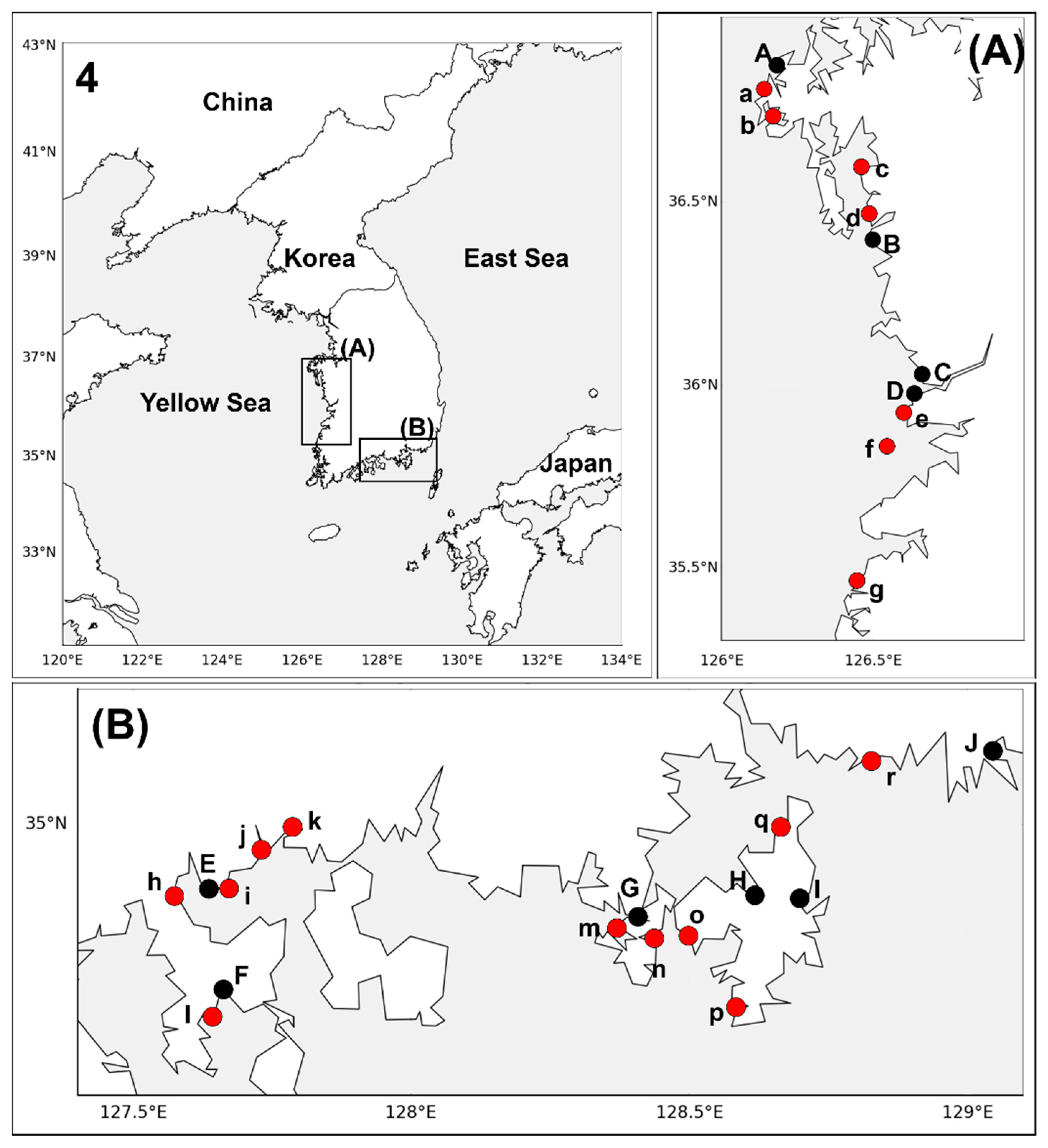
Figure 2.
Map showing sampling locations of Crassostrea gigas along the west (A) and south coasts (B) of Korea. A, Taean Port; B, Boryeong Port; C, Janghang Port; D, Gunsan Port; E, Gwangyang Port; F, Yeosu Port; G, Tongyeong Port; H, Gohyeon Port; I, Okpo Port; J, Busan Port; a, Mohang Port; b, Pado-ri; c, Gungri; d, Suryong Port; e, Janghang Port; f, Seonyu Port; g, Gomso Port; h, Imok-ri; i, Chonam Bridge; j, Gwangyang Port; k, Gwangyang Police Station; l, Taein Bridge; m, Pyeongrim Port; n, Dongam Port; o, Seondaldo Ferry Terminal; p, Daepo Port; q, Jangmok-ri; r, Busan New Port.
Figure 2.
Map showing sampling locations of Crassostrea gigas along the west (A) and south coasts (B) of Korea. A, Taean Port; B, Boryeong Port; C, Janghang Port; D, Gunsan Port; E, Gwangyang Port; F, Yeosu Port; G, Tongyeong Port; H, Gohyeon Port; I, Okpo Port; J, Busan Port; a, Mohang Port; b, Pado-ri; c, Gungri; d, Suryong Port; e, Janghang Port; f, Seonyu Port; g, Gomso Port; h, Imok-ri; i, Chonam Bridge; j, Gwangyang Port; k, Gwangyang Police Station; l, Taein Bridge; m, Pyeongrim Port; n, Dongam Port; o, Seondaldo Ferry Terminal; p, Daepo Port; q, Jangmok-ri; r, Busan New Port.
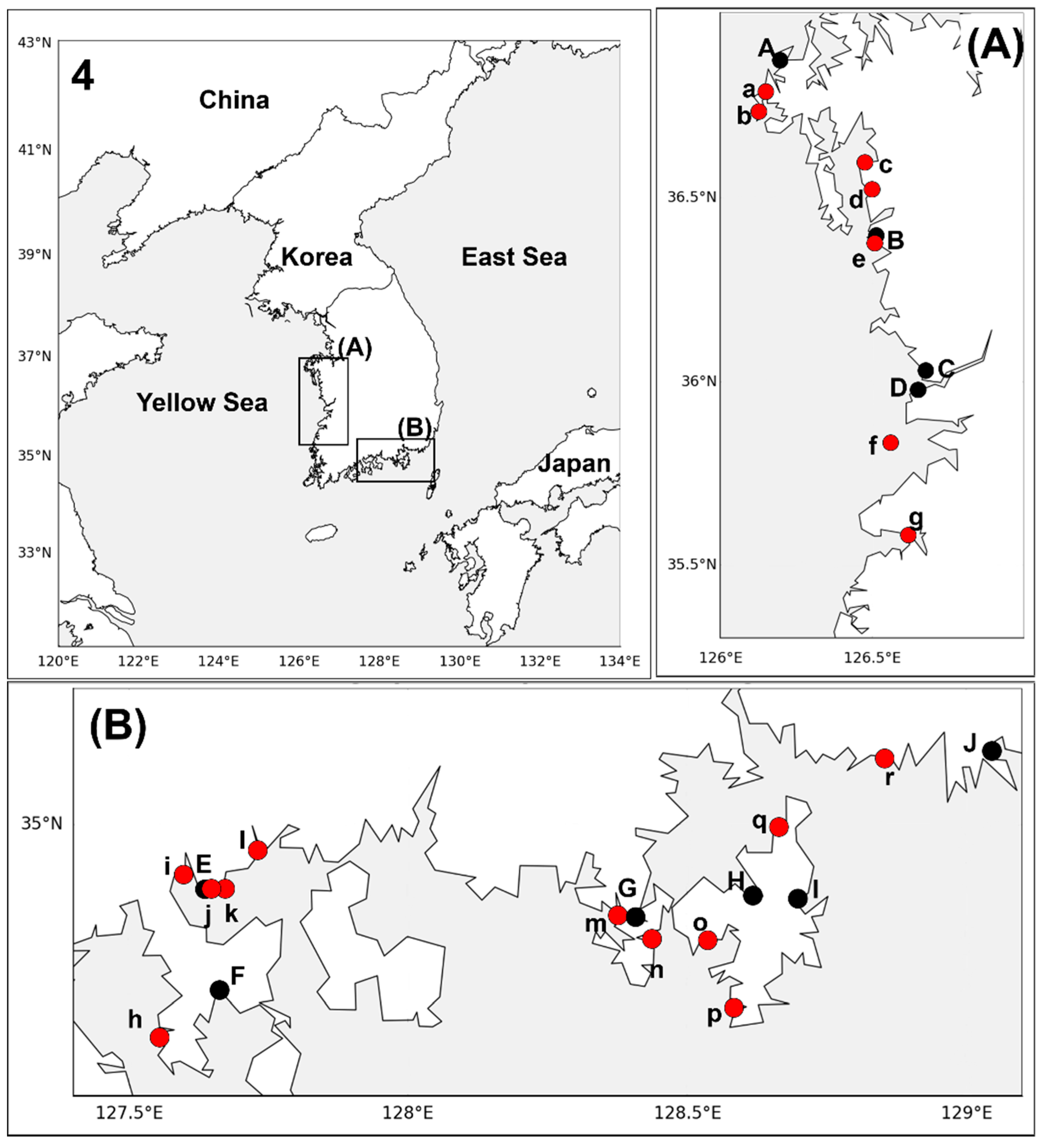
Figure 3.
PCR amplification of Perkinsus marinus (A), Perkinsus olseni (B), Perkinsus beihaiensis (C), Bonamia ostreae and B. exitiosa (D), and Marteilia refringens (E) using species-specific PCR assays. L, 100 bp DNA ladder; PC, positive control; 1–5, genomic DNA from three replicate pools of six samples each of Mytilus galloprovincialis or Crassostrea gigas.
Figure 3.
PCR amplification of Perkinsus marinus (A), Perkinsus olseni (B), Perkinsus beihaiensis (C), Bonamia ostreae and B. exitiosa (D), and Marteilia refringens (E) using species-specific PCR assays. L, 100 bp DNA ladder; PC, positive control; 1–5, genomic DNA from three replicate pools of six samples each of Mytilus galloprovincialis or Crassostrea gigas.
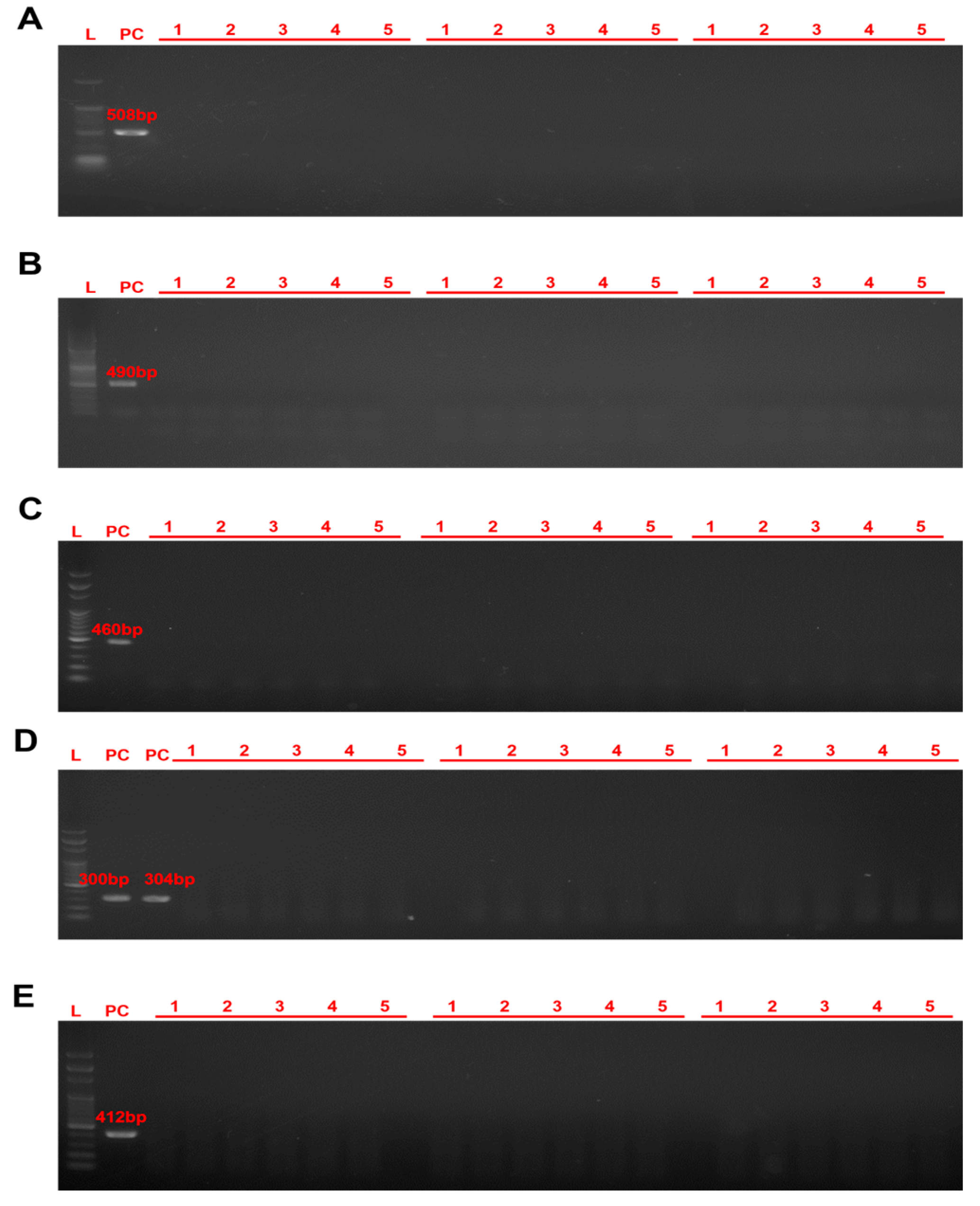

Table 1.
Primer sets used for species-specific PCR detection of protozoan parasites in Mytilus galloprovincialis and Crassostrea gigas.
Table 1.
Primer sets used for species-specific PCR detection of protozoan parasites in Mytilus galloprovincialis and Crassostrea gigas.
| Species | Primers | Primers sequence (5’-3’) | Size (bp) | Target gene | Reference |
|---|---|---|---|---|---|
| Perkinsus marinus | PmarITS-70F | F: CTT TTG YTW GAG WGT TGC GAG ATG | 509 | Inter Transcribed Spacer of rDNA gene | [20] |
| PmarITS-600R | R: CGA GTT TGC GAG TAC CTC KAG AG | ||||
| P. olseni | HS12 | F: CGA AAC TAG CGG TCT TGC TTC GGC | 490 | Inter Transcribed Spacer of rDNA gene | Kang et al. (2017) |
| HS13 | R: AGG CGC GGT CCT CCT CKC G | ||||
| P. beihaiensis | PerkITS-85 | F: CCG CTT TGT TTG GAT CCC | 460 | Inter Transcribed Spacer of rDNA gene | [21] |
| PerkITS-430R | R: TCT GAG GGG CTA CAA TCA T | ||||
|
Bonamia ostreae, B. exitiosa |
BO | F: CAT TTA ATT GGT CGG GCC GC | 300 (B. ostreae) 304 (B. exitiosa) |
Small Sub Unit of rDNA gene | Cochennec et al. (2000) |
| BOAS | R: CTG ATC GTC TTC GAT CCC CC | ||||
| Marteilia refringens | Pr4 | F: CCG CAC ACG TTC TTC ACT CC | 412 (M type) 413 (O type) |
Inter Transcribed Spacer of rDNA gene | Le Roux et al. (2001) |
| Pr5 | R: CTC GCG AGT TTC GAC AGA CG |
Table 2.
Infection prevalence of WOAH-listed and non-listed protozoan parasites in Mytilus galloprovincialis collected from the western and south coast of Korea.
Table 2.
Infection prevalence of WOAH-listed and non-listed protozoan parasites in Mytilus galloprovincialis collected from the western and south coast of Korea.
| Site | N | SL (mm) mean±SD | TWT (g) mean±SD | Infection prevalence (%) | ||||||||||||||||||
|---|---|---|---|---|---|---|---|---|---|---|---|---|---|---|---|---|---|---|---|---|---|---|
| Perkinsus | Bonamia | Marteilia | ||||||||||||||||||||
| marinus | olseni | beihaiensis | ostreae | exitiosa | refringens | |||||||||||||||||
| May | Sep. | May | Sep. | May | Sep. | May | Sep. | May | Sep. | May | Sep. | May | Sep. | May | Sep. | |||||||
| Western Coast | Taean Port | Eoeundol Port | 60 | 59.9±7.6 | 27.5±3.9 | 4.6±2.2 | 0.6±0.2 | 0 | 0 | 0 | 0 | 0 | 0 | 0 | 0 | 0 | 0 | 0 | 0 | |||
| Tonggae Port | 60 | 35.5±7.9 | 60.7±7.1 | 1.6±1.2 | 5.6±1.9 | 0 | 0 | 0 | 0 | 0 | 0 | 0 | 0 | 0 | 0 | 0 | 0 | |||||
| Boryeong Port | Gungri | 60 | 57.9±3.8 | 62.4±7.1 | 6.1±1.4 | 7.0±2.1 | 0 | 0 | 0 | 0 | 0 | 0 | 0 | 0 | 0 | 0 | 0 | 0 | ||||
| Namdang Port | 60 | 49.3±5.2 | 59.0±6.3 | 4.2±1.4 | 6.2±2.2 | 0 | 0 | 0 | 0 | 0 | 0 | 0 | 0 | 0 | 0 | 0 | 0 | |||||
| Janghang Port | Bieung Port | 60 | 67.2±6.8 | 31.0±2.9 | 7.3±2.1 | 0.8±0.3 | 0 | 0 | 0 | 0 | 0 | 0 | 0 | 0 | 0 | 0 | 0 | 0 | ||||
| Gunsan Port | Jangja-do | 60 | 55.1±9.6 | 36.5±6.9 | 5.2±2.3 | 1.3±0.8 | 0 | 0 | 0 | 0 | 0 | 0 | 0 | 0 | 0 | 0 | 0 | 0 | ||||
| Gusipo Port | 60 | 33.7±2.4 | 63.6±6.0 | 1.4±0.3 | 6.7±2.0 | 0 | 0 | 0 | 0 | 0 | 0 | 0 | 0 | 0 | 0 | 0 | 0 | |||||
| South Coast | Gwangyang Port | Gwangyang Police Station | 60 | 59.9±9.8 | 70.6±7.1 | 5.9±3.2 | 9.3±3.4 | 0 | 0 | 0 | 0 | 0 | 0 | 0 | 0 | 0 | 0 | 0 | 0 | |||
| Dochon Ferry Terminal |
60 | 50.5±2.2 | 74.9±8.3 | 5.4±1.2 | 9.1±2.6 | 0 | 0 | 0 | 0 | 0 | 0 | 0 | 0 | 0 | 0 | 0 | 0 | |||||
| Johwa-ri | 60 | 42.2±4.9 | 35.3±9.4 | 2.9±1.1 | 1.3±1.1 | 0 | 0 | 0 | 0 | 0 | 0 | 0 | 0 | 0 | 0 | 0 | 0 | |||||
| Mangdeok Port | 60 | 46.6±5.8 | 57.8±6.7 | 4.2±1.7 | 3.7±1.6 | 0 | 0 | 0 | 0 | 0 | 0 | 0 | 0 | 0 | 0 | 0 | 0 | |||||
| Yeosu Port | Hodu-ri | 60 | 60.7±4.0 | 58.5±6.7 | 5.3±1.0 | 4.3±1.5 | 0 | 0 | 0 | 0 | 0 | 0 | 0 | 0 | 0 | 0 | 0 | 0 | ||||
| Tongyeong Port | Pyeongrim Port | 60 | 49.1±7.5 | 63.5±6.7 | 5.3±2.4 | 4.2±1.4 | 0 | 0 | 0 | 0 | 0 | 0 | 0 | 0 | 0 | 0 | 0 | 0 | ||||
| Hwasam-ri | 60 | 50.0±4.2 | 74.0±6.2 | 5.1±1.5 | 9.6±2.9 | 0 | 0 | 0 | 0 | 0 | 0 | 0 | 0 | 0 | 0 | 0 | 0 | |||||
| Gohyeon Port | Eogu-ri | 60 | 46.5±7.8 | 30.3±2.7 | 3.8±2.0 | 0.7±0.2 | 0 | 0 | 0 | 0 | 0 | 0 | 0 | 0 | 0 | 0 | 0 | 0 | ||||
| Myeongsa-Po | 60 | 67.5±5.7 | 55.9±8.1 | 5.9±1.5 | 3.8±1.7 | 0 | 0 | 0 | 0 | 0 | 0 | 0 | 0 | 0 | 0 | 0 | 0 | |||||
| Okpo Port | Jangmok-ri | 60 | 65.6±5.6 | 39.2±3.6 | 6.5±2.3 | 1.6±0.5 | 0 | 0 | 0 | 0 | 0 | 0 | 0 | 0 | 0 | 0 | 0 | 0 | ||||
| Busan Port | Angolpo | 60 | 46.7±8.3 | 60.8±8.3 | 4.0±2.6 | 5.5±3.1 | 0 | 0 | 0 | 0 | 0 | 0 | 0 | 0 | 0 | 0 | 0 | 0 | ||||
Table 3.
Infection prevalence of WOAH-listed and non-listed protozoan parasites in Crassostrea gigas collected from the western and south coast of Korea.
Table 3.
Infection prevalence of WOAH-listed and non-listed protozoan parasites in Crassostrea gigas collected from the western and south coast of Korea.
| Site | N | SL (mm) mean±SD | TWT (g) mean±SD | Infection prevalence (%) | |||||||||||||||||||
|---|---|---|---|---|---|---|---|---|---|---|---|---|---|---|---|---|---|---|---|---|---|---|---|
| Perkinsus | Bonamia | Marteilia | |||||||||||||||||||||
| marinus | olseni | beihaiensis | ostreae | exitiosa | refringens | ||||||||||||||||||
| May | Sep. | May | Sep. | May | Sep. | May | Sep. | May | Sep. | May | Sep. | May | Sep. | May | Sep. | ||||||||
| Western Coast | Taean Port | Mohang Port | 60 | 56.8±8.5 | 43.4±5.9 | 2.5±1.0 | 2.1±1.1 | 0 | 0 | 0 | 0 | 0 | 0 | 0 | 0 | 0 | 0 | 0 | 0 | ||||
| Pado-ri | 60 | 79.1±11.5 | 61.5±6.3 | 6.2±2.3 | 3.5±1.5 | 0 | 0 | 0 | 0 | 0 | 0 | 0 | 0 | 0 | 0 | 0 | 0 | ||||||
| Boryeong Port | Gungri | 60 | 67.8±7.0 | 63.5±12.1 | 3.6±0.8 | 3.7±1.6 | 0 | 0 | 0 | 0 | 0 | 0 | 0 | 0 | 0 | 0 | 0 | 0 | |||||
| Suryong Port | 60 | 49.3±6.7 | 59.9±14.8 | 2.0±0.5 | 3.3±1.8 | 0 | 0 | 0 | 0 | 0 | 0 | 0 | 0 | 0 | 0 | 0 | 0 | ||||||
| Janghang Port | Janghang Port | 60 | 21.3±4.7 | 45.3±7.9 | 3.1±1.5 | 1.0±0.3 | 0 | 0 | 0 | 0 | 0 | 0 | 0 | 0 | 0 | 0 | 0 | 0 | |||||
| Gunsan Port | Seonyu Port | 60 | 53.1±7.4 | 52.7±7.1 | 5.4±1.4 | 3.1±0.9 | 0 | 0 | 0 | 0 | 0 | 0 | 0 | 0 | 0 | 0 | 0 | 0 | |||||
| Gomso Port | 60 | 50.0±8.3 | 55.6±9.6 | 3.9±1.6 | 3.4±1.2 | 0 | 0 | 0 | 0 | 0 | 0 | 0 | 0 | 0 | 0 | 0 | 0 | ||||||
| South Coast | Gwangyang Port | Gwangyang Port | 60 | 58.7±11.0 | 55.1±8.0 | 6.5±2.0 | 2.6±1.5 | 0 | 0 | 0 | 0 | 0 | 0 | 0 | 0 | 0 | 0 | 0 | 0 | ||||
| Gwangyang Police Station | 60 | 77.2±11.2 | 40.9±6.6 | 6.8±2.7 | 0.9±0.7 | 0 | 0 | 0 | 0 | 0 | 0 | 0 | 0 | 0 | 0 | 0 | 0 | ||||||
| Chonam Bridge | 60 | 80.0±14.2 | 54.6±7.1 | 6.0±3.5 | 2.9±1.0 | 0 | 0 | 0 | 0 | 0 | 0 | 0 | 0 | 0 | 0 | 0 | 0 | ||||||
| Taein Bridge | 60 | 73.0±10.7 | 45.4±6.5 | 5.4±1.8 | 1.4±0.5 | 0 | 0 | 0 | 0 | 0 | 0 | 0 | 0 | 0 | 0 | 0 | 0 | ||||||
| Yeosu Port | Imok-ri | 60 | 42.0±5.0 | 43.6±6.9 | 1.4±0.4 | 1.7±0.5 | 0 | 0 | 0 | 0 | 0 | 0 | 0 | 0 | 0 | 0 | 0 | 0 | |||||
| Tongyeong Port | Pyeongrim Port | 60 | 66.0±10.0 | 75.4±21.3 | 5.8±2.6 | 8.4±7.2 | 0 | 0 | 0 | 0 | 0 | 0 | 0 | 0 | 0 | 0 | 0 | 0 | |||||
| Dongam Port | 60 | 63.8±13.5 | 57.2±7.7 | 4.4±2.2 | 2.3±0.6 | 0 | 0 | 0 | 0 | 0 | 0 | 0 | 0 | 0 | 0 | 0 | 0 | ||||||
| Gohyeon Port | Daepo Port | 60 | 43.7±5.5 | 47.0±4.8 | 1.5±0.6 | 2.3±0.8 | 0 | 0 | 0 | 0 | 0 | 0 | 0 | 0 | 0 | 0 | 0 | 0 | |||||
| Seondaldo Ferry Terminal |
60 | 56.4±8.8 | 54.4±20.1 | 4.1±1.6 | 3.5±2.9 | 0 | 0 | 0 | 0 | 0 | 0 | 0 | 0 | 0 | 0 | 0 | 0 | ||||||
| Okpo Port | Jangmok-ri | 60 | 75.0±17.9 | 53.1±13.1 | 13.3±7.3 | 3.1±2.2 | 0 | 0 | 0 | 0 | 0 | 0 | 0 | 0 | 0 | 0 | 0 | 0 | |||||
| Busan Port | Busan New Port | 60 | 54.4±6.1 | 58.7±7.8 | 2.9±0.8 | 4.0±1.3 | 0 | 0 | 0 | 0 | 0 | 0 | 0 | 0 | 0 | 0 | 0 | 0 | |||||
Disclaimer/Publisher’s Note: The statements, opinions and data contained in all publications are solely those of the individual author(s) and contributor(s) and not of MDPI and/or the editor(s). MDPI and/or the editor(s) disclaim responsibility for any injury to people or property resulting from any ideas, methods, instructions or products referred to in the content. |
© 2026 by the authors. Licensee MDPI, Basel, Switzerland. This article is an open access article distributed under the terms and conditions of the Creative Commons Attribution (CC BY) license (http://creativecommons.org/licenses/by/4.0/).
Copyright: This open access article is published under a Creative Commons CC BY 4.0 license, which permit the free download, distribution, and reuse, provided that the author and preprint are cited in any reuse.


