
Submitted:
24 April 2026
Posted:
27 April 2026
You are already at the latest version
Abstract
Background/Objectives: Immunoglobin A nephropathy (IgAN) is a type of chronic kidney disease (CKD) and the most common cause of kidney failure in patients <40 years of age. Previous economic models in CKD have generally defined health states solely by the progression of CKD. This manuscript presents an alternative method which also considers the level of proteinuria in a CKD patient. Methods: A cohort-level state transition model was developed comparing the health benefits of sparsentan, a dual endothelin angiotensin receptor antagonist, to irbesartan, an angiotensin receptor blocker, in IgAN. Within four UP/C (proteinuria) states, patients are assigned to three sub-health states according to CKD stage. Patients with end-stage renal disease are grouped together irrespective of UP/C, and are stratified instead by renal replacement therapy modality. Transition matrices are derived from a combination of data from PROTECT, a clinical trial comparing sparsentan to irbesartan, and the UK RaDaR registry. Health-related quality of life data from a general CKD population is used as a proxy. Results: Patients with IgAN who were modelled to receive treatment with sparsentan had estimated total undiscounted life years of 25.5 years, a gain of 0.9 years in comparison with irbesartan. Patients were also more likely to spend more time in earlier CKD stages while pre-ESRD. This translated to significant quality adjusted life year gains for patients treated with sparsentan in comparison with irbesartan. Conclusions: This study presents a new structure for health economic models in IgAN that more comprehensively captures the effect of proteinuria in combination with CKD progression. This new approach ultimately allows for the more robust implementation of clinical trial data in IgAN and estimates of the cost-effectiveness of new treatments.
Keywords:
economic modelling
; chronic kidney disease
; IgA nephropathy
; nephrology
; sparsentan
1. Introduction
1.1. Immunoglobin A Nephropathy
Immunoglobin A nephropathy, or IgAN, is the most common cause of kidney failure (or chronic kidney disease, CKD) in patients <40 years of age [1]. It is an immune complex mediated form of glomerulonephritis, a group of diseases characterised by damage to the blood vessels in the kidney which filter waste and remove fluids from the blood (the glomeruli). IgAN specifically sees the build-up of immunoglobin A in the glomeruli, leading to inflammation and subsequent damage of the glomerular filtration barrier [2,3].
As kidney damage accumulates, patients can initially suffer from symptoms such as hypertension and oedema. IgAN patients are very likely to experience kidney failure as their disease progresses, and as such experience symptoms typical of kidney failure such as fever and flank pain, as well as other symptoms such as haematuria and loin pain [1,4,5]. IgAN leads to quicker disease progression than other causes of CKD; as such, there is a shorter window in which to administer treatments, and less time before the more advanced disease stages are reached [1,6].
As with other CKD aetiologies, patients with IgAN may receive dialysis treatment and possible kidney transplant. However, dialysis is associated with a significant impact on a patient’s livelihood, and kidney transplant may not prevent disease recurrence [7,8]. IgAN itself has no cure, with the goal of treatment being to slow down its rapid advancement. Angiotensin-converting enzyme inhibitors and angiotensin receptor blockers, collectively referred to as renin angiotensin-angiotensin system inhibitors (RAASi) are generally the first treatment option, and are used to manage blood pressure. Patients with persistent proteinuria (high levels of protein in urine) may also be prescribed immunosuppressants. In addition, SGLT2 inhibitors are becoming an increasingly common option for CKD patients who have already optimised other treatments [9].
1.2. Sparsentan
Sparsentan is a non-immunosuppressive, single molecule dual endothelin angiotensin receptor antagonist. By blocking the receptors for endothelin and angiotensin, two hormones which contribute to inflammation and kidney damage, sparsentan reduces proteinuria and therefore slows down the progress of CKD [10]. Clinical studies in CKD patients have shown that sparsentan, after RAASi optimisation, reduced proteinuria to a greater extent than RAASi monotherapy [11,12,13].
The PROTECT study, a Phase 3, double-blind, randomised, active-controlled trial, compared the efficacy of sparsentan in reducing proteinuria in patients with biopsy-proven IgAN at high risk of disease progression versus irbesartan, an angiotensin receptor blocker. Sparsentan demonstrated a significantly greater improvement in proteinuria, as measured by protein-creatinine ratio in urine samples (UP/C) [11].
1.3. Scope
Health economic modelling is a crucial part of health technology assessments (HTAs), allowing HTA bodies to make decisions regarding the allocation of healthcare resources in a cost-effective manner. Previous economic models in CKD have generally defined health states solely by the progression of CKD, mostly using estimated glomerular filtration rate (eGFR) [14,15,16,17,18,19,20,21]. This manuscript presents an alternative method of modelling CKD which also considers the level of proteinuria in a CKD patient. It also validates the model using published real-world evidence in IgAN, and quantifies the health benefits of treatment with sparsentan based on the results of the PROTECT clinical trial.
2. Materials and Methods
2.1. Patient Population
The target patient population for this analysis is aligned with the licensed patient population for sparsentan based on the results of the PROTECT study: adult patients with primary IgAN who have a urine protein excretion (UPE) of ≥1.0g/day (UP/C ≥0.75 g/g) [11]. The baseline characteristics of the modelled patient population are presented in Table 1 based on the results of the PROTECT clinical trial [11].
2.2. Model Structure
The model aimed to estimate the health benefits of treatment with sparsentan compared to irbesartan, the active comparator in the PROTECT trial. It is a cohort-level state transition model which utilises clinically established definitions of stages of CKD in Kidney Disease: Improving Global Outcomes (KDIGO) guidelines [22]. These stages are defined based on eGFR, a measure of how well a patient’s kidneys can filter waste, and are displayed in Table 2.
Previous economic models in IgAN, and CKD more generally, have typically modelled treatment effects based on patient progression through CKD stages defined by eGFR alone, or based on proteinuria alone [14,15,16,17,18,19,20,21]. However, both eGFR and proteinuria are independent predictors of patient prognosis. While eGFR provides a direct quantification of a patient’s kidney function, proteinuria is highly predictive of the rate of decline of kidney function [23]. Proteinuria also has the benefit of being more sensitive to changes in treatment and consequently is typically used as the primary endpoint of clinical trials in IgAN [24].
Therefore, the developed model considers both CKD stage (defined by eGFR), but also a patient’s level of proteinuria. Data on CKD stage transitions from both the PROTECT study and the world’s largest registry of rare renal disease, UK RaDaR, was used to estimate transitions between CKD (as measured by eGFR) stages within UP/C states [6,11]. The model therefore considers patient outcomes, including quality of life, mortality, and healthcare resource utilisation (HCRU), conditional on both CKD stage and proteinuria level, rather than just the former. As shown in Figure 1, the model utilises 15 states (excluding death): three CKD states (CKD1/2, CKD3, and CKD4) for each of the four UP/C states (<0.44 g/g, 0.44-0.88 g/g, 0.88-1.76 g/g, and ≥1.76 g/g), equating to a total of 12 states, with an additional three health states within ESRD (CKD5) for pre-renal replacement therapy (RRT), dialysis, and transplant.
UP/C states are split into four bandings. Because these transitions are different for sparsentan and irbesartan in the PROTECT trial, they are the main driver of the differences in efficacy between the two drugs. Within the UP/C states, patients are assigned to sub-health states according to CKD stage. The first two stages of CKD, CKD1 and CKD2, are considered together because of their similar HCRU and QoL profiles. Patients in CKD5 are considered to have end-stage renal disease (ESRD) and are grouped together irrespective of their UP/C, with stratifications based on RRT modality.
Figure 1 is a schematic of this model structure.
Whilst not expected to be clinically plausible, backwards transitions and transitions that skipped stages (i.e., going from CKD1/2 to CKD4, or vice versa) were not strictly disallowed in the study’s model. This was to account for natural fluctuations in eGFR readings at the time of observation (for example a patient at the boundary of two CKD states transitioning back and forth between observations) to avoid additional manipulation or added constraints to the data. Abbreviations: CKD, chronic kidney disease; ESRD, end-stage renal disease; RRT, renal replacement therapy; UP/C, urine protein/creatinine ratio.
The model had a lifetime horizon to reflect the lifelong, incurable nature of IgAN. The cycle length was 12 weeks, reflecting the frequency of data collection in the PROTECT trial. The treatment effect of sparsentan was extrapolated beyond the duration of the trial.
2.3. Health State Transitions
Transitions between the health states defined in the model were based on three separate sources: PROTECT data for transitions between the UP/C health states and health states defined by CKD1 to CKD4 (within each UP/C state), RaDaR data for transitions from CKD 4 and to CKD5, and UK Renal Registry (UKRR) data for transitions within ESRD [6,11,25]. Patients in RaDaR were matched in terms of clinical and demographic characteristics and inclusion criteria to the PROTECT clinical trial. This approach used weights obtained from a logistic regression model (for full details on this matching, see Supplementary Materials).
The transition matrix for the first 12-week cycle is treatment-specific and is derived from a combination of the first 12 weeks of PROTECT (for treatment-specific UP/C transitions treatment-agnostic early CKD stage transitions) and the RaDaR dataset (for treatment-agnostic late CKD stage transitions) [6,11]. This is because the change in UP/C observed in the first 12 weeks of PROTECT was substantial: if it were used and extrapolated over the entire stage of the model, it would result in a significant overestimation of the sparsentan treatment effect over the lifetime model horizon. From Week 12 to Week 108 (the end of the PROTECT trial period), another treatment-specific transition matrix is derived from PROTECT and RaDaR data. A uniform transition matrix is employed from this point forward, made from extrapolated UP/C and CKD stage transitions based on the results of PROTECT and RaDaR.
Transitions between UP/C health states were based on patient-level data from PROTECT. Patients were sorted into four groups based on their UP/C at baseline, with movements between these groups at 12-week observation intervals recorded in both treatment arms and entered into the model. From Week 106 onwards, transitions were based on the uniform transition matrix described above.
In the model, patients who progress to ESRD are grouped together regardless of their UP/C, and distributed across three states: those who are not receiving RRT, those receiving dialysis, and those who have received a kidney transplant. A constant transition matrix was applied for these three states, with transition probabilities taken from the NICE technology appraisal guidance for targeted-related budesonide in treating IgAN (NICE TA775) [14,26,27].
2.4. Adverse Events, Treatment Discontinuations, and Mortality
Data on adverse events and treatment discontinuations in the model was sourced from the PROTECT trial. All treatment-emergent adverse events (TEAE) which occurred in ≥5% of patients in either treatment arm were modelled using one-off costs and one-off utility decrements in the first cycle, sourced from Sullivan et al. 2011 [28]. The disutilities applied for adverse events are outlined in Table 3. All disutilities were set to last for 7 days.
Discontinuation of sparsentan was applied as a constant per-cycle rate based on rates of treatment discontinuation in PROTECT, resulting in an annual discontinuation probability of 7.08% and a per-cycle discontinuation probability of 1.68%. Additional discontinuations were included by assuming treatment would be stopped if sparsentan did not result in sufficient treatment effect.
Mortality rates could not be modelled using PROTECT data because the rate of mortality in the trial was low. A systematic literature review found no published data on IgAN-specific mortality rates [13]. Therefore, data from the 2024 KDIGO draft guidelines were used to apply mortality hazard ratios (HRs) for CKD1/2, CKD3, and CKD4 patients, as well as ESRD patients who had not undergone RRT, versus all-cause mortality in the population of England adjusted for age and sex [29]. For ESRD patients who were undergoing dialysis or who had received a kidney transplant, HRs calculated by Neovius et al. 2014 were multiplied by the CKD4 HR [30]. These HRs, as applied in the model, are shown in Table 4.
2.5. Health-Related Quality of Life
EQ-5D data was collected in the PROTECT trial, but this was unsuitable for use in the model because the data was not broken down sufficiently to provide inputs for all the modelled health states. Because a systematic literature review found no health-related quality of life (HRQoL) data for IgAN specifically, CKD was used as a proxy in the model; Cooper et al. 2020 was selected for use on the basis of its inclusion in previous NICE submissions for treatments in IgAN and CKD [26,31,32]. The utility values reported by Cooper et al. are shown in Table 5.
2.6. Model Validation
Model predictions were validated against real-world data reported by Pitcher et al. (2023) who reported ESRD-free survival for patients categorised by time-averaged UP/C level (<0.44 g/g, 0.44 to <0.88 g/g, 0.88 to <1.76 g/g, and ≥1.76 g/g) based on analysis of long-term follow-up data collected in RaDaR . The economic model was parameterised to reflect three of these groups (0.44 to <0.88 g/g, 0.88 to <1.76 g/g, and ≥1.76 g/g) reflecting those groups who would potentially be eligible for treatment with sparsentan. In these validation scenarios, patients were assumed to not transition between UP/C health states, consistent with the time-averaged approach presented by Pitcher et al. 2023 [6]. Model predictions of ESRD-free survival for irbesartan-treated patients were compared with those presented by Pitcher et al. 2023 [6]. Validation was assessed in terms of visual inspection, R2, and root mean square error (RMSE).
3. Results
3.1. Model Validation
External validation exercises found that model predictions of ESRD-free survival for patients treated with irbesartan were consistent with the findings presented by Pitcher et al. 2023 [6]. Model predictions and Kaplan-Meier estimates based on digitisation of the data presented by Pitcher et al. are presented in Figure 2 R2 was high, with values of 0.967, 0.993, and 0.984 in UP/C states defined by 0.44 to <0.88 g/g, 0.88 to <1.76 g/g, and ≥1.76 g/g, respectively. Similarly, RMSE over a 15-year horizon was generally low, with values of 3.7%, 7.8%, and 5.6% for UP/C states defined by 0.44 to <0.88 g/g, 0.88 to <1.76 g/g, and ≥1.76 g/g, respectively. Visual inspection showed good alignment between model predictions and published real-world evidence in IgAN.
3.2. Model Application
Patients treated with irbesartan were estimated to gain a total of 24.6 life years over a lifetime model horizon, with an average of 12.8 years spent in the ESRD health state (Table 6). Life expectancy combined with disease progression and treatment modality results in total quality-adjusted life year (QALY) gains of 15.7 QALYs undiscounted, or 10.7 QALYs when discounted at 3.5% per annum. Treatment with sparsentan was estimated to delay disease progression consistent with the results of the PROTECT clinical trial, leading to improved patient outcomes. Patients with IgAN who were modelled to receive treatment with sparsentan had estimated total undiscounted life years of 25.5 years, a gain of 0.9 years in comparison with irbesartan-treated patients. Patients were also more likely to spend more time in earlier CKD stages while pre-ESRD, with an additional 1.2 years in CKD1/2, 1.4 years in CKD3, and 0.5 years in CKD4 (Figure 3). Furthermore, sparsentan treated patients spent an average of 10.6 years with ESRD, a reduction of 2.2 years in comparison with irbesartan (a reduction of 0.1 years, 1.3 years, and 0.8 years spent in pre-RRT, dialysis, and transplant health states, respectively). Improved survival and delayed disease progression translated to significant QALY gains for patients treated with sparsentan in comparison with irbesartan: a total gain of 16.9 QALYs, or an incremental gain of 1.2 QALYs (11.4 QALYs total, 0.7 incremental QALYs gained discounted at 3.5% per annum).
4. Discussion
This study presented a novel lifetime health economic model that can be used to effectively quantify the health benefits for patients on treatment with sparsentan as a consequence of reduced UP/C and prolonged retention of kidney function. The model builds upon previous models in IgAN and CKD more generally, which have typically utilised either eGFR (based on CKD stage) or proteinuria in isolation. The new approach presented in this study allows for the model to capture both the definitive outcome of renal function, while also reflecting the important prognostic value of UP/C on long-term health outcomes for people living with IgAN. Furthermore, as clinical trials for treatments of IgAN and other glomerulonephritis diseases are typically powered to identify improvements in proteinuria, this approach can be used to be more effectively translate the findings of clinical trials, such as PROTECT, to health economic outcomes. The developed model was validated to real-world evidence and showed good concordance between model predictions and observed outcomes, with high R2 and low RMSE over a 15-year model horizon. The model was subsequently accepted for use in the NICE technology appraisal for sparsentan [13].
Based on model analysis, sparsentan is anticipated to provide clinically meaningful improvements in outcomes for people with IgAN. The improvements in UP/C and eGFR observed in PROTECT translated to delayed onset of ESRD, with 2.2 fewer years spent with late-stage disease in comparison with irbesartan. This resulted in increased total life years and QALYs gained in comparison with irbesartan of 0.9 years and 1.2 QALYs, respectively.
As with any modelling exercise, this study is associated with several limitations. Firstly, the model presented is necessarily a simplification of the disease and patient experience and requires significant extrapolation beyond the follow-up of the PROTECT clinical trial. While model external validation showed that predictions were generally consistent with observed real-world evidence, there were discrepancies in predictions. Notably, the model tended to overestimate ESRD-free survival in patients with UP/C 0.88 to <1.76 g/g from, around year five onwards, and tended to underestimate ESRD-free survival in patients with UP/C ≥1.76 g/g. The model also assumes that patients are homogeneous within health states; although this assumption is necessary in the context of a Markov state transition model, the rate of eGFR decline for patients with IgAN can vary significantly, and in a non-linear disease such as IgAN, this assumption may cause the model to systematically under- or overestimate the incidence of ESRD. Finally, sodium glucose transport protein 2 (SGLT2) inhibitors are now recommended as part of standard of care treatment for IgAN, and can be used in combination with sparsentan. PROTECT and the long-term RaDaR dataset did not include data regarding treatment with concomitant SGLT2 inhibitors, and no direct comparative evidence for sparsentan and SGLT2 inhibitors is available. Consequently, the relative health benefits of sparsentan versus SGLT2 inhibitors is uncertain.
Future adaptations of this model could incorporate country specific costs associated with disease management and HCRU and allow for cost-utility analysis to assess if sparsentan is a cost-effective treatment for IgAN. This could build on the analysis presented by the National Institute for Health and Care Excellence in the UK, who concluded that sparsentan was a cost-effective treatment for IgAN based on the model presented in this study [13].
In conclusion, this study presents a new structure for health economic models in IgAN that more comprehensively captures the effect of proteinuria in combination with CKD progression. This new approach ultimately allows for the more robust implementation of clinical trial data in IgAN, and consequently, estimates of the cost-effectiveness of new treatments such as sparsentan. The analysis also quantified the impact of sparsentan, which has the potential to improve the impact of IgAN on patients by delaying disease progression and consequently improving patient health outcomes and HRQoL. Furthermore, by delaying the requirement for RRT, there is the potential to positively impact service delivery with significant anticipated cost-offsets to the acquisition cost of sparsentan.
Supplementary Materials
The following supporting information can be downloaded at the website of this paper posted on Preprints.org.
Author Contributions
Conceptualisation, G.B., A.R.d.A., T.E.; methodology, T.E.; software, T.E.; validation, T.E.; formal analysis, T.E.; investigation, T.E.; data curation, T.E.; writing — original draft preparation, T.E.; writing — review and editing, G.B., A.R.d.A., T.E.; visualisation, T.E.; supervision, G.B., A.R.d.A.; project administration, G.B. A.R.d.A.; funding acquisition, G.B., A.R.d.A.
Funding
This publication was initiated and funded by CSL Vifor.
Data Availability Statement
The original contributions presented in this study are included in the article/Supplementary Materials. Further inquiries can be directed to the corresponding author.
Acknowledgments
Cameron Collins and Oliver Darlington assisted with the development of the economic model described in this manuscript; both were employed by Initiate Consultancy at the time. Harry Lewis, employed at Initiate Consultancy, assisted with the writing of this manuscript.
Conflicts of Interest
G.B. and A.R.d.A. are employed by CSL Vifor, who funded the project. T.E.’s work facilitating the model build and the writing of this manuscript was funded by CSL Vifor.
Abbreviations
The following abbreviations are used in this manuscript:
| AE | Adverse event |
| CKD | Chronic kidney disease |
| CONSORT | Consolidated Standards of Reporting Trials |
| ESRD | End-stage renal disease |
| HCRU | Healthcare resource utilisation |
| HR | Hazard ratio |
| HRQoL | Health-related quality of life |
| HTA | Health technology assessment |
| IgA | Immunoglobin A |
| IgAN | IgA nephropathy |
| KDIGO | Kidney Disease: Improving Global Outcomes |
| NICE | National Institute of Health and Care Excellence |
| QALY | Quality-adjusted life year |
| QoL | Quality of life |
| RMSE | Root mean square error |
| RRT | Renal replacement therapy |
| TEAE | Treatment-emergent adverse event |
| UKRR | UK Renal Registry |
| UP/C | Urine protein/creatinine ratio |
| UPE | Urine protein excretion |
References
- Pattrapornpisut, P.; Avila-Casado, C.; Reich, H.N. IgA Nephropathy: Core Curriculum 2021. Am. J. Kidney Dis. 2021, 78(3), 429–441. [Google Scholar] [CrossRef]
- Boyd, J.K.; et al. An update on the pathogenesis and treatment of IgA nephropathy. Kidney Int. 2012, 81(9), 833–43. [Google Scholar] [CrossRef]
- Lai, K.N.; et al. IgA nephropathy. Nat. Rev. Dis. Prim. 2016, 2, 16001. [Google Scholar] [CrossRef]
- Wong, K.; et al. Effects of rare kidney diseases on kidney failure: a longitudinal analysis of the UK National Registry of Rare Kidney Diseases (RaDaR) cohort. The Lancet 2024, 403(10433), 1279–1289. [Google Scholar] [CrossRef] [PubMed]
- National Kidney Foundation. The Voice of the Patient: Externally Led Patient-Focused Drug Development Meeting on IgA Nephropathy; 2020. [Google Scholar]
- Pitcher, D.; et al. Long-Term Outcomes in IgA Nephropathy. Clin. J. Am. Soc. Nephrol. 2023, 18(6), 727–738. [Google Scholar] [CrossRef] [PubMed]
- Himmelfarb, J.; et al. The current and future landscape of dialysis. Nat. Rev. Nephrol. 2020, 16(10), 573–585. [Google Scholar] [CrossRef]
- Wyatt, R.J.; Julian, B.A. IgA Nephropathy. N. Engl. J. Med. 2013, 368(25), 2402–2414. [Google Scholar] [CrossRef] [PubMed]
- Kidney Disease Improving Global Outcomes. KDIGO 2021 Clinical Practice Guideline for the Management of Glomerular Diseases. Kidney Int. 2021, 100(4s), S1–s276. [Google Scholar] [CrossRef]
- European Medicines Agency. Filspari Summary of Product Characteristics. 2024. [Google Scholar]
- Rovin, B.H.; et al. Efficacy and safety of sparsentan versus irbesartan in patients with IgA nephropathy (PROTECT): 2-year results from a randomised, active-controlled, phase 3 trial. The Lancet 2023, 402(10417), 2077–2090. [Google Scholar] [CrossRef]
- Heerspink, H.J.L.; et al. Sparsentan in patients with IgA nephropathy: a prespecified interim analysis from a randomised, double-blind, active-controlled clinical trial. Lancet 2023, 401(10388), 1584–1594. [Google Scholar] [CrossRef] [PubMed]
- National Institute for Health and Care Excellence. Sparsentan for treating primary IgA nephropathy. 2025.
- Sugrue, D.M.; et al. Economic Modelling of Chronic Kidney Disease: A Systematic Literature Review to Inform Conceptual Model Design. Pharmacoeconomics 2019, 37(12), 1451–1468. [Google Scholar] [CrossRef]
- Levy, A.R.; et al. An epidemiologic model to project the impact of changes in glomerular filtration rate on quality of life and survival among persons with chronic kidney disease. Int. J. Nephrol. Renov. Dis. 2014, 7, 271–80. [Google Scholar] [CrossRef]
- Orlando, L.A.; et al. The chronic kidney disease model: a general purpose model of disease progression and treatment. BMC Med. Inf. Decis. Mak. 2011, 11, 41. [Google Scholar] [CrossRef]
- Elbasha, E.; et al. Cost-effectiveness of elbasvir/grazoprevir use in treatment-naive and treatment-experienced patients with hepatitis C virus genotype 1 infection and chronic kidney disease in the United States. J. Viral Hepat. 2017, 24(4), 268–279. [Google Scholar] [CrossRef]
- Ferguson, T.W.; et al. Screening for chronic kidney disease in Canadian indigenous peoples is cost-effective. Kidney Int. 2017, 92(1), 192–200. [Google Scholar] [CrossRef] [PubMed]
- Nuijten, M.; et al. Chronic kidney disease Markov model comparing paricalcitol to calcitriol for secondary hyperparathyroidism: a US perspective. Curr. Med. Res. Opin. 2009, 25(5), 1221–34. [Google Scholar] [CrossRef]
- Nuijten, M.; et al. Cost Effectiveness of Paricalcitol versus a non-selective vitamin D receptor activator for secondary hyperparathyroidism in the UK: a chronic kidney disease markov model. Clin. Drug. Investig. 2010, 30(8), 545–57. [Google Scholar] [CrossRef]
- Erickson, K.F.; et al. Cost-effectiveness of statins for primary cardiovascular prevention in chronic kidney disease. J. Am. Coll. Cardiol. 2013, 61(12), 1250–8. [Google Scholar] [CrossRef] [PubMed]
- Kidney Disease Improving Global Outcomes. KDIGO 2024 Clinical Practice Guideline for the Evaluation and Management of Chronic Kidney Disease. Kidney Int. 2024, 105(4s), S117–s314. [Google Scholar] [CrossRef]
- Aucella, F.; et al. Proteinuria in the prognosis of IgA nephropathy. Minerva Urol. Nefrol. 2009, 61(3), 235–48. [Google Scholar]
- Gholizadeh Ghozloujeh, Z.; et al. IgA Nephropathy: An Overview of the Clinical Trials. Kidney Med. 2025, 7(10), 101078. [Google Scholar] [CrossRef]
- UK Kidney Association; UK Renal Registry: 26th Annual Report. 2022.
- National Institute for Health and Care Excellence. Dapaglifolzin for treating chronic kidney disease. 2022. [Google Scholar]
- Heerspink Hiddo, J.L.; et al. Dapagliflozin in Patients with Chronic Kidney Disease. N. Engl. J. Med. 2020, 383(15), 1436–1446. [Google Scholar] [CrossRef]
- Sullivan, P.W.; et al. Catalogue of EQ-5D scores for the United Kingdom. Med. Decis. Mak. 2011, 31(6), 800–4. [Google Scholar] [CrossRef]
- Office for National Statistics. National Life Tables: England. 2024. [Google Scholar]
- Neovius, M.; et al. Mortality in chronic kidney disease and renal replacement therapy: a population-based cohort study. BMJ Open. 2014, 4(2), e004251. [Google Scholar] [CrossRef] [PubMed]
- Cooper, J.T.; et al. Health related quality of life utility weights for economic evaluation through different stages of chronic kidney disease: a systematic literature review. Health Qual. Life Outcomes 2020, 18(1), 310. [Google Scholar] [CrossRef] [PubMed]
- National Institute for Health and Care Excellence. Targeted-release budesonide for treating primary IgA nephropathy. 2023. [Google Scholar]
Figure 1.
Model schematic.
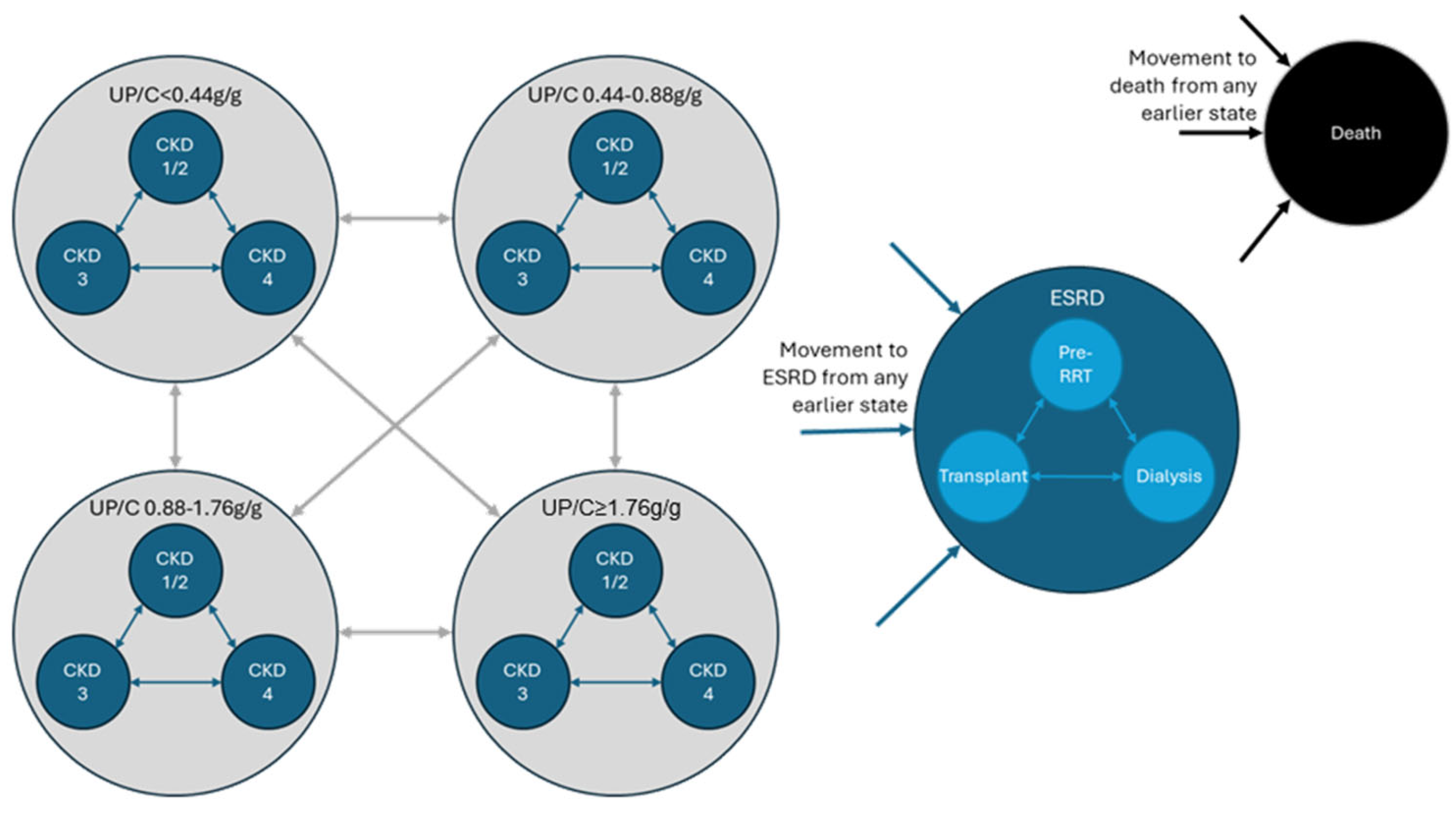
Figure 2.
Model validation results. Abbreviations: ESRD, end-stage renal disease; UPCR, urine protein/creatinine ratio.
Figure 2.
Model validation results. Abbreviations: ESRD, end-stage renal disease; UPCR, urine protein/creatinine ratio.
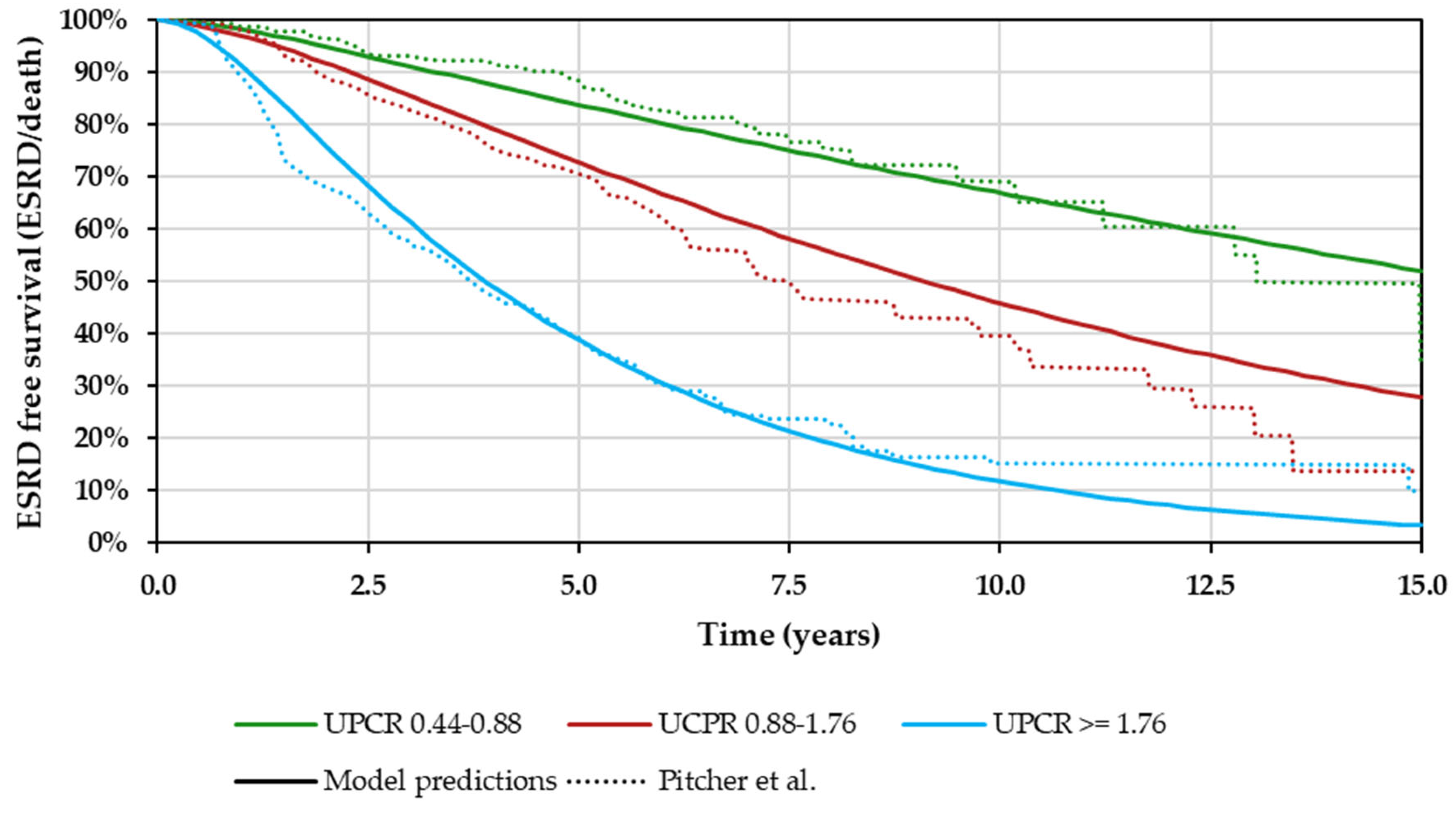
Figure 3.
Summary of life years gained by CKD stage/RRT modality. Abbreviations: CKD, chronic kidney disease; RRT, renal replacement therapy.
Figure 3.
Summary of life years gained by CKD stage/RRT modality. Abbreviations: CKD, chronic kidney disease; RRT, renal replacement therapy.
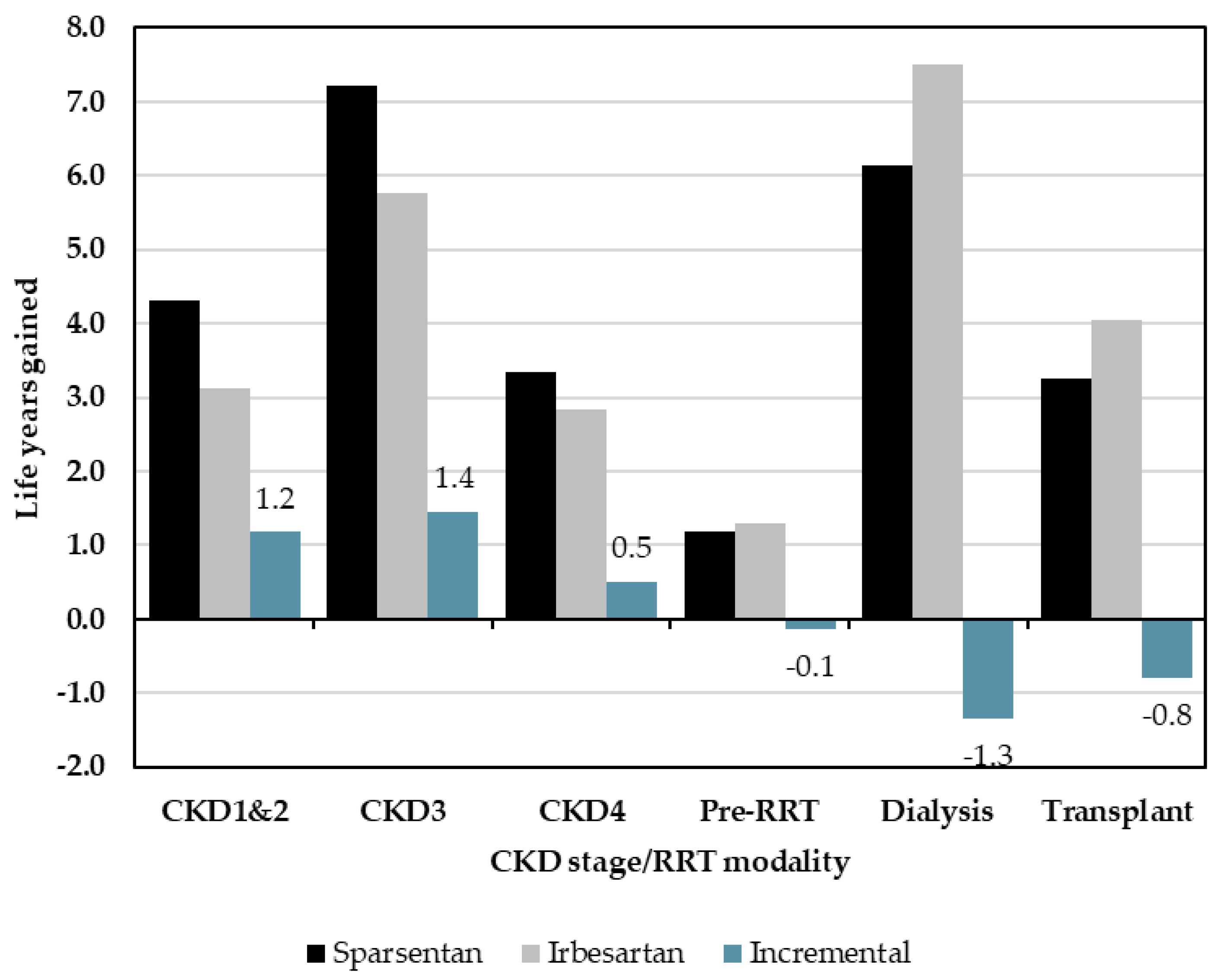

Table 1.
Patient characteristics (N=404).
| Characteristic | Value |
|---|---|
| Age (mean) | 46 years |
| Sex (male) | 69.8% |
| Weight (mean) | 84 kg |
| CKD1&2 (g/g 0-<0.44) | 1.24% |
| CKD3 (g/g 0-<0.44) | 1.24% |
| CKD4 (g/g 0-<0.44) | 0.25% |
| CKD1&2 (g/g 0.44-<0.88) | 9.16% |
| CKD3 (g/g 0.44-<0.88) | 15.10% |
| CKD4 (g/g 0.44-<0.88) | 1.24% |
| CKD1&2 (g/g 0.88-<1.76) | 18.32% |
| CKD3 (g/g 0.88-<1.76) | 25.25% |
| CKD4 (g/g 0.88-<1.76) | 1.98% |
| CKD1&2 (g/g >=1.76) | 7.92% |
| CKD3 (g/g >=1.76) | 16.83% |
| CKD4 (g/g >=1.76) | 1.49% |
Abbreviations: CKD, chronic kidney disease. Percentages refer to the proportion of the overall population that fits into a specific category.
Table 2.
KDIGO CKD stages used in the economic model.
| CKD Stage | eGFR 1 |
|---|---|
| CKD1, CKD2 | ≥60 |
| CKD3 | 30-59 |
| CKD4 | 15-29 |
| CKD5 (ESRD) | <15 |
1 mL/min/1.73 m2. Abbreviations: CKD, chronic kidney disease; ESRD, end-stage renal disease.
Table 3.
Disutilities applied to adverse events.
| Adverse Event Type | Mean Disutility |
|---|---|
| Metabolism and nutrition disorders | 0.00 |
| Nervous system disorders | -0.07 |
| Vascular disorders | -0.10 |
| Investigations | 0.00 |
| General disorders and administration site conditions | 0.00 |
| Gastrointestinal disorders | -0.05 |
| Renal and urinary disorders | -0.10 |
Adverse event types categorised according to System Organ Class.
Table 4.
Mortality hazard ratios.
| CKD stage | Mortality HR |
|---|---|
| CKD1, CKD2 | 1.00 |
| CKD3 | 1.55 |
| CKD4 | 2.80 |
| ESRD pre-RRT | 4.60 |
| ESRD dialysis 1 | 6.96 |
| ESRD transplant | 1.40 |
1 Values for dialysis comprised of weighted average of peritoneal dialysis (12.6%) and haemodialysis (87.4%), sourced from the UKRR. Abbreviations: CKD, chronic kidney disease; ESRD, end-stage renal disease; RRT, renal replacement therapy.
Table 5.
Cooper et al. utility values.
| CKD stage | Mean | Standard error |
|---|---|---|
| CKD1, CKD2 | 0.85 | 0.08 |
| CKD3 | 0.80 | 0.08 |
| CKD4 | 0.74 | 0.06 |
| ESRD pre-RRT | 0.44 | 0.01 |
| ESRD dialysis 1 | 0.44 | 0.032 |
| ESRD transplant | 0.71 | 0.019 |
1 Values for dialysis comprised of weighted average of peritoneal dialysis (12.6%) and haemodialysis (87.4%), sourced from the UKKR. Abbreviations: CKD, chronic kidney disease; ESRD, end-stage renal disease; RRT, renal replacement therapy.
Table 6.
Summary of modelled health outcomes.
| Sparsentan | Irbesartan | Incremental | |
|---|---|---|---|
| Life years | |||
| Pre-ESRD | 14.87 | 11.72 | 3.14 |
| Pre-RRT | 1.18 | 1.30 | -0.12 |
| Dialysis | 6.15 | 7.49 | -1.34 |
| Transplant | 3.26 | 4.04 | -0.79 |
| Total | 25.45 | 24.56 | 0.89 |
| Quality-adjusted life years | |||
| Pre-ESRD | 8.43 | 6.95 | 1.48 |
| Pre-RRT | 0.82 | 0.92 | -0.09 |
| Dialysis | 2.60 | 3.18 | -0.58 |
| Transplant | 2.11 | 2.63 | -0.52 |
| AEs | -0.13 | -0.08 | -0.05 |
| Total | 16.87 | 15.72 | 1.16 |
Abbreviations: AE, adverse event; ESRD, end-stage renal disease; RRT, renal replacement therapy.
Disclaimer/Publisher’s Note: The statements, opinions and data contained in all publications are solely those of the individual author(s) and contributor(s) and not of MDPI and/or the editor(s). MDPI and/or the editor(s) disclaim responsibility for any injury to people or property resulting from any ideas, methods, instructions or products referred to in the content. |
© 2026 by the authors. Licensee MDPI, Basel, Switzerland. This article is an open access article distributed under the terms and conditions of the Creative Commons Attribution (CC BY) license.
Copyright: This open access article is published under a Creative Commons CC BY 4.0 license, which permit the free download, distribution, and reuse, provided that the author and preprint are cited in any reuse.


