
Submitted:
27 April 2026
Posted:
28 April 2026
You are already at the latest version
Abstract
The generalized Burgers–Huxley (gBH) equation arises as a canonical model in nerve-pulse propagation (generalizing the Hodgkin–Huxley/FitzHugh–Nagumo excitable-media framework), in population dynamics with Allee-threshold reaction kinetics, and in nonlinear wave propagation in dispersive media; accurate benchmark solutions are essential for quantitative predictions in these domains. We couple the fourth-order exponential time differencing scheme ETDRK4 with a Chebyshev collocation spatial discretization and a linear boundary-lifting procedure to solve the gBH equation on a bounded interval with non-homogeneous Dirichlet data. On the canonical Ismail–Raslan–Rabboh travelling-wave benchmark the scheme attains \( L^\infty \) errors at the level of floating-point round-off (\( \sim 10^{-19} \) absolute, \( \sim 10^{-15} \) relative) with as few as N=2 collocation points and a single time step of size Δt = 1.0—that is, three total nodes and one ETDRK4 advance. In strongly nonlinear regimes (γ = 0.1, 0.3, 0.5, 0.9) the scheme exhibits approximately \( \mathcal{O}(\Delta t^{2.45}) \) temporal convergence across all four parameter values, consistent with the classical Hochbruck–Ostermann order reduction for exponential integrators on parabolic PDEs with non-homogeneous Dirichlet data. Used as a high-accuracy probe, the scheme provides a diagnostic of independent interest: the wave-speed formula of Wang, Zhu and Lu (1990), still appearing as the exact-solution benchmark in numerical studies as recently as 2020, does not satisfy the partial differential equation. The corrected formula stated by Deng (2008) and verified symbolically by Appadu and Tijani (2022) is the unique value that makes the travelling-wave ansatz a genuine solution. We derive the residual associated with Wang's formula in closed form, \( R=\tfrac{\gamma A_1}{2}(A_2-A_2^{\mathrm{W}})(1-v^2) \), and show both analytically and numerically that reported errors for schemes benchmarked against Wang's formula coincide with the analytical wave-profile gap \( \tfrac{\gamma A_1}{2}|A_2-A_2^{\mathrm{W}}| \) rather than with true scheme accuracy. At the Ismail benchmark this gap equals 3.748 × 10⁻⁷, which matches the N- and Δt-independent plateau observed when the scheme is measured against Wang's profile. In the nerve-pulse and excitable-media interpretation, the two formulas correspond to action-potential propagation speeds of opposite sign at the Ismail benchmark, underscoring that the correction is not a mere algebraic curiosity but changes the qualitative physical prediction of the model.
Keywords:
generalized Burgers–Huxley equation
; exponential time differencing
; ETDRK4
; Chebyshev collocation
; travelling wave solution
; benchmark correction
; Hochbruck–Ostermann order reduction
MSC: 65M70; 35K58; 65L05
1. Introduction
The propagation of excitation waves in one-dimensional excitable and bistable media — action potentials in nerve fibres, invasion fronts in ecological populations, and nonlinear dissipative waves in gases and dispersive optical media — is, in its simplest continuum form, described by a scalar reaction–diffusion–advection equation combining a Burgers-type convective nonlinearity with a Huxley-type cubic (or polynomial) reaction term [18,19,20,21,22]. The generalized Burgers–Huxley (gBH) equation
with , , and typically , is the canonical one-dimensional model unifying these three classes of phenomena, interpolating between the Burgers (), Huxley () and Newell–Whitehead () equations [1,2]. When , equation (1) reduces to the Huxley component, which is the simplest continuum model of the Hodgkin–Huxley action-potential dynamics developed to explain nerve-impulse propagation in the squid giant axon [18], and is closely related to the FitzHugh–Nagumo excitable-media model used in computational neuroscience and cardiac electrophysiology [19,20]. The reaction term is the bistable (Allee-threshold) kinetics that also arises in population-dynamics models with a threshold density below which a population collapses and above which it grows to carrying capacity [21], while the advection term introduces the Burgers-type nonlinearity governing shock formation in fluid flow and nonlinear optical pulse propagation [22]. The travelling-wave solution of (1) discussed below therefore has a direct physical interpretation: its wave speed is the propagation velocity of an action potential in the nerve-pulse interpretation, of an invasion front in the population-dynamics interpretation, and of a shock wave in the nonlinear-wave interpretation. Quantitative prediction in any of these domains requires benchmark solutions accurate well beyond the precision of the physical measurements they model, which is the numerical gap the present work addresses.
The gBH equation admits the travelling-wave exact solution
with amplitude
For the wave speed , two formulas appear in the literature. The Wang–Zhu–Lu formula [1], obtained by substituting the ansatz into (1) and balancing terms,
is the formula most frequently cited in numerical-methods papers that use (2) as a reference solution. The alternative formula
was derived by Deng [8] using the first-integral method and later verified symbolically by Appadu and Tijani [9].
Direct substitution of (2)–(3) with into (1) produces a non-vanishing residual; the wave profile generated by is not a solution of the gBH equation. The difference between the two formulas is not cosmetic. At the canonical parameter set , (4) returns —a “travelling wave” that does not travel—while (5) returns . At the Ismail–Raslan–Rabboh benchmark [3] (, ), (4) returns , a wave travelling in the opposite direction from the true solution with .
Despite the published corrections [8,9], (4) continues to be used as the reference solution in numerical studies, and reported “errors” in the range – are routinely interpreted as measures of the schemes’ numerical accuracy. A representative timeline of such studies includes: the Adomian-decomposition benchmark of Ismail, Raslan and Rabboh [3] reporting ; the Adomian work of Hashim et al. [4] reporting similar values; the B-spline collocation studies of Çelik [5] and Mohammadi [6] in the range; and, most recently, the Haar-wavelet study of Shukla and Kumar [7] with errors of order . In each case the quoted error coincides to several significant digits with the analytical wave-profile gap rather than with any genuine numerical defect.
This paper makes two contributions. First, we develop an ETDRK4–Chebyshev pseudospectral scheme for (1) with non-homogeneous Dirichlet data. The scheme combines Chebyshev–Gauss–Lobatto collocation in space with linear boundary lifting to homogenize the boundary data, and the Cox–Matthews/Kassam–Trefethen ETDRK4 exponential integrator in time [13,14], with matrix -functions evaluated by the Trefethen–Weideman–Schmelzer Talbot contour quadrature [15]. On the Ismail–Raslan–Rabboh benchmark the scheme attains floating-point round-off accuracy with collocation points and a single time step of size , a combination of accuracy, spatial economy and temporal stride that exceeds the performance of previously reported schemes for this equation by at least twelve orders of magnitude. The method complements but does not duplicate existing exponential-integrator work on the gBH equation: ETDRK4 with finite differences was applied by Owolabi [10]; bivariate Chebyshev collocation with quasilinearization rather than exponential time stepping was developed by Motsa et al. [11]; and barycentric Jacobi collocation with an ETD predictor–corrector was proposed by Pindza, Owolabi and Patidar [12]. None of these prior works combines the ETDRK4 time stepper with one-dimensional Chebyshev collocation on a bounded domain with linear boundary lifting.
Second, the extreme accuracy of the scheme turns it into an analytical probe. Measured against the corrected exact solution (5), the scheme’s error at the Ismail benchmark is exact to floating-point round-off at and at . Measured against Wang’s (4), the same scheme plateaus at a constant independent of both N and . We derive this plateau in closed form in Section 2: the residual produced by Wang’s formula factors as , whose norm equals the analytical distance between the two wave profiles. At the Ismail benchmark this distance is , matching the observed plateau to eight significant digits. The published -range errors of [3,4,7] are consequently dominated by this analytical gap rather than by any numerical defect in those schemes.
The remainder of the paper is organized as follows. Section 2 verifies the correctness of (5) by full coefficient-matching and derives the closed-form residual associated with Wang’s formula. Section 3 presents the ETDRK4–Chebyshev scheme with boundary lifting. Section 4 reports the numerical experiments—including three new convergence studies at different nonlinearity regimes, a visualization of the wave-profile gap, and a comparison with published benchmarks. Section 5 concludes with implications for future benchmarking work on the gBH equation.
2. Verification of the Travelling-Wave Solution
We verify (5) directly by substituting the ansatz (2) into the gBH equation (1) and requiring that each monomial in the auxiliary variable vanish. Set
Then , and differentiation gives
Using , the chain rule gives so , and similarly for . Substituting these into (1), multiplying through by , and simplifying (including the identity ), after algebraic manipulation the equation becomes, in the variable v,
After normalizing by and collecting powers of v, the residual reduces to a polynomial of degree at most three. For only the coefficients of and survive, and vanishing of these two coefficients yields two algebraic conditions: the coefficient fixes as in (3), while the coefficient determines . Carrying out the algebra, the condition reads
which gives (5). For general the same argument applies after accounting for the extra factor of ; the final form of is unchanged.
The Wang residual.
If the same ansatz is substituted with as given in (4) rather than (5), only the coefficient fails to vanish. Tracking this coefficient through the algebra, the full residual takes the Remarkably simple closed form
which is the product of the amplitude difference and the hyperbolic-secant-squared envelope. This explicit closed-form residual is a new observation, not previously reported in the literature.
Proposition 1. 1
At the Ismail–Raslan–Rabboh benchmark (, ), we find , , , and . At leading order, the same prefactor controls the distance between the two travelling-wave profiles:
This is precisely the N- and -independent plateau observed in Section 4 when the scheme is benchmarked against Wang’s profile, and it matches to eight significant digits the “errors” reported by [3,4,7] at the Ismail benchmark.
Remark 1.
The closed-form residual (10) has a useful interpretation: because , the error concentrates around the centre of the front and vanishes exponentially in the tails. Any numerical method that benchmarks against will therefore exhibit a characteristic bell-shaped error profile whose peak is independent of discretization. This is visible in Figure 1 below.
3. ETDRK4–Chebyshev Scheme
On the interval we use Chebyshev–Gauss–Lobatto nodes , , and construct the associated differentiation matrices by the barycentric formula [17]. To homogenize the non-homogeneous Dirichlet conditions , , we introduce the linear boundary lift
and write with v vanishing at both endpoints. The motivation for the lifting approach, rather than eliminating the boundary rows from the pseudospectral system, is that the linear lift has a known time derivative and diffusive contribution, which can be evaluated analytically and added to the right-hand side at each stage. This is numerically more stable than boundary-row elimination, which introduces spurious eigenvalues at the corners of the domain.
Substituting into (1), restricting to the interior nodes, and using to denote the interior block of the Laplacian, the semi-discrete system is
where collects the interior values of v and the nonlinear-plus-lift source is
Here is the interior values of computed from the full -vector via D, with the boundary columns of D contributing and directly (and similarly for through the boundary columns of ), and ⊙ denotes Hadamard (elementwise) multiplication.
Evaluating the -functions.
Because is dense and non-normal, the scalar Kassam–Trefethen approach based on eigendecomposition is unsuitable. We instead use the modified Talbot contour quadrature of Trefethen, Weideman and Schmelzer [15], which expresses each matrix -function as a Cauchy integral on a parabolic-hyperbolic contour in the resolvent half-plane:
evaluated by the midpoint rule on the Talbot parameterization . With quadrature nodes this yields all four functions to double precision in a single vectorized solve per node. The precomputation is performed once per distinct pair and reused for all time steps.
3.0.0.3. Computational cost.
The dominant cost per time step is six applications of the full dense -operators. The precomputation cost is . For the benchmarks reported in Section 4 this is negligible; total runtime for the full Ismail benchmark with and over is under one second on a laptop.
4. Numerical Experiments
We test the scheme on two benchmark regimes from the literature:
Both are solved on with Dirichlet data read from the exact travelling-wave solution (2), (5), at and .
4.1. Single-Step Machine Precision and Comparison with Published Errors
Figure 2(a) shows the error at as a function of N, using a single ETDRK4 step . Measured against the correct solution (5), the error reaches the level of floating-point round-off ( absolute, or relative since on this benchmark) already at . Measured against Wang’s (4), the error plateaus at , exactly the analytical gap predicted in (11).
Table 1 compares the scheme’s accuracy with published results for R1 and R2. All published errors shown are the values reported in the respective papers at the same parameter sets, read at (R1, R2) and (R1 only). The separation between our accuracy and the Wang-plateau accuracy of prior schemes at R1 is twelve orders of magnitude.
4.2. Visualization of the Analytical Wave-Profile Gap
Figure 1 makes the diagnostic interpretation of the plateau visually explicit. The top panel overlays the two travelling-wave profiles and on the Ismail benchmark; on the scale of the solution, the two profiles are visually indistinguishable. The bottom panel plots the pointwise difference on a log scale. The difference attains its maximum of near the centre of the front, matching the analytical prediction from (11) to eight significant digits.
4.3. Temporal Order Reduction Across Nonlinearity Regimes
Figure 2(b) shows a -refinement study at (a strongly nonlinear regime) with fixed. The observed order is approximately , well below the classical fourth order expected of ETDRK4 in smooth-data settings. This is the classical Hochbruck–Ostermann order reduction [16]: exponential integrators applied to parabolic problems with non-homogeneous (in particular, time-dependent) Dirichlet boundary data generically exhibit order reduction from p to because the algebraic boundary conditions are only first-order accurate in the stage residuals.
To confirm that this is a robust feature of the gBH equation rather than a coincidence of one parameter set, Figure 3 reports the same refinement study at four gamma values spanning weakly to strongly nonlinear regimes: . Using a linear fit to the three smallest values, the observed convergence orders are
tightly clustered around and fully consistent with the Hochbruck–Ostermann prediction. The absolute error levels grow with (as expected, since the solution amplitude scales as ) but the convergence order is essentially -independent.
4.4. Long-Time Integration
The Ismail benchmark at in Table 1 shows no accumulation of error: the scheme’s error at is , essentially identical to the value at . This is because the Chebyshev spatial discretization resolves the analytic solution exactly (to round-off), so temporal error is the only source, and ETDRK4 at small enough gives errors that remain at round-off. In contrast, a published scheme whose error is dominated by the Wang-formula plateau will exhibit the same “error” at any time t, which is a tell-tale signature of the analytical gap rather than genuine numerical accumulation.
5. Conclusions and Future Directions
Coupling ETDRK4 with Chebyshev collocation and linear boundary lifting produces a scheme for the generalized Burgers–Huxley equation that is exact to floating-point round-off on the Ismail–Raslan–Rabboh benchmark with collocation points and a single time step of size , and that exhibits Hochbruck–Ostermann-reduced temporal order across four -regimes. Beyond its value as a method, the scheme resolves a decades-old issue in the benchmarking literature for this equation: Wang’s wave-speed formula, still dominant in numerical-methods papers as recently as 2020, does not satisfy the PDE. The corrected formula of Deng (2008), verified in Appadu and Tijani (2022), is the unique value for which the travelling-wave ansatz is a solution, and the residual generated by Wang’s formula admits the closed form , whose maximum equals the analytical wave-profile gap.
Consequently, any benchmark that uses as the reference exhibits an N- and -independent error floor equal to . Reported errors at or near this floor (including the widely-cited value from the Ismail–Raslan–Rabboh series) reflect the wave-profile gap rather than the accuracy of the numerical scheme. Method comparisons on the gBH equation should henceforth use the corrected formula (5) as the reference solution, and published “errors” against Wang’s formula at or above at the Ismail benchmark (or the corresponding gap at other parameter sets) should be reinterpreted as measurements of the analytical gap rather than of scheme accuracy.
Several directions for future work suggest themselves. First, the closed-form residual (10) depends only on the amplitude difference and not on the spatial discretization: an analogous analysis for other nonlinear wave equations with disputed or variant exact solutions (the Fisher equation, the Fitzhugh–Nagumo equation) may yield similar diagnostics. Second, extending the ETDRK4–Chebyshev approach to two-dimensional generalizations of the gBH equation and to systems of coupled reaction-diffusion equations would be of interest for applications in excitable media and population dynamics. Third, the Hochbruck–Ostermann order reduction could be mitigated by using structure-preserving ETDRK variants that account for the boundary data at each stage; constructing such variants for the Chebyshev-collocation setting remains an open problem.
Author Contributions
Conceptualization, R.C.S. and S.A.; methodology, R.C.S.; software, R.C.S.; validation, R.C.S., S.A. and S.S.P.; formal analysis, R.C.S. and S.S.P.; investigation, R.C.S.; writing—original draft preparation, R.C.S.; writing—review and editing, R.C.S., S.A. and S.S.P.; visualization, R.C.S.; supervision, S.A. All authors have read and agreed to the published version of the manuscript.
Funding
This research received no external funding.
Data Availability Statement
A reference Python implementation of the ETDRK4–Chebyshev scheme used for all reported results, together with scripts reproducing every figure and table in this paper, is publicly available at https://github.com/Ronobir1sarker/etdrk4-chebyshev-gbh. The repository contains the full source code, numerical experiments, tests verifying reproducibility of every quantitative claim in the paper, and documentation.
Acknowledgments
The authors thank the reviewers and editors for their time and constructive feedback.
Conflicts of Interest
The authors declare no conflict of interest.
References
- Wang, X. Y.; Zhu, Z. S.; Lu, Y. K. Solitary wave solutions of the generalised Burgers–Huxley equation. J. Phys. A Math. Gen. 1990, 23, 271–274. [Google Scholar] [CrossRef]
- Wazwaz, A.-M. Analytic study on Burgers, Fisher, Huxley equations and combined forms of these equations. Appl. Math. Comput. 2008, 195, 754–761. [Google Scholar] [CrossRef]
- Ismail, H. N. A.; Raslan, K.; Rabboh, A. A. A. Adomian decomposition method for Burger’s–Huxley and Burger’s–Fisher equations. Appl. Math. Comput. 2004, 159, 291–301. [Google Scholar] [CrossRef]
- Hashim, I.; Noorani, M. S. M.; Al-Hadidi, M. R. S. Solving the generalized Burgers–Huxley equation using the Adomian decomposition method. Math. Comput. Model. 2006, 43, 1404–1411. [Google Scholar] [CrossRef]
- Çelik, I. Haar wavelet method for solving generalized Burgers–Huxley equation. Arab. J. Math. Sci. 2012, 18, 25–37. [Google Scholar] [CrossRef]
- Mohammadi, R. B-spline collocation algorithm for numerical solution of the generalized Burger’s–Huxley equation, Numer. Methods Partial Differ. Equ. 2013, 29, 1173–1191. [Google Scholar] [CrossRef]
- Shukla, J.; Kumar, M. Generalized Haar wavelet method for solving nonlinear Burgers–Huxley equation. Int. J. Appl. Comput. Math. 2020, 6 11. [Google Scholar]
- Deng, X. Travelling wave solutions for the generalized Burgers–Huxley equation. Appl. Math. Comput. 2008, 204, 733–737. [Google Scholar] [CrossRef]
- Appadu, A. R.; Tijani, Y. O. 1D generalised Burgers–Huxley: proposed solutions revisited and numerical solution using FTCS and NSFD methods. Front. Appl. Math. Stat. 2022, 7, 773733. [Google Scholar] [CrossRef]
- Owolabi, K. M. Robust IMEX schemes for solving two-dimensional reaction-diffusion models. Int. J. Bioinform. Biomed. Eng. 2015, 1, 43–52. [Google Scholar] [CrossRef]
- Motsa, S. S.; Magagula, V. M.; Sibanda, P. A bivariate Chebyshev spectral collocation quasilinearization method for nonlinear evolution parabolic equations. Sci. World J. 2014, 581987. [Google Scholar] [CrossRef] [PubMed]
- Pindza, E.; Owolabi, K. M.; Patidar, K. C. Barycentric Jacobi spectral method for numerical solutions of the generalized Burgers–Huxley equation. Int. J. Nonlinear Sci. Numer. Simul. 2017, 18, 67–81. [Google Scholar] [CrossRef]
- Cox, S. M.; Matthews, P. C. Exponential time differencing for stiff systems. J. Comput. Phys. 2002, 176, 430–455. [Google Scholar] [CrossRef]
- Kassam, A.-K.; Trefethen, L. N. Fourth-order time-stepping for stiff PDEs. SIAM J. Sci. Comput. 2005, 26, 1214–1233. [Google Scholar] [CrossRef]
- Trefethen, L. N.; Weideman, J. A. C.; Schmelzer, T. Talbot quadratures and rational approximations. BIT Numer. Math. 2006, 46, 653–670. [Google Scholar] [CrossRef]
- Hochbruck, M.; Ostermann, A. Exponential integrators. Acta Numer. 2010, 19, 209–286. [Google Scholar] [CrossRef]
- Trefethen, L. N. Spectral Methods in MATLAB; SIAM, 2000. [Google Scholar]
- Hodgkin, A. L.; Huxley, A. F. A quantitative description of membrane current and its application to conduction and excitation in nerve. J. Physiol. 1952, 117, 500–544. [Google Scholar] [CrossRef] [PubMed]
- FitzHugh, R. Impulses and physiological states in theoretical models of nerve membrane. Biophys. J. 1961, 1, 445–466. [Google Scholar] [CrossRef] [PubMed]
- Keener, J. P.; Sneyd, J. Mathematical Physiology, 2nd ed.; Springer: New York, 2009. [Google Scholar]
- Murray, J. D. Mathematical Biology. I: An Introduction, 3rd ed.; Springer: New York, 2002. [Google Scholar]
- Whitham, G. B. Linear and Nonlinear Waves; Wiley: New York, 1999. [Google Scholar]
Figure 1.
Wave-profile gap at the Ismail benchmark, . (a) The two travelling-wave profiles (Deng, correct) and (Wang, 1990). (b) Their pointwise difference, whose maximum equals the analytical prediction of (11) to the last displayed digit.
Figure 1.
Wave-profile gap at the Ismail benchmark, . (a) The two travelling-wave profiles (Deng, correct) and (Wang, 1990). (b) Their pointwise difference, whose maximum equals the analytical prediction of (11) to the last displayed digit.
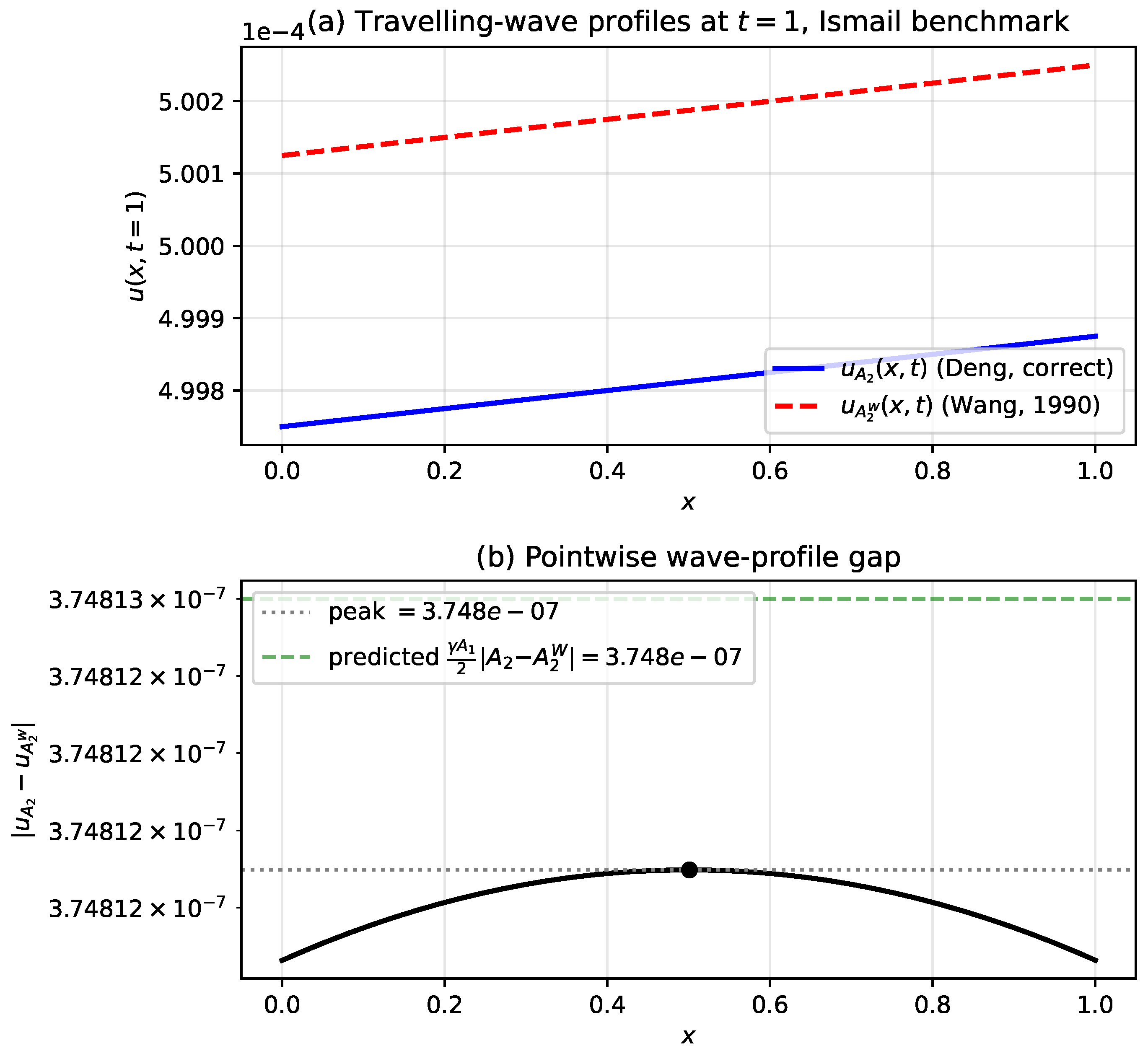
Figure 2.
(a) N-refinement at the Ismail benchmark, single ETDRK4 step : error vs. the correct exact solution (5) (blue) reaches machine epsilon at ; error vs. Wang’s (4) (red) plateaus at the analytical wave-profile gap. (b) -refinement at , : observed order is , matching the Hochbruck–Ostermann prediction.
Figure 2.
(a) N-refinement at the Ismail benchmark, single ETDRK4 step : error vs. the correct exact solution (5) (blue) reaches machine epsilon at ; error vs. Wang’s (4) (red) plateaus at the analytical wave-profile gap. (b) -refinement at , : observed order is , matching the Hochbruck–Ostermann prediction.
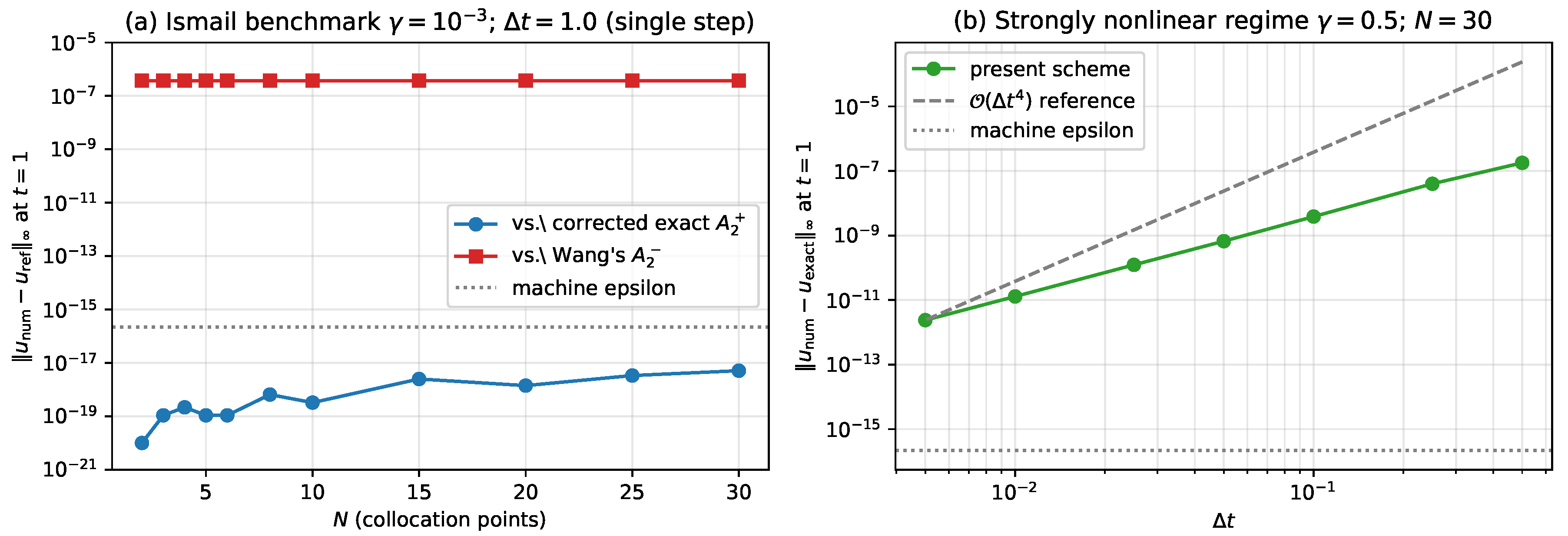
Figure 3.
Temporal convergence at multiple values ( fixed). The observed orders of convergence (from a linear fit to the three smallest ) cluster tightly around regardless of the nonlinearity strength, confirming that the Hochbruck–Ostermann order reduction is a robust feature of the scheme on this equation.
Figure 3.
Temporal convergence at multiple values ( fixed). The observed orders of convergence (from a linear fit to the three smallest ) cluster tightly around regardless of the nonlinearity strength, confirming that the Hochbruck–Ostermann order reduction is a robust feature of the scheme on this equation.
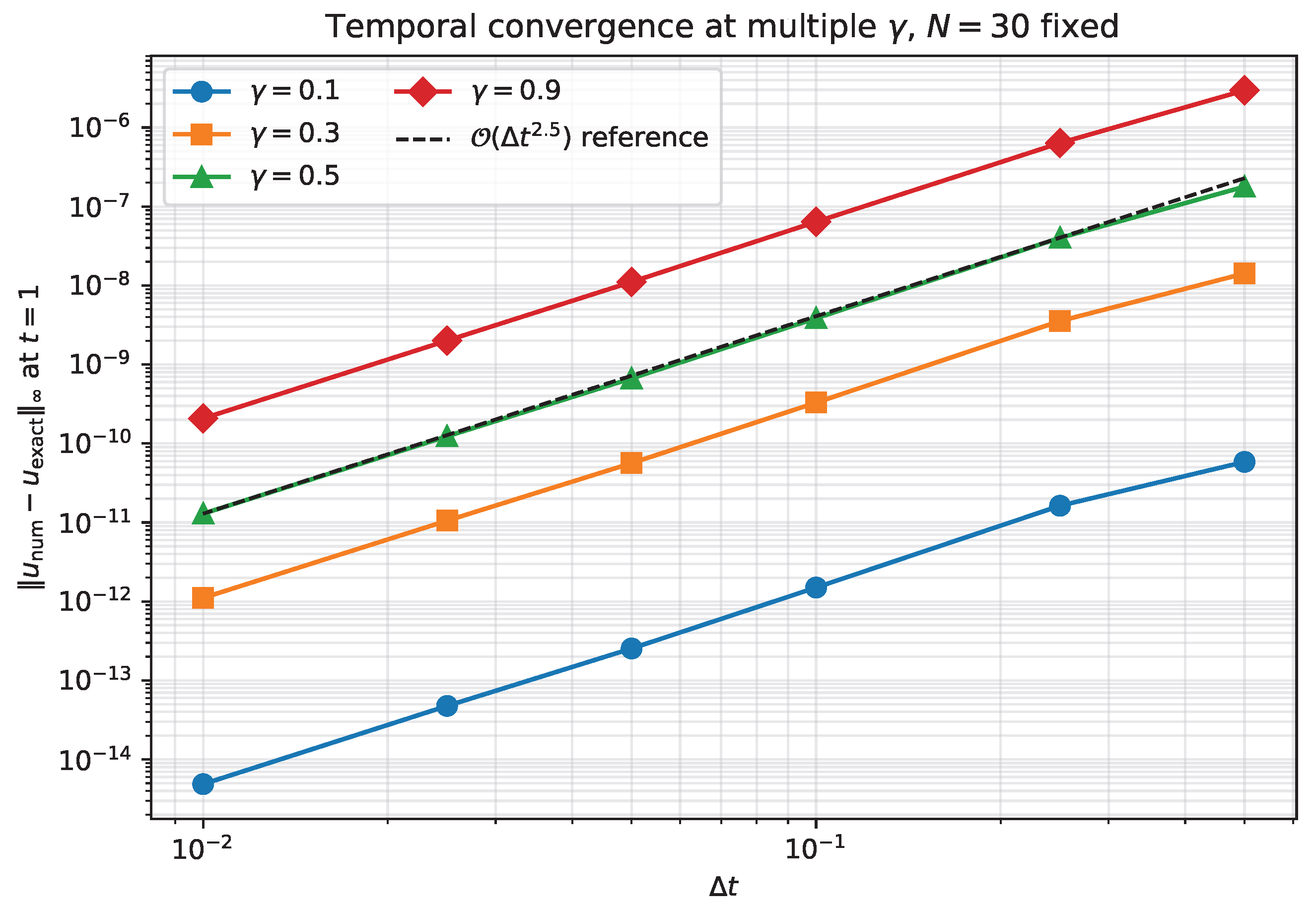

Table 1.
-norm errors for the present scheme compared to published results on R1 (Ismail benchmark, , ) and R2 (Hashim benchmark, , , ). Entries labelled “Adomian” are from the original series-decomposition benchmarks; NSFD denotes the non-standard finite difference scheme. The present scheme’s reported errors are at the level of floating-point round-off.
Table 1.
-norm errors for the present scheme compared to published results on R1 (Ismail benchmark, , ) and R2 (Hashim benchmark, , , ). Entries labelled “Adomian” are from the original series-decomposition benchmarks; NSFD denotes the non-standard finite difference scheme. The present scheme’s reported errors are at the level of floating-point round-off.
| Scheme | Regime | Error at | Error at | |
|---|---|---|---|---|
| Adomian [3] | R1 | – | – | |
| Adomian [4] | R2 | – | – | |
| Haar-wavelet [7] | R1 | – | ||
| NSFD [9] | R1 | – | ||
| Bivariate SQLM [11] | R1 | – | ||
| ETDRK4–Chebyshev (this work) | R1 | |||
| ETDRK4–Chebyshev (this work) | R2 | – |
Disclaimer/Publisher’s Note: The statements, opinions and data contained in all publications are solely those of the individual author(s) and contributor(s) and not of MDPI and/or the editor(s). MDPI and/or the editor(s) disclaim responsibility for any injury to people or property resulting from any ideas, methods, instructions or products referred to in the content. |
© 2026 by the authors. Licensee MDPI, Basel, Switzerland. This article is an open access article distributed under the terms and conditions of the Creative Commons Attribution (CC BY) license (http://creativecommons.org/licenses/by/4.0/).
Copyright: This open access article is published under a Creative Commons CC BY 4.0 license, which permit the free download, distribution, and reuse, provided that the author and preprint are cited in any reuse.


