
Submitted:
26 April 2026
Posted:
27 April 2026
You are already at the latest version
Abstract
Purpose: This research intends to explore the relationships between digital risk management practices and the successful implementation of innovative banking services with moderation effect of digital capabilities and moderation effect of digital culture. Methodology Approach: In this study, the data was gathered using a quantitative approach and the cross-sectional survey method with responses from participants who were chosen as the unit of analysis of being investigated for the study. Islamic finance institutions in Jordan were used as the unit of analysis in this study. Responses of different Islamic finance institutions were surveyed in a structured manner to collect data. The current study then used a structural equation modeling using SmartPLS to investigate the relationship between the variables. Findings: The results show that utilizing digital risk management advanced analytics artificial intelligence and automated compliance systems is essential to fostering innovation while upholding Shariah compliance. The study also shows that efficient digital risk management boosts users confidence increases service effectiveness and facilitates the launch of cutting-edge Shariah-compliant products. The findings reveal meditation and moderation significant effect of digital capabilities and digital culture respectively among between digital risk management and innovative banking services. Originality: By investigating digital risk management in the particular context of Islamic innovative banking services, this study provides novel insight. In contrast to earlier research that focuses on innovation in Islamic finance or digital risk management in conventional banking independently this paper examines how digital risk management frameworks impact the creation governance and sustainability of innovative banking services that adhere to Shariah.
Keywords:
digital risk management
; innovation
; banking services
; Islamic finance institutions
; mediaton-moderation
Introduction
In an era characterized by rapid technological advancement and digital transformation, financial institutions worldwide are redefining their operational strategies to compete effectively in an increasingly competitive marketplace (Kotarba, 2023). Islamic finance institutions, governed by principles that prohibit interest (riba) and emphasize ethical investments, are no exception to this digital shift. As Islamic finance institutions seek to enhance service delivery and customer experience, they embrace innovative digital banking services such as mobile banking platforms, automated Sharia-compliant financial products, artificial intelligence (AI)-driven advisory tools, and blockchain-based solutions (Ifedayo et al., 2025). These technologies provide significant opportunities to expand market reach, reduce operational costs, and improve financial inclusion. However, they also introduce complex forms of digital risks that can undermine the stability and trust that are central to Islamic finance (Ahmed et al., 2024).
Digital risk management has emerged as a critical discipline that enables financial institutions to identify, assess, and mitigate risks associated with digital transformation. These risks include but are not limited to cybersecurity threats, data privacy breaches, technological failures, and compliance challenges tied to both regulatory standards and Sharia governance (Toshtemirovich, 2021). For Islamic finance institutions, the management of such risks is not solely a matter of regulatory compliance or financial prudence; it also intersects with ethical imperatives intrinsic to Sharia principles. As digital banking services evolve, Islamic financial institutions must therefore navigate a dual imperative: harnessing innovation to deliver efficient and competitive services while concurrently safeguarding the integrity, confidentiality, and trust of their systems within the framework of Islamic ethical values (Muslim, 2024).
Despite the increasing adoption of digital technologies in Islamic finance institutions, there remains a significant gap in academic literature regarding how effective digital risk management strategies influence the development and performance of innovative banking services (Mishchenko et al., 2021). Traditional risk management paradigms may not fully address the unique operational and ethical considerations faced by Islamic finance institutions, making specialized research essential. Understanding the impact of digital risk management on innovation in Islamic banking holds practical importance for policymakers, industry practitioners, technology vendors, and scholars alike (Afdawaiza et al., 2024).
Despite the growing interest in digital transformation within the financial sector, several significant gaps remain in the literature regarding the intersection of digital risk management, innovative banking services, and Islamic finance institutions (Ahmad et al., 2024). These gaps highlight areas that require deeper scholarly investigation to enhance both theoretical understanding and practical application. Limited focus on Islamic finance context which most existing studies on digital risk management and innovation are rooted in conventional banking environments, which operate under different ethical, regulatory, and risk frameworks (Mandych et al., 2023). Islamic finance institutions, governed by Sharia principles that prohibit interest (riba) and emphasize risk-sharing and ethical conduct, present unique risk profiles. However, there is scant research examining how digital risk management practices specifically align with the ethical and operational intricacies of Islamic finance, particularly in relation to innovative service delivery (Mohamed, 2021).
Insufficient analysis of digital risks in innovative services while several studies acknowledge the existence of digital risks in finance industry (e.g., cybersecurity threats, data breaches), few have systematically analyzed how these risks impact the adoption and performance of innovative Islamic banking services such as AI-enhanced products, and Sharia compliance automation tools (Andarwati et al., 2025). There is a need for empirical evidence that links specific categories of digital risks to the successful implementation and sustainability of such innovations. In addition, lack of integrated frameworks existing research often treats digital risk management and service innovation as separate domains, with limited integration into comprehensive frameworks that capture their dynamic interplay (Eckert & Hüsig, 2022).
This research intends to explore the relationships between digital risk management practices and the successful implementation of innovative banking services in Islamic finance institutions. It will examine how risk management frameworks can be optimized to support technological innovation without compromising the core ethical and compliance obligations of Islamic finance. By investigating this nexus, the study aims to contribute to both theoretical knowledge and practical strategies for enhancing innovation in Islamic financial services. Ultimately, this research aspires to provide insights that enable Islamic finance institutions to balance the opportunities and challenges of digital transformation in a manner that aligns with both modern banking demands and enduring Islamic financial principles.
Literature Review
The rapid digital transformation of the global financial sector has significantly reshaped risk management practices, service delivery models, and innovation capabilities within banking institutions. Islamic finance institutions, which operate under Shariah principles prohibiting interest (riba), excessive uncertainty (gharar), and speculative activities (maysir), face unique challenges and opportunities in adopting digital technologies (Saha et al., 2025). Digital risk management has emerged as a critical strategic function enabling banks to manage operational, financial, cyber, and Shariah-related risks while supporting innovation in banking services. Innovative banking services—such as digital Islamic banking platforms, fintech-based Shariah-compliant products, mobile banking, and AI-driven credit assessment—require robust risk management frameworks to ensure sustainability, compliance, and customer trust (Hassan et al., 2022).
This literature review synthesizes prior studies on digital risk management, innovation in banking services, and Islamic finance, and develops hypotheses linking digital risk management to innovative banking services in Islamic finance institutions (Mohd Haridan et al., 2023). Digital risk management refers to the use of digital technologies, data analytics, artificial intelligence (AI), blockchain, and automated systems to identify, assess, monitor, and mitigate risks in financial institutions (Jing, 2023). Unlike traditional risk management, digital risk management emphasizes real-time monitoring, predictive analytics, and integrated risk governance across operational, financial, cyber, regulatory, and reputational domains (Menezes & Rete, 2026). Scholars argue that digital risk management enhances organizational agility and resilience by enabling proactive rather than reactive risk mitigation. Technologies such as machine learning improve fraud detection, while cloud-based risk dashboards enhance transparency and decision-making speed (Abiodun et al., 2024).
In Islamic finance, risk management is inherently linked to Shariah compliance. Islamic finance institutions face additional risks such as Shariah non-compliance risk, displaced commercial risk, and equity investment risk (Ines & Adnene, 2025). Digital risk management tools can strengthen Shariah governance through automated compliance checks, smart contracts, and blockchain-enabled transparency. Studies suggest that digital risk management supports Islamic finance institutions in managing profit-and-loss sharing arrangements, monitoring asset-backed transactions, and ensuring ethical compliance (Sarwar, 2024). However, adoption levels vary due to regulatory constraints, lack of technical expertise, and concerns over Shariah permissibility of certain technologies.
Innovative banking services refer to the introduction of new or significantly improved financial products, processes, delivery channels, or business models that enhance customer value and operational efficiency (Yuryev et al., 2022). In the digital era, innovation is increasingly driven by fintech, big data, and platform-based banking ecosystems. In Islamic banking, innovation must align with Shariah principles, which influences product design and service delivery. Examples include digital mudarabah savings accounts, mobile zakat platforms, peer-to-peer Islamic financing, and blockchain-based takaful solutions (Mustapha et al., 2025). Previous studies highlight that innovation in Islamic banking is essential for competitiveness and financial inclusion. Digital innovation enables Islamic finance institutions to reach underserved populations, reduce transaction costs, and enhance customer experience (John, 2025). However, innovation in Islamic banking is often slower compared to conventional banks due to conservative governance structures and Shariah approval processes.
Empirical evidence suggests that technological capability, regulatory support, and risk management effectiveness are key determinants of successful innovation in Islamic finance institutions (Rashid et al., 2024). The literature increasingly recognizes risk management not as a constraint, but as an enabler of innovation. Effective digital risk management reduces uncertainty, enhances managerial confidence, and allows institutions to experiment with new digital products while maintaining control over potential risks (Kessler et al., 2024). In banking, strong digital risk management frameworks facilitate the safe adoption of fintech solutions, open banking, and digital platforms. For Islamic banks, digital risk management ensures that innovative services comply with Shariah requirements while maintaining financial stability (Nasution, 2025).
Empirical studies in conventional banking demonstrate a positive relationship between advanced risk management systems and service innovation. Banks with strong digital risk analytics are more likely to introduce mobile banking services, AI-based customer support, and digital lending platforms (Pattabhi, 2022). Although limited, existing research in Islamic finance indicates that institutions with robust governance and risk management structures show higher levels of product innovation and digital transformation. This suggests that digital risk management may play a significant role in fostering innovative banking services in Islamic finance institutions (Liaqat et al., 2025).
Over the past decade, Jordan has witnessed a remarkable transformation in its financial landscape driven by digital financial services evolution which has been influenced by a number of factors such as the increased use of smartphones. internet usage and the government efforts to promote financial inclusion (Raimi et al., 2024). Consequently, digital financial services have become a potent instrument for providing access to a larger portion of the populace as the financial services that were previously unattainable. The growth of branchless banking services has been one of the biggest trends. The companies have been essential in helping millions of people get basic financial services. Jordan people particularly those living in underdeveloped and rural areas these services enable users to conduct transactions through pay bills even receive remittances through mobile wallets significantly reducing the reliance on (Al-khawaja et al., 2025).
The kingdom implementation of the digital payment system is another significant development in Jordanians digital financial services environment. Peer-to-peer transactions and instantaneous inexpensive digital payments are made possible by this system which is anticipated to play a key role by providing a quicker and safer payment system (Hazar & Babuşcu, 2023). The expansion of digital financial services has also been greatly aided by the government and regulatory agencies. Projects such as the national financial inclusion strategy utilize digital technology these programs seek to integrate the unbanked population into the established financial system and the platforms lowering poverty and encouraging economic inclusion (Mbodj & Laye, 2025).
Another factor propelling Jordan’s digital financial services revolution is fintech startups. The companies are creating creative solutions such as microloans for small businesses that are suited to the demands of different market segments. The emergence of these fintechs has raised competition in addition to introducing new financial products that resulting in cheaper prices and improved services for customers (Kumari & Devi, 2022). Despite these developments Jordan’s digital financial services expansion still faces a number of obstacles including inadequate funding and literacy concerns about cyber security and problems with trust. However, with continued investment in digital infrastructure supportive regulatory frameworks and public campaigns for awareness these challenges can be surmounted (Webber et al., 2022). Furthermore, the expansion of digital financial services in Jordan is a major step in the right direction. a financial system that is inclusive. Jordan is utilizing technology to generate new economic opportunities especially for those who were previously shut out of the financial mainstream.
These insights are becoming more pertinent to Islamic banks even though a large portion of the larger literature on digital banking concentrates on risk impacts and response mechanisms in traditional settings. In order to protect digital services a systematic review of digital banking risk highlights the ongoing risks posed by cyberattacks and the implementation of security measures like encryption biometric authentication and AI-driven fraud detection (Aziz & Andriansyah, 2023). Additionally, literature indicates that Islamic banks digital inclusion results are different from those of their conventional counterparts. Digital financial services can improve access and lower some risks but they may not always increase stability because of customer resistance and compliance-related limitations when digital offerings don’t follow Islamic principles (Kamal et al., 2021). The literature highlights how digital innovation and risk management in Islamic banking are mutually reinforcing.
The risks associated with Islamic banks are more complicated and more varied than traditional banks as a result attributes of goods and services. The results claim that the cornerstone of Islamic banking is different from conventional banking where the main. Loans are used in conventional banks operations and interests on the basis of which Islamic banks operate on profit-loss sharing (Syahri & Harjito, 2020). The products of banks have created numerous risks, for example market risk credit risk liquidity risk and foreign exchange risk particular risks. Therefore, exposure to risks can endanger ones survival and success, the heavily reliant Islamic banking sector. the capacity to control risks (Archer & Haron, 2013). Moreover, the Islamic banks oversee risk sensibly and successfully identify the practice of risk management by measuring keeping an eye on and managing its nature.
Innovation and competitiveness in the banking industry especially in Islamic banking are now largely driven by digital capabilities. They indicate to an organizations capacity to implement integrate and reorganize digital skills infrastructure and technologies in order to generate value and provide cutting-edge financial services. The quick development of financial technologies which allow banks to offer quicker more flexible and customer-focused services has drastically changed the banking sector (Zhen et al., 2021). In Islamic banking however digital capabilities are even more crucial since organizations must make sure that innovations adhere to Sharia principles while still being efficient and competitive. Furthermore, research highlights the importance of digital capabilities in adapting to shifting consumer demands in the digital age. Islamic banks are forced to constantly improve their technological capabilities as a result of customers growing demands for seamless secure and real-time banking services (Proksch et al., 2024).
Despite their significance Islamic banks encounter obstacles in building their digital capabilities such as inadequate infrastructure a shortage of qualified personnel and regulatory limitations. These obstacles underscore the necessity of ongoing investment in digital transformation projects. The term digital culture describes the common values attitudes and behaviors that foster innovation digital transformation and technology adoption within an organization (Ly & Huong, 2024). It has a significant impact on how well digital capabilities are applied. Digital culture also affects how workers view and use new technologies. Innovation outcomes may be limited by a weak culture even in banks with sophisticated digital capabilities (Teguh et al., 2022). On the other hand, a positive digital culture encourages staff members to use digital tools to create new banking services.
Jordan’s Islamic finance institutions function in an increasingly digital world where cutting-edge digital payment systems online platforms mobile apps and fintech partnerships are revolutionizing the provision of financial services. Institutions must deal with growing digital risks in addition to these opportunities such as cybersecurity risks operational disruptions data privacy issues and compliance difficulties. Enabling innovation without jeopardizing Shariah compliance customer trust or institutional resilience requires effective digital risk management (Salleh et al., 2025). Digital risk management serves as both a basis and a catalyst for cutting-edge banking services in Jordan’s Islamic finance sector. Adopting and expanding digital services that satisfy contemporary demands while upholding Shariah principles is made possible by effective digital risk management which also improves customer trust regulatory compliance and operational resilience.
Methodology
A strategy for conducting the study and gathering data is known as the research design through gathering and evaluation of the variables in this research. In this study, the data was gathered using a quantitative approach and the cross-sectional survey method with responses from participants who were chosen as the unit of analysis of being investigated for the study. Islamic finance institutions in Jordan were used as the unit of analysis in this study. Examining how different risk factors impact innovative banking services was the research key aim, and the setting in which digital financial services are used. The study started with a literature search in well-known databases like Google Scholar and Scopus among others. A plethora of studies and research papers were examined following the use of sources of literature were chosen for reviews. The study was examined the results in order to classify and arrange the findings and outcomes used inclusion criteria (e.g time frame not before 2010) of research papers according to their classification enabling us to arrange them.
The study was able to remove studies that did not meet our reviews inclusion criteria and the objectives from the search as well as eliminate search terms that are repeated. These were the search criteria we used that decided after a brainstorming session and an analysis of the study’s objectives. The search parameters are set at a high level and made use of general best-fit phrases which directed us to several sources and this realized that a more limited syntax would be used if the first search produced no noteworthy results. By using a specific we were able to obtain the most relevant search and then we focused on digital risk management and innovative banking services. The current study’s measurement scales came from earlier publications. The variables of data privacy encryption and authentication and the items that were modified and adapted were used to measure the information and details provided. To gather information in order to investigate how digital risk management affect innovative banking services, the study adopted and adopted a survey to protect responses using digital financial services.
The questionnaires first section asked about the respondents demographics, with statements were given a five-point rating system. Likert scale where 5 is strongly agree 4 is agree 3 is neutral 2 is disagree and so on. 1 denotes strong disagreement. Responses of different Islamic finance institutions were surveyed in a structured manner to collect data. The survey was carried out in the first quarter of 2026. Participants in Jordan who utilized Islamic finance institutions services made up the sample and produced 281 valid responses which is ideal according to Hinkins (1995) recommendation of sample size for structural equation modeling. For every scale examined Hinkin recommended that the item-to-response ratio fall between 120–300 responses. The researchers used Microsoft Excel to compute descriptive statistics in order to analyze the data they had gathered demographic frequencies of the participants. The current study then used a structural equation modeling tool called SmartPLS (partial least square) to investigate the relationship between the variables.
Data Analysis and Findings
This section’s main objective is to present the results of the analysis of the information, inferential and descriptive statistics that are both included in the analysis. Analysis was done to show the demographic features of the present investigation. This section also explores the results of SmartPLS path modeling wherein convergent cross-loadings were examined using the measurement model using validity discriminant validity and internal consistency dependability. To determine the impact of path coefficients R-squared values the model was created, the predictive relevance model and the effect size of each individual variable were examined and PLS-SEM analysis was used to determine the results. The distribution of the questionnaire and the percentage of responses are displayed in Table 1. In terms of gender the data show that male made up the majority for 62% of all responses with female making up 38%. Additionally, the descriptive analysis shows that half of the total 35% of respondents were between the ages of 25 and 45 while the remaining respondents were between the ages of 35 and 45. 15% of the population was between the ages of 44 and 55. In terms of educational level, 56% of the respondents had a bachelor degree. 35% had a master degree, those who have completed a post-master degree constituted 9% of all respondents.
The descriptive statistics that follow were calculated using a Likert scale ranging from 1 (strongly disagree) to 5. The mean and minimum are among the statistics values of the maximum and standard deviation. The mean is shown by the descriptive statistics values fall between 2.9 and 3.9 and the standard deviation falls between 0.7 and 1.1 revealed in Table 2. Furthermore, Cronbach alpha results are in line with the norm requirements for dependability. While an average reliability is deemed to be at least 0.76. A higher level of instrument reliability is indicated by a reliability score of 0.70 or higher. The validity and internal consistency reliability of the study were examined model also known as the measurement model that is employed to evaluate the outer model which is shown in Figure 1.
Composite reliability (CR) was used to evaluate the models internal consistency. All values are greater than 0.50 as the table below shows which meet the standards specified by Hair et al (2014). Ringle et al (2020) define the degree to which a latent construct explains the variation in is known as convergent validity. Furthermore Table 2 reveals that each construct achieves at least 50 percent of the variance. AVE exceeds the designated threshold value and is equal to or greater than 0.50. through Ringle et al (2020). To evaluate the constructs validity Klines (2023) criteria were used. incorporate two frequently used parameters specifically HTMT0.85 as well as HTMT 0.90 with preset cutoff points. These thresholds were used to assess the HTMT values. Table 3 shows values that fall below the designated threshold. The emphasis shifted to evaluating the structural model after the measurement model was evaluated. Path coefficients and t-values are incorporated into the structural model which examine direct effects. Additionally, t-value of more than 1.64 is taken into account and significant in determining the strength of the relationship and is subsequently utilized to decide on the previously suggested hypotheses. The model of their structure is shown in Figure 2.
The hypotheses that were supported in the current study with t-values greater than 1.64 are shown in Table 4. As a result, every direct relationship hypothesis was supported in the current study. The main hypothesis which examines the digital risk management impact on innovative banking services was supported (beta) value = 0.755 and p 0.05). However, the first sub-hypothesis which examines the digital risk management impact on web design was supported (beta) value = 0.789 and p 0.05). The second sub-hypothesis examines how digital risk management affects security and got support (beta) value = 0.739 and p 0.05. Similarly, the third sub-hypothesis focusing on the convenience was found to be significantly impacted by the digital risk management and got (beta) value = 0.757 and p 0.05). Lastly, the fourth sub-hypothesis looks at the digital risk management impact on speed was also determined to be substantial and got (beta) value = 0.705 and p 0.05.
The research calculated the predictive accuracy of the research model R2 or coefficient of determination. The coefficient of determination (R2) in this study is determined to be 0.696. This figure shows the degree of endogenous variance. Every exogenous variable contributes to the explanation of this variable. Based on the defined thresholds by Hair et al (2014) an R2 value of 0.75 as substantial and the predictive accuracy of 0.50 is regarded as moderate and 0.25 is regarded as weak, the value shows a high degree of predictive accuracy.
Conclusion and Implications
This study discussed how digital risk management affected Islamic finance institutions creation and provision of cutting-edge banking services. The results show that utilizing digital risk management advanced analytics artificial intelligence and automated compliance systems is essential to fostering innovation while upholding Shariah compliance. By proactively identifying evaluating and mitigating several risks digital risk management helps Islamic banks create a safe environment for innovation. The study also shows that efficient digital risk management boosts users confidence increases service effectiveness and facilitates the launch of cutting-edge Shariah-compliant products such as fintech-based Islamic solutions digital financing platforms and mobile banking services. Digital risk management harmonizes technology development with the moral and risk-sharing tenets of Islamic finance by lowering uncertainty and increasing transparency. Overall, the study comes to the conclusion that digital risk management is a strategic enabler of sustainable innovation and competitiveness in Islamic banking institutions rather than just a defensive mechanism.
The results verify that the relationship between digital risk management and innovative Islamic banking services is partially or fully mediated by digital capabilities. This suggests that digital risk management can’t stimulate innovation on its own. Rather digital risk management improves digital capabilities. Dynamic Capabilities Theory which contend that organizational resources must be converted into capabilities in order to achieve competitive outcomes are supported by this outcome. In this situation digital capabilities play a crucial role in the transformation of risk management into innovation. The results also show that the relationship between digital capabilities and innovative Islamic banking services is significantly moderated by digital culture. On the other hand, even strong digital capabilities may not result in significant innovation in companies with a poor digital culture. This demonstrates how culture influences the efficient use of digital resources by acting as a contextual enabler. Within Islamic banking institutions a welcoming digital culture promotes experimentation teamwork and acceptance of digital transformation.
Implications
The results indicate that in order to support innovation initiatives management in Islamic finance institutions should give top priority to investing in strong digital risk management frameworks. For innovative services to be both technologically sound and Shariah-compliant senior executives and risk managers must incorporate digital risk strategies into organizational decision-making processes. Building institutional capacity and resilience also requires training programs that emphasize emerging technologies and digital risk awareness. The findings can be used by regulators and Shariah supervisory organizations to create flexible regulatory frameworks that promote digital innovation while upholding stringent risk and compliance requirements. Stability and innovation in the sector can be fostered by harmonizing digital risk regulations with Islamic finance principles.
By placing digital transformation in the context of Islamic banking services which are governed by particular Sharia principles this study adds to the expanding body of knowledge on the subject. It illustrates how digital innovation in Islamic banks is risk-sensitive compliance-focused and technology-driven enhancing current frameworks for innovation. The results demonstrate that digital risk management when bolstered by organizational capabilities is both a strategic enabler of innovation and a protective mechanism. As a result the conventional perspective on risk management is changed from being reactive to proactive and value-creating. Digital risk management should not be viewed by Islamic banks as merely a requirement for compliance. Rather they ought to increase confidence in digital platforms use digital risk management. The mediating effect emphasizes how important of bolstering systems integration and digital infrastructure which can improve the digital competencies and skills of staff members. The advantages of digital risk management cannot be converted into cutting-edge services without these capabilities.
Future Research Directions and Limitations
Future research could compare the digital risk management strategies of Islamic and conventional banks. Further insights into the long-term impacts of digital risk management on innovation performance and financial sustainability in Islamic finance institutions may be obtained through empirical research employing longitudinal data. Several directions for further research are suggested building on the limitations of this study. To improve generalizability and offer cross-institutional insights into digital risk management practices future research could first compare Islamic and conventional banks in Jordan or several Middle Eastern countries. Second as Jordanian Islamic banks increasingly embrace blockchain fintech and AI longitudinal research designs are encouraged to investigate how digital risk management capabilities affect innovation performance over time. Third by investigating how digital risk management influences customer trust satisfaction and adoption of cutting-edge Islamic banking services future research may integrate customer-centric viewpoints. Fourth, in order to determine which risk factors have the greatest impact on innovation in Jordan’s Islamic finance institutions future research could examine particular aspects of digital risk management such as cybersecurity risk data privacy Shariah non-compliance risk and operational resilience.
Despite its contributions this study has a number of limitations that should be taken into account when interpreting the results. First the study is restricted to Jordanian Islamic financial institutions. The results may not be entirely applicable to Islamic financial institutions in other nations with different regulatory frameworks degrees of technological maturity and socioeconomic circumstances even though this contextual focus offers insightful information about a growing Islamic banking market. Second the study might make use of cross-sectional data which records attitudes and behaviors at a particular moment in time. This method makes it more difficult to determine causal relationships or track changes in innovation outcomes and digital risk management techniques over time. A more thorough understanding would be provided by longitudinal insights as digital technologies and related risks change quickly.
Third self-reported data gathered from managers or staff may be the basis for measuring digital risk management and cutting-edge banking services. The accuracy of the results may be impacted by response bias in such data which includes social desirability and subjective interpretation. Lastly, the study might concentrate mostly on internal organizational viewpoints possibly ignoring customer opinions the roles of fintech partners and external environmental elements like Jordan’s cybersecurity readiness national digital infrastructure and level of regulatory enforcement.
Funding
This research is fully funded by Zarqa University.
References
- Abiodun, K., Jinadu, S. O., Alaka, E., Igba, E., & Ezeh, V. N. (2024). Risk-sensitive financial dashboards with embedded machine learning: A user-centric approach to operational transparency. International Journal of Scientific Research and Modern Technology, 3(2), 1-18.
- Afdawaiza, A., Mas’ud, R., & Manulandong, S. Q. (2024). Islamic Banks in the digital age: balancing innovation with Sharia principles. IKONOMIKA, 33-50.
- Ahmed, F., Hussain, A., Khan, S. N., Malik, A. H., Asim, M., Ahmad, S., & El-Affendi, M. (2024). Digital risk and financial inclusion: Balance between auxiliary innovation and protecting digital banking customers. Risks, 12(8), 133.
- Ahmad, I., Fatima, T., Ali, A., & Imran, M. (2024). Digital Financial Services in Pakistan Aligning Innovation with Islamic Banking and Finance. Al-Mahdi Research Journal (MRJ), 5(4), 781-786.
- Al-khawaja, H., AbuBaker, S., & AlZu’bi, S. (2025). Financial Technology and its Role in Enhancing Digital Services in the Jordanian Commercial Banks. Al-Basaer Journal of Business Research, 1(1).
- Andarwati, M., Yuniarti, S., Jatmiko, A. R., Putra, F. A. I. A., Swalaganata, G., & Andriono, A. T. (2025). User Satisfaction in AI-Driven Islamic Fintech: An Extended Technology Acceptance Model with Task--Technology Fit and Sharia Compliance. International Journal of Advanced Computer Science & Applications, 16(10).
- Archer, S., & Haron, A. (2013). Operational risk exposures of Islamic banks. Islamic finance: the new regulatory challenge, 133-52.
- Aziz, L. A. R., & Andriansyah, Y. (2023). The role artificial intelligence in modern banking: an exploration of AI-driven approaches for enhanced fraud prevention, risk management, and regulatory compliance. Reviews of Contemporary Business Analytics, 6(1), 110-132.
- Eckert, T., & Hüsig, S. (2022). Innovation portfolio management: A systematic review and research agenda in regards to digital service innovations. Management Review Quarterly, 72(1), 187-230.
- Hair, Joe F., Jr., Marko Sarstedt, Lucas Hopkins, and Volker G. Kuppelwieser. (2014). Partial least squares structural equation modeling (PLS-SEM): An emerging tool in business research. European Business Review 26: 106–21.
- Hassan, M. K., Rabbani, M. R., Jreisat, A., & Hossain, M. M. (2022). Fintech, pandemic, and the Islamic financial system: Innovative financial services and its shariah compliance. In FinTech in Islamic Financial Institutions: Scope, Challenges, and Implications in Islamic Finance (pp. 243-261). Cham: Springer International Publishing.
- Hazar, A., & Babuşcu, Ş. (2023). Financial Technologies: Digital Payment Systems and Digital Banking. Today's Dynamics. Journal of Research. Innovation and Technologies, 2(4), 162-178.
- Hinkin, Timothy R. (1995). A Review of Scale Development Practices in the Study of Organizations. Journal of Management 21: 23.
- Ifedayo, A. E., Olugbade, D., & Hamid, S. (2025). Integrating Artificial Intelligence with Blockchain: A Literature Review on Opportunities, Challenges, and Applications. Blockchain, Artificial Intelligence, and Future Research, 1(1), 52-69.
- Ines, H., & Adnene, A. (2025). Displaced Commercial Risk: Quantitative Measurement and Impact on Islamic Banks. Pakistan Journal of Life & Social Sciences, 23(2).
- Jing, A. (2023). The technology and digital financial risk management model using intelligent data processing. Optik, 273, 170410.
- John, B. (2025). Exploring Digital Maturity and the Role of Artificial Intelligence in Islamic Banks Enhancing Digital Financial Inclusion Through Al Rajhi Bank's Experience.
- Kamal, A., Hussain, T., & Khan, M. M. S. (2021). Impact of Financial inclusion and financial stability: Empirical and theoretical review. Liberal Arts and Social Sciences International Journal (LASSIJ), 5(1), 510-524.
- Kessler, M., Rosca, E., & Arlinghaus, J. (2024). Risk management behaviour in digital factories: the influence of technology and task uncertainty on managerial risk responses. Supply Chain Management: An International Journal, 29(2), 297-314.
- Kotarba, M. (2023). Digital transformation of financial institutions. In The Digital Revolution in Banking, Insurance and Capital Markets (pp. 47-64). Routledge.
- Kumari, A., & Devi, N. C. (2022). The impact of fintech and blockchain technologies on banking and financial services. Technology Innovation Management Review, 12(1/2).
- Liaqat, M. M., Sair, S. A., & Sohail, A. (2025). THE IMPACT OF SHARIAH GOVERNANCE, RISK MANAGEMENT AND FINANCIAL INNOVATION UPON PERFORMANCE: ORGANIZATIONAL AGILITY AS MEDIATOR. Gomal University Journal of Research, 41(1), 01-12.
- Ly, N. T., & Huong, N. T. (2024). Exploring the nexus of organizational culture, digital capabilities, and organizational readiness for change in primary school in digital transformation: A quantitative analysis. International Journal of Educational Methodology, 10(2), 325-336.
- Mandych, O., Zaika, S., Zaika, O., Zhyliakova, O., & Blуznіuk, О. (2023). Risk management of innovation activities in the digital ecosystem. Innovations in The Scientific, Technical and Social Ecosystems, 1(6), 24-45.
- Mbodj, A., & Laye, S. (2025). Reducing poverty through financial growth: The impact of financial inclusion and development in emerging economies. Journal of Business and Economic Options, 8(1), 61-76.
- Menezes, H. G., & Rete, O. M. (2026). Digital Risk Management in Digital Transformation Contexts. In Innovation Management for Disruptive Maturity in Competitive Scenarios (pp. 311-330). IGI Global Scientific Publishing.
- Mishchenko, S., Naumenkova, S., Mishchenko, V., & Dorofeiev, D. (2021). Innovation risk management in financial institutions. Investment Management and Financial Innovations, 18(1), 191-203.
- Mohamed, H. (2021). Managing Islamic financial risks and new technological risks. In Artificial Intelligence and Islamic Finance (pp. 61-76). Routledge.
- Mohd Haridan, N., Sheikh Hassan, A. F., Mohammed Shah, S., & Mustafa, H. (2023). Financial innovation in Islamic banks: evidence on the interaction between Shariah board and FinTech. Journal of Islamic Accounting and Business Research, 14(6), 911-930.
- Muslim, M. (2024). The evolution of financial products and services in the digital age. Advances in Economics & Financial Studies, 2(1), 33-43.
- Mustapha, R., & Malkan, S. N. A. (2025). Maqasid Al-Shariah in The Ai Era: Balancing Innovation and Islamic Ethical Principles. International Journal of Islamic Theology & Civilization (E-ISSN-3009-1551), 3(3), 1-21.
- Nasution, E. R. (2025). SHARIA COMPLIANCE IN ISLAMIC BANKING IN INDONESIA: LEGAL CHALLENGES AND OPPORTUNITIES IN THE DIGITAL AGE. Kanun Jurnal Ilmu Hukum, 27(2).
- Pattabhi, A. (2022). Big Data Analytics in Banking Risk Management: AI-Powered Decision Support Systems. International Journal of Artificial Intelligence, Data Science, and Machine Learning, 3(2), 26-35.
- Proksch, D., Rosin, A. F., Stubner, S., & Pinkwart, A. (2024). The influence of a digital strategy on the digitalization of new ventures: The mediating effect of digital capabilities and a digital culture. Journal of small business management, 62(1), 1-29.
- Raimi, L., Abdur-Rauf, I. A., & Ashafa, S. A. (2024). Does Islamic sustainable finance support sustainable development goals to avert financial risk in the management of Islamic finance products? A critical literature review. Journal of Risk and Financial Management, 17(6), 236.
- Rashid, A., Akmal, M., & Shah, S. M. A. R. (2024). Corporate governance and risk management in Islamic and convectional financial institutions: explaining the role of institutional quality. Journal of Islamic Accounting and Business Research, 15(3), 466-498.
- Ringle, Christian M., Marko Sarstedt, Rebecca Mitchell, and Siegfried P. Gudergan. (2020). Partial least squares structural equation modeling in HRM research. The International Journal of Human Resource Management 31: 1617–43.
- Saha, A., Raut, R., & Kumar, M. (2025). Digital technology adoption challenges in the agri-food supply chain from the perspective of attaining sustainable development goals. The international journal of logistics management, 36(2), 556-588.
- Salleh, S., Alwi, N. M., & Ariffin, N. M. (2025). Evolution of Shariah Governance Practices in Shariah Risk Management Function from The Institutional Theory Perspective. International Journal of Economics, Management and Accounting, 33(2), 377-409.
- Sarwar, M. (2024). Financial Risk Management: It’s Implications and Compliance with Shari’ah Standards. Al-Marjān, 2(3), 01-17.
- Syahri, N. A., & Harjito, D. A. (2020). The effect of financing using the principle of profit-loss sharing on profitability level of commercial Islamic bank registered in Bank Indonesia. Asian Journal of Islamic Management (AJIM), 46-58.
- Teguh, M. J., Noermijati, N., Moko, W., & Rofiaty, R. (2022). The Impact of Digital Organizational Culture and Digital Capability on Organizational Performance through Digital Innovation Mediation in the COVID-19 Era: A Study on Indonesian Pharmaceutical SOEs. Jurnal Pengurusan, 66.
- Toshtemirovich Mamadiyarov, Z. (2021, December). Risk management in the remote provision of banking services in the conditions of digital transformation of banks. In Proceedings of the 5th International Conference on Future Networks and Distributed Systems (pp. 311-317).
- Webber, D. J., Hughes, E., Pacheco, G., & Parry, G. (2022). Investment in digital infrastructure: Why and for whom?. Region, 9(1), 147-163.
- Yuryev, D. A., Ermolaev, K. N., & Nedorezova, E. S. (2022, April). The banking services market in the innovative economy development. In Proceedings of the International Conference Engineering Innovations and Sustainable Development (pp. 425-432). Cham: Springer International Publishing.
- Zhen, Z., Yousaf, Z., Radulescu, M., & Yasir, M. (2021). Nexus of digital organizational culture, capabilities, organizational readiness, and innovation: Investigation of SMEs operating in the digital economy. Sustainability, 13(2), 720.
Figure 1.
the outer model.
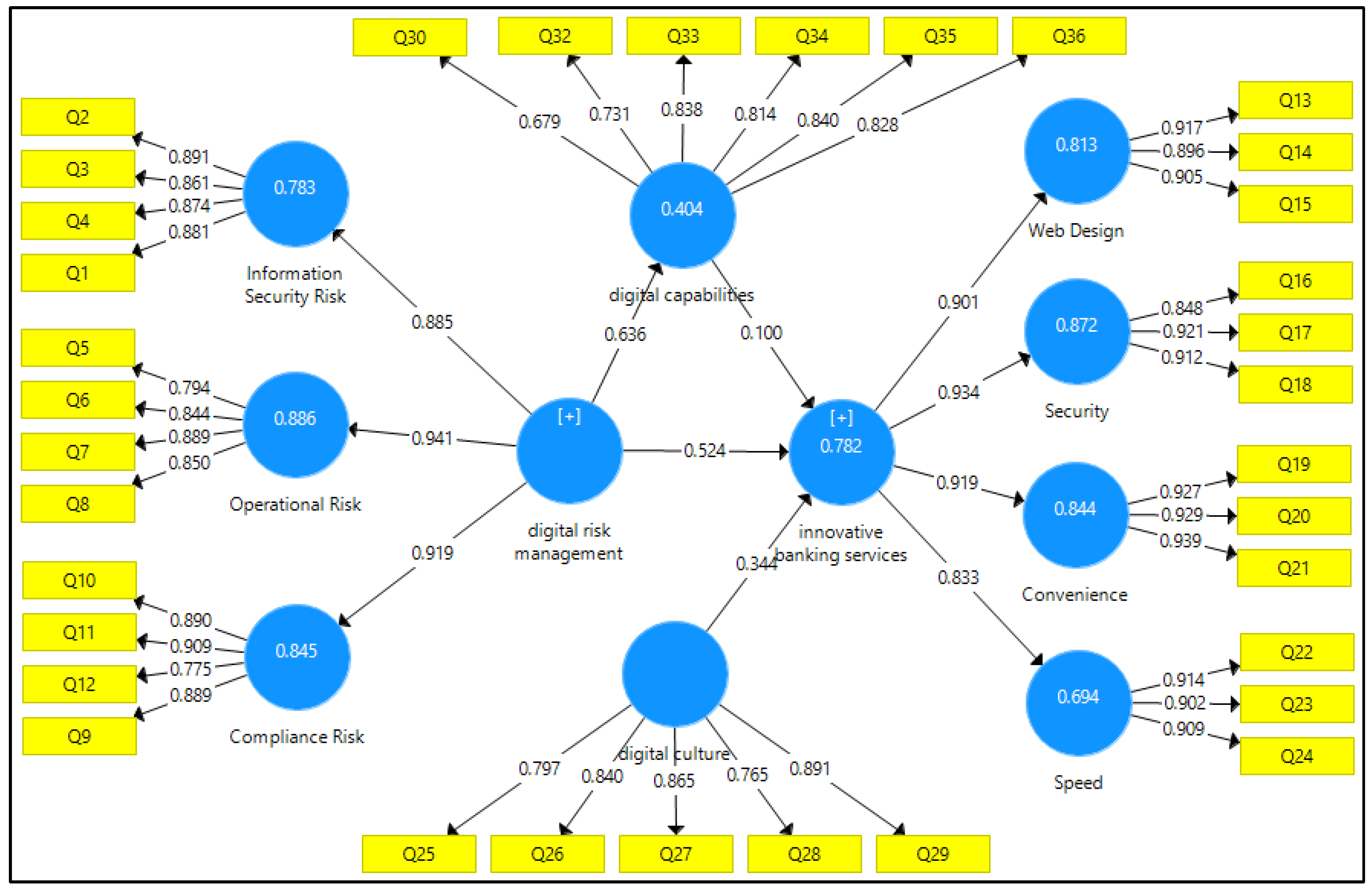
Figure 2.
The model structure.
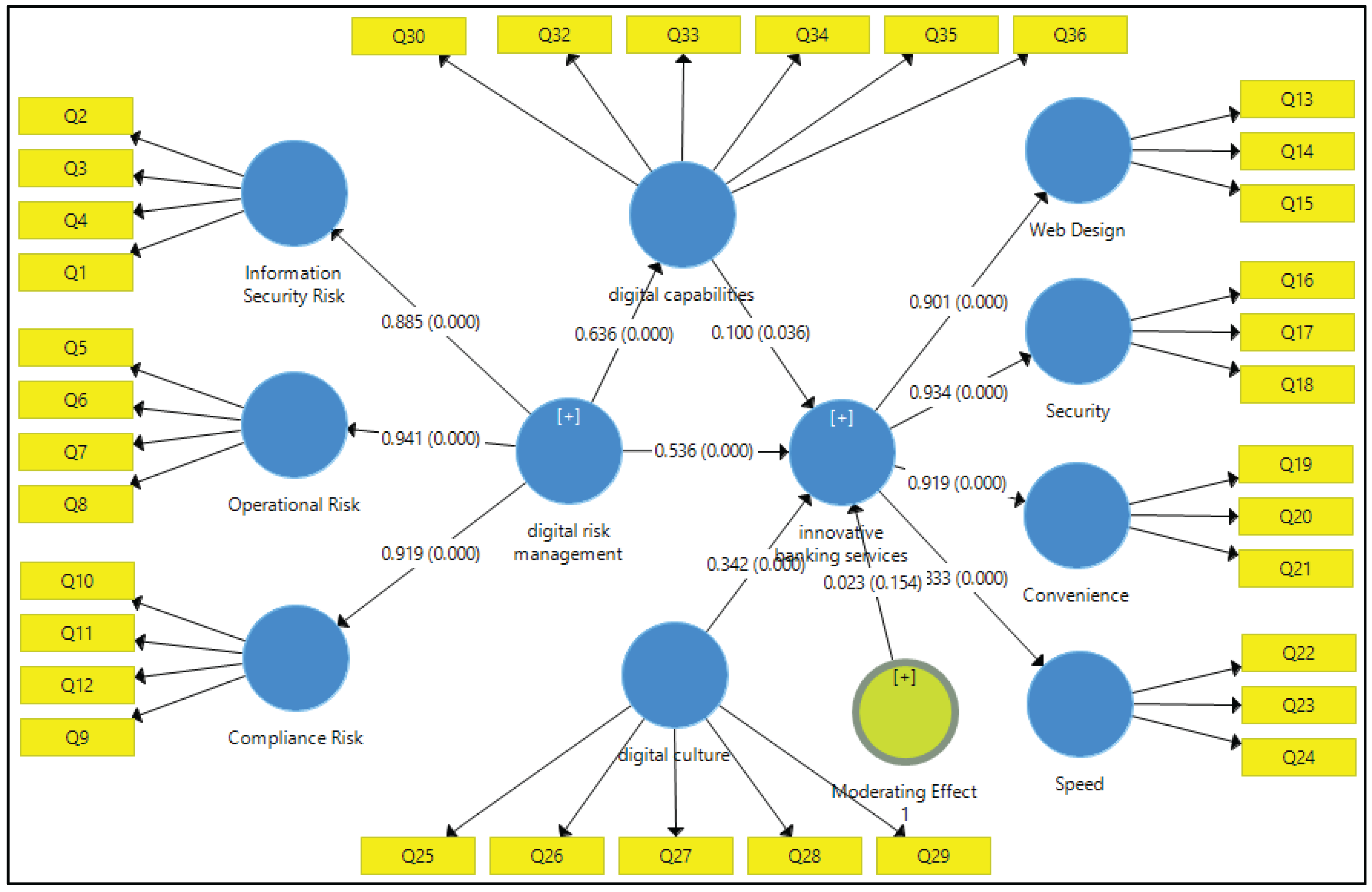

Table 1.
Response rate of questionnaires.
| Type of Questionnaire | Response Rate |
| Distributed | 305 |
| Returned | 291 |
| Incomplete | 10 |
| Returned and usable | 281 |
| Response rate percentage | 92% |
Table 2.
Descriptive Analysis of Latent Construct.
| Min | Max | Mean | SD | Cronbach | |
| Information Security Risk | 1 | 5 | 3.49 | 0.874 | 0.776 |
| Operational Risk | 1 | 5 | 3.55 | 0.984 | 0.789 |
| Compliance Risk | 1 | 5 | 3.78 | 0.786 | 0.791 |
| Web Design | 1 | 5 | 3.21 | 1.033 | 0.811 |
| Security | 1 | 5 | 2.99 | 1.109 | 0.820 |
| Convenience | 1 | 5 | 3.98 | 0.873 | 0.852 |
| Speed | 1 | 5 | 3.02 | 0.764 | 0.765 |
| Digital capabilities | 1 | 5 | 3.17 | 0.810 | 0.672 |
| Digital culture | 1 | 5 | 3.0282 | 0.901 | 0.722 |
Table 2.
Reliability and validity results.
| Factor | Item | Loadings | Alpha | CR | AVE |
|---|---|---|---|---|---|
| Information Security Risk |
Q1 Q2 Q3 Q4 |
0.881 0.891 0.861 0.874 |
0.906 | 0.927 | 0.681 |
| Operational Risk |
Q5 Q6 Q7 Q8 |
0.794 0.844 0.889 0.850 |
0.944 | 0.927 | 0.681 |
| Compliance Risk | Q9 Q10 Q11 Q12 |
0.889 0.890 0.909 0.775 |
0.903 | 0.928 | 0.723 |
| Web Design | Q13 Q14 Q15 |
0.917 0.896 0.905 |
0.911 | 0.934 | 0.741 |
| Security | Q16 Q17 Q18 |
0.848 0.921 0.912 |
0.911 | 0.934 | 0.741 |
| Convenience | Q19 Q20 Q21 |
0.927 0.929 0.939 |
0.911 | 0.934 | 0.741 |
| Speed | Q22 Q23 Q24 |
0.914 0.902 0.909 |
0.911 | 0.934 | 0.741 |
| Digital capabilities | Q30 Q32 Q33 Q34 Q35 Q36 |
0.679 0.731 0.838 0.814 0.840 0.828 |
0.878 | 0.909 | 0.625 |
| Digital culture | Q25 Q26 Q27 Q28 Q29 |
0.797 0.840 0.865 0.765 0.891 |
0.889 | 0.919 | 0.694 |
Table 3.
Heterotrait–monotrait ratio of correlations (HTMT).
| Variable | Information Security Risk | Operational Risk |
Compliance Risk | Web Design | Security | Convenience | Speed | Digital capabilities | Digital culture |
| Information Security Risk | 0.785 | ||||||||
| Operational Risk | 0.760 | 0.861 | |||||||
| Compliance Risk | 0.690 | 0.723 | 0.884 | ||||||
| Web Design | 0.772 | 0.764 | 0.719 | 0.825 | |||||
| Security | 0.727 | 0.675 | 0.800 | 0.711 | 0.690 | ||||
| Convenience | 0.863 | 0.654 | 0.812 | 0.763 | 0.800 | 0.699 | |||
| Speed | 0.812 | 0.567 | 0.656 | 0.609 | 0.753 | 0.567 | 0.732 | ||
| Digital capabilities | 0.779 | 0.654 | 0.373 | 0.490 | 0.574 | 0.632 | 0.324 | 0.576 | |
| Digital culture | 0.791 | 0.699 | 0.490 | 0.368 | 0.755 | 0.654 | 0.454 | 0.432 | 0.654 |
Table 4.
Path coefficients and significance.
| Hypotheses | Path coefficient | T values | p-values | Result | |
|---|---|---|---|---|---|
| H1 | digital risk management → innovative banking services | 0.536 | 2.654 | 0.000 | Supported |
| H1.1 | digital risk management → web design | 0.789 | 2.654 | 0.000 | Supported |
| H1.2 | digital risk management → security | 0.739 | 2.998 | 0.000 | Supported |
| H1.3 | digital risk management → convivence | 0.757 | 3.209 | 0.000 | Supported |
| H1.4 | digital risk management → speed | 0.705 | 2.766 | 0.000 | Supported |
| H2 | digital risk management → digital capabilities | 0.636 | 6.029 | 0.000 | Supported |
| H3 | digital capabilities → innovative banking services | 0.100 | 2.102 | 0.036 | Supported |
| H4 | digital risk management → digital capabilities → innovative banking services | 0.058 | 2.053 | 0.041 | Supported |
| H5 | digital risk management * digital culture → innovative banking services | 0.023 | 1.427 | 0.154 | Not supported |
Disclaimer/Publisher’s Note: The statements, opinions and data contained in all publications are solely those of the individual author(s) and contributor(s) and not of MDPI and/or the editor(s). MDPI and/or the editor(s) disclaim responsibility for any injury to people or property resulting from any ideas, methods, instructions or products referred to in the content. |
© 2026 by the authors. Licensee MDPI, Basel, Switzerland. This article is an open access article distributed under the terms and conditions of the Creative Commons Attribution (CC BY) license (http://creativecommons.org/licenses/by/4.0/).
Copyright: This open access article is published under a Creative Commons CC BY 4.0 license, which permit the free download, distribution, and reuse, provided that the author and preprint are cited in any reuse.


