

Submitted:
26 April 2026
Posted:
27 April 2026
You are already at the latest version
Abstract
Current variant interpretation frameworks, including those proposed by the American College of Medical Genetics and Genomics and the Association for Molecular Pathology (ACMG/AMP) and ClinGen, rely on implicit assumptions regarding allele frequencies, linkage disequilibrium (LD), and independence of variables. These assumptions are largely derived from European populations and are not valid in highly admixed populations. Here, we argue that the Brazilian population constitutes a natural stress test for these frameworks, not merely due to the extent of admixture, but due to its qualitative structure, characterized by recent tri-hybrid admixture (European, African, Indigenous American) and extensive recombination generating novel haplotypic configurations. We further highlight the instability of borderline variants of uncertain significance (VUS) under Bayesian classification and propose a reformulation explicitly incorporating haplotype structure and local ancestry.
Keywords:
ACMG/AMP guidelines
; human population genetics
; pathogenic variants
; medical genetics
; human genomics
Introduction
Bayesian frameworks have become central to clinical variant interpretation, formalizing the integration of heterogeneous evidence into posterior probabilities of pathogenicity (Tavtigian et al., 2018). However, these frameworks depend critically on priors and likelihoods derived from population data that remain heavily biased toward European ancestry (Sirugo et al., 2019).
Admixed populations expose the limitations of this approach. Brazil, in particular, represents one of the most complex admixture scenarios globally, shaped by recent (~500 years) gene flow among European colonizers, enslaved Africans from multiple regions, and diverse Indigenous populations (Pena et al., 2011). This is directly supported by the recent whole-genome analysis of 2,723 Brazilian individuals, which identified over 8 million previously unreported variants absent from major reference databases (Nunes et al., 2025), demonstrating that allele frequency priors derived from non-admixed populations are systematically miscalibrated for this context.
Crucially, this is not simply a matter of degree. Other populations, such as those in India, also exhibit extensive and ancient (4,200 to 1,900 years) admixture (Reich et al., 2009). However, the Brazilian population is characterized not only by a high degree of admixture but by a distinct admixture structure, involving recent, large-scale, tri-continental gene flow that generates mosaic haplotypes with frequent ancestry switching along chromosomes (Pena et al., 2011; Gravel, 2012).
This qualitative difference leads to the emergence of haplotypic combinations that are rare or absent in ancestral populations, challenging the assumptions underlying current variant interpretation frameworks.
The Bayesian Framework and Its Hidden Assumptions
Variant classification can be formalized as (Tavtigian et al., 2018):
where denotes the totality of observed evidence used to classify a variant, encompassing functional data, population frequency estimates, computational predictions, segregation data, and clinical observations. Although widely adopted, this formulation embeds several implicit assumptions: (1) allele frequencies are stable across populations, (2) LD structure is predictable and transferable and (3) criteria for significant evidence are conditionally independent. These assumptions are rarely stated explicitly but are fundamental to the validity of the framework. In (Tavtigian et al., 2018) is not named as such, instead, it is defined as P(A) the prior probability of pathogenicity, P(B) as the probability of the evidence, P(A|B) as the posterior probability, and P(B|A) as the probability of the evidence given that the variant is pathogenic. Therefore, in the present study (Equation (1)) corresponds to what (Tavtigian et al., 2018) calls P(B), the evidence composite.
The ACMG/AMP Evidence is used in an Odds Pipeline where each piece of evidence (a criterion like PS4, PM3, PP1, etc.) is assigned a category of strength, and each category maps to a calibrated odds of pathogenicity (OP). Tavtigian et al. (2018) estimated these as: when evidence strength (ES) is “supporting”, the odds of pathogenicity (OP) is ~2.08, when ES is moderate, OP is ~4.33, when ES is strong, OP is ~18.7 and when ES is very strong, OP is ~350. For benign evidence, the reciprocals apply (e.g., supporting benign ≈ 1/2.08). enters the formula as a full Bayesian calculation:
where OPcombined is the product of all individual odds: OPcombined = OP₁ × OP₂ × OP₃ × OPn
Post P = (Prior P × OPcombined) / [(Prior P × OPcombined) + (1 – Prior P)]
This product is the operationalization of inside Equation (1). Therefore is not a single input, it enters the formula as the joint likelihood ratio formed by multiplying all individual evidence odds together, under the assumption that they are independent. The standard prior used is P(Pathogenic) = 0.10 for a generic variant of uncertain significance, though this varies by gene context.
Admixture as a Source of Model Misspecification
In admixed genomes, chromosomes consist of alternating ancestry tracts, reflecting recombination between distinct ancestral populations (Gravel, 2012). In Brazil, this process is particularly recent, resulting in short ancestry blocks, high recombination density and complex haplotype mosaics. These mosaics generate novel combinations of variants in cis, not present in reference populations. This leads to prior miscalibration.
Allele frequency is a cornerstone of prior estimation. However:
where H denotes haplotype and A local ancestry. A haplotype is a combination of alleles at multiple loci that are physically linked and co-inherited on the same chromosome, reflecting local linkage disequilibrium and recombination history (Daly et al., 2001). Failure to condition on these variables leads to systematic bias, particularly in admixed populations (Martin et al., 2019).
Likelihood misspecification is observed because evidence criteria, such as segregation (PP1), case–control enrichment (PS4), and trans configuration (PM3) implicitly assume known LD and independence between variants. However, in admixed genomes LD varies locally and unpredictably, and co-occurrence may reflect shared haplotypes. This leads to distorted likelihood estimates.
If variants in LD are treated as independent the evidence is overcounted and the posterior probability is therefore inflated. This issue is amplified in recombined haplotypes, and constitutes the core mechanism of evidence double counting.
Borderline VUS Instability as a Structural Phenomenon
Variants near classification thresholds are inherently sensitive to small perturbations in priors or likelihoods (Tavtigian et al., 2018). In admixed populations, this sensitivity becomes a structural property of the system. As representative examples three should be mentioned: (1) CFTR p.Arg117His, a haplotype-dependent penetrance driven by intronic variation (Thauvin-Robinet et al., 2009); (2) GJB2 p.Met34Thr, a high allele frequency inconsistent with high penetrance (Shen et al., 2019); (3) BRCA2 p.Lys3326Ter, where reclassification was driven by prior recalibration (Gaudet et al., 2010). These examples illustrate phase transitions in classification, where small changes in model parameters shift variants across decision thresholds.
Haplotype Classes in Brazilian Populations
The Brazilian genomic landscape can be conceptualized as generating three major haplotype classes (Figure 1), each with distinct implications for Bayesian inference. Five known examples of relevant haplotype configurations originated by these admixture patterns (Table 1).
Imported risk haplotypes (Figure 1A) include the APOL1 G1/G2 haplotypes, which originate in African populations and exhibit ancestry-dependent risk when embedded in admixed genomes (Genovese et al., 2010).
Recombined haplotypes (Figure 1B) occur in highly polymorphic regions such as HLA and pharmacogenomic loci such as CYP3A5, displaying novel haplotypic combinations due to recombination (Kuehl et al., 2001; Lam et al., 2013). These haplotypes exhibit altered LD patterns, ancestry-dependent expression and non-transferable associations.
Ancestry-mixed functional haplotypes, such as SLC24A5 locus, exemplify recombination between ancestry-specific alleles, generating new functional contexts (Lamason et al., 2005).
Among Founder haplotypes (Figure 1C), the TP53 p.R337H variant represents a regional founder haplotype with elevated frequency in Southern Brazil (Achatz et al., 2007).
Toward a Haplotype-Aware Bayesian Framework
To account for haplotype structure, the classification model should be:
with key components
Prior conditioning:
Likelihood refinement:
Dependency modeling: explicit incorporation of LD
However, LD is not added as a variable. The factorization of likelihood is changed so independence between pieces of evidence is not assumed.
How LD Breaks the Non-Haplotype Aware Model
In practice, ACMG/Bayesian implementations behave like:
This assumes independence among evidence components . However, under LD, this is false, because it leads to double counting.
Correct Formulation
Condition on haplotype :
encodes LD (correlation structure) and evidence is no longer treated as independent. Note that in Equation (7), A is not shown explicitly because local ancestry is intrinsic to the haplotype structure encoded in H. Once the haplotype is resolved, local ancestry is determined. The full conditioning on A is therefore implicit in the conditioning on H.
Three Practical Ways to Incorporate LD
Three methods can be used to incorporate LD into Bayesian frameworks for significance estimation of genomic variants and correct for the effect of admixture generated haplotypes: (1) joint likelihood, (2) correlation penalty and (3) hierarchical model. These are detailed below.
Joint Likelihood
Instead of:
The joint occurrence should be used:
In practice: co-occurrence can be estimated from data or approximated using LD measures (e.g., , ).
Correlation Penalty
If full modeling is not feasible:
where is the combined likelihood ratio summarizing the cumulative evidence for pathogenicity, and each is the individual likelihood ratio contributed by evidence component , that is, the ratio of the probability of observing given pathogenicity versus given benignity. The correction term , with , penalizes the sum when evidence components are correlated due to linkage disequilibrium, with calibrated empirically. This formulation prevents inflation of the posterior probability arising from double counting of correlated evidence.
Hierarchical Model
: local ancestry
: haplotype
LD emerges naturally through
Translation to ACMG/AMP Criteria
For example, a scenario with a PM3 (in trans evidence) and PS4 (case–control enrichment) is considered (Figure 1D,E). PM3 and PS4 are as defined by the American College of Medical Genetics and Genomics and the Association for Molecular Pathology (ACMG/AMP) (Richards et al., 2015) where PM3 means Pathogenic Moderate criterion #3 and PS4 means Pathogenicity Strong criterion #4. In this example PM3 captures allelic configuration in recessive disease, whereas PS4 reflects case–control enrichment. However, when variants are in linkage disequilibrium, both criteria may reflect the same underlying haplotypic signal, leading to double counting of evidence if treated as independent. If variants are in LD they cannot be treated as independent lines of evidence. Either one must be downweighed or they must be modelled jointly. In the presence of linkage disequilibrium, the variables used to estimate the significance of variants cannot be assumed as independent variables, and the likelihood term must be reformulated as a joint distribution conditioned on haplotype structure, i.e., , rather than a product of marginal terms. Therefore, stabilization of VUS classification can be achieved by incorporating haplotypes. Posterior distributions become more robust, threshold crossings decrease and clinical interpretation should stabilize.
The implicit assumption of independence used to calculate OPcombined is precisely the vulnerability the present study is targeting. Because OPcombined is computed as a simple product of individual terms: OPcombined = OP(PM3) × OP(PS4) × OP(PP1) × ..., any two criteria that share a common haplotypic signal (i.e., are in LD) will inflate OPcombined by being counted twice as independent factors, when in reality they carry the same underlying information. The correct formulation proposed in Equations (7)–(9) above replaces this product with a joint likelihood conditioned on haplotype H, so that correlated evidence items are not treated as multiplicative. This is also why the correlation penalty in Equation (10) subtracts , from the log-likelihood sum, as it works as a practical correction for this inflation.
Conclusions
Current variant interpretation frameworks are formally misspecified for admixed populations. The instability of borderline VUS is a measurable manifestation of this misspecification. We argue that incorporating haplotype structure and local ancestry into Bayesian models is necessary for accuracy, stability, and equity in genomic medicine.
The empirical scale of this challenge is underscored by the recent identification of over 8 million previously unreported variants in Brazilian genomes (Nunes et al., 2025). Variants absent from reference databases do not merely represent gaps in allele frequency tables; they introduce uncharacterized linkage disequilibrium relationships that propagate through every component of the Bayesian framework: distorting priors through miscalibrated frequency estimates, inflating likelihoods through undetected evidence correlation, and rendering independence assumptions untenable in ways that are invisible to current pipelines.
We conjecture that Brazil is not an outlier but a precursor. As global populations become increasingly admixed, the limitations described here will become universal. Ignoring haplotype structure, and the novel LD architectures that admixture continuously generates, risks embedding systematic and inequitable bias into the foundations of genomic medicine.
Author Contributions
MRSB: Writing – original draft, Writing – review and editing. MRSB, RCF, FA: Conceptualization, Methodology, Supervision, Writing – original draft, Writing – review and editing.
Funding
The authors declared that financial support was received for this work from Fundação de Amparo à Pesquisa do Estado de São Paulo (FAPESP) grant # 20/08943-5.
Data Availability Statement
This study did not generate datasets or scripts. Additional information can be requested from the corresponding author.
Acknowledgments
The authors declare that generative AI was used in editing, English grammar verification, assistance with image generation and verification of mathematical expressions of this manuscript.
Conflicts of Interest
The author(s) declared that this work was conducted in the absence of any commercial or financial relationships that could be construed as a potential conflict of interest. The author MRSB declared that he was an Associate Editor of Frontiers at the time of submission and this had no impact on the peer review process and the final decision.
References
- Achatz, M.I.W.; Olivier, M.; Calvez, F.L.; Martel-Planche, G.; Lopes, A.; Rossi, B.M.; et al. The TP53 mutation, R337H, is associated with Li-Fraumeni and Li-Fraumeni-like syndromes in Brazilian families. Cancer Letters 2007, 245, 96–102. [Google Scholar] [CrossRef] [PubMed]
- Daly, M.J.; Rioux, J.D.; Schaffner, S.F.; Hudson, T.J.; Lander, E.S. High-resolution haplotype structure in the human genome. Nat Genet 2001, 29, 229–232. [Google Scholar] [CrossRef] [PubMed]
- Gaudet, M.M.; Kirchhoff, T.; Green, T.; Vijai, J.; Korn, J.M.; Guiducci, C.; et al. Common Genetic Variants and Modification of Penetrance of BRCA2-Associated Breast Cancer. PLOS Genetics 2010, 6, e1001183. [Google Scholar] [CrossRef]
- Genovese, G.; Friedman, D.J.; Ross, M.D.; Lecordier, L.; Uzureau, P.; Freedman, B.I.; et al. Association of Trypanolytic ApoL1 Variants with Kidney Disease in African Americans. Science 2010, 329, 841–845. [Google Scholar] [CrossRef] [PubMed]
- Gravel, S. Population Genetics Models of Local Ancestry. Genetics 2012, 191, 607–619. [Google Scholar] [CrossRef] [PubMed]
- Kuehl, P.; Zhang, J.; Lin, Y.; Lamba, J.; Assem, M.; Schuetz, J.; et al. Sequence diversity in CYP3A promoters and characterization of the genetic basis of polymorphic CYP3A5 expression. Nat Genet 2001, 27, 383–391. [Google Scholar] [CrossRef] [PubMed]
- Lam, T.H.; Shen, M.; Chia, J.-M.; Chan, S.H.; Ren, E.C. Population-specific recombination sites within the human MHC region. Heredity 2013, 111, 131–138. [Google Scholar] [CrossRef] [PubMed]
- Lamason, R.L.; Mohideen, M.-A. P. K.; Mest, J.R.; Wong, A.C.; Norton, H.L.; Aros, M.C.; et al. SLC24A5, a Putative Cation Exchanger, Affects Pigmentation in Zebrafish and Humans. Science 2005, 310, 1782–1786. [Google Scholar] [CrossRef] [PubMed]
- Martin, A.R.; Kanai, M.; Kamatani, Y.; Okada, Y.; Neale, B.M.; Daly, M.J. Clinical use of current polygenic risk scores may exacerbate health disparities. Nat Genet 2019, 51, 584–591. [Google Scholar] [CrossRef] [PubMed]
- Nunes, K.; Araújo Castro e Silva, M.; Rodrigues, M.R.; Lemes, R.B.; Pezo-Valderrama, P.; Kimura, L.; et al. Admixture’s impact on Brazilian population evolution and health. Science 2025, 388, eadl3564. [Google Scholar] [CrossRef] [PubMed]
- Pena, S.D.J.; Pietro, G.D.; Fuchshuber-Moraes, M.; Genro, J.P.; Hutz, M.H.; Kehdy, F. de S. G.; et al. The Genomic Ancestry of Individuals from Different Geographical Regions of Brazil Is More Uniform Than Expected. PLOS ONE 2011, 6, e17063. [Google Scholar] [CrossRef] [PubMed]
- Reich, D.; Thangaraj, K.; Patterson, N.; Price, A.L.; Singh, L. Reconstructing Indian population history. Nature 2009, 461, 489–494. [Google Scholar] [CrossRef] [PubMed]
- Richards, S.; Aziz, N.; Bale, S.; Bick, D.; Das, S.; Gastier-Foster, J.; et al. Standards and guidelines for the interpretation of sequence variants: a joint consensus recommendation of the American College of Medical Genetics and Genomics and the Association for Molecular Pathology. Genet Med 2015, 17, 405–423. [Google Scholar] [CrossRef] [PubMed]
- Shen, J.; Oza, A.M.; del Castillo, I.; Duzkale, H.; Matsunaga, T.; Pandya, A.; et al. Consensus interpretation of the p.Met34Thr and p.Val37Ile variants in GJB2 by the ClinGen Hearing Loss Expert Panel. Genetics in Medicine 2019, 21, 2442–2452. [Google Scholar] [CrossRef] [PubMed]
- Sirugo, G.; Williams, S.M.; Tishkoff, S.A. The Missing Diversity in Human Genetic Studies. Cell 2019, 177, 26–31. [Google Scholar] [CrossRef] [PubMed]
- Tavtigian, S.V.; Greenblatt, M.S.; Harrison, S.M.; Nussbaum, R.L.; Prabhu, S.A.; Boucher, K.M.; et al. Modeling the ACMG/AMP variant classification guidelines as a Bayesian classification framework. Genetics in Medicine 2018, 20, 1054–1060. [Google Scholar] [CrossRef] [PubMed]
- Thauvin-Robinet, C.; Munck, A.; Huet, F.; Génin, E.; Bellis, G.; Gautier, E.; et al. The very low penetrance of cystic fibrosis for the R117H mutation: a reappraisal for genetic counselling and newborn screening. Journal of Medical Genetics 2009, 46, 752–758. [Google Scholar] [CrossRef] [PubMed]
Figure 1.
Haplotype classes in admixed populations and their implications for variant interpretation. This figure illustrates three distinct haplotype configurations that arise in admixed populations and their consequences for Bayesian variant interpretation. In (A) (Imported risk haplotypes): Risk alleles originating in specific ancestral populations, such as APOL1 G1 and G2, are introduced into admixed genomes. Although the variant itself is unchanged, its phenotypic effect becomes dependent on the surrounding haplotypic and ancestry context. This leads to variability in penetrance and challenges in estimating prior probabilities of pathogenicity. In (B) Recombined or mosaic haplotypes: Recent admixture generates novel haplotypes through meiotic recombination between chromosomes of distinct ancestry. This process produces mosaic haplotypes composed of alternating ancestry blocks, resulting in local linkage disequilibrium (LD) patterns that differ from those observed in ancestral populations. Consequently, variants that are independent in one population may be in LD in another, leading to misestimation of likelihoods and potential double counting of evidence in Bayesian frameworks. In (C) Regional founder haplotypes: Founder variants, such as TP53 p.R337H in Southern Brazil, arise from a single ancestral mutation that expands within a geographically or culturally defined population. These haplotypes are associated with high local allele frequencies and relatively conserved haplotypic backgrounds, which can strongly influence prior probabilities and lead to population-specific disease risk profiles. In (D) and (E) 1) PM3 “in trans” (basic Mendelian genetics), PM3 is applied when two variants are observed in a recessive gene and they are located on different chromosomes (in trans) one inherited from the father and another inherited from the mother so Chromosome 1 has variant A while Chromosome 2 has variant B For a recessive disease, two altered copies are required, therefore Variant A plus Variant B in trans can explain the disease phenotype. PM3 summary: The variant contributes to a causal allelic pair, with one variant on each chromosome. PS4 come from case–control enrichment therefore PS4 is based on statistical evidence. This variant is more frequent in affected individuals than in controls. In the example, 20 out of 100 patients carry the variant while in controls 5 out 1000 individuals carry the variant. Therefore, the variant is enriched in cases, and this supports pathogenicity. PS4 summary: The variant occurs more frequently in individuals with the disease than in unaffected controls. The problem arises when both criteria are combined. In this scenario, Variant A (the variant under study) and Variant B (on the same haplotype) are in linkage disequilibrium (LD), in other words, are frequently inherited together. Although Variant A is observed in trans with another pathogenic variant, Variant B may be the true causal allele, and Variant A is simply co-inherited on the same haplotype. In PS4, Variant A is enriched in cases, however, the enrichment may be driven by Variant B and Variant A is merely hitchhiking with it. The error is taking PM3 evidence and PS4 evidence and combining them as independent when, in reality, both may reflect the same underlying haplotype. Linkage disequilibrium can transform apparently independent ACMG/AMP criteria into correlated observations of the same underlying haplotypic signal, leading to double counting of evidence if not properly modeled.
Figure 1.
Haplotype classes in admixed populations and their implications for variant interpretation. This figure illustrates three distinct haplotype configurations that arise in admixed populations and their consequences for Bayesian variant interpretation. In (A) (Imported risk haplotypes): Risk alleles originating in specific ancestral populations, such as APOL1 G1 and G2, are introduced into admixed genomes. Although the variant itself is unchanged, its phenotypic effect becomes dependent on the surrounding haplotypic and ancestry context. This leads to variability in penetrance and challenges in estimating prior probabilities of pathogenicity. In (B) Recombined or mosaic haplotypes: Recent admixture generates novel haplotypes through meiotic recombination between chromosomes of distinct ancestry. This process produces mosaic haplotypes composed of alternating ancestry blocks, resulting in local linkage disequilibrium (LD) patterns that differ from those observed in ancestral populations. Consequently, variants that are independent in one population may be in LD in another, leading to misestimation of likelihoods and potential double counting of evidence in Bayesian frameworks. In (C) Regional founder haplotypes: Founder variants, such as TP53 p.R337H in Southern Brazil, arise from a single ancestral mutation that expands within a geographically or culturally defined population. These haplotypes are associated with high local allele frequencies and relatively conserved haplotypic backgrounds, which can strongly influence prior probabilities and lead to population-specific disease risk profiles. In (D) and (E) 1) PM3 “in trans” (basic Mendelian genetics), PM3 is applied when two variants are observed in a recessive gene and they are located on different chromosomes (in trans) one inherited from the father and another inherited from the mother so Chromosome 1 has variant A while Chromosome 2 has variant B For a recessive disease, two altered copies are required, therefore Variant A plus Variant B in trans can explain the disease phenotype. PM3 summary: The variant contributes to a causal allelic pair, with one variant on each chromosome. PS4 come from case–control enrichment therefore PS4 is based on statistical evidence. This variant is more frequent in affected individuals than in controls. In the example, 20 out of 100 patients carry the variant while in controls 5 out 1000 individuals carry the variant. Therefore, the variant is enriched in cases, and this supports pathogenicity. PS4 summary: The variant occurs more frequently in individuals with the disease than in unaffected controls. The problem arises when both criteria are combined. In this scenario, Variant A (the variant under study) and Variant B (on the same haplotype) are in linkage disequilibrium (LD), in other words, are frequently inherited together. Although Variant A is observed in trans with another pathogenic variant, Variant B may be the true causal allele, and Variant A is simply co-inherited on the same haplotype. In PS4, Variant A is enriched in cases, however, the enrichment may be driven by Variant B and Variant A is merely hitchhiking with it. The error is taking PM3 evidence and PS4 evidence and combining them as independent when, in reality, both may reflect the same underlying haplotype. Linkage disequilibrium can transform apparently independent ACMG/AMP criteria into correlated observations of the same underlying haplotypic signal, leading to double counting of evidence if not properly modeled.
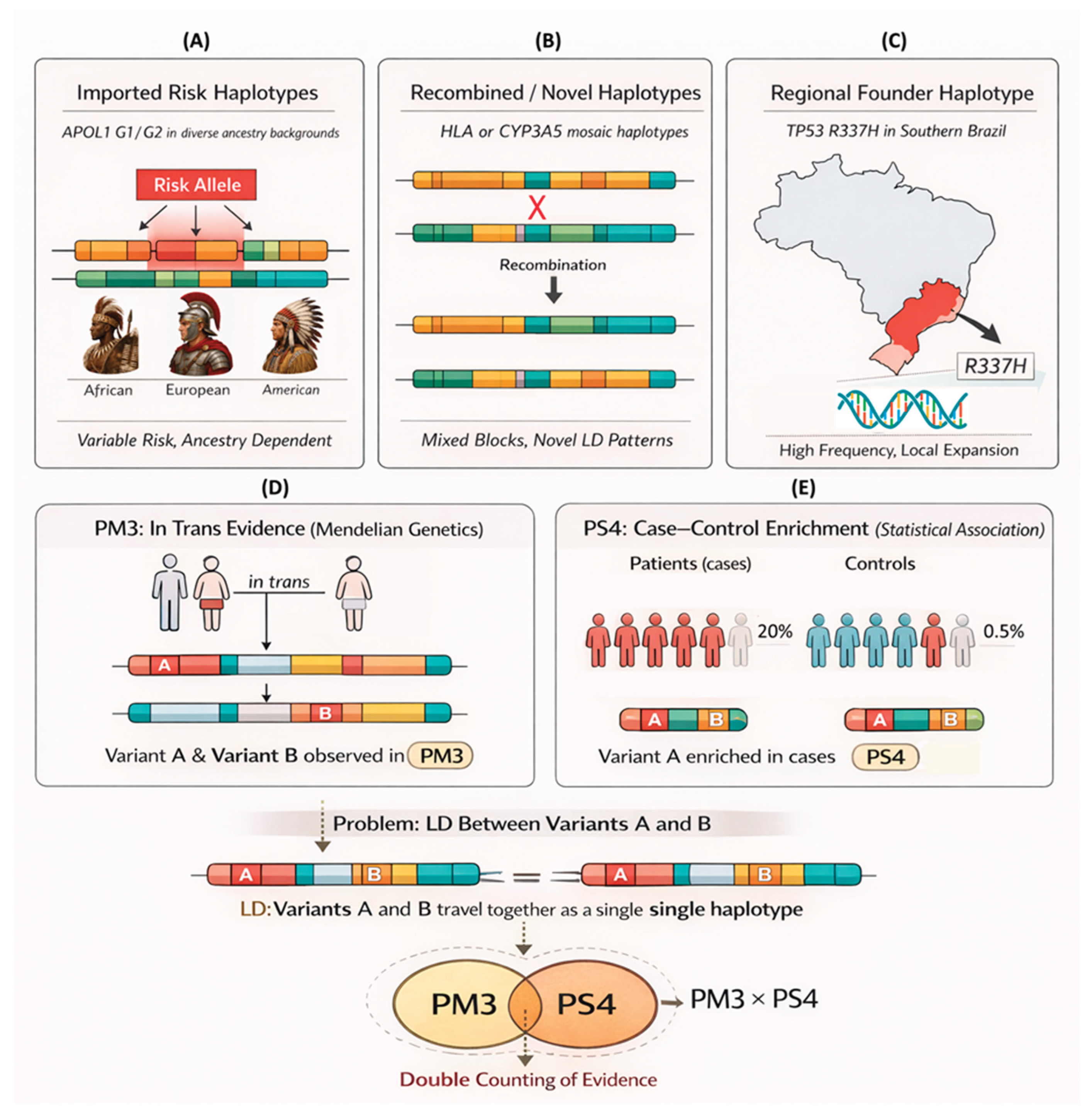

Table 1.
Haplotype configurations relevant in Brazilian populations.
| Haplotype Class | Gene | Variant / Structure | Origin | Key Property | Bayesian Impact |
|---|---|---|---|---|---|
| Imported risk | APOL1 | G1 / G2 | African | Context-dependent risk | Prior distortion |
| Recombined | HLA | Multi-locus haplotypes | Mixed | Novel LD | Likelihood error |
| Recombined | CYP3A5 | *1 / *3 | African+ European | Expression variability | Prior+ likelihood |
| Mixed functional | SLC24A5 | A111T context | European+ mixed | Functional recombination | Prior miscalibration |
| Founder | TP53 | R337H | Brazilian | Local expansion | Prior shift |
Disclaimer/Publisher’s Note: The statements, opinions and data contained in all publications are solely those of the individual author(s) and contributor(s) and not of MDPI and/or the editor(s). MDPI and/or the editor(s) disclaim responsibility for any injury to people or property resulting from any ideas, methods, instructions or products referred to in the content. |
© 2026 by the authors. Licensee MDPI, Basel, Switzerland. This article is an open access article distributed under the terms and conditions of the Creative Commons Attribution (CC BY) license (http://creativecommons.org/licenses/by/4.0/).
Copyright: This open access article is published under a Creative Commons CC BY 4.0 license, which permit the free download, distribution, and reuse, provided that the author and preprint are cited in any reuse.


