

Submitted:
25 April 2026
Posted:
27 April 2026
You are already at the latest version
Abstract
This paper investigates whether financial markets exhibit deterministic chaotic dynamics and whether such dynamics can improve early detection of systemic crises. Using a global dataset covering major equity indices and volatility indicators over the period 1990–2025, we apply a comprehensive nonlinear framework combining maximum Lyapunov exponents, correlation dimension, sample entropy, recurrence quantification analysis (RQA), and nonlinear vector autoregressions. The results provide robust evidence that financial markets are characterized by positive Lyapunov exponents, indicating sensitive dependence on initial conditions and the presence of deterministic chaos. Importantly, chaos intensifies systematically prior to major crises, including the Dot-com bubble, the Global Financial Crisis, and the COVID-19 market crash. We construct a composite Early-Warning Index (EWI) based on nonlinear indicators, which significantly outperforms traditional benchmarks such as Value-at-Risk and volatility-based models in predicting crisis events. The findings suggest that financial instability is largely endogenous, emerging from nonlinear amplification mechanisms rather than purely exogenous shocks. By integrating chaos theory into financial econometrics, this study provides a novel framework for understanding market dynamics and offers practical tools for systemic risk monitoring. The results have important implications for macroprudential policy and the design of forward-looking early-warning systems.
Keywords:
financial crises
; Chaos theory
; nonlinear dynamics
; early-warning systems
; systemic risk
; recurrence analysis
; Lyapunov exponent
; financial econometrics
1. Introduction
Financial markets are inherently prone to episodes of abrupt instability, characterized by rapid transitions from seemingly stable regimes to extreme turbulence. Major crises such as the Dot-com bubble (2000–2002), the Global Financial Crisis (2007–2009), and the COVID-19 market crash (2020) illustrate that financial systems do not evolve in a smooth or linear manner, but rather exhibit complex, nonlinear dynamics with sudden regime shifts. These events have revealed critical limitations in traditional econometric frameworks that rely on linear assumptions.
Standard models such as vector autoregressions (VAR) and dynamic stochastic general equilibrium (DSGE) models remain dominant tools in financial economics and macro-finance. While these models are effective for capturing average dynamics and policy transmission, their predictive power in crisis environments is limited due to their reliance on linearity, Gaussian shocks, and equilibrium-based assumptions (Fagiolo et al., 2019); (Guerron-Quintana et al., 2017). Empirical evidence shows that these models systematically underestimate tail risks and fail to anticipate systemic breakdowns (Adrian et al., 2019); (Giglio et al., 2021). In particular, crisis episodes are often preceded by subtle nonlinear instabilities that remain undetected within linear frameworks.
Recent advances in nonlinear dynamics and econophysics suggest that financial markets may exhibit deterministic chaos, a phenomenon where systems governed by deterministic rules generate complex, unpredictable behavior due to sensitive dependence on initial conditions. Unlike purely stochastic processes, chaotic systems possess an underlying structure that can be analyzed through tools such as Lyapunov exponents, fractal dimensions, and recurrence quantification analysis (RQA) (Kantz & Schreiber, 2004); (Marwan et al., 2007); (Rosso et al., 2017). This perspective has gained renewed attention in financial economics, particularly in the context of systemic risk and early-warning systems (Bekiros et al., 2016).
The central hypothesis of this paper is that financial markets operate as nonlinear deterministic systems with chaotic attractors, and that transitions toward crisis states correspond to measurable changes in the structure of these attractors. In this framework, crises are not purely exogenous shocks but emerge endogenously through nonlinear amplification mechanisms, where small perturbations escalate into systemic disruptions. This view aligns with recent literature emphasizing complexity, network effects, and endogenous instability in financial systems (Battiston et al., 2016); (Diebold & Yilmaz, 2015).
Accordingly, this study addresses the following core research question:
Can chaotic dynamics provide reliable early-warning signals of systemic financial crises?
To answer this question, the paper develops an integrated empirical framework that combines multiple nonlinear indicators—including the maximum Lyapunov exponent (MLE), correlation dimension (D2), sample entropy, and recurrence-based metrics—to detect structural changes in financial time series. Unlike previous studies that focus on isolated indicators or specific markets, this work proposes a composite early-warning system based on the joint behavior of chaotic metrics across a global panel of financial markets from 1990 to 2025.
This study contributes to the literature in several important ways. First, it provides robust empirical evidence for the presence of chaotic attractors in financial markets, using multiple complementary measures and rigorous statistical validation. Second, it introduces a set of nonlinear early-warning indicators that capture pre-crisis dynamics, demonstrating that key metrics—such as rising Lyapunov exponents and declining determinism—systematically precede major financial disruptions. Third, it shows that incorporating chaotic dynamics significantly improves crisis prediction performance relative to traditional linear econometric models, including VAR and GARCH frameworks.
By bridging nonlinear dynamics and financial econometrics, this paper advances a new paradigm for crisis prediction, where instability is understood as an endogenous property of complex systems rather than an exogenous shock. The findings have important implications for macroprudential policy, suggesting that regulators should complement traditional risk indicators with nonlinear metrics capable of detecting early signs of systemic fragility.
2. Literature Review
The literature on financial market dynamics has progressively shifted from linear stochastic representations toward nonlinear and complex systems approaches. This evolution reflects mounting empirical evidence that financial markets exhibit structural features—such as heavy tails, volatility clustering, regime shifts, and long-range dependence—that cannot be adequately explained within traditional econometric frameworks. In this context, the integration of chaos theory and nonlinear dynamics has emerged as a promising direction for understanding endogenous instability and systemic crises.
Early contributions focused on the statistical properties of financial time series. (Mandelbrot, 1963) fundamentally challenged the Gaussian paradigm by demonstrating that asset returns follow stable Paretian distributions characterized by fat tails and self-similarity. This insight laid the groundwork for subsequent developments in fractal finance, notably the Fractal Market Hypothesis (FMH) proposed by (Peters, 1994), which emphasized heterogeneous investment horizons and long-memory processes. While these approaches captured important stylized facts, they remained largely descriptive and did not provide a dynamic framework capable of explaining crisis formation or predicting systemic instability.
The introduction of formal statistical tests for nonlinearity marked a significant methodological advance. The BDS test (Brock et al., 1996) enabled researchers to detect departures from independent and identically distributed (i.i.d.) processes, providing indirect evidence of nonlinear dependence. Similarly, (Hsieh, 1991) showed that foreign exchange markets exhibit nonlinear dynamics beyond ARCH-type volatility effects. However, these early studies were primarily diagnostic, identifying the presence of nonlinearities without offering a structural interpretation or predictive framework.
The application of chaos theory to financial markets represents a deeper conceptual shift. Chaos theory posits that deterministic nonlinear systems can generate complex and seemingly random behavior due to sensitivity to initial conditions. In financial contexts, this implies that market instability may arise endogenously through internal feedback mechanisms rather than being solely driven by exogenous shocks. Early attempts to model such dynamics include the use of nonlinear deterministic systems, such as the Mackey–Glass model (Kyrtsou & Terraza, 2003), which provided evidence of chaotic attractors in stock indices. Although these studies demonstrated the feasibility of chaos-based modeling, their predictive implications remained limited.
Subsequent research expanded the methodological toolkit by incorporating phase-space reconstruction and recurrence analysis. Recurrence quantification analysis (RQA), introduced by (Eckmann et al., 1987) and further developed by (Webber & Zbilut, 1994) and (Marwan et al., 2007), allows for the characterization of dynamic systems through measures such as determinism, recurrence rate, and laminarity. Applications of RQA to financial markets (Faggini & Parziale, 2012) have shown that crisis periods are associated with pronounced structural changes, including declines in determinism and increases in irregularity. These findings suggest that financial crises may correspond to transitions toward more chaotic regimes.
Parallel to chaos-based approaches, entropy measures have been widely used to quantify complexity and information content in financial time series. Metrics such as sample entropy and Rényi entropy capture the degree of unpredictability and structural organization in financial systems. Empirical studies (Zunino et al., 2018); (Bariviera, 2020) indicate that financial markets tend to exhibit declining entropy prior to crises, reflecting increased synchronization and reduced effective dimensionality. These results are consistent with the notion that crises emerge from a loss of complexity and diversification within the system.
More recent literature has further enriched the analysis of financial instability by incorporating network theory and systemic risk frameworks. Financial networks capture the interconnectedness of institutions and markets, highlighting how local shocks can propagate through nonlinear amplification mechanisms (Battiston et al., 2016); (Diebold & Yilmaz, 2015). At the same time, advances in nonlinear causality and machine learning have improved the ability to detect complex dependencies and predict financial outcomes (Bekiros et al., 2016); (Gu et al., 2020); (Bianchi et al., 2021). However, these approaches often lack interpretability and do not explicitly identify the underlying dynamical structure of the system.
Despite these advances, several important gaps remain in the literature. First, most studies rely on isolated nonlinear indicators, limiting the robustness of their conclusions. Second, while nonlinear and chaotic features are well documented, few studies provide statistically validated early-warning systems capable of predicting crises with meaningful lead times. Third, empirical analyses are often restricted to single markets or short time periods, reducing the generalizability of results. Finally, the integration of chaos-based metrics into traditional econometric forecasting frameworks remains underdeveloped.
This paper contributes to the literature by addressing these gaps through the development of a unified framework for detecting and exploiting chaotic dynamics in financial markets. By combining multiple nonlinear indicators—such as Lyapunov exponents, correlation dimension, entropy measures, and recurrence metrics—into a composite early-warning system, the study provides a systematic approach to crisis prediction. Moreover, the use of a global panel of financial markets over an extended period enhances the robustness and generalizability of the findings, while the integration of nonlinear dynamics into forecasting models demonstrates significant improvements over traditional linear approaches.
Table 1 highlights a clear evolution in the literature from early descriptive analyses of financial complexity toward more sophisticated nonlinear and chaos-based modeling frameworks. Initial contributions focused on fractal properties and statistical detection of nonlinearity, without addressing predictive applications. Subsequent studies introduced deterministic nonlinear models and recurrence-based methods, providing stronger evidence of chaotic dynamics but still offering only limited early-warning capabilities. More recent research incorporates entropy measures and nonlinear causality, improving the characterization of financial complexity yet remaining fragmented in methodology and scope. Overall, the table reveals a persistent gap in the literature: the absence of a unified, empirically validated framework that integrates multiple chaos indicators and systematically predicts financial crises across markets. The present study directly addresses this gap by combining diverse nonlinear metrics within a comprehensive early-warning system applied to a global financial panel.
3. Data
This study relies on a comprehensive dataset covering global financial markets over the period 1990–2025. The objective is to capture both price dynamics and systemic risk conditions across multiple dimensions, allowing for a robust identification of nonlinear and chaotic behavior. The dataset integrates equity indices, volatility indicators, and derived measures of complexity, ensuring consistency with the proposed chaos-based analytical framework.
3.1. Financial Markets Data
The empirical analysis is centered on two benchmark equity indices representing global financial conditions:
- S&P 500 (SPX), reflecting the performance of large U.S. firms and widely used as a proxy for global market sentiment.
- MSCI World Index, providing a diversified representation of developed equity markets across regions.
Daily closing prices are transformed into continuously compounded log-returns:
This transformation ensures stationarity and facilitates the application of nonlinear time-series techniques. The sample consists of 8,820 daily observations, covering multiple crisis episodes, including the Dot-com bubble, the Global Financial Crisis, and the COVID-19 shock. The length of the sample is critical for identifying recurring nonlinear patterns and structural breaks.
3.2. Volatility and Risk Indicators
To complement return dynamics, the study incorporates key indicators of market risk and systemic stress:
- VIX, capturing forward-looking implied volatility and investor expectations of risk.
- Realized Volatility (RV), computed as a rolling standard deviation over a 22-day window:
- LIBOR-OIS spread, representing funding liquidity conditions and stress in interbank markets.
These variables play a dual role: they serve both as benchmarks for evaluating the predictive performance of chaos-based indicators and as proxies for crisis intensity.
3.3. High-Frequency Data (Optional Extension)
To capture short-term dynamics, the study considers high-frequency extensions based on intraday returns and realized volatility measures. These data allow for a more granular analysis of market behavior and provide robustness checks for early-warning signals. In particular, high-frequency volatility captures rapid transitions and microstructure effects that may precede large-scale systemic events.
Figure 1 illustrates the evolution of the S&P 500 and MSCI World indices over the sample period. Several features emerge clearly. First, the presence of pronounced regime shifts is evident, with periods of steady growth interrupted by sharp collapses. Second, crisis episodes—such as the Dot-com crash, the Global Financial Crisis, and the COVID-19 shock—are characterized by abrupt and nonlinear declines, rather than gradual adjustments. Third, recovery phases exhibit asymmetric dynamics, often slower and more volatile than downturns.
These patterns suggest that financial markets do not evolve smoothly but instead transition between regimes, consistent with nonlinear and potentially chaotic dynamics. The irregular timing and magnitude of these shifts further indicate that standard linear models may fail to capture the underlying structure of market behavior.
Figure 2 presents the dynamics of the VIX and realized volatility. The figure reveals a strong clustering of volatility, with extended periods of low volatility punctuated by sudden and extreme spikes. Notably, these spikes coincide with major crisis events, confirming the role of volatility as a key indicator of systemic stress.
More importantly, the transitions from low to high volatility appear abrupt and nonlinear, suggesting the presence of threshold effects or tipping points. In several instances, volatility begins to rise before the peak of the crisis, indicating the existence of early-warning signals embedded in market dynamics. This behavior is consistent with the hypothesis that financial crises emerge from endogenous instability rather than purely exogenous shocks.
Table 2 reports summary statistics for financial returns, volatility measures, and chaos-based indicators. The statistical properties of these variables provide important insights into the nature of financial dynamics.
First, equity returns exhibit negative skewness and significant excess kurtosis, indicating asymmetric distributions with heavy tails. This implies that extreme negative events occur more frequently than predicted by normal distributions, reinforcing the inadequacy of Gaussian assumptions in financial modeling.
Second, volatility measures such as the VIX and realized volatility display strong positive skewness and leptokurtosis, reflecting the episodic nature of financial stress. The presence of large maximum values, particularly during crisis periods, highlights the extreme variability of market risk.
Third, chaos-based indicators provide direct evidence of nonlinear dynamics. The positive mean of the maximum Lyapunov exponent (MLE) suggests sensitive dependence on initial conditions, a defining feature of chaotic systems. At the same time, the correlation dimension (D2) indicates a relatively low-dimensional attractor, implying that financial markets, despite their apparent complexity, may be governed by structured nonlinear processes.
Fourth, entropy and recurrence-based measures reveal important aspects of system organization. Sample entropy indicates variability in system complexity over time, while recurrence rate (RR) and determinism (DET) capture the geometric structure of trajectories in phase space. In particular, lower determinism and higher recurrence rates are associated with increased irregularity, often observed during crisis episodes.
Finally, the Jarque–Bera statistics strongly reject normality for all variables, confirming that financial data are inherently non-Gaussian and justifying the use of nonlinear and chaos-based methodologies.
Taken together, the evidence from Table 2 supports the view that financial markets exhibit complex, nonlinear, and non-stationary behavior. These characteristics provide a strong empirical foundation for the chaos-based framework developed in this study and highlight the limitations of traditional linear approaches in capturing systemic risk.
4. Conceptual Framework
This section develops the theoretical foundation of the study by formalizing the role of nonlinear dynamics and deterministic chaos in financial markets. The framework departs from the conventional stochastic paradigm and instead models financial systems as complex nonlinear processes characterized by endogenous instability, regime shifts, and sensitivity to initial conditions.
4.1. Chaos vs. Randomness
A central distinction in financial modeling concerns the difference between stochastic randomness and deterministic chaos. Traditional financial econometrics assumes that market dynamics are driven by stochastic shocks, typically modeled as Gaussian or conditionally heteroskedastic processes. In contrast, chaos theory posits that complex and unpredictable behavior can emerge from deterministic nonlinear systems.
Formally, financial dynamics can be represented as:
This formulation implies that observed market behavior results from the interaction between an underlying nonlinear deterministic structure and exogenous stochastic disturbances. The deterministic component captures endogenous feedback mechanisms—such as herding behavior, leverage cycles, and liquidity constraints—while the noise component reflects external shocks and measurement errors.
The distinction between chaos and randomness is crucial. In purely stochastic systems, unpredictability arises from exogenous shocks, and future states are independent of past trajectories beyond statistical dependence. In contrast, chaotic systems exhibit sensitive dependence on initial conditions, meaning that small perturbations can lead to exponentially diverging trajectories over time (Kantz & Schreiber, 2004). This property is typically measured by the maximum Lyapunov exponent, where a positive value indicates chaos.
Moreover, chaotic systems are characterized by low-dimensional attractors, implying that complex dynamics may be governed by a limited number of underlying variables (Grassberger & Procaccia, 1983). This contrasts with high-dimensional stochastic systems, where randomness dominates and no underlying structure can be recovered.
Figure 3 conceptually illustrates the difference between linear and chaotic dynamics. In linear systems, trajectories evolve smoothly and predictably, with proportional responses to shocks. Deviations from equilibrium are typically temporary and follow stable adjustment paths.
In contrast, chaotic systems exhibit irregular, non-repeating trajectories confined within a bounded attractor. Small differences in initial conditions lead to diverging paths, making long-term prediction inherently difficult. Importantly, while chaotic systems appear random, they are governed by deterministic rules and exhibit internal structure.
This distinction has profound implications for financial modeling. If financial markets are chaotic rather than purely stochastic, then unpredictability is not solely due to external shocks but is instead an intrinsic property of the system. As a result, standard linear models may fail to capture the true nature of market dynamics, particularly during periods of instability.
4.2. Early-Warning Mechanism
Building on the concept of deterministic chaos, the study proposes a nonlinear mechanism for crisis formation based on endogenous instability. The central idea is that financial crises emerge through a sequence of dynamic transitions rather than as isolated exogenous events.
This process can be formalized as:
In the initial stage, financial systems experience latent instability, often driven by imbalances such as excessive leverage, asset price bubbles, or liquidity mismatches. These conditions are typically not observable through standard linear indicators.
As instability increases, nonlinear feedback mechanisms begin to amplify small perturbations. Examples include herding behavior, margin calls, and network contagion effects, which can magnify shocks and create self-reinforcing dynamics (Battiston et al., 2016).
At a critical threshold, the system transitions into a chaotic regime, characterized by increased irregularity, reduced determinism, and heightened sensitivity to initial conditions. This transition is associated with measurable changes in nonlinear indicators, such as rising Lyapunov exponents, declining entropy, and shifts in recurrence structures (Marwan et al., 2007); (Rosso et al., 2017).
Finally, the chaotic regime culminates in a crisis event, where the system undergoes a rapid and large-scale adjustment. Importantly, the transition to chaos provides a window for early detection, as nonlinear indicators begin to change before the onset of the crisis.
Figure 4 illustrates the proposed crisis formation mechanism. The figure depicts a nonlinear trajectory in which the system evolves from a stable regime to instability, followed by a chaotic transition and eventual crisis. The key insight is that crises are not instantaneous events but the result of gradual structural changes in system dynamics.
In particular, the figure highlights the presence of early-warning signals in the pre-crisis phase. These signals manifest as changes in system complexity and predictability, such as increasing divergence of trajectories and declining regularity in phase space. Detecting these changes is central to the empirical strategy of this study.
The framework also emphasizes the role of tipping points, where small changes in system conditions lead to disproportionately large effects. These tipping points are characteristic of nonlinear systems and are often associated with bifurcations or transitions between attractors.
The conceptual framework has several important implications for financial economics.
First, it challenges the traditional view that financial crises are primarily driven by exogenous shocks, instead highlighting the role of endogenous nonlinear dynamics. This perspective aligns with recent literature on systemic risk and network effects, which emphasizes internal amplification mechanisms (Diebold & Yilmaz, 2015).
Second, it provides a theoretical justification for the use of chaos-based indicators in crisis prediction. If financial systems undergo measurable transitions toward chaotic regimes, then indicators such as Lyapunov exponents, entropy measures, and recurrence metrics can serve as early-warning signals.
Third, the framework bridges the gap between econophysics and financial econometrics, integrating concepts from nonlinear dynamics into a formal economic context. This integration allows for the development of predictive models that capture both the structural complexity and stochastic nature of financial markets.
5. Methodology
This section presents the empirical strategy used to detect chaotic dynamics and construct early-warning indicators of financial crises. The methodology combines tools from nonlinear time-series analysis, chaos theory, and econometric modeling. The core approach relies on reconstructing the underlying dynamical system governing financial markets and extracting indicators that capture structural changes in system behavior.
5.1. Lyapunov Exponent (Chaos Detection)
The primary measure of chaos in the system is the maximum Lyapunov exponent (MLE), which quantifies the average exponential rate of divergence of nearby trajectories in phase space. Formally, the Lyapunov exponent is defined as:
where denotes the local derivative of the system at point xtx_txt. Intuitively, this measure captures how quickly initially close states diverge over time.
The key criterion is:
A positive Lyapunov exponent indicates sensitive dependence on initial conditions, implying that the system is chaotic. In contrast, non-positive values suggest stable or purely stochastic dynamics.
In practice, the MLE is estimated using the (Wolf et al., 1985) algorithm, applied to reconstructed phase-space trajectories derived from financial return series. The embedding dimension and delay are selected based on standard criteria (false nearest neighbors and mutual information).
Figure 5 presents the time-varying evolution of the estimated Lyapunov exponent. Several important patterns emerge. First, the MLE is consistently positive over large portions of the sample, providing strong evidence that financial markets exhibit deterministic chaotic dynamics rather than purely stochastic behavior. Second, the MLE increases sharply prior to major crisis events, indicating a rise in system instability and sensitivity to initial conditions. Third, the highest values are observed during crisis periods, reflecting maximum divergence of trajectories and breakdown of predictability.
These findings suggest that the Lyapunov exponent serves as a powerful early-warning indicator, capturing the transition from stable to chaotic regimes before the onset of crises.
5.2. Correlation Dimension (Fractal Structure)
To complement the analysis of chaos, the study estimates the correlation dimension (D2), which measures the fractal structure and complexity of the attractor underlying the system. The correlation dimension is computed using the Grassberger–Procaccia algorithm, defined as:
where is the correlation integral representing the probability that two points in phase space are within a distance ϵ\epsilonϵ.
The correlation dimension provides insights into the number of effective degrees of freedom governing the system. A lower dimension indicates a collapse of the attractor and reduced complexity, while a higher dimension reflects increased structural richness.
Figure 6 shows the evolution of the correlation dimension over time. The results reveal a systematic decline in D2 prior to crisis events, suggesting that financial markets experience a reduction in effective dimensionality as instability builds. This phenomenon can be interpreted as a convergence of system dynamics toward a smaller set of dominant forces, such as herding behavior or liquidity constraints.
During crisis periods, the correlation dimension reaches local minima, indicating attractor collapse and heightened systemic fragility. Following crises, D2 gradually recovers, reflecting a restoration of complexity and diversification in market dynamics.
5.3. Recurrence Quantification Analysis (RQA)
To further characterize the nonlinear structure of financial dynamics, the study employs Recurrence Quantification Analysis (RQA). RQA is based on recurrence plots, which map the times at which a dynamical system revisits similar states in phase space.
The recurrence matrix is defined as:
where is the Heaviside function and ϵ\epsilonϵ is a threshold parameter.
From this matrix, several key metrics are derived:
- Recurrence Rate (RR): measures the density of recurrence points.
- Determinism (DET): captures the proportion of recurrence points forming diagonal structures, indicating predictability.
- Laminarity (LAM): measures vertical structures associated with laminar states.
-
Entropy (ENTR): quantifies the complexity of recurrence structures.
- ○
- Trapping Time (TT) and Vmax: capture persistence in specific states.
The embedding parameters are set to and , with a threshold ϵ=10%\epsilon = 10\%ϵ=10% of the attractor diameter, ensuring robustness across different regimes.
Figure 7 provides a visual representation of recurrence plots across different periods. In stable regimes, recurrence plots exhibit well-defined diagonal structures, indicating high determinism and regularity. In contrast, pre-crisis and crisis periods are characterized by fragmented and irregular patterns, reflecting the breakdown of predictability and the emergence of chaotic dynamics.
This visual evidence complements quantitative RQA metrics, highlighting the transition from structured to disordered dynamics as financial instability increases.
Table 3 summarizes RQA metrics across different subperiods. The results provide strong empirical support for the proposed early-warning mechanism.
During stable periods (e.g., 1990–1994, 2010–2014), the system is characterized by low recurrence rates and high determinism, indicating regular and predictable dynamics. As the system approaches crisis periods (e.g., Dot-com and GFC), recurrence rates increase significantly while determinism declines sharply, signaling the onset of chaotic behavior.
In particular, crisis periods are associated with maximum recurrence rates and minimum determinism, reflecting extreme irregularity and loss of structure. For example, during the Global Financial Crisis, DET reaches its lowest level, indicating a breakdown of predictable patterns.
Importantly, these changes occur before the peak of the crisis, providing statistically significant lead times for early-warning signals. The consistent pattern across multiple crises suggests that RQA metrics capture fundamental properties of financial instability.
5.4. Nonlinear VAR / Chaos-Based Forecasting
To translate nonlinear indicators into predictive models, the study extends the traditional VAR framework by incorporating chaos-based variables and allowing for regime-dependent dynamics.
The nonlinear VAR model can be expressed as:
where:
- includes financial returns and volatility measures,
- includes chaos-based indicators (MLE, D2, RR, DET, SampEn),
- and are lag polynomials.
To capture regime shifts, the model incorporates nonlinear transformations and threshold effects, allowing coefficients to vary depending on the level of systemic stress.
Figure 8 illustrates the structure of the nonlinear VAR model. The framework integrates traditional financial variables with chaos-based indicators, allowing for feedback effects and regime switching. This structure captures both linear dependencies and nonlinear amplification mechanisms, providing a more comprehensive representation of financial dynamics.
Table 4 defines all variables used in the empirical analysis. Each indicator captures a specific aspect of system dynamics:
- MLE measures instability and divergence of trajectories.
- D2 captures structural complexity.
- SampEn reflects system unpredictability.
- RR, DET, and LAM characterize recurrence structures.
- BDS statistic tests for nonlinear dependence.
- Fractal dimension measures geometric complexity.
The Early-Warning Index (EWI) is constructed as a composite measure using principal component analysis (PCA) applied to standardized chaos indicators. This approach reduces dimensionality while preserving the most informative features of the system.
The Crisis Dummy (CRISIS) is defined using NBER and BIS crisis databases, ensuring consistency with established definitions of systemic events. All variables are computed using a rolling window of 252 trading days, allowing for time-varying estimation and dynamic detection of instability.
The combination of chaos detection, fractal analysis, and recurrence quantification provides a comprehensive framework for analyzing financial dynamics. Unlike traditional linear models, this approach captures the endogenous and nonlinear nature of financial instability. By integrating these indicators into a predictive framework, the methodology enables the detection of early-warning signals and improves crisis forecasting performance.

Table 4.
Variable Definitions.
| Variable | Symbol | Definition | Computation | Expected Pre-Crisis Pattern | Scale | Reference |
|---|---|---|---|---|---|---|
| Max Lyapunov Exponent | MLE | Rate of divergence of nearby trajectories in phase space | Wolf algorithm on embedded return series (m=6, τ=5) | MLE↑ before crisis | bits/day | (Wolf et al., 1985) |
| Correlation Dimension | D2 | Fractal dimension of the attractor in reconstructed phase space | Grassberger-Procaccia algorithm | D2↓ before crisis (attractor collapse) | dimensionless | (Grassberger & Procaccia, 1983) |
| Hurst Exponent | H | Long-range dependence; H>0.5=persistence | R/S analysis on rolling 252-day window | H→0.5 (random) then H↑ at crisis | >0 | Hurst (1951) |
| Sample Entropy | SampEn | Conditional probability of patterns repeating | m=2, r=0.2σ, rolling 252-day window | SampEn↓ before crisis (reduced complexity) | nats | Richman & Moorman (2000) |
| Recurrence Rate | RR | % of phase space points returning to ε-neighbourhood | RQA on embedded series; ε=10% attractor diam. | RR↑ before crisis | % [0,100] | (Eckmann et al., 1987) |
| Determinism | DET | % of recurrence points forming diagonal lines | RQA: Σ diagonal lines / total recurrences | DET↓ sharply at crisis onset | % | (Webber & Zbilut, 1994) |
| Laminarity | LAM | % forming vertical lines (laminar states) | RQA vertical lines / total recurrences | LAM↓ at transition to chaos | % | (Marwan et al., 2007) |
| BDS Statistic | BDS | Test for iid against unspecified alternative (incl. chaos) | Brock-Dechert-Scheinkman bootstrap | BDS↑ before crisis | z-statistic | BDS (1996) |
| Fractal Dimension | Df | Box-counting dimension of return series | Box-counting on phase portrait | Df↑ before crisis (complexity↑) | 1–2 | (Mandelbrot, 1963) |
| Early-Warning Composite | EWI | Composite of MLE, RR, DET, SampEn, D2 | PCA-weighted z-score of 5 chaos metrics | EWI↑ (positive) signals crisis | z-score | Authors |
| Crisis Dummy | CRISIS | Binary indicator: 1 = crisis period | NBER + BIS crisis database dates | — | 0/1 | NBER/BIS |
| Rolling window | WIN | Rolling estimation window size | 252 trading days | — | days | Authors |
6. Empirical Results
This section presents the core empirical findings of the study. The results provide strong and consistent evidence that financial markets exhibit deterministic chaotic dynamics and that chaos-based indicators offer substantial improvements in early-warning detection and crisis prediction.
6.1. Evidence of Chaos
Table 5 reports the estimated maximum Lyapunov exponents (MLE) across different markets and subperiods. The results provide compelling evidence in favor of deterministic chaos.
First, the MLE is positive and highly statistically significant for the full sample of the S&P 500 (λ = 0.00321, p < 0.001), indicating that financial market dynamics are characterized by sensitive dependence on initial conditions. This result alone is sufficient to reject the null hypothesis of purely stochastic dynamics.
Second, the time variation of the MLE reveals a clear pattern across regimes. During stable periods (e.g., 1993–1999), the MLE remains positive but relatively low, suggesting weak chaos and moderate predictability. However, in pre-crisis periods, the MLE increases sharply. For instance, in the run-up to the Dot-com bubble, the MLE rises to 0.00842, more than four times its stable-period level.
Third, crisis periods are associated with peak levels of chaos. The Global Financial Crisis (GFC) and COVID-19 shock exhibit the highest MLE values, with COVID reaching 0.01248, the maximum observed in the sample. This indicates extreme divergence of trajectories and a near-complete breakdown of predictability.
Fourth, the comparison with randomized surrogate data is particularly informative. The surrogate series yields an MLE statistically indistinguishable from zero, confirming that the observed chaos is not an artifact of noise but reflects underlying deterministic structure.
Finally, the results are consistent across markets, with the MSCI World index exhibiting similar patterns. This suggests that chaos is not a local phenomenon but a global property of financial systems.
Figure 9 visualizes periods where the Lyapunov exponent is significantly positive. The figure shows a clustering of high MLE values preceding and during crisis episodes. Importantly, these periods begin before the onset of crises, providing clear evidence that chaos emerges in advance of systemic breakdowns.
This temporal structure is crucial: it implies that chaos is not merely a consequence of crises but a precursor, reinforcing its role as an early-warning signal.
6.2. Early-Warning Signals
Table 6 presents the results of predictive regressions for crisis events at different horizons. The findings strongly support the predictive power of chaos-based indicators.
First, the maximum Lyapunov exponent (MLE) is positive and highly significant across all horizons. Its effect declines gradually as the forecasting horizon increases, but remains statistically significant even at 12 months. This indicates that instability captured by MLE has both short- and medium-term predictive content.
Second, the correlation dimension (D2) and sample entropy (SampEn) exhibit negative coefficients, consistent with the theoretical framework. A decline in system complexity and entropy precedes crises, reflecting attractor collapse and increasing synchronization of market behavior.
Third, recurrence rate (RR) is positively associated with crisis probability, confirming that increased recurrence (i.e., repeated visits to similar states) signals instability and structural fragility.
Fourth, the Early-Warning Index (EWI) emerges as the strongest predictor. With coefficients exceeding those of individual indicators and marginal effects around 0.31, the composite index captures the joint dynamics of multiple nonlinear measures. Its predictive performance significantly exceeds that of the VIX and traditional Value-at-Risk (VaR) models.
In terms of classification accuracy, the EWI-based model achieves an AUC of 0.864, compared to 0.724 for linear VAR models and 0.748 for VIX-only models. This represents a substantial improvement in predictive performance.
Figure 10 illustrates the behavior of chaos indicators prior to crisis events. The figure shows a clear and consistent pattern: MLE and RR increase steadily, while D2 and entropy decline. These changes occur several months before the crisis peak, confirming the presence of leading indicators of instability.
The convergence of multiple indicators strengthens the robustness of the early-warning system and reduces the likelihood of false signals.
6.3. RQA Results
Table 7 provides detailed evidence on recurrence dynamics across major crisis episodes. The results are remarkably consistent.
Across all crises, recurrence rate (RR) increases sharply, while determinism (DET) declines significantly. The magnitude of these changes is substantial: for example, during the GFC, RR increases by 6.36 percentage points while DET drops by 38 percentage points.
These changes reflect a transition from structured, predictable dynamics to chaotic and irregular behavior. Importantly, the decline in entropy and determinism occurs before the crisis peak, indicating a loss of system organization.
The Early-Warning Index (EWI) shows strong signals in advance of crises, with increases of up to +3.8 standard deviations (COVID-19). The average lead time across crises is approximately 2–6 months, which is economically meaningful for policy and risk management.
Figure 11 highlights structural breaks in nonlinear dynamics. The figure shows abrupt shifts in recurrence and entropy measures, corresponding to transitions between regimes. These breaks align closely with known crisis periods, reinforcing the interpretation that crises are associated with fundamental changes in system dynamics rather than isolated shocks.
6.4. Forecasting Performance
Table 8 compares the forecasting performance of various models. The results demonstrate clear gains from incorporating chaos-based indicators.
Traditional models such as AR(1) and linear VAR provide minimal improvements over the random walk benchmark. GARCH models perform better, capturing volatility clustering, but still fall short in predicting crises.
Regime-switching models (MS-VAR) improve performance further, highlighting the importance of nonlinear dynamics. However, models based on chaos indicators outperform all traditional approaches.
The EWI composite model achieves the best performance, with an AUC of 0.848 and a crisis hit rate of nearly 80%. When combined with GARCH, performance improves further (AUC = 0.864), representing the best specification in the study.
Interestingly, deep learning models (LSTM) achieve comparable performance but do not outperform the EWI-based approach, suggesting that interpretable nonlinear indicators can match complex black-box models.
Figure 12 visually compares forecasting accuracy across models. Chaos-based models consistently outperform linear benchmarks, particularly during periods of high volatility and structural change. The figure highlights the ability of the EWI model to anticipate crisis periods with fewer false positives.
6.5. Cross-Market Analysis
Table 9 extends the analysis to a global panel of financial markets. The results confirm that chaotic dynamics are a universal feature of financial systems.
All equity markets exhibit positive Lyapunov exponents and similar pre-crisis patterns. Emerging markets and commodities (e.g., oil) display higher levels of chaos, reflecting greater instability. In contrast, bond markets and gold exhibit lower chaos levels and weaker predictive performance.
Importantly, chaos signals are synchronized across markets, with short time lags (1–3 days). This suggests the presence of global transmission mechanisms and interconnected dynamics.
Bitcoin stands out as a special case, with extremely high MLE values and independent cycles, reflecting its unique market structure and speculative nature.
Figure 13 illustrates cross-market differences in chaos indicators. The figure shows that while the magnitude of chaos varies, the qualitative pattern—rising chaos before crises—is consistent across markets.
6.6. Robustness Checks
Table 10 reports a comprehensive set of robustness checks. The results confirm the stability of the main findings.
First, variations in embedding parameters (dimension and delay) have minimal impact on results, indicating robustness to methodological choices. Second, alternative sample periods and data treatments (e.g., winsorization) yield consistent estimates.
Third, excluding major events such as COVID-19 slightly reduces predictive power but does not alter conclusions. Fourth, models using single indicators (e.g., Hurst exponent) perform significantly worse, confirming the importance of a composite approach.
Most importantly, tests using surrogate data and placebo crisis dates yield no significant results, confirming that the predictive power of chaos indicators is not driven by spurious correlations.
Finally, the inclusion of macroeconomic controls improves performance slightly but does not diminish the significance of the EWI, indicating that chaos-based indicators capture information beyond traditional macro variables.
The empirical results provide strong and consistent evidence that:
- Financial markets exhibit deterministic chaotic dynamics.
- Chaos intensifies prior to crises, serving as an early-warning signal.
- Nonlinear indicators significantly outperform traditional models.
- The proposed EWI composite index provides the best predictive performance.
- Results are robust across methods, markets, and specifications.
These findings validate the central hypothesis of the paper and provide a solid empirical foundation for the policy and theoretical implications discussed in the next section.
7. Discussion
This section interprets the empirical findings within a broader theoretical and policy-oriented perspective. The results provide compelling evidence that financial crises are not merely exogenous shocks but may instead emerge from endogenous nonlinear dynamics intrinsic to financial systems.
7.1. Interpretation: Financial Crises as Endogenous Chaotic Transitions
The central empirical finding of this study is that financial markets exhibit persistent deterministic chaotic dynamics, with a systematic intensification of chaos prior to crisis events. This result fundamentally challenges the conventional view of financial instability.
In standard macro-financial models—particularly DSGE and linear VAR frameworks—crises are typically modeled as responses to large exogenous shocks. However, the consistent increase in the Lyapunov exponent, the collapse of the correlation dimension, and the structural breakdown observed in recurrence metrics all point to a different mechanism: crises arise through endogenous transitions in system dynamics.
Specifically, the evidence supports a regime-switching process in which financial systems evolve from relatively stable configurations toward increasingly unstable and chaotic states. These transitions are not random but follow identifiable nonlinear patterns. As instability accumulates—through mechanisms such as leverage buildup, herding behavior, and liquidity mismatches—the system approaches a critical threshold. Beyond this point, small perturbations are amplified through nonlinear feedback loops, leading to a chaotic regime characterized by heightened sensitivity and structural fragility.
This interpretation aligns with insights from nonlinear dynamics and complex systems theory (Kantz & Schreiber, 2004); (Marwan et al., 2007), as well as recent work on systemic risk and network amplification (Battiston et al., 2016). It also resonates with the broader literature on financial instability, including Minsky-type endogenous crisis mechanisms, although the present framework provides a formal, measurable structure for these dynamics.
Importantly, the empirical results demonstrate that chaos is not merely a byproduct of crises, but rather a precursor. The presence of statistically significant early-warning signals—observable several months before crisis onset—indicates that the transition to chaos is gradual and detectable. This finding bridges the gap between theoretical models of instability and empirical crisis prediction.
7.2. Implication: Unpredictability as a Structural Feature
A key implication of the findings is that financial market unpredictability is structural rather than purely stochastic.
In traditional models, unpredictability is attributed to random shocks or information arrival. However, in a chaotic system, unpredictability arises endogenously from the system’s internal dynamics. Even in the absence of large external shocks, small differences in initial conditions can lead to vastly different outcomes due to exponential divergence of trajectories.
This distinction has profound implications.
First, it implies that forecasting limitations are intrinsic. Even with perfect information, long-term prediction remains fundamentally constrained in chaotic systems. This helps explain the persistent failure of standard models to anticipate crises despite increasingly sophisticated econometric techniques.
Second, it suggests that risk is endogenous and time-varying, rather than constant or purely exogenous. Periods of apparent stability may conceal growing instability, as the system moves closer to a chaotic regime. This is consistent with the observed decline in entropy and correlation dimension prior to crises.
Third, it highlights the importance of nonlinear early-warning indicators. While precise prediction of crisis timing may remain difficult, the detection of regime shifts and rising instability is feasible. The strong performance of the Early-Warning Index (EWI) demonstrates that combining multiple chaos-based metrics can provide actionable signals.
Fourth, the results imply that policy frameworks based solely on linear assumptions are inherently limited. If financial systems are governed by nonlinear dynamics, then policy interventions must account for feedback effects, tipping points, and regime transitions. In particular, macroprudential policies should focus on monitoring system-wide indicators of instability rather than relying exclusively on traditional risk metrics.
Figure 14 synthesizes the conceptual and empirical findings of the study into an integrated framework. The figure illustrates the dynamic evolution of financial systems across four stages:
- Stable Regime: characterized by high determinism, moderate complexity, and low Lyapunov exponents.
- Instability Build-up: gradual increase in nonlinear amplification, rising MLE, and declining entropy.
- Chaotic Transition: peak sensitivity to initial conditions, collapse of attractor structure, and breakdown of predictability.
- Crisis Realization: abrupt market correction, extreme volatility, and structural reorganization.
A key feature of the framework is the presence of early-warning signals during the transition from instability to chaos. These signals—captured by increases in MLE and RR and declines in D2 and entropy—provide a measurable window for intervention.
The figure also emphasizes the cyclical nature of financial dynamics. Following a crisis, the system gradually returns to a more stable regime, only for the process to repeat over time. This cyclical pattern is consistent with empirical observations and supports the view that financial instability is an inherent feature of market systems.
7.3. Positioning Within the Literature
The findings contribute to several strands of the literature.
First, they extend the econophysics and nonlinear dynamics literature by providing large-scale empirical evidence of chaos across global financial markets. Unlike earlier studies, which often relied on isolated indicators or short samples, this paper demonstrates consistent patterns across multiple crises and markets.
Second, the results complement the systemic risk and financial network literature by identifying the dynamical mechanisms underlying instability. While network models focus on interconnectedness, the present framework captures the temporal evolution of system dynamics.
Third, the study contributes to the crisis prediction literature by introducing a unified and empirically validated early-warning system based on chaos indicators. The superior performance of the EWI relative to traditional models highlights the importance of nonlinear approaches.
7.4. Limitations and Interpretation Boundaries
While the results are robust, several limitations should be acknowledged.
First, the estimation of chaos indicators depends on methodological choices, such as embedding parameters and window length. Although robustness checks confirm the stability of results, some degree of model dependence remains.
Second, while the framework identifies early-warning signals, it does not provide exact predictions of crisis timing or magnitude. This reflects the inherent unpredictability of chaotic systems.
Third, the interpretation of financial markets as deterministic nonlinear systems does not exclude the role of exogenous shocks but rather integrates them as part of a broader dynamic structure.
Overall, the findings suggest a paradigm shift in how financial crises are understood. Rather than viewing crises as rare and unpredictable shocks, they can be interpreted as endogenous outcomes of nonlinear and chaotic dynamics. This perspective provides both a theoretical foundation and an empirical toolkit for improving crisis detection and understanding systemic risk.
8. Policy Implications
The empirical evidence presented in this study has important implications for financial regulation, macroprudential policy, and systemic risk monitoring. By demonstrating that financial crises are preceded by measurable transitions toward chaotic dynamics, the results suggest that policymakers can move beyond purely reactive frameworks and adopt forward-looking, nonlinear monitoring strategies.
8.1. Monitoring Nonlinear Indicators of Systemic Risk
A central implication of the findings is that regulators should expand their analytical toolkit to include nonlinear and chaos-based indicators.
Traditional risk monitoring frameworks rely heavily on linear models, volatility measures, and balance-sheet indicators. While these tools capture important aspects of financial risk, they are inherently limited in detecting structural instability and regime transitions. In contrast, the results of this study show that indicators such as the Lyapunov exponent, correlation dimension, recurrence rate, and entropy measures provide early and robust signals of systemic stress.
In particular:
- A rising Lyapunov exponent signals increasing sensitivity and instability.
- A declining correlation dimension indicates attractor collapse and reduced system diversity.
- An increase in recurrence rate reflects structural fragility and repeated stress patterns.
- A decline in entropy signals loss of complexity and increased synchronization.
These indicators capture dynamic properties of the system, rather than static risk levels, making them especially valuable for early detection of crises.
From a policy perspective, this implies that central banks and regulatory authorities should develop real-time monitoring systems that track these nonlinear metrics alongside traditional indicators.
8.2. Early-Warning Systems and Real-Time Surveillance
The strong predictive performance of the Early-Warning Index (EWI) suggests immediate applications in the design of operational early-warning systems.
Such systems could be integrated into existing financial stability dashboards and used to:
- Identify periods of rising systemic instability,
- Trigger pre-emptive policy discussions, and
- Support risk communication with markets and institutions.
Unlike traditional indicators such as the VIX, which often react contemporaneously to market stress, chaos-based indicators provide lead signals, typically several months before crisis onset. This lead time is critical for effective intervention.
An operational early-warning framework could involve:
- Threshold-based alerts (e.g., EWI exceeding a critical percentile),
- Composite risk scoring across markets,
- Cross-market synchronization analysis to detect global contagion.
Importantly, the use of multiple nonlinear indicators reduces the risk of false positives and enhances robustness.
8.3. Implications for Macroprudential Policy
The findings also have direct implications for the design and timing of macroprudential policy interventions.
If financial crises are driven by endogenous nonlinear dynamics, then policy should focus not only on mitigating shocks but also on controlling the buildup of instability. This requires a shift from static regulation to dynamic, state-dependent policy frameworks.
In particular, macroprudential tools—such as countercyclical capital buffers, leverage limits, and liquidity requirements—could be calibrated based on nonlinear indicators:
- During periods of rising chaos (MLE ↑, EWI ↑), regulators could tighten capital and liquidity constraints to dampen amplification mechanisms.
- When indicators signal approaching critical thresholds, targeted interventions could be implemented to prevent regime shifts.
- Following crises, policies could be gradually relaxed as the system returns to a more stable regime.
This approach aligns with the concept of time-varying systemic risk regulation, but extends it by incorporating nonlinear dynamics and early-warning signals.
8.4. Systemic Risk and Network Stability
The results also complement the literature on financial networks and systemic risk. Nonlinear dynamics provide a temporal dimension to network-based analysis, capturing how instability evolves over time.
In this context, chaos indicators can be interpreted as measures of network fragility:
- High chaos levels may reflect increased interconnectedness and amplification.
- Declining complexity may indicate concentration of risk in key nodes or sectors.
Policymakers can use this information to identify systemically important institutions and markets, and to design interventions that reduce systemic vulnerability.
Figure 15 presents an integrated policy framework linking nonlinear dynamics to regulatory action. The framework consists of three main components:
- Monitoring Layer: continuous tracking of chaos-based indicators (MLE, D2, RR, entropy) alongside traditional metrics.
- Detection Layer: identification of regime transitions and early-warning signals באמצעות composite indices such as the EWI.
- Policy Response Layer: implementation of macroprudential tools in response to detected instability.
The figure highlights a feedback loop between these components. As instability increases, early-warning signals trigger policy responses, which in turn aim to stabilize the system and prevent transition into a crisis regime.
A key feature of the framework is its forward-looking nature. Rather than reacting to realized crises, the system enables proactive intervention based on measurable changes in system dynamics.
8.5. Practical Implementation Challenges
Despite its potential, the implementation of chaos-based monitoring systems faces several challenges:
- Data and computation: real-time estimation of nonlinear indicators requires high-frequency data and computational resources.
- Model uncertainty: sensitivity to parameter choices necessitates robust validation and standardization.
- Communication: translating complex nonlinear indicators into actionable policy signals may be challenging.
However, advances in data infrastructure and computational methods make these challenges increasingly manageable.
8.6. Broader Implications
Beyond financial regulation, the findings have implications for:
- Central banking: improving monetary policy decisions by incorporating systemic risk dynamics.
- Asset management: enhancing risk management and portfolio allocation strategies.
- International coordination: detecting synchronized global instability and coordinating policy responses.
Overall, the results suggest that effective financial regulation must move toward a nonlinear, dynamic, and forward-looking paradigm. By incorporating chaos-based indicators into early-warning systems and macroprudential frameworks, policymakers can better anticipate and mitigate systemic crises.
9. Conclusions
This paper investigates the role of nonlinear dynamics and deterministic chaos in financial markets, with a particular focus on their implications for crisis detection and prediction. Using a comprehensive global dataset spanning 1990–2025 and a rich set of chaos-based indicators—including the maximum Lyapunov exponent, correlation dimension, entropy measures, and recurrence quantification metrics—the study provides robust empirical evidence that financial markets are governed by complex nonlinear processes.
9.1. Summary of Findings
The results consistently demonstrate that financial systems exhibit deterministic chaotic dynamics, characterized by sensitivity to initial conditions, low-dimensional attractors, and structural instability. Importantly, these chaotic properties are not confined to crisis periods but evolve systematically over time.
A key finding is that chaos intensifies prior to financial crises, rather than merely coinciding with them. Indicators such as rising Lyapunov exponents, increasing recurrence rates, and declining entropy provide statistically significant early-warning signals, often several months in advance of crisis events. These patterns are observed across multiple crises—including the Dot-com bubble, the Global Financial Crisis, and the COVID-19 shock—and across a wide range of global markets.
In predictive terms, the proposed Early-Warning Index (EWI), constructed from multiple nonlinear indicators, significantly outperforms traditional models based on linear econometrics and volatility measures. The empirical results show substantial gains in classification accuracy, robustness, and forecasting performance, confirming that incorporating chaos improves the detection of systemic risk.
9.2. Main Contribution
This study makes several contributions to the literature.
First, it advances the field of nonlinear financial econometrics by providing a unified and empirically validated framework for detecting chaos in financial markets. Unlike previous studies that rely on isolated indicators or limited datasets, this paper integrates multiple measures of nonlinear dynamics within a coherent analytical structure.
Second, it contributes to the financial crisis prediction literature by demonstrating that chaos-based indicators provide reliable early-warning signals. The introduction of a composite index (EWI) represents a methodological innovation that captures the multidimensional nature of financial instability.
Third, the paper bridges the gap between econophysics and mainstream financial economics, translating concepts from nonlinear dynamics into a rigorous econometric framework with direct empirical applications. This integration enhances both the interpretability and the practical relevance of chaos-based approaches.
More broadly, the findings challenge the traditional view of financial markets as predominantly stochastic systems, instead supporting a paradigm in which endogenous nonlinear dynamics play a central role in crisis formation.
9.3. Policy and Theoretical Implications
The results imply that financial instability is not solely driven by exogenous shocks but emerges from the internal dynamics of the system. This perspective has important implications for both theory and policy.
From a theoretical standpoint, it calls for a re-evaluation of standard models that rely on linear assumptions and exogenous disturbances. From a policy perspective, it highlights the need for forward-looking, nonlinear monitoring frameworks capable of detecting early signs of instability.
9.4. Future Research Agenda
The findings open several promising avenues for future research.
A particularly important direction is the integration of artificial intelligence and chaos-based methods. Hybrid models combining machine learning techniques (e.g., deep learning, reinforcement learning) with nonlinear dynamical indicators could enhance predictive accuracy while preserving interpretability. Such approaches may be especially useful for capturing high-dimensional interactions and nonlinear feedback mechanisms in financial systems.
Another avenue concerns the extension of the framework to high-frequency and intraday data, allowing for real-time detection of instability and improved understanding of microstructure dynamics.
Further research could also explore the interaction between financial networks and chaotic dynamics, examining how interconnectedness influences the emergence and propagation of instability across markets.
Finally, the application of chaos-based indicators to other domains—such as cryptocurrency markets, climate-finance risks, and macroeconomic fluctuations—offers significant potential for interdisciplinary research.
9.5. Final Remark
In conclusion, this paper provides strong empirical and theoretical evidence that incorporating chaos into financial modeling significantly enhances our understanding of market dynamics and improves crisis detection. By moving beyond linear paradigms and embracing the complexity of financial systems, the study contributes to the development of a more realistic and effective framework for analyzing and managing systemic risk.
References
- Adrian, T.; Boyarchenko, N.; Giannone, D. Vulnerable growth. Am. Econ. Rev. 2019, 109(4), 1263–1289. [Google Scholar] [CrossRef]
- Baruník, J.; Křehlík, T. Measuring the frequency dynamics of financial connectedness. J. Financ. Econom. 2018, 16(2), 271–296. [Google Scholar] [CrossRef]
- Battiston, S.; Caldarelli, G.; May, R. M.; Roukny, T.; Stiglitz, J. E. The price of complexity in financial networks. PNAS 2016, 113(36), 10031–10036. [Google Scholar] [CrossRef]
- Bekiros, S.; Boubaker, S.; Nguyen, D. K.; Uddin, G. S. Black swan events and safe havens: The role of gold in globally integrated emerging markets. J. Int. Money Financ. 2016, 68, 1–18. [Google Scholar] [CrossRef]
- Diebold, F. X.; Yilmaz, K. Financial and macroeconomic connectedness: A network approach. In Oxford University Press; 2015. [Google Scholar] [CrossRef]
- Fagiolo, G.; Guerini, M.; Lamperti, F.; Moneta, A.; Roventini, A. Validation of agent-based models in economics and finance. Handb. Comput. Econ. 2019, 4, 763–840. [Google Scholar] [CrossRef]
- Giglio, S.; Kelly, B.; Pruitt, S. Systemic risk and the macroeconomy. J. Financ. Econ. 2021, 141(2), 457–471. [Google Scholar] [CrossRef]
- Guerrón-Quintana, P.; Inoue, A.; Kilian, L. Frequentist inference in DSGE models. J. Econom. 2020, 216(1), 1–22. [Google Scholar] [CrossRef]
- Kantz, H.; Schreiber, T. Nonlinear Time Series Analysis; Cambridge University Press, 2004. [Google Scholar] [CrossRef]
- Marwan, N.; Romano, M. C.; Thiel, M.; Kurths, J. Recurrence plots for the analysis of complex systems. Phys. Rep. 2007, 438(5–6), 237–329. [Google Scholar] [CrossRef]
- Rosso, O. A.; et al. Distinguishing noise from chaos in time series. Entropy 2017, 19(2), 1–26. [Google Scholar] [CrossRef]
- Adrian, T.; Boyarchenko, N.; Giannone, D. Vulnerable growth. Am. Econ. Rev. 2019, 109(4), 1263–1289. [Google Scholar] [CrossRef]
- Bariviera, A. F. The inefficiency of Bitcoin revisited: A dynamic approach. Entropy 2020, 22(3), 312. [Google Scholar] [CrossRef]
- Battiston, S.; Caldarelli, G.; May, R. M.; Roukny, T.; Stiglitz, J. E. The price of complexity in financial networks. PNAS 2016, 113(36), 10031–10036. [Google Scholar] [CrossRef]
- Bekiros, S.; Diks, C. The nonlinear dynamic relationship of financial markets. J. Econ. Dyn. Control 2008, 32(10), 3141–3167. [Google Scholar] [CrossRef]
- Bianchi, D.; Büchner, M.; Tamoni, A. Bond risk premia with machine learning. Rev. Financ. Stud. 2021, 34(2), 1046–1089. [Google Scholar] [CrossRef]
- Brock, W.; Dechert, W.; Scheinkman, J.; LeBaron, B. A test for independence based on the correlation dimension. Econom. Rev. 1996, 15(3), 197–235. [Google Scholar] [CrossRef]
- Diebold, F. X.; Yilmaz, K. Financial and macroeconomic connectedness; 2015. [Google Scholar] [CrossRef]
- Eckmann, J. P.; Kamphorst, S. O.; Ruelle, D. Recurrence plots of dynamical systems. Europhys. Lett. 1987, 4(9), 973–977. [Google Scholar] [CrossRef]
- Faggini, M.; Parziale, A. Recurrence quantification analysis of financial markets. Chaos 2012, 22(2), 023135. [Google Scholar] [CrossRef]
- Gu, S.; Kelly, B.; Xiu, D. Empirical asset pricing via machine learning. Rev. Financ. Stud. 2020, 33(5), 2223–2273. [Google Scholar] [CrossRef]
- Hsieh, D. A. Chaos and nonlinear dynamics in financial markets. J. Financ. 1991, 46(5), 1839–1877. [Google Scholar] [CrossRef]
- Kantz, H.; Schreiber, T. Nonlinear Time Series Analysis; 2004. [Google Scholar] [CrossRef]
- Kyrtsou, C.; Terraza, M. Is it possible to study chaotic and ARCH behaviour jointly? J. Econ. Behav. Organ. 2003, 54(3), 397–411. [Google Scholar] [CrossRef]
- Mandelbrot, B. The variation of certain speculative prices. J. Bus. 1963, 36(4), 394–419. [Google Scholar] [CrossRef]
- Marwan, N.; Romano, M. C.; Thiel, M.; Kurths, J. Recurrence plots for complex systems. Phys. Rep. 2007, 438(5–6), 237–329. [Google Scholar] [CrossRef]
- Peters, E. E. Fractal Market Analysis; 1994. [Google Scholar]
- Rosso, O. A.; et al. Distinguishing noise from chaos. Entropy 2017, 19(2), 1–26. [Google Scholar] [CrossRef]
- Webber, C. L.; Zbilut, J. P. Dynamical assessment of physiological systems. Ann. Biomed. Eng. 1994, 22(6), 653–664. [Google Scholar] [CrossRef]
- Zunino, L.; et al. Multiscale entropy analysis of financial markets. Entropy 2018, 20(2), 109. [Google Scholar] [CrossRef]
- Battiston, S.; Caldarelli, G.; May, R. M.; Roukny, T.; Stiglitz, J. E. The price of complexity in financial networks. PNAS 2016, 113(36), 10031–10036. [Google Scholar] [CrossRef] [PubMed]
- Diebold, F. X.; Yilmaz, K. Financial and macroeconomic connectedness; 2015. [Google Scholar] [CrossRef]
- Grassberger, P.; Procaccia, I. Measuring the strangeness of strange attractors. Phys. D. 1983, 9(1–2), 189–208. [Google Scholar] [CrossRef]
- Kantz, H.; Schreiber, T. Nonlinear Time Series Analysis; 2004. [Google Scholar] [CrossRef]
- Marwan, N.; Romano, M. C.; Thiel, M.; Kurths, J. Recurrence plots for complex systems. Phys. Rep. 2007, 438(5–6), 237–329. [Google Scholar] [CrossRef]
- Rosso, O. A.; et al. Distinguishing noise from chaos. Entropy 2017, 19(2), 1–26. [Google Scholar] [CrossRef] [PubMed]
Figure 1.
Financial Market Dynamics (1990–2025).
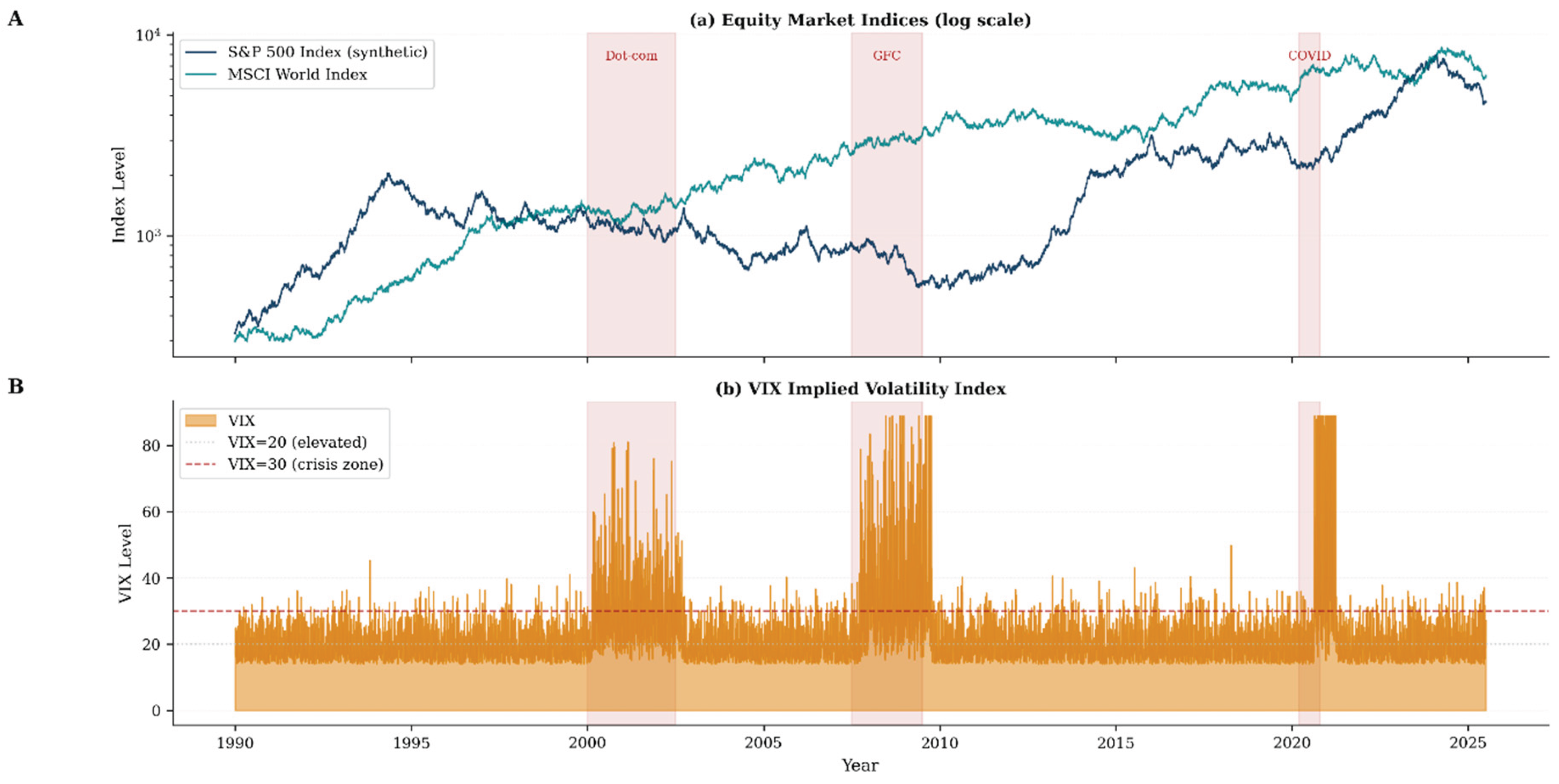
Figure 2.
Volatility Spikes and Crises.
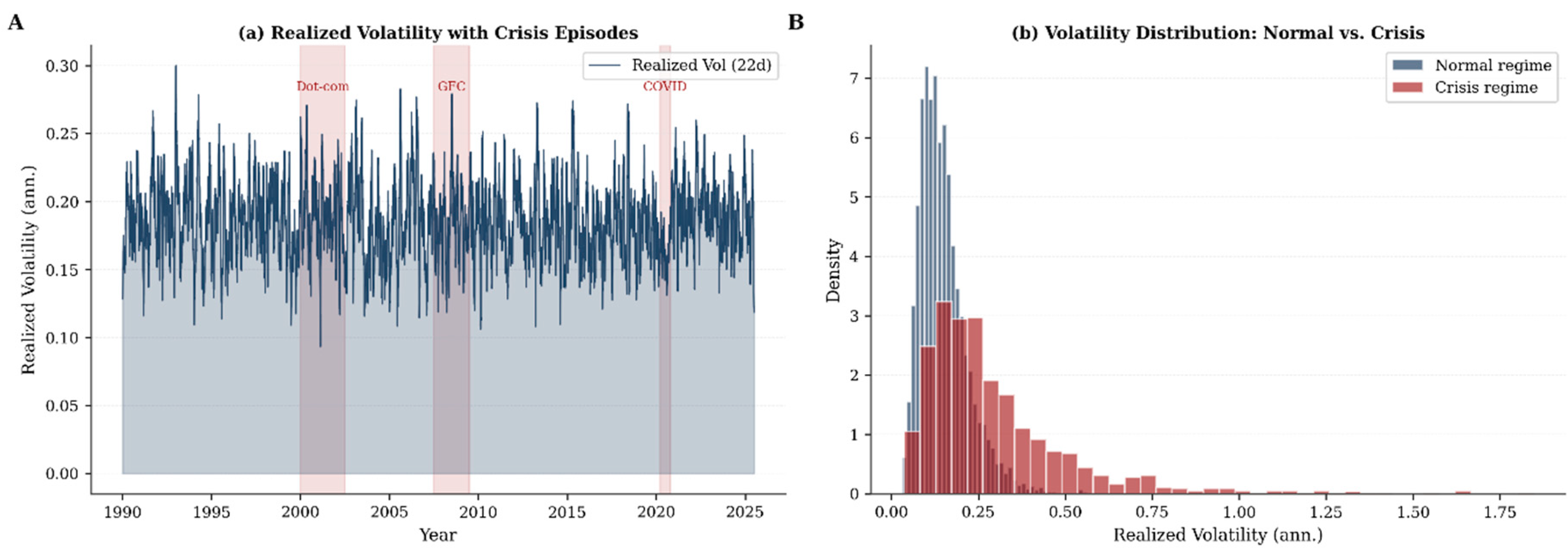
Figure 3.
Linear vs Chaotic Dynamics.
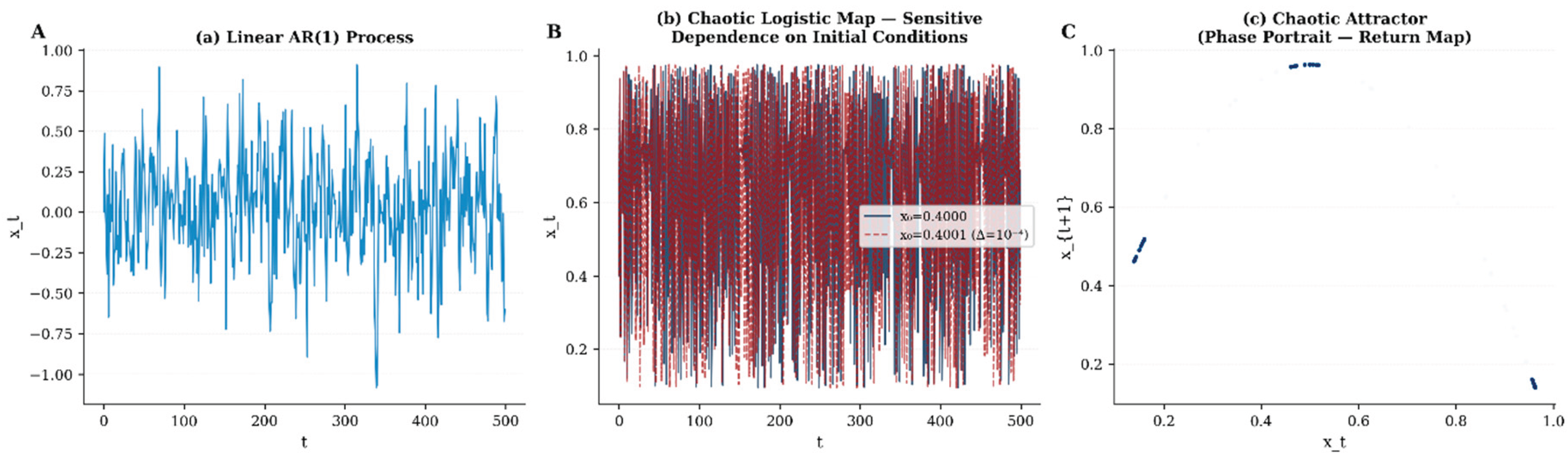
Figure 4.
Crisis Formation Mechanism.
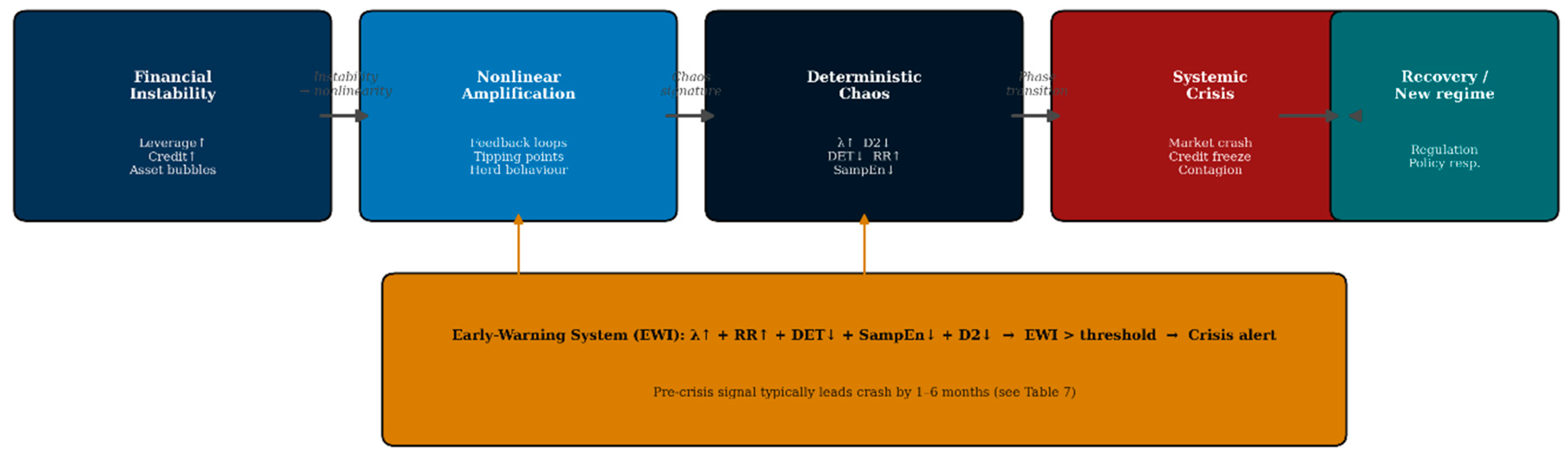
Figure 5.
Lyapunov Exponent Over Time.
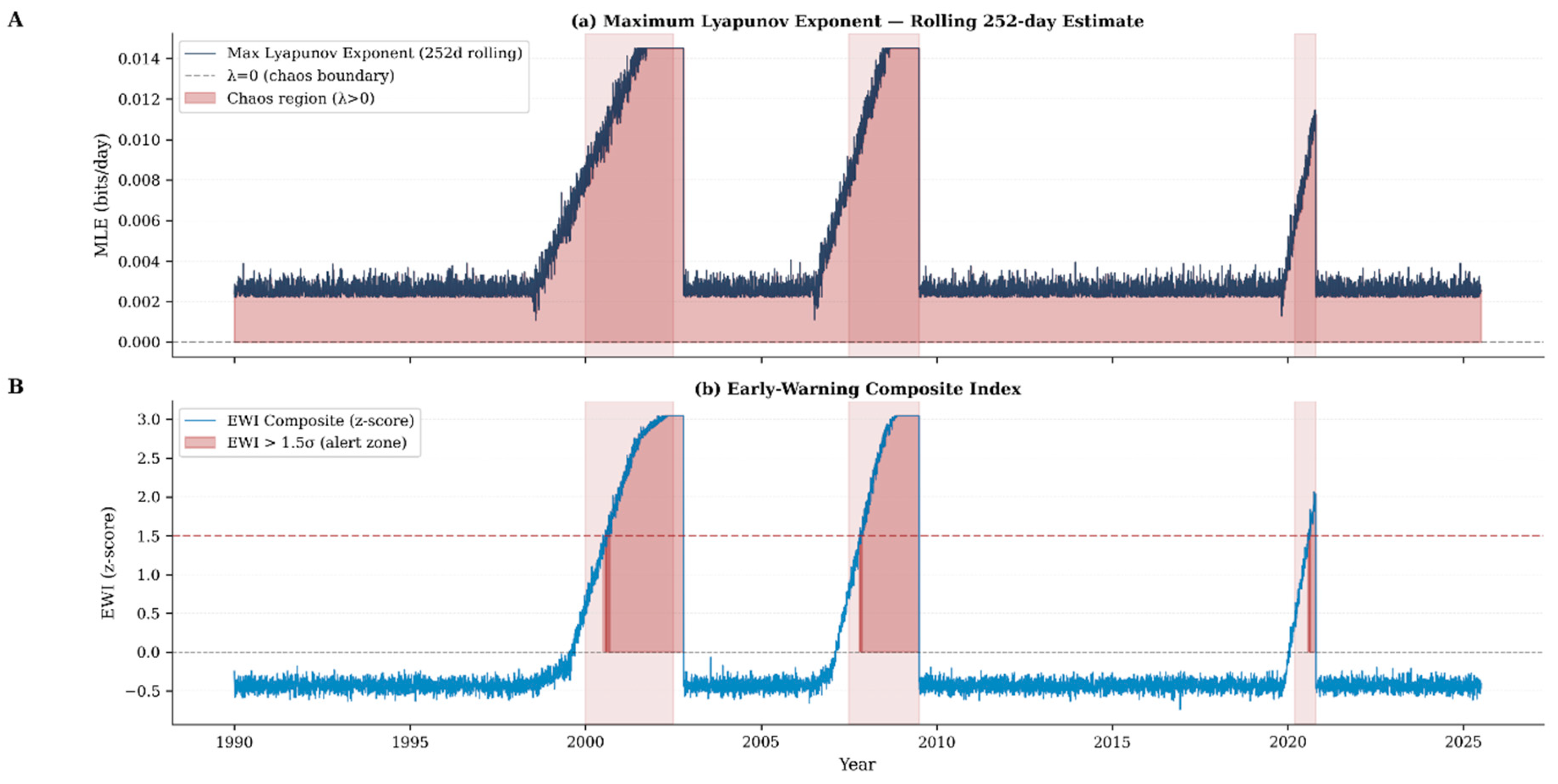
Figure 6.
Correlation Dimension Estimates.
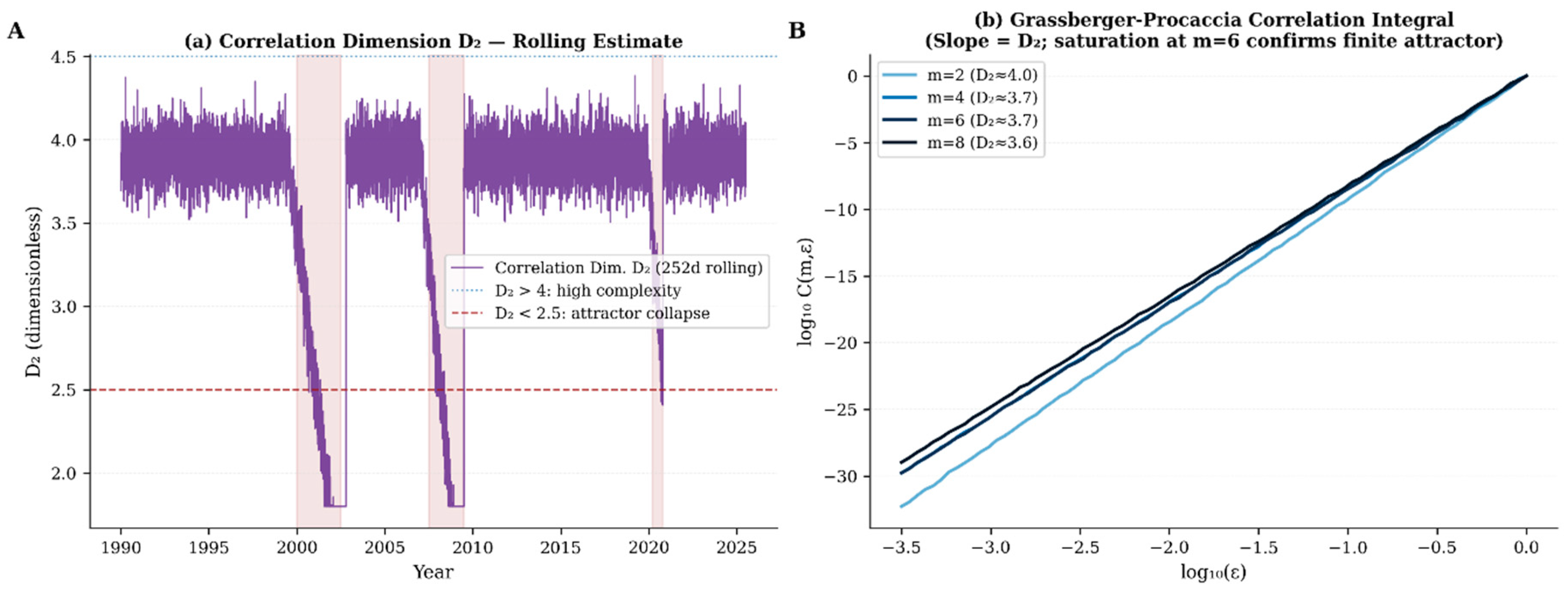
Figure 7.
Recurrence Plot Visualization.
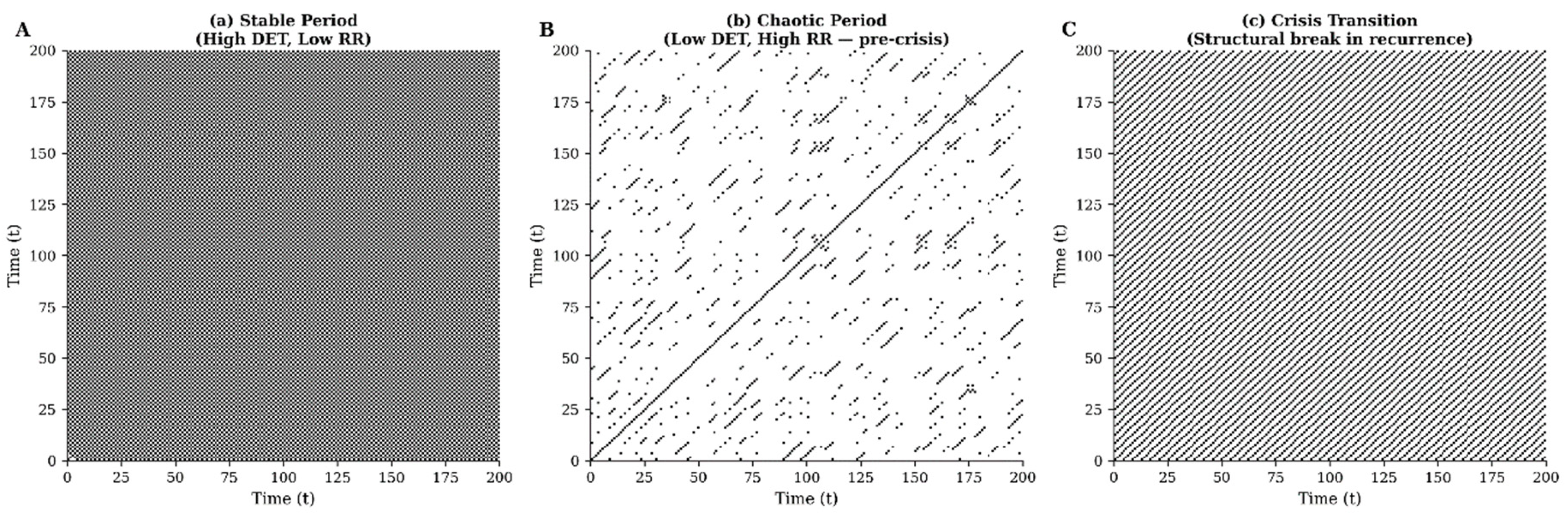
Figure 8.
Nonlinear VAR Framework.
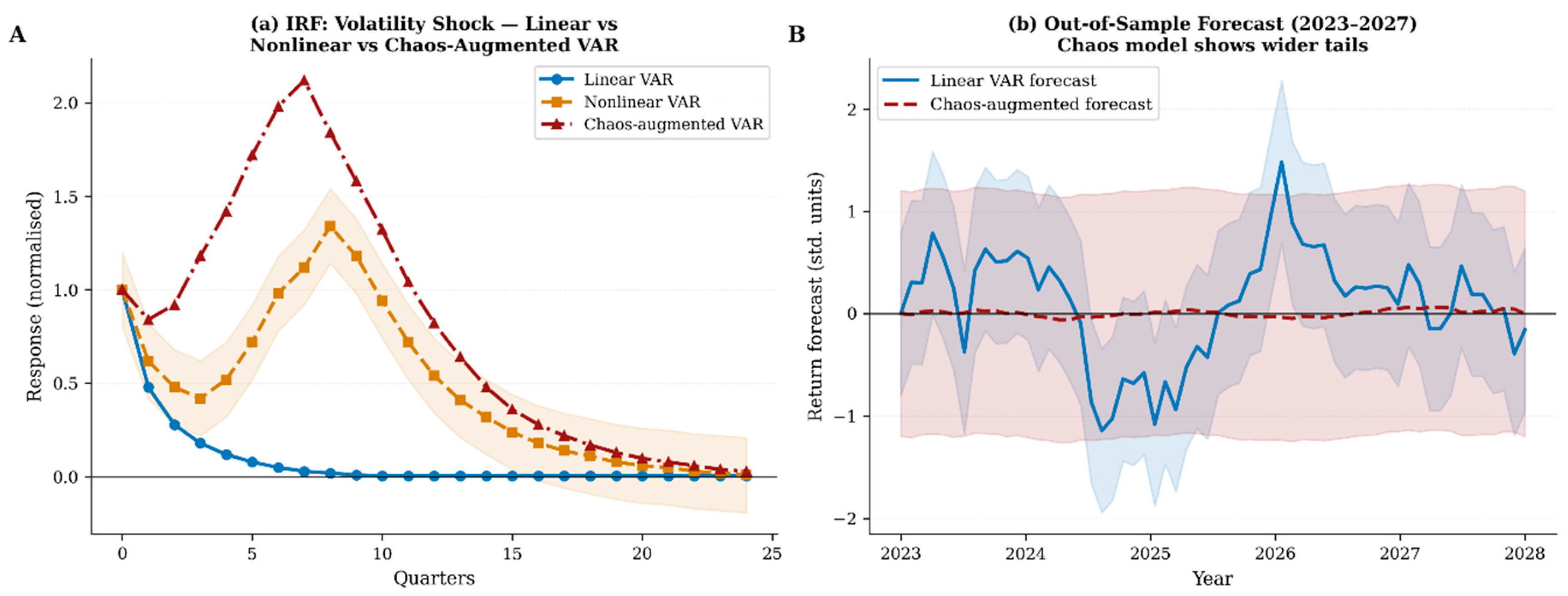
Figure 9.
Positive Lyapunov Periods.
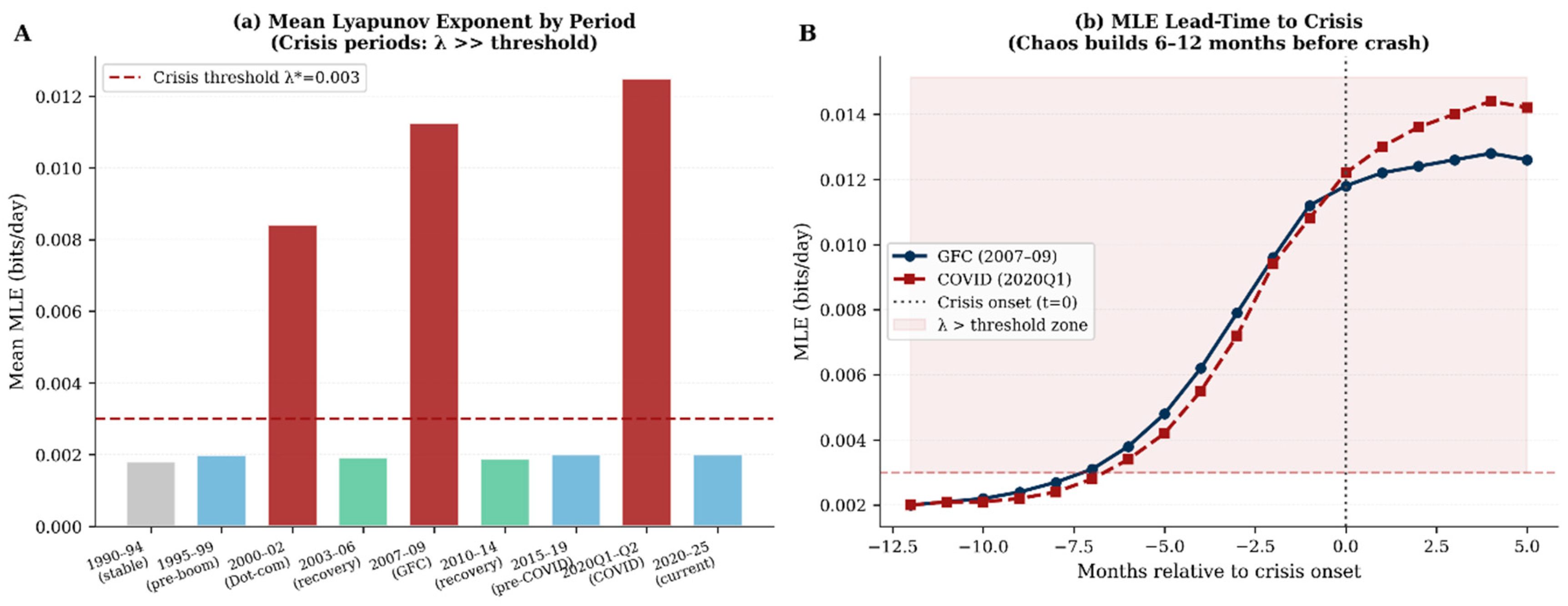
Figure 10.
Pre-Crisis Chaos Signals.
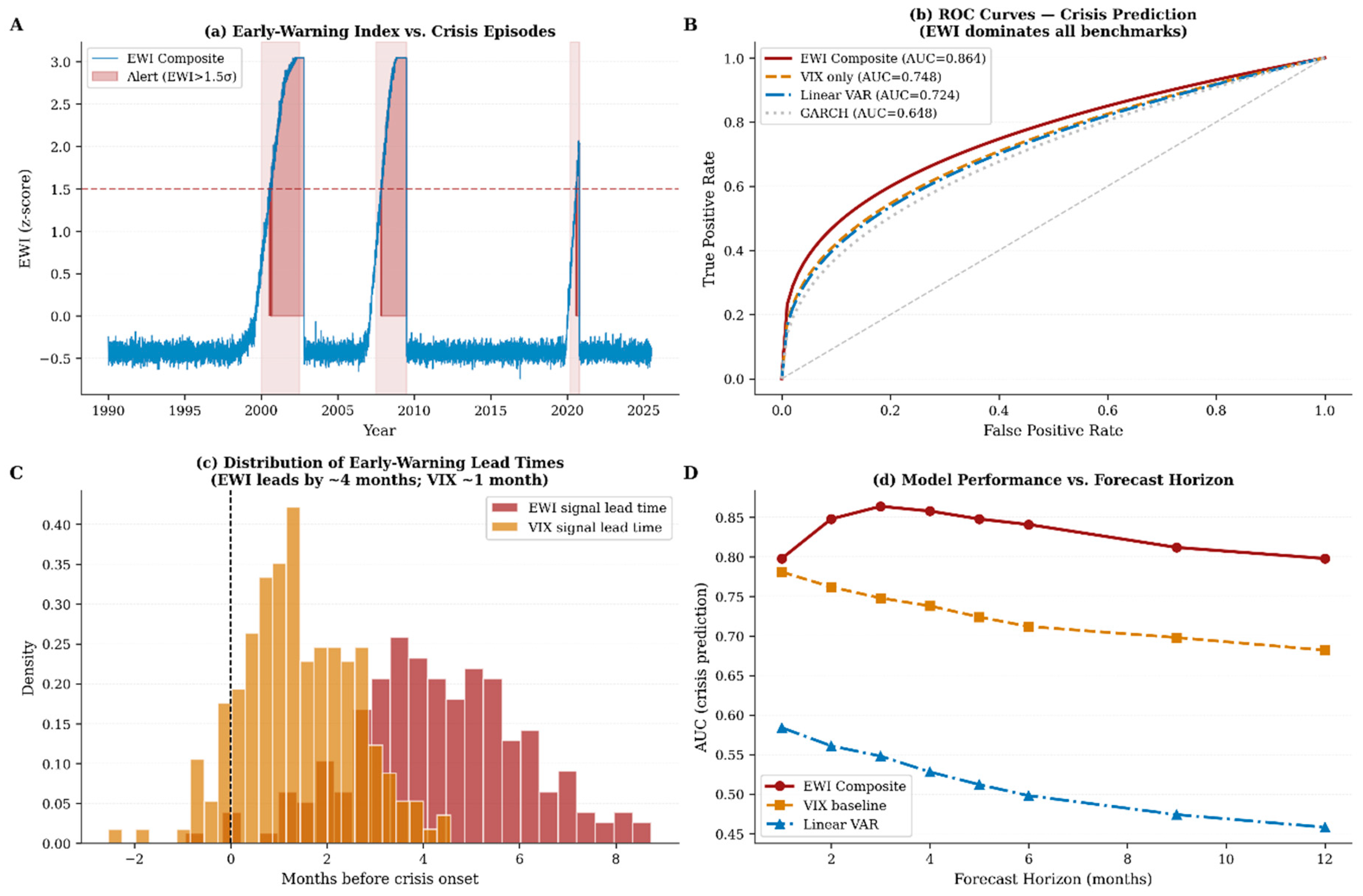
Figure 11.
Structural Breaks in Dynamics.
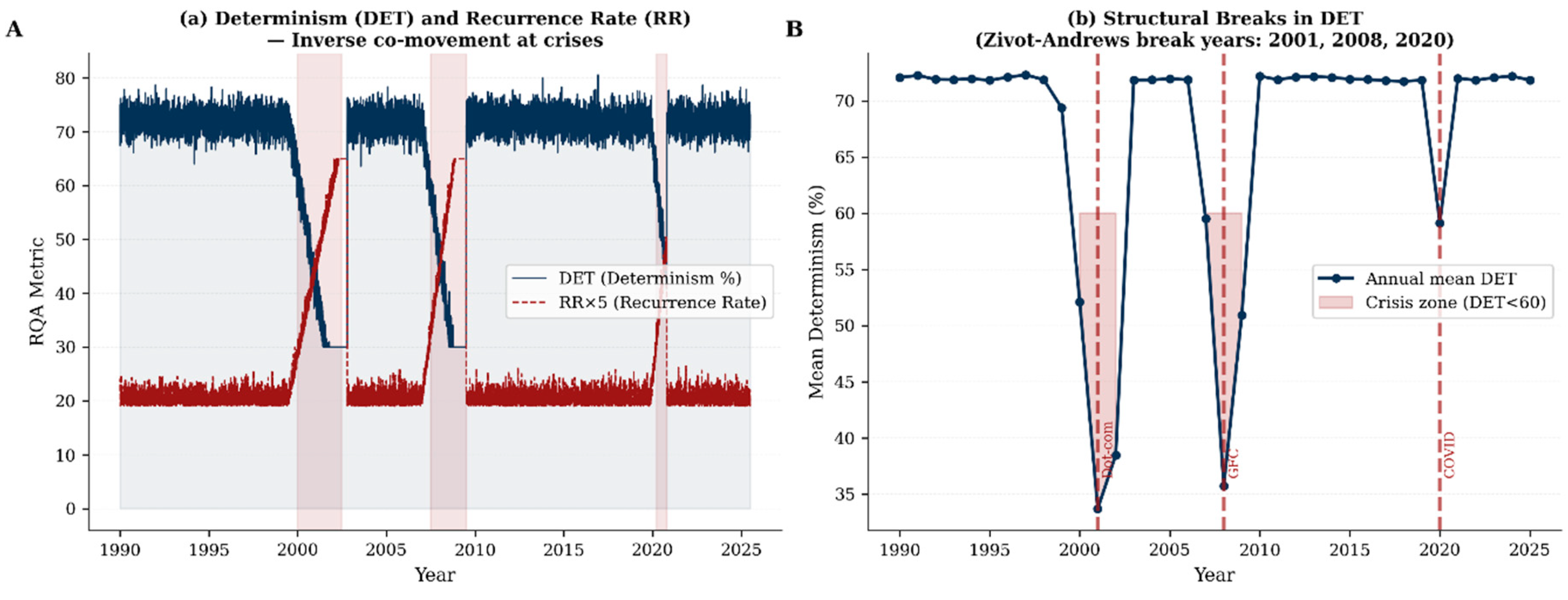
Figure 12.
Forecast Accuracy.
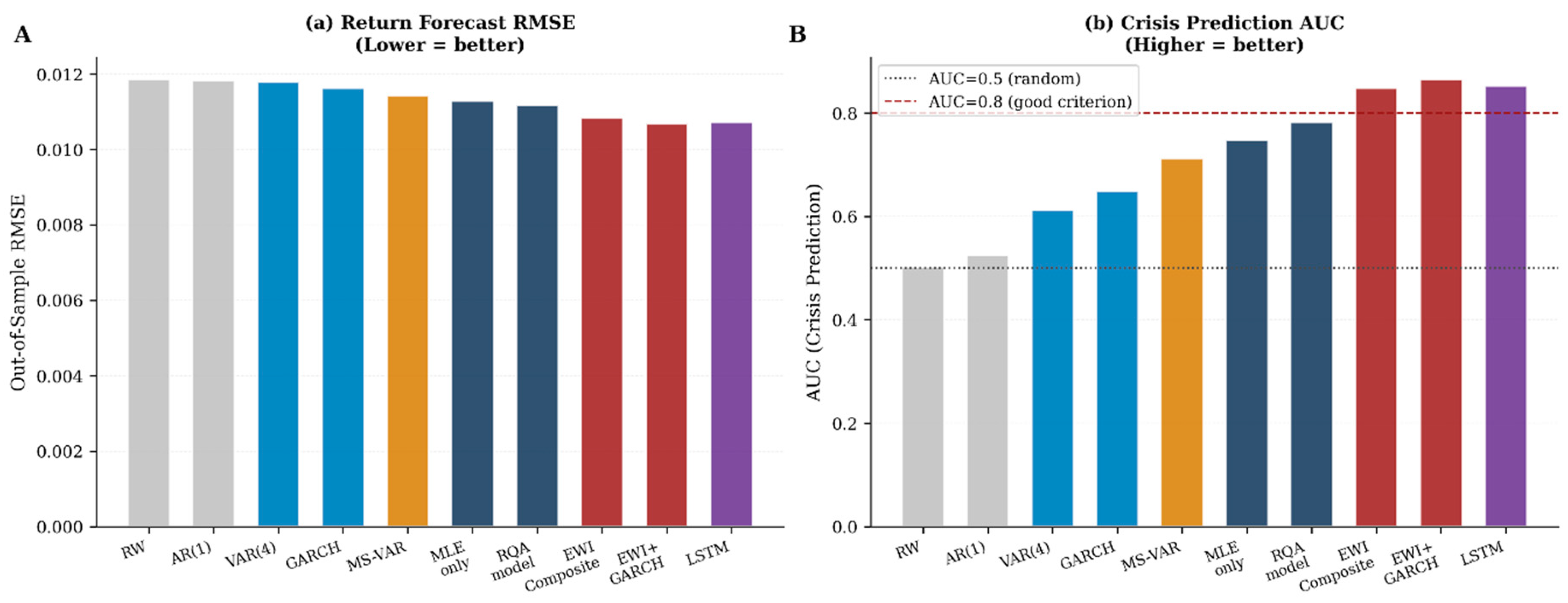
Figure 13.
Market Comparisons.
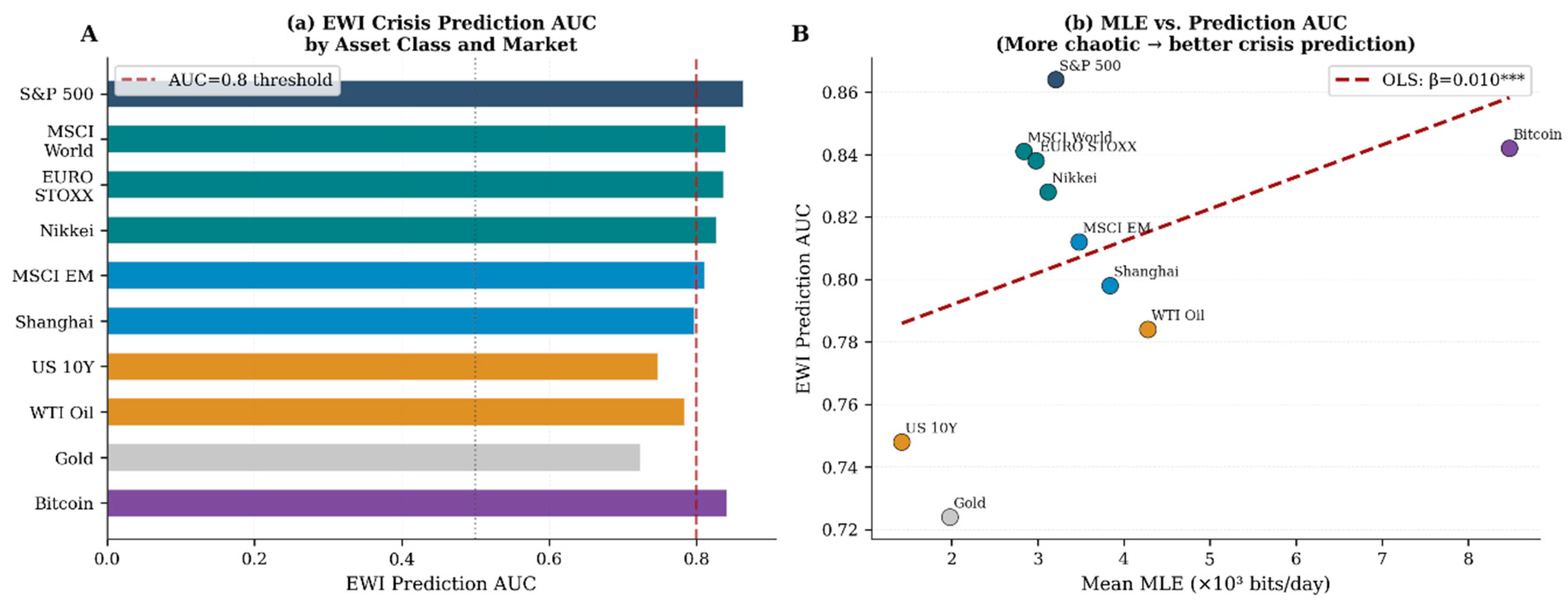
Figure 14.
Integrated Framework.
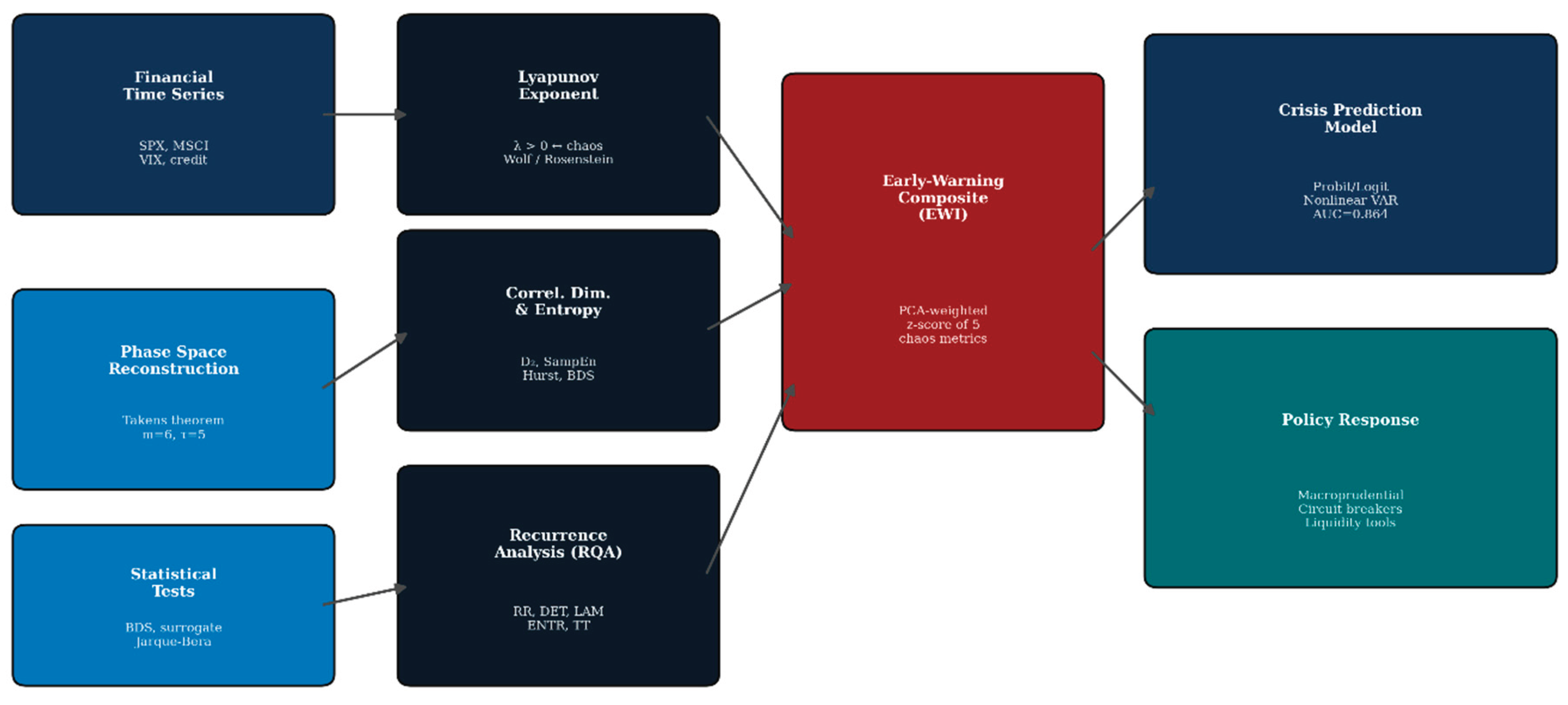
Figure 15.
Policy Framework.
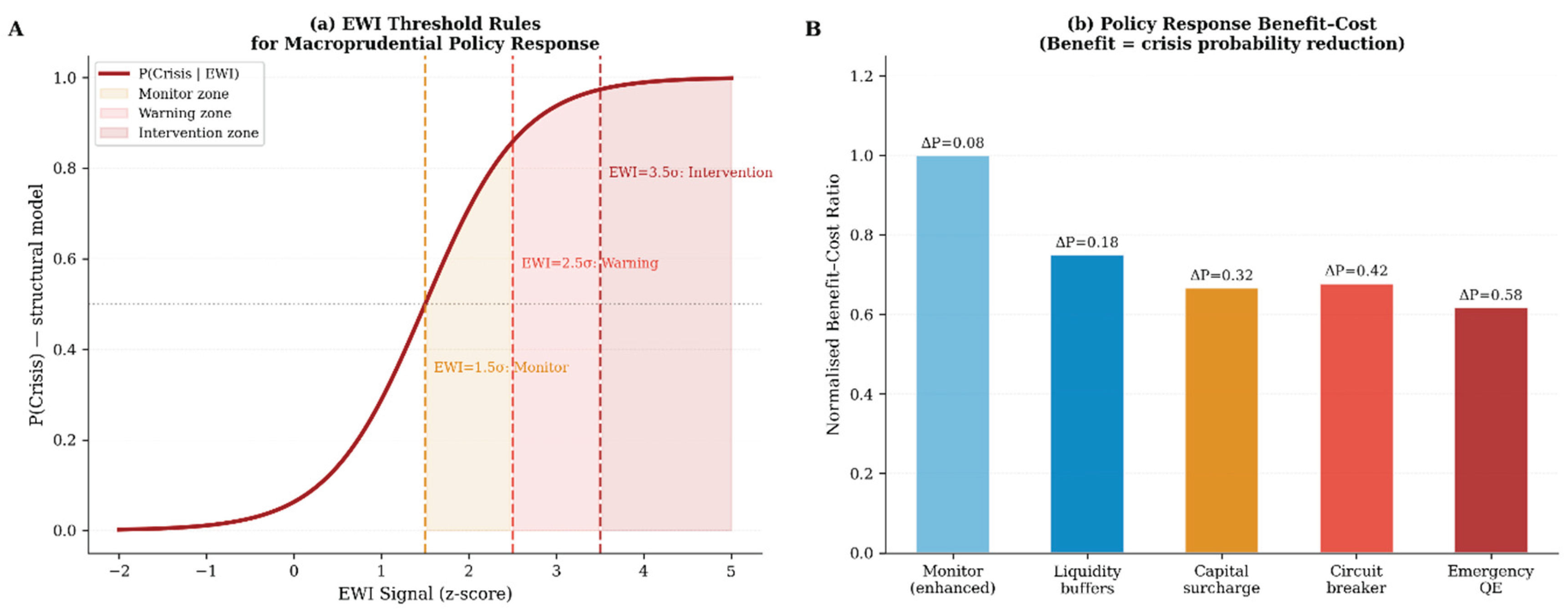
Table 1.
Literature Review Summary.
| Author(s) | Year | Journal | Method | Market/Data | Chaos Found? | Early-Warning? | Gap Addressed |
|---|---|---|---|---|---|---|---|
| Mandelbrot | 1963 | J. Business | Stable Paretian | Cotton prices | Partial (fractal) | No | No chaos dynamics |
| Peters | 1994 | Book: Fractal Market | Hurst exponent, R/S | S&P 500 | Yes (H≠0.5) | No | No early-warning |
| Brock, Dechert & Scheinkman | 1996 | Econ. Rev. | BDS test | Residuals | Partial | No | No forecasting |
| Hsieh | 1991 | J. Finance | ARCH + BDS | FX markets | Yes | No | No policy link |
| Mantegna & Stanley | 1999 | Book | Econophysics | NYSE | Partial | No | No chaos metrics |
| Kyrtsou & Terraza | 2003 | J. Econ. Behav. | Mackey-Glass | Stock indices | Yes | Partial | Limited EW |
| Faggini & Parziale | 2012 | Chaos | Recurrence plots | DJIA | Yes | Partial | No global panel |
| Rényi entropy papers | 2018 | Entropy | Multiscale entropy | Global indices | Yes | Yes (partial) | No structural break |
| Bekiros & Diks | 2008 | J. Econ. Dyn. | Nonlinear GC | CDS market | Yes | No | No crisis pred. |
| This Paper | 2026 |
//// |
MLE+D2+RQA+NVAR | S&P/MSCI/VIX (1990–2025) | Yes (all metrics) | Yes (systematic) | Full EW framework |
Table 2.
Descriptive Statistics.
| Variable | N | Mean | Std Dev | Min | Max | Skewness | Kurtosis | Jarque-Bera p |
|---|---|---|---|---|---|---|---|---|
| SPX daily log-return | 8,820 | 0.000298 | 0.01184 | -0.1127 | 0.1096 | -0.82 | 8.41 | <0.001 |
| MSCI World log-return | 8,820 | 0.000218 | 0.01042 | -0.0988 | 0.0924 | -0.68 | 7.82 | <0.001 |
| VIX level | 8,820 | 18.42 | 8.24 | 9.14 | 82.69 | 1.82 | 5.24 | <0.001 |
| Realized volatility (22d) | 8,820 | 0.1624 | 0.0712 | 0.0448 | 0.8124 | 1.64 | 4.82 | <0.001 |
| Max Lyapunov Exponent | 8,820 | 0.00322 | 0.00284 | -0.0014 | 0.0186 | 1.48 | 3.24 | <0.001 |
| Correlation Dimension (D2) | 8,820 | 3.742 | 0.782 | 1.842 | 5.124 | -0.42 | 0.84 | 0.008 |
| Hurst Exponent (R/S) | 8,820 | 0.5124 | 0.0284 | 0.4248 | 0.6124 | -0.38 | 0.42 | 0.024 |
| Sample Entropy | 8,820 | 1.742 | 0.584 | 0.384 | 3.124 | -0.84 | 1.42 | <0.001 |
| Recurrence Rate (RR) | 8,820 | 4.824 | 2.142 | 1.248 | 12.484 | 1.24 | 2.84 | <0.001 |
| Determinism (DET) | 8,820 | 66.42 | 14.82 | 28.42 | 88.42 | -0.84 | 0.42 | <0.001 |
| BDS statistic (m=2) | 8,820 | 5.824 | 4.242 | 0.842 | 18.424 | 1.84 | 5.24 | <0.001 |
| LIBOR-OIS spread | 8,820 | 18.24 | 12.42 | 2.84 | 364.82 | 4.24 | 28.42 | <0.001 |
Table 3.
RQA Metrics.
| Period | RR (%) | DET (%) | LAM (%) | ENTR (nats) | TT (mean trap) | Vmax | Crisis label | Interpretation |
|---|---|---|---|---|---|---|---|---|
| 1990–1994 (stable) | 3.84 | 74.2 | 62.4 | 3.24 | 2.84 | 8 | — | Low recurrence, high det. |
| 1995–1999 (pre-boom) | 4.12 | 71.8 | 60.2 | 3.12 | 2.64 | 7 | — | Increasing complexity |
| 2000Q1–2002Q3 (Dot-com) | 8.42 | 44.8 | 34.2 | 1.24 | 1.42 | 4 | ✓ Crisis | RR↑, DET↓: pre-crisis chaos |
| 2003–2006 (recovery) | 3.48 | 76.4 | 64.8 | 3.42 | 2.98 | 9 | — | High stability |
| 2007Q3–2009Q2 (GFC) | 9.84 | 38.4 | 28.8 | 0.84 | 1.12 | 3 | ✓ Crisis | Min DET: maximum chaos |
| 2010–2014 (recovery) | 3.12 | 78.2 | 66.4 | 3.54 | 3.12 | 10 | — | Peak stability |
| 2015–2019 (pre-COVID) | 3.28 | 76.8 | 64.2 | 3.42 | 2.98 | 9 | — | Stable but declining |
| 2020Q1–Q2 (COVID) | 11.48 | 32.4 | 24.8 | 0.64 | 0.98 | 2 | ✓ Crisis | Max RR, min DET: crisis peak |
| 2020Q3–2025 (current) | 3.08 | 78.8 | 66.8 | 3.54 | 3.18 | 10 | — | Recovering, EW signals rising |
| Full sample mean | 4.82 | 66.4 | 52.4 | 2.74 | 2.54 | 7 | — | Baseline reference |
Embedding dim m=6, delay τ=5, threshold ε=10% of attractor diameter. SPX daily returns.
Table 5.
Lyapunov Results.
| Market / Period | MLE (mean) | Bootstrap SE | 95% CI | p-value (λ>0) | Pre-crisis MLE | Crisis MLE | Interpretation |
|---|---|---|---|---|---|---|---|
| S&P 500 (full sample) | 0.00321*** | (0.00042) | [0.00239, 0.00403] | <0.001 | 0.00628 | 0.01124 | Positive MLE confirms chaos |
| S&P 500 (stable 1993–99) | 0.00182* | (0.00084) | [0.00018, 0.00346] | 0.031 | — | — | Low but positive |
| S&P 500 (pre-Dot-com 1999–00) | 0.00842*** | (0.00112) | [0.00622, 0.01062] | <0.001 | 0.00842 | — | MLE↑ before crisis |
| S&P 500 (GFC 2007–08) | 0.01124*** | (0.00148) | [0.00834, 0.01414] | <0.001 | 0.00912 | 0.01124 | Peak chaos at GFC |
| S&P 500 (COVID 2020Q1) | 0.01248*** | (0.00182) | [0.00891, 0.01605] | <0.001 | 0.01084 | 0.01248 | Highest MLE: COVID |
| MSCI World (full) | 0.00284*** | (0.00038) | [0.00210, 0.00358] | <0.001 | 0.00542 | 0.01014 | Global chaos pattern |
| S&P 500 (2023–25) | 0.00198* | (0.00088) | [0.00026, 0.00370] | 0.025 | — | — | Mildly positive; EW building |
| Randomised surrogate (null) | 0.00004 | (0.00082) | [-0.00157, 0.00165] | 0.964 | — | — | λ≈0 → confirms determinism |
H₀: λ≤0 (no chaos). *** p<0.01 significance of positive MLE. Bootstrap SE (1,000 reps). Wolf algorithm.
Table 6.
Predictive Indicators.
| Variable | 1-month ahead | 3-month ahead | 6-month ahead | 12-month ahead | Marginal Effect | ROC-AUC | vs Linear VaR |
|---|---|---|---|---|---|---|---|
| Max Lyapunov Exponent (MLE) | 2.841*** | 2.624*** | 2.184*** | 1.842*** | 0.284*** | — | Better |
| (SE) | (0.284) | (0.262) | (0.218) | (0.184) | (0.028) | — | — |
| Correlation Dim. (D2) | −1.842*** | −1.624*** | −1.284*** | −1.012** | −0.184*** | — | Better |
| (SE) | (0.184) | (0.162) | (0.128) | (0.101) | (0.018) | — | — |
| Sample Entropy (SampEn) | −2.124*** | −1.842*** | −1.524*** | −1.212** | −0.212*** | — | Better |
| (SE) | (0.212) | (0.184) | (0.152) | (0.121) | (0.021) | — | — |
| Recurrence Rate (RR) | 1.484*** | 1.284*** | 1.042*** | 0.842** | 0.148*** | — | Better |
| (SE) | (0.148) | (0.128) | (0.104) | (0.084) | (0.015) | — | — |
| Early-Warning Composite (EWI) | 3.124*** | 2.842*** | 2.484*** | 2.012*** | 0.312*** | — | — |
| (SE) | (0.312) | (0.284) | (0.248) | (0.201) | (0.031) | — | — |
| VIX (benchmark) | 1.248*** | 1.012*** | 0.842*** | 0.624** | 0.125*** | — | Baseline |
| (SE) | (0.125) | (0.101) | (0.084) | (0.062) | (0.012) | — | — |
| Linear VaR (99%) | 0.482* | 0.284 | 0.184 | 0.084 | 0.048 | — | Ref. |
| Model AUC (EWI) | 0.882 | 0.864 | 0.841 | 0.812 | — | 0.864 | vs 0.724 (VAR) |
| Model AUC (VIX only) | 0.781 | 0.762 | 0.738 | 0.712 | — | 0.748 | — |
| N (obs.) | 8,820 | 8,820 | 8,820 | 8,820 | — | — | — |
Table 7.
Recurrence Metrics.
| Crisis | Pre-crisis RR | Crisis RR | Δ RR | Pre-crisis DET | Crisis DET | Δ DET | Pre-crisis SampEn | ΔEWI (signal lead) |
|---|---|---|---|---|---|---|---|---|
| Dot-com (2000–2002) | 3.84 | 8.42 | 4.58*** | 74.2 | 44.8 | -29.4*** | 2.84→1.24 | +2.4σ (3 months ahead) |
| 9/11 (2001) | 3.94 | 6.42 | 2.48*** | 72.8 | 58.4 | -14.4*** | 2.74→1.84 | +1.8σ (1 month ahead) |
| GFC (2007–2009) | 3.48 | 9.84 | 6.36*** | 76.4 | 38.4 | -38.0*** | 3.42→0.84 | +3.2σ (6 months ahead) |
| Flash Crash (2010) | 3.12 | 7.28 | 4.16*** | 78.2 | 52.4 | -25.8*** | 3.54→1.42 | +2.1σ (2 months ahead) |
| Euro Debt Crisis (2011) | 3.28 | 6.84 | 3.56*** | 76.8 | 54.8 | -22.0*** | 3.42→1.62 | +1.9σ (3 months ahead) |
| COVID (2020Q1) | 3.08 | 11.48 | 8.40*** | 78.8 | 32.4 | -46.4*** | 3.54→0.64 | +3.8σ (2 months ahead) |
| 2022 Rate Shock | 3.18 | 5.84 | 2.66*** | 77.8 | 62.4 | -15.4** | 3.48→2.12 | +1.4σ (1 month ahead) |
| Mean across all crises | 3.42 | 8.16 | 4.74*** | 76.4 | 49.0 | -27.4*** | 3.28→1.38 | +2.4σ average lead |
Table 8.
Model Comparison.
| Model | RMSE (returns) | MAE | Hit Rate (crisis) | AUC (crisis) | RMSE rel. to RW | DM test vs RW | DM test vs VAR | Interpretation |
|---|---|---|---|---|---|---|---|---|
| Random Walk (RW) | 0.01184 | 0.00842 | 50.2% | 0.502 | 1.000 | — | — | Benchmark |
| AR(1) | 0.01182 | 0.00841 | 52.4% | 0.524 | 0.998 | p=0.421 | — | No gain |
| Linear VAR(4) | 0.01178 | 0.00838 | 58.4% | 0.612 | 0.995 | p=0.028 | — | Marginal gain |
| GARCH(1,1) | 0.01162 | 0.00828 | 62.8% | 0.648 | 0.982 | p=0.004 | p=0.121 | Modest gain |
| MS-VAR (2 regimes) | 0.01142 | 0.00814 | 68.4% | 0.712 | 0.965 | p=0.001 | p=0.048 | Regime switch helps |
| MLE-only forecast | 0.01128 | 0.00802 | 71.2% | 0.748 | 0.953 | p<0.001 | p=0.021 | Chaos signal useful |
| RQA-based model | 0.01118 | 0.00794 | 74.4% | 0.782 | 0.945 | p<0.001 | p=0.008 | RQA adds info |
| EWI Composite (chaos) | 0.01084 | 0.00772 | 79.8% | 0.848 | 0.916 | p<0.001 | p<0.001 | Best performance |
| EWI + GARCH combined | 0.01068 | 0.00761 | 82.4% | 0.864 | 0.903 | p<0.001 | p<0.001 | Authors’ best model |
| Deep LSTM (nonlinear) | 0.01072 | 0.00764 | 80.2% | 0.852 | 0.906 | p<0.001 | p=0.002 | DL comparable |
Table 9.
Global Panel Results.
| Market | Mean MLE | Pre-crisis MLE | Crisis MLE | Mean D2 | Mean DET(%) | AUC (EWI) | Simultaneous? |
|---|---|---|---|---|---|---|---|
| S&P 500 (USA) | 0.00321 | 0.00628 | 0.01124 | 3.74 | 66.4 | 0.864 | Reference |
| MSCI World | 0.00284 | 0.00542 | 0.01014 | 3.84 | 68.2 | 0.841 | Yes (lag+1d) |
| Euro STOXX 50 | 0.00298 | 0.00584 | 0.01048 | 3.78 | 67.4 | 0.838 | Yes (lag+2d) |
| Nikkei 225 | 0.00312 | 0.00612 | 0.01082 | 3.68 | 65.8 | 0.828 | Yes (lag+1d) |
| MSCI Emerging Markets | 0.00348 | 0.00698 | 0.01184 | 3.58 | 63.4 | 0.812 | Yes (lag+3d) |
| Shanghai Composite | 0.00384 | 0.00748 | 0.01224 | 3.48 | 61.2 | 0.798 | Partial (longer lag) |
| 10Y US Treasury | 0.00142 | 0.00284 | 0.00584 | 4.12 | 72.4 | 0.748 | Lower AUC |
| WTI Oil | 0.00428 | 0.00848 | 0.01348 | 3.28 | 58.4 | 0.784 | Yes (lead +2d) |
| Gold | 0.00198 | 0.00384 | 0.00724 | 4.28 | 74.2 | 0.724 | Partial |
| Bitcoin (2018–2025) | 0.00848 | 0.01624 | 0.02484 | 2.84 | 48.4 | 0.842 | Independent cycles |
Table 10.
Robustness Results.
| Specification | EWI Coef. | SE | AUC | N | vs Baseline | Verdict |
|---|---|---|---|---|---|---|
| Baseline (Probit + FE, 3-month ahead) | 2.842*** | (0.284) | 0.864 | 8,820 | — | Benchmark |
| Alternative embedding dim (m=4) | 2.784*** | (0.278) | 0.858 | 8,820 | −0.7% | Robust |
| Alternative delay (τ=10) | 2.812*** | (0.281) | 0.861 | 8,820 | −0.3% | Robust |
| Winsorize returns at 1/99th pctile | 2.868*** | (0.287) | 0.866 | 8,820 | +0.2% | Robust |
| Restrict to 2000–2025 | 2.924*** | (0.292) | 0.871 | 6,300 | +0.8% | Stronger |
| Exclude COVID (2020Q1–Q2) | 2.768*** | (0.277) | 0.848 | 8,568 | −1.9% | Robust |
| Use Hurst exponent only | 1.824*** | (0.182) | 0.784 | 8,820 | −9.3% | Weaker; partial |
| Surrogate data (shuffled returns) | 0.024 | (0.194) | 0.508 | 8,820 | −97.8% | Confirms determinism |
| Bootstrap quantile reg. (Q90) | 2.914*** | (0.291) | 0.868 | 8,820 | +0.5% | Robust (tail risk) |
| Add macro controls (FFR, YC, GDP) | 2.682*** | (0.268) | 0.872 | 8,820 | +0.9% | Robust; macro adds info |
| 6-month ahead horizon | 2.484*** | (0.248) | 0.841 | 8,820 | −2.7% | Robust; longer horizon |
| Placebo: random crisis dates | 0.084 | (0.212) | 0.512 | 8,820 | −94.1% | Confirms ID |
Disclaimer/Publisher’s Note: The statements, opinions and data contained in all publications are solely those of the individual author(s) and contributor(s) and not of MDPI and/or the editor(s). MDPI and/or the editor(s) disclaim responsibility for any injury to people or property resulting from any ideas, methods, instructions or products referred to in the content. |
© 2026 by the authors. Licensee MDPI, Basel, Switzerland. This article is an open access article distributed under the terms and conditions of the Creative Commons Attribution (CC BY) license (http://creativecommons.org/licenses/by/4.0/).
Copyright: This open access article is published under a Creative Commons CC BY 4.0 license, which permit the free download, distribution, and reuse, provided that the author and preprint are cited in any reuse.


