
Submitted:
26 April 2026
Posted:
27 April 2026
You are already at the latest version
Abstract
Pancreatic cancer remains one of the most lethal malignancies worldwide, with pancreatic ductal adenocarcinoma accounting for the vast majority of cases and characterized by extensive desmoplasia, immune exclusion, and resistance to systemic therapies. Increasing evidence implicates lysosomal cathepsins as important regulators of these defining features of pancreatic tumor biology. Cathepsin-dependent proteolysis and lysosome-associated signaling pathways contribute to extracellular matrix remodeling, regulate immune cell trafficking, and influence antigen processing and presentation. Beyond their classical degradative functions, cathepsins participate in stress-adaptive cellular programs linked to autophagy, metabolic regulation, and proteostasis, supporting tumor cell survival under hypoxic, nutrient-limited, and therapy-induced stress conditions. Within the tumor microenvironment, dysregulated cathepsin activity promotes immune evasion by reshaping cytokine networks, impairing effective antigen presentation, and reinforcing physical and functional barriers to cytotoxic T-cell infiltration. Collectively, these mechanisms position the lysosome–cathepsin system as a central regulator of proteolytic remodeling, immune exclusion, and adaptive therapy resistance in pancreatic cancer, highlighting its potential relevance for emerging combinatorial therapeutic strategies.
Keywords:
pancreatic ductal adenocarcinoma
; lysosomal cathepsins
; tumor microenvironment
; immune evasion
; extracellular matrix remodeling
; autophagy
; therapeutic resistance
; cytotoxic cells
; antigen presentation
1. Introduction
Pancreatic cancer remains one of the deadliest malignancies, with high mortality due to late diagnosis, early metastatic spread, and limited durable responses to current therapies. Pancreatic ductal adenocarcinoma (PDAC) is the most common and aggressive subtype, accounting for approximately 90% of cases, and still has a five-year survival rate below 12% [1]. Because early symptoms are non-specific and screening is ineffective, late diagnosis is typical, with most patients presenting with advanced, often unresectable tumors. Even when surgery is possible, relapse is common, and long-term survival remains poor, highlighting limited treatment progress and the urgent need for more effective, mechanism-driven therapeutic strategies. [2,3].
PDAC is also among the most therapy-resistant cancers in clinical practice. For resectable disease, surgery followed by adjuvant chemotherapy (gemcitabine-based regimens or FOLFIRINOX) is standard; however, many patients never fully recover to receive treatment, and those who do often experience only modest benefit; in the palliative setting, response rates remain limited (8–32%) [4]. Resistance arises from both tumor-intrinsic mechanisms, such as KRAS-driven signaling, cancer stemness, and adaptive genetic or epigenetic rewiring, as well as from strong extrinsic pressures in the tumor microenvironment (TME) [5,6,7]. Dense desmoplasia, heterogeneous cancer-associated fibroblast (CAF) populations, immunosuppressive infiltrates, and metabolic reprogramming impair drug delivery, weaken anti-tumor immunity, and support tumor survival [8,9,10,11,12].
A major unmet need in PDAC is the consistent failure of immunotherapy. Unlike several other solid tumors, PDAC has shown poor and largely disappointing responses to immune checkpoint blockade and other immunotherapeutic strategies [13]. PDAC is historically considered an immunologically “cold” tumor, characterized by limited cytotoxic T-cell infiltration due to dense desmoplastic stroma, defective antigen presentation, and a highly immunosuppressive TME enriched in myeloid cells and CAFs. Notably, surface major histocompatibility complex (MHC) class I expression is often reduced despite the absence of recurrent inactivating mutations in core MHC-I genes, indicating that post-transcriptional mechanisms, such as autophagy-mediated MHC-I degradation, may contribute to immune evasion [14]. In this context, lysosomes and autophagy are gaining increasing attention as central regulators of tumor fitness and immune evasion in PDAC. Beyond their degradative role, lysosomes function as key hubs for metabolic signaling, coordinating pathways such as mTORC1 and transcription factor EB (TFEB) while serving as the terminal compartment for autophagic flux [15]. PDAC cells frequently exhibit elevated autophagic activity and a strong dependence on lysosomal function to buffer nutrient deprivation and oxidative stress, recycle macromolecules, and survive chemotherapy-induced damage. These adaptive processes support metabolic plasticity and stress tolerance and may indirectly reinforce immune escape by sustaining tumor cell viability within the nutrient-poor and immune-excluded PDAC TME [16,17]. Within this framework, lysosomal peptidases—particularly cathepsins—emerge as important effectors of lysosomal activity, linking intracellular protein turnover with extracellular matrix (ECM) remodeling, immune regulation, and tumor progression in PDAC [18,19,20].
This review systematically elucidates the mechanisms by which lysosomal cathepsins influence PDAC progression, therapy resistance, and antitumor immune dysfunction. We present evidence from both tumor cell-intrinsic and microenvironmental compartments (including tumor-associated macrophages (TAMs), CAFs, and other stromal or immune populations) to explain how cathepsin-driven proteolysis and lysosomal signaling converge on ECM remodeling, immune cell trafficking, antigen processing and presentation, and stress-adaptive survival programs that maintain an immune-excluded, treatment-resistant state. By positioning cathepsins at the intersection of stromal dynamics and immune dysfunction, we also outline mechanistically grounded opportunities for combinatorial therapeutic intervention.
2. Lysosomes and the Tumor Microenvironment
2.1. Lysosomal Degradation and Signaling Networks in Cellular and Tumor Homeostasis
Lysosomes are dynamic, membrane-bound acidic organelles containing approximately 60 hydrolytic enzymes, including proteases, lipases, and nucleases, responsible for degrading endocytic and autophagic cargo [21]. Once considered primarily terminal degradative compartments, lysosomes are now recognized as central regulators of cellular homeostasis, integrating proteolysis, metabolism, membrane trafficking, and signaling [22,23].
A principal pathway for delivering cytoplasmic material to lysosomes is macroautophagy (hereafter autophagy), a conserved catabolic process that maintains cellular integrity under both basal and stress conditions. Autophagy begins with the formation of a crescent-shaped isolation membrane (phagophore), orchestrated by autophagy-related (ATG) proteins. Progressive expansion and closure of the phagophore generate a double-membraned autophagosome that engulfs damaged organelles, protein aggregates, and other cytoplasmic components. Subsequent fusion with late endosomes and lysosomes forms autolysosomes, where lysosomal hydrolases, including cysteine and aspartic cathepsins, mediate cargo degradation. The resulting metabolites are recycled to sustain biosynthesis, ATP production, and redox balance. In cancer, sustained autophagic–lysosomal flux often confers a survival advantage by enabling tumor cells to withstand hypoxia, nutrient deprivation, and therapy-induced stress [24,25].
Beyond degradation and recycling, lysosomes function as nutrient-sensing and signaling hubs. The lysosomal surface serves as a platform for mTORC1 activation via Rag GTPases, coupling amino acid availability to anabolic growth programs. Under nutrient-replete conditions, active mTORC1 suppresses autophagy and promotes biosynthesis, whereas nutrient limitation inactivates mTORC1, permitting autophagic induction and lysosome-dependent recycling. TFEB coordinates this adaptive response by regulating the expression of genes involved in lysosomal biogenesis, autophagy, and vesicular trafficking. Through TFEB-dependent programs, the autophagy–lysosome axis dynamically adjusts degradative capacity to metabolic demand [15].
In addition to autophagy, macropinocytosis is a complementary route by which extracellular material is delivered to the lysosomal system. Macropinocytosis is an actin-driven endocytic process that enables bulk uptake of extracellular fluid, soluble antigens, and proteins, particularly in dendritic cells and macrophages [26,27]. After internalization, macropinosomes undergo a regulated maturation sequence characterized by Rab GTPase exchange, progressive acidification, and fusion with late endosomes and lysosomes [28]. Within these compartments, lysosomal hydrolases, including cathepsins, process internalized proteins into peptide fragments. In professional antigen-presenting cells, this proteolysis supports loading of peptides onto MHC class II molecules, enabling CD4⁺ T-cell activation [29]. Under certain conditions, including antigen escape into the cytosol or delayed endosomal maturation in specialized dendritic cell subsets, macropinocytosed cargo can also enter cross-presentation pathways, linking antigen processing to MHC class I presentation and CD8⁺ T-cell priming [30,31,32]. Through these mechanisms, lysosomes couple environmental sampling to adaptive immune activation, reinforcing their role as dynamic regulators of immune homeostasis.
Beyond intracellular degradation, lysosomes also participate in membrane repair, vesicular trafficking, and regulated secretion, functions that are particularly relevant in the TME [33]. Importantly, lysosomal cargo is not confined to the cell interior. Lysosomal enzymes and partially processed substrates can reach the extracellular space through several routes: (i) lysosomal exocytosis, involving fusion of lysosomes with the plasma membrane; (ii) secretion via extracellular vesicles derived from multivesicular bodies with lysosome-related trafficking; and (iii) release following lysosomal membrane permeabilization or cell stress. In a protease-rich and metabolically stressed tumor niche, these export pathways extend lysosomal activity beyond the intracellular compartment, promoting ECM remodeling and modulating immune signaling [34].
PDAC exploits these lysosome-centered processes to adapt to its hostile TME, characterized by hypoxia, tissue acidosis, and nutrient limitation. Elevated autophagic flux, enhanced macropinocytosis, and altered proteostasis collectively converge on lysosomal degradation to sustain metabolic fitness and survival [35,36]. Consistent with this lysosomal dependency, increased lysosomal biogenesis and expansion of the lysosomal compartment have been reported in PDAC compared with normal pancreatic tissue [37] underscoring the central role of lysosomes as both metabolic hubs and platforms for extracellular proteolytic activity in this malignancy.
2.2. Unique Features of PDAC TME That Impact Lysosomal Function
PDAC is characterized by an exceptionally harsh TME that strongly influences lysosomal activity (see Figure 1). A defining feature is the dense fibroinflammatory (desmoplastic) stroma, which can constitute the majority of the tumor mass (on average about 60%, reaching up to 90% in some cases) [35,36]. This ECM–rich compartment, composed largely of collagens and hyaluronan, increases solid stress and interstitial fluid pressure, compresses intratumoral vasculature, and restricts perfusion, creating a major physical barrier within the tumor [35,37,38]. Pancreatic stellate cells (PSCs), a principal source of CAFs, drive this desmoplastic reaction through extensive ECM deposition and bidirectional signaling with tumor cells, promoting tumor progression [39].
The PDAC stroma resembles chronic, non-resolving wound repair, characterized by persistent CAF activation, excessive ECM accumulation, and sustained inflammatory signaling [40]. Among stromal populations, α-SMA⁺ myofibroblast-like CAFs are particularly abundant and contribute to both matrix production and pro-tumorigenic signaling networks [41,42,43]. In addition to forming a structural barrier, CAFs and myeloid cells promote immune suppression through cytokines such as TGF-β and IL-6, leading to T-cell exclusion and therapy resistance [44,45,46]. These stromal and immune populations also represent major sources of extracellular peptidases, including cathepsins, which participate in ECM remodeling and modulation of immune–stromal interactions within the PDAC TME [34,47].
2.2.1. Hypoxia and Low pH (Turning Lysosomal Programs Outward)
Chronic hypoxia, resulting from poor perfusion and high metabolic demand, is a defining feature of the PDAC TME [48]. Hypoxia-driven metabolic rewiring enhances glycolysis and lactate export, leading to extracellular acidosis. This acidic milieu is particularly relevant for cathepsins, as many retain or even increase their proteolytic activity at low pH once released into the extracellular space [47,49,50]. In addition, hypoxia can directly promote cathepsin expression and proteolytic capacity through HIF-1α–dependent transcriptional regulation. Hypoxia and acidosis also stimulate secretory trafficking, including extracellular vesicle release, and may favor pathways that redirect lysosomal contents into the TME, thereby extending lysosomal proteolysis beyond the cell boundary [51,52].
2.2.2. Nutrient Limitation (Autophagy and Scavenging Through Lysosomes)
Limited vascularization in PDAC restricts nutrient delivery, forcing tumor cells to rely heavily on lysosome-dependent recycling pathways. Nutrient limitation within the PDAC TME is measurable and functionally restrictive, driving reliance on stress-adaptive metabolism [53]. Under these conditions, sustained autophagic flux and lysosomal turnover maintain intracellular amino acid and lipid pools when glucose and other nutrients are scarce [54]. PDAC cells also exploit macropinocytosis to scavenge extracellular proteins, which are subsequently degraded in lysosomes to supply metabolic substrates [55]. In Ras-driven tumors, oncogenic Ras promotes constitutive macropinocytosis, enabling tumor cells to internalize extracellular proteins that are degraded in lysosomes to generate amino acids and support anabolic metabolism under nutrient-limited conditions [32]. These metabolic constraints also affect immune cells within the TME: hypoxia and acidosis impair cytotoxic lymphocyte function and reinforce immunosuppressive programs, while lysosomal pathways in myeloid cells influence antigen processing and inflammatory signaling [49].
2.3. Lysosomal–Immune System Interface (Antigen Presentation, Cytokine Release, Cell Death)
Lysosomes serve as critical immune regulatory hubs that integrate antigen processing, inflammatory signaling, and stress responses. At this interface, lysosomal cysteine cathepsins play key roles by shaping antigen presentation, modulating inflammatory signaling, and influencing whether stressed cells undergo survival or inflammatory cell death [56]. In PDAC models, MHC-I molecules can be redirected into autophagosomes or lysosomes, reducing their surface presentation; inhibition of autophagy or lysosomal function restores MHC-I expression and enhances CD8⁺ T-cell–mediated tumor control [56]. These findings link metabolic stress programs, including nutrient limitation–induced autophagy, to immune evasion mechanisms in PDAC [56,57,58]. Consistently, PDAC frequently shows reduced MHC-I expression without recurrent inactivating mutations in core MHC-I genes and exhibits poor responsiveness to immune checkpoint blockade, further supporting a connection between metabolic adaptation and immune escape [56,59]. Beyond antigen presentation, lysosomes regulate cytokine release and inflammatory signaling. Several cytokines, including IL-1β and IL-18, can be secreted through lysosome-dependent unconventional pathways following inflammasome activation, processes associated with lysosomal destabilization and regulated exocytosis [60,61,62,63]. Lysosomal pathways also intersect with neutrophil extracellular trap (NET) formation. NETosis involves the mobilization of proteases from neutrophil azurophilic granules, lysosome-related organelles containing enzymes such as neutrophil elastase, myeloperoxidase, and cathepsin G (CTSG; UniProt ID: P08311)—which translocate to the nucleus to promote chromatin decondensation and extracellular DNA release. In tumors, signals such as G-CSF, IL-8, and hypoxia stimulate NET formation, which can trap circulating tumor cells, remodel the ECM, and promote immunosuppressive and pro-thrombotic conditions within the TME [64], In PDAC, NETs further contribute to stromal activation and metastatic spread [65]. Finally, lysosomal membrane permeabilization can release lysosomal peptidases into the cytosol, where they initiate or amplify apoptotic and inflammatory cell-death pathways in a context-dependent manner [66,67]. Together, these mechanisms position lysosomes as central regulators linking metabolic stress, immune signaling, and cell-fate decisions within the PDAC TME.
3. Cathepsins as Lysosomal Effectors in Pancreatic Cancer
3.1. Overview of Cathepsins
Cathepsins are lysosomal peptidases classified as cysteine, aspartic, or serine peptidases based on their catalytic mechanism. The human genome encodes eleven cysteine cathepsins (B, C, F, H, K, L, O, S, V, W, X/Z), two aspartic cathepsins (D, E), and two serine cathepsins (A, G) [68,69]. Cathepsins are synthesized as inactive zymogens and are activated mainly in acidic endolysosomal compartments by propeptide removal through autocatalysis or processing by other cathepsins [69,70].
Cathepsins differ in proteolytic specificity and catalytic mode. Most cathepsins function as endopeptidases, while cathepsin C (CTSC; also known as dipeptidyl peptidase I, DPP1; UniProt ID: P53634) is a dipeptidyl peptidase, cathepsin H (CTSH; UniProt ID: P09668) has aminopeptidase activity, and cathepsin Z/X (CTSZ/X; UniProt ID: Q9UBR2) functions as a carboxypeptidase [71]. Cathepsin B (CTSB; UniProt ID: P07858) exhibits both endo- and exopeptidase activity due to its unique occluding loop structure [72].
3.2. Lysosomal Localization, Trafficking, and Activation Control of Cathepsin Activity
Cathepsins are synthesized as inactive zymogens whose activity is tightly regulated by intracellular trafficking, compartmental maturation, and endogenous inhibitors. They are translated on rough endoplasmic reticulum–bound ribosomes as preproenzymes, after which the signal peptide is removed and the nascent proenzymes undergo post-translational modification. N-linked glycosylation facilitates correct folding and lysosomal targeting while maintaining catalytic latency during biosynthesis and transport [69,85]. In the Golgi apparatus, most pro-cathepsins acquire mannose-6-phosphate (M6P) residues that enable recognition by mannose-6-phosphate receptors and delivery to endosomal compartments, although alternative receptor-independent trafficking pathways also exist [86].
Along the endosomal maturation pathway, pro-cathepsins enter progressively acidified compartments where receptor dissociation coincides with conditions that permit enzymatic activation. Maturation occurs primarily in late endosomes and lysosomes, where acidic pH destabilizes interactions between the propeptide and catalytic domain, enabling proteolytic removal of the inhibitory propeptide. Many cysteine and aspartic cathepsins undergo autocatalytic activation, while trans-activation by pre-existing active cathepsins further amplifies proteolysis within the lysosomal lumen [50,85].
Importantly, cathepsin activity is not determined solely by gene or protein expression levels. Instead, it depends on a combination of intracellular routing, maturation state, compartmental pH, and inhibition by endogenous inhibitors such as cystatins. Members of the cystatin family, including cystatin C, cystatin B, and related intracellular inhibitors, bind active cathepsins with high affinity and serve as key physiological brakes on proteolytic activity. Thus, the balance between cathepsins and their endogenous inhibitors critically determines the net proteolytic capacity of a cell [87]. Distinct pH and stability profiles further restrict activity along the endolysosomal continuum: enzymes such as cathepsin S (CTSS; UniProt ID: P25774), CTSC, and CTSH retain activity in late endosomes, whereas CTSB, cathepsin D (CTSD; UniProt ID: P07339), cathepsin L (CTSL; also known as cathepsin L1; UniProt ID: P07711), and cathepsin K (CTSK; UniProt ID: P43235) achieve maximal catalytic efficiency in fully acidified lysosomes [66]. In PDAC, oncogenic signaling and microenvironmental stress promote lysosomal biogenesis and increased lysosomal flux, expanding the pool of mature and catalytically competent cathepsins [88,89]. Alterations in lysosomal homeostasis or in the availability of endogenous inhibitors can further shift the balance toward sustained proteolysis, enhancing cargo degradation and supporting metabolic adaptation. Cathepsin regulation also intersects with TFEB-dependent lysosomal gene programs and autophagy. In PDAC models with impaired autophagy, dysregulated cathepsin activity is accompanied by increased extracellular cathepsin release and enhanced invasive behavior, underscoring that trafficking, maturation, and inhibitor balance, rather than expression alone, ultimately determine functional cathepsin output [88,89].
Multiple cathepsins are upregulated in PDAC compare to normal pancreatic tissue and are expressed in malignant epithelial, stromal, and immune compartments. Among these, cysteine cathepsins such as CTSB, CTSL, and CTSS promote tumor progression through ECM remodeling and cleavage of adhesion molecules, including E-cadherin, thereby facilitating invasion and dissemination. Genetic ablation of these enzymes reduces invasive growth in PDAC models [73]. Additional family members contribute to distinct aspects of tumor biology: CTSZ/X regulates cell–matrix interactions in tumor cells and macrophages, CTSH participates in pericellular proteolysis, while cathepsin W (CTSW; UniProt ID: P56202) is predominantly expressed in cytotoxic lymphocytes and reflects immune rather than tumor-intrinsic activity [75,76,77]. Aspartic cathepsins also participate in PDAC pathobiology: CTSD is frequently overexpressed and secreted by tumor cells and can be induced by oncogenic regulators such as anterior gradient protein 2 (AGR2), a protein disulfide isomerase family member involved in protein folding and regulation of the secretory pathway, whereas cathepsin E (CTSE; UniProt ID: P14091) is strongly upregulated in pancreatic intraepithelial neoplasia and invasive PDAC, consistent with early lysosomal reprogramming during tumorigenesis [78,79,80,81,82]. Importantly, cathepsin activity is influenced by the mechanical properties of the TME. In compliant stromal environments, lysosomal cathepsins can promote degradation of the mechanotransduction effector YAP1, thereby restraining oncogenic transcriptional programs. In contrast, in the stiff, fibrotic PDAC stroma characteristic of advanced disease, lysosomal cathepsin activity is suppressed, leading to YAP1 stabilization and enhanced tumor growth [83,84].
3.3. Non-Canonical Release into the Extracellular Space and Microenvironmental Effects
Although typically confined to lysosomes, cathepsins can be redistributed under pathological conditions (reviewed in detail in [90]). In PDAC and other stress-adapted cancers, cathepsins are frequently secreted or relocalized to the plasma membrane, where they mediate extracellular proteolysis of ECM and adhesion components, thereby promoting invasion and tumor–stroma remodeling [62,75]. Lysosomal membrane permeabilization can also release cathepsins into the cytosol, where they contribute to mitochondrial apoptosis by cleaving the pro-apoptotic protein Bid and degrading anti-apoptotic Bcl-2 family proteins, amplifying caspase-dependent cell death pathways [91]. In some contexts, cathepsins can also translocate to the nucleus, suggesting additional roles in stress-responsive signaling and transcriptional regulation [92].
Despite their lysosomal pH optimum, CTSB and CTSL are frequently redirected to pericellular and extracellular sites in the PDAC TME [93,94]. This redistribution reflects an actively rewired trafficking and secretory program rather than passive lysosomal leakage, increasing proteolytic flux in the TME. The resulting pericellular proteolytic niche promotes ECM remodeling and basement membrane disruption, facilitating invasive tumor phenotypes [80,95,96]. Extracellular CTSB and CTSL cleave structural ECM components such as type I and IV collagens, laminins, and fibronectin, and cooperate with matrix metalloproteinases (MMPs) and the urokinase-type plasminogen activator (uPA) system to amplify proteolytic cascades [97]. Their activity persists extracellularly in PDAC because local acidification in hypoxic and desmoplastic regions, as well as binding to cell surfaces or ECM scaffolds, helps preserve enzymatic activity [70,98].
Oncogenic signaling pathways further reinforce this extracellular cathepsin program. In KRAS-driven PDAC, KRAS signaling enhances lysosomal biogenesis and function, expanding the intracellular pool of cathepsins available for secretion. Consistently, dedicator of cytokinesis 8 (DOCK8), a cytoskeletal regulator involved in membrane trafficking and immune signaling, increases lysosomal CTSB activity and promotes tumor cell invasion, linking oncogenic circuitry to enhanced lysosomal proteolysis [99]. AGR2 has also been implicated in regulating CTSB and CTSD expression and activity, supporting metastatic competence. In parallel, Hedgehog signaling can upregulate CTSB expression, further enhancing invasive behavior and stromal–tumor crosstalk [80,100].
Beyond proteolysis, some cathepsins also regulate adhesion signaling. CTSZ/X contains an RGD integrin-binding motif that promotes integrin-dependent attachment and cell spreading, influencing tumor–ECM interactions independently of its catalytic activity. Regulation of CTSZ/X by S100P-binding protein (S100PBP), an adaptor protein associated with cytoskeletal organization and cell adhesion, links cathepsin expression to adhesion and cytoskeletal networks [75]. In PDAC progression, CTSZ/X expression inversely correlates with S100PBP levels: whereas CTSZ/X expression increases in PDAC tissues, while S100PBP expression decreases in invasive and metastatic lesions. Unlike CTSB and CTSL, which mainly promote invasion through ECM degradation, CTSZ/X functions primarily as a carboxypeptidase and facilitates integrin-mediated adhesion. Adhesion to CTSZ/X depends largely on αv-integrins, particularly αvβ5, linking cathepsin signaling to integrin-driven tumor–stroma interactions [75,103].
Additional non-canonical release mechanisms also contribute to extracellular cathepsin activity. Lysosomal exocytosis can deposit active lysosomal peptidases directly into the pericellular space, further promoting ECM remodeling and tumor invasion [34]. Moreover, CTSC, a lysosomal peptidase that activates neutrophil serine proteases such as neutrophil elastase, proteinase 3, and CTSG during neutrophil maturation, links lysosomal peptidase activity to inflammatory and immune responses within the TME [104].
Collectively, these non-canonical trafficking and secretion pathways extend cathepsin activity beyond lysosomes, linking ECM remodeling, invasion, immune modulation, and lysosome-dependent stress responses into an oncogene-driven program with significant relevance for PDAC progression and therapy resistance.
3.4. Clinical Associations and Compartmental Expression
Multiple members of the cathepsin family are dysregulated in PDAC and have been associated with clinical outcomes [80,96,105]. Transcriptomic, proteomic, and immunohistochemical studies consistently link altered cathepsin expression with patient survival, tumor progression, and metastatic potential, supporting their functional contribution to PDAC pathobiology and their potential prognostic value [77,93,95,96]. Importantly, cathepsin expression and activity can vary across cellular compartments of the TME, including tumor cells, stromal fibroblasts, and infiltrating immune populations, indicating that both tumor-intrinsic and microenvironmental sources contribute to the overall proteolytic landscape of PDAC.
Clinically, elevated CTSB and CTSL expression is consistently associated with poor prognosis in PDAC patients [68,106]. CTSL, in particular, has been linked to neural invasion and perineural dissemination, hallmarks of aggressive PDAC biology [93]. Immunohistochemical studies show that CTSL immunoreactivity is often prominent within the desmoplastic stroma however, epithelial expression appears to carry stronger prognostic significance. Although stromal staining can be more intense, increased CTSL levels in tumor cells are significantly associated with adverse clinicopathologic features, including lymphatic invasion, advanced tumor stage, early recurrence following surgical resection, and markedly reduced overall survival (median 6 vs. 22 months) [95]. These findings indicate that tumor cell–derived CTSL, rather than stromal expression alone, more accurately reflects aggressive tumor behavior and may serve as a clinically meaningful prognostic marker. Cathepsin V (CTSV; UniProt ID: O60911), also known as cathepsin L2 or cathepsin U, is a close paralog of cathepsin L that shares elastolytic and collagenolytic properties and has been implicated in invasive behavior in several epithelial malignancies [107]. Transcriptomic analyses indicate detectable CTSV expression in PDAC; however, direct associations with prognosis, chemoresistance, or metastasis remain limited. Given its structural similarity to CTSL, CTSV may participate in matrix remodeling at the tumor–stroma interface, although compartment-resolved evidence in pancreatic cancer is still emerging. CTSS is expressed in both the tumor and stromal compartments and contributes to ECM degradation, angiogenesis, and invasive growth [108]. Bioinformatic analyses have further identified CTSB as a central “hub” gene within PDAC-associated regulatory networks [109]. Functional studies in genetically engineered mouse models support a pro-tumorigenic role for CTSB in PDAC progression [106,110]. Increased CTSB expression correlates with adverse pathological features, poorer surgical outcomes, and enrichment within pancreatic cancer stem-like subpopulations [94]. In resected PDAC specimens, CTSB and CTSL are detected in both tumor cells and stromal compartments, and the CTSB/CTSL expression ratio correlates with tumor grade and survival following curative resection. Notably, CTSB expression has been associated with lymphatic invasion and early postoperative recurrence [96]. Other cathepsins primarily reflect microenvironmental or immune-cell activity. CTSC is a lysosomal cysteine peptidase best known for activating neutrophil serine peptidases, including neutrophil elastase, proteinase 3, and CTSG, during neutrophil maturation. Consequently, CTSC expression in tumors often reflects myeloid or neutrophil infiltration rather than tumor cell–intrinsic activity [111]. A recent multi-omics pan-cancer analysis incorporating TCGA cohorts further identifies CTSC as an immune-associated biomarker whose expression correlates with immune infiltration and patient outcome across multiple tumor types [112]. Thus, when CTSC expression associates with PDAC prognosis, it likely reflects the activity of inflammatory myeloid programs within the TME. CTSH is detectable in PDAC across malignant epithelial and stromal compartments and has been identified in endoscopic ultrasound–guided fine needle aspiration (EUS-FNA) cytology material from pancreatic lesions. However, current datasets have not established a consistent relationship between CTSH expression levels and disease stage or clinical outcome [76].
Among structurally distinct cathepsins, CTSZ/X has strict carboxypeptidase activity and contains a unique exposed RGD integrin-binding motif within its propeptide region [113]. Unlike classical matrix-degrading cathepsins, CTSZ/X often promotes tumor progression through integrin signaling rather than proteolysis alone. In pancreatic neuroendocrine tumor (PanNET) models, CTSZ/X is produced by both tumor cells and TAMs, but its functional contributions are compartment-specific. Tumor cell–derived CTSZ/X enhances proliferation and invasion via RGD-dependent integrin engagement and activation of FAK–Src signaling, whereas macrophage-derived CTSZ/X mainly promotes invasion without directly affecting tumor cell proliferation [75]. Although these mechanistic insights derive primarily from PanNET models, the integrin–FAK–Src signaling axis is also highly active in PDAC, and CTSZ/X regulation through S100PBP has been demonstrated in pancreatic cancer cells, suggesting similar integrin-mediated programs may operate in PDAC [75]. In contrast, CTSW exhibits a fundamentally different biology, being expressed predominantly in cytotoxic lymphocytes such as CD8⁺ T cells and natural killer (NK) cells [114]. Transcriptomic analyses of TCGA datasets show that reduced CTSW expression correlates with decreased overall survival in PDAC patients [77]. Because CTSW expression is restricted to cytotoxic immune cells, reduced levels likely reflect diminished immune infiltration rather than tumor cell–intrinsic peptidase activity. Accordingly, CTSW has been incorporated into machine-learning–based survival models as an immune-context biomarker of cytotoxic antitumor activity [77].
CTSK is a highly collagenolytic cysteine peptidase best known for its role in bone remodeling but is also conceptually relevant to PDAC due to the dense collagen-rich desmoplastic stroma. Transcriptomic studies suggest that CTSK expression signatures correlate with stromal or immune features and clinical outcomes in selected pancreatic cancer cohorts [115]. However, mechanistic studies defining its cellular source and functional role in PDAC remain limited. Cathepsin F (CTSF; UniProt ID: Q9UBX1) is another lysosomal cysteine peptidase for which PDAC-specific evidence remains sparse. Transcriptomic datasets confirm CTSF expression in pancreatic tumors [116,117], but consistent associations with patient survival, metastatic progression, or therapy response have not yet been established. Among aspartic cathepsins CTSD is frequently upregulated in PDAC tumor epithelium. Elevated CTSD expression correlates with reduced overall survival and adverse clinicopathologic features [118]. Integrative translational analyses further indicate that CTSD contributes to reduced responsiveness to gemcitabine, linking lysosomal peptidase activity to chemotherapy resistance [118]. Thus, CTSD is best interpreted as a tumor-intrinsic peptidase associated with aggressive disease behavior and therapeutic tolerance [118]. In contrast, CTSE displays one of the most disease-selective expression patterns among pancreatic cathepsins. CTSE is markedly upregulated in pancreatic intraepithelial neoplasia (PanIN) lesions and invasive PDAC compared with benign pancreatic tissue [82,119]. Elevated CTSE levels have also been detected in pancreatic juice from affected patients [119]. Unlike CTSD, CTSE has not been consistently linked to metastasis or therapy resistance; rather, its strongest clinical association lies in lesion-enriched epithelial expression and diagnostic specificity, making CTSE a promising biomarker for early detection of PDAC [82,119].
4. Lysosome–Cathepsin Axis in Anti-Tumor Immunity in Pancreatic Cancer
4.1. Antigen Presentation: Role of Cathepsins in MHC Class II Loading in Dendritic Cells and Macrophages
A central immune function of lysosomal cathepsins is processing internalized antigens for presentation (see Figure 2). In professional antigen-presenting cells, including dendritic cells, macrophages, and B cells, endolysosomal cathepsins generate peptide ligands from internalized proteins and shape the repertoire available for loading onto MHC-II molecules. A key step in this pathway is proteolytic processing of the invariant chain (Ii), which occupies the MHC-II peptide-binding groove during biosynthesis. Among lysosomal peptidases, CTSS is the principal enzyme driving invariant-chain cleavage in dendritic cells, macrophages, and B cells, thereby enabling removal of Ii-derived intermediates, formation of CLIP-containing complexes, and subsequent peptide exchange for stable MHC-II loading and CD4⁺ T-cell presentation. CTSL can also contribute to this pathway, although its role is more context- and cell-type-dependent. Together with endosomal acidification, cathepsin activity determines whether antigenic epitopes are preserved for presentation or over-degraded before loading, making lysosomal proteolysis a key checkpoint in adaptive immune priming [20,120]. Recent work continues to support CTSS as a critical regulator of MHC-II antigen presentation and CD4⁺ T-cell activation.
4.2. Implications for T-Cell Priming in PDAC
In PDAC, lysosome-dependent antigen handling is altered in ways that weaken both tumor cell recognition and APC-driven T-cell priming. Surface MHC-I is frequently reduced through autophagy–lysosome-dependent trafficking and degradation, limiting CD8⁺ T-cell recognition and reinforcing the immunologically “cold” phenotype of PDAC [121]. Mechanistically, MHC-I is selectively diverted from the plasma membrane into autophagosomes and lysosomes via an NBR1-dependent pathway, where it is degraded; inhibition of autophagy or lysosomal function restores surface MHC-I and enhances CD8⁺ T-cell–mediated tumor control in PDAC models. Recent work further suggests that selective cargo-capture machinery involving NBR1 and the ER-phagy receptor TEX264 may facilitate this routing, although this extension is currently based on a 2024 preprint rather than a peer-reviewed study [59,122,124]. These findings identify the autophagy–lysosome system as a mechanistic link between metabolic stress adaptation and immune evasion in PDAC. Consistent with this, PDAC often shows reduced MHC-I expression without recurrent inactivating mutations in core MHC-I genes, supporting the idea that defective antigen display is driven, at least in part, by post-translational lysosomal routing rather than irreversible genetic loss. At the level of APCs, altered CTSS-dependent endolysosomal proteolysis in tumor-associated macrophages or dendritic cells could plausibly distort invariant-chain processing, peptide trimming, and the quality of MHC-II presentation, thereby weakening CD4⁺ T-cell priming. In parallel, PIKfyve-dependent phagosome-to-lysosome maturation helps establish the endolysosomal environment required for efficient CTSS-mediated antigen processing and MHC-II presentation; inhibition of this pathway reduces CD4⁺ T-cell activation [125]. Together, these lysosome-dependent mechanisms can simultaneously limit tumor-cell visibility to CD8⁺ T cells and compromise APC-mediated T-cell priming, helping explain the weak adaptive immune responses typical of PDAC [59,121,123].
Beyond antigen presentation, lysosomal cathepsins also influence inflammatory signaling by regulating endolysosomal maturation, receptor turnover, and cytokine-processing pathways. Through proteolytic control of ligands, receptors, and signaling intermediates, they can either amplify or restrain inflammatory outputs, further shaping the immune tone of the PDAC TME [126].
4.3. Lysosomal Cathepsins in Stromal Remodeling and Immune Exclusion
TAMs in PDAC are often skewed toward an immunosuppressive, tissue-remodeling phenotype that promotes fibrosis, invasion, and immune evasion. In this context, lysosomal cysteine cathepsins contribute not only to ECM turnover but also to macrophage metabolic programming. Pharmacologic inhibition of CTSB, CTSL, and CTSS with GB111-NH2 in murine and human tumor-infiltrating macrophages reduced M2-like features, induced a shift toward a more pro-inflammatory phenotype, and altered lysosome-linked metabolic pathways, including ATP production and lipid mediator profiles. These findings support the view that cysteine cathepsins are active regulators of TAM polarization rather than passive markers of macrophage state, with direct implications for stromal remodeling in PDAC [127].
In parallel, stromal mechanical cues intersect with lysosomal proteolysis to influence tumor-cell behavior. Recent work shows that in compliant stromal environments, the autophagic–lysosomal axis promotes cathepsin-dependent degradation of YAP1, thereby constraining proliferative outgrowth. In PDAC tissues, CTSL and YAP1 show an inverse relationship, supporting a model in which reduced lysosomal cathepsin activity permits YAP1 persistence and favors tumor progression. This is particularly relevant because stromal stiffening, fibrosis, and altered lysosomal function are tightly linked in PDAC [116].
Together, these observations suggest that lysosomal peptidase activity in both myeloid and tumor compartments contributes to desmoplastic remodeling, sustains stromal–tumor crosstalk, and reinforces immune exclusion in PDAC. In this context, the lysosome–cathepsin axis can be viewed as a determinant of immune accessibility, acting through coordinated ECM remodeling, mechanotransduction, and modulation of macrophage polarization.
4.4. Lysosomal Membrane Permeabilization and Cathepsin-Mediated Cell Death
Beyond extracellular proteolysis, cathepsins also interact with autophagy and stress-adaptation pathways in PDAC. Under homeostatic conditions, CTSB regulates lysosomal biogenesis and autophagy by cleaving the lysosomal Ca²⁺ channel MCOLN1/TRPML1. This cleavage limits activation of the transcription factor TFEB, thereby restraining lysosomal biogenesis and the expression of autophagy-related genes. Consistent with this regulatory role, combined deficiency of CTSB and the aspartic peptidase CTSD in pancreatic tissue disrupts autophagic homeostasis, supporting a broader role for lysosomal peptidases in maintaining degradative flux [128,129]. In PDAC cells, sustained CTSB activity supports autophagic cargo degradation and generates metabolites that can fuel central metabolic pathways, including glycolysis. Autophagy in PDAC critically depends on ATG5, which is required for LC3-II–positive autophagosome formation and maintenance of autophagic flux [88]. Genetic studies in PDAC models driven by oncogenic signaling and tumor suppressor loss demonstrate a context-dependent role for autophagy: deletion of ATG5 can enhance tumor initiation but impair later tumor progression. Complete ATG5 loss blocks tumorigenesis, whereas monoallelic ATG5 loss promotes tumor development and metastasis [88]. In ATG5⁺/⁻; KRAS-driven PDAC models, partial impairment of autophagy increases extracellular activity of CTSL and CTSD, peptidases associated with matrix degradation and tumor invasion. This alteration links lysosomal homeostasis and cathepsin activity to cytokine secretion and immune modulation within the TME. In the same model, cytokine profiles shift toward signals that favor pro-tumorigenic macrophage polarization, with increased infiltration of M2-like macrophages observed in both primary and metastatic lesions. Consistently, macrophage depletion in these models reduces metastatic burden, supporting a role for lysosome-dependent peptidase activity in shaping stromal and immune dynamics [88]. Under conditions of tumor stress or lysosomal dysfunction, lysosomal membrane permeabilization (LMP) can occur. This process releases cathepsins from the lysosomal lumen into the cytosol, where they shift from degradative roles within lysosomes to cytosolic effectors capable of activating apoptotic and inflammatory signaling pathways. Through these mechanisms, lysosomal destabilization links metabolic stress, autophagy disruption, and cathepsin activity to cell death and inflammatory responses in PDAC [66].
Release of lysosomal cathepsins following LMP can trigger apoptosis through both caspase-dependent and caspase-independent mechanisms. In PDAC models, several therapeutic agents exploit this pathway. In BxPC-3 pancreatic cancer cells, the proteasome inhibitor PS-341 (bortezomib) induces apoptosis by promoting reactive oxygen species (ROS)–dependent lysosomal permeabilization and cytosolic release of CTSB. Cytosolic CTSB subsequently activates caspase-2, linking lysosomal damage to mitochondrial depolarization and downstream apoptotic signaling [130]. Similarly, Bobel-24, a cyclooxygenase/5-lipoxygenase (COX/5-LOX) inhibitor, induces lysosomal permeabilization and CTSB release, leading to mitochondrial depolarization, ROS accumulation, and apoptosis-inducing factor (AIF) translocation. In contrast to PS-341, this pathway proceeds largely independently of caspase activation, demonstrating that CTSB-mediated mitochondrial damage can also drive caspase-independent cell death in apoptosis-resistant pancreatic cancer cells such as NP9 [131].
Beyond apoptosis, emerging evidence suggests that CTSB may also participate in ferroptosis-related pathways. Iron-dependent lysosomal disruption can promote CTSB release and nuclear translocation, leading to DNA damage and activation of STING1 signaling [132]. In pancreatic cancer cells, nuclear CTSB has been proposed to facilitate autophagy-dependent ferroptosis, positioning this peptidase as a context-dependent mediator of organelle-specific cell death signaling and a potential therapeutic target [133].
5. Therapeutic Targeting of the Lysosome-Cathepsin Axis
5.1. Lysosome-Targeting Drugs
Lysosome-targeted therapy has emerged as a promising strategy in PDAC by exploiting the tumor’s reliance on elevated autophagy and lysosome-mediated metabolic recycling. Therapeutic approaches have largely focused on inhibiting late-stage autophagy and lysosomal function, most commonly using chloroquine (CQ) or hydroxychloroquine (HCQ), which interfere with autophagosome–lysosome fusion and blunt a major stress-adaptation pathway in PDAC cells [134,135]. These strategies represent early autophagy-targeting approaches that have evolved into broader efforts to exploit tumor-specific lysosomal dependency. Preclinical studies show that gemcitabine treatment induces autophagy and lysosomal activity through ERK–TFEB signaling, reflecting a therapy-induced lysosomal “rescue” response in PDAC cells [89]. Conversely, CQ sensitizes PDAC cells to gemcitabine by increasing oxidative stress and promoting lysosomal membrane permeability, leading to protease release and apoptosis [136].
Activation of TFEB and induction of lysosomal and autophagy-related gene expression are strongly associated with PDAC growth and metabolic fitness [137,138]. Accordingly, next-generation lysosomal inhibitors have been developed to target this dependency. The palmitoyl-protein thioesterase 1 (PPT1) inhibitor DC661 induces lysosomal membrane permeabilization, lipid peroxidation, and immunogenic cell death, although resistance mechanisms involving lipid metabolic rewiring, particularly glycosphingolipid metabolism, have also been described [139,140]. In addition, PIKfyve, a kinase regulating lysosomal lipid homeostasis and membrane dynamics, has emerged as a therapeutic vulnerability distinct from classical lysosomal acidification blockade [141].
Clinical evaluation of HCQ in combination regimens has shown biological activity but limited efficacy as a single agent, underscoring the need for rational therapeutic combinations [142]. Adaptive resistance can occur through TFEB-driven lysosomal biogenesis and drug sequestration, particularly following MAPK pathway inhibition, reinforcing the concept of PDAC “lysosomal addiction” [143]. In metastatic PDAC, adding HCQ to gemcitabine/nab-paclitaxel improved response rates but did not significantly extend 12-month overall survival and was associated with increased toxicity [144]. In contrast, in the neoadjuvant setting, HCQ-based combinations improved pathological responses and demonstrated pharmacodynamic evidence of autophagy inhibition and immune activation, supporting biomarker-guided patient selection [145]. Beyond CQ derivatives, therapeutic strategies that directly induce lysosomal membrane permeabilization have also been explored. For example, siramesine-like compounds can selectively target pancreatic cancer stem-like cells in patient-derived xenograft models, suggesting an alternative approach to exploiting lysosomal vulnerability in PDAC [146].
Despite encouraging preclinical results, clinical benefit from lysosomal inhibitors remains modest. This limitation likely reflects both tumor-intrinsic resistance mechanisms, such as TFEB-mediated lysosomal adaptation, and the unique physical barriers of the PDAC TME. Dense desmoplastic stroma, abnormal vasculature, elevated interstitial pressure, and heterogeneous perfusion collectively impair effective drug delivery. Additionally, hypoxia-driven metabolic rewiring promotes extracellular acidosis, which can influence lysosomotropic drug distribution and activity. These factors restrict intratumoral drug penetration and limit effective lysosomal inhibition, highlighting the need for combination strategies that also improve vascular function and drug delivery within the TME [52,147].
Collectively, these studies support the concept that PDAC displays a functional dependence on lysosomal pathways; however, effective therapeutic exploitation will likely require combination strategies to prevent compensatory lysosomal biogenesis and metabolic adaptation.
5.2. Cathepsin Inhibitors
Direct pharmacologic inhibition of cysteine cathepsins (see Figure 3) offers a complementary strategy to lysosome-targeting therapies by blocking the proteolytic activity of the lysosomal compartment rather than globally disrupting lysosomal pH or trafficking. In PDAC, cathepsin inhibition has been investigated both as a tumor-intrinsic strategy, limiting invasion, proliferation, and stress adaptation, and as a microenvironmental approach that modulates stromal and immune-cell proteolysis.
CTSB, which is frequently upregulated in PDAC, contributes to ECM degradation, invasion, and tumor progression. Preclinical studies using the CTSB-selective inhibitor CA-074Me demonstrated antitumor activity in pancreatic cancer models, including reductions in tumor growth comparable to gemcitabine in certain contexts, providing early proof-of-concept for pharmacologic CTSB inhibition [148,149]. Other cathepsins also contribute to PDAC progression. Co-overexpression of CTSL and CTSS has been linked to metastatic behavior, invasion, and immune modulation. Dual inhibition of CTSL and CTSS using ASPER-29 reduced metastatic traits in vitro [150], while newly developed CTSS inhibitors demonstrated antiproliferative activity in BxPC-3 and Capan-1 pancreatic cancer cells [151]. Broad-spectrum cathepsin inhibition has likewise shown proof-of-concept activity. The reversible multi-cathepsin inhibitor VBY-825 reduced tumor burden in pancreatic cancer models [152]. Natural compounds can also target lysosomal protease pathways. For example, matrine, an alkaloid derived from Sophora flavescens, suppresses pancreatic cancer growth by disrupting autophagy-dependent energy metabolism. Matrine inhibits lysosomal protease activity by preventing maturation of CTSB and CTSD, leading to impaired mitochondrial function and reduced energy production through downregulation of STAT3 signaling [153].
Beyond tumor-cell-intrinsic effects, cysteine cathepsin inhibition can also reprogram immune and stromal responses. The activity-based inhibitor GB111-NH₂, which targets CTSB, CTSL, and CTSS, alters macrophage polarization and lysosome-linked metabolic programs, thereby affecting proteolysis, inflammation, and stromal remodeling within the TME [127]. A major challenge in cathepsin inhibitor development is achieving sufficient selectivity. Many cathepsins share structurally similar active sites, particularly among CTSL-, CTSS-, and CTSK-like peptidases, enabling compensatory protease activity when a single enzyme is inhibited. This functional overlap may reduce the effectiveness of single-target inhibition approaches. However, preclinical studies have shown that selectively targeting individual cathepsins can modulate tumor-associated processes. In particular, inhibition of cathepsin B has been reported to reduce tumor invasion and related proteolytic activity in experimental cancer models [154]. Additionally, CTSZ/X has been proposed as a relevant target in tumor biology, with selective inhibitors demonstrating effects on cell adhesion and migration in preclinical settings [155]. Modulation of CTSB and CTSZ/X activity may influence tumor progression-related phenotypes, supporting the potential value of selective inhibition strategies in preclinical oncology models [156]. Therefore, rational multi-target inhibition strategies or combination therapies may be more effective than single-enzyme blockade.
5.3. Cathepsin-Responsive Targeting Strategies, Theranostics, and Prodrug Systems
Elevated cathepsin activity in PDAC tumors and their TME has created opportunities to exploit these enzymes as proteolytic triggers for targeted drug delivery and diagnostic imaging. In these systems, cathepsin activity serves as an enzymatic switch that activates therapeutic payloads specifically within the tumor, improving drug penetration while reducing systemic toxicity. Multiple polymer conjugates, nanoparticles, and prodrug systems incorporating CTSB- or CTSS-cleavable linkers have been engineered to deliver gemcitabine and other anticancer agents preferentially to PDAC tissues [152,157,158,159,160,161,162,163,164,165,166,167,168,169,170]. Because CTSB is frequently overexpressed and enzymatically active in PDAC cells and their TME [94,106], it has been widely used as a proteolytic trigger in nanotherapeutic design. Peptide linkers such as GFLG motifs have been incorporated into gemcitabine prodrugs and ligand-targeted nanoparticles, including RGD- or uPAR-directed delivery platforms, enabling intracellular drug release following endocytosis and lysosomal processing [170,171]. Some constructs integrate self-reporting fluorescence activation, allowing real-time monitoring of enzymatic drug release and therapeutic engagement [168].
CTSE shows a highly PDAC-selective expression pattern, being upregulated early during pancreatic intraepithelial neoplasia (PanIN) progression and remaining elevated in invasive PDAC [119,172]. This has enabled development of CTSE-activatable fluorescent probes for in vivo imaging and confocal endomicroscopy-based detection of neoplastic pancreatic lesions [81,173]. CTSE-responsive prodrug systems have also been explored, including enzyme-cleavable 5-aminolevulinic acid derivatives that generate localized photodynamic cytotoxicity after activation within the TME [174].
Cathepsin-dependent vulnerabilities can also be exploited to target stromal components. Magneto-mechanical activation of nanoparticles has been shown to induce lysosomal membrane permeabilization and cathepsin release in PDAC CAF models, leading to stromal cell death [175]. Spatially programmed combination delivery strategies have further demonstrated the potential of cathepsin-triggered systems to address multiple components of the TME simultaneously. For example, CTSB-triggered gemcitabine release combined with a perivascular PI3K inhibitor depot enhanced drug penetration, repolarized tumor-associated macrophages toward an M1-like phenotype, and improved antitumor immunity in orthotopic PDAC models [176].
Cathepsin-responsive technologies are also being developed as theranostic platforms, enabling simultaneous detection and treatment of tumors. Near-infrared probes capable of reporting protease activity in vivo [164], radiotherapeutic delivery systems incorporating cathepsin-cleavable linkers [163] and antibody-based targeting strategies that engage immune effector functions such as antibody-dependent cellular cytotoxicity (ADCC) have all been explored [177]. More recently, highly sensitive cathepsin-activatable fluorescence probes (including NIR-II designs) and multifunctional CTSB-responsive nanoDDS platforms have continued to expand the theranostic toolkit, supporting real-time mapping of protease activity to guide delivery strategies [178].
5.4. Biomarkers and Monitoring
Systemic and local readouts of extracellular cathepsin activity have been explored as potential biomarkers in PDAC. Cathepsins such as CTSB and CTSL have been detected in patient biofluids, supporting their potential use in biomarker and targeting strategies (see Table 1) [93,97,179,180]. Cathepsins including CTSB, CTSL, CTSS, and CTSH have also been identified in EUS-FNA samples from PDAC lesions, although current studies have not established clear correlations between expression levels and disease stage [181]. Circulating cathepsins may also serve as minimally invasive biomarkers. CTSB has been proposed as a urinary biomarker, and circulating CTSB and CTSL levels are elevated in pancreatic cancer compared with controls, with plasma CTSL associated with advanced disease and poorer overall survival [93,179,180].
Among cathepsins, CTSE shows the strongest disease enrichment. CTSE expression is markedly elevated in PDAC tissue and pancreatic juice compared to benign pancreatic conditions, supporting its diagnostic potential [119]. Additional studies have confirmed CTSE as a promising target for both imaging and therapeutic strategies in pancreatic cancer [182,183]. Activatable fluorescent probes that report CTSE activity enable in vivo detection of neoplastic and precursor lesions, linking protease activity to early tumor biology [81,173]. Importantly, CTSD has also been included in analytically validated serum multi-analyte signatures for early-stage PDAC, improving diagnostic discrimination beyond CA19-9 alone and highlighting the translational potential of protease-based liquid biopsy approaches [184].
In contrast, CTSB and CTSL are less disease-specific but more strongly associated with tumor aggressiveness. Elevated circulating CTSL has been linked to advanced disease stage and reduced survival [93], while elevated CTSB expression in PDAC tumor tissue correlates with tumor progression and stem-like phenotypes [94,106]. However, circulating cathepsin levels reflect contributions from tumor cells, stromal cells, and immune populations, which may limit specificity. Therefore, activity-based assays that quantify the active protease fraction, especially when combined with longitudinal sampling, may improve clinical interpretability compared with static abundance measurements alone [185].
Emerging evidence also suggests potential roles for additional family members. A Mendelian randomization analysis across digestive system tumors identified CTSF as a genetically supported exposure associated with pancreatic cancer risk, indicating possible involvement in disease susceptibility rather than tumor progression [117].
Collectively, current evidence supports a compartment-aware biomarker model in which CTSE is most informative for early detection, while CTSB and CTSL more strongly reflect tumor aggressiveness and disease dynamics, and CTSF may relate to inherited susceptibility. Integrating cathepsin measurements into multiplex biomarker panels, particularly those incorporating activity-based assays and longitudinal monitoring, may enhance the utility of protease biomarkers within emerging liquid-biopsy frameworks for PDAC.
6. Conclusions and Future Perspectives
In summary, accumulating evidence identifies the lysosome–cathepsin axis as a central regulator of PDAC biology, integrating metabolic adaptation, ECM remodeling, immune evasion, and therapy resistance. Lysosomal pathways support tumor cell survival in the nutrient-deprived and hypoxic PDAC TME through sustained autophagy, macropinocytosis, and TFEB-driven lysosomal biogenesis, while dysregulated cathepsin activity extends beyond lysosomes to remodel the ECM, shape stromal–tumor interactions, and influence immune signaling. Cathepsins also participate in antigen processing and presentation, modulate macrophage polarization and cytokine networks, and contribute to lysosomal membrane permeabilization–dependent cell death pathways, collectively linking proteolytic remodeling to both tumor progression and immune suppression. These multifaceted roles underscore the lysosome–cathepsin system as a critical node connecting tumor-intrinsic stress responses with microenvironmental regulation in PDAC. Although therapeutic strategies targeting lysosomal function or cathepsin activity have shown promising preclinical results, clinical translation remains limited by adaptive resistance, lysosomal biogenesis programs, and the physical barriers of the desmoplastic TME. Future research should therefore prioritize integrated approaches that combine lysosome-targeting therapies with strategies to modulate stromal architecture, restore antigen presentation, and enhance immune infiltration. Advances in cathepsin-responsive drug delivery systems, theranostic probes, and activity-based biomarkers may further enable patient stratification and real-time monitoring of proteolytic activity in vivo. Ultimately, a deeper mechanistic understanding of compartment-specific cathepsin regulation, particularly the balance between protease activation and endogenous inhibition, may facilitate the development of rational combination therapies that convert the lysosome–cathepsin axis from a driver of tumor resilience into a therapeutic vulnerability in pancreatic cancer.
Author Contributions
Conceptualization, M.P.N.; writing—original draft preparation, N.M.J and E.S.; visualization and illustrations, N.M.J.; writing—review and editing, J.K. and M.P.N.; funding acquisition, J.K. and M.P.N.
Funding
The author(s) declare financial support was received for the research and/or publication of this article. Research was funded by Slovenian Research and Innovation Agency grants P4–0127 to JK, Z3–50102 to ES, J3–60067 and RSF-041 to MPN and International Centre for Genetic Engineering and Biotechnology (ICGEB), CRP/SVN24-01 grant to MPN.
Acknowledgments
During the preparation of this manuscript, the authors used Instatex to assist in improving the clarity and language of the text and BioRender.com to create schematic illustrations. The authors have reviewed and edited the output and take full responsibility for the content of this publication.
Conflicts of Interest
The authors declare that the research was conducted in the absence of any commercial or financial relationships that could be construed as a potential conflict of interest.
Abbreviations
The following abbreviations are used in this manuscript:
| APC | Antigen presenting cell |
| ATG | Autophagy related protein |
| CAF | Cancer-associated fibroblast |
| CQ | Chloroquine |
| ECM | Extracellular matrix |
| HCQ | Hydrochloroquine |
| MHC | Major histocompatibility complex |
| MMP | Matrix metalloproteinase |
| NET | Neutrophil extracellular trap |
| NK | Natural killer cell |
| PDAC | Pancreatic ductal adenocarcinoma |
| PSC | Pancreatic stellate cell |
| TAM | Tumor-associated macrophage |
| TFEB | Transcription factor EB |
| TME | Tumor microenvironment |
| uPA | Urokinase-type plasminogen activator |
References
- Lencioni, G.; Gregori, A.; Toledo, B.; Rebelo, R.; Immordino, B.; Amrutkar, M.; Xavier, C.P.R.; Kocijančič, A.; Pandey, D.P.; Perán, M.; et al. Unravelling the Complexities of Resistance Mechanism in Pancreatic Cancer: Insights from in Vitro and Ex-Vivo Model Systems. Semin. Cancer Biol. 2024, 106–107, 217–233. [Google Scholar] [CrossRef]
- Mukherji, R.; Debnath, D.; Hartley, M.L.; Noel, M.S. The Role of Immunotherapy in Pancreatic Cancer. Curr. Oncol. Tor. Ont. 2022, 29, 6864–6892. [Google Scholar] [CrossRef]
- Partyka, O.; Pajewska, M.; Kwaśniewska, D.; Czerw, A.; Deptała, A.; Budzik, M.; Cipora, E.; Gąska, I.; Gazdowicz, L.; Mielnik, A.; et al. Overview of Pancreatic Cancer Epidemiology in Europe and Recommendations for Screening in High-Risk Populations. Cancers 2023, 15, 3634. [Google Scholar] [CrossRef]
- Di Costanzo, F.; Di Costanzo, F.; Antonuzzo, L.; Mazza, E.; Giommoni, E. Optimizing First-Line Chemotherapy in Metastatic Pancreatic Cancer: Efficacy of FOLFIRINOX versus Nab-Paclitaxel Plus Gemcitabine. Cancers 2023, 15, 416. [Google Scholar] [CrossRef]
- Galindo-Vega, A.; Maldonado-Lagunas, V.; Mitre-Aguilar, I.B.; Melendez-Zajgla, J. Tumor Microenvironment Role in Pancreatic Cancer Stem Cells. Cells 2023, 12, 1560. [Google Scholar] [CrossRef] [PubMed]
- Sherman, M.H.; Beatty, G.L. Tumor Microenvironment in Pancreatic Cancer Pathogenesis and Therapeutic Resistance. Annu. Rev. Pathol. 2023, 18, 123–148. [Google Scholar] [CrossRef]
- Glapiński, F.; Zając, W.; Fudalej, M.; Deptała, A.; Czerw, A.; Sygit, K.; Kozłowski, R.; Badowska-Kozakiewicz, A. The Role of the Tumor Microenvironment in Pancreatic Ductal Adenocarcinoma: Recent Advancements and Emerging Therapeutic Strategies. Cancers 2025, 17, 1599. [Google Scholar] [CrossRef] [PubMed]
- Hartupee, C.; Nagalo, B.M.; Chabu, C.Y.; Tesfay, M.Z.; Coleman-Barnett, J.; West, J.T.; Moaven, O. Pancreatic Cancer Tumor Microenvironment Is a Major Therapeutic Barrier and Target. Front. Immunol. 2024, 15. [Google Scholar] [CrossRef] [PubMed]
- Olaoba, O.T.; Yang, M.; Adelusi, T.I.; Maidens, T.; Kimchi, E.T.; Staveley-O’Carroll, K.F.; Li, G. Targeted Therapy for Highly Desmoplastic and Immunosuppressive Tumor Microenvironment of Pancreatic Ductal Adenocarcinoma. Cancers 2024, 16. [Google Scholar] [CrossRef]
- Bräutigam, K.; Skok, K.; Szymonski, K.; Rift, C.V.; Karamitopoulou, E. Tumor Immune Microenvironment in Pancreatic Ductal Adenocarcinoma Revisited – Exploring the “Space.”. Cancer Lett. 2025, 622, 217699. [Google Scholar] [CrossRef]
- Masuda, H. Cancer-Associated Fibroblasts in Cancer Drug Resistance and Cancer Progression: A Review. Cell. Death Discov. 2025, 11, 341. [Google Scholar] [CrossRef]
- Deipenbrock, A.; Wilmes, B.E.; Sommermann, T.; Abdo, N.; Moustakas, K.; Raasch, M.; Rennert, K.; Teusch, N.E. Modelling of the Multicellular Tumor Microenvironment of Pancreatic Ductal Adenocarcinoma (PDAC) on a Fit-for-Purpose Biochip for Preclinical Drug Discovery. Lab. Chip 2025, 25, 2168–2181. [Google Scholar] [CrossRef]
- Bear, A.S.; Vonderheide, R.H.; O’Hara, M.H. Challenges and Opportunities for Pancreatic Cancer Immunotherapy. Cancer Cell. 2020, 38, 788–802. [Google Scholar] [CrossRef] [PubMed]
- Bowers, J.S.; Bailey, S.R.; Rubinstein, M.P.; Paulos, C.M.; Camp, E.R. Genomics Meets Immunity in Pancreatic Cancer: Current Research and Future Directions for Pancreatic Adenocarcinoma Immunotherapy. Oncol. Rev. 2019, 13, 430. [Google Scholar] [CrossRef]
- Settembre, C.; Perera, R.M. Lysosomes as Coordinators of Cellular Catabolism, Metabolic Signalling and Organ Physiology. Nat. Rev. Mol. Cell. Biol. 2024, 25, 223–245. [Google Scholar] [CrossRef]
- Huang, F.-F.; Cui, W.-H.; Ma, L.-Y.; Chen, Q.; Liu, Y. Crosstalk of Nervous and Immune Systems in Pancreatic Cancer. Front. Cell. Dev. Biol. 2023, 11. [Google Scholar] [CrossRef]
- Savini, M.; Zhao, Q.; Wang, M.C. Lysosomes: Signaling Hubs for Metabolic Sensing and Longevity. Trends Cell. Biol. 2019, 29, 876–887. [Google Scholar] [CrossRef]
- Pišlar, A.; Perišić Nanut, M.; Kos, J. Lysosomal Cysteine Peptidases - Molecules Signaling Tumor Cell Death and Survival. Semin. Cancer Biol. 2015, 35, 168–179. [Google Scholar] [CrossRef]
- Senjor, E.; Kos, J.; Nanut, M.P. Cysteine Cathepsins as Therapeutic Targets in Immune Regulation and Immune Disorders. Biomedicines 2023, 11, 476. [Google Scholar] [CrossRef] [PubMed]
- Zhao, K.; Sun, Y.; Zhong, S.; Luo, J.-L. The Multifaceted Roles of Cathepsins in Immune and Inflammatory Responses: Implications for Cancer Therapy, Autoimmune Diseases, and Infectious Diseases. Biomark. Res. 2024, 12, 165. [Google Scholar] [CrossRef] [PubMed]
- Cao, M.; Luo, X.; Wu, K.; He, X. Targeting Lysosomes in Human Disease: From Basic Research to Clinical Applications. Signal Transduct. Target. Ther. 2021, 6, 379. [Google Scholar] [CrossRef]
- Ren, H.; Wang, G. Autophagy and Lysosome Storage Disorders. Adv. Exp. Med. Biol. 2020, 1207, 87–102. [Google Scholar] [CrossRef]
- Tang, T.; Yang, Z.; Wang, D.; Yang, X.; Wang, J.; Li, L.; Wen, Q.; Gao, L.; Bian, X.; Yu, S. The Role of Lysosomes in Cancer Development and Progression. Cell. Biosci. 2020, 10, 131. [Google Scholar] [CrossRef]
- Ma, Y.; Galluzzi, L.; Zitvogel, L.; Kroemer, G. Autophagy and Cellular Immune Responses. Immun. Camb. Mass. 2013, 39, 211–227. [Google Scholar] [CrossRef]
- Eriksson, I.; Öllinger, K. Lysosomes in Cancer-At the Crossroad of Good and Evil. Cells 2024, 13, 459. [Google Scholar] [CrossRef]
- Bloomfield, G.; Kay, R.R. Uses and Abuses of Macropinocytosis. J. Cell. Sci. 2016, 129, 2697–2705. [Google Scholar] [CrossRef] [PubMed]
- Lim, J.P.; Gleeson, P.A. Macropinocytosis: An Endocytic Pathway for Internalising Large Gulps. Immunol. Cell. Biol. 2011, 89, 836–843. [Google Scholar] [CrossRef] [PubMed]
- Levin-Konigsberg, R.; Montaño-Rendón, F.; Keren-Kaplan, T.; Li, R.; Ego, B.; Mylvaganam, S.; DiCiccio, J.E.; Trimble, W.S.; Bassik, M.C.; Bonifacino, J.S.; et al. Phagolysosome Resolution Requires Contacts with the Endoplasmic Reticulum and Phosphatidylinositol-4-Phosphate Signalling. Nat. Cell. Biol. 2019, 21, 1234–1247. [Google Scholar] [CrossRef]
- Roche, P.A.; Furuta, K. The Ins and Outs of MHC Class II-Mediated Antigen Processing and Presentation. Nat. Rev. Immunol. 2015, 15, 203–216. [Google Scholar] [CrossRef]
- Gros, M.; Amigorena, S. Regulation of Antigen Export to the Cytosol During Cross-Presentation. Front. Immunol. 2019, 10, 41. [Google Scholar] [CrossRef] [PubMed]
- Canton, J.; Khezri, R.; Glogauer, M.; Grinstein, S. Contrasting Phagosome pH Regulation and Maturation in Human M1 and M2 Macrophages. Mol. Biol. Cell. 2014, 25, 3330–3341. [Google Scholar] [CrossRef] [PubMed]
- Commisso, C.; Davidson, S.M.; Soydaner-Azeloglu, R.G.; Parker, S.J.; Kamphorst, J.J.; Hackett, S.; Grabocka, E.; Nofal, M.; Drebin, J.A.; Thompson, C.B.; et al. Macropinocytosis of Protein Is an Amino Acid Supply Route in Ras-Transformed Cells. Nature 2013, 497, 633–637. [Google Scholar] [CrossRef]
- Lysosomes and Plasma Membrane Repair. In Current Topics in Membranes; Academic Press, 2019; Vol. 84, pp. 1–16.
- Trojani, M.-C.; Santucci-Darmanin, S.; Breuil, V.; Carle, G.F.; Pierrefite-Carle, V. Lysosomal Exocytosis: From Cell Protection to Protumoral Functions. Cancer Lett. 2024, 597, 217024. [Google Scholar] [CrossRef] [PubMed]
- Bulle, A.; Lim, K.-H. Beyond Just a Tight Fortress: Contribution of Stroma to Epithelial-Mesenchymal Transition in Pancreatic Cancer. Signal Transduct. Target. Ther. 2020, 5, 249. [Google Scholar] [CrossRef]
- Liot, S.; Balas, J.; Aubert, A.; Prigent, L.; Mercier-Gouy, P.; Verrier, B.; Bertolino, P.; Hennino, A.; Valcourt, U.; Lambert, E. Stroma Involvement in Pancreatic Ductal Adenocarcinoma: An Overview Focusing on Extracellular Matrix Proteins. Front. Immunol. 2021, 12, 612271. [Google Scholar] [CrossRef]
- Edwards, P.; Kang, B.W.; Chau, I. Targeting the Stroma in the Management of Pancreatic Cancer. Front. Oncol. 2021, 11, 691185. [Google Scholar] [CrossRef]
- Yu, M.; Tannock, I.F. Targeting Tumor Architecture to Favor Drug Penetration: A New Weapon to Combat Chemoresistance in Pancreatic Cancer? Cancer Cell. 2012, 21, 327–329. [Google Scholar] [CrossRef]
- Thomas, D.; Radhakrishnan, P. Tumor-Stromal Crosstalk in Pancreatic Cancer and Tissue Fibrosis. Mol. Cancer 2019, 18, 14. [Google Scholar] [CrossRef]
- M, S.; S, W. Cancer as an Overhealing Wound: An Old Hypothesis Revisited. Nat. Rev. Mol. Cell. Biol. 2008, 9. [Google Scholar] [CrossRef]
- Cirri, P.; Chiarugi, P. Cancer Associated Fibroblasts: The Dark Side of the Coin. Am. J. Cancer Res. 2011, 1, 482–497. [Google Scholar] [PubMed]
- Eyden, B.; Banerjee, S.S.; Shenjere, P.; Fisher, C. The Myofibroblast and Its Tumours. J. Clin. Pathol. 2009, 62, 236–249. [Google Scholar] [CrossRef]
- Klingberg, F.; Hinz, B.; White, E.S. The Myofibroblast Matrix: Implications for Tissue Repair and Fibrosis. J. Pathol. 2013, 229, 298–309. [Google Scholar] [CrossRef]
- Xiang, X.; Niu, Y.-R.; Wang, Z.-H.; Ye, L.-L.; Peng, W.-B.; Zhou, Q. Cancer-Associated Fibroblasts: Vital Suppressors of the Immune Response in the Tumor Microenvironment. Cytokine Growth Factor Rev. 2022, 67, 35–48. [Google Scholar] [CrossRef]
- Hou, W. Role of TGFβ-Activated Cancer-Associated Fibroblasts in the Resistance to Checkpoint Blockade Immunotherapy. Front. Oncol. 2025, 15, 1602452. [Google Scholar] [CrossRef]
- Liao, T.; Chen, X.; Qiu, F.; Zhang, X.; Wu, F.; Zhao, Z.; Xu, M.; Chen, M.; Shen, J.-W.; Shen, Q.; et al. Regulation of Cancer-Associated Fibroblasts for Enhanced Cancer Immunotherapy Using Advanced Functional Nanomedicines: An Updated Review. J. Nanobiotechnology 2025, 23, 166. [Google Scholar] [CrossRef]
- Wang, H.; Inoue, A.; Lei, Y.; Wu, H.; Hong, L.; Cheng, X.W. Cathepsins in the Extracellular Space: Focusing on Non-Lysosomal Proteolytic Functions with Clinical Implications. Cell. Signal. 2023, 103, 110531. [Google Scholar] [CrossRef] [PubMed]
- Sadozai, H.; Acharjee, A.; Kayani, H.Z.; Gruber, T.; Gorczynski, R.M.; Burke, B. High Hypoxia Status in Pancreatic Cancer Is Associated with Multiple Hallmarks of an Immunosuppressive Tumor Microenvironment. Front. Immunol. 2024, 15, 1360629. [Google Scholar] [CrossRef] [PubMed]
- Rahman, M.A.; Yadab, M.K.; Ali, M.M. Emerging Role of Extracellular pH in Tumor Microenvironment as a Therapeutic Target for Cancer Immunotherapy. Cells 2024, 13, 1924. [Google Scholar] [CrossRef] [PubMed]
- Vidak, E.; Javoršek, U.; Vizovišek, M.; Turk, B. Cysteine Cathepsins and Their Extracellular Roles: Shaping the Microenvironment. Cells 2019, 8, 264. [Google Scholar] [CrossRef]
- Peppicelli, S.; Calorini, L.; Bianchini, F.; Papucci, L.; Magnelli, L.; Andreucci, E. Acidity and Hypoxia of Tumor Microenvironment, a Positive Interplay in Extracellular Vesicle Release by Tumor Cells. Cell. Oncol. 2025, 48, 27–41. [Google Scholar] [CrossRef] [PubMed]
- Bogdanov, A.; Bogdanov, A.; Chubenko, V.; Volkov, N.; Moiseenko, F.; Moiseyenko, V. Tumor Acidity: From Hallmark of Cancer to Target of Treatment. Front. Oncol. 2022, 12, 979154. [Google Scholar] [CrossRef]
- Sheehan, C.; Muir, A. What’s on the Menu?: Metabolic Constraints in the Pancreatic Tumor Microenvironment. J. Clin. Invest. 135, e191940. [CrossRef]
- Mondal, G.; Debnath, J. NRF2 Activates Macropinocytosis upon Autophagy Inhibition. Cancer Cell. 2021, 39, 596–598. [Google Scholar] [CrossRef]
- Qiu, Z.; Liu, W.; Zhu, Q.; Ke, K.; Zhu, Q.; Jin, W.; Yu, S.; Yang, Z.; Li, L.; Sun, X.; et al. The Role and Therapeutic Potential of Macropinocytosis in Cancer. Front. Pharmacol. 2022, 13, 919819. [Google Scholar] [CrossRef]
- Yamamoto, K.; Venida, A.; Yano, J.; Biancur, D.E.; Kakiuchi, M.; Gupta, S.; Sohn, A.S.W.; Mukhopadhyay, S.; Lin, E.Y.; Parker, S.J.; et al. Autophagy Promotes Immune Evasion of Pancreatic Cancer by Degrading MHC-I. Nature 2020, 581, 100–105. [Google Scholar] [CrossRef]
- Piersma, B.; Hayward, M.-K.; Weaver, V.M. Fibrosis and Cancer: A Strained Relationship. Biochim. Biophys. Acta BBA-Rev. Cancer 2020, 1873, 188356. [Google Scholar] [CrossRef]
- Manoukian, P.; Damhofer, H.; Zhao, L.; van Laarhoven, H.W.M.; Bijlsma, M.F. Stromal Hedgehog Signaling Is Associated with Favorable Outcomes in Pancreatic Cancer. Int. J. Mol. Sci. 2025, 26, 5200. [Google Scholar] [CrossRef] [PubMed]
- Yamamoto, K.; Venida, A.; Perera, R.M.; Kimmelman, A.C. Selective Autophagy of MHC-I Promotes Immune Evasion of Pancreatic Cancer. Autophagy 2020, 16, 1524–1525. [Google Scholar] [CrossRef] [PubMed]
- Saftig, P.; Puertollano, R. How Lysosomes Sense, Integrate, and Cope with Stress. Trends Biochem. Sci. 2021, 46, 97–112. [Google Scholar] [CrossRef]
- Ballabio, A.; Bonifacino, J.S. Lysosomes as Dynamic Regulators of Cell and Organismal Homeostasis. Nat. Rev. Mol. Cell. Biol. 2020, 21, 101–118. [Google Scholar] [CrossRef] [PubMed]
- Evavold, C.L.; Kagan, J.C. Inflammasomes: Threat-Assessment Organelles of the Innate Immune System. Immunity 2019, 51, 609–624. [Google Scholar] [CrossRef]
- Cullen, S.P.; Kearney, C.J.; Clancy, D.M.; Martin, S.J. Diverse Activators of the NLRP3 Inflammasome Promote IL-1β Secretion by Triggering Necrosis. Cell. Rep. 2015, 11, 1535–1548. [Google Scholar] [CrossRef]
- Morawiec, M.-L.; Kubina, R.; Jabłońska, E.; Ratajczak-Wrona, W.; Stępień, S.; Gołębski, M.; Mielczarek-Palacz, A. NETs - as Predictors and Targets of Supportive Therapy for Cancer Treatment. Front. Immunol. 2025, 16. [Google Scholar] [CrossRef]
- He, X.-Y.; Ng, D.; Egeblad, M. Caught in a Web: Emerging Roles of Neutrophil Extracellular Traps in Cancer. Annu. Rev. Cancer Biol. 2022, 6, 223–243. [Google Scholar] [CrossRef]
- Repnik, U.; Hafner Česen, M.; Turk, B. Lysosomal Membrane Permeabilization in Cell Death: Concepts and Challenges. Mitochondrion 2014, 19 Pt A, 49–57. [Google Scholar] [CrossRef] [PubMed]
- Aits, S.; Jäättelä, M. Lysosomal Cell Death at a Glance. J. Cell. Sci. 2013, 126, 1905–1912. [Google Scholar] [CrossRef]
- Fujii, Y.; Asadi, Z.; Mehla, K. Cathepsins: Emerging Targets in the Tumor Ecosystem to Overcome Cancers. Semin. Cancer Biol. 2025, 112, 150–166. [Google Scholar] [CrossRef]
- Turk, V.; Stoka, V.; Vasiljeva, O.; Renko, M.; Sun, T.; Turk, B.; Turk, D. Cysteine Cathepsins: From Structure, Function and Regulation to New Frontiers. Biochim. Biophys. Acta 2012, 1824, 68–88. [Google Scholar] [CrossRef] [PubMed]
- Mohamed, M.M.; Sloane, B.F. Cysteine Cathepsins: Multifunctional Enzymes in Cancer. Nat. Rev. Cancer 2006, 6, 764–775. [Google Scholar] [CrossRef] [PubMed]
- Nägler, D.K.; Zhang, R.; Tam, W.; Sulea, T.; Purisima, E.O.; Ménard, R. Human Cathepsin X: A Cysteine Protease with Unique Carboxypeptidase Activity. Biochemistry 1999, 38, 12648–12654. [Google Scholar] [CrossRef]
- Mort, J.S.; Buttle, D.J. Cathepsin B. Int. J. Biochem. Cell. Biol. 1997, 29, 715–720. [Google Scholar] [CrossRef] [PubMed]
- Löser, R.; Pietzsch, J. Cysteine Cathepsins: Their Role in Tumor Progression and Recent Trends in the Development of Imaging Probes. Front. Chem. 2015, 3. [Google Scholar] [CrossRef]
- Bakst, R.L.; Xiong, H.; Chen, C.-H.; Deborde, S.; Lyubchik, A.; Zhou, Y.; He, S.; McNamara, W.; Lee, S.-Y.; Olson, O.C.; et al. Inflammatory Monocytes Promote Perineural Invasion via CCL2-Mediated Recruitment and Cathepsin B Expression. Cancer Res. 2017, 77, 6400–6414. [Google Scholar] [CrossRef]
- Lines, K.E.; Chelala, C.; Dmitrovic, B.; Wijesuriya, N.; Kocher, H.M.; Marshall, J.F.; Crnogorac-Jurcevic, T. S100P-Binding Protein, S100PBP, Mediates Adhesion through Regulation of Cathepsin Z in Pancreatic Cancer Cells. Am. J. Pathol. 2012, 180, 1485–1494. [Google Scholar] [CrossRef] [PubMed]
- Gocheva, V.; Chen, X.; Peters, C.; Reinheckel, T.; Joyce, J.A. Deletion of Cathepsin H Perturbs Angiogenic Switching, Vascularization and Growth of Tumors in a Mouse Model of Pancreatic Islet Cell Cancer. Biol. Chem. 2010, 391, 937–945. [Google Scholar] [CrossRef]
- Khojasteh-Leylakoohi, F.; Mohit, R.; Khalili-Tanha, N.; Asadnia, A.; Naderi, H.; Pourali, G.; Yousefli, Z.; Khalili-Tanha, G.; Khazaei, M.; Maftooh, M.; et al. Down Regulation of Cathepsin W Is Associated with Poor Prognosis in Pancreatic Cancer. Sci. Rep. 2023, 13, 16678. [Google Scholar] [CrossRef]
- Park, H.-D.; Kang, E.-S.; Kim, J.-W.; Lee, K.-T.; Lee, K.H.; Park, Y.S.; Park, J.-O.; Lee, J.; Heo, J.S.; Choi, S.H.; et al. Serum CA19-9, Cathepsin D, and Matrix Metalloproteinase-7 as a Diagnostic Panel for Pancreatic Ductal Adenocarcinoma. Proteomics 2012, 12, 3590–3597. [Google Scholar] [CrossRef] [PubMed]
- Vetvicka, V.; Fusek, M. Procathepsin D as a Tumor Marker, Anti-Cancer Drug or Screening Agent. Anticancer Agents Med. Chem. 12, 172–175. [CrossRef]
- Dumartin, L.; Whiteman, H.J.; Weeks, M.E.; Hariharan, D.; Dmitrovic, B.; Iacobuzio-Donahue, C.A.; Brentnall, T.A.; Bronner, M.P.; Feakins, R.M.; Timms, J.F.; et al. AGR2 Is a Novel Surface Antigen That Promotes the Dissemination of Pancreatic Cancer Cells through Regulation of Cathepsins B and D. Cancer Res. 2011, 71, 7091–7102. [Google Scholar] [CrossRef]
- Cruz-Monserrate, Z.; Abd-Elgaliel, W.R.; Grote, T.; Deng, D.; Ji, B.; Arumugam, T.; Wang, H.; Tung, C.-H.; Logsdon, C.D. Detection of Pancreatic Cancer Tumours and Precursor Lesions by Cathepsin E Activity in Mouse Models. Gut 2012, 61, 1315–1322. [Google Scholar] [CrossRef]
- Azuma, T.; Hirai, M.; Ito, S.; Yamamoto, K.; Taggart, R.T.; Matsuba, T.; Yasukawa, K.; Uno, K.; Hayakumo, T.; Nakajima, M. Expression of Cathepsin E in Pancreas: A Possible Tumor Marker for Pancreas, a Preliminary Report. Int. J. Cancer 1996, 67, 492–497. [Google Scholar] [CrossRef]
- Dupont, S.; Morsut, L.; Aragona, M.; Enzo, E.; Giulitti, S.; Cordenonsi, M.; Zanconato, F.; Le Digabel, J.; Forcato, M.; Bicciato, S.; et al. Role of YAP/TAZ in Mechanotransduction. Nature 2011, 474, 179–183. [Google Scholar] [CrossRef] [PubMed]
- Xiao, Y.; Zhang, H.; Ma, Q.; Huang, R.; Lu, J.; Liang, X.; Liu, X.; Zhang, Z.; Yu, L.; Pang, J.; et al. YAP1-Mediated Pancreatic Stellate Cell Activation Inhibits Pancreatic Cancer Cell Proliferation. Cancer Lett. 2019, 462, 51–60. [Google Scholar] [CrossRef] [PubMed]
- Turk, V.; Turk, B.; Turk, D. Lysosomal Cysteine Proteases: Facts and Opportunities. EMBO J. 2001, 20, 4629–4633. [Google Scholar] [CrossRef]
- Saftig, P.; Klumperman, J. Lysosome Biogenesis and Lysosomal Membrane Proteins: Trafficking Meets Function. Nat. Rev. Mol. Cell. Biol. 2009, 10, 623–635. [Google Scholar] [CrossRef]
- Komura, T.; Takabatake, H.; Harada, K.; Yamato, M.; Miyazawa, M.; Yoshida, K.; Honda, M.; Wada, T.; Kitagawa, H.; Ohta, T.; et al. Clinical Features of Cystatin A Expression in Patients with Pancreatic Ductal Adenocarcinoma. Cancer Sci. 2017, 108, 2122–2129. [Google Scholar] [CrossRef]
- Görgülü, K.; Diakopoulos, K.N.; Ai, J.; Schoeps, B.; Kabacaoglu, D.; Karpathaki, A.-F.; Ciecielski, K.J.; Kaya-Aksoy, E.; Ruess, D.A.; Berninger, A.; et al. Levels of the Autophagy-Related 5 Protein Affect Progression and Metastasis of Pancreatic Tumors in Mice. Gastroenterology 2019, 156, 203–217.e20. [Google Scholar] [CrossRef]
- B, M.; Ma, P.; C, L.; Lh, T.; S, J.; Mj, B. Gemcitabine Promotes Autophagy and Lysosomal Function through ERK- and TFEB-Dependent Mechanisms. Cell. Death Discov. 2023, 9. [Google Scholar] [CrossRef]
- Conesa-Bakkali, R.; Morillo-Huesca, M.; Martínez-Fábregas, J. Non-Canonical, Extralysosomal Activities of Lysosomal Peptidases in Physiological and Pathological Conditions: New Clinical Opportunities for Cancer Therapy. Cells 2025, 14. [Google Scholar] [CrossRef] [PubMed]
- Droga-Mazovec, G.; Bojic, L.; Petelin, A.; Ivanova, S.; Romih, R.; Repnik, U.; Salvesen, G.S.; Stoka, V.; Turk, V.; Turk, B. Cysteine Cathepsins Trigger Caspase-Dependent Cell Death through Cleavage of Bid and Antiapoptotic Bcl-2 Homologues. J. Biol. Chem. 2008, 283, 19140–19150. [Google Scholar] [CrossRef]
- Enneking, A.E.; Khorey, M.M.; Edgington-Mitchell, L.E. Nuclear Roles for Canonically Lysosomal Proteases. Mol. Cell. Biol. 2025, 45, 343–352. [Google Scholar] [CrossRef]
- Singh, N.; Das, P.; Gupta, S.; Sachdev, V.; Srivasatava, S.; Datta Gupta, S.; Pandey, R.M.; Sahni, P.; Chauhan, S.S.; Saraya, A. Plasma Cathepsin L: A Prognostic Marker for Pancreatic Cancer. World J. Gastroenterol. 2014, 20, 17532–17540. [Google Scholar] [CrossRef]
- Fujimoto, T.; Tsunedomi, R.; Matsukuma, S.; Yoshimura, K.; Oga, A.; Fujiwara, N.; Fujiwara, Y.; Matsui, H.; Shindo, Y.; Tokumitsu, Y.; et al. Cathepsin B Is Highly Expressed in Pancreatic Cancer Stem-like Cells and Is Associated with Patients’ Surgical Outcomes. Oncol. Lett. 2021, 21, 1–1. [Google Scholar] [CrossRef]
- Singh, N.; Das, P.; Datta Gupta, S.; Sahni, P.; Pandey, R.M.; Gupta, S.; Chauhan, S.S.; Saraya, A. Prognostic Significance of Extracellular Matrix Degrading Enzymes-Cathepsin L and Matrix Metalloproteases-2 [MMP-2] in Human Pancreatic Cancer. Cancer Invest. 2013, 31, 461–471. [Google Scholar] [CrossRef] [PubMed]
- Niedergethmann, M.; Wostbrock, B.; Sturm, J.W.; Willeke, F.; Post, S.; Hildenbrand, R. Prognostic Impact of Cysteine Proteases Cathepsin B and Cathepsin L in Pancreatic Adenocarcinoma. Pancreas 2004, 29, 204–211. [Google Scholar] [CrossRef]
- Kalubowilage, M.; Covarrubias-Zambrano, O.; Malalasekera, A.P.; Wendel, S.O.; Wang, H.; Yapa, A.S.; Chlebanowski, L.; Toledo, Y.; Ortega, R.; Janik, K.E.; et al. Early Detection of Pancreatic Cancers in Liquid Biopsies by Ultrasensitive Fluorescence Nanobiosensors. Nanomed. Nanotechnol. Biol. Med. 2018, 14, 1823–1832. [Google Scholar] [CrossRef]
- Olson, O.C.; Joyce, J.A. Cysteine Cathepsin Proteases: Regulators of Cancer Progression and Therapeutic Response. Nat. Rev. Cancer 2015, 15, 712–729. [Google Scholar] [CrossRef]
- Gutierrez-Ruiz, O.L.; Johnson, K.M.; Krueger, E.W.; Nooren, R.E.; Cruz-Reyes, N.; Heppelmann, C.J.; Hogenson, T.L.; Fernandez-Zapico, M.E.; McNiven, M.A.; Razidlo, G.L. Ectopic Expression of DOCK8 Regulates Lysosome-Mediated Pancreatic Tumor Cell Invasion. Cell. Rep. 2023, 42, 113042. [Google Scholar] [CrossRef] [PubMed]
- Hwang, J.-H.; Lee, S.H.; Lee, K.H.; Lee, K.Y.; Kim, H.; Ryu, J.K.; Yoon, Y.B.; Kim, Y.-T. Cathepsin B Is a Target of Hedgehog Signaling in Pancreatic Cancer. Cancer Lett. 2009, 273, 266–272. [Google Scholar] [CrossRef]
- Yuan, J.; Ofengeim, D. A Guide to Cell Death Pathways. Nat. Rev. Mol. Cell. Biol. 2024, 25, 379–395. [Google Scholar] [CrossRef] [PubMed]
- Jiang, Y.; Han, L.; Xue, M.; Wang, T.; Zhu, Y.; Xiong, C.; Shi, M.; Li, H.; Hai, W.; Huo, Y.; et al. Cystatin B Increases Autophagic Flux by Sustaining Proteolytic Activity of Cathepsin B and Fuels Glycolysis in Pancreatic Cancer: CSTB Orchestrates Autophagy and Glycolysis in PDAC. Clin. Transl. Med. 2022, 12, e1126. [Google Scholar] [CrossRef] [PubMed]
- Jakoš, T.; Pišlar, A.; Jewett, A.; Kos, J. Cysteine Cathepsins in Tumor-Associated Immune Cells. Front. Immunol. 2019, 10, 2037. [Google Scholar] [CrossRef]
- Turk, D.; Janjić, V.; Štern, I.; Podobnik, M.; Lamba, D.; Weis Dahl, S.; Lauritzen, C.; Pedersen, J.; Turk, V.; Turk, B. Structure of Human Dipeptidyl Peptidase I (Cathepsin C): Exclusion Domain Added to an Endopeptidase Framework Creates the Machine for Activation of Granular Serine Proteases. EMBO J. 2001, 20, 6570–6582. [Google Scholar] [CrossRef] [PubMed]
- Sulpizio, S.; Franceschini, N.; Piattelli, A.; Di Sebastiano, P.; Innocenti, P.; Selvaggi, F. Cathepsins and Pancreatic Cancer: The 2012 Update. Pancreatology 2012, 12, 395–401. [Google Scholar] [CrossRef]
- Gopinathan, A.; Denicola, G.M.; Frese, K.K.; Cook, N.; Karreth, F.A.; Mayerle, J.; Lerch, M.M.; Reinheckel, T.; Tuveson, D.A. Cathepsin B Promotes the Progression of Pancreatic Ductal Adenocarcinoma in Mice. Gut 2012, 61. [Google Scholar] [CrossRef]
- Brömme, D.; Li, Z.; Barnes, M.; Mehler, E. Human Cathepsin V Functional Expression, Tissue Distribution, Electrostatic Surface Potential, Enzymatic Characterization, and Chromosomal Localization. Biochemistry 1999, 38, 2377–2385. [Google Scholar] [CrossRef]
- Canè, S.; Barouni, R.M.; Fabbi, M.; Cuozzo, J.; Fracasso, G.; Adamo, A.; Ugel, S.; Trovato, R.; De Sanctis, F.; Giacca, M.; et al. Neutralization of NET-Associated Human ARG1 Enhances Cancer Immunotherapy. Sci. Transl. Med. 2023, 15, eabq6221. [Google Scholar] [CrossRef]
- Karimi, E.; Kalaki, N.S.; Akrami, S.M. Identifying Hub Genes and Pathways in Pancreatic Ductal Adenocarcinoma (PAAD): A Comprehensive in Silico Study. Biochem. Biophys. Rep. 2025, 41, 101921. [Google Scholar] [CrossRef]
- Giriyappagoudar, M.; Vastrad, B.; Horakeri, R.; Vastrad, C. Identification and Interaction Analysis of Molecular Markers in Pancreatic Ductal Adenocarcinoma by Bioinformatics and Next-Generation Sequencing Data Analysis. Bioinforma. Biol. Insights 2023, 17, 11779322231186719. [Google Scholar] [CrossRef]
- Aghdassi, A.A.; Pham, C.; Zierke, L.; Mariaule, V.; Korkmaz, B.; Rhimi, M. Cathepsin C Role in Inflammatory Gastroenterological, Renal, Rheumatic, and Pulmonary Disorders. Biochimie 2024, 216, 175–180. [Google Scholar] [CrossRef] [PubMed]
- Zheng, L.; Liu, X.; Xi, Y.; Gong, D.; Ge, B.; Wei, X.; Cai, J.; Chen, P. A Pan-Cancer Analysis of CTSC as a Candidate Prognostic and Immune-Related Biomarker. Discov. Oncol. 2025, 16, 2258. [Google Scholar] [CrossRef] [PubMed]
- Akkari, L.; Gocheva, V.; Kester, J.C.; Hunter, K.E.; Quick, M.L.; Sevenich, L.; Wang, H.-W.; Peters, C.; Tang, L.H.; Klimstra, D.S.; et al. Distinct Functions of Macrophage-Derived and Cancer Cell-Derived Cathepsin Z Combine to Promote Tumor Malignancy via Interactions with the Extracellular Matrix. Genes. Dev. 2014, 28, 2134–2150. [Google Scholar] [CrossRef]
- Wex, T.; Bühling, F.; Wex, H.; Günther, D.; Malfertheiner, P.; Weber, E.; Brömme, D. Human Cathepsin W, a Cysteine Protease Predominantly Expressed in NK Cells, Is Mainly Localized in the Endoplasmic Reticulum. J. Immunol. 2001, 167, 2172–2178. [Google Scholar] [CrossRef]
- Ding, Y.; Li, Z.; Wang, H.; Wang, Q.; Jiang, H.; Yu, Z.; Xu, M. CTSK and PLAU as Prognostic Biomarker and Related to Immune Infiltration in Pancreatic Cancer: Evidence from Bioinformatics Analysis and qPCR. Int. J. Genom. 2023, 2023, 3914687. [Google Scholar] [CrossRef]
- Zhang, T.; Chen, J.; Yang, H.; Sun, X.; Ou, Y.; Wang, Q.; Edderkaoui, M.; Zheng, S.; Ren, F.; Tong, Y.; et al. Stromal Softness Confines Pancreatic Cancer Growth through Lysosomal-Cathepsin Mediated YAP1 Degradation. Cell. Mol. Life Sci. CMLS 2024, 81, 442. [Google Scholar] [CrossRef] [PubMed]
- Huang, X.; Deng, H.; Zhang, B.; Wang, K.; Qu, Y.; Li, T.; Liu, T. The Causal Relationship between Cathepsins and Digestive System Tumors: A Mendelian Randomization Study. Front. Oncol. 2024, 14. [Google Scholar] [CrossRef]
- Mahajan, U.M.; Goni, E.; Langhoff, E.; Li, Q.; Costello, E.; Greenhalf, W.; Kruger, S.; Ormanns, S.; Halloran, C.; Ganeh, P.; et al. Cathepsin D Expression and Gemcitabine Resistance in Pancreatic Cancer. JNCI Cancer Spectr. 2019, 4, pkz060. [Google Scholar] [CrossRef] [PubMed]
- Uno, K.; Azuma, T.; Nakajima, M.; Yasuda, K.; Hayakumo, T.; Mukai, H.; Sakai, T.; Kawai, K. Clinical Significance of Cathepsin E in Pancreatic Juice in the Diagnosis of Pancreatic Ductal Adenocarcinoma. J. Gastroenterol. Hepatol. 2000, 15, 1333–1338. [Google Scholar] [CrossRef]
- Watts, C. Lysosomes and Lysosome-Related Organelles in Immune Responses. FEBS Open. Bio 2022, 12, 678–693. [Google Scholar] [CrossRef]
- DeVorkin, L.; Pavey, N.; Carleton, G.; Comber, A.; Ho, C.; Lim, J.; McNamara, E.; Huang, H.; Kim, P.; Zacharias, L.G.; et al. Autophagy Regulation of Metabolism Is Required for CD8+ T Cell Anti-Tumor Immunity. Cell. Rep. 2019, 27, 502–513.e5. [Google Scholar] [CrossRef]
- Riese, R.J.; Wolf, P.R.; Brömme, D.; Natkin, L.R.; Villadangos, J.A.; Ploegh, H.L.; Chapman, H.A. Essential Role for Cathepsin S in MHC Class II-Associated Invariant Chain Processing and Peptide Loading. Immunity 1996, 4, 357–366. [Google Scholar] [CrossRef] [PubMed]
- Gao, H.; Zhang, Z.; Deng, J.; Song, Y. Cathepsin S: Molecular Mechanisms in Inflammatory and Immunological Processes. Front. Immunol. 2025, 16, 1600206. [Google Scholar] [CrossRef]
- Berquez, M.; Li, A.L.; Luy, M.A.; Venida, A.C.; O’Loughlin, T.; Rademaker, G.; Barpanda, A.; Hu, J.; Yano, J.; Wiita, A.; et al. A Multi-Subunit Autophagic Capture Complex Facilitates Degradation of ER Stalled MHC-I in Pancreatic Cancer. BioRxiv Prepr. Serv. Biol. 2024, 10.27.620516. [Google Scholar] [CrossRef]
- Baranov, M.V.; Bianchi, F.; Schirmacher, A.; van Aart, M.A.C.; Maassen, S.; Muntjewerff, E.M.; Dingjan, I.; Ter Beest, M.; Verdoes, M.; Keyser, S.G.L.; et al. The Phosphoinositide Kinase PIKfyve Promotes Cathepsin-S-Mediated Major Histocompatibility Complex Class II Antigen Presentation. iScience 2019, 11, 160–177. [Google Scholar] [CrossRef]
- Roh, K.; Noh, J.; Kim, Y.; Jang, Y.; Kim, J.; Choi, H.; Lee, Y.; Ji, M.; Kang, D.; Kim, M.-S.; et al. Lysosomal Control of Senescence and Inflammation through Cholesterol Partitioning. Nat. Metab. 2023, 5, 398–413. [Google Scholar] [CrossRef] [PubMed]
- Oelschlaegel, D.; Weiss Sadan, T.; Salpeter, S.; Krug, S.; Blum, G.; Schmitz, W.; Schulze, A.; Michl, P. Cathepsin Inhibition Modulates Metabolism and Polarization of Tumor-Associated Macrophages. Cancers 2020, 12, 2579. [Google Scholar] [CrossRef]
- Man, S.M.; Kanneganti, T.-D. Regulation of Lysosomal Dynamics and Autophagy by CTSB/Cathepsin B. Autophagy 2016, 12, 2504–2505. [Google Scholar] [CrossRef]
- Iwama, H.; Mehanna, S.; Imasaka, M.; Hashidume, S.; Nishiura, H.; Yamamura, K.-I.; Suzuki, C.; Uchiyama, Y.; Hatano, E.; Ohmuraya, M. Cathepsin B and D Deficiency in the Mouse Pancreas Induces Impaired Autophagy and Chronic Pancreatitis. Sci. Rep. 2021, 11, 6596. [Google Scholar] [CrossRef]
- Yeung, B.H.Y.; Huang, D.-C.; Sinicrope, F.A. PS-341 (Bortezomib) Induces Lysosomal Cathepsin B Release and a Caspase-2-Dependent Mitochondrial Permeabilization and Apoptosis in Human Pancreatic Cancer Cells. J. Biol. Chem. 2006, 281, 11923–11932. [Google Scholar] [CrossRef] [PubMed]
- Parreño, M.; Casanova, I.; Céspedes, M.V.; Vaqué, J.P.; Pavón, M.A.; Leon, J.; Mangues, R. Bobel-24 and Derivatives Induce Caspase-Independent Death in Pancreatic Cancer Regardless of Apoptotic Resistance. Cancer Res. 2008, 68, 6313–6323. [Google Scholar] [CrossRef]
- Qu, M.; Zhu, C.; Sun, C.; Zhu, S.; Zhang, H.; Miao, C.; Zhou, D. Neutrophil Extracellular Traps Promote Pancreatic Cancer Progression via the STING Pathway. Gastroenterol. Res. Pract. 2025, 2025, 4950214. [Google Scholar] [CrossRef]
- Kuang, F.; Liu, J.; Li, C.; Kang, R.; Tang, D. Cathepsin B Is a Mediator of Organelle-Specific Initiation of Ferroptosis. Biochem. Biophys. Res. Commun. 2020, 533, 1464–1469. [Google Scholar] [CrossRef]
- Piffoux, M.; Eriau, E.; Cassier, P.A. Autophagy as a Therapeutic Target in Pancreatic Cancer. Br. J. Cancer 2021, 124, 333–344. [Google Scholar] [CrossRef]
- Elliott, I.A.; Dann, A.M.; Xu, S.; Kim, S.S.; Abt, E.R.; Kim, W.; Poddar, S.; Moore, A.; Zhou, L.; Williams, J.L.; et al. Lysosome Inhibition Sensitizes Pancreatic Cancer to Replication Stress by Aspartate Depletion. Proc. Natl. Acad. Sci. U. S. A 2019, 116, 6842–6847. [Google Scholar] [CrossRef]
- Fu, Z.; Cheng, X.; Kuang, J.; Feng, H.; Chen, L.; Liang, J.; Shen, X.; Yuen, S.; Peng, C.; Shen, B.; et al. CQ Sensitizes Human Pancreatic Cancer Cells to Gemcitabine through the Lysosomal Apoptotic Pathway via Reactive Oxygen Species. Mol. Oncol. 2018, 12, 529–544. [Google Scholar] [CrossRef] [PubMed]
- Klein, K.; Werner, K.; Teske, C.; Schenk, M.; Giese, T.; Weitz, J.; Welsch, T. Role of TFEB-Driven Autophagy Regulation in Pancreatic Cancer Treatment. Int. J. Oncol. 2016, 49, 164–172. [Google Scholar] [CrossRef]
- Kim, J.H.; Lee, J.; Cho, Y.-R.; Lee, S.-Y.; Sung, G.-J.; Shin, D.-M.; Choi, K.-C.; Son, J. TFEB Supports Pancreatic Cancer Growth through the Transcriptional Regulation of Glutaminase. Cancers 2021, 13. [Google Scholar] [CrossRef]
- Jain, V.; Harper, S.L.; Versace, A.M.; Fingerman, D.; Brown, G.S.; Bhardwaj, M.; Crissey, M.A.S.; Goldman, A.R.; Ruthel, G.; Liu, Q.; et al. Targeting UGCG Overcomes Resistance to Lysosomal Autophagy Inhibition. Cancer Discov. 2023, 13, 454–473. [Google Scholar] [CrossRef]
- Phadatare, P.; Debnath, J. Lysosomal Lipid Peroxidation Mediates Immunogenic Cell Death. J. Clin. Invest. 2023, 133. [Google Scholar] [CrossRef] [PubMed]
- Cheng, C.; Hu, J.; Mannan, R.; He, T.; Bhattacharyya, R.; Magnuson, B.; Wisniewski, J.P.; Peters, S.; Karim, S.A.; MacLean, D.J.; et al. Targeting PIKfyve-Driven Lipid Metabolism in Pancreatic Cancer. Nature 2025, 642, 776–784. [Google Scholar] [CrossRef] [PubMed]
- Bryant, K.L.; Der, C.J. Blocking Autophagy to Starve Pancreatic Cancer. Nat. Rev. Mol. Cell. Biol. 2019, 20, 265–265. [Google Scholar] [CrossRef] [PubMed]
- Zhao, B.; Dierichs, L.; Gu, J.-N.; Trajkovic-Arsic, M.; Axel Hilger, R.; Savvatakis, K.; Vega-Rubin-de-Celis, S.; Liffers, S.-T.; Peña-Llopis, S.; Behrens, D.; et al. TFEB-Mediated Lysosomal Biogenesis and Lysosomal Drug Sequestration Confer Resistance to MEK Inhibition in Pancreatic Cancer. Cell. Death Discov. 2020, 6, 12. [Google Scholar] [CrossRef]
- Karasic, T.B.; O’Hara, M.H.; Loaiza-Bonilla, A.; Reiss, K.A.; Teitelbaum, U.R.; Borazanci, E.; De Jesus-Acosta, A.; Redlinger, C.; Burrell, J.A.; Laheru, D.A.; et al. Effect of Gemcitabine and Nab-Paclitaxel With or Without Hydroxychloroquine on Patients With Advanced Pancreatic Cancer: A Phase 2 Randomized Clinical Trial. JAMA Oncol. 2019, 5, 993–998. [Google Scholar] [CrossRef]
- Zeh, H.J.; Bahary, N.; Boone, B.A.; Singhi, A.D.; Miller-Ocuin, J.L.; Normolle, D.P.; Zureikat, A.H.; Hogg, M.E.; Bartlett, D.L.; Lee, K.K.; et al. A Randomized Phase II Preoperative Study of Autophagy Inhibition with High-Dose Hydroxychloroquine and Gemcitabine/Nab-Paclitaxel in Pancreatic Cancer Patients. Clin. Cancer Res. Off. J. Am. Assoc. Cancer Res. 2020, 26, 3126–3134. [Google Scholar] [CrossRef]
- Cash, T.P.; Alcalá, S.; Rico-Ferreira, M.D.R.; Hernández-Encinas, E.; García, J.; Albarrán, M.I.; Valle, S.; Muñoz, J.; Martínez-González, S.; Blanco-Aparicio, C.; et al. Induction of Lysosome Membrane Permeabilization as a Therapeutic Strategy to Target Pancreatic Cancer Stem Cells. Cancers 2020, 12, 1790. [Google Scholar] [CrossRef]
- Stylianopoulos, T.; Munn, L.; Jain, R. Reengineering the Tumor Vasculature: Improving Drug Delivery and Efficacy. Trends Cancer 2018, 4. [Google Scholar] [CrossRef]
- Reinheckel, T.; Peters, C.; Krüger, A.; Turk, B.; Vasiljeva, O. Differential Impact of Cysteine Cathepsins on Genetic Mouse Models of De Novo Carcinogenesis: Cathepsin B as Emerging Therapeutic Target. Front. Pharmacol. 2012, 3. [Google Scholar] [CrossRef]
- Zhang, C.; Sun, J.; Liu, D.; Cui, Y.; Liu, S.; Sun, H. Preliminary Research on the Pathological Role of Cathepsin-B in Subcutaneous Heteroplastic Pancreatic Carcinoma in Nude Mice. Chin. Med. J. (Engl.) 2009, 122, 2489–2496. [Google Scholar] [PubMed]
- Huang, H.; Zhang, Y.; Xu, X.; Liu, Y.; Zhao, J.; Ma, L.; Lei, J.; Ge, W.; Li, N.; Ma, E.; et al. Design and Synthesis of Dual Cathepsin L and S Inhibitors and Antimetastatic Activity Evaluation in Pancreatic Cancer Cells. Bioorg. Med. Chem. Lett. 2023, 80, 129087. [Google Scholar] [CrossRef] [PubMed]
- Citarella, A.; Petrella, S.; Moi, D.; Dimasi, A.; Braga, T.; Ruberto, L.; Pieraccini, S.; Sironi, M.; Micale, N.; Schirmeister, T.; et al. Synthesis of α-Fluorocinnamate Derivatives as Novel Cathepsin S Inhibitors with in Vitro Antiproliferative Activity against Pancreatic Cancer Cells. Bioorg. Med. Chem. 2024, 115, 117987. [Google Scholar] [CrossRef]
- Elie, B.T.; Gocheva, V.; Shree, T.; Dalrymple, S.A.; Holsinger, L.J.; Joyce, J.A. Identification and Pre-Clinical Testing of a Reversible Cathepsin Protease Inhibitor Reveals Anti-Tumor Efficacy in a Pancreatic Cancer Model. Biochimie 2010, 92, 1618–1624. [Google Scholar] [CrossRef] [PubMed]
- Cho, Y.; Lee, J.H.; Kim, J.H.; Lee, S.; Yoo, S.; Jung, M.; Kim, S.J.; Yoo, H.J.; Pack, C.; Rho, J.K.; et al. Matrine Suppresses KRAS-driven Pancreatic Cancer Growth by Inhibiting Autophagy-mediated Energy Metabolism. Mol. Oncol. 2018, 12, 1203–1215. [Google Scholar] [CrossRef]
- Mirković, B.; Markelc, B.; Butinar, M.; et al. Nitroxoline impairs tumor progression in vitro and in vivo by regulating cathepsin B activity. Oncotarget 2015, 6(22), 19027–19042. [Google Scholar] [CrossRef]
- Fonović, U.P.; Mitrović, A.; Knez, D.; et al. Identification and characterization of the novel reversible and selective cathepsin X inhibitors. Sci. Rep. 2017, 7, 11459. [Google Scholar] [CrossRef]
- Mitrović, A.; Završnik, J.; Mikhaylov, G.; et al. Evaluation of novel cathepsin-X inhibitors in vitro and in vivo and their ability to improve cathepsin-B-directed antitumor therapy. Cell. Mol. Life Sci. Published. 2022, 79(1), 34. [Google Scholar] [CrossRef]
- Hadi, M.M.; Farrell, S.; Nesbitt, H.; Thomas, K.; Kubajewska, I.; Ng, A.; Masood, H.; Patel, S.; Sciscione, F.; Davidson, B.; et al. Nanotechnology-Augmented Sonodynamic Therapy and Associated Immune-Mediated Effects for the Treatment of Pancreatic Ductal Adenocarcinoma. J. Cancer Res. Clin. Oncol. 2023, 149, 5007–5023. [Google Scholar] [CrossRef]
- Han, H.; Jin, Q.; Wang, Y.; Chen, Y.; Ji, J. The Rational Design of a Gemcitabine Prodrug with AIE-Based Intracellular Light-up Characteristics for Selective Suppression of Pancreatic Cancer Cells. Chem. Commun. 2015, 51, 17435–17438. [Google Scholar] [CrossRef]
- Fang, Y.; Du, F.; Xu, Y.; Meng, H.; Huang, J.; Zhang, X.; Lu, W.; Liu, S.; Yu, J. Enhanced Cellular Uptake and Intracellular Drug Controlled Release of VESylated Gemcitabine Prodrug Nanocapsules. Colloids Surf. B Biointerfaces 2015, 128, 357–362. [Google Scholar] [CrossRef]
- Koga, Y.; Manabe, S.; Aihara, Y.; Sato, R.; Tsumura, R.; Iwafuji, H.; Furuya, F.; Fuchigami, H.; Fujiwara, Y.; Hisada, Y.; et al. Antitumor Effect of Antitissue Factor Antibody-MMAE Conjugate in Human Pancreatic Tumor Xenografts. Int. J. Cancer 2015, 137, 1457–1466. [Google Scholar] [CrossRef] [PubMed]
- Wang, Y.; Fan, W.; Dai, X.; Katragadda, U.; Mckinley, D.; Teng, Q.; Tan, C. Enhanced Tumor Delivery of Gemcitabine via PEG-DSPE/TPGS Mixed Micelles. Mol. Pharm. 2014, 11, 1140–1150. [Google Scholar] [CrossRef] [PubMed]
- Chitkara, D.; Mittal, A.; Behrman, S.W.; Kumar, N.; Mahato, R.I. Self-Assembling, Amphiphilic Polymer-Gemcitabine Conjugate Shows Enhanced Antitumor Efficacy against Human Pancreatic Adenocarcinoma. Bioconjug. Chem. 2013, 24, 1161–1173. [Google Scholar] [CrossRef] [PubMed]
- Ogbomo, S.M.; Shi, W.; Wagh, N.K.; Zhou, Z.; Brusnahan, S.K.; Garrison, J.C. 177Lu-Labeled HPMA Copolymers Utilizing Cathepsin B and S Cleavable Linkers: Synthesis, Characterization and Preliminary in Vivo Investigation in a Pancreatic Cancer Model. Nucl. Med. Biol. 2013, 40, 606–617. [Google Scholar] [CrossRef]
- von Burstin, J.; Eser, S.; Seidler, B.; Meining, A.; Bajbouj, M.; Mages, J.; Lang, R.; Kind, A.J.; Schnieke, A.E.; Schmid, R.M.; et al. Highly Sensitive Detection of Early-Stage Pancreatic Cancer by Multimodal near-Infrared Molecular Imaging in Living Mice. Int. J. Cancer 2008, 123, 2138–2147. [Google Scholar] [CrossRef] [PubMed]
- Han, H.; Valdepérez, D.; Jin, Q.; Yang, B.; Li, Z.; Wu, Y.; Pelaz, B.; Parak, W.J.; Ji, J. Dual Enzymatic Reaction-Assisted Gemcitabine Delivery Systems for Programmed Pancreatic Cancer Therapy. ACS Nano 2017, 11, 1281–1291. [Google Scholar] [CrossRef] [PubMed]
- Fan, W.; Zhang, W.; Jia, Y.; Brusnahan, S.K.; Garrison, J.C. Investigation into the Biological Impact of Block Size on Cathepsin S-Degradable HPMA Copolymers. Mol. Pharm. 2017, 14, 1405–1417. [Google Scholar] [CrossRef]
- Joubert, F.; Martin, L.; Perrier, S.; Pasparakis, G. Development of a Gemcitabine-Polymer Conjugate with Prolonged Cytotoxicity against a Pancreatic Cancer Cell Line. ACS Macro Lett. 2017, 6, 535–540. [Google Scholar] [CrossRef]
- Han, H.; Teng, W.; Chen, T.; Zhao, J.; Jin, Q.; Qin, Z.; Ji, J. A Cascade Enzymatic Reaction Activatable Gemcitabine Prodrug with an AIE-Based Intracellular Light-up Apoptotic Probe for in Situ Self-Therapeutic Monitoring. Chem. Commun. 2017, 53, 9214–9217. [Google Scholar] [CrossRef]
- Han, H.; Wang, J.; Chen, T.; Yin, L.; Jin, Q.; Ji, J. Enzyme-Sensitive Gemcitabine Conjugated Albumin Nanoparticles as a Versatile Theranostic Nanoplatform for Pancreatic Cancer Treatment. J. Colloid Interface Sci. 2017, 507, 217–224. [Google Scholar] [CrossRef]
- S, W.; D, C.; C, Z. A Cathepsin B-Sensitive Gemcitabine Prodrug for Enhanced Pancreatic Cancer Therapy. J. Pharm. Sci. 2024, 113. [Google Scholar] [CrossRef]
- Lee, G.Y.; Qian, W.P.; Wang, L.; Wang, Y.A.; Staley, C.A.; Satpathy, M.; Nie, S.; Mao, H.; Yang, L. Theranostic Nanoparticles with Controlled Release of Gemcitabine for Targeted Therapy and MRI of Pancreatic Cancer. ACS Nano 2013, 7, 2078–2089. [Google Scholar] [CrossRef]
- Pontious, C.; Kaul, S.; Hong, M.; Hart, P.A.; Krishna, S.G.; Lara, L.; Conwell, D.L.; Cruz-Monserrate, Z. Cathepsin E Expression and Activity: Role in the Detection and Treatment of Pancreatic Cancer. Pancreatol. Off. J. Int. Assoc. Pancreatol. IAP Al 2019, 19, 951–956. [Google Scholar] [CrossRef]
- Li, H.; Li, Y.; Cui, L.; Wang, B.; Cui, W.; Li, M.; Cheng, Y. Monitoring Pancreatic Carcinogenesis by the Molecular Imaging of Cathepsin E In Vivo Using Confocal Laser Endomicroscopy. PLoS ONE 2014, 9, e106566. [Google Scholar] [CrossRef]
- Abd-Elgaliel, W.R.; Cruz-Monserrate, Z.; Wang, H.; Logsdon, C.D.; Tung, C.-H. Pancreatic Cancer-Associated Cathepsin E as a Drug Activator. J. Control. Release Off. J. Control. Release Soc. 2013, 167, 221–227. [Google Scholar] [CrossRef]
- Lopez, S.; Hallali, N.; Lalatonne, Y.; Hillion, A.; Antunes, J.C.; Serhan, N.; Clerc, P.; Fourmy, D.; Motte, L.; Carrey, J.; et al. Magneto-Mechanical Destruction of Cancer-Associated Fibroblasts Using Ultra-Small Iron Oxide Nanoparticles and Low Frequency Rotating Magnetic Fields. Nanoscale Adv. 4, 421–436. [CrossRef]
- Li, T.; Chen, D.; Liu, H.; Tao, Y.; He, X.; Zang, S.; Li, J.; Zhang, L.; Li, M.; Liu, J.; et al. Spatially Targeting and Regulating Tumor-Associated Macrophages Using a Raspberry-like Micellar System Sensitizes Pancreatic Cancer Chemoimmunotherapy. Nanoscale 2022, 14, 13098–13112. [Google Scholar] [CrossRef] [PubMed]
- Kwok, H.F.; Buick, R.J.; Kuehn, D.; Gormley, J.A.; Doherty, D.; Jaquin, T.J.; McClurg, A.; Ward, C.; Byrne, T.; Jaworski, J.; et al. Antibody Targeting of Cathepsin S Induces Antibody-Dependent Cellular Cytotoxicity. Mol. Cancer 2011, 10, 147. [Google Scholar] [CrossRef]
- Deng, Y.; Yan, K.; Xu, L.; Liu, X.; Zhao, F.; Wang, S.; Zhang, F.; Liang, G.; Wang, R. “Turn-on” NIR-II Fluorescence of a Dually Quenched Probe for Sensitive Imaging of Cathepsin B in Vivo. Chem. Commun. 2025, 61, 544–547. [Google Scholar] [CrossRef] [PubMed]
- Husi, H.; Fernandes, M.; Skipworth, R.J.; Miller, J.; Cronshaw, A.D.; Fearon, K.C.H.; Ross, J.A. Identification of Diagnostic Upper Gastrointestinal Cancer Tissue Type-Specific Urinary Biomarkers. Biomed. Rep. 2019, 10, 165–174. [Google Scholar] [CrossRef]
- Tumminello, F.M.; Leto, G.; Pizzolanti, G.; Candiloro, V.; Crescimanno, M.; Crosta, L.; Flandina, C.; Montalto, G.; Soresi, M.; Carroccio, A.; et al. Cathepsin D, B and L Circulating Levels as Prognostic Markers of Malignant Progression. Anticancer Res. 1996, 16, 2315–2319. [Google Scholar]
- Roger, M.; Martínez, J.; Aparicio, J.-R.; Peiró, G.; Ruiz, F.; Compañy, L.; Casellas, J.-A.; Roger, M.; Martínez, J.; Aparicio, J.-R.; et al. EUS-FNA Cytological Material from Pancreatic Lesions: The Expression of Cathepsins and Its Predictive Value of Malignancy. Rev. Esp. Enfermedades Dig. 2018, 110, 446–450. [Google Scholar] [CrossRef]
- Cruz-Monserrate, Z.; Abd-Elgaliel, W.R.; Ji, B.; Deng, D.; Arumugan, T.; Tung, C.H.; Logsdon, C.D. Abstract 5324: Cathepsin E Expression: A New Potential Target for Pancreatic Tumor Imaging. Cancer Res. 2011, 71. [Google Scholar] [CrossRef]
- Ivry, S.L.; Sharib, J.M.; Dominguez, D.A.; Roy, N.; Hatcher, S.E.; Yip-Schneider, M.T.; Schmidt, C.M.; Brand, R.E.; Park, W.G.; Hebrok, M.; et al. Global Protease Activity Profiling Provides Differential Diagnosis of Pancreatic Cysts. Clin. Cancer Res. 2017, 23, 4865–4874. [Google Scholar] [CrossRef]
- Pescatore, R.; Milliken, N.; King, T.; Josey, D.; Palma, N.A.; Ford, L. Analytical Validation of a Serum Biomarker Signature for Detection of Early-Stage Pancreatic Ductal Adenocarcinoma. Diagnostics 2025, 15, 3177. [Google Scholar] [CrossRef] [PubMed]
- Yitzhak, Y.; Gaikwad, H.; Weiss-Sadan, T.; Merquiol, E.; Turk, B.; Blum, G. Improved Cathepsin Probes for Sensitive Molecular Imaging. Molecules 2022, 27, 842. [Google Scholar] [CrossRef] [PubMed]
Figure 1.
The PDAC TME Reprograms the Lysosome–Cathepsin Axis. PDAC is characterized by various stress conditions, including hypoxia, acidosis, nutrient limitation, and matrix stiffness associated with desmoplasia, as well as therapy-induced pressure. In tumor cells, CAFs and TAMs, these cues converge to activate lysosomal programs. This reprogramming is reflected by increased autophagic flux, enhanced macropinocytic trafficking to lysosomes, modulation of the mTORC1–TFEB axis with TFEB-driven lysosomal biogenesis, and proteolytic maturation of cathepsins from inactive pro-forms to active enzymes, with cystatins contributing to endogenous regulation of peptidase activity. Simultaneously, increased lysosomal exocytosis and extracellular vesicle release, along with acidification of the TME, facilitate extracellular activity of cathepsins such as cathepsin B (CTSB), cathepsin L (CTSL), and cathepsin D (CTSD). The resulting proteolytic remodeling of the ECM supports invasive growth, sustains desmoplastic reinforcement through CAF–TAM feedback circuits, and contributes to immune exclusion marked by limited T-cell and NK-cell infiltration. (Created with https://BioRender.com).
Figure 1.
The PDAC TME Reprograms the Lysosome–Cathepsin Axis. PDAC is characterized by various stress conditions, including hypoxia, acidosis, nutrient limitation, and matrix stiffness associated with desmoplasia, as well as therapy-induced pressure. In tumor cells, CAFs and TAMs, these cues converge to activate lysosomal programs. This reprogramming is reflected by increased autophagic flux, enhanced macropinocytic trafficking to lysosomes, modulation of the mTORC1–TFEB axis with TFEB-driven lysosomal biogenesis, and proteolytic maturation of cathepsins from inactive pro-forms to active enzymes, with cystatins contributing to endogenous regulation of peptidase activity. Simultaneously, increased lysosomal exocytosis and extracellular vesicle release, along with acidification of the TME, facilitate extracellular activity of cathepsins such as cathepsin B (CTSB), cathepsin L (CTSL), and cathepsin D (CTSD). The resulting proteolytic remodeling of the ECM supports invasive growth, sustains desmoplastic reinforcement through CAF–TAM feedback circuits, and contributes to immune exclusion marked by limited T-cell and NK-cell infiltration. (Created with https://BioRender.com).
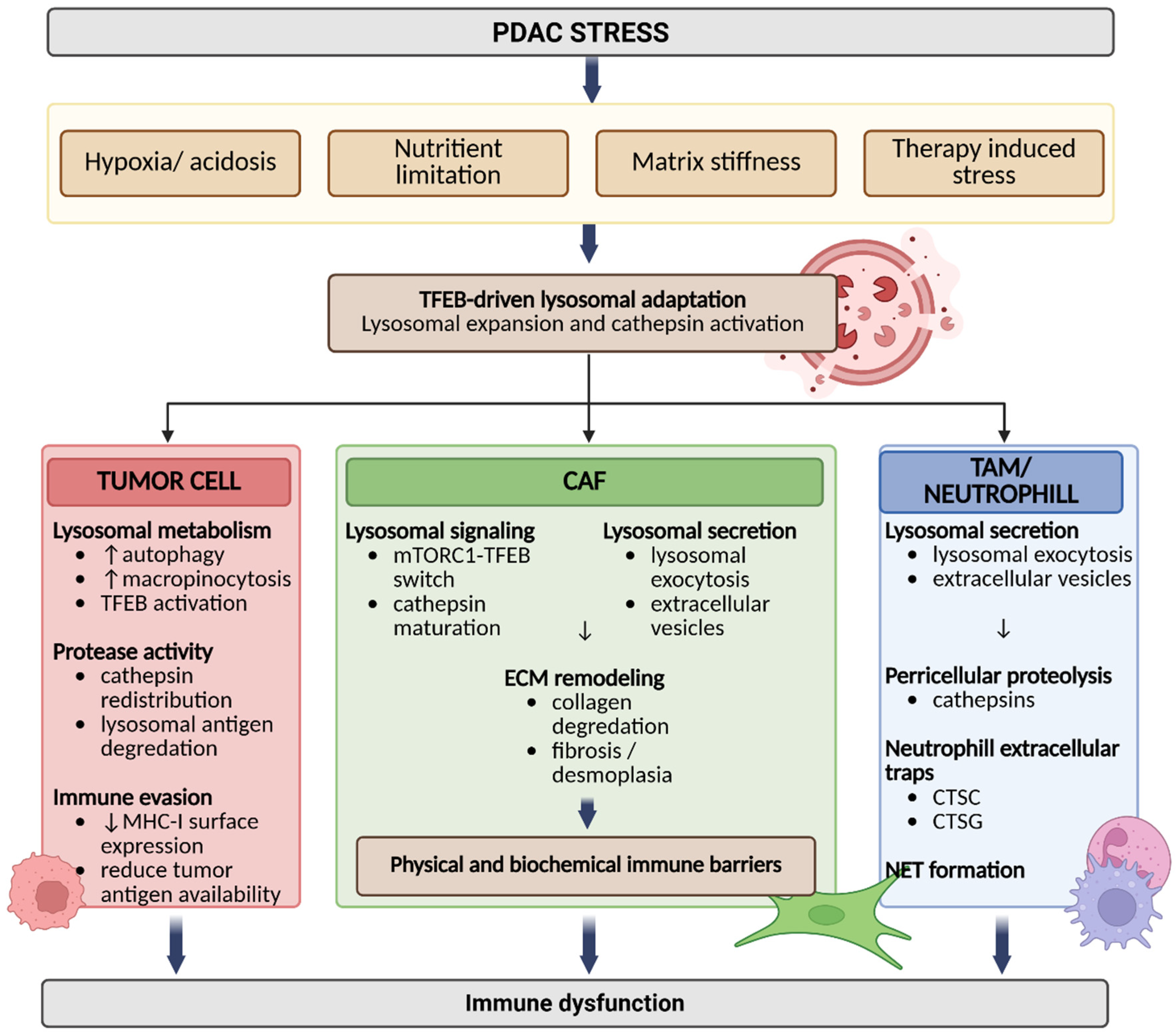
Figure 2.
Regulation of Antitumor Immunity by the Lysosome–Cathepsin Axis (Tumor–APC–T Cell Interface). The lysosome–cathepsin axis plays a context-dependent role in regulating antitumor immunity in the TME. In cancer cells, stress-associated lysosomal activity and cathepsin function may alter antigen processing and reduce tumor antigen availability. In antigen-presenting cells (APCs), lysosomal peptidases, particularly cathepsin S (CTSS), regulate MHC class II antigen processing, while excessive proteolysis may limit peptide presentation. In T cells, lysosomal membrane permeabilization and cathepsin release can impair cellular function and survival. Collectively, these processes contribute to reduced antigen presentation and T cell dysfunction. Abbreviations: Major Histocompatibility Complex (MHC); Transcription Factor EB (TFEB); TLR9 (Toll-like receptor 9); STING (stimulator of interferon genes); CLIP, class II–associated invariant chain peptide; DM, HLA-DM, a molecule that facilitates peptide loading onto MHC class II by removing CLIP. (Created with https://BioRender.com).
Figure 2.
Regulation of Antitumor Immunity by the Lysosome–Cathepsin Axis (Tumor–APC–T Cell Interface). The lysosome–cathepsin axis plays a context-dependent role in regulating antitumor immunity in the TME. In cancer cells, stress-associated lysosomal activity and cathepsin function may alter antigen processing and reduce tumor antigen availability. In antigen-presenting cells (APCs), lysosomal peptidases, particularly cathepsin S (CTSS), regulate MHC class II antigen processing, while excessive proteolysis may limit peptide presentation. In T cells, lysosomal membrane permeabilization and cathepsin release can impair cellular function and survival. Collectively, these processes contribute to reduced antigen presentation and T cell dysfunction. Abbreviations: Major Histocompatibility Complex (MHC); Transcription Factor EB (TFEB); TLR9 (Toll-like receptor 9); STING (stimulator of interferon genes); CLIP, class II–associated invariant chain peptide; DM, HLA-DM, a molecule that facilitates peptide loading onto MHC class II by removing CLIP. (Created with https://BioRender.com).
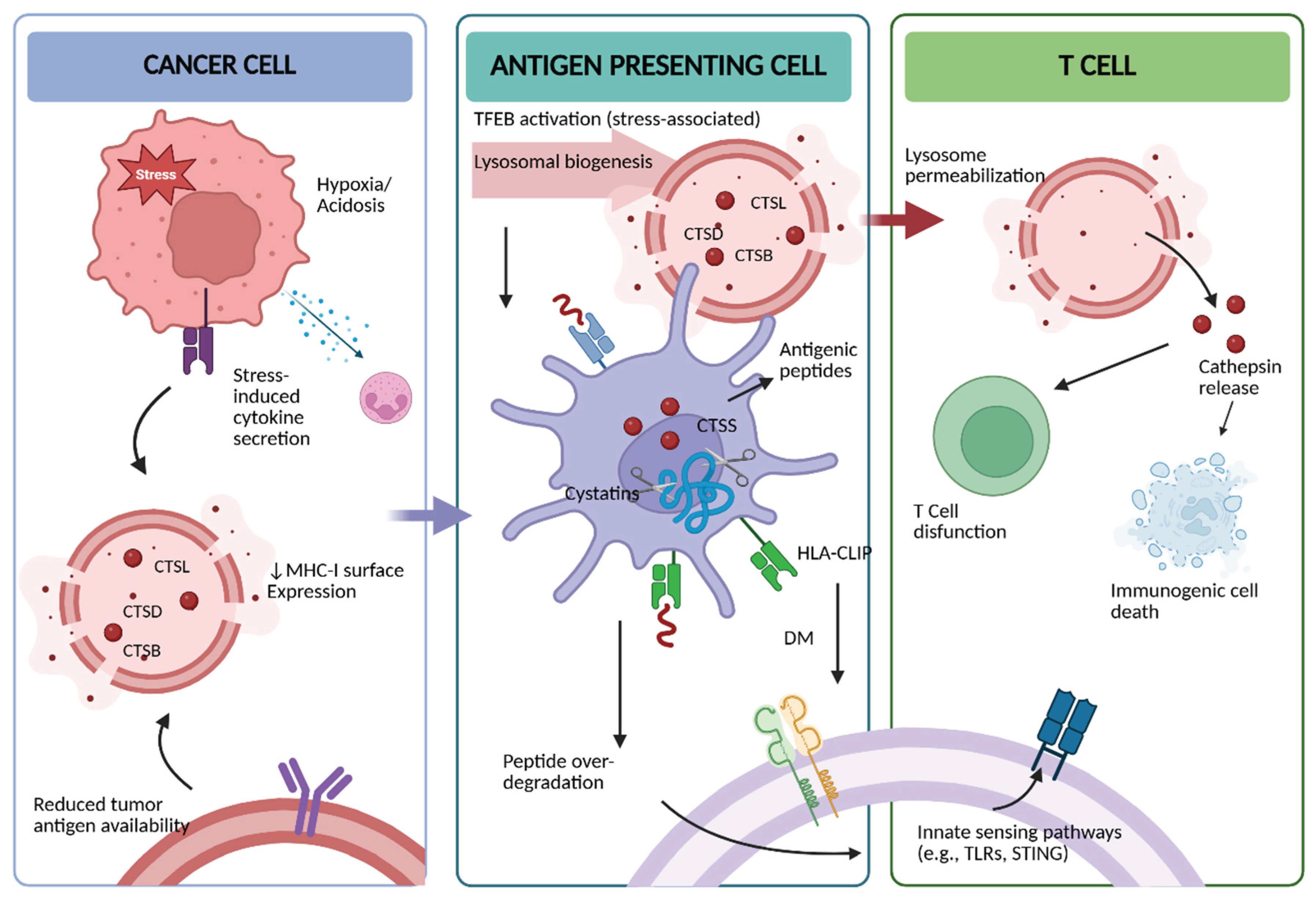
Figure 3.
Targeting Cathepsins to Restore Immunogenic Cell Death and Enhance Immunotherapy in PDAC. Pharmacological inhibition of cathepsins is a promising strategy to restore antitumor immunity and improve the efficacy of immunotherapy in PDAC. Inhibition of cathepsins (e.g., CTSB/CTSL, CTSC, and CTSG) limits excessive lysosomal proteolysis and may stabilize tumor-derived antigens, thereby reducing antigen degradation and potentially enhancing antigen presentation via MHC-I. This may contribute to the induction of immunogenic cell death (ICD), characterized by increased apoptotic signaling and activation of innate immune pathways, including STING. Additionally, cathepsin inhibition may modulate ECM–associated barriers and may also influence NET formation, thereby facilitating immune cell infiltration into the TME. Collectively, these mechanisms are proposed to promote antigen presentation, support APC activation and T-cell priming, enhance CD8⁺ T-cell–mediated tumor clearance, and improve responses to immune checkpoint blockade. (Created with https://BioRender.com).
Figure 3.
Targeting Cathepsins to Restore Immunogenic Cell Death and Enhance Immunotherapy in PDAC. Pharmacological inhibition of cathepsins is a promising strategy to restore antitumor immunity and improve the efficacy of immunotherapy in PDAC. Inhibition of cathepsins (e.g., CTSB/CTSL, CTSC, and CTSG) limits excessive lysosomal proteolysis and may stabilize tumor-derived antigens, thereby reducing antigen degradation and potentially enhancing antigen presentation via MHC-I. This may contribute to the induction of immunogenic cell death (ICD), characterized by increased apoptotic signaling and activation of innate immune pathways, including STING. Additionally, cathepsin inhibition may modulate ECM–associated barriers and may also influence NET formation, thereby facilitating immune cell infiltration into the TME. Collectively, these mechanisms are proposed to promote antigen presentation, support APC activation and T-cell priming, enhance CD8⁺ T-cell–mediated tumor clearance, and improve responses to immune checkpoint blockade. (Created with https://BioRender.com).
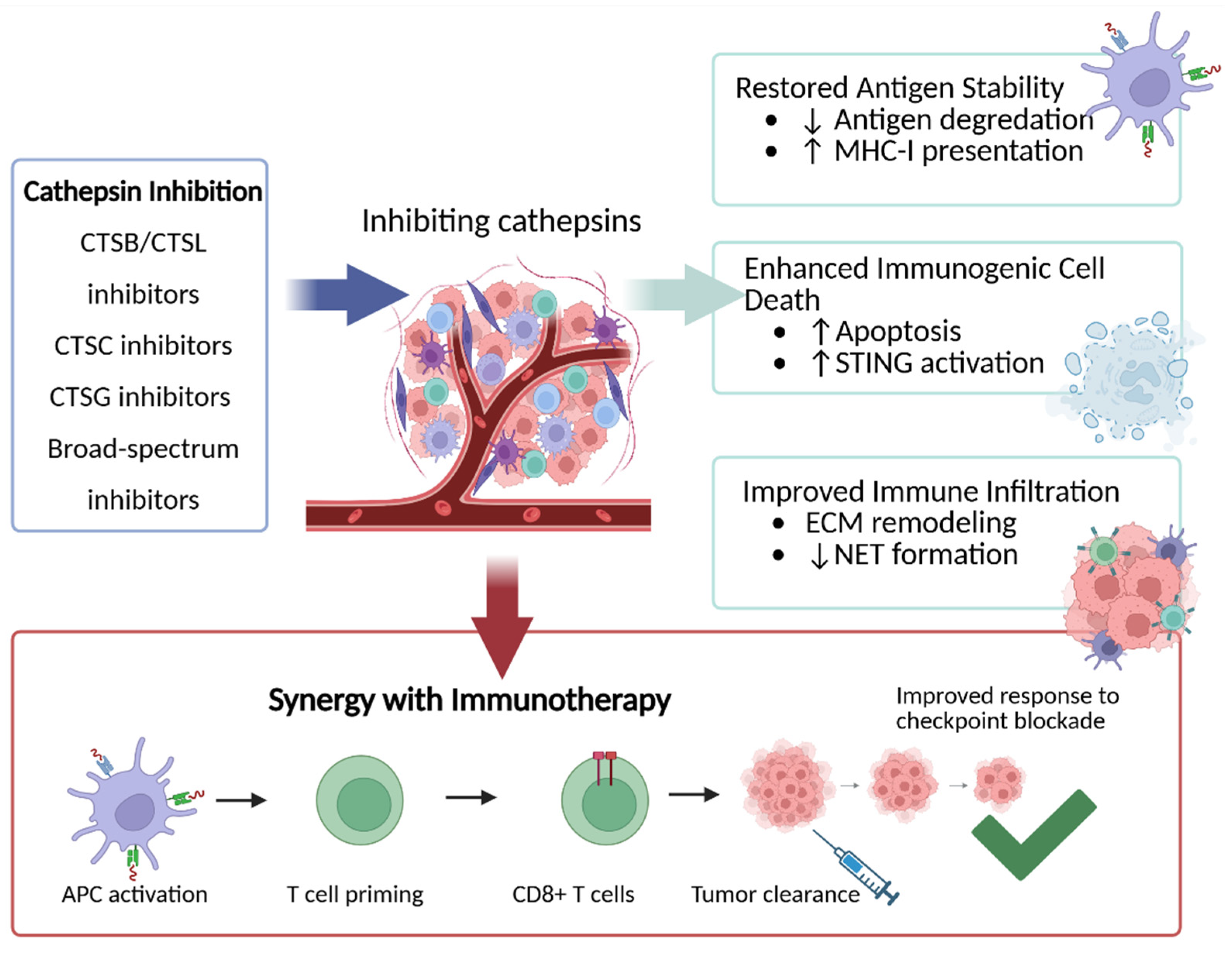

Table 1.
Cathepsin-Related Liquid Biopsy Readouts in PDAC.
| Sample type | Analyte(s) | Intended application | Key finding | Ref. |
|---|---|---|---|---|
| Urine | Cathepsin B (among candidate urinary biomarkers) | Non-invasive biomarker discovery | Urinary biomarker profiling identified tissue–type–specific candidates for upper GI cancers, including markers relevant to pancreatic cancer. | [179] |
| Serum / liquid biopsy | Enzymatic activity panel (arginase, MMP-1/3/9, cathepsins B & E, uPA, neutrophil elastase) | Early detection/ screening concept | Multiplex enzymatic “signature” proposed for potential early detection of pancreatic cancers in liquid biopsies. | [97] |
| Serum (circulating levels) | Cathepsins D, B, L | Prognosis / malignant progression | Circulating cathepsins are reported as markers associated with malignant progression. | [180] |
| Plasma | Cathepsin L | Prognosis | Plasma CTSL evaluated as a potential prognostic marker in pancreatic cancer. | [93] |
| Pancreatic juice | Cathepsin E | Diagnostics | CTSE levels are significantly elevated in pancreatic juice from PDAC patients compared to benign pancreatic disease; high diagnostic specificity | [119] |
| Serum (circulating levels) | Cathepsin B | Prognosis | Increased CTSB levels correlate with tumor burden and invasive phenotype; associated with aggressive disease biology | [94] |
Disclaimer/Publisher’s Note: The statements, opinions and data contained in all publications are solely those of the individual author(s) and contributor(s) and not of MDPI and/or the editor(s). MDPI and/or the editor(s) disclaim responsibility for any injury to people or property resulting from any ideas, methods, instructions or products referred to in the content. |
© 2026 by the authors. Licensee MDPI, Basel, Switzerland. This article is an open access article distributed under the terms and conditions of the Creative Commons Attribution (CC BY) license (http://creativecommons.org/licenses/by/4.0/).
Copyright: This open access article is published under a Creative Commons CC BY 4.0 license, which permit the free download, distribution, and reuse, provided that the author and preprint are cited in any reuse.


