

Submitted:
25 April 2026
Posted:
27 April 2026
You are already at the latest version
Abstract
Background: HIV-infected children (CLHIV) are known to have impaired seroconversion or waning immunity following seroconversion against measles. This may result in measles infection, morbidity and mortality among CLHIV and is also a challenge to measles elimination. Objectives: To compare measles seroprevalence between vaccinated CLHIV and HIV-exposed uninfected children (HEU). The null hypothesis (H0) was that the difference in proportions for measles seroconversion between CLHIV and HEU is not statistically significant. Materials and Methods: An unmatched case-control study was conducted among 35 CLHIV and 28 HEU aged 18 months to 8 years, attending the Paediatric Centre of Excellence in HIV care (PCOE) at Medical College, Kolkata, between 2022-2024. Participants provided demographic and treatment details; venous blood sample was collected and tested using an ELISA kit to detect measles IgG. We measured outcome as distribution of measles IgG titre and odds ratio (OR) for seroconversion with 95% confidence interval (CI). Results: Groups were similar by sex, weight and duration since last measles vaccine, but differed in age. There were 50% of HEU and 33.7% of CLHIV who had seroconverted, with Measles IgG antibody ≥ 275 IU/L. The overall seroconversion rate was 41%; the difference in proportion did not reachstatistical significance (χ² = 1.7; p = 0.18). However, antibody distributions according to serostatus were significantly different by the Mann-Whitney U test (p = 0.04).Conclusion: Null hypothesis could not be rejected; a combination of vaccine failures and waning immunity possibly resulted in low seroconversion. This indicates existing pockets of vulnerability which could hinder measles elimination.
Keywords:
enzyme-linked immunosorbent assay
; HIV
; measles
; measles vaccine
; seroconversion
Introduction
Measles is one of the most infectious human diseases, but the number of cases has declined globally due to the availability of measles vaccine. [1,2] Despite progress with measles elimination, World Health Organisation (WHO) reported 13600 measles attributable deaths in 2022. [3] Measles can result in profound immunosuppression in all children; it presents with atypical features in children living with HIV (CLHIV), evading diagnosis, resulting in higher morbidity and mortality, as well as longer duration of viral shedding. [1,4] Children born to HIV infected women, regardless of their HIV status, are more susceptible to measles during the first 6 months of life due to lower maternally acquired antibody. [4]
The WHO’s Measles and Rubella Strategic Framework 2021–2030 (MRSF) reports a change in the epidemiology of measles, with more cases appearing among young infants and older individuals due to an unaddressed immunity gap. Closing this gap is a key strategic priority. [5]
measles incidence has been increasing in Europe and the United States, culminating in 1200 confirmed cases in the United States alone in September 2019. This phenomenon was linked to changing herd immunity and vaccine refusals. [6,7] Hence, success in measles elimination can be rapidly reversed as long as the measles virus continues to circulate. Maintaining disease elimination depends on high seroconversion (>95%) and the persistence of protective antibodies. [4] A systematic review reported reduced immunogenicity of measles vaccine among HIV-infected children (CLHIV), when compared to both HIV-exposed uninfected children (HEU) as well as HIV unexposed children. This was the combined effect of primary and secondary vaccine failures, as well as waning vaccine-induced antibody levels. [8] Seroprotection is likely to wane more rapidly with ART interruptions. [9] On the other hand, HEU exhibits seroconversion rate and long-term seroprotection similar to that of healthy children. [9,10] A study from Cameroon reports comparable seroconversion and antibody persistence among CLHIV and other children with early initiation of ART and primary immunization at six months. [11] However, a study done in India reports seroconversion rate of 39.4% among HEU after primary measles vaccination at six months, which was lower than the Cameroon study (72.9%). [11,12] Irrespective of variability in measures, measles susceptibility likely remains high in CLHIV, and they will emerge as a critical group for viral transmission as measles infection falls within the general population. While most studies report comparable immunological outcomes for HEU children with the general population, the lone study from India reports much lower seroconversion with vaccination at six months. With a maturing HIV program in India, there is better population coverage with testing and treatment, earlier detection of childhood infections (EID), availability of viral load testing and more effective ART regimens. [13,14] Thus, it is important to revalidate the knowledge of seroprotection against measles among CLHIVs to achieve and sustain the measles elimination goal.
The present study aims to compare measles antibody levels between CLHIV on ART and HEU who have received two doses of measles-containing vaccine.
The null hypothesis (H0) posits there are no statistically significant differences in measles seroprotection between CLHIV and HEU; the alternate hypothesis (H1) states a statistically significant difference in measles seroconversion between the two groups.
Materials and Methods
Study Design
We conducted this hospital-based, case-control study among children living with HIV (CLHIV) registered at the Paediatric Centre of Excellence in HIV care (PCOE) at Medical College, Kolkata, and HIV-exposed children who tested HIV-negative by early infant diagnosis (EID). The study duration was from February 2022 to December 2024.
Setting
CLHIVs and HIV-exposed children linked to HIV care are likely to visit PCOE. Established in 2013, PCOEs aims to expand care, support, treatment, and advance research on paediatric HIV in India. The study site primarily serves regions in Eastern India, including states of West Bengal, Bihar, Jharkhand, Chhattisgarh, Odisha, Assam, and Sikkim. As of December 31, 2021, there were 155 CLHIV aged 0-14 years registered at this PCOE. Services offered here are HIV testing following National AIDS Control Organisation (NACO) protocols, training, research, ongoing medical education (CME) workshops, mentoring ART centres, and organising Pediatric State AIDS Control Expert Panel (p-SACEP) meetings for case referrals from participating states.
Participants
All registered CLHIV aged between 18 months to 8 years were eligible as cases; they were either born to women living with HIV (WLHIV) and later tested positive by EID or clinically suspected children who tested positive.
As controls, we included 18 months to 8-year-old HEU who tested negative by EID and their mother/guardian visited the ART clinic attached to PCOE, Medical College Kolkata, during the study period. Exclusion criteria were refusal to participate by caregivers, received none or a single dose of measles vaccine, being < 12 weeks from the second dose of measles vaccine, clinically ever diagnosed and/or laboratory confirmed measles. It is noteworthy to mention, in India there is no specific guideline to vaccinate CLHIV and HEU with measles vaccine at six months (zero-dose measles vaccine).
Variables
The effect measures were the Odds ratio (OR) of measles seroconversion and comparison of antibody titer between CLHIV and HEU. Other variables were demographic (age, sex), birth weight, current weight, dates of receiving first and second dose of measles vaccines, maternal HIV and ART status, serostatus and disease-related attributes of CLHIVs (age of ART initiation, CD4% or CD4 count at ART initiation and latest plasma viral load).
Data Sources/Measurement
Demographic data was collected by interviewing the accompanying caregiver using a pre-designed, pre-tested, structured interview schedule. As all the children were registered with PCOE, details on ART initiation, maternal HIV status, maternal ART and HIV test results were extracted from existing records. Additionally, we checked the immunisation card/ Mother and Child Protection Card (MCPC) to record dates of Measles vaccine doses. Infant weighing scale or bathroom-type weighing scale was used to record weight in kg, followed by plotting in the WHO weight for age standard 0-5 years: girls or boys for interpretation of weight category (18-59 months); for children aged five to eight years, we used the 5 to 18 years girls/ boys Indian Association of Paediatrics (IAP) combined chart. Venous whole blood was collected for measles IgG antibody detection.
We used Anti-measles virus ELISA (IgG) commercial test kits [ EUROIMMUN™, EI 2610-9601 G; Medizinische Labordiagnostika AG · Seekamp 31 · 23560 Lübeck (Germany); reported to be 100% sensitive and specific on a sample of clinically characterised specimens according to product insert] for quantitative measles IgG antibody testing. Three millilitres of venous blood was collected from participating children, maintaining universal precautions and aseptic technique. Each sample was allowed to clot by standing at room temperature for 30 minutes. Clotted samples were sent in reverse cold chain at 2-8 degree Celsius to the testing laboratory (ICMR-NIRBI), where sera were separated and stored at -60 degree Celsius. For the ELISA test, 1:101-diluted patient serum was incubated in the test wells. In the case of positive samples, specific IgG antibodies (also IgA and IgM) were bound to the antigens. Bound antibodies were detected by a photometric method as Optical Density (OD) values. These values were then calibrated to generate a point-to-point standard curve, where the slope and intercept of each line segment were used to convert the OD values to measles IgG antibody concentrations (IU/L).
Study Size
The sample size calculated for this study was 28 participants in each group. This number was arrived considering 57% seroconversion after measles vaccination among HIV-infected children and 96% seroconversion among HIV-uninfected children (Power=90%, α=0.05, the ratio of exposed: infected=1).[6] We used the Fleiss continuity correction method for the sample size calculation for unmatched case-control study in the application Epiinfo™ version 5.5.18. [15] All children attending PCOE who met the inclusion criteria were invited to participate in this study. Recruitment was anonymous and consecutive.
Quantitative Variables
Measles IgG titers were grouped as seropositive, seronegative, or equivocal. According to the testing protocol and manufacturer’s instructions, results were interpreted as <200 IU/L as negative or non-seroconversion, ≥ 200 to < 275 IU/L as equivocal and ≥ 275 IU/L as seroconversion.
Statistical Methods
The distribution of variables for CLHIV and HEU is reported as mean and standard deviation for continuous data, and as numbers and proportions for categorical data. We compared two groups of children for background similarities using t-test or Chi-Square test, depending on the data type. Measles seroconversion was reported as percentages with 95% confidence interval (95% CI-Wilson score) and compared by chi-square tests. We further calculated OR with 95% confidence interval (95% CI) to measure the likelihood of seroconversion. Additionally, we reported the distribution of Measles IgG by groups. The distribution of measles antibody levels was tested to determine whether they follow normal distribution by the Kolmogorov-Smirnov test with Lilliefors’ significance correction. Statistical significance was set at p<0.05. We conducted all analyses using Statistical Package for Social Sciences (SPSS) version 23. [16] Violin plots showing kernel density distributions of Measles IgG levels were made using Python 3.11. [17]
Results
Participants
A total of 72 CLHIV registered at PCOE were potentially eligible for the study according to age criterion, among them 41 children attended the study site during data collection period and were assessed for eligibility, among them 37 were eligible, 35 were included in the study and 33 blood samples were collected. During the same period, 34 potentially eligible HEU attended PCOE, 32 were found eligible and 28 children could be enrolled in the study. Children were excluded based on MCV doses and timing or refusal by parents. None of these children had received zero-dose measles vaccine (Figure 1-Recruitment flowchart)
Descriptive Data
We could enroll 63 children in this study, comprising of 28 (44.4%) HEU and 35 (55.6%) HIV-infected children. The groups were similar in terms of sex distribution and nutritional status, assessed by weight-for-age. However, the mean age of CLHIV (62.1 ± 18.3 months) was significantly higher than that of the HEU group (52.1 ± 19.6 months) (t = 2.07; p = 0.04). We found a greater proportion of severely underweight children among the HEU group. All children in this study received two doses of measles vaccine from government hospitals, as the measles-rubella vaccine (MR). Participants received their second dose of MR between three months to 68 months before blood collection. (Table 1) Among CLHIVs, 54.3% children started ART before two years of age, and 91.4% had suppressed plasma viral load. Baseline CD4% (0-59 months of age at ART initiation) or CD4 count (if ART initiation was at 60 months or higher age) was missing for four children. There were 4 (11.4%) CLHIVs who had low CD% or CD4 count at ART initiation. (Table 2) All CLHIV were on dolutegravir-based first-line ART, and there was no ART interruption in last six months/or since ART initiation.
Outcome Data
Measles IgG ELISA test was conducted on 61 blood samples (two samples were inadequate for processing). This included 28 HEU and 33 CLHIVs. IgG test results are reported as IU/L. Table 3 shows the summary measures for measles-specific antibody concentration according to serostatus. Distribution of measles antibody titre for both CLHIV and HEU deviated from Gaussian distribution by Kolmogorov-Smirnov test with Lilliefors’ significance correction. Distributions were significantly different by Mann-Whitney U test (p=0.041).
Figure 2 displays violin plots for measles IgG concentration according to serostatus. The width of each plot indicates density, the median is shown by a dashed line, and the interquartile range (IQR) is shown by dotted lines. CLHIVs had a shorter plot, with higher density at lower antibody concentration. In contrast, HEU children had a very different shape of ‘violin’ with a long upper tail indicating very high IgG titer in few children. Distributions for the groups were significantly different by the Mann-Whitney U test (p = 0.04).
Main Results
It was found that 50% (95% CI 32.63 – 67.37) of HEU and 33.7% (95% CI 19.75 – 50.39) of CLHIV had seroconverted, with Measles IgG antibody ≥ 275 IU/L. The overall seroconversion rate was 41%; the difference in proportion for seroconversion between the groups did not reach statistical significance by Chi-square test (χ² = 1.7; p = 0.18). Odds ratio was 0.5 (95% CI was 0.18-1.41). (Table 4)
Discussion
In this study, we compared seroconversion against measles virus among 63 children who were either CLHIV or HEU. All CLHIVs were on dolutegravir-based first-line ART, and 91.4% children were virally suppressed. We found low seroconversion rates among both groups (33.7% versus 50%), with a high proportion of CLHIVs remaining susceptible to measles. This 16.3% difference between the groups, however, was not statistically significant. HEU had higher mean and median IgG titer, and the distribution of antibody level was significantly different between the groups.
Antibody response to the measles vaccine can be impaired in HIV-infected children. However, with early diagnosis and treatment using more effective ART regimens, seroconversion rates with a single dose of measles-containing vaccine (MCV) have improved from 25-33% in the USA, early in the epidemic, to 64% in Malawi with two doses of MCV. [8] A study conducted at Cameroon enrolled a cohort of children between 2005-2006 and categorized them into five groups: deferred-ART, immediate ART with interruption at 12 or 24 months, HEU, and HIV-unexposed. Four and a half years after enrolment, measles IgG was present at levels of ≥150 mIU/ml among 98.4%-81.4% of CLHIVs, 98.6% among HEU, and 100% for HIV-unexposed. [9] Our findings differ markedly from this study but are closer to another study conducted in Rabat, Morocco, which reports 26% seroconversion among CLHIVs. [18] Seroconversion among HEU in the present study is lower than the reported measures in both studies. [9,18] These differences may be explained by the changing epidemiology of measles and HIV. A serosurvey conducted by the Indian Council of Medical Research (ICMR) in four districts in India, among 9-month to <15-year-olds, before and after a nationwide Measles-Rubella Supplementary Immunization Activity (MR-SIAs) in 2018-2020, reported seroprevalence rates of 63.4% to 88.5% prior to the campaign. [19] This may be attributed to comparatively lower immunization rates in the surveyed states,[20] as well as primary and secondary vaccine failures. The lower seroprevalence against measles among CLHIV and HEU in our study may reflect a population-level decline in antibody prevalence, due to the lack of a boosting effect from circulating wild measles virus in near-elimination settings. There may be waning immunity following initial seroconversion, which is more intense during the first five years after vaccination. [21] Seroconversion depends on immune status at the time of MCV doses, [8] which may explain the paradox of low antibody titers among virally suppressed CLHIVs, who may have had low immune status at the time of MR vaccination.
India has reported the third-highest number of global measles cases at 10,688 between January and July 2025. [22] At the national level, 92.2% of the population is covered with two doses of MCV. However, the ICMR study reports pockets of low vaccine coverage. [18,23] Maintaining high population immunity against measles appears challenging in elimination settings and may defer measles eradication. [24,25] The subset of CLHIVs may become particularly vulnerable to measles in this evolving epidemiological landscape.
WHO recommends a supplementary dose of MCV (to be recorded as MCV0 in immunization cards) to CLHIVs and HEU; however, the seroconversion rate depends on pre-existing maternal antibodies. [8,12] MCV administered at six months to CLHIVs resulted in a seroconversion of 59% (95% confidence intervals [CI], 46–71%), which was comparable to seroconversion at 9 and 12 months. This was, however, different from HEU and HIV-unexposed children, where seroconversion increased with increasing age at vaccination. [26] WHO further recommends an additional dose of MCV to CLHIVs following immune reconstitution. [8] MR-SIA is another strategy to improve population immunity and thereby protect CLHIVs. The ICMR study reported an increase in post-campaign seroprotection, but this depends on factors like pre-campaign immunity and population covered during MR-SIA. [19]
India continues to report measles cases due to pockets of low immunization, vaccine failures, and waning immunity. Modelling studies have warned that susceptibility to measles infection may rise with time due to waning vaccine-induced immunity, in the absence of natural boosting by circulating measles viruses. The model posits that vaccinees will eventually become susceptible to a milder form of vaccine-modified measles with a lower transmission potential than unvaccinated classical measles. [27] However, how this scenario will affect the population with sub-optimal immunity remains unknown.
Research on measles seroconversion among the HIV-infected population was largely conducted either in countries where measles has been eliminated [28] or in an earlier stage of the HIV epidemic, before the test and treat policy, universal dolutegravir-based ART and widely available viral load testing. Our study closes this evidence gap by reporting measles antibody titers among virally suppressed CLHIV and HEU in a country setting where measles cases are still reported, and population-level immunity is variable despite high coverage with two doses of measles vaccine.
Limitations
The cross-sectional study design could not determine whether low antibody levels were due to vaccine failures or waning immunity, and ELISA method to measure measles IgG levels is less sensitive at lower antibody concentrations. Antibodies to H and F proteins contribute to virus neutralization and are the best correlates of protection against measles virus infection. The presence of neutralizing antibodies, demonstrated by the plaque reduction neutralization assay (PRNT), is considered the most reliable correlate of protection (protective level, >120 mIU/ml). [8] Nevertheless, quantitative measles IgG ELISA has shown 92% agreement with PRNT. [29]
Conclusions
A considerable proportion of CLHIV and HEU are susceptible to measles, which may be due to lower levels of maternally acquired antibodies, primary vaccine failures, and rapidly waning immunity. HEU had a higher antibody titre, but the proportion seroprotected was not significantly different from that of CLHIVs. Our study findings of low seroprevalence along with available serosurveillance, vaccine coverage, and modelling data from literature provide compelling evidence on changing population-level immunity in elimination settings, which may put CLHIVs at disproportionately higher risk of acquiring measles infection.
Ethical Statement
The study protocol was approved by the Institutional Ethics Committee (IEC) of Medical College Kolkata. Informed consent was given by all parents.
References
- World Health Organization (WHO); Regional Office for South-East Asia. Midterm review of the “Strategic plan for measles elimination and rubella and congenital rubella syndrome control in the South-East Asia Region: 2014–2020” [Internet]. World Health Organization. Regional Office for South-East Asia, 2018. Available online: https://apps.who.int/iris/handle/10665/279993.
- Feemster, K.A.; Szipszky, C. Resurgence of measles in the United States: how did we get here? Curr. Opin. Pediatr. 2020, 32, 139–144. [Google Scholar] [CrossRef]
- Mehtani, N.J.; Rosman, L.; Moss, W.J. Immunogenicity and Safety of the Measles Vaccine in HIV-Infected Children: An Updated Systematic Review. Am. J. Epidemiol. 2019, 188, 2240–51. [Google Scholar] [CrossRef] [PubMed]
- Simani, O.E.; Adrian, P.V.; Violari, A.; et al. Effect of in-utero HIV exposure and antiretroviral treatment strategies on measles susceptibility and immunogenicity of measles vaccine. AIDS 2013, 27, 1583–1591. [Google Scholar] [CrossRef] [PubMed]
- World Health Organization (WHO). Measles and rubella strategic framework 2021–2030; Licence: CC BY-NC-SA 3.0 IGO; World Health Organization: Geneva, 2020. [Google Scholar]
- Siberry, G.K.; Patel, K.; Bellini, W.J.; Karalius, B.; Purswani, M.U.; Burchett, S.K.; Meyer, W.A., 3rd; Sowers, S.B.; Ellis, A.; Van Dyke, R.B. Pediatric HIV AIDS Cohort Study (PHACS); Pediatric HIV AIDS Cohort Study PHACS. Immunity to Measles, Mumps, and Rubella in US Children With Perinatal HIV Infection or Perinatal HIV Exposure Without Infection. Clin. Infect. Dis. 2015, 61, 988–95. [Google Scholar] [CrossRef] [PubMed] [PubMed Central]
- Chen, R.T.; Markowitz, L.E.; Albrecht, P.; Stewart, J.A.; Mofenson, L.M.; Preblud, S.R.; Orenstein, W.A. Measles antibody: reevaluation of protective titers. J. Infect. Dis. 1990, 162, 1036–42. [Google Scholar] [CrossRef] [PubMed]
- World Health Organisation (WHO). ISSN 0049-8114 [Internet]. In Weekly Epidemiological Record; World Health Organization: Geneva, 2017; vol. 92, p. 17. Available online: https://www.who.int/publications/i/item/who-wer9217-205-227.
- Mutsaerts, E.A.; Nunes, M.C.; Van Rijswijk, M.N.; Klipstein-Grobusch, K.; Otwombe, K.; Cotton, M.F.; Violari, A.; Madhi, S.A. Measles immunity at 4.5 years of age following vaccination at 9 and 15–18 months of age among human immunodeficiency virus (HIV)–infected, HIV-exposed–uninfected, and HIV-unexposed children. Clin. Infect. Dis. 2019, 69, 687–96. [Google Scholar] [CrossRef] [PubMed]
- Mutsaerts, E.A.; Nunes, M.C.; van Rijswijk, M.N.; Klipstein-Grobusch, K.; Grobbee, D.E.; Madhi, S.A. Safety and immunogenicity of measles vaccination in HIV-infected and HIV-exposed uninfected children: a systematic review and meta-analysis. E Clin. Med. 2018, 1, 28–42. [Google Scholar] [CrossRef] [PubMed]
- Tejiokem, M.C.; Desselas, E.; Noumsi, T.J.; Ateba Ndongo, F.; Tetang Ndiang, S.; Fossi, M.A.; Guemkam, G.; Zangue Kenfack Tekougang, B.; Tagnouokam-Ngoupo, P.A.; Penda, I.C.; Faye, A. Pre-and Post-Vaccination Measles Antibody and Persistence Up to 5 Years of Age Among Early ART-Treated HIV-Infected, HIV-Exposed Uninfected and HIV-Unexposed Children in Cameroon. Vaccines 2025, 13, 584. [Google Scholar] [CrossRef] [PubMed]
- Jain, S.; Seth, A.; Khare, S.; Chandra, J. Seroprevalence of transplacentally acquired measles antibodies in HIV-exposed versus HIV-unexposed infants at six months of age. Indian J. Med. Res. 2017, 145, 536–42. [Google Scholar] [CrossRef] [PubMed]
- National AIDS and STD Control Programme Phase-V (2021-26). Strategy booklet. National AIDS Control Organisation (NACO), Ministry of Health & Family Welfare, Government of India: New Delhi, 2021. Available online: https://naco.gov.in/sites/default/files/NACP_V_Strategy_Booklet.pdf.
- NACO. Early infant diagnosis. National AIDS Control Organisation: New Delhi, 26 Sep 2023. Available online: https://naco.gov.in/sites/default/files/DBS_Sample_Collection_for_EID_Module_Read_Only.pdf.
- OpenEpi. Sample Size for Unmatched Case-Control Studies [Internet]. OpenEpi. 2 Feb 2022. Available online: http://www.openepi.com/SampleSize/unmatchedcc.htm.
- International Business Machines Corp. IBM SPSS Statistics for Windows, Version 23.0; IBM Corp.: Armonk (NY), 2015; Available online: https://www.ibm.com/products/spss-statistics.
- Python Software Foundation. Python language reference, version 3.11; Python Software Foundation: Wilmington (DE), 2023; Available online: http://www.python.org.
- Haban, H.; Benchekroun, S.; Sadeq, M.; Tajounte, L.; Ahmed, H.J.; Benjouad, A.; Amzazi, S.; Oumzil, H.; Elharti, E. Seroprevalence of measles vaccine antibody response in vertically HIV-infected children, in Morocco. BMC Infect. Dis. 2018, 18, 680. [Google Scholar] [CrossRef] [PubMed]
- Murhekar, M.V.; Gupta, N.; Hasan, A.Z.; Kumar, M.S.; Kumar, V.S.; Prosperi, C.; Sapkal, G.N.; Thangaraj, J.W.; Kaduskar, O.; Bhatt, V.; Deshpande, G.R. Evaluating the effect of measles and rubella mass vaccination campaigns on seroprevalence in India: A before-and-after cross-sectional household serosurvey in four districts, 2018–2020. Lancet Glob. Health 2022, 10, e1655-64. [Google Scholar] [CrossRef] [PubMed]
- Kumar, P.; Dhalaria, P.; Sapru, M.; Brahma, D.; Datta, E.; Priyadarshini, P.; Singh, A.K.; Taneja, G.; Tripathi, B. Trend Analysis of Routine Immunization Coverage in India: A Composite Measure Using Cross-Sectional Data of National Family Health Surveys-4 & 5. VeriXiv 2025, 2, 190. [Google Scholar]
- Bolotin, S.; Osman, S.; Hughes, S.L.; Ariyarajah, A.; Tricco, A.C.; Khan, S.; Li, L.; Johnson, C.; Friedman, L.; Gul, N.; Jardine, R. In elimination settings, measles antibodies wane after vaccination but not after infection: a systematic review and meta-analysis. J. Infect. Dis. 2022, 226, 1127–39. [Google Scholar] [CrossRef] [PubMed]
- Available online: https://www.cdc.gov/global-measles-vaccination/data-research/global-measles-outbreaks/index.html.
- Ministry of Health and Family Welfare; Government of India. Union Health Minister Shri J P Nadda launches National Zero Measles-Rubella Elimination Campaign on the occasion of World Immunization Week [press release]. PIB. 24 Apr 2025. Available online: https://www.pib.gov.in/PressReleasePage.aspx?PRID=2124032.
- Kang, H.J.; Han, Y.W.; Kim, S.J.; Kim, Y.J.; Kim, A.R.; Kim, J.A.; Jung, H.D.; Eom, H.E.; Park, O.; Kim, S.S. An increasing, potentially measles-susceptible population over time after vaccination in Korea. Vaccine 2017, 35, 4126–32. [Google Scholar] [CrossRef] [PubMed]
- Kontio, M.; Jokinen, S.; Paunio, M.; Peltola, H.; Davidkin, I. Waning antibody levels and avidity: implications for MMR vaccine-induced protection. J. Infect. Dis. 2012, 206, 1542–8. [Google Scholar] [CrossRef] [PubMed]
- Scott, P.; Moss, W.J.; Gilani, Z.; Low, N. Measles vaccination in HIV-infected children: systematic review and meta-analysis of safety and immunogenicity. J. Infect. Dis. 2011, 204, S164–78. [Google Scholar] [CrossRef] [PubMed]
- Mossong, J.; Muller, C.P. Modelling measles re-emergence as a result of waning of immunity in vaccinated populations. Vaccine 2003, 21, 4597–603. [Google Scholar] [CrossRef] [PubMed]
- Lefebvre, M.; Secher, S.; Bouchez, S.; Vandamme, Y.M.; Fialaire, P.; Leautez, S.; Blanchi, S.; Michau, C.; Coste-Burel, M.; Brunet-Cartier, C.; Reliquet, V. Measles seroprevalence in human immunodeficiency virus-infected adults born in the era of measles vaccination. AIDS 2022, 36, 1273–8. [Google Scholar] [CrossRef] [PubMed]
- Cohen, B.J.; Parry, R.P.; Doblas, D.; Samuel, D.; Warrener, L.; Andrews, N.; Brown, D. Measles immunity testing: comparison of two measles IgG ELISAs with plaque reduction neutralisation assay. J. Virol. Methods 2006, 131, 209–12. [Google Scholar] [CrossRef] [PubMed]
Figure 1.
Recruitment Flowchart.
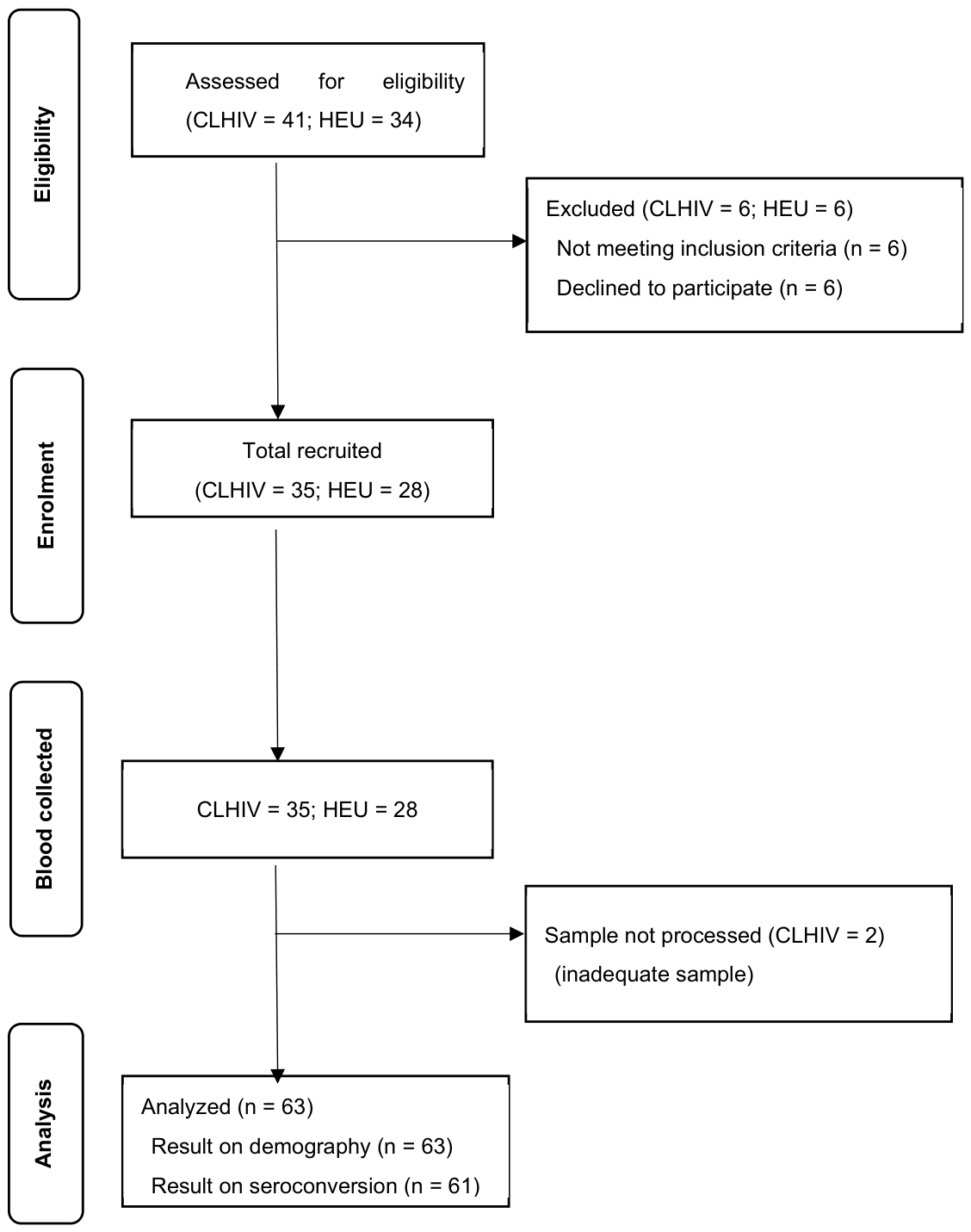
Figure 2.
Violin plot showing comparative distribution of measles antibody (IU/L) according to serostatus. # Negative values reflect kernel density smoothing in the violin plot and do not represent observed measurements.
Figure 2.
Violin plot showing comparative distribution of measles antibody (IU/L) according to serostatus. # Negative values reflect kernel density smoothing in the violin plot and do not represent observed measurements.
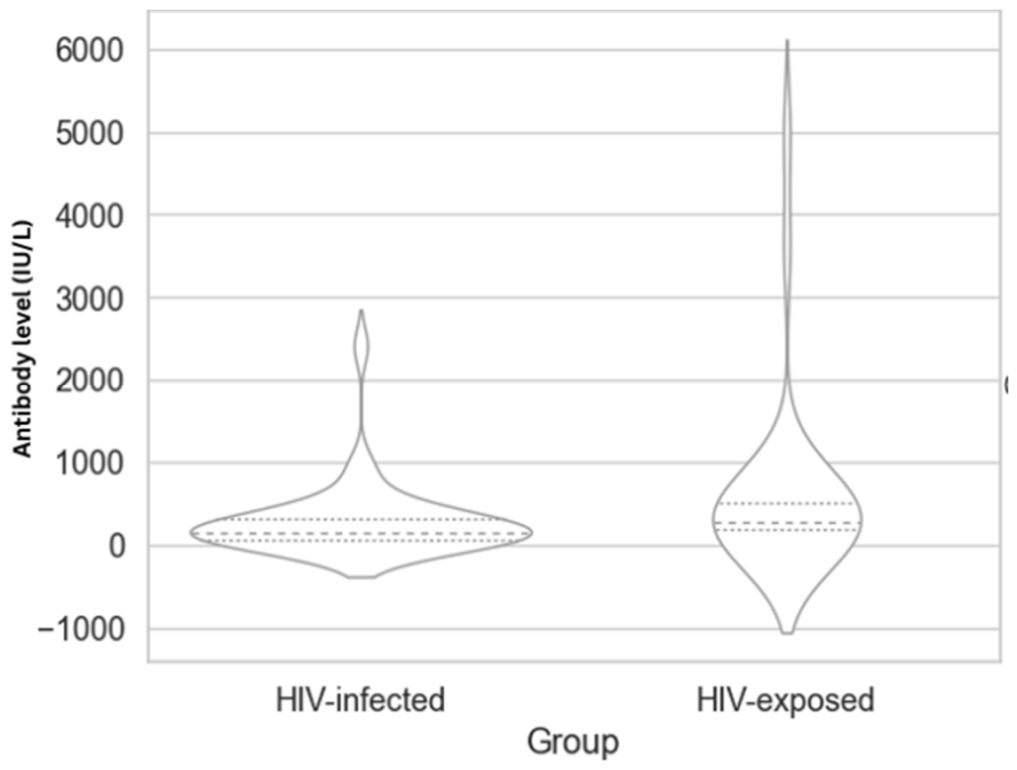

Table 1.
Comparison of HIV-exposed and HIV-infected children according to background characteristics.
Table 1.
Comparison of HIV-exposed and HIV-infected children according to background characteristics.
| HIV exposed (n=28) Number (%) |
HIV infected (n=35) Number (%) |
Difference between groups |
|
|---|---|---|---|
| Age (mean ± SD) in months | 52.1 (19.6) | 62.1 (18.3) | t=2.07; p =0.04 * |
| Birth weight (mean ± SD) in Kg | 2.7 (0.7) | 2.9 (0.4) | t=1.23; p=0.22 |
| Months from MR2 (mean ± SD) | 36.3 (23.8) | 40.6 (23.9) | t=0.61; p=0.55 |
| Sex | |||
| Male | 13 (46.4) | 16 (45.7) | X2 = 0.003 (DF 1; p=0.96) |
| Female | 15 (53.6) | 19 (54.3) | |
| Weight for Agea) | |||
| Normal | 17 (60.7) | 21 (61.8) | X2 = 1.7 (DF 2; p=0.42) |
| Underweight | 3 (10.7) | 7 (20.6) | |
| Severely underweight | 8 (28.6) | 6 (17.6) | |
* p< 0.05. a) Missing data for one participant.
Table 2.
Disease and treatment-related characteristics of HIV-infected children (n=35).
| Characteristic | Number | % |
|---|---|---|
| Age of starting ART | ||
| Mean (SD) in months | 29.13 (17.24) | |
| Median (Q1-Q3 range) in months | 24 (18 – 41) | |
| Within 24 months | 19 | 54.3 |
| After 24 months | 12 | 34.3 |
| Missing record on ART initiation | 4 | 11.4 |
| Viral Load Suppression | ||
| Undetectable/Suppressed | 32 | 91.4 |
| Unsuppressed | 03 | 08.6 |
| CD4% or CD4 count at ART initiation | ||
| Immunosuppressed [ < 25% or <350] | 4 | 11.4 |
| Immunocompetent [≥ 25% or ≥ 350] | 27 | 77.1 |
| Missing record on ART initiation | 4 | ----- |
Table 3.
Summary measures for Measles IgG (IU/L) distribution according to serostatus.
| Mean (SD) | Median (IQR) | Skewness | Kurtosis | |
|---|---|---|---|---|
| HIV infectedb) (n=33) |
290.62 (440.09) | 147.79 (2362.96) | 3.86 | 17.43 |
| HIV exposed (n=28) |
609.42 (1083.63) | 272.88 (4950.00) | 3.44 | 11.79 |
Table 4.
Comparison of Measles seroconversion of HIV-exposed and infected children.
| Immunity against measles | HIV exposed (n=28) Number (%) |
HIV infectedb) (n=33) Number (%) |
Total (n=61) Number (%) |
Chi-square test for independence | Odds Ratio (95% CI) |
|---|---|---|---|---|---|
| Seroconversion | 14 (50) | 11 (33.7) | 25 (41) | χ2 = 1.73 (DF 1; p=0.18) |
0.5 (0.18-1.41) |
| Non-conversion | 14 (50) | 22 (66.7) | 36 (59) |
b) Two samples were inadequate for processing * p<0.05.
Disclaimer/Publisher’s Note: The statements, opinions and data contained in all publications are solely those of the individual author(s) and contributor(s) and not of MDPI and/or the editor(s). MDPI and/or the editor(s) disclaim responsibility for any injury to people or property resulting from any ideas, methods, instructions or products referred to in the content. |
© 2026 by the authors. Licensee MDPI, Basel, Switzerland. This article is an open access article distributed under the terms and conditions of the Creative Commons Attribution (CC BY) license (http://creativecommons.org/licenses/by/4.0/).
Copyright: This open access article is published under a Creative Commons CC BY 4.0 license, which permit the free download, distribution, and reuse, provided that the author and preprint are cited in any reuse.


