
Submitted:
25 April 2026
Posted:
27 April 2026
You are already at the latest version
Abstract
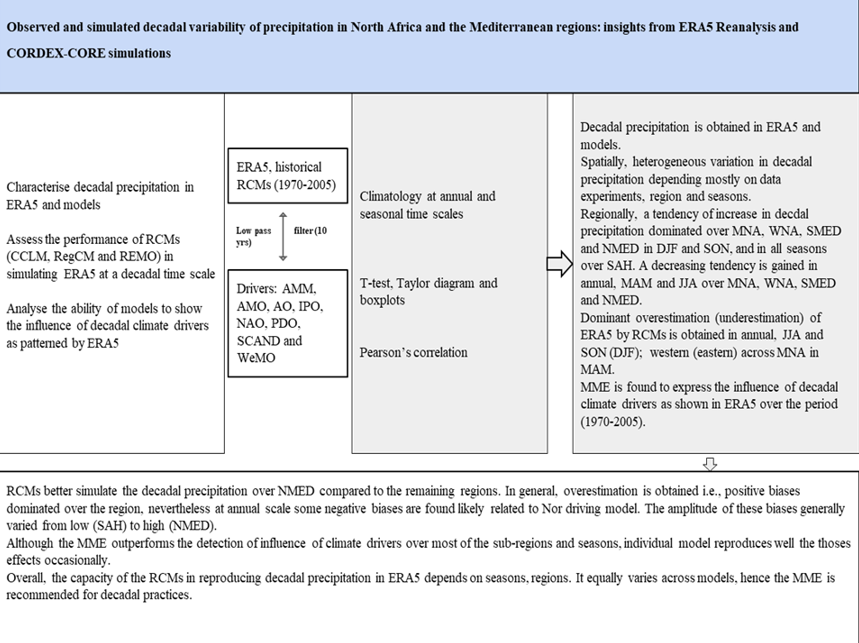
Climate change and variability pose serious threats to natural and human systems. The Mediterranean region and North Africa (MNA) are among the world’s climate change hotspots. An in-depth understanding of decadal climate variability over this region is critical for climate prediction to support planning and management, as well as adaptation in important sectors such as water resources. Therefore, the observation-based ERA5 precipitation and the outputs of the CORDEX-CORE regional models are used to characterise the decadal precipitation variability over these regions. The influence of a set of large-scale climatic indices (Atlantic Meridional Mode: AMM, Atlantic Multidecadal Oscillation: AMO, Arctic Oscillation: AO, Interdecadal Pacific Oscillation: IPO, North Atlantic Oscillation: NAO, Pacific Decadal Oscillation: PDO, Scandinavia: SCAND, and Western Mediterranean Oscillation: WeMO) on the decadal precipitation is also examined. The results reveal certain discrepancies between ERA5 and the CORDEX-CORE models’ values. Overestimations and underestimations are found between the models and observations, depending on the region and season. However, the capability of multi-model mean (MME) is better in capturing observation patterns over MNA, SMED, and NMED at all time scales; while REMO-Nor and MME perform better than the remaining models over two regions (SAH and WNA) at the annual time scale. As revealed by ERA5, MME confirmed that AMO, NAO, SCAND, and WeMO have more influence on precipitation over the entire region than others. These findings are useful for climate modelling enhancement and predictions in the region that still needs development of multi-annual to decadal time scales, especially in North Africa.
Keywords:
ERA5
; CORDEX-CORE
; North Africa and Mediterranean
; decadal precipitation
; climate drivers
Copyright: This open access article is published under a Creative Commons CC BY 4.0 license, which permit the free download, distribution, and reuse, provided that the author and preprint are cited in any reuse.


