

Submitted:
23 April 2026
Posted:
27 April 2026
You are already at the latest version
Abstract
Sustainable urban transportation is fundamentally linked to public health outcomes, specifically the mitigation of fatal traffic risks under environmental stress. While stressors like adverse weather affect entire cities, traditional road safety models often assume uniform risk, thereby masking the spatial inequalities inherent in the urban fabric. This study addresses this gap by investigating the geographically heterogeneous impact of environmental stressors—including rainfall, surface moisture, and lighting conditions—on the conditional probability of fatal crash outcomes in Melbourne, Australia. Analyzing 43,075 severe crashes through a multi-stage geospatial framework (Getis-Ord Gi* and Geographically Weighted Logistic Regression), this research diagnoses how varying urban development patterns mediate the lethality of these stressors. The findings unmask a critical “threshold-crossing” effect for wet surfaces, where risk transitions from protective to hazardous based on local infrastructure form and street geometry. Significant spatial inequalities are identified: high-density inner-urban cores and adjacent coastal corridors exhibit a heightened sensitivity to visibility failures and moisture, whereas newer industrial peripheries show stronger protective “risk compensation” effects. These results reveal a systemic mismatch between historical urban form and contemporary climate-driven public health risks. By identifying localized “lethality thresholds”, this study provides a robust evidence base for integrated planning and equitable resource allocation. It enables urban planners to move beyond generalized safety warnings toward targeted structural interventions, ensuring that sustainable transportation networks prioritize safety equity for all citizens regardless of their location within the urban environment.
Keywords:
spatial inequality
; urban road safety
; crash severity
; environmental stressors
; sustainable transportation
; vulnerable road users (VRUs)
; hotspot analysis
; Geographically Weighted Logistic Regression (GWLR)
; spatial non-stationarity
; urban resilience
1. Introduction
1.1. Background and Rationale
In the pursuit of sustainable urban development, the intersection of transportation safety and public health has emerged as a critical research frontier. While systemic resilience is a cornerstone of contemporary urban science, the survival margins provided by transportation networks during adverse weather remain a critical, yet underexplored indicator for sustainable transportation [1,2,3]. Because transportation networks serve as the vital circulatory system of the city, ensuring their safety under environmental stress is not merely a matter of infrastructure management, but a fundamental requirement for protecting public health and achieving socio-spatial equity [4,5]. Consequently, road safety must be viewed as a core dimension of urban morphology, where the interaction between street design, building density, and environmental stressors determines the overall public health and safety performance of the city.
The link between adverse weather and elevated traffic crash risk has been extensively documented in transportation safety research [6,7,8,9,10], with city-wide meta-analyses confirming that precipitation can increase crash rates by 70–140% compared to dry conditions [11,12]. Current safety research acknowledges that this risk is heavily mediated by specific urban contexts, including infrastructure quality, traffic composition, and road geometry. However, a critical challenge remains: most existing studies rely on “global” statistical models that assume these risk relationships are uniform across an entire metropolitan area. From a public health perspective, this reliance on global averages is problematic because it obscures the spatial inequalities inherent in the urban fabric. While adverse weather conditions are often assumed to increase road safety risks on average, its effect on crash severity is spatially non-stationary—such that conditions like wet surfaces or heavy rain may reduce lethality in some neighborhoods while substantially increasing it in others [11,13,14]. Identifying these localized disparities is essential for developing sustainable transportation policies that move beyond generalized warnings toward targeted interventions, ensuring that the benefits of a safe and resilient city are equitably distributed across all urban environments.
1.2. Objectives and Structure
The purpose of this study is to move beyond generalized understandings of what influences severe crash outcomes towards a spatially explicit analysis that can inform local-level urban planning and climate adaptation strategies. By integrating spatial hotspot analysis with Geographically Weighted Logistic Regression (GWLR)— a modeling framework that explicitly accounts for spatial non-stationarity in risk relationships [15]—this study addresses two fundamental research questions:
- -
- Do severe crash hotspots shift spatially under adverse weather conditions? Using Getis-Ord Gi* (Gi*) spatial statistics, this study identifies and compares the spatial clustering of fatal and serious injury crashes during normal versus adverse weather events to determine if high-risk locations remain stable or exhibit weather-dependent spatial redistribution.
- -
- How does the influence of environmental factors on the probability of a crash being fatal vary across urban space? Through GWLR modeling stratified by road user type, this research quantifies location-specific coefficients for risk factors (precipitation, road surface conditions), revealing where and for whom adverse weather poses the greatest threat to the lethality of a crash.
This local-level, context-sensitive approach provides the geographically precise insights necessary to inform targeted, evidence-based interventions for creating safer and more climate-resilient cities.
The remainder of this paper is structured as follows: Section 2 provides a focused review of the relevant literature regarding weather-related crash risk and geospatial modeling. Section 3 describes the materials and methods, including the data sources and the multi-stage geospatial framework. Section 4 presents the results, mapping spatial patterns in hotspots and visualizing the geographic variation in local coefficients or odds ratios. Section 5 discusses the implications of these findings for urban planning and climate adaptation, while Section 6 concludes with final remarks and policy recommendations.
2. Literature Review
Because the literature on urban transportation safety and systemic resilience is vast and spans multiple outcome domains—including civil engineering, environmental science, and urban planning—this manuscript does not aim to provide an exhaustive systematic review. Instead, it synthesizes the evidence across three thematic pillars essential to this study: the physical mechanisms linking adverse weather to crash risk (Section 2.1); the evolution of geospatial techniques in road safety modeling (Section 2.2); and the critical shift from “global” to “local” analysis required to capture spatial non-stationarity (Section 2.3). Collectively, these sections establish the theoretical and methodological foundation for investigating localized vulnerabilities within the urban fabric and justify the spatially explicit approach employed in this research.
2.1. Adverse Weather and Road Crash Risk
The relationship between adverse weather conditions and elevated crash risk remains a critical focus in contemporary road safety research [16,17]. Environmental factors such as precipitation, fog, snow, and reduced visibility fundamentally alter vehicle dynamics, road surface characteristics, and driver decision-making, contributing to increased crash frequency and severity [6,7,17]. Recent meta-analyses have confirmed that precipitation increases crash risk by 34-75%, with wet pavement conditions associated with crash rate increases of 70-140% compared to dry conditions, though effects vary substantially by precipitation type, intensity, and regional contexts [11,12].
Advanced methodologies employing high-resolution weather data and real-time traffic information have revealed more nuanced relationships between weather variables and crash outcomes. Zeng et al. [11] demonstrated through Bayesian spatial analysis that real-time weather impacts vary significantly across freeway segments, with visibility impairment and precipitation intensity exhibiting spatially heterogeneous effects on crash severity. Machine learning and data mining approaches have further elucidated temporal patterns, showing that crash risk peaks during the initial 30-60 min of precipitation events—the “first rain” effect—before drivers adapt their behavior [18,19].
Contemporary research has extended beyond simple weather-crash correlations to examine interactive effects between weather, traffic flow dynamics, and infrastructure characteristics [12,20]. Studies using naturalistic driving data have revealed that precipitation effects on crash risk are substantially moderated by traffic density, with the highest relative risk occurring during moderate traffic volumes where speed variance increases [21]. The mechanisms linking weather to injury severity specifically have been examined through random parameters modeling, revealing that wet surface conditions increase severe injury probabilities differentially by crash type, with run-off-road and loss-of-control crashes showing strong weather-severity associations [22,23].
2.2. Geospatial Analysis in Road Safety Research
Spatial analytical techniques have evolved substantially in recent years, with methodological innovations enabling more sophisticated identification of crash risk patterns and their underlying determinants [24,25]. Kernel Density Estimation (KDE) with adaptive bandwidth selection has emerged as a refined approach for crash hotspot identification, addressing limitations of fixed-bandwidth methods by accounting for varying crash densities across urban and rural contexts [26,27,28]. Recent comparative studies have demonstrated that network-constrained KDE (NKDE) methods, which account for actual road network topology, outperform traditional planar KDE in identifying high-risk road segments, particularly in dense urban environments [29,30].
Advanced spatial statistical methods have complemented density-based approaches. Local indicators of spatial association (LISA) and Gi* statistics, when applied with appropriate corrections for multiple testing, effectively distinguish true spatial clusters from random concentrations [31,32]. These techniques have been recently integrated with temporal analysis, revealing that crash hotspot locations exhibit both spatial and temporal instability, with significant implications for countermeasure prioritization [33,34].
The integration of machine learning with spatial analysis represents a significant recent advancement. Gradient boosting and random forest algorithms, applied to spatially-referenced crash data enriched with built environment features, have achieved substantial improvements in hotspot prediction accuracy [35,36]. Studies incorporating high-resolution spatial data—including street-level imagery, land use characteristics, and pedestrian infrastructure—have revealed that crash risk concentrates at locations characterized by complex land use mixing, inadequate pedestrian facilities, and mismatches between infrastructure design and actual usage patterns [37,38,39,40,41].
However, while geospatial techniques excel at identifying where crash clusters form—revealing the spatial distribution of high-risk locations—they often lack the explanatory power to quantify why these clusters emerge and how specific environmental conditions differentially affect crash severity (i.e., the conditional probability of a fatal outcome). This explanatory gap, particularly critical for understanding weather-related risk factors, requires integration with spatial modeling approaches, such as Geographically Weighted Logistic Regression (GWLR), which can explicitly test and quantify the relationship between environmental stressors and the binary outcome of crash severity while accounting for spatial non-stationarity.
2.3. The Limitations of Global Models and the Case for Local Analysis
Traditional crash severity modeling approaches employing global statistical methods—including multinomial logit, ordered probit, and mixed logit models—estimate single, study-area-wide parameters that assume uniform relationships between risk factors and crash outcomes [42,43,44]. While these approaches have generated important insights into average effects, mounting empirical evidence demonstrates that this spatial stationarity assumption is frequently violated in practice, potentially obscuring critical local variations in how environmental and infrastructure factors influence crash severity [45,46].
The problematic nature of spatial uniformity assumptions is particularly acute for weather-related risk factors in heterogeneous urban environments [45,46,47]. Recent research has demonstrated that precipitation-related crash risk and severity differ markedly by road functional class, with high-speed facilities (e.g., interstates and principal arterials) exhibiting substantially higher rain-related relative accident risk than urban local streets, largely reflecting differences in speed environment and roadway characteristics [48,49,50]. Similarly, infrastructure characteristics such as roadway alignment, work zone, grade, slope, and sight distance exhibit spatially varying relationships with crash outcomes, with effect magnitudes differing substantially across urban contexts [13,51].
Geographically Weighted Regression (GWR) has gained substantial traction as a framework explicitly designed to model spatial non-stationarity by estimating location-specific regression coefficients [15]. This framework is adaptable to various types of dependent variables, including continuous outcomes (standard GWR), count data (Geographically Weighted Poisson Regression), and binary outcomes (Geographically Weighted Logistic Regression). Recent methodological refinements include multiscale GWR, which allows different explanatory variables to operate at different spatial scales, and Geographically and Temporally Weighted Regression (GTWR), which extends the framework to account for both spatial and temporal non-stationarity [52,53,54].
Applications in road safety have demonstrated substantial spatial heterogeneity in risk factor effects. Tang et al. [55] applied GWR in crash data from Dalian China to show that the relationships between crash frequency and local road-network, geographic, demographic, socio-economic and land-use factors vary substantially across space. Xu et al. [52] demonstrated through GTWR that the effects of exogenous factors such as weather on crash risk are both spatially and temporally heterogeneous. Notably, studies comparing global and local models consistently find that GWR-based approaches achieve superior model fit and out-of-sample prediction accuracy, while revealing actionable spatial patterns in risk factors [56,57].
Despite these advances, several critical gaps remain. First, while the GWR framework has been extensively applied to crash frequency modeling, applications to binary crash severity outcomes using Geographically Weighted Logistic Regression (GWLR) remain limited, particularly for weather-related risk factors. Second, most existing applications examine either crash frequency or severity in isolation; this study integrates hotspot analysis to explicitly explore how high-risk locations shift under varying environmental conditions before modeling the underlying factors. Third, the differential impacts of environmental factors on vulnerable road users (VRUs)—particularly motorcyclists, cyclists, and pedestrians who face disproportionate weather-related risks—have received limited attention in the local modeling literature [58].
3. Materials and Methods
3.1. Study Area and Data
3.1.1. Study Area
The study area comprises the Melbourne Metropolitan Area in Victoria, Australia, encompassing 31 local government areas across approximately 9,993 km2 (Figure 1). Home to 4.9 million residents, Melbourne exhibits substantial spatial heterogeneity in urban form, transitioning from a high-density central business district (>19,000 persons/km2) through transit-oriented inner suburbs to low-density outer suburban sprawl.
Melbourne serves as an ideal context for this analysis due to its complex urban morphology and variable climatic conditions. The road network includes diverse typologies—from grid-patterned streets with high pedestrian activity to high-speed peri-urban freeways—creating varied contexts for weather-related risk. Furthermore, the region experiences significant seasonal rainfall variability, providing sufficient adverse weather events to enable robust statistical comparison between environmental states.
3.1.2. Data Sources and Integration
The crash datasets were obtained from the Victorian Road Crash Data repository (Department of Transport and Planning). To capture the full environmental and infrastructure context of crash events, this study utilized three distinct datasets linked via the unique primary key ACCIDENT_NO:
- 1)
- ACCIDENT: The core dataset containing spatial coordinates (LATITUDE, LONGITUDE), temporal details, severity outcomes, lighting conditions, and road user counts.
- 2)
- ATMOSPHERIC_CONDITION: Providing specific weather data at the time of the crash.
- 3)
- ROAD_SURFACE_CONDITION: Detailing the moisture/state of the pavement.
3.2. Data Cleaning and Final Sample
Data processing and cleaning (Figure 2) were conducted using Python and ArcGIS Pro 3.6. The source files were merged to create a comprehensive crash data (n = 136,182). This study focuses on “Killed or Seriously Injured (KSI)” crashes because they reduce reporting bias while prioritizing the most severe outcomes relevant to public health and transportation system resilience; accordingly, filtering was performed using the SEVERITY field to retain 47,589 KSI records in Melbourne from 2012 to 2025 (Figure 1).
Other data quality filters were applied based on the variable definitions outlined in Table 1. Records with missing or “Unknown” environmental values (Table 1) were removed, resulting in 44,334 KSI crashes for the comparative hotspot analysis in Phase 1.
Lastly, an additional filter was applied to remove crashes with unknown SPEED_ZONE value (SPEED_LIMIT = Unknown) and road median values (DIVIDED = Null), yielding 43,075 KSI crashes for the GWLR modelling in Phase 2.
3.3. Analytical Framework
This study employed a two-phase dual-scale analytical framework to investigate the impact of environmental factors on crash severity. Phase 1 (Exploratory Analysis) used spatial statistics (Gi*) to answer the question of where severe crash clusters are located and how their geographic distribution shifts between normal and adverse weather conditions. Subsequently, Phase 2 (Explanatory Modeling) used (GWLR) to explain why severity is elevated in these locations. This second phase moved beyond cluster identification to quantify how the relationship between specific environmental factors and the probability of a fatal outcome varies across the urban landscape. This integrated approach allows the study to first identify broad spatial patterns before modeling the micro-level factors that drive them.
3.4. Phase-1: Comparative Hotspot Analysis
To analyze environmental impacts, crashes were stratified into “Normal” and “Adverse” categories based on the criteria in Table 1 (of the 44,334 KSI clashes, 25,308 were normal and 6,085 adverse (19,026 Total Adverse − 6,085 Daytime Adverse = 12,941 or 68% of the severe crashes involving adverse weather occurred during Dusk, Dawn, or Night when street lights were on or other dark conditions).
Phase 1 utilized a hexagonal grid structure for the Gi* analysis [32,59] to explore if severe crash locations shift under adverse weather. Crash points were aggregated to a 1km2 hexagonal grid to minimize edge effects and orientation bias and normalize the spatial area for density comparisons [60]. Unlike global measures of autocorrelation, Gi* identifies local clusters of high values (hotspots) relative to the global average [61]. The analysis employed a Fixed Distance Band of 2km, determined via incremental spatial autocorrelation to be the peak clustering distance. To control for Type I errors inherent in multiple testing, a False Discovery Rate (FDR) correction [62] was applied.
Hexagonal aggregation was selected over point-based density methods or rectangular grids for three reasons: (1) it normalizes the spatial distribution of crashes, allowing for the calculation of statistically significant “intensity” values (crash counts) rather than simple coordinate density; (2) hexagons reduce sampling bias and edge effects compared to rectangular grids due to their higher perimeter-to-area ratio and consistent distance between centroids [60]; and (3) the six-neighbor connectivity of hexagons provides a smoother representation of curved road network patterns compared to the four-neighbor connectivity of raster grids.
Hexagons were classified as hotspots if they exhibited a Gi* z-score > 1.96 (p < 0.05). Comparative analysis involves three metrics: 1) Count Comparison: the number of significant hotspots under normal vs. adverse conditions; 2) Location Overlap: the identification of “persistent” (both conditions) vs. “weather-specific” hotspots, and 3) Migration Distance: the mean centroid shift of high-risk clusters between environmental states.
3.5. Phase 2: Geographically Weighted Logistic Regression (GWLR)
To explain spatial variation in crash severity, a global model was compared with local models, using a point-level approach that models individual crash events rather than aggregated spatial units. This is a deliberate choice to preserve the micro-scale roadway and environmental variables that are critical to understanding severity but would be obscured by spatial aggregation.
3.5.1. Global Logistic Regression (GLR)
First, a standard global binary logistic regression was estimated to identify significant predictors across the entire study area, assuming spatial stationarity. The probability (P) of a fatal outcome is modeled as:
where represents the global coefficients for the independent variables .
3.5.2. Modeling Approach: Conditional Probability of Severity
It is important to note that comprehensive traffic volume data (e.g., AADT) was not available for the entire road network for the study period. Consequently, this study does not model crash rates or the frequency of crash occurrences. Instead, the analysis was designed to model the conditional probability of a fatal outcome, given that a KSI crash has already occurred. This approach allowed the study to isolate the contribution of environmental and roadway infrastructure factors on injury severity. The GWLR model is therefore the appropriate choice, as it models a binary outcome (Fatal = 1, Serious Injury = 0) to identify what conditions exacerbate the severity of a crash event. This binary outcome was chosen because the reporting rates for both fatal and serious injury crashes are consistently high, ensuring a reliable dataset. The results should be interpreted as revealing factors that increase the lethality of crashes, rather than factors that increase their frequency.
The GWLR model extends standard logistic regression by allowing coefficients to vary by location :
The conditional probability of a fatal outcome given a KSI crash was modeled using GWLR at the point level to preserve micro-scale attributes. Dependent variable was fatal vs serious injury (1 = Fatal; 0 = Serious injury), modelling the conditional probability of a fatal outcome given a KSI crash. The model was specified with the following dependent and independent variables.
3.5.3. Variable Construction
Variables were selected based on the literature review and screened for multicollinearity. To ensure model stability, rare categories () were excluded, and lighting conditions were consolidated. Table 1 summarizes the variables used in the Phase 2 modeling.
Primary Independent Variables: Rain (1/0) and Wet surface (1/0) capture atmospheric and frictional mechanisms, respectively. They were selected as the primary independent variables because they represent the most direct and immediate environmental conditions influencing crash severity. Precipitation intensity affects driver visibility, vehicle handling, and hydroplaning risk, while wet pavement reduces tyre–road friction and braking performance. These mechanisms have been widely identified in the road-safety literature as key contributors to injury severity in adverse weather conditions. Treating these factors separately allows the model to capture their distinct physical effects and to identify spatial variation in their influence across the study area. This approach also avoided conflating different environmental mechanisms within a single composite metric, thereby improving the interpretability of the GWLR coefficients or odds ratio and supporting clearer policy-relevant insights.
Control Independent Variables: Several additional factors known to influence crash severity were included as control variables to adjust for non-weather-related sources of variation and reduce potential confounding. Time of day was incorporated to account for differences in lighting conditions and driver alertness that can independently affect injury severity. Road user type (VRUs vs. vehicle occupant) was controlled for because differences in physical protection and exposure could substantially alter the severity outcome of a crash. Intersection presence was included to capture the elevated conflict density and turning movements that characterize intersection environments. Road hierarchy was used to adjust for variations in road design, traffic function, and operational characteristics that directly influence crash dynamics. Finally, the speed environment was incorporated as a fundamental determinant of injury severity, reflecting the well-established relationship between impact speed and injury risk. Including these variables ensures that the estimated effects of the primary weather variables are not biased by roadway, traffic, or user-related factors, thereby improving the validity of the GWLR results.
A summary of these variables is provided in Table 2. The table presents the distribution for the dependent variable (crash severity) and the independent variables used to model the probability of a fatal outcome. All statistics are based on the final analytical sample of severe crashes.
3.5.4. Bandwidth Selection and Model Diagnostics
The selection of an appropriate bandwidth (the number of neighbors used for local parameter estimation) is a critical step in GWLR modeling to ensure a balance between statistical bias and variance. Following the sensitivity analysis framework described by Zafri et al. [17], this study did not rely solely on automated optimization. Instead, multiple model iterations were estimated and compared using both an AICc-optimized (automated) bandwidth and a range of fixed-proportion bandwidths to identify the spatial scale that best balanced goodness of fit with interpretability (see Table 4).
The 75% threshold was selected because it represented the point where the AICc stabilized and local multicollinearity (measured via Condition Number) remained consistently below the recommended threshold of 30 across the entire study area. This choice provides a stable, sub-regional risk landscape that avoided the “local noise” and over-fitting common in smaller bandwidths while still capturing significant spatial non-stationarity that was masked by the global model.
The final model performance was evaluated using the Akaike Information Criterion (AIC), Residual Deviance, and Percent Deviance Explained. Multicollinearity is rigorously monitored using local Variance Inflation Factors (VIFs), with a threshold of VIF < 3 indicating high stability. The highest VIFs were observed for the Rain and Wet Surface variables (approximately 2.6 each), while all other predictors range between 1.0 and 2.0. The final condition numbers—6.96 for the main model, and 5.35 for the weather-only sensitivity models—indicate excellent statistical stability and confirm that the local estimates are reliable across the urban landscape.
4. Results
4.1. Descriptive Statistics
Across the Phase-2 analytical sample (N = 43,075 KSI crashes), most crashes occurred in daylight (65.2%), followed by dark with street lights on (22.1%), dusk/dawn (8.0%), and Other Dark Condition—i.e., dark with no/off/unknown lighting (4.6%).
4.2. Phase 1: Spatial Dynamics of Crash Hotspots
The comparative hotspot analysis reveals a distinct spatial contraction of severe crash clusters under adverse weather conditions (Figure 4). While the Central Business District (CBD) and inner-north suburbs remain a persistent high-risk core in both scenarios, the spatial extent of risk corridors differs significantly between environmental states.
4.2.1. Quantitative Assessment of Stability
Quantitative comparison of the hotspot layers confirms a massive reduction in the spatial footprint of severe crash risk. Under normal conditions, 353 hexagonal units were identified as statistically significant hotspots (95% confidence). Under adverse conditions, this number dropped by 61% to only 138 units.
Crucially, the analysis indicates that adverse weather does not induce spatial migration to new locations. Of the 138 hotspots identified under adverse conditions, 134 (97.1%) were also hotspots under normal conditions. This “subset relationship” demonstrates that weather does not generate emergent risk in previously safe areas; rather, it confines the highest-risk zones to the structural core of the network.
4.2.2. Fragmentation of Arterial Risk
Visually, the “Normal” pattern (Figure 3a) exhibits a continuous, radial structure, with clusters extending outward along major arterial spines. In contrast, the “Adverse” pattern (Figure 3b) shows these arterial “arms” retreating. The disappearance of 219 peripheral hotspots likely reflects the “Safety in Congestion” effect: reduced operating speeds during rain events lower the injury severity on high-speed arterials, dropping these locations below the statistical threshold for severity hotspots. These findings reconfirms the positive relationship between travel speed and the probability of serious injury: even small reductions in speed substantially lower the risk of serious injuries [63,64]. In Adelaide, Australia, detailed reconstruction of 176 fatal pedestrian crashes estimated that if all vehicles travelled 10 km/h slower, fatal pedestrian collisions could be reduced by up to 48%, illustrating how modest speed reductions sharply cut fatality risk [65].
4.2.3. The Resistant Core
The 134 Persistent Hotspots—those that remain dangerous regardless of weather—are heavily concentrated in the CBD and inner-urban activity centers. In these locations, high intersection density and vulnerable road user interactions create a baseline risk so high that even weather-induced speed reductions fail to mitigate the severity outcomes.4.3. Phase 2: Model Selection and Global Baseline
To quantify the influence of environmental and roadway factors on crash lethality, a two-step modeling process was employed. First, a Global Logistic Regression (GLR) was estimated to establish a non-spatial baseline, assuming that the impact of variables like rain and speed is uniform across the entire Melbourne Metropolitan Area. Subsequently, a Geographically Weighted Logistic Regression (GWLR) framework was applied to test for spatial non-stationarity—investigating whether these relationships vary significantly by location. The following sections detail the baseline results from the global model and the iterative process used to select the optimal bandwidth for the local model, ensuring a balance between model fitness and spatial detail.
4.3.1. Global Model Results
The baseline results for the global binary logistic regression (GLR) model are presented in Table 3. Multicollinearity was assessed using the Variance Inflation Factor (VIF), with a maximum value of 2.65 (for the “Wet Surface” variable), well below the conservative threshold of 5.0. This indicates that the independent variables are sufficiently independent and the model is stable.
The global model identifies five variables as highly significant predictors of crash lethality (): lighting conditions, speed limit, intersection presence, freeway classification, and the involvement of vulnerable road users (VRUs).
Lighting and Speed Environments: Lighting conditions proved to be a primary driver of severity. Compared to daylight conditions, the odds of a fatal outcome more than double in unlit or “other” dark conditions (OR = 2.249, ) and increase by 83% at locations with street lights on (OR = 1.832, ). The speed environment also demonstrated a high-confidence positive correlation with lethality; for every 1 km/h increase in the posted speed limit, the odds of a fatal outcome increase by approximately 2.3% (OR = 1.023, ). Cumulatively, a 20 km/h increase in speed environment corresponds to a nearly 60% increase in the odds of a crash being fatal.
Road Geometry and User Type: Consistent with the “Safety in Congestion” hypothesis and the presence of high-standard protective infrastructure, crashes occurring at intersections (OR = 0.750, ) or on freeways (OR = 0.542, ) are significantly less likely to result in a fatality compared to mid-block and local road segments. However, the physical vulnerability of road users remains the most critical factor; the involvement of a VRU (pedestrian, cyclist, or motorcyclist) increases the odds of a fatal outcome by 123% (OR = 2.232, ).
The Case for Spatial Analysis (Rain and Wet Surface): Crucially, environmental factors showed no strong global signal. Rain was only marginally significant at the level (), and Wet Surface conditions were statistically non-significant (). At this global scale, rain appears to have a slightly protective effect (OR = 0.771), likely due to a “risk compensation” effect where drivers reduce speeds during visible precipitation across the metropolitan area. However, this global average potentially masks localized “blackspots” where the combination of weather and specific road geometries creates extreme risk. The lack of global significance for weather factors underscores the necessity of the Phase 2 GWLR analysis to unmask the spatial non-stationarity of these environmental impacts.
Although some variables (e.g., wet surface conditions) were not statistically significant in the GLR (rainfall exhibited a marginal significance (p = 0.095)), they were retained due to their theoretical relevance and to examine potential spatial heterogeneity using GWLR.
4.3.2. Bandwidth Sensitivity and Selection
Bandwidth selection plays a critical role in GWLR, as it determines the spatial scale over which local relationships are estimated. Preliminary tests with substantially smaller neighbourhood sizes resulted in unstable local estimation due to insufficient local variation in categorical predictors; therefore, the final bandwidth sensitivity analysis focused on fixed-proportion and AICc-optimised bandwidths that produced stable GWLR solutions. Bandwidth sensitivity was evaluated by comparing an AICc-optimised adaptive bandwidth with several fixed-proportion bandwidths. The AICc-optimised model selected a large neighbourhood (33,685 observations), indicating that, from an information-theoretic perspective, a near-global scale provided the best overall fit (Table 4). However, consistent with previous findings, such large bandwidths substantially reduce spatial heterogeneity by approximating global behaviour. Fixed-proportion models using smaller neighbourhoods (25%, 50%, and 75% of observations) revealed a clear trade-off between model fit and spatial detail: smaller bandwidths produced higher deviance and lower explanatory power, while larger bandwidths yielded improved deviance explained but increasingly globalised coefficient surfaces (Table 4). Among the fixed-bandwidth models, the 75% bandwidth achieved the lowest deviance and highest percent deviance explained, with an AICc value only marginally higher than the optimised model. Given the primary objective of GWLR to explore spatial non-stationarity rather than solely minimise information criteria, the large-bandwidth models are interpreted as reflecting a balance between statistical stability and meaningful spatial variation.
Although the AICc-optimised bandwidth produced the lowest information criterion, it corresponded to a near-global spatial scale. For visualisation and interpretation of spatial non-stationarity, coefficient maps are therefore presented using the 75% bandwidth, which achieved comparable model fit while preserving greater spatial variation.
4.4. Spatial Variation in Environmental and Roadway Effects on Crash Severity
This section examines the spatial non-stationarity of factors influencing crash severity using the local coefficients estimated by the GWLR model, with a focus on environmental conditions, roadway context, and road-user characteristics. To visualise how the direction and relative strength of effects vary across urban space, results are presented as maps of local GWLR odds ratio (OR), where OR > 1 values indicate an increased probability that a KSI crash results in a fatal outcome and OR < 1 values indicate a protective effect. This OR-based mapping approach enables direct interpretation of spatial heterogeneity in effect direction and magnitude, highlighting locations where environmental conditions, road geometry, and user vulnerability differentially shape crash lethality. ORs derived from these coefficients are also summarized separately in tabular form (Table 5) to characterise the overall range of local effects, while the maps focus on revealing geographically specific patterns that would be obscured in global models.
The OR statistics summary indicates speed environment exhibited the highest degree of spatial variability (Range = 0.658), with its impact on lethality increasing by up to 70% in high-sensitivity clusters (Max OR = 1.698). While VRU involvement remained a consistent risk factor across the entire study area (Min OR > 1.0), the intensity of this vulnerability fluctuated by over 50% between different neighborhoods (Range = 0.542). Collectively, these findings (Table 5) provide empirical evidence that the environmental and structural drivers of crash severity are highly localized, justifying the need for the spatially explicit mapping provided in the following subsections.
To improve the interpretability of the 43,075 point-level results, the GWLR outputs were aggregated to the regular hexagonal grid used in Phase 1 for visualization. The median OR for each hexagonal cell was calculated using a spatial join function. The median was preferred over the mean to ensure a robust representation of spatial patterns, as it minimizes the potential skewing effect of extreme local outliers often produced by spatial non-stationarity or edge effects in the GWLR process. Hexagonal aggregation further reduces these edge effects and provides a more stable representation of the urban risk landscape.
In the following sections, these spatial distributions are analyzed by theme: starting with localized rainfall and surface effects (Section 3.4.1), followed by the interaction between lighting conditions and road geometry (Section 3.4.2), and concluding with the specific spatial vulnerability of road users (Section 3.4.3).
4.4.1. Local Rainfall and Surface Effects
The spatial distribution of local ORs for environmental stressors—Rain and Wet Surface—reveals a significant departure from the uniform results suggested by the global model. By mapping the median coefficients across the hexagonal grid (Figure 4), the GWLR unmasks the localized intensity of these environmental risks.
Rainfall Effects: As shown in Table 5, the local odds ratios for rainfall remained consistently below unity (OR < 1.0) across the entire study area, ranging from 0.873 to 0.997. This suggests that, given a severe crash has occurred, active precipitation is associated with a reduction in the probability of a fatal outcome. This phenomenon is likely driven by “risk compensation”, wherein drivers significantly reduce travel speeds and increase following distances during visible rainfall—behaviors that lower impact energy even when a collision occurs. However, Figure 4a demonstrates that the magnitude of this protective effect is highly non-stationary. The western industrial and peri-urban corridors exhibit the strongest protective influence, potentially due to the presence of wider road reserves and fewer complex pedestrian interactions compared to the eastern and inner-western clusters, where coefficients approach unity (Max OR = 0.997), indicating that the environmental influence on safety is nearly neutralized by the complexities of the dense urban fabric.
Wet Surface Effects: The spatial risk profile for Wet Surface conditions (Figure 4b) is more complex and demonstrates a higher degree of variability (Range = 0.157). Unlike rainfall, the wet surface ORs exhibit a “threshold-crossing” effect. While the majority of the metropolitan area shows a protective effect similar to rain (Median OR = 0.96), localized clusters in the inner-city and specific eastern arterial segments show odds ratios exceeding 1.034. In these specific contexts, the physical hazard of reduced pavement friction appears to outweigh any compensatory driver caution, effectively increasing the probability of a fatal outcome. This highlights a critical vulnerability: even after the rain has stopped, the residual moisture on the road surface creates a “lingering risk” that is highly sensitive to local pavement quality and road geometry.
4.4.2. Interaction Between Lighting Conditions and Road Geometry
The second phase of the spatial analysis examines the interplay between visibility stressors and the physical road environment (Figure 5). While these factors were highly significant in the global model, the GWLR reveals that their “lethality intensity” is dictated by the specific urban or peri-urban context in which a crash occurs.
Lighting and Visibility Variability: The impact of lighting conditions on crash lethality is both statistically significant and highly non-stationary across the study area (Figure 5a–c). Darkness with street lights on (Figure 5b) represents a consistent risk factor across the entire metropolitan area (Min OR = 1.028; Max OR = 1.334). However, the intensity of this risk is nearly 30% higher in localized clusters throughout the southern and eastern suburbs, likely reflecting areas where high-speed traffic intersects with inconsistent or aging lighting infrastructure.
In contrast, the spatial distribution for unlit or unknown dark conditions (Figure 5c) reveals a concentrated “lethality peak” (Max OR = 1.231) extending from the inner-metropolitan core to adjacent coastal corridors. These areas, characterized by the highest population densities and most complex urban fabric in the study area, exhibit a heightened sensitivity to visibility failures. While functional street lighting carries a baseline risk across the broader suburbs (Figure 5b), the complete absence of illumination is most hazardous in these high-density zones. Here, the density of multi-modal interactions and heavy pedestrian traffic leaves no margin for error, suggesting that the survival penalty for unlit conditions is dictated by the complexity and occupancy of the surrounding urban environment.
Finally, Dusk and Dawn conditions (Figure 5a) exhibit a “threshold-crossing” effect (OR range: 0.862–1.029). In western regions, transitional light appears to act as a protective factor (OR < 1.0), possibly due to increased driver alertness during peak commute times on simpler road geometries. However, in eastern segments, particularly where road alignment may exacerbate sun-glare issues or where visibility is compromised by undulating terrain, the transition between light and dark significantly increases the probability of a fatal outcome (OR > 1.0).
Road Geometry and Infrastructure: The presence of Intersections (Figure 5d) remains a globally protective factor due to lower operating speeds; however, the local coefficients reveal that this “Safety in Congestion” effect is not uniform. The odds ratios range from 0.808 to 0.993, indicating that in some highly complex urban nodes, the reduction in speed is almost entirely offset by the increased density of conflict points, bringing the lethality risk nearly level with mid-block segments (OR ≈ 1.0).
Similarly, Divided Roads (Figure 5e) show a localized duality (OR range: 0.874–1.048). While physical separation typically prevents high-energy head-on collisions, the GWLR identifies specific arterial segments where divided roads are associated with increased lethality. These are often high-speed corridors where the presence of a median may encourage higher travel speeds, thereby increasing the severity of run-off-road or side-impact crashes.
The Lethality of Speed: The most volatile predictor in the model is the Speed Environment (Figure 5f), which demonstrates the largest degree of spatial variability (Range = 0.658). While speed is a risk factor everywhere (Min OR = 1.039), its impact is dramatically amplified in certain geographic pockets. In the highest-risk clusters, a standard deviation increase in speed increases the odds of a fatal outcome by nearly 70% (Max OR = 1.698). These “speed-lethality hotspots” often occur on the peri-urban fringe, where higher posted speeds coincide with less forgiving roadside infrastructure (e.g., lack of barriers or unsealed shoulders). This finding provides a clear evidence-base for targeted speed-limit reviews in high-sensitivity zones rather than city-wide reductions.
4.4.3. Vulnerable Road User (VRU) Vulnerability
The final phase of the spatial analysis examines the vulnerability of pedestrians, cyclists, and motorcyclists (VRUs) relative to vehicle occupants in high-severity crashes. As shown in Table 5, VRU involvement is the most consistently hazardous predictor in the model, with the entire range of local odds ratios remaining above the unity threshold (Min OR = 1.048; Max OR = 1.591). This confirms that in any urban context within the study area, the presence of a VRU in a severe crash significantly increases the probability of a fatal outcome.
Spatial Intensity of Risk: Despite this consistent baseline risk, the GWLR reveals a substantial “vulnerability gradient” across Melbourne (Figure 6). The median odds ratio of 1.540 indicates that, typically, VRUs are 54% more likely to be killed in a severe crash than vehicle occupants. However, the spatial distribution mapped in Figure 6 identifies several high-intensity “lethality clusters” (mapped in deep red) where this risk peaks at 1.591. These high-risk zones are predominantly concentrated in the inner-metropolitan core and along major radial arterial corridors. In these dense urban environments, the elevated risk likely stems from a combination of high pedestrian/cyclist volumes and complex multi-modal interactions. In these areas, even at lower urban speeds, the density of conflict points—such as turning movements at signalized intersections and mid-block crossings—creates a “high-stakes” environment where the physical protection of VRUs is frequently compromised.
Infrastructure Mismatch: The wide range of the VRU coefficients (Range = 0.542) suggests a significant mismatch between infrastructure design and actual road usage patterns. In the “vulnerability hotspots” identified in Figure 6, the high odds ratios suggest that the existing safety measures (e.g., speed limits or crossing types) are insufficient to mitigate the inherent physical fragility of VRUs.
Conversely, the lower odds ratios observed in some outer-suburban or industrial clusters (Min OR = 1.048) do not suggest that these areas are “safe,” but rather that the relative difference in lethality between VRUs and vehicle occupants is narrower—potentially because crashes in these lower-density contexts are already so severe for all road users that the “VRU penalty” is less distinct. Collectively, these findings provide a geographically precise evidence-base for urban planners to prioritize separated infrastructure, such as protected bike lanes and raised pedestrian crossings, in the specific inner-city and radial corridors where VRU lethality is at its peak.
5. Discussion
The results of this study demonstrate that the relationship between environmental stressors and traffic crash lethality is not a global constant but is heavily mediated by the local urban context. By employing a “spatially explicit” approach, this research identifies several critical departures from the generalized assumptions of traditional road safety modeling.
5.1. Interpretation of Environmental Heterogeneity
The most striking finding in the environmental analysis (Figure 4) is the spatial divergence between the western industrial corridors and the eastern residential/inner-metropolitan clusters. In the western suburbs, rainfall and wet surfaces exhibit a significantly stronger protective effect (Min OR = 0.873). This may be attributed to the “risk compensation” theory being amplified by the road hierarchy of the West. These areas are characterized by newer industrial land uses with wider, straighter road reserves and higher posted speeds. Drivers in these high-speed environments may be more acutely aware of the risks associated with hydroplaning, leading to more dramatic speed reductions compared to the city average.
Conversely, the eastern and inner-western clusters show a “threshold-crossing” effect where wet surfaces transition into a risk factor (OR > 1.0). This indicates a potential “infrastructure gap” in Melbourne’s older urban areas. The contrast between the western and eastern suburbs suggests that urban development history plays a significant role in safety resilience. The newer, master-planned industrial layouts of the West—characterized by wider road reserves and standardized geometries—appear more responsive to driver risk-compensation behaviors. In contrast, the tighter, more organically developed street networks of the eastern coastal corridors, which reflect historical development patterns, present more complex conflict points under stress. In these older areas, the urban fabric itself limits the effectiveness of individual driver caution, as the physical infrastructure was not originally designed to manage contemporary traffic volumes under increasing environmental pressure.
5.2. The VRU Risk Profile and Urban Design
The “vulnerability gradient” identified in Section 3.4.3 (Range = 0.542) reveals that while being a VRU is hazardous throughout the metropolitan area, the intensity of that risk is geographically concentrated in the inner-metropolitan core and along radial arterial corridors (Figure 6). The peak odds ratio of 1.591 in these clusters suggests that prevailing urban design in these areas is failing to mitigate the inherent physical fragility of pedestrians and cyclists. These “lethality hotspots” coincide with high-activity zones where high-speed arterial traffic is funneled through dense pedestrian environments. The elevated GWLR coefficients in these areas indicate a fundamental mismatch: the infrastructure is prioritized for vehicle throughput (high speeds and multiple lanes), yet the actual usage is heavily multi-modal. In these high-stakes corridors, the lack of physically separated crossings and protected cycling infrastructure means that any environmental stressor—such as compromised visibility (particularly the unlit conditions mapped in Figure 5c) or reduced pavement friction—disproportionately impacts VRUs.
This finding confirms that “blanket” safety warnings or generalized speed reductions are insufficient for complex urban nodes. Crucially, while the Gi* analysis (Phase 1) identified a “Resistant Core” of high-risk clusters in the inner-urban area that persisted regardless of weather conditions, the subsequent GWLR analysis (Phase 2) clarifies the mechanism behind this persistence: these specific zones exhibit the highest local sensitivity to both VRU involvement (Figure 6) and intersection complexity (Figure 5d). This creates a baseline of high lethality that remains constant even when environmental conditions fluctuate. The spatial overlap between high VRU sensitivity and the hazards of unlit dark conditions in the inner-city core suggests that visibility gaps are most lethal where conflict density is highest. Therefore, these red-mapped corridors require “hard” engineering interventions—such as raised priority crossings, “Smart Lighting” resilience, and fully separated active-transport paths—to fundamentally lower the baseline vulnerability of the network’s most exposed users.
5.3. Methodological Contribution: The Strategic Value of Sub-Regional Scale
A core contribution of this research is the justification for selecting a sub-regional scale (75% bandwidth) for the GWLR analysis over the AICc-optimized “near-global” scale or a “noisy” micro-scale model. In our sensitivity testing (Table 4), the AICc-optimized model selected a bandwidth of nearly 33,000 observations, which effectively “smoothed out” the spatial non-stationarity we sought to investigate, making it nearly identical to the GLR. On the other hand, micro-scale models (e.g., 25% bandwidth) produced unstable results and local multicollinearity due to the sparse distribution of rare fatal events at the neighborhood level.
The 75% bandwidth approach (representing 32,306 neighbors) provides a stable, sub-regional view that is ideal for strategic urban planning. This scale captures the broad “risk landscapes” of Melbourne—such as the West/East divide—while remaining statistically robust enough to inform corridor-level policy. By moving away from “noisy” intersection-level analysis toward this sub-regional perspective, planners can move beyond “tactical fixes” and instead implement large-scale, climate-resilient infrastructure programs targeted at the specific sub-regions where environmental factors are most lethal.
Furthermore, the use of a “Point Logistic” (Conditional Probability) framework provides a significant methodological advantage in urban contexts where comprehensive Annual Average Daily Traffic (AADT) data is incomplete or unavailable for minor roads. While traditional crash frequency modeling is heavily dependent on AADT as an exposure measure, the modeling of crash lethality is driven primarily by the physical and environmental conditions at the point of impact—such as speed, lighting, and pavement friction. By focusing on the conditional probability of a fatal outcome given a severe crash has occurred, this study isolates the impact of environmental stressors independent of total traffic volume. This makes the methodology highly transferable to other global cities that require geographically precise insights into the “lethality hotspots” of their transportation network but lack fine-grained, network-wide AADT sensors.
5.4. Implications for Urban Resilience
Connecting these findings back to the theme of urban resilience, this study provides a methodology for “predictive adaptation.” As climate change increases the frequency of extreme weather events in Victoria, the transportation network’s ability to maintain safety under stress is paramount. The GWLR maps act as a resilience diagnostic tool, identifying which parts of the circulatory system are most fragile when exposed to rain or darkness. By prioritizing infrastructure upgrades in the “red zones” identified in this study, urban planners can ensure that Melbourne’s road safety system does not just “withstand” environmental stressors but “adapts” its infrastructure to the specific geographic vulnerabilities revealed by the data.
6. Conclusions
This study set out to investigate the spatially heterogeneous influence of environmental and roadway factors on traffic crash lethality in Melbourne, Victoria. By moving beyond the limitations of “global” statistical models, this research provides a geographically explicit evidence-base for improving urban transportation resilience.
6.1. Key Findings and Theoretical Contributions
The central conclusion of this study is that environmental stressors affecting road traffic safety are highly localized and context-dependent, highlighting the limitations of one-size-fits-all modeling in climate-stressed urban environments. Although the global model did not identify statistically significant environmental effects, the GWLR results (Table 5) indicate that this outcome is largely driven by spatial averaging, which obscures geographically specific vulnerabilities associated with fatal crashes. By revealing the localized range of environmental effects—particularly for wet surface conditions, which shift spatially between protective (OR < 1.0) and hazardous (OR > 1.0) states—this study offers a more geographically precise basis for targeted road safety interventions than conventional global approaches.
Additionally, the identification of a pronounced speed-lethality gradient in peri-urban areas constitutes a key finding. In these high-sensitivity clusters, the probability of a fatal outcome increases by nearly 70% (Max OR = 1.698), suggesting that the speed–fatality relationship is substantially more volatile than implied by metropolitan-wide averages. Collectively, these findings indicate that transportation network resilience is shaped by localized weak points where speed, road geometry, and weather conditions interact to produce elevated fatal risk.
6.2. Policy Recommendations for Melbourne, Victoria
Based on the spatially explicit maps (Figure 4, Figure 5 and Figure 6) and the local odds ratio summary (Table 5), three specific policy interventions are recommended for the Department of Transport and local councils. First, authorities should prioritize anti-skid surface treatments and drainage upgrades in the high-sensitivity “Wet Surface Risk Zones” (OR > 1.0) identified in Figure 4b. Specifically, the results suggest that the western industrial corridors require anti-skid surface treatments that may not be as critical in the eastern residential sectors. These areas require physical adaptation to mitigate the “lingering risk” of moisture that remains after precipitation has ceased.
Second, rather than city-wide speed reductions, the findings support the deployment of dynamic speed limits in the peri-urban “lethality hotspots” identified in the GWLR speed map (Figure 5f), where weather-related fatal risk is nearly 20% higher than the metropolitan average. In addition, the elevated lethality associated with unlit conditions in inner-metropolitan areas (Figure 5c) indicates that “smart-lighting” audits should be prioritized in the CBD, inner-north, and dense coastal corridors to ensure lighting resilience in high-volume pedestrian environments.
Finally, the high VRU vulnerability mapped in Figure 6 provides a strategic roadmap for the “Active Transport Victoria” initiative. Investment in physically separated bicycle lanes and raised pedestrian crossings should be prioritized along the identified radial arterial corridors where the “vulnerability penalty” for pedestrians and cyclists is greatest. In these dense urban contexts, high local odds ratios (Max OR = 1.591) indicate that existing multimodal safety measures are insufficient, necessitating robust engineering interventions to reduce baseline VRU risk.
6.3. Limitations, Future Research, and Concluding Remarks
Despite the geographically detailed insights offered by this study, several limitations should be acknowledged. First, the analysis does not incorporate comprehensive network-wide exposure measures such as AADT, particularly for local and minor roads; as a result, the focus is on modeling the conditional probability of a fatal outcome given a severe crash, rather than crash rates or frequencies. While this approach isolates factors influencing crash lethality, future work integrating probe vehicle data or synthetic exposure measures could better contextualize severity patterns. Second, the analysis adopts a static spatial framework over a multi-year period, whereas environmental influences on crash risk are inherently spatiotemporal; extensions using GTWR could examine temporal variation by time of day, season, or evolving climate conditions. Finally, although the models control for a broad set of environmental, roadway, and user characteristics, they do not explicitly capture behavioral factors such as impairment, distraction, or driving experience. Incorporating high-resolution telematics, naturalistic driving data, or finer-grained land-use indicators could further refine understanding of the localized mechanisms underlying crash lethality.
In closing, this study demonstrates the value of spatially explicit approaches for understanding crash lethality in climate-stressed urban environments. By identifying locations where environmental and roadway factors most strongly amplify fatal risk, the proposed framework supports a shift from generalized safety measures toward geographically targeted, climate-adaptive interventions. As extreme weather events become more frequent, such localized evidence will be increasingly important for enhancing the resilience and safety of urban transportation systems, with findings from Melbourne offering transferable insights for analyses in other geographic contexts.
Funding
This research received no external funding.
Data Availability Statement
The data used in this study are publicly and freely available.
Acknowledgments
During the preparation of this manuscript, the author(s) used the GPT 5.1 and Copilot tool for the purposes of bibliography management and language refinement. The authors have reviewed and edited the output and take full responsibility for the content of this publication.
Conflicts of Interest
The author declares no conflicts of interest.
Abbreviations
The following abbreviations are used in this manuscript:
| AADT | Annual Average Daily Traffic |
| CBD | Central Business District |
| Gi* | Getis-Ord Gi* Statistics |
| GLR | Global Logistic Regression |
| GWR | Geographically Weighted Regression |
| GWLR | Geographically Weighted Logistic Regression |
| GTWR | Geographically and Temporally Weighted Regression |
| KDE | Kernel Density Estimation |
| NKDE | Network-constrained Kernel Density Estimation |
| KSI | Killed or Seriously Injured |
| LISA | Local Indicators of Spatial Association |
| MGWR | Multiscale Geographically Weighted Regression |
| OR(s) | Odds Ratio(s) |
| VRU(s) | Vulnerable Road User(s) |
References
- Ahmed, S.; Dey, K. Resilience modeling concepts in transportation systems: A comprehensive review based on mode, and modeling techniques. J. Infrastruct. Preserv. Resil. 2020, 1, 8. [Google Scholar] [CrossRef]
- Han, F.; Zhang, S. Evaluation of Spatial Resilience of Highway Networks in Response to Adverse Weather Conditions. ISPRS Int. J. Geo-Inf. 2020, 9, 480. [Google Scholar] [CrossRef]
- Serdar, M.Z.; Koç, M.; Al-Ghamdi, S.G. Urban Transportation Networks Resilience: Indicators, Disturbances, and Assessment Methods. Sustain. Cities Soc. 2022, 76, 103452. [Google Scholar] [CrossRef]
- Cui, P.; Abdel-Aty, M.; Yang, X.; Wang, C.; Yuan, Y. Quantifying spatial inequities in traffic injury rates through the integration of urban road network measures and social vulnerability. Accid. Anal. Prev. 2025, 211, 107916. [Google Scholar] [CrossRef]
- Doran, A.; El-Geneidy, A.; Manaugh, K. The pursuit of cycling equity: A review of Canadian transport plans. J. Transp. Geogr. 2021, 90, 102927. [Google Scholar] [CrossRef]
- Zhai, X.; Huang, H.; Sze, N.N.; Song, Z.; Hon, K.K. Diagnostic analysis of the effects of weather condition on pedestrian crash severity. Accid. Anal. Prev. 2019, 122, 318–324. [Google Scholar] [CrossRef] [PubMed]
- Perrels, A.; Votsis, A.; Nurmi, V.; Pilli-Sihvola, K. Weather Conditions, Weather Information and Car Crashes. ISPRS Int. J. Geo-Inf. 2015, 4, 2681–2703. [Google Scholar] [CrossRef]
- Effati, M.; Atrchian, C. Considering the Reliability of Police-Reported Weather Information on Freeways Traffic Crash Severity Analysis: Proposing a Mixed Statistical and Geospatial Solution. Transp. Dev. Econ. 2024, 10, 30. [Google Scholar] [CrossRef]
- Das, S.; Geedipally, S.R.; Fitzpatrick, K. Inclusion of speed and weather measures in safety performance functions for rural roadways. IATSS Res. 2021, 45, 60–69. [Google Scholar] [CrossRef]
- Call, D.A.; Medina, R.M.; Black, A.W. Causes of Weather-Related Crashes in Salt Lake County, Utah. Prof. Geogr. 2019, 71, 253–264. [Google Scholar] [CrossRef]
- Zeng, Q.; Hao, W.; Lee, J.; Chen, F. Investigating the impacts of real-time weather conditions on freeway crash severity: A Bayesian spatial analysis. Int. J. Environ. Res. Public Health 2020, 17, 2768. [Google Scholar] [CrossRef]
- Yu, R.; Wang, X.; Yang, K.; Abdel-Aty, M. Crash risk analysis for Shanghai urban expressways: A Bayesian semi-parametric modeling approach. Accid. Anal. Prev. 2020, 95, 495–502. [Google Scholar] [CrossRef]
- Chen, F.; Song, M.; Ma, X. Investigation on the injury severity of drivers in rear-end collisions between cars using a random parameters bivariate ordered probit model. Int. J. Environ. Res. Public Health 2021, 16, 2632. [Google Scholar] [CrossRef]
- Chen, Y.; Luo, R.; King, M.; Shi, Q.; He, J.; Hu, Z. Spatiotemporal analysis of crash severity on rural highway: A case study in Anhui, China. Accid. Anal. Prev. 2022, 165, 106538. [Google Scholar] [CrossRef]
- Fotheringham, A.S.; Yang, W.; Kang, W. Multiscale geographically weighted regression (MGWR). Ann. Am. Assoc. Geogr. 2017, 107, 1247–1265. [Google Scholar] [CrossRef]
- Mergia, W.Y.; Eustace, D.; Chimba, D.; Qumsiyeh, M. Exploring factors contributing to injury severity at freeway merging and diverging locations in Ohio. Accid. Anal. Prev. 2013, 55, 202–210. [Google Scholar] [CrossRef]
- Zafri, N.M.; Khan, A. Using geographically weighted logistic regression (GWLR) for pedestrian crash severity modeling: Exploring spatially varying relationships with natural and built environment factors. IATSS Res. 2023, 47, 325–334. [Google Scholar] [CrossRef]
- Turab, D.; Muzaffar, S.; Nadeem, L.; Li, J.; Wang, Y.; Mahmood, T.; Saba, T. Data-driven analysis and prediction of traffic accident dynamics using spatiotemporal modeling and optimized machine learning techniques. Int. J. Data Sci. Anal. 2026, 22, 28. [Google Scholar] [CrossRef]
- Mostafa, A.M.; Aldughayfiq, B.; Tarek, M.; Alaerjan, A.S.; Allahem, H.; Elbashir, M.K.; Ezz, M.; Hamouda, E. AI-based prediction of traffic crash severity for improving road safety and transportation efficiency. Sci. Rep. 2025, 15, 27468. [Google Scholar] [CrossRef] [PubMed]
- Theofilatos, A.; Ziakopoulos, A.; Papadimitriou, E.; Yannis, G.; Diamandouros, K. Meta-analysis of the effect of road work zones on crash occurrence. Accid. Anal. Prev. 2021, 108, 1–8. [Google Scholar] [CrossRef]
- Wang, J.; Huang, H.; Xu, P.; Xie, S.; Wong, S.C. Random parameter probit model to analyze pedestrian red-light violations and injury severity in pedestrian–motor vehicle crashes at signalized crossings. J. Transp. Saf. Secur. 2022, 12, 818–837. [Google Scholar] [CrossRef]
- Yu, M.; Zheng, C.; Ma, C.; Shen, J. The temporal stability of factors affecting driver injury severity in run-off-road crashes: A random parameters ordered probit model with heterogeneity in the means approach. Accid. Anal. Prev. 2020, 144, 105677. [Google Scholar] [CrossRef]
- Al-Bdairi, N.S.S.; Hernandez, S. An empirical analysis of run-off-road injury severity crashes involving large trucks. Accid. Anal. Prev. 2017, 102, 93–100. [Google Scholar] [CrossRef]
- Soltani, A.; Mansourihanis, O.; RoohaniQadikolaei, M.; Askari, S. Two decades of geospatial evolution: Tracing the analytical journey towards data-driven road crash prevention. Appl. Spat. Anal. Policy 2024, 17, 1301–1334. [Google Scholar] [CrossRef]
- Ziakopoulos, A.; Yannis, G. A review of spatial approaches in road safety. Accid. Anal. Prev. 2020, 135, 105323. [Google Scholar] [CrossRef] [PubMed]
- Oestreich, L.; Pereira, B.M.; Ruiz-Padillo, A. Identification of contributing factors and hotspots of pedestrian-vehicle collisions in urban areas: An alternative hybrid method for small cities. Traffic Inj. Prev. 2022, 23, 416–421. [Google Scholar] [CrossRef]
- Khatun, M.S.; Hossain, M.A.; Kabir, M.A.; Rahman, M.A. Identification and analysis of accident black spots using Geographic Information System (GIS): A study on Kushtia-Jhenaidah national highway (N704), Bangladesh. Heliyon 2024, 10, e25952. [Google Scholar] [CrossRef] [PubMed]
- Hashimoto, S.; Yoshiki, S.; Saeki, R.; Mimura, Y.; Ando, R.; Nanba, S. Development and application of traffic accident density estimation models using kernel density estimation. J. Traffic Transp. Eng. (English Edition) 2016, 3, 262–270. [Google Scholar] [CrossRef]
- Nie, K.; Wang, Z.; Du, Q.; Ren, F.; Tian, Q. A Network-Constrained Integrated Method for Detecting Spatial Cluster and Risk Location of Traffic Crash: A Case Study from Wuhan, China. Sustainability 2015, Vol. 7, 2662–2677. [Google Scholar] [CrossRef]
- Bisht, L.S.; Tiwari, G. Identification of road traffic crashes hotspots on an intercity expressway in India using geospatial techniques. IATSS Res. 2023, 47, 349–356. [Google Scholar] [CrossRef]
- Anselin, L. Local Indicators of Spatial Association—LISA. Geogr. Anal. 1995, 27, 93–115. [Google Scholar] [CrossRef]
- Ord, J.K.; Getis, A. Local Spatial Autocorrelation Statistics: Distributional Issues and an Application. Geogr. Anal. 1995, 27, 286–306. [Google Scholar] [CrossRef]
- Huang, H.; Abdel-Aty, M.; Darwiche, A.L. County-level crash risk analysis in Florida: Bayesian spatial modeling. Transp. Res. Rec. 2022, 2148, 27–37. [Google Scholar] [CrossRef]
- Pirdavani, A.; Bellemans, T.; Brijs, T.; Wets, G. Application of geographically weighted regression technique in spatial analysis of fatal and injury crashes. J. Transp. Eng. 2021, 140, 04014032. [Google Scholar] [CrossRef]
- Saha, D.; Dumbaugh, E. Use of a model-based gradient boosting framework to assess spatial and non-linear effects of variables on pedestrian crash frequency at macro-level. J. Transp. Saf. Secur. 2022, 14, 1419–1450. [Google Scholar] [CrossRef]
- Islam, M.K.; Reza, I.; Gazder, U.; Akter, R.; Arifuzzaman, M.; Rahman, M.M. Predicting Road Crash Severity Using Classifier Models and Crash Hotspots. Appl. Sci. 2022, Vol. 12, 11354. [Google Scholar] [CrossRef]
- Sung, H.; Lee, S.; Cheon, S.; Yoon, J. Pedestrian Safety in Compact and Mixed-Use Urban Environments: Evaluation of 5D Measures on Pedestrian Crashes. Sustainability 2022, 14, 646. [Google Scholar] [CrossRef]
- Stiles, J.; Li, Y.; Miller, H.J. How does street space influence crash frequency? An analysis using segmented street view imagery. Environ. Plan. B Urban Anal. City Sci. 2022, 49, 2277–2297. [Google Scholar] [CrossRef]
- Mooney, S.J.; DiMaggio, C.J.; Lovasi, G.S.; Neckerman, K.M.; Bader, M.D.M.; Teitler, J.O.; Sheehan, D.M.; Jack, D.W.; Rundle, A.G. Use of Google Street View to Assess Environmental Contributions to Pedestrian Injury. Am. J. Public Health 2016, 106, 462–469. [Google Scholar] [CrossRef]
- Ding, C.; Chen, P.; Jiao, J. Non-linear effects of the built environment on automobile-involved pedestrian crash frequency: A machine learning approach. Accid. Anal. Prev. 2018, 112, 116–126. [Google Scholar] [CrossRef]
- Askari, S.; Snyder, D.; Li, C.; Saugstad, M.; Froehlich, J.E.; Eisenberg, Y. Validating Pedestrian Infrastructure Data: How Well Do Street-View Imagery Audits Compare to Government Field Data? Urban Sci. 2025, 9, 130. [Google Scholar] [CrossRef]
- Zhang, J.; Li, Z.; Pu, Z.; Xu, C. Comparing Prediction Performance for Crash Injury Severity Among Various Machine Learning and Statistical Methods. IEEE Access 2018, 6, 60079–60087. [Google Scholar] [CrossRef]
- Ye, F.; Lord, D. Comparing three commonly used crash severity models on sample size requirements: Multinomial logit, ordered probit and mixed logit models. Anal. Methods Accid. Res. 2014, 1, 72–85. [Google Scholar] [CrossRef]
- Song, D.; Yang, X.; Ch. Anastasopoulos, P.; Zu, X.; Yue, X.; Yang, Y. Temporal stability of the impact of factors determining drivers’ injury severities across traffic barrier crashes in mountainous regions. Anal. Methods Accid. Res. 2023, 39, 100282. [Google Scholar] [CrossRef]
- Zeng, Q.; Gu, W.; Zhang, X.; Wen, H.; Lee, J.; Hao, W. Analyzing freeway crash severity using a Bayesian spatial generalized ordered logit model with conditional autoregressive priors. Accid. Anal. Prev. 2019, 127, 87–95. [Google Scholar] [CrossRef]
- Yan, X.; He, J.; Zhang, C.; Liu, Z.; Wang, C.; Qiao, B. Spatiotemporal instability analysis considering unobserved heterogeneity of crash-injury severities in adverse weather. Anal. Methods Accid. Res. 2021, 32, 100182. [Google Scholar] [CrossRef]
- Lin, R.; Zheng, F.; Ma, Y.; Duan, H.-F.; Chu, S.; Deng, Z. Impact of Spatial Variation and Uncertainty of Rainfall Intensity on Urban Flooding Assessment. Water Resour. Manag. 2022, 36, 5655–5673. [Google Scholar] [CrossRef]
- Omranian, E.; Sharif, H.; Dessouky, S.; Weissmann, J. Exploring rainfall impacts on the crash risk on Texas roadways: A crash-based matched-pairs analysis approach. Accid. Anal. Prev. 2018, 117, 10–20. [Google Scholar] [CrossRef]
- Lobo, A.; Ferreira, S.; Iglesias, I.; Couto, A. Urban Road Crashes and Weather Conditions: Untangling the Effects. Sustainability 2019, Vol. 11, 3176. [Google Scholar] [CrossRef]
- Ashifur Rahman, M.; Das, S.; Sun, X. Using Cluster Correspondence Analysis to Explore Rainy Weather Crashes in Louisiana. Transp. Res. Rec. 2022, 2676, 159–173. [Google Scholar] [CrossRef]
- Hou, Q.; Tarko, A.P.; Meng, X. Analyzing crash frequency in freeway tunnels: A correlated random parameters approach. Accid. Anal. Prev. 2020, 111, 94–100. [Google Scholar] [CrossRef] [PubMed]
- Xu, X.; Luo, X.; Ma, C.; Xiao, D. Spatial-temporal analysis of pedestrian injury severity with geographically and temporally weighted regression model in Hong Kong. Transp. Res. Part F. Traffic Psychol. Behav. 2020, 69, 286–300. [Google Scholar] [CrossRef]
- Mohammadnazar, A.; Mahdinia, I.; Ahmad, N.; Khattak, A.J.; Liu, J. Understanding how relationships between crash frequency and correlates vary for multilane rural highways: Estimating geographically and temporally weighted regression models. Accid. Anal. Prev. 2021, 157, 106146. [Google Scholar] [CrossRef] [PubMed]
- Liu, J.; Li, X.; Khattak, A.J. An integrated spatio-temporal approach to examine the consequences of driving under the influence (DUI) in crashes. Accid. Anal. Prev. 2020, 146, 105742. [Google Scholar] [CrossRef]
- Tang, X.; Bi, R.; Wang, Z. Spatial analysis of moving-vehicle crashes and fixed-object crashes based on multi-scale geographically weighted regression. Accid. Anal. Prev. 2023, 189, 107123. [Google Scholar] [CrossRef]
- Cai, Q.; Abdel-Aty, M.; Lee, J.; Eluru, N. Comparative analysis of zonal systems for macro-level crash modeling. J. Saf. Res. 2020, 61, 157–166. [Google Scholar] [CrossRef]
- Shafabakhsh, G.; Famili, A.; Bahadori, M.S. GIS-based spatial analysis of urban traffic accidents: Case study in Mashhad, Iran. J. Traffic Transp. Eng. 2021, 4, 290–299. [Google Scholar] [CrossRef]
- Skaug, L.; Nojoumian, M.; Dang, N.; Yap, A. Road Crash Analysis and Modeling: A Systematic Review of Methods, Data, and Emerging Technologies. Appl. Sci. 2025, 15, 7115. [Google Scholar] [CrossRef]
- Getis, A.; Ord, J.K. The Analysis of Spatial Association by Use of Distance Statistics. Geogr. Anal. 1992, 24, 189–206. [Google Scholar] [CrossRef]
- Birch, C.P.D.; Oom, S.P.; Beecham, J.A. Rectangular and hexagonal grids used for observation, experiment and simulation in ecology. Ecol. Model. 2007, 206, 347–359. [Google Scholar] [CrossRef]
- Songchitruksa, P.; Zeng, X. Getis–Ord Spatial Statistics to Identify Hot Spots by Using Crash Data. Transp. Res. Rec. 2010, 2165, 42–51. [Google Scholar] [CrossRef]
- Benjamini, Y.; Hochberg, Y. Controlling the False Discovery Rate: A Practical and Powerful Approach to Multiple Testing. J. R. Stat. Soc. Ser. B (Methodological) 1995, 57, 289–300. [Google Scholar] [CrossRef]
- Doecke, S.D.; Baldock, M.R.J.; Kloeden, C.N.; Dutschke, J.K. Impact speed and the risk of serious injury in vehicle crashes. Accid. Anal. Prev. 2020, 144, 105629. [Google Scholar] [CrossRef]
- Doecke, S.D.; Dutschke, J.K.; Baldock, M.R.J.; Kloeden, C.N. Travel speed and the risk of serious injury in vehicle crashes. Accid. Anal. Prev. 2021, 161, 106359. [Google Scholar] [CrossRef]
- Anderson, R.W.G.; McLean, A.J.; Farmer, M.J.B.; Lee, B.H.; Brooks, C.G. Vehicle travel speeds and the incidence of fatal pedestrian crashes. Accid. Anal. Prev. 1997, 29, 667–674. [Google Scholar] [CrossRef]
Figure 1.
The metropolitan Melbourne study area context, illustrating the major road network hierarchy (freeways and arterial roads) and the spatial distribution of 47,589 KSI crashes (resulting in fatal or serious injuries) from 1 Jan 2012–30 Apr 2025. The inset maps indicate the location of the study area within the state of Victoria, Australia.
Figure 1.
The metropolitan Melbourne study area context, illustrating the major road network hierarchy (freeways and arterial roads) and the spatial distribution of 47,589 KSI crashes (resulting in fatal or serious injuries) from 1 Jan 2012–30 Apr 2025. The inset maps indicate the location of the study area within the state of Victoria, Australia.
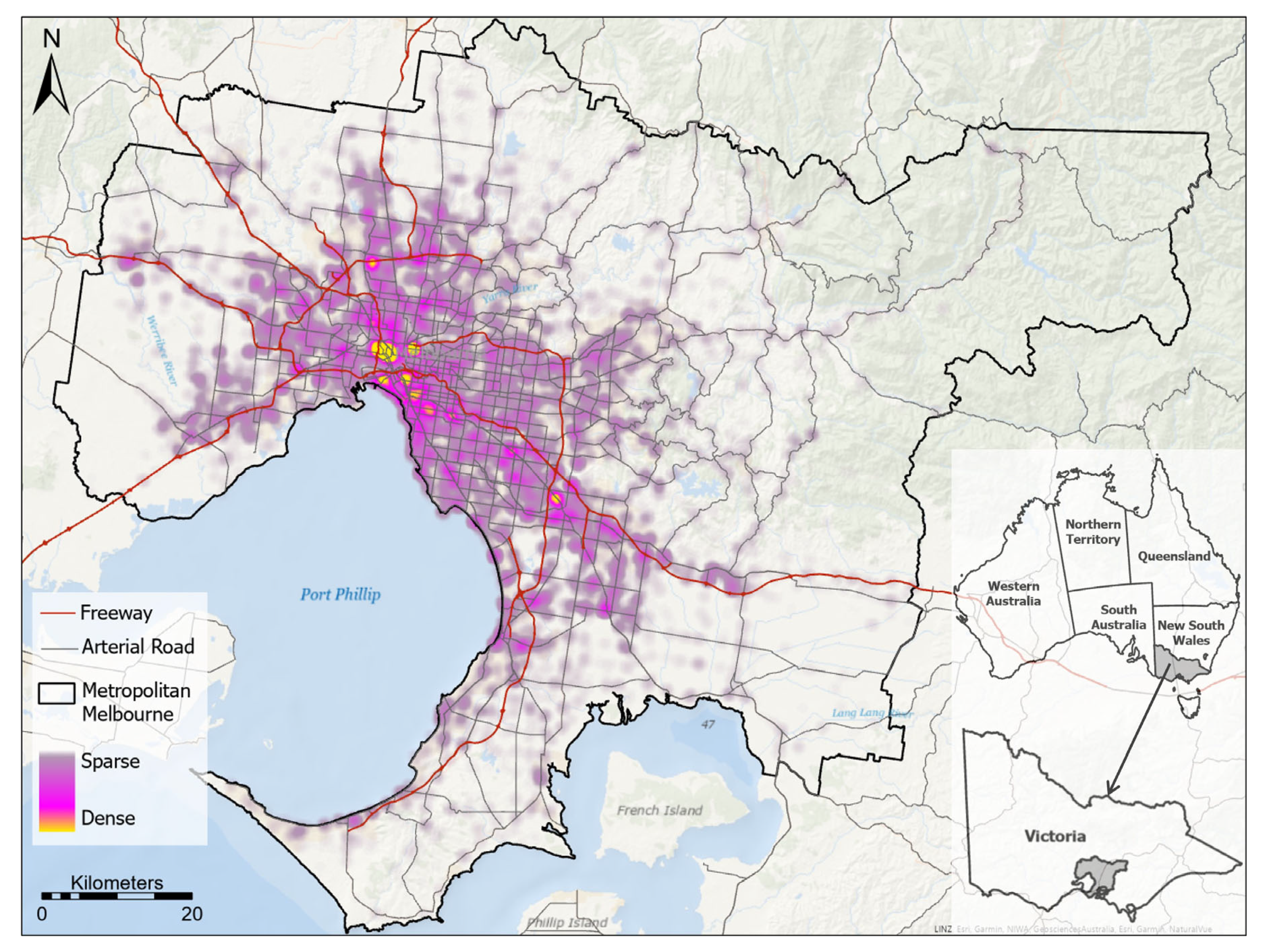
Figure 2.
Data processing and cleaning workflow.
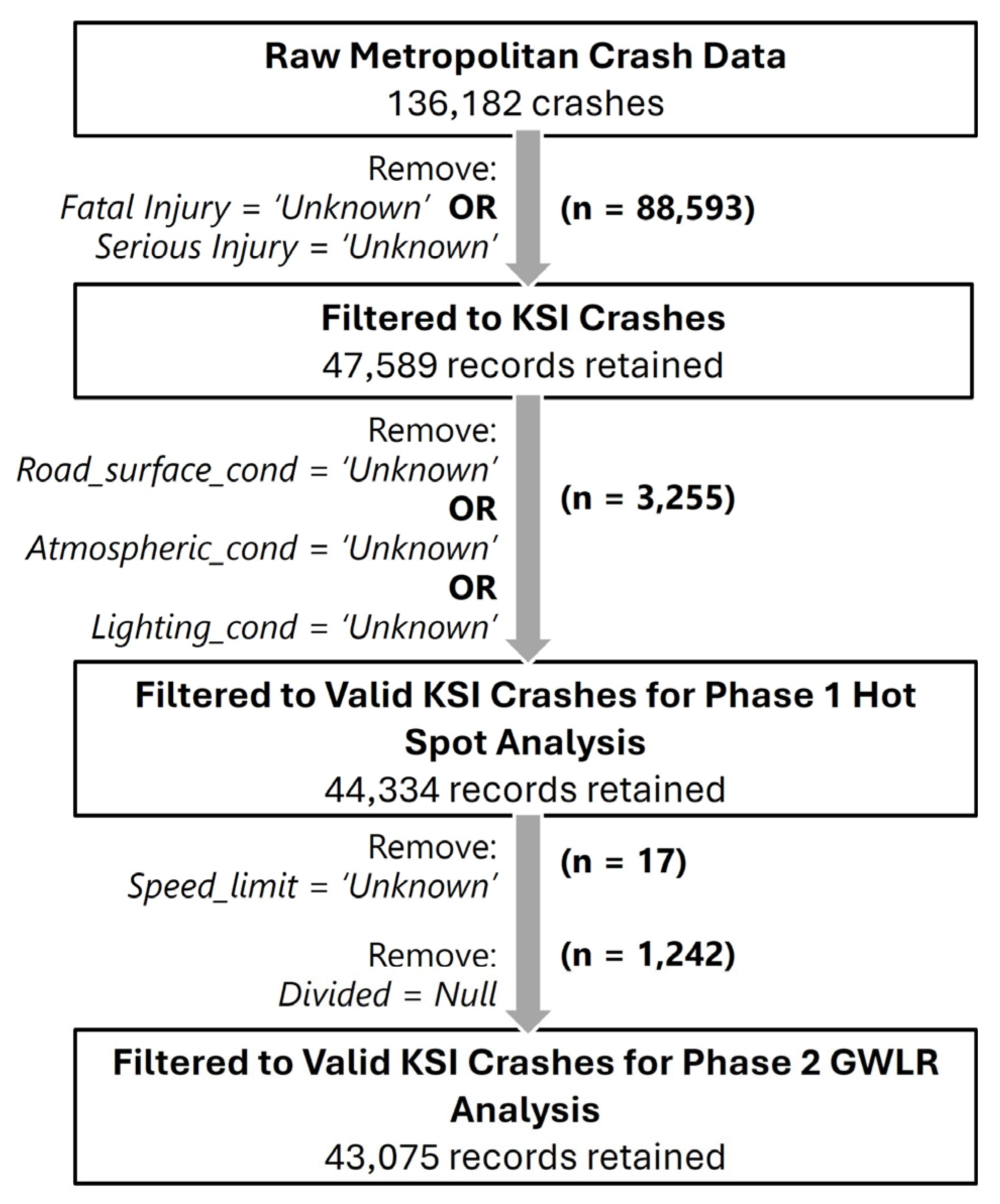
Figure 3.
Spatial distribution of severe crash hotspots (Getis-Ord Gi) under (a) Normal Conditions and (b) Adverse Conditions. The comparison reveals a contraction of risk along high-speed arterial corridors during adverse weather, likely driven by speed reductions and reduced vulnerable road user exposure.
Figure 3.
Spatial distribution of severe crash hotspots (Getis-Ord Gi) under (a) Normal Conditions and (b) Adverse Conditions. The comparison reveals a contraction of risk along high-speed arterial corridors during adverse weather, likely driven by speed reductions and reduced vulnerable road user exposure.
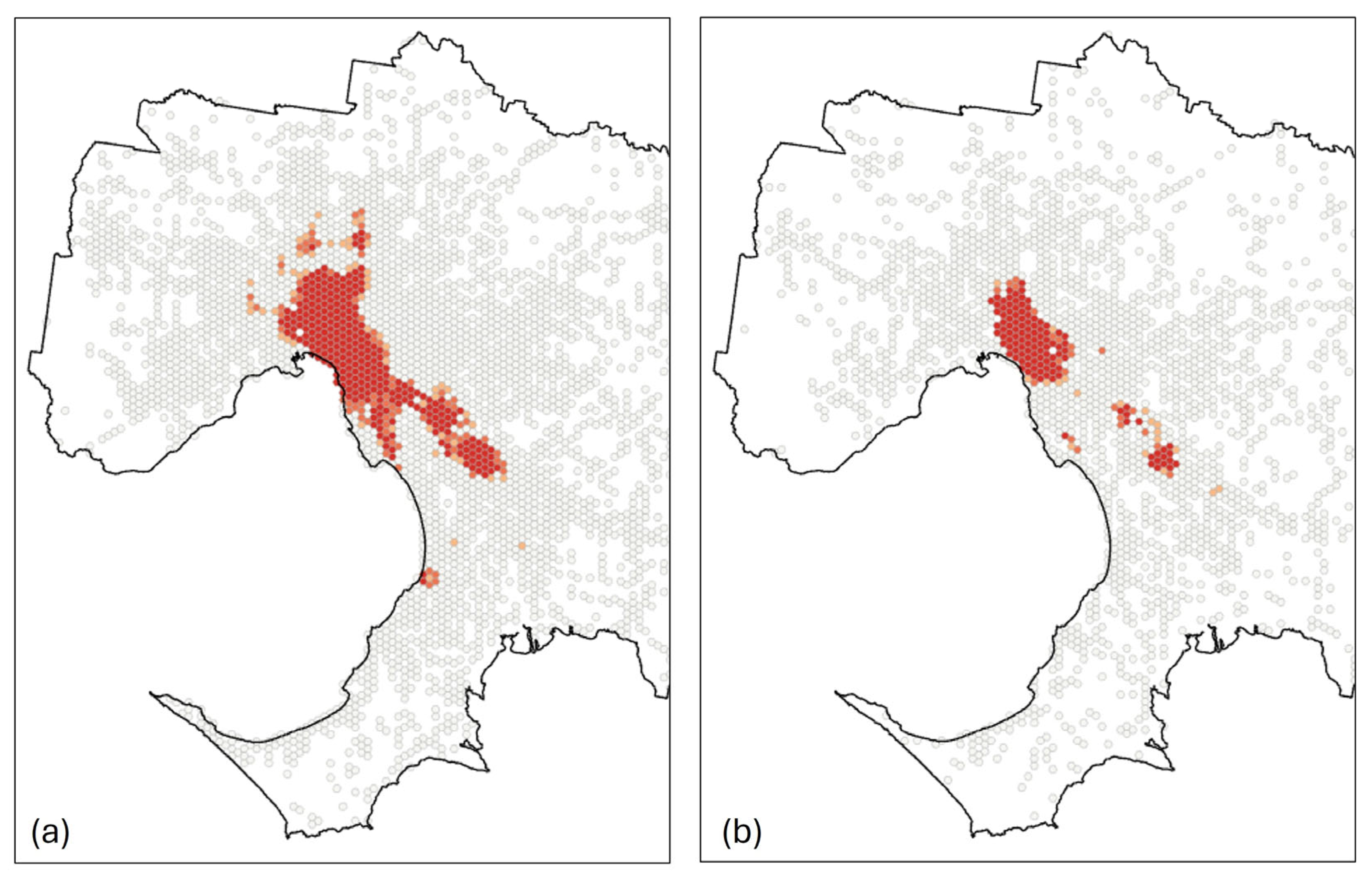
Figure 4.
Spatial distribution of GWLR odds ratio (OR) associated with independent variables: (a) Rain and (b) Wet surface.
Figure 4.
Spatial distribution of GWLR odds ratio (OR) associated with independent variables: (a) Rain and (b) Wet surface.
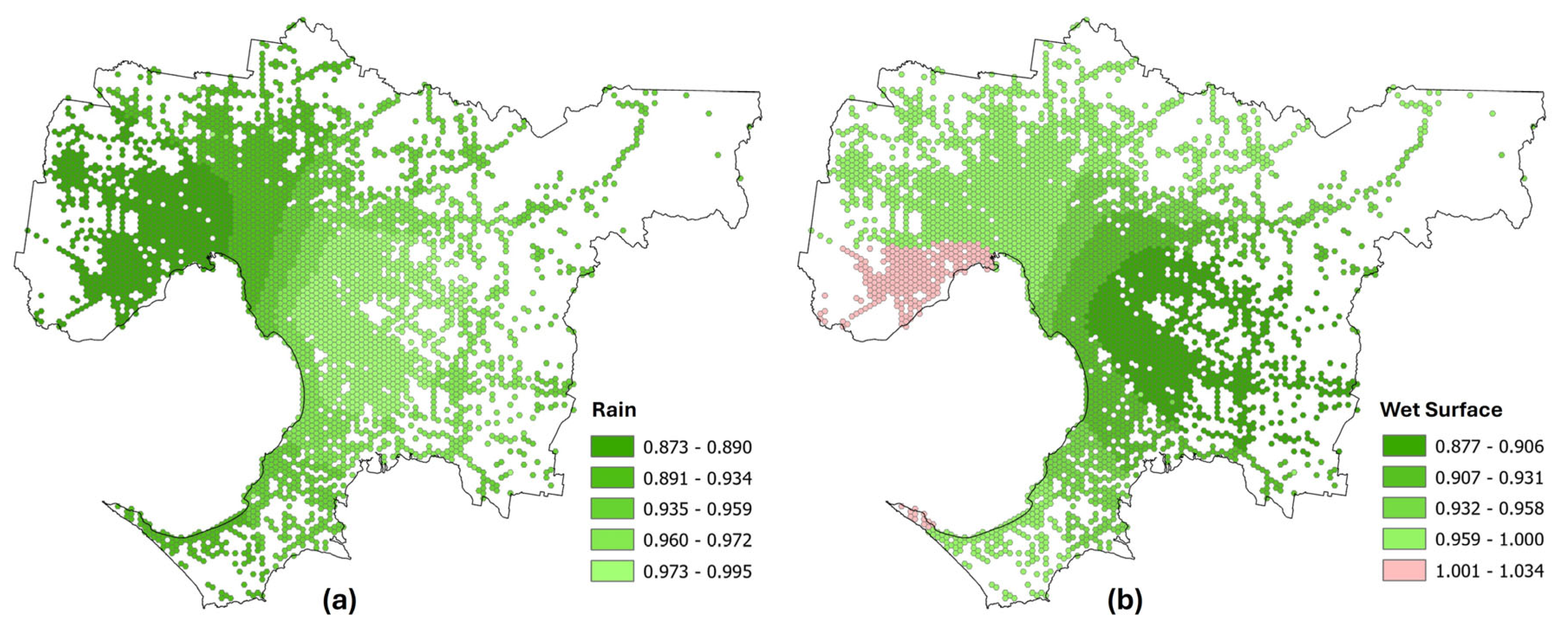
Figure 5.
Spatial distribution of GWLR odds ratio (OR) associated with independent variables: (a) Light: Dusk dawn, (b) Dark: Street lights on, (c) Other Dark, (d) Intersection, (e) Divided road and (f) Speed zone.
Figure 5.
Spatial distribution of GWLR odds ratio (OR) associated with independent variables: (a) Light: Dusk dawn, (b) Dark: Street lights on, (c) Other Dark, (d) Intersection, (e) Divided road and (f) Speed zone.
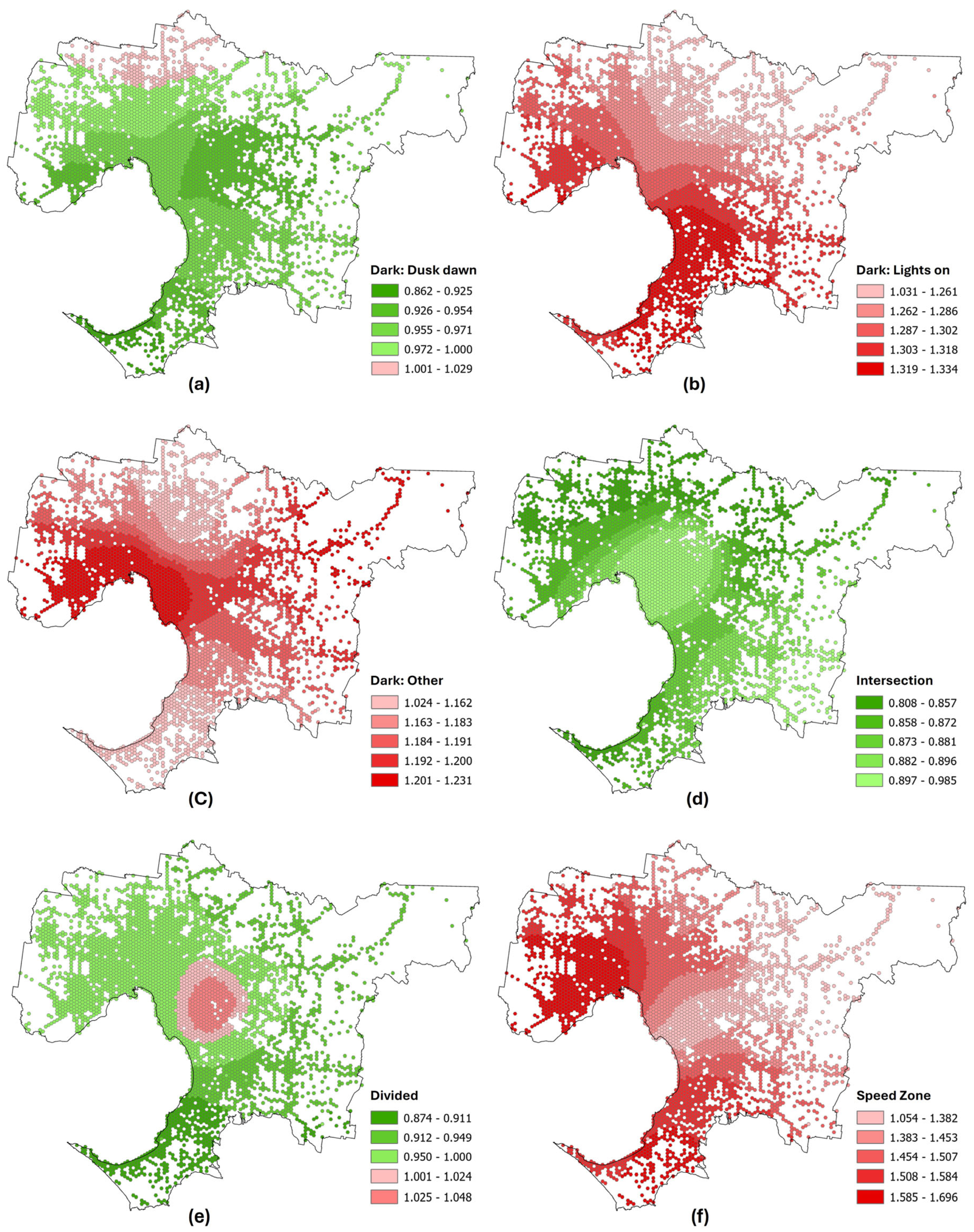
Figure 6.
Spatial distribution of GWLR odds ratio (OR) associated with independent variable VRUs.
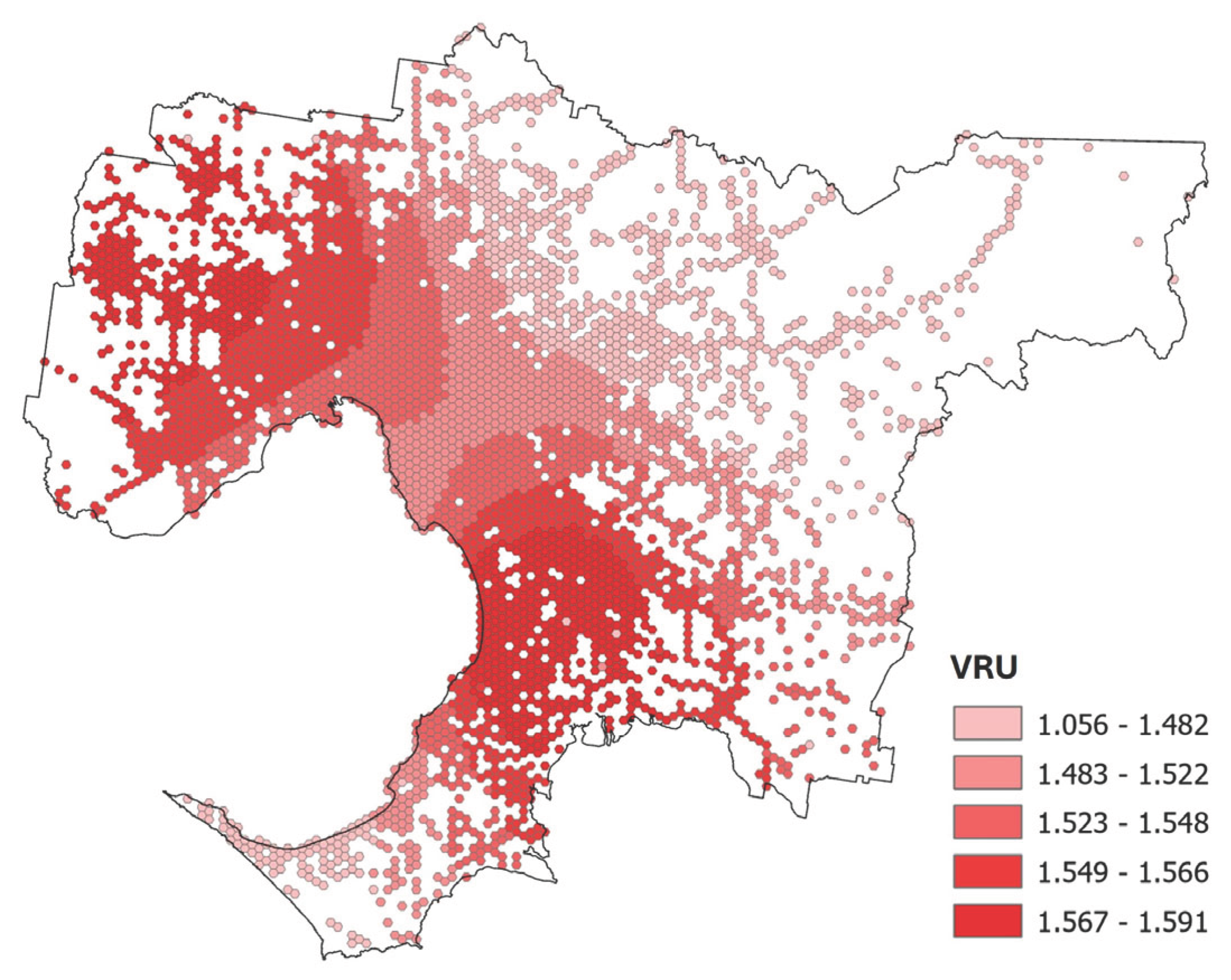

Table 1.
Variable definitions, original data codes, and study classification criteria for Phase 1.
| Variable Category | Original Codes & Descriptions | Classification in Study |
|---|---|---|
| Atmospheric Condition | 1: Clear | Normal |
| 2: Raining 3: Muddy 4: Fog 5: Smoke 6: Dust 7: Strong winds |
Adverse | |
| 9: Unknown | Excluded | |
| Road Surface Condition | 1: Dry | Normal |
| 2: Wet 3: Muddy 4: Snowy 5: Icy |
Adverse | |
| 9: Unknown | Excluded | |
| Light Condition | 1: Day | Daylight |
| 2: Dusk/dawn 3: Dark street lights on 4: Dark street lights off 5: Dark no street lights 6: Dark street lights unknown |
Low light/Dark | |
| 9: Unknown | Excluded |
Table 2.
Variable definitions, coding, and descriptive statistics (N = 43,075).
| Variable Category | Variable Name | Coding/Definition | Count |
Percentage (%) / Mean (SD) |
|
| Dependent Variable | Crash Severity | 1 = Fatal; | 1,358 | 3.2% | |
| 0 = Serious Injury | 41,717 | 96.8% | |||
| Primary Independent Variable | Rain | 1 = Raining; | 4,377 | 10.2% | |
| 0 = Otherwise | |||||
| Wet Surface | 1 = Wet | 6,404 | 14.9% | ||
| 0 = Dry | |||||
|
Control Independent Variable |
Lighting | Daylight(Ref.) | Reference category | 28,103 | 65.2% |
| Dusk/Dawn | 1 = Dusk or Dawn | 3,454 | 8.0% | ||
| 0 = Otherwise | |||||
| Dark (Lit) | 1 = Dark with street lights on; | 9,525 | 22.1% | ||
| 0 = Otherwise | |||||
| Dark (unlit/Other) ^ | 1 = 1 = Dark (no lights, lights off, or unknown) | 1,993 | 4.6% | ||
| 0 = Otherwise | |||||
|
Road Context |
Speed Limit | Continuous (km/h); Standardized for GWLR |
-- | 62.7 (17.2) | |
| Intersection | 1 = At intersection | 21,737 | 50.5% | ||
| 0 = Mid-block | |||||
| Divided Road | 1 = Divided (median/barrier); | 17,644 | 41.0% | ||
| 0 = Undivided | |||||
|
Road Hierarchy |
Local/Non-Arterial (Ref.) | Reference category | 14,108 | 32.8% | |
| Freeway | 1 = Freeway | 4,241 | 9.9% | ||
| 0 = Otherwise | |||||
| Arterial Highway | 1 = Arterial Highway | 6,956 | 16.2% | ||
| 0 = Otherwise | |||||
| Arterial Other | 1 = Arterial Other | 17,770 | 41.3% | ||
| 0 = Otherwise | |||||
| Road User | VRU Involvement | 1 = VRU involved; | 17,252 | 40.1% | |
| 0 = Vehicle occupants only | 9.9% | ||||
^ “Dark (Unlit/Other)” combines “Dark—No street lights” (n = 1,576), “Dark—Street lights off” (n = 119), and “Dark—Street lights unknown” (n = 298) due to low sample sizes.
Table 3.
GLR model results (N = 43,075).
| Predictor | Coef. (β) | S.E. | p-Value | OR | 95% C.I. for OR | ||
|---|---|---|---|---|---|---|---|
| Lower | Upper | Difference | |||||
| Intercept | -5.279 | 0.144 | < 0.001* | 0.005 | |||
| Rain (1=raining) | -0.259 | 0.155 | 0.095 | 0.772 | 0.570 | 1.046 | 0.476 |
| Wet surface (1=wet) | -0.121 | 0.127 | 0.339 | 0.886 | 0.691 | 1.136 | 0.444 |
| Dusk/Dawn | -0.115 | 0.118 | 0.333 | 0.892 | 0.707 | 1.125 | 0.417 |
| Dark (street lights on) | 0.605 | 0.065 | < 0.001* | 1.832 | 1.614 | 2.079 | 0.465 |
| Dark (unlit/other) | 0.810 | 0.102 | < 0.001* | 2.249 | 1.842 | 2.744 | 0.902 |
| Speed limit (per 1 SD) | 0.023 | 0.002 | < 0.001* | 1.024 | 1.020 | 1.028 | 0.008 |
| At intersection | -0.287 | 0.060 | < 0.001* | 0.750 | 0.667 | 0.843 | 0.176 |
| Divided road | -0.102 | 0.069 | 0.140 | 0.903 | 0.788 | 1.034 | 0.246 |
| Freeway | -0.611 | 0.135 | < 0.001* | 0.543 | 0.417 | 0.707 | 0.290 |
| Arterial highway | 0.049 | 0.100 | 0.621 | 1.051 | 0.864 | 1.277 | 0.413 |
| Arterial other | 0.075 | 0.070 | 0.290 | 1.077 | 0.938 | 1.237 | 0.299 |
| VRU involved | 0.803 | 0.058 | < 0.001* | 2.233 | 1.993 | 2.501 | 0.508 |
| Model diagnostics Highest VIF = 2.65 Likelihood ratio χ2 = 474.48 (df = 12, p < 0.001) Deviance = 11613 Percent deviance explained = 0.039 AIC = 11613.28 |
|||||||
Reference categories: Daylight (Lighting), Mid-block (Road Context), Local/Non-Arterial (Road Hierarchy), and Vehicle Occupants only (Road User).
Table 4.
Bandwidth sensitivity and selection for GWLR (Adaptive Bisquare Kernel; N = 43,075. Diagnostics reported from MGWR 2.2 outputs).
Table 4.
Bandwidth sensitivity and selection for GWLR (Adaptive Bisquare Kernel; N = 43,075. Diagnostics reported from MGWR 2.2 outputs).
| Model | Bandwidth Rule | Bandwidth (Neighbors) | trace(S) | Deviance | AIC | AICc | % Deviance Explained |
|---|---|---|---|---|---|---|---|
| GWLR-AICc | AICc-optimised | 33,685 | 39.927 | 2606.363 | 2686.217 | 2686.293 | 0.056 |
| GWLR-25% | Fixed proportion | 10,769 | 155.962 | 2663.501 | 2975.426 | 2976.567 | 0.035 |
| GWLR-50% | Fixed proportion | 21,538 | 73.998 | 2625.623 | 2773.620 | 2773.878 | 0.049 |
| GWLR-75% | Fixed proportion | 32,306 | 42.730 | 2603.738 | 2689.199 | 2689.286 | 0.057 |
Table 5.
Summary statistics of local odds ratios (ORs) estimated through the GWLR model.
| Predictor | Minimum | Median | Maximum | Range |
|---|---|---|---|---|
| Rain | 0.873 | 0.928 | 0.997 | 0.124 |
| Wet surface | 0.877 | 0.960 | 1.034 | 0.157 |
| Light condition (Dusk/Dawn) | 0.862 | 0.963 | 1.029 | 0.166 |
| Light condition (Dark—lights on) | 1.028 | 1.289 | 1.334 | 0.306 |
| Light condition (Dark—unlit/other) | 1.023 | 1.192 | 1.231 | 0.207 |
| VRU involvement | 1.048 | 1.540 | 1.591 | 0.542 |
| Intersection | 0.808 | 0.886 | 0.993 | 0.185 |
| Divided road | 0.874 | 0.982 | 1.048 | 0.175 |
| Road class (Freeway) | 0.744 | 0.832 | 0.984 | 0.240 |
| Road class (Arterial highway) | 0.913 | 1.028 | 1.135 | 0.222 |
| Road class (Arterial other) | 0.923 | 1.075 | 1.144 | 0.220 |
| Speed (standardized) | 1.039 | 1.486 | 1.698 | 0.658 |
Notes: OR = exp(β). Minimum, median, maximum, and range (maximum − minimum) are calculated across all 43,075 local GWLR estimates for each predictor (75% bandwidth model).
Disclaimer/Publisher’s Note: The statements, opinions and data contained in all publications are solely those of the individual author(s) and contributor(s) and not of MDPI and/or the editor(s). MDPI and/or the editor(s) disclaim responsibility for any injury to people or property resulting from any ideas, methods, instructions or products referred to in the content. |
© 2026 by the author. Licensee MDPI, Basel, Switzerland. This article is an open access article distributed under the terms and conditions of the Creative Commons Attribution (CC BY) license.
Copyright: This open access article is published under a Creative Commons CC BY 4.0 license, which permit the free download, distribution, and reuse, provided that the author and preprint are cited in any reuse.


