

Submitted:
23 April 2026
Posted:
27 April 2026
You are already at the latest version
Abstract
Depression, anxiety, and stress-related disorders continue to rise globally, with South Africa’s burden intensified by structural inequalities and a 91% mental health treatment gap. Accessible complementary interventions are urgently needed. This exploratory mixed-methods pilot study examined the feasibility, acceptability, and preliminary effectiveness of astronomy-based mental health support grounded in Attention Restoration Theory and awe research. Two retreats combined guided naked-eye and telescope-based stargazing with nature immersion: a proof-of-concept peer camp (n=19, Glencairn) and a family-focused retreat (n=27, Sutherland). Quantitative outcomes using the Depression Anxiety Stress Scale (DASS-21) were collected in the Glencairn cohort, alongside qualitative data from Most Significant Change focus groups and asynchronous text-based interviews. Significant reductions in depression, anxiety, and stress were observed in the Glencairn cohort, while qualitative findings across both settings indicated experiences of calm, perspective shifts, and relational connection. However, increased environmental novelty and family dynamics introduced competing cognitive demands in the Sutherland setting. These findings provide preliminary evidence that astronomy-based interventions may support short-term psychological well-being, while highlighting key design considerations, including cognitive spaciousness, contextual onboarding, and relational facilitation, for implementation in diverse African contexts.
Keywords:
mental health
; awe
; attention restoration theory
; astronomy
; nature-based interventions
1. Introduction
The intersection of astronomy and mental health draws upon two primary theoretical frameworks. Kaplan’s Attention Restoration Theory (ART) proposes that natural environments engage “soft fascination”, an effortless form of attention that allows depleted cognitive resources to recover [1,2]. The night sky offers a unique form of soft fascination: engaging without demanding active attention, vast without overwhelming. Researchers have extended ART’s application to astronomical environments, arguing that the vast, perspective-inducing qualities of the night sky engage restorative attention processes [3].
Complementing ART, research on awe provides a second framework. Keltner & Haidt [4] characterized awe as an emotional response to vast stimuli that challenge existing mental models. Subsequent studies demonstrate that awe reduces self-focus, quiets inner criticism, and increases prosocial behaviour [5,6]. The “Overview Effect” described by astronauts represents a prototypical awe experience that ground-based astronomy attempts to replicate [7]. Keltner & Haidt [4] argue that astronomy naturally elicits awe by presenting humanity within an incomprehensibly vast universe.
1.1. Global Research Evidence
A substantial body of research supports nature exposure for mental health. Berman et al. [8] demonstrated that walks in natural environments improved cognitive performance compared to urban walks. Ohly [2] conducted a systematic review finding consistent evidence that natural environments facilitate recovery from directed attention fatigue. Bratman [9] provided comprehensive evidence that nature exposure produces measurable benefits for psychological health, including reductions in stress, anxiety, and depressive symptoms.
Recent developments specifically examining night sky engagement include the Night Sky Connectedness Index by Barnes [10], a 12-item scale measuring individuals’ connection to the night sky. Validation studies found that greater night sky connectedness was positively associated with mental health and happiness, independent of general nature connectedness. Notably, people in light-polluted areas felt less connected to the night sky, suggesting that access to dark skies is an important environmental determinant of wellbeing.
Direct astronomy-mental health studies remain limited but growing. Gankhuu et al. [11] found that engagement with the starry night sky helped mitigate stress and alienation among isolated nomads in Mongolia during COVID-19. Japanese research demonstrated that dark night sky images significantly reduced oxygenated haemoglobin in the right prefrontal cortex and increased psychological healing ratings [12]. Barragan and Meltzoff [13] linked the opportunity to view the starry night sky to human emotion and behavioural interest in astronomy.
1.2. The African Context: Implementation Without Evidence
The African continent faces substantial mental health challenges that make innovative interventions particularly valuable. Neuropsychiatric disorders rank third in their contribution to the overall burden of disease in Africa, with anxiety and mood disorders most prevalent among adults (8.1% and 4.9% respectively) and generalized anxiety at 11% for children and adolescents [14]. In South Africa specifically, nearly 40% of the population experiences symptoms of depression or anxiety, with a mental health service gap of 91% [3,14,15].
Despite these challenges, Africa hosts significant astronomy infrastructure, including the Southern African Large Telescope (SALT), and the MeerKAT radio telescope which will be integrated into the future Square Kilometre Array (SKA) [16]. The International Astronomical Union’s Office of Astronomy for Development (IAU-OAD), hosted in Cape Town, coordinates the most significant global effort linking astronomy to development [17]. Since 2012, the IAU has granted nearly EUR 1.5 million to over 200 projects across 112 countries [18]. The OAD’s Flagship Project 2: Astronomy for Mental Health explicitly aims to harness the inspirational potential of astronomy and use it as a tool for improving people’s mental health and wellbeing.
1.3. South African Research: Building the Evidence Base
South Africa stands at the forefront of astronomy-for-mental-health research on the continent. The Stellenbosch University CoCREATE Health Hub and IAU-OAD collaboration examines how structured stargazing sessions can support mental health, grounded in ART, Acceptance and Commitment Therapy principles, and awe research [18]. Preliminary results from a guided astronomy weekend in Sutherland indicate that participants reported reduced anxiety within 24 hours, improved mood, a sense of “mental spaciousness,” and greater family cohesion [19].
Recent pilot studies through collaboration between OAD, Stellenbosch University (SU), Table Mountain National Park (TMNP), Guardians of the Deep NPC, and the Inter-university Institute for Data Intensive Astronomy (IDIA), provided early empirical evidence. A proof-of-concept camp (n=19) demonstrated statistically significant reductions in DASS-21 depression, anxiety, and stress scores. An expanded family-focused retreat (n=27) revealed both potential and challenges: while astronomical content remained a potent source of awe, family dynamics and environmental novelty sometimes introduced competing demands on cognitive resources.
A critical insight from South African research is the importance of contextual adaptation. In settings where mental well-being is understood relationally (Ubuntu philosophy), interventions cannot rely on Western models of individualistic “escape.” The African concept of Ubuntu: “I am because we are”, reflects that individual well-being is inseparable from collective flourishing. Astronomy-based interventions must include “contextual onboarding” that addresses socio-economic contrasts participants encounter [20].
1.4. The Research-Implementation Gap
Despite promising theoretical foundations and preliminary findings, significant evidence gaps remain. No systematic reviews specifically examining astronomy-based mental health interventions exist. No randomized controlled trials specifically testing astronomy interventions for mental health outcomes have been conducted in Africa. Existing studies are primarily pilot studies with small sample sizes, pre-post designs without control groups, or qualitative explorations. Optimal frequency, duration, and intensity remain unknown [21].
While NGOs, NPOs, and development organizations are actively implementing astronomy-for-development initiatives across Africa, academic research has not kept pace with practice. Most initiatives lack rigorous evaluation frameworks, and existing studies are concentrated in South Africa, leaving the rest of the continent unexamined. Limited evidence exists for specific populations including clinical populations, children and adolescents, elderly populations, refugees and trauma survivors, and across different cultural contexts.
1.5. Framing the Current Study
To advance beyond theoretical promise toward practical implementation, this study adopts an iterative pilot approach to explore the feasibility and potential effects of astronomy-based mental health interventions within the South African context. Recognising that effective interventions must account for both neurobiological mechanisms of restoration and relational understandings of well-being, the study examines how guided stargazing and nature immersion function across differing environmental and social contexts.
Two pilot iterations were conducted, varying key conditions including environmental setting and social configuration, to explore how these factors influence participantexperience and perceived outcomes. This approach enables the identification of contextual and design considerations necessary for developing culturally responsive, community-oriented interventions in African settings.
This study contributes to the emerging field of environmental and nature-based mental health interventions by providing one of the first empirical, mixed-methods explorations of astronomy-based mental health support in an African context. Specifically, it aims to (1) assess the feasibility and acceptability of guided stargazing interventions, (2) generate preliminary evidence of short-term mental health outcomes, and (3) identify contextual and relational factors influencing intervention effectiveness across differing environmental and social settings.
2. Materials and Methods
2.1. Research Design
This is an exploratory mixed-methods pilot study designed to assess feasibility, acceptability, and preliminary effectiveness of the restorative potential of astronomy-based interventions concerning mental health and family cohesion/connection. Given the exploratory nature of the research within the African context, an iterative pilot approach was utilized. This allowed researchers to test the intervention logic in two controlled settings with the aim of continuing to adapt and expand the scope of the interventions.
The study combined quantitative measures to assess changes in mental well-being with qualitative inquiry using the Most Significant Change (MSC) technique [22]. MSC was selected as it allows participants to articulate complex, subjective changes, such as shifts in perspective or feelings of awe, that predefined quantitative measures might miss. Family cohesion was assessed using asynchronous text-based interviews, collecting personal reflections on changes in family dynamics. The research team was involved in programme facilitation, and reflexive practices were used to critically consider how this may have shaped data collection and interpretation.
2.2. Setting and Site Selection
To ensure the interventions facilitated Attention Restoration Theory (ART) and awe, venues were purposely selected based on specific criteria outlined in the ethical protocol. First, locations required dark skies with minimal light pollution to ensure optimal naked-eye stargazing. Second, scenic and clutter-free natural settings were prioritized to enhance soft fascination and restorative potential. Third, venues required secure environments for nighttime activities and basic amenities to support group comfort. Finally, locations needed to be reachable for diverse participants while still providing a sense of being away.
Based on these criteria, two distinct settings were identified for the pilot iterations:
- Glencairn (Setting A): A coastal mountain venue providing a green nature experience with moderate accessibility.
- Sutherland (Setting B): A remote, arid location hosting the Southern African Large Telescope (SALT), selected for its dark sky status and the contrast between the stark landscape and advanced scientific infrastructure.
2.3. Intervention Design: Testing Combinations
The intervention utilized an iterative modular design. Rather than testing a static programme, the pilot tested different combinations of restorative variables. The core activity, which consisted of accessible astronomical observation using the naked eye and manual Dobsonian telescopes, remained constant. However, the environmental context and social composition were varied to understand how these factors influence the restorative process.
Table 1 outlines the specific combinations of variables tested across the two pilot settings.
The selection of measures was tailored to the specific variables tested in each iteration to capture relevant outcomes. Table 2 outlines the distribution of instruments across the two settings.
2.6. Data Collection Methods
Quantitative Data: Depression Anxiety Stress Scale (DASS-21)
The selection of measures was tailored to each pilot iteration to align with the variables being tested. Quantitative assessment using the DASS-21 was conducted only in the Glencairn cohort to establish a preliminary baseline of psychological outcomes. Qualitative methods, including Most Significant Change (MSC) focus groups and asynchronous text-based interviews, were used across both settings to capture subjective experiences and relational dynamics.
The DASS-21 [23] served as the primary measure to establish a quantitative baseline for general mental well-being. This 21-item instrument assesses current states of emotional distress across three subscales: Depression, Anxiety, and Stress. Items are rated on a 4-point Likert scale ranging from 0 (Did not apply to me at all) to 3 (Applied to me very much or most of the time). The DASS-21 was selected for its strong psychometric properties within the South African context [24], where it has demonstrated high internal consistency (Cronbach’s alpha 0.70 to 0.97).
Qualitative Inquiry: Most Significant Change (MSC)
Qualitative data from focus groups and text-based interviews were analysed using reflexive thematic analysis. Analysis followed an iterative process of familiarisation, coding, theme development, and refinement. Coding was conducted by members of the research team, with ongoing discussion to enhance interpretive depth. Reflexive practices were employed to acknowledge the researchers’ positionality and involvement in programme facilitation.
Qualitative data was collected from the Glencairn cohort using the MSC technique [22]. MSC is particularly suited to non-clinical interventions as it allows participants to define the value of the experience in their own terms.
Qualitative Inquiry: Asynchronous Text-Based Interviews
The data collected from the Sutherland cohort were obtained through asynchronous text-based interviews conducted on WhatsApp. This process enables individuals to answer questions at their own pace and provides greater anonymity and confidentiality for participants [25]. As individuals were attending with their families and due to the time constraints, this method was considered to be more appropriate to collect data.
2.7. Data Collection Procedure
Data collection for the Glencairn retreat occurred at two specific time points:
T1 (Pre-Intervention): Participants completed the demographic questionnaire and quantitative measure (DASS-21 for Glencairn) upon registration.
- 3.
- T2 (Post-Intervention): On the final day of the retreat, participants repeated the quantitative measures. Additionally, facilitated focus groups consisting of 6 to 7 participants were conducted.
2.7.1. Focus Group
During the T2 focus group, participants were presented with three specific prompts designed to elicit narratives regarding restoration, nature, and astronomical engagement:
Can you describe the most significant change you experienced during the retreat related to your mental well-being?
- 4.
- How did the astronomy activities (e.g., stargazing, cosmic perspective discussions) affect your outlook on life or personal challenges?
- 5.
- What, if anything, surprised you about your experience during the retreat?
2.7.2. Text-based Interviews
During the Sutherland retreat, the text-based interviews included five questions/prompts that were sent to participants over the course of the weekend.
What has been your favorite part of the trip so far?
- 6.
- Share your thoughts on yesterday when we were all together.
- 7.
- What did you enjoy the most?
- 8.
- What has the weekend done for your family?
- 9.
- How are you feeling after the weekend’s activities?
2.8. Data Analysis
2.8.1. Quantitative Analysis
Descriptive statistics were calculated to profile participant demographics (Table 2). To evaluate the impact of the intervention, paired sample t-tests were conducted. For the Glencairn cohort, this analysed if there were significant group differences between pre-intervention (T1) and post-intervention (T2) scores on the DASS-21.
2.8.2. Qualitative Analysis
Focus group transcripts and the text-based interviews were analysed using reflexive thematic analysis [26]. The analysis sought to identify patterns relevant to the study’s theoretical framework, coding for instances of attention restoration, awe, cognitive load, and perspective-taking.
2.9. Intervention Components
Both retreats shared two core elements: (a) guided astronomical observation and discussion, and (b) immersion in natural settings. These components were intentionally designed to align with ART principles: Being Away (psychological escape), Fascination (effortless engagement with nature’s “soft” stimuli), Extent (feeling immersed in a rich world), and Compatibility (alignment with personal goals)[1].
3. Results
2.4. Participants
Purposive sampling was used to recruit participants relevant to the study’s interdisciplinary focus. The total sample (N=46) comprised two distinct cohorts corresponding to the intervention settings.
- Glencairn Cohort (n=19): Participants were recruited from social, professional and academic networks, including field rangers from Table Mountain National Park, astronomy postgraduates, and psychology students.
- Sutherland Cohort (n=27): Participants comprised nine family groups recruited through Stellenbosch University staff email and advertising internally.
Table 3 details the demographic characteristics of the participants.
2.5. Data Collection and Analysis3.1. Quantitative Findings
Table 4 presents pre- and post-intervention DASS-21 means for the Glencairn cohort. Mean scores decreased across all the subscales. Paired-samples t-tests confirmed statistically significant results: anxiety (t(18) = 3.142, p = .003, Cohen’s d = 0.72), depression (t(18) = 2.388, p = .014, Cohen’s d = 0.55), and stress (t(18) = 2.127, p = .024, Cohen’s d = 0.49). These represent moderate to large effects.
The values in the table indicate that for each variable, the mean value in the pre-test was higher than the mean value in the post-test. This implies that the overall average levels of anxiety, depression and stress were higher before the retreat than after the retreat.
Table 5 shows the results of a paired sample t-test carried out using the participants’ scores before the retreat and after the retreat.
The results in the table show the results from the dependent t-tests to be statistically significant for all three groups being measured, showing that there is a mean difference between each of the groups. The anxiety group showed a significant result, t(18) = 3.14, p = .003, with the positive t value showing a reduction in anxiety symptoms. Similarly, the depression comparison scores were also significant, t(18) = 2.39, p = .014, with the t score showing a decrease in depression symptoms and the stress scores, t(18) = 2.13, p = .024, also reported significant differences in the mean scores, showing a reduction in stress symptoms.
These findings indicate short-term improvements in psychological distress following the intervention within this cohort.
3.2. Qualitative Findings—MSC Focus Groups (Glencairn)
Three focus groups were conducted with the participants at the end of the Glen Cairn retreat. The discussions explored the participants’ perceptions and experiences of the programme and how this impacted their mental wellbeing. The themes that arose from these conversations are presented below.
3.2.1. Themes
3.2.1.1. Sense of Calm and Stress Release
Participants described the retreat environment as creating a calming atmosphere where they could let go of stress and gain respite from the demands of day-to-day life. One participant shared, “I was actually at peace” (male), whereas another mentioned,
“It just kind of slows you down a bit and you get back into your normal rhythm. Instead of being like this, like you’re in a hamster wheel, just going on to the next thing, not dealing with what you actually need to deal with, just keep running away from it”. (male, age if known)—do this for all quotes
These accounts suggest that the retreat environment facilitated a process of slowing down the mind and body, allowing for a more balanced approach to daily activities and, consequently, a reduced mental load.
3.2.1.2. Enhanced Sense of Community and Connection
Some participants highlighted their experience of building connections with others and feeling accepted in the group as something that challenged their personal ideas of themselves. One shared
“this is the first time that I’ve, like, I’ve had such a positive experience with you guys, and it’s really helped me, sort of, shift that perception of myself was so negative”. (female)
Another participant highlighted the value that can emerge from coming together as a group, “I realised that we gain more experience of interacting with each other, of learning the new things from each other. And it’s new experience now that we learn about many things from different aspects that they know”. This shows that some participants experienced profound feelings of connection with other people during the retreat and this impacted them positively.
3.2.1.3. Expanded Perspective
Several participants explained how they felt they had gained a greater perspective on their lives and on personal issues they are dealing with. One shared, “there’s, like, a sense of, like, we’re all just tiny little animals on this rock. And that universal truth and the universality of it and the spirituality of it definitely hit home for me when we’re all standing there”.
Another participant explained,
“the more you’re zooming into whatever you’re looking at, you keep getting smaller and smaller. Your problems keep getting smaller and smaller”. (male)
This shows the impact that being faced with the enormity of the stars and the galaxy had on the way individuals viewed their own lives and problems. Through understanding the scale of the universe, there was a sense that by focusing so intensely on specific aspects of life, one loses perspective about what is important.
3.2.1.4. Cultural Significance
Another theme that was presented was the way the stars align with culture, and that people connected to their cultural knowledge to glean personal significance from the experience of looking at the stars.
One individual explained, “That they’re not just stars. There’s a message within each star. Each star has its own story and all of that. And that can actually be applied in our own lives”.
Another participant shared, “We thought the stars are just the stars. And we call it... There’s a star that we say... I don’t know what is the English name. It’s coming from the east. When the sun is rising, it stands up all the way to this guy’s nose. And there’s a star that comes from that star. Okay. When it’s about to sunrise, then we call it... Kwezi. That means it’s a very bright star”. (male)
These accounts highlight the different ways in which people make sense of the stars and how to each person it means something different. The importance of the stars in South African cultures implies that the sky can represent something deeper and allow a personal connection to something greater.
3.2.1.5. Personal Understanding
Another aspect that came across was the way that participants had gained a greater sense of personal understanding from their time at the retreat. One participant shared, “What surprised me about this whole experience is how high strung I am. It doesn’t come across that way, but in the background, there is chaos”. (male) This shows that the process of slowing down during the retreat had highlighted their true nature. Another said, “…at first I was thinking, wow, this is exactly the stuff that I’ve been thinking about. My position, doing astronomy, what does that mean? Why am I doing it? Do I really love what I’m doing? All that kind of stuff”. (male) This indicates that the retreat helped to facilitate these questions for the participant, leading them to try to understand more deeply their reasons for making certain decisions in their life.
3.3. Qualitative Findings—Text-Based Interviews (Sutherland)
Over the course of the 2 day retreat, five questions were asked using WhatsApp and individuals were asked to respond in their own time. The general themes identified are presented below.
3.3.1. Themes
3.3.1.1. Ideas about Family
One theme that came across was how participants thought about their concept of family, one shared, “when I left for weekend, I didn’t conceptualise the family beyond the 2 of us. Realised the family was larger and included family and friends—from 2 to 8 and a half with toddler. Recognition of importance of families”. This shows how taking time together as a family unit highlighted the importance of family and how family can mean more than the traditional sense. Another participant wrote that, “The weekend gave the family a chance to share time, stories and each one got to have time together and individually to explore.” This implies that the retreat had prompted families to spend quality time with each other that they may not have made time for previously.
3.3.1.2. Importance of History
Participants reflected on the continued influence of South Africa’s historical context within the Sutherland setting. One of the participants wrote, “The sense of race and class is still so divided” (female), reflecting on the ongoing divisions related to race and class. Another individual replied, “our word is “development” the good, the bad, the ugly, the untold and mis-told truths and how interesting the dynamic is in an environment like South Africa”.(male and female) These accounts suggest that participants situated their experience within the broader historical and structural realities that are still so relevant today in South Africa.
3.3.1.3. Logistic Issues
A prominent theme revolved around the logistical issues that had been experienced by participants. One of the participants had reflected that, “I think it would be helpful to build in time for reflection, which we can also do as a family after each activity or at the end of each day”. (male) Another individual shared that they felt, “More prompts at getting to know each other would have made it feel less isolating”. (male) One participant suggested that the schedule for the weekend was too busy, “Centre session was a bit long/ could have had better time management—program bit too full. Negative impact on the rest of the time as having to communicate changes”. (male) These aspects were important to note as areas for improvement. The participant feedback highlighted that planning multiple activities over a short period was counterproductive and actually added to stress and fatigue. Also, it was noted that when bringing together multiple groups of people, there needs to be more effort made to integrate them and encourage people to get to know each other.
3.3.1.4. Mental Restoration
One concept that was communicated was the experiences of mental restoration that the participants had experienced. One shared, “The SALT tour and stargazing was for me a good time to appreciate having an opportunity to see what we saw and to reflect on how busy I let life get with many things”. (male) This was iterated by another participant who said, “I wanna take back the calmness Sutherland has”. Showing that the activities and the environment had prompted a sense of calm and reflection. Another individual wrote, “A sense of appreciation being here just being part of something bigger” (female), which reiterated that the weekend had encouraged perspective building.
3.3.1.5. Environment Appreciation
A clear theme that arose was the appreciation that participants had shown for the natural environment. One participant shared “Privilege to be part of Milky Way at this time of year when the core is visible at night in southern hemisphere”. (male) Another individual wrote, “Awed by the beauty and the isolation. And the determination of life to survive.” (female) This highlighted the way that participants connected with the environment and that it allowed for deeper self-reflection and contemplation.
4. Discussion
The findings from this exploratory pilot study provide preliminary evidence for the potential restorative effects of astronomy-based interventions, while highlighting important contextual and design considerations within the South African setting.
In the Glencairn cohort, the familiar coastal-natural setting, peer social container, and guided astronomical observation produced clear restorative effects. Quantitative results suggested statistically significant reductions across all DASS-21 subscales. These changes line up nicely with Attention Restoration Theory [1]. The theory describes how the night sky, with its vast and effortless beauty, captures our attention in a gentle way. This helps restore our mental focus after it has been worn down, without requiring any extra effort from our brains [2]. Qualitative accounts richly complement this picture: participants described mental calm, release from the “hamster wheel” of daily life, and expanded perspective (“our problems keep getting smaller”), illustrating ART’s elements of Being Away, Extent, and Compatibility.
Awe operated as a complementary mechanism. The cosmic scale elicited perspective-taking that diminished self-focus and rumination, consistent with established awe literature [4,5] and the Overview Effect analogue [7]. Cultural resonance themes further distinguished the experience: participants spontaneously linked stellar observation to indigenous knowledge (e.g., “Kwezi”), bridging scientific wonder with personal and collective meaning-making. This cultural integration suggests the night sky functions not merely as a restorative stimulus but as a culturally resonant space in African contexts.
Figure 1.
(a) Group stargazing at the Glen Cairn retreat: (b) View from The South African Large Telescope (SALT) in Sutherland.
Figure 1.
(a) Group stargazing at the Glen Cairn retreat: (b) View from The South African Large Telescope (SALT) in Sutherland.
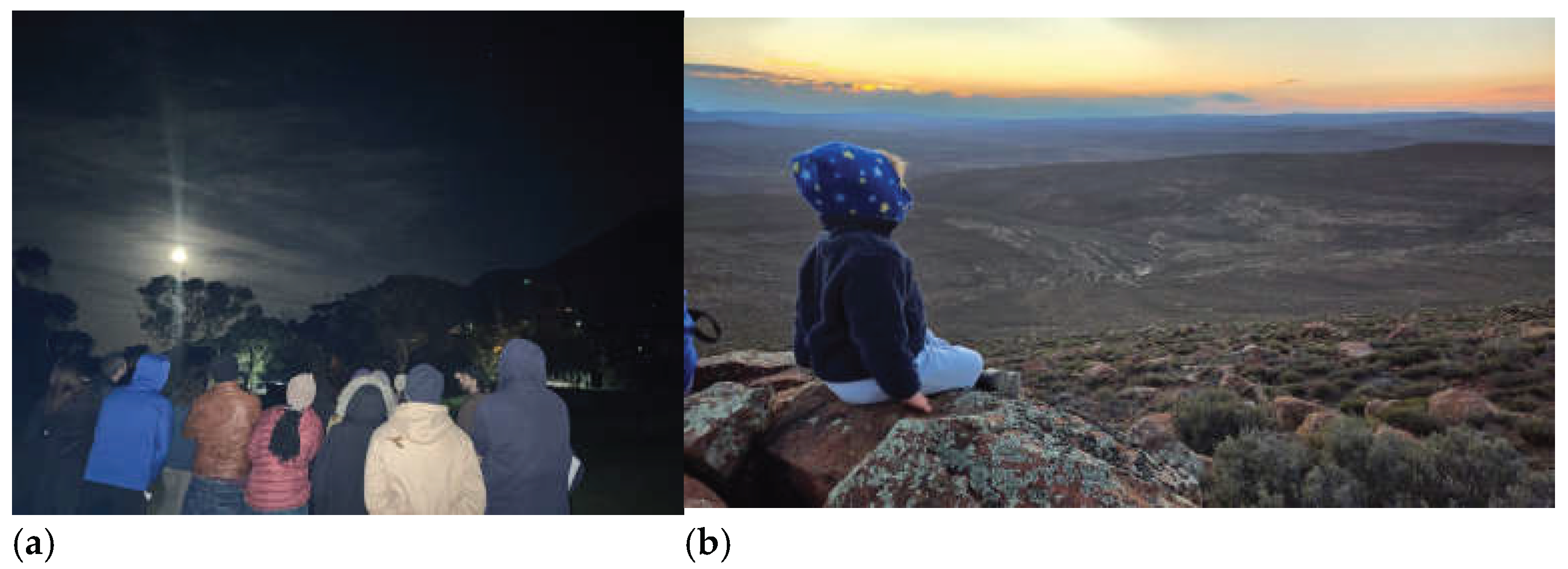
By contrast, the Sutherland trip showed how adding more layers of complexity can soften those benefits. While the astronomical highlights, such as the SALT tour and stargazing, still sparked awe and a sense of something much bigger than ourselves, the other elements brought competing mental demands. Family systems, long-distance travel, the novelty of the dry landscape, and sharp socio-economic contrasts all played a role. Logistical weariness, packed schedules, and thoughts about historical divisions pulled attention away from gentle restoration and toward active processing of real-life realities.
These findings connect beautifully with Ubuntu philosophy, a cornerstone of many African worldviews. At its heart is the simple idea “I am because we are,” which reminds us that our health and happiness are tied to the health and happiness of those around us. In this light, shared nights under the stars can strengthen family bonds, build a feeling of communal safety, and create moments of togetherness that feel truly healing. At the same time, these group experiences need thoughtful guidance so that family dynamics or differing viewpoints do not turn into extra stress for anyone.
Importantly, these findings must be interpreted with caution. The absence of a control group limits causal inference, and observed changes may reflect broader retreat-related effects rather than astronomy-specific mechanisms. Additionally, the small sample size and purposive sampling approach restrict generalisability. Self-reported measures may also be influenced by social desirability or participant expectations. These limitations underscore the need for controlled and longitudinal studies to validate and extend these preliminary findings.
The contrasting results push the theory further by showing that the night sky’s restorative power is not automatic. It depends on how the program is designed to protect cognitive spaciousness, the mental breathing room that lets our attention rest and recover without being pulled in too many directions at once. Too much novelty or unfiltered discussion of social and political realities can shift awe from something refreshing to something overwhelming, especially in places marked by inequality.
The study, therefore, offers practical guidance for astronomy-for-development programs. It highlights those culturally sensitive adjustments, such as building strong relational anchors and easing people gently into the experience, are essential when moving beyond the more individualistic Western retreat model.
Despite these limitations, this study offers an important contribution by identifying key intervention design principles that extend beyond the specific context. The concepts of cognitive spaciousness, contextual onboarding, and relational anchoring provide a practical framework for developing culturally responsive, community-oriented mental health interventions that integrate environmental and social dimensions of well-being. Limitations call for caution. The small, carefully chosen groups mean the findings cannot be generalized widely, and the pre-post design without a control group stops us from making firm claims about cause and effect or how long the benefits last. Self-reports can be shaped by what people expect to feel or by wanting to present themselves positively, and the DASS-21 data came only from Glencairn. Even so, the step-by-step mixed-methods approach, the real-world African settings, and the way the numbers and stories supported each other give us solid, trustworthy starting insights. Additionally, improvements may reflect general retreat-related factors such as removal from daily stressors, social connection, and environmental change, rather than astronomy-specific mechanisms.
5. Conclusions
This exploratory pilot study provides preliminary evidence that astronomy-based interventions may support short-term psychological well-being. in South Africa. By iteratively testing guided stargazing and nature immersion across differing social and environmental conditions, it provides preliminary evidence that accessible dark-sky experiences can foster attention restoration, elicit awe, and promote perspective shifts that alleviate short-term psychological distress, at least under supportive conditions.
Critically, the results underscore that awe is a powerful yet context-sensitive catalyst. Its therapeutic efficacy depends on thoughtful program architecture that prioritizes cognitive spaciousness (“less is more”), prepares participants for environmental and socio-economic realities, and nurtures relational safety in line with Ubuntu principles. Three human-centered design principles emerged: (1) cognitive spaciousness, ample unscheduled time for integration; (2) contextual onboarding, transparent preparation for contrasts; and (3) relational anchoring, skilled facilitation to turn group dynamics into sources of communal safety rather than stress.
The implications extend beyond mental health. As urbanization and light pollution diminish access to dark skies worldwide, protecting nocturnal environments emerges as a public-health strategy. In Africa, where mental health infrastructure is limited and astronomical heritage is rich, low-cost interventions leveraging existing infrastructure (SALT, SKA, community dark-sky sites) offer scalable promise.
5.1. Way Forward
Future research should address current limitations through larger, controlled trials with diverse populations (including clinical, youth, and trauma-affected groups), longitudinal follow-up, and validated tools such as the Night Sky Connectedness Index [10]. Dose-response studies and cost-effectiveness analyses will clarify optimal parameters. Practically, astronomical bodies and partners should develop facilitator training, open-source toolkits, and policy advocacy framing dark-sky preservation as mental-health infrastructure. While these findings suggest potential for low-cost, scalable interventions, further rigorous evaluation is required before informing large-scale policy or implementation.
By inviting people to look up at the cosmos, we create space to look within, cultivating perspective, connection, and resilience in communities across the continent and beyond. Protecting our view of the stars is therefore not merely an astronomical or environmental imperative; it is an investment in the psychological well-being of present and future generations. In resource-constrained settings where access to formal mental health services is limited, integrating environmental and culturally resonant approaches into community health ecosystems represents a promising direction for public health innovation.
Institutional Review Board Statement
This study was conducted in accordance with the Declaration of Helsinki and approved by the Social and Behavioral Ethics Committee of Stellenbosch University (protocol code 32953, date of approval 15/05/2025).
Informed Consent Statement
Informed consent was obtained from all subjects involved in the study.
Data Availability Statement
The raw data supporting the conclusions of this article will be made available by the corresponding author on request.
Acknowledgments
The authors would like to express their sincere gratitude to the rangers of Table Mountain National Park (TMNP), the team at Guardians of the Deep NPC, and the Inter-university Institute for Data Intensive Astronomy (IDIA) for their invaluable collaboration and field support during our first retreat. We would also like to acknowledge and thank the programme participants and their families who explored the night sky and its value with us. Special thanks are extended to the Collaborative and Creative Research for Equity and Transdisciplinary Knowledge Exchange (CO-CREATE) Hub within the Faculty of Medicine and Health Sciences at Stellenbosch University for providing essential research support for the camp. During the preparation of this manuscript, the authors used Gemini 3 Flash for the purposes of proofreading and assisting formatting of the manuscript. The authors have reviewed and edited the output and take full responsibility for the content of this publication.
Conflicts of Interest
The lead author is a social worker affiliated with the International Astronomical Union’s Office of Astronomy for Development. This dual role shaped intervention design and narrative interpretation. Reflexive practices were maintained throughout to mitigate bias.
Abbreviations
The following abbreviations are used in this manuscript:
| ART | Attention Restoration Theory |
| MSC | Most Significant Change |
| IAU-OAD | International Astronomical Union’s Office of Astronomy for Development |
| SALT | South African Large Telescope |
| MeerKAT | The South African MeerKAT radio telescope, is a precursor to the Square Kilometer Array (SKA) telescope |
| SKA | Square Kilometre Array |
| TMNP | Table Mountain National Park |
| IDIA | Inter-university Institute for Data Intensive Astronomy |
References
- Kaplan, S. The restorative benefits of nature: Toward an integrative framework. J. Environ. Psychol. 1995, 15, 169–182. [Google Scholar] [CrossRef]
- Ohly, H.; White, M.P.; Wheeler, B.W.; Bethel, A.; Ukoumunne, O.C.; Nikolaou, V.; Garside, R. Attention Restoration Theory: A systematic review of the attention restoration potential of exposure to natural environments. J. Toxicol. Environ. Health Part B 2016, 19, 305–343. [Google Scholar] [CrossRef] [PubMed]
- Vertue, D. The Intersection Between Astronomy and Mental Health. Ment. Health Matters 2022, 9, 29–30. [Google Scholar]
- Keltner, D.; Haidt, J. Approaching awe, a moral, spiritual, and aesthetic emotion. Cogn. Emot. 2003, 17, 297–314. [Google Scholar] [CrossRef] [PubMed]
- Piff, P.K.; Dietze, P.; Feinberg, M.; Stancato, D.M.; Keltner, D. Awe, the small self, and prosocial behavior. J. Personal. Soc. Psychol. 2015, 108, 883–899. [Google Scholar] [CrossRef]
- Stellar, J.E.; John-Henderson, N.; Anderson, C.L.; Gordon, A.M.; McNeil, G.D.; Keltner, D. Positive affect and markers of inflammation: Discrete positive emotions predict lower levels of inflammatory cytokines. Emotion 2015, 15, 129–133. [Google Scholar] [CrossRef]
- Yaden, D.B.; Iwry, J.; Slack, K.J.; Eichstaedt, J.C.; Zhao, Y.; Vaillant, G.E.; Newberg, A.B. The overview effect: Awe and self-transcendent experience in space flight. Psychol. Conscious. Theory Res. Pract. 2016, 3, 1–11. [Google Scholar] [CrossRef]
- Berman, M.G.; Jonides, J.; Kaplan, S. The Cognitive Benefits of Interacting With Nature. Psychol. Sci. 2008, 19, 1207–1212. [Google Scholar] [CrossRef]
- Bratman, G.N.; Anderson, C.B.; Berman, M.G.; Cochran, B.; de Vries, S.; Flanders, J.; Folke, C.; Frumkin, H.; Gross, J.J.; Hartig, T.; et al. Nature and mental health: An ecosystem service perspective. Sci. Adv. 2019, 5, eaax0903. [Google Scholar] [CrossRef]
- Barnes, C.; Passmore, H.-A. Development and testing of the Night Sky Connectedness Index (NSCI). J. Environ. Psychol. 2024, 93, 102198. [Google Scholar] [CrossRef]
- Gankhuu, E.E.; Amar, T.; Bayarkhuu, B.; Balgan, A. Astronomy for Mental Health and Wellbeing. Bull. AAS 2023, 55. [Google Scholar]
- Tanaka, M.; Otani, K.; Horiuchi, T. Relationship Between Darkness and Healing of Night Sky in Planetarium. Int. J. Environ. Res. Public Health 2025, 22. [Google Scholar] [CrossRef]
- Barragan, R.C.; Meltzoff, A.N. Opportunity to view the starry night sky is linked to human emotion and behavioral interest in astronomy. Sci. Rep. 2024, 14, 19314. [Google Scholar] [CrossRef]
- Herman, A.A.; Stein, D.J.; Seedat, S.; Heeringa, S.G.; Moomal, H.; Williams, D.R. The South African Stress and Health (SASH) study: 12-month and lifetime prevalence of common mental disorders. S Afr. Med. J. 2009, 99, 339–344. [Google Scholar]
- Lund, C.; Petersen, I.; Kleintjes, S.; Bhana, A. Mental Health Services in South Africa: Taking stock. Afr. J. Psychiatry 2012, 15. [Google Scholar] [CrossRef]
- Pović, M.; Backes, M.; Baki, P.; Baratoux, D.; Tessema, S.B.; Benkhaldoun, Z.; Bode, M.; Klutse, N.A.B.; Charles, P.; Govender, K.; et al. Development in astronomy and space science in Africa. Nat. Astron 2018, 2, 507–510. [Google Scholar] [CrossRef]
- Govender, K. Astronomy for African development. Proc. Int. Astron. Union 2011, 260, 577–586. [Google Scholar] [CrossRef]
- Mdhluli, J.E.; Takalana, C.; Venugopal, R.; Govender, K.; Hussein, E.; Vertue, D. Astronomy as a strategic driver for sustainable development. Nat. Astron 2025, 9, 936–939. [Google Scholar] [CrossRef]
- Hendricks, L. Under Southern Skies: How stargazing is shaping mental health research in South Africa | Stellenbosch University. 2025.
- Vertue, D.; Herrera, S. The Astronomy for Mental Health Guidelines: A live document for the community 2023, 21–24.
- Patatanyan, A.; Govender, K.; Herrera, S.B.; Vertue, D.G. ASTRONOMY FOR MENTAL HEALTH GUIDELINES. 2022. [Google Scholar]
- Dart, J.; Davies, R. A Dialogical, Story-Based Evaluation Tool: The Most Significant Change Technique. Am. J. Eval. 2003, 24, 137–155. [Google Scholar] [CrossRef]
- Sh, L. Manual for the depression anxiety stress scales. In Sydney Psychology Foundation; 1995. [Google Scholar]
- Dreyer, Z.; Henn, C.; Hill, C. Validation of the Depression Anxiety Stress Scale-21 (DASS-21) in a non-clinical sample of South African working adults. In Journal of Psychology in Africa; 2019. [Google Scholar] [CrossRef]
- Bakken, S.A. App-based textual interviews: interacting with younger generations in a digitalized social reality. Int. J. Soc. Res. Methodol. 2023, 26. [Google Scholar] [CrossRef]
- Braun, V.; Clarke, V. Using thematic analysis in psychology. Qual. Res. Psychol. 2006, 3, 77–101. [Google Scholar] [CrossRef]

Table 1.
Intervention Logic and Combinations Tested.
| Variable | Combination A: Glencairn (Baseline) | Combination B: Sutherland (Expanded) |
|---|---|---|
| Environmental Setting | Green/Coastal: Lush, familiar nature designed to support restoration via soft fascination (ART). | Arid/Stark: Remote, high-contrast landscape offering deep novelty and a profound sense of being away to stimulate reflection. |
| Astronomical Context | Direct Engagement: Stargazing focused purely on the visual experience using naked eye and manual Dobsonian telescopes. | Contextual Contrast: Accessible stargazing (Dobsonians) juxtaposed with a daytime excursion to the Southern African Large Telescope (SALT), grounding the personal viewing experience within the context of Big Science. |
| Social Container | Individual/Peer: Experience focused on individual self-reflection within a loose professional network. | Family Systems: Experience focused on family connection, testing the impact of family cohesion on the restorative process. |
Table 2.
Summary of Measures Administered by Pilot Setting.
| Measure | Domain Assessed | Setting A: Glencairn (Individual/Peer) | Setting B: Sutherland (Family/High-Tech) |
|---|---|---|---|
| Demographic Questionnaire | Age, gender | Yes | Yes |
| DASS-21 | Depression, Anxiety, Stress (Distress) | Yes | No |
| MSC Focus Groups | Subjective change & perspective | Yes | Yes |
| Asynchronous text-based interview | Personal reflections on family dynamics | No | No |
Table 3.
Participant Characteristics.
| Measure | Glencairn (n=19) | Sutherland (n=27) | Total (N=46) |
|---|---|---|---|
| Age (Years) | |||
| 18-25 | 1 (5.3%) | 3 (11.1%) | 3 (11.1%) |
| 26-35 | 10 (52.6%) | 4 (8.7%) | 4 (8.7%) |
| 36-45 | 6 (31.6%) | 3 (11.1%) | 3 (11.1%) |
| 46-55 | 2 (10.53%) | 13 (28.2%) | 13 (28.2%) |
| 55+ | 0 (0%) | 13 (48.2%) | 13 (48.2%) |
| Gender | 19 (41.3%) | 19 (41.3%) | |
| Female | 10 (52.6%) | 3 (11.1%) | 3 (11.1%) |
| Male | 9 (47.4%) | 5 (10.9%) | 5 (10.9%) |
Table 4.
Comparison of Pre- and Post-Intervention DASS-21 Scores for the Glencairn Cohort.
| Pair | Variable | Mean | n | Std. Deviation | Std. Error Mean |
|---|---|---|---|---|---|
| Pair 1 | anxiety_pre | 5.84 | 19 | 3.287 | 0.754 |
| anxiety_post | 2.63 | 19 | 3.004 | 0.689 | |
| Pair 2 | depression_pre | 4.84 | 19 | 3.132 | 0.718 |
| depression_post | 2.47 | 19 | 2.836 | 0.651 | |
| Pair 3 | stress_pre | 8.05 | 19 | 3.951 | 0.906 |
| stress_post | 4.63 | 19 | 4.387 | 1.006 | |
Table 5.
Paired sample t-test results.
| Pair Comparison | Mean | Std. Deviation | Std. Error Mean | t | df | One-Sided p |
|---|---|---|---|---|---|---|
| Pair 1: anxietyT1 − anxietyT2 Pair 2: depressionT1 − depressionT2 Pair 3: stressT1 − stressT2 |
3.211 2.368 3.421 |
4.454 4.323 7.010 |
1.022 .992 1.608 |
3.142 2.388 2.127 |
18 18 18 |
.003 .014 .024 |
Disclaimer/Publisher’s Note: The statements, opinions and data contained in all publications are solely those of the individual author(s) and contributor(s) and not of MDPI and/or the editor(s). MDPI and/or the editor(s) disclaim responsibility for any injury to people or property resulting from any ideas, methods, instructions or products referred to in the content. |
© 2026 by the authors. Licensee MDPI, Basel, Switzerland. This article is an open access article distributed under the terms and conditions of the Creative Commons Attribution (CC BY) license (http://creativecommons.org/licenses/by/4.0/).
Copyright: This open access article is published under a Creative Commons CC BY 4.0 license, which permit the free download, distribution, and reuse, provided that the author and preprint are cited in any reuse.