

Submitted:
23 April 2026
Posted:
27 April 2026
You are already at the latest version
Abstract
In the Republic of Kazakhstan, more than 300 million tons of ash are stored in dumps, containing substantial quantities of valuable metals. The aim of this work is to achieve waste-free and carbon-neutral processing of Ekibastuz coal. The innovations include: a smelter using new "ideal mixing–ideal displacement" method, lowering energy consumption by two to three times compared to current models; extraction degree exceeding 70% for germanium and zinc, and successful production of stone-cast products; a distiller based on the "counter colliding jets" method, with tenfold reduction in energy consumption, compared to a traditional one; a zinc-method for hydrogen production, reducing electricity to one-third of that required by electrolysis; carbon reduction from its dioxide by hydrogen. The analysis suggests that reaching carbon neutrality by 2060 for a boiler with a power rating of 125 MW will necessitate increasing its power output by approximately 2.58 times. A comprehensive assessment of the economic efficiency related to the processing of Ekibastuz coal, including 15% gas decarbonization, suggests that the system could realize a payback period of around eight years.
Keywords:
carbon neutrality
; decarbonization
; waste-free technology
; hydrogen production
; smelting reactor
; resource recovery
; high-ash coal
1. Introduction
In the Republic of Kazakhstan, approximately 80% of electricity is generated from coal, resulting in the annual emission of over 100 million tons of carbon dioxide into the atmosphere. Globally, excess CO2 in the atmosphere is accompanied by climate change, which presents disasters like floods, forest fires, droughts, etc. [1,2,3,4].
Today, due to CO2 emissions, climate change creates public opinion about the "harmfulness" of coal and tends to use renewable energy sources. However, the accumulated world experience has shown that in the foreseeable future, there is no need to talk about the victory of renewable energy sources, such as wind, sun, and water, over traditional ones – oil, coal, and gas. Nuclear power plants are another source of clean energy. However, in light of the accidents that occurred at the Chornobyl and Fukushima nuclear power plants, the issue of the safety of atomic energy is being questioned.
As global carbon emissions continue to rise, the climate target of 1.5 by 2050 looks less and less optimistic without decisive action to reduce and remove local carbon emissions from the atmosphere.
An effective approach in this context is the application of direct air capture (DAC) technology. In this process, air containing carbon dioxide is passed through a potassium hydroxide (KOH) solution, which serves to absorb the CO2. Subsequently, the solution is combined with calcium hydroxide. The lime reacts with dissolved carbon dioxide, resulting in the formation of calcium carbonate (limestone) precipitates. The lime flakes are processed in a calciner, where pure CO2 is released, captured, and subsequently stored. At every stage of the process, residual chemicals are systematically recycled and incorporated back into the workflow. According to "Climate Engineering," the estimated cost of capturing CO2 from the atmosphere varies significantly, with figures ranging from $100 to $1,000 per ton. An alternative approach has been proposed by the direct air capture company «Climeworks». This method involves combining the captured carbon dioxide with water and injecting it 500–600 meters below ground, where it reacts with the surrounding basalt to form solid mineral compounds. Nevertheless, uncertainties remain regarding the kinetics of the process. Another emerging technology is "Chemical Looping Combustion". In contrast to conventional methods, this process utilises red mud—a byproduct of alumina production—as an oxidising agent instead of air. Prior to processing, red mud undergoes several stages of treatment: drying, roasting to clinker at 1450°C, cooling, crushing, and sieving. Following sieving, red mud can contain up to 60% Fe2O3, which acts as both an oxidant and a catalyst. Typically, the system comprises two interconnected units: the fuel reactor and the air reactor. Red mud, after being restored and heated to 900°C in the air reactor, is combined with pulverized coal and introduced into the fuel reactor via a steam stream. Within the reactor, primary combustion occurs, resulting in the generation of concentrated CO2. [5,6,7,8,9,10,11]. Nevertheless, employing red mud as an oxidant restricts the potential applications of this technology. Additionally, when utilising high-ash coal, the challenge of ash management continues to be unresolved. Consequently, the aforementioned technologies do not entirely adhere to the principles of zero-waste production. Furthermore, considering that power plants in the Republic of Kazakhstan emit approximately 100 million tons of CO2 annually, the minimum estimated cost of capturing these emissions through the DAC method would amount to $10 billion per year. Such an expense represents a substantial challenge for the nation’s economy.
The Republic of Kazakhstan (RK) ranks eighth in terms of proven coal reserves, sufficient for hundreds of years. The alternative to cheap coal is the Kendirlik shale, the high–ash coals of the Saryadyr and Ekibastuz deposits. Their reserves are between 15 and 20 billion tons. However, only from the combustion of Ekibastuz coal in the dumps there are more than 300 million tons of ash, and their reserves are steadily growing by 30 million tons/year, which can lead to an inevitable man–made disaster. When burning Ekibastuz coal with an ash content of 45–50% at thermal power plants of the Republic of Kazakhstan, by ash is lost: Zn (0.3 – 4.0)%, Pb (0.1– 0.09)%, Cd up to 0.028%, Ga, Ge – 200 g/t, and the average content of dustlike gold– 0.8 g/t, and other elements [3,4].
Previous work was carried out in the areas of using ash in road construction, the production of building materials such as aerated concrete, and ash concrete, in the form of enlarged laboratory studies for the extraction of radioactive metals, alumina, and silica using chemical reagents, the separation of the iron–containing fraction by the method of wet magnetic separation, the separation of unburned coal by the method flotation, the use of ash in the composition of the reagent for deep purification of wastewater from sulfate ions [12,13,14]. However, despite their undoubted importance, all of the above studies are aimed at recycling coal waste, following the residual principle of "first create waste, then "successfully" recycle it."
The novelty of the proposed technology is as follows:
experimental results, showing that processing coal ash in a smelting reactor with the "ideal" mixing-"ideal" displacement method enables sublimation of germanium and zinc, cast stone production, and reduces energy costs by 2-3 times compared to current methods;
development of a new zinc method for producing hydrogen, which reduces electricity consumption by ~3 times compared to the electrolysis method;
the use of an innovative method of recovering carbon from CO2 by hydrogen, with the release of carbon black, and the reuse it to restore zinc in the distiller;
the possibility of processing the associated CO gas from a distiller into hydrogen and carbon dioxide using the water gas shift reaction;
a calculated assessment of the technical characteristics of the BKZ-420 boiler, which shows a 2-3-fold increase in the boiler's electrical power for complete decarbonization of gases.
The advantages of the proposed technology over existing ones are:
waste-free processing of coal ash, enabling the extraction of valuable metals such as germanium and zinc, and the production of stone-cast materials from the melt without generating waste;
further use of the country's vast, cheap coal reserves; to keep running current coal power plants; eliminating the need to build nuclear plants or switch to natural gas or renewables;
the possibility of using the hydrogen method for cleaning CO2 from blast furnace gases, gases from non-ferrous, construction and petrochemical industries.
One limitation of the proposed technology is that as decarbonization efforts intensify, the energy demand of the zinc distiller rises accordingly. For instance, achieving coal neutrality by 2060 would require the electrical power output of the BKZ-420 boiler to be increased by a factor of 2.58, resulting in a proportional expansion of the boiler's size.
2. Methodology
To address the aforementioned challenges, an advanced energy- and resource-saving approach was implemented, consisting of the following measures: 1) waste-free processing of coal ash to recover rare and non-ferrous metals, as well as produce melt suitable for manufacturing building materials; 2) hydrogen production utilizing zinc; 3) boiler CO2 neutralization through hydrogen application; 4) separation of carbon black from CO2 via substitution reaction methodology, with subsequent use of carbon black in the hydrogen production process.
3. Development of Waste–Free Technology
A promising direction, in our opinion, would be the creation of a technology that allows waste–free combustion of Ekibastuz coal with the production, in one cycle, steam of energy parameters, sublimates of rare earth metals, a melt suitable for the production of slag wool, corrective additive for cement clinker or stone casting. Such technology would ensure a waste–free process and reduce the specific emission of carbon dioxide into the atmosphere concerning each of the products that are additionally produced.
To process coal’s ash into building materials without waste, the authors have developed a next-generation smelting unit - "reactor inversion phase" (see Figure 1). The reactor is based on a new effect, a combination of "ideal mixing" and "ideal displacement" modes. The brief gist of this new phenomenon is as follows. In the melt layer, during a continuous process, two reactions occur, opposite in direction and intensity: (1) the slow decomposition of complex components (Zn2SiO4, ZnFe2O4) into simple molecules (ZnO, SiO2, Fe2O3) and (2) the reverse, rapid reactions of the formation of complex components from simple molecules.
The dominance of one of the two reactions affects the degree of zinc extraction from the melt. To prevent reverse reactions, the process is divided into two zones. 1) the molten bath—the "ideal" mixing zone, where slow reactions decompose complex components (Zn2SiO4, ZnFe2O4) into simple molecules (ZnO, SiO2, Fe2O3). 2) The inclined section of the reactor is a zone of "ideal" displacement, where reactions that form complex components from simple molecules are inhibited due to the parallel movement of elementary melt streams. As a result, in continuous mode, zinc recovery increases from 30% to 70%.
3.1. Calculation Method for Industrial Melting Reactor Characteristics
For reaction (2) temperature dependence of the equilibrium constant is
Here number of moles in combustion products per 1 mole of initial carbon, – carbon activity in the system;
From the material balance for carbon and oxygen, considering the zinc recovered from the melt, we derive a system for determining the composition of the reactor exhaust gases.
From the joint solution of equations (3), (4) and (5) is found:
Here: – total number of moles of carbon in coal, – total number of oxygen moles in the oxidizer, – moles number of ZnO reacted with one mole of carbon in coal.
Total number of moles of products obtained: , here – total number of moles of nitrogen reacted.
Here:
Where: – number of moles of nitrogen and carbon dioxide supplied with coal, – oxidizer consumption coefficient, – a ratio of mole fractions of nitrogen and oxygen in the oxidizer, – moisture content of one mole of oxidizer.
Thermal balance of carbon combustion:
Here: – calorimetric combustion temperature, – combustion products physical and chemical heat. From the heat balance (10), the iterative method is used to find .
Actual combustion temperature in the smelter: where – pyrometric coefficient.
Fuel consumption of the "industrial sample" can be determined by using the formula derived from the reactor’s thermal balance [19]:
Here, reactor’s productivity for charge - P, heat required to carry out smelting and reduction processes in the reactor - = heat lost during cooling of the reactor caissons - chemical and physical heat of coal - physical heat of the oxidizer - physical and chemical heat of reactor outgoing gases - . – melt temperature, – the temperature of the slag as it enters the reactor, – average specific heat of slag, –specific heat of slag melting, – zinc’s concentration in the slag, – zinc’s concentration in the flue gases, – specific zinc sublimation heat, – reactor’s caisson cooling area, – reactor’s specific heat loss with cooling water, – specific heat capacities of coal, oxidizer, outgoing gases, respectively, – temperatures of coal, oxidizer, outgoing gases, respectively, – oxidizer consumption coefficient, – theoretical consumption of oxidizer, – carbon monoxide content in outgoing gases, – specific heat of carbon monoxide combustion, D - amount of combustion products per unit of initial fuel.
The criterion dependence of the technological processing time of the melt was obtained experimentally, [19]:
fair within the limits of changing criteria:
Here - homochrony criterion. )
– impulse of gas flow in the nozzle;
— bath weight;
- gas velocity in the purge grate nozzle;
— gas velocity relative to the surface of the purge grate;
- melt processing time;
- acceleration of gravity.
The reactor performance is determined by the expression - /τ, where is the mass of the bath
The height of the quiescent melt layer in the reactor bath is found from the expression - here - reactor purge grid area, melt density, coefficient of thermal expansion of gas in a layer.
Using the above method, the thermal characteristics of an industrial model of the reactor inversion phase were calculated, some of which are presented in Figure 2.
Thus, as shown in Figure 2, when the reactor’s slag productivity increases 24 times, the fire surface will rise 8 times, the fuel consumption will reduce 2.4 times, and the share of exhaust gases in the heat balance will remain constant at 45%.
The experiments were carried out on an experimental unit of new generation "reactor inversion phase-rotary kiln" (RIPh-RK) [20,21,22].
The operating principle of RIPh-RK is as follows (refer to Figure 1 and Figure 3 and 4). Mixture of ash and slag from hoppers is constantly fed into the rotary kiln, where it is heated to 900◦C by waste gases of reactor inversion phase (RIPh), and is routed into the same RIPh for slag melting, Zn, Ge distillation and, it is a continuous process. In the caissons of the reactor inversion phase, steam is generated with technical parameters.
Natural gas and blast air are supplied to combustion chamber. Conversed gas comprising of reducing agents (CO, H2), with a temperature of 1800–2000◦C, at a rate of 500–600 m/s, pass through a lattice via nozzles, and is then fed under the layer of smelt in the smelting chamber. Waste gases move through the separation chamber and, are directed into the rotary kiln.
Figure 4.
Pilot plant measurement scheme. Reactor inversion phase, 2-rotary kiln, 3-dust chamber, air heater, 5-cooler, 6-economiser, bag filter,8-exhausters, 9-stack, 10-granulating pit, 11-chute, 12-compressor. electricity consumption, – natural gas consumption and pressure, consumption, pressure and temperature of air, consumption, pressure of oxygen, – off gases under pressure and temperature, water consumption, I, R- indicating and recording instruments, OG- off gases.
Figure 4.
Pilot plant measurement scheme. Reactor inversion phase, 2-rotary kiln, 3-dust chamber, air heater, 5-cooler, 6-economiser, bag filter,8-exhausters, 9-stack, 10-granulating pit, 11-chute, 12-compressor. electricity consumption, – natural gas consumption and pressure, consumption, pressure and temperature of air, consumption, pressure of oxygen, – off gases under pressure and temperature, water consumption, I, R- indicating and recording instruments, OG- off gases.
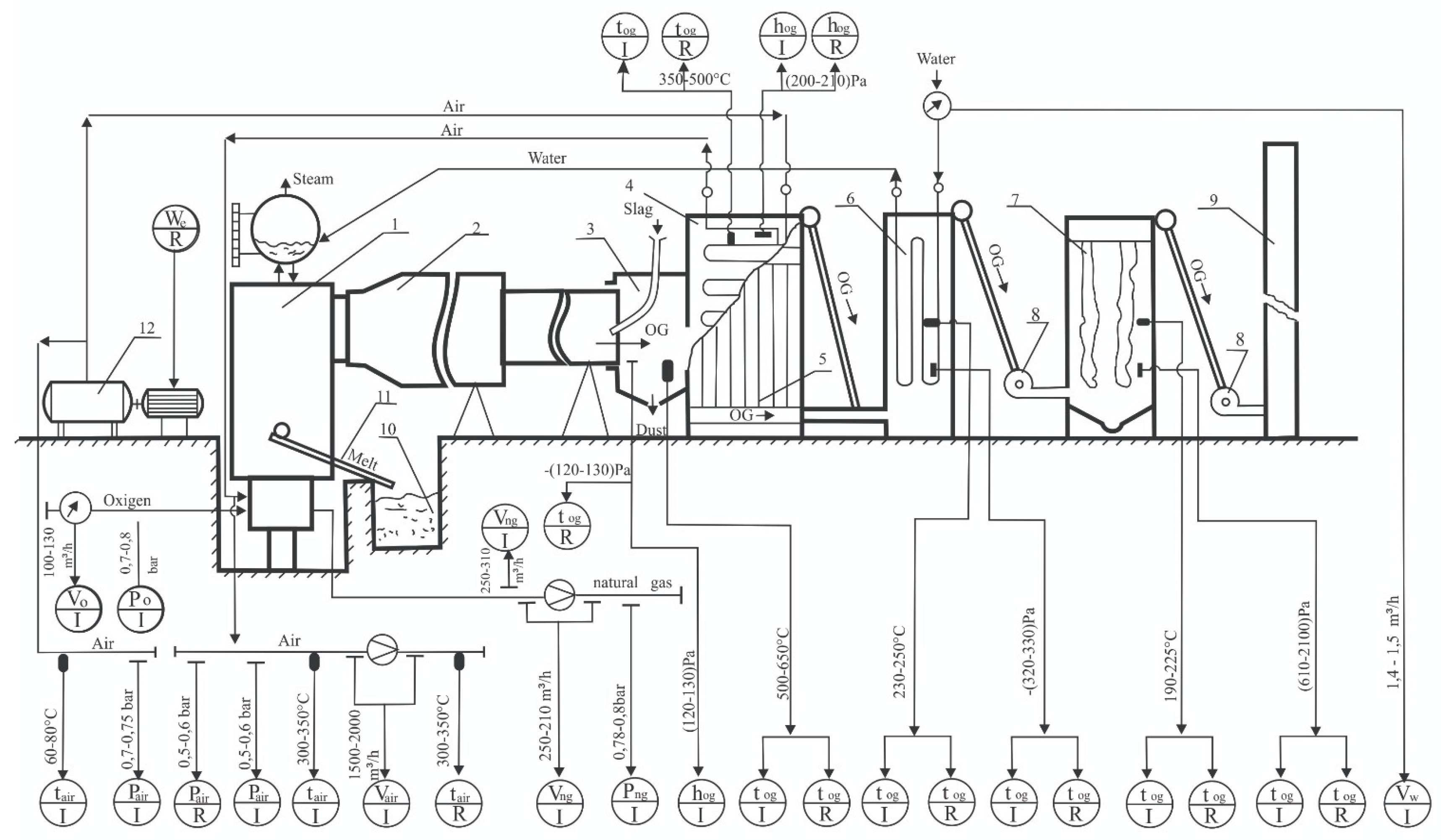
Table 1 presents the specifications of the devices utilized.
3.2. Experiments on the Extraction of Zinc and Germanium from Fluxed Ash–Slag
A technological assessment was conducted, following the methodology outlined in [20], to evaluate the feasibility of melting a mixture comprising Ekibastuz coal ash and converter slag into a melt appropriate for building material production, for the ash composition: Zn (0.3 – 4.0)%, Pb ( 0.1–0.9)%, Cd up to 0.028%, Ga, Ge – 200 g/t, SiO2 – 30; Al2O3 – 16; Fe2O3 – 17; CaO – 11; MgO – 5.
For the composition "ash/converter slag/silica" with a ratio of 1/0.3/0.15, the calculated acidity modulus of the melt is 1.52, the viscosity modulus is 1.2, and the water resistance index is 4.42. These parameters meet the requirements for stone casting production at temperatures of 1400–1500 °C, with a melt viscosity ranging from 7 to 6 Poise.
Considering that about 20 million tons of waste converter slag from the Karaganda Metallurgical Plant have accumulated, with an annual output of 60,000 tons, its smelting with ash would make it possible to produce cheap building material.
The chemical composition of the fluxed slag is as follows, %: SiO2 (42 – 44); Al2O3 (10 – 12); Fe2O3+FeO (10 – 11); CaO (24 – 26); MgO (2.5 – 2.8); MnO (0.5 – 0.7); V2O5 (0.15–0.2), P2O5 (1.1–1.2), Na2O (0.7 – 0.8); Au (0.5–0.6), GeO2 (0.007–0.0076), Zn (2.2 – 2.50); Pb (0.5 – 0.6); S (1.55 – 1.67).
Table 2 illustrates experiment results.
Symbols in Table 2: is the gas pressure in the reactor, is the temperature in the melt bath, , are the mass of the bath and the productivity of the reactor, is the ratio of the momentum of gases in the nozzles of the purge grate to the weight of the reactor bath, – the ratio of the initial and final concentration of zinc in the slag, – is the ratio of the initial and final content of germanium in the slag, E – is the degree of extraction of zinc and germanium from the slag, is the consumption of natural gas in the reactor inversion phase, – air consumption, – is oxygen consumption for the process, is the temperature of the blast air from the air heater.
3.3. Experiment Results of Cast Stone Production
During the process of pouring the melt into molds, at 1300–1400°C, the samples quickly solidified in air at a temperature of 850 – 900°C. Exposure in a muffle furnace at a temperature of 900°C for 5 – 10 minutes leads to complete volumetric crystallization of the samples. Table 3 shows the physicochemical characteristics of stone casting samples.
Thus, it has been experimentally proven that when a mixture of power plant ash, converter slag, and sand is melted at 1:0.3:0.15, the obtained product automatically becomes suitable for casting stone items. The calculation results (7 – 6 Poise ) satisfactorily coincide with experimental data (8 – 7 Poise ) with an accuracy of 10–15%.
3.4. Experiment Results Discussion
To study the probability of germanium reduction by CO(H2) gases and zinc, their thermodynamic characteristics were calculated within the temperature range of 1200–14000C. As a result, it can be concluded that the equilibrium constant for the germanium reduction from its oxide by CO (H2), at 12000C changes from 3.002 to 19.24. The largest value of the "K", therefore, the expected degree of Ge is achieved during the reduction of germanium by zinc, according to the formula GeO2 + 2Zn = 2ZnO + Ge (t = 1200, K = 2894.0). In this case, the equilibrium constant of germanium’s extraction by zinc is two orders of magnitude higher than its value when it is recovered by CO (H2) gases. The latter circumstance confirms zinc’s dominant role in germanium extraction from the melt.
For the composition “ash/converter slag/silica” in the ratio 1/0.3/0.15, the temperature is 1400 – 1500℃, and the calculated melt viscosity is 7–6 Poise. The experimentally approved value at the 1300 is 8 – 7 Poise. Consequently, the calculation results satisfactorily coincide with experimental data with an accuracy of 5–10%.
Thus, based on the results of the experiments, it can be concluded that the proposed unit can ensure energy–saving and waste–free processing of ash and slag.
4. Development of Carbon–Free Technology
An additional environmental concern associated with boilers is the emission of carbon dioxide (CO2) gas. According to literature data, carbon dioxide can be separated from air or flue gases using absorption, adsorption, amine purification, membrane gas separation, or gas hydrate technologies [23,24,25,26]. To reduce CO2 emissions, Kazakhstan experts propose two ways: switching power plants from coal to natural gas and building nuclear power plants. However, the insufficient supply of natural gas in the Republic of Kazakhstan and the accidents that occurred at the Chernobyl and Fukushima nuclear plants do not make such a plan attractive.
Hydrogen today is seen as a way to build a carbon–free economy [27,28]. As a solution to the problem, the authors propose the neutralization of CO2 by hydrogen. According to Table 4, this reaction is exothermic, the change in Gibbs energy is negative, the equilibrium constant is high, and it proceeds better at low temperatures. These indicators allow the process to be carried out outside the boiler, in the decarbonization chamber, without interfering with the steam generator mode.
Table 5 shows the thermodynamic characteristics of the reduction of iron oxide with hydrogen. This reaction occurs in the existing Midrex (USA) and Corex (Austria) processes, with a degree of iron recovery from oxides of 92-95%. Comparing Table 4 and Table 5 show that the equilibrium constant for the reaction 2H2+CO22H2O+C is, on average, an order of magnitude higher than that for the reaction 9H2 +3Fe2O3=6Fe+ 9H2O [17]. Moreover, CO2 reduction with hydrogen will occur in a homogeneous mode. Based on these facts, it can be concluded that the proposed technology for decarbonizing gases with hydrogen is feasible.
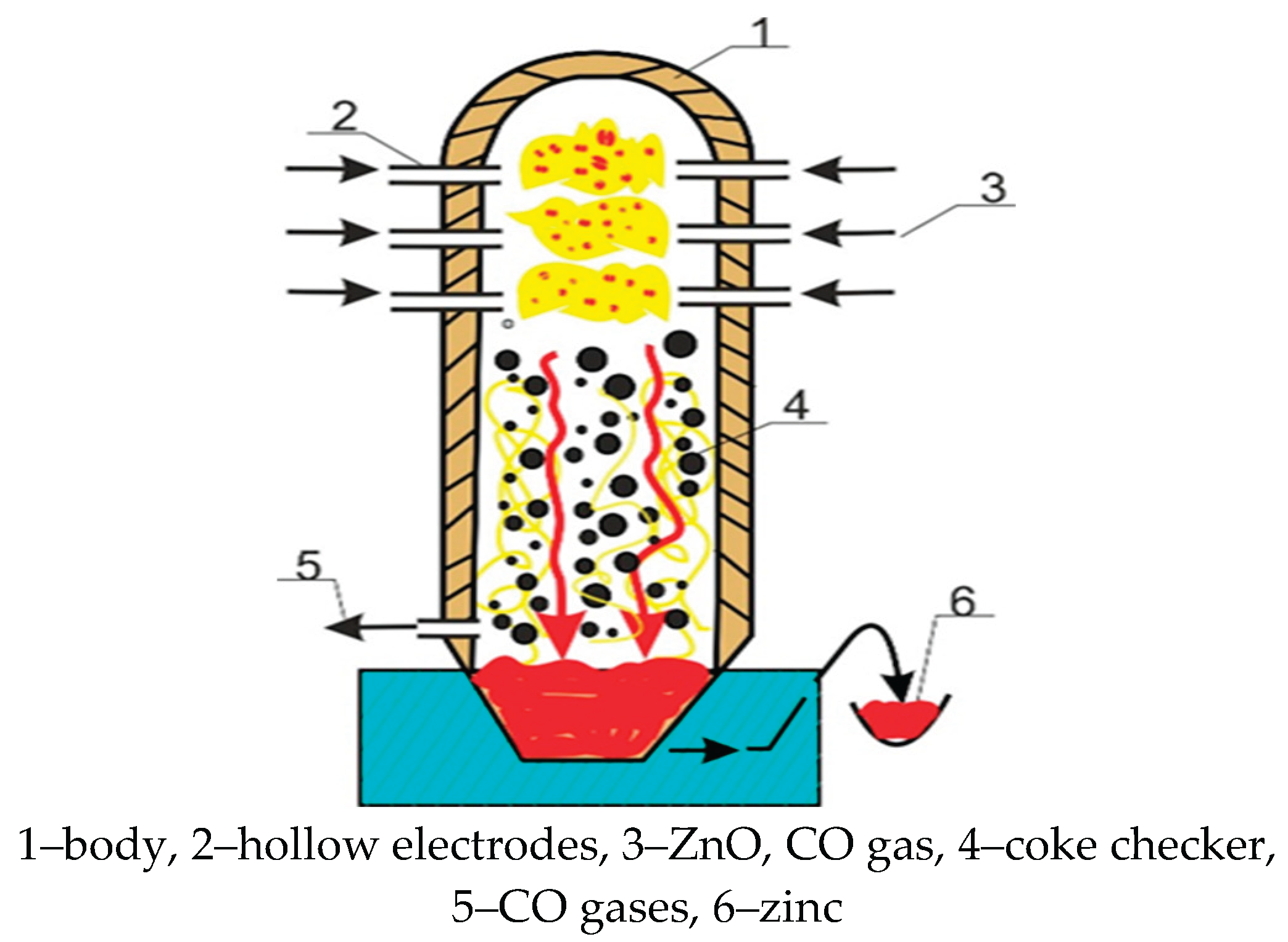
As illustrated in Figure 5, hydrogen is introduced into the decarbonization chamber, where it reacts with CO2 to produce water vapor and elemental carbon. A mixture of "C" and sublimates ZnO, GeO2, and PbO is separated from the gases in the electrostatic precipitator. The exhaust gases will contain only nitrogen and water vapor. After separating from the sublimates and drying, the "C" is used as a coke checker in the distiller (see Figure 6 and Figure 8). ZnO–sublimates are blown by pressured portion of “CO” into the distiller’s hollow carbon electrodes. Counter-colliding jets decelerate the ZnO–gas flow, thereby extending the residence time of elements within the arc. Element ionization and reactions take place in the electrode arc and coke layer, following processes such as ZnO + CO → Zn + CO2 and CO2 + C → 2CO. The stream, heated to an elevated temperature by the arc, transmits energy predominantly via radiation, effectively raising the temperature of both the coke checker and the distiller as a whole. The arc temperature correlates directly with the ionization potential of the elements present in the ZnO–gas flow sustaining the arc, and can be determined with considerable accuracy using the following formula: where is the ionization potential of the ZnO–gas mixture [29].
Then, the Zn–gas flow passes through the coke checker, where the zinc is condensed and removed from the distiller. Next, liquid zinc in a stream of steam is blown into cyclone 2 (refer to Figure 6), where hydrogen is released according to the reaction Zn+H2O=ZnO+H2. ZnO returns to the distiller. In the 3, water vapors are condensed, and H2 is used in the boiler’s decarbonization chamber by the reaction 2H2+ CO2=C+2H2O (refer to Figure 5).
Let's compare the energy consumption to produce 1 kg of H2 using electrolysis and zinc methods. With the electrolysis method, at the lowest efficiency of 50%, the specific energy consumption is 50 kWh/kgH2. When sublimating zinc in a distiller, the specific energy consumption is 0.25 kWh/kg Zn (see Table 7). According to the formula Zn + H2O = ZnO + H2, for 65 kg of zinc, the energy consumption is 65 0.25 = 16.25 kWh. Then, for one kilogram of hydrogen, the theoretical specific consumption will be 16.25/2=8.125 kWh/kgH2. Taking the process efficiency as 50%, we find the practical specific energy consumption for the zinc method - 8.125/0.5=16.25 kWh/H2. From the calculation results, it can be expected that with the zinc method of hydrogen production, energy consumption can be reduced by three times compared to the electrolysis.
For complete condensation of zinc in a distiller, a very high reduction potential is required, which is expressed by the ratio of partial pressures y= . According to [19], only at y=3000 can a good condensate yield be expected, since the mixture does not oxidize when cooled to 550℃. Therefore, highly concentrated “CO” can be expected at the outlet of the distiller (refer to Figure 6). To convert toxic «CO» into hydrogen, it would be appropriate to use an industrial method - the water gas shift reaction (WGS). Reaction formula - In practice, the process occurs in the temperature range of 200-400°C. As shown in Table 6, the reaction equilibrium constant is low, suggesting slow reaction kinetics. Therefore, catalysts are used in production to accelerate the reaction [17].
A variety of methods are available for CO2 separation, including absorption, adsorption, membrane processes, and others. The utilization of captured CO2 has attracted interest for enhanced oil recovery operations, wherein CO2 is injected into oil reservoirs to improve oil mobility and thereby enhance reservoir productivity.
Thus, the expected complete decarbonization of the boiler exhaust gases will occur in the following sequence: 1) obtaining hydrogen by the zinc method in a distiller (Zn+H2O=ZnO+H2); 2) treatment of CO2-containing boiler exhaust gases with hydrogen, producing carbon black “C”, (CO2+2H2=C+2H2O); 3) the use of "C" in a distiller to restore zinc from its oxide, producing "CO", (ZnO+C=Zn+CO); 4) the interaction of carbon monoxide (CO) with water vapor (H2O) to produce carbon dioxide (CO2) and hydrogen (H2), using the Water-Gas Shift reaction method (CO+H2OH2+CO2).
4.1. Estimation of Specific Electrical Energy Consumption for a Zinc Distiller
The principal metric for assessing the profitability of the proposed system is its energy consumption within the zinc distillation process. Figure 7 presents a schematic representation of a conventional electrothermal distiller–condenser system. The unit operates as follows. A blend of sinter and coke, with particle sizes ranging from approximately 10 to 20 mm, is introduced into the upper section of the furnace. An electrical current between 10,000 and 20,000 amperes and a voltage of 220 to 240 volts is applied across the carbon electrodes within the furnace, elevating the temperature to a range of 1200–1400°C. [19]. The condenser consists of a bath containing liquid zinc, through which gases are extracted. Zinc vapor present within the gas stream is absorbed by the liquid zinc bath. In an operational facility where distillation and condensation are conducted as separate processes, the specific energy consumption is 2.5 kWh per kilogram of zinc [30].
In place of agglomerated material, fine dust-like ZnO will be introduced into the proposed distiller, allowing for the simultaneous distillation and condensation of zinc within a single chamber, on a coke checker. In this process, zinc oxide particles with a diameter significantly less than 1 mm are conveyed through hollow electrodes into the distillation apparatus (refer to Figure 8). As noted in [31], when other factors remain constant, the energy required for heat treatment of a material is directly proportional to its volume or mass. Then we can assume that when sublimates of ZnO are supplied through a hollow electrode to the arc region, the specific energy consumption for heating ZnO can be reduced by n = 10–20 times compared to the traditional process, and amount to at least 0.25 kWh/kg Zn.
Figure 8.
Proposed circuit diagram of a zinc distiller.
According to experiments conducted on dump slag at α=0.78, t=1300℃, the rate of zinc reduction in dump slag is described by the first order equation – [19]. Partial pressure of gases in the melt = 8–10%, versus its value in the distiller =100%, or, ratio nZnO content in dump slag =3.5–4.3%, versus ZnO concentration in the distiller 100%, Thus, it can be expected that the recovery time of zinc from ZnO in the proposed distiller will be 10–20 times shorter than in a traditional distiller.
In this case, the equation for the rate of sublimation of zinc in the distiller can be described by Knowing the time of sublimation of zinc in the distiller, at a given zinc productivity, it is possible to calculate the dimensions, material, and heat balances of the distiller.
To compile the heat balance, the following assumptions are made:
The degree of zinc recovery from ZnO is 100%
Reduction of zinc from ZnO occurs only on a coke checker
Purge CO –gas serves only to transport zinc oxide and does not participate in the sublimation of zinc
The total ionization potential of Zn, ZnO is sufficient to maintain an arc temperature more than 1300°C
The amount of slag formed does not exceed 5%.
Table 7 presents the thermal balance analysis of the distillation unit.

Table 7.
Distiller heat balance (per 1 kg ZnO).
| # | Heat input | Q, kJ | % | # | Heat output | Q, kJ | % |
|---|---|---|---|---|---|---|---|
| 1 | 819 | 91.57 | 1 | 2790 | 317.9 | ||
| 2 | 75.4 | 8.43 | 2 | With purge “CO” gas |
29 | 3.3 | |
| 3 | Total | 894.4 (0.2484 kWh) |
100 | 3 | 250 | 28.48 | |
| Zn | 4 | –2011 | -229.15 | ||||
| 5 | The difference in the heat of incoming and outgoing zinc consumed in the distiller |
–504 | -57.43 | ||||
| 6 | The difference in the heat of incoming and outgoing “CO” consumed in the distiller |
–46.4 | -5.28 | ||||
| 7 | With liquid zinc |
200 | 22.79 | ||||
| 8 | With slag |
20 | 2.27 | ||||
| 9 | Losses to the environment through distiller surfaces, ~17% | 150 | 17.1 | ||||
| Total | 877.6 | 100 | |||||
Thus, the results of the heat balance calculation of the distiller show the validity of the assumption that when ZnO sublimates are supplied through a hollow electrode into the arc region, specific energy consumption for heating and reduction of ZnO can be reduced up to n=10 times compared to the traditional process, and amount to 0.25 kWh/kg Zn. Moreover, heating the zinc oxide and carbon mixture with exhaust gases to 300℃, before loading into the distiller, can also reduce the specific energy consumption.
4.2. Assessment of the Possibility of Complete Neutralization of CO2 Gas in the Proposed System
Having previously assumed the specific energy consumption for the distiller to be 0.25 kWh/kg Zn, the main parameters of the system were calculated.
Demonstrative Analysis for Attaining 15% Decrease in Carbon Content of Boiler Gas
The following data were used for calculation. The smelting reactor capacity for Ekibastuz coal is = 80 t/h. Coal ash content is A = 50%. CO2 emissions from the boiler are = 148 t/h. The nominal electrical power of the boiler in condensing mode is W = 125 MWh.
With 15% decarbonization of gases, the amount of CO2 is = 1480.15 = 22 t/h. From the formula C + 2 ZnO = CO2 + 2Zn, we determine the zinc consumption for the distiller, = 22130/44 = 65 t/h. Here, the and correspond to the molecular masses of Zn and CO2.
The energy consumption for zinc recovery in a distiller is =w =650.25=16 MWh.
Here, w (kWh/kg Zn) is the specific energy consumption of the distiller. As a result, the boiler's nominal electrical output will decrease from 125 to 109 MWh.
To maintain nominal performance, it is necessary to increase the coal carbon consumption in the boiler: = b = 16,000 0.33 = 5,280 kg c.f./h (5.28 t/h). Here, "b" is the conventional fuel consumption for generating 1 kWh of electricity for the boiler in condensing mode.
Then the yield of CO2 from coal combustion, according to the formula C + O2 = CO2, will be = 44 5,280/12 = 19,360 kg/h (19.36 t/h).
The amount of hydrogen for the reduction of carbon from CO2, according to the formula CO2 + 2H2 = C + 2H2O, will be = 4 19,360/44 = 1,760 kg/h (1.76 t/h).
The amount of additional electrical energy required to maintain the boiler's nominal output is ∆W = q= 16.25 1,760 = 28,600 kWh ~ 29.0 MWh. Here, "q" is the specific energy consumption for the reduction of 1 kg of hydrogen using the zinc method (refer to paragraph IV).
The maximum electrical output of the boiler will then be = W + ∆W = 125 + 29 = 154 MWh.
Maximum consumption of Ekibastuz coal per boiler = =80+25.28=90.56~91t/h.
Maximum amount CO2 released from the boiler = 22+19.36=41.36 t/h.
Additional amount of zinc for hydrogen reduction, according to the formula H2O + Zn = ZnO + H2, = 65 1.76/2 = 57.2 t/h.
The maximum amount of reusable zinc = 65+57.2=122.2~122 t/h.
The maximum amount of hydrogen for the reduction of carbon from CO2, according to the formula CO2 + 2H2 = C + 2H2O, = 41.36 4/44 = 3.76 t/h.
Maximum amount of carbon returned to the distiller 0.5 0.580+5.28=45.28 t/h.
Table 8 shows the results of the full system calculation.
Figure 9 shows a graph of the dependence of the electrical performance of the BKZ–420 boiler on the energy consumption of the distiller, MWh.
According to Figure 9, in the range of CO2 neutralization from 15% to 100%, the energy consumption of the distiller will increase from 16 MWh to 109 MWh, and the electrical power of the boiler will decrease from 109 MW to 16 MW. To sustain a power output of 125 MW, the boiler power must be increased to compensate for energy losses in the distiller. For instance, during the interval from 2030 (15% CO2) to 2060 (100% CO2), this adjustment would require raising the boiler power from 154 MW (an increase of 1.23 times) to 323 MW (an increase of 2.58 times).
If an electrolyzer is implemented, the required boiler power between 2030 and 2060 will need to increase from 675 MW (a factor of 5.4) to 3825 MW (a factor of 30.6).
5. Assessment of Economic Indicators of the Proposed Technology
To determine the economic feasibility of waste–free processing of Ekibastuz coal, with carbon dioxide decarbonization by 15%, an enlarged calculation of the proposed technology was carried out. The main equipment was the “melting reactor–boiler BKZ–420” and zinc distiller. The estimated cost of specific capital costs of this project is $ 1,500/kWh, against reference data for fuel boilers of power plants – (1,150 – 1,450) $/kWh.
According to the conducted technical and economic calculation, the average payback period of the proposed system is: τ = = 8 years
Here «I» is the capital investment, «n» is the project implementation period, the number of years during which annual savings will be obtained; «NPV» is the net present value, the difference between the present value of all future cash flows and the initial capital investment, taking into account the bank interest rate of 20%.
Thus, an assessment of the economic efficiency of waste–free processing of Ekibastuz coal with 15% decarbonization of gases shows that the average payback period of the proposed system can be 8 years.
6. Conclusions
- (1)
- A novel smelting reactor has been proposed for the combustion of Ekibastuz coal in power plant boilers, utilizing a combined "ideal mixing–ideal displacement" approach. This method reduces energy consumption by two to three times compared to existing technologies.
- (2)
- Experiments on a smelting reactor in continuous mode have demonstrated the possibility of waste-free processing of coal ash, with a degree of extraction of germanium and zinc above 70%, and the processing of the silicate portion of the slag into stone casting.
- (3)
- A new method for calculating the parameters of a melting reactor has been developed. Based on this, it was established that with an increase in reactor productivity from 1.25 to 30 t/h, the specific fuel consumption will decrease by 2.3 times.
- (4)
- Based on the new method of “counter colliding dust and gas jets”, a new distiller design has been proposed, where distillation and condensation of zinc are carried out in one chamber. A tenfold reduction in energy consumption in the distiller compared to a traditional zinc distiller is estimated.
- (5)
- A novel zinc method technology, for hydrogen production, and using it for carbon reduction from its dioxide, has been developed. This approach enables a reduction of specific energy consumption for H2 to one-third that of the electrolysis process. Additionally, the feasibility of supplementary hydrogen processing from distiller-associated CO gas through the water-gas displacement reaction has been proposed.
- (6)
- A comparison of the thermodynamic characteristics of hydrogen reduction of iron from Fe2O3 in the Midrex (USA) and Corex (Austria) processes with the proposed method of hydrogen reduction of carbon from CO2 leads to the conclusion that this method can be implemented.
- (7)
- For the BKZ–420 boiler, analysis indicates that attaining carbon neutrality by 2060 while sustaining a power output of 125 MW will require increasing the boiler’s capacity to offset energy losses in the distiller. Specifically, during the period from 2030 to 2060, the necessary boiler power must be raised from 154 MW (representing a 1.23-fold increase) to 323 MW (a 2.58-fold increase).
- (8)
- An assessment of the economic efficiency of processing Ekibastuz coal with 15% decarbonization of gases shows that the average payback period of the proposed system can be ~8 years.
- (9)
- Implementing this technology allows coal-fired plants to keep existing infrastructure, eliminating the need for new nuclear facilities or costly conversions to natural gas. It reduces the immediate pressure to shift fully to renewables by improving both efficiency and environmental performance, ensuring reliable power and avoiding major infrastructure expenses.
Financing: The research described in this document was conducted as part of the scientific and technical program IRN AP23489509, titled “Creation of a melting reactor for energy–efficient recycling of ash and slag dumps.” This program provided the framework and resources necessary to develop and evaluate innovative approaches for processing ash and slag waste generated by thermal power plants.
Prospects: The authors intend to commercialize the smelting unit utilizing the “reactor inversion phase.” This innovative technology is specifically designed to process various types of industrial waste, including ash dumps generated by thermal power plants, fuming slag, Waelz clinker, low–grade zinc ores, tailings, and other forms of metallurgical waste. By implementing this unit, it becomes possible to efficiently recycle and recover valuable materials from these waste streams, contributing to both environmental sustainability and resource optimization within the power generation and metallurgical sectors.
Conflicts of Interest
The authors affirm that there are no conflicts of interest associated with the research presented in this document. The corresponding author, acting on behalf of all contributors, explicitly states that neither financial nor personal relationships have influenced the outcomes or the reporting of this study. This declaration ensures the integrity and transparency of the research process, confirming that all results and conclusions were developed independently and are free from any external bias or undue influence.
Nomenclature
| Nomenclature |
|
number of kilomoles in combustion products per 1 kilomole of initial carbon (km/km); carbon activity in the system,–; – number of moles of carbon in coal (km/km); (km/km); –number of oxygen moles in the oxidizer, (km/km); –total number of moles of nitrogen reacted (km/km); – pyrometric coefficient –; P–reactor’s productivity for charge (kg/h); – gas pressure in the reactor (mm w.c.); – temperature in the melt bath (); mass of the bath (kg); – the productivity of the reactor (kg/h); – ratio of the momentum of gases in the nozzles of the purge grate to the weight of bath–; – ratio of the initial and final concentration of zinc in the slag–; – ratio of the initial and final content of germanium in the slag–; E – the degree of extraction of zinc and germanium from the slag (%); the consumption of propane in the reactor inversion phase (m3/h); – air consumption (m3/h); – oxygen consumption for the process (m3/h); ΔG – the change of Gibbs (free) energy (kJ); – initial and final particle concentration of the zinc in the melt–; τ – sublimation time of zinc in the distiller (min); |
| Acronyms |
| BKZ–420 – steam boiler with productivity 420t/h; DAC – direct air capture; OG – outgoingt gases; |
References
- Sumer, V., Zhanaltay, Z., & Parkhomchik, L. (2019). Renewable Energy in Kazakhstan: Potential and Challenges. Renewable Energy. [CrossRef]
- Ahmad, S., Nadeem, A., Akhanova, G., Houghton, T., & Muhammad–Sukki, F. (2017). Multi–criteria evaluation of renewable and nuclear resources for electricity generation in Kazakhstan. Energy, 141, 1880–1891. [CrossRef]
- Blyda I. A., Slyusarenko L. I., Abisheva Z. “Zoloshlakovie othody energetiki – syrie dly proizvodstva redkih metallov i glinozema. Kompleksnoe ispolzovanie miniralnogo Syria. [Ash and slag waste from the power industry – raw material for the production of rare metals and alumina. Complex use of mineral raw materials]”. no. 4. (2008): 39–51. (In Russian).
- Delitsyn, L., Kulumbegov, R., Klimenko, N., Popel’, O., Sulman, M., Sinelschikov, V., Sychev, G., & Petropavlovsky, K. (2024). Enrichment of Iron–containing Concentrate with Ammonium Hydrofluoride. Ecology and Industry of Russia. [CrossRef]
- Fanchi, John R., Fanchi, Christopher J. “Energy in the 21st Century”. World Scientific Publishing Co Inc., (2016): 350. ISBN 978–981–314–480–4.
- Birch, E. L. “A Review of “Climate Change 2014: Impacts, Adaptation, and Vulnerability” and “Climate Change 2014: Mitigation of Climate Change.” Journal of the American Planning Association, no 80(2). (2014): 184–185. [CrossRef]
- Rhodes, J. S., Keith, D. W. “Biomass with capture: negative emissions within social and environmental constraints: an editorial comment”. Climatic Change, no 87(3–4) (2008): 321–328. [CrossRef]
- Werner, C., Schmidt, H.–P., Gerten, D., Lucht, W., Kammann, C. “Biogeochemical potential of biomass pyrolysis systems for limiting global warming to 1.5 °C”. Environmental Research Letters, 13(4), (2018): 044036. [CrossRef]
- Tomasz Czakiert, Jaroslaw Krzywanski, Anna Zylka Wojciech Nowak. Chemical Looping Combustion: A Brief Overview. Energies 2022, 15(4), 1563. [CrossRef]
- Wadim Strielkowski, Anna Sherstobitova, Patrik Rovny and Tatiana Evteeva. Increasing Energy Efficiency and Modernization of Energy Systems in Russia: A Review. Energies. May 2021Energies 14(11):3164. [CrossRef]
- Raid J. Hassiba, Patrick Linke. On the simultaneous integration of heat and carbon dioxide in industrial parks. Applied Thermal Engineering. Volume 127, 25 December 2017, Pages 81-94.
- Fang, Z., & Gesser, H. (1996). Recovery of gallium from coal fly ash. Hydrometallurgy, 41, 187–200. [CrossRef]
- Bai, R., Huang, Y., Li, S., Su, C., Li, H., Cui, Q., Liu, W., Wei, H., & Si, Y. (2025). Study on Extraction of Gallium from Fly Ash by Sodium Fluoride Calcination–Organic Acid Leaching. Sustainability. [CrossRef]
- Zhao, Z., Cui, L., Guo, Y., Jianming, G., Li, H., & Cheng, F. (2021). A stepwise separation process for selective recovery of gallium from hydrochloric acid leach liquor of coal fly ash. Separation and Purification Technology, 265, 118455. [CrossRef]
- Junjun Xu, Haibin Zuo, Guangwei Wang, Jianliang Zhang, Ke Guo, Wang Liang. Gasification mechanism and kinetics analysis of coke using distributed activation energy model (DAEM) Applied Thermal Engineering Volume 152, April 2019, Pages 605–614. [CrossRef]
- Kaan Büyükkanber, Hanzade Haykiri–Acma, Serdar Yaman. Calorific value prediction of coal and its optimization by machine learning based on limited samples in a wide range. Energy. Volume 277, 15 August 2023, 127666. [CrossRef]
- Outokumpu HSC Chemistry for Windows. Chemical Reaction and Equilibrium Software with Extensive Thermochemical Database. Version 5.1. October 31, 2012.
- Dikhanbaev A. B., Dikhanbaev B. I., Koshumbaev M. B., Ybrai S. B. On the issue of converting the exhaust gases of the phase inversion reactor into artificial gas. Bulletin of Toraigyrs University. ISSN 2710–3420. Energy series. No. 1. 2022. Republic of Kazakhstan, Pavlodar. (In Russian). [CrossRef]
- Dikhanbaev B.I., Dikhanbaev A.B. Monograph. Energy–efficient technologies for processing industrial waste. Aktaulova's LLP. ISBN 978–601–257–438–8. – Astana. – 2024. – 445p.
- Vagin V. V., Kileso V. V., Scotarekko Z. G. Products of ferrous metallurgy. Industry catalogue. Stone casting. –Moscow. –2008.–6p. (in Russian).
- Dikhanbaev, Bayandy, Chandima Gomes, and Aristan Bayandievich Dikhanbaev. "Design and implementation of an energy–saving melting reactor." Case Studies in Thermal Engineering 26 (2021): 101003. [CrossRef]
- Dikhanbaev B., Dikhanbaev A., Chandima G. “Energy–saving method for technogenic waste processing”. Journal PLoS ONE, no 12(12): – San Francisco, California, USA. (2017): 1–16. [CrossRef]
- Sumida, K., Rogow, D. L., Mason, J. A., McDonald, T. M., Bloch, E. D., Herm, Z. R., ... & Long, J. R. (2012). Carbon dioxide capture in metal–organic frameworks. Chemical reviews, 112(2), 724–781. [CrossRef]
- Habib Mohamed A, Nemitallah Medhat A. Design of an ion transport membrane.
- reactor for application in fire tube boilers. Energy 2015;81:787–801. [CrossRef]
- Remiorz Leszek, Wiciak Grzegorz, Grzywnowicz Krzysztof. Novel concept of supporting the membrane separation of CO2 in power plants by thermoacoustic dehumidification. Energy Peltola, P., Saari, J., Tynjälä, T., & Hyppänen, T. (2020). Process integration of chemical looping combustion with oxygen uncoupling in a biomass–fired combined heat and power plant. Energy, 210, 118550. [CrossRef]
- H. Wang, Z.G. Qu, W. Zhang, Y.X. Chang, Y.L. He. Experimental and numerical study of CO2 adsorption on Ni/DOBDC metal-organic framework. Applied Thermal Engineering. Volume 73, Issue 2, 22 December 2014, Pages 1501-1509.
- Durakovic Goran del Granado, Crespo Pedro, Tomasgard Asgeir. Are green and blue hydrogen competitive or complementary? Insights from a decarbonized European power system analysis. Energy November 2023;282:128282. [CrossRef]
- Matus, E. V., Ismagilov, I. Z., Yashnik, S. A., Ushakov, V. A., Prosvirin, I. P., Kerzhentsev, M. A., & Ismagilov, Z. R. (2020). Hydrogen production through autothermal reforming of CH4: Efficiency and action mode of noble (M= Pt, Pd) and non-noble (M= Re, Mo, Sn) metal additives in the composition of Ni-M/Ce0. 5Zr0. 5O2/Al2O3 catalysts. International Journal of Hydrogen Energy, 45(58), 33352-33369.
- Shchukin AA. Gas and furnace facilities of factories. M: – Publishing house "Energy;1973. p. 232p (in Russian).
- Marchenko, N. V., E. P. Vershinina, E. M. Hildebrandt. Metallurgy of heavy non–ferrous metals. ISBN 978–5–7638–1776–8. Krasnoyarsk: IPK SFU, 2009. 394 p. (in Russian).
- Sidenko P.M.. Grinding in the chemical industry. Moscow. Publishing house "Chemistry" –1968. 384s. (in Russian).
Figure 1.
Schematic diagram of a reactor inversion phase.
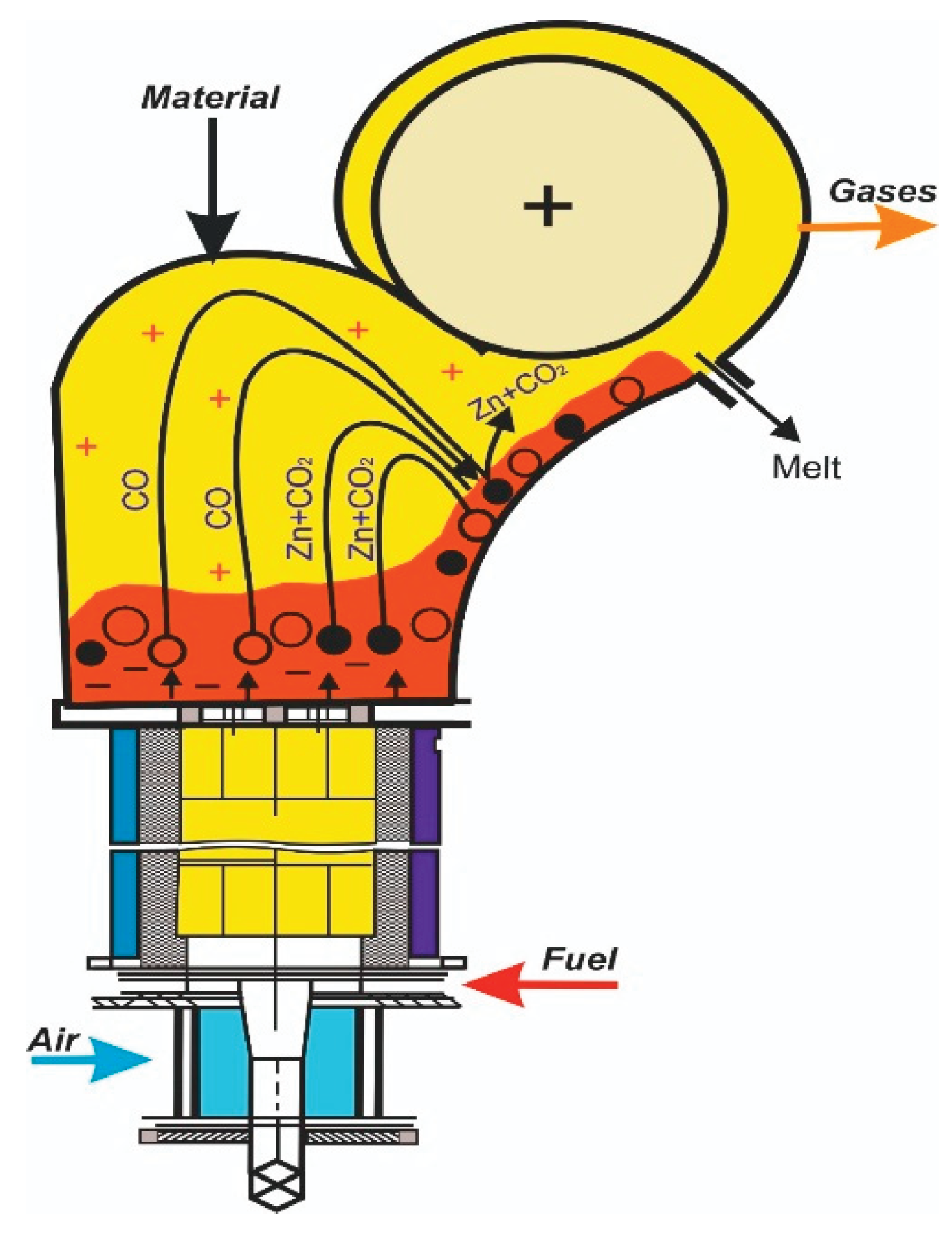
Figure 2.
Dependence of specific conditional fuel consumption, n102 kg/tZn, fire surface, m2, and the share of exhaust gases in the heat balance, %, on reactor capacity, t/h.
Figure 2.
Dependence of specific conditional fuel consumption, n102 kg/tZn, fire surface, m2, and the share of exhaust gases in the heat balance, %, on reactor capacity, t/h.
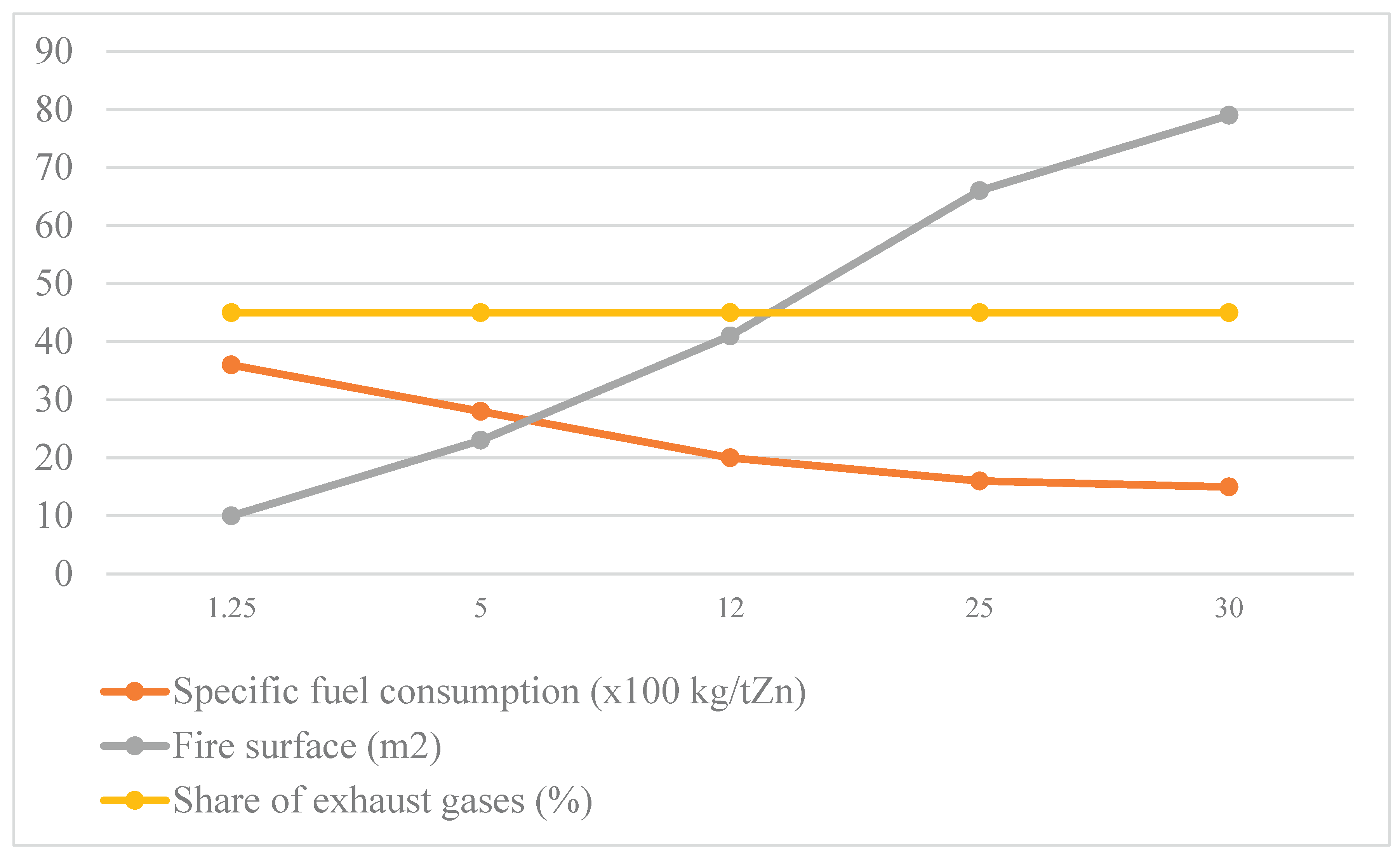
Figure 3.
General view of the pilot plant. 1 reactor inversion phase, 2-rotary kiln, 3-bypass.
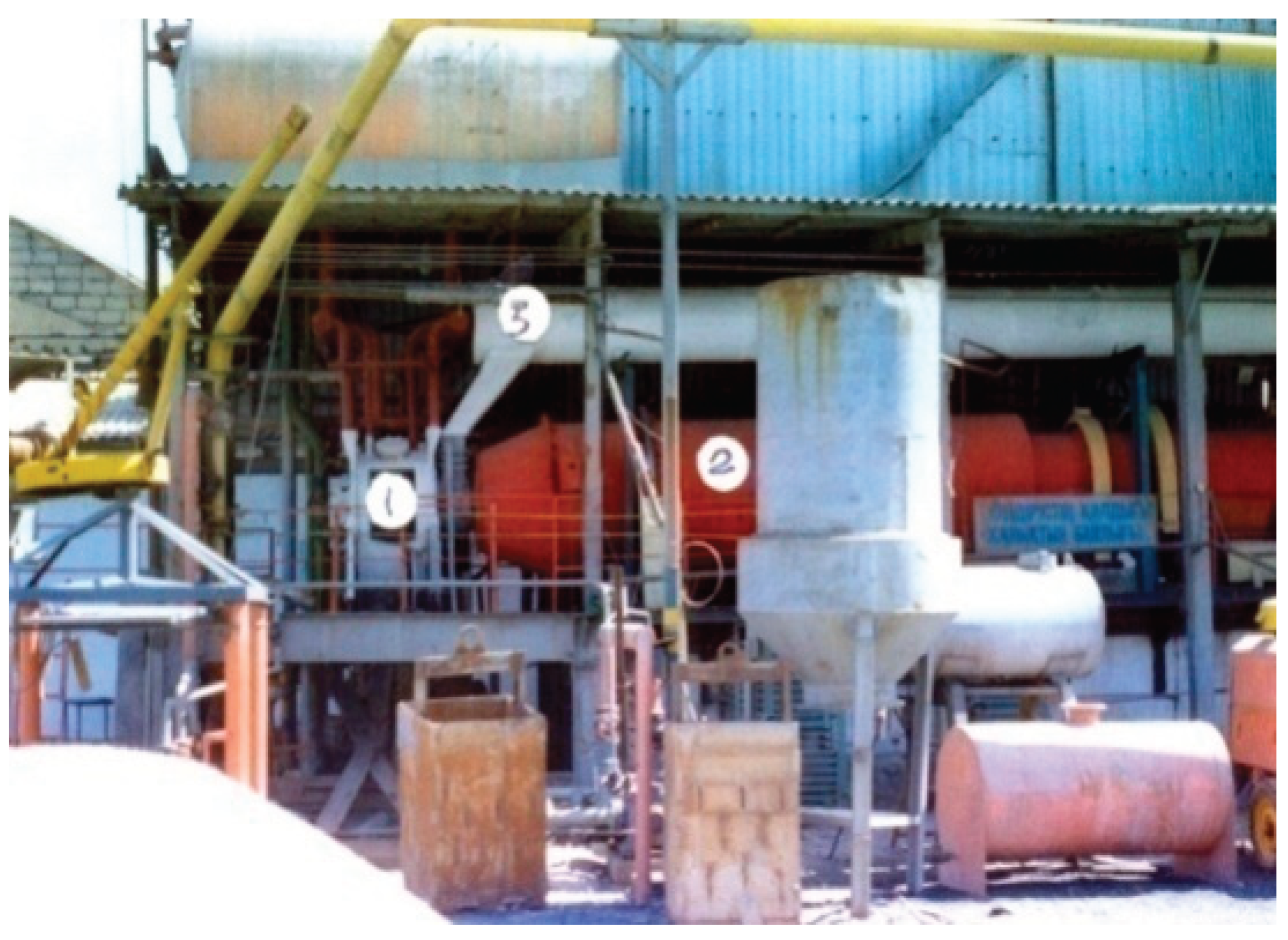
Figure 5.
Schematic diagram of decarbonization by hydrogen.
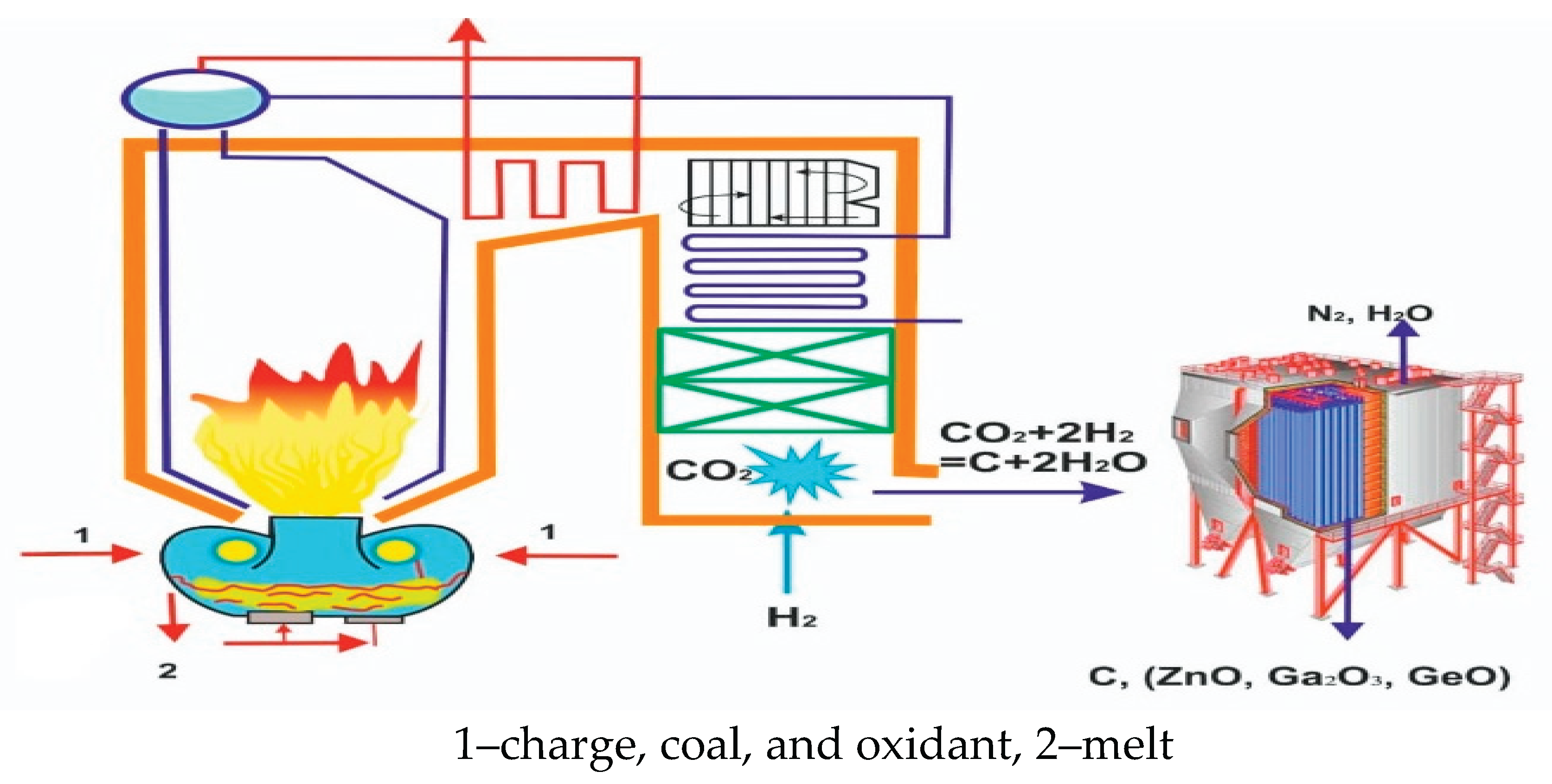
Figure 6.
Hydrogen production schematic diagram.
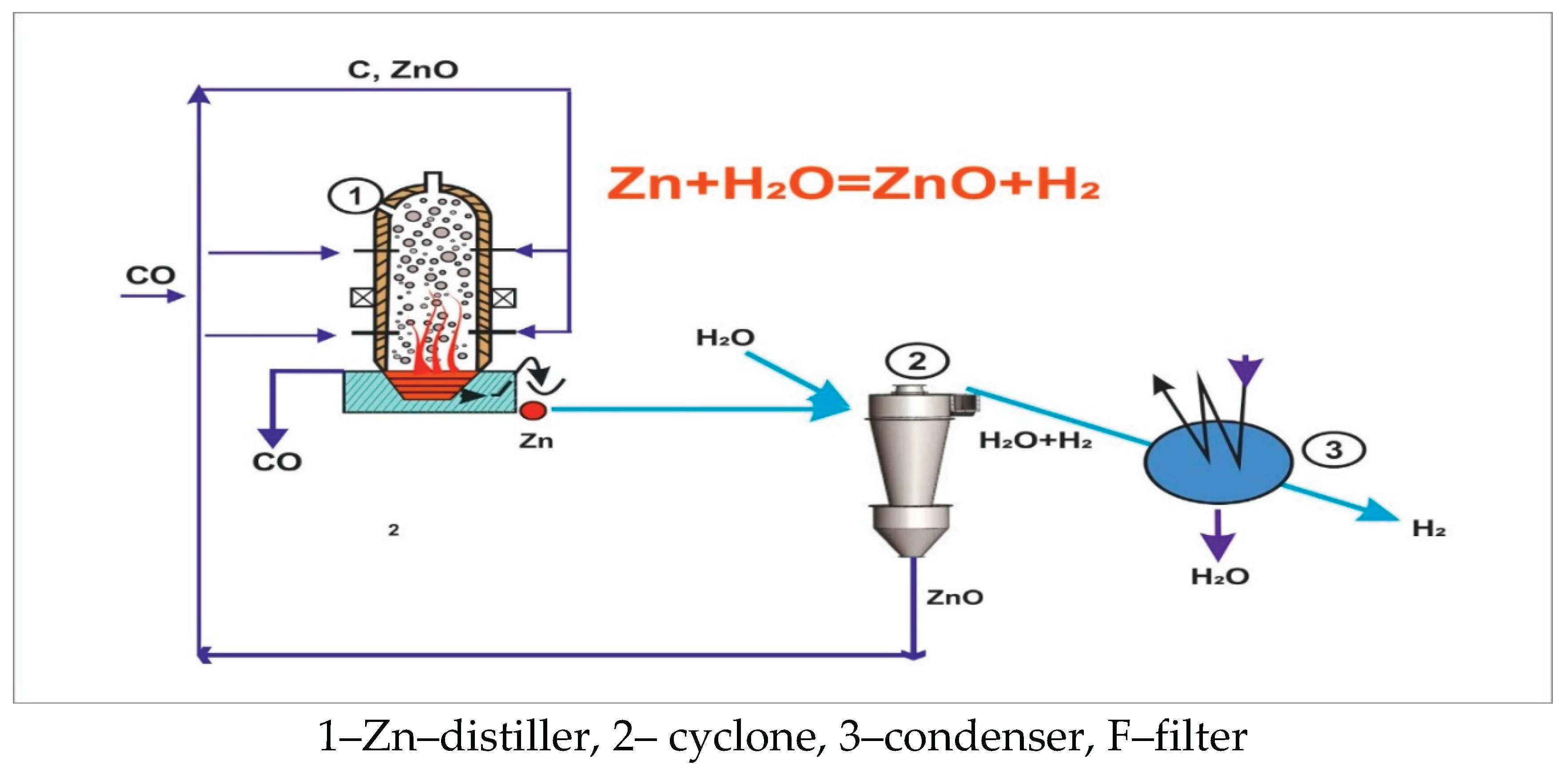
Figure 7.
Schematic diagram of a traditional zinc distiller.
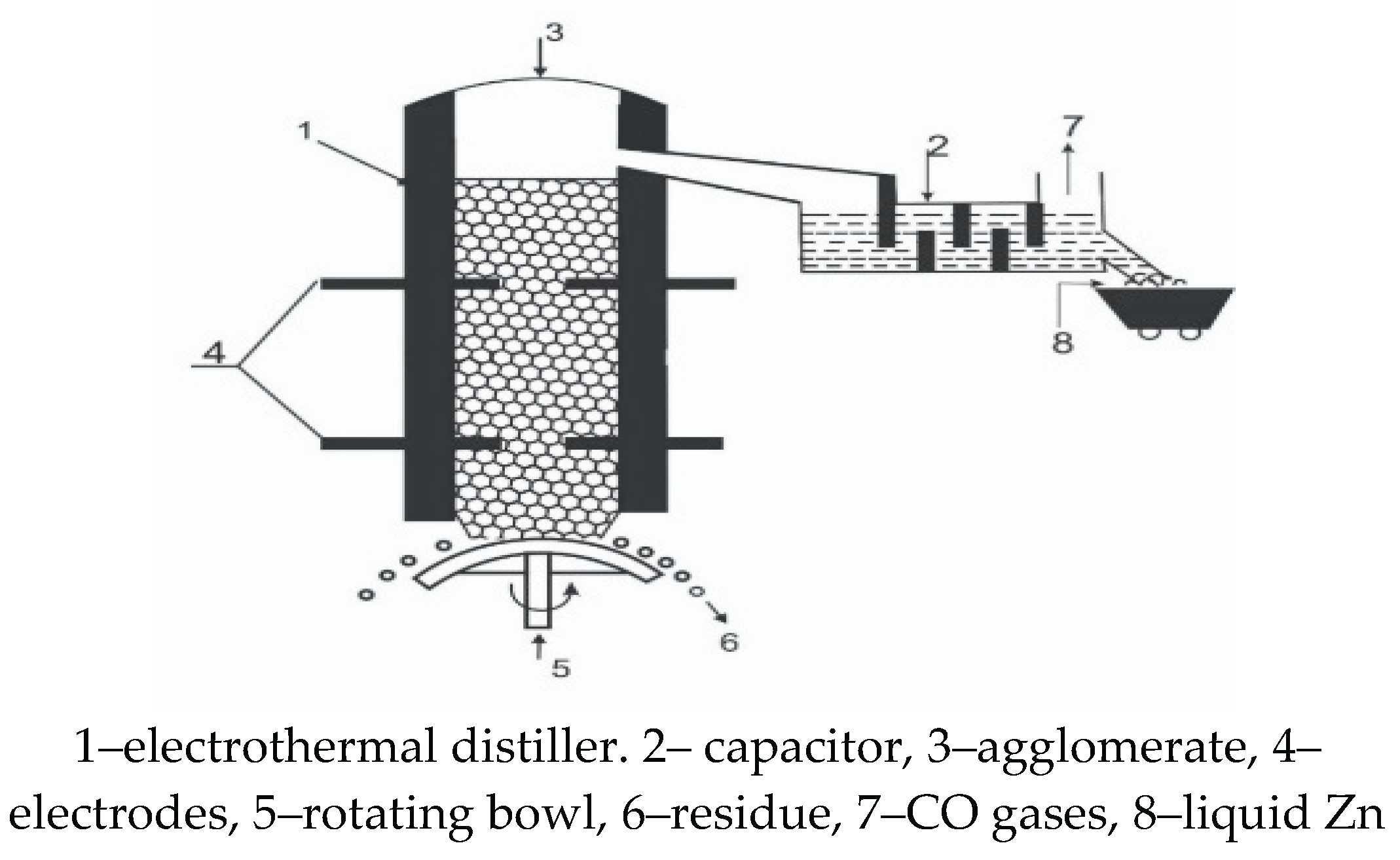
Figure 9.
Dependence of the electrical power of the BKZ–420 boiler on the degree of gas decarbonization. 1- nominal electrical perfomance of boiler, 2- current energy production of boiler, 3 - current energy consumption of distiller, 4 – recuired energy production of boiler.
Figure 9.
Dependence of the electrical power of the BKZ–420 boiler on the degree of gas decarbonization. 1- nominal electrical perfomance of boiler, 2- current energy production of boiler, 3 - current energy consumption of distiller, 4 – recuired energy production of boiler.
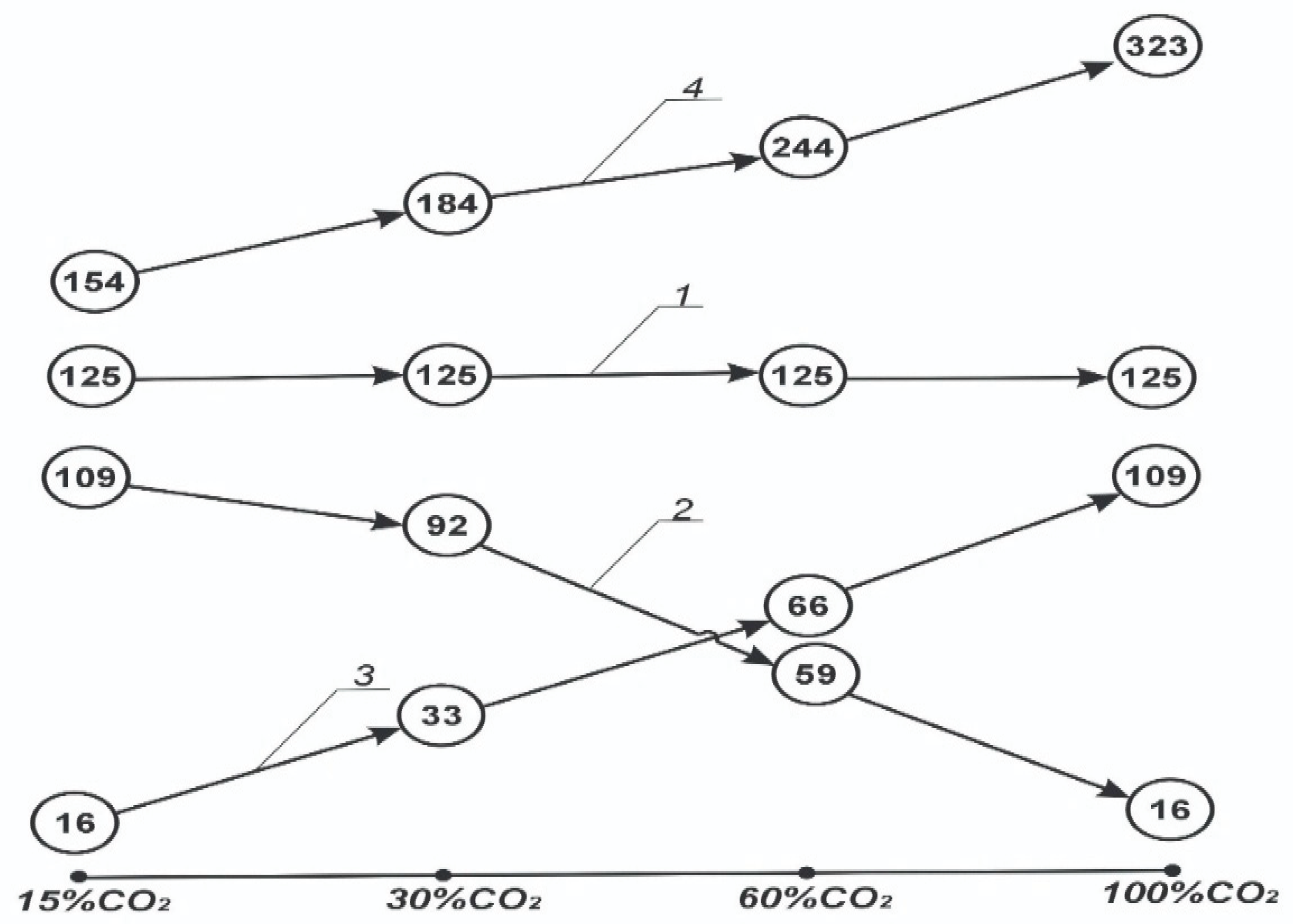
Table 1.
Measuring instruments and their characteristics.
| Measured Value | Limit of Error | Name, Type | Measuring Range |
| Natural gas consumption |
At maximum gas flow - (±1)%, at minimum - (±2)% | Explosion-Proof Vortex Flow Meter. SUP-FVX480. HANGZHOU SUPMEA INTERNATIONAL TRADING CO.,LTD. Process Connection and Body Material: HG/T20592 Flange Connection, 304SS; Accuracy: Class 1.5; Compensation Method: Temperature and Pressure Compensation; Output, Display, and Power Supply: Pulse + Two-wire 4-20mA, Display, 24VDC; Heat Resistance Temperature: -40-250℃; | From 200m3/h to 300m3/h |
| Oxygen consumption | From (±1)% to (±2)% | Explosion-proof Vortex Flow meter.SUP-FVX480. HANGZHOU SUPMEA INTERNATIONAL TRADING CO.,LTD. Process Connection and Body Material: HG/T20592 Flange Connection, 304SS; Accuracy: Class 1.5; Compensation Method: Temperature and Pressure Compensation; Output, Display, and Power Supply: Pulse + Two-wire 4-20mA, Display, 24VDC; Heat Resistance Temperature: -40-250℃; |
From 100m3/h to 200m3/h |
| Air consumption | ±0.15% | Explosion-proof Vortex Flow Meter. SUP-FVX480. HANGZHOU SUPMEA INTERNATIONAL TRADING CO.,LTD. Measuring Medium: air; Accuracy: Class 1.5; Compensation Method: Temperature and Pressure Compensation; Output, Display, and Power Supply: Pulse + Two-wire 4-20mA, Display, 24VDC; Heat Resistance Temperature: -40-250℃; |
From 900m3/h to 2000m3/h |
| Collection of analogue signals from temperature, pressure, rarefaction sensors, their conversion and transfer to a computer | - | Programmable microprocessor controllers: -ADAM -4018, 8-channel analogue input module, 2pcs. - ADAM-4520, RS-232, RS-485 interface signal converter, 1 pc. |
One to 16 input channels |
| Flue gas temperature downstream of the rotary kiln, air heater, and scrubber | 0.01 of measured medium temperature | Thermoelectric converters Metran, Russia. Type TXA-0292K, 4 pieces | From (-400°C) to (+1,000°C) |
| The pressure of natural gas and blast air in front of the furnace | From (±0.25)% to (±0.5)% | Overpressure sensors Sapphire 22M-DI, Russia, model 2140, 2 pcs. | 0~250 kPa |
| The composition of the combustion products behind the reactor, rotary kiln, air heater and scrubber | From (±5%) to (±1%) | Manual automatic gas analyzer with display and printer, "Crowcon Sprint", Kane International Ltd. | CO2-(0.0÷15%); CO-(0.0-15%); O2(0-30%) Maximum sample temperature 800°C |
| Melt temperature in the melting reactor | ±1°C | Optical pyrometer " Smotrych-5P-01" |
From 800°C to 1,500°C |
Table 2.
Experiment results of zinc and germanium sublimation from ash–slag.
| Parameters | 1 Experiment | 2 Experiment |
|---|---|---|
| , mm water column. | 50 – 100 | 50 – 100 |
| , °C | 1,300 – 1,400 | 1,300 – 1,400 |
| 200 | 240 | |
| 1200 | 1500 | |
| 0.36 | 0.42 | |
| 2.15/0.43 | 2.5/0.5 | |
| , gr/t | 76/15 | 80/16 |
| 80 | 79 | |
| 270 | 280 | |
|
|
1350 110 |
1380 120 |
| , °C | 300 | 290 |
| , in sublimates,% | 27 | 20 |
Table 3.
Melting mode and properties of stone casting samples.
| 1 | Melt temperature at the exit from the tap hole,°C | 1300 – 1350 |
| 2 | Melt viscosity, poise | 8 – 7 |
| 3 | Specific heat flux through water–cooled reactor caissons, kW/m2 | 130 – 140 |
| 4 | Specific gravity, g/cm3 | 2.2 – 2.5 |
| 5 | Water absorption‚% | 0.13 |
| 6 | Compressive strength, kgf/cm2 | 2700 |
| 7 | Abrasion loss, g/cm2 | 0.21 – 0.24 |
| 8 | Softening temperature, °C | 1200 |
| 9 | Acid resistance in hydrochloric acid, % | 96.7 |
| 10 | Grain (crystal) size, microns | 80 – 150 |
| 11 | Heat resistance, heat changes | 20 – 25 |
Table 4.
Reaction thermodynamic characteristics.
| 2H2+CO2=2H2O+C | ||
| T | ΔG | K |
| C | kJ | |
| 100 | –55,752 | 6,382E+007 |
| 200 | –45,922 | 1,175E+005 |
| 300 | –35,718 | 1,801E+003 |
Table 5.
Reaction thermodynamic characteristics.
| 9H2 +3Fe2O3=6Fe+ 9H2O | ||
| T | deltaG | K |
| C | kJ | |
| 700 | -50,028 | 4,848E+002 |
| 800 | -74,737 | 4,346E+003 |
| 900 | -99,217 | 2,618E+004 |
Table 6.
Water gas reaction thermodynamic characteristics.
| H2O+COH2+CO2 | ||
| T | deltaG | K |
| C | kJ | |
| 200 | -21,469 | 2,346E+002 |
| 300 | -17,618 | 4,034E+001 |
| 400 | -13,928 | 1,205E+001 |
Table 8.
Calculation results of the system decarbonization.
| № | Name quantities |
Units | Degree of decarbonization |
|||
|---|---|---|---|---|---|---|
| 15%CO2 | 30%CO2 | 60%CO2 | 100%CO2 | |||
| 1 | Electrical energy | MWh | 154.0 | 184.52 | 244.13 | 323.33 |
| 2 | Ekibastuz coal | t/h | 90.56 | 101.64 | 123.3 | 152.1 |
| 3 | Yield of CO2 from boiler | t/h | 41.36 | 84.1 | 168.2 | 280.18 |
| 4 | Reusable zinc | t/h | 122.2 | 248.43 | 497.05 | 827.65 |
| 5 | Hydrogen for carbon recovery from CO2 | t/h | 3.76 | 7.37 | 15.3 | 25.47 |
| 6 | Carbon for a distiller as a checker | t/h | 45.28 | 50.82 | 61.65 | 76.05 |
| 7 | Melt suitable for the production of construction products | t/h | 65.65 | 73.69 | 89.39 | 110.27 |
| 8 | Zinc oxide in sublimates (ZnO-2% in ash) | t/h | 0.905 | 1.016 | 1.233 | 1.521 |
| 9 | Germanium oxides in sublimates (GeO2, Ge2O3-100 g/t) | kg/h | 4.528 | 5.082 | 6.165 | 7.605 |
| 10 | Carbon monoxide (CO) from a distiller | t/h | 105.65 | 118.58 | 143.86 | 177.45 |
Disclaimer/Publisher’s Note: The statements, opinions and data contained in all publications are solely those of the individual author(s) and contributor(s) and not of MDPI and/or the editor(s). MDPI and/or the editor(s) disclaim responsibility for any injury to people or property resulting from any ideas, methods, instructions or products referred to in the content. |
© 2026 by the authors. Licensee MDPI, Basel, Switzerland. This article is an open access article distributed under the terms and conditions of the Creative Commons Attribution (CC BY) license (http://creativecommons.org/licenses/by/4.0/).
Copyright: This open access article is published under a Creative Commons CC BY 4.0 license, which permit the free download, distribution, and reuse, provided that the author and preprint are cited in any reuse.


