

Submitted:
22 April 2026
Posted:
27 April 2026
You are already at the latest version
Abstract
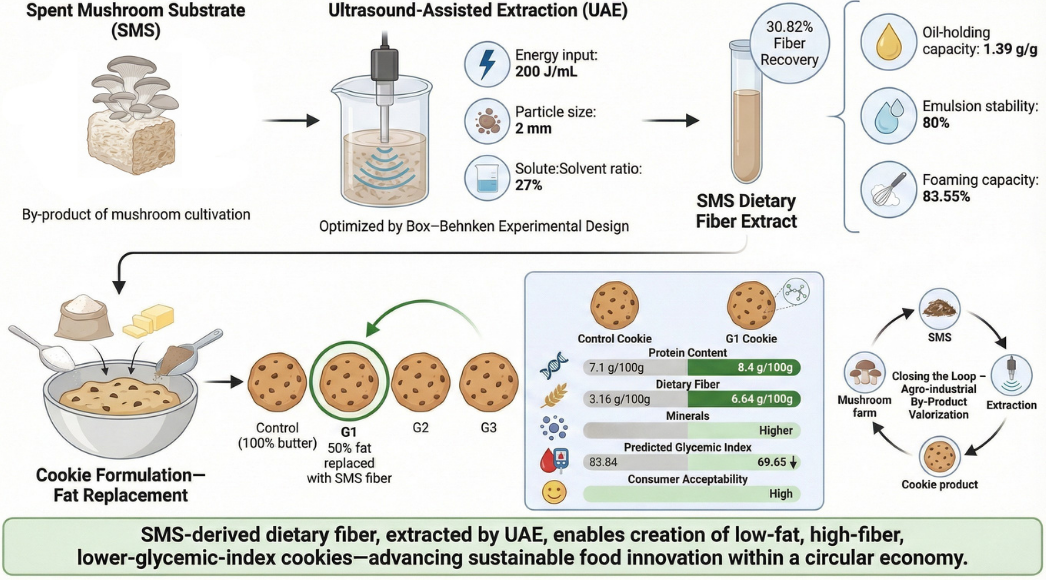
Spent mushroom substrate (SMS), the main by-product of mushroom production, is rich in valuable compounds that could be recovered by ultrasound-assisted extraction (UAE) and exploited as fat-mimetic functional ingredients in food formulations. In this study, low-fat cookies prototypes were developed by incorporating a dietary fiber extract obtained from SMS using UAE. The extraction process was optimized following a Box–Behnken experimental design, identifying optimal conditions at a specific energy input of 200 J/mL, a particle size of 2 mm, and a solute-to-solvent ratio of 1:27, yielding a dietary fiber recovery of 30.82%. The optimized SMS extract exhibited high oil-holding capacity (1.39 g/g), emulsion stability (80%), and foaming capacity (83.55%). Four cookie formulations were evaluated, among which G1 (50% fat replacement) showed the best balance between consumer acceptability and an improved nutritional profile, characterized by higher protein (8.4 g/100 g), total dietary fiber (7.10 g/100 g), and mineral contents. Notably, G1 cookies displayed a significant reduction in predicted glycemic index, decreasing from 83.84 in the control to 69.65. Overall, these results demonstrate that optimized SMS-derived dietary fiber is an effective functional ingredient for the development of low-fat, high-fiber, and reduced-glycemic cookies, contributing to the valorization of agro-industrial by-products within a circular economy framework.
Keywords:
mushrooms by-products
; Pleurotus ostreatus
; Box-Behnken design
; total dietary fiber
; low-fat cookies
; starch digestibility
; glycemic index
Copyright: This open access article is published under a Creative Commons CC BY 4.0 license, which permit the free download, distribution, and reuse, provided that the author and preprint are cited in any reuse.


