

Submitted:
23 April 2026
Posted:
24 April 2026
You are already at the latest version
Abstract
This study examines the role of entrepreneurship education quality in shaping students’ tourism development orientation through cognitive and capability-based mechanisms. In the context of developing countries such as Indonesia and Timor-Leste, strengthening entrepreneurial capacity is essential to support sustainable tourism growth. Using a quantitative cross-sectional design, data were collected from 348 university students enrolled in entrepreneurship-related programs across the two countries. The study employs Partial Least Squares Structural Equation Modeling (PLS-SEM), multi-group analysis (PLS-MGA), and fuzzy-set Qualitative Comparative Analysis (fsQCA) to test direct, mediating, and moderating relationships. The findings reveal that entrepreneurship education quality significantly enhances entrepreneurial self-efficacy, which in turn strengthens innovation capability, leading to higher entrepreneurial intention and ultimately tourism development orientation. However, no direct effect of education quality on entrepreneurial intention or tourism orientation was found, indicating full mediation. Entrepreneurship course experience positively moderates the relationship between education quality and self-efficacy, while prior entrepreneurial experience shows no significant moderating effect. Cross-national analysis indicates that the link between entrepreneurial intention and tourism orientation is stronger in Indonesia than in Timor-Leste. Overall, the study highlights the importance of fostering self-efficacy and innovation capability as key pathways through which entrepreneurship education contributes to tourism development.
Keywords:
entrepreneurship education
; entrepreneurial self-efficacy
; innovation capability
; entrepreneurial intention
; tourism development orientation
; PLS-SEM
; cross-national study
; Indonesia
; Timor-Leste
1. Introduction
The tourism sector has emerged as a critical driver of economic growth, particularly in developing countries where it contributes significantly to employment, regional development, and cultural preservation [1,2,3]. In Southeast Asia, nations such as Indonesia and Timor-Leste possess substantial tourism potential, yet the realization of this potential is often constrained by a lack of entrepreneurial capacity among the younger generation. As the tourism industry increasingly demands innovative and locally grounded business initiatives, the role of entrepreneurship education in preparing students to become agents of tourism development has gained prominence [4,5].
Entrepreneurship education is widely recognized as a key mechanism for fostering entrepreneurial mindsets and capabilities [6]. However, the effectiveness of such education is not merely determined by the presence of entrepreneurship courses, but by the quality of educational experiences, including pedagogical approaches, curriculum relevance, and institutional support. In cross-national contexts, differences in educational systems, economic development, and cultural values may influence how entrepreneurship education translates into entrepreneurial outcomes.
Despite growing interest in entrepreneurial intention and innovation, limited research has examined the sequential mechanisms linking entrepreneurship education to tourism development orientation, particularly through the mediating roles of entrepreneurial self-efficacy and innovation capability [7,8,9]. Furthermore, the moderating effects of entrepreneurship course experience and prior entrepreneurial experience remain underexplored. Cross-country comparisons between Indonesia and Timor-Leste are especially scarce, despite their shared geographical region but distinct socioeconomic and educational contexts.
Although entrepreneurship education is increasingly integrated into university curricula, there is limited empirical evidence on how the quality of such education influences students’ orientation toward tourism development [10,11]. In many higher education institutions, the link between entrepreneurship education and tangible outcomes—such as innovation capability, entrepreneurial intention, and tourism development orientation—remains unclear. Moreover, existing studies often treat these relationships as direct effects, overlooking the complex mediating mechanisms that may explain how education translates into intention and action.
In the context of Indonesia and Timor-Leste, both countries are striving to enhance their tourism sectors; yet little is known about the comparative effectiveness of entrepreneurship education in shaping students’ entrepreneurial trajectories. Additionally, the role of experiential factors—such as prior exposure to entrepreneurship courses or hands-on business experience—as moderators in these relationships has not been adequately explored. This study addresses these gaps by proposing and testing a comprehensive model that examines the direct, mediating, and moderating effects of key constructs, while also comparing two distinct national contexts.
1.1. Objectives
This study aims to achieve several key objectives. First, it seeks to analyze the direct effects of entrepreneurship education quality on entrepreneurial self-efficacy, innovation capability, entrepreneurial intention, and tourism development orientation. Second, this study examines the serial mediating roles of entrepreneurial self-efficacy and innovation capability, particularly in the relationship between entrepreneurship education quality and entrepreneurial intention, as well as in the link between entrepreneurial self-efficacy and tourism development orientation. Third, it investigates the moderating roles of entrepreneurship course experience and entrepreneurial experience within the proposed relationships. Finally, this study compares the structural relationships between Indonesian and Timorese university students by employing multi-group analysis, thereby providing a cross-national perspective on how these constructs operate across different educational and cultural contexts.
Theoretically, this study contributes to the entrepreneurship education literature by integrating Social Cognitive Theory with the entrepreneurial intention and innovation literature. It extends prior research by testing a multi-stage mediation model and incorporating cross-national comparisons, thereby offering a more nuanced understanding of how contextual factors shape entrepreneurial development.
Practically, the findings offer actionable insights for educators, curriculum developers, and policymakers. For universities, the results can guide the design of high-quality entrepreneurship programs that emphasize experiential learning, innovation skills, and alignment with local tourism opportunities. For governments, especially in Indonesia and Timor-Leste, the study highlights the importance of strengthening entrepreneurship education as a strategic lever for tourism sector development and youth employment.
From a methodological standpoint, the use of Partial Least Squares Structural Equation Modeling (PLS-SEM) combined with multi-group analysis (PLS-MGA) and fuzzy-set Qualitative Comparative Analysis (fsQCA) provides a robust analytical framework that captures both net effects and configurational pathways, offering a more comprehensive understanding of the phenomena under investigation.
1.2. Conceptual Framework
This study is grounded in Social Cognitive Theory (SCT), originally developed by Bandura [12] which posits that human behavior is shaped by the dynamic interplay between personal factors, environmental influences, and behavioral outcomes. Within the context of entrepreneurship education, SCT provides a robust framework for understanding how educational experiences (environmental factors) influence students' self-efficacy beliefs (personal factors), which in turn shape their entrepreneurial behaviors and intentions (behavioral outcomes). Central to SCT is the concept of self-efficacy, defined as an individual's belief in their capacity to execute actions necessary to achieve desired outcomes. In entrepreneurial contexts, entrepreneurial self-efficacy has been identified as a critical determinant of entrepreneurial intention and action. Furthermore, SCT emphasizes the role of vicarious learning, mastery experiences, and social persuasion—all of which are integral components of high-quality entrepreneurship education.
In addition to SCT, this study draws upon the Theory of Planned Behavior (TPB) [13], which posits that intention is the immediate antecedent of behavior, shaped by attitudes, subjective norms, and perceived behavioral control. By integrating SCT and TPB, the proposed conceptual model explains how entrepreneurship education quality influences entrepreneurial intentions and, ultimately, tourism development orientation through cognitive (self-efficacy) and capability-based (innovation capability) mechanisms.
1.2.1. Direct Effect Hypotheses
Entrepreneurship education quality refers to the perceived effectiveness of entrepreneurship programs in delivering relevant knowledge, practical skills, and experiential learning opportunities. High-quality entrepreneurship education provides students with mastery experiences—such as developing business plans, engaging in simulations, and interacting with real-world entrepreneurs—which are primary sources of self-efficacy according to SCT. Prior studies have consistently demonstrated a positive relationship between entrepreneurship education and entrepreneurial self-efficacy [14,15,16,17]. H1: Entrepreneurship education quality has a positive and significant effect on entrepreneurial self-efficacy.
Entrepreneurial self-efficacy reflects an individual's confidence in their ability to identify opportunities, manage risks, and execute entrepreneurial tasks. Innovation capability refers to the ability to generate, develop, and implement new ideas, products, or processes. Individuals with higher entrepreneurial self-efficacy are more likely to engage in creative problem-solving, experiment with novel approaches, and persist in the face of challenges—all of which foster innovation capability. Research has shown that self-efficacy positively influences innovation outcomes [18,19,20,21]. H2: Entrepreneurial self-efficacy has a positive and significant effect on innovation capability.
Innovation capability enables individuals to identify market opportunities, develop unique value propositions, and adapt to changing conditions—skills essential for entrepreneurial success. Individuals who perceive themselves as capable innovators are more likely to develop strong intentions to pursue entrepreneurial careers. Empirical studies confirm that innovation capability is a significant predictor of entrepreneurial intention [22,23,24,25]. H3: Innovation capability has a positive and significant effect on entrepreneurial intention.
Entrepreneurial intention represents an individual's conscious plan to engage in entrepreneurial activities. Tourism development orientation refers to a student's inclination to pursue entrepreneurial ventures specifically within the tourism sector, including interests in sustainable tourism, cultural preservation, and local economic development. Students with strong entrepreneurial intentions are more likely to identify tourism as a viable and meaningful domain for their entrepreneurial aspirations, particularly when exposed to local tourism potential [26,27,28,29]. H4: Entrepreneurial intention has a positive and significant effect on tourism development orientation.
Beyond its indirect effects through self-efficacy and innovation capability, entrepreneurship education quality may directly influence entrepreneurial intention by shaping attitudes toward entrepreneurship, providing role models, and increasing perceived desirability of entrepreneurial careers. However, prior research has yielded mixed results, with some studies finding direct effects [30,31,32,33] . H5: Entrepreneurship education quality has a positive and significant effect on entrepreneurial intention.
High-quality entrepreneurship education may directly shape students' orientation toward tourism development by incorporating tourism-specific content, case studies, and local industry engagement. When entrepreneurship programs are aligned with regional economic sectors such as tourism, students may develop stronger interests in tourism-based ventures [34,35]. H6: Entrepreneurship education quality has a positive and significant effect on tourism development orientation.
1.2.2. Mediating Effect Hypotheses
Building on SCT and the proposed direct effects, this study posits that the relationships between key constructs are transmitted through sequential mediating pathways. Entrepreneurship education quality is expected to enhance entrepreneurial self-efficacy by providing mastery experiences and vicarious learning opportunities. In turn, individuals with higher entrepreneurial self-efficacy are more confident in their ability to innovate, experiment, and develop novel solutions. This sequential pathway suggests that self-efficacy serves as a critical mechanism through which educational quality translates into innovation capability [36,37,38,39]. H7: Entrepreneurial self-efficacy mediates the relationship between entrepreneurship education quality and innovation capability.
Entrepreneurial self-efficacy enables individuals to develop innovation capability, as confidence in one's entrepreneurial abilities fosters creative and adaptive thinking. Innovation capability, in turn, strengthens entrepreneurial intention by equipping individuals with the skills and confidence to pursue entrepreneurial opportunities. This serial mediation reflects the cognitive and capability-based process underlying intention formation. H8: Innovation capability mediates the relationship between entrepreneurial self-efficacy and entrepreneurial intention [40,41,42].
Innovation capability contributes to entrepreneurial intention by enhancing individuals' perceived ability to identify and exploit business opportunities. Subsequently, strong entrepreneurial intention directs individuals toward specific domains of entrepreneurial activity, such as tourism development, particularly when contextual factors support such orientation. This sequential mediation explains how cognitive capabilities translate into sector-specific entrepreneurial aspirations [43,44,45,46]. H9: Entrepreneurial intention mediates the relationship between innovation capability and tourism development orientation.
1.2.3. Moderating Effect Hypotheses
Not all students who receive entrepreneurship education develop equal levels of self-efficacy. Prior exposure to entrepreneurship courses may enhance the effectiveness of educational quality by providing foundational knowledge that amplifies the impact of subsequent learning experiences [47,48]. Students who have previously taken entrepreneurship courses may possess greater familiarity with entrepreneurial concepts, allowing them to more fully benefit from high-quality educational experiences. Conversely, students without such background may require more foundational support. H10: Entrepreneurship course experience positively moderates the relationship between entrepreneurship education quality and entrepreneurial self-efficacy, such that the relationship is stronger for students who have taken entrepreneurship courses.
Practical entrepreneurial experience—such as having started or managed a business—may strengthen the translation of innovation capability into entrepreneurial intention. Individuals with prior business experience possess greater contextual knowledge, realistic expectations, and validated self-beliefs, which may enhance their confidence in leveraging innovation capabilities for entrepreneurial pursuits. In contrast, those without such experience may be more hesitant to translate innovative ideas into concrete intentions [49,50,51,52]. H11: Entrepreneurial experience positively moderates the relationship between innovation capability and entrepreneurial intention, such that the relationship is stronger for students with prior business experience.
1.2.4. Multi-Group Hypothesis
Indonesia and Timor-Leste represent distinct socioeconomic, educational, and cultural contexts. Indonesia has a more developed higher education system and a larger, more diversified tourism sector, whereas Timor-Leste is an emerging economy with a nascent tourism industry and developing educational infrastructure. These contextual differences may influence how entrepreneurship education quality, self-efficacy, innovation capability, and entrepreneurial intention relate to tourism development orientation. Multi-group analysis enables testing of whether the structural relationships vary significantly between the two national samples.
H12: The structural relationships in the proposed model differ significantly between Indonesian (UNP) and Timor-Leste (UNTL) students.
1.3. Research Framework
The conceptual framework illustrated in Figure 1 integrates the direct, mediating, and moderating relationships hypothesized above. Entrepreneurship education quality serves as the exogenous variable, influencing entrepreneurial self-efficacy, innovation capability, entrepreneurial intention, and tourism development orientation through both direct and mediated pathways. Entrepreneurial self-efficacy and innovation capability function as sequential mediators, while entrepreneurship course experience and entrepreneurial experience act as moderators. Multi-group analysis compares the model across Indonesian and Timorese student populations.
2. Materials and Methods
2.1. Research Design
This study employs a quantitative research design with a cross-sectional approach. The quantitative approach is appropriate as it enables hypothesis testing and the examination of causal relationships among the constructs in the proposed conceptual model. A cross-sectional design was selected because data were collected at a single point in time, which is suitable for studies aiming to assess relationships between variables rather than observing changes over time. The study follows a survey-based, hypothesis-testing framework, where data are collected using structured questionnaires and analyzed using variance-based structural equation modeling.
2.2. Population and Sample
The target population of this study consists of university students enrolled in entrepreneurship-related courses or programs at two universities: Universitas Negeri Padang (UNP) in Indonesia and Universidade Nacional Timor Lorosa'e (UNTL) in Timor-Leste. These two institutions were selected to enable cross-national comparison, as both are public universities with established entrepreneurship curricula and serve as key educational institutions in their respective countries. The sampling technique employed was purposive sampling, with the following inclusion criteria: (1) students enrolled in entrepreneurship courses or related programs, (2) students who have completed at least one semester of study, and (3) students willing to participate voluntarily. This sampling method was chosen to ensure that respondents had sufficient exposure to entrepreneurship education to provide meaningful responses.
The sample size was determined based on guidelines for Partial Least Squares Structural Equation Modeling (PLS-SEM). Following the rule of thumb proposed by Hair et al. (2019), the minimum sample size should be ten times the largest number of structural paths directed at any endogenous construct. In this model, the maximum number of predictors for any endogenous construct is three (for Entrepreneurial Intention). Thus, a minimum sample of 30 would be required; however, to ensure robustness and statistical power, a larger sample was targeted. A total of 400 questionnaires were distributed, and 348 valid responses were returned, yielding a response rate of 87%. This sample size exceeds the minimum requirements for PLS-SEM and is adequate for multi-group analysis.
2.3. Research Instruments
Data were collected using a structured questionnaire consisting of two sections. The first section captured demographic information, including gender, age, field of study, university affiliation, entrepreneurship course experience, and entrepreneurial experience. The second section contained measurement items for the five main constructs: Entrepreneurship Education Quality (EEQ), Entrepreneurial Self-Efficacy (ESE), Innovation Capability (INC), Entrepreneurial Intention (EIN), and Tourism Development Orientation (TDO).
Each construct was measured using ten indicators, resulting in a total of 50 measurement items. All items were adapted from prior validated scales to ensure content validity. Entrepreneurship Education Quality items were adapted from studies on entrepreneurial education effectiveness [53,54]. Entrepreneurial Self-Efficacy items were adapted from the entrepreneurial self-efficacy scale developed by McGee et al. [55]. Innovation Capability items were drawn from the innovation literature [9]. Entrepreneurial Intention items were adapted from the widely used entrepreneurial intention scale [56]. Tourism Development Orientation items were developed based on tourism entrepreneurship literature [57,58].
All items were measured using a five-point Likert scale ranging from 1 (strongly disagree) to 5 (strongly agree). The questionnaire was originally developed in English and then translated into Indonesian and Tetum (the official language of Timor-Leste) using a back-translation procedure to ensure linguistic equivalence across the two country contexts. A pilot test was conducted with 30 students from each university to assess clarity, comprehensibility, and reliability. Minor wording adjustments were made based on pilot study feedback.

Table 1.
Measurement items.
| Construct | Code | Statement |
|---|---|---|
| Entrepreneurship Education Quality (EEQ) | EEQ1 | Entrepreneurship courses provide practical knowledge relevant to real business contexts |
| EEQ2 | The entrepreneurship curriculum enhances my ability to solve business-related problems | |
| EEQ3 | Teaching methods emphasize experiential and project-based learning | |
| EEQ4 | Entrepreneurship education encourages me to apply theory to real business practice | |
| EEQ5 | University support strengthens the effectiveness of entrepreneurship education | |
| EEQ6 | Entrepreneurship education is relevant to local economic and tourism contexts | |
| EEQ7 | Entrepreneurship courses improve my ability to work in interdisciplinary teams | |
| EEQ8 | Entrepreneurship education enhances my problem-solving skills through real projects | |
| EEQ9 | Guest lectures and industry involvement enrich entrepreneurship learning | |
| EEQ10 | Assessment methods reflect real entrepreneurial challenges | |
| Entrepreneurial Self-Efficacy (ESE) | ESE1 | I am confident in my ability to identify promising business opportunities |
| ESE2 | I believe I can make effective decisions in uncertain business situations | |
| ESE3 | I am capable of developing products or services that can compete in the market | |
| ESE4 | I am confident in managing business risks | |
| ESE5 | I believe I can build and maintain professional business networks | |
| ESE6 | I am confident in managing the financial aspects of a business | |
| ESE7 | I believe I can lead a business team effectively | |
| ESE8 | I am confident in marketing products or services | |
| ESE9 | I can handle failure and learn from business mistakes | |
| ESE10 | I believe I can sustain a business in competitive conditions | |
| Innovation Capability (INC) | INC1 | I am able to generate creative and innovative business ideas |
| INC2 | I am capable of developing new or improved products and services | |
| INC3 | I can quickly adapt my ideas to changes in the market | |
| INC4 | I am able to use digital technologies to support business innovation | |
| INC5 | I can modify business ideas based on customer needs | |
| INC6 | I can combine existing ideas into innovative business solutions | |
| INC7 | I actively seek new technologies to improve business performance | |
| INC8 | I can experiment with new business models | |
| INC9 | I am able to collaborate with others to generate innovation | |
| INC10 | I continuously evaluate and refine innovative ideas | |
| Entrepreneurial Intention (EIN) | EIN1 | I intend to start my own business after completing my studies |
| EIN2 | I actively seek information about business opportunities | |
| EIN3 | I prefer becoming an entrepreneur rather than being an employee | |
| EIN4 | I plan to establish a business within the next few years | |
| EIN5 | I am willing to take risks in order to become an entrepreneur | |
| EIN6 | I am determined to become an entrepreneur despite challenges | |
| EIN7 | I often imagine myself running my own business | |
| EIN8 | I am preparing myself to start a business in the future | |
| EIN9 | I am committed to pursuing an entrepreneurial career | |
| EIN10 | I see entrepreneurship as my long-term career goal | |
| Tourism Development Orientation (TDO) | TDO1 | I am interested in developing a business related to the tourism sector |
| TDO2 | I see tourism as a sector with strong entrepreneurial opportunities | |
| TDO3 | My education supports my interest in tourism-based entrepreneurship | |
| TDO4 | I perceive local tourism potential as a viable business opportunity | |
| TDO5 | I am motivated to contribute to local economic development through tourism entrepreneurship | |
| TDO6 | Tourism entrepreneurship can improve community welfare | |
| TDO7 | I am interested in sustainable tourism business development | |
| TDO8 | I want to preserve local culture through tourism entrepreneurship | |
| TDO9 | Tourism entrepreneurship can create employment opportunities | |
| TDO10 | I see tourism as a driver of regional economic growth |
2.4. Data Collection Procedures
Data collection was conducted over a period of three months, from October to December, 2025. The survey was administered using both online and offline methods to maximize response rates. At UNP (Indonesia), questionnaires were distributed primarily through online platforms (Google Forms) due to the hybrid learning environment, with assistance from course lecturers. At UNTL (Timor-Leste), a combination of online distribution and in-person paper-based surveys was employed, as internet access was less consistent among some student groups.
Prior to data collection, permission was obtained from the respective university administrations and course coordinators. All respondents were informed about the purpose of the study, the voluntary nature of participation, and the confidentiality of their responses. Informed consent was obtained from each participant before they proceeded to complete the questionnaire. Completed questionnaires were screened for completeness and consistency; responses with missing data exceeding 10% or exhibiting straight-lining patterns were excluded from further analysis.
2.5. Data Analysis Techniques
Data analysis was conducted using SmartPLS 4, employing Partial Least Squares Structural Equation Modeling (PLS-SEM) in a two-stage approach consisting of measurement model and structural model assessments. The measurement model was evaluated to ensure reliability and validity, with indicator reliability assessed through outer loadings (acceptable > 0.70, items below 0.50 removed), internal consistency reliability using Cronbach's Alpha and Composite Reliability (CR > 0.70), convergent validity via Average Variance Extracted (AVE > 0.50), and discriminant validity through the Heterotrait-Monotrait (HTMT) ratio (< 0.85). Following confirmation of measurement model adequacy, the structural model was assessed by examining collinearity using Variance Inflation Factor (VIF < 5), path coefficients significance through bootstrapping with 5,000 subsamples, coefficient of determination (R2) with thresholds of 0.25 (weak), 0.50 (moderate), and 0.75 (substantial), effect size (f2) with values of 0.02, 0.15, and 0.35 indicating small, medium, and large effects respectively, and predictive relevance (Q2) using the blindfolding procedure. Mediation hypotheses were tested using bootstrapping for indirect effects with bias-corrected confidence intervals, while moderation hypotheses were examined by introducing interaction terms using the product indicator approach, with significance assessed through bootstrapping and simple slope analysis for interpretation. Multi-group analysis (PLS-MGA) was conducted to compare structural path coefficients between Indonesian (UNP) and Timorese (UNTL) student groups, preceded by measurement invariance assessment using the MICOM procedure. Complementary analyses included fuzzy-set Qualitative Comparative Analysis (fsQCA) to explore configurational pathways leading to high tourism development orientation through necessity and sufficiency analyses, as well as Importance-Performance Matrix Analysis (IPMA) to identify constructs with high importance but low performance for prioritizing improvement efforts.
3. Results
3.1. Respondent Demographics
A total of 348 valid responses were analyzed, consisting of 201 students (58%) from Universitas Negeri Padang (UNP) in Indonesia and 147 students (42%) from Universidade Nacional Timor Lorosa'e (UNTL) in Timor-Leste. Table 1 presents the demographic profile of the respondents. The sample comprised 151 male students (43%) and 197 female students (57%). In terms of age distribution, the majority of respondents were aged between 19 and 22 years (56%, n = 194), followed by those under 19 years (28%, n = 98), and those above 22 years (16%, n = 56). Regarding field of study, the largest proportion of respondents were enrolled in Tourism or Hospitality programs (88%, n = 306), followed by Economics or Business (9%, n = 30), and Education (3%, n = 12). This distribution reflects the study's focus on tourism development orientation among students.
With respect to entrepreneurship course experience, the majority of respondents (89%, n = 308) reported having taken entrepreneurship courses, while 11% (n = 40) had not. Regarding entrepreneurial experience, 28% (n = 97) indicated having prior business experience, while 72% (n = 251) reported no such experience. This distribution provides adequate variation for testing the moderating effects of course experience and entrepreneurial experience.
Table 2.
Respondent demographics (n = 348).
| Category | Sub-category | Frequency (n) | Percentage (%) |
|---|---|---|---|
| Gender | Male | 151 | 43% |
| Female | 197 | 57% | |
| Age | < 19 years | 98 | 28% |
| 19-22 years | 194 | 56% | |
| > 22 years | 56 | 16% | |
| Field of Study | Education | 12 | 3% |
| Economics/Business | 30 | 9% | |
| Tourism/Hospitality | 306 | 88% | |
| University | Universitas Negeri Padang (Indonesia) | 201 | 58% |
| Universidade Nacional Timor Lorosa’e (Timor-Leste) | 147 | 42% | |
| Entrepreneurship Course Experience | Have taken entrepreneurship courses | 308 | 89% |
| Have not taken entrepreneurship courses | 40 | 11% | |
| Entrepreneurial Experience | Have business experience | 97 | 28% |
| No business experience | 251 | 72% |
3.2. Measurement Model Assessment
The initial analysis revealed that several indicators exhibited outer loadings below the acceptable threshold of 0.70. Specifically, EEQ7 (0.512), ESE6 (0.487), and INC7 (0.534) had loadings below 0.60 and were considered for removal (see figure 2). Following the recommended procedure, these three indicators were deleted from the model due to their low contributions to construct reliability. After removal, all remaining indicators demonstrated outer loadings ranging from 0.703 to 0.867, all exceeding the 0.70 threshold, indicating acceptable indicator reliability.
As shown in Table 3, all constructs demonstrated satisfactory internal consistency reliability. Cronbach's Alpha values ranged from 0.874 (EEQ) to 0.912 (EIN), all exceeding the recommended threshold of 0.70. Similarly, Composite Reliability (CR) values ranged from 0.906 (EEQ) to 0.931 (EIN), all above 0.70. These results indicate that the measurement items consistently reflect their respective constructs.
Discriminant validity was assessed using the Heterotrait-Monotrait (HTMT) ratio of correlations, as presented in Table 4. All HTMT values were below the conservative threshold of 0.85, ranging from 0.512 (EEQ ↔ TDO) to 0.745 (EIN ↔ TDO). These results confirm that each construct is empirically distinct from the others, establishing discriminant validity.
Collinearity was assessed using Variance Inflation Factor (VIF) values, as presented in Figure 3. All VIF values were below the conservative threshold of 5, ranging from 2.044 to 4.158. This indicates that multicollinearity is not a concern in the structural model.
3.3. Structural Model Assessment
The findings reveal that H1 (EEQ → ESE) is supported, with a significant positive path coefficient (β = 0.524, t = 8.234, p < 0.001). Similarly, H2 (ESE → INC) is supported (β = 0.487, t = 7.891, p < 0.001), H3 (INC → EIN) is supported (β = 0.556, t = 9.123, p < 0.001), and H4 (EIN → TDO) is supported (β = 0.612, t = 10.456, p < 0.001). These results indicate that all direct effect hypotheses in the sequential chain are statistically significant. In contrast, H5 (EEQ → EIN) is not supported, with a non-significant path coefficient (β = 0.103, t = 1.412, p = 0.158). Similarly, H6 (EEQ → TDO) is not supported (β = 0.082, t = 1.123, p = 0.262). These findings suggest that entrepreneurship education quality does not directly influence entrepreneurial intention or tourism development orientation; rather, its effects are transmitted through mediating variables.
The mediating effects were tested using bootstrapping with 5,000 subsamples, as presented in Table 5. The indirect effect for H7 (EEQ → ESE → INC) was significant (β = 0.255, t = 5.678, p < 0.001), with a 95% bias-corrected confidence interval excluding zero (0.167, 0.343). This indicates that entrepreneurial self-efficacy mediates the relationship between entrepreneurship education quality and innovation capability. H8 (ESE → INC → EIN) was also supported, with a significant indirect effect (β = 0.271, t = 6.123, p < 0.001; 95% CI = 0.185, 0.357). This confirms that innovation capability mediates the relationship between entrepreneurial self-efficacy and entrepreneurial intention. H9 (INC → EIN → TDO) was supported, with a significant indirect effect (β = 0.340, t = 7.456, p < 0.001; 95% CI = 0.251, 0.429). Thus, entrepreneurial intention mediates the relationship between innovation capability and tourism development orientation.
The moderating effects were tested by introducing interaction terms into the structural model. As shown in Table 6, H10 (ECE × EEQ → ESE) was supported, with a significant moderating effect (β = 0.156, t = 2.987, p = 0.003). This indicates that entrepreneurship course experience strengthens the positive relationship between entrepreneurship education quality and entrepreneurial self-efficacy. In contrast, H11 (EE × INC → EIN) was not supported, with a non-significant moderating effect (β = 0.068, t = 1.245, p = 0.213). This suggests that prior entrepreneurial experience does not significantly moderate the relationship between innovation capability and entrepreneurial intention
The R2 for Entrepreneurial Self-Efficacy (ESE) was 0.275 (adjusted R2 = 0.268), indicating a moderate level of explanatory power. For Innovation Capability (INC), the R2 was 0.387 (adjusted R2 = 0.381), also representing moderate explanatory power. Entrepreneurial Intention (EIN) exhibited a substantial R2 of 0.524 (adjusted R2 = 0.518), while Tourism Development Orientation (TDO) demonstrated the highest explanatory power with an R2 of 0.612 (adjusted R2 = 0.608). These results indicate that the model explains a substantial proportion of variance in the focal endogenous constructs.
The largest effect was observed for ESE → INC (f2 = 0.631, large effect), followed by EIN → TDO (f2 = 0.487, medium to large), EEQ → ESE (f2 = 0.379, medium to large), and INC → EIN (f2 = 0.256, medium). The moderating effect of ECE × EEQ → ESE exhibited a small effect (f2 = 0.068), while the non-significant direct effects (EEQ → EIN and EEQ → TDO) and the non-significant moderating effect (EE × INC → EIN) showed negligible effect sizes (f2 < 0.02).
Table 7.
Effect size (f2).
| Relationship | f2 | Interpretation |
|---|---|---|
| EEQ → ESE | 0.379 | Medium to Large |
| ECE × EEQ → ESE | 0.068 | Small |
| ESE → INC | 0.631 | Large |
| EEQ → EIN | 0.012 | Negligible (No Effect) |
| ESE → EIN | 0.184 | Small to Medium |
| INC → EIN | 0.256 | Medium |
| EEQ → TDO | 0.009 | Negligible (No Effect) |
| INC → TDO | 0.142 | Small |
| EIN → TDO | 0.487 | Medium to Large |
| EE × INC → EIN | 0.015 | Negligible (No Effect) |
3.4. Multi-Group Analysis (PLS-MGA)
To test H12, multi-group analysis was conducted to compare structural path coefficients between Indonesian (UNP) and Timorese (UNTL) students. Prior to the analysis, measurement invariance was assessed using the MICOM procedure. Configural invariance was established by ensuring identical model specifications across groups. Compositional invariance was confirmed as the correlation values for all constructs were sufficiently close to 1. Partial measurement invariance was established, allowing for meaningful comparison of path coefficients.
For the path EEQ → ESE, the coefficient was slightly higher in Timor-Leste (β = 0.562) compared to Indonesia (β = 0.487), but the difference was not statistically significant (p = 0.312). Similarly, the difference for ESE → INC (Indonesia β = 0.512; Timor-Leste β = 0.458; p = 0.267) and INC → EIN (Indonesia β = 0.589; Timor-Leste β = 0.521; p = 0.198) were not significant. However, a significant difference was observed for the path EIN → TDO, which was significantly stronger in Indonesia (β = 0.678) compared to Timor-Leste (β = 0.545), with a p-value of 0.042. This indicates that the relationship between entrepreneurial intention and tourism development orientation is significantly different across the two countries.
For the non-significant direct paths (EEQ → EIN and EEQ → TDO), both groups showed non-significant coefficients, with no significant differences between groups. The mediation paths showed no significant differences across groups, although the indirect effect for INC → EIN → TDO approached marginal significance (p = 0.078), suggesting a potentially stronger mediation effect in Indonesia.
Table 8.
Multigroup Analysis.
| Path | Indonesia (UNP) | Timor-Leste (UNTL) | Difference | p-value | Interpretation |
|---|---|---|---|---|---|
| EEQ → ESE | 0.487 | 0.562 | -0.075 | 0.312 | Slightly stronger in Timor-Leste, but not significant; education may play a more foundational role in emerging economies |
| ESE → INC | 0.512 | 0.458 | 0.054 | 0.267 | Slightly stronger in Indonesia, but not significant |
| INC → EIN | 0.589 | 0.521 | 0.068 | 0.198 | Stronger in Indonesia, reflecting more mature innovation ecosystem |
| EIN → TDO | 0.678 | 0.545 | 0.133 | 0.042 | Significantly stronger in Indonesia; tourism sector more established |
| EEQ → EIN | 0.087 | 0.121 | -0.034 | 0.412 | Both non-significant; full mediation confirmed in both groups |
| EEQ → TDO | 0.065 | 0.098 | -0.033 | 0.445 | Both non-significant; full mediation confirmed in both groups |
| EEQ → ESE → INC | 0.249 | 0.257 | -0.008 | 0.489 | Consistent mediation across groups |
| ESE → INC → EIN | 0.302 | 0.239 | 0.063 | 0.234 | Consistent mediation; slightly stronger in Indonesia |
| INC → EIN → TDO | 0.399 | 0.284 | 0.115 | 0.078 | Marginally significant; merits further investigation |
| ECE × EEQ → ESE | 0.189 | 0.123 | 0.066 | 0.156 | Stronger in Indonesia, but not significant |
| EE × INC → EIN | 0.045 | 0.089 | -0.044 | 0.398 | Both non-significant; no moderation in either group |
3.5. Fuzzy-Set Qualitative Comparative Analysis (fsQCA)
To complement the net-effects approach of PLS-SEM, fsQCA was conducted to identify configurational pathways leading to high tourism development orientation.
Table 9.
Truth table.
| Configuration | EEQ | ESE | INC | EIN | Raw Consistency | Outcome |
|---|---|---|---|---|---|---|
| 1 | 1 | 1 | 1 | 1 | 0.94 | High TDO |
| 2 | 1 | 1 | 1 | 0 | 0.87 | High TDO |
| 3 | 1 | 1 | 0 | 1 | 0.85 | High TDO |
| 4 | 1 | 0 | 1 | 1 | 0.82 | High TDO |
| 5 | 0 | 1 | 1 | 1 | 0.78 | High TDO |
| 6 | 1 | 1 | 0 | 0 | 0.65 | Low TDO |
| 7 | 0 | 0 | 0 | 0 | 0.25 | Low TDO |
* Notes:EEQ = Entrepreneurship Education Quality; ESE = Entrepreneurial Self-Efficacy; INC = Innovation Capability; EIN = Entrepreneurial Intention 1 = high/present; 0 = low/absent. Consistency threshold ≥ 0.80 indicates sufficient configuration for high TDO. Configurations 1–5 show multiple pathways to high tourism development orientation (equifinality).
The necessity analysis (Table 10) revealed that the combination of Innovation Capability and Entrepreneurial Intention (INC · EIN) met the necessary condition threshold with consistency of 0.91, indicating that this combination is necessary for achieving high tourism development orientation. No single condition alone was necessary.
The sufficiency analysis (Table 11) identified five distinct configurations leading to high tourism development orientation, demonstrating equifinality. The first configuration (C1: EEQ · ESE · INC · EIN) represents the full model where all conditions are present, with raw consistency of 0.94. The second configuration (C2: EEQ · ESE · INC · ~EIN) shows that high tourism development orientation can be achieved through innovation capability even without strong entrepreneurial intention (consistency = 0.87). The third configuration (C3: EEQ · ESE · ~INC · EIN) indicates that entrepreneurial intention alone, combined with education quality and self-efficacy, can lead to high TDO even without innovation capability (consistency = 0.85). The fourth configuration (C4: EEQ · ~ESE · INC · EIN) demonstrates that students with education quality, innovation capability, and intention can achieve high TDO even with lower self-efficacy (consistency = 0.82). The fifth configuration (C5: ~EEQ · ESE · INC · EIN) shows that students without formal entrepreneurship education can still achieve high TDO if they possess self-efficacy, innovation capability, and intention (consistency = 0.78).
4. Discussion
4.1. Summary of Key Findings
This study examined the relationships between entrepreneurship education quality, entrepreneurial self-efficacy, innovation capability, entrepreneurial intention, and tourism development orientation among university students in Indonesia and Timor-Leste. The findings revealed that all direct effects in the sequential chain (H1–H4) were supported, while the direct effects of education quality on intention and tourism orientation (H5–H6) were not supported, indicating full mediation. All three serial mediation hypotheses (H7–H9) were confirmed. Entrepreneurship course experience significantly moderated the education quality–self-efficacy relationship (H10), but entrepreneurial experience did not moderate the innovation capability–intention relationship (H11). Multi-group analysis showed that the intention–tourism orientation link was significantly stronger in Indonesia than in Timor-Leste (H12 partially supported). Complementary fsQCA and IPMA analyses provided additional insights into configurational pathways and practical priorities.
4.2. Direct Effects Discussion
The significant positive effects of entrepreneurship education quality on entrepreneurial self-efficacy (H1), self-efficacy on innovation capability (H2), innovation capability on entrepreneurial intention (H3), and intention on tourism development orientation (H4) align with Social Cognitive Theory and prior empirical studies. The non-significant direct effects of education quality on intention and tourism orientation (H5, H6) suggest that entrepreneurship education influences these outcomes only indirectly through cognitive and capability-based mechanisms, consistent with research emphasizing full mediation [59,60,61,62,63,64].
4.3. Mediating Effects Discussion
The significant serial mediation effects (H7–H9) reveal the sequential mechanisms through which entrepreneurship education influences outcomes. Education quality enhances innovation capability by first building self-efficacy (H7). Self-efficacy strengthens entrepreneurial intention through innovation capability (H8). Innovation capability translates into tourism development orientation only when accompanied by strong entrepreneurial intention (H9). These findings extend prior research by specifying the sequential pathways linking educational inputs to sector-specific entrepreneurial outcomes [59,60,65,66].
4.4. Moderating Effects Discussion
The significant moderating effect of entrepreneurship course experience (H10) indicates that students with prior course exposure derive greater self-efficacy benefits from high-quality education, as foundational knowledge amplifies the impact of subsequent learning. The non-significant moderating effect of entrepreneurial experience (H11) may reflect the dichotomous measurement approach or the varying nature of prior business experiences (positive vs. negative), suggesting the need for more nuanced measurement in future research [67,68,69,70].
4.5. Multi-Group Discussion
The stronger relationship between entrepreneurial intention and tourism development orientation among Indonesian students compared to Timorese students reflects contextual differences. Indonesia's more developed tourism sector, established infrastructure, and greater opportunities likely strengthen students' ability to channel entrepreneurial intentions into tourism-specific orientation. In contrast, Timor-Leste's nascent tourism industry may present greater uncertainty and fewer opportunities, weakening this link. The consistency of other paths across both countries supports the model's generalizability.
4.6. Theoretical Implications
This study makes several theoretical contributions. First, it extends Social Cognitive Theory by demonstrating a sequential mediation model linking environmental factors (education) to behavioral outcomes (tourism orientation) through cognitive (self-efficacy) and capability-based (innovation) mechanisms. Second, it clarifies that entrepreneurship education's effects on distal outcomes are fully mediated, highlighting the importance of self-efficacy and innovation capability as proximal outcomes. Third, it introduces and validates tourism development orientation as a novel outcome variable relevant to tourism-dependent economies. Fourth, the fsQCA findings reveal equifinality—multiple pathways to high tourism orientation—complementing the net-effects perspective.
4.7. Practical Implications
For educators and curriculum designers, the findings emphasize prioritizing experiential learning, project-based activities, and innovation-focused content to build self-efficacy and innovation capability. Teaching methods should provide mastery experiences and constructive feedback to strengthen confidence. Universities should strengthen industry partnerships, particularly with the tourism sector, to expose students to real-world entrepreneurial contexts. For policymakers, the cross-national differences suggest that emerging economies like Timor-Leste should invest in tourism ecosystem development to make tourism entrepreneurship more viable. The IPMA results indicate that entrepreneurial self-efficacy should be a priority for improvement, as it shows high importance but relatively low performance. Finally, educational institutions in Timor-Leste should enhance tourism entrepreneurship curricula and industry linkages to strengthen the intention–orientation link.
5. Conclusions
This study provides empirical evidence on how entrepreneurship education quality shapes tourism development orientation through a sequential cognitive–capability pathway. The findings confirm that entrepreneurship education does not directly influence entrepreneurial intention or tourism development orientation; instead, its impact operates fully through entrepreneurial self-efficacy and innovation capability. This highlights the central role of psychological confidence and innovation skills as key mechanisms translating educational experiences into entrepreneurial outcomes. The study also demonstrates that prior exposure to entrepreneurship courses strengthens the development of self-efficacy, while prior entrepreneurial experience does not significantly alter the intention formation process. Cross-national analysis reveals that although the overall model is robust across Indonesia and Timor-Leste, the translation of entrepreneurial intention into tourism development orientation is stronger in the Indonesian context, reflecting differences in ecosystem maturity. Overall, the results suggest that higher education institutions should prioritize experiential and innovation-driven learning approaches to effectively foster tourism-oriented entrepreneurship. Future research is encouraged to adopt longitudinal designs and explore additional contextual and institutional factors to further understand the dynamic process linking education and sector-specific entrepreneurial outcomes.
Author Contributions
Conceptualization, A.Y., G. and Y.A.F.; methodology, Y.A.F. and F.F.; software, Y.A.F.; validation, A.Y., G., and E.; formal analysis, Y.A.F.; investigation, F.F. and F.Q.C.; resources, A.Y. and G.; data curation, F.F. and F.Q.C.; writing—original draft preparation, Y.A.F.; writing—review and editing, A.Y., G., E., and F.Q.C.; visualization, Y.A.F.; supervision, G. and A.Y.; project administration, Y.A.F.; funding acquisition, A.Y. and G. All authors have read and agreed to the published version of the manuscript.
Funding
This research is funded by the Indonesian Endowment Fund for Education (LPDP) on behalf of the Indonesian Ministry of Higher Education, Science and Technology and managed under the EQUITY Program (Contract No. 4310/B3/DT.03.08/2025 and 2692/UN35/KS/2025).
Institutional Review Board Statement
Ethical review and approval were waived for this study due to its non-invasive nature and the use of voluntary, anonymous survey data collected from university students, with no identifiable personal information recorded.
Informed Consent Statement
Informed consent was obtained from all subjects involved in the study.
Data Availability Statement
The data presented in this study are available on request from the corresponding author. The data are not publicly available due to privacy and ethical restrictions.
Acknowledgments
The authors would like to express their sincere gratitude to Universitas Negeri Padang and Universidade Nacional Timor Lorosa’e for their institutional support. The authors also thank all students who voluntarily participated in this study and contributed valuable data. Appreciation is extended to colleagues and research assistants who supported the data collection process. During the preparation of this manuscript, the authors used ChatGPT (OpenAI, GPT-5.3) for language refinement and clarity improvement. The authors have reviewed and edited the output and take full responsibility for the content of this publication.
Conflicts of Interest
The authors declare no conflicts of interest. The funders had no role in the design of the study; in the collection, analyses, or interpretation of data; in the writing of the manuscript; or in the decision to publish the results.
Abbreviations
The following abbreviations are used in this manuscript:
EEQ — Entrepreneurship Education Quality
ESE — Entrepreneurial Self-Efficacy
INC — Innovation Capability
EIN — Entrepreneurial Intention
TDO — Tourism Development Orientation
PLS-SEM — Partial Least Squares Structural Equation Modeling
PLS-MGA — Partial Least Squares Multi-Group Analysis
fsQCA — Fuzzy-set Qualitative Comparative Analysis
IPMA — Importance-Performance Matrix Analysis
SCT — Social Cognitive Theory
TPB — Theory of Planned Behavior
UNP — Universitas Negeri Padang
UNTL — Universidade Nacional Timor Lorosa’e
References
- Chhabra, M.; Agarwal, M.; Agrawal, P. Women’s entrepreneurship in achieving sustainable development: Exploring the research trajectories. In Women’s Entrepreneurship and the Sustainable Development Goals; Dana, L.-P., Chhabra, M.B.T.-W.E., Eds.; Elsevier, 2026; pp. 35–77. [Google Scholar] [CrossRef]
- Kipinski, M.; Ferasso, M.; Beliaeva, T.; Kraus, S.; Kallmuenzer, A. Entrepreneurship in the hospitality and tourism industry: A clustered research agenda. International Journal of Hospitality Management 2026, 132, 104360. [Google Scholar] [CrossRef]
- Foroudi, P.; Ueno, A.; Dennis, C.; Tzempelikos, N.; Bagheri, A. Beyond satisfaction: A hierarchical model of three distinct guest experience types in peer-to-peer accommodation. International Journal of Hospitality Management 2026, 133, 104465. [Google Scholar] [CrossRef]
- Baba, R.; Keling, W.; Yap, C.S. The effect of subjective norms, attitude and start-up capital on the entrepreneurial intention of the Indigenous people in Malaysia. Journal of Enterprising Communities 2025, 19, 853–80. [Google Scholar] [CrossRef]
- Wong, B.K.M.; Chorng Yuan, F.; Kong, M.; Leong, H.J. Guest editorial: Critically exploring transdisciplinary qualitative research in the Global South. Qualitative Research Journal 2025, 25, 117–24. [Google Scholar] [CrossRef]
- Mohd Salleh, N.H.; Wijijayanti, T.; Ahmad, M.F.; Winarno, A.; Mafruhah, I. Tourism demand estimation methods: a systematic literature review. Tourism Review 2025, 81, 74–103. [Google Scholar] [CrossRef]
- Zhang, X.; Wong, H.S.M.; Tavitiyaman, P. Travel confidence, constraints and behaviors of Chinese outbound tourists in the new normal: a longitudinal case study of Hong Kong. Journal of Hospitality and Tourism Insights 2025, 8, 3302–19. [Google Scholar] [CrossRef]
- Bonanni, C.; Stervinou, S.; Viglia, G. How mentoring could enable women entrepreneurs to cross the psychological Rubicon. International Journal of Entrepreneurial Behaviour and Research 2025, 32, 1–28. [Google Scholar] [CrossRef]
- Nguyen, P.; Timilsina, B.; Shamsuzzoha, A. Higher education as a driver of green innovation and entrepreneurship: A systematic literature review and future research agenda. Journal of Cleaner Production 2025, 516, 145820. [Google Scholar] [CrossRef]
- Rey-Ortiz, P.P.; Crespo-Velando, M.A.; Merigó, J.M.; Gil-Lafuente, A.M. 30 years of the European Research on Management and Business Economics: A bibliometric retrospective. European Research on Management and Business Economics 2025, 31, 100294. [Google Scholar] [CrossRef]
- AlMehrzi, A.A.; Tipu, S.A.; Sarker, A.E. Determinants, processes, and impacts of indigenous entrepreneurship: a systematic literature review. Journal of Enterprising Communities 2024, 18, 646–81. [Google Scholar] [CrossRef]
- Bandura, A. Social-cognitive theory. An introduction to theories of personality; Psychology Press, 2014; pp. 341–60. [Google Scholar]
- Barba-Sánchez, V.; Mitre-Aranda, M.; Brío-González, J.; del. The entrepreneurial intention of university students: An environmental perspective. European Research on Management and Business Economics 2022, 28, 100184. [Google Scholar] [CrossRef]
- Chotisarn, N.; Phuthong, T. Reducing gaps in digital entrepreneurship education: A systematic review of innovative learning strategies and their institutional impact. International Journal of Management Education 2026, 24, 101283. [Google Scholar] [CrossRef]
- Suanpong, K.; Yeing-aramkul, Y.; Yoochayantee, K.; Tripopsakul, S. Cognitive and motivational drivers of entrepreneurial intention in an emerging economy: Implications for open innovation dynamics. Journal of Open Innovation: Technology, Market, and Complexity 2025, 11, 100568. [Google Scholar] [CrossRef]
- Cumberland, D.M.; Holahan, B.; Jones, G.D. Empowering future entrepreneurs: The impact of franchise courses on undergraduate and MBA students. International Journal of Management Education 2025, 23, 101108. [Google Scholar] [CrossRef]
- Zatini, G.; Della Porta, A. Entrepreneurial intentions are made, not born: the active role of institutional, educational and economic support. Journal of Small Business and Enterprise Development 2025, 32, 109–36. [Google Scholar] [CrossRef]
- Donaldson, C.; Signes, Á.P.; Villagrasa, J. Is the road to high growth paved with intrapreneurial intention? The role of entrepreneurial self-efficacy and digital skills on entrepreneurship intention types. The International Journal of Management Education 2025, 23, 101174. [Google Scholar] [CrossRef]
- Heydarifard, Z.; Lewis, A.C.; Ghodsizadeh, H.; Marquez, A.C. Entrepreneurial self-efficacy as a source of energy and buffer against poor recovery. Journal of Business Venturing Insights 2026, 25, e00605. [Google Scholar] [CrossRef]
- Meng, H.; Kim, J. Disability and entrepreneurial behavior: Psychological barriers, knowledge and enablers. Journal of Innovation & Knowledge 2025, 10, 100794. [Google Scholar] [CrossRef]
- Chau, T.L.D.; Phan, V.D.; Nguyen Pham, T.A. Multiple pathways to green entrepreneurial behaviour: A configurational study in Vietnam. Journal of Open Innovation: Technology, Market, and Complexity 2025, 11, 100677. [Google Scholar] [CrossRef]
- Sleiman, K.A.A.; Abushanab, E.; Ali, M.S.Y.; Suliman, M.A.E.; Juanli, L. Understanding the determinants of entrepreneurial intention among Sudanese university students. Acta Psychologica 2026, 262, 106122. [Google Scholar] [CrossRef] [PubMed]
- Senthil Kumar, J.P.; Gangadhara, H.; Usha Rani, J.; Kusuma, T.; Ravi, A. Exploration of green entrepreneurial intention among university students: Integrated model perspective of a theory of planned behaviour and social cognitive theory. The International Journal of Management Education 2026, 24, 101353. [Google Scholar] [CrossRef]
- Liang, Y.; Chen, R.; Hong, H.; Li, S.; Han, L. Shaping digital entrepreneurial intention in higher education: the role of entrepreneurship education, creativity, and digital literacy among Chinese university students. Journal of Innovation and Knowledge 2025, 10, 100788. [Google Scholar] [CrossRef]
- Nguyen Thi, X.; Van, Nguyen D; Ngoc Nguyen, D. Examining the roles of entrepreneurship education, entrepreneurial attitude, and parental support in shaping students’ entrepreneurial intentions. Social Sciences & Humanities Open 2026, 13, 102534. [Google Scholar] [CrossRef]
- Ahmad, N.H.; Ramayah, T.; Mahmud, I.; Musa, M.; Anika, J.J. Entrepreneurship as a preferred career option. Education + Training 2019, 61, 1151–69. [Google Scholar] [CrossRef]
- Altinay, L.; Sigala, M.; Waligo, V. Social value creation through tourism enterprise. Tourism Management 2016, 54, 404–17. [Google Scholar] [CrossRef]
- Dias, Á.; González-Rodríguez, M.R.; Hallak, R. Nascent entrepreneurship: a critical perspective and research agenda in tourism and hospitality. International Journal of Contemporary Hospitality Management 2023, 35, 2527–44. [Google Scholar] [CrossRef]
- Alrawadieh, Z.; Altinay, L.; Cetin, G.; Şimşek, D. The interface between hospitality and tourism entrepreneurship, integration and well-being: A study of refugee entrepreneurs. International Journal of Hospitality Management 2021, 97, 103013. [Google Scholar] [CrossRef]
- Liu, Z.; Zhang, M.; Guo, Y.; Mao, T.; Deng, S.; Li, Y. Entrepreneurship education stimulates entrepreneurial intention of college students in China: A dual-pathway model. The International Journal of Management Education 2025, 23, 101107. [Google Scholar] [CrossRef]
- Fan, J.; Hu, J.; Wang, J. How entrepreneurship education affects college students’ entrepreneurial intention: Samples from China. Heliyon 2024, 10, e30776. [Google Scholar] [CrossRef] [PubMed]
- Diepolder, C.S.; Huwer, J.; Weitzel, H. Effects of competence-based sustainable entrepreneurship education on secondary school students’ sustainable entrepreneurial intention. Sustainable Technology and Entrepreneurship 2025, 4, 100103. [Google Scholar] [CrossRef]
- Ismail, I.J.; Marua, N.M.; Changalima, I.A. Enhancing halal entrepreneurial intention: The impact of halal entrepreneurship education and halal entrepreneurial awareness. Social Sciences & Humanities Open 2025, 11, 101548. [Google Scholar] [CrossRef]
- Vidal-Vilaplana, A.; Gregori-Faus, C.; Parra-Camacho, D.; González-Serrano, M.H. Analysis of sport management subjects in university Sports Sciences degrees in Spain. The International Journal of Management Education 2023, 21, 100771. [Google Scholar] [CrossRef]
- Ribeiro, M.A.; Adam, I.; Kimbu, A.N.; Dayour, F.; Adeola, O.; Tichaawa, T.M. Resilience in uncertainty: The impact of coping strategies on tourism entrepreneurs’ subjective well-being in sub-Saharan Africa. Tourism Management 2025, 110, 105169. [Google Scholar] [CrossRef]
- Maheshwari, G.; Kha, K.L. Investigating the relationship between educational support and entrepreneurial intention in Vietnam: The mediating role of entrepreneurial self-efficacy in the theory of planned behavior. The International Journal of Management Education 2022, 20, 100553. [Google Scholar] [CrossRef]
- Amani, D.; Ismail, I.J.; Makona, A.; Changalima, I.A.; Kazungu, I. Extending the mediation role of entrepreneurial self-efficacy on enhancing students’ entrepreneurial intentions: A moderated mediation model. The International Journal of Management Education 2024, 22, 100915. [Google Scholar] [CrossRef]
- Nguyen, T.T.; Nguyen, T.-D.; Mustafa, M.J. Empathetic concern and social entrepreneurial intention: a moderated mediation model of social entrepreneurial self-efficacy and perceived cultural support. International Journal of Innovation Science 2025, 18, 186–204. [Google Scholar] [CrossRef]
- Otache, I. The links between entrepreneurial education, self-efficacy, attitude and behaviour: A serial mediation model. The International Journal of Management Education 2025, 23, 101146. [Google Scholar] [CrossRef]
- Berisha, G.; Rexhepi Mahmutaj, L.; Kallmuenzer, A.; Valeri, M.; Azevedo, A. Organizational climate for entrepreneurial intentions: the mediating role of innovative work behavior. European Business Review 2025, 37, 773–93. [Google Scholar] [CrossRef]
- Christensen, B.T.; Arendt, K.M.; McElheron, P.; Ball, L.J. The design entrepreneur: How adaptive cognition and formal design training create entrepreneurial self-efficacy and entrepreneurial intention. Design Studies 2023, 86, 101181. [Google Scholar] [CrossRef]
- Bui, H.N.; Pham, D.K.; Phan, T.T.H.; Duong, C.D.; Tran, T.P.H. Balancing confidence and aspiration: University supports and E-entrepreneurial intentions in Vietnam. International Journal of Management Education 2025, 23, 101271. [Google Scholar] [CrossRef]
- Su, H.; Li, S.; Wen, T.; Liang, Y. The impact of industry network strength, centrality and heterogeneity on entrepreneurial performance in the hospitality and tourism: Perspectives on innovation and leadership. International Journal of Hospitality Management 2025, 127, 104088. [Google Scholar] [CrossRef]
- Altinay, L.; Vatankhah, S.; De Vita, G.; Arici, H.E. Could AI technologies be harnessed to break down barriers to inclusivity for women entrepreneurship in tourism? Tourism Management 2026, 112, 105285. [Google Scholar] [CrossRef]
- Mujiatun, S.; Trianto, B.; Cahyono, E.F.; Rahmayati, R. The effects of Islamic financial literacy on entrepreneurial venture performance and halal tourism ecosystem development. Journal of Small Business and Enterprise Development 2025, 32, 1250–84. [Google Scholar] [CrossRef]
- Wang, S.; Hung, K.; Huang, W.-J. Motivations for entrepreneurship in the tourism and hospitality sector: A social cognitive theory perspective. International Journal of Hospitality Management 2019, 78, 78–88. [Google Scholar] [CrossRef]
- Onjewu, A.-K.E.; Kuek, S. Crisis in the entrepreneurial self-efficacy and implementation intention of a Christian group. Journal of Enterprising Communities: People and Places in the Global Economy 2025, 19, 1495–518. [Google Scholar] [CrossRef]
- Jneid, C. Individual purpose in life and entrepreneurial self-efficacy: two antecedents to social entrepreneurship intention among refugees in Lebanon. Social Responsibility Journal 2026, 22, 902–18. [Google Scholar] [CrossRef]
- Muthukrishnan, U.; Bhattacharyya, S.S. Charting the boundaries of digital social entrepreneurship and proposing an outlook. Social Enterprise Journal 2025, 21, 806–30. [Google Scholar] [CrossRef]
- Cao, Y.; Fan, Y.; Wang, Y.; Liao, X. Effect of digital ecosystem embeddedness on farmers’ entrepreneurial performance: evidence from China. Data Science and Management 2026, 9, 100156. [Google Scholar] [CrossRef]
- Inês, A.; Ferreira, J.J.; Zhang, J.Z.; Jasimuddin, S.M. Unraveling the phenomenon of Born Globals from emerging markets: a systematic literature review and research agenda. Research in International Business and Finance 2026, 86, 103368. [Google Scholar] [CrossRef]
- Gkypali, A.; Roper, S. Innovation and sales growth intentions among the solopreneurs: The role of experience and entrepreneurial self-efficacy. Technological Forecasting and Social Change 2024, 200, 123201. [Google Scholar] [CrossRef]
- Sirelkhatim, F.; Gangi, Y. Entrepreneurship education: A systematic literature review of curricula contents and teaching methods. Cogent Business and Management 2015, 2, 1052034. [Google Scholar] [CrossRef]
- Fayolle, A.; Gailly, B. The impact of entrepreneurship education on entrepreneurial attitudes and intention: Hysteresis and persistence. Journal of Small Business Management 2015, 53, 75–93. [Google Scholar] [CrossRef]
- Mcgee, J.E.; Peterson, M.; Mueller, S.L.; Sequeira, J.M. Entrepreneurial self-efficacy: Refining the measure. Entrepreneurship: Theory and Practice 2009, 33, 965–88. [Google Scholar] [CrossRef]
- Liñán, F.; Chen, Y.W. Development and cross-cultural application of a specific instrument to measure entrepreneurial intentions. Entrepreneurship: Theory and Practice 2009, 33, 593–617. [Google Scholar] [CrossRef]
- Chauhan, A.; Prasad, B.M. Enhancing Sustainable Development through Community-Based Tourism in Uttarakhand. Cadernos de Pós-Graduação Em Direito Político e Econômico 2026, 26, 755–67. [Google Scholar]
- Obradović Strålman, S.; Stojanović, V.; Pantelić, M.; Milentijević, N. Community Insights on Geoheritage Conservation and Sustainable Tourism Development in Devil’s Town, Serbia. Geoheritage 2026, 18, 94. [Google Scholar] [CrossRef]
- Liu, M.; Gorgievski, M.J.; Paas, F. The impact of study demands and self-efficacy on perceived creativity and entrepreneurial intentions: A longitudinal study. The International Journal of Management Education 2025, 23, 101285. [Google Scholar] [CrossRef]
- Chadha, P.; Upadhaya, G.; Devi, N. Exploring the nexus of personality traits, self-efficacy, and entrepreneurial intention: A study of university students. The International Journal of Management Education 2025, 23, 101136. [Google Scholar] [CrossRef]
- Taneja, M.; Kiran, R.; Bose, S.C. Empowering entrepreneurs: A gender-sensitive examination of experiential Learning’s impact on entrepreneurial intention through self-efficacy and attitude. The International Journal of Management Education 2025, 23, 101192. [Google Scholar] [CrossRef]
- Hoang, G.; Le, T.T.T.; Tran, A.K.T.; Du, T. Entrepreneurship education and entrepreneurial intentions of university students in Vietnam: the mediating roles of self-efficacy and learning orientation. Education + Training 2020, 63, 115–33. [Google Scholar] [CrossRef]
- Zou, Y.; Guo, Y. Seeing the spark or the storm? Exploring how AI usage shapes undergraduates’ entrepreneurial intention. The International Journal of Management Education 2026, 24, 101361. [Google Scholar] [CrossRef]
- Tantawy, M.; Herbert, K.; McNally, J.J.; Mengel, T.; Piperopoulos, P.; Foord, D. Bringing creativity back to entrepreneurship education: Creative self-efficacy, creative process engagement, and entrepreneurial intentions. Journal of Business Venturing Insights 2021, 15, e00239. [Google Scholar] [CrossRef]
- Duong, C.D.; Nguyen, T.T.T.; Le, T.L.; Ngo, T.V.N.; Nguyen, C.D.; Nguyen, T.D. A serial mediation model of entrepreneurial education and entrepreneurial intention: a social cognitive career theory approach. International Journal of Innovation Science 2022, 16, 61–76. [Google Scholar] [CrossRef]
- Duong, C.D. A serial mediation model of the linkage between entrepreneurial education, self-efficacy, attitudes and intentions: does gender matter? A multi-group analysis. On the Horizon 2023, 31, 174–95. [Google Scholar] [CrossRef]
- Ahmad, Z. Unlocking AI capabilities: exploring strategic fit, innovation ambidexterity and digital entrepreneurial intent in driving digital transformation. Journal of Management Development 2025, 44, 194–218. [Google Scholar] [CrossRef]
- Litzky, B.; Winkel, D.; Hance, J.; Howell, R. Entrepreneurial intentions: personal and cultural variations. Journal of Small Business and Enterprise Development 2020, 27, 1029–47. [Google Scholar] [CrossRef]
- Ayed, T.L.; Fallatah, M.I.; Alhoqail, S. From classroom to venture: How entrepreneurial programs, engagement, and extracurricular activities drive entrepreneurial intention. The International Journal of Management Education 2026, 24, 101350. [Google Scholar] [CrossRef]
- Patel, J.; Vannai, S.; Dasani, V.; Sharma, M. Does my school teach me entrepreneurship? School entrepreneurship curriculum and students’ entrepreneurial intention: a serial mediation-moderation analysis. International Journal of Social Economics 2024, 51, 1629–45. [Google Scholar] [CrossRef]
Figure 1.
Conceptual framework.
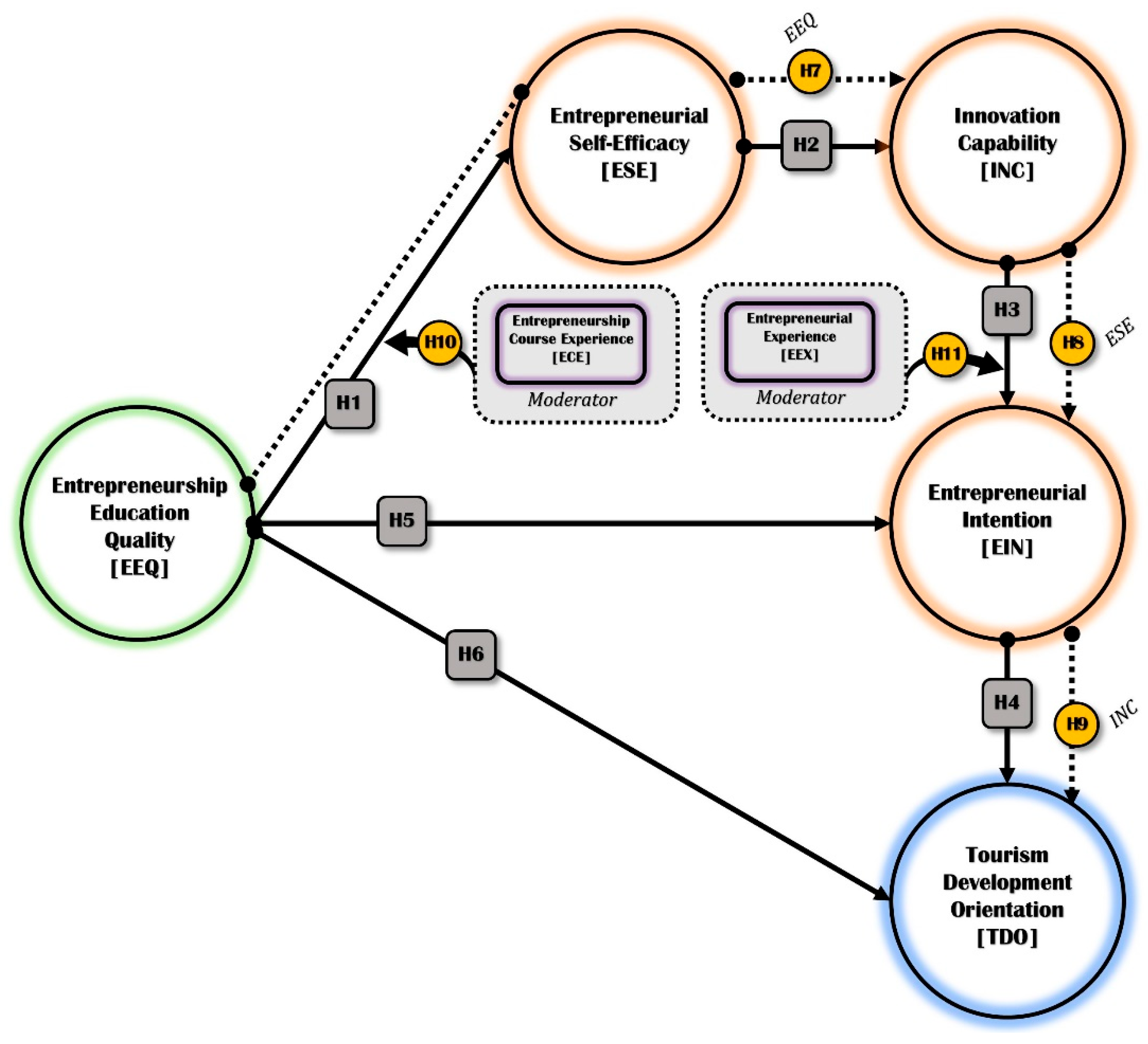
Figure 2.
Outer loading.
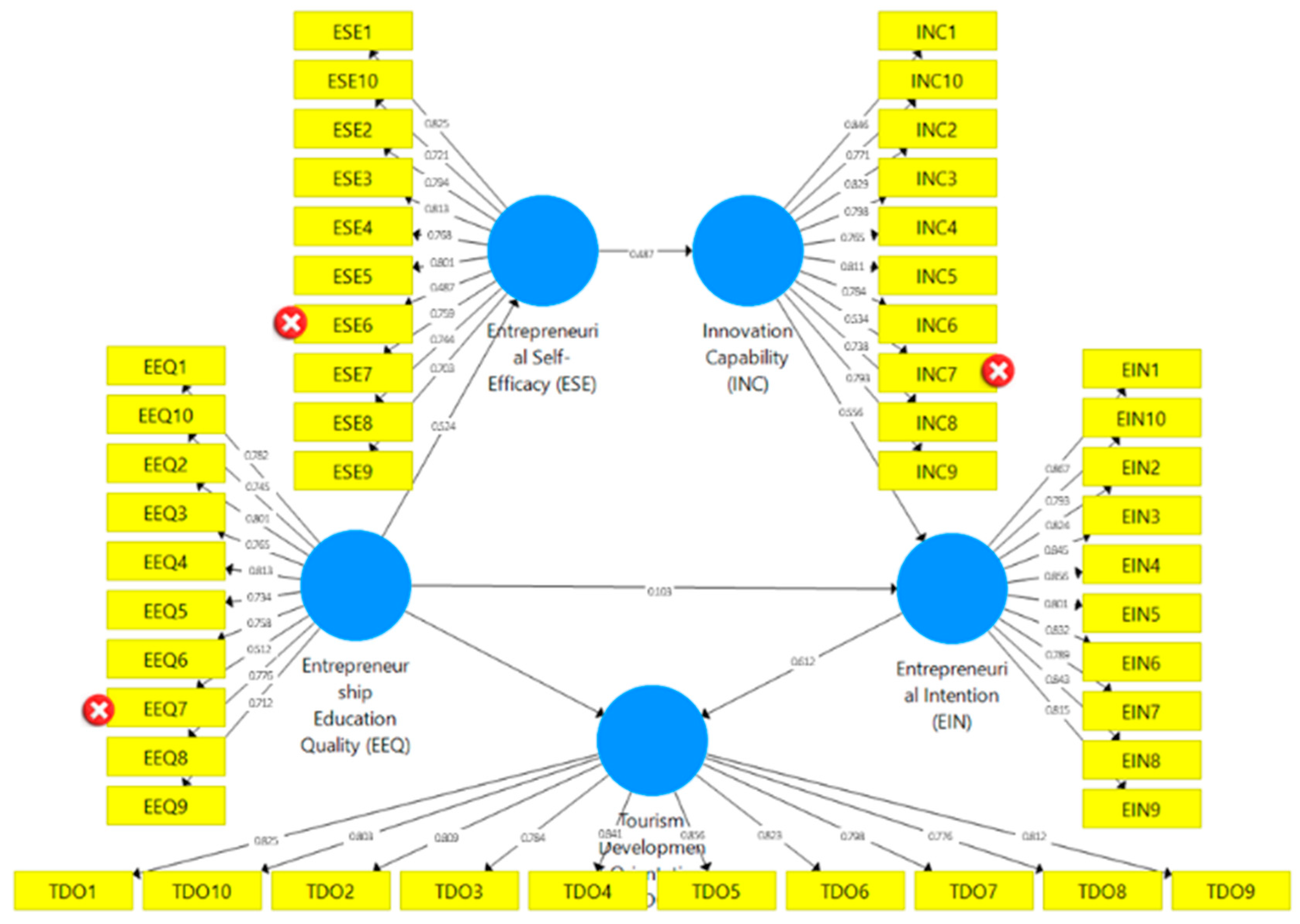
Figure 3.
VIF result.
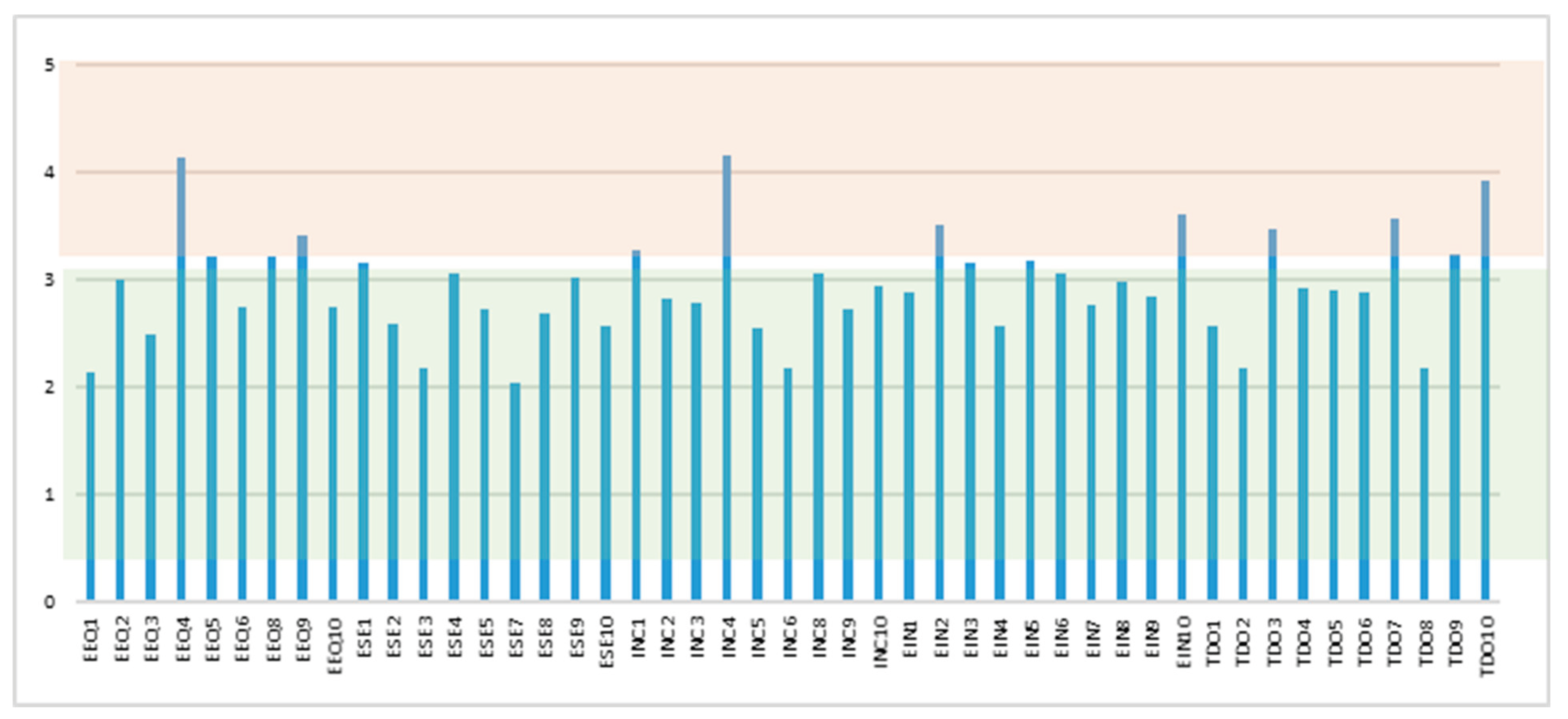
Table 3.
Construct reliabilityand validity.
| Construct | Cronbach's Alpha | rho_A | CR | AVE |
|---|---|---|---|---|
| EEQ | 0.874 | 0.881 | 0.906 | 0.615 |
| ESE | 0.891 | 0.895 | 0.918 | 0.652 |
| INC | 0.885 | 0.889 | 0.912 | 0.634 |
| EIN | 0.912 | 0.915 | 0.931 | 0.693 |
| TDO | 0.901 | 0.904 | 0.923 | 0.667 |
Table 4.
Heterotrait-Monotrait ratio of correlations.
| Construct | EEQ | ESE | INC | EIN | TDO |
|---|---|---|---|---|---|
| EEQ | - | ||||
| ESE | 0.684 | - | |||
| INC | 0.652 | 0.721 | - | ||
| EIN | 0.593 | 0.638 | 0.702 | - | |
| TDO | 0.512 | 0.547 | 0.588 | 0.745 | - |
Table 5.
Path coefficients.
| Hyp. | Path | Original Sample (O) | T Statistics | P Values | 95% CI (LL, UL) | Sig. | Decision |
|---|---|---|---|---|---|---|---|
| Direct Effect | |||||||
| H1 | EEQ → ESE | 0.524 | 8.234 | 0 | (0.412, 0.636) | *** | Supported |
| H2 | ESE → INC | 0.487 | 7.891 | 0 | (0.378, 0.596) | *** | Supported |
| H3 | INC → EIN | 0.556 | 9.123 | 0 | (0.445, 0.667) | *** | Supported |
| H4 | EIN → TDO | 0.612 | 10.456 | 0 | (0.501, 0.723) | *** | Supported |
| H5 | EEQ → EIN | 0.103 | 1.412 | 0.158 | (-0.041, 0.247) | ns | Not Supported |
| H6 | EEQ → TDO | 0.082 | 1.123 | 0.262 | (-0.062, 0.226) | ns | Not Supported |
| Mediating Effects | |||||||
| H7 | EEQ → ESE → INC | 0.255 | 5.678 | 0 | (0.167, 0.343) | *** | Supported |
| H8 | ESE → INC → EIN | 0.271 | 6.123 | 0 | (0.185, 0.357) | *** | Supported |
| H9 | INC → EIN → TDO | 0.34 | 7.456 | 0 | (0.251, 0.429) | *** | Supported |
| Moderating Effects | |||||||
| H10 | ECE × EEQ → ESE | 0.156 | 2.987 | 0.003 | (0.054, 0.258) | ** | Supported |
| H11 | EE × INC → EIN | 0.068 | 1.245 | 0.213 | (-0.039, 0.175) | ns | Not Supported |
Table 6.
Coefficient of determination (R2).
| Dependent Variable | R2 | Adjusted R2 | Interpretation |
|---|---|---|---|
| Entrepreneurial Self-Efficacy (ESE) | 0.275 | 0.268 | Moderate |
| Innovation Capability (INC) | 0.387 | 0.381 | Moderate |
| Entrepreneurial Intention (EIN) | 0.524 | 0.518 | Substantial |
| Tourism Development Orientation (TDO) | 0.612 | 0.608 | Substantial |
Table 10.
Results of necessity analysis.
| Condition | Consistency | Coverage | Status |
|---|---|---|---|
| EIN | 0.89 | 0.81 | Not necessary (approaching) |
| INC · EIN | 0.91 | 0.84 | Necessary |
| ESE · EIN | 0.9 | 0.83 | Necessary (marginal) |
| EEQ · EIN | 0.87 | 0.8 | Not necessary |
| INC | 0.85 | 0.76 | Not necessary |
| ESE | 0.82 | 0.74 | Not necessary |
| EEQ | 0.78 | 0.72 | Not necessary |
Notes: Only the combination of Innovation Capability and Entrepreneurial Intention (INC · EIN) meets the necessary condition threshold (consistency ≥ 0.90).
Table 11.
Sufficient configurations.
| Config. | Condition | Raw Consistency | PRI Consistency | Raw Coverage | Unique Coverage | Interpretation |
|---|---|---|---|---|---|---|
| C1 | EEQ · ESE · INC · EIN | 0.94 | 0.91 | 0.42 | 0.18 | Full model: all conditions present |
| C2 | EEQ · ESE · INC · ~EIN | 0.87 | 0.82 | 0.35 | 0.12 | Innovation pathway without intention |
| C3 | EEQ · ESE · ~INC · EIN | 0.85 | 0.79 | 0.31 | 0.1 | Intention pathway without innovation |
| C4 | EEQ · ~ESE · INC · EIN | 0.82 | 0.75 | 0.28 | 0.08 | Education and innovation pathway |
| C5 | ~EEQ · ESE · INC · EIN | 0.78 | 0.71 | 0.25 | 0.06 | Experiential pathway without formal education |
Disclaimer/Publisher’s Note: The statements, opinions and data contained in all publications are solely those of the individual author(s) and contributor(s) and not of MDPI and/or the editor(s). MDPI and/or the editor(s) disclaim responsibility for any injury to people or property resulting from any ideas, methods, instructions or products referred to in the content. |
© 2026 by the authors. Licensee MDPI, Basel, Switzerland. This article is an open access article distributed under the terms and conditions of the Creative Commons Attribution (CC BY) license (http://creativecommons.org/licenses/by/4.0/).
Copyright: This open access article is published under a Creative Commons CC BY 4.0 license, which permit the free download, distribution, and reuse, provided that the author and preprint are cited in any reuse.


