

Submitted:
23 April 2026
Posted:
24 April 2026
You are already at the latest version
Abstract
This paper introduces a quantitative refinement of the classical concept of differentiability within the space of real functions. Shifting the focus from the qualitative existence of the derivative to a scale-sensitive framework, we define two new invariants of the radii of differentiability: the radius of pointwise differentiability and the radius of uniform differentiability. These radii quantify the maximal horizontal scale over which the first-order Taylor approximation remains valid for a prescribed error tolerance ε. The theoretical development establishes a robust set of structural properties, including scaling laws, monotonicity, and behavior under function composition and sums. We provide a rigorous characterization of these invariants, demonstrating that the property of having an infinite radius of differentiability is uniquely characteristic of affine functions. A significant portion of the study is dedicated to the “bottleneck identity,” which reconciles local and global regularity by expressing the uniform radius as the infimum of its pointwise counterparts. Furthermore, we explore the interplay between these differentiability radii and the radius of continuity, utilizing the Fundamental Theorem of Calculus to prove that the process of integration yields a strict improvement in the local regularity profile. Finally, the utility of the proposed framework is demonstrated through explicit computations for several classes of elementary functions, including polynomials and trigonometric maps.
Keywords:
differentiability
; uniform differentiability
; epsilon-delta methods
; real functions
; quantitative invariants
MSC: 26A03; 26A06; 28A75
| “ We are servants rather than masters in mathematics.” | |
| — Charles Hermite (1822– 1901) |
1. Introduction
1.1 Real-Valued Functions and Differentiability
The modern language of differentiability emerged from nineteenth-century analysis, especially in the work of Augustin-Louis Cauchy(1789-1857) in 1823, where the derivative was formulated through the limiting behavior of the difference quotient [1] rather than through purely geometric intuition. In the present setting of real-valued functions , differentiability at a point means that the ratio [2,3,4]:
admits a finite limit as . Thus, differentiability is a local first-order approximation property: near , the graph of f is well approximated by its tangent line. In this sense, limits provide the analytic mechanism, continuity supplies zeroth-order control, and differentiability sharpens both by encoding local linear behavior.
Differentiability is therefore conceptually stronger than continuity. Indeed, differentiability at always implies continuity at , whereas the converse may fail. Moreover, the derivative extracts the instantaneous rate of change hidden in the indeterminate ratio above and thereby measures local steepness in a way that continuity alone cannot. For this reason, differentiability occupies a central position among local regularity properties of real-valued functions and naturally invites quantitative refinement beyond the usual yes-or-no formulation.
1.2 Motivation
In earlier work, the author introduced the radius of continuity as a quantitative invariant associated with the ε–δ definition of continuity, in both its pointwise and uniform forms [5]. That viewpoint replaces the purely qualitative question of whether a function is continuous with a scale-sensitive one: for a fixed tolerance ε, how large can the admissible neighborhood be made?
Given the close structural relationship between continuity and differentiability, it is natural to ask whether an analogous theory exists for first-order approximation. The present paper takes up that question by introducing the radius of differentiability in its two forms: pointwise differentiability and the radius of uniform differentiability. The goal is to determine which geometric and algebraic features of the continuity-radius theory persist in the differentiable setting, which require modification, and which reveal genuinely new phenomena. In this way, the paper continues the radius-of-continuity program at a finer level of local regularity [5,6,7], with the difference quotient replacing the zeroth-order increment as the governing object.
1.1. Organization of the Paper
The remainder of the paper is organized as follows. In Section 2 we review the required mathematical background for this study. Then, in Section 3, we introduce the radius of pointwise differentiability and the radius of uniform differentiability, develop their equivalent formulations, and establish their fundamental structural properties. We also study the relationship between the pointwise and uniform radii. Section 4 is devoted to explicit examples and concrete computations. Finally, Section 5 concludes with a discussion of the main findings and several directions for future work.
This paper is a companion sequel to the author’s earlier work on the radius of continuity [5]. Its overall structure is intentionally parallel, but the central object is now the deviation of the difference quotient from the derivative rather than the deviation of function values from a base-point value. Thus, some arguments remain formally analogous, whereas others require genuinely new ideas tied to the finer structure of differentiability.
Several results below serve as companion analogues of the continuity-radius theory. To avoid repetition, we give full proofs for the main characterization theorems and for results whose differentiability setting brings new technical features, while routine formal analogues are stated with abbreviated proofs.
2. Preliminaries
In this subsection we collect the basic notation and standard definitions and facts about real-valued functions, radius of continuity and basic definition of differentiability that will be used throughout the paper [2,3,5,8,9,10,11,12].
Definition 1
(Function Space). The function space is defined as the set of all mappings , which forms a real vector space under the operations of pointwise addition and pointwise scalar multiplication .
Remark 1.
Throughout this paper, unless explicitly stated otherwise, all functions are assumed to be defined on the real line . In instances where the same arguments remain valid on a smaller domain, the real line may be replaced by a Borel subset , such as an interval with .
Definition 2
(Radius of Pointwise Continuity). Let be a real-valued function with a nonempty set of continuity points . For and define the pointwise admissible continuity admissible radius as:
Theorem 1
(Characterization of Radius of Pointwise Continuity). Let be a real-valued function with a nonempty set of continuity points . For and the following two statements hold:
- (i)
- f is non-constant. ⇔ There is there exists such that .
- (ii)
- f is constant. ⇔ For every and every , we have .
Definition 3
(Radius of Uniform Continuity). Let be a real-valued function with a nonempty set of continuity points . For define the uniform admissible radius as:
Theorem 2
(Characterization of Radius of Uniform Continuity). Let be a real-valued function with a nonempty set of continuity points . For the following two statements hold:
- (i)
- f is non-constant. ⇔ There exists , .
- (ii)
- f is constant. ⇔ For every , we have .
Proposition 1
(Uniform Radius as the Infimum of the Pointwise Radii). Let be continuous on , and let . Then
Example 1
(Radius of Pointwise Continuity of Quadratic Polynomial). Let be the quadratic polynomial. Then:
Definition 4
(Pointwise and Uniform Differentiability). Let be a real-valued function with a nonempty set .
(i) Pointwise differentiability. Let . We say that f isdifferentiable at the point if there exists a real number such that, for every , there exists satisfying
In this case, the number A is called the derivative of f at , and we write .
(ii) Uniform differentiability. Assume that f is differentiable at every point of I. We say that f is uniformly differentiable on I if, for every , there exists such that
Definition 5
(Hermite polynomials). For , the probabilists’ () and physicists’ () Hermite polynomials are defined via:
The first few terms are and . Unless stated otherwise, we use the probabilists’ as the natural convention for Gaussian formulations.
3. The Radius of Differentiability: Definitions and General Properties
3.1. Radius of Pointwise Differentiability
In this subsection, we introduce the local radius associated with the – formulation of differentiability at a fixed point. The key idea is to treat the set of all admissible radii as a meaningful object and to extract from it a maximal radius through a supremum operation.
Definition 6
(Radius of Pointwise Differentiability). Let be a real-valued function with a nonempty set of differentiability points . For and , define the pointwise admissible differentiability-radius set by
and define the radius of pointwise differentiability by
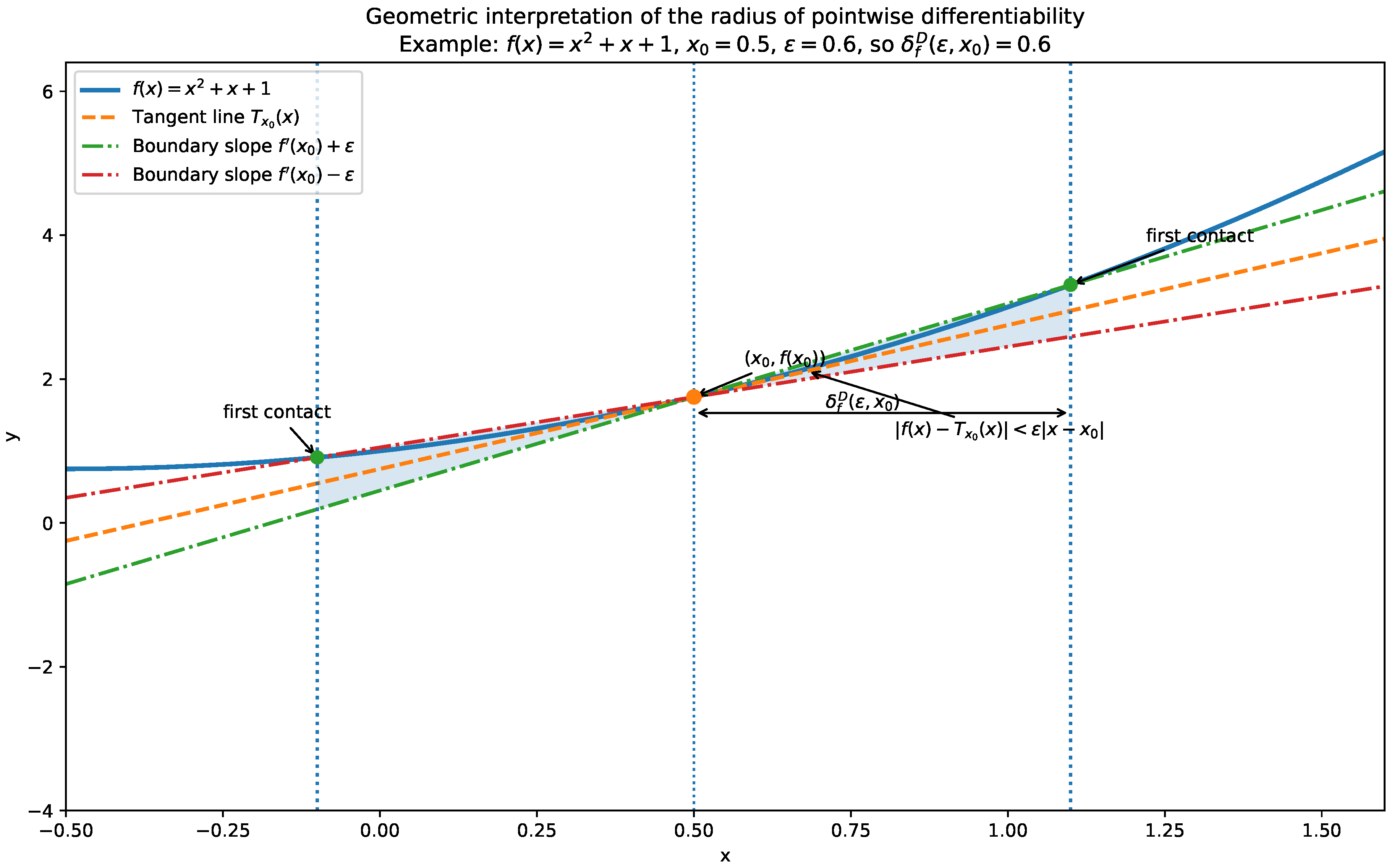
Geometric Interpretation (Pointwise)
Fix a differentiability point . The tangent line is drawn at , together with the two boundary lines of slopes . Admissible radii are those for which every secant line from to with has slope within of . Equivalently, the graph remains inside the wedge
The maximal radius is attained at the first point where the graph touches or exits this wedge.
Figure 1.
Geometric illustration of the pointwise radius of differentiability: Pointwise differentiability wedge at for with ; the first boundary contact occurs at distance .
Figure 1.
Geometric illustration of the pointwise radius of differentiability: Pointwise differentiability wedge at for with ; the first boundary contact occurs at distance .
Remark 2
(Shifted-h Formulation). For and , define the pointwise differentiability oscillation by
Then
and
Remark 3
(Difference-Quotient Interpretation). Fix , and define the difference-quotient map
Then, f is differentiable at if and only if the the extension is continuous at . Moreover, for every and every , Consequently,
Proposition 2
(Properties of Radius of Pointwise Differentiability). Let . Then, for and , the radius has the following properties.
(A) Single-function properties.
- (i)
- Evenness. If f is even, then
- (ii)
- Scaling. If , then if , then
- (iii)
- Large- for bounded derivative. If f is differentiable on for all and , then
- (iv)
- Monotonicity in . If , then
- (v)
- Input translation. If , then
- (vi)
- Local derivative-control lower bound. If is L-Lipschitz on [13], then In particular, if is globally L-Lipschitz on , then
- (vii)
- Differentiability criterion. The function f is differentiable at iff
(B) Two-function properties.
- (viii)
- Composition (one convenient bound). Assume f is differentiable at , and assume that g is differentiable on with being L-Lipschitz there. Set Then, for any ,
- (ix)
- Sum (lower bound). For and any ,
- (x)
-
Linear combination (lower bound). For and any ,with the convention from (ii) when one coefficient is 0.
- (xi)
- Product (one convenient bound). If on , then
Proof.
The proof is divided according to the listed assertions. (i). If f is even, then is odd on , and with , Taking suprema over gives hence . (ii). For , yielding so iff . Therefore If , then for all , hence . (iii). By the Mean Value Theorem, for each there exists between x and such that Therefore Thus, if , every is admissible, and hence (iv). (v). so (vi) Suppose is L-Lipschitz on . Then, for ,
Hence which implies The global version is immediate. (vii) By above Remark 3.2, iff iff (viii). Let and assume and
Then yields and hence By the Mean Value Theorem applied to g on the interval between and , there exists between and such that Therefore
Since is L-Lipschitz on , hence If, in addition,
and
then
This proves the stated lower bound. (ix). Since we obtain Therefore, if and then , and hence the assertion follows. (x). Apply (ii) to and , and then apply (ix) on its result. (xi) Assume ; if , then near and the claim is trivial. For ,
If then on , and Hence Therefore, if the three terms on the right are each , then , which yields the desired result. □
Theorem 3
(Characterization of the Radius of Pointwise Differentiability). Let be a real-valued function with . Then the following two statements hold:
- (i)
- f is non-affine. ⇔ There is there exists such that .
- (ii)
- f is affine. ⇔ For every and every , we have .
Proof.
It is sufficient to prove (ii) as (i) is its logical equivalent. It is trivial that f is affine iff is constant. Now, by Theorem 1, is constant iff for every and every . But, by Remark 3 This proves the assertion. □
3.2. Radius of Uniform Differentiability
We now pass from the local picture at a fixed base point to a global one. The purpose is to identify the largest single horizontal scale that makes the differentiability estimate work simultaneously throughout the entire domain.
Definition 7
(Radius of Uniform Differentiability). Let be a real-valued function differentiable on . For , define the uniform admissible differentiability-radius set by
and define the radius of uniform differentiability by
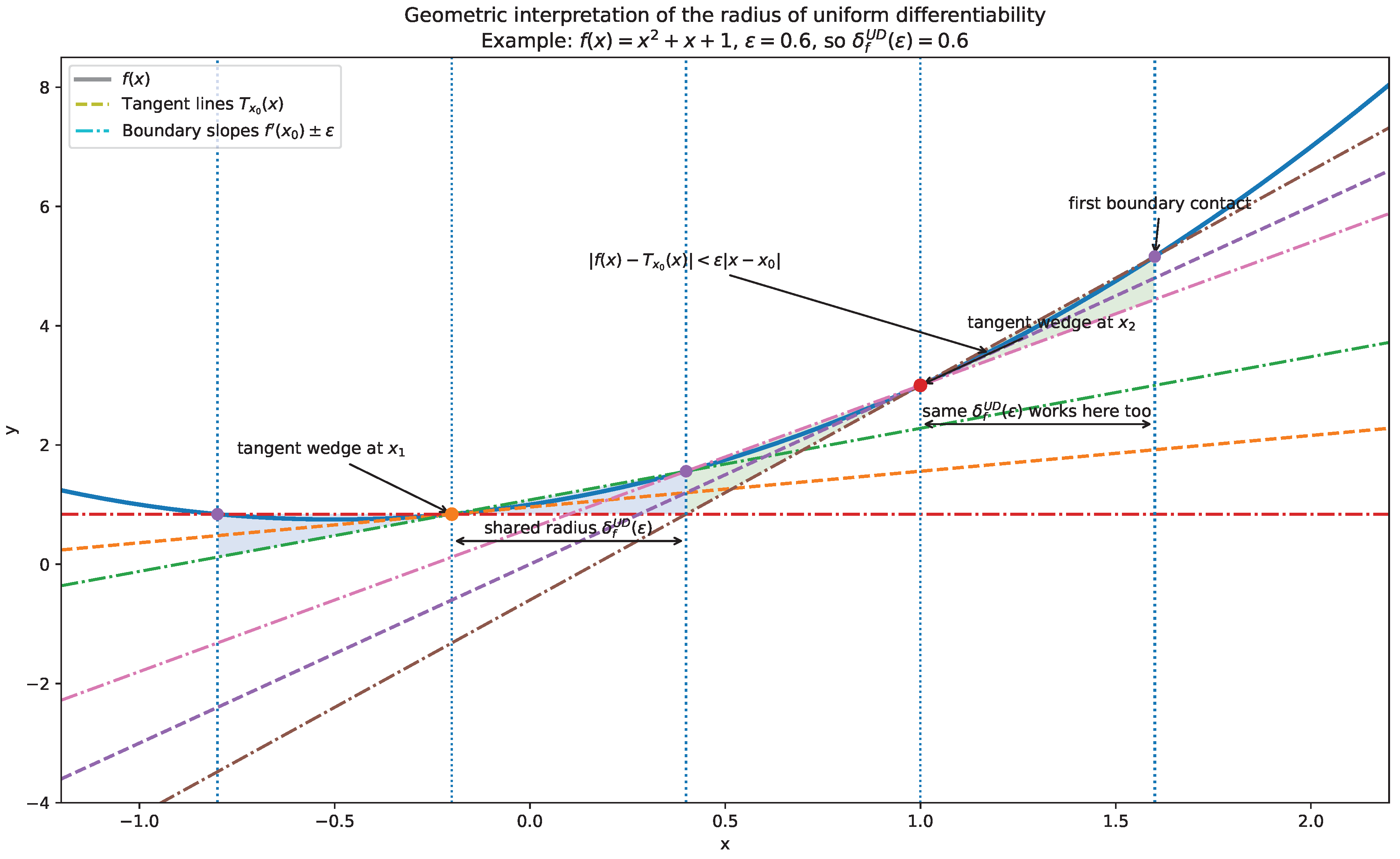
Geometric Interpretation (Uniform)
For each base point , the graph of f is compared with its tangent line . The admissible region is the wedge bounded by the two lines of slopes . A radius is admissible if, for every , all secant lines from to nearby points with have slope within of . Equivalently, the graph satisfies
The uniform radius is the largest common radius for which this holds simultaneously at every base point.
Figure 2.
Geometric illustration of the uniform radius of differentiability: Uniform differentiability wedges for with ; the common first boundary contact distance is .
Figure 2.
Geometric illustration of the uniform radius of differentiability: Uniform differentiability wedges for with ; the common first boundary contact distance is .
Remark 4
(Shifted-h Formulation). Define the uniform differentiability oscillation by
Then
and
Remark 5
(Uniform Difference-Quotient Profile Interpretation). Let be differentiable on , and define the worst-case difference-quotient error profile by Then, f is uniformly differentiable on if and only if is continuous at 0. Moreover, for every , Consequently,
Proposition 3
(Properties of Radius of Uniform Differentiability). Let be differentiable on . Then, for , the radius of uniform differentiability has the following properties.
(A) Single-function properties.
- (i)
- Scaling. If , then if , then
- (ii)
- Monotonicity in . If , then
- (iii)
- Translation/reflection invariance. If or , then
- (iv)
- Large- for bounded derivative. If everywhere and , then
- (v)
- Lipschitz lower bound on the derivative. If is globally L-Lipschitz on , then
- (vi)
- Uniform differentiability criterion. The function f is uniformly differentiable on iff
- (vii)
- Link to pointwise differentiability radii.
(B) Two-function properties.
- (viii)
- Composition. Assume and on , with , and assume that admits a global modulus η, that is, Then, for any ,
- (ix)
-
Sum (lower bound). For and any ,There is no universal matching upper bound; for example, one may take and .
- (x)
-
Linear combination (lower bound). For and any ,with the convention from (i) when a coefficient is 0.
- (xi)
- Product (one convenient global bound). If , , , and on , with , then for any with ,
Proof.
The proof is divided according to the listed assertions. (i). hence If , then the oscillation is identically zero. (ii). Given we have Taking suprema yields the result. (iii). If , then so the corresponding oscillations agree. If , then and taking absolute values and suprema again yields the same oscillation. (iv). By the Mean Value Theorem, for each and , there exists between x and such that Therefore Hence, if , every is admissible, so the assertion follows. (v). Since is globally L-Lipschitz, for every and ,
Thus every is admissible or (vi). This is exactly the definition of uniform differentiability. (vii). If then, fixing any , yields , hence ; take sups and then the infimum over . (viii). Let . By the chain rule, and
Since , the Mean Value Theorem gives Thus, if
then and hence Multiplying by yields a contribution . Also, if
then so Summing the two bounds proves the claim. (ix). Given, Now, applying the triangle inequality and splitting into and gives the stated lower bound. (x). Apply (i) to and , and then apply (ix) to obtain the plausible assertion. (xi). For , Subtracting yields
Now , , and by the Mean Value Theorem, Hence, if
then the three terms are bounded respectively by respectively. Adding them gives which proves the result. □
Theorem 4
(Characterization of the Radius of Uniform Differentiability). Let be differentiable on . Then the following two statements hold:
- (i)
- f is non-affine on . ⇔ There exists such that
- (ii)
- f is affine on . ⇔ For every , one has
Proof.
It is sufficient to prove (ii) as (i) is its logical equivalent. We provide two proofs for (ii).
- Proof(1) for (ii)
It is trivial that f is affine iff vanishes identically. Next, by Theorem 1, and the definition of in the Remark 5, is constant zero (and poinswise continuous at ) iff for every . But, by Remark 5, for every This completes the proof.
- Proof(2) for (ii)
Assume first that f is affine on . Since f is differentiable on , we have . Hence, by Theorem 3(ii), for every and every , we have Therefore, for every , we have Applying Proposition 4, for every , we obtain
Conversely, assume that for every , we have Suppose, toward a contradiction, that f is non-affine on . Then, by Theorem 3(i), there exist and such that Now Proposition 4 yields which contradicts the original assumption. Hence f must be affine on .
□
3.3. Connection Between the Pointwise and Uniform Radii of Differentiability
The pointwise and uniform radii introduced above are local and global versions of the same quantitative phenomenon. We now clarify their precise relationship.
Lemma 1 (Downward Closedness of Admissible Radius Sets).
Let , let , and let . Then
and
In particular, both admissible-radius sets are downward closed.
Proof. Suppose and . If , then automatically . Since is admissible, it follows that Hence , proving (19).
The proof of (20) is identical. Suppose and . If , then , and therefore for every , we have Thus . □
Lemma 2 (Uniform Admissible Radius as an Intersection).
Let be differentiable on , and let . Then
Proof. First, let . Then by definition, for all and all , whenever we have Fix any . If , then setting gives which shows that . Since was arbitrary, we have Therefore
Conversely, let Then for every we have . Now take arbitrary and with . Since , choosing in the role of the nearby point gives Hence . Therefore
Proposition 4 (Uniform Radius as the Infimum of the Pointwise Radii).
Let be differentiable on , and let . Then
In particular, the radius of uniform differentiability is the global bottleneck among the pointwise differentiability radii.
Proof. By Lemma 2, we have Hence, for every , we have Next, taking suprema in both sides, we obtain and therefore
For the reverse inequality, set Let . Then for every , we have Since f is differentiable on , each set is nonempty. Hence for every there exists such that . By Lemma 1, the set is downward closed, so from and we conclude that Therefore, by Lemma 2. Since this holds for every , we obtain
Corollary 1 (Consequences of the bottleneck identity).
Let be differentiable on , and let . Then the following statements hold.
- (i)
-
If there exist and a sequence such thatthenand consequently f is not uniformly differentiable on .
- (ii)
-
If for every there exists a positive function such thatthenand hence f is uniformly differentiable on .
- (iii)
-
If for some there exists such thatthenIn this situation, the point may be interpreted as a differentiability bottleneck at scale ε: the local first-order approximation of f at determines the global uniform differentiability radius.
- (iv)
-
Whenever the map is available in explicit form, the corresponding uniform radius may be recovered from the one-dimensional optimization formulaThus the global problem of finding a single admissible differentiability radius reduces to minimizing the pointwise differentiability radius over the base point.
Proof. Each claim follows directly from Proposition 4. Indeed, parts (i), (ii), and (iv) are obtained by taking the infimum of the family , while part (iii) corresponds to the special case in which that infimum is attained at a point . □
Example 2 (Application of part (i): detecting failure of uniform differentiability).
Let . Fix and a base point . For and , we have Therefore every satisfying is admissible, and the maximal one is Now choose . Then By part (i), we have so is not uniformly differentiable on .
Example 3 (Application of part (ii): proving uniform differentiability from a global lower bound).
Let . For , we have Since for all , it follows that Consequently, every is admissible at every base point x, and hence Part (ii) now yields which shows that is uniformly differentiable on .
Example 4 (Application of part (iii): a bottleneck point may be attained, and need not be unique).
Let . Then for every and every , we have precisely when . Therefore Hence the infimum is attained at every base point; in particular, one may take . By part (iii), we have So, in this case, the differentiability bottleneck is completely flat: no single point is more restrictive than another.
Example 5 (Application of part (iv): computing the uniform radius from an explicit pointwise formula).
Let . Then , and for every and , we have if and only if . Hence the pointwise differentiability radius is explicitly given by Applying part (iv), we obtain Thus the global uniform radius is recovered immediately by minimizing the explicit pointwise formula.
3.4. Connection Between the Radius of Differentiability and the Radius of Continuity
The radii of continuity and differentiability introduced in previous paper and this paper are associated for specific classes of the functions.
Proposition 5 (Pointwise differentiability radius of the antiderivative).
Let be continuous, and define
- (i)
- for every
- (ii)
- for every
Proof. The proof is divided according to the listed assertions. (i). Fix and . Take any with . By the Fundamental Theorem of Calculus,
Hence:
Now every point t between and x satisfies Since , we have Thus
So , proving Taking suprema yields the plausible result. (ii). There are two proofs for this part.
- Proof(1) for (ii)
This is indeed parallel to the proof in (i). Again, by the Fundamental Theorem of Calculus, and similar arguments on integral inequalities as in part (i), for any , we have , proving Taking suprema yields the plausible result.
- Proof(2) for (ii)
By part(i), for every ; hence, taking infima over , we obtain . Using the infimum characterizations of the uniform radii in Proposition 1 and Proposition 4, it follows that
as claimed. □
Remark 6. In general, the inequalities above are not equalities. For example, on , let . Then Fix . For , one has whereas so Likewise, for , Thus the Fundamental Theorem of Calculus yields a comparison principle, but not an exact identity in general.
Remark 7. When f is a constant function, both inequalities in Proposition 5 become equalities as by Theorem 1(ii) and Theorem 2(ii):
- (i)
- for every
- (ii)
- for every
Next, we prove that, at the pointwise level, finite equality is impossible: whenever the pointwise continuity radius of f is finite and positive, the corresponding pointwise differentiability radius of its antiderivative is necessarily strictly larger. Thus the averaging mechanism built into the Fundamental Theorem of Calculus produces a genuine improvement except in the trivial infinite-radius case.
Proposition 6 (Strict Improvement at Every Finite Pointwise and Uniform Radii of Differentiability).
Let be continuous, and define
- (i)
- Fix and . If then
- (ii)
- Fix . If then
Proof. The proof is divided according to the listed assertions. (i). Here, we outline the proof in four stages as follows: Stage 1: Boundary Property of .
Set . By definition, for all x such that . Since f is continuous on , taking the limit as ensures that the non-strict inequality holds on the closed set .
Stage 2: FTC and Difference Quotient Representation.
Define and for . By the Fundamental Theorem of Calculus, . For any , we express the error as an integral average:
Stage 3: Strict Inequality via Integral Averaging.
For all , we have . Furthermore, since , continuity implies there exists a neighborhood around where the integrand is strictly less than . Averaging a function that is everywhere and strictly on a sub-interval of positive length yields for all .
Stage 4: Topological Extension to .
Because f is continuous, is continuous on the compact set . Since on , its maximum M satisfies . The set is open and contains ; thus, there exists some such that U includes a -neighborhood of or equivalently . Therefore, , concluding .
(ii). Here, we outline the proof in four stages as follows:
Stage 1: Boundary Property of the Uniform Radius.
Let . By definition, for all with . Since f is continuous on the compact interval , this inequality extends to the boundary: for all pairs in the closed set .
Stage 2: Representation of the Error Function .
Define for and . Since , is continuous on . Using the Fundamental Theorem of Calculus (), we express the error as an integral average:
Stage 3: Uniform Strict Inequality via Averaging.
Since f is continuous on , it is uniformly continuous. Thus, there exists such that . For any with , the integrand is on the whole interval and strictly on a sub-interval of length at least . This forces the average to be strictly less than :
Stage 4: Topological Extension to .
Because is continuous and on the compact set , its maximum M on satisfies . The set is open and contains . By the properties of compact sets in metric spaces, there exists such that the -neighborhood of is contained in U. This implies for all , hence . Thus, . □
Corollary 2 (Equality occurs only in the infinite-radius case).
Let be continuous, and define
Then:
- (i)
- For every and every , the equality is impossible.
- (ii)
- For every , the equality is impossible.
Proof. This follows immediately from the preceding Proposition 6, since for all and , and for all . □
4. Examples and Explicit Computations
This section illustrates the general theory by working out explicit formulas for selected families of differentiable functions. These examples are intended to show how the abstract radius framework translates into concrete computations and geometric interpretations.
4.1. Radius of Pointwise Differentiability
Example 6 (Polynomial Reduction from Pointwise Differentiability to Pointwise Continuity).
Let be a polynomial of degree . Fix and . Then, for every :
Define for
Now observe that for every ,
Therefore the admissible-radius sets for pointwise differentiability of and pointwise continuity of at coincide, i.e., Hence their radii are exactly equal:
Thus, the radius of pointwise differentiability of a degree-n polynomial is reduced exactly to the radius of pointwise continuity of an explicitly associated polynomial of degree . In particular, for the cases n = 1, 2, 3 using Example 1 we have:
Example 7 (Hermite Polynomials of Degrees ).
We consider the first three Hermite polynomials. First, for the physicists’ Hermite polynomials, by Example 6, for each we form the associated polynomial and then compute using Example 1 as in:
(i) Degree 1:
(ii) Degree 2:
(iii) Degree 3:
Second, for probabilists’ Hermit polynomials, with similar computations to the case of physicists’ polynomials, we have:
(i) Degree 1:
(ii) Degree 2:
(iii) Degree 3:
Example 8 (Homographic function on the right branch).
Let and assume Consider the right branch of f, namely the interval and let . We compute the radius of pointwise differentiability for f in terms of Δ status. Indeed, if , then f is constant, and hence
Assume now that . By a simple algebraic decomposition, Therefore, if we define then on the right branch we may write Using the input-translation and scaling properties of in Proposition 2, we obtain
Set Since , we compute For , the largest value occurs on the negative side, so Thus if and only if which is equivalent to Now, it follows that Substituting back yields:
4.2. Radius of Uniform Differentiability
Example 9 (Polynomials of Degree at Least Three Are Not Uniformly Differentiable on ).
Let Fix . By Example 6, for every and every , we have Write . Then Hence, whenever , the reverse triangle inequality gives
where
Now let . Since while for every , we have Thus, for all sufficiently large N, one has and Taking , the preceding estimate yields Therefore no admissible differentiability radius at level ε and base point N can exceed , so Finally, by Proposition 4, we have Since , it follows that Hence is not uniformly differentiable on .
Example 10 (A Taylor Lower Bound for the Radius of Uniform Differentiability).
Let be twice differentiable, and assume that Then, for any and any , Taylor’s theorem with Lagrange remainder gives for some between x and . Dividing by h and subtracting , we obtain Hence, whenever it follows that Therefore,
In particular, for the trigonometric function we have: Furthermore, Table 1 presents the lower bound of radius of uniform differentiability for five prominent probability density distributions:
Example 11 (Homographic Function Are Not Uniformly Differentiable on the Right Branch).
Let and set Consider the right branch of f, namely We compute the readious of uniform differentiability of f in terms of Δ status. Indeed, if , then f is constant, since and therefore
Assume now that . By the pointwise formula established earlier in equality (44) the interval version of Proposition 4, we obtain:
Thus every non-constant homographic function has vanishing radius of uniform differentiability on its full right branch and is not uniformly differentiable on it.
5. Discussion
5.1. Summary of the Radius-of-Differentiability Viewpoint
In this paper, we introduced two quantitative invariants associated with the – formulation of differentiability: the pointwise radius and the uniform radius . These quantities refine the classical yes-or-no notion of differentiability by measuring the largest spatial scale on which the first-order approximation remains valid within tolerance . The theory developed in Section 3 shows that these radii admit equivalent formulations in terms of oscillation functions and auxiliary difference-quotient profiles. In particular, Proposition 4 gives the identity
showing that the radius of uniform differentiability is determined by the global bottleneck among the pointwise radii. The characterization theorems further show that affine functions are precisely those for which all differentiability radii are infinite.
The examples in Section 4 illustrate several distinct behaviors. Affine functions have infinite radii, while quadratic and Gaussian-type examples admit explicit formulas or bounds. By contrast, higher-degree polynomials and non-constant homographic functions on their full branches have vanishing uniform radius. Altogether, these examples indicate that the proposed radii capture a meaningful intermediate layer between mere differentiability and stronger global regularity.
5.2. Relation to Classical Differentiability, Moduli, and -Regularity
Conceptually, the radius-of-differentiability viewpoint provides a quantitative refinement of classical differentiability. Instead of asking only whether the difference quotient converges to , it asks how far from that approximation remains accurate for a prescribed error level.
The results also show that regularity of the derivative controls the size of the admissible radii. In particular, Propositions 2 and 3 show that Lipschitz control of yields explicit lower bounds for both the pointwise and uniform radii. This places the theory naturally near the setting and connects it with classical moduli of continuity and smoothness; see, for example, [6,7,14,15].
Another important feature is the link with the radius of continuity established in SubSection 3.4 [5]. For antiderivatives, the Fundamental Theorem of Calculus yields lower bounds from continuity radii to differentiability radii, while Proposition 6 shows that strict improvement occurs at every positive finite radius. Thus, the present invariant fits naturally into a broader family of scale-sensitive quantities in analysis.
5.3. Future Work
Several directions remain open. A first one is the development of higher-order radii based on Taylor expansions and remainder terms. Such a theory may lead to a hierarchy of scale parameters measuring the validity of higher-order approximation. A second direction is to extend the theory from first-order differentiability to the infinitely differentiable setting . For each , one may define the nth radius of differentiability by
whenever exists. This produces a sequence of radius functions
whose behavior may itself be studied as . In particular, it would be natural to investigate their pointwise, uniform, or local-uniform convergence as a sequence of functions of , and to determine whether their asymptotic behavior reflects deeper regularity properties of f, such as smoothness, analyticity, or eventual rigidity. A third direction is the study of the functions and themselves, including their asymptotic behavior for small or large . A fourth direction is to relate these radii more systematically to standard regularity classes, such as Hölder, Lipschitz, and spaces [13,16]. Finally, the framework should be extended to broader settings, including multivariate functions, metric and normed spaces, and Banach-space formulations [15,17], together with explicit computations for wider classes of elementary, oscillatory, and probabilistic functions.
Funding
This research received no external funding.
Funding
This research received no external funding.
Conflicts of Interest
The author declares no conflicts of interest.
References
- Cauchy, A.-L. (1823). Résumé des leçons données à l’École Royale Polytechnique sur le calcul infinitésimal. Debure Frères. https://gallica.bnf.fr/ark:/12148/bpt6k90196z.
- Abbott, S. (2015). Understanding analysis (2nd ed.). Springer. [CrossRef]
- Tao, T. (2016). Analysis I (3rd ed.). Hindustan Book Agency; Springer. [CrossRef]
- Pugh, C. C. (2015). Real mathematical analysis (2nd ed.). Springer. [CrossRef]
- Soltanifar, M. What is the radius of continuity in the function space (,) ? Preprints 2026. [Google Scholar] [CrossRef]
- Soltanifar, M. An atlas of epsilon-delta continuity proofs in function space (,). Preprints 2025. [Google Scholar] [CrossRef]
- Soltanifar, M. A classification of elements of function space (,). Mathematics 2023, 11(17), 3715. [Google Scholar] [CrossRef]
- Rudin, W. (1976). Principles of mathematical analysis (3rd ed.). McGraw-Hill.
- Aksoy, A. G., & Khamsi, M. A. (2010). A problem book in real analysis. Springer. [CrossRef]
- Axler, S. (2020). Measure, integration & real analysis. Springer. [CrossRef]
- Hermite, C. Sur un nouveau développement en série de fonctions [On a new development in function series]. Comptes rendus hebdomadaires des séances de l’Académie des sciences 1864, 58, 93–100, 266–273, Collected in Œuvres II, 293–308. [Google Scholar]
- Apostol, T. M. (1974). Mathematical analysis (2nd ed.). Addison-Wesley.
- Cobzaş, Ş., Miculescu, R., & Nicolae, A. (2019). Lipschitz functions (Vol. 2241). Springer. [CrossRef]
- Shen, J., Tang, T., & Wang, L.-L. (2011). Spectral methods: Algorithms, analysis and applications (Vol. 41). Springer. [CrossRef]
- Heinonen, J. (2001). Lectures on analysis on metric spaces. Springer. [CrossRef]
- DeVore, R. A., Lorentz, G. G., & Makovoz, Y. (1996). Constructive approximation (Vol. 304). Springer. https://link.springer.com/book/9783642646102.
- Megginson, R. E. (1998). An introduction to Banach space theory (Vol. 183). Springer. [CrossRef]

Table 1.
The lower bound for the radius of uniform differentiability for five prominent probability density functions
Table 1.
The lower bound for the radius of uniform differentiability for five prominent probability density functions
| # | Distribution | Parameters | Density | Rad.Unif.Diff.LB | |
|---|---|---|---|---|---|
| 1 | Normal | ||||
| 2 | Student-t | ||||
| 3 | Cauchy | ||||
| 4 | Logistic | ||||
| 5 | Gumbel |
Disclaimer/Publisher’s Note: The statements, opinions and data contained in all publications are solely those of the individual author(s) and contributor(s) and not of MDPI and/or the editor(s). MDPI and/or the editor(s) disclaim responsibility for any injury to people or property resulting from any ideas, methods, instructions or products referred to in the content. |
© 2026 by the authors. Licensee MDPI, Basel, Switzerland. This article is an open access article distributed under the terms and conditions of the Creative Commons Attribution (CC BY) license (http://creativecommons.org/licenses/by/4.0/).
Copyright: This open access article is published under a Creative Commons CC BY 4.0 license, which permit the free download, distribution, and reuse, provided that the author and preprint are cited in any reuse.


