

Submitted:
22 April 2026
Posted:
24 April 2026
You are already at the latest version
Abstract
Background: Mental health problems often begin in adolescence, yet early detection and intervention remain limited. This study assesses the prevalence of psychological distress and its correlates among high-school students in Makkah, Saudi Arabia, and explores whether specific symptom clusters of depression, anxiety and bipolar/mania can be identified using the General Health Questionnaire‑30 (GHQ‑30). Methods: A cross‑sectional survey was conducted during the 2025–2026 academic year using stratified cluster sampling. A total of 535 students aged 15‑18 years completed a questionnaire containing the validated Arabic GHQ‑30 and demographic, socioeconomic and lifestyle items. The GHQ‑30 was scored with binary 0‑0‑1‑1 scoring (cut‑off ≥ 6) to define cases of psychological distress. Item clusters were used to screen for probable depression, anxiety and bipolar/mania. Descriptive statistics characterized the sample. Associations were examined using chi‑square tests and multivariable logistic regression. Results: Overall, 70.5 % of participants screened positive for psychological distress. The prevalences of probable depression, anxiety and bipolar/mania were 33.1 %, 28.2 % and 31.2 %, respectively. In adjusted models, female gender, insufficient sleep, lack of physical activity and exposure to bullying were associated with increased odds of psychological distress; longer sleep was protective. History of mental health conditions was a strong predictor of probable depression, whereas medication use was protective. Older age and higher paternal education were protective for anxiety. Bullying was the most consistent predictor across all symptom clusters. Conclusions: Psychological distress is highly prevalent among Makkah high-school students. Key determinants include gender, sleep duration, lack of physical activity and bullying. Routine school‑based mental health screening, sleep‑hygiene education, anti‑bullying initiatives and early referral pathways are warranted. Further research should examine and validate GHQ‑30 item clusters for specific disorders.
Keywords:
adolescent mental health
; psychological distress
; GHQ-30
; school-based screening
; highschool students
; Saudi Arabia
; bullying
; sleep duration
; physical activity
; cross-sectional study
Introduction
Adolescent mental health has become a critical public health priority worldwide. According to the World Health Organization (WHO), around one in seven adolescents experiences a mental health disorder and suicide is among the leading causes of death for this age group [1]. Untreated mental health conditions in adolescence can continue into adulthood, underscoring the need for early detection [1]. Early identification and intervention may mitigate long-term negative consequences, including substance misuse, social withdrawal and academic underachievement [2,48]. Adolescence is a formative developmental period in which rapid physical, emotional and social changes—including exposure to poverty, abuse or violence—heighten vulnerability to psychological problems [1].
Most mental health disorders emerge in adolescence; nearly half of all disorders begin by age 14 and many cases go unrecognized until adulthood [2,48]. Because serious psychiatric conditions often start before adulthood, focusing on high-school students (15–18 years) allows screening and intervention during a critical developmental stage [1,48].
Screening instruments such as the General Health Questionnaire (GHQ) and the Strengths and Difficulties Questionnaire (SDQ) are widely used to identify psychological distress in non-clinical adolescent populations [3,4]. The GHQ-30, in particular, demonstrates high reliability and sensitivity across diverse settings [5,6]. It has been validated in Arabic-speaking populations and shows excellent internal consistency and appropriate thresholds when scored using the binary method [8]. In this study, psychological distress is defined using the GHQ-30: respondents scoring six or more on the binary-scored GHQ-30 are considered to screen positive for distress.
Existing evidence from Arab countries indicates that between one-quarter and two-fifths of adolescents experience significant psychological distress, influenced by socioeconomic status and academic stress [9,10]. Saudi-specific studies report comparable rates. For instance, AlYousefi and colleagues identified depression risk factors such as poor parent–child communication and social isolation among Riyadh adolescents [11], while Khan and co-authors documented high levels of depression, anxiety and obsessive-compulsive symptoms among secondary students in the Al-Hasa region [12].
To date, no study has applied the Arabic GHQ-30 to high-school students in Makkah city. Cultural norms, socioeconomic variability and educational contexts in Makkah may uniquely shape adolescent distress patterns. This study addresses that gap by estimating the prevalence of psychological distress (GHQ-30 score ≥ 6) and examining demographic, socioeconomic and academic correlates among high-school students in Makkah.
In addition to measuring overall distress, we explored GHQ-30 item-level clusters to screen for probable depression, anxiety and bipolar tendencies. Although the GHQ-30 is not a diagnostic tool, factor analyses suggest that its items group into dimensions such as depression, anxiety and social dysfunction [5,6,28]. Bipolar disorder often manifests during adolescence, with community prevalence estimated at about 1–2% [19,20]. By examining item clusters, we aim to identify students who may be at elevated risk for depressive, anxious or manic-like symptoms. These clusters are exploratory and are intended to flag individuals who may require further clinical assessment rather than to diagnose specific disorders.
Research Aims
The aims of this study were to assess the prevalence of psychological distress among high-school students in Makkah using the validated Arabic GHQ-30, to identify demographic, socioeconomic, and school-related factors associated with psychological distress, and to explore the use of GHQ-30 item clusters to screen for probable depression, anxiety, and bipolar tendencies.
Methodology
Study Design
This cross-sectional survey was conducted among high-school students in Makkah during the 2025–2026 academic year and is reported in accordance with the STROBE guidelines to ensure methodological quality.
Study Population
Eligible participants were students aged 15–18 years who were enrolled in one of the selected high schools and were able to read and write in Arabic. Students who were absent on the scheduled data collection day were excluded, as were those who did not provide assent or whose parent or guardian did not provide consent. Questionnaires with more than 20% missing GHQ items were considered incomplete and were excluded from the analysis.
Sample Size Calculation
The minimum sample size required to estimate a 40.1% prevalence of psychological distress with 95% confidence and a 5% margin of error was 368.4 students. Applying a design effect of 1.5 for cluster sampling increased this to 553. Consistent with methodological guidance that surveys should recruit 20–30% more subjects to compensate for potential non-response and missing data, an additional 10% allowance was added, yielding a target sample of 609 students. In practice, 535 questionnaires were returned and included in the analysis. This represents an 87.8% response rate, which falls within the anticipated non-response range and preserves sufficient statistical power for the planned analyses.
Sampling Strategy
According to the Ministry of Education, there are about 105 high schools in Makkah (55 for boys and 50 for girls) across public and private sectors [13]. We employed a stratified random cluster sampling strategy to ensure representation across gender and school sector. The sampling frame was stratified into four categories (boys-public, boys-private, girls-public, girls-private). From each stratum, one school was randomly selected. Within each selected school, two class sections from each of grades 10, 11 and 12 were randomly chosen; all students in the selected sections were invited to participate. This two-stage cluster design was chosen to enhance logistical feasibility while preserving representativeness.
Data Collection Tools
- General Health Questionnaire (GHQ-30):
We used the validated Arabic version of the GHQ-30. This self-administered screening tool comprises 30 items scored using the binary method (0-0-1-1), yielding a total score between 0 and 30 [3]. The Arabic version has demonstrated high internal consistency (Cronbach’s α ≈ 0.93) and test–retest reliability in primary care populations [8]. Permission to use this version was obtained from its original Arabic-language validators [8]. Respondents scoring six or more on the GHQ-30 were considered to screen positive for psychological distress.
- 2.
- Demographic and Socioeconomic Questionnaire:
A custom questionnaire captured demographic and socioeconomic data. Its items were informed by factors previously linked to adolescent mental health—including parental education, family income, household size, academic performance, sleep patterns, physical activity and bullying—based on regional studies [21,22,23,24]. Content validity was reviewed and approved by a consultant child psychiatrist.
Data Collection Procedure
Data were collected using paper-based forms during school hours. A trained data collector administered the questionnaires in the classroom; signed parent consent forms were distributed to the selected students a day before the survey and collected at the start of the session. The teacher assisted with classroom management but did not view students’ responses. Sufficient time (~ 30–40 minutes) was provided.
To ensure confidentiality, all survey responses were anonymized using unique codes without names or identifiers. Students who wish to receive their results may voluntarily provide their name and contact information on a separate form attached to the questionnaire. This information was stored securely and separately by the Principal Investigator (PI) and used solely to send individual results. It will not be accessible to other researchers or included in data analysis.
All identifiable data were securely destroyed after results were shared. Electronic files were password-protected, and paper records were stored in a locked cabinet for the duration required by institutional policy.
Statistical Analysis
The GHQ-30 can be scored using either the binary 0-0-1-1 “GHQ” method or Likert scoring. The test publisher notes that thresholds depend on the population and context; for the GHQ-30, there is no universal default, and users are advised to select a threshold based on prior research [5,8]. Suggested binary thresholds for the GHQ-30 range from 4/5 to 6/7. A validation study of the Malay GHQ-30 found that a cut-off of 5/6 (≥6) achieved high sensitivity (87.5%) and specificity (80.6%) for detecting psychological distress. Given the expected high prevalence of distress in adolescents and the need to reduce false-positive results, we adopted a threshold of ≥6, consistent with this validation study and with recommendations from the GHQ manual and WHO-related work suggesting that the optimal threshold may lie between 5/6 and 6/7. This threshold has also been used in Arabic-speaking populations and is appropriate for screening purposes [5,8].
Although the GHQ-30 yields an overall distress score, factor-analytic studies have shown that its items cluster into dimensions resembling depression, anxiety, interpersonal dysfunction, and related constructs. For example, a large Japanese population study identified factors labelled depression, anxiety and tension, anergia, interpersonal dysfunction, difficulty in coping, insomnia, anhedonia, and social avoidance. Similarly, factor analyses in student samples have reported components such as general dysphoria, social functioning, depressive thoughts, and insomnia. Building on this evidence, and on the four subscales established for the related GHQ-28 (somatic symptoms, anxiety/insomnia, social dysfunction, and severe depression), we grouped GHQ-30 items into exploratory clusters reflecting depressive, anxious, and bipolar/mania-related symptoms. This clustering was intended to screen for probable symptom patterns rather than to diagnose specific disorders [5,6,28].
Accordingly, GHQ-30 items were grouped into three exploratory symptom clusters. The depression cluster comprised nine items (16, 17, 22, 23, 24, 25, 26, 27, and 29), the anxiety cluster comprised ten items (1, 2, 3, 14, 15, 18, 19, 21, 28, and 30), and the bipolar/mania cluster comprised four items (3, 14, 28, and 30). Cut-offs for positive screens were defined as five or more for depression, six or more for anxiety, and three or more for bipolar/mania. Each cluster score was calculated by summing the binary-scored responses to the corresponding items. These exploratory subscales were used only to identify probable symptom patterns and should not be interpreted as diagnostic measures.
Data were entered and analysed using IBM SPSS Statistics for Windows, version 28.0 (IBM Corp., Armonk, NY, USA). Completeness checks were performed before analysis. Descriptive statistics were used to summarise participants’ sociodemographic and behavioural characteristics. Categorical variables were expressed as frequencies and percentages, whereas continuous variables were summarised using mean ± standard deviation or median and interquartile range, depending on their distribution. GHQ-30 items were scored using the binary 0-0-1-1 method, and total and cluster scores were calculated accordingly; cases of psychological distress were defined by a GHQ-30 score of ≥6. Normality of continuous variables was assessed using the Shapiro-Wilk test, and homogeneity of variances was assessed using Levene’s test; non-parametric alternatives were used when assumptions were violated. Associations between categorical variables were examined using chi-square tests. Variables with p < 0.05 in bivariate analyses were entered into multivariable binary logistic regression models to identify independent predictors of overall psychological distress and each symptom cluster (depression, anxiety, and bipolar/mania), with results reported as adjusted odds ratios (aORs) and 95% confidence intervals. All candidate predictors were entered simultaneously using the enter method in SPSS (Analyze → Regression → Binary Logistic). Because the SPSS output did not include covariance parameters or intraclass correlation coefficients, no random effects were specified in the final models, and the analyses therefore assumed independent observations. Statistical significance was set at p < 0.05.
Ethical Considerations
Ethical approval for this study was obtained from the Institutional Review Board of the Ministry of Health, Makkah (IRB No. H-02-K-076-0725-1383, issued 27 July 2025). Approval to conduct the survey in schools was also secured from the appropriate educational authorities and from the principals of all participating schools.
Permission to use the Arabic GHQ-30 was obtained by email from its original Arabic-language validator, Dr. Gamal Abdel-Rasoul [7]. Written informed consent was obtained from parents or legal guardians, and assent was obtained from all participating students. Participation was entirely voluntary, and students could withdraw at any time without consequence. To protect confidentiality, all data were de-identified, securely stored and accessible only to the principal investigator. Students who voluntarily provided their names and contact information to receive their results had that information stored separately and used solely for that purpose. The principal investigator communicated the GHQ-30 findings to each student in a sensitive manner, along with advice to seek counselling if the score suggested distress.
Results
Sample Characteristics
The survey included 535 high-school students from Makkah. The median age was 17 years; 45.8% were 17-year-olds, 24.3% were 16 years, 20.4% were 18 years and 9.5% were 15 years. Male students comprised 67.9% of the sample. More than half of the respondents were in the third secondary-school year (51.4%), 30.7% were in the second year and 17.9% were in the first year. Most students attended government schools (68.4%), while 31.6% attended private schools. Only 1.1% reported a history of psychological or mental conditions and 0.7% were taking psychiatric or neurological medications. Nearly half of respondents preferred not to disclose their monthly household income; among those who answered, 16.6% reported incomes above 15 000 Saudi rials and 12.5% reported incomes below 5 000 rials. University education was the most common highest educational attainment among fathers (39.8%) and mothers (44.1%). Family size varied: 41.9% had three to four siblings and 39.4% had five or more. These characteristics are detailed in Table 1.
Lifestyle Habits and Experiences
Table 2 summarizes students’ lifestyle habits. Almost half (45.2%) reported sleeping 4–6 hours per night; 37.6% achieved the recommended 7–9 hours and 11.0% slept more than 9 hours. Physical activity levels were generally low: 32.7% reported no weekly physical activity and 26.7% engaged in less than 60 minutes per week; only 11.0% exceeded 400 minutes of activity per week. Most students (77.6%) had not been subjected to bullying in the past three years; 20.4% reported verbal or psychological bullying and 1.3% reported combined physical and psychological bullying. Academic performance was high overall (mean score 94.5 ± 8.0).
Prevalence of Psychological Distress and Symptom Clusters
The General Health Questionnaire-30 (GHQ-30) was scored using the binary 0-0-1-1 method. A total GHQ-30 score ≥ 6 defined psychological distress. Figure 1 illustrates the prevalence of psychological distress and symptom clusters. Overall, 70.5% of students screened positive for psychological distress. Item-level clusters indicated that 33.1% screened positive for probable depression, 28.2% for probable anxiety and 31.2% for probable bipolar/mania. These categories were not mutually exclusive; some participants screened positive for more than one cluster.
Bivariate Associations
Table 3 presents associations between psychological distress and demographic, socioeconomic and lifestyle factors. Psychological distress was significantly more prevalent among females (76.7% vs 67.5% in males) and among students aged 16 and 17 years compared with those aged 15 or 18 years. Lower household income (< 5 000 rials) was associated with the highest distress prevalence (85.1%), whereas students from families earning > 15 000 rials had the lowest prevalence (56.2%). Distress prevalence was strongly related to sleep duration; students sleeping less than 4 hours per night had a prevalence of 90.9% compared with 58.2% among those sleeping 7–9 hours. Physical activity was also associated with distress: students reporting no activity had the highest prevalence (82.3%). Bullying exposure had the largest effect, with 89.9% of students who reported verbal or psychological bullying screening positive for distress. School type, parental education, number of siblings and history of mental conditions were not significantly associated with distress.
Across all three outcomes—probable depression, anxiety and bipolar/mania—a few factors emerged as consistently important. Girls were significantly more likely than boys to screen positive for anxiety and bipolar/mania and showed a slightly higher rate of depressive symptoms. Students attending government schools had higher prevalences of anxiety and bipolar/mania than those in private schools. Socioeconomic disadvantage increased risk: adolescents from low-income households and those whose fathers had little formal education were much more likely to report symptoms of anxiety and bipolar/mania, whereas income gradients for depression were less pronounced.
Sleep patterns were strongly linked to mental health status; students sleeping the recommended seven to nine hours each night had the lowest rates of all three outcomes, while those sleeping less than four hours or more than nine hours had markedly higher rates of depression, anxiety and bipolar/mania. Similarly, physical inactivity was associated with greater psychological distress across the board; the highest prevalences were observed among students who reported no regular exercise. Finally, bullying was one of the most potent risk factors: those exposed to verbal, psychological or physical bullying were several times more likely to meet the thresholds for depression, anxiety and bipolar/mania compared with peers who were not bullied. Age, number of siblings, and maternal education showed little or no association with these mental health outcomes. Together, these patterns highlight the combined influence of gender, school environment, socioeconomic status, sleep, lack of physical activity and peer victimisation on adolescent mental health in Makkah.
Multivariable Logistic Regression
Multivariable logistic regression models are presented in Table 4, Table 5, Table 6 and Table 7. In the model for psychological distress (Table 4), female gender remained a significant predictor (adjusted odds ratio [aOR] = 1.54; 95% confidence interval [CI] 1.01–2.60). Longer sleep duration was protective (aOR = 0.61 per additional hour; 95% CI 0.47–0.80). Lack of physical activity showed a modest positive association with distress (aOR = 1.24; 95% CI 1.04–1.48), and bullying exposure was the strongest predictor (aOR = 4.13; 95% CI 2.19–7.78). Other factors, including age, academic year, school type, income, parental education, number of siblings and medication use, were not significant.
In the model for probable depression (Table 5), a history of psychological or mental conditions substantially increased the odds of depression (aOR = 11.56; 95% CI 1.99–134.45), while current medication use was associated with reduced odds (aOR = 0.55; 95% CI 0.31–0.98). Lack of physical activity remained positively associated with depression (aOR = 1.40; 95% CI 1.18–1.66), and bullying exposure increased the odds more than four-fold (aOR = 4.54; 95% CI 2.88–7.17). Sleep duration was not a significant predictor after adjustment.
In the model for probable anxiety (Table 6), older age was protective (aOR = 0.69; 95% CI 0.47–1.00). Female gender (aOR = 1.83; 95% CI 1.10–3.05) and higher academic year (aOR = 1.68; 95% CI 1.07–2.64) increased the odds of anxiety. Medication use (aOR = 0.45; 95% CI 0.25–0.81) and higher father’s education (aOR = 0.80; 95% CI 0.65–0.98) were protective. Longer sleep duration reduced the odds (aOR = 0.66; 95% CI 0.51–0.87). Lack of physical activity (aOR = 1.53; 95% CI 1.29–1.83) and bullying (aOR = 2.66; 95% CI 1.65–4.29) were associated with higher odds of anxiety.
In the model for probable bipolar/mania (Table 7), female gender (aOR = 1.89; 95% CI 1.19–3.00), lack of physical activity (aOR = 1.18; 95% CI 1.01–1.39) and bullying exposure (aOR = 1.65; 95% CI 1.04–2.60) increased the odds of bipolar/mania. Medication use was associated with lower odds (aOR = 0.54; 95% CI 0.31–0.93). Other variables were not significant.
Discussion
This cross-sectional study provides a comprehensive assessment of psychological distress and probable depression, anxiety and bipolar/mania symptoms among high-school students in Makkah. Using the Arabic GHQ-30, more than two-thirds of the sample screened positive for psychological distress and roughly one-third screened positive for probable depression or anxiety. These estimates exceed global adolescent mental health prevalence figures; the World Health Organization reports that about one in seven adolescents experiences a mental disorder and that many conditions go unrecognised until adulthood [1]. Studies from Middle Eastern countries using the GHQ-28 or GHQ-30 report distress prevalence between 25% and 40% among adolescents [9,31,32], while national surveys in Saudi Arabia have documented elevated levels of depressive and anxiety symptoms among secondary-school students [11,12,24,33]. Our findings therefore highlight a substantial mental health burden among students in Makkah.
Consistent with previous research, female students were more likely than males to experience psychological distress and to screen positive for anxiety or bipolar/mania. Large meta-analyses and epidemiological surveys indicate that gender differences in depression and anxiety emerge in early adolescence and persist across cultures [37]. Biological factors (such as hormonal changes) and psychosocial factors (including gender-specific stress and expectations) likely contribute to these differences.
Sleep duration emerged as a robust protective factor. Students sleeping fewer than 4 hours per night had markedly higher prevalence of distress and symptom clusters, whereas sleep durations of 7–9 hours were associated with substantially lower odds of psychological symptoms. These findings align with evidence that insufficient sleep significantly increases emotional dysregulation and vulnerability to psychiatric symptoms [38,39]. Sleep deprivation disrupts prefrontal–amygdala connectivity, leading to heightened emotional reactivity and impaired cognitive control [40]. Promoting healthy sleep habits may therefore be an effective strategy for improving adolescent mental health.
Bullying exposure was among the strongest predictors of psychological distress and all symptom clusters. Students subjected to verbal, psychological or combined bullying had dramatically higher odds of distress, depression, anxiety and bipolar/mania. This is supported by systematic reviews showing that bullying victimisation is consistently associated with depression, anxiety and suicidal ideation [41]. The Health Behaviour in School-aged Children (HBSC) international survey confirms that bullying victimisation contributes to psychosomatic and psychological symptoms in adolescents [42]. Studies in the Gulf region, including Saudi Arabia and the United Arab Emirates, report similar patterns of increased psychological symptoms among bullied adolescents [43,44]. Effective anti-bullying programmes and supportive school environments are therefore essential components of mental health promotion.
Figure 1 illustrates the adjusted odds ratios for key predictors across all mental health outcomes. Bullying and female gender emerged as the strongest risk factors for distress, depression, anxiety and bipolar/mania, whereas sufficient sleep had a marked protective effect. Physical inactivity was also associated with increased risk across outcomes.
The positive association between lack of physical activity and mental health problems observed in the multivariable models is consistent with the global literature: insufficient activity is known to increase the risk of mental-health problems. Most literature indicates that regular, moderate physical activity improves mood and reduces symptoms of depression and anxiety [45,46].
Lower socioeconomic status was associated with higher distress and symptom prevalence in descriptive analyses, consistent with evidence that economic disadvantage exacerbates psychological vulnerability through chronic stress, reduced access to supportive environments and increased exposure to adversity [47]. Income did not remain an independent predictor after adjustment, suggesting its effects may operate through mediators such as sleep, bullying or school environment. A history of mental health conditions strongly predicted probable depression, while medication use appeared protective across several models. These findings underscore the importance of early identification and treatment; prospective studies show that untreated childhood psychiatric problems are associated with adverse adult outcomes [48].
Academic performance, number of siblings and parental education were not consistently associated with mental health outcomes. Previous research reports mixed findings regarding these factors; some studies suggest that academic achievement and parental education are protective, whereas others report minimal or context-dependent effects [49]. In this study, high overall academic performance and a predominance of university-educated parents may have limited variability and statistical power.
Overall, the determinants of mental health observed in Makkah—female gender, inadequate sleep, bullying, socioeconomic disadvantage and mental health history—mirror those documented in international studies. The high overall burden of psychological symptoms indicates the need for school-based mental health programmes, improved sleep-hygiene education, robust anti-bullying initiatives and early screening using validated tools such as the GHQ-30.
A number of limitations should be acknowledged. First, because this was a cross-sectional survey, it provides only a single snapshot and cannot establish temporal relationships or infer causation. Associations observed between sleep, lack of physical activity, bullying and mental health outcomes could be bidirectional, and longitudinal studies would be needed to clarify causal pathways. Second, the study population comprised only high-school students from four schools in Makkah; although stratified random sampling was used, the findings may not generalize to adolescents in other regions or to out-of-school youth. Self-administered questionnaires are also subject to recall errors and social desirability bias; stigma surrounding mental health may have led some students to under-report symptoms or experiences such as bullying. Third, the General Health Questionnaire-30 is a screening tool for general psychological distress, not a diagnostic instrument; it may not detect severe or chronic psychiatric disorders and can be influenced by cultural and linguistic factors. The subscale groupings used here (for depression, anxiety and bipolar-like symptoms) have not been formally validated and should be interpreted cautiously. Fourth, although we recruited additional participants to compensate for potential non-response, as recommended by sample-size guides, the final analytic sample was smaller than the target and some subgroups (e.g., students with a history of mental illness or taking medications) were small. This limited the precision of estimates and produced wide confidence intervals for some predictors. In addition, although the sampling design involved clustering at the school and class levels, the final regression models did not include random effects; therefore, clustering-related variation may not have been fully accounted for. Finally, unmeasured factors such as trauma exposure, substance use, or family history may confound the observed relationships; the cross-sectional design is particularly vulnerable to residual confounding and selection bias.
Conclusions and Recommendations
This study reveals a considerable burden of psychological distress and probable depression, anxiety and bipolar/mania symptoms among high-school students in Makkah. Key determinants include female gender, inadequate sleep, bullying exposure and lack of physical activity. Socioeconomic disadvantage and a history of mental health conditions also contribute to vulnerability. These findings underscore the need to recognise mental health as a core component of adolescent well-being, particularly within school environments where academic pressures, social transitions and lifestyle changes can heighten vulnerability.
Schools should integrate routine mental health screening programmes using validated tools such as the GHQ-30, alongside sleep-hygiene education and comprehensive anti-bullying initiatives. Teachers and school counsellors require training to recognise mental health problems and to provide appropriate support or referrals. Expanding access to school-based counselling services and creating confidential, youth-friendly mental health clinics within or near schools could encourage help-seeking behaviours. Public-health authorities should implement awareness campaigns to reduce stigma and encourage family involvement in supporting adolescents. Future research should investigate and further validate GHQ-30 item clusters as screening tools for specific disorders.
Author Contributions
Conceptualization, A.H.H. and A.A.K.; methodology, A.H.H., A.A.K., and A.A.H.; formal analysis, A.H.H.; investigation, A.H.H.; supervision, A.A.K. and A.A.H.; writing—original draft preparation, A.H.H.; writing—review and editing, A.A.K. and A.A.H. All authors have read and agreed to the published version of the manuscript.
Funding
This research received no external funding. Study-related expenses were covered by the principal investigator.
Institutional Review Board Statement
The study was conducted in accordance with the Declaration of Helsinki and approved by the Institutional Review Board of the Ministry of Health, Makkah, Saudi Arabia (IRB No. H-02-K-076-0725-1383; issued 27 July 2025). Approval was also obtained from the relevant educational authorities and participating school principals.
Informed Consent Statement
Written informed consent was obtained from parents or legal guardians, and assent was obtained from all participating students involved in the study.
Data Availability Statement
The data are not publicly available because they contain sensitive information from minors and are subject to ethical and institutional restrictions. De-identified data may be available from the corresponding author on reasonable request and with permission from the relevant ethics authority.
Acknowledgments
The authors thank the participating students, parents, school administrations, and data collectors (Asma Alwadani, Rania Alhazmi, Mansour Darbashi, Mohammed Alnashri, Faeq Madani) for their cooperation and support in conducting this study.
Conflicts of Interest
The authors declare no conflicts of interest.
References
- World Health Organization. Adolescent mental health [Internet]. World Health Organization: Geneva, 2021; Available online: https://www.who.int/news-room/fact-sheets/detail/adolescent-mental-health.
- Patel, V.; Saxena, S.; Lund, C.; Thornicroft, G.; Baingana, F.; Bolton, P.; Chisholm, D.; Collins, P.Y.; Cooper, J.L.; Eaton, J.; et al. The Lancet Commission on global mental health and sustainable development. Lancet 2018, 392, 1553–1598. [Google Scholar] [CrossRef] [PubMed]
- Goldberg, D.P.; Williams, P. A user’s guide to the General Health Questionnaire; NFER-Nelson: Windsor, 1988. [Google Scholar]
- Goodman, R.; Ford, T.; Simmons, H.; Gatward, R.; Meltzer, H. Using the Strengths and Difficulties Questionnaire (SDQ) to screen for child psychiatric disorders in a community sample. Br. J. Psychiatry 2000, 177, 534–539. [Google Scholar] [CrossRef] [PubMed]
- Jackson, C. The General Health Questionnaire. Int Rev Psychiatry 2007, 19(3), 207–15. [Google Scholar] [CrossRef]
- Hankins, M. The reliability of the twelve-item general health questionnaire (GHQ-12) under realistic assumptions. BMC Public Heal. 2008, 8, 355–355. [Google Scholar] [CrossRef]
- Abdel-Rasoul, G.M.; Abou Salem, M.E.; Mechael, A.A.; Hendy, O.M.; El-Batanouny, M.M. Risk factors associated with stress, anxiety and depression among Egyptian adolescents: A cross-sectional study. Egypt J Community Med. 2016, 34(1), 21–33. [Google Scholar]
- El-Rufaie, O.E.F.; Daradkeh, T.K. Validation of the Arabic versions of the Thirty- and Twelve-Item General Health Questionnaires in Primary Care Patients. Br. J. Psychiatry 1996, 169, 662–664. [Google Scholar] [CrossRef]
- Abdel-Rasoul, G.; Awadalla, N.J. Psychological distress in Arab adolescents: A review. East Mediterr Health J. 2016, 22(12), 887–94. [Google Scholar]
- Gordon, J.M.; Gaffney, K.; Slavitt, H.C.; Williams, A.; Lauerer, J.A. Integrating infant mental health practice models in nursing. J. Child Adolesc. Psychiatr. Nurs. 2020, 33, 7–23. [Google Scholar] [CrossRef]
- AlYousefi, N.A.; AlYousefi, R.A.; AlYousefi, F.A.; et al. Depression and its associated factors among adolescents in Saudi Arabia. J Family Community Med. 2021, 28(1), 1–7. [Google Scholar] [CrossRef]
- Khan, A.A.; Al-Dabal, B.K.; Al-Ghamdi, S.A.; et al. Prevalence of depression, anxiety and obsessive-compulsive disorders among secondary school students in Al-Hasa Region, Saudi Arabia. J Family Community Med. 2021, 28(1), 8–14. [Google Scholar] [CrossRef]
- Ministry of Education; Saudi Arabia. Statistical yearbook 2023; Ministry of Education: Riyadh, 2023. [Google Scholar]
- Baksheev, G.N.; Robinson, J.; Cosgrave, E.M.; Baker, K.; Yung, A.R. Validity of the 12-item General Health Questionnaire (GHQ-12) in detecting depressive and anxiety disorders among high school students. Psychiatry Res. 2011, 187, 291–296. [Google Scholar] [CrossRef] [PubMed]
- Farhood, L.F.; Dimassi, H. Validation of an Arabic Version of the GHQ-28 against the Beck Depression Inventory for Screening for Depression in War-Exposed Civilians. Psychol. Rep. 2015, 116, 470–484. [Google Scholar] [CrossRef] [PubMed]
- Van Meter, A.R.; Moreira, A.L.R.; Youngstrom, E.A. Meta-Analysis of Epidemiologic Studies of Pediatric Bipolar Disorder. J. Clin. Psychiatry 2011, 72, 1250–1256. [Google Scholar] [CrossRef] [PubMed]
- Walker, M.; Mann, R.A. Exploration of mindfulness in relation to compassion, empathy and reflection within nursing education. Nurse Educ. Today 2016, 40, 188–190. [Google Scholar] [CrossRef]
- Huppert, F.A.; Corney, R.; Bramwell, G.; St Leger, S. Measuring psychological well-being: a validated instrument for use in primary care. Br J Gen Pract. 1989, 39(320), 298–302. [Google Scholar]
- Birmaher, B.; Axelson, D.; Goldstein, B.; Strober, M.; Gill, M.K.; Hunt, J.; Houck, P.; Ha, W.; Iyengar, S.; Kim, E.; et al. Four-Year Longitudinal Course of Children and Adolescents With Bipolar Spectrum Disorders: The Course and Outcome of Bipolar Youth (COBY) Study. Am. J. Psychiatry 2009, 166, 795–804. [Google Scholar] [CrossRef]
- Youngstrom, E.A. Definitional issues in bipolar disorder across the life cycle. Clin. Psychol. Sci. Pr. 2009, 16, 140–160. [Google Scholar] [CrossRef]
- Al-Yousefi, N.A.; Al-Yousefi, R.A.; Badri, M.; et al. Predictors of adolescents’ mental health problems in Saudi Arabia. J Family Community Med. 2017, 24(2), 106–12. [Google Scholar] [CrossRef]
- Mahsoon, A.; Sharif, L.; Banakhar, M.; Alasmee, N.; Almowallad, E.; Jabali, R.; Bahamil, A.; Assur, S. Parental Support, Beliefs about Mental Illness, and Mental Help-Seeking among Young Adults in Saudi Arabia. Int. J. Environ. Res. Public Heal. 2020, 17, 5615. [Google Scholar] [CrossRef]
- Hermosilla, F.; Sanders, R.; González-Mohíno, F.; Yustres, I.; González-Rave, J.M. Effects of Dry-Land Training Programs on Swimming Turn Performance: A Systematic Review. Int. J. Environ. Res. Public Heal. 2021, 18, 9340. [Google Scholar] [CrossRef]
- Al-Haqwi, A.I.; Tamim, H.; Jarallah, J.S.; et al. Exploring the predictors of depression among Saudi adolescents. Saudi Med J. 2021, 42(6), 673–80. [Google Scholar] [CrossRef] [PubMed]
- Finlay-Jones, R.A.; Murphy, E. Severity of Psychiatric Disorder and the 30-Item General Health Questionnaire. Br. J. Psychiatry 1979, 134, 609–616. [Google Scholar] [CrossRef] [PubMed]
- Sharp, D.J.; Lipscombe, J.; Calnan, M.; Azam, U.; Sampson, F.; Vail, L.; et al. Shortened General Health Questionnaire: a valid tool for depression screening in primary care? Br J Gen Pract. 1997, 47(423), 144–8. [Google Scholar]
- Agenda Julio-Septiembre 2015. Rev. de Psiquiatr. y Salud Ment. 2015, 8, 195. [CrossRef]
- Goldberg, D.P.; Hillier, V.F. A scaled version of the General Health Questionnaire. Psychol. Med. 1979, 9, 139–145. [Google Scholar] [CrossRef]
- Tait, R.J.; French, D.J.; Hulse, G.K. Validity and Psychometric Properties of the General Health Questionnaire-12 in Young Australian Adolescents. Aust. New Zealand J. Psychiatry 2003, 37, 374–381. [Google Scholar] [CrossRef]
- Montazeri, A.; Harirchi, A.M.; Shariati, M.; Garmaroudi, G.; Ebadi, M.; Fateh, A. The 12-item General Health Questionnaire (GHQ-12): translation and validation study of the Iranian version. Heal. Qual. Life Outcomes 2003, 1, 1–66. [Google Scholar] [CrossRef]
- Dwekat, E.; Al-Amer, R.M.; Al-Daraawi, H.; Saleh, M.Y.N. Prevalence and Correlates of Depression and Anxiety Among Jordanian Adolescents: A Cross-Sectional Study. Youth Soc. 2021, 55, 103–121. [Google Scholar] [CrossRef]
- Al-Gelban, K.S. Depression, anxiety and stress among Saudi adolescent school boys. Perspect. Public Heal. 2007, 127, 33–37. [Google Scholar] [CrossRef]
- Al-Shehri, M.M.; Harazi, N.M.; Elmagd, M.H.A.; T, M.A.; Alshmemri, M. Prevalence of Depression, Anxiety and Stress among Secondary School Students in Jeddah City. Asean J. Psychiatry 2022, 23. [Google Scholar] [CrossRef]
- Bischops, A.C.; Radev, S.T.; Köthe, U.; Chen, S.; Geldsetzer, P.; Sarker, M.; et al. Data resource profile: the global school-based student health survey—behavioural risk and protective factors among adolescents. Int J Epidemiol. 2023, 52(2), e102-9. [Google Scholar] [CrossRef] [PubMed]
- Amu, H.; Seidu, A.-A.; Agbemavi, W.; Afriyie, B.O.; Ahinkorah, B.O.; Ameyaw, E.K.; Kissah-Korsah, K. Psychosocial distress among in-school adolescents in Mozambique: a cross-sectional study using the Global School-Based Health Survey data. Child Adolesc. Psychiatry Ment. Heal. 2020, 14, 1–9. [Google Scholar] [CrossRef]
- World Health Organization. Report of the second global school-based student health survey (2016) in Myanmar; World Health Organization: Geneva, 2016. [Google Scholar]
- Salk, R.H.; Hyde, J.S.; Abramson, L.Y. Gender differences in depression in representative national samples: Meta-analyses of diagnoses and symptoms. Psychol. Bull. 2017, 143, 783–822. [Google Scholar] [CrossRef] [PubMed]
- Owens, J.; Au, R.; Carskadon, M.; Millman, R.; Wolfson, A.; Braverman, P.K.; Adelman, W.P.; Breuner, C.C.; et al.; ADOLESCENT SLEEP WORKING GROUP; COMMITTEE ON ADOLESCENCE Insufficient Sleep in Adolescents and Young Adults: An Update on Causes and Consequences. Pediatrics 2014, 134, e921–e932. [Google Scholar] [CrossRef] [PubMed]
- Shochat, T.; Cohen-Zion, M.; Tzischinsky, O. Functional consequences of inadequate sleep in adolescents: A systematic review. Sleep Med. Rev. 2014, 18, 75–87. [Google Scholar] [CrossRef]
- Yoo, S.-S.; Gujar, N.; Hu, P.; Jolesz, F.A.; Walker, M.P. The human emotional brain without sleep — a prefrontal amygdala disconnect. Curr. Biol. 2007, 17, R877–R878. [Google Scholar] [CrossRef]
- Moore, E.S.; E Norman, R.E.; Suetani, S.; Thomas, H.J.; Sly, P.D.; Scott, J.G. Consequences of bullying victimization in childhood and adolescence: A systematic review and meta-analysis. World J. Psychiatry 2017, 7, 60–76. [Google Scholar] [CrossRef]
- Currie, D. Growing up unequal: gender and socioeconomic differences in young people’s health and well-being. Health Behaviour in School-aged Children (HBSC) study: international report from the 2013/2014 survey; World Health Organization: Geneva, 2016. [Google Scholar]
- AlBuhairan, F.; Abou Abbas, O.; El Sayed, D.; Badri, M.; Alshahri, S.; De Vries, N. The relationship of bullying and physical violence to mental health and academic performance: a cross-sectional study among adolescents in the Kingdom of Saudi Arabia. Int J Pediatr Adolesc Med. 2017, 4(2), 61–5. [Google Scholar] [CrossRef]
- Al-Ketbi, A.; Elkonaisi, I.; Abdullahi, A.S.; Elbarazi, I.; Abu Hamada, B.; Grivna, M. Bullying victimization in schools in the United Arab Emirates: a cross-sectional study. BMC Public Heal. 2024, 24, 1–15. [Google Scholar] [CrossRef]
- Biddle, S.J.H.; Asare, M. Physical activity and mental health in children and adolescents: a review of reviews. Br. J. Sports Med. 2011, 45, 886–895. [Google Scholar] [CrossRef]
- Nguyen Ho, P.T.; Ha, P.B.; Tong, T.; Bramer, W.M.; Hofman, A.; Lubans, D.R.; et al. Mechanisms linking physical activity with psychiatric symptoms across the lifespan: a systematic review. Sports Med. 2023, 53(11), 2171–90. [Google Scholar] [CrossRef]
- Reiss, F. Socioeconomic inequalities and mental health problems in children and adolescents: A systematic review. Soc. Sci. Med. 2013, 90, 24–31. [Google Scholar] [CrossRef]
- Copeland, W.E.; Wolke, D.; Shanahan, L.; Costello, E.J. Adult functional outcomes of common childhood psychiatric problems: a prospective, longitudinal study. JAMA Psychiatry 2015, 72(9), 892–9. [Google Scholar] [CrossRef]
- Bas, G. Relation between student mental health and academic achievement revisited: a meta-analysis. In Health and academic achievement findings; IntechOpen: London, 2021. [Google Scholar]
Figure 1.
Adjusted odds ratios for key predictors of mental health outcomes among high-school students in Makkah.
Figure 1.
Adjusted odds ratios for key predictors of mental health outcomes among high-school students in Makkah.
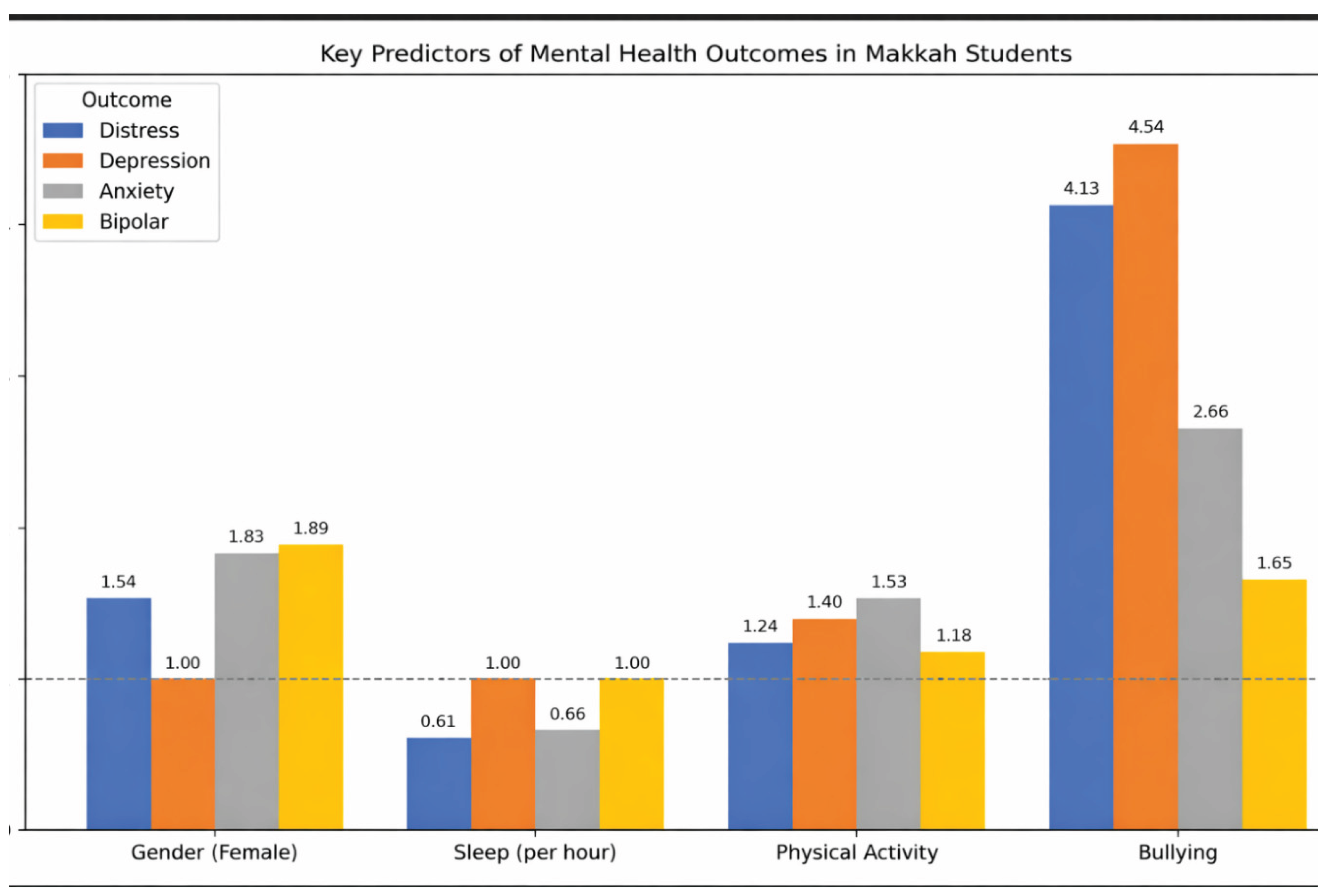

Table 1.
Demographic Characteristics of the Study Students, Makkah, Saudi Arabia (N=535).
| Socio-Demographic data | No | % |
| Age in years | ||
| 15 | 51 | 9.5% |
| 16 | 130 | 24.3% |
| 17 | 245 | 45.8% |
| 18 | 109 | 20.4% |
| Gender | ||
| Male | 363 | 67.9% |
| Female | 172 | 32.1% |
| The study year | ||
| 1st secondary school year | 96 | 17.9% |
| 2nd secondary school year | 164 | 30.7% |
| 3rd secondary school year | 275 | 51.4% |
| School type | ||
| Governmental | 366 | 68.4% |
| Private | 169 | 31.6% |
| Do you have a history of psychological/mental conditions? | ||
| Yes | 6 | 1.1% |
| No | 529 | 98.9% |
| Do you take any medications regularly? | ||
| Yes, neurological or psychiatric medications | 4 | .7% |
| Yes, medications for other diseases | 55 | 10.3% |
| None | 476 | 89.0% |
| Monthly income | ||
| < 5000 SR | 67 | 12.5% |
| 5000-10000 SR | 76 | 14.2% |
| 10000-15000 SR | 40 | 7.5% |
| > 15000 SR | 89 | 16.6% |
| I prefer not to answer | 263 | 49.2% |
| Father education | ||
| Illiterate | 13 | 2.4% |
| Primary education | 20 | 3.7% |
| Preparatory education | 42 | 7.9% |
| Secondary education | 136 | 25.4% |
| University education | 213 | 39.8% |
| Post-graduate degree | 111 | 20.7% |
| Mother education | ||
| Illiterate | 23 | 4.3% |
| Primary education | 23 | 4.3% |
| Preparatory education | 65 | 12.1% |
| Secondary education | 137 | 25.6% |
| University education | 236 | 44.1% |
| Post-graduate degree | 51 | 9.5% |
| Number of brothers and sisters | ||
| None | 8 | 1.5% |
| 1-2 | 92 | 17.2% |
| 3-4 | 224 | 41.9% |
| 5+ | 211 | 39.4% |
Table 2.
Lifestyle Habits, Bullying Exposure, and Academic Performance of High-school students in Makkah (N = 535).
Table 2.
Lifestyle Habits, Bullying Exposure, and Academic Performance of High-school students in Makkah (N = 535).
| Items | No | % |
| Daily sleep hours | ||
| < 4 hours/day | 33 | 6.2% |
| 4-6 hours/day | 242 | 45.2% |
| 7-9 hours/day | 201 | 37.6% |
| > 9 hours/day | 59 | 11.0% |
| Physical activity level | ||
| < 60 minutes per week | 143 | 26.7% |
| 60-400 minutes per week | 158 | 29.5% |
| > 400 minutes per week | 59 | 11.0% |
| I do not engage in any physical activity | 175 | 32.7% |
| Have you been subjected to any kind of bullying from your schoolmates during the past three years? | ||
| I have not been subjected to any type of bullying. | 415 | 77.6% |
| Yes, I have been subjected to verbal or psychological bullying. | 109 | 20.4% |
| Yes, I was subjected to physical and psychological bullying. | 7 | 1.3% |
| Yes, I was subjected to physical bullying. | 4 | .7% |
| Academic performance | ||
| Range | 20-100 | |
| Mean ± SD | 94.5 ± 8.0 | |
Table 3.
Factors Associated with high-school students’ Psychological Distress in Makkah.
| Factors | Psychological distress | p-value | ||||
| No | Yes | |||||
| No | % | No | % | |||
| Age in years | 15 | 26 | 51.0% | 25 | 49.0% | .002* |
| 16 | 37 | 28.5% | 93 | 71.5% | ||
| 17 | 60 | 24.5% | 185 | 75.5% | ||
| 18 | 35 | 32.1% | 74 | 67.9% | ||
| Gender | Male | 118 | 32.5% | 245 | 67.5% | .028* |
| Female | 40 | 23.3% | 132 | 76.7% | ||
| School type | Governmental | 99 | 27.0% | 267 | 73.0% | .064 |
| Private | 59 | 34.9% | 110 | 65.1% | ||
| Do you have a history of psychological/mental conditions? | Yes | 1 | 16.7% | 5 | 83.3% | .487^ |
| No | 157 | 29.7% | 372 | 70.3% | ||
| Monthly income | < 5000 SR | 10 | 14.9% | 57 | 85.1% | .001* |
| 5000-10000 SR | 23 | 30.3% | 53 | 69.7% | ||
| 10000-15000 SR | 15 | 37.5% | 25 | 62.5% | ||
| > 15000 SR | 39 | 43.8% | 50 | 56.2% | ||
| I prefer not to answer | 71 | 27.0% | 192 | 73.0% | ||
| Father education | Illiterate | 2 | 15.4% | 11 | 84.6% | .652 |
| Primary education | 5 | 25.0% | 15 | 75.0% | ||
| Preparatory education | 10 | 23.8% | 32 | 76.2% | ||
| Secondary education | 43 | 31.6% | 93 | 68.4% | ||
| University education | 68 | 31.9% | 145 | 68.1% | ||
| Post-graduate degree | 30 | 27.0% | 81 | 73.0% | ||
| Mother education | Illiterate | 6 | 26.1% | 17 | 73.9% | .525 |
| Primary education | 7 | 30.4% | 16 | 69.6% | ||
| Preparatory education | 19 | 29.2% | 46 | 70.8% | ||
| Secondary education | 38 | 27.7% | 99 | 72.3% | ||
| University education | 78 | 33.1% | 158 | 66.9% | ||
| Post-graduate degree | 10 | 19.6% | 41 | 80.4% | ||
| Number of brothers and sisters | None | 2 | 25.0% | 6 | 75.0% | .906 |
| 1-2 | 26 | 28.3% | 66 | 71.7% | ||
| 3-4 | 64 | 28.6% | 160 | 71.4% | ||
| 5+ | 66 | 31.3% | 145 | 68.7% | ||
| Daily sleep hours | < 4 hours/day | 3 | 9.1% | 30 | 90.9% | .001* |
| 4-6 hours/day | 54 | 22.3% | 188 | 77.7% | ||
| 7-9 hours/day | 84 | 41.8% | 117 | 58.2% | ||
| > 9 hours/day | 17 | 28.8% | 42 | 71.2% | ||
| Physical activity level | < 60 minutes per week | 44 | 30.8% | 99 | 69.2% | .001* |
| 60-400 minutes per week | 63 | 39.9% | 95 | 60.1% | ||
| > 400 minutes per week | 20 | 33.9% | 39 | 66.1% | ||
| I do not engage in any physical activity | 31 | 17.7% | 144 | 82.3% | ||
| Have you been subjected to any bullying from your schoolmates during the past three years? | I have not been subjected to any bullying. | 145 | 34.9% | 270 | 65.1% | .001*^ |
| Yes, I have been subjected to verbal or psychological bullying. | 11 | 10.1% | 98 | 89.9% | ||
| Yes, I was subjected to physical and psychological bullying. | 1 | 14.3% | 6 | 85.7% | ||
| Yes, I was subjected to physical bullying. | 1 | 25.0% | 3 | 75.0% | ||
Table 4.
Multivariate Logistic Regression of Predictors for Psychological Distress Among Secondary School Students in Makkah.
Table 4.
Multivariate Logistic Regression of Predictors for Psychological Distress Among Secondary School Students in Makkah.
| Predictors | p-value | ORA | 95% CI | |
| Lower | Upper | |||
| Age in years | .485 | 1.14 | 0.79 | 1.62 |
| Female vs. Male gender | .049* | 1.54 | 1.01 | 2.60 |
| Higher academic year | .444 | 1.18 | 0.77 | 1.79 |
| Private school vs. Governmental | .924 | 0.97 | 0.57 | 1.65 |
| History of psychological/mental conditions | .771 | 1.41 | 0.14 | 14.50 |
| Receive any medications | .198 | 0.63 | 0.31 | 1.27 |
| Higher family income | .841 | 0.98 | 0.85 | 1.15 |
| Higher father’s education | .859 | 1.02 | 0.82 | 1.26 |
| Higher mother’s education | .464 | 1.07 | 0.89 | 1.29 |
| Number of brothers/sisters | .545 | 0.92 | 0.70 | 1.21 |
| Academic performance (high grades) | .202 | 0.98 | 0.94 | 1.01 |
| Daily sleep hours | .001* | 0.61 | 0.47 | 0.80 |
| Physical activity engagement per week | .015* | 1.24 | 1.04 | 1.48 |
| Subjected to any kind of bullying from your schoolmates | .001* | 4.13 | 2.19 | 7.78 |
ORA: Adjusted odds ratio. CI: Confidence Interval. * P < 0.05 (significant).
Table 5.
Multivariate Logistic Regression of Predictors for Depression Among Secondary School Students in Makkah.
Table 5.
Multivariate Logistic Regression of Predictors for Depression Among Secondary School Students in Makkah.
| Predictors | p-value | ORA | 95% CI | |
| Lower | Upper | |||
| Age in years | .547 | .90 | .63 | 1.28 |
| Female vs. Male gender | .768 | .93 | .57 | 1.52 |
| Higher academic year | .388 | 1.20 | .79 | 1.82 |
| Private school vs. Governmental | .132 | .67 | .39 | 1.13 |
| History of psychological/mental conditions | .048* | 11.56 | 1.99 | 134.45 |
| Receive any medications | .041* | .55 | .31 | .98 |
| Higher family income | .199 | 1.10 | .95 | 1.27 |
| Higher father’s education | .286 | .90 | .73 | 1.10 |
| Higher mother’s education | .996 | 1.00 | .83 | 1.20 |
| Number of brothers/sisters | .934 | 1.01 | .78 | 1.32 |
| Academic performance (high grades) | .501 | 1.01 | .98 | 1.04 |
| Daily sleep hours | .111 | .81 | .63 | 1.05 |
| Physical activity engagement per week | .001* | 1.40 | 1.18 | 1.66 |
| Subjected to any kind of bullying from your schoolmates | .001* | 4.54 | 2.88 | 7.17 |
ORA: Adjusted odds ratio . CI: Confidence Interval. * P < 0.05 (significant).
Table 6.
Multivariate Logistic Regression of Predictors for Anxiety Among Secondary School Students in Makkah.
Table 6.
Multivariate Logistic Regression of Predictors for Anxiety Among Secondary School Students in Makkah.
| Predictors | p-value | ORA | 95% CI | |
| Lower | Upper | |||
| Age in years | .047* | .69 | .47 | 1.00 |
| Female vs. Male gender | .019* | 1.83 | 1.10 | 3.05 |
| Higher academic year | .024* | 1.68 | 1.07 | 2.64 |
| Private school vs. Governmental | .816 | .93 | .52 | 1.67 |
| History of psychological/mental conditions | .185 | 3.80 | .53 | 27.38 |
| Receive any medications | .007* | .45 | .25 | .81 |
| Higher family income | .823 | .98 | .85 | 1.14 |
| Higher father’s education | .032* | .80 | .65 | .98 |
| Higher mother’s education | .625 | .95 | .78 | 1.16 |
| Number of brothers/sisters | .852 | 1.03 | .77 | 1.36 |
| Academic performance (high grades) | .743 | 1.00 | .97 | 1.02 |
| Daily sleep hours | .003* | .66 | .51 | .87 |
| Physical activity engagement per week | .001* | 1.53 | 1.29 | 1.83 |
| Subjected to any kind of bullying from your schoolmates | .001* | 2.66 | 1.65 | 4.29 |
ORA: Adjusted odds ratio . CI: Confidence Interval. * P < 0.05 (significant).
Table 7.
Multivariate Logistic Regression of Predictors for Bipolar/Mania Among Secondary School Students in Makkah.
Table 7.
Multivariate Logistic Regression of Predictors for Bipolar/Mania Among Secondary School Students in Makkah.
| Predictors | p-value | ORA | 95% CI | |
| Lower | Upper | |||
| Age in years | .700 | .93 | .66 | 1.33 |
| Female vs. Male gender | .007* | 1.89 | 1.19 | 3.00 |
| Higher academic year | .406 | 1.19 | .79 | 1.79 |
| Private school vs. Governmental | .070 | .60 | .35 | 1.04 |
| History of psychological/mental conditions | .928 | .92 | .16 | 5.20 |
| Receive any medications | .026* | .54 | .31 | .93 |
| Higher family income | .770 | .98 | .85 | 1.12 |
| Higher father’s education | .373 | .91 | .75 | 1.11 |
| Higher mother’s education | .815 | 1.02 | .85 | 1.23 |
| Number of brothers/sisters | .820 | .97 | .75 | 1.26 |
| Academic performance (high grades) | .313 | 1.01 | .99 | 1.04 |
| Daily sleep hours | .066 | .79 | .62 | 1.02 |
| Physical activity engagement per week | .040* | 1.18 | 1.01 | 1.39 |
| Subjected to any kind of bullying from your schoolmates | .033* | 1.65 | 1.04 | 2.60 |
ORA: Adjusted odds ratio . CI: Confidence Interval. * P < 0.05 (significant).
Disclaimer/Publisher’s Note: The statements, opinions and data contained in all publications are solely those of the individual author(s) and contributor(s) and not of MDPI and/or the editor(s). MDPI and/or the editor(s) disclaim responsibility for any injury to people or property resulting from any ideas, methods, instructions or products referred to in the content. |
© 2026 by the authors. Licensee MDPI, Basel, Switzerland. This article is an open access article distributed under the terms and conditions of the Creative Commons Attribution (CC BY) license.
Copyright: This open access article is published under a Creative Commons CC BY 4.0 license, which permit the free download, distribution, and reuse, provided that the author and preprint are cited in any reuse.


