
Submitted:
23 April 2026
Posted:
24 April 2026
You are already at the latest version
Abstract
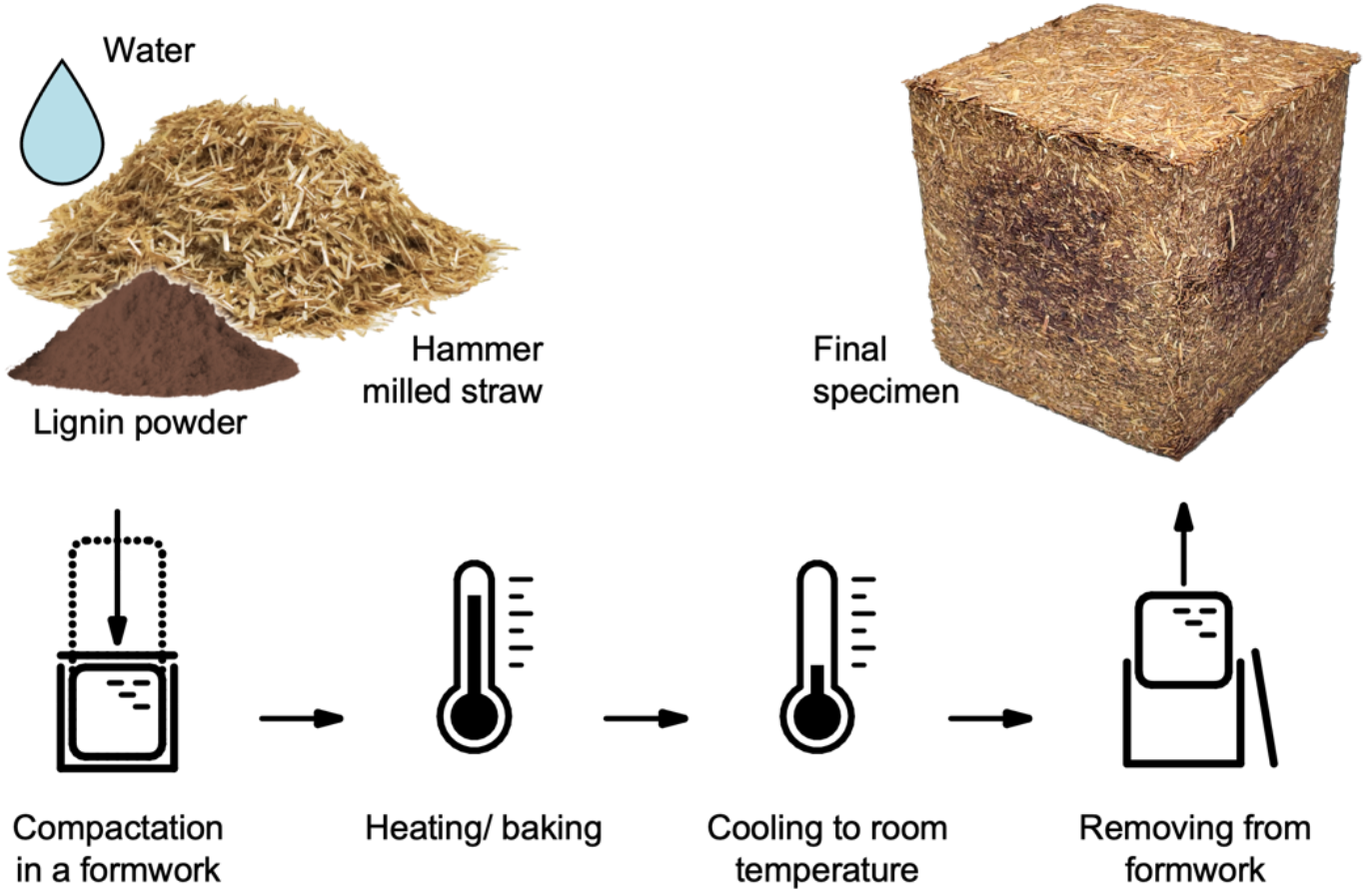
To reduce the significant environmental impact of the construction sector, developing renewable, load-bearing building materials is crucial. Straw, an abundant agricultural by-product, presents a promising resource for this purpose. This study focuses on a novel building material made from highly compressed straw, referred to as Straw-Brick, aiming to provide a reliable numerical model for predicting its complex mechanical behavior. To characterize the material, a series of uniaxial single-cycle and cyclic compression tests were conducted. Based on the experimental results, a one-dimensional, nonlinear rheological model was developed to capture the material’s key mechanical features. The model parameters were identified by fitting the simulation to the experimental data. The results show that the material behavior is characterized by strong nonlinearity, hysteresis, and stress relaxation. The proposed model is capable of capturing these main characteristics, showing good agreement with the experimental data. This work provides a validated material model that establishes a robust foundation for future numerical simulations of structural components made from this innovative and sustainable building material.
Keywords:
straw-brick
; sustainable building material
; viscoelasticity
; rheological model
; parameter identification
; nonlinear mechanics
; experimental characterization
; cyclic loading
Copyright: This open access article is published under a Creative Commons CC BY 4.0 license, which permit the free download, distribution, and reuse, provided that the author and preprint are cited in any reuse.


