

Submitted:
24 April 2026
Posted:
24 April 2026
You are already at the latest version
Abstract
With the increasing availability of high-resolution (< 50m) space borne night time light imagery, it is now becoming more feasible to examine the correspondence between space borne and ground based measurements of night lights. However, so far there were very few studies that conducted a ground-based campaign of night time brightness measurements during the overpass of a night light sensitive satellite. Here we tested whether the correspondence between measurements is higher when ground-based are conducted at the same time of the satellite overpass. We conducted measurements using a LANcube photometer along the same route in two consecutive nights (27-28 Aug 2025) in Brisbane, Australia, and compared them with a SDGSAT-1 (10-40m) and Haishao-1 (10m) images acquired concurrently at the evening, and with an early morning ISS photo (8m) acquired three months earlier. We found the correlation between ground based and space-borne measurements was not higher for simultaneous measurements, and the explanatory power of our model predicting night time brightness as measured from space increased when including horizontal and upwards ground-based brightness measurements along-side variables of canopy height, land use and road hierarchy. We confirmed the importance of multi-directional ground measurements and urban structure for understanding night-time brightness levels measured from space.
Keywords:
night lights
; variability
; SDGSAT-1
; Haishao-1
; ISS astronaut photos
; LANcube
1. Introduction
Remote sensing of night lights is one of the key approaches for monitoring human activity from space and to estimate light pollution [1]. However, the variability in night time lights is not only a function of human activities, but also depends on emission directionality [2], viewing geometry [3], time of night [4], season [5], and policies for reducing light pollution [6]. Ground referencing (validating) night time lights as measured from space is a challenge due to mismatches between the spatial resolution of the spaceborne sensor and the field of view ground measurements, differences in their viewing geometry (downwards vs downwards and horizontal and all sky; [2]), differences in the units used by the sensors and in their spectral sensitivities [7], atmospheric scattering [8], limitations in the spatial coverage of the ground measurements (with networks for sky observing photometers being limited spatially; [9,10]), the sensitivity of the sensor to low light levels, and temporal mismatches in the time of measurements (satellite images acquired over a few seconds vs the collection of ground measurements whose acquisition might take minutes to hours if conducted along a pre-determined route).
Studies of remote sensing of night lights that attempted to examine the correspondence between space borne measurements and ground based measurements often did not have the two sets of measurements conducted simultaneously (e.g. [2,11]; Table 1). In most cases where simultaneous measurements were conducted on the ground, they were limited to fixed point measurements using a single or a network of photometers such as Sky Quality Meter (SQM) or Telescope Encoder and Sky Sensor - WiFi (TESS-W) (e.g. [10,12]; Table 1). The only examples we know of where simultaneous measurements of night lights were conducted alongside ground based sensors over pre-determined routes, took place using UAVs [13] or from a high altitude balloon [14], but very few from space borne sensors (Table 1).
In daytime remote sensing, it has been shown that ground measurements of surface reflectance for the purpose of atmospheric correction do not have to be acquired simultaneously at the overpass time of satellite [21]. In this paper, we aimed to examine whether the correspondence between ground measurements acquired using a mobile LANcube photometer and spaceborne measurements of night lights is higher when they are conducted at the same time or not. A secondary objective of ours here was to examine and compare the quality of three night-time space borne sensors: SDGSAT-1, HaiShao-1 and astronaut photos acquired during the current mission of ISS073, and to better understand the variables explaining night time brightness as measured from space.
Our hypotheses were the following:
- That the correlations between ground based and spaceborne measurements will not be much higher for same night measurements, than for different night measurements, due to the high variability in space and time of light emissions, and the variability in the viewing angles of the spaceborne measurements.
- That the correlations between ground based and spaceborne measurements will be higher at a finer spatial resolution (≤10 m) than at 40 m resolution.
- That the correlations between ground based and spaceborne measurements will be higher for the green band than for the other spectral bands, because of atmospheric scattering in the blue band, and because of the inclusion of the near infra-red in the “red” band of the SDGSAT-1 [15].
- That the correlations between ground based and spaceborne measurements will be higher when using the sum of lights including the horizontal measurements of the LANcube than when only including the upwards measurements of the LANcube, given that the horizontal measurements will include additional light sources that may be partly sensed from space [2].
- That dimly lit areas will be below the threshold of spaceborne sensors [17], and that in densely built areas with high-rise buildings, the ground based measurements will under-represent the night time brightness levels measured from space, given that street level measurements will be less representative of light sources originating from high-rise buildings.
- That areas along major roads and in non-residential areas will be associated with higher night time brightness levels [11].
2. Materials and Methods
2.1. Study Area
Our study area was placed in the inner western suburbs of Brisbane, Queensland, Australia, to the west of the Brisbane River, between the university suburb of St Lucia in the south, Kelvin Grove in the north, Toowong and Indooroopilly in the west, covering both residential streets and major roads.
2.2. Space Borne Images
We used three sources of night time light images, all acquired on weekdays, as detailed in Table 2. Astronaut photos represent the first source of multispectral night time light images from space [1] and have been used for various studies of urban areas [22]. However, they are provided as digital images without georeferencing or radiometric calibration, and their quality and spatial resolution can vary a lot between different ISS missions, depending in part, on the camera used [23,24]. The astronaut photo we used here was acquired after midnight May 21st, 2025, three months before our field campaign.
The SDGSAT-1 satellite was launched in November 2021, and is the first multispectral night time sensor providing free color night time images at a moderate spatial resolution of 40 m and panchromatic images at a spatial resolution of 10 m for the scientific community as well as for humanitarian purposes [25,26]. The SDGSAT-1 satellite acquires its images around 21:30 pm (local time) when people are more active [6], in comparison with the VIIRS/DNB sensor that acquires its images around 01:30 am, and opens new research avenues for ecological and urban applications [27,28].
More recently, in December 2024, the Haishao-1 satellite was launched, offering a panchromatic night time lights band centered around 0.7 μm at a spatial resolution of 10 m [29].
We georeferenced all images to the road network of Brisbane using OpenStreetMap (OSM) data with more than 15 ground control points each and used a spline transformation, validating that the images are well aligned with the road network along the roads that were measured on the ground. The SDGSAT-1 bands were calibrated from DN values to at-sensor radiance values using the gain and bias coefficients provided in the metadata of the SDGSAT-1 imagery, following the approach described in [26]. The ISS and Haishao-1 images were analyzed using their DN values with no radiometric calibration. Radiometric calibration of spaceborne sensors is critical for examining changes in radiation or in night time brightness; however, given that calibration functions from DN to at-sensor-radiance are linear [16,26], the conversion from DN to radiance will not affect correlations or the explanatory power of regression models between ground based and space borne measurements.
2.3. Ground Measurements of Night Lights
We coordinated the timing of the image acquisition by the SDGSAT-1 and Haishao-1 for two consecutive nights, 27 and 28 of August 2025, in the early evening hours, when the moon was less than 25% full, near the time of the moonset, and in cloud free conditions. We used a LANcubeV2 photometer [11,30] to acquire ground measurements of night lights along the same route on both evenings, around the time of the image acquisition by the two satellites (on the 27/8/2025 between 20:14 and 21:50 pm, and on the 28/8/2025 between 19:39 and 20:57 pm). The LANcube acquired data every 0.6 s with sensors in five directions (S1: upwards, S2: backwards, S3: right, S4: forwards, S5: left) in three bands (R, G, B) and calculated the lux values in each direction for each measurement. Overall, more than 7,000 GPS locations were measured.
2.4. Spatial and Statistical Analysis
We aggregated the LANcube point measurements within grid cells of 40 m that were defined so as to fit the 40 m pixels of the SDGSAT-1 RGB bands. We calculated within each grid cell the average lux values in each direction (thus accounting for variable car speed and number of LANcube measurements within each grid cell), as well as the average values for the different night time light sensors (Table 2). Altogether this resulted with a sample size of 1,057 grid cells of 40 m. We examined the correlations between the ground based measurements and spaceborne measurements using the Spearman rank correlation coefficient (rs), to examine the hypotheses presented above. To examine the overall explanatory power of spaceborne measurements as a function of ground based measurements, we also included the following datasets: ETH (Eidgenössische Technische Hochschule) Global Canopy Height (2020) product at 10-m resolution, which utilizes deep-learning fusion of Sentinel-2 and GEDI LIDAR data [31], residential and non-residential building height classes extracted from the Global Human Settlement Layer (GHSL) GHS-BUILT-C (2018 epoch) product [32,33], and OpenStreetMap road classes [34]. We merged the road classes of Motorway, Trunk and Primary into a Highway class, and the road classes of Secondary, Tertiary and Unclassified into a Major road class. Four stepwise regression models were run each time for one of the spaceborne datasets of night time brightness after a logarithmic transformation of the spaceborne dataset, at the grid cell level. The explanatory variables were the sum of lux values as measured by the LANcube in all directions, canopy height, percent area covered by residential buildings, percent area covered by non-residential buildings, percent area covered by buildings higher than 6 m, percent area covered by buildings higher than 15 m, length of highways, length of major roads, and length of residential roads.
An additional examination of the quality of the images was performed within four representative dark areas. Three of these four areas were completely unlit: a section of the Brisbane River (58 ha), a section of the Indooroopilly Golf Course (67 ha) and a section of Mount Coot-tha Forest (223 ha). An additional area we examined, included dimly lit residential streets in a low density residential area in the university neighbourhood of St Lucia, between Carmody Road in the north and Hawken Drive in the south (20 ha). The most common street light type in that specific area was compact fluorescent (43 out of 62 street lights), followed by LED (14 street lights), with an average lux value (in the upwards direction) of 2.45 lux (based on >1,500 LANcube measurements conducted in those streets on 11 September 2025). To quantify the variability of night time light levels as measured from space in those areas, we created a point layer with a uniform distribution every 40 m within those four areas, and calculated the average and standard deviation of the DN values of each of the bands of the ISS, Haishao-1 and SDGSAT-1 images. Given that in the SDGSAT-1 image, a DN value of one is the lowest value, whereas in the ISS and Haishao-1 zero is the lowest DN value, we subtracted a value of one from the SDGSAT-1 bands for this analysis. To assess differences in night light brightness levels as a function of street light types, we used a GIS layer from Energy Queensland that we intersected with the 40 m grid cells. Each grid cell was associated with the street light type that was most common within it. Grid cells had an equal number of different street lights were excluded from our analysis (6% of all grid cells). We also excluded the grid cells within the university campus (8% of all grid cells) from our analysis, because they were not covered by the street light dataset of Energy Queensland.
3. Results
The three night-time satellite images of Brisbane had similar spatial resolution, and were highly correlated, especially between the higher spatial resolution night time images, in the following descending order: SDGSAT-1 at 10m and the sum of the three ISS bands (rs = 0.795), SDGSAT-1 at 10m and Haishao-1 (rs = 0.729), and Haishao-1 and the sum of the ISS bands (rs = 0.667). The correlation in overall brightness (radiance) between the multispectral bands of SDGSAT-1 (sum of the three bands after their conversion into radiance at-sensor) that have a spatial resolution of 40 m, was lower, and amounted to about to 0.610 with the Haishao-1 and to 0.599 with the sum of spectral bands of the ISS. Some notable differences between the three images for example were in the lighting of sport ovals and stadiums, as can be seen in the St Lucia campus of the University of Queensland (bottom part of all sub-figures of Figure 1).
From the point of view of image quality, the ISS image was the most ‘noisy’ (showing bright pixels in unlit areas, such as the Brisbane River) and the SDGSAT-1 image was the least ‘noisy’ (Figure 2). In addition, the ISS image had a significant NW-SE smear of the pixels, whereas the other images were ‘sharper’. In all three spaceborne platforms, many dimly lit residential streets with street lights appeared to be either unlit or ‘noisy’, and thus the night time brightness in them appeared to be below the detection threshold of these sensors (Figure 2). Amongst the four dark areas we compared, Mt Coot-tha was the darkest, followed by the Indooroopilly Golf Course, the dimly lit residential streets in St Lucia and the Brisbane River having similar values (Table 3). The panchromatic band of the ISS photo presented the darkest values for all four areas (in DN values), followed by the Haishao-1 (Table 3). Based on the LANcube measurements in the upwards direction, streets led by LED (n = 229 grid cells) were the most brightly lit, followed by high pressure sodium (HPS, n = 323 grid cells) and compact fluorescent (CFL, n = 110 grid cells) (Figure 3a). Unlit grid cells (i.e. grid cells with no street lights within them; n = 236) were not dark, and their brightness levels mostly affected by adjacent light sources. However, in all three space borne images, the difference in night time brightness between LED and HPS was smaller than in the ground based measurements (Figure 3b-e).
As for multispectral information, in the ISS photo analyzed in this study, the correlations between the three color bands were very high (rs > 0.985 for all band combinations), indicating little multispectral information, whereas the correlations between the three color bands of the SDGSAT-1 were lower (rs ranging between 0.91 and 0.97 for the different band combinations) indicating better color information.
The correlations between the two consecutive ground measurements of the LANcube were much higher than between the two consecutive measurement of the spaceborne sensors. The correlation between the S1 (upwards) lux measurements of the two nights was 0.927, and was even higher when summing up the lux values in three directions (S1+S3+S5, upwards, right and left), being 0.950 between the two nights. When examined on a map, the consistency of the ground-based measurements in these directions can be well appreciated (Figure 4). When summing the lux values in three directions, the measurements were less ‘noisy’ than when examining the values in the upwards direction, with a higher coefficient of variation (standard deviation divided by the average) in both nights (being 1.16 when summing the three measurements directions, vs 1.27 in the upwards direction alone).
The correlations between the ground-based lux measurements and the space borne measurements were highest with the ISS photo (that was acquired three months before the ground based LANcube measurements), second highest for the SDGSAT-1 at 10m, followed by the Haishao-1 and last by the SDGSAT-1 multispectral bands at 40m (Table 3). Across all comparisons, the correlations were higher between the spaceborne measurements and the ground-based measurements when we summed the lux measurements of the LANcube in all five directions, than in the three directions (upwards, right and left), and than when examining the correlations only with the upwards (S1) measurements (Table 4). In both the Haishao-1 and the SDGSAT-1 images, there were grid cells in which both sensors recorded no radiance, mostly up to sum lux values of 10 lux (Figure 5). These locations were mostly associated with roads lit by CFL (Figure 6). As for the same-day vs. one-day-apart comparisons, the correlations for both the Haishao-1 and the SDGSAT-1 were higher when compared with the ground measurements taken on the same day than with the ground measurements taken on another day, however these differences were quite small (Table 4). Band-wise, the highest correlations were found for the green band across the three multispectral sensors, and the lowest correlations were found for the red band (Table 5).
The multivariate stepwise regression model with the highest explanatory power was for the ISS night time brightness values (Adj R2 of 0.643), followed by that of the SDGSAT-1 image at 10 m (Adj R2 of 0.525) (Table 6). Six of the explanatory variables were found as statistically significant in all four stepwise models. The variable of sum of lux values as measured by the LANcube had the highest standardized coefficient in all models, followed by the length of the highways. Two variables had negative standardized coefficients in all models: canopy height and the length of residential roads. In the model of the ISS night time brightness, an additional explanatory variable was included in the model, also with a negative standardized coefficient: the percent area of residential buildings within a grid cell, whereas the percent area of non-residential buildings always had a positive coefficient in all four models. The height of buildings was not found as a significant variable in any of our models.
4. Discussion
This study was the first to conduct multidirectional ground measurements along multiple road sections concurrently with the overpass of two high-resolution spaceborne night light sensors with an early evening overpass – SDGSAT-1 and the recently launched Haishao-1. We found that same date measurements of night lights at the ground level and from above are not critical for comparing the two perspectives. This may at first seem a surprising result, given that night lights are highly volatile and temporally dynamic [35]. While the turning on and off of lights within residential areas is an individual level decision, during the early evening hours (before 10 pm) most people are still awake and have some indoor lights that can spill outside via windows, and the turning off of lights becomes noticeable after midnight [4,36]. In a study examining the dynamics of the urban nightscape, it was actually found that the turning off time of lights is quite consistent between nights (at least for residential sources) [4]. Moreover, in residential areas (in contrast with commercial or industrial areas), street lights can be a major source of artificial lights [37], having very consistent lighting dynamics, and in most countries and cities are not dimmed or turned off during the night (as is also the case in Brisbane). Therefore, it is not surprising that ground measurements of night lights can be well correlated with spaceborne measurements conducted on other nights. Our finding that the correlation between ground based measurements of night lights over two nights were much higher than the correlation between spaceborne measurements of night lights over the same two nights, also reinforces our conclusion and the relative stability of artificial light sources during the early evening, compared with the variability in spaceborne measurements of night lights, that are also affected by variable atmospheric conditions [20], viewing geometries [3], and georeferencing errors [38]. Within our case study of Brisbane, the highest correlation between ground based and space borne imagery was actually found for the ISS photo, acquired after midnight three months before the field campaign that was conducted in the early evening hours. While some of the light sources were obviously turned off after midnight (e.g. of some sport facilities within the University of Queensland St Lucia campus), most of the study area was composed of residential buildings: 63% of all grid cells had more than 25% of residential areas, whereas only 4% of the grid cells had more than 25% of non-residential areas. We therefore expect that when conducting a similar study in a major commercial urban area, or in an area where lights are dimmed or turned off after midnight (as in rural France; [6]), coordinating the time at night of the ground based and spaceborne measurements will be more critical than in our case study of Brisbane. The time can be coordinated withing general time frames of early evening, late evening, after midnight, and before dawn, depending on the local dynamics of night lights turning on and off. We expect that in brightly lit urban and suburban areas, the moonlight will have a negligible effect on the correspondence between ground based and space borne measurements, given that the full moon has a brightness of less than 0.3 lux [39].
In this study we also provide a first of a kind comparison of the quality of three high-res night time lights sensors with a spatial resolution of at least 10m, covering the same area, ISS photo, SDGSAT-1 and the new Haishao-1 satellite [29] that was only recently launched. We found that all three sensors were not sensitive enough in dimly lit and dark areas – with the SDGSAT-1 being almost completely dark in such areas, corresponding with previous studies [17], and the ISS and Haishao-1 images being mostly ‘noisy’ in such dimly lit or dark areas. The quality of ISS photos varies widely between missions, depending also on the camera and the settings used (e.g. F/stop, ISO, lens etc.) [24]. Recent night time ISS photos from mission 073 have high spatial resolution (< 10m) back seem to lack in their multispectral quality, with less differentiation between the different bands. While the three space borne sensors were not sensitive enough to measure artificial lights originating from residential streets lit by CFL, the ground based LANcube photometer was able to fill this gap, and to provide multidirectional night time brightness measurements that enabled us to better explain the space borne night time brightness measurements. Although the LANcube photometer is not as sensitive as the SQM photometer for real dark sky areas [6], it is perfectly suitable for measurements in peri-urban and urban settings where artificial lights are present. One of the limitations in comparing between the spectral bands of the LANcube, ISS and SDGSAT-1, is the different widths of the spectral bands on each of these sensors, especially with the SDGSAT-1 ‘red’ band actually covering both the red and infra-red regions [15]. It is therefore recommended for future night-time light missions to have a dedicated truly red band, and to have a separate band for measuring the near infrared band, which is important for detecting emissions from HPS lighting for example. Our measurements were mostly conducted within residential areas and along some major roads, and we did not cover many non-residential areas where commercial activities are present. Commercial areas are characterized by multiple light sources (such as window facades, decoration lighting, flood lighting, billboards etc), different from residential areas [11]. Non-residential areas were found to increase night brightness as measured from space, whereas higher canopy cover was found to decrease it. When conducting field campaigns for the comparison between ground based measurements and spaceborne measurements of night time brightness, it is therefore recommended to focus on areas where light sources are less variable and are less affected by obstruction from trees or buildings [40] – such as highways and newly built low density residential areas.
5. Conclusions
Planning and conducting field campaigns alongside the overpass of a satellite is logistically challenging, even more so at night time. In this study we demonstrated that ground-based measurements of night lights can be highly correlated with high-resolution spaceborne measurements of night time lights even if they were not conducted at the same time. This finding has important implications for future studies aiming for better calibration and validation of light pollution estimates from space. While high correspondence may be achieved between measurements conducted on separate nights, we recommend that the ground measurements will be conducted at a similar phase of the night (e.g. early evening, after midnight) to the overpass of the satellite. Researchers should also verify that no transition of lighting types (e.g. between HPS and LED) took place within the study area between the two acquisition dates and that no major land use changes occurred between the two dates, for the comparison to be more reliable between ground based and space borne measurements. We also recommend to conduct the field campaign in areas where light sources are expected to be more stable between different nights (e.g. streets and major roads in residential areas), and to prefer areas where there will be less obstructions from high-rise buildings or high trees, for the comparison between ground based and spaceborne measurements to be more consistent and less affected by satellite viewing angle differences. We call for future studies to continue exploring these avenues, so that protocols for ground based night time measurements will be developed and agreed upon.
Author Contributions
For research articles with several authors, a short paragraph specifying their individual contributions must be provided. The following statements should be used “Conceptualization, N.L.; methodology, N.L..; acquisition of SDGSAT-1 image, L.Y.; acquisition of Haishao-1 image: X.M.-L., N.W.; validation, N.L.; formal analysis, N.L.; investigation, N.L..; resources, N.L.; data curation, N.L.; writing—original draft preparation, N.L.; writing—review and editing, N.L., L.Y., X.M.-L., Y.T., N.W.; visualization, N.L.; funding acquisition, N.L.. All authors have read and agreed to the published version of the manuscript.”
Funding
This work was funded by the Israel Science Foundation (ISF), Grants 303/21 and 1521/25..
Data Availability Statement
The ISS photo is available online via NASA’s website https://eol.jsc.nasa.gov/ . The SDGSAT-1 images are available via the website of the International Research Center of Big Data for Sustainable Development Goals https://www.cbas.ac.cn/en/ . The LANcube data can be shared with researchers upon request to the corresponding author.
Acknowledgments
The research findings are a component of the SDGSAT-1 Open Science Program, which is conducted by the International Research Center of Big Data for Sustainable Development Goals (CBAS). The data utilized in this study is sourced from SDGSAT-1 and provided by CBAS. We would also like to thank the Hainan Aerospace Technology Innovation Center for providing access to Haishao-1 imagery. We thank Energy Queensland for providing us with a GIS layer of streetlights. We thank the Earth Science and Remote Sensing Unit, NASA Johnson Space Center for the ISS photo used in this study.
Conflicts of Interest
The authors declare no conflicts of interest. The funders had no role in the design of the study; in the collection, analyses, or interpretation of data; in the writing of the manuscript; or in the decision to publish the results.
Abbreviations
The following abbreviations are used in this manuscript:
| CBAS | International Research Center of Big Data for Sustainable Development Goals |
| CFL | Compact Fluorescent |
| ETH | Eidgenössische Technische Hochschule |
| HPS | High Pressure Sodium |
| ISS | International Space Station |
| LANcube | Light At Night cube |
| LED | Light Emitting Diode |
| SDGSAT-1 | Sustainable Development Goals Satellite |
| SQM | Sky Quality Meter |
| TESS-W | Telescope Encoder and Sky Sensor - WiFi |
References
- Levin, N.; Kyba, C.C.M.; Zhang, Q.; Sánchez de Miguel, A.; Román, M.O.; Li, X.; Portnov, B.A.; Molthan, A.L.; Jechow, A.; Miller, S.D.; et al. Remote Sensing of Night Lights: A Review and an Outlook for the Future. Remote Sens. Environ. 2020, 237, 111443. [Google Scholar] [CrossRef]
- Katz, Y.; Levin, N. Quantifying Urban Light Pollution — A Comparison between Field Measurements and EROS-B Imagery. Remote Sens. Environ. 2016, 177, 65–77. [Google Scholar] [CrossRef]
- Li, X.; Ma, R.; Zhang, Q.; Li, D.; Liu, S.; He, T.; Zhao, L. Anisotropic Characteristic of Artificial Light at Night – Systematic Investigation with VIIRS DNB Multi-Temporal Observations. Remote Sens. Environ. 2019, 233, 111357. [Google Scholar] [CrossRef]
- Dobler, G.; Ghandehari, M.; Koonin, S.E.; Nazari, R.; Patrinos, A.; Sharma, M.S.; Tafvizi, A.; Vo, H.T.; Wurtele, J.S. Dynamics of the Urban Lightscape. Inf. Syst. 2015, 54, 115–126. [Google Scholar] [CrossRef]
- Levin, N. The Impact of Seasonal Changes on Observed Nighttime Brightness from 2014 to 2015 Monthly VIIRS DNB Composites. Remote Sens. Environ. 2017, 193, 150–164. [Google Scholar] [CrossRef]
- Levin, N. Challenges in Remote Sensing of Night Lights – a Research Agenda for the next Decade. Remote Sens. Environ. 2025, 328, 114869. [Google Scholar] [CrossRef]
- Bará, S.; Aubé, M.; Barentine, J.; Zamorano, J. Magnitude to Luminance Conversions and Visual Brightness of the Night Sky. Mon. Not. R. Astron. Soc. 2020, 493, 2429–2437. [Google Scholar] [CrossRef]
- Kocifaj, M. Multiple Scattering Contribution to the Diffuse Light of a Night Sky: A Model Which Embraces All Orders of Scattering. J. Quant. Spectrosc. Radiat. Transf. 2018, 206, 260–272. [Google Scholar] [CrossRef]
- Falchi, F.; Cinzano, P.; Duriscoe, D.; Kyba, C.C.M.; Elvidge, C.D.; Baugh, K.; Portnov, B.A.; Rybnikova, N.A.; Furgoni, R. The New World Atlas of Artificial Night Sky Brightness. Sci. Adv. 2016, 2, e1600377. [Google Scholar] [CrossRef]
- Fernandez-Ruiz, B.; Serra-Ricart, M.; Alarcon, M.R.; Lemes-Perera, S.; Santana-Perez, I.; Ruiz-Alzola, J. Calibrating Nighttime Satellite Imagery with Red Photometer Networks. Remote Sens. 2023, 15, 4189. [Google Scholar] [CrossRef]
- Levin, N. Quantifying the Variability of Ground Light Sources and Their Relationships with Spaceborne Observations of Night Lights Using Multidirectional and Multispectral Measurements. Sensors 2023, 23, 8237. [Google Scholar] [CrossRef]
- Bará, S.; Tapia, C.E.; Zamorano, J. Absolute Radiometric Calibration of TESS-W and SQM Night Sky Brightness Sensors. Sensors 2019, 19, 1336. [Google Scholar] [CrossRef]
- Li, X.; Levin, N.; Xie, J.; Li, D. Monitoring Hourly Night-Time Light by an Unmanned Aerial Vehicle and Its Implications to Satellite Remote Sensing. Remote Sens. Environ. 2020, 247, 111942. [Google Scholar] [CrossRef]
- Aubé, M.; Simoneau, A.; Kolláth, Z. HABLAN: Multispectral and Multiangular Remote Sensing of Artificial Light at Night from High Altitude Balloons. J. Quant. Spectrosc. Radiat. Transf. 2023, 306, 108606. [Google Scholar] [CrossRef]
- Labrousse, C.; Haspel, C.; Levin, N. Quantifying the Impact of the Transition to LED Lighting on Night Sky Brightness and Colour Using Ground-Based Measurements and Satellite Imagery. J. Quant. Spectrosc. Radiat. Transf. 2025, 340, 109450. [Google Scholar] [CrossRef]
- Yan, L.; Hu, Y.; Dou, C.; Li, X.-M. Radiometric Calibration of SDGSAT-1 Nighttime Light Payload. IEEE Trans. Geosci. Remote Sens. 2024, 62, 1–15. [Google Scholar] [CrossRef]
- Levin, N.; Cooper, R.M.; Kark, S. Quantifying Night Sky Brightness as a Stressor for Coastal Ecosystems in Moreton Bay, Queensland. Remote Sens. 2024, 16, 3828. [Google Scholar] [CrossRef]
- Simons, A.L.; Yin, X.; Longcore, T. High Correlation but High Scale-Dependent Variance between Satellite Measured Night Lights and Terrestrial Exposure. Environ. Res. Commun. 2020, 2, 021006. [Google Scholar] [CrossRef]
- Liu, S.K.; So, C.W.; Pun, C.S.J. Analyzing Nighttime Lights Using Multi-Temporal Imagery from Luojia-1 and the International Space Station with In Situ and Land Use Data. Remote Sens. 2025, 17, 3739. [Google Scholar] [CrossRef]
- Cao, C.; Bai, Y. Quantitative Analysis of VIIRS DNB Nightlight Point Source for Light Power Estimation and Stability Monitoring. Remote Sens. 2014, 6, 11915–11935. [Google Scholar] [CrossRef]
- Ben-Dor, E.; Levin, N. Determination of Surface Reflectance from Raw Hyperspectral Data without Simultaneous Ground Data Measurements: A Case Study of the GER 63-Channel Sensor Data Acquired over Naan, Israel. Int. J. Remote Sens. 2000, 21, 2053–2074. [Google Scholar] [CrossRef]
- Levin, N.; Duke, Y. High Spatial Resolution Night-Time Light Images for Demographic and Socio-Economic Studies. Remote Sens. Environ. 2012, 119, 1–10. [Google Scholar] [CrossRef]
- Sánchez de Miguel, A.; Kyba, C.C.M.; Aubé, M.; Zamorano, J.; Cardiel, N.; Tapia, C.; Bennie, J.; Gaston, K.J. Colour Remote Sensing of the Impact of Artificial Light at Night (I): The Potential of the International Space Station and Other DSLR-Based Platforms. Remote Sens. Environ. 2019, 224, 92–103. [Google Scholar] [CrossRef]
- Sánchez De Miguel, A.; Zamorano, J.; Aubé, M.; Bennie, J.; Gallego, J.; Ocaña, F.; Pettit, D.R.; Stefanov, W.L.; Gaston, K.J. Colour Remote Sensing of the Impact of Artificial Light at Night (II): Calibration of DSLR-Based Images from the International Space Station. Remote Sens. Environ. 2021, 264, 112611. [Google Scholar] [CrossRef]
- Guo, B.; Hu, D.; Zheng, Q. Potentiality of SDGSAT-1 Glimmer Imagery to Investigate the Spatial Variability in Nighttime Lights. Int. J. Appl. Earth Obs. Geoinf. 2023, 119, 103313. [Google Scholar] [CrossRef]
- Liu, S.; Wang, C.; Chen, Z.; Li, W.; Zhang, L.; Wu, B.; Huang, Y.; Li, Y.; Ni, J.; Wu, J.; et al. Efficacy of the SDGSAT-1 Glimmer Imagery in Measuring Sustainable Development Goal Indicators 7.1.1, 11.5.2, and Target 7.3. Remote Sens. Environ. 2024, 305, 114079. [Google Scholar] [CrossRef]
- Weber, D.; Bolliger, J.; Ecker, K.; Fischer, C.; Ginzler, C.; Gossner, M.M.; Huber, L.; Obrist, M.K.; Zellweger, F.; Levin, N. Night Lights from Space: Potential of SDGSAT -1 for Ecological Applications. Remote Sens. Ecol. Conserv 2025, rse2.70011. [Google Scholar] [CrossRef]
- Lv, Z.; Guo, H.; Zhang, L.; Liang, D.; Zhu, Q.; Liu, X.; Zhou, H.; Liu, Y.; Gou, Y.; Dou, X.; et al. Urban Public Lighting Classification Method and Analysis of Energy and Environmental Effects Based on SDGSAT-1 Glimmer Imager Data. Appl. Energy 2024, 355, 122355. [Google Scholar] [CrossRef]
- Li, X.-M.; Chang, L.; Zhou, J.; Sun, J.; Lu, X.; Han, X.; Wang, J.; Lu, H.; Li, X.; Wang, N.; et al. Haishao-1 Satellite: Low-Inclination Orbit Spaceborne Synthetic Aperture Radar. The Innovation 2025, 6, 100949. [Google Scholar] [CrossRef]
- Aubé, M.; Marseille, C.; Farkouh, A.; Dufour, A.; Simoneau, A.; Zamorano, J.; Roby, J.; Tapia, C. Mapping the Melatonin Suppression, Star Light and Induced Photosynthesis Indices with the LANcube. Remote Sens. 2020, 12, 3954. [Google Scholar] [CrossRef]
- Lang, N.; Jetz, W.; Schindler, K.; Wegner, J.D. A High-Resolution Canopy Height Model of the Earth. Nat. Ecol. Evol. 2023, 7, 1778–1789. [Google Scholar] [CrossRef] [PubMed]
- Pesaresi, M.; Schiavina, M.; Politis, P.; Freire, S.; Krasnodębska, K.; Uhl, J.H.; Carioli, A.; Corbane, C.; Dijkstra, L.; Florio, P.; et al. Advances on the Global Human Settlement Layer by Joint Assessment of Earth Observation and Population Survey Data. Int. J. Digit. Earth 2024, 17, 2390454. [Google Scholar] [CrossRef]
- Pesaresi, M.; Politis, P. GHS-BUILT-C R2023A - GHS Settlement Characteristics, Derived from Sentinel2 Composite (2018) and Other GHS R2023A Data 2023.
- Haklay, M. How Good Is Volunteered Geographical Information? A Comparative Study of OpenStreetMap and Ordnance Survey Datasets. Environ. Plan. 2010, 37, 682–703. [Google Scholar] [CrossRef]
- Li, T.; Wang, Z.; Kyba, C.C.M.; Román, M.O.; Seto, K.C.; Yang, Y.; Qiu, S.; Kuester, T.; Fragkias, M.; Chen, X.; et al. Satellite Imagery Reveals Increasing Volatility in Human Night-Time Activity. Nature 2026, 652, 379–386. [Google Scholar] [CrossRef]
- Nachtlichter, T.; Tegeler, A.; Marz, A.; Gokus, A.; Hänel, A.; Rienow, A.; Ruby, A.; Glinka, A.; Kyba, A.M.; Dröge-Rothaar, A.; et al. What’s in a Watt? Interpreting Nightlights Satellite Data via Citizen Science Observations 2024.
- Bará, S.; Rodríguez-Arós, Á.; Pérez, M.; Tosar, B.; Lima, R.; Sánchez De Miguel, A.; Zamorano, J. Estimating the Relative Contribution of Streetlights, Vehicles, and Residential Lighting to the Urban Night Sky Brightness. Light. Res. Technol. 2019, 51, 1092–1107. [Google Scholar] [CrossRef]
- Pesaresi, M.; Uhl, J.H.; Lu, L.; Politis, P.; Liang, D.; Melchiorri, M.; Rivero, I.M.; Krasnodębska, K.; Guo, H. Compositing High-Resolution SDGSAT-1 Nighttime Light Data by Ranking of Structural Image Features. Remote Sens. Environ. 2026, 337, 115313. [Google Scholar] [CrossRef]
- Kyba, C.C.M.; Mohar, A.; Posch, T. How Bright Is Moonlight? Astron. Geophys. 2017, 58, 1.31–1.32. [Google Scholar] [CrossRef]
- Wu, J.; Li, X.; Li, D. Investigating the Anisotropy of Nighttime Light Using an Unmanned Aerial Vehicle Combined with Scaled Experiments. Remote Sens. Environ. 2025, 329, 114960. [Google Scholar] [CrossRef]
Figure 1.
Night time light images of Brisbane used in this study. (a) 27/8/2025 SDGSAT-1 10m panchromatic band; (b) 28/8/2025 HaiShao-1 10m band; (c) 27/8/2025 SDGSAT-1 40m RGB bands; (d) 21/5/2025 ISS073-E-120440 astronaut photo from the ISS.
Figure 1.
Night time light images of Brisbane used in this study. (a) 27/8/2025 SDGSAT-1 10m panchromatic band; (b) 28/8/2025 HaiShao-1 10m band; (c) 27/8/2025 SDGSAT-1 40m RGB bands; (d) 21/5/2025 ISS073-E-120440 astronaut photo from the ISS.
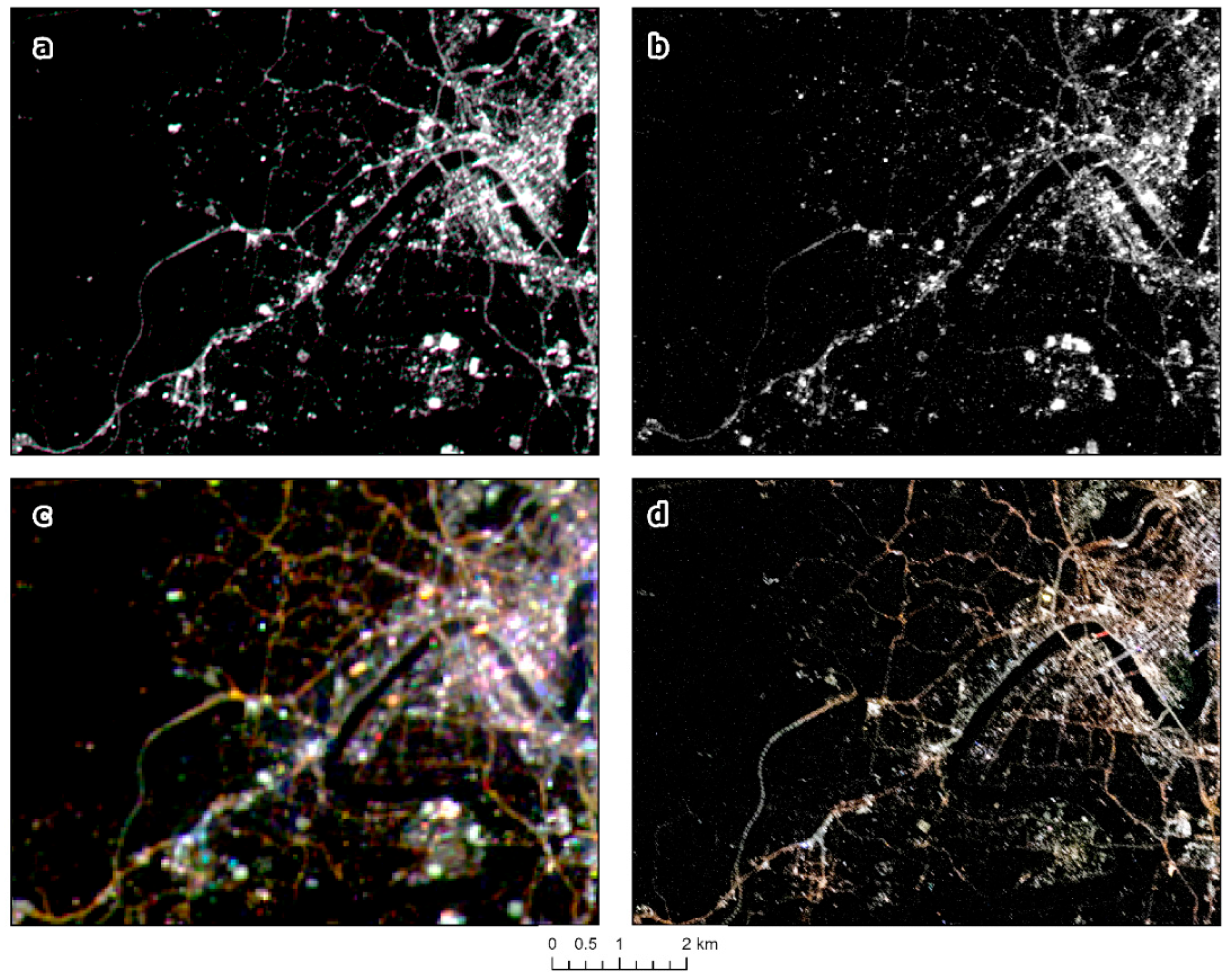
Figure 2.
Zoom-in on dimly lit streets near the Brisbane River, between the suburbs of St Lucia and West End. (a) street light locations (the white diamonds, from Energy Queensland) overlaying the LANcube measurements routes (see legend for the lux measurements in Figure 3); (b) 21/5/2025 ISS073-E-120440 astronaut photo from the ISS; (c) 28/8/2025 HaiShao-1 10m band; (d) 27/8/2025 SDGSAT-1 10m panchromatic band; (e) 27/8/2025 SDGSAT-1 40m RGB bands. All satellite images are shown using the same stretching (dynamic range adjustment, two standard deviations, Gamma=2).
Figure 2.
Zoom-in on dimly lit streets near the Brisbane River, between the suburbs of St Lucia and West End. (a) street light locations (the white diamonds, from Energy Queensland) overlaying the LANcube measurements routes (see legend for the lux measurements in Figure 3); (b) 21/5/2025 ISS073-E-120440 astronaut photo from the ISS; (c) 28/8/2025 HaiShao-1 10m band; (d) 27/8/2025 SDGSAT-1 10m panchromatic band; (e) 27/8/2025 SDGSAT-1 40m RGB bands. All satellite images are shown using the same stretching (dynamic range adjustment, two standard deviations, Gamma=2).
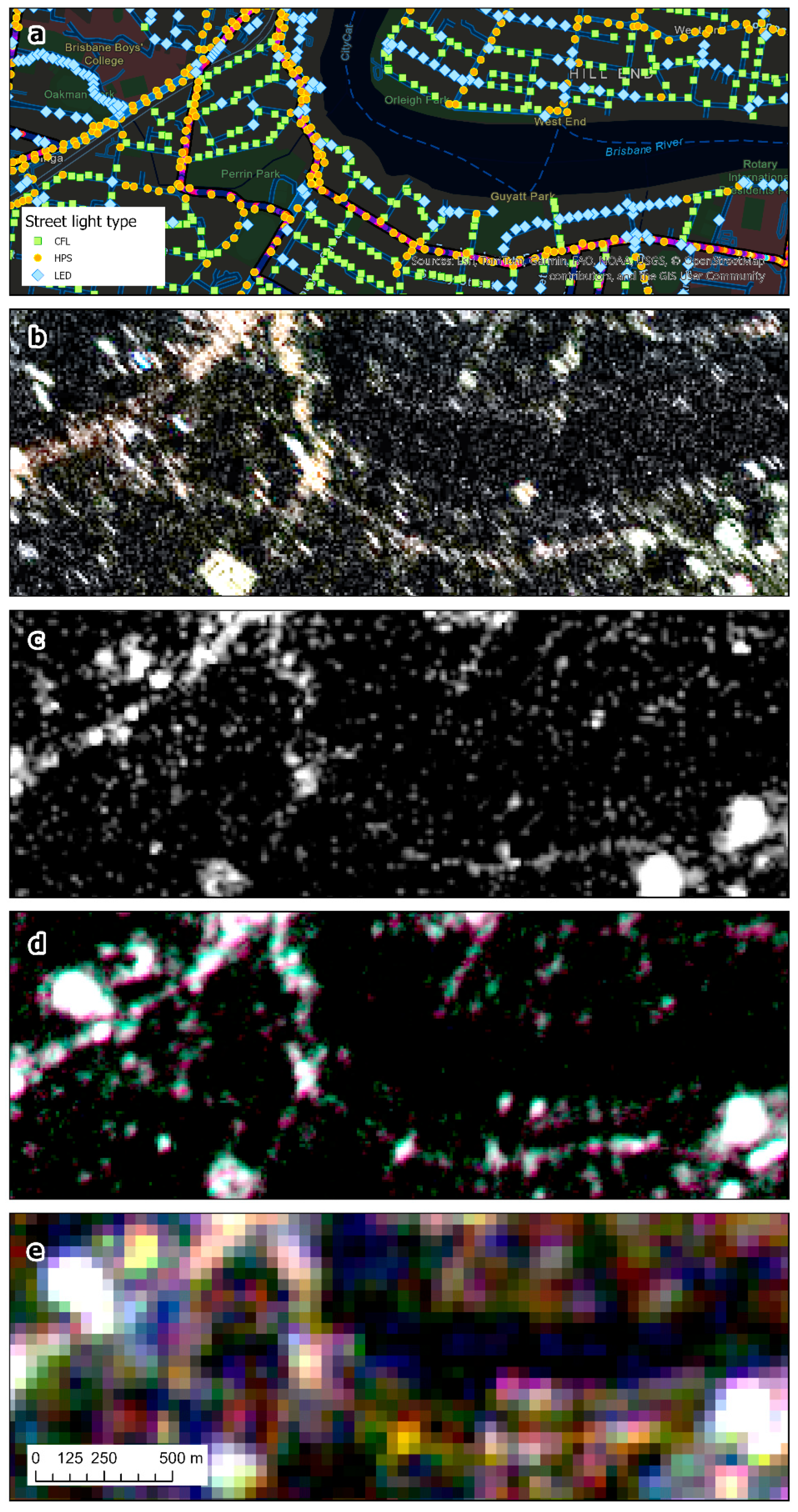
Figure 3.
Night time brightness distribution as a function of street light type within the grid cells: (a) LANcube S1 (upwards); (b) SDGSAT-1 10m; (c) Haishao-1; (d) ISS.
Figure 3.
Night time brightness distribution as a function of street light type within the grid cells: (a) LANcube S1 (upwards); (b) SDGSAT-1 10m; (c) Haishao-1; (d) ISS.
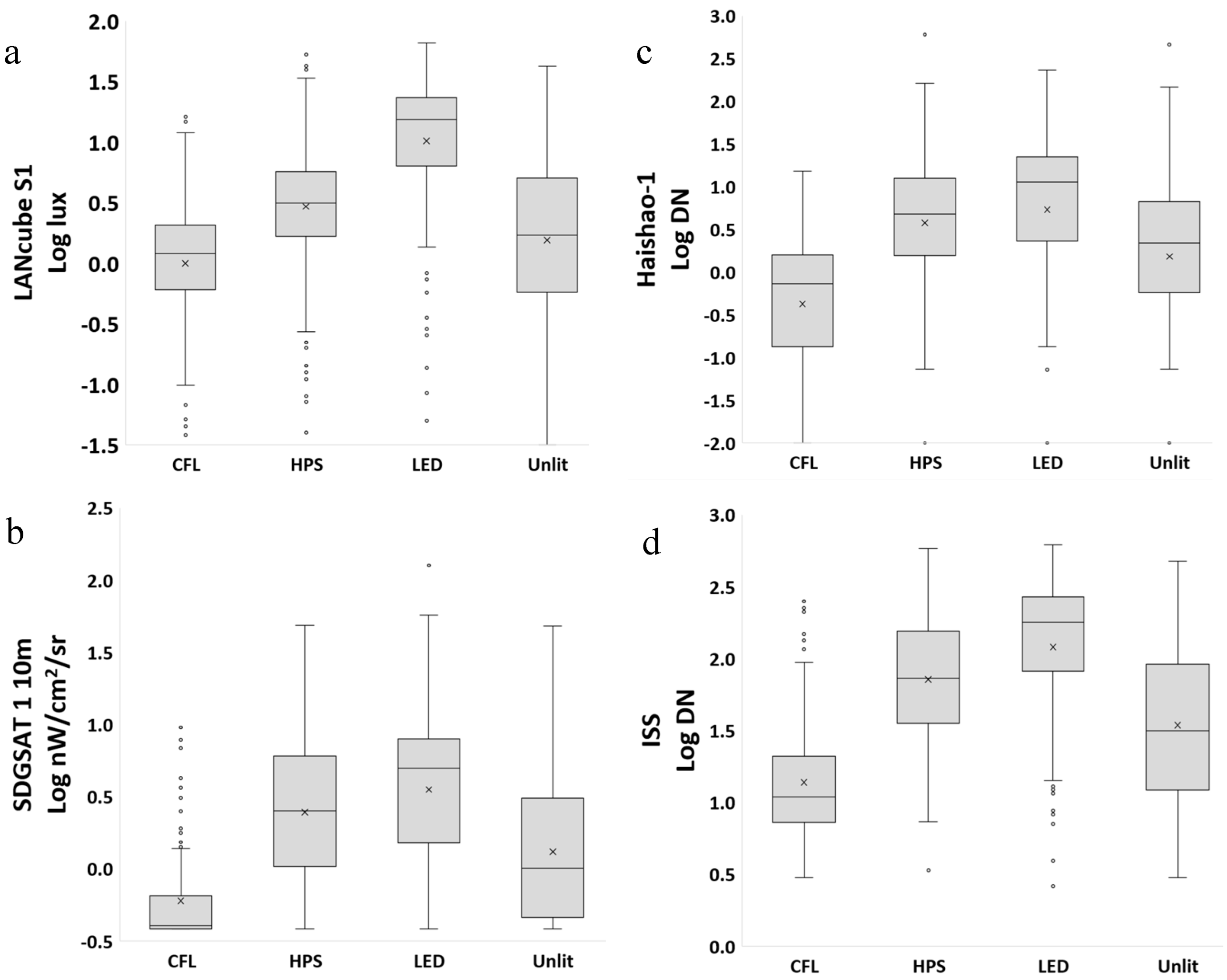
Figure 4.
LANcube measurements conducted in this study. (a) 27/8/2025, S1 (upwards) lux measurements; (b) 28/8/2025, S1 (upwards) lux measurements; (c) 27/8/2025, S1 (upwards) + S3 (right) + S5 (left) lux measurements, with the simultaneous SDGSAT-1 image in the background; (d) 28/8/2025, S1 (upwards) + S3 (right) + S5 (left) lux measurements, with the simultaneous HaiShao-1 image in the background.
Figure 4.
LANcube measurements conducted in this study. (a) 27/8/2025, S1 (upwards) lux measurements; (b) 28/8/2025, S1 (upwards) lux measurements; (c) 27/8/2025, S1 (upwards) + S3 (right) + S5 (left) lux measurements, with the simultaneous SDGSAT-1 image in the background; (d) 28/8/2025, S1 (upwards) + S3 (right) + S5 (left) lux measurements, with the simultaneous HaiShao-1 image in the background.
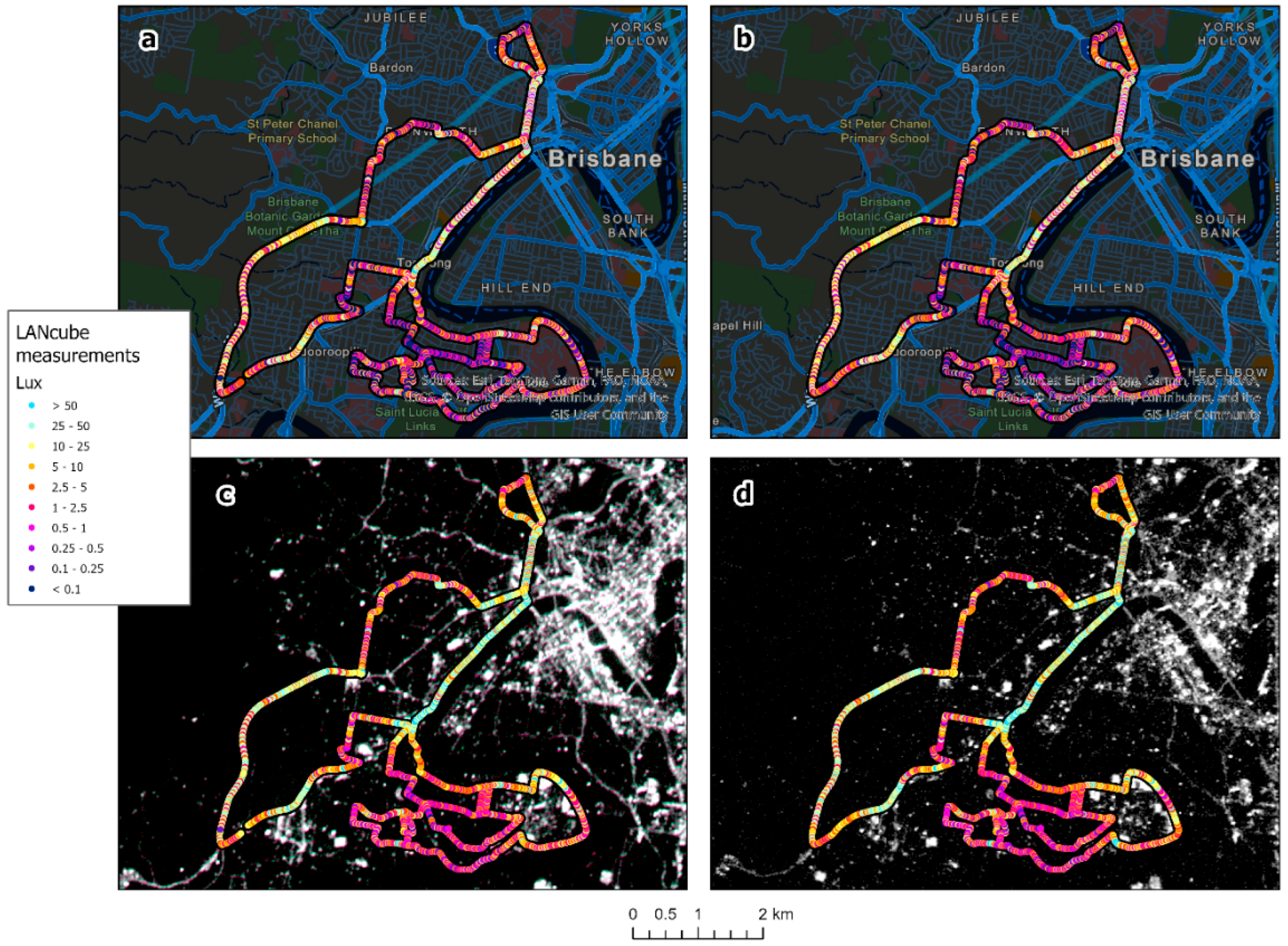
Figure 5.
Scatterplots showing the correlation between LANcube ground based measurements of lux values (sum in all directions), and the three high-res spaceborne night-time measurements: (a) ISS photo; (b) Haishao-1 image; (c) SDGSAT-1 image at 10 m.
Figure 5.
Scatterplots showing the correlation between LANcube ground based measurements of lux values (sum in all directions), and the three high-res spaceborne night-time measurements: (a) ISS photo; (b) Haishao-1 image; (c) SDGSAT-1 image at 10 m.
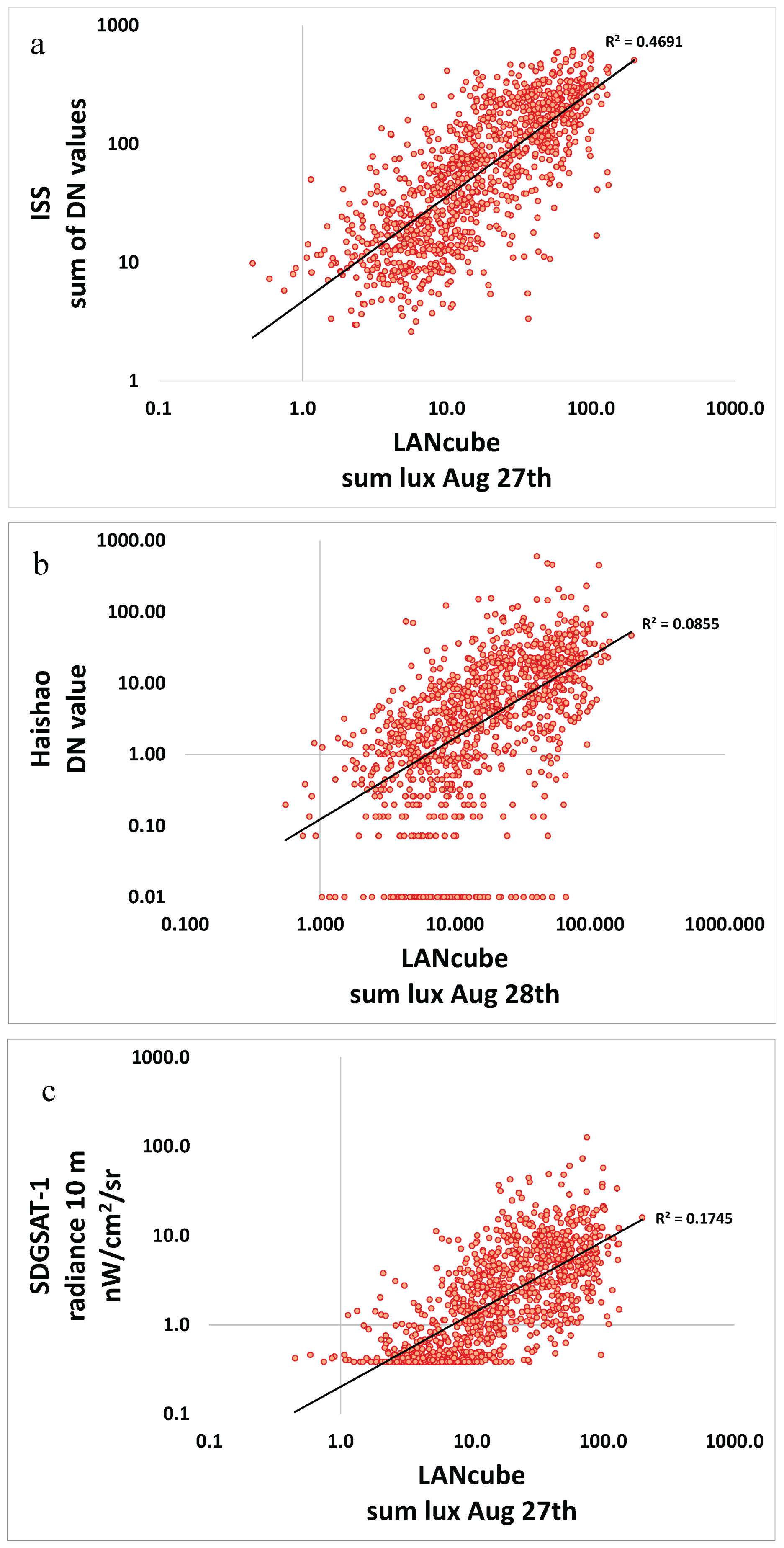
Figure 6.
Scatterplots showing the correlation between LANcube ground based measurements of lux values (upward direction) and the SDGSAT-1 panchromatic band radiance, by the most common street light type in each grid cell.
Figure 6.
Scatterplots showing the correlation between LANcube ground based measurements of lux values (upward direction) and the SDGSAT-1 panchromatic band radiance, by the most common street light type in each grid cell.
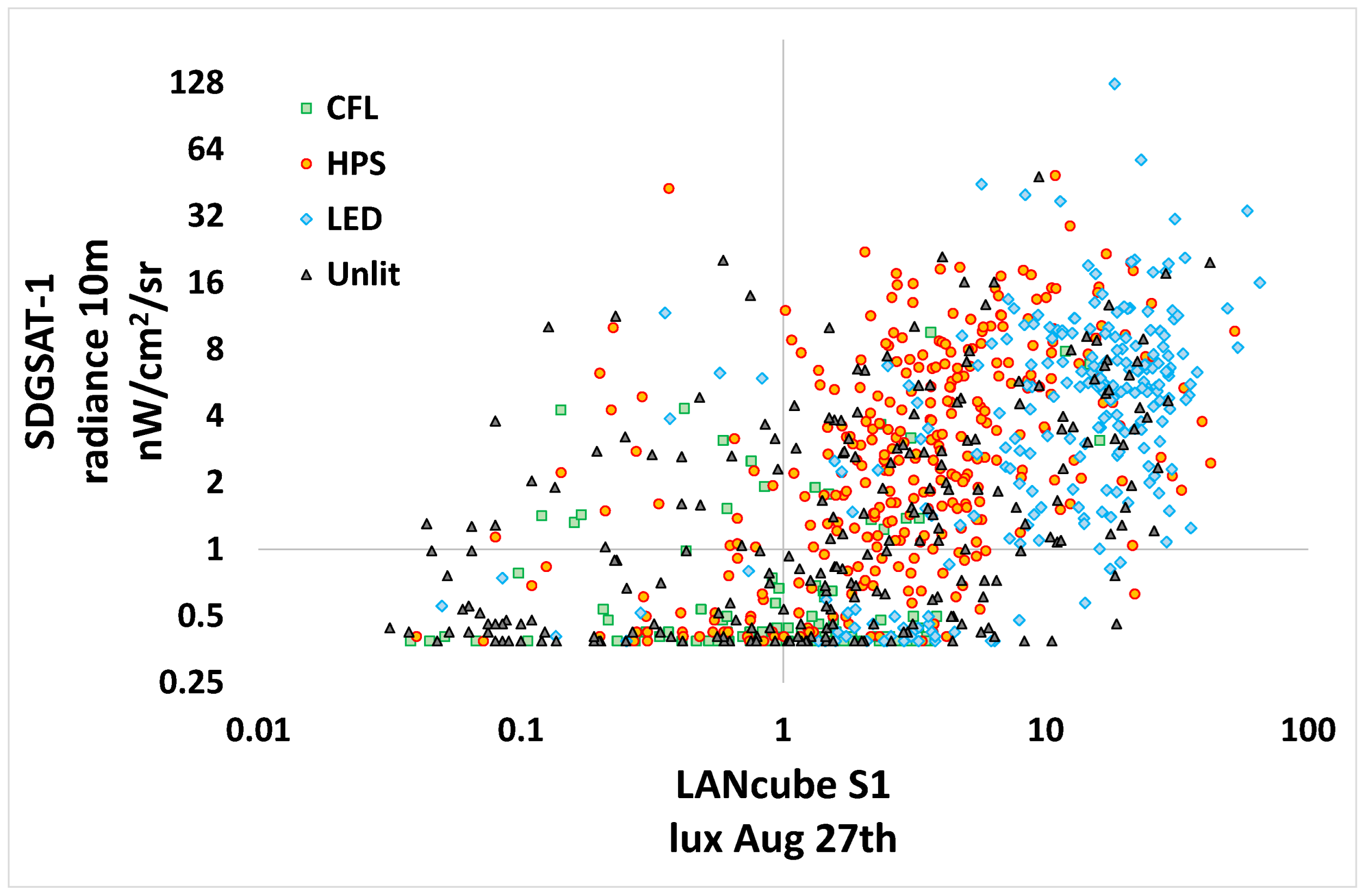

Table 1.
Selected previous studies that used ground based sensors to calibrate and validate space borne night light imagery.
Table 1.
Selected previous studies that used ground based sensors to calibrate and validate space borne night light imagery.
| Spaceborne or aerial sensor | Ground based data | Concurrent acquisition |
Spatial matching of ground measurements |
Aims of comparison | Ref. |
|---|---|---|---|---|---|
| SDGSAT-1 | TESS-4C | Yes | Fixed point measurements |
To examine the impact of the transition from HPS to LED | [15] |
| SDGSAT-1 | LANcube | No | Along a short road section | [15] | |
| SDGSAT-1 | Five point light sources | Yes | Fixed point measurements |
Vicarious radiometric calibration | [16] |
| High Altitude Balloon flights | LANcube | Yes | Along roads in a town in Canada | To better calibrate spaceborne night light measurements | [14] |
| SDGSAT-1, VIIRS/DNB | DSLR camera with fisheye lens | No | Measurements along the coast | To estimate coastal light pollution | [17] |
| VIIRS/DNB | SQM, DSLR camera with fisheye lens | No | [18] | ||
| SDGSAT-1 | LANcube | No | Along roads in Israel and Brisbane | To examine the effect of directionality of ground measurements on the correspondence with satellite data | [11] |
| EROS-B | SQM | No | Along trails in parks | [2] | |
| ISS | SQM | Yes | Fixed point measurements |
To better understand temporal changes in lighting during the night | [19] |
| VIIRS/DNB | Modelling of light emission | Yes | Fixed point measurements |
To better understand the calibration stability and absolute accuracy of VIIRS data and the impact of the atmosphere | [20] |
| VIIRS/DNB | SQM | Yes | Mostly fixed point measurements |
To calibrate and generate the atlas of artificial night sky brightness | [9] |
| VIIRS/DNB | TESS-W, SG-WAS | Yes | Fixed point measurements |
Better calibrate and integrate ground and space borne measurements | [10] |
| UAV | SQM | Yes | Fixed point measurements as well as along a route in a playground | To understand the diurnal dynamics of city lights during the night | [13] |
Table 2.
Satellite images used in this study
| Satellite | Date | Time of acquisition |
Spatial resolution | Spectral bands | Comments |
|---|---|---|---|---|---|
| Astronaut photo | Wednesday 21/5/2025 | 02:56 am | 8 m | RGB | ISS073-E-120440 NIKKON Z 400mm f/2.8 |
| SDGSAT-1 | Wednesday 27/8/2025 | 21:12 pm | 10m | panchromatic | |
| SDGSAT-1 | 40m | RGB | |||
| Haishao-1 | Thursday 28/8/2025 |
20:14 pm | 10m | panchromatic |
Table 3.
Average DN values of the different bands of each of the spaceborne platforms, in four dark or dimly lit areas.
Table 3.
Average DN values of the different bands of each of the spaceborne platforms, in four dark or dimly lit areas.
| Satellite | Resolution (m) | Band | Brisbane River | Golf course | Mt Coot-tha |
St Lucia dimly lit streets |
| ISS photo | 8 | Red | 3.210 | 2.409 | 2.114 | 3.234 |
| Green | 3.204 | 2.421 | 2.117 | 3.234 | ||
| Blue | 3.102 | 2.414 | 2.115 | 3.081 | ||
| Haishao-1 | 10 | Pan | 0.769 | 0.702 | 0.474 | 0.879 |
| SDGSAT-1 | 10 | Pan | 0.043 | 0.005 | 0.007 | 0.129 |
| 40 | Red | 11.390 | 0.428 | 0.024 | 14.758 | |
| Green | 22.263 | 2.560 | 0.251 | 15.935 | ||
| Blue | 8.632 | 1.371 | 0.328 | 1.742 |
Table 4.
Spearman rank correlation coefficients between the spaceborne images and the ground based LANcube lux measurements. The five sensors of the LANcube analyzed here are the S1 (upwards), S2 (backwards), S3 (right), S4 (forward) and S5 (left). All correlations were statistically significant (p < 0.0001).
Table 4.
Spearman rank correlation coefficients between the spaceborne images and the ground based LANcube lux measurements. The five sensors of the LANcube analyzed here are the S1 (upwards), S2 (backwards), S3 (right), S4 (forward) and S5 (left). All correlations were statistically significant (p < 0.0001).
| LANcube | S1 | S1+S3+S5 | S1+S2+S3+S4+S5 | S1 | S1+S3+S5 | S1+S2+S3+S4+S5 | |
| Imagery date | 27/8/2025 | 28/8/2025 | |||||
| ISS photo 8m | 21/5/2025 | 0.654 | 0.742 | 0.773 | 0.640 | 0.726 | 0.768 |
| Haishao-1 10m | 28/8/2025 | 0.496 | 0.592 | 0.619 | 0.499 | 0.616 | 0.638 |
| SDGSAT-1 10m | 27/8/2025 | 0.584 | 0.689 | 0.722 | 0.574 | 0.673 | 0.713 |
| SDGSAT-1 40m | 0.451 | 0.540 | 0.563 | 0.452 | 0.541 | 0.575 | |
Table 5.
Spearman rank correlation coefficients between the three multispectral sensors, the LANcube, the ISS photo and the SDGSAT-1 image, within each of the three spectral bands. All correlations were statistically significant (p < 0.0001). Note that the ‘red’ band of SDGSAT-1 includes the NIR as well.
Table 5.
Spearman rank correlation coefficients between the three multispectral sensors, the LANcube, the ISS photo and the SDGSAT-1 image, within each of the three spectral bands. All correlations were statistically significant (p < 0.0001). Note that the ‘red’ band of SDGSAT-1 includes the NIR as well.
| Red | Green | Blue | |
|---|---|---|---|
| ISS and SDGSAT-1 | 0.581 | 0.612 | 0.586 |
| ISS and LANcube | 0.610 | 0.670 | 0.665 |
| SDGSAT and LANcube | 0.418 | 0.478 | 0.472 |
Table 6.
Multivariate linear stepwise regression models, explaining the spaceborne borne night time brightness (after a logarithmic transformation), as a function of the sum LANcube lux values (sum of all directions), and additional variables representing canopy height, GHSL morphological settlement zones (residential and non-residential classes, and building height classes), and OpenStreetMap road classes. The table shows the standardized coefficients of each of the variables that were found as statistically significant.
Table 6.
Multivariate linear stepwise regression models, explaining the spaceborne borne night time brightness (after a logarithmic transformation), as a function of the sum LANcube lux values (sum of all directions), and additional variables representing canopy height, GHSL morphological settlement zones (residential and non-residential classes, and building height classes), and OpenStreetMap road classes. The table shows the standardized coefficients of each of the variables that were found as statistically significant.
|
Response variable |
ISS | Haishao-1 | SDGSAT-1 10m | SDGSAT-1 40m | ||||
| Adjusted R2 | 0.643 | 0.370 | 0.525 | 0.295 | ||||
|
Explanatory variable |
t | Pr > |t| | t | Pr > |t| | t | Pr > |t| | t | Pr > |t| |
| LANcube Sum lux | 17.109 | < 0.0001 | 11.636 | < 0.0001 | 13.446 | < 0.0001 | 7.642 | < 0.0001 |
| Canopy height | -9.183 | < 0.0001 | -2.354 | 0.019 | -6.673 | < 0.0001 | -2.535 | 0.011 |
| GHSL residential |
-2.147 | 0.032 | ||||||
| GHSL non-residential |
2.927 | 0.003 | 3.215 | 0.001 | 4.387 | < 0.0001 | 5.974 | < 0.0001 |
| GHSL > 6m | ||||||||
| GHSL > 15m | ||||||||
| OSM Highways |
14.492 | < 0.0001 | 6.353 | < 0.0001 | 11.253 | < 0.0001 | 7.081 | < 0.0001 |
| OSM Major roads |
10.334 | < 0.0001 | 5.576 | < 0.0001 | 6.082 | < 0.0001 | 2.652 | 0.008 |
| OSM Residential |
-4.540 | < 0.0001 | -5.308 | < 0.0001 | -5.487 | < 0.0001 | -3.187 | 0.001 |
Disclaimer/Publisher’s Note: The statements, opinions and data contained in all publications are solely those of the individual author(s) and contributor(s) and not of MDPI and/or the editor(s). MDPI and/or the editor(s) disclaim responsibility for any injury to people or property resulting from any ideas, methods, instructions or products referred to in the content. |
© 2026 by the authors. Licensee MDPI, Basel, Switzerland. This article is an open access article distributed under the terms and conditions of the Creative Commons Attribution (CC BY) license (http://creativecommons.org/licenses/by/4.0/).
Copyright: This open access article is published under a Creative Commons CC BY 4.0 license, which permit the free download, distribution, and reuse, provided that the author and preprint are cited in any reuse.


