
Submitted:
23 April 2026
Posted:
24 April 2026
You are already at the latest version
Abstract
Coxiella burnetii is an intracellular bacterium responsible for an anthropozoonosis that can be asymptomatic or manifest as acute or chronic Q fever . This extensive series of 588 patients represents one of the largest single-center studies on sporadic acute Q fever, highlighting the Canary Islands as a high-incidence region in Spain. Epi-demiologically, the domestic cycle is the primary driver of infection, with caprine livestock serving as the main reservoir, showing a local prevalence of 60.4%. Transmission is predominantly airborne via aerosols; the environmental resilience of C. burnetii facilitates its transport into urban areas, where the majority of patients reside despite lacking direct animal contact. While fever, headache, and sweating are hallmark symptoms, over 90% of patients exhibit transient urinalysis abnormalities, a finding that often leads to misdiagnosis and inappropriate antimicrobial use. Clinically, the non-specific (45.7%) and hepatic (44.1%) forms are most prevalent, whereas the pulmonary form (7.8%) is strongly associated with smoking and alcohol consumption. Although localized forms affecting the nervous system or skin (such as panniculitis) were observed, the overall prognosis remains excellent with no pro-gression to chronic Q fever in this series. In summary, the extensive series described characterizes acute Q fever patients in the Autonomous Community of the Canary Islands, with features that are similar in some cases but also show notable differences compared to other national and international series. Furthermore, depending on the patients' age, the time elapsed between the onset of clinical manifestations and hospital evaluation, and the clinical form, acute Q fever displays significant diffe-rences.
Keywords:
Coxiella burnetii
; acute Q fever
; demography
; epidemiology
; clinical manifestations
1. Introduction
Coxiella burnetii is an obligate intracellular bacterium classified within the phylum Proteobacteria (gamma subdivision), the family Coxiellaceae, and the order Legionellales [1]. In addition to humans, this bacterium is capable of infecting a vast array of hosts (i.e., mammals, birds, reptiles, amphibians, fish, or arthropods) [2,3,4,5]. Although serological evidence of infection has been observed in mammals [6], they typically remain asymptomatic except during the reproductive period (i.e., miscarriages, low birth weight) [7]. Nevertheless, these animals shed C. burnetii in their secretions (urine, feces, milk, amniotic fluid), particularly during parturition [8]. The highest concentration of bacteria is found in milk and products of conception, due to its tropism for the uterus and mammary glands [9].
In humans, Coxiella burnetii infection can manifest in four distinct forms [1,3,10,11] : i) inapparent, when there are no subjective or objective signs of disease but serological evidence of infection is confirmed; ii) acute Q fever and iii) chronic Q fever, characterized by subjective and objective clinical manifestations, distinguished by their temporal profile, type of symptoms and signs, and characteristic microbiological data; and iv) post-Q fever, presenting with non-specific symptomatology in the absence of objective data despite microbiological evidence of infection.
Q fever exhibits a cosmopolitan distribution in both humans and other hosts [12,13]. Specifically, acute Q fever can manifest as either an autochthonous or an imported disease [14,15,16,17,18]. Within the context of acute Q fever, two distinct forms exist [8]: outbreaks (which involve a varying number of cases) [19,20,21,22,23] and sporadic cases. Furthermore, in patients with sporadic acute Q fever, the incidence, temporal pattern, clinical manifestations, and laboratory findings differ considerably between countries and, within a single country, across different regions[4,12,13,21,24,25,26].
Prior to the year 2000, our group published the results of a brief series of patients with sporadic acute Q fever [27]. Since then, the number of observed cases has increased significantly; therefore, the primary objective of this study was to describe the clinical and epidemiological aspects of an extensive series of patients with autochthonous acute Q fever over a 25-year period. As secondary objectives, differences between patients were evaluated based on three aspects: age, the time elapsed between the onset of clinical manifestations and evaluation, and the primary clinical forms.
2. Patients and Methods
This was a retrospective study conducted on patients treated at the Hospital Universitario Insular de Gran Canaria (HUIGC) between January 1, 2000, and December 31, 2024. The HUIGC is one of the two primary hospitals in Gran Canaria, one of the seven largest and most populated of the Canary Islands (Spain), situated in the Atlantic Ocean between 27° and 29° North. The adult population for which the HUIGC serves as the referral hospital consists of 414,191 people, residing in the southern and eastern regions of Gran Canaria, as well as on the island of Fuerteventura.
Initially, 818 patients evaluated across various departments of the HUIGC were included, all of whom had at least one documented positive antibody determination against Coxiella burnetii phase II antigens. Patients meeting one or more of the following conditions were excluded: i) absence of clinical and/or microbiological data for proper classification (see below); ii) potential imported acquisition: travelers and recent immigrants (< 3 months prior to serological determination); iii) diagnostic criteria for another disease (bacterial or viral infection, or neoplasia); iv) immunosuppression (HIV, chemotherapy, or use of biological agents) [28,29,30,31]; v) criteria for chronic Q fever[32,33] and vi) post-Q fever fatigue syndrome[34].
2.1. Inclusion Criteria
The diagnosis of acute Q fever was based on the simultaneous presence of three criteria: i) age ≥ 14 years; ii) presence of clinical manifestations (compatible subjective and objective findings); and iii) microbiological criteria.
The age of 14 was selected as individuals below this age are treated at another hospital within the Canary Islands healthcare area.
Regarding clinical manifestations, the definitions proposed by Raoult were employed with minor modifications [35]: i) presence of data suggestive of pulmonary infection (“pulmonary”) (cough with expectoration, hemoptysis, dyspnea, or chest pain) and chest X-ray abnormalities; isolated dry cough was not considered a diagnostic criterion; ii) presence of an apparent hepatic focus (“hepatic”) (elevation of ALT over two times the upper normal value), this being the limit employed by the majority of series, with some exceptions [36,37]; iii) “other localized form” (i.e., nervous system, skin and soft tissues, heart, biliary tract) defined by clinical and complementary tests; and iv) “unspecific” or isolated febrile syndrome, defined when fever was present without lung or hepatic involvement or another focus of infection. Some patients met the criteria for two clinical forms.
Microbiological diagnosis included three types [11]: i) defined AQF when there was evidence of seroconversion of IgG titres to phase II C. burnetii (a fourfold increase or two dilutions) [7] within 2–4 weeks[4]; or positive serum PCR [38] ; ii) very probable AQF if IgG was clearly elevated alongside positive IgM in patients for whom only a single serological determination was performed; and iii) probable AQF when IgG serology was positive at a high titre with negative IgM, or when IgM was positive with negative IgG. Serological analysis was conducted as follows. First, a screening test was performed to determine specific IgG antibodies against C. burnetii phase II antigens in serum; until 2010, an indirect immunofluorescence (IFA) technique was employed (C. Burnetii-Spot IFA. BioMérieux, Marcy l’Etoile, France), and since then, a chemiluminescent immunoassay (CLIA) (VirClia kit, Vircell SL, Granada, Spain) has been used. Regarding IgM, the cutoff point for a positive result was ≥ 1:80 by IFA or ≥ 1:64 by CLIA, whereas for IgG, it was ≥ 1:128 for both techniques. High IgG titres were defined as ≥ 1:512. In 181 patients, the presence of antibodies against C. burnetii phase I antigens was also evaluated during follow-up.
2.2. Demographic and Epidemiological Data
Whenever available, the following demographic data were evaluated: age, gender, place of birth, habitat, and occupation. Regarding age, patients were classified into three groups: young (14-29 years old); middle-aged (30-59 years old); and older (≥ 60 years old) [39,40]. The terminology used in the definition of gender was that described by Rioux et al. [41]. Based on the patients’ place of birth, they were classified as Spanish or foreign, specifying the country and continent in the latter case. The place of residence (habitat) was categorized into three groups according to population density (inhabitants/km2): urban (>1,500), semi-urban (300-1,500), and rural (< 300) [42]. Patients’ occupation was reported according to modified international and Spanish criterio [43,44].
Epidemiological data included the year and month of diagnosis, the presence of toxic habits, and exposure to potential risk factors. Regarding smoking habits, a distinction was made between current smokers, those who had never smoked, and former smokers, the latter defined as those who had ceased consumption at least three months prior to the study. Regarding alcohol consumption, participants were classified into three groups based on daily standard drink units [45]. It should be noted that the standard drink unit varies by country; in Spain, it equals 10 g of pure alcohol [46]. Risk factors included contact with animals, arthropod bites, consumption of unpasteurized dairy products (milk, cheese), and contact with wastewater. If animal contact existed, information on the primary type was recorded: domestic (dogs or cats), livestock (goats, sheep, cows), and poultry, as well as combinations thereof. The presence of arthropod bites was based on clinical history and physical examination, although in most cases, it was impossible to identify the specific type.
Furthermore, past medical history was recorded (with a particular focus on the presence of structural heart disease and/or vascular grafts) as well as the occurrence of familial cases.
2.3. Clinical Data
The time elapsed between the onset of clinical manifestations and evaluation (TOCE) was assessed, along with the maximum temperature reached, the prior use of antimicrobials (excluding doxycycline) and the class of drug administered, the previously indicated clinical forms of the disease, hospital admission and its duration, clinical signs and symptoms (present during the initial evaluation), and the disease progression over the six months following diagnosis (including the development of chronic Q fever, the onset of other medical conditions, and patient mortality).
2.4. Complementary Examinations
During the initial week of hospital evaluation, various laboratory studies were performed: complete blood count, routine coagulation tests, inflammatory biomarkers (erythrocyte sedimentation rate, C-reactive protein, and procalcitonin), serum biochemical parameters (creatinine, sodium, creatine kinase, and total g-globulin), and urinalysis. Additionally, three sets of liver tests were measured to assess the presence and degree of cytolysis (alanine aminotransferase [ALT], aspartate aminotransferase [AST], and lactate dehydrogenase [LDH]), cholestasis (alkaline phosphatase, g-glutamyl transferase, and direct serum bilirubin), and hepatocellular insufficiency (Quick prothrombin index and serum albumin).
Furthermore, plasma concentrations of the main immunoglobulin isotypes (IgG, IgM, and IgA) were evaluated in 76 patients. Conversely, in patients whose protein electrophoresis demonstrated the presence of paraproteins, the specific type was identified via immunofixation. Additional hemostasis studies—including, among others, mixing tests, factor assays, and evaluation of antiphospholipid antibodies (lupus anticoagulant [dilute Russell’s viper venom test with confirmation using excess phospholipids], anticardiolipin antibodies [IgG and IgM], and anti-b2-glycoprotein I antibodies)—were performed in up to 59 patients, depending on previous results.
Other complementary examinations conducted included transthoracic echocardiograms (245 patients within the month following initial evaluation) and, depending on clinical manifestations, abdominal ultrasound or CT, brain or spinal CT and/or MRI, and lumbar puncture.
2.5. Statistics
Statistical analysis of the data obtained in the present study was performed using SPSS version 31 and Stata version 19 (StataNow).
Descriptive variables were expressed as percentages for qualitative data and as measures of central tendency and dispersion for quantitative data. Data distribution was initially assessed using the Shapiro–Wilk or Kolmogorov–Smirnov tests, as appropriate. Variables with a normal distribution were summarized as mean and standard deviation, whereas variables with a non-normal distribution were expressed as median and interquartile range.
To assess the association between three independent variables (age group, time to evaluation, and clinical group) and the dependent variables, an initial bivariate analysis was performed for exploratory purposes. Associations were evaluated using the c2 test, and when an association was identified, Cramér’s V was calculated to assess its strength. Subsequently, multivariate analysis was conducted using logistic regression (ordinal or binary, depending on the type of dependent variable) and multinomial logistic regression for nominal polytomous variables, with the aim of identifying independent associations. The results of the multivariate analysis were expressed as odds ratios (ORs) with 95% confidence intervals (CIs). Statistical significance was defined as a two-tailed p value < 0.05.
2.6. Ethics
The present study was conducted in accordance with the guidelines of the 1975 Declaration of Helsinki, as revised in 2013. The protocol was approved by the Research Ethics Committee / Drug Research Ethics Committee (CEI/CEIm) of Las Palmas (Canary Islands, Spain) (Approval Code: 2025-209-1; Approval Date: 24/04/2025). Given the retrospective nature of the study and the use of anonymized clinical data, the requirement for individual informed consent was waived [47].
3. Results
During the study period, 588 patients were registered over 25 years, with an annual mean of 23 cases (Figure 1). Graphical analysis using a 5-year moving average revealed a non-strictly linear pattern, characterized by an initial low-frequency phase during the early years of the registry, a sustained increase with peaks between 2011 and 2017, and a relative decline in the most recent years of the analyzed period.
The main demographic data are shown in Table 1 and Table S1. Regarding gender, two cisgender women were pregnant at the time of illness. Furthermore, a significant percentage of patients were born in countries other than Spain. When this data was compared with the general population of Gran Canaria, significant differences were observed (p < 0.05), with a higher prevalence among foreign nationals. Specifically, the proportion was higher among those born in the Americas (particularly Cuba, Colombia, and Venezuela) and lower among those originating from Eurasia, Africa, or Asia.
The main epidemiological data are detailed in Table 2.
In 225 patients (38.3%), there were no relevant medical antecedents, while in the remaining cases, one or several common medical conditions were detected. These primarily included hypertension, diabetes mellitus, dyslipidemia, COPD, and gastroesophageal reflux. Surgical history was also frequently noted, particularly appendectomy or tonsillectomy. Additionally, a history of cardiac and vascular disorders was common (especially ischemic heart disease or arrhythmias; however, only three patients had a history of valvular lesions), and none had vascular grafts. No familial cases of Q fever were documented.
Table 3 provides details on the primary general clinical data for this series.
Regarding the type of antibacterials used, 61% were beta-lactams (primarily amoxicillin/clavulanate), 28% fluoroquinolones (mainly ciprofloxacin), and 24% macrolides (specifically azithromycin). Table S2 shows the main localized syndromes, excluding liver and lung involvement. The symptoms and signs present during the initial evaluation are indicated in Table 4. Figure S2 displays the percentage of patients with acute Q fever who were hospitalized, categorized by the year of the study.
During the six-month follow-up after diagnosis, only one patient died from liver failure attributable to the infection. 15 patients presented IgG antibodies against phase I (with the following titers: 1:1,024 [7], 1:2,048 [5], 1:4,096 [1], 1:8,192 [1], and 1:16,384 [1]); none of them met other criteria for chronic Q fever. During this period, several new medical problems were observed, both neoplastic (two B-cell lymphomas, two lung adenocarcinomas, one gastric adenocarcinoma, one laryngeal neoplasm, one cancer of unknown primary with multiple metastases, and one Warthin’s tumor) and of other origins (basal ganglia calcification and a colloid cyst of the third ventricle).
Among the 76 patients in whom the concentration of the main immunoglobulin isotypes (IgG, IgM, and IgA) was quantified, a highly variable result was found: it was normal in 32 cases and elevated in all of them in 3 cases; in 4 cases, elevation of two different isotypes was detected (1 IgG + IgA, 3 IgM + IgA), and in the remainder, modifications of a single isotype were observed (elevated IgG in 1 patient and decreased in 2 cases; elevated IgM in 17 patients; and IgA elevated in 17 cases and decreased in 1 case).
In 17 patients, alterations in the protein electrophoresis (proteinogram) other than hypergammaglobulinemia and hypoalbuminemia were observed. In 15 patients, these corresponded to paraproteins (double in 3 cases; single in 12 [8 IgG, 2 kappa / 5 lambda; 4 IgM, 2 kappa / 5 lambda]). The remaining two cases corresponded to IgG biclonality and a beta-gamma bridge.
The main alteration observed in the complementary coagulation studies was the presence of antiphospholipid antibodies (24 patients), especially lupus anticoagulant (17), anticardiolipin (4), and both (2). Other less frequent findings were contact phase alteration (8), factor deficiency (1), and disseminated intravascular coagulation (1).
A very important aspect that should be noted is that most of the clinical and analytical data were observed early during the acute phase and were transient in nature, disappearing during patient follow-up.
Of the 245 transthoracic echocardiograms performed, valvular lesions confirmed by TTE were observed in only 12 of them.
In the bivariate analysis of the association between the age group and the remaining variables (Table S3a), a statistically significant association was observed with demo-epidemiological data (place of birth, habitat, tobacco use, and animal contact) and clinical-analytical data (time elapsed between the onset of clinical manifestations and evaluation, hospital admission, serum ALT and GGT levels, diagnostic group, and clinical group). When the independent association of variables was evaluated using the 30 to 59 years group as the reference value, several associations were observed as indicated in Table S3b.
When the bivariate analysis of the association of time to hospital evaluation with the rest of the variables was performed (Table S4a), no statistically significant association was observed with demo-epidemiological data; however, associations were found with clinical-analytical data (platelet count, aPTT ratio, ESR, CK, ALT, LDH, GGT, diagnostic, and clinical group). Multivariate analysis, using the 8-21 group as the reference value, showed several associations indicated in Table S4b.
In the bivariate study of the association of the clinical group with the remaining variables (Table S5a), a statistically significant association was observed with demo-epidemiological data (gender, tobacco, or alcohol use) and clinical-analytical data (time elapsed between the onset of clinical manifestations and evaluation, hospital admission, arthralgias, headache, myalgias, white blood cell count, platelet count, C-reactive protein, ALT, LDH, GGT, overall urinalysis, and diagnostic group). In the multivariate study, using the “unspecific” group as the reference value, several associations were observed as indicated in Table S5b
4. Discussion
Including 588 patients with sporadic acute Q fever, this study represents, to our knowledge, one of the largest and longest single-center series reported [5,11,21,35,36,37,48,49,50,51,52,53,54,55,56,57], even when compared with cohorts focusing solely on pulmonary or hepatic forms [58,59]. The analysis of the results and, specifically, the comparison with the other aforementioned series, is difficult due to variation in methods of case finding, diagnostic testing, reporting, and surveillance data [54].
The number of cases in this series, similar to others previously published, exhibits significant annual variations, with mean values exceeding those reported in the literature for other Spanish regions [5,21,26,36,49,50,51,52,53] with few exceptions [11]. In recent years, an apparent increase in the incidence of this disease has been observed, which may be due to increased reporting or diagnosis [6,35]. The actual incidence of Q fever in our region is likely underestimated, as cases managed exclusively in primary care or private centers were not included [9,11]. Although Q fe[5,11,21,35–37,48–57ver has been a notifiable disease in Spain since 2015 (Centro Nacional de Epidemiología [National Epidemiology Centre]), indirect data (comparing notifications with hospitalizations) suggests the existence of underreporting [54]. Despite these limitations, the Canary Islands is the community with the highest incidence of notification and hospitalization (3.95 and 2.95 per 100,000 inhabitants/year) [54].
Regarding gender, the majority of patients are male, as is the rule in all series to a greater or lesser extent. Although occupation and/or contact with animals may play a role in certain cases, the most plausible explanation based on experimental studies is the protective role of estrogens (i. e. 17 ß oestradiol) [10].
Considering age at the time of diagnosis, the majority of cases, both in the current series and in most other published works, correspond to middle-aged patients24. Nevertheless, up to 30% of them were younger (20%) or older (10%). In the multivariate study, the 14-29 age group was less likely to have a foreign origin, an urban habitat, current or previous tobacco consumption, or elevated GGT levels; conversely, a shorter interval between time to evaluation and confirmed diagnosis was more frequent. On the other hand, in the age group ≥ 60 years, hospital admission, a very likely diagnosis, and non-specific and pulmonary forms were more frequent, while elevated ALT levels were less common.
We have found no references in the literature regarding other demographic aspects or risk factors such as place of birth, nor the (current or previous) consumption of tobacco or alcohol. In this study, when the origin of the patients was compared with the general population, an increase in individuals born outside of Spain was observed, particularly from Latin America. The reason for this finding remains speculative, potentially due to greater exposure or a specific genetic predisposition, though no data exist to support this. On the other hand, investigating the relationship with tobacco consumption was of interest, given that other granulomatous diseases (i.e., sarcoidosis or hypersensitivity pneumonitis) are less frequent in smokers [60]. Although the study design precluded a definitive evaluation of this aspect, it was observed that tobacco consumption was more frequently associated with pulmonary forms. An association between excessive alcohol consumption and pulmonary forms was also observed.
No familial clustering of Q fever patients was observed in this series. Reports of acute familial Q fever are anecdotal [36,61,62,63] and have been linked to shared contact during the birthing of infected pets or contaminated work clothing (“second-hand Q fever”).
From an epidemiological perspective, two infection cycles for C. burnetii have coexisted since the disease was first recognized: the sylvatic and the domestic [8,13] , with the latter being the most significant today. As with many infectious diseases, it is essential to identify three elements: the reservoir or source of infection, the mode of transmission, and the role of the host. In the sylvatic cycle, the reservoir consists of wild animals, whereas in the domestic cycle, it comprises livestock (especially ruminants such as goats, sheep, and cattle) and, to a lesser extent, companion animals (dogs and cats) [9,64]. The primary mode of transmission is the airborne route through aerosols containing infectious bacteria, although other forms have been described, such as the consumption of contaminated milk or derivatives, and other less frequent routes[7,13]. Years ago, it was suggested that pulmonary forms were associated with airborne transmission and hepatic forms with the ingestion of dairy products, a hypothesis currently discarded [26]. Various tick species are linked to the epidemiology of Q fever, although direct transmission to humans is very rare[13]. Another important, though poorly studied, aspect is the role of the host in the development of the disease. Our group has previously studied several of these epidemiological aspects, providing various results. Thus, in a seroepidemiological study of a representative sample of ruminants in our area, 60.4%, 31.7%, and 12.2% of goats, sheep, and cattle, respectively, were found to be infected [65]. Furthermore, in 100 rodents on farms and 129 wild rabbits, C. burnetii DNA was detected in 8.0% and 1.5%2. Using the same methodology (PCR), C. burnetii DNA prevalence in ticks removed from livestock, domestic dogs, wild animals, and vegetation was 11.3%, 6.9%, 6%, and 0%, respectively [2]. Finally, in a case-control study, we observed that HLA-DRB1*04 was more frequent in patients compared to the control group [66]. Therefore, we studied various aspects in this series to more precisely define the epidemiological characteristics of the disease in our environment.
Several data suggest a significant role for animals, such as the high percentage of patients reporting contact with them (approximately 70%), the previously indicated high prevalence of infection in livestock in Gran Canaria, and a monthly distribution that coincides with the kidding (birthing) season of goats. Regarding animal contact, data from different series are highly diverse, ranging between 2% and 83% of patients [5,11,21,35,36,48,49,50,57]. Concerning the role of caprine livestock in our area, it is noteworthy that Gran Canaria and Fuerteventura are the islands with the largest livestock populations (including semi-intensive farms and feral goats). Traditionally, kidding occurred between the months of October and February. However, other data from our series limit the importance of direct animal contact. Thus, occupational risk exposure (including agriculture, livestock, and environmental management or healthcare and social services) accounts for only 8% of patients. On the other hand, although the exact definition of rural and urban habitat is detailed in very few series [36,49], the percentage of patients with urban residence is very high, often exceeding rural cases [11,26,35,49,50,51,52,53]. Furthermore, few series in the literature specify the type of animal, and in those that do, as is the case in our series, domestic animals (dogs and cats) predominate [5,11]. In this regard, there are limited data concerning the relevance of the role of domestic animal infection in humans [67,68,69]. A unifying explanation for all these data is based on the resistance of C. burnetii to adverse environmental conditions, allowing it to be transported many kilometers away while maintaining great virulence from its origin. Environmental conditions (wind, humidity, and temperature) and other factors (i.e., the use of face masks during the COVID-19 pandemic) could all affect the variation in annual cases. Finally, other factors such as the consumption of unpasteurized dairy products, exposure to wastewater, or tick bites appear to play a less relevant role in the epidemiology of acute Q fever
It is generally assumed that the incubation period of C. burnetii infection in humans is 18 days (95% CI 7-32) [70]. However, this figure is difficult or impossible to ascertain concretely in individual cases. Although data in the literature are scarce, an aspect of interest is the time elapsed between the onset of clinical manifestations and hospital evaluation. In our series, this global figure is 8 (5-14) days, similar to or slightly lower than other series [11,26,37,49]. In the majority of patients, the TOCE (Time to Clinical Evaluation) was ≤ 7 days (short duration) or between 8-21 days (intermediate duration), being much less frequent beyond 21 days (long duration). It is worth noting that although acute Q fever is a common cause of “fever of intermediate duration”, practically half of Q fever cases are of short duration. In the multivariate analysis, the short duration group was less likely to present a prolonged aPTTr (activated partial thromboplastin time ratio) or increased ESR (erythrocyte sedimentation rate) or GGT; conversely, thrombopenia and elevated CK (creatine kinase) were more frequent. On the other hand, in the long duration group, elevated LDH or ALT was less likely, while thrombocytosis and non-specific or localized clinical forms were more frequent.
Approximately one-fourth of patients with acute Q fever required hospital admission, a percentage lower than that reported in other published series [11,21,49,50,54,57]. An aspect that warrants highlighting is the discrepancy between the annual reduction in case incidence and the number of admissions. One interpretation for this finding is that an increased awareness of the disease ensures that only the most severe cases are referred to the hospital.
In this series, the most frequent clinical manifestations were fever, headache, arthralgia, and myalgia. High-grade fever was observed in 97.4% of patients, frequently accompanied by profuse sweating (70%). These data are consistent with most published series [36,37,49,50,53] although it is lower in a small percentage of them [5,11,21,51,71]. The presence of headache was also frequent (7 out of 10 patients), higher than in other series [5,11,35,37,49,52,54] and lower than others [26,50,57]. Just over half of the patients presented with arthralgia and/or myalgia, which is difficult to compare with other series as they do not specifically differentiate between both types of symptoms. Laboratory data evaluation indicates two aspects of interest. Firstly, the detection of inflammatory biomarkers is very frequent, especially C-reactive protein and, to a lesser extent, ESR. Secondly, more than 90% of the patients in this series presented one or more abnormalities in urinalysis, in the absence of urinary casts or glomerular function impairment. To our knowledge, urinalysis alterations have only been noted in one previous publication [37]. Although it is very difficult to evaluate the mechanisms behind these alterations due to their transient nature, their presence is of practical interest. In this sense, they may be related to the inappropriate use of antimicrobials when interpreted as a surrogate marker of urinary tract infection.
The most frequent clinical forms in our region are the unspecific type, accounting for 45.7% of the total, and the hepatic form (either isolated or associated), present in 44.1% of patients. The pulmonary form is infrequent, whether isolated or associated, with an incidence of 7.8%. Other localized forms account for 7.4% of cases in this series. An aspect to highlight in this study is the high incidence of localized forms other than the liver or lung, which is higher than in most other published series. The majority corresponded to involvement of the nervous system and, in descending order, skin and soft tissue, biliary tract, and heart. Several of the neurological forms have already been described by other authors, such as meningoencephalitis [72,73], ischaemic stroke [74,75], transverse myelitis [73,76], and optic neuritis [77,78]; however, we have found no references regarding the association of Q fever with cerebral venous sinus thrombosis, hearing loss, or dysgeusia. Inspecific skin lesions in acute Q fever are infrequent (6.3% in our series). Nevertheless, we have also observed other better-defined skin and soft tissue lesions, primarily in the form of panniculitis (septal or lobular) without vasculitis, as previously described by other authors [79,80,81,82]. Furthermore, several patients presented other manifestations such as Sweet syndrome, lichenoid pityriasis, or angioedema, which, to our knowledge, have not been reported in association with acute Q fever. In this series, the most frequent form of biliary tract involvement was cholangitis, unlike other published cases where cholecystitis was observed [83,84]. Unlike chronic Q fever, in which endocarditis is characteristic, cardiac involvement in acute Q fever in this series manifests as pericardial or myocardial lesions, as previously reported [85,86,87,88].
Literature analysis indicates different clinical patterns depending on the geographical area. Thus, for instance, in Spain, non-specific forms predominate in Extremadura [36] or the Balearic Islands [11]; hepatic forms in Andalucia [26], Castilla-La Mancha [49], and the Valencian Community [50]; and pulmonary forms in the Basque Country [58] or Galicia [21]. The distinct clinical expression of acute Q fever in the aforementioned geographical areas appears to depend, among other factors, on the size of the inoculum, the route of infection acquisition, and the virulence and genotype of the C. burnetii strain [89,90,91].
Finally, it should be noted that the clinical forms indicated are independently associated with various distinct epidemiological and clinical data. Specifically, in the hepatic form, a shorter time to hospital evaluation, the presence of hematological alterations (thrombopenia and leukopenia), marked alteration of GGT and LDH enzymes, an elevation of C-reactive protein, abnormalities in urinalysis, and a higher frequency of definitive cases were more frequent. On the other hand, in the pulmonary form, tobacco consumption (current or previous) and excessive alcohol consumption, hospital admission, hematological alterations such as leukocytosis or thrombo-cytosis, and “very likely” diagnosed cases were more frequent. Finally, in the group of other localized forms, hospital admission, leukocytosis, increased GGT, and “very likely” diagnosed cases were more common.
In the follow-up of patients with acute Q fever, death is exceptional in our series, as is the case in virtually all other published works. Furthermore, despite limitations due to the small number of patients who attended follow-up visits, none of them presented criteria for chronic Q fever, regardless of the data indicated over the years as predictors of this progression, such as advanced age, previous valvular involvement, Phase I antibody titers against C. burnetii, prolongation of aPTTr, or the detection of anticardiolipin antibodies [53,92,93]. On the other hand, other diseases were observed during this follow-up, especially neoplasms, some of which have already been previously noted, such as lymphomas or carcinomas [94,95,96,97,98,99], although establishing a causal relationship with C. burnetii infection remains very difficult.
Our study has several limitations that should be acknowledged, primarily stemming from its retrospective and single-center design. This nature restricted the data to that collected as part of routine clinical surveillance, which may limit the availability and precision of information regarding specific environmental exposures and clinical details, particularly in older cases where standardized data collection protocols were not yet established. Furthermore, as a hospital-based series, our findings only include patients diagnosed within the hospital setting, potentially leading to a selection bias toward more severe clinical presentations and an underestimation of the total incidence, as milder episodes managed exclusively in primary care or private centers were not captured. Additionally, the transient nature of clinical and laboratory alterations, such as transaminases or C-reactive protein, may introduce analytical discrepancies depending on the timing of evaluation; however, we attempted to mitigate this by selecting determinations closest to the clinical event. Finally, a diagnostic bias cannot be ruled out, as episodes of acute Q fever—especially those presenting as isolated pneumonia or acute hepatitis—may have gone unnoticed since serological testing is not routinely performed in these clinical situations unless a fever is prolonged and without an evident source
5. Conclusions
In summary, the extensive series described characterizes acute Q fever patients in the Autonomous Community of the Canary Islands, with features that are similar in some cases but also show notable differences compared to other national and international series. Furthermore, depending on the patients’ age, the time elapsed between the onset of clinical manifestations and hospital evaluation, and the clinical form, acute Q fever displays significant differences.
Supplementary Materials
The following supporting information can be downloaded at: https://www.mdpi.com/article/doi/s1, Figure S1. Monthly distribution of acute Q fever ; Figure S2. Hospital admission; Table S1. Occupation; Table S2. Other localized síndromes; Table S3a. Bivariate analysis of associations with age group; Table S3b. Multivariate analysis of associations with age group; Table S4a. Bivariate analysis of associations with time to clinical evaluation; Table S4b.Multivariate analysis of associations with time to clinical evaluation; Table S5a. Bivariate analysis of associations with clinical group; Table S5b. Multivariate analysis of associations with clinical group.
Author Contributions
Not applicable.
Funding
This research received no external funding.
Institutional Review Board Statement
The present study was conducted in accordance with the guidelines of the 1975 Declaration of Helsinki, as revised in 2013. The protocol was approved by the Research Ethics Committee / Drug Research Ethics Committee (CEI/CEIm) of Las Palmas (Canary Islands, Spain) (Approval Code: 2025-209-1; Approval Date: 24/04/2025).
Informed Consent Statement
Given the retrospective nature of the study and the use of anonymized clinical data, the requirement for individual informed consent was waived.
Data Availability Statement
Author has full access to and is the guarantor for the data. The datasets generated are available from the corresponding author on reasonable request.
Acknowledgments
Naturally, many individuals have contributed to this work but do not meet the criteria for authorship. The author wishes to express particular gratitude to the clinicians responsible for patient care and/or data collection (especially those from the UEIMT [M. Briega, C. Lavilla, E. Pisos, L. Suárez, H. Rosario, C.J. Ramírez, L. López, C. Betancor, N. Jaén, M. Hernández]) and to the microbiologists responsible for establishing the etiological diagnosis (A. Hernández, M. Bolaños, C. Carranza). The author also acknowledges the guidance provided by J. Curbelo with respect to the statistical analysis, as well as the contributions of the veterinarians (C. Gutiérrez†, M.T. Tejedor) regarding aspects related to the role of ruminants in the pathogenesis of Q fever.
Conflicts of Interest
The author declare no conflicts of interest.
References
- Pérez-Arellano, J.L.; Curbelo, J.; Carranza-Rodríguez, C. A Comprehensive Review of the Mechanisms of Human Q Fever: Pathogenesis and Pathophysiology. Pathogens 2025, 14, 589. [Google Scholar] [CrossRef] [PubMed]
- Bolaños-Rivero, M.; Carranza-Rodríguez, C.; Rodríguez, N.F.; Gutiérrez, C.; Pérez-Arellano, J.L. Detection of Coxiella burnetii DNA in Peridomestic and Wild Animals and Ticks in an Endemic Region (Canary Islands, Spain). Vector Borne Zoonotic Dis. 2017, 17, 630–634. [Google Scholar] [CrossRef]
- Parker, N.R.; Barralet, J.H.; Bell, A.M. Q fever. Lancet 2006, 367, 679–88. [Google Scholar] [CrossRef] [PubMed]
- Hartzell, J.D.; Wood-Morris, R.N.; Martinez, L.J.; Trotta, R.F. Q fever: epidemiology, diagnosis, and treatment. Mayo Clin Proc. 2008, 83, 574–9. [Google Scholar] [CrossRef]
- Raya Cruz, M.; Gállego Lezaún, C.; García Gasalla, M.; Cifuentes Luna, C.; Forteza Forteza, T.; Fernández-Baca, V.; et al. Symptomatic acute Q fever: a series of 87 cases in an area of Mallorca. In Enferm Infecc Microbiol Clin.; 2014; Volume 32, pp. 213–8. [Google Scholar] [CrossRef]
- Fournier, P.E.; Marrie, T.J.; Raoult, D. Diagnosis of Q fever. J Clin Microbiol. 1998, 36, 1823–34. [Google Scholar] [CrossRef] [PubMed]
- Angelakis, E.; Raoult, D. Q Fever. Vet Microbiol. 2010, 140, 297–309. [Google Scholar] [CrossRef]
- Fernández Guerrero, M.L. Q fever in Spain: “an inconclusive history”. Enferm Infecc Microbiol Clin. 2014, 32, 211–2. [Google Scholar] [CrossRef]
- Jemilehin, F.O.; Okunlade, A.O.; Adesola, R.O.; Obiechefu, H.C.; Ahmed, A.O. Q fever in the 21st century: Uncovering diagnostic, epidemiological, and one health gaps in a re-emerging zoonosis. Res Vet Sci. 2026, 201, 106060. [Google Scholar] [CrossRef]
- Raoult, D.; Marrie, T.; Mege, J. Natural history and pathophysiology of Q fever. Lancet Infect Dis. 2005, 5, 219–26. [Google Scholar] [CrossRef]
- García-Gasalla, M.; Pinecki Socias, S.; Fraile, P.A.; Fernández-Baca, V.; Villoslada, A.; Adrover, A.; et al. Acute Q fever in Majorca island 2017-2022. An underestimated problem. Enferm Infecc Microbiol Clin 2025, 43, 639–644. [Google Scholar] [CrossRef]
- Pascual Velasco, F. Q fever; Junta de Castilla y León: Zamora; Spain, 1996. [Google Scholar]
- Pérez-Arellano, J.L.; Carranza Rodríguez, C.; Gutiérrez, C.; Bolaños Rivero, M. [Epidemiology of Q fever in Spain (2018)]. Rev Esp Quimioter. 2018, 31, 386–405. [Google Scholar]
- Nordmann, T.; Wiemer, D.; Halfter, M.; Ramirez, A.V.; Tappe, D.; Jordan, S.; et al. Q fever: a rare zoonotic disease as a cause of pneumonia in travellers. J Travel Med. 2024, 31, taae001. [Google Scholar] [CrossRef]
- Espinosa-Encalada, D.; Copete Piqueras, S.; Gómez Cortés, A.; Blanco Marchite, C.I. Retinitis as first clinical manifestation of Q fever infection in a patient returning from Mexico: A diagnostic challenge. Travel Med Infect Dis. 2022, 45, 102215. [Google Scholar] [CrossRef]
- Matsui, T.; Nakamoto, T.; Hayakawa, K.; Yamamoto, K.; Nakamura, K.; Kutsuna, S.; et al. Case Report: Two Cases of Acute Q Fever from the Same Family Who Returned from Malawi to Japan. Am J Trop Med Hyg. 2019, 101, 1263–1264. [Google Scholar] [CrossRef] [PubMed]
- Delord, M.; Socolovschi, C.; Parola, P. Rickettsioses and Q fever in travelers (2004-2013). Travel Med Infect Dis. 2014, 12, 443–58. [Google Scholar] [CrossRef]
- Ta, T.H.; Jiménez, B.; Navarro, M.; Meije, Y.; González, F.J.; Lopez-Velez, R. Q Fever in returned febrile travelers. J Travel Med. 2008, 15, 126–9. [Google Scholar] [CrossRef]
- Serbezov, V.S.; Kazár, J.; Novkirishki, V.; Gatcheva, N.; Kovácová, E.; Voynova, V. Q fever in Bulgaria and Slovakia. Emerg Infect Dis. 1999, 5, 388–94. [Google Scholar] [CrossRef]
- Schneeberger, P.M.; Wintenberger, C.; van der Hoek, W.; Stahl, J.P. Q fever in the Netherlands - 2007-2010: what we learned from the largest outbreak ever. Med Mal Infect. 2014, 44, 339–53. [Google Scholar] [CrossRef]
- Alende-Castro, V.; Macía-Rodríguez, C.; Novo-Veleiro, I.; García-Fernández, X.; Treviño-Castellano, M.; Rodríguez-Fernández, S.; et al. Q fever in Spain: Description of a new series, and systematic review. PLoS Negl Trop Dis. 2018, 12, e0006338. [Google Scholar] [CrossRef] [PubMed]
- Hurtado, A.; Zendoia, I.I.; Alonso, E.; Beraza, X.; Bidaurrazaga, J.; Ocabo, B.; et al. A Q fever outbreak among visitors to a natural cave, Bizkaia, Spain, December 2020 to October 2021. Euro Surveill. 2023, 28, 2200824. [Google Scholar] [CrossRef] [PubMed]
- Tan, T.; Heller, J.; Firestone, S.; Stevenson, M.; Wiethoelter, A. A systematic review of global Q fever outbreaks. One Health 2023, 18, 100667. [Google Scholar] [CrossRef]
- Fraile Fariñas, M.T.; Collado, C.M. Infection by Coxiella burnetii (Q fever)]. Enferm Infecc Microbiol Clin. 2010, 28 Suppl 1, 29–32. [Google Scholar] [CrossRef]
- Christodoulou, M.; Malli, F.; Tsaras, K.; Billinis, C.; Papagiannis, D. A Narrative Review of Q Fever in Europe. Cureus 2023, 15, e38031. [Google Scholar] [CrossRef] [PubMed]
- de Alarcón, A. Q fever: still many unanswered questions. Enferm Infecc Microbiol Clin. 2007, 25, 165–7. [Google Scholar] [CrossRef] [PubMed]
- Bolaños, M.; Santana, O.E.; Pérez-Arellano, J.L.; Angel-Moreno, A.; Moreno, G.; Burgazzoli, J.L.; et al. Q fever in Gran Canaria: 40 new cases. Enferm Infecc Microbiol Clin. 2003, 21, 20–3. [Google Scholar] [CrossRef]
- Robyn, M.P.; Newman, A.P.; Amato, M.; Walawander, M.; Kothe, C.; Nerone, J.D.; et al. Q fever outbreak among travelers to Germany associated with live cell therapy - United States and Canada, 2014: a co-publication. Can Commun Dis Rep. 2015, 41, 223–226. [Google Scholar] [CrossRef]
- Schoffelen, T.; den Broeder, A.A.; Nabuurs-Franssen, M.; van Deuren, M.; Sprong, T. Acute and probable chronic Q fever during anti-TNFα and anti B-cell immunotherapy: a case report. BMC Infect Dis. 2014, 14, 330. [Google Scholar] [CrossRef]
- Guirao-Arrabal, E.; Delgado-Ureña, A.; Borrego-García, E.; Ríos-Pelegrina, R. Q fever as a cause of fever of unknown origin in a patient on hemodialysis. Nefrologia 2024, 44, 906–910. [Google Scholar] [CrossRef]
- de França, D.A.; Kmetiuk, L.B.; do Couto, A.C.; Langoni, H.; Biondo, A.W. Coxiella burnetii and HIV infection in people experiencing homelessness. Sci Rep. 2025, 15, 28312. [Google Scholar] [CrossRef]
- Wegdam-Blans, M.C.; Kampschreur, L.M.; Delsing, C.E.; Bleeker-Rovers, C.P.; Sprong, T.; van Kasteren, M.E.; et al. Chronic Q fever: Review of the literature and a proposal of new diagnostic criteria. J. Infect. 2012, 64, 247–259. [Google Scholar] [CrossRef]
- Raoult, D. Chronic Q fever: Expert opinion versus literature analysis and consensus. J. Infect. 2012, 65, 102–108. [Google Scholar] [CrossRef]
- Morroy, G.; Keijmel, S.P.; Delsing, C.E.; Bleijenberg, G.; Langendam, M.; Timen, A.; et al. Fatigue following Acute Q-Fever: A Systematic Literature Review. PLoS ONE 2016, 11, e0155884. [Google Scholar] [CrossRef]
- Raoult, D.; Tissot-Dupont, H.; Foucault, C.; Gouvernet, J.; Fournier, P.E.; Bernit, E.; et al. Q fever 1985-1998. Clinical and epidemiologic features of 1,383 infections. Medicine (Baltimore) 2000, 79, 109–23. [Google Scholar] [CrossRef] [PubMed]
- Muñoz-Sanz, A.; Vera, A.; Rodríguez Vidigal, F.F. [Q fever in Extremadura: an emerging infection]. Enferm Infecc Microbiol Clin. 2007, 25, 230–4. [Google Scholar] [CrossRef] [PubMed]
- Ergas, D.; Keysari, A.; Edelstein, V.; Sthoeger, Z.M. Acute Q fever in Israel: clinical and laboratory study of 100 hospitalized patients. Isr Med Assoc J. 2006, 8, 337–41. [Google Scholar]
- Bolaños-Rivero, M.; Carranza-Rodríguez, C.; Hernández-Cabrera, M.; Pisos-Álamo, E.; Jaén-Sánchez, N.; Pérez-Arellano, J.L. Usefulness of the early molecular diagnosis of Q fever and rickettsial diseases in patients with fever of intermediate duration. Enferm Infecc Microbiol Clin. 2017, 35, 655–658. [Google Scholar] [CrossRef] [PubMed]
- Rodríguez-Alonso, B.; Almeida, H.; Alonso-Sardón, M.; López-Bernus, A.; Pardo-Lledias, J.; Velasco-Tirado, V.; et al. Epidemiological scenario of Q fever hospitalized patients in the Spanish Health System: What’s new. Int J Infect Dis. 2020, 90, 226–233. [Google Scholar] [CrossRef]
- Spronk, I.; Brus, I.M.; de Groot, A.; Tieleman, P.; Olde Loohuis, A.G.M.; Haagsma, J.A.; et al. Long-term health outcomes of Q-fever fatigue syndrome patients. Epidemiol Infect. 2023, 151, e179. [Google Scholar] [CrossRef]
- Rioux, C.; Paré, A.; London-Nadeau, K.; Juster, R.P.; Weedon, S.; Levasseur-Puhach, S.; et al. Sex and gender terminology: a glossary for gender-inclusive epidemiology. J Epidemiol Community Health 2022, jech-2022-219171. [Google Scholar] [CrossRef]
- ONU-Habitat. ONU-Habitat: United Nations Human Settlements Programme [Internet]. Nairobi: ONUHabitat; [cited 2026 Feb 11]. Available from: https://onu-habitat.org
- International Labour Organization. International Standard Classification of Occupations (ISCO) [Internet]. Geneva: International Labour Organization; [cited 2026 Mar 20]. Available from: https://ilostat.ilo.org/methods/concepts-and-definitions/classification-occupation/.
- Instituto Nacional de Estadística (INE). Clasificación Nacional de Ocupaciones (CNO-11) [Internet]. Madrid: INE; 2011 [cited 2026 Mar 20]. Available from: https://www.ine.es/clasificaciones/cno11.
- National Institute on Alcohol Abuse and Alcoholism (NIAAA). Understanding Alcohol Drinking Patterns [Internet]. Bethesda (MD): NIAAA; [cited 2026 Mar 20]. Available from: https://www.niaaa.nih.gov/alcohol-health/overview-alcohol-consumption/moderate-binge-drinking.
- Ministerio de Sanidad, Servicios Sociales e Igualdad. Manual de consenso sobre alcohol en atención primaria [Internet]. Madrid: Ministerio de Sanidad; 2016 [cited 2026 Mar 20]. Available from: https://pnsd.sanidad.gob.es/profesionales/publicaciones/catalogo/bibliotecaDigital/publicaciones/pdf/16_ Socimanualconsensoalcoholatprimaria2016.pdf.
- Council for International Organizations of Medical Sciences (CIOMS). International ethical guidelines for health-related research involving humans [Internet]. Geneva: CIOMS; 2016 [cited 3 Apr 2026]. Available from:https://cioms.ch/wp-content/uploads/2017/01/WEB-CIOMS-EthicalGuidelines.pdf.
- Alarcón, Ad; Villanueva, J.L.; Viciana, P.; López-Cortés, L.; Torronteras, R.; Bernabeu, M.; et al. Q fever: epidemiology, clinical features and prognosis. A study from 1983 to 1999 in the South of Spain. J Infect. 2003, 47, 110–6. [Google Scholar] [CrossRef]
- Bartolomé, J.; Marín, A.; Lorente, S.; Heredero, E.; Crespo, M.D. Acute Q Fever: 35 cases in Castilla-La Mancha. Enferm Infecc Microbiol Clin. 2004, 22, 292–4. [Google Scholar] [CrossRef] [PubMed]
- Ramos, J.M.; Masía, M.; Rodríguez, J.C.; Gutiérrez, F. Acute Q fever in the Valencian autonomous community. A study of 30 cases. Enferm Infecc Microbiol Clin. 2005, 23, 512–3. [Google Scholar] [CrossRef]
- Ruiz Seco, M.P.; López Rodríguez, M.; Estébanez Muñoz, M.; Pagán, B.; Gómez Cerezo, J.F.; Barbado Hernández, F.J. Q fever: 54 new cases from a tertiary hospital in Madrid. Rev Clin Esp. 2011, 211, 240–4. [Google Scholar] [CrossRef]
- Espejo, E.; Gil-Díaz, A.; Oteo, J.A.; Castillo-Rueda, R.; García-Alvarez, L.; Santana-Báez, S.; et al. Clinical presentation of acute Q fever in Spain: seasonal and geographical differences. Int J Infect Dis. 2014, 26, 162–4. [Google Scholar] [CrossRef]
- Martín-Aspas, A.; Collado-Pérez, C.; Vela-Manzano, L.; Fernández-Gutiérrez Del Álamo, C.; Tinoco-Racero, I.; Girón-González, J.A. Acute Q fever and the risk of developing endocarditis. Rev Clin Esp 2015, 215, 265–71. [Google Scholar] [CrossRef]
- Miyar, I.; Guerras, J.M.; Estévez-Reboredo, R.M.; Gómez-Barroso, D.; González-Barrio, D.; Jado, I.; Cifo, D. Fiebre Q en España: Comparativa entre notificación epidemiológica y altas hospitalarias (2016-2022). Boletín Epidemiológico Semanal 2025, 33(1), 58–70. [Google Scholar] [CrossRef]
- Bond, K.A.; Franklin, L.; Sutton, B.; Stevenson, M.A.; Firestone, S.M. Review of 20 years of human acute Q fever notifications in Victoria, 1994-2013. Aust Vet J. 2018, 96, 223–230. [Google Scholar] [CrossRef] [PubMed]
- Greiner, A.L.; Bhengsri, S.; Million, M.; Edouard, S.; Thamthitiwat, S.; Clarke, K.; et al. Acute Q Fever Case Detection among Acute Febrile Illness Patients, Thailand, 2002-2005. Am J Trop Med Hyg. 2018, 98, 252–257. [Google Scholar] [CrossRef]
- Qayoom, T.; Fomda, B.A.; Bhat, J.I.; Siraj, F.; Qadri, U.; Bhat, M.A.; et al. Q fever in patients with acute febrile illness: a hospital-based study from North India. Trans R Soc Trop Med Hyg. 2026, trag024. [Google Scholar] [CrossRef]
- Sobradillo, V.; Ansola, P.; Baranda, F.; Corral, C. Q fever pneumonia: a review of 164 community-acquired cases in the Basque country. Eur Respir J 1989, 2, 263–6. [Google Scholar] [CrossRef]
- Romero-Jiménez, M.J.; Suárez-Lozano, I.; Fajardo, J.M.; Benavente, A.; Menchero, A.; de la Iglesia, A. Hepatitis as unique manifestation of Q fever: clinical and epidemiologic characteristics in 109 patients. Enferm Infecc Microbiol Clin. 2003, 21, 193–5. [Google Scholar] [CrossRef]
- Vassallo, R.; Ryu, J.H. Smoking-related interstitial lung diseases. Clin Chest Med. 2012, 33, 165–78. [Google Scholar] [CrossRef] [PubMed]
- Rotaeche del Campo, R.; Anta Unanue, J.L. [Q fever. A familial outbreak of 5 cases]. Aten Primaria 1990, 7, 211-212, 214-215. [Google Scholar]
- Langer, A.J.; McKeown, P.; Morgan, D.; MacKenzie, C. A family cluster of Q fever associated with a parturient cat. Vector Borne Zoonotic Dis. 2003, 3, 147–152. [Google Scholar] [CrossRef]
- Oliphant, J.W.; Parker, R.R. Q fever: Case occurring in the home of a laboratory worker. Public Health Rep. 1948, 63, 1364–1370. [Google Scholar] [CrossRef]
- España, P.P.; Uranga, A.; Cillóniz, C.; Torres, A. Q Fever (Coxiella burnetii). Semin Respir Crit Care Med. 2020, 41, 509–521. [Google Scholar] [CrossRef]
- Rodríguez, N.F.; Carranza, C.; Bolaños, M.; Pérez-Arellano, J.L.; Gutierrez, C. Seroprevalence of Coxiella burnetii in domestic ruminants in Gran Canaria Island, Spain. Transbound Emerg Dis. 2010, 57, 66–7. [Google Scholar] [CrossRef]
- Robaina Bordón, J.M.; Pérez-Arellano, J.L.; Montes-Ares, O.; Torio-Ruiz, A.; Hernández-Cabrera, M.; Pisos-Álamo, E.; et al. Host Genetic Factors in Q Fever Susceptibility. Pathogens 2025, 14, 394. [Google Scholar] [CrossRef] [PubMed]
- Ferrara, G.; Flores Ramirez, G.; Palkovicova, K.; Ferrucci, F.; Pagnini, U.; et al. Serological and molecular survey of Q fever in the dog population of the Campania region, southern Italy. Acta Trop. 2024, 107299. [Google Scholar] [CrossRef]
- Cicuttin, G.L.; Lobo, B.; Anda, P.; Jado García, I. Seropositividad a Coxiella burnetii (agente de la fiebre Q) en caninos domésticos de la Ciudad Autónoma de Buenos Aires. InVet 2013, 15, 129–134. [Google Scholar]
- Anastácio, S.; Anjos, S.; Neves, S.; et al. Coxiella burnetii in dogs and cats from Portugal: serological and molecular analysis. Pathogens 2022, 11, 1525. [Google Scholar] [CrossRef]
- Todkill, D.; Fowler, T.; Hawker, J.I. Estimating the incubation period of acute Q fever, a systematic review. Epidemiol Infect. 2018, 146, 665–672. [Google Scholar] [CrossRef]
- Alonso, E.; Lopez-Etxaniz, I.; Hurtado, A.; Liendo, P.; Urbaneja, F.; Aspiritxaga, I.; et al. Q Fever Outbreak among Workers at a Waste-Sorting Plant. PLoS One 2015, 10(9), e0138817. [Google Scholar] [CrossRef] [PubMed]
- Navarro, J.; Martinez, M.L.; Iniesta, J.A.; Palazon, D.; Cano, A. A case of Q fever manifested solely as meningoencephalitis. Eur J Clin Microbiol Infect Dis. 2001, 20, 361–2. [Google Scholar] [CrossRef] [PubMed]
- Bernit, E.; Pouget, J.; Janbon, F.; Dutronc, H.; Martinez, P.; Brouqui, P.; et al. Neurological involvement in acute Q fever: a report of 29 cases and review of the literature. Arch Intern Med. 2002, 162, 693–700. [Google Scholar] [CrossRef]
- Maljaars, J.; Ortega-Gutierrez, S.; Cho, T.; Shaban, A. Q Fever, CNS Vasculitis, and Stroke: A Case Report. Am J Med. 2020, 133, e729–e730. [Google Scholar] [CrossRef]
- González-Quijada, S.; Salazar-Thieroldt, E.; Mora-Simón, M.J. Persistent Q fever and ischaemic stroke in elderly patients. Clin Microbiol Infect. 2015, 21, 362–7. [Google Scholar] [CrossRef]
- Waltereit, R.; Küker, W.; Jürgens, S.; Weller, M.; Dichgans, J.; Wiendl, H. Acute transverse myelitis associated with Coxiella burnetii infection. J Neurol. 2002, 249, 1459–61. [Google Scholar] [CrossRef] [PubMed]
- Ong, C.; Ahmad, O.; Senanayake, S.; Buirski, G.; Lueck, C. Optic neuritis associated with Q fever: case report and literature review. Int J Infect Dis. 2010, 14 Suppl 3, e269-73. [Google Scholar] [CrossRef]
- Million, M.; Halfon, J.; Le Lez, M.L.; Drancourt, M.; Raoult, D. Relapsing uveitis and optic neuritis due to chronic Q fever. Br J Ophthalmol. 2011, 95, 1026-7, 1038-9. [Google Scholar] [CrossRef] [PubMed]
- Nuño Mateo, F.J.; Noval Menéndez, J.; Campoamor Serrano, M.T.; Seguí Riesco, M.E. [Prolonged fever and cutaneous lesions in a 59-year old woman]. Rev Clin Esp. 2002, 202, 239–40. [Google Scholar] [CrossRef]
- Galache, C.; Santos-Juanes, J.; Blanco, S.; Rodríguez, E.; Martínez, A.; Soto, J. Q fever: a new cause of ‘doughnut’ granulomatous lobular panniculitis. Br J Dermatol. 2004, 151, 685–7. [Google Scholar] [CrossRef]
- Villar García, J.; Velat Rafols, M.; Güerri Fernández, R.; Garcés Jarque, J.M. Erythema nodosum secondary to Q fever. Rev Clin Esp. 2008, 208, 58. [Google Scholar] [CrossRef]
- Soulard, R.; Souraud, J.B.; Landais, C.; Le Hemon, A.; Gaillard, T.; Fouet, B. Histopathology of a granulomatous lobular panniculitis in acute Q fever: a case report. J Cutan Pathol. 2010, 37, 870–6. [Google Scholar] [CrossRef]
- Stheme de Jubécourt, A.; Hocquart, M.; Picaud, O.; Farvacque, G.; Edouard, S.; Beaudoin, L.; et al. Cholecystitis associated with Q fever: case report and systematic review. Eur J Clin Microbiol Infect Dis. 2025, 44, 2287–2294. [Google Scholar] [CrossRef]
- González Delgado, L.; López Larramona, G.; Santolaria Piedrafita, S.; García Prats, D.; Ferrero Cáncer, M.; Montoro Huguet, M. Acalculous cholecystitis: an uncommon form of presentation of Q fever. Gastroenterol Hepatol. 2005, 28, 232–6. [Google Scholar] [CrossRef]
- Murcia, J.; Reus, S.; Climent, V.; Manso, M.I.; López, I.; Tello, A. [Acute myocardial failure in a young man: Q-fever myocarditis]. Rev Esp Cardiol. 2002, 55, 875–7. [Google Scholar] [CrossRef] [PubMed]
- Bustos-Merlo, A.; Rosales-Castillo, A.; Esteva Fernández, D. Cardiac tamponade secondary to acute Q fever. Enferm Infecc Microbiol Clin. 2022, 40, 43–44. [Google Scholar] [CrossRef]
- Merón Pino, A.B.; Alonso Campana, A.; Picazo Feu, E.; Vallejo Ruiz, M.Á.; Vaello Paños, A. Acute pericarditis due to Q fever: a rare manifestation. Rev Esp Cardiol 2024, 77, 1060–1061. [Google Scholar] [CrossRef] [PubMed]
- Minguez de la Guía, E.; Lopez Vázquez, M.; Blanch Sancho, J.J.; Calvo Córdoba, R.; Salmeron Martínez, F.M.; Corbi Pascual, M. Clinical implications of cardiac involvement in Q fever: Findings from a Spanish cohort. Med Clin (Barc) 2026, 166, 107311. [Google Scholar] [CrossRef]
- Jado, I.; Carranza-Rodríguez, C.; Barandika, J.F.; Toledo, Á.; García-Amil, C.; Serrano, B.; et al. Molecular method for the characterization of Coxiella burnetii from clinical and environmental samples: variability of genotypes in Spain. BMC Microbiol. 2012, 12, 91. [Google Scholar] [CrossRef]
- Gil-Zamorano, J.; Cifo, D.; Llorente, M.T.; Rodriguez-Vargas, M.; Estevez-Reboredo, R.; Gomez-Barroso, D.; et al. High diversity of Coxiella burnetii genotypes in Q fever human cases from Spain, 2012–2024. Int J Infect Dis. 2025, 158, 107948. [Google Scholar] [CrossRef]
- Carmona-Torre, F.; Ibarguren Pinilla, M.; Goenaga, M.Á. Acute Q fever in Spain: Aligning diagnosis and one health surveillance. Enferm Infecc Microbiol Clin 2025, 43, 629–631. [Google Scholar] [CrossRef]
- Million, M.; Walter, G.; Bardin, N.; Camoin, L.; Giorgi, R.; Bongrand, P.; et al. Immunoglobulin G anticardiolipin antibodies and progression to Q fever endocarditis. Clin Infect Dis. 2013, 57–64. [Google Scholar] [CrossRef]
- Rodríguez-Fernández, M.; Espíndola Gómez, R.; Trigo-Rodríguez, M.; Castro, C.; Martínez Pérez-Crespo, P.; Herrero, R.; et al. High Incidence of Asymptomatic Phase I IgG Seroconversion After an Acute Q Fever Episode: Implications for Chronic Q Fever Diagnosis. Clin Infect Dis. 2022, 74, 2122–2128. [Google Scholar] [CrossRef]
- Weehuizen, J.M.; van Roeden, S.E.; Hogewoning, S.J.; van der Hoek, W.; Bonten, M.J.M.; Hoepelman, A.I.M.; et al. No increased risk of mature B-cell non-Hodgkin lymphoma after Q fever detected: results from a 16-year ecological analysis of the Dutch population incorporating the 2007-2010 Q fever outbreak. Int J Epidemiol. 2022, 51, 1481–1488. [Google Scholar] [CrossRef] [PubMed]
- David, K.A.; Kritharis, A.; Evens, A.M. Does Q fever contribute to pathogenesis of non-Hodgkin lymphoma? Lancet Haematol 2018, 5, e186–e187. [Google Scholar] [CrossRef]
- Melenotte, C.; Million, M.; Audoly, G.; Gorse, A.; Dutronc, H.; Roland, G.; et al. B-cell non-Hodgkin lymphoma linked to Coxiella burnetii. Blood 2016, 127, 113–21. [Google Scholar] [CrossRef]
- van Roeden, S.E.; Hermans, M.H.A.; Nooijen, P.T.G.A.; Herbers, A.; Bleeker-Rovers, C.P.; Hoepelman, A.I.M.; et al. Coxiella burnetii in non-Hodgkin lymphoma tissue samples: Innocent until proven otherwise? Immunobiology 2019, 224, 254–261. [Google Scholar] [CrossRef] [PubMed]
- van Roeden, S.E.; van Houwelingen, F.; Donkers, C.M.J.; Hogewoning, S.J.; de Lange, M.M.A.; van der Hoek, W.; et al. Exposure to Coxiella burnetii and risk of non-Hodgkin lymphoma: a retrospective population-based analysis in the Netherlands. Lancet Haematol. 2018, 5, e211–e219. [Google Scholar] [CrossRef] [PubMed]
- Marrie, T.J. Pneumonia and carcinoma of the lung. J Infect. 1994, 29, 45–52. [Google Scholar] [CrossRef] [PubMed]
Figure 1.
Annual Trend in Patient Numbers.
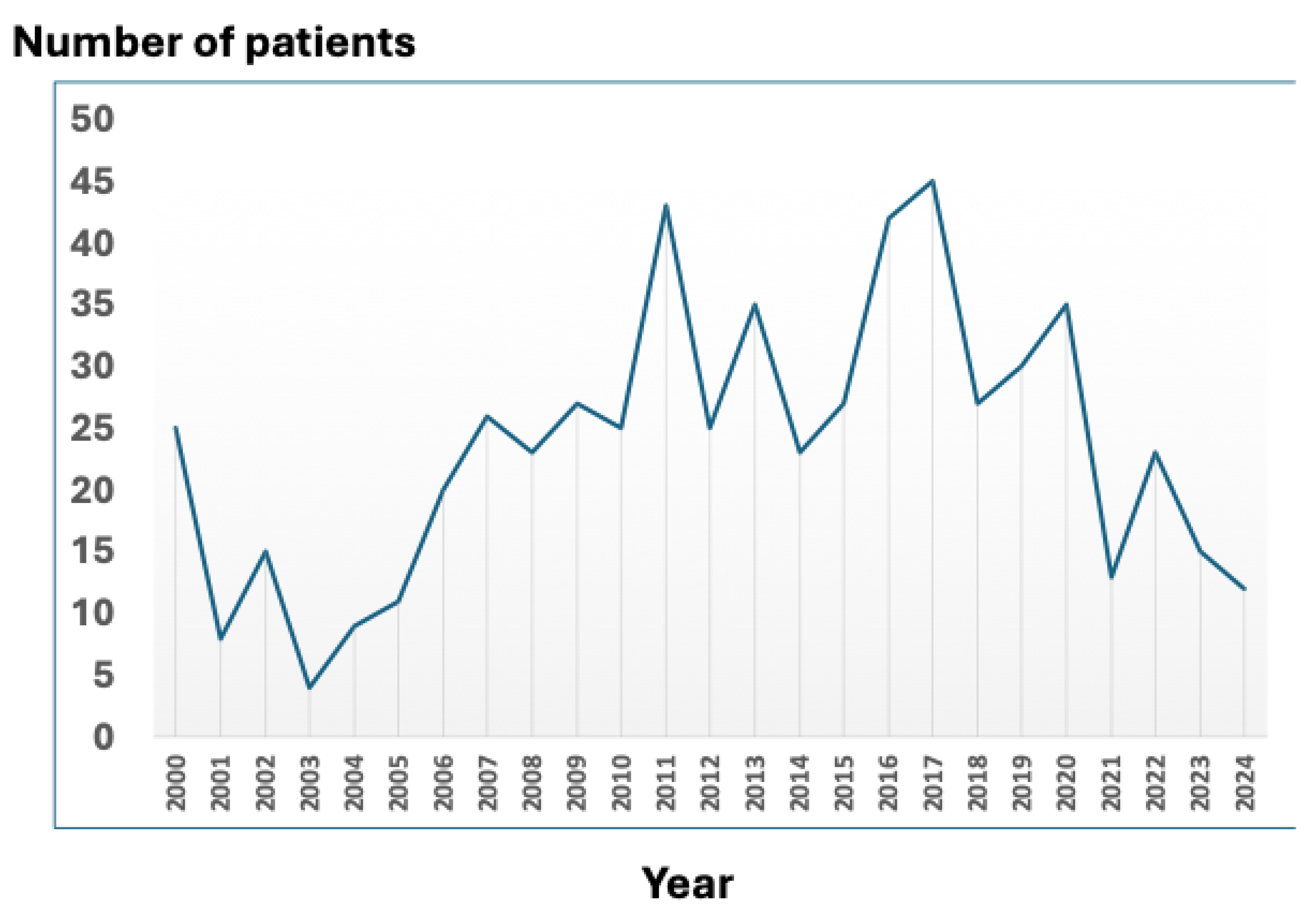

Table 1.
Demographic Data.
| Variable (Available data) |
Category | n | % |
|---|---|---|---|
| Age (N=588) | 14–29 | 118 | 20.1 |
| 30–59 | 411 | 69.9 | |
| ≥ 60 | 59 | 10.0 | |
| Gender (N=588) | Cisgender men | 492 | 83.7 |
| Cisgender women | 96 | 16.3 | |
| Place of birth (N=588) | Spain | 482 | 82.0 |
| Other countries | 106 | 18.0 | |
| Habitat* (N=576) | Urban | 166 | 28.8 |
| Semi-urban | 319 | 55.4 | |
| Rural | 91 | 15.8 | |
| Occupation (N=463) | Paid employment | 353 | 76.2 |
| Unpaid | 44 | 9.5 | |
| Not established | 66 | 14.3 |
*Habitat classification based on population density and local administrative criteria.
Table 2.
Epidemiological Data.
| Variable (Available data) | Characteristics | n | % |
|---|---|---|---|
| Tobacco use (N=484) | Current smoker | 199 | 41.1 |
| Never smoker | 222 | 45.9 | |
| Former smoker | 63 | 13.0 | |
| Alcohol use (N=447) | Low or no consumption | 253 | 56.6 |
| Moderate consumption | 174 | 38.9 | |
| Excessive or heavy consumption | 20 | 4.5 | |
| Animal contact (N=458) | No | 151 | 33.0 |
| Yes (Total) | 307 | 67.0 | |
| Domestic animals (dogs, cats) | 171 | 37.3 | |
| Livestock (goats, sheep) | 40 | 8.7 | |
| Domestic animals and livestock | 32 | 7.0 | |
| Birds | 26 | 5.7 | |
| Birds and domestic animals | 16 | 3.5 | |
| Birds and livestock | 4 | 0.9 | |
| Other animals | 7 | 1.5 | |
| Mixed animal groups | 11 | 2.4 | |
| Arthropod bites (N=588) | No | 539 | 91.7 |
| Yes | 49 | 8.3 | |
| Consumption of unpasteurized dairy (N=276) | No | 227 | 82.2 |
| Yes | 49 | 17.8 | |
| Exposure to wastewater (N=249) | No | 221 | 88.8 |
| Yes | 28 | 11.2 |
Table 3.
General clinical data.
| Variable (Available data) | Median (IQR) | Category | Number | % |
|---|---|---|---|---|
| TOCE* (days) (N = 554) | 8 (5–14) | ≤ 7 | 266 | 48.0 |
| 8-21 | 248 | 45.0 | ||
| ≥ | 40 | 7.0 | ||
| Maximum body temperature (ºC) (N = 581) | 39.4(39.0–40.0) | < 37.5 | 11 | 2.2 |
| 37.5-37.9 | 4 | 0.8 | ||
| 38.0-38.4 | 44 | 8.8 | ||
| 38.5-38.9 | 50 | 10.0 | ||
| 39.0-39.4 | 152 | 30.3 | ||
| 39.5-39.9 | 86 | 17.2 | ||
| >40 | 154 | 30.7 | ||
| Pre-hospital antimicrobial use (N = 473)** | No | 302 | 63.8 | |
| Yes | 171 | 36.2 | ||
| Hospital admission (see Figure S2) (N =588) | No | 450 | 76.5 | |
| Yes*** | 138 | 23.5 | ||
| Clinical group (see Table S2) (n = 588) | Hepatic only | 234 | 39.8 | |
| Hepatic + Pulmonary | 10 | 1.7 | ||
| Hepatic + OLF**** | 15 | 2.6 | ||
| Pulmonary only | 32 | 5.4 | ||
| Pulmonary + OLF**** | 4 | 0.7 | ||
| OLF**** | 24 | 4.1 | ||
| Unespecific | 269 | 45.7 |
* TOCE=time elapsed between the onset of clinical manifestations and evaluation. ** Excluding doxycycline. *** Median length of hospital stay (days), expressed as median and interquartile range =22 (16–31). **** OLF= Other localized forms including the central nervous system, skin and soft tissues, biliary tract, and heart.
Table 4.
Clinical symptoms and signs.
| Variable (Available data) | Category | Number | % |
|---|---|---|---|
| Abdominal pain (N= 452) | Present | 112 | 24.8 |
| Absent | 340 | 75.2 | |
| Arthralgias* (N= 343) | Present | 203 | 59.2 |
| Absent | 140 | 40.8 | |
| Conjunctivitis (N= 368) | Present | 29 | 4.9 |
| Absent | 339 | 92.1 | |
| Nonproductive cough (N= 478) | Present | 157 | 32.8 |
| Absent | 321 | 67.2 | |
| Cutaneous rash** (N= 558) | Present | 35 | 6.3 |
| Absent | 523 | 93.7 | |
| Profuse diaphoresis (N= 337) | Present | 237 | 70.3 |
| Absent | 100 | 26.7 | |
| Diarrhea (N= 569) | Present | 66 | 11.6 |
| Absent | 503 | 88.4 | |
| Headache (N= 441) | Present | 322 | 73.0 |
| Absent | 119 | 37.0 | |
| Heart murmur (N= 556) | Present | 15 | 2.7 |
| Absent | 541 | 97.3 | |
| Hepatomegaly (N= 558) | Present | 71 | 12.7 |
| Absent | 487 | 87.3 | |
| Jaundice (N= 551) | Present | 19 | 3.4 |
| Absent | 532 | 96.6 | |
| Lymphadenopathy (N= 549) | Present | 21 | 3.8 |
| Absent | 528 | 96.2 | |
| Altered mental status** (N= 454) | Present | 24 | 5.0 |
| Absent | 430 | 95.0 | |
| Myalgias (N= 385) | Present | 235 | 61.0 |
| Absent | 150 | 39.0 | |
| Nausea and/or vomiting (N= 460) | Present | 167 | 36.3 |
| Absent | 293 | 63.7 | |
| Odynophagia (N= 387) | Present | 43 | 11.1 |
| Absent | 344 | 88.9 | |
| Pharyngitis (N= 552) | Present | 14 | 2.5 |
| Absent | 538 | 97.5 | |
| Splenomegaly (N= 559) | Present | 31 | 5.5 |
| Absent | 528 | 94.5 |
* Arthritis was documented in five patients. ** Excluding specific skin lesions.
Table 5.
Laboratory Test (I).
| Variable (Available data) | Category | Abnormal values | Number (n) | % | Median (IQR)* |
|---|---|---|---|---|---|
|
Complete Blood Count |
Hemoglobin (g/dL) (n = 574) |
Anemia |
94 |
16.4 |
11.5 (11.3–11.7) |
| Mean corpuscular volume (fL) (n = 570) |
Microcytosis |
19 |
3.3 |
74.8 (72.8–76.9) |
|
| Macrocytosis | 4 | 0.7 | 105 (101–109) | ||
| White blood cell count x 103µL) (n = 579) |
Leukopenia |
42 |
7.2 |
3.4 (3.2–3.6) |
|
| Leukocytosis | 91 | 15.8 | 14.6 (14.0–15.2) | ||
| Platelet count (x 103µL) (n = 577) |
Thrombocytopenia |
129 |
22.3 |
109 (105–112) |
|
| Thrombocytosis | 42 | 7.3 | 501 (479–524) | ||
| Coagulation studies** | aPTT ratio (n = 425) |
Decreased |
8 |
1.9 |
0.7 (0.6–0.8) |
| Increased | 154 | 36.2 | 1.5 (1.3–1.7) | ||
| Inflammatory biomarkers | Erythrocyte sedimentation rate (mm/h) (n = 358) | Elevated | 243 | 67.9 | 34 (20–52) |
| C-reactive protein (mg/dL) (n = 280) | Elevated | 222 | 79.3 | 8.9 (3.3–14.9) | |
| Procalcitonin (ng/mL) (n = 162) | Elevated | 88 | 54.3 | 1.18 (0.6–1.9) | |
| Serum biochemical parameters | Serum creatinine (mg/dL) (n = 566) |
Decreased Elevated |
60 54 |
10.6 9.6 |
0.63 (0.57–0.66) 1.37 (1.3–1.5) |
| Serum sodium (mmol/L) (n = 550) |
Decreased Elevated |
243 3 |
44.2 0.5 |
133 (131–134) 147 (146-151) |
|
| Creatine kinase (U/L) (n = 311) |
Decreased |
27 |
8.7 |
15 (11–18) |
|
| Elevated | 32 | 10.3 | 419 (290–544) | ||
| Serum g-gamma-globulin (g/dL) (n = 88) | Elevated | 19 | 21.6 | 2 (1.6–2.1) | |
| Urinalysis | Overall urinalysis (n = 394) | Altered | 325 | 92.5 | - |
| Microhematuria (n = 390) | Positive | 234 | 60.0 | - | |
| Leukocyturia (n = 393) | Positive | 199 | 50.6 | - | |
| Proteinuria (n = 394) | Positive | 258 | 65.5 | - |
* IQR: Interquartile range. ** Abnormal hemoglobin value: Defined as < 13 g/dL in males and < 12 g/dL in females. *** Additional data: Provided in Table 6 and in the main text.
Table 6.
Laboratory Test (II). Liver tests.
| Variable (Available data) | Abnormal values | Number (n) | % | Median (IQR)* |
|---|---|---|---|---|
| Cytolisis | ||||
| AST (U/L) (n = 558) | Elevated | 497 | 89.1 | 148 (87–241) |
| ALT (U/L) (n = 557) | Elevated | 496 | 89.1 | 165 (93–296) |
| LDH (U/L) (n = 398) | Elevated | 335 | 84.2 | 344 (275–471) |
| Cholestasis | ||||
| GGT (U/L) (n = 496) | Elevated | 425 | 85.7 | 196 (105–349) |
| Alkaline phosphatase (U/L) (n = 533) | Elevated | 400 | 75.0 | 198 (139–304) |
| Total bilirubin (mg/dL) (n = 551) | Elevated | 58 | 10.5 | 1.6 (1.3–2.6) |
| Hepatocellular insufficiency | ||||
| Serum albumin (g/dL) (n = 432) | Decreased | 321 | 74.3 | 2.9 (2.6–3.2) |
| Quick ratio (%) (n = 417) | Decreased | 42 | 10.1 | 62 (52-27) |
* IQR: Interquartile range. ** ULN: Upper limit of normal. *** In 35 patients, the ratio of direct to total bilirubin exceeded 30%.
Disclaimer/Publisher’s Note: The statements, opinions and data contained in all publications are solely those of the individual author(s) and contributor(s) and not of MDPI and/or the editor(s). MDPI and/or the editor(s) disclaim responsibility for any injury to people or property resulting from any ideas, methods, instructions or products referred to in the content. |
© 2026 by the authors. Licensee MDPI, Basel, Switzerland. This article is an open access article distributed under the terms and conditions of the Creative Commons Attribution (CC BY) license (http://creativecommons.org/licenses/by/4.0/).
Copyright: This open access article is published under a Creative Commons CC BY 4.0 license, which permit the free download, distribution, and reuse, provided that the author and preprint are cited in any reuse.


