
Submitted:
23 April 2026
Posted:
24 April 2026
You are already at the latest version
Abstract
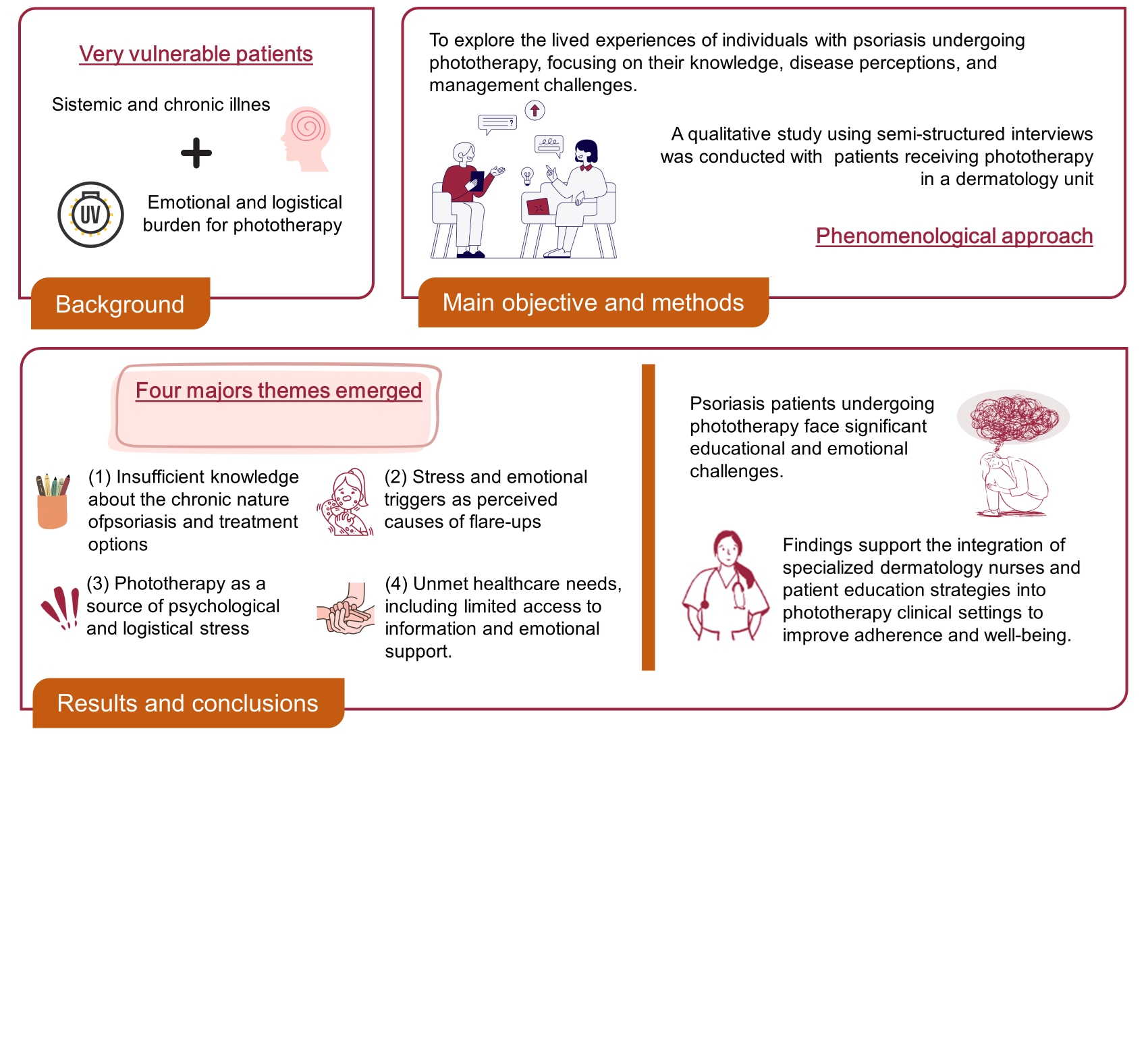
Background: Psoriasis is a chronic, systemic and immune-mediated disease that affects over 60 million people worldwide. Although phototherapy is a safe and effective treatment, its demanding thrice-weekly clinical regimen imposes a significant treatment burden that can disrupt the patient’s life narratives. Despite its clinical importance, little is known about how patients navigate the logistical and emotional complexities of this therapy within specialised nursing-led units. Objective: To explore the lived experiences, disease management strategies, and healthcare expectations of patients with psoriasis undergoing phototherapy. Methods: A descriptive phenomenological design was adopted. Between 2019 and 2022, purposive and exhaustive sampling was used to recruit 72 participants receiving treatment at a specialised nursing-led phototherapy unit in a tertiary hospital in Spain. Data were collected through semi-structured interviews and analysed using inductive thematic content analysis supported by NVivo 12 Pro. Results: Eleven subtopics emerged within four main thematic areas: (1) Knowledge about the disease and treatment options: A striking dichotomy exists between a well-recognised psychological burden and a persistent lack of awareness regarding systemic physical comorbidities and biological therapies; (2) Triggers of the disease and flare-ups: Psychological stress was identified as the primary driver of disease activity, overshadowing secondary external factors; (3) Functional and logistical stressors: The rigorous frequency of sessions creates an "adherence-stress cycle," where the effort to maintain therapeutic continuity paradoxically generates the stress that exacerbates clinical flares, leading to profound biographical disruption and a perceived incapacity to fulfil professional and family roles; (4) Healthcare expectations and systemic barriers: Participants identified diagnostic delays and inequities in the financing of supportive care, manifesting as a collective demand for a permanent professional nursing referent to act as an anchor for integrated care. Conclusions: Phototherapy functions as a "double-edged sword" where clinical efficacy frequently conflicts with the logistical rigour of the treatment. Clinical skin clearance is insufficient if the biographical and systemic gaps remain unaddressed. This investigation advocates for a paradigm shift toward integrated care models where specialised dermatology nurses provide the necessary clinical navigation to support patients "beyond the surface" of the disease.
Keywords:
disease management
; qualitative research
; nursing care
; patient-centered care
; phototherapy
; psoriasis
; treatment adherence and compliance
Copyright: This open access article is published under a Creative Commons CC BY 4.0 license, which permit the free download, distribution, and reuse, provided that the author and preprint are cited in any reuse.


