

Submitted:
21 April 2026
Posted:
23 April 2026
You are already at the latest version
Abstract
Oleoresins are complex natural lipophilic matrices traditionally analyzed using chromatographic techniques that require extensive sample preparation, derivatization, and authentic standards. Amazonian oleoresins from Copaifera and Eperua species (Fabaceae) represent valuable bioresources with recognized pharmacological potential, largely attributed to diterpenoids such as copalic and hardwickiic acids, as well as bioactive sesquiterpenes, including the cannabinoid b-caryophyllene. In this study, we present a proof-of-concept application of Direct Analysis in Real Time coupled with High-Resolution Mass Spectrometry (DART-HRMS) as a rapid, direct, and environmentally friendly approach for chemical fingerprinting and semi-targeted screening of the two most important amazonian oleoresins from these two genera: Eperua oleifera and Copaifera multijuga. Analyses were performed using a Q Exactive Orbitrap coupled to a DART ion source under after conditions optimization. Hardwickiic acid was used as a model compound for method optimization, with optimal performance achieved at 200 °C and 100 V, yielding stable signal intensities (CV < 10%) and high mass accuracy (< 1 ppm). The method enabled reproducible detection of diterpenic acids in both oleoresins, allowing differentiation of their chemical profiles and assessment of short-term stability under ambient conditions. In addition to diterpenes, free fatty acids were also detected, expanding the compositional characterization of these matrices. Compound annotation was performed based on accurate mass measurements and literature comparison, corresponding to Level 5 confidence according to established metabolomics criteria. Although the absence of chromatographic separation limits isomer discrimination and absolute quantification, DART-HRMS provides a rapid and solvent-free strategy for chemical fingerprinting and preliminary characterization of oleoresins. This approach aligns with Green Chemistry principles and shows strong potential as a screening and triage tool for quality control, chemotaxonomic studies, and sustainable valorization of Amazonian natural products.
Keywords:
Amazonian bioeconomy
; oleoresins
; Eperua oleifera Ducke
; Copaifera multijuga hayne
; green chemistry
; DART-MS
1. Introduction
Amazonian resins are natural plant-derived substances widely used by traditional forest communities for a variety of purposes, including medicinal applications, incense, adhesives, and repellents [1–3]. Among the native resin-producing species traditionally employed for these uses, Protium heptaphyllum (Aubl.) Marchand (breu-branco), Eperua oleifera Ducke, and Copaifera multijuga Hayne (Copaiba trees) are particularly noteworthy [4,5,6]. Low-impact extractive practices combined with the use of clean technologies have proven to be economically viable and sustainable, enabling the exploitation of these resources without compromising ecological balance. In this context, resins emerge as key elements of the Amazonian bioeconomy, as they integrate environmental conservation, cultural valorization, and technological development [7,8].
Copaiba trees are native to tropical regions of Latin America and West Africa, with species distributed throughout Mexico and northern Argentina [9]. These trees grow slowly, reaching heights of 5 to 40 meters, and produce copaiba oleoresin, an exudate composed of sap containing resin acids and volatile compounds [10]. In Brazil, copaiba oil is of great social, economic, and medicinal importance [11, 12]. From a medicinal perspective, it exhibits antimicrobial, healing, and anti-inflammatory properties, and it is also widely used in the perfume and cosmetic industries, as well as in varnishes and paints. [9, 13]. In a similar context, the genus Eperua Aublet is distributed throughout Central Amazonia, covering the northern region, including parts of Manaus, other areas of the state of Amazonas, southern Ecuador, the Guianas, and Venezuela [14]. The main product obtained from Eperua species is resin, which is used in traditional medicine for its healing properties, comparable to those reported for the genus Copaifera L. This resin has been described as exhibiting healing, antifungal, and antibacterial activities [15, 16].
Hardwickiic and copalic acids are recognized as two of the most abundant diterpenoid acids in the oleoresins of Eperua oleifera Ducke and Copaifera multijuga Hayne, respectively. These compounds belong to the clerodane- and labdane-type diterpenoid families, which are characterized by tricyclic and bicyclic carbon skeletons, respectively, derived from geranylgeranyl pyrophosphate terpene biosynthetic pathway. Hardwickiic acid exhibits a clerodane-type carboxylate structure with a conjugated diene system, which contributes to its chemical stability and characteristic fragmentation pattern in mass spectrometry. This compound has been associated with anti-inflammatory, antimicrobial, and cytotoxic activities, highlighting its pharmacological relevance. Copalic acid, a structurally related labdane diterpenoid, is considered a chemotaxonomic marker of Copaifera species and is typically the predominant constituent of C. multijuga oleoresin, often accompanied by minor diterpenoids such as kaurenoic and hardwickiic acids [12, 13]. Together, these compounds play a central role in defining the chemical and biological profiles of Amazonian oleoresins [1, 14].
The growing medicinal and economic interest in oleoresins from Copaifera and Eperua species underscores the need for rapid, sustainable analytical strategies to evaluate their chemical biomarkers directly at the extraction site. These Amazonian trees produce complex mixtures of other bioactive diterpenes together with sesquiterpenes, which are widely used in both traditional and modern medicine [16]. However, ensuring quality, traceability, and environmental sustainability remains a challenge, especially given the geographical distance between Amazonian extraction areas and major industrial or research centers.
Generally, analyzing natural oleoresins using traditional gas chromatography (GC) or liquid chromatography (LC) methods requires several preparatory steps, including pH adjustments, extraction, solvent manipulation, fractionation, concentration, and derivatization [17, 13]. Extensive processing may need large amounts of starting material to offset sample loss. Additionally, degradation, oxidation, and other artifacts can occur during sample preparation [18].
Advances in analytical speed and environmental compatibility can be achieved through direct, real-time analysis combined with mass spectrometry, particularly using Direct Analysis in Real Time mass spectrometry (DART-MS) [19]. DART-MS is an advanced technology that has significantly impacted many fields of chemical analysis [20]. The importance of DART-MS in quality control lies in its ability to accelerate and enhance the detection, concentration estimation, and compositional analysis of different samples [21]. This technique can directly ionize compounds without sample preparation or dilution, enabling rapid and reliable identification across various matrices [22]. In natural products research, DART-MS is used for chemotaxonomic studies of lipids, alkaloids, and saccharides. It involves using chemical profiles of biological markers, such as metabolites or surface molecules, as a chemical fingerprint [23], as well as metabolomic studies in the analysis of complex mixtures. [24].
In this context, the DART-HRMS technique aligns strongly with the principles of Green Chemistry by minimizing solvent use, reducing waste generation, and eliminating time- and resource-intensive sample preparation steps. Its ambient ionization capability enables real-time chemical fingerprinting of oleoresins, supporting guided, responsible extraction practices that help prevent overharvesting and forest degradation [25,26]. This approach directly supports several United Nations Sustainable Development Goals (SDGs), including responsible consumption and production by promoting eco-efficient analytical practices and sustainable use of natural products; climate action through reducing chemical waste and the carbon footprint of analytical workflows; life on land by fostering biodiversity conservation and sustainable forest management; and good health and well-being by ensuring the safety and efficacy of medicinal natural products [26]. By promoting the rational use of natural resources, conserving biodiversity, and strengthening a sustainable Amazonian economy, this strategy effectively bridges scientific innovation with environmental preservation and socio-economic development [4, 5].
Overall, applying DART-HRMS as a rapid, green, and field-deployable technique fosters an integrated approach that bridges scientific innovation, environmental preservation, and socio-economic sustainability in the Amazon region. This work presents a proof-of-concept for a new strategy that enables rapid, specific, and reproducible analysis of resin using DART-HRMS.
2. Results and Discussion
2.1. DART-HRMS Analysis
2.1.1. Optimization of the DART-HRMS Method Performance
The DART-HRMS method was optimized for hardwickiic acid ionization efficiency. In particular, the temperature of the carrier gas influences the DART ionization process. The temperature of the ionization gas provides thermal energy for ionization and induces the thermal desorption of analytes from solid samples. Therefore, at very high temperatures, the ion of interest may degrade, while at very low temperatures, proper ionization may not be induced due to insufficient energy [27].
DART ionization occurs in the gas phase following thermal desorption, which necessitates careful optimization of desorption conditions. The gas temperature was therefore optimized for hardwickiic acid, selected as the biomarker of E. oleifera oleoresin, as shown in Figure 1 [16]. The highest signal intensity was observed at 200 °C with great precision (CV = 4.4%, n = 3). At low temperatures, thermal desorption may not reach a steady state, leading to an incorrect analyte concentration in the gas phase. Meanwhile, at high temperatures, desorption can occur too rapidly, causing signal loss as the vapor-phase analyte dissipates too quickly into the surroundings [22]. Therefore, selecting an optimal desorption temperature is critical to balance analyte release and signal stability, ensuring reliable detection and reproducibility in DART-HRMS analyses.
Another critical parameter affecting ionization performance in DART is the grid voltage. The DART grid voltage is vital for preventing ion recombination, facilitating ion flow from the sample to the mass spectrometer, and providing a source of electrons via surface Penning ionization [27]. After establishing 200 °C as the optimal gas temperature, the grid voltage was tested within the range of 50 V to 400 V. The pseudomolecular ion intensity increased at 100 V (CV = 7.0%, n = 3). Beyond 200 V, a decline in signal intensity was observed without any increase in the relative standard deviation. Coefficient of variation values below 10% indicate that, despite a significant decrease in the signal intensity of the deprotonated ion, the ionization process for fresh resin remains consistent and accurate. The highest CV% value recorded was 7.1% at a GRID voltage of 200 V, and the lowest was 3.3% at 300 V. Dates are shown in Figure 2.
According to those results, the most effective instrumental conditions observed for hardwickiic acid analysis were a grid voltage of 100 V and a carrier gas temperature of 200°C. All mass error values obtained in this experiment were below 1 ppm.
Taken together, these findings show that carefully optimizing both carrier gas temperature and grid voltage is crucial for maximizing ionization efficiency, accuracy, and consistency in DART-HRMS analysis. The combination of 200 °C and 100 V provided the optimal conditions, yielding stable signal intensities with low variability and high mass accuracy (<1 ppm) for hardwickiic acid. These optimized settings provide a reliable framework for analyzing diterpenic acids in complex oleoresin matrices.
2.1.2. Analysis of Hardwickiic Acid in Oilresin
Based on the exact mass determined by comprehensive acquisition and the mass spectra acquired by Data-Dependent Analysis (DDA), hardwickiic acid can be rapidly detected without the need for specific sample preparation. The sample’s homogeneous nature further facilitates direct analysis.
These variations reflect the inherent differences in ion formation processes: while electrospray ionization (ESI) promotes the generation of stable [M–H]⁻ ions through solution-phase deprotonation, DART produces ions via direct gas-phase reactions, resulting in lower pseudomolecular ion intensity and altered fragment distributions. In recent work [17], during the characterization of the chemical constituents of E. oleifera oleoresin using UHPLC-HRMS, hardwickiic acid was identified by ESI negative mode. The precursor ion m/z 315.1966 was fragmented in m/z 301.1820 (14%), m/z 285.18582 (11%), m/z 273.2223 (26%), and m/z 257.1909 (16%). The fragmentation profile of hardwickiic acid observed under UHPLC-HRMS conditions serves as a benchmark for comparison with DART-HRMS, where differences in ionization mechanisms between ESI and DART not only affect the intensity of pseudomolecular ions but also shape the diversity of fragment ions detected. In DART-MS, the pseudomolecular ion is much less intense. The fragmentation profile acquired with a normalized collision energy (NCE) of 30 is represented by the ions m/z 301.1820 (5%), m/z 285.1858 (20%), m/z 273.2223 (38%), and m/z 257.1909 (10%). These variations reflect the inherent differences in ion formation processes: while ESI promotes the generation of stable [M–H]⁻ ions through solution-phase deprotonation, DART produces ions via direct gas-phase reactions, resulting in lower pseudomolecular ion intensity and altered fragment distributions.
Electrospray ionization (ESI) and direct analysis in real time (DART) differ significantly in their ionization mechanisms, which influence ionization efficiency and fragmentation behavior. ESI is a soft ionization method that primarily produces intact pseudomolecular ions, preserving molecular integrity, making it ideal for polar and thermally labile compounds [27]. In contrast, DART employs a plasma-based process that uses Penning ionization, in which metastable species ionize analytes in open air. This mechanism provides broader ionization coverage and higher ionization efficiency but often results in greater in-source fragmentation [22, 28]. While this may complicate direct identification, it also offers additional structural information, making DART more suitable for rapid, exploratory analyses. In contrast, ESI excels in preserving molecular ions for accurate mass determination [29].
2.1.3. Assessment of the Limit of Detection in Methanolic Extracts of E. oleifera
The detection limit of hardwickiic acid under the optimized conditions was determined by analyzing the diluted extract in Full MS mode over three consecutive runs at a final concentration of 10 µg/mL. The presence of hardwickiic acid was confirmed through its pseudomolecular ion. The coefficient of variation across the three measurements was 6.1%, and the mass error remained below 1 ppm. Therefore, absolute intensity values on the order of 10³ are considered sufficiently robust to support stability-related inferences.
2.1.4. Five-Day Stability Assessment of E. oleifera and C. multijuga on Quick Strip
The analysis across consecutive days demonstrated the resin's stability even under environmental conditions. During the experimental period, the ambient temperature and relative humidity were 20.7 °C and 67.1%, respectively. In a previous study, we confirmed the absence of sesquiterpenes and monoterpenes in the resin of E. oleifera. [16] The lack of these volatile components likely contributes to the enhanced stability of the resin, as monoterpenes and sesquiterpenes are prone to evaporation and oxidation. As shown in Table 1, no significant differences in the absolute intensities of the target analyte were observed across consecutive days, yielding a coefficient of variation of 3.2%.
To support this conclusion, the same experiment was conducted with C. multijuga oleoresin, which contains sesquiterpenes and monoterpenes [16]. The data are presented in Table 2.
It is well known that hardwickiic acid is not the most abundant biomarker in copaiba oleoresin; however, the absolute intensity of its characteristic deprotonated ion fragment was detected in the last experiment (April 11, 2025) at about twice the estimated limit of detection. According to Table 2, the 48% coefficient of variation supports our hypothesis that the presence of sesquiterpenes and monoterpenes affects oleoresin stability, leading to lower stability under environmental conditions compared to E. oleifera oleoresin.
2.1.5. Assessment of Hardwickiic Acid Detectability in Repeated Resin Analyses
Hardwickiic acid was detectable in the E. oleifera sample up to four days of reanalysis, as shown in Table 3.
A decrease in signal intensity was observed as expected due to sample desorption; however, detection remained above the method’s limit of detection even on the fifth consecutive day. The increase in mass error was observed throughout the experiment, consistent with the Orbitrap analysis. In this mass spectrometer, mass accuracy (ppm) depends on the analyte: lower analyte concentrations generally lead to higher mass errors due to lower signal-to-noise ratios, whereas higher concentrations improve mass accuracy [30].
This experiment was repeated with C. multijuga. However, on the second day of reanalysis, the characteristic fragment of the deprotonated pseudomolecular ion of hardwickiic acid could no longer be detected, as it fell below the method's established limit of detection.
2.1.6. Detection of Acidic Diterpenes, Their Corresponding Methyl Esters, and Other Compounds in E. oleifera and C. multijuga by DART-HRMS
To our knowledge, this is the first report to use DART-HRMS for the chemical fingerprinting of an oleoresin. In this study, we took a targeted approach to analyze the chemical composition of E. oleifera and C. multijuga, relying on accurate mass searches of deprotonated and protonated pseudomolecular ions previously reported in the literature [16]. The high-resolution capability of DART-HRMS coupling enabled the direct identification of these ions in the crude matrix, eliminating the need for prior chromatographic separation. According to the confidence level framework proposed by Schymanski et al. (2014) [31] and adapted for ambient ionization methods such as DART-HRMS [32], targeted analyses without chromatographic separation typically achieve Level 5 identification confidence. The putative annotation is based on exact mass accuracy and structural identification, supported by literature matches.
These findings demonstrate the potential of DART-HRMS as a fast and reliable tool for oleoresin analysis, broadening its applications beyond previous studies in natural product research, including propolis and other resinous matrices [33]. The detailed results of this approach are summarized in Figure 3.
The DART-HRMS method presented here is not designed to distinguish between isomers (e.g., patagonic acid and 14-deoxy-11,12-didehydro-andrographolide, 16-oxo-13,14H-hardwickiic acid, or copalic acid and kovalenic acid), nor any other isomers present in the matrix. However, this limitation is compensated for by the technique’s ability to detect molecules without requiring sample preparation. Moreover, this triage approach can be highly advantageous when implemented before the application of time-consuming confirmatory analyses. Table S1 in the Supplementary Materials lists possible isomeric assignments, along with individual signal intensities and mass errors for each analyte in both samples.
2.1.7. Detection of Free Fatty Acids in E. oleifera and C. multijuga by DART-HRMS
In addition to the major diterpenic constituents, free fatty acids were investigated in both resins using DART-HRMS. This analysis aimed to expand the chemical characterization of the resin, as minor lipid components may contribute to its physicochemical properties or originate from associated endophytic microorganisms, providing a more comprehensive metabolomic profile. The obtained results are presented in Figure 4A (negative mode) and 4B (positive mode). The data on the fatty acids present in Eperua oleifera are presented in Table S2 of the Supplementary Materials.
The detection of free fatty acids in oleoresin can be rationalized by multiple, nonmutually exclusive mechanisms. First, plants naturally produce a wide variety of lipids, including structural phospholipids, glycolipids, cuticular waxes, and storage triacylglycerols, all of which are ultimately derived from fatty acids [34, 35]. Although diterpenes and, recently, their corresponding methyl esters have been described as the dominant constituents of oleoresins, minor lipid fractions can be present and may play roles in the physicochemical properties of the secretion, such as viscosity and protection against desiccation [36]. Second, the role of the associated microbiota cannot be ruled out. Endophytic bacteria and fungi inhabiting Fabaceae species are known to biosynthesize fatty acid derivatives, and their metabolic activity may contribute to the chemical profile observed in the oleoresin [37, 38]. Finally, artifacts should also be considered. In DART or ESI based mass spectrometry, in situ transesterification of free fatty acids can occur in the presence of trace amounts of methanol, leading to the formation of FAMEs during ionization. However, this can be excluded because the direct analysis of the resin was performed without methanol dilution [39]. Taken together, the occurrence of free fatty acids in Eperua and Copaifera oleoresin may reflect a combination of intrinsic plant lipids and microbial contributions.
DART-HRMS detected free fatty acids in both positive and negative ion modes [40]. The absolute signal intensity enables the estimation of absolute abundance within the oleoresin matrix. Higher signal intensities for specific free fatty acids suggest that these compounds are more prevalent in the sample, whereas lower intensities indicate minor components. Therefore, ion intensities can be used to infer the relative distribution of free fatty acids within the oleoresin, providing insight into its chemical composition without chromatographic separation. The oleoresin of E. oleifera consists predominantly of diterpenes (97%), followed by 1.5% phenolic acids, 1% free fatty acids, and 0.5% minor constituents. In contrast, C. multijuga oleoresin is composed of approximately 88% diterpenes, 3% phenolic compounds, 8% free fatty acids, and 1% other minor substances.
These compositional differences reflect distinct metabolic profiles and may be associated with variations in the chemical stability and oxidation state of the oleoresins. The higher content of free fatty acids observed in C. multijuga suggests greater susceptibility to oxidative and hydrolytic processes, which can promote diterpene degradation and alter physicochemical properties such as viscosity, color, and volatility. In contrast, the lower proportion of these acids in E. oleifera indicates a more stable matrix, less prone to spontaneous oxidation. Therefore, the presence and relative abundance of free fatty acids can be considered not only as chemical markers of aging and oxidative instability but also as indicative parameters of the chemical integrity and preservation degree of the analyzed Amazonian oleoresins.
In a metabolomic approach, the identification of free fatty acids will also be assigned Level 5 confidence, based solely on the exact mass of the target analyte [32, 33] in both ionization modes.
4. Materials and Methods
4.1. Plant Material
The oil resin from Eperua oleifera was collected in Manicoré, in September / 2023, and Copaiba multijuga was collected in Manaus, in September / 2023, both in Amazonas State, Brazil. The research project was registered on the National System for Governance of Genetic Heritage and Associated Traditional Knowledge (SisGen AAC8B84 and AAB3AA1). Hardwickic acid was previously isolated and its structure elucidate at our research group.
4.2. Sample Preparation for DART-HRMS
4.2.1. Direct Sample Analysis
The semi-solid sample of each oilresin was pipetted onto the QuickStripTM card and dried at room temperature. The QuickStripTM will then be placed in the sample holder of the DART source. Methanol was used, as the same approach was applied to the negative controls (methanol). Each sample replicate was intercalated with a negative control on the QuickStripTM.
4.2.2. Dilute Sample Analysis
To prepare the oleoresin extract, 1 mg of crude resin was dissolved in methanol and subsequently diluted 100-fold to obtain a final concentration of 10 µg/mL.
4.3. DART-HRMS Method Performance Evaluation
Method performance was evaluated for hardwickiic acid based on the precision obtained from the analysis of three consecutive samples. The semi-solid sample was placed in front of the DART-MS holder. The media, standard deviation, and coefficient of variation were calculated for each triplicate.
4.3.1. Assessment of the Limit of Detection in Methanolic Extracts of E. oleifera
To evaluate the limit of detection of hardwickiic acid under the optimized conditions, 1 mg of crude resin was diluted in methanol and subsequently diluted 100-fold to obtain an extract with a final concentration of 10 µg/mL. The oilresin extract was pipetted onto the QuickStripTM card and dried at room temperature. The Quick-StripTM will then be placed in the sample holder of the DART source. Three consecutive analyses of this extract were performed in Full MS mode. The media, standard deviation, and coefficient of variation were calculated for each triplicate.
4.3.2. Five-Day Stability Assessment of E. oleifera and C. multijuga on Quick Strip
To evaluate the stability, 5 µL of each oleoresin was deposited at five consecutive positions on the QuickStrip, with an empty position between each sample. Analyses were conducted over five successive mornings under controlled temperature and humidity conditions. Each well was analyzed on each of the five days.
4.3.3. Assessment of Hardwickiic Acid Detectability in Repeated Resin Analyses
The oilresin was applied to a single position on the QuickStrip and analyzed on consecutive days without reapplication. In this approach, we assessed how many analyses of the same well containing the resin were still possible to detect Hardwickiic acid.
4.4. DART-HRMS Analysis and Instrument Conditions
High resolution mass spectra QExactive Orbitrap mass spectrometer (Thermo Fisher Scientific, Bremen, Germany) coupled with an IonSense® DART® JumpShot source (Saugus, MA, USA). Mass spectra were acquired in negative and positive ionization modes using Helium (He) as the carrier and ionization gas. The distance between the MS inlet and the DART gunshot was 3 cm. The DART ion source was set as follows: needle potential, 300 V; grid potential, 350 V; autosampler velocity, 1 mm/s; and the ionization gas temperature was evaluated at 100 °C, 200 °C, 250 °C, 300 °C, 350 °C, 400 °C, and 500 °C. The DART instrumental setup for standard ionization was initially assessed using a direct analysis of resin, an amount equivalent to 10 μL. The mass spectrometer, operating in negative and positive modes, was calibrated daily with a manufacturer´s calibration solution (Thermo Fisher Scientific, Bremen, Germany).
Full-scan data were acquired in a range of m/z 70 – m/z 1050 at a resolution of 70,000 full widths at half maximum (FWHM), automatic gain control (AGC) of 1 x 10⁶, and maximum injection time (IT) of 100 ms.
4.4.1. Data Processing Analysis
Data were acquired and processed using Thermo Scientific XCalibur 3.2 software (Thermo Fisher Scientific, Austin, TX, USA), with a mass tolerance of ±5 ppm.
5. Conclusions
The DART-HRMS technique offers significant advantages for the rapid screening and detection of key biomarkers in oleoresins from Copaifera and Eperua species, even without prior chromatographic separation of isomers. Its ambient ionization capability enables the direct analysis of complex matrices, such as oleoresins, thereby minimizing or eliminating the need for sample preparation steps. This feature dramatically reduces analysis time, solvent consumption, and the risk of compound degradation during extraction or derivatization.
Beyond its analytical precision, DART-HRMS exhibits remarkable potential for high-throughput exploratory analyses, enabling the rapid examination of numerous samples within a short period. This makes it especially useful as an initial screening or triage tool, capable of identifying chemical fingerprints and detecting characteristic molecular markers that guide subsequent, more detailed chromatographic or spectroscopic studies.
Although its ability to distinguish structural isomers is limited, DART-HRMS offers high mass accuracy and sensitivity, ensuring reliable identification of molecular ions related to diterpenic acids, sesquiterpenes, and other characteristic compounds of these resins. The ability to obtain molecular fingerprints directly from raw samples further enhances the usefulness of this technique in chemical profiling, quality control, and the authentication of natural products.
In this context, DART-HRMS stands out as a quick, eco-friendly, and cost-efficient analytical platform, perfect for initial large-scale screenings and on-site analyses, thereby promoting the sustainable valorization and traceability of Amazonian oleoresins from Copaifera and Eperua.
Supplementary Materials
The following supporting information can be downloaded at the website of this paper posted on Preprints.org. Table S1: Metabolic fingerprint of Eperua oleifera and Copaifera multijuga obtained using DART-HRMS. Table S2: Free fatty acids assigned in Eperua oleifera and Copaifera multijuga, using DART-HRMS.
Author Contributions
Conceptualization, R.R.; Methodology, G.R.A.C., H.M.G.P. and M.C.P.; Validation, M.C.P. and V.F.V.-J.; Investigation, R.R., G.R.A.C., M.C.P.; Resources, M.C.P., H.M.G.P.; Data curation, G.R.A.C., M.C.P.; Writing—original draft, R.R., M.C.P. and V.F.V.-J.; Writing—review & editing, R.R., M.C.P. and V.F.V.-J.; Visualization, H.M.G.P.; Supervision, H.M.G.P., M.C.P. and V.F.V.-J.; Project administration, H.M.G.P., M.C.P. and V.F.V.-J. All authors have read and agreed to the published version of the manuscript.”.
Funding
FAPERJ (Grant Numbers E-26/200.512/2023 and E-26/211.315/2021), CAPES (Coordenação de Aperfeiçoamento de Pessoal de Nível Superior), and CNPq (Grant number 310782/2022-8). FINEP (Financiadora de Estudos e Projetos), vinculada ao Ministério da Ciência, Tecnologia e Inovação (MCTI): nº. 01.25.0191.00.
Data Availability Statement
The original contributions presented in this study are included in the article. Further inquiries can be directed at the corresponding author(s).
Conflicts of Interest
The authors declare that they have no conflicts of interest.
References
- Frazão, D.R.; Cruz, J.N.; Santana de Oliveira, M.; Baia-da-Silva, D.C.; Nazário, R.M.F.; Rodrigues, M.F. de L.; Saito, M.T.; Souza-Rodrigues, R.D.; Lima, R.R. Evaluation of the Biological Activities of Copaiba (Copaifera Spp): A Comprehensive Review Based on Scientometric Analysis. Front. Pharmacol. 2023, 14, 1215437. [Google Scholar] [CrossRef]
- de Oliveira Santos, M.; Camilo, C.J.; Macedo, J.G.F.; de Lacerda, M.N.S.; Lopes, C.M.U.; Rodrigues, A.Y.F.; da Costa, J.G.M.; de Almeida Souza, M.M. Copaifera Langsdorffii Desf.: A Chemical and Pharmacological Review. Biocatal. Agric. Biotechnol. 2022, 39, 102262. [Google Scholar] [CrossRef]
- Arruda, C.; Aldana Mejía, J.A.; Ribeiro, V.P.; Gambeta Borges, C.H.; Martins, C.H.G.; Sola Veneziani, R.C.; Ambrósio, S.R.; Bastos, J.K. Occurrence, Chemical Composition, Biological Activities and Analytical Methods on Copaifera Genus—A Review. Biomed. Pharmacother. 2019, 109, 1–20. [Google Scholar] [CrossRef]
- Cardinelli, C.C.; Silva, J.E.A. e; Ribeiro, R.; Veiga-Junior, V.F.; dos Santos, E.P.; de Freitas, Z.M.F. Toxicological Effects of Copaiba Oil (Copaifera Spp.) and Its Active Components. Plants 2023, 12, 1054. [Google Scholar] [CrossRef]
- Gomes, F.T.A.; de Araújo Boleti, A.P.; Leandro, L.M.; Squinello, D.; Aranha, E.S.P.; Vasconcelos, M.C.; Cos, P.; Veiga-Junior, V.F.; Lima, E.S. Biological Activities and Cytotoxicity of Eperua Oleifera Ducke Oil-Resin. Pharmacogn. Mag. 2017, 13, 542. [Google Scholar] [CrossRef]
- de Almeida Júnior, J.S.; da Silva, É.B.S.; Moraes, T.M.P.; Kasper, A.A.M.; Sartoratto, A.; Baratto, L.C.; de Oliveira, E.C.P.; Oliveira, E.; Barata, L.E.S.; Minervino, A.H.H. Anti-Inflammatory Potential of the Oleoresin from the Amazonian Tree Copaifera Reticulata with an Unusual Chemical Composition in Rats. Vet. Sci. 2021, 8, 320. [Google Scholar] [CrossRef]
- Amazon Investor Coalition; Earth Innovation Institute. Bioeconomy Products of the Brazilian Amazon: Boosting the Forest-Friendly Entrepreneurial Ecosystem; Amazon Investor Coalition: Brazil, 2023; Available online: https://www.earthinnovation.org (accessed on 15 August 2025).
- United Nations. Sustainable Development Goals. Available online: https://sdgs.un.org/goals (accessed on 27 October 2025).
- Veiga Junior, V.F.; Pinto, A.C. O Gênero Copaifera L. Quim. Nova 2002, 25, 273–286. [Google Scholar]
- Lee, J.; Wang, M.; Zhao, J.; Ali, Z.; Hawwal, M.F.; Khan, I.A. Chemical Characterization and Quality Assessment of Copaiba Oil-Resin Using GC/MS and SFC/MS. Plants 2023, 12, 1619. [Google Scholar] [CrossRef] [PubMed]
- Rodrigues, T.M.; Machado, S.R. Developmental and Structural Features of Secretory Canals in Root and Shoot Wood of Copaifera Langsdorffii Desf. (Leguminosae–Caesalpinioideae). Trees 2009, 23, 1013–1018. [Google Scholar] [CrossRef]
- Braga, W.F.; Rezende, C.M.; Antunes, O.A.C.; Pinto, A.C. Terpenoids from Copaiba Cearensis. Phytochemistry 1998, 49, 263–264. [Google Scholar] [CrossRef]
- Pinto, A.C.; Braga, W.F.; Rezende, C.M.; Garrido, F.M.S.; Veiga, V.F.; Bergter, L.; Patitucci, M.L.; Antunes, O.A.C. Separation of Acid Diterpenes of Copaifera Cearensis Huber Ex Ducke by Flash Chromatography Using Potassium Hydroxide Impregnated Silica Gel; 2000; Vol. 11. [Google Scholar]
- Leandro, L.M.; Veiga-Junior, V.F. O Gênero Eperua Aublet: Uma Revisão. Sci. Amazon. 2012, 1, 14–22. [Google Scholar]
- dos Santos, A.O.; Ueda-Nakamura, T.; Dias Filho, B.P.; Veiga Junior, V.F.; Pinto, A.C.; Nakamura, C.V. Antimicrobial Activity of Brazilian Copaiba Oils Obtained from Different Species of the Copaifera Genus. Mem. Inst. Oswaldo Cruz 2008, 103, 277–281. [Google Scholar] [CrossRef] [PubMed]
- Ribeiro, R.; Carneiro, G.R.A.; dos Santos, G.R.C.; Gomes, M.V. da S.; Pereira, H.M.G.; Padilha, M.C.; Veiga-Junior, V.F. Advancing the Chemical Characterization of Eperua Oleifera Duke Oleoresin: A UHPLC-HRMS-Based Approach. Plants 2025, 14, 2893. [Google Scholar] [CrossRef]
- Jiang, C.; Gates, P.J. Systematic Characterisation of the Fragmentation of Flavonoids Using High-Resolution Accurate Mass Electrospray Tandem Mass Spectrometry. Molecules 2024, 29, 5246. [Google Scholar] [CrossRef]
- Armenta, S.; Garrigues, S.; de la Guardia, M. Green Analytical Chemistry. TrAC. Trends Anal. Chem. 2008, 27, 497–511. [Google Scholar] [CrossRef]
- Schmauder, F.; Schütz, D.; Creydt, M.; Riedl, J.; Fischer, M. Food Authentication Goes Green: Determination of the Geographical Origin of Grain Maize (Zea Mays L.) Using Direct Analysis in Real Time Mass Spectrometry (DART-MS). Food Control 2024, 163, 110489. [Google Scholar] [CrossRef]
- Sisco, E.; Forbes, T.P.; Staymates, M.E.; Gillen, G. Rapid Analysis of Trace Drugs and Metabolites Using a Thermal Desorption DART-MS Configuration. Anal. Methods 2016, 8, 6494–6499. [Google Scholar] [CrossRef]
- Black, C.; Chevallier, O.P.; Elliott, C.T. The Current and Potential Applications of Ambient Mass Spectrometry in Detecting Food Fraud. TrAC. Trends Anal. Chem. 2016, 82, 268–278. [Google Scholar] [CrossRef]
- Gross, J.H.; Gross, J.H. Direct Analysis in Real Time—a Critical Review on DART-MS. Anal. Bioanal. Chem. Gross, J.H. Direct Analysis in Real Time—a Critical Review on DART-MS. Anal. Bioanal. Chem. 2014, 406, 63–80. 2014, 406, 63–80. [Google Scholar] [CrossRef]
- Antal, B.; Kuki, A.; Nagy, L.; Nagy, T.; Zsuga, M.; M-HAMVAS, M.; Vasas, G.; Keki, S. Rapid Discrimination of Closely Related Seed Herbs (Cumin, Caraway, and Fennel) by Direct Analysis in Real Time Mass Spectrometry (DART-MS). Anal. Sci. 2016, 32, 1111–1116. [Google Scholar] [CrossRef] [PubMed]
- Ren, J.-L.; Zhang, A.-H.; Kong, L.; Wang, X.-J. Advances in Mass Spectrometry-Based Metabolomics for Investigation of Metabolites. RSC Adv. 2018, 8, 22335–22350. [Google Scholar] [CrossRef]
- Lante, A.; Massaro, A.; Zacometti, C.; Mihaylova, D.; Chalova, V.; Krastanov, A.; Kalaydzhiev, H.; Cisneros, M.; Morbin, G.; Riuzzi, G. DART-HRMS for the Rapid Assessment of Bioactive Compounds in Ultrasound-Processed Rapeseed Meal By-Product. Appl. Sci. 2025, 15, 5952. [Google Scholar] [CrossRef]
- Anastas, P.T.; Warner, J.C. Green Chemistry: Theory and Practice; Oxford university press; ISBN 0197704050, 2000. [Google Scholar]
- Demarque, D.P.; Crotti, A.E.M.; Vessecchi, R.; Lopes, J.L.C.; Lopes, N.P. Fragmentation Reactions Using Electrospray Ionization Mass Spectrometry: An Important Tool for the Structural Elucidation and Characterization of Synthetic and Natural Products. Nat. Prod. Rep. 2016, 33, 432–455. [Google Scholar] [CrossRef] [PubMed]
- Shrestha, S.A.; Cha, S. Ambient Desorption/Ionization Mass Spectrometry for Direct Solid Material Analysis. TrAC. Trends Anal. Chem. 2021, 144, 116420. [Google Scholar] [CrossRef]
- Yew, J.Y. Natural Product Discovery by Direct Analysis in Real Time Mass Spectrometry. Mass. Spectrom. 2019, 8, S0081–S0081. [Google Scholar] [CrossRef] [PubMed]
- Makarov, A.; Denisov, E.; Lange, O.; Horning, S. Dynamic Range of Mass Accuracy in LTQ Orbitrap Hybrid Mass Spectrometer. J. Am. Soc. Mass. Spectrom. 2006, 17, 977–982. [Google Scholar] [CrossRef]
- Schymanski, E.L.; Jeon, J.; Gulde, R.; Fenner, K.; Ruff, M.; Singer, H.P.; Hollender, J. Identifying Small Molecules via High Resolution Mass Spectrometry: Communicating Confidence 2014.
- Cody, R.B.; Dane, A.J. Development of confidence levels for direct analysis in real time mass spectrometry in metabolomic and natural products applications. Rapid Commun. Mass. Spectrom. 2018, 32, 1513–1525. [Google Scholar] [CrossRef]
- Sumner, L.W.; Amberg, A.; Barrett, D.; Beale, M.H.; Beger, R.; Daykin, C.A.; Fan, T.W.-M.; Fiehn, O.; Goodacre, R.; Griffin, J.L. Proposed Minimum Reporting Standards for Chemical Analysis: Chemical Analysis Working Group (CAWG) Metabolomics Standards Initiative (MSI). Metabolomics 2007, 3, 211–221. [Google Scholar] [CrossRef]
- Wang, X.; Kong, L.; Zhi, P.; Chang, C. Update on Cuticular Wax Biosynthesis and Its Roles in Plant Disease Resistance. Int. J. Mol. Sci. 2020, 21, 5514. [Google Scholar] [CrossRef] [PubMed]
- Xue DaWei, X.D.; Zhang XiaoQin, Z.X.; Lu XueLi, L.X.; Chen Guang, C.G.; Chen ZhongHua, C.Z. Molecular and Evolutionary Mechanisms of Cuticular Wax for Plant Drought Tolerance; 2017. [Google Scholar]
- Tsanaktsidis, C.; Stimoniaris, A.; Bousios, S.; Spinthiropoulos, K.; Tzilantonis, G.; Scaltsoyiannes, A. Effect Study of Modulation of Molecules of Natural Resin from Black and Halepensis Pinus in the Removal of Humidity from Diesel Fuel. Pet. Sci. Technol. 2018, 36, 1332–1339. [Google Scholar] [CrossRef]
- Anisha, C.; Radhakrishnan, E.K. Metabolite Analysis of Endophytic Fungi from Cultivars of Zingiber Officinale Rosc. Identifies Myriad of Bioactive Compounds Including Tyrosol. 3 Biotech. 2017, 7, 146. [Google Scholar] [CrossRef] [PubMed]
- Deka, D.; Sonowal, S.; Chikkaputtaiah, C.; Velmurugan, N. Symbiotic Associations: Key Factors That Determine Physiology and Lipid Accumulation in Oleaginous Microorganisms. Front. Microbiol. 2020, 11, 555312. [Google Scholar] [CrossRef] [PubMed]
- Sauerschnig, C.; Doppler, M.; Bueschl, C.; Schuhmacher, R. Methanol Generates Numerous Artifacts during Sample Extraction and Storage of Extracts in Metabolomics Research. Metabolites 2017, 8, 1. [Google Scholar] [CrossRef]
- Organtini, K.; Cleland, G. Rapid Profiling and Authentication of Cinnamon Samples Using Ambient Ionization (DART) and Single Quadrupole Mass Spectrometry; Waters Corporation: MA, USA, June 2016. [Google Scholar]
Figure 1.
Evaluation of the ionizing gas temperature in the absolute intensity m/z 315.1966 [M-H]-.
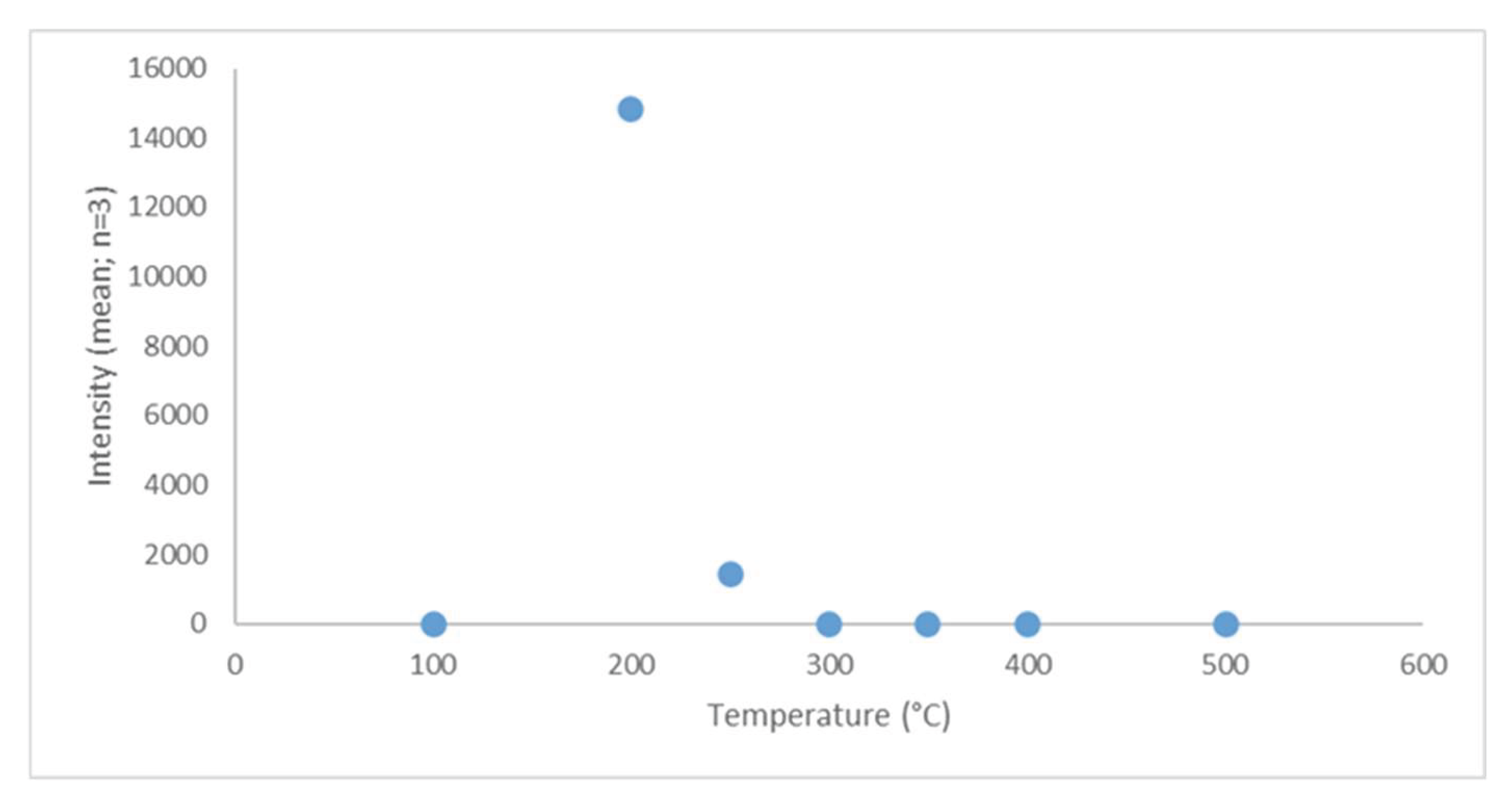
Figure 2.
Evaluation of the DART grid voltage in the absolute intensity m/z 315.1966 [M-H]-.
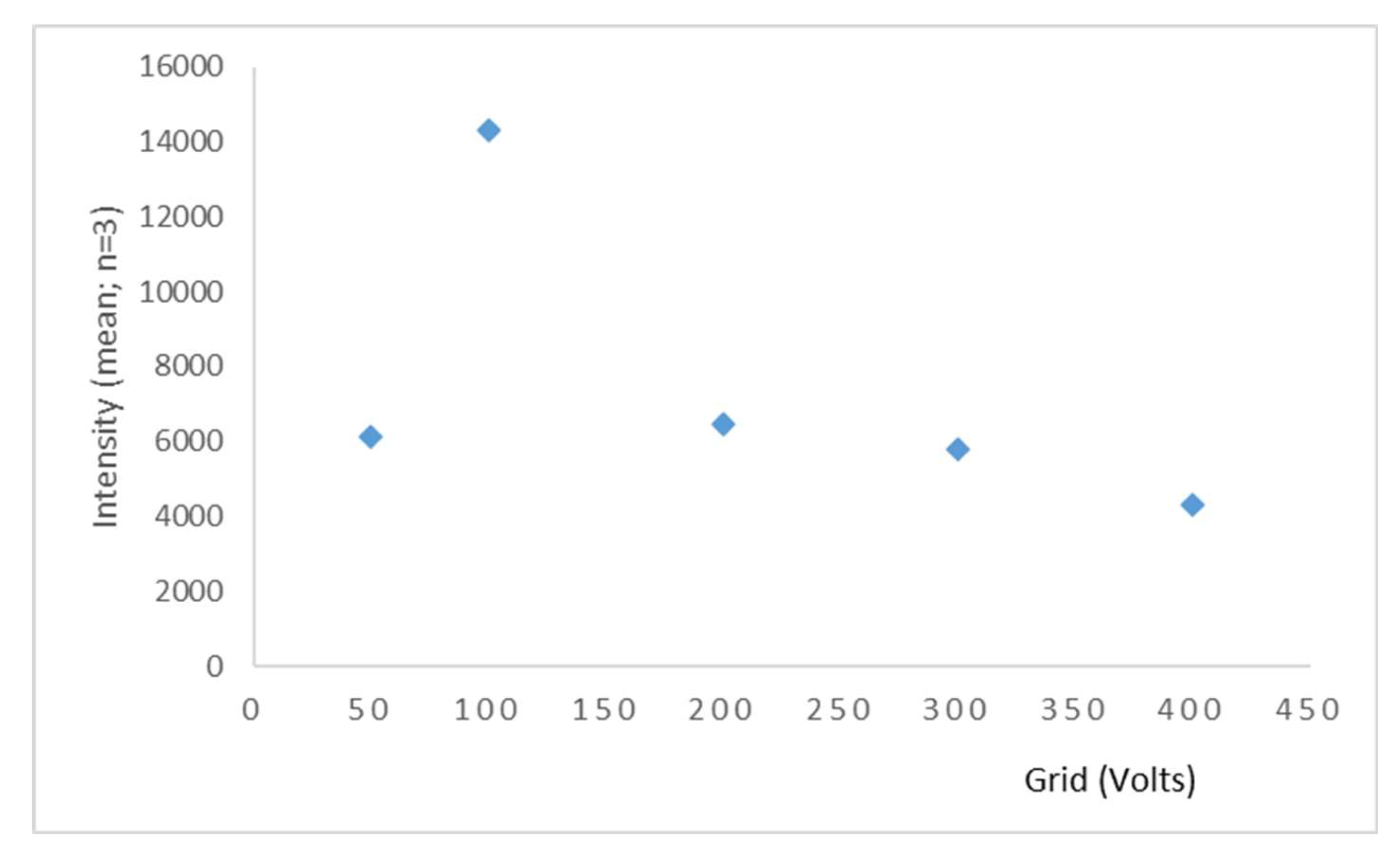
Figure 3.
Heatmap showing distribution of acidic diterpenes, their corresponding methyl esters, and other compounds in E. oleifera and C. multijuga. Red color boxes indicate the higher amount, blue color boxes indicate intermediate amounts, and white color represents low intensity or absence.
Figure 3.
Heatmap showing distribution of acidic diterpenes, their corresponding methyl esters, and other compounds in E. oleifera and C. multijuga. Red color boxes indicate the higher amount, blue color boxes indicate intermediate amounts, and white color represents low intensity or absence.
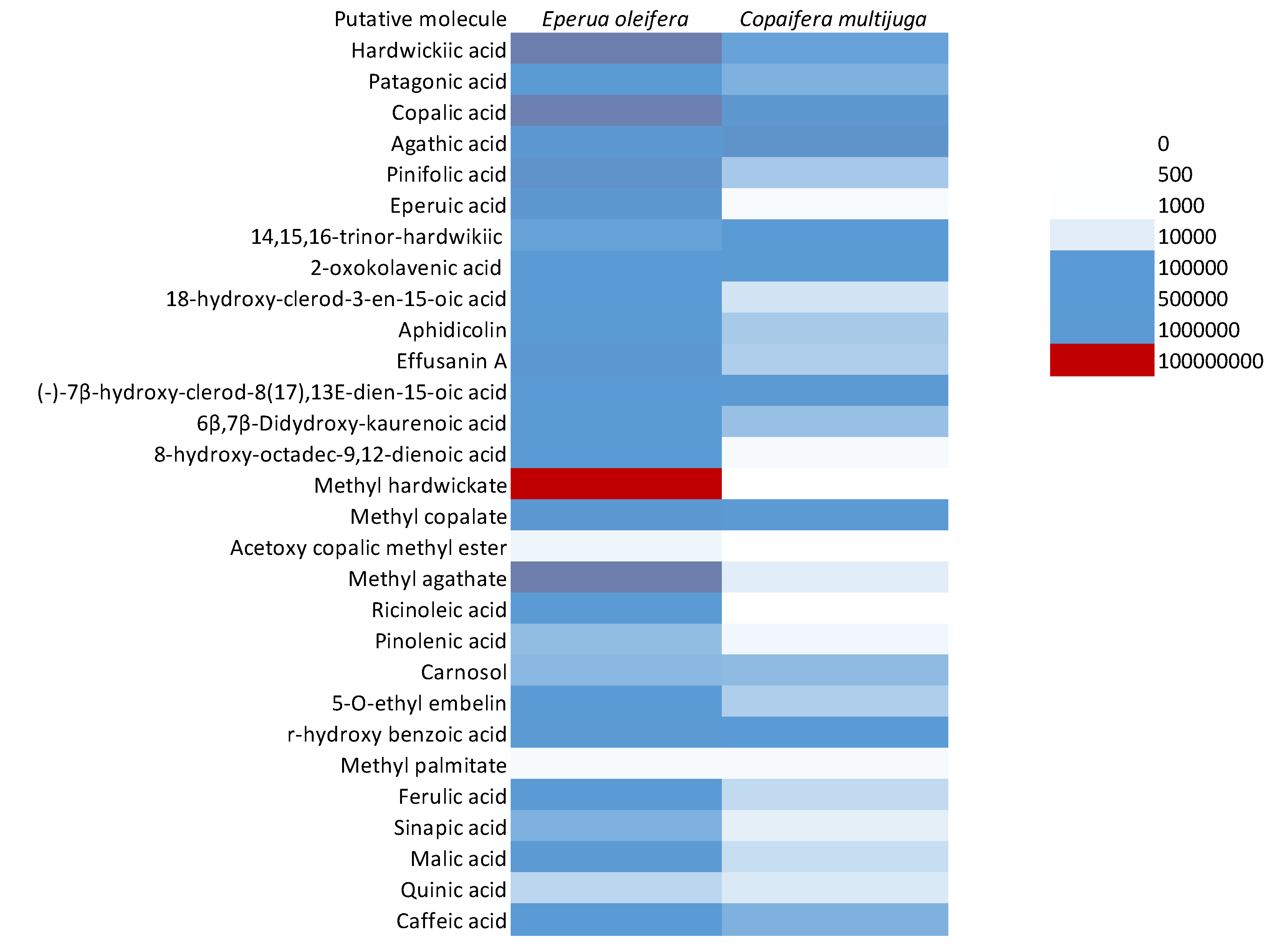
Figure 4.
Heatmap showing distribution of free fatty acids assigned in E. oleifera and C. multijuga, using DART-HRMS. (A) negative mode and (B) positive mode.
Figure 4.
Heatmap showing distribution of free fatty acids assigned in E. oleifera and C. multijuga, using DART-HRMS. (A) negative mode and (B) positive mode.
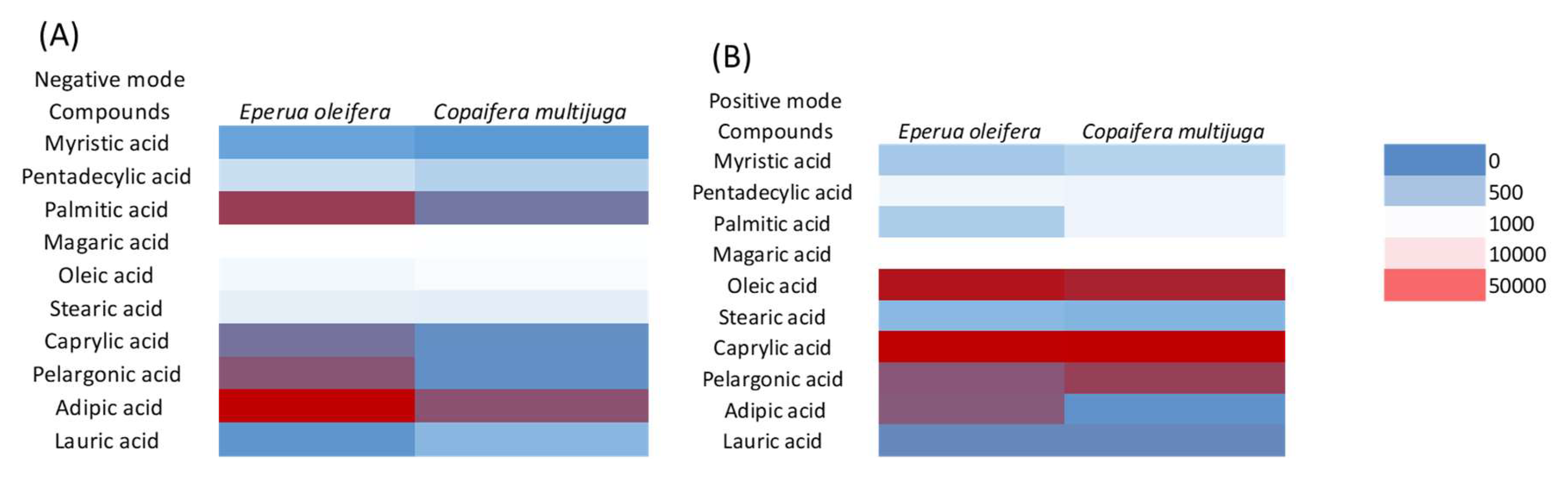

Table 1.
Five-Day Stability Assessment of E. oleifera on QuickStrip.
| Experiment dates |
[M-H]- | Mass error (ppm) | Absolute intensity | SD | mean | CV% |
|---|---|---|---|---|---|---|
| April 7, 2025 | 315.1967 | 0.32 | 16280 | 518 | 16168 | 3.2 |
| April 8, 2025 | 315.1968 | 0.48 | 16910 | |||
| April 9, 2025 | 315.1967 | 0.25 | 15980 | |||
| April 10, 2025 | 315.1967 | 0.32 | 16190 | |||
| April 11, 2025 | 315.1968 | 0.63 | 15480 |
Table 2.
Five-Day Stability Assessment of C. multijuga on QuickStrip.
| Experiment Dates |
[M-H]- | Mass error (ppm) | Absolute intensity | SD | mean | CV% |
|---|---|---|---|---|---|---|
| April 7, 2025 | 315.1969 | 0.95 | 8354 | 2497 | 5196 | 48 |
| April 8, 2025 | 315.1972 | 1.90 | 6910 | |||
| April 9, 2025 | 315.1970 | 1.24 | 5209 | |||
| April 10, 2025 | 315.1980 | 4.44 | 2967 | |||
| April 11, 2025 | 315.1971 | 1.59 | 2540 |
Table 3.
Assessment of Hardwickiic Acid Detectability in Repeated E. oleifera analyses.
| Experiment dates | [M-H]- | Mass error (ppm) | Absolute intensity |
|---|---|---|---|
| April 7, 2025 | 315.1967 | 0.32 | 16280 |
| April 8, 2025* | 315.1968 | 0.63 | 4676 |
| April 9, 2025* | 315.1960 | - 1.90 | 3428 |
| April 10, 2025* | 315.1959 | - 2.22 | 3205 |
| April 11, 2025* | 315.1952 | - 4.44 | 2098 |
Disclaimer/Publisher’s Note: The statements, opinions and data contained in all publications are solely those of the individual author(s) and contributor(s) and not of MDPI and/or the editor(s). MDPI and/or the editor(s) disclaim responsibility for any injury to people or property resulting from any ideas, methods, instructions or products referred to in the content. |
© 2026 by the authors. Licensee MDPI, Basel, Switzerland. This article is an open access article distributed under the terms and conditions of the Creative Commons Attribution (CC BY) license (http://creativecommons.org/licenses/by/4.0/).
Copyright: This open access article is published under a Creative Commons CC BY 4.0 license, which permit the free download, distribution, and reuse, provided that the author and preprint are cited in any reuse.


