

Submitted:
22 April 2026
Posted:
23 April 2026
You are already at the latest version
Abstract
Traumatic tracheal injuries and congenital defects can be life threatening. Regenerating the trachea through tissue engineered scaffolds has emerged as an innovative alternative to traditional therapies. At present time, challenges in tracheal regeneration preclude clinical adoption, such as revascularization and promotion of favorable paracrine and immune signaling responses. This review summarizes current advances in tracheal regeneration and highlights key biological and engineering barriers to address to achieve functional tracheal regeneration.
Keywords:
tracheal tissue enginneering
; tracheal regeneration
; advancements
; barriers
1. Introduction
Traumatic tracheal injuries and congenital airway defects in adult and pediatric populations are difficult to manage 1. Most tracheal injuries are iatrogenic, although they may also result from blunt or penetrating trauma 2. The true incidence is likely underestimated because many patients succumb before reaching definitive care 2,3. Other tracheal abnormalities are caused by congenital defects, including severe laryngotracheal clefts (type IV). These cases are rare and fatal without intervention. The incidence of laryngotracheal clefts is between 1:10,000 and 1:20,000 live births 4. In addition, extensive tracheal defects that arise following oncological resection present a significant challenge, as current surgical techniques cannot reliably reconstruct defects exceeding 40-50% of the tracheal length in adults and 30% in children 5. These limitations highlight the urgent need for regenerative strategies using tissue engineered scaffolds capable of restoring functional tracheal tissue.
In 20% of cases, when surgical repair for tracheal defects is possible, it is complicated by granulation tissue formation, tracheal stenosis, anastomotic separation and leak, tracheoesophageal fistula (TEF), or tracheoinnominate fistula formation 6. Additionally, almost 4.1% of these patients develop stenosis at the anastomotic site, requiring multiple additional procedures such as balloon dilation and reoperation 7. Long-term comorbidities include aberrant airway anatomy, recurrent TEF, impaired mucociliary clearance leading to recurrent pulmonary infections, and tracheomalacia 8,9. These complications significantly impair quality of life, causing psychological stress for patients and families while also increasing healthcare costs. This underscores the need for replacement strategies that can reduce complications, improve outcomes, and promote physiological tissue healing and regeneration. Early clinical attempts at tracheal replacement highlight significant challenges, including graft ischemia and failure, infection, and lack of epithelialization, thereby emphasizing the need for improved regenerative approaches 8. This review will focus on advances in tracheal tissue engineering and the persistent challenges that need to be overcome to form functional tracheal tissue.
2. Tracheal Embryogenesis, Anatomy and Regeneration: A Brief Overview
Understanding the embryology and anatomy of the trachea is essential to help guide optimal tracheal engineering techniques. The trachea is a crucial conduit that allows for the movement of air into the lungs, while protecting it from environmental hazards, and regulating humidity and temperature 10. During embryogenesis, the trachea and esophagus form from a common foregut tube during the first trimester 11. The trachea then separates from the esophagus to become its own structure 11. The ventral foregut endoderm forms a diverticulum, or outpouching, that develops into the trachea 12. The dorsal aspect of the foregut mostly contains mesenchymal cells which have been seen to play a role in the separation of the trachea and esophagus 12.
Anatomically, the trachea begins inferior to the larynx and bifurcates into the right and left mainstem bronchi within the thoracic cavity 10,13. It is composed of 16-20 hyaline cartilage rings on the anterior and lateral walls with smooth muscle posteriorly, giving the trachea its characteristic U-Shape 10. Fibroelastic connective tissue unites the tracheal rings and forms the layer in-between each ring that is continuous with the perichondrium 14. Surrounding the trachea is a loose fibroconnective areolar tissue, which contains a rich network of blood vessels and nerves (Figure 1) 14.
The inner lining of the trachea, specifically the epithelial layer, plays an important role in mucus production, immunity, and mucociliary clearance 10. The epithelial layer is composed of numerous cells, specifically ciliated, basal, goblet, club, neuroendocrine, tuft, and hillock cells 15. Surrounding the epithelial layer is a basement membrane, followed by smooth muscle (posteriorly), fibroblasts, and cartilage composed of chondrocytes (anteriorly) (Figure 2) 15. These cellular components and their precise organization highlight the complex anatomy and infrastructure of the trachea, underscoring the challenges of regenerating a new trachea and the difficulty in designing scaffolds that replicate native tracheal structure and function. In addition, the trachea receives its blood supply from a large network of arteries originating from surrounding structures, illustrating the complexity of the trachea and the challenge of developing a robust vascular network to supply an engineered scaffold. 10.
In addition to its anatomic complexity, the trachea must withstand significant mechanical forces including cyclic compression and expansion, airflow shear stress, coughing pressures, and cervical motion in a variety of directions. The trachea maintains an intricate level of firmness while upholding its ability to be pliable. One group of researchers determined the degree of stiffness of tracheal cartilage depends on age with a stiffer trachea noted in older patients (20.5 pascals) compared to younger patients (12.2 pascals) 16. Any engineered scaffold must maintain structural integrity and withstand external forces while preserving airway patency under these dynamic conditions.
When considering tracheal regeneration for diverse conditions ranging from congenital to acquired etiologies, it is important to understand the anatomical and functional differences in children and adults 17. In children, the trachea is shorter, narrower, and posteriorly angled compared to adults 17. In addition, a child’s trachea has more tracheal rings compared to adults (newborns:10 rings, adolescents: 8 rings, and adults: 6 or less from the sternal notch) 17. The growth pattern of the trachea during development is highly debated with speculations ranging from linear growth patterns versus a polynomial growth pattern 17,18,19. What is evident is that the trachea is not a “one-size fits all” organ, which further complicates the process required for regenerative engineering. For pediatric populations, scaffold development needs to account for increased growth over time so that engineered tissue will develop with the individual throughout adulthood, mitigating the need for additional surgical intervention.
3. Main Barriers to Regeneration
Successful tracheal regeneration requires overcoming several major challenges including restoration of epithelial function, vascularization of engineered constructs, immune compatibility, and mechanical stability (Figure 3 and Table 1). Each of these barriers must be addressed simultaneously and systematically to achieve durable airway repair and integration.
4. Leveraging Innate Repair Mechanisms in the Trachea
The trachea has innate repair mechanisms that can be leveraged for tissue engineering purposes. The lateral tracheal vascular pedicle is a robust network that can provide nutrients during times of stress and injury. Preservation of this network would be critical for any engineered construct 14.
In general, the tracheal epithelium has a low turnover rate; however, when there is damage, quiescent progenitor cells, such as the hillock and basal stem cells, activate and rapidly undergo clonal expansion 24,25. The hillock cells protect the basal stem cells during injury and inflammation, allowing the basal stem cells to proliferate and differentiate 25. These basal cells can generate all six types of normal pseudostratified epithelial cells (i.e., mucociliary and secretory cells), which could be helpful for promoting appropriate tissue function and regeneration 25,26. This regenerative potential makes basal cells particularly attractive tools for scaffold-based tissue engineering strategies. Table 2 describes the pseudostratified epithelial cells and their function. For example, these cells could be isolated from a patient’s airway, cultured and expanded in vitro, and used to seed a tissue engineered trachea. Butler et al. was able to culture human respiratory epithelial cells from endobronchial biopsies and demonstrated preserved mucociliary function 27. This highlights the possibility of restoring mucociliary function when designing scaffolds.
Additionally, when the tracheal epithelium is compromised, the innate immune system works to repair the epithelium leveraging signaling pathways such as Wnt/β-catenin, Notch, and TGF-β to promote repair, growth, and healing 34. As highlighted in Table 2, basal cells are a part of the tracheal epithelium that undergo differentiation to fit the tracheal environment 35. These basal cells can be observed to proliferate and differentiate into goblet cells via the Notch pathway during times of stress and damage 34.
5. Cell Types Used in Tracheal Tissue Engineering and Regeneration
As previously mentioned, mesenchymal stem cells (MSCs) play an important role in the development of the trachea. Additionally, these cells are easy to harvest from various tissues (bone marrow, adipose, placenta, and umbilical cord), have anti-inflammatory properties, immune modulating capability, and multi-potency that can create a pro-healing environment 36. Given this, many researchers utilize MSCs in their scaffold design for tracheal regeneration 37. Shin et al. cultured MSCs on a porcine cartilage-based tracheal scaffold that was then implanted into defects in the trachea of rabbits and promoted the development of intact respiratory epithelium and patent luminal contour at the site of transplantation 38. Other researchers cultured MSCs on a silk fibroin-hydroxyapatite scaffold and found that the scaffold was biocompatible and promoted MSC adhesion, growth, and proliferation, therefore showing promise as a possible scaffold for tracheal regeneration 39.
In addition to MSCs, researchers have utilized induced pluripotent stem cells (iPSCs) derived from fetal or adult somatic cells, which can be virally reprogrammed and differentiated using specific growth factors to the cell type of interest 40. These cells are beneficial as they have unlimited proliferative capacity, can be patient-derived for autologous administration and help mitigate the ethical concerns of using embryonic stem cells (reference). One group incorporated iPSCs into a collagen sponge scaffold that was implanted into rats with tracheal defects 23. Six of the eleven rats developed cartilage-like tissue within the tracheal defect, while the other five did not 23. Another study utilized iPSCs to generate tracheal epithelium by differentiating iPSCs into ciliated epithelial cells over 30 days at air liquid interface culture and then incorporated these cells into a collagen scaffold 41. This scaffold was then implanted into rats with a surgically created tracheal defect 41. After seven days, functional ciliated epithelial cells were noted on the luminal side of the regenerated tissue 41.
Lastly, researchers have been incorporating primary cell lines such as chondrocytes into scaffolds to repair tracheal defects. Nomoto et al created a polypropylene tracheal prosthesis where autologous chondrocytes were harvested from rabbits’ costal cartilage 42. The bioengineered trachea seeded with autologous chondrocytes was then implanted into the tracheas of rabbits 42. Fourteen weeks following implantation, regenerated cartilaginous tissue in the bioengineered trachea with maintenance of tracheal shape and structure was observed 42.
These examples of scaffolds demonstrate the benefit of using stem cells and primary cells to encourage appropriate tracheal tissue regeneration in tissue engineered constructs. Based on preliminary pre-clinical studies, MSCs provide immunomodulatory and anti-inflammatory benefits, whereas iPSCs offer greater differentiation potential but raise concerns regarding tumorigenicity and clinical safety. Next steps will be to determine which cell types or combination of cell types should be used to regenerate a functional trachea. Additionally, understanding the regenerative signaling pathways that regulate epithelial repair, cellular response, and tissue remodeling will be essential to model appropriate tracheal function and regeneration. As previously mentioned, pathways such as Wnt/β-catenin, Notch, and TGF-β play central roles in airway epithelial differentiation and stem cell activation. Therefore, understanding the pathways that influence tracheal cell behavior and identity will be critical for directing functional tracheal regeneration. Table 3 summarizes commonly studied cell types used in tracheal tissue engineering along with their advantages and limitations.
6. Biomaterials Used in Designing Scaffolds for Tracheal Tissue Engineering and Regeneration
Scaffolds are a three-dimensional template that provides a structural, mechanical, and biological construct that supports cell infiltration, growth, and proliferation. Scaffolds composed of various biomaterials have demonstrated promise in trachea regeneration and tissue engineering. However, the challenge with scaffolds is designing one with the optimal material that is biocompatible with humans, supports cell proliferation, is non-immunogenic, and has mechanical properties that support tracheal functions 21,44.
Materials used for bioengineering the trachea can be classified as natural, synthetic, or hybrid. Natural biomaterials, such as alginate, chitosan, collagen, fibrin, gelatin, hyaluronic acid, and soy protein 21,45,46,47,48,49,50,51, support cell adhesion, proliferation, and tissue regeneration in vitro and in vivo due to their similarity to native extracellular matrix 21. For example, collagen–hyaluronic acid scaffolds have been shown to promote vascular development within engineered tracheal tissue 21,45. When seeded with human umbilical vein endothelial cells and MSCs, these scaffolds demonstrated enhanced vascularization in a chick chorioallantoic membrane model 21,43. While this study did not implant these scaffolds in vivo, it illustrates of the ability of collagen and hyaluronic acid to promote vascularization. These results are particularly important because insufficient vascularization remains one of the primary limitations in tracheal regeneration 21,52. Natural biomaterials have limited mechanical strength, however, making them vulnerable to deformation under the mechanical stresses experienced within the airway 21. One way to circumvent this limitation is through the use of stronger synthetic materials.
Synthetic materials enable the engineered tracheal device to withstand the physical stresses required to retain proper function. In addition, it is easier to standardize the formulation and synthesis of these materials, making their production scalable and reproducible 21. Examples of synthetic materials include polylactic acid (PLA), polycaprolactone (PCL), polycarbonate (PC), thermoplastic polyurethane (TPU), polyglycolic acid (PGA), poly(lactic-co-glycolic) acid (PLGA), polyphosphoesters (PPE), polyethylene terephthalate (PET), and high-density polyethylene (HDPE) 21,53,54. Materials such as PLA, PCL, aliphatic PC are biodegradable, whereas aromatic PC and TPU are not 21,22,53,54. Modifying different chemical groups and properties of these materials allow for tunable biodegradation rates, which is advantageous for controlling tissue regeneration and healing. While there are significant advantages for the use of synthetic materials to encourage tracheal tissue regeneration, one drawback is limited biocompatibility which can cause an unwanted immune response and possible rejection 21.
In an effort to optimize the strengths of natural and synthetic materials, researchers are developing hybrid scaffolds. One study described a hybrid scaffold composed of PLGA knitted mesh with a collagen sponge impregnated with a gelatin hydrogel containing growth factor, basic fibroblast growth factor (bFGF), and implanted this into a rabbit tracheal defect model 55. Six months following implantation, the bFGF hydrogel impregnated scaffold promoted regeneration of cartilage with growth and epithelization in-between the hosts’ cartilage stumps 55. Reportedly, the scaffold maintained its rigid strength, preventing tracheal collapse during healing 55. While hybrid scaffolds provide improved mechanical stability and biocompatibility, long-term epithelial regeneration and integration remain inconsistent across experimental models. As previously mentioned, the challenge in developing a hybrid scaffold with synthetic and natural materials is incorporating materials that work together while minimizing host reaction. Table 4 summarizes commonly used biomaterials in tracheal tissue engineering along with their advantages, limitations, and representative studies.
7. Specific Challenges with Engineering Tracheal Tissue
Scaffolds lack biochemical cues, such as of the presence of growth factors, cytokines, and extracellular matrix proteins, that are required for scaffold regeneration 20. To overcome this, one group investigated the incorporation of extracellular matrix (ECM) to enable regeneration. ECM has been shown to play a crucial role in cell proliferation, adhesion, and viability 56. In addition, the utilization of ECM with in vivo models has been shown to promote epithelization and prevent chronic inflammatory reactions that leads to secondary stenosis following tracheal repair 57,58,59. One group took synthetic tracheal scaffolds and soaked them in lyophilized porcine ECM (pECM) or human ECM (hECM) and then seeded the scaffold with lung epithelial cells from a human lung 20. The scaffolds coated with pECM or hECM had a greater proportion of living cells and increased cell density at 24 hours and 7 days 20. In addition, cell proliferation was enhanced by 24 hours in the scaffolds that were coated with pECM and hECM compared to standard cell well plates and uncoated scaffolds 20. The presence of extracellular matrix proteins helped with cell differentiation and growth by providing important ligands and proteins that are typically present in native tissue. Therefore, this study highlights a developing area of tissue engineering research where the optimization of scaffold conditions promotes favorable environments for cells to grow.
Tracheal epithelial regeneration remains challenging as many factors, such as extracellular proteins, signaling molecules and inflammation, play a role in differentiation of the basal cells. These cells are sensitive to stresses and quickly adapt. One strategy for promoting epithelial regeneration involves modulation of the oxidative stress environment. Chen et al. evaluated hydrogels composed of chitin, tannic acid, aspartic acid, and L-arginine (LA@PA-TA@C) for the repair of damaged tracheal epithelium. After four weeks, the regenerated epithelium closely resembled native airway tissue, with the presence of ciliated, goblet, and basal cells. The authors attributed these outcomes partly to the antioxidant properties of tannic acid, which reduced oxidative stress and cellular apoptosis 34. By limiting oxidative injury, basal cells were able to survive, proliferate, and differentiate into functional epithelial cells. This study illustrates how scaffold composition can influence cellular signaling pathways and promote epithelial regeneration.
Immune response also plays a critical role in the success of implanted tracheal scaffolds as inflammatory reactions can impair tissue integration and regeneration 60. One of the most important regulators of this response is the macrophage 60,61. Macrophages exhibit distinct functional phenotypes that influence scaffold outcomes. Pro-inflammatory M1 macrophages promote cytokine release, fibrosis, and graft failure, whereas pro-regenerative/anti-inflammatory M2 macrophages support tissue remodeling and scaffold integration. Excessive M1 macrophage activation can lead to extracellular matrix deposition and tracheal narrowing, ultimately compromising airway patency. For this reason, researchers are actively exploring strategies to modulate macrophage polarization toward the M2 phenotype 60,61. For example, delivering immunomodulary molecules, such as interleukin-4 (IL-4) or interleukin-13 (IL-13), to promote M2 macrophage polarization that will elicit a pro-regenerative environment, allowing for tissue repair and scaffold integration within the native host environment 62. Reduced systemic side effects and long-term scaffold viability were observed when IL-4 and IL-13 were slowly released from nanoparticles embedded within a scaffold 62. This demonstrates a potential strategy for circumventing M1 macrophage polarization and reducing fibrosis, stenosis, and scaffold rejection. In addition to macrophage polarization, the host response to implanted scaffolds involves foreign body reactions, cytokine signaling cascades, and fibrotic remodeling. Excessive fibrosis can lead to airway narrowing and impaired scaffold integration, highlighting the importance of designing biomaterials that minimize chronic inflammation.
The type of material used in the scaffold plays an integral role in the degree of immune response it generates. It has been noted that decellularized scaffolds may contain residual immunogenic material leading to fibrosis 61. On the other hand, fully synthetic scaffolds have low bioactivity and mount less of an immune response 61. However, this can lead to persistent and chronic inflammation that ultimately causes rejection of the scaffold 61. Therefore, designing a scaffold with limited immunogenicity remains a challenge.
Lastly, designing a scaffold that has a durable blood supply for the graft and cells is critical and, as previously stated, remains one of the most significant barriers in tracheal tissue engineering. Without rapid angiogenesis, implanted scaffolds are prone to ischemia, impaired epithelial regeneration, and eventual graft failure. Currently, pre-vascularized scaffolds, growth delivery systems, and in-vivo bioreactor techniques have been examined 20. Growth factor delivery systems that deliver factors, such as vascular endothelial growth factors, have been shown to enhance endothelial cell proliferation and promote angiogenesis in tracheal scaffolds 20. Although promising, one setback of growth factor delivery systems is the need to have controlled release of factors, otherwise aberrant vascular growth occurs 20. Pre-vascularized scaffolds allow for early integration of the scaffold and can reduce ischemia of the scaffold and cells, but these scaffolds can be difficult to create 20. Finally, the use of in-vivo bioreactors allows researchers to implant an engineered scaffold into a vascular rich region of the body, such as the omentum, to promote natural development of blood vessels prior to implanting into the trachea 16. This approach enhances endothelialization and scaffold maturation 20, thereby improving long-term tissue viability with a reduction in ischemic complications 20. While promising, this novel and relatively new approach require multiple surgical procedures that can be time consuming and costly 20.
8. The Future of Tracheal Regeneration
Future engineered tracheal scaffolds will benefit from a multilayered design leveraging the strength of both synthetic and natural biomaterials, incorporation of key regenerative cells and extracellular matrix. The use of 3D bioprinting technology has immense potential given its ability to personalize the design, create multiple layers, and incorporate cells as well as extracellular matrix within the construct. Using this technology, different scaffold layers could be bioprinted. For example, one layer could incorporate natural biomaterials seeded with epithelial and endothelial cells optimized for epithelialization and vascular regeneration, while another layer could support cartilage formation and mechanical stability with chondrocyte seeded synthetic material. Such multifunctional constructs would allow researchers to address several barriers to tracheal regeneration within a single engineered scaffold.
9. Conclusion
This review highlights recent advances in tracheal tissue engineering while emphasizing the major challenges that remain. Although substantial progress has been made in identifying suitable biomaterials, cell sources, and immune-modulating strategies, major challenges remain in vascularization, mechanical stability, and enabling epithelial regeneration while minimizing immune-mediated fibrosis and rejection. Addressing these challenges will require multidisciplinary approaches that integrate biomaterial engineering, stem cell biology, and regenerative biochemical signaling modulation in order to develop a clinically viable method of restoring functional tracheal tissue.
Author Contributions
Conceptualization, N.D.K., J.W., H.W., C.F.; Writing- Original Draft Preparation – N.D.K.; Visualization – N.D.K., J.W.; Writing – Review & Editing, N.D.K., J.W., H.W., C.F.; Supervision, C.F.
Funding
This research received no external funding.
Data Availability Statement
Given that this paper is a review article, this is not applicable. This manuscript does not report data generation or analysis.
Acknowledgments
The authors would like to acknowledge Connecticut Children’s Medical Center and UCONN Health for their support in their research. During the preparation of this manuscript, the authors used ChatGPT for the purposes of creating Figure 3. The authors have reviewed and edited the output and take full responsibility for the content of this publication.
Conflicts of Interest
The authors declare no conflicts of interest.
Abbreviations
The following abbreviations are used in this manuscript:
| TEF | Tracheoesophageal Fistula |
| VEGF | Vascular Endothelial Growth Factors |
| TGF-β | Transforming growth factor-beta |
| MSC | Mesenchymal Stem Cell |
| iPSCs | Induced pluripotent stem cells |
| PLA | Polylactic Acid |
| PCL | Polycaprolactone |
| PC | Polycarbonate |
| TPU | Thermoplastic polyurethane |
| PGA | Polyglycolic acid |
| PLGA | Poly(lactic-co-glycolic) acid |
| PPE | Polyphosphoesters |
| PET | Polyethylene terephthalate |
| HDPE | High-density polyethylene |
| bFGF | Basic fibroblast growth factor |
| ECM | Extracellular matrix |
| hECM | Human extracellular matrix |
| pECM | Porcine extracellular matrix |
| IL-4 | Interleukin-4 |
| IL-13 | Interleukin-13 |
| 3D | Three-dimension |
References
- Herrera, M.A.; Tintinago, L.F.; Morales, W. Victoria; Ordoñez, C.A.; Parra, M.W.; Betancourt-Cajiao, M.; Caicedo, Y.; Guzmán-Rodríguez, M.; Gallego, L.M.; González Hadad, A.; et al. Damage control of laryngotracheal trauma: the golden day. Colomb Med (Cali) 2020, 51(4), p. e4124599. [Google Scholar] [CrossRef]
- Grewal, H.S.; Dangayach, N.S.; Ahmad, U.; Ghosh, S.; Gildea, T.; Mehta, A.C. Treatment of Tracheobronchial Injuries: A Contemporary Review. Chest 2019, 155(3), 595–604. [Google Scholar] [CrossRef] [PubMed]
- Boutros, J.; Marquette, C.H.; Ichai, C.; Leroy, S.; Benzaquen, J. Multidisciplinary management of tracheobronchial injury. Eur Respir Rev 2022, 31(163). [Google Scholar] [CrossRef] [PubMed]
- De Jong, R.; Hohman, M.H.; Farahani, C. Laryngeal Clefts.; StatPearls [Internet], 2025. [Google Scholar]
- Asnaghi, A.; Macchiarini, P.; Mantero, S. Tissue engineering toward organ replacement: a promising approach in airway transplant. Int J Artif Organs 2009, 32(11), 763–8. [Google Scholar] [CrossRef] [PubMed]
- Auchincloss, H.G.; Wright, C.D. Complications after tracheal resection and reconstruction: prevention and treatment. J Thorac Dis 2016, 8 (Suppl 2), S160–7. [Google Scholar]
- Tapias, L.F.; Mathisen, D.J. Prevention and management of complications following tracheal resections-lessons learned at the Massachusetts General Hospital. Ann Cardiothorac Surg 2018, 7(2), 237–243. [Google Scholar] [CrossRef]
- Wei, S.; Zhang, Y.; Luo, F.; Duan, K.; Li, M.; Lv, G. Tissue-engineered tracheal implants: Advancements, challenges, and clinical considerations. Bioengineering & Translational Medicine 2024, 9(4), p. e10671. [Google Scholar]
- Sadreameli, S.C.; McGrath-Morrow, S.A. Respiratory Care of Infants and Children with Congenital Tracheo-Oesophageal Fistula and Oesophageal Atresia. Paediatr Respir Rev 2016, 17, 16–23. [Google Scholar] [CrossRef]
- Mieczkowski, B. S.B.F., Anatomy, Head and Neck, Trachea.; StatPearls [Internet], 2023. [Google Scholar]
- Edwards, N.A.; Shacham-Silverberg, V.; Weitz, L.; Kingma, P.S.; Shen, Y.; Wells, J.M.; Chung, W.K.; Zorn, A.M. Developmental basis of trachea-esophageal birth defects. Dev Biol 2021, 477, 85–97. [Google Scholar] [CrossRef]
- Faure, S.; de Santa Barbara, P. Molecular embryology of the foregut. J Pediatr Gastroenterol Nutr 2011, 52 Suppl 1(Suppl 1), S2–3. [Google Scholar] [CrossRef]
- Jacobsen, B.; VanKampen, N.; Ashurst, J.V. Anatomy, Head and Neck, Thyrohyoid Membrane, in StatPearls; StatPearls Publishing Copyright © 2025, StatPearls Publishing LLC.; Treasure Island (FL), 2025. [Google Scholar]
- Shamji, F.M. Factors Favoring and Impairing Healing of Tracheal Anastomosis. Thorac Surg Clin 2018, 28(2), 211–218. [Google Scholar] [CrossRef] [PubMed]
- Kishimoto, K.; Morimoto, M. Mammalian tracheal development and reconstruction: insights from in vivo and in vitro studies. Development 2021, 148(13). [Google Scholar] [CrossRef] [PubMed]
- Safshekan, F.; Tafazzoli-Shadpour, M.; Abdouss, M.; Behgam Shadmehr, M.; Ghorbani, F. Investigation of the Mechanical Properties of the Human Tracheal Cartilage. Tanaffos 2017, 16(2), 107–114. [Google Scholar] [PubMed]
- Di Cicco, M.; Kantar, A.; Masini, B.; Nuzzi, G.; Ragazzo, V.; Peroni, D. Structural and functional development in airways throughout childhood: Children are not small adults. Pediatr Pulmonol 2021, 56(1), 240–251. [Google Scholar] [CrossRef] [PubMed]
- Szpinda, M.; Daroszewski, M.; Woźniak, A.; Szpinda, A.; Mila-Kierzenkowska, C. Tracheal dimensions in human fetuses: an anatomical, digital and statistical study. Surg Radiol Anat 2012, 34(4), 317–23. [Google Scholar] [CrossRef]
- Luscan, R.; Leboulanger, N.; Fayoux, P.; Kerner, G.; Belhous, K.; Couloigner, V.; Garabedian, E.N.; Simon, F.; Denoyelle, F.; Thierry, B. Developmental changes of upper airway dimensions in children. Paediatr Anaesth 2020, 30(4), 435–445. [Google Scholar] [CrossRef]
- Liu, L.; Dharmadhikari, S.; Pouliot, R.A.; Li, M.M.; Minneci, P.M.; Tan, Z.; Shontz, K.; Johnson, J.; Reynolds, S.D.; Breuer, C.K.; et al. Modulation of Synthetic Tracheal Grafts with Extracellular Matrix Coatings. Bioengineering (Basel) 2021, 8(8). [Google Scholar] [CrossRef]
- Naik, S.S.; Dutta, N.K.; Sukumaran, N. Kiran; Choudhury, N.R. Critical advances in biofabrication and biomaterial strategies in tracheal tissue engineering: A comprehensive overview. Adv Colloid Interface Sci 2025, 345, 103604. [Google Scholar] [CrossRef]
- DeStefano, V.; Khan, S.; Tabada, A. Applications of PLA in modern medicine. Eng Regen 2020, 1, 76–87. [Google Scholar] [CrossRef]
- Imaizumi, M.; Nomoto, Y.; Sato, Y.; Sugino, T.; Miyake, M.; Wada, I.; Nakamura, T.; Omori, K. Evaluation of the use of induced pluripotent stem cells (iPSCs) for the regeneration of tracheal cartilage. Cell Transplant 2013, 22(2), 341–53. [Google Scholar] [CrossRef]
- Eenjes, E.; Tibboel, D.; Wijnen, R.M.H.; Rottier, R.J. Lung epithelium development and airway regeneration. Front Cell Dev Biol 2022, 10, 1022457. [Google Scholar] [CrossRef] [PubMed]
- Lin, B.; Shah, V.S.; Chernoff, C.; Sun, J.; Shipkovenska, G.G.; Vinarsky, V.; Waghray, A.; Xu, J.; Leduc, A.D.; Hintschich, C.A.; et al. Airway hillocks are injury-resistant reservoirs of unique plastic stem cells. Nature 2024, 629(8013), 869–877. [Google Scholar] [CrossRef] [PubMed]
- Rock, J.R.; Randell, S.H.; Hogan, B.L. Airway basal stem cells: a perspective on their roles in epithelial homeostasis and remodeling. Dis Model Mech 2010, 3(9-10), 545–56. [Google Scholar] [CrossRef] [PubMed]
- Butler, C.R.; Hynds, R.E.; Gowers, K.H.; Lee Ddo, H.; Brown, J.M.; Crowley, C.; Teixeira, V.H.; Smith, C.M.; Urbani, L.; Hamilton, N.J.; et al. Rapid Expansion of Human Epithelial Stem Cells Suitable for Airway Tissue Engineering. Am J Respir Crit Care Med 2016, 194(2), 156–68. [Google Scholar] [CrossRef]
- Bustamante-Marin, X.M.; Ostrowski, L.E. Cilia and Mucociliary Clearance. Cold Spring Harb Perspect Biol 2017, 9(4). [Google Scholar] [CrossRef]
- Rogers, D.F. The airway goblet cell. Int J Biochem Cell Biol 2003, 35(1), 1–6. [Google Scholar] [CrossRef]
- Ruysseveldt, E.; Martens, K.; Steelant, B. Airway Basal Cells, Protectors of Epithelial Walls in Health and Respiratory Diseases. Front Allergy 2021. 2, 787128. [Google Scholar] [CrossRef]
- Davis, J.D.; Wypych, T.P. Cellular and functional heterogeneity of the airway epithelium. Mucosal Immunol 2021, 14(5), 978–990. [Google Scholar] [CrossRef]
- Thakur, A.; Mei, S.; Zhang, N.; Zhang, K.; Taslakjian, B.; Lian, J.; Wu, S.; Chen, B.; Solway, J.; Chen, H.J. Pulmonary neuroendocrine cells: crucial players in respiratory function and airway-nerve communication. Front Neurosci 2024, 18, 1438188. [Google Scholar] [CrossRef]
- Hollenhorst, M.I.; Husnik, T.; Zylka, M.; Duda, N.; Flockerzi, V.; Tschernig, T.; Maxeiner, S.; Krasteva-Christ, G. Human airway tuft cells influence the mucociliary clearance through cholinergic signalling. Respir Res 2023, 24(1), p. 267. [Google Scholar] [CrossRef]
- Chen, Y.; Tang, H.; Zhang, Y.; Wang, L.; Zhu, J.; Wang, L.; Li, A.; Zeng, X.; Yin, B.; Liang, Y. Multiplexed self-adaptable Janus hydrogels rescue epithelial malfunction to promote complete trachea repair. Nature Communications 2025, 16(1), p. 5734. [Google Scholar] [CrossRef]
- Rogers, D.F. Airway goblet cells: responsive and adaptable front-line defenders. Eur Respir J 1994, 7(9), 1690–706. [Google Scholar] [CrossRef] [PubMed]
- Margiana, R.; Markov, A.; Zekiy, A.O.; Hamza, M.U.; Al-Dabbagh, K.A.; Al-Zubaidi, S.H.; Hameed, N.M.; Ahmad, I.; Sivaraman, R.; Kzar, H.H.; et al. Clinical application of mesenchymal stem cell in regenerative medicine: a narrative review. Stem Cell Res Ther 2022, 13(1), p. 366. [Google Scholar] [CrossRef] [PubMed]
- Hernández, R.; Jiménez-Luna, C.; Perales-Adán, J.; Perazzoli, G.; Melguizo, C.; Prados, J. Differentiation of Human Mesenchymal Stem Cells towards Neuronal Lineage: Clinical Trials in Nervous System Disorders. Biomol Ther (Seoul) 2020, 28(1), 34–44. [Google Scholar] [CrossRef] [PubMed]
- Shin, Y.S.; Choi, J.W.; Park, J.K.; Kim, Y.S.; Yang, S.S.; Min, B.H.; Kim, C.H. Tissue-engineered tracheal reconstruction using mesenchymal stem cells seeded on a porcine cartilage powder scaffold. Ann Biomed Eng 2015, 43(4), 1003–13. [Google Scholar] [CrossRef]
- Xie, X.; Miao, B.; Yao, J.; Chen, Z. Silk fibroin-hydroxyapatite scaffolds promote the proliferation of adipose-derived mesenchymal stem cells by activating the ERK signal. J Biomater Appl 2023, 37(10), 1767–1775. [Google Scholar] [CrossRef]
- Aboul-Soud, M.A.M.; Alzahrani, A.J.; Mahmoud, A. Induced Pluripotent Stem Cells (iPSCs)-Roles in Regenerative Therapies, Disease Modelling and Drug Screening. Cells 2021, 10(9). [Google Scholar] [CrossRef]
- Ikeda, M.; Imaizumi, M.; Yoshie, S.; Otsuki, K.; Miyake, M.; Hazama, A.; Wada, I.; Omori, K. Regeneration of tracheal epithelium using mouse induced pluripotent stem cells. Acta Otolaryngol 2016, 136(4), 373–8. [Google Scholar] [CrossRef]
- Nomoto, M.; Nomoto, Y.; Tada, Y.; Tani, A.; Otsuki, K.; Suzuki, R.; Nakamura, T.; Omori, K. Bioengineered trachea using autologous chondrocytes for regeneration of tracheal cartilage in a rabbit model. Laryngoscope 2013, 123(9), 2195–201. [Google Scholar] [CrossRef]
- Khalid, T.; Soriano, L.; Lemoine, M.; Cryan, S.A.; O'Brien, F.J.; O'Leary, C. Development of tissue-engineered tracheal scaffold with refined mechanical properties and vascularisation for tracheal regeneration. Front Bioeng Biotechnol 2023, 11, 1187500. [Google Scholar] [CrossRef]
- Wei, S.; Zhang, Y.; Luo, F.; Duan, K.; Li, M.; Lv, G. Tissue-engineered tracheal implants: Advancements, challenges, and clinical considerations. Bioeng Transl Med 2024, 9(4), p. e10671. [Google Scholar] [CrossRef]
- Gomez-Florit, M.; Pardo, A.; Domingues, R.M.A.; Graça, A.L.; Babo, P.S.; Reis, R.L.; Gomes, M.E. Natural-Based Hydrogels for Tissue Engineering Applications. Molecules 2020, 25(24), 5858. [Google Scholar] [CrossRef] [PubMed]
- Xu, Y.; Wang, Z.; Hua, Y.; Zhu, X.; Wang, Y.; Duan, L.; Zhu, L.; Jiang, G.; Xia, H.; She, Y. Photocrosslinked natural hydrogel composed of hyaluronic acid and gelatin enhances cartilage regeneration of decellularized trachea matrix. Mater Sci Eng C Mater Biol Appl 2021, 120, 111628. [Google Scholar] [CrossRef] [PubMed]
- Nematollahi, Z.; Tafazzoli-Shadpour, M.; Zamanian, A.; Seyedsalehi, A.; Mohammad-Behgam, S.; Ghorbani, F.; Mirahmadi, F. Fabrication of Chitosan Silk-based Tracheal Scaffold Using Freeze-Casting Method. Iran Biomed J 2017, 21(4), 228–39. [Google Scholar] [CrossRef] [PubMed]
- Dai, Y.; Liu, G.; Ma, L.; Wang, D.; Gao, C. Cell-free macro-porous fibrin scaffolds for in situ inductive regeneration of full-thickness cartilage defects. Journal of Materials Chemistry B 2016, 4(25), 4410–4419. [Google Scholar] [CrossRef]
- Luo, Y.; Lode, A.; Gelinsky, M. Direct Plotting of Three-Dimensional Hollow Fiber Scaffolds Based on Concentrated Alginate Pastes for Tissue Engineering. Advanced Healthcare Materials 2013, 2(6), 777–783. [Google Scholar] [CrossRef]
- Cao, Y.; Cheng, P.; Sang, S.; Xiang, C.; An, Y.; Wei, X.; Shen, Z.; Zhang, Y.; Li, P. Mesenchymal stem cells loaded on 3D-printed gradient poly(ε-caprolactone)/methacrylated alginate composite scaffolds for cartilage tissue engineering. Regenerative Biomaterials 2021, 8(3). [Google Scholar] [CrossRef]
- Fares, M.M.; Shirzaei Sani, E.; Portillo Lara, R.; Oliveira, R.B.; Khademhosseini, A.; Annabi, N. Interpenetrating network gelatin methacryloyl (GelMA) and pectin-g-PCL hydrogels with tunable properties for tissue engineering. Biomaterials Science 2018, 6(11), 2938–2950. [Google Scholar] [CrossRef]
- Novosel, E.C.; Kleinhans, C.; Kluger, P.J. Vascularization is the key challenge in tissue engineering. Adv Drug Deliv Rev 2011, 63(4-5), 300–11. [Google Scholar] [CrossRef]
- Gandha, P.; Surve, T.; Kandasubramanian, B. Mozafari, M., Chauhan, N.P. Singh, Eds.; 15 - Polycaprolactone as biomaterial. In Handbook of Polymers in Medicine; Woodhead Publishing, 2023; pp. 425–443. [Google Scholar]
- Artham, T.; Doble, M. Biodegradation of aliphatic and aromatic polycarbonates. Macromol Biosci 2008, 8(1), 14–24. [Google Scholar] [CrossRef]
- Tatekawa, Y.; Kawazoe, N.; Chen, G.; Shirasaki, Y.; Komuro, H.; Kaneko, M. Tracheal defect repair using a PLGA-collagen hybrid scaffold reinforced by a copolymer stent with bFGF-impregnated gelatin hydrogel. Pediatr Surg Int 2010, 26(6), 575–80. [Google Scholar] [CrossRef]
- Reyes, C.D.; Petrie, T.A.; García, A.J. Mixed extracellular matrix ligands synergistically modulate integrin adhesion and signaling. J Cell Physiol 2008, 217(2), 450–8. [Google Scholar] [CrossRef] [PubMed]
- Pouliot, R.A.; Link, P.A.; Mikhaiel, N.S.; Schneck, M.B.; Valentine, M.S.; Kamga Gninzeko, F.J.; Herbert, J.A.; Sakagami, M.; Heise, R.L. Development and characterization of a naturally derived lung extracellular matrix hydrogel. J Biomed Mater Res A 2016, 104(8), 1922–35. [Google Scholar] [CrossRef] [PubMed]
- Villegas-Alvarez, F.; González-Zamora, J.F.; González-Maciel, A.; Soriano-Rosales, R.; Pérez-Guille, B.; Padilla-Sánchez, L.; Reynoso-Robles, R.; Ramos-Morales, A.; Zenteno-Galindo, E.; Pérez-Torres, A.; et al. Fibrocollagen-covered prosthesis for a noncircumferential segmental tracheal replacement. J Thorac Cardiovasc Surg 2010, 139(1), 32–7. [Google Scholar] [CrossRef] [PubMed]
- Young, B.M.; Shankar, K.; Allen, B.P.; Pouliot, R.A.; Schneck, M.B.; Mikhaiel, N.S.; Heise, R.L. Electrospun Decellularized Lung Matrix Scaffold for Airway Smooth Muscle Culture. ACS Biomater Sci Eng 2017, 3(12), 3480–3492. [Google Scholar] [CrossRef]
- Anderson, J.M.; Rodriguez, A.; Chang, D.T. Foreign body reaction to biomaterials. Semin Immunol 2008, 20(2), 86–100. [Google Scholar] [CrossRef]
- Liang, Y.; Wei, S.; Zhang, A. Bioengineered tracheal graft with enhanced vascularization and mechanical stability for functional airway reconstruction. Regen Ther 2025, 29, 364–380. [Google Scholar] [CrossRef]
- Majumder, N.; Roy, C.; Doenges, L.; Martin, I.; Barbero, A.; Ghosh, S. Covalent Conjugation of Small Molecule Inhibitors and Growth Factors to a Silk Fibroin-Derived Bioink to Develop Phenotypically Stable 3D Bioprinted Cartilage. ACS Appl Mater Interfaces 2024, 16(8), 9925–9943. [Google Scholar] [CrossRef]
Figure 1.
Tracheal Anatomy with key anatomical structures highlighted. Created in BioRender. Kosciuszek, N. (2026) https://BioRender.com/s2xo1f8.
Figure 1.
Tracheal Anatomy with key anatomical structures highlighted. Created in BioRender. Kosciuszek, N. (2026) https://BioRender.com/s2xo1f8.
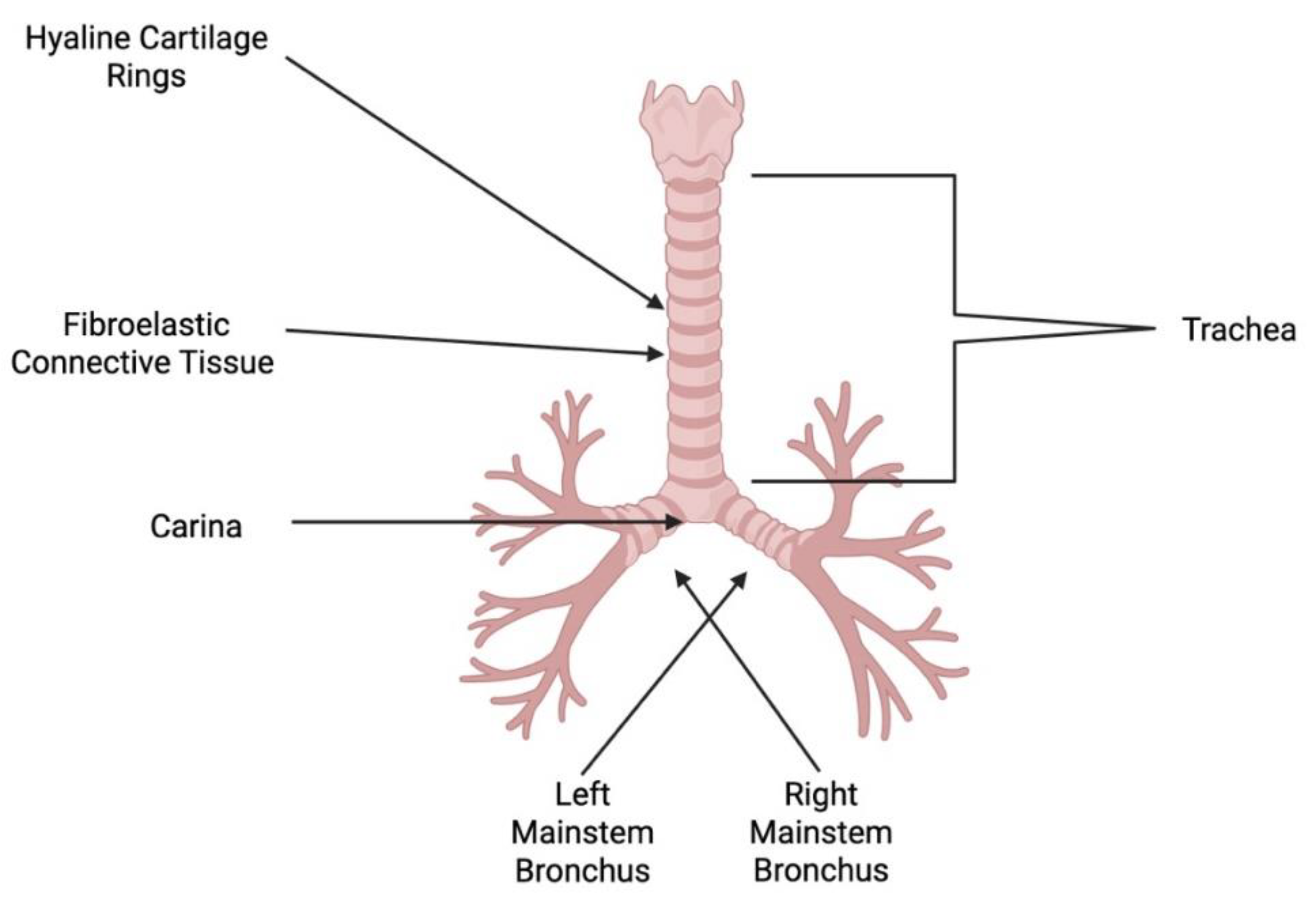
Figure 2.
Cross section depiction of trachea highlighting the intricate layers of chondrocytes, fibroblasts, smooth muscle cells, and endothelial cells. Zoomed in panel represents a close up to the cells that are present in the endothelial layer. Created in BioRender. Kosciuszek, N. (2026) https://BioRender.com/7g7t7sd.
Figure 2.
Cross section depiction of trachea highlighting the intricate layers of chondrocytes, fibroblasts, smooth muscle cells, and endothelial cells. Zoomed in panel represents a close up to the cells that are present in the endothelial layer. Created in BioRender. Kosciuszek, N. (2026) https://BioRender.com/7g7t7sd.
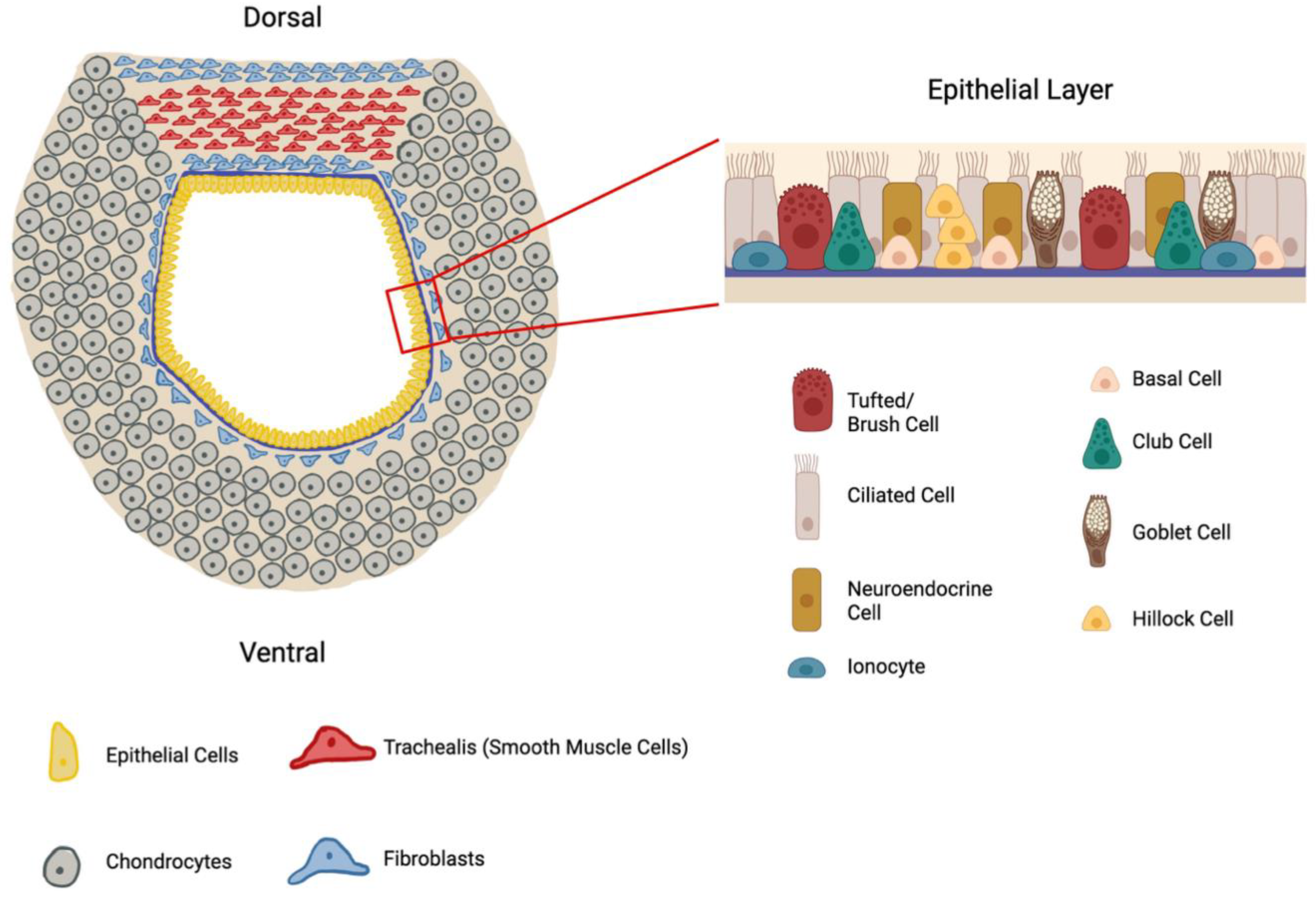
Figure 3.
Overview of the key biological and engineering challenges that must be addressed to achieve successful tracheal tissue regeneration, including epithelial regeneration, vascularization, immune compatibility, and mechanical stability. Figure created with assistance of ChatGPT for design.
Figure 3.
Overview of the key biological and engineering challenges that must be addressed to achieve successful tracheal tissue regeneration, including epithelial regeneration, vascularization, immune compatibility, and mechanical stability. Figure created with assistance of ChatGPT for design.
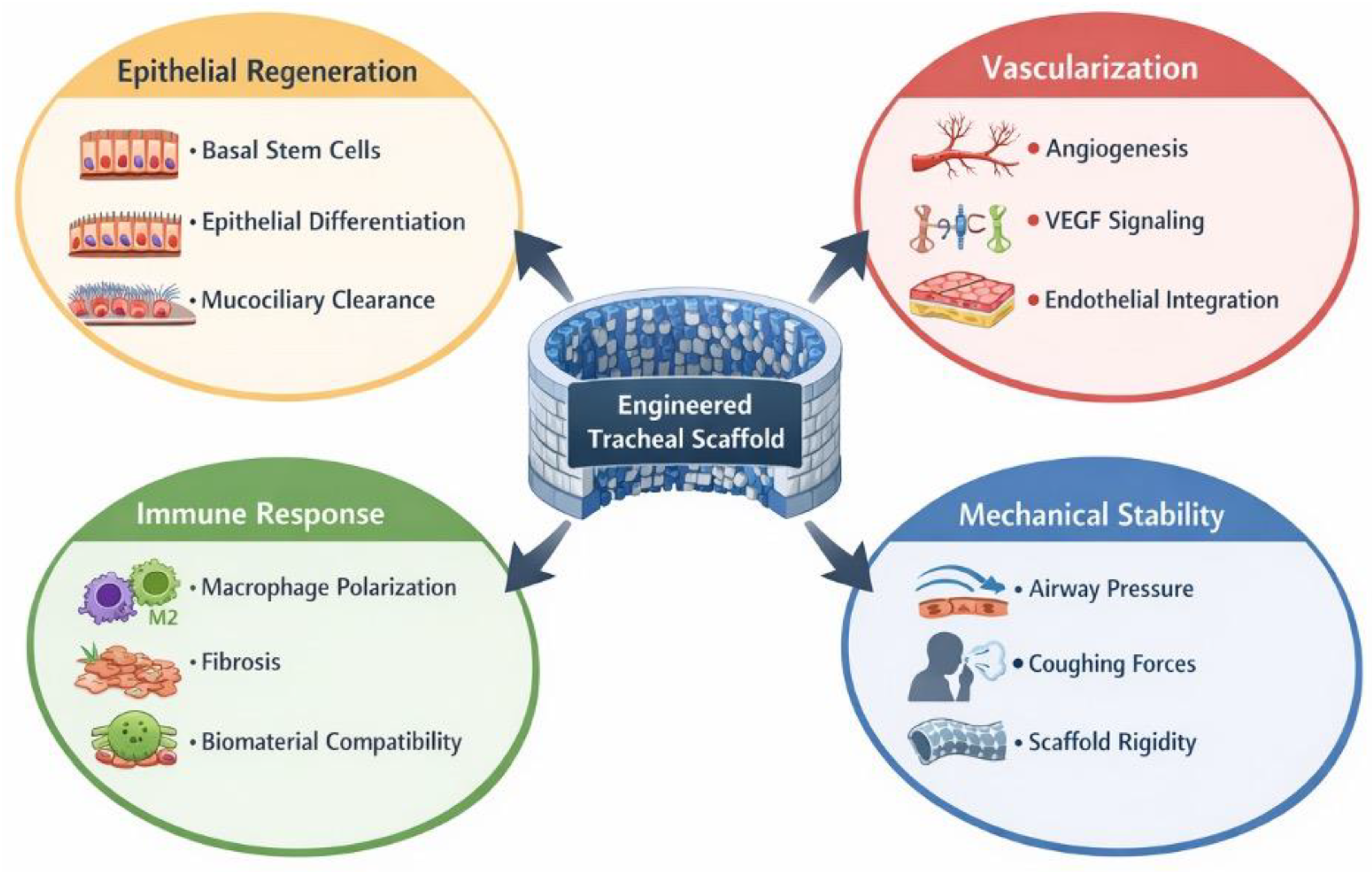

Table 1.
Major biological and engineering challenges associated with tracheal regeneration.
| Challenge | Biological / Engineering Issue | Current Strategies |
| Vascularization | Poor blood supply leads to scaffold ischemia and graft failure | Growth factor delivery (VEGF), pre-vascularized scaffolds, in vivo bioreactors 20 |
| Mechanical Stability | Airway must withstand airflow pressure, coughing, and neck motion | Synthetic polymers, reinforced scaffolds 21 |
| Immune Response | Foreign body reactions and fibrosis can cause scaffold rejection | Immunomodulatory biomaterials, cytokine delivery 22 |
| Epithelial Regeneration | Functional airway epithelium required for mucociliary clearance | Stem cell seeding, epithelial progenitor cells 23 |
| Tracheal Growth | Airway growth requires adaptable scaffolds | Biodegradable and growth-permitting biomaterials 22 |
Table 2.
List of Pseudostratified Epithelial Cells Derived from Hillock and Basal Progenitor Cells.
| Cell Name | Cell Function |
| Ciliated (Brush) | Mucociliary clearance – the cilia (hair-like projections) that beat in a wave-like movement to move mucus and debris out of the airway 28 |
| Goblet | Production of mucus that traps debris such as dust and pathogens from further entering the respiratory tract 29 |
| Basal | Multipotent stem cell – responsible for regenerating and repairing the epithelium by differentiating into ciliated and goblet cells 30 |
| Club (Clara) | Secretes proteins that reduce inflammation (uteroglobin) and regulate immune properties while having the capability to de-differentiate when basal cells are injured 31 |
| Pulmonary Neuroendocrine (PNECS) | Sensory and paracrine signaling that regulate airway tone, mucociliary clearance, and hyperresponsiveness to pathogens and airway irritants 32 |
| Tuft | Regulates the mucociliary clearance in response to chemical irritants that enter the respiratory tract 33 |
Table 3.
Cell types used in tracheal tissue engineering, along with their advantages and limitations.
Table 3.
Cell types used in tracheal tissue engineering, along with their advantages and limitations.
| Cell Type | Advantages | Limitations | Representative Study |
| Mesenchymal Stem Cells (MSCs) | Immunomodulatory, anti-inflammatory, multipotent, easy to isolate | Limited differentiation toward airway epithelium in some models | Shin et al. 38 |
| Induced Pluripotent Stem Cells (iPSCs) | High differentiation potential, can generate airway epithelial cells | Tumorigenicity concerns and complex differentiation protocols | Ikeda et al. 41 |
| Autologous Chondrocytes | Promote cartilage regeneration and structural support | Limited proliferation capacity and donor tissue requirements | Nomoto et al. 42 |
| Airway Basal Stem Cells | Native airway progenitors capable of regenerating epithelium | Difficult isolation and expansion | Lin et al. 25 |
| Endothelial Cells | Promote vascularization of scaffolds | Require supportive microenvironment for stability | Khalid et al. 43 |
Table 4.
Summary of Biomaterials Used in Tracheal Tissue Engineering and Their Advantages and Limitations.
Table 4.
Summary of Biomaterials Used in Tracheal Tissue Engineering and Their Advantages and Limitations.
| Material | Type | Strengths | Limitations | Representative Study |
| Alginate | Natural | Biocompatible, supports cell adhesion and hydrogel formation | Weak mechanical strength, rapid degradation | Luo et al. 49 |
| Chitosan | Natural | Antimicrobial properties, promotes cell attachment | Limited mechanical stability | Nematollahi et al. 47 |
| Collagen | Natural | Mimics extracellular matrix, excellent cell compatibility | Rapid degradation and poor structural strength | Xu et al. 46 |
| Fibrin | Natural | Supports cell infiltration and angiogenesis | Weak mechanical properties, fast degradation | Dai et al. 48 |
| Gelatin | Natural | Promotes cell adhesion and proliferation | Low mechanical stability | Fares et al. 51 |
| Hyaluronic Acid | Natural | Supports cartilage regeneration and ECM signaling | Limited structural strength | Xu et al. 46 |
| Soy Protein | Natural | Biodegradable and supportive for cell growth | Limited studies in airway applications | Naik et al. 21 |
| HDPE | Synthetic | High mechanical strength and durability | Poor biodegradability and limited bioactivity | Naik et al. 21 |
| PLA | Synthetic | Biodegradable, tunable degradation rate | Can produce acidic degradation byproducts | DeStefano et al. 22 |
| PCL | Synthetic | Excellent mechanical strength, slow degradation | Hydrophobic surface limits cell attachment | Gandha et al. 53 |
| PC | Synthetic | Strong structural support | Limited biodegradability | Artham et al. 54 |
| PET | Synthetic | High durability and stability | Limited biocompatibility in regenerative applications | Naik et al. 21 |
| PGA | Synthetic | Biodegradable with good mechanical strength | Rapid degradation may compromise structural support | Naik et al. 21 |
| PLGA | Synthetic | Tunable degradation and widely used in tissue engineering | Degradation may produce acidic environment | Tatekawa et al. 55 |
| PPE | Synthetic | Tunable degradation and polymer properties | Limited long-term airway studies | Naik et al. 21 |
| TPU | Synthetic | Elastic and mechanically durable | Poor bioactivity for cell attachment | Naik et al. 21 |
| Abbreviations: HDPE - high-density polyethylene; PLA - polylactic acid; PCL – polycaprolactone; PC – polycarbonate; PET - polyethylene terephthalate; PGA - polyglycolic acid; PLGA - poly(lactic-co-glycolic) acid; PPE – polyphosphoesters; TPU - thermoplastic polyurethane | ||||
Disclaimer/Publisher’s Note: The statements, opinions and data contained in all publications are solely those of the individual author(s) and contributor(s) and not of MDPI and/or the editor(s). MDPI and/or the editor(s) disclaim responsibility for any injury to people or property resulting from any ideas, methods, instructions or products referred to in the content. |
© 2026 by the authors. Licensee MDPI, Basel, Switzerland. This article is an open access article distributed under the terms and conditions of the Creative Commons Attribution (CC BY) license (http://creativecommons.org/licenses/by/4.0/).
Copyright: This open access article is published under a Creative Commons CC BY 4.0 license, which permit the free download, distribution, and reuse, provided that the author and preprint are cited in any reuse.