
Submitted:
22 April 2026
Posted:
23 April 2026
You are already at the latest version
Abstract
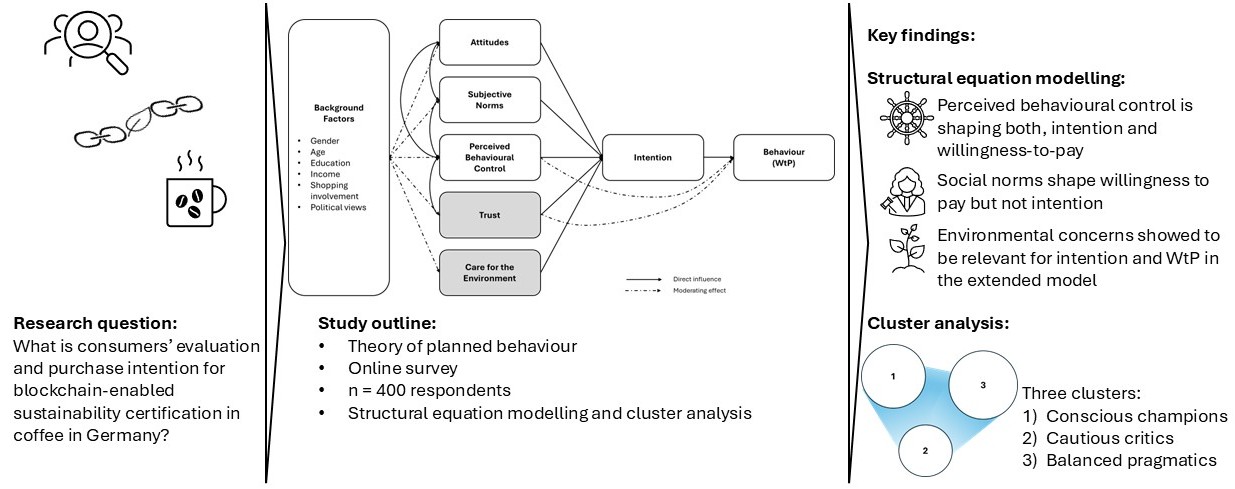
Given the increasing relevance of sustainability certification in food supply chains and, at the same time, rising confusion among consumers about the multitude of labels on food products, concerns about the value of sustainability certification occur frequently. This paper aims to investigate consumers’ evaluation and purchase intentions, and willingness-to-pay (WtP) for blockchain-enabled sustainability certification in coffee. Utilizing a questionnaire guided by an extended model of Ajzen’s theory of planned behavior (TPB), an online survey was conducted with n = 400 German consumers. Data were analyzed using structural equation modeling and cluster analysis. The results revealed perceived behavioral control (PBC) and SN as the most influential factors on WtP, whereas intention to buy is shaped by PBC and environmental concerns. Three distinct clusters were identified with concise preference, intention, and WtP profiles, highlighting heterogeneous consumer motivations. The study is the first one exploring the topic in the German context. It provides novel insights for academics and industry stakeholders on sustainable coffee, blockchain technology, and factors influencing evaluation and purchase intentions for coffee with blockchain-enabled sustainability certifications. It also paves the way for future research on blockchain-enabled sustainability certification in other product groups. Moreover, the paper contributes to a more nuanced theoretical understanding of the TPB and its applications.
Keywords:
sustainability certification
; blockchain
; consumers’ willingness
; coffee
; theory of planned behavior
Copyright: This open access article is published under a Creative Commons CC BY 4.0 license, which permit the free download, distribution, and reuse, provided that the author and preprint are cited in any reuse.


