

Submitted:
21 April 2026
Posted:
22 April 2026
You are already at the latest version
Abstract
Industry 4.0 technologies offer substantial opportunities for sustainable business transformation, yet organisations consistently struggle to translate technological in-vestments into successful project outcomes. This study investigates the inner workings the "black box” of Industry 4.0 project implementation by examining how project management practices, team competencies, and decision-making processes interact. Using a mixed-methods case study of a leading industrial automation company, in-cluding a survey of project team members (n=50) and interviews with project managers (n=5), The identification of recursive feedback loop: competency gaps directly cause decision failures, and poor decision processes subsequently widen those competency gaps. Conversely, structured decision reviews and transparent communication trans-form routine choices into competency-building opportunities. An Integrated Imple-mentation Model (IIM) was proposed that explains these dynamics and demonstrates that sustainability outcomes, like resource efficiency, waste reduction, and circular economy practices emerge naturally when organisations manage processes, people, and decisions together. For practitioners, the core message is that every Industry 4.0 project should be treated as an opportunity to build long-term organisational learning capacity, not merely as a technology installation. This study provides both a theoretical framework for understanding implementation dynamics and actionable guidance for sustainable digital transformation.
Keywords:
Industry 4.0
; project management
; Industry 4.0 technologies
; competencies
; decision‐making
; sustainability
; circular economy
; organisational learning
1. Introduction
Industry 4.0 has changed from a future idea to a main business goal for companies that want to compete and become more sustainable [1,2]. This change is very clear in manufacturing and industrial automation. Factories and industrial companies are major users of resources and producers of goods. Because of this, they have a special ability to affect the environment, improve how efficiently they work, and create long term value for society. They do this by using digital technologies like the Internet of Things (IoT), big data analysis, and smart computer systems that control machines [3,4]. For these reasons, using Industry 4.0 technologies in project work is no longer something companies can choose to do or not do. It is now necessary for companies that want to survive and perform well in a world that is becoming more digital and where resources are becoming harder to get [5,6].
However, the path from deciding to use Industry 4.0 technology by seeing real, sustainable results is full of difficulties [7,8]. Research shows that whether Industry 4.0 projects succeed depends heavily on a company’s internal abilities, how it manages projects, and the human side of work [9,10]. Even though more researchers and businesspeople are interested in Industry 4.0 technologies and what they can do, there is still a gap in the knowledge. The lack of fully understanding the small, daily details of how Industry 4.0 gets put into practice. Lack of understanding what really happens inside project work [11,12]. This is referred to the term missing knowledge, “the black box” of Industry 4.0 technology implementation. Inside this black box, three things work together in a dynamic way: project management practices, the skills of teams and managers, and how decisions are made [13,14]. Project management provides the structure and plan for getting work done [15,16]. Competencies are the skills, knowledge, and abilities that people bring to their work [17,18]. Decision-making is how teams turn plans into real actions from moment to moment [19,20]. Yet, the lack of understanding well how these three things affect each other and how they together lead to project success or failure, or to sustainable outcomes [21,22].
This article tries to fill this gap by asking one main research question: How do project management practices, competencies, and decision-making processes work together to shape the results of Industry 4.0 technology implementation? The exploration of this question by doing an in-depth case study of a leading company that specializes in industrial automation projects [23]. This company is a perfect setting for our study for three reasons. First, it uses the most advanced Industry 4.0 technologies, this shows clearly the challenges and opportunities of digital transformation [24]. Second, because the company organizes its work around projects, by observing the small, daily dynamics of how teams work together [25]. Third, the company cares about always improving and about sustainability, which helps us connect our findings to larger environmental and social goals [26,27].
The main goal of this article is to analyze and explain the connection between project management, competencies, and decision making when putting Industry 4.0 technology into practice and these three things do not work alone. Instead, they form a loop where each one affects the others and feeds back into the system [28,29]. When teams lack important skills (what we call competency gaps), this leads directly to clear failures in decision making [30,31]. Poor decision-making processes, especially when communication is bad, and not open then make those competency gaps even worse. This happens because team members lose chances to learn from their inaccuracy [32,33]. On the other hand, when teams have structured ways to review their decisions and when they communicate openly, then everyday project choices become powerful chances to build new skills [34,35]. By explaining these interactions, this study hopes to give practical help to managers, project teams, and policymakers who want to implement Industry 4.0 in ways that work well and are truly sustainable [36,37].
The importance of this research fits directly with the main themes of this journal and with the larger sustainability discussion. First, this study looks closely at the “business administration” side of digital transformation. It focuses on the actions of managers and teams that put Industry 4.0 investments to work [38,39]. Second, it addresses the risk that implementation will fail when companies pay attention only to technology and ignore the human and procedural side of work [40,41]. Our study shows that building real skills and designing good decision processes cannot be separated from achieving successful results [42,43]. Finally, this research shows that sustainable outcomes such as using resources more efficiently and moving toward a circular economy are deeply connected to the quality of project implementation dynamics [44,45]. When companies manage their processes, their people, and their decisions all together, sustainability happens naturally as a result, not as an extra burden [46].
The remainder of this paper is organized as follows. Section 2 presents the theoretical background. It brings together what other researchers have written about Industry 4.0 project management, new skill needs, how decision-making changes with digital technology, and the research gap about how these three things interact [47,48]. Section 3 explains our research methods in detail. This includes the case study setting, the questionnaire provided to project team members (50 people), the open interviews have been done with project managers (5 people), and our analysis of published research from 2000 to 2024 [49,50]. Section 4 presents our findings in a comparative way, organized around key themes: what technologies teams use, what challenges they face, what benefits they gain, and our discovery of the competency-decision feedback loop. Section 5 discusses what these findings mean for theory and practice. This includes our Integrated Implementation Model (IIM) and how our findings connect to sustainability goals like the circular economy [51,52]. Section 6 concludes the study. It summarizes how the results of the research questions, explains our theoretical contributions, gives practical advice for managers, presents the core message about building sustainable business strength, and discusses the limitations of our study along with ideas for future research [53,54].
1.1. Industry 4.0 and Its Link to Sustainable Business
The fourth industrial revolution, commonly termed Industry 4.0, represents a fundamental paradigm shift in how organisations design, produce, and deliver value. Characterized by the integration of digital technologies such as the Internet of Things (IoT), big data analytics, cloud computing, artificial intelligence, and cyber-physical systems, Industry 4.0 promises unprecedented levels of operational efficiency, customization, and responsiveness [55,56]. However, beyond these operational gains, a growing body of research links Industry 4.0 directly to sustainable business performance. Scholars argue that the data-driven nature of Industry 4.0 enables firms to optimize resource consumption, reduce waste, monitor emissions in real time, and support circular economy models [57,58]. For example, IoT sensors can track energy usage across production lines, while big data analytics can identify inefficiencies that lead to material savings. In this sense, Industry 4.0 is not merely a technological upgrade but a potential enabler of the environmental and social dimensions of sustainability [59]. Nevertheless, realizing these sustainability benefits depends entirely on successful project implementation, a process that remains poorly understood and underexplored in existing literature.
1.2. The Core Problem: Project Implementation Is Key, but Its Inner Workings Are a “Black Box”
While the strategic potential of Industry 4.0 is well documented, organisations consistently struggle to translate technological investments into tangible, sustained improvements in performance [60,61]. The gap between adopting Industry 4.0 technologies and achieving improved business outcomes lies in project implementation. Implementing an IoT system, a big data analytics platform, or a cyber-physical production cell is not a routine technology upgrade; it is a complex, interdisciplinary project that reshapes workflows, roles, responsibilities, and decision-making processes across the organisation [62]. Yet, existing research has largely focused on the technologies themselves or on macro-level readiness and maturity models [63]. What happens inside the implementation process is how project teams navigate daily challenges, how managers make decisions under conditions of uncertainty, and how competencies evolve through project experience remain a “black box” [64]. Without opening this box, organisations cannot reliably learn why some Industry 4.0 projects succeed while others fail, nor can they deliberately build the capabilities needed for sustainable digital transformation.
1.3. Our Focus: Opening the Box to Analyse Project Management, Competencies, and Decision-Making
To open the black box, this study focuses on three interconnected internal dimensions: project management practices, team and manager competencies, and decision-making processes. First, project management in the industry 4.0 era differs fundamentally from traditional project management. It requires handling an avalanche of real-time data, managing remote and globally distributed teams, addressing cybersecurity threats as a continuous concern, and navigating highly dynamic technology landscapes where requirements often change mid-project [65,66]. Second, new competencies are essential for both team members and managers. Beyond technical skills, employees have to demonstrate data literacy, adaptability, creative problem-solving, effective digital communication, and a willingness to engage in continuous learning [67,68]. Third, decision-making becomes qualitatively more complex in Industry 4.0 projects. With real-time data flows, higher interdependencies between system components, and greater uncertainty about technology behaviours, decisions must be faster, more collaborative, and more aware of systemic risks [69,70]. Our central argument is that these three dimensions do not operate in isolation. Rather, they interact dynamically: competency gaps lead to poor decisions, and poor decision processes can stifle team growth and learning. Understanding these interactions is the key to explaining implementation success or failure.
1.4. The Aim and Questions of This Study
The aim of this study is to empirically investigate the inner workings of Industry 4.0 project implementation by analysing how project management practices, required competencies, and decision-making processes interact to shape project outcomes. Using a case study of a leading industrial automation company, the following research questions was addressed:
RQ1: What project management practices, competencies, and decision-making challenges characterize Industry 4.0 implementation from the perspectives of both project team members and project managers?
RQ2: How do competency gaps influence decision-making quality in Industry 4.0 projects?
RQ3: How do decision-making processes, in turn, affect the development of team competencies and overall project outcomes?
RQ4: What integrated model can explain the interactions among project management, competencies, and decisions to guide successful and sustainable Industry 4.0 implementation?
1.5. Structure of the Study
This study is organized as follows. Section 2 reviews the existing literature on Industry 4.0 project management, emerging competency needs, changes in decision-making under digital transformation, and identifies the research gap concerning how these three dimensions interact dynamically during implementation. Section 3 describes the mixed-methods research design, including the case study context, the questionnaire administered to project team members (n=50), the unstructured interviews with project managers (n=5), and the bibliometric analysis of the literature from 2000 to 2024. Section 4 presents the results, beginning with a bibliometric overview, followed by quantitative insights from team members, qualitative insights from project managers, and culminating in the key discovery of how competency gaps lead to poor decisions and how decision processes affect team growth. Section 5 discusses these findings by explaining the black box mechanism, deriving key lessons for business practice, and linking the proposed model to sustainability goals including the circular economy. Section 6 concludes the study with a summary of how the research questions were answered, theoretical contributions including the Integrated Implementation Model (IIM), practical implications for managers, the core message regarding sustainable business strength, and limitations of the study with directions for future research.
2. Literature Review
2.1. How Industry 4.0 Is Changing Project Management
In recent years have seen the dynamic development of a new industrial era—Industry 4.0 [71,72]. This term refers to the fourth industrial revolution, characterized by the digitalization and automation of production processes [73], along with their integration with digital technologies [74]. The academic literature does not provide a single universal definition of Industry 4.0. This may be due to the ongoing changes and development of the concept, as well as the variability of economic conditions [75,76].
In order for organisations to effectively carry out the process of developing and implementing innovative solutions, knowledge in the field of project management is essential [77]. According to the PRINCE2 methodology, project management is treated as “the discipline of initiating, planning, executing, controlling, and closing the work of a team in order to achieve specific objectives and meet defined success criteria within a specified time”[77]According to H. Kerzner, project management is “the planning, organizing, motivating, and controlling of resources, procedures, and protocols to achieve specific goals in the context of scientific, engineering, technological, or business problems”[78]. Meanwhile, the PMI defines project management as “the application of knowledge, skills, tools, and techniques to project activities to meet the project requirements” [79]. Based on the presented definitions, it can therefore be concluded that project management constitutes a process that involves planning, organizing, monitoring, and controlling activities related to the achievement of a specific objective. It is a comprehensive approach that enables the effective management of projects of varying scales and nature.
The first clear change that can be observed when working with new technologies is the enormous amount of information and data that employees have to deal with [80]. Compared to previous industrial eras, this change appears almost abrupt. The introduction of Industry 4.0 and the technologies associated with it has resulted in an avalanche-like increase in available information. This can be considered both a challenge and a vast resource of potential opportunities. In this context, the continuous development of employees’ competencies is very important. Among the key skills that should be developed, particular attention should be paid to the ability to analyze data [81]. In the era of the aforementioned changes, employees must be able to effectively process huge amounts of information, extract meaningful conclusions from it, and transform them into concrete actions [82]. Only then can data be considered a valuable tool in the decision-making process and in improving organizational activities.
Additionally, employees should develop the ability to implement conclusions in practice, make appropriate decisions and take actions based on them [83]. It can be stated that data analysis is only the first step, while the next one is the ability to develop and implement strategies based on the obtained information. Therefore, employees should be flexible, ready to adapt to changing circumstances, and capable of responding quickly to new challenges.
Another important aspect of the digital world is the possibility of remote work from any corner of the globe [84]. In the past, when specialists in a very narrow field were necessary for the implementation of a project, bringing them into an organization was a serious logistical challenge and sometimes also a financial burden for the entity. Traveling between countries, visa formalities and documentation, as well as the need to be physically present in one place constituted real obstacles. This approach has changed, partly as a result of the industry 4.0 era. Technologies enable remote work, transforming the way organizations collaborate with experts around the world. Modern technologies provide remote access to organizational data and networks, allowing highly qualified specialists to actively participate in projects regardless of their geographical location. As a result, international cooperation becomes more accessible and convenient, eliminating time and geographical barriers [85]. It should be emphasized, however, that both remote work and global cooperation require appropriate management. Organizations must ensure the provision of proper tools and security measures that allow safe access to data and remote communication between employees [86,87]. Moreover, it is necessary to focus on an organizational culture that supports remote work and builds trust among team members who do not work together in one physical location [88].
In the era of Industry 4.0, where remote connections, cooperation between teams from different parts of the world, and project teams composed of experts with various specializations are common, the development of effective communication has become a key challenge for organizations [89,90]. Technology, although it undoubtedly supports the communication process, is not always sufficient on its own. To cooperate effectively in this new reality, the responsibility for acquiring new interpersonal communication skills lies with employees. In addition to traditional means of communication such as e-mails or phone calls, organizations increasingly use modern communication tools such as video conferencing platforms or online collaboration tools. However, merely possessing these tools does not guarantee effective and efficient communication. Employees must learn how to use these technologies in a way that supports productive cooperation [91].
In the context of communication in projects, it is worth noting the increasingly important role of the project manager. They act as a coordinator of work who is responsible not only for supervising the progress of the project but also for ensuring clarity of communication within the team [92]. They should create an atmosphere of open and effective information exchange, particularly in international project teams [93].
The range of technological solutions offered by the Industry 4.0 era is enormous. Due to this technological diversity, employees in modern organizations must be ready for constant change and adaptation to new technologies [94]. Projects carried out in the era of Industry 4.0 are often associated with innovative technologies that employees may not have encountered before. This frequently requires employees to acquire specific skills for the needs of a single project. Flexibility and the ability to quickly acquire new knowledge and skills have become key characteristics of employees in this era [95]. Employees must be ready for continuous learning and development in order to meet the requirements of Industry 4.0 projects. In the past, employees could be assigned to one type of project or activity that lasted for a long time. However, in the era of Industry 4.0 projects often change dynamically, and employees must be ready for rapid changes in priorities and objectives [96].
New technologies closely linked with the Internet have become an integral part of the daily functioning of organizations, and with them a new threat has emerged in the form of cyberattacks [97]. Not only employees but also the organization itself has become exposed to the risk of sensitive data leaks, which may have serious financial and reputational consequences. Securing the organization’s networks and data becomes an indispensable element of project management in the era of Industry 4.0. Appropriate security measures such as firewalls, antivirus software, and monitoring systems must be implemented from the very beginning of a project to minimize the risk of cyberattacks [98]. Education of employees in the field of cybersecurity is also becoming a priority. Employees constitute the first line of defense against potential attacks; therefore, they must be aware of threats and know how to protect themselves against them. Organizations increasingly organize cybersecurity training in order to raise the level of employee awareness. It is worth emphasizing that threats related to cybersecurity evolve along with the continuous development of technology [99]. Therefore, project management in the era of Industry 4.0 requires constant attention to cybersecurity, monitoring of new threats, and adapting security strategies to an ever-changing reality.
2.2. New Needs: What New Competencies Do Teams and Managers Require?
The shift to Industry 4.0 creates a fundamental discontinuity in required workplace competencies. Traditional project management skills such as scheduling, budgeting, and risk assessment remain necessary but are no longer sufficient [100]. Research identifies several new competency clusters. First, data-related competencies are most important. Employees must be able to locate, interpret, visualize, and communicate insights from large, often unstructured datasets [101]. Without data literacy, the information avalanche described in Section 2.1 becomes paralyzing rather than empowering. Second, adaptive and learning competencies have gained prominence. Because Industry 4.0 technologies evolve rapidly, employees must demonstrate flexibility, a willingness to acquire new skills for single projects, and comfort with continuous change [102,103]. Third, collaborative and communication competencies extend beyond traditional teamwork. With remote and global project teams becoming the norm, employees must master digital communication tools, build trust without physical presence, and navigate cross-cultural differences [104,105]. Fourth, problem-solving and creative competencies are critical. Industry 4.0 projects often involve novel, ill-defined problems that cannot be solved by routine procedures. Employees need the ability to think systematically, integrate knowledge from multiple domains, and generate creative solutions [106,107]. For project managers specifically, additional meta-competencies are required: leading through influence rather than authority, managing cybersecurity as a continuous concern, and balancing agile responsiveness with strategic alignment [108,109]. Importantly, these competencies are not static; they co-evolve with project experiences, creating a dynamic interplay between individual learning and project outcomes [110].
2.3. New Challenges: How Is Decision-Making Different in Complex Digital Projects?
Decision-making in Industry 4.0 projects differs from traditional project decision-making in at least four fundamental ways. First, decision frequency and speed have increased. Real-time data from IoT devices, dashboards, and monitoring systems create pressure for rapid responses. Delaying a decision for days or weeks may render it irrelevant [111]. Second, decision complexity has grown due to interdependence. In a cyber-physical system, a change in one component (e.g., a sensor calibration) can ripple through production schedules, quality control, and maintenance planning. Decisions cannot be made in isolated silos [112]. Third, decision uncertainty is heightened. Unlike routine projects with known failure modes, Industry 4.0 implementations involve emerging technologies where even experts cannot fully predict outcomes. This shifts decision-making from optimization under certainty to experimentation and learning under ambiguity [113]. Fourth, decision authority is more distributed. With agile methodologies and empowered project teams, decisions that once required senior management approval are now made by team members. This democratization of decision-making can accelerate progress but also risks inconsistency and misalignment if competencies are lacking [114,115]. Furthermore, cybersecurity introduces a new class of decisions: trade-offs between openness (data sharing for collaboration) and protection (data security). Poor decisions in this domain can have catastrophic consequences [116,117]. Thus, decision-making in Industry 4.0 is not just faster or harder it is qualitatively different, demanding new heuristics, tools, and team structures.
2.4. The Research Gap: How Do Project Management, Competencies, and Decisions Work Together to Shape Outcomes?
Despite the rich literature on Industry 4.0 technologies, project management changes, competency needs, and decision-making challenges separately, a critical gap remains. Few studies examine how these three dimensions interact dynamically during implementation [118,119]. Most research is cross-sectional, measuring competencies or practices at a single point in time. Yet our opening argument suggests that the black box of implementation contains feedback loops. For example, a competency gap in data analysis (e.g., team members cannot interpret IoT dashboards) may lead to poor operational decisions (e.g., ignoring early warning signs of equipment failure). Those poor decisions, in turn, reduce opportunities for team members to learn from real feedback, further widening the competency gap [120]. Conversely, a well-designed decision process that explicitly captures and reviews choices can become a learning mechanism, building competencies over time [121,122]. Similarly, project management practices (e.g., agile stand-ups, risk reviews) are not neutral containers; they shape what decisions get made, by whom, and with what information [123]. Therefore, the research gap is not merely descriptive (what competencies or decisions exist) but mechanistic: there is a lack an empirically grounded model of how project management, competencies, and decisions produce implementation success or failure. This study directly addresses that gap by opening the black box and tracing these interactions in a real-world Industry 4.0 project setting.
3. Research Methods
The research conducted was divided into two stages. The first involved a literature review focused on project management and Industry 4.0, the aim of which was to identify key concepts and research gaps that may be relevant from the perspective of further analyses.
In the second stage of research process, a case study was conducted in a leading company specializing in the implementation of projects in the field of industrial automation. The research process of the article assumed the use of methodological triangulation, which increases the validity and completeness of the research by employing both quantitative and qualitative methods, thereby allowing for a comprehensive understanding of the investigated phenomena [124,125,126]. Quantitative research was conducted using a questionnaire distributed among members of one of the project teams (n=50). Its aim was to identify their awareness, attitudes, and actions related to project execution in the era of Industry 4.0. Before administering the questionnaire, the research tool was tested through unstructured interviews with members of another project team (n=5), which allowed for verification and refinement of the questionnaire’s accuracy. The qualitative research was conducted using an unstandardized, unstructured interview, which took the form of a focused informal interview. The respondents were project managers (n=5), regarded as experts in the implementation of projects in the area of Industry 4.0. The interviews, which lasted between 30 and 45 minutes, were conducted in person at the headquarters of the company under analysis. With the participants’ consent, they were recorded, which enabled an efficient transcription of the audio files into text.
4. Results
4.1. Results from the Bibliometric Analysis
The literature review focused on examining the challenges and opportunities of project management in the era of Industry 4.0, considering the perspectives of both project teams and managers. The review was conducted as a systematic literature review [127] aimed at identifying the current state of knowledge in the relevant subject areas. For this purpose, the literature was selected using databases such as Scopus and Web of Science.
The next step was to select publications, taking into account the following keywords: ‘Industry 4.0’ and ‘project management’. The list of publications was further supplemented using the snowball method. The inclusion criteria were the language of publication (English and Polish) and the publication period (2000–2024). Focusing on keywords, research fields (business, management and accounting, and social sciences), and document types (articles, conference papers, books, and book chapters), bibliometric analysis techniques were also applied. As a result of it, a database of relevant publications was compiled.
Figure 1 presents an analysis of the number of publications from 2000 to 2024 related to industry 4.0, based on the Scopus and Web of Science databases.
An analysis of the number of publications presented in Figure 1 on Industry 4.0 between 2000 and 2024, based on the Scopus and Web of Science databases, shows a clear evolution in interest in this topic. Until 2012, virtually no documents related to research in this area were recorded in both databases. However, a significant increase in the number of publications is noticeable from 2013 onwards, with a sharp increase occurring between 2015 and 2021. During this period, the number of publications in Scopus increased from 68 to 3,514, and in Web of Science from 4 to 135. After 2021, the number of publications remains relatively stable. However, it should be noted that a slight downward trend can be observed in Scopus in 2024, while in Web of Science there is a clear jump to 309 publications. The data presented indicate the growing importance of Industry 4.0-related topics in the scientific literature. Researchers’ interest in this area can be observed primarily in topics such as smart factories, digital manufacturing, robotics, supply chain management, cybersecurity and sustainable production.
Figure 2 presents an analysis of the number of publications from 2000 to 2024 related to project management, based on the Scopus and Web of Science databases.
Based on Figure 2, the analysis of the number of publications on project management between 2000 and 2024, based on two databases, shows clear differences both in trends and in the total number of documents. In the early years (2000–2004), the number of publications increased rapidly, reaching a peak in 2004-2006. In the following years, there were minor fluctuations in the number of publications in the subject analyzed area. After 2010, a relatively stable level of publications can be observed, with a slight increase in 2019–2020 and a noticeable jump in 2024 in the Scopus database.
When analyzing the number of publications, it is important to note the discrepancies observed between the results from the two databases. These are likely due to differences in indexed journals and document types, search and classification methods, and the updating of each database. Nevertheless, despite these differences, both databases indicate a consistent interest in the topic of project management over the past two decades. Periods of higher publication output are also noticeable, which may reflect the growing importance of effective project management in a business environment characterized by the need to adapt to constant changes.
4.2. Result from the Case Study: Voices from the Front Lines
4.2.1. Technological Contributions
The first part of the questionnaire concerned the technologies used by the project team during the implementation of projects in the area of Industry 4.0.
The analysis of Figure 3 indicates that the project team members have experience in using various tools and technologies applied in the implementation of projects within the industry 4.0 domain. The respondents’ answers allow for the identification of three dominant technologies. The first of these is modern project management systems (49 out of 50 respondents), suggesting that the team relies on up-to-date, advanced solutions that support effective planning and coordination of project activities. This may positively influence the effectiveness and efficiency of the implemented project initiatives. The second key technology indicated by the respondents is Big Data (40 out of 50 respondents), which points to the involvement of team members in projects requiring the processing and analysis of large datasets. The third most frequently mentioned technology is the Internet of Things (IoT) (43 out of 50 respondents), demonstrating the widespread use of solutions that enable communication and information exchange between devices, as well as real-time data collection.
The analysis of Figure 4 concludes that the most frequently indicated problem among project team members is inadequate communication within the team (47 out of 50 respondents). Respondents also highlighted the lack of appropriate skills (30 out of 50 respondents), experience with innovative technologies (34 out of 50 respondents), and project funding (26 out of 50 respondents). Therefore, it can be stated that a lack or insufficiency of any of these three factors constitutes a barrier to effective project execution. In contrast, access to technology (9 out of 50 respondents) and insufficient support from management (0 out of 50 respondents) were not identified as problematic factors by the members of the surveyed project team.
As seen in Figure 5, the most frequently indicated benefit of implementing Industry 4.0 projects, according to respondents, is the opportunity to develop project team members’ competencies through acquiring skills in solving complex problems (48 out of 50 respondents) and enhancing creativity (44 out of 50 respondents). An important benefit is also the improvement in the quality of products or services offered by the company (42 out of 50 respondents). In contrast, benefits related to gaining knowledge in complementary fields (26 out of 50 respondents) and improving forecasting and planning (31 out of 50 respondents) are less emphasized by the respondents.
4.2.2. Insights from Project Managers
The second part of this research stage consisted of interviews with project managers working in the area of Industry 4.0. First, a question was asked regarding the tools and technologies used by respondents in project management. All of them agreed that Microsoft Project, Jira, and Trello are tools that play a crucial role in effective project management. On the other hand, Microsoft Teams was highlighted by the experts as a tool facilitating efficient and timely communication within project teams.
In the context of the challenges faced by project managers, the interview participants consistently pointed to the insufficient awareness of the benefits of using modern, innovative technologies among the company’s potential clients. The respondents also raised the issue of the lack of compatibility between technologies provided by different suppliers, which can often hinder the work of project managers and project team members. The participants further highlighted problems related to cybersecurity and the imperfections occurring in this area. During the interview, the experts were also asked whether and what changes they observe in the approach to project management in the era of Industry 4.0. The respondents were fully unanimous, stating that it must be adapted to the constantly changing business environment conditions, which is why it is characterized by dynamism. The experts also consistently noted that project management has become agile, enabling projects to quickly adapt to changes in the business environment and achieve the planned project objectives. Furthermore, project managers emphasized that, as a result, they must demonstrate flexibility and openness to innovative approaches in the field of project management. The next question posed to project managers concerned the benefits that organizations gain from effective project management in the field of Industry 4.0. Three experts emphasized that, thanks to the implementation of product and business process innovations, particularly those of a technological nature, the overall efficiency of the enterprise has increased. Two projects’ managers noted that, as a result of supervising each stage of a project, it is possible to reduce excessive expenditures. By identifying areas deemed inefficient, appropriate modifications and improvements can be implemented. Project managers were also asked whether they observe benefits for employees involved in projects within the scope of Industry 4.0. All experts agreed that, through acquiring knowledge of innovative technologies, employees have the opportunity to develop and enhance their skills and competencies in this area. Another aspect highlighted by the respondents is that employees gain new experiences due to the diversity of projects being carried out. The final, but equally important, benefit for employees emphasized during the interviews with all project managers is the sense of job satisfaction. The experts agreed that project implementation stimulates creativity and motivates team members, which can lead to increased satisfaction with their tasks. The respondents also consistently stated that carrying out projects in the era of Industry 4.0 involves the creation and implementation of innovative technological solutions, which often have an impact on the development of employees, enterprises, and the entire industry in which a given organization operates. Project managers were also asked whether and what barriers they observe during the implementation of projects in the field of Industry 4.0. They all reached a unanimous conclusion that such barriers do indeed exist. One of the barriers highlighted was inadequate risk management. Others included improper selection of project team members and flawed project planning. One expert also pointed out inadequate data management.
4.2.3. The Key Discovery: How Competency Gaps Lead to Poor Decisions, and How Decision Processes Affect Team Growth
Integrating the quantitative data from team members (n=50) with the qualitative insights from project managers (n=5) reveals a non-linear, causal mechanism at the heart of the black box. The key discovery is a two-way, recursive relationship between competency gaps and decision-making quality.
Finding 1: Competency gaps directly cause identifiable decision failures. The survey data (Figure 4) showed that 30 out of 50 team members identified a “lack of appropriate skills” as a major challenge, while 34 cited “lack of experience with innovative technologies.” Interview data from managers specified how these gaps manifest in decisions. One manager stated: “When team members cannot interpret big data outputs, they either ignore the data entirely or make decisions based on intuition alone. Both are poor choices.” Another manager provided a concrete example: “In one project, a competency gap in cybersecurity awareness led a team member to approve an unsecured data transfer. That decision cost us two weeks of rework.” Thus, competency gaps do not merely slow down work; they actively degrade the quality of operational and strategic decisions [128,129].
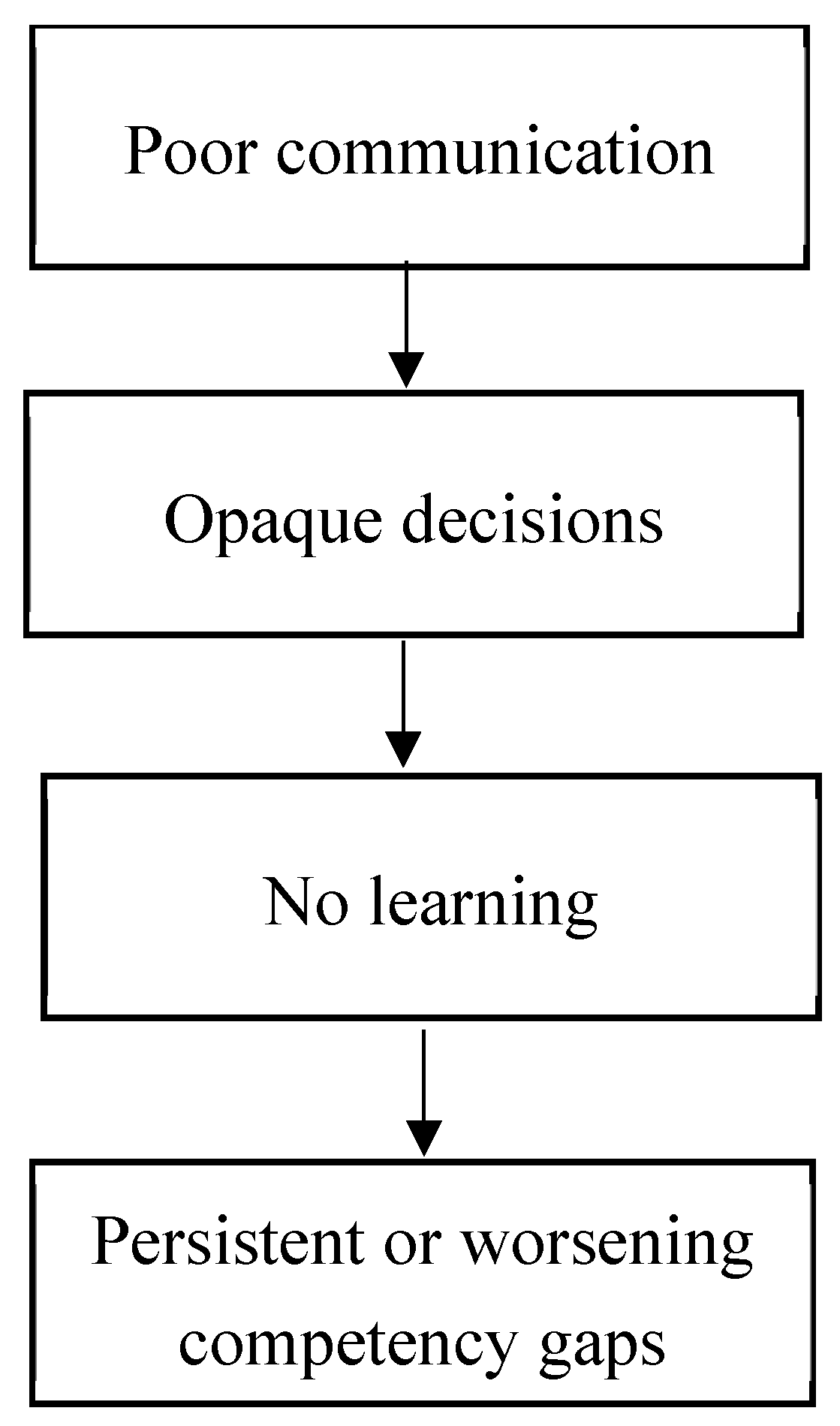
Finding 2: Poor decision processes, in turn, widen competency gaps. The survey data (Figure 4) identified “inadequate communication within the team” as the most frequently cited problem (47 out of 50 respondents). Managers explained that when communication fails, decisions are made without transparency or documentation. As one manager noted: “If a decision is made in a silo and not explained, other team members lose the chance to learn why that choice was better than alternatives. Over time, the team stops developing judgment.” This creates a negative spiral [130,131].
Figure 6.
The negative spiral of Industry 4.0 implementation. Source: Authors’ own survey data.
Finding 3: Deliberate decision processes can become competency-building mechanisms. Conversely, the interviews revealed that when project managers implemented structured decision reviews (e.g., post-decision debriefs, assumption testing, or “pre-mortem” analyses), team members reported higher learning gains. Although not directly measured in the survey, managers consistently observed that teams using transparent, documented decision processes showed faster improvement in data interpretation and problem-solving skills. One manager summarized: “Every major decision was turned into a mini-training session. ‘What data was used? What was assumed? What would be done differently?’ That process built more competency than any formal course” [132,133].
This Figure 7 shows the two-way relationship between competencies and decision-making. Competency gaps lead to poor decisions, which then prevent learning and widen competency gaps. Well-designed decision processes, in contrast, transform project choices into competency-building opportunities.
Figure 7.
The Competency-Decision Feedback Loop. Source: Authors’ own survey data.
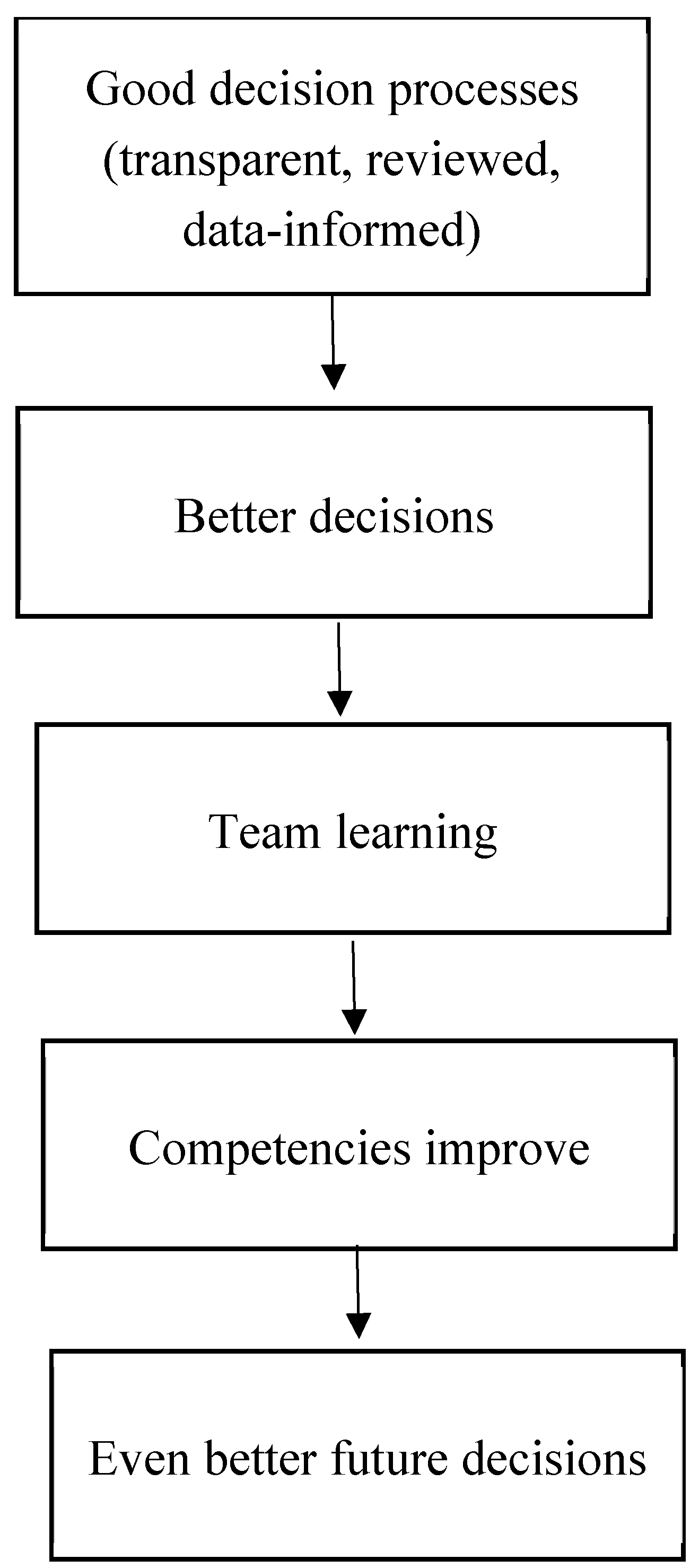
Figure 8.
The negative competency-decision feedback. Source: Authors’ own survey data.
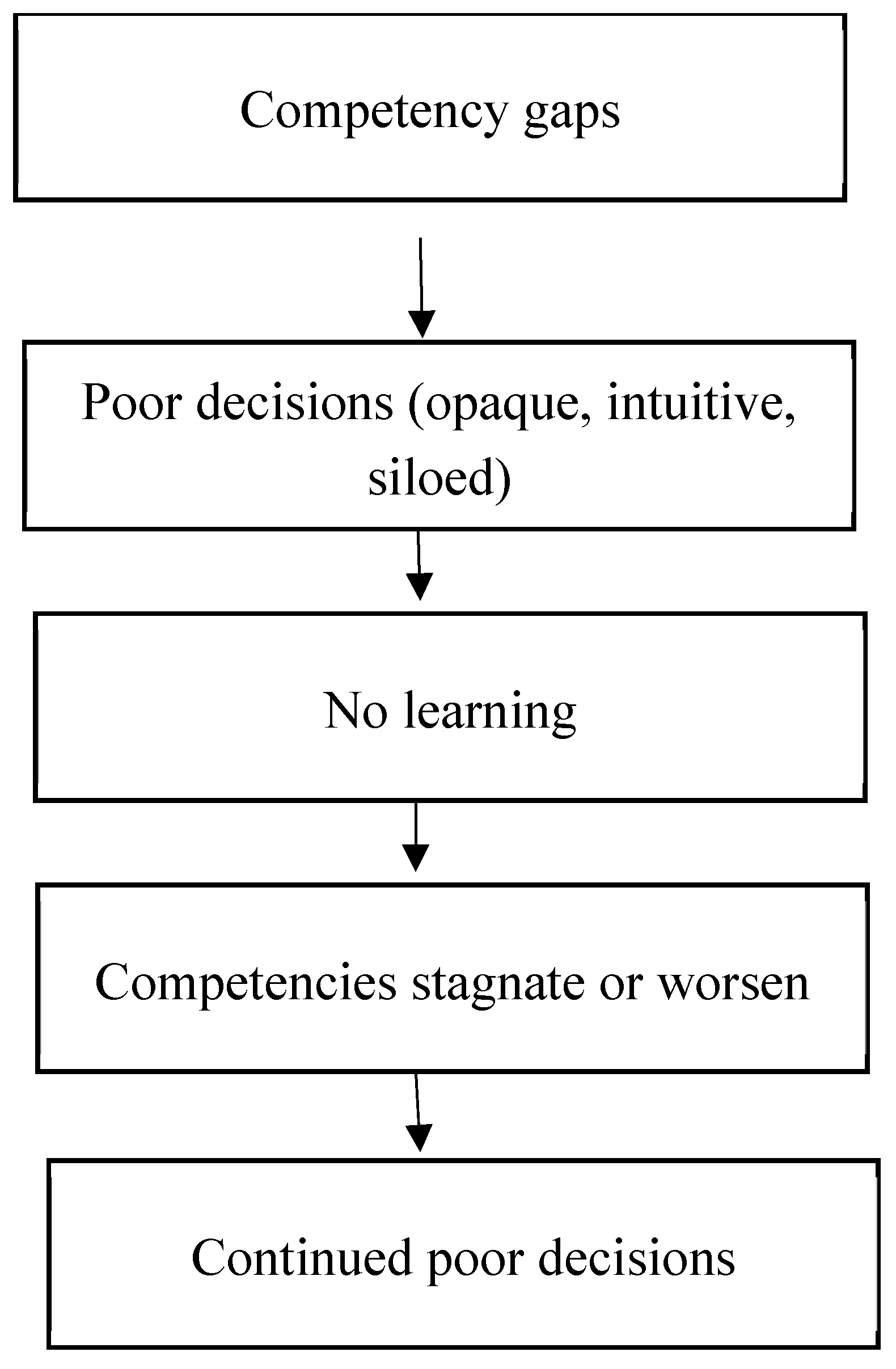
This figure shows the vicious cycle where competency gaps produce poor, opaque decisions. These poor decisions eliminate learning opportunities, causing competencies to stagnate or worsen. Without intervention, this self-reinforcing loop leads to continued decision failures and persistent skill gaps.
5. Discussion
5.1. Explaining the “Black Box” Mechanism: How PM, Competencies, and Decisions Interact
Our results allow us to replace the vague metaphor of a “black box” with a specific, causal model. The black box of Industry 4.0 implementation contains three interacting layers. The outer layer is project management practices (e.g., communication protocols, agile methods, risk reviews, cybersecurity procedures). These practices create the structure within which work happens [136,137]. The middle layer is decision-making processes (e.g., who decides, with what data, how transparently, how quickly. The inner layer is competencies (individual and team skills in data analysis, adaptability, problem solving, etc.) [138,139]. The key dynamic is that project management practices shape decision processes (e.g., a daily stand-up encourages rapid, shared decisions). Decision processes, in turn, either build or erode competencies depending on whether they include reflection and learning [140,141]. Finally, competencies determine the quality of future decisions and the ability to execute project management practices effectively [142]. This three-layer interaction explains why simply adopting Industry 4.0 technologies or following a standard project management methodology is insufficient. Successful implementation requires alignment and feedback across all three layers [143,144]. Our discovery of the competency-decision loop (Section 4.2.3) is the engine of this mechanism.
5.2. The Key Lesson for Business: To Succeed with Industry 4.0, You Must Manage Processes, People, and Decisions Together
For managers and practitioners, this study offers a clear, actionable lesson. Do not treat project management (tools and schedules), people development (training), and decision-making as separate functions. They are a single, integrated system [145,146]. Three practical implications follow. First, audit your decision processes, not just your outcomes. Most organisations measure whether a project succeeded or failed but not how decisions were made along the way. Introducing decision reviews (e.g., “decision journals” or weekly decision audits) can turn everyday choices into learning opportunities [147]. Second, redesign competency development around real decisions. Instead of generic Industry 4.0 training, use actual project decisions as case studies. Ask: what decision was face? What data was available? Who decided? What was the outcome? This decision-centric learning directly addresses the competency gaps identified in our survey [148,149]. Third, invest in communication infrastructure as a strategic asset. With 47 out of 50 team members citing poor communication as a top challenge, communication is not a “soft skill” it is the critical link that prevents the negative spiral from competency gaps to poor decisions [150,151]. Tools like shared dashboards, structured decision protocols, and cross-functional review meetings are not overhead; they are the mechanisms that enable the virtuous loop.
5.3. The Link to Sustainability: Managing This “Black Box” Well Is How Companies Actually Use Industry 4.0 to Reach Green Goals
Our findings directly connect to sustainability in two ways. First, operational sustainability (resource efficiency, waste reduction) depends on high-quality decisions. A team that lacks data competencies cannot interpret energy usage data from IoT sensors; a team with poor decision processes will not act on that data even if they understand it [152]. Thus, the competency-decision loop determines whether Industry 4.0 technologies deliver environmental gains or remain unused features. Second, strategic sustainability (circular economy models, long-term resilience) requires organisational learning. The virtuous loop we identified good decision processes leading to competency growth is exactly the mechanism that enables a firm to continuously improve its sustainable practices over time [153]. Companies that master the internal dynamics of project implementation can repeatedly launch successful Industry 4.0 initiatives, each one building on the last. In contrast, companies stuck in the vicious loop (Competency gaps lead to poor decisions, which then prevent learning) will find that even the most advanced technologies fail to produce sustainable outcomes [154]. Therefore, we argue that sustainability is not a separate goal from good project management; it is the natural result of managing the black box well. For circular economy initiatives, where material flows must be tracked, traced, and optimized across product lifecycles, the decision-making and competency requirements are even higher [155]. Our approach provides a practical way to achieve these sustainability outcomes.
6. Conclusions
This study demonstrates how to open the black box of Industry 4.0 project implementation by examining how project management practices, team competencies, and decision-making processes work together. Based on a mixed-methods case study of a leading industrial automation company, including a survey of 50 project team members and interviews with 5 project managers, we discovered that successful implementation depends on a recursive feedback loop between competencies and decisions. When teams lack critical skills, they make poor, opaque decisions that eliminate learning opportunities, causing competencies to stagnate or worsen. This negative spiral leads to continued decision failures and persistent skill gaps [156,157]. Conversely, when teams use structured decision reviews and transparent communication, every project choice becomes a learning opportunity that builds competencies and improves future decisions [158,159].
Our findings show that competency gaps are not just a minor inconvenience. They directly cause identifiable decision failures, such as ignoring data insights or making unsecured technical choices [160,161]. Poor decision processes, especially those characterized by inadequate communication and lack of transparency, then widen these gaps by removing any chance for team members to learn from their experiences. This is why organisations cannot treat project management, people development, and decision-making as separate functions. They are a single, integrated system that must be managed together [162,163]. This view is reinforced by recent research confirming that managerial competence is essential for integrating Industry 4.0 technologies with broader organisational goals such as corporate social responsibility (CSR) and safety culture [164].
The theoretical contribution of this research is the Integrated Implementation Model, which explains how project management practices shape decision processes, decision processes either build or erode competencies, and competencies determine future decision quality. This model moves beyond simple lists of success factors by showing how implementation unfolds over time through feedback loops [165,166]. It also bridges the gap between organisational learning theory and digital transformation research, demonstrating that competency development is not something to finish before starting a project but something that emerges naturally from well-designed decision processes during implementation[167,168].
For managers and practitioners, the key lesson is clear. Every Industry 4.0 project should be treated as an opportunity to build sustainable business strength, not just as a one-time technology installation. When you manage processes, people, and decisions together, sustainability emerges naturally as a result rather than as an extra burden. To achieve this, organisations should audit their decision processes, not just their outcomes. They should redesign competency development around real project decisions instead of generic training [169]. And they should invest in communication infrastructure as a strategic asset, because poor communication is the critical link that turns competency gaps into persistent failure. Managerial competence is essential for this integration [170].
This study has limitations. It was conducted in a single company, which makes it harder to generalize the results to other sectors, countries, or organisation sizes. The research was also cross-sectional, meaning it could not track how management practices and competencies change over time within the same organisation. Future research should repeat this study in different settings, include other potentially important factors, and use longitudinal designs to observe how the competency-decision feedback loop evolves over the life of multiple projects.
Despite these limitations, this research makes a strong case that the black box of Industry 4.0 implementation can be opened. Inside that box, a simple but powerful mechanism was found: competencies and decisions continuously influence each other. When that influence is positive, teams learn and grow. When it is negative, teams stagnate and fail. The practical implication is straightforward. Organisations that want to succeed with Industry 4.0 must pay as much attention to how decisions are made and how competencies are built as they do to which technologies are installed. Sustainability is not a separate goal. It is the natural result of getting this internal dynamic right.
Abbreviations
The following abbreviations are used in this manuscript:
| AI | Artificial Intelligence |
| PMI | Project Management Institute |
| CSR | Corporate Social Responsibility |
| PRINCE2 | Projects IN Controlled Environments (version 2) |
| n | Sample size |
| RQ | Research Question |
| IoT | Internet of Things |
| IIM | Integrated Implementation Model |
| SDGs | Sustainable Development Goals |
| UN | United Nations |
References
- Culot, G., Nassimbeni, G., Orzes, G., & Sartor, M. (2020). Behind the definition of Industry 4.0: Analysis and open questions. International Journal of Production Economics, *226*, 107617. [CrossRef]
- Schwab, K. (2017) The Fourth Industrial Revolution. Crown Publishing Group, New York.
- Dalenogare, L. S., Benitez, G. B., Ayala, N. F., & Frank, A. G. (2018). The expected contribution of Industry 4.0 technologies for industrial performance. International Journal of Production Economics, *204*, 383–394. [CrossRef]
- Da Xu, L., Xu, E. L., & Li, L. (2018). Industry 4.0: State of the art and future trends. International Journal of Production Research, *56*(8), 2941–2962. [CrossRef]
- Kristoffersen, E., Blomsma, F., Mikalef, P., & Li, J. (2020). The smart circular economy: A digital-enabled circular strategies framework for manufacturing companies. Journal of Business Research, *120*, 241–254. [CrossRef]
- Schöggl, J. P., Rusch, M., Stumpf, L., & Baumgartner, R. J. (2023). Implementation of digital technologies for a circular economy and sustainability management in the manufacturing sector. Sustainable Production and Consumption, *35*, 401–420. [CrossRef]
- Elnadi, M., & Abdallah, Y. O. (2023). Industry 4.0: Critical investigations and synthesis of key findings. Management Review Quarterly, *74*(2), 711–744. [CrossRef]
- Rupp, M., Schneckenburger, M., Merkel, M., Börret, R., & Harrison, D. K. (2021). Industry 4.0: A technological-oriented definition based on bibliometric analysis and literature review. Journal of Open Innovation: Technology, Market, and Complexity, *7*(1), 68. [CrossRef]
- Kipper, L. M., Iepsen, S., Forno, A. J. D., Frozza, R., Furstenau, L., Agnes, J., & Cossul, D. (2021). Scientific mapping to identify competencies required by industry 4.0. Technology in Society, *64*, 101454. [CrossRef]
- Sony, M., & Mekoth, N. (2022). Employee adaptability skills for Industry 4.0 success: A road map. Production & Manufacturing Research, *10*(1), 24–41. [CrossRef]
- Miah, M. R., Erdei-Gally, S., Dancs, A., & Fekete-Farkas, M. (2024). A systematic review of Industry 4.0 technology on workforce employability and skills: Driving success factors and challenges in South Asia. Economies, *12*(2), 35. [CrossRef]
- Treviño-Elizondo, B. L., & García-Reyes, H. (2023). An employee competency development maturity model for Industry 4.0 adoption. Sustainability, *15*(14), 11371. [CrossRef]
- Rosin, F., Forget, P., Lamouri, S., & Pellerin, R. (2021). Impact of Industry 4.0 on decision-making in an operational context. Advances in Production Engineering & Management, *16*(4), 500–512. [CrossRef]
- Turcato, C. B., Pedroso, B., Arnold, M., & Picinin, C. T. (2024). Adapting to Industry 4.0 in France: Essential competencies for a future-ready workforce. Administrative Sciences, *14*(12), 322. [CrossRef]
- Kerzner, H. (2017). Project Management Metrics, KPIs, and Dashboards: A Guide to Measuring and Monitoring Project Performance. Hoboken, NJ: John Wiley & Sons. [CrossRef]
- Project Management Institute. (2026). A guide to the project management body of knowledge (PMBOK® guide) (8th ed.). Project Management Institute.
- Hilsen, A. I., & Olsen, D. S. (2021). Competence and knowledge at work. In The importance and value of older employees (pp. 9–20). Springer. [CrossRef]
- van Laar, E., van Deursen, A. J. A. M., van Dijk, J. A. G. M., & de Haan, J. (2020). Determinants of 21st-century skills and 21st-century digital skills for workers: A systematic literature review. Sage Open, *10*(1), 1–14. [CrossRef]
- Henderson, L. S., Stackman, R. W., & Lindekilde, R. (2016). The centrality of communication norm alignment, role clarity, and trust in global project teams. International Journal of Project Management, *34*(8), 1717–1730. [CrossRef]
- Pianese, T., Errichiello, L., & Da Cunha, J. V. (2022). Organizational control in the context of remote working: A synthesis of empirical findings and a research agenda. European Management Review, *20*(2), 303–319. [CrossRef]
- Culot, G., Nassimbeni, G., Orzes, G., & Sartor, M. (2020). Behind the definition of Industry 4.0: Analysis and open questions. International Journal of Production Economics, *226*, 107617. [CrossRef]
- Rupp, M., Schneckenburger, M., Merkel, M., Börret, R., & Harrison, D. K. (2021). Industry 4.0: A technological-oriented definition based on bibliometric analysis and literature review. Journal of Open Innovation: Technology, Market, and Complexity, *7*(1), 68. [CrossRef]
- Yin, R. K. (2018). Case study research and applications: Design and methods (6th ed.). Sage Publications.
- Dalenogare, L. S., Benitez, G. B., Ayala, N. F., & Frank, A. G. (2018). The expected contribution of Industry 4.0 technologies for industrial performance. International Journal of Production Economics, *204*, 383–394. [CrossRef]
- Paredes-Saavedra, M., Vallejos, M., Huancahuire-Vega, S., Morales-García, W. C., & Geraldo-Campos, L. A. (2024). Work team effectiveness: Importance of organizational culture, work climate, leadership, creative synergy, and emotional intelligence in university employees. Administrative Sciences, 14(11), 280. [CrossRef]
- Schöggl, J. P., Rusch, M., Stumpf, L., & Baumgartner, R. J. (2023). Implementation of digital technologies for a circular economy and sustainability management in the manufacturing sector. Sustainable Production and Consumption, *35*, 401–420. [CrossRef]
- Kristoffersen, E., Blomsma, F., Mikalef, P., & Li, J. (2020). The smart circular economy: A digital-enabled circular strategies framework for manufacturing companies. Journal of Business Research, *120*, 241–254. [CrossRef]
- Sony, M., & Mekoth, N. (2022). Employee adaptability skills for Industry 4.0 success: A road map. Production & Manufacturing Research, *10*(1), 24–41. [CrossRef]
- Treviño-Elizondo, B. L., & García-Reyes, H. (2023). An employee competency development maturity model for Industry 4.0 adoption. Sustainability, *15*(14), 11371. [CrossRef]
- Kipper, L. M., Iepsen, S., Forno, A. J. D., Frozza, R., Furstenau, L., Agnes, J., & Cossul, D. (2021). Scientific mapping to identify competencies required by industry 4.0. Technology in Society, *64*, 101454. [CrossRef]
- Rosin, F., Forget, P., Lamouri, S., & Pellerin, R. (2021). Impact of Industry 4.0 on decision-making in an operational context. Advances in Production Engineering & Management, *16*(4), 500–512. [CrossRef]
- Henderson, L. S., Stackman, R. W., & Lindekilde, R. (2016). The centrality of communication norm alignment, role clarity, and trust in global project teams. International Journal of Project Management, *34*(8), 1717–1730. [CrossRef]
- Pianese, T., Errichiello, L., & Da Cunha, J. V. (2022). Organizational control in the context of remote working: A synthesis of empirical findings and a research agenda. European Management Review, *20*(2), 303–319. [CrossRef]
- Ivaldi, S., Scaratti, G., & Fregnan, E. (2021). Dwelling within the fourth industrial revolution: Organizational learning for new competences, processes and work cultures. Journal of Workplace Learning, *33*(8), 555–571. [CrossRef]
- Turcato, C. B., Pedroso, B., Arnold, M., & Picinin, C. T. (2024). Adapting to Industry 4.0 in France: Essential competencies for a future-ready workforce. Administrative Sciences, *14*(12), 322. [CrossRef]
- Alqudhaibi, A., Albarrak, M., Jagtap, S., Williams, N., & Salonitis, K. (2024). Securing industry 4.0: Assessing cybersecurity challenges and proposing strategies for manufacturing management. Cyber Security and Applications, *3*, 100067. [CrossRef]
- Schöggl, J. P., Rusch, M., Stumpf, L., & Baumgartner, R. J. (2023). Implementation of digital technologies for a circular economy and sustainability management in the manufacturing sector. Sustainable Production and Consumption, *35*, 401–420. [CrossRef]
- Kerzner, H. (2017). Project Management Metrics, KPIs, and Dashboards: A Guide to Measuring and Monitoring Project Performance. Hoboken, NJ: John Wiley & Sons. [CrossRef]
- Project Management Institute. (2026). A guide to the project management body of knowledge (PMBOK® guide) (8th ed.). Project Management Institute.
- Elnadi, M., & Abdallah, Y. O. (2023). Industry 4.0: Critical investigations and synthesis of key findings. Management Review Quarterly, *74*(2), 711–744. [CrossRef]
- Rupp, M., Schneckenburger, M., Merkel, M., Börret, R., & Harrison, D. K. (2021). Industry 4.0: A technological-oriented definition based on bibliometric analysis and literature review. Journal of Open Innovation: Technology, Market, and Complexity, *7*(1), 68. [CrossRef]
- Kowal, B., Włodarz, D., Brzychczy, E., & Klepka, A. (2022). Analysis of employees’ competencies in the context of Industry 4.0. Energies, *15*(19), 7142. [CrossRef]
- Miah, M. R., Erdei-Gally, S., Dancs, A., & Fekete-Farkas, M. (2024). A systematic review of Industry 4.0 technology on workforce employability and skills: Driving success factors and challenges in South Asia. Economies, *12*(2), 35. [CrossRef]
- Schöggl, J. P., Rusch, M., Stumpf, L., & Baumgartner, R. J. (2023). Implementation of digital technologies for a circular economy and sustainability management in the manufacturing sector. Sustainable Production and Consumption, *35*, 401–420. [CrossRef]
- Kristoffersen, E., Blomsma, F., Mikalef, P., & Li, J. (2020). The smart circular economy: A digital-enabled circular strategies framework for manufacturing companies. Journal of Business Research, *120*, 241–254. [CrossRef]
- Dalenogare, L. S., Benitez, G. B., Ayala, N. F., & Frank, A. G. (2018). The expected contribution of Industry 4.0 technologies for industrial performance. International Journal of Production Economics, *204*, 383–394. [CrossRef]
- Culot, G., Nassimbeni, G., Orzes, G., & Sartor, M. (2020). Behind the definition of Industry 4.0: Analysis and open questions. International Journal of Production Economics, *226*, 107617. [CrossRef]
- Kipper, L. M., Iepsen, S., Forno, A. J. D., Frozza, R., Furstenau, L., Agnes, J., & Cossul, D. (2021). Scientific mapping to identify competencies required by industry 4.0. Technology in Society, *64*, 101454. [CrossRef]
- Jick, T.D. (1979) Mixing Qualitative and Quantitative Methods: Triangulation in Action. Administrative Science Quarterly, 24, 602-611. [CrossRef]
- Yin, R. K. (2018). Case study research and applications: Design and methods (6th ed.). Sage Publications.
- Kristoffersen, E., Blomsma, F., Mikalef, P., & Li, J. (2020). The smart circular economy: A digital-enabled circular strategies framework for manufacturing companies. Journal of Business Research, *120*, 241–254. [CrossRef]
- Schöggl, J. P., Rusch, M., Stumpf, L., & Baumgartner, R. J. (2023). Implementation of digital technologies for a circular economy and sustainability management in the manufacturing sector. Sustainable Production and Consumption, *35*, 401–420. [CrossRef]
- Culot, G., Nassimbeni, G., Orzes, G., & Sartor, M. (2020). Behind the definition of Industry 4.0: Analysis and open questions. International Journal of Production Economics, *226*, 107617. [CrossRef]
- Rupp, M., Schneckenburger, M., Merkel, M., Börret, R., & Harrison, D. K. (2021). Industry 4.0: A technological-oriented definition based on bibliometric analysis and literature review. Journal of Open Innovation: Technology, Market, and Complexity, *7*(1), 68. [CrossRef]
- Dalenogare, L. S., Benitez, G. B., Ayala, N. F., & Frank, A. G. (2018). The expected contribution of Industry 4.0 technologies for industrial performance. International Journal of Production Economics, *204*, 383–394. [CrossRef]
- Da Xu, L., Xu, E. L., & Li, L. (2018). Industry 4.0: State of the art and future trends. International Journal of Production Research, *56*(8), 2941–2962. [CrossRef]
- Culot, G., Nassimbeni, G., Orzes, G., & Sartor, M. (2020). Behind the definition of Industry 4.0: Analysis and open questions. International Journal of Production Economics, *226*, 107617. [CrossRef]
- Kristoffersen, E., Blomsma, F., Mikalef, P., & Li, J. (2020). The smart circular economy: A digital-enabled circular strategies framework for manufacturing companies. Journal of Business Research, *120*, 241–254. [CrossRef]
- Schöggl, J. P., Rusch, M., Stumpf, L., & Baumgartner, R. J. (2023). Implementation of digital technologies for a circular economy and sustainability management in the manufacturing sector. Sustainable Production and Consumption, *35*, 401–420. [CrossRef]
- Elnadi, M., & Abdallah, Y. O. (2023). Industry 4.0: Critical investigations and synthesis of key findings. Management Review Quarterly, *74*(2), 711–744. [CrossRef]
- Rupp, M., Schneckenburger, M., Merkel, M., Börret, R., & Harrison, D. K. (2021). Industry 4.0: A technological-oriented definition based on bibliometric analysis and literature review. Journal of Open Innovation: Technology, Market, and Complexity, *7*(1), 68. [CrossRef]
- Miah, M. R., Erdei-Gally, S., Dancs, A., & Fekete-Farkas, M. (2024). A systematic review of Industry 4.0 technology on workforce employability and skills: Driving success factors and challenges in South Asia. Economies, *12*(2), 35. [CrossRef]
- Kipper, L. M., Iepsen, S., Forno, A. J. D., Frozza, R., Furstenau, L., Agnes, J., & Cossul, D. (2021). Scientific mapping to identify competencies required by industry 4.0. Technology in Society, *64*, 101454. [CrossRef]
- Sony, M., & Mekoth, N. (2022). Employee adaptability skills for Industry 4.0 success: A road map. Production & Manufacturing Research, *10*(1), 24–41. [CrossRef]
- Alqudhaibi, A., Albarrak, M., Jagtap, S., Williams, N., & Salonitis, K. (2024). Securing industry 4.0: Assessing cybersecurity challenges and proposing strategies for manufacturing management. Cyber Security and Applications, *3*, 100067. [CrossRef]
- Bednarz, J., Schuster, C., & Rost, M. (2023). Impact of Industry 4.0 technology on international posting of workers. SAGE Open, *13*(1), 1–14. [CrossRef]
- Kowal, B., Włodarz, D., Brzychczy, E., & Klepka, A. (2022). Analysis of employees’ competencies in the context of Industry 4.0. Energies, *15*(19), 7142. [CrossRef]
- Treviño-Elizondo, B. L., & García-Reyes, H. (2023). An employee competency development maturity model for Industry 4.0 adoption. Sustainability, *15*(14), 11371. [CrossRef]
- Rosin, F., Forget, P., Lamouri, S., & Pellerin, R. (2021). Impact of Industry 4.0 on decision-making in an operational context. Advances in Production Engineering & Management, *16*(4), 500–512. [CrossRef]
- Turcato, C. B., Pedroso, B., Arnold, M., & Picinin, C. T. (2024). Adapting to Industry 4.0 in France: Essential competencies for a future-ready workforce. Administrative Sciences, *14*(12), 322. [CrossRef]
- Dalenogare, L. S., Benitez, G. B., Ayala, N. F., & Frank, A. G. (2018). The expected contribution of Industry 4.0 technologies for industrial performance. International Journal of Production Economics, *204*, 383–394. [CrossRef]
- Da Xu, L., Xu, E. L., & Li, L. (2018). Industry 4.0: State of the art and future trends. International Journal of Production Research, *56*(8), 2941–2962. [CrossRef]
- Culot, G., Nassimbeni, G., Orzes, G., & Sartor, M. (2020). Behind the definition of Industry 4.0: Analysis and open questions. International Journal of Production Economics, *226*, 107617. [CrossRef]
- Lu, Y. (2017). Industry 4.0: A survey on technologies, applications and open research issues. Journal of Industrial Information Integration, *6*, 1–10. [CrossRef]
- Rupp, M., Schneckenburger, M., Merkel, M., Börret, R., & Harrison, D. K. (2021). Industry 4.0: A technological-oriented definition based on bibliometric analysis and literature review. Journal of Open Innovation: Technology, Market, and Complexity, *7*(1), 68. [CrossRef]
- Elnadi, M., & Abdallah, Y. O. (2023). Industry 4.0: Critical investigations and synthesis of key findings. Management Review Quarterly, *74*(2), 711–744. [CrossRef]
- Penkala, M. (2024). The role of human capital in the innovation management process. Humanities and Social Sciences Quarterly, 31(3), 107–119. [CrossRef]
- AXELOS. (2017). Managing successful projects with PRINCE2 (6th ed.). TSO (The Stationery Office).
- Kerzner, H. (2017). Project Management Metrics, KPIs, and Dashboards: A Guide to Measuring and Monitoring Project Performance. Hoboken, NJ: John Wiley & Sons. [CrossRef]
- Project Management Institute. (2026). A guide to the project management body of knowledge (PMBOK® guide) (8th ed.). Project Management Institute.
- Miah, M. R., Erdei-Gally, S., Dancs, A., & Fekete-Farkas, M. (2024). A systematic review of Industry 4.0 technology on workforce employability and skills: Driving success factors and challenges in South Asia. Economies, *12*(2), 35. [CrossRef]
- Kipper, L. M., Iepsen, S., Forno, A. J. D., Frozza, R., Furstenau, L., Agnes, J., & Cossul, D. (2021). Scientific mapping to identify competencies required by industry 4.0. Technology in Society, *64*, 101454. [CrossRef]
- Kowal, B., Włodarz, D., Brzychczy, E., & Klepka, A. (2022). Analysis of employees’ competencies in the context of Industry 4.0. Energies, *15*(19), 7142. [CrossRef]
- Rosin, F., Forget, P., Lamouri, S., & Pellerin, R. (2021). Impact of Industry 4.0 on decision-making in an operational context. Advances in Production Engineering & Management, *16*(4), 500–512. [CrossRef]
- Bednarz, J., Schuster, C., & Rost, M. (2023). Impact of Industry 4.0 technology on international posting of workers. SAGE Open, *13*(1), Article 21582440231163488. [CrossRef]
- Ivaldi, S., Scaratti, G., & Fregnan, E. (2021). Dwelling within the fourth industrial revolution: Organizational learning for new competences, processes and work cultures. Journal of Workplace Learning, *33*(8), 555–571. [CrossRef]
- Bizjak, M., & Faganel, A. (2020). Internal communication in global project teams. Management, *15*(3), 179–206. [CrossRef]
- Georgiadou, A., Mouzakitis, S., & Askounis, D. (2021). Working from home during COVID-19 crisis: A cyber security culture assessment survey. Security Journal, *35*, 486–505. [CrossRef]
- Pianese, T., Errichiello, L., & Da Cunha, J. V. (2022). Organizational control in the context of remote working: A synthesis of empirical findings and a research agenda. European Management Review, *20*(2), 303–319. [CrossRef]
- Lee, J. J., & Meng, J. (2021). Digital competencies in communication management: A conceptual framework of Readiness for Industry 4.0 for communication professionals in the workplace. Journal of Communication Management, *25*(4), 417–436. [CrossRef]
- Abdul, O., & Kozlovski, E. (2023). The role of communication management within the virtual team in an international projects-based organisation. Archives of Business Research, *11*(9), 31–42. [CrossRef]
- Turcato, C. R. P., Pedroso, B., Arnold, M., & Picinin, C. T. (2024). Adapting to Industry 4.0 in France: Essential competencies for a future-ready workforce. Administrative Sciences, *14*(12), 322. 12. [CrossRef]
- Guzmán, V. E., Muschard, B., Gerolamo, M., Kohl, H., & Rozenfeld, H. (2020). Characteristics and skills of leadership in the context of Industry 4.0. Procedia Manufacturing, *43*, 543–550. [CrossRef]
- Henderson, L. S., Stackman, R. W., & Lindekilde, R. (2016). The centrality of communication norm alignment, role clarity, and trust in global project teams. International Journal of Project Management, *34*(8), 1717–1730. [CrossRef]
- Sony, M., & Mekoth, N. (2022). Employee adaptability skills for Industry 4.0 success: A road map. Production & Manufacturing Research, *10*(1), 24–41. [CrossRef]
- Treviño-Elizondo, B. L., & García-Reyes, H. (2023). An employee competency development maturity model for Industry 4.0 adoption. Sustainability, *15*(14), 11371. [CrossRef]
- Li, L. (2022). Reskilling and upskilling the future-ready workforce for Industry 4.0 and beyond. Information Systems Frontiers, *24*(6), 1–16. [CrossRef]
- Alqudhaibi, A., Albarrak, M., Jagtap, S., Williams, N., & Salonitis, K. (2024). Securing industry 4.0: Assessing cybersecurity challenges and proposing strategies for manufacturing management. Cyber Security and Applications, *3*, Article 100067. [CrossRef]
- Raicu, G., & Raicu, A. (2022). Cybersecurity strategies in Industry 4.0. International Journal of Modern Manufacturing Technologies, *14*(3), 233–240. 3. [CrossRef]
- García de Soto, B., Turk, Ž., Maciel, A., Mantha, B., Georgescu, A., & Sonkor, M. S. (2022). Understanding the significance of cybersecurity in the construction industry: Survey findings. Journal of Construction Engineering and Management, *148*(9), 1–20. [CrossRef]
- Hecklau, F., Galeitzke, M., Flachs, S., & Kohl, H. (2016). Holistic approach for human resource management in Industry 4.0. Procedia CIRP, *54*, 1–6. [CrossRef]
- van Laar, E., van Deursen, A. J. A. M., van Dijk, J. A. G. M., & de Haan, J. (2020). Determinants of 21st-century skills and 21st-century digital skills for workers: A systematic literature review. SAGE Open, *10*(1), 1–14. [CrossRef]
- Sony, M., & Mekoth, N. (2022). Employee adaptability skills for Industry 4.0 success: A road map. Production & Manufacturing Research, *10*(1), 24–41. [CrossRef]
- Treviño-Elizondo, B. L., & García-Reyes, H. (2023). An employee competency development maturity model for Industry 4.0 adoption. Sustainability, *15*(14), 11371. [CrossRef]
- Bizjak, M., & Faganel, A. (2020). Internal communication in global project teams. Management, *15*(3), 179–206. [CrossRef]
- Henderson, L. S., Stackman, R. W., & Lindekilde, R. (2016). The centrality of communication norm alignment, role clarity, and trust in global project teams. International Journal of Project Management, *34*(8), 1717–1730. [CrossRef]
- Kipper, L. M., Iepsen, S., Forno, A. J. D., Frozza, R., Furstenau, L., Agnes, J., & Cossul, D. (2021). Scientific mapping to identify competencies required by industry 4.0. Technology in Society, *64*, 101454. [CrossRef]
- Rosin, F., Forget, P., Lamouri, S., & Pellerin, R. (2021). Impact of Industry 4.0 on decision-making in an operational context. Advances in Production Engineering & Management, *16*(4), 500–512. [CrossRef]
- Guzmán, V. E., Muschard, B., Gerolamo, M., Kohl, H., & Rozenfeld, H. (2020). Characteristics and skills of leadership in the context of Industry 4.0. Procedia Manufacturing, *43*, 543–550. [CrossRef]
- Raicu, G., & Raicu, A. (2022). Cybersecurity strategies in Industry 4.0. International Journal of Modern Manufacturing Technologies, *14*(3), 233–240. [CrossRef]
- Ivaldi, S., Scaratti, G., & Fregnan, E. (2022). Dwelling within the fourth industrial revolution: Organizational learning for new competences, processes and work cultures. Journal of Workplace Learning, *34*(1), 1–26. [CrossRef]
- Rosin, F., Forget, P., Lamouri, S., & Pellerin, R. (2021). Impact of Industry 4.0 on decision-making in an operational context. Advances in Production Engineering & Management, *16*(4), 500–512. [CrossRef]
- Dalenogare, L. S., Benitez, G. B., Ayala, N. F., & Frank, A. G. (2018). The expected contribution of Industry 4.0 technologies for industrial performance. International Journal of Production Economics, *204*, 383–394. [CrossRef]
- Elnadi, M., & Abdallah, Y. O. (2023). Industry 4.0: Critical investigations and synthesis of key findings. Management Review Quarterly, *74*(2), 711–744. [CrossRef]
- Sony, M., & Mekoth, N. (2022). Employee adaptability skills for Industry 4.0 success: A road map. Production & Manufacturing Research, *10*(1), 24–41. [CrossRef]
- Treviño-Elizondo, B. L., & García-Reyes, H. (2023). An employee competency development maturity model for Industry 4.0 adoption. Sustainability, *15*(14), 11371. [CrossRef]
- Alqudhaibi, A., Albarrak, M., Jagtap, S., Williams, N., & Salonitis, K. (2024). Securing industry 4.0: Assessing cybersecurity challenges and proposing strategies for manufacturing management. Cyber Security and Applications, *3*, Article 100067. [CrossRef]
- García de Soto, B., Turk, Ž., Maciel, A., Mantha, B., Georgescu, A., & Sonkor, M. S. (2022). Understanding the significance of cybersecurity in the construction industry: Survey findings. Journal of Construction Engineering and Management, *148*(9), 1–20. [CrossRef]
- Culot, G., Nassimbeni, G., Orzes, G., & Sartor, M. (2020). Behind the definition of Industry 4.0: Analysis and open questions. International Journal of Production Economics, 226, 107617. [CrossRef]
- Rupp, M., Schneckenburger, M., Merkel, M., Börret, R., & Harrison, D. K. (2021). Industry 4.0: a Technological-Oriented Definition based on bibliometric analysis and literature review. Journal of Open Innovation Technology Market and Complexity, 7(1), 68. [CrossRef]
- Kowal, B., Włodarz, D., Brzychczy, E., & Klepka, A. (2022). Analysis of Employees’ Competencies in the Context of Industry 4.0. Energies. [CrossRef]
- Pianese, T., Errichiello, L., & Da Cunha, J. (2022). Organizational control in the context of remote working: A synthesis of empirical findings and a research agenda. European Management Review. [CrossRef]
- Turcato, C., Pedroso, B., Arnold, M., & Picinin, C. (2024). Adapting to Industry 4.0 in France: Essential Competencies for a Future-Ready Workforce. Administrative Sciences. [CrossRef]
- Miah, M., Erdei-Gally, S., Dancs, A., & Fekete-Farkas, M. (2024). A Systematic Review of Industry 4.0 Technology on Workforce Employability and Skills: Driving Success Factors and Challenges in South Asia. Economies. [CrossRef]
- Jick, T. D. (1979). Mixing qualitative and quantitative methods: Triangulation in action. Administrative Science Quarterly, 24(4), 602. [CrossRef]
- Bekhet, A. K., & Zauszniewski, J. A. (2012). Methodological triangulation: an approach to understanding data. Nurse Researcher, 20(2), 40–43. [CrossRef]
- Carter, N., Bryant-Lukosius, D., DiCenso, A., Blythe, J., & Neville, A. J. (2014). The Use of Triangulation in Qualitative Research. Oncology Nursing Forum, 41(5), 545–547. [CrossRef]
- Czakon, W., Klimas, P., & Kawa, A. (2019). Krótkowzroczność strategiczna: Metodyczne aspekty systematyczego przeglądu literatury [Strategic myopia: Methodological aspects of systematic literature review]. Repozytorium Uniwersytetu Jagiellońskiego. https://ruj.uj.edu.pl/handle/item/152194.
- Kipper, L., Iepsen, S., Forno, A., Frozza, R., Furstenau, L., Agnes, J., & Cossul, D. (2021). Scientific mapping to identify competencies required by industry 4.0. Technology in Society, 64, 101454. [CrossRef]
- Rosin, F., Forget, P., Lamouri, S., & Pellerin, R. (2021). Impact of Industry 4.0 on decision-making in an operational context. Advances in Production Engineering & Management. [CrossRef]
- Henderson, L., Stackman, R., & Lindekilde, R. (2016). The centrality of communication norm alignment, role clarity, and trust in global project teams. International Journal of Project Management, 34, 1717-1730. [CrossRef]
- Pianese, T., Errichiello, L., & Da Cunha, J. (2022). Organizational control in the context of remote working: A synthesis of empirical findings and a research agenda. European Management Review. [CrossRef]
- Ivaldi, S., Scaratti, G., & Fregnan, E. (2021). Dwelling within the fourth industrial revolution: organizational learning for new competences, processes and work cultures. Journal of Workplace Learning. [CrossRef]
- Turcato, C., Pedroso, B., Arnold, M., & Picinin, C. (2024). Adapting to Industry 4.0 in France: Essential Competencies for a Future-Ready Workforce. Administrative Sciences. [CrossRef]
- Sony, M., & Mekoth, N. (2022). Employee adaptability skills for Industry 4.0 success: a road map. Production & Manufacturing Research, 10, 24–41. [CrossRef]
- Treviño-Elizondo, B., & García-Reyes, H. (2023). An Employee Competency Development Maturity Model for Industry 4.0 Adoption. Sustainability. [CrossRef]
- Miah, M., Erdei-Gally, S., Dancs, A., & Fekete-Farkas, M. (2024). A Systematic Review of Industry 4.0 Technology on Workforce Employability and Skills: Driving Success Factors and Challenges in South Asia. Economies. [CrossRef]
- Project Management Institute. (2026). A guide to the project management body of knowledge (PMBOK® guide) Eighth edition and the standard for project management. Project Management Institute.
- Kipper, L. M., Iepsen, S., Dal Forno, A. J., Frozza, R., Furstenau, L., Agnes, J., & Cossul, D. (2021). Scientific mapping to identify competencies required by industry 4.0. Technology in Society, *64*, Article 101454. [CrossRef]
- Kowal, B., Włodarz, D., Brzychczy, E., & Klepka, A. (2022). Analysis of employees’ competencies in the context of Industry 4.0. Energies, *15*(19), Article 7142, 1–20. [CrossRef]
- Rosin, F., Forget, P., Lamouri, S., & Pellerin, R. (2021). Impact of Industry 4.0 on decision-making in an operational context. Advances in Production Engineering & Management, *16*(4), 500–514. [CrossRef]
- Turcato, C. R. P., Pedroso, B., Arnold, M., & Picinin, C. T. (2024). Adapting to Industry 4.0 in France: Essential competencies for a future-ready workforce. Administrative Sciences, *14*(12), 322, 1–28. [CrossRef]
- Sony, M., & Mekoth, N. (2022). Employee adaptability skills for Industry 4.0 success: A road map. Production & Manufacturing Research, *10*(1), 24–41. [CrossRef]
- Culot, G., Nassimbeni, G., Orzes, G., & Sartor, M. (2020). Behind the definition of Industry 4.0: Analysis and open questions. International Journal of Production Economics, *226*, Article 107617, 1–14. [CrossRef]
- Elnadi, M., & Abdallah, Y. O. (2023). Industry 4.0: Critical investigations and synthesis of key findings. Management Review Quarterly, *74*(2), 711–744. [CrossRef]
- Dalenogare, L. S., Benitez, G. B., Ayala, N. F., & Frank, A. G. (2018). The expected contribution of Industry 4.0 technologies for industrial performance. International Journal of Production Economics, *204*, 383–394. [CrossRef]
- Kerzner, H. (2017). Project management metrics, KPIs, and dashboards: A guide to measuring and monitoring project performance (3rd ed.). John Wiley & Sons.
- Pianese, T., Errichiello, L., & da Cunha, J. V. (2022). Organizational control in the context of remote working: A synthesis of empirical findings and a research agenda. European Management Review, *20*(2), 303–319. [CrossRef]
- Kowal, B., Włodarz, D., Brzychczy, E., & Klepka, A. (2022). Analysis of employees’ competencies in the context of Industry 4.0. Energies, *15*(19), Article 7142, 1–20. [CrossRef]
- Treviño-Elizondo, B. L., & García-Reyes, H. (2023). An employee competency development maturity model for Industry 4.0 adoption. Sustainability, *15*(14), Article 11371, 1–25. [CrossRef]
- Bizjak, M., & Faganel, A. (2020). Internal communication in global project teams. Management, *15*(3), 179–206. [CrossRef]
- Henderson, L. S., Stackman, R. W., & Lindekilde, R. (2016). The centrality of communication norm alignment, role clarity, and trust in global project teams. International Journal of Project Management, *34*(8), 1717–1730. [CrossRef]
- Kristoffersen, E., Blomsma, F., Mikalef, P., & Li, J. (2020). The smart circular economy: A digital-enabled circular strategies framework for manufacturing companies. Journal of Business Research, *120*, 241–261. [CrossRef]
- Schöggl, J. P., Rusch, M., Stumpf, L., & Baumgartner, R. J. (2023). Implementation of digital technologies for a circular economy and sustainability management in the manufacturing sector. Sustainable Production and Consumption, *35*, 401–420. [CrossRef]
- Alqudhaibi, A., Albarrak, M., Jagtap, S., Williams, N., & Salonitis, K. (2025). Securing industry 4.0: Assessing cybersecurity challenges and proposing strategies for manufacturing management. Cyber Security and Applications, *3*, Article 100067. [CrossRef]
- Kristoffersen, E., Blomsma, F., Mikalef, P., & Li, J. (2020). The smart circular economy: A digital-enabled circular strategies framework for manufacturing companies. Journal of Business Research, *120*, 241–261. [CrossRef]
- Henderson, L. S., Stackman, R. W., & Lindekilde, R. (2016). The centrality of communication norm alignment, role clarity, and trust in global project teams. International Journal of Project Management, *34*(8), 1717–1730. [CrossRef]
- Pianese, T., Errichiello, L., & da Cunha, J. V. (2022). Organizational control in the context of remote working: A synthesis of empirical findings and a research agenda. European Management Review, *20*(2), 303–319.
- Ivaldi, S., Scaratti, G., & Fregnan, E. (2022). Dwelling within the fourth industrial revolution: Organizational learning for new competences, processes and work cultures. Journal of Workplace Learning, *34*(1), 1–26.
- Turcato, C. R. P., Pedroso, B., Arnold, M., & Picinin, C. T. (2024). Adapting to Industry 4.0 in France: Essential competencies for a future-ready workforce. Administrative Sciences, *14*(12), 322.
- Alqudhaibi, A., Albarrak, M., Jagtap, S., Williams, N., & Salonitis, K. (2024). Securing industry 4.0: Assessing cybersecurity challenges and proposing strategies for manufacturing management. Cyber Security and Applications, *3*, Article 100067.
- Kowal, B., Włodarz, D., Brzychczy, E., & Klepka, A. (2022). Analysis of employees’ competencies in the context of Industry 4.0. Energies, *15*(19), Article 7142.
- Kerzner, H. (2017). Project management metrics, KPIs, and dashboards: A guide to measuring and monitoring project performance (3rd ed.). John Wiley & Sons.
- Project Management Institute. (2026). A guide to the project management body of knowledge (PMBOK® guide) — Eighth edition and the standard for project management. Project Management Institute.
- Ndanguza, A. P. I. (2025). Managerial competence in integrating Industry 4.0 with corporate social responsibility for enhanced safety culture in manufacturing. Sustainability, *17*(10), 4678. 10. [CrossRef]
- Dalenogare, L. S., Benitez, G. B., Ayala, N. F., & Frank, A. G. (2018). The expected contribution of Industry 4.0 technologies for industrial performance. International Journal of Production Economics, *204*, 383–394. [CrossRef]
- Elnadi, M., & Abdallah, Y. O. (2023). Industry 4.0: Critical investigations and synthesis of key findings. Management Review Quarterly, *74*(2), 711–744. [CrossRef]
- Kristoffersen, E., Blomsma, F., Mikalef, P., & Li, J. (2020). The smart circular economy: A digital-enabled circular strategies framework for manufacturing companies. Journal of Business Research, *120*, 241–261. [CrossRef]
- Schöggl, J. P., Rusch, M., Stumpf, L., & Baumgartner, R. J. (2023). Implementation of digital technologies for a circular economy and sustainability management in the manufacturing sector. Sustainable Production and Consumption, *35*, 401–420. [CrossRef]
- Rosin, F., Forget, P., Lamouri, S., & Pellerin, R. (2021). Impact of Industry 4.0 on decision-making in an operational context. Advances in Production Engineering & Management, *16*(4), 500–514. 4.
- Ndanguza, A. P. I. (2025). Managerial competence in integrating Industry 4.0 with corporate social responsibility for enhanced safety culture in manufacturing. Sustainability, *17*(10), 4678. [CrossRef]
Figure 1.
Number of publications on Industry 4.0 from 2000 to 2024. Source: Scopus and Web of Science databases.
Figure 1.
Number of publications on Industry 4.0 from 2000 to 2024. Source: Scopus and Web of Science databases.
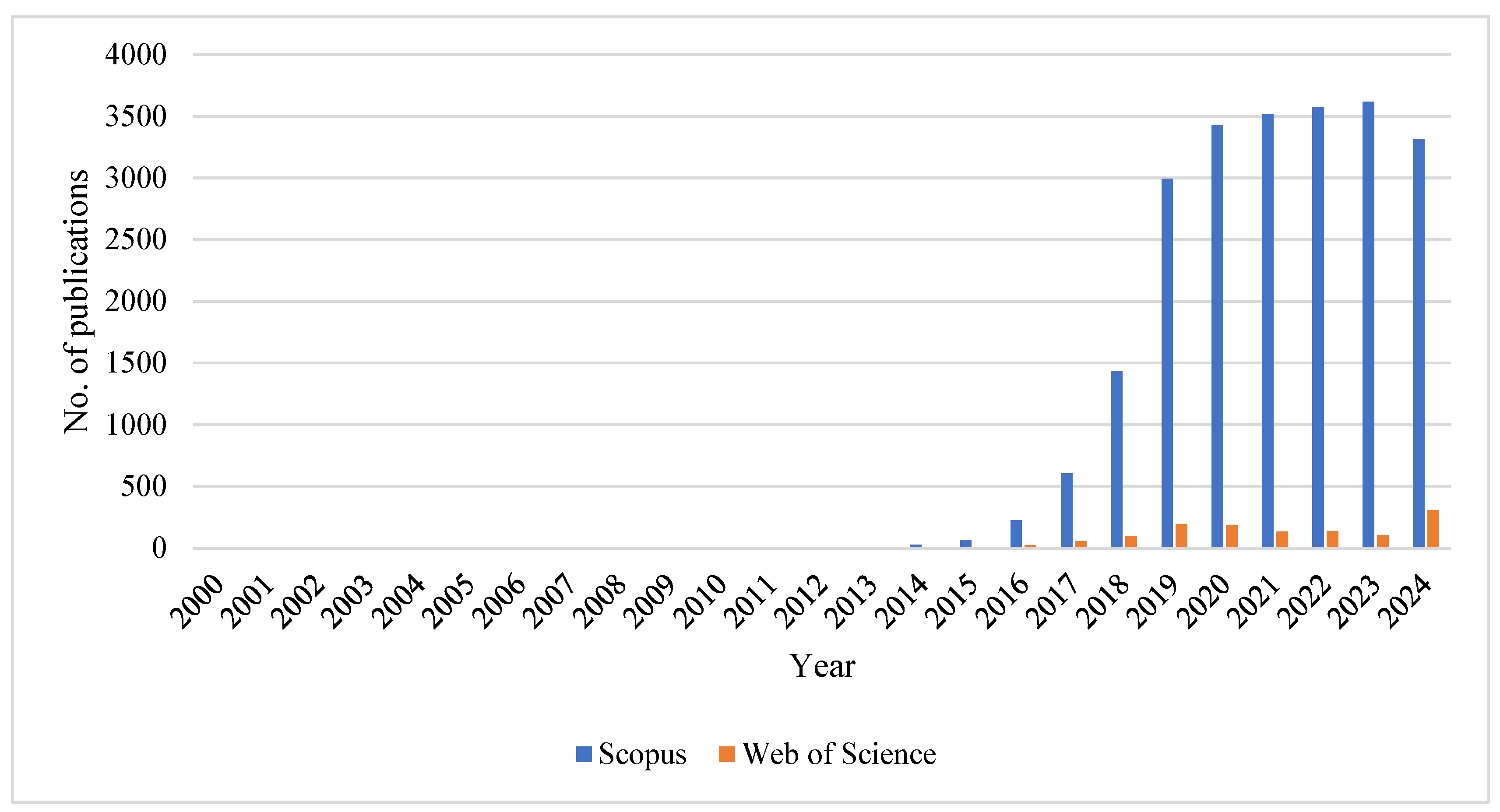
Figure 2.
Number of publications on project management from 2000 to 2024. Source: Scopus and Web of Science databases.
Figure 2.
Number of publications on project management from 2000 to 2024. Source: Scopus and Web of Science databases.
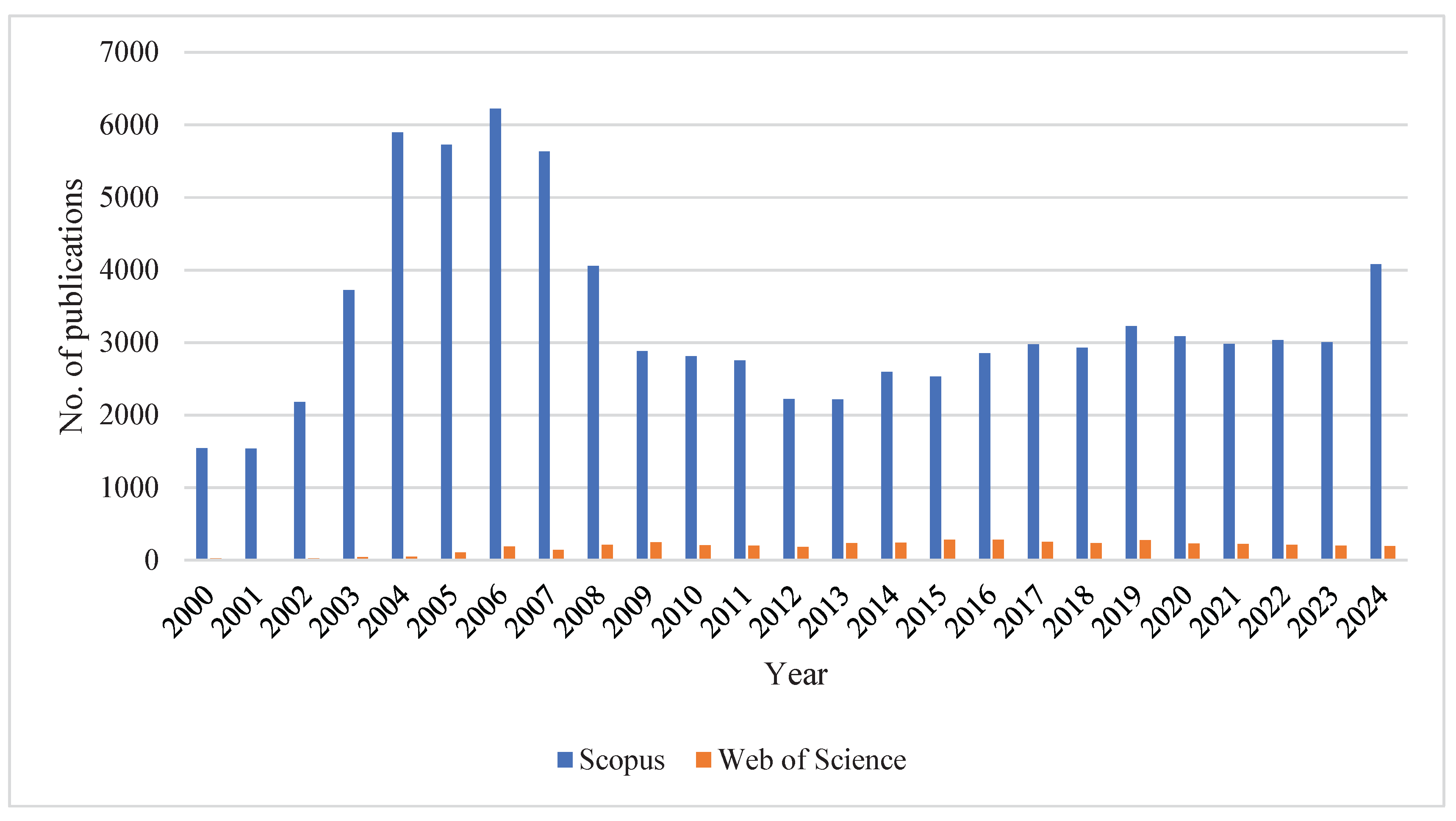
Figure 3.
Project team members’ responses to the question ‘Which Industry 4.0 tools and technologies are used by the project team members?’. Source: Authors’ own survey data.
Figure 3.
Project team members’ responses to the question ‘Which Industry 4.0 tools and technologies are used by the project team members?’. Source: Authors’ own survey data.
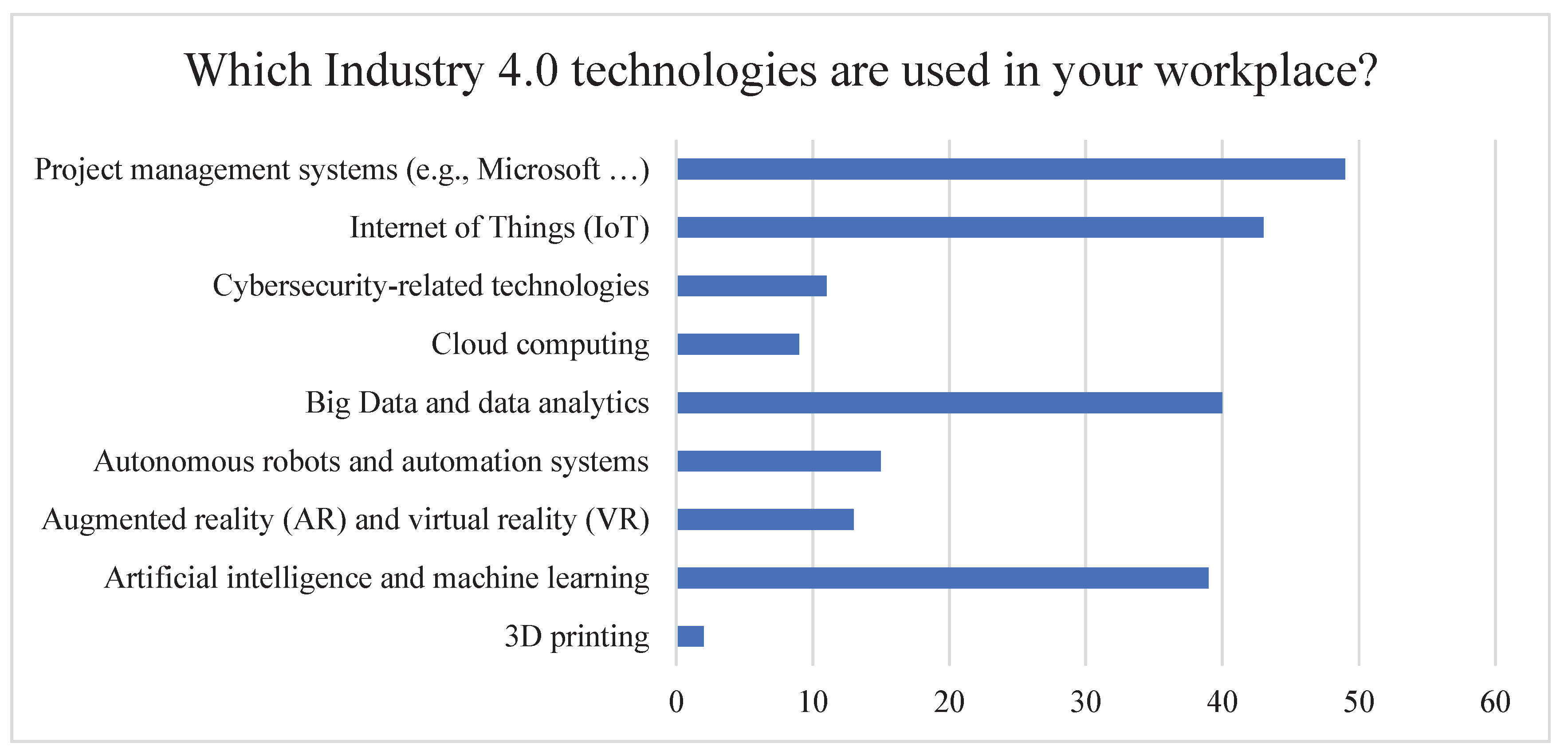
Figure 4.
Project team members’ responses to the question ’What challenges do project teams members face in Industry 4.0 projects?’. Source: Authors’ own survey data.
Figure 4.
Project team members’ responses to the question ’What challenges do project teams members face in Industry 4.0 projects?’. Source: Authors’ own survey data.
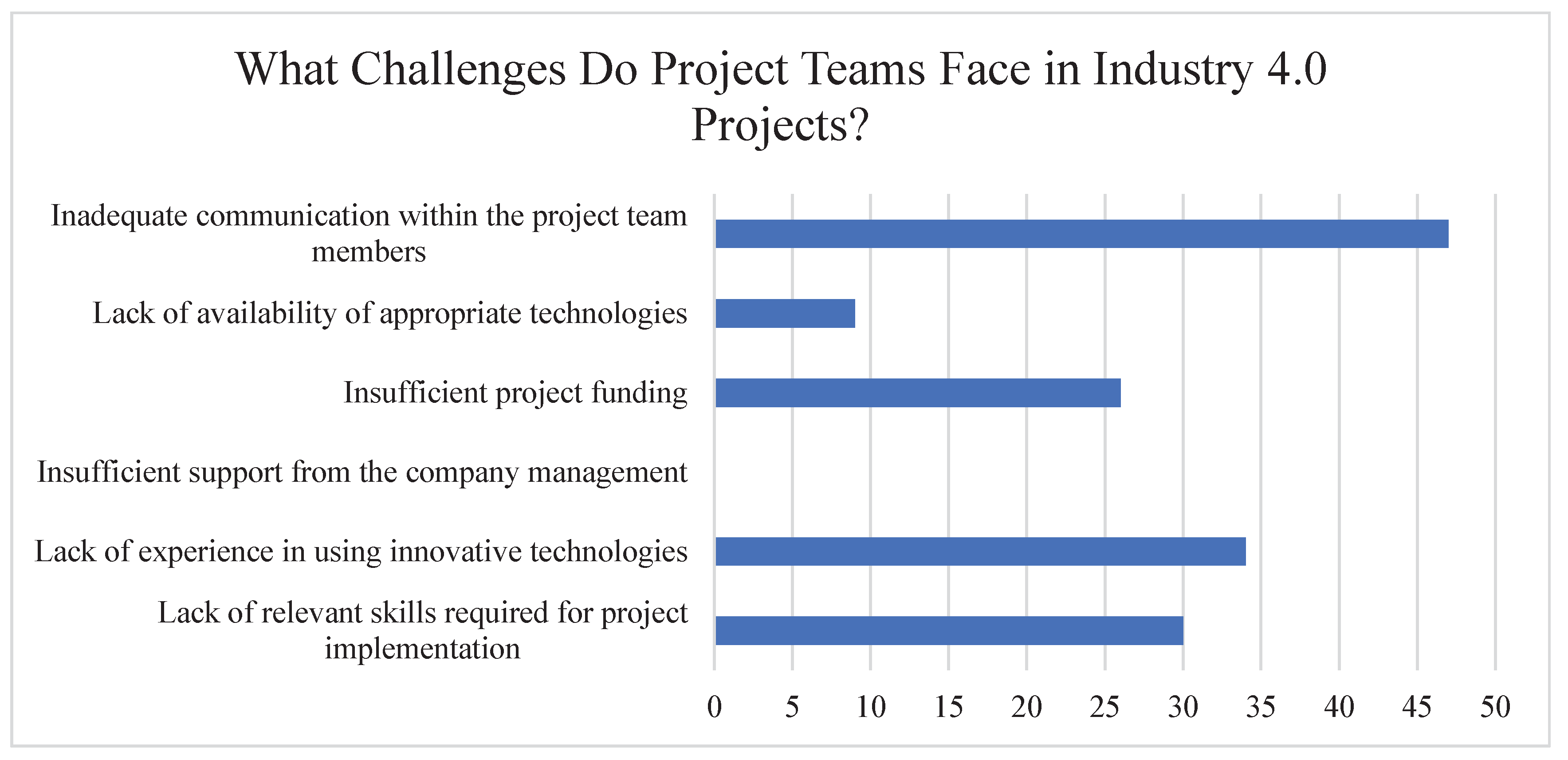
Figure 5.
Project team members’ responses to the question, “What benefits can the implementation of Industry 4.0 projects bring?’. Source: Authors’ own survey data.
Figure 5.
Project team members’ responses to the question, “What benefits can the implementation of Industry 4.0 projects bring?’. Source: Authors’ own survey data.
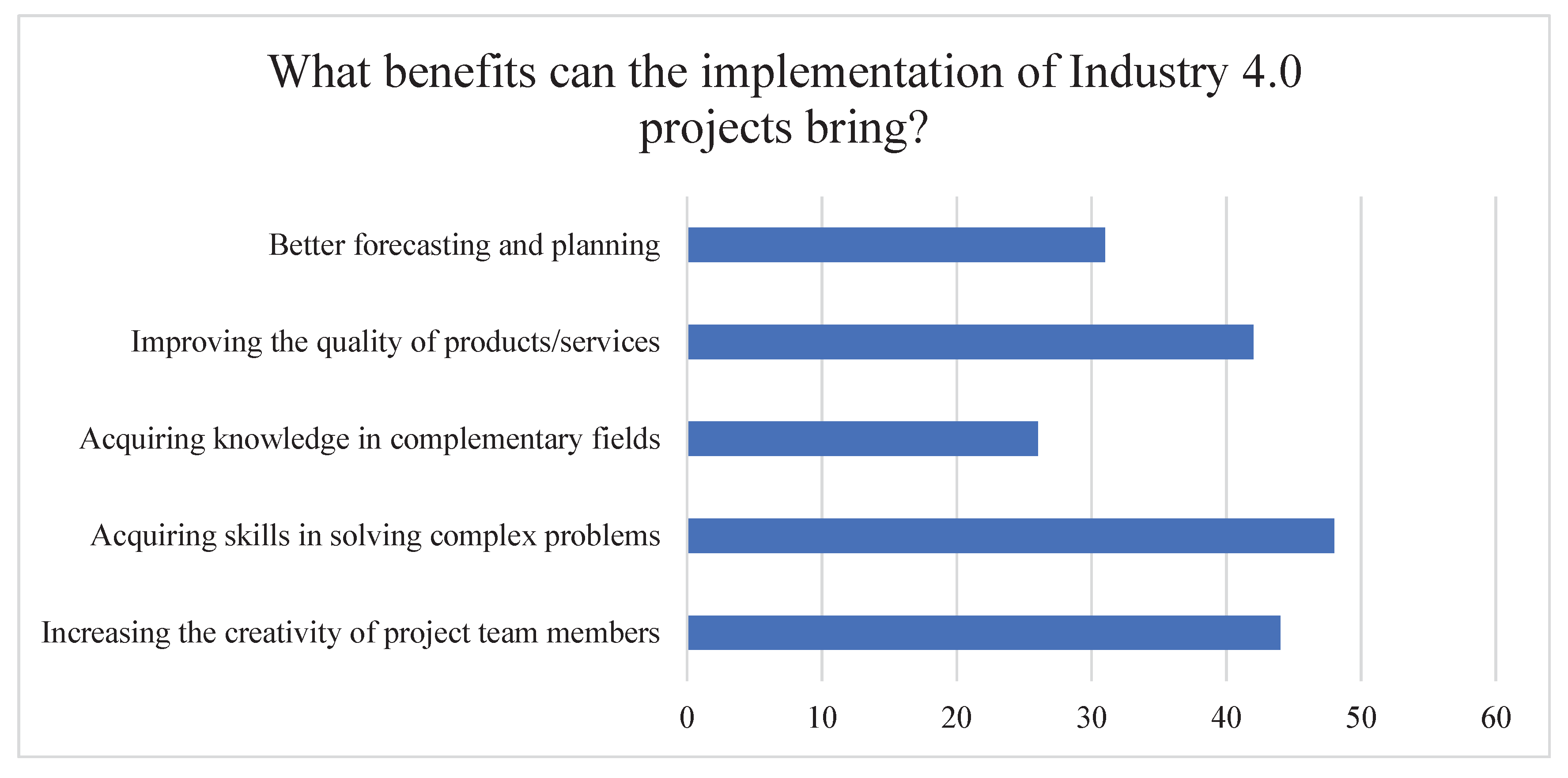
Disclaimer/Publisher’s Note: The statements, opinions and data contained in all publications are solely those of the individual author(s) and contributor(s) and not of MDPI and/or the editor(s). MDPI and/or the editor(s) disclaim responsibility for any injury to people or property resulting from any ideas, methods, instructions or products referred to in the content. |
© 2026 by the authors. Licensee MDPI, Basel, Switzerland. This article is an open access article distributed under the terms and conditions of the Creative Commons Attribution (CC BY) license (http://creativecommons.org/licenses/by/4.0/).
Copyright: This open access article is published under a Creative Commons CC BY 4.0 license, which permit the free download, distribution, and reuse, provided that the author and preprint are cited in any reuse.


