

Submitted:
21 April 2026
Posted:
23 April 2026
You are already at the latest version
Abstract
Background/Objectives: This study evaluates the prognostic value of baseline inflam-matory biomarkers neutrophil-to-lymphocyte ratio (NLR), platelet-to-lymphocyte ratio (PLR), monocyte-to-lymphocyte ratio (MLR), lymphocyte-to-monocyte ratio (LMR), systemic immune-inflammation index (SII) and pan-immune-inflammation value (PIV) in advanced cutaneous melanoma treated with first-line immunotherapy.
Methods: This multicenter retrospective study included 162 patients with unresectable stage III/IV cutaneous melanoma treated with first-line pembrolizumab, nivolumab, or nivolumab plus ipilimumab. Biomarkers were calculated from complete blood counts obtained within 30 days before treatment start. Cut-offs were defined by ROC analysis. Progression free survival (PFS) and overall survival (OS) were analyzed using Kaplan–Meier and Cox regression. Response was assessed by RECIST v1.1.
Results: Higher baseline NLR, PLR, MLR, SII and PIV were more common in patients with adverse baseline features, including liver metastases, elevated LDH and poorer ECOG performance status. Patients with biomarker values below the cut-offs had sig-nificantly longer PFS and OS. In multivariable models adjusted for clinical covariates, PIV remained independently associated with the duration of PFS and OS; MLR inde-pendently predicted PFS, while PLR independently predicted OS.
Conclusions: Baseline inflammatory biomarkers from routine blood counts provide useful prognostic information in advanced melanoma treated with first-line ICIs. PIV showed the most consistent independent association with survival outcomes and may support initial risk stratification alongside LDH, ECOG and metastasis pattern. However, prospective validation in independent cohorts is needed before routine clinical implementation.
Keywords:
metastatic melanoma
; first-line immunotherapy
; immune checkpoint inhibitors
; inflammatory biomarkers
; progression-free survival
; overall survival
; prognostic factors
1. Introduction
Melanoma is a significant global health concern, with rising incidence and mortality rates in recent years [1]. The main predictor for survival is tumor stage at diagnosis, ranging from 85% to 95% at 10 years for localized disease while survival rates for advanced melanoma are much lower [2].
Immunotherapy has reshaped the management of metastatic disease. Anti–PD-1 monotherapy with pembrolizumab or nivolumab yields durable benefit, with five-year survival rates of 38.7% and 39%, respectively [3,4]. Combination of nivolumab and ipilimumab provides additional advantage, achieving five-year overall survival of up to 52%5. These data underscore the central role of immunotherapy in prolonging survival in advanced melanoma. Although immunotherapy improves outcomes in metastatic melanoma, primary resistance is still common. Up to 58% of patients receiving anti–PD-1 monotherapy and up to 42% receiving anti–PD-1 plus anti–CTLA-4 do not achieve an objective response in the first-line setting [4,5,6]. In view of persistent primary and acquired resistance, priority should be given to individualizing management and to early identification of patients who will benefit from first-line immunotherapy.
So far, some tumor-related factors have been suggested as predictive markers of efficacy for immunotherapy [7,8,9]. In routine practice, however, rapid and low-cost biomarkers are needed to support treatment individualization [10,11]. Growing evidence implies that systemic inflammatory response impacts disease progression and course in different cancers, including melanoma [11,12]. Hence, several immune-based scores such as neutrophil count, lymphocyte count, neutrophil-to-lymphocyte ratio (NLR), platelet-to-lymphocyte ratio (PLR) and monocyte-to-lymphocyte ratio (MLR) were usually employed to assess the systemic inflammation in cancer patients [10,13,14,15]. Low lymphocyte count, increased neutrophil or platelet count are frequently observed in cancer patients, indicating poor survival outcome [11,14,15,16,17]. These counts can be used for calculation of pan-immune-inflammation value (PIV), a new comprehensive biomarker that has been proven to be a strong predictor of survival in patients with metastatic colorectal cancer, non-small cell lung cancer and breast cancer [18,19,20].
The aim of this study was to assess the prognostic value of baseline inflammatory biomarkers (NLR, PLR, MLR, lymphocyte-to-monocyte ratio (LMR), systemic immune-inflammation index (SII) and PIV for response to first-line immunotherapy in metastatic melanoma, and to strengthen the evidence base for their clinical utility in this setting.
2. Materials and Methods
Patients
The study enrolled 162 patients with advanced cutaneous melanoma treated at three centers in the Western Balkans (South Eastern Europe)—two in Serbia (the Clinic of Dermatolovenereology, Military Medical Academy, Belgrade [n=68] and the Clinic of Oncology, University Clinical Center Niš [n=88]) and one in Bosnia and Herzegovina (the Clinic of Oncology, Clinical Center Sarajevo [n=6]). Inclusion criteria for participation in the study were: 18 years of age or older, unresectable stage III/IV cutaneous melanoma, first-line mono-immunotherapy (pembrolizumab or nivolumab) or combined immunotherapy (nivolumab and ipilimumab) and availability of a complete blood count with differential obtained within 30 days before initiation of the first treatment cycle. Exclusion criteria were: age under 18 years, patients with insufficient follow-up (<12 months) without documented progression or death.
Treatment
In the pembrolizumab regimen, 200 mg of pembrolizumab was administered intravenously every 3 weeks or 400 mg every 6 weeks. In the nivolumab regimen, 480 mg of nivolumab was administered intravenously every 4 weeks. In the ipilimumab plus nivolumab regimen, 3 mg/kg of ipilimumab was administered intravenously following 1 mg/kg of nivolumab, or 1 mg/kg of ipilimumab following 3 mg/kg of nivolumab, every 3 weeks for up to 4 cycles, followed by continued administration of 480 mg of nivolumab every 4 weeks. Dose and schedule modifications were permitted based on the patient’s condition.
Response to therapy was evaluated according to Response Evaluation Criteria in Solid Tumors (RECIST v1.1) guidelines [21].
Data Collection and Ethics
Patients’ data were extracted from the National Melanoma Registries, which are part of the Central South Eastern European Melanoma Expert Group and integrated into the European Melanoma Registry (EuMelaReg).
The collection of patient data and its entry into the National Melanoma Registries were approved by the Ethics Committees of the respective institutions from which the data were obtained (Ethics Committee of the Military Medical Academy, Serbia, Number 55/2019 from 04 July 2019; Ethics Committee of the Clinical Center Niš, Serbia, Number 13872/502 from 06 June 2020; Ethics Committee of the University Clinical Center Sarajevo, Bosnia and Herzegovina, Number 03-02-282 from 24 December 2019).
All participants had previously signed informed consent forms allowing their clinicopathological data to be entered into an anonymized melanoma registry and used for research purposes.
Statistical Analysis
The baseline clinicopathological variables were summarized using descriptive statistics.
Calculation of biomarker ratios included absolute cell counts at baseline (within 30 days prior to the initiation of immunotherapy). PIV was calculated as (neutrophil count × platelet count × monocyte count)/lymphocyte count, while SII was calculated as (neutrophil count × platelet count)/lymphocyte count. All baseline absolute cell counts were in 109/L.
The cut-off values were calculated using ROC-Curves predicting a survival of “>1 year”, choosing the value with the highest distance from the diagonal.
Progression-free survival (PFS) was calculated from treatment initiation to radiologically confirmed disease progression according to RECIST criteria or death from any cause. Participants who started a new therapy before progression/death were censored at the start of the next therapy. Participants without progression/death and no further therapies were censored at the last date they were known to be alive. Overall survival (OS) was calculated from start of treatment until death. Participants not documented as dead were censored at the last date they were known to be alive. Survival curves were plotted by Kaplan-Meier method.
P values were calculated using Fisher’s exact test for categorical variables, Student’s t-test for continuous variables and Log-Rank-Test for Kaplan-Meier-estimates.
Missing data are presented, but not imputed. P values less than 0.05 were considered as statistically significant.
3. Results
3.1. Clinical Characteristics and Therapy
This study included, 61 females (37.65%) and 101 men (62.35%) with advanced cutaneous melanoma. The mean age at initiation of immunotherapy was 65 years (range 28–96, median 67). The most frequent histological subtype was nodular melanoma (54.94%). Median Breslow thickness was 4.45 mm (range 0.4–38 mm) and ulceration was present in 108 patients (66.67%), indicating that more than half of the cohort initially had histopathologically high-risk cutaneous melanoma. BRAF mutation was detected in 63 patients (38.89%). At initial diagnosis, most patients were stage II (55.56%), whereas 7.4% were already stage IV. The mean interval from initial diagnosis to relapse to stage III or IV was 28.1 months (range 0-165.16; median 17.01). Table 1 presents clinicopathologic characteristics at baseline.
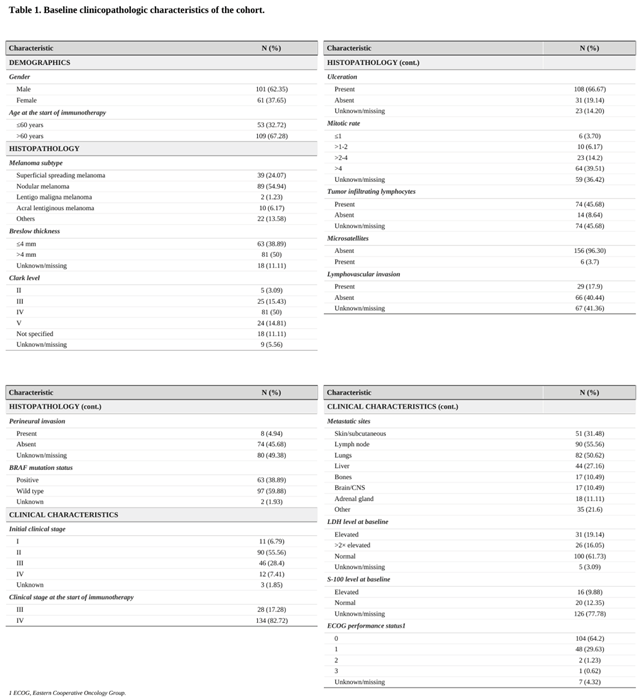
As first-line treatment, 59.88% received pembrolizumab, 36.42% received nivolumab and 3.70% received combination nivolumab/ipilimumab in standard regime. At the start of immunotherapy, most patients had involvement of two or fewer metastatic organ sites (69.75%). The most common sites of metastasis were lymph nodes (55.56%), lungs (50.62%), skin/subcutaneous (31.48%) and liver (27.16%). Central nervous system metastases were present in 17 patients (10.49%). Baseline LDH values were elevated in 57 patients (35.19%). Most patients had an ECOG performance status of 0 or 1 (93.83%). Best overall response to first-line therapy comprised a complete response (CR) in 15.43% of patients; the disease control rate (DCR) was 66.05% and the objective response rate (ORR) 37.04%. Immune-related adverse events were documented in 58 patients.
3.2. ROC analyses and cut-off values of inflammatory biomarkers
The ROC curves were calculated against OS>1 year vs. OS≤1 year. Baseline cut-offs for inflammatory biomarkers were: NLR 3.748 [area under the curve (AUC) 0.66; p=0.012], PLR 180.741 (AUC 0.614; p=0.003), MLR 0.298 (AUC 0.658; p=0.005), LMR 3.351 (AUC 0.652; p=0.083), SII 763.958 (AUC 0.623; p=0.001) and PIV 277.269 (AUC 0.62; p=0.003).
3.3. Inflammatory Biomarkers and Clinical Characteristics
Patients with baseline NLR, PLR and MLR values above cut-off more frequently experienced liver metastases (45.65% vs. 19.83%, p=0.002 for NLR; 43.75% vs. 20.35%, p=0.004 for PLR; 36.51% vs. 20.88%, p=0.043 for MLR), and elevated serum LDH (54.35% vs. 27.59%, p=0.001 for NLR; 58.34% vs. 25.66%, p<0.0001 for PLR; 46.03% vs. 25.27%, p=0.001 for MLR). These patients were also of older age at the beginning of immunotherapy (median 70 vs. 66 years, p=0.043 for NLR; 70 vs. 65 years, p=0.015 for PLR; 71 vs. 63 years, p=0.002 for MLR), and had unfavorable ECOG score (54.35% vs. 22.41%, p=0.001 for NLR; 50% vs. 23.89%, p=0.004 for PLR; 41.27% vs. 24.18%, p=0.004 for MLR) and lower rate of overall response (ORR) to therapy (19.57% vs. 43.97%, p=0.004 for NLR; 12.5% vs. 46.9, p<0.0001 for PLR; 25.4% vs. 42.86%, p=0.028 for MLR), respectively. Microsatellites were more frequently present in patients with NLR and PLR values above cut-off than in patients with lower NLR and PLR (8.7 vs. 1.72, p=0.055 and 8.33 vs. 1.77, p=0.065). PLR above threshold was also associated with the presence of more than two metastatic sites (41.67% vs. 24.78%, p=0.039), while MLR values above threshold were also associated with elevated serum S-100 (20.63% vs. 3.3%, p=0.002).
When patients were grouped by at least one high ratio (NLR, PLR or MLR), significant association was observed for older age at the start of immunotherapy (median 70 vs. 63 years, p=0.005), presence of liver metastasis (34.94% vs. 19.99%, p=0.033), elevated serum LDH (46.99% vs. 22.79%, p=0.0001) and S-100 (15.66% vs. 3.8%, p=0.039), unfavorable EGOG score (43.37% vs. 18.99%, p=0.003) and ORR (73.49% vs. 51.9%, p=0.006).
Analysis of LMR showed that patients with values above cut-off were younger at the start of immunotherapy (median 64 vs. 70.5 years, p=0.004), less frequently had metastases in liver (21.35% vs. 35.94%, p=0.066), elevated serum LDH (25.84% vs. 45.32%, p=0.002) and S-100 (3.37% vs. 20.31%, p=0.003). Also, these patients less frequently had poor ECOG score (24.72% vs. 40.63%, p=0.051) and more frequently had better ORR (42.7% vs. 25%, p=0.027).
Patients with baseline SII above cut-off more frequently had liver metastases (40.98% vs. 19%, p=0.0034), more than two metastatic sites (39.34% vs. 24%, p=0.053), elevated serum LDH (52.46% vs. 25%, p=0.0002) and S-100 protein (16.39% vs. 5%, p=0.051). These patients were also of older age at the start of immunotherapy (median 69 vs. 65 years, p=0.031), and more frequently had unfavorable ECOG score (45.9% vs. 23%, p=0.002) and poor ORR to therapy (77.05% vs. 55%, p=0.007), respectively.
PIV values above cut-off were associated with elevated LDH (44.45% vs. 24.69%, p<0.0001) and S-100 (16.67% vs. 3.7, p=0.01), unfavorable ECOG score (41.67% vs. 22.22%, p=0.022) and poor ORR (73.61% vs. 56.79%, p=0.042).
3.4. Inflammatory Biomarkers and Survival Analyses
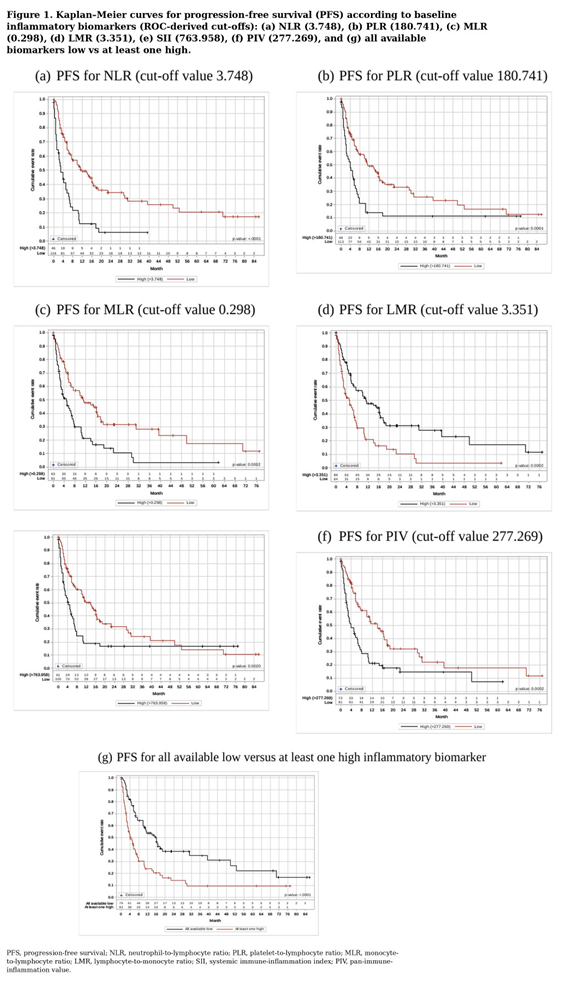
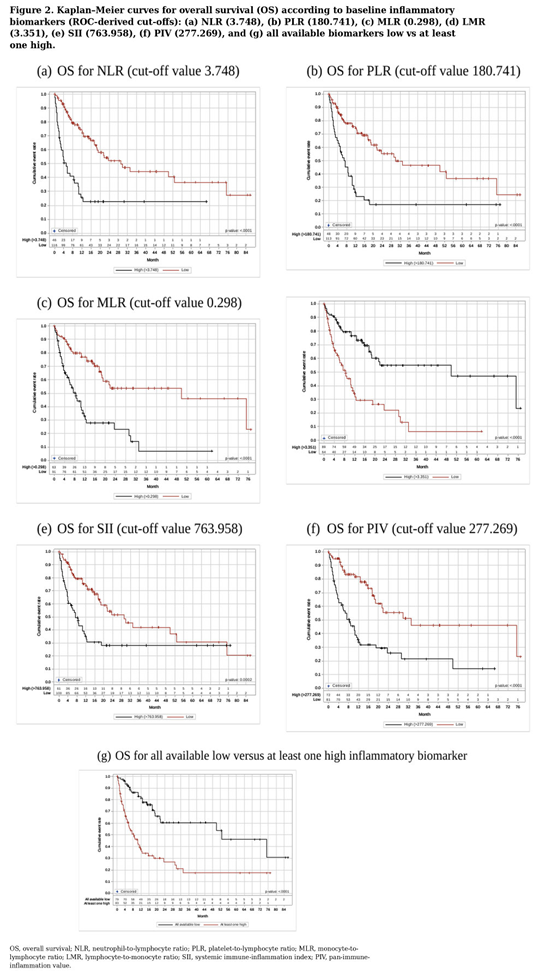
Patients with baseline values below these thresholds had markedly longer median PFS: 11.48 vs. 3.06 months for NLR (p<0.0001); 11.48 vs. 3.95 months for PLR (p=0.0006); 11.18 vs. 4.93 months for MLR (p<0.0001); 13.91 vs. 3.85 months for PIV (p<0.0001). The same pattern was observed for OS, with significantly longer survival in the below cut-off groups: 29.18 vs. 5.03 months for NLR (p<0.0001); 29.87 vs. 6.78 months for PLR (p<0.0001); 49.90 vs. 8.42 months for MLR (p<0.0001); 33.09 vs. 8.42 months for PIV (p<0.0001).
Using a composite indicator, patients were classified as at least one high biomarker if at least one of NLR, PLR, or MLR exceeded its pre-specified cut-off (with the other two below). Compared with the all-low group, at least one high cohort had markedly shorter survival—median PFS 4.21 vs. 16.02 months and OS 8.42 vs. 52.66 months, both p<0.0001.
SII values below cut-off were associated with superior median PFS (13.91 vs. 4.21 months, p=0.0083) and OS (29.18 vs. 7.4 months, p=0.0007).
Opposite to NLR, MLR, PLR and SII patients with LMR values below threshold, had poor median PFS (5 vs. 11.18 months, p<0.0001) and OS (8.42 vs. 49.9 months, p<0.0001).
Survival curves are presented by Figure 1 and Figure 2.
3.5. Cox Regression Analysis
Univariate Cox regression for PFS and OS, respectively, included the following variables: NLR, PLR, MLR, LMR, SII, PIV, gender, age, histologic subtype, Breslow thickness, the presence of ulcerations, lymphovascular and/or perineural invasion, tumor infiltrating lymphocytes, microsatellites before the first line of therapy, BRAF status, number of metastatic sites, the presence of CNS and/or liver and/or lung metastases, clinical stage, baseline levels of LDH and S100, ECOG score and prior adjuvant treatment.
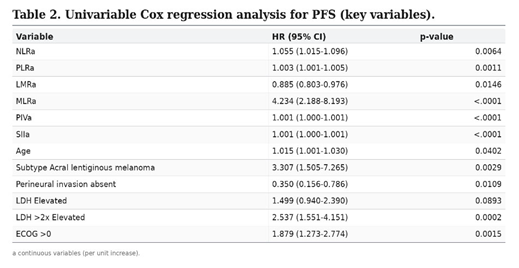
In univariate Cox analysis, higher baseline NLR (p=0.006), PLR (p=0.001), MLR (p<0.0001), PIV (p<0.0001) and SII (p<0.0001), as well as the presence of acral lentiginous melanoma (p=0.003), LDH >2× Upper Limit of Normal (ULN) (p=0.0002) and ECOG score >0 (p=0.002) were associated with shorter PFS. Opposite, higher baseline LMR (p=0.015) and the absence of perineural invasion (p=0.011) indicate better PFS.
For OS, all five indices were likewise significant: NLR (p=0.002), PLR (p<0.0001), MLR (p<0.0001), PIV (p<0.0001) and SII (p<0.0001). Inferior OS was also associated with age over 60 years (p=0.016), the presence of nodular (p=0.028) or acral lentiginous melanoma (p=0.0001), wild type BRAF (p=0.019), baseline LDH elevated (p=0.004) or LDH >2× ULN (p<0.0001) and ECOG score >0 (p<0.0001). Similarly to PFS, LMR above cut-off values (p=0.002) and the absence of perineural invasion (p=0.009) indicate better OS. The most impactful variables of the univariable Cox proportional-hazards analyses for PFS and OS are summarized in Table 2 and Table 3.
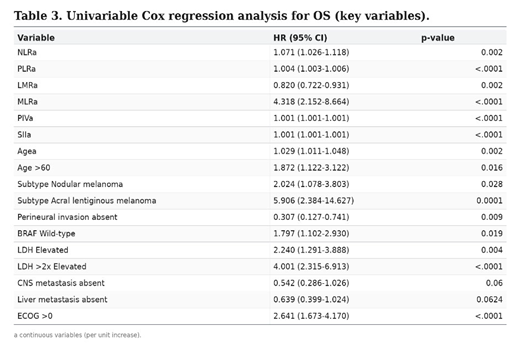
In multivariable Cox models fitted separately for each biomarker and adjusted for clinical covariates, MLR (p=0.006) and PIV (p=0.001) retained independent associations with shorter PFS. For OS, PLR (p=0.032) and PIV (p=0.032) remained independently associated with mortality, whereas NLR and MLR were not significant after adjustment. In these adjusted models, additional covariates showed consistent associations: ECOG performance status >0 predicted shorter PFS in the NLR (p=0.013), PLR (p=0.02) and MLR (p=0.016) models. Baseline LDH >2× ULN predicted worse PFS in the NLR (p=0.002) and PLR (p=0.011) models, and worse OS in the NLR (p<0.0001), PLR (p=0.001) and MLR (p=0.004) models. For OS, older age was independently associated with higher mortality in the PLR (p=0.009), MLR (p=0.01) and PIV (p=0.002) models. The acral lentiginous subtype conferred higher risk for PFS in the NLR (p=0.043), MLR (p=0.02) and PIV (p=0.01) models, and for OS in the PLR (p=0.023), MLR (p=0.01) and PIV (p=0.013) models. Finally, absence of CNS metastases was associated with better OS in the PLR (p=0.0392), MLR (p=0.024) and PIV (p=0.012) models.
Results of biomarker-specific multivariable Cox regression models for PFS and OS are provided in Supplementary Tables S1 and S2.
4. Discussion
In this multicenter, real-world cohort of patients with unresectable stage III/IV cutaneous melanoma receiving first-line immune checkpoint inhibitors (ICIs), baseline inflammatory biomarkers derived from routine complete blood counts showed clinically meaningful and partly independent prognostic associations. On univariable analyses, higher NLR, PLR, monocyte–lymphocyte ratio and PIV were each linked to shorter PFS and OS. After adjustment for clinical covariates in biomarker-specific multivariable Cox models, monocyte–lymphocyte ratio and PIV retained independent value for PFS, while PLR and PIV remained independently associated with OS. These findings support the concept that composite complete blood count–derived markers reflecting the balance between innate (neutrophils, monocytes, platelets) and adaptive (lymphocytes) immunity have been investigated as baseline tools for risk stratification in ICI-treated melanoma, although results across cohorts are not fully consistent [13,22,23,24].
Our results are consistent with a meta-analysis of melanoma cohorts treated with ICIs (n=3,235), in which elevated baseline NLR and PLR were associated with poorer OS and PFS, supporting the prognostic utility of systemic inflammatory biomarkers at treatment initiation [13].
For PIV, published data in melanoma are not fully concordant. In a retrospective, single-center cohort of metastatic melanoma receiving first-line systemic therapy (including both immunotherapy and targeted therapy), higher baseline PIV was independently associated with shorter PFS and OS, whereas a smaller single-center study restricted to ICI-treated advanced melanoma did not confirm significant associations with response or survival outcomes. A recent meta-analysis across ICI-treated cancers further supported the adverse prognostic impact of elevated PIV on both PFS and OS [22,23,24].
The observed links between higher inflammatory biomarkers and worse baseline features (higher LDH, poorer ECOG performance status, and visceral disease) are biologically and clinically plausible. LDH is widely used as a marker of tumor burden, but it also reflects a more glycolytic tumor environment with higher lactate production, which can impair effector T-cell function and contribute to weaker antitumor immunity [25,26]. Regarding liver involvement, we interpret it as a feature of high-risk visceral spread rather than a single isolated factor; importantly, a recent multicenter nomogram in unresectable stage IV melanoma treated with first-line anti-PD-1–based therapy included the presence of liver or brain metastases together with LDH, NLR, melanoma subtype and other variables as key determinants of early progression risk [27]. This approach is consistent with current ESMO guidance, which stresses baseline clinical assessment—including LDH, performance status, and the pattern of visceral disease—when choosing and sequencing systemic treatment in advanced melanoma [28].
From a biological perspective, CBC-derived inflammatory markers have a clear immune rationale. Neutrophils can support tumor progression and, when highly activated, may form neutrophil extracellular traps (NETs) that facilitate immune evasion and have been linked to resistance mechanisms relevant to anticancer therapies, including immunotherapy [29]. Platelets are also active players in cancer biology: they can enhance tumor growth signals, contribute to angiogenesis/vascular remodeling, and promote metastatic spread and early metastatic niche formation [30,31,32,33]. In contrast, the circulating lymphocyte compartment can be viewed as a practical surrogate of systemic immune competence, and lower lymphocyte levels have been associated with worse outcomes in immunotherapy-treated melanoma cohorts [34]. At the tumor level, tumor-infiltrating lymphocytes (TILs) are consistently associated with improved survival and are increasingly discussed in the context of treatment selection and response in the ICI era35. Taken together, it is therefore expected that higher indices weighting innate components (neutrophils/monocytes/platelets) relative to lymphocytes—such as NLR, PLR, MLR (as defined in our study) and especially PIV—correspond to a more immunosuppressive milieu and worse clinical outcomes [29,30,31,32,33,34,35].
Clinically, these markers are acceptable because they are inexpensive, readily available, and reproducible. In our cohort, PIV emerged as the most consistently independent predictor across endpoints, suggesting potential utility as a primary stratifier, while MLR (for PFS) and PLR (for OS) may provide additional prognostic information.
Prospectively, further research should address this study limitations by: validating the observed effects of PIV, NLR, PLR, MLR and LMR in independent cohorts using pre-specified cut-offs; evaluating on-treatment dynamics of these biomarkers (e.g., during the first two cycles) and their predictive value; integrating inflammatory biomarkers with LDH, ECOG performance status, sites of disease (particularly liver/CNS), and molecular features into multivariable nomograms for prediction of treatment response; testing whether high-risk inflammatory profiles identify patients more likely to benefit from intensified combination regimens versus monotherapy; and combining inflammatory biomarkers with circulating tumor DNA and cell-free DNA in multivariable nomograms to improve predictive performance.
5. Conclusions
Baseline inflammatory biomarkers derived from routine blood counts provide independent and accessible prognostic information at initiation of first-line ICI for advanced melanoma. When interpreted alongside LDH, ECOG status and metastatic pattern, these biomarkers can refine initial risk stratification and treatment individualization. Prospective validation with pre-specified thresholds and external cohorts is needed before clinical implementation.
Supplementary Materials
The following supporting information can be downloaded at the website of this paper posted on Preprints.org.
Author Contributions
Data curation: B.D, I.S, J.P, A.P, M.B, A.J.S, M.T and E.B.F. Conceptualization, B.D, L.K, T.M. and B.C.A; Formal analysis: P.S. and B.D. Investigation, B.D, J.P, I.S, L.K, A.P, M.B, A.J.S, M.T. and E.B.F; Methodology, B.D, L.K, T.M, A.J.S, A.P. and P.S. Project administration: B.D, I.S, J.P, B.C.A, A.P, A.J.S, P.S. and L.K. Writing original draft: B.D, L.K. and B.C.A. Writing, review, and editing: All authors. All authors approved the final version of the article.
Funding
Science Fund of the Republic of Serbia, Grant No. 6795 (ReDiMEL).
Institutional Review Board Statement
Patients’ data were extracted from the National Melanoma Registries, which are part of the Central South Eastern European Melanoma Expert Group and integrated into the European Melanoma Registry (EuMelaReg). The collection of patient data and its entry into the National Melanoma Registries were approved by the Ethics Committees of the respective institutions from which the data were obtained (Ethics Committee of the Military Medical Academy, Serbia, Number 55/2019 from 04 July 2019; Ethics Committee of the Clinical Center Niš, Serbia, Number 13872/502 from 06 June 2020; Ethics Committee of the University Clinical Center Sarajevo, Bosnia and Herzegovina, Number 03-02-282 from 24 December 2019).
Informed Consent Statement
All participants had previously signed informed consent forms allowing their clinicopathological data to be entered into an anonymized melanoma registry and used for research purposes. Informed consent was obtained from all subjects involved in the study.:.
Data Availability Statement
The data underlying this article will be shared on reasonable request to the corresponding author.
Conflicts of Interest
A.P. received payment/honoraria for lectures/educational events from MSD, Roche, Novartis and BMS, and won ICF/ESMO fellowship grant. M.B. received payment/honoraria for lectures/educational events from MSD, Roche, Novartis and BMS. I.S. was supported to attend meetings by MSD. J.P. received payment/honoraria for presentations/educational events from Novartis and support for attending meetings by Amicus, Medison. P.S. is employed at Alcedis GmbH, a CRO with contracts to several pharmaceutical companies and EUMelaReg gGmbH. T.M. received payment/honoraria for lectures/educational events from Servier, Merck, BMS, AstraZeneca, Medis and Medison. L.K. is a member of the advisory boards of MSD, Novartis and Medison, received payment/honoraria for lectures/educational events from MSD, BMS, Immunocore, Novartis and Abbvie, and support for attending meetings and/or travel from Abbvie and MSD. All of the other authors have no declarations of interest.
References
- Arnold, M.; Singh, D.; Laversanne, M.; et al. Global Burden of Cutaneous Melanoma in 2020 and Projections to 2040. JAMA Dermatol 2022, 158, 495–503. [Google Scholar] [CrossRef]
- Garbe, C.; Amaral, T.; Peris, K.; et al. European consensus-based interdisciplinary guideline for melanoma. Part 1: Diagnostics—Update 2024. Eur J Cancer 2025, 215, 115152. [Google Scholar] [CrossRef] [PubMed]
- Robert, C.; Ribas, A.; Schachter, J.; et al. Pembrolizumab versus ipilimumab in advanced melanoma (KEYNOTE-006): post-hoc 5-year outcomes from an open-label, multicentre, randomised, controlled, phase 3 study. Lancet Oncol 2019, 20, 1239–51. [Google Scholar] [CrossRef] [PubMed]
- Robert, C.; Long, G.V.; Brady, B.; et al. Five-Year Outcomes With Nivolumab in Patients With Wild-Type BRAF Advanced Melanoma. J Clin Oncol 2020, 38, 3937–46. [Google Scholar] [CrossRef] [PubMed]
- Larkin, J.; Chiarion-Sileni, V.; Gonzalez, R.; et al. Five-year survival with combined nivolumab and ipilimumab in advanced melanoma. N Engl J Med 2019, 381, 1535–46. [Google Scholar] [CrossRef]
- Robert, C.; Schachter, J.; Long, G.V.; et al. Pembrolizumab versus Ipilimumab in Advanced Melanoma. N Engl J Med 2015, 372, 2521–32. [Google Scholar] [CrossRef]
- Nebhan, C.A.; Johnson, D.B. Predictive biomarkers of response to immune checkpoint inhibitors in melanoma. Expert Rev Anticancer Ther 2020, 20, 137–45. [Google Scholar] [CrossRef]
- Baltussen, J.C.; Welters, M.J.P.; Verdegaal, E.M.E.; et al. Predictive Biomarkers for Outcomes of Immune Checkpoint Inhibitors (ICIs) in Melanoma: A Systematic Review. Cancers (Basel) 2021, 13, 6366. [Google Scholar] [CrossRef]
- Poletto, S.; Paruzzo, L.; Nepote, A.; et al. Predictive Factors in Metastatic Melanoma Treated with Immune Checkpoint Inhibitors: From Clinical Practice to Future Perspective. Cancers (Basel) 2023, 16, 101. [Google Scholar] [CrossRef]
- Templeton, A.J.; McNamara, M.G.; Šeruga, B.; et al. Prognostic role of neutrophil-to-lymphocyte ratio in solid tumors: a systematic review and meta-analysis. J Natl Cancer Inst 2014, 106, dju124. [Google Scholar] [CrossRef]
- Dolan, R.D.; Lim, J.; McSorley, S.T.; et al. The role of the systemic inflammatory response in predicting outcomes in patients with operable cancer: Systematic review and meta-analysis. Sci Rep 2017, 7, 16717. [Google Scholar] [CrossRef]
- Mantovani, A.; Allavena, P.; Sica, A.; Balkwill, F. Cancer-related inflammation. Nature 2008, 454, 436–44. [Google Scholar] [CrossRef]
- Ou, Y.; Liang, S.; Gao, Q.; et al. Prognostic value of inflammatory markers NLR, PLR, LMR, dNLR, ANC in melanoma patients treated with immune checkpoint inhibitors: a meta-analysis and systematic review. Front Immunol 2024, 15, 1482746. [Google Scholar] [CrossRef]
- Zhou, X.; Du, Y.; Huang, Z.; et al. Prognostic value of PLR in various cancers: a meta-analysis. PLoS One 2014, 9, e101119. [Google Scholar] [CrossRef] [PubMed]
- Capone, M.; Giannarelli, D.; Mallardo, D.; et al. Baseline neutrophil-to-lymphocyte ratio (NLR) and derived NLR could predict overall survival in patients with advanced melanoma treated with nivolumab. J Immunother Cancer 2018, 6, 74. [Google Scholar] [CrossRef]
- Ferrucci, P.F.; Gandini, S.; Battaglia, A.; et al. Baseline neutrophil-to-lymphocyte ratio is associated with outcome of ipilimumab-treated metastatic melanoma patients. Br J Cancer 2015, 112, 1904–10. [Google Scholar] [CrossRef]
- Giannakeas, V.; Kotsopoulos, J.; Brooks, J.D.; et al. Platelet Count and Survival after Cancer. Cancers (Basel) 2022, 14, 549. [Google Scholar] [CrossRef]
- Fucà, G.; Guarini, V.; Antoniotti, C.; et al. The Pan-Immune-Inflammation Value is a new prognostic biomarker in metastatic colorectal cancer: results from a pooled-analysis of the Valentino and TRIBE first-line trials. Br J Cancer 2020, 123, 403–9. [Google Scholar] [CrossRef] [PubMed]
- Lin, F.; Zhang, L.P.; Xie, S.Y.; et al. Pan-Immune-Inflammation Value: A New Prognostic Index in Operative Breast Cancer. Front Oncol 2022, 12, 830138. [Google Scholar] [CrossRef] [PubMed]
- Chen, Y.; Gong, L.; Gu, P.; et al. Pan-immune-inflammation and its dynamics: predictors of survival and immune-related adverse events in patients with advanced NSCLC receiving immunotherapy. BMC Cancer 2023, 23, 944. [Google Scholar] [CrossRef] [PubMed]
- Eisenhauer, E.A.; Therasse, P.; Bogaerts, J.; et al. New response evaluation criteria in solid tumours: revised RECIST guideline (version 1.1). Eur J Cancer 2009, 45, 228–47. [Google Scholar] [CrossRef] [PubMed]
- Susok, L.; Said, S.; Reinert, D.; et al. The pan-immune-inflammation value and systemic immune-inflammation index in advanced melanoma patients under immunotherapy. J Cancer Res Clin Oncol 2022, 148, 3103–8. [Google Scholar] [CrossRef]
- Fuca, G.; Beninato, T.; Bini, M.; et al. The Pan-Immune-Inflammation Value in Patients with Metastatic Melanoma Receiving First-Line Therapy. Target Oncol 2021, 16, 529–36. [Google Scholar] [CrossRef]
- Kuang, T.; Qiu, Z.; Wang, K.; et al. Pan-immune inflammation value as a prognostic biomarker for cancer patients treated with immune checkpoint inhibitors. Front Immunol 2024, 15, 1326083. [Google Scholar] [CrossRef]
- Van Wilpe, S.; Koornstra, R.; Den Brok, M.; et al. Lactate dehydrogenase: a marker of diminished antitumor immunity. Oncoimmunology 2020, 9, 1731942. [Google Scholar] [CrossRef]
- Fischer, K.; Hoffmann, P.; Voelkl, S.; et al. Inhibitory effect of tumor cell-derived lactic acid on human T cells. Blood 2007, 109, 3812–9. [Google Scholar] [CrossRef]
- Chatziioannou, E.; Higuita, L.M.S.; Kreft, S.; et al. Nomogram for predicting survival after first-line anti-PD-1-based immunotherapy in unresectable stage IV melanoma: a multicenter international study. ESMO Open 2024, 9, 103661. [Google Scholar] [CrossRef]
- Amaral, T.; Ottaviano, M.; Arance, A.; et al. Cutaneous melanoma: ESMO Clinical Practice Guideline for diagnosis, treatment and follow-up. Ann Oncol 2025, 36, 10–30. [Google Scholar] [CrossRef]
- Zhao, J.; Jin, J. Neutrophil extracellular traps: New players in cancer research. Front Immunol 2022, 13, 937565. [Google Scholar] [CrossRef] [PubMed]
- Liao, K.; Zhang, X.; Liu, J.; et al. The role of platelets in the regulation of tumor growth and metastasis: the mechanisms and targeted therapy. MedComm (2020) 2023, 4, e350. [Google Scholar] [CrossRef] [PubMed]
- Filippelli, A.; Del Gaudio, C.; Simonis, V.; et al. Scoping Review on Platelets and Tumor Angiogenesis: Do We Need More Evidence or Better Analysis? Int J Mol Sci 2022, 23, 13401. [Google Scholar] [CrossRef]
- Labelle, M.; Begum, S.; Hynes, R.O. Direct signaling between platelets and cancer cells induces an epithelial-mesenchymal-like transition and promotes metastasis. Cancer Cell 2011, 20, 576–90. [Google Scholar] [CrossRef] [PubMed]
- Labelle, M.; Begum, S.; Hynes, R.O. Platelets guide the formation of early metastatic niches. Proc Natl Acad Sci U S A 2014, 111, E3053-61. [Google Scholar] [CrossRef] [PubMed]
- Postow, M.A.; Chasalow, S.D.; Kuk, D.; et al. Absolute lymphocyte count as a prognostic biomarker for overall survival in patients with advanced melanoma treated with ipilimumab. Melanoma Res 2020, 30, 71–5. [Google Scholar] [CrossRef] [PubMed]
- Brummel, K.; Eerkens, A.L.; de Bruyn, M.; Nijman, H.W. Tumour-infiltrating lymphocytes: from prognosis to treatment selection. Br J Cancer 2023, 128, 451–8. [Google Scholar] [CrossRef]
Disclaimer/Publisher’s Note: The statements, opinions and data contained in all publications are solely those of the individual author(s) and contributor(s) and not of MDPI and/or the editor(s). MDPI and/or the editor(s) disclaim responsibility for any injury to people or property resulting from any ideas, methods, instructions or products referred to in the content. |
© 2026 by the authors. Licensee MDPI, Basel, Switzerland. This article is an open access article distributed under the terms and conditions of the Creative Commons Attribution (CC BY) license (http://creativecommons.org/licenses/by/4.0/).
Copyright: This open access article is published under a Creative Commons CC BY 4.0 license, which permit the free download, distribution, and reuse, provided that the author and preprint are cited in any reuse.


