
Submitted:
21 April 2026
Posted:
23 April 2026
You are already at the latest version
Abstract
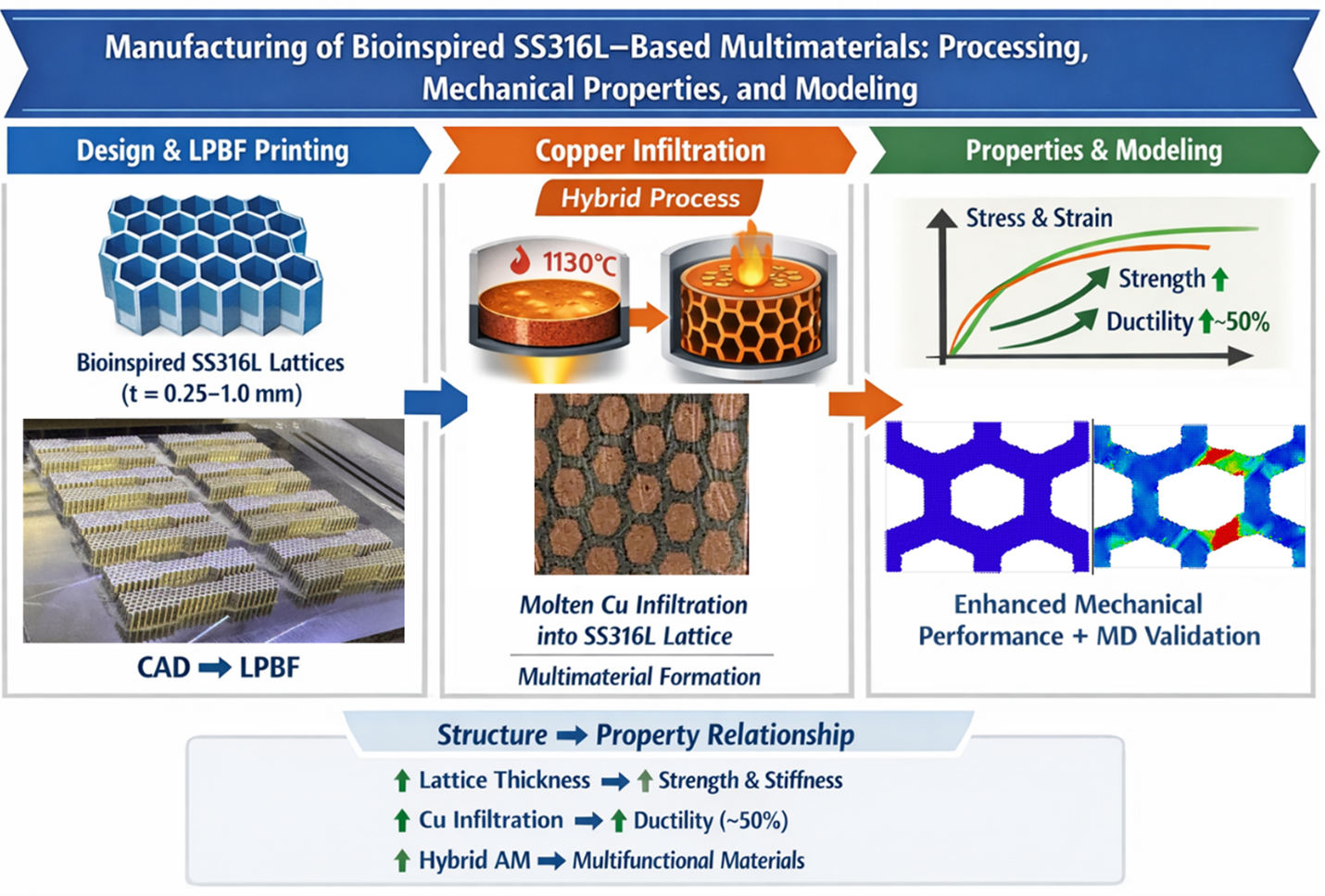
This study presents a hybrid additive manufacturing approach to fabricate bioinspired stainless steel 316L-copper (SS316L-Cu) multimaterial structures using laser powder bed fusion (LPBF). The present study incorporates honeycomb lattice structures with varying wall thicknesses (0.25 mm, 0.5 mm, 0.75 mm, and 1.0 mm) to investigate the effect of geometric parameters on mechanical performance. Mechanical testing was conducted according to ISO 6892 standards, and the results revealed a strong dependence of tensile strength and ductility on lattice thickness. Copper (Cu) infiltration into SS316L lattice structures improved ductility by 30% compared to the monolithic SS316L lattice, with minimal compromise in tensile strength. To complement experimental results, molecular dynamics (MD) simulations were performed to study atomic-scale deformation and validate the trend of strength enhancement with increasing wall thickness. The findings demonstrate the potential of combining LPBF and liquid Cu infiltration to develop multifunctional, mechanically robust, and thermally conductive metallic composites. This approach provides valuable insight into structure–property relationships and supports the design of next-generation multifunctional composites for structural and thermal applications.
Keywords:
additive manufacturing
; Laser Powder Bed Fusion (LPBF)
; SS316L-Cu multimaterial
; bioinspired lattice structures
; molecular dynamics (MD) simulation
Copyright: This open access article is published under a Creative Commons CC BY 4.0 license, which permit the free download, distribution, and reuse, provided that the author and preprint are cited in any reuse.


