

Submitted:
22 April 2026
Posted:
22 April 2026
You are already at the latest version
Abstract
Urban eco-efficiency (UEE) is fundamental to achieving China's dual-carbon goals. However, literature has overlooked green space carbon sequestration, and linear models fail to capture complex nonlinear relationships. This study integrates green space carbon sinks into the evaluation framework, employing the global super-efficiency EBM model to measure the UEE of 108 cities in the Yangtze River Economic Belt (YREB) from 2012 to 2023. It combines XGBoost-SHAP with Geographically and Temporally Weighted Regression (GTWR) to examine UEE's spatiotemporal dynamics and driving mechanisms. The findings reveal that: (1) UEE in the YREB increased from 1.0760 in 2012 to 1.0990 in 2023, while spatial polarization became more pronounced. (2) Core driving factors exhibited significant nonlinear threshold and interactive effects. Specifically, fiscal decentralization's environmental dividend is contingent on active government intervention to circumvent localized "race to the bottom" behaviors. Furthermore, population density transitions from yielding scale dividends to inducing "crowding effects" beyond optimal capacities—a degradation advanced financial systems appear unable to mitigate. (3) A spatiotemporal misalignment was observed: fiscal decentralization unleashed green institutional dividends downstream (coefficients up to 0.0682), but caused a race to the bottom in middle and upper reaches (extending to -0.6548); excessive population agglomeration in megacities induced a crowding effect eroding early pollution control dividends. This study supports abandoning one-size-fits-all approaches and developing precise, spatiotemporally differentiated low-carbon policies.
Keywords:
urban eco-efficiency (UEE)
; global super-efficiency EBM model
; XGBoost-SHAP
; geographically and temporally weighted regression
; Yangtze River Economic Belt
1. Introduction
In recent years, driven by large-scale greenhouse gas emissions, climate change has posed a significant threat to global ecological security and human sustainable development [1], becoming an important issue of global concern [2]. Since the Industrial Revolution, massive consumption of fossil fuels has led to a sharp increase in carbon emissions in urban areas [3]. Due to their high-density economic and production activities, urban systems have become one of the main sources of global carbon emissions [4]. Data from the International Energy Agency (IEA) show that urban areas consume more than two-thirds of the world's energy and emit approximately 70% of total CO₂ [5]. Given the strong negative environmental externalities of carbon dioxide and associated local pollutants such as sulfur dioxide and smoke dust [6], the academic community generally believes that emission reduction in urban areas is of great significance for controlling global temperature rise within a safe threshold [7]. Unlike pure industrial production processes, urban systems can generate ecological carbon sink effects through photosynthesis of green space vegetation and soil carbon sequestration in built-up areas, thereby making important contributions to carbon neutrality and climate change mitigation [8].
For a long time, the expansion of urban economic scale and spatial development has relied heavily on the input of traditional factors such as land, capital and resources. However, with the intensification of resource constraints and the decline of environmental carrying capacity, promoting urban low-carbon and green transformation has become an important direction of national strategy. In practice, resource consumption is closely related to urban economic growth [9]. Cities, especially industrial and resource-intensive cities, are the main carriers of environmental pollution [10], and their infrastructure is also a highly vulnerable receptor to climate change and extreme weather events [11]. Therefore, improving the resilience of urban ecosystems is an important strategy for addressing climate change and maintaining economic stability [12]. This sustainable development model aims to reduce environmental load through industrial structure optimization, technological innovation, and improvement of energy utilization efficiency [13,14]. Achieving this goal requires cutting pollution emissions and enhancing the carbon sink function of green space ecosystems while maintaining stable economic growth.
Although existing studies on urban green development have achieved important results, most focus on single carbon emission or pollution indicators, including greenhouse gas accounting [15], decomposition of emission driving factors [16] and macro emission reduction path planning [17]. However, focusing only on pollution emission indicators cannot fully reflect the true ecological metabolism level of urban low-carbon development, as it ignores the carbon sink compensation effect of urban internal green spaces. Such unilateral accounting often underestimates the substantial progress made by specific regions in the carbon neutrality process. In addition, due to differences in industrial division of labor and emission reduction costs among regions [18], a single emission reduction assessment may cause underdeveloped regions to miss economic development opportunities. Compared with the single carbon intensity indicator, UEE can better reflect the essence of urban green development. It quantifies the comprehensive ability of urban systems to simultaneously achieve economic value and ecological carbon sink output under the constraints of resource consumption and undesirable pollutant generation. Existing empirical studies have shown that UEE is affected by socioeconomic factors such as urbanization process [19] and industrial structure optimization [20].
Given the obvious differences in development stages and ecological resource endowments among cities in the upper, middle and lower reaches of the YREB, large-scale spatial measurement of UEE in this basin is of great significance for achieving regional collaborative emission reduction and high-quality development. On the one hand, regional integration (including industrial transfer, technology diffusion, and capital flow) has increased the interdependence of urban agglomerations in the basin [21]. On the other hand, the negative externalities of pollution spillover make ecological degradation affect all node cities in the basin [22]. Against this background of coexisting spatial spillovers and environmental constraints, examining the spatiotemporal evolution characteristics, internal driving mechanisms and future trends of UEE in the YREB is of great significance.
In summary, existing studies have achieved important results in revealing the driving mechanisms of UEE, but there are still two limitations that need to be further addressed. First, most measurement models focus on single radial or non-radial measurement, making it difficult to balance proportionality and slackness among factors. Second, there is often a disconnect between global nonlinearity and local spatial heterogeneity in the analysis of driving factors.
To address these gaps, this study takes 108 cities in the YREB from 2012 to 2023 as research samples, and its possible marginal contributions are mainly reflected in the following three aspects.
First, in terms of accounting methods and explanatory frameworks, this study constructs a dual complementary research path of global super-efficiency EBM and XGBoost-GTWR. We first establish a global super-efficiency EBM model incorporating undesirable outputs. By integrating radial and non-radial characteristics, this model helps solve the bias of traditional DEA models in factor processing and realizes the measurement of UEE in the entire basin. On this basis, we construct a complementary explanatory framework combining XGBoost-SHAP and GTWR. Aiming at the problems that traditional spatial econometric models (such as SDM and GTWR) are limited by linear assumptions and cannot identify asymmetric thresholds, and machine learning models (such as XGBoost) tend to ignore spatial dependence characteristics, this study combines the two approaches: first, we use XGBoost and SHAP values to analyze the global nonlinear characteristics and key evolution thresholds of each driving factor on eco-efficiency; then, we introduce the GTWR model to project this complex driving relationship into a specific geographic coordinate system to reveal its local spatiotemporal heterogeneity. This combination compensates for the explanatory limitations of a single model and realizes the complementary advantages of global nonlinear attribution and local spatial dynamic response.
Second, at the theoretical and empirical levels, this study identifies the spatiotemporal misalignment and threshold characteristics in the driving mechanism of eco-efficiency within the YREB. We not only confirm that core factors such as economic development and population agglomeration have significant nonlinear threshold effects on eco-efficiency, but also find the dynamic changes of this driving relationship in geographic space through spatial tracking. For example, we reveal that fiscal decentralization presents green institutional dividends in downstream regions, but is obviously accompanied by a race to the bottom at the expense of the environment in underdeveloped regions of the middle and upper reaches. Meanwhile, we identify that the crowding effect caused by excessive population agglomeration in megacities offsets the early scale pollution control dividends. These findings provide micro evidence from a typical Chinese basin for spatial environmental economics.
Third, at the decision support level, this study provides a dual discriminant basis for evolution threshold identification and spatial hotspot location for precise basin governance. Traditional policies often ignore the asymmetry of factor effects, leading to limited effectiveness of one-size-fits-all macro regulation. The factor thresholds established based on SHAP values can guide local governments to identify their own nonlinear evolution stages, while the spatial response maps outlined by GTWR provide references for identifying cold and hot spots of policy effects. This dual reference system combining stage and location can assist decision-makers in formulating differentiated governance paths that not only conform to the overall basin strategy but also fit local spatial characteristics when promoting industrial green transformation, optimizing population spatial distribution and adjusting fiscal authority.
2. Literature Review
First introduced by Schaltegger and Sturm [23], early eco-efficiency assessments relied on single-factor ratios comparing economic outputs to specific environmental impacts [24]. Capitalizing on its simplicity, scholars expanded this framework to capture various urban constraints. Notable applications include utilizing energy-to-GDP ratios to gauge resource efficiency [25,26], measuring spatial ecological loads via area-based pollution intensities [27], and evaluating regional climate mitigation progress through per capita CO₂ footprints [28].
Single-factor eco-efficiency frequently neglects synergistic interactions among core production factors [29] and fails to capture substitution effects, such as technology investments offsetting energy consumption [30]. Because these systematic limitations can distort actual urban efficiency assessments [31], researchers increasingly advocate for integrating diverse inputs (labor, capital) with both desirable and undesirable outputs [32]. Consequently, evaluating UEE through a total-factor lens has become the prevailing paradigm [33].
Evaluating total-factor eco-efficiency typically relies on parametric or non-parametric techniques. Parametric tools, such as Stochastic Frontier Analysis (SFA), account for stochastic noises but depend strictly on predefined production functions and error distributions [33]. In contrast, non-parametric Data Envelopment Analysis (DEA) evaluates relative efficiency via linear programming without rigid functional assumptions. Classic DEA applications include the constant-returns-to-scale CCR model [34] and the variable-returns-to-scale BCC model [35].
Unlike SFA, DEA requires no predefined functional form, thereby preventing subjective distribution biases [36]. It is particularly advantageous for evaluating units with multiple inputs and outputs [37]. Nevertheless, traditional radial DEA models (CCR and BCC) assume proportional factor changes and ignore slacks. Consequently, they fail to seamlessly integrate undesirable outputs—like emissions—into optimization targets, hindering the accurate measurement of true UEE [38].
To address these issues, Tone [39] proposed the non-radial Slack-Based Measure (SBM) model by directly incorporating slack variables into the objective function based on radial DEA models. Since the SBM model can handle undesirable outputs, it has gradually become a common method for measuring the UEE. For example, Huang et al. [20] used the SBM model to analyze the spatiotemporal evolution of eco-efficiency in 108 cities in YREB, providing empirical evidence for formulating regional green coordinated development policies. Liu et al. [40] adopted a two-stage SBM model to measure the UEE at different levels in China, revealing the causes of efficiency gradients among cities. Tone and Tsutsui [41] further proposed the EBM model to integrate the measurement advantages of radial DEA and non-radial SBM, providing a methodological reference for the measurement of the UEE in the YREB in this study.
Compared with previous literature, this study has the following main contributions. First, this study incorporates urban built-up area green space carbon sinks as an expected ecological output into the evaluation framework of UEE, aiming to objectively and systematically assess the true ecological metabolic efficiency of core cities in the YREB. Urban ecosystems are not only the main sources of carbon emissions but also carriers of carbon sequestration, which highlights the importance of separating their net environmental effects in the accounting model. Existing studies mainly simply set cities as pollution sources at the macro scale, while national or basin-level analyses often ignore the physical compensation effect of urban internal green facilities as micro carbon sinks [42].
Second, this study adopts an interpretable machine learning method based on Extreme Gradient Boosting (XGBoost) and SHAP (SHapley Additive exPlanations) values [43] to reveal the mapping mechanism between factors such as economic development, industrial structure, technological innovation and the UEE. The UEE is synergistically affected by various heterogeneous factors, and nonlinear response boundaries generally exist between driving factors and between these factors and eco-efficiency. Interpretable machine learning does not require pre-setting the linear function form of the parameter model, but derives complex variable associations through an integrated tree structure and directly quantifies marginal contribution rates from high-dimensional data. This study thereby alleviates the assumption limitations of traditional econometric models in handling complex interactions [44].
3. Methods and Materials
This study establishes a full-chain quantitative analytical framework consisting of "efficiency measurement, mechanism interpretation, and spatiotemporal heterogeneity analysis". First, the UEE is evaluated using the global super-efficiency EBM model incorporating undesirable outputs. Second, the XGBoost-SHAP framework is applied to identify the nonlinear characteristics of driving factors. Finally, the GTWR model is adopted to analyze the spatial heterogeneity of such driving effects.
3.1. Research Methods
3.1.1. Global Super-Efficiency EBM Model
Traditional DEA models have notable limitations in handling input-output vectors. Radial DEA models fail to fully account for non-radial slack variables, while non-radial models cannot adequately reflect the proportional adjustment characteristics of input factors. To alleviate such structural biases, Tone and Tsutsui proposed the EBM model, which integrates both radial proportionality and non-radial slack distances [41].
To reduce measurement biases caused by the shift of intertemporal technological frontiers and address the issue that efficient decision-making units (DMUs) cannot be further ranked as their efficiency scores are all equal to 1, this study constructs a global super-efficiency EBM model incorporating undesirable outputs with reference to the framework of Cao et al.[45]. Assume that there are n independent DMUs (n=108 cities in this study), and each DMU contains m inputs, s₁ desirable outputs (including real GDP and urban green space carbon sinks), and s₂ undesirable outputs (including carbon dioxide and local pollutants). The core linear programming formulation is presented in Equation (1).
where denotes the global super-efficiency score; x, , and represent the vectors of inputs, desirable outputs, and undesirable outputs, respectively; λ is the weight vector of DMUs; θ and φ are radial programming parameters; ϵ is the key weighting parameter; s denotes the slacks of each variable; and w refers to the relative weights of factors. This study specifies the model as variable returns to scale (VRS) and non-oriented.
3.1.2. Exploratory Spatial Data Analysis (ESDA)
ESDA provides analytical and visual tools to evaluate spatial dependence and heterogeneity within datasets. To assess the overarching spatial autocorrelation of urban eco-efficiency (UEE) across the study area, we apply the Global Moran's I statistic, which is formulated in Equation (2).
where I denotes the Moran's I statistic; n is the total number of spatial units; Xi and Xj represent the observed values of the i-th and j-th spatial units, respectively; S2 is the variance of the observed values; Wijis an element of the spatial weight matrix, which defines the spatial adjacency between spatial units i and j.
3.1.3. XGBoost-SHAP Interpretable Machine Learning Framework
Given the widespread nonlinear responses and multicollinearity among driving factors in urban ecosystems, this study adopts the XGBoost algorithm to fit the mapping relationship between eco-efficiency and its driving factors. Based on the Boosting ensemble framework, XGBoost conducts the second-order Taylor expansion via the Newton method and iteratively constructs multiple regression trees to minimize the regularized objective function, which improves the nonlinear fitting performance while controlling model complexity [46].
To mitigate the black box nature of machine learning models, this study introduces the SHAP post-hoc interpretation framework [43]. Grounded in cooperative game theory, SHAP quantifies the actual impact of each explanatory variable on eco-efficiency by calculating the expected marginal contribution of a given feature across all possible feature combinations [47]. Its additive explanatory model is expressed in Equation (3).
where g(z′) denotes the explanatory model; is the base value of model prediction, corresponding to the mean of eco-efficiency scores across all samples; M is the number of driving factors; and represents the SHAP value of the j-th driving factor, which directly reflects the positive promotion or negative inhibition effect of the feature on the predicted outcome.
3.1.4. Geographically and Temporally Weighted Regression (GTWR)
As the YREB stretches across eastern, central, and western China, the marginal effects of driving factors on eco-efficiency generally exhibit spatial heterogeneity and temporal dynamics. This study adopts the GTWR model proposed by Huang et al. [48], which incorporates the time dimension (2012–2023) into the spatial weight matrix to construct a local regression model in a three-dimensional spatiotemporal coordinate system, as shown in Equation (4).
where is the measured eco-efficiency of city i in year t; represent the longitude, latitude, and time coordinates of city i, respectively; is the spatiotemporal intercept; is the local spatiotemporal regression coefficient of the k-th explanatory variable ; and is the random error term. The GTWR model determines the spatiotemporal weight matrix using a Gaussian kernel function and cross-validation (CV) bandwidth selection, to capture the spatiotemporal variations of core factors.
Notably, the global nonlinearity identified by XGBoost and the local linearity assumption adopted by GTWR are logically consistent and form a complementary structure of global nonlinearity with local linear approximation. According to the local linear approximation principle in calculus, complex nonlinear relationships can be reasonably approximated as linear relationships within a limited spatiotemporal neighborhood of a given city. Therefore, the local regression coefficients estimated by GTWR essentially reflect the local marginal slope of each city along the global nonlinear evolution path. The combination of the two methods can identify the threshold points at which driving factors shift abruptly, and also accurately characterize the stage-specific spatial heterogeneity of cities within the basin.
3.2. Variable Selection
3.2.1. Indicators of the UEE
Following the input-output indicator system for measuring the UEE (UEE) established by Huang et al.[20] and Zeng et al.[30], this study selects the number of employed persons at year-end, urban construction land area, capital stock, total electricity consumption, and total water supply as input indicators. Real GDP and urban carbon sinks are treated as desirable outputs, while carbon dioxide, wastewater, sulfur dioxide, and smoke dust emissions are regarded as undesirable outputs. Detailed variables are presented in Table 1. The relatively large standard deviations of some indicators objectively reflect the pronounced spatial heterogeneity in resource endowments and economic scales across the YREB.
1. Input Indicators
This study comprehensively selects core production factors supporting urban operation and socioeconomic development, covering four dimensions: labor, land, capital, and resource consumption. Specifically, labor input is represented by the number of employed persons at year-end; land input is characterized by urban construction land area; capital input is measured by capital stock estimated via the perpetual inventory method; and resource consumption focuses on basic urban energy and water inputs, proxied by total electricity consumption and total water supply, respectively.
2. Desirable Output Indicators
Desirable outputs consider both economic and ecological benefits of cities. Economic output is measured by real GDP adjusted for price factors to truly reflect urban economic development levels. Ecological output is represented by the carbon sequestration of urban built-up green spaces. Urban carbon sink refers to the amount of carbon fixed by green vegetation in built-up areas through photosynthesis , as calculated in Equation (5).
where denotes urban carbon sequestration; is the green space area in built-up districts; is the comprehensive carbon absorption coefficient of green spaces, set as a fixed value based on benchmark parameters and molecular weight conversion.In this study, [42]. represents the standard molecular weight ratio for converting pure carbon (C) to carbon dioxide () equivalents.
Notably, while the carbon sequestration capacity of vegetation may exhibit slight variations across different climatic zones, the application of a standardized comprehensive carbon absorption coefficient remains the most viable and widely acknowledged methodology in macro-level panel studies involving extensive spatial and temporal dimensions. This approach ensures the horizontal comparability of carbon sink baseline data across diverse cities, thereby avoiding endogeneity biases introduced by inconsistent micro-accounting standards [42].
3. Undesirable Output Indicators
This study incorporates both urban climatic impacts and local environmental pollution into the category of undesirable outputs [49], specifically including greenhouse gases (total carbon dioxide emissions) and major industrial and domestic pollutants (total wastewater discharge, sulfur dioxide emissions, and smoke dust emissions).
3.2.2. Driving Factors of UEE
Considering the multidimensional characteristics of urban development in the YREB, this study selects eight core driving factors from three dimensions: economic factors, social and human factors, and institutional factors to analyze the spatiotemporal evolution mechanism of UEE, as is shown in Table 2.
Before constructing the spatial econometric model, this study conducts multicollinearity tests on the eight selected driving factors using the VIF and Tolerance. As shown in Table 2, the VIF values of all explanatory variables range from 1.302 to 4.423, with the maximum value being far below the conventional threshold of 10, and the overall average VIF is 2.659. These results indicate that the eight driving factors maintain satisfactory independence without serious multicollinearity. The variable specification is reasonable and meets the basic prerequisites for subsequent spatial econometric regression.
1. Economic Factors
Guided by the Environmental Kuznets Curve, per capita GDP serves as the proxy for economic development (Economic). To capture factor allocation optimization, industrial structure (Industrial) is measured by the tertiary-to-secondary industry ratio. The ratio of utilized foreign capital to GDP denotes opening-up (Opening), reflecting potential "pollution haven" or "halo" dynamics [50]. Finally, financial development (Financial)—calculated via deposit-loan balances against GDP—illustrates the capacity to alleviate green financing constraints.
2. Social and Human Factors
Urban population agglomeration can improve resource utilization efficiency through scale effects, but may also aggravate environmental pressure via crowding effects. Population density (Population) is measured by the number of people per unit land area. The agglomeration of high-skilled human capital provides an important foundation for green technology innovation. The number of college students per 10,000 people is used to represent the level of human capital (Human).
3. Institutional Factors
Within decentralized administrative systems, local fiscal autonomy fundamentally dictates how regional governments balance rapid economic expansion against sustainable environmental management. To capture this dynamic, fiscal decentralization (Fiscal) is quantified using the ratio of local to provincial public revenues. Concurrently, government intervention (Government)—calculated as local public expenditure relative to GDP—illustrates regional resource allocation priorities and the overarching stringency of environmental regulations [51].
3.3. Data Sources
To ensure the research period covers complete policy cycles while maintaining data availability, this study takes 108 prefecture-level and above cities in the YREB from 2012 to 2023 as research samples. Original panel data for input-output indicators and driving factors are mainly obtained from the China Statistical Yearbook and statistical communiqués on national economic and social development of each province and city. Urban carbon emission accounting data refer to the inversion results provided by institutions such as the China Emission Accounts and Datasets (CEADs) [21].
To eliminate the interference of price fluctuations on the long-term panel data, all monetary indicators were deflated. Specifically, taking 2012 as the base year, the nominal GDP was converted into real GDP using the GDP deflator of the respective provinces. For the Capital Stock (Cap) indicator, the Perpetual Inventory Method (PIM) was employed for estimation, and the annual new investments were deflated using the Fixed Asset Investment Price Index to ensure the comparability of capital inputs across the time series.
To guarantee a balanced panel, missing observations were resolved via multiple imputation [52]. Comparisons of key descriptive statistics—including means, standard deviations, and extrema—between the raw and imputed datasets demonstrated robust consistency, thereby confirming that the procedure successfully minimized potential systematic biases.
4. Empirical Results and Analysis
4.1. Spatiotemporal Evolution Characteristics of UEE in the YREB
Based on the Global Super-EBM model, this study analyzes the spatiotemporal evolution of UEE in the YREB from the temporal trend and dynamic distribution.
1. Temporal Evolution Trend of UEE
As shown in Figure 1, the UEE in the whole YREB and its upper, middle, and lower reaches exhibited an overall fluctuating upward trend from 2012 to 2023. The average efficiency of the whole basin increased from 1.0760 in 2012 to 1.0990 in 2023. After the implementation of the national strategy of prioritizing ecological protection and green development in 2016, the overall efficiency showed a noticeable upward trend following a short-term adjustment, reflecting the driving effect of macro policies on the green transformation of the basin.
In terms of regional differences, the three regions present significant spatial disequilibrium [53]. The lower reaches maintain a long-term leading position in average efficiency owing to advantages in technological innovation and industrial structure. The upper reaches show a catch-up trend, whose efficiency value surpassed that of the middle reaches and gradually approached the lower reaches by 2023. In contrast, constrained by the carbon lock-in effect of traditional industries [54], the middle reaches witnessed relatively slow efficiency improvement and became a relatively weak area in the green development of the basin.
2. Dynamic Distribution Evolution of UEE
While the overall level of UEE in the YREB increased steadily, its spatial structure also displayed noticeable heterogeneity. Such internal differentiation suggests that the driving mechanisms exhibit significant non-stationarity across geographic space, as shown by the kernel density plots in Figure 2.
In terms of dynamic distribution patterns, the kernel density curves during the study period show the following features:
First, the main peak shifted significantly to the right. Over time, the peak of the kernel density curve moved continuously from around 1.05 toward 1.10, which confirms the overall improvement of UEE across the basin from the perspective of distribution dynamics.
Second, the distribution range expanded and a long-tail pattern emerged. The curve in 2012 was relatively steep, indicating small efficiency differences among cities. By 2023, the bottom of the curve had widened noticeably, with an obvious long tail in the high-efficiency range (right side). This indicates that, amid overall progress, the green transformation process varies substantially across cities, with prominent spatial polarization and a widening gap between high-efficiency and low-efficiency cities.
4.2. Global Nonlinear Driving Mechanism Analysis Based on XGBoost-SHAP
Traditional linear regression models usually assume that independent variables are independent and their effects are homogeneous. However, the evolution of the UEE is typically a complex nonlinear system. To better characterize the complex interactions among variables, this study adopts the XGBoost model combined with the SHAP framework [55] to quantitatively evaluate the global importance and marginal effect directions of the eight driving factors.
Figure 3 presents the results from the XGBoost-SHAP model. Specifically, Figure 3(a) shows the feature importance ranking based on the mean absolute SHAP value (Mean |SHAP value|). The results indicate that the contributions of different variables to eco-efficiency in the YREB differ noticeably.
In particular, fiscal decentralization (Fiscal) shows the highest importance and is the primary driving factor of the UEE in the basin during the study period. Population density (Population) and financial development (Financial) follow closely, and these three indicators constitute the core influencing factors of eco-efficiency. By comparison, the advancement of the industrial structure (Industrial) has relatively weak global explanatory power. This result suggests that, compared with simple industrial structure adjustment, the fiscal autonomy of local governments and the factor reallocation effect brought by population agglomeration exert more significant marginal impacts on changes in eco-efficiency.
The SHAP bee swarm plot in Figure 3(b) further illustrates the effect direction and sample distribution of each variable. The color of scattered points from blue to red represents the feature value from low to high, and the SHAP value on the horizontal axis reflects the positive or negative marginal contribution of the feature to eco-efficiency. It can be observed that high-value samples (red points) of the core variable fiscal decentralization (Fiscal) are mainly concentrated on the right side of the vertical axis (SHAP value > 0), indicating that a higher level of fiscal decentralization generally promotes eco-efficiency, which may be related to increased investment in environmental governance and green innovation by local governments with expanded autonomy.
In addition, the scatter distribution of population density (Population) shows an obvious long tail and two-way dispersion (high-value samples appear on both positive and negative axes), suggesting that the effect of population agglomeration on eco-efficiency is not simply linear but exhibits a significant threshold effect [56]. In the early stage of agglomeration, population concentration may generate scale dividends; after exceeding a certain threshold, it may cause crowding effects and environmental pressure, and this process may show spatial heterogeneity across different regions.
To investigate the nonlinear threshold characteristics and interactive effects of core driving factors on UEE, this study constructs SHAP dependence plots for fiscal decentralization and population density, as illustrated in Figure 4.
With respect to fiscal decentralization (Figure 4a), the model identifies the level of government intervention (Government) as the predominant interacting variable. The impact of fiscal decentralization on UEE exhibits a distinct stepwise pattern: at lower degrees of decentralization (< 0.4), the majority of sample points correspond to low levels of government intervention (blue clusters) and exert a negative marginal effect on eco-efficiency. In contrast, when fiscal decentralization crosses a critical threshold and begins to yield positive marginal contributions, the corresponding interval is densely populated with samples characterized by high government intervention (red clusters). This nonlinear interaction underscores a potential synergistic relationship between fiscal decentralization and local governance capacity, implying that the positive environmental externalities of fiscal decentralization are closely intertwined with proactive government intervention. Sufficient environmental regulation and administrative coordination are conducive to preventing the escalation of a localized "race to the bottom" triggered by enhanced fiscal autonomy, thereby transforming fiscal decentralization into a robust driver for UEE improvement.
Regarding population density (Figure 4b), the level of financial development (Financial) emerges as the core interacting variable. The dependence plot demonstrates a clear transition wherein the initial agglomeration dividends are ultimately offset by crowding effects. In the low population density interval, moderate agglomeration forms a positive synergy with financial capital, jointly facilitating the enhancement of eco-efficiency. Nevertheless, once population density exceeds a specific threshold—evidenced by a substantial decline in SHAP values—the high-density interval is dominated by samples representing high financial development (red clusters). This finding indicates that financial capital alone is insufficient to counteract the losses incurred by environmental degradation; in core megacities, when population expansion surpasses ecological carrying capacity, even well-developed financial systems fail to fully mitigate the UEE loss induced by crowding effects. This observation underscores the necessity of implementing prudent population scale management and spatial structure decentralization in megacities.
4.3. Spatial Non-Stationarity Test and GTWR Model Validation
Since the cross-sectional dimension of the sample (N=108 cities) is much larger than the time dimension (T=12 years), this study uses typical short panel data. The risk of spurious regression caused by non-stationary variable sequences is relatively low, so strict panel unit root tests are not required, and subsequent estimation can be conducted directly.
Although traditional global regression models can reflect the overall average effect of the basin, they tend to mask the differences in the effects of influencing factors across different spatial units. The YREB spans eastern, central, and western China, with significant differences in resource endowments, economic development levels, and policy orientations among regions. Relying solely on global regression cannot accurately characterize the spatiotemporal dynamic characteristics of the driving mechanisms. Therefore, this section first identifies the spatial correlation characteristics of eco-efficiency through spatial autocorrelation tests, and then uses the GTWR model to examine and analyze the spatiotemporal non-stationarity of the driving mechanisms.
4.3.1. Spatial Non-Stationarity Test
To examine the spatial correlation characteristics of the UEE in the YREB, this study calculates the global Moran's I index of eco-efficiency across the entire basin from 2012 to 2023. As shown in Table 3, the average global Moran's I index for the entire study period is close to 0.
The statistical results indicate that the global Moran's I index does not show significant global agglomeration characteristics. However, this does not mean that spatial effects are absent. Such global insignificance usually reflects the regional offset effect of spatial correlation: some regions in the basin exhibit positive spatial spillovers, while others show negative spillovers. The two offset each other at the global level, resulting in insignificant overall correlation. Preliminary local spatial autocorrelation analysis (LISA) reveals the localized coexistence of "High-High" agglomeration in the downstream regions and "Low-Low" clustering in certain upstream areas. This underlying local spatial dependence further corroborates the necessity of employing local spatial econometric models to capture these hidden spatiotemporal dynamics.
To further verify the existence of spatial non-stationarity, this study diagnoses the spatial stationarity assumption of the model. Traditional global regression assumes that the effects of driving factors are spatially homogeneous, but the driving mechanisms of eco-efficiency in the YREB may show significant spatial differences [57]. Therefore, the Breusch-Pagan/Koenker (BP) test is used for verification. The results show that the Koenker statistic is 162.5165 with a p-value less than 0.001, which significantly rejects the null hypothesis of spatial stationarity at the 1% significance level. This indicates that the effects of various driving factors on eco-efficiency exhibit significant spatial non-stationarity and geographic heterogeneity, making it necessary to introduce a local regression model with coefficients varying with spatiotemporal coordinates.
4.3.2. Model Comparison and GTWR Applicability Verification
To further verify the spatiotemporal non-stationarity of the driving mechanisms and select the optimal parameter estimation model, this study constructs four models based on unified original data: OLS, TWR, GWR, and GTWR. The core parameters of each model are extracted for quantitative comparison of model performance, as shown in Table 4.
The comparison results show that the traditional global OLS model has relatively limited explanatory power, with an of only 0.1795. After introducing single time-distance decay and spatial-distance decay mechanisms respectively, the goodness of fit of both TWR and GWR models is significantly improved compared with the OLS model. Among them, the R² of the GWR model increases to 0.4245, and the residual sum of squares (RSS) decreases from 4.7674 to 3.3441. Meanwhile, the TWR model also shows a corresponding optimization trend (=0.2476). This preliminarily verifies that the effects of driving factors on eco-efficiency indeed exhibit non-stationary characteristics in both temporal evolution and spatial heterogeneity dimensions.
Further horizontal comparison reveals that the GTWR model, which simultaneously couples spatiotemporal dimensions, exhibits the best fitting performance. Its rises to the highest value among the four models (0.4494), the adjusted also ranks first, and the model residual further decreases to 3.2015. According to the information criterion judgment standard proposed by Fotheringham et al.[58], the AICc value of the GTWR model (-3828.72) is significantly lower than that of the second-best GWR model. These results indicate that the driving mechanisms of eco-efficiency in the YREB are not isolated evolutions of time or space, but exhibit highly spatiotemporally coupled non-stationary characteristics. Therefore, using the GTWR model for local parameter estimation is scientifically justified.
4.4. Spatiotemporal Heterogeneity Analysis of Core Driving Factors
Based on the XGBoost model and SHAP value analysis, the previous section has revealed the global nonlinear effects and threshold characteristics of core driving factors such as fiscal decentralization and population density on eco-efficiency in YREB. However, due to differences in resource endowments and development stages, cities in the upper, middle, and lower reaches of the YREB may be at different positions on this nonlinear evolution curve, resulting in obvious spatial misalignment. Therefore, this section further introduces the GTWR model to convert the global nonlinear marginal effects into local linear response coefficients of each city, and analyzes the evolution characteristics of the driving mechanisms in geographic space and time series.
4.4.1. Overview of Statistical Characteristics of GTWR Regression Coefficients
To grasp the heterogeneity degree of each driving factor from a macro perspective, this study first conducts descriptive statistics for the entire basin.
First, there is an obvious positive-negative alternation in the direction of effects. Table 5 indicates that except for population density (Population), which shows an almost global positive effect (positive values account for 99.15%), the local regression coefficients of the other seven core driving factors all span positive and negative intervals (minimum values are negative and maximum values are positive). This phenomenon that the same factor produces opposite effects in different regions suggests that the driving mechanism of eco-efficiency in the YREB is relatively complex, depending not only on the change of the factor itself but also on regional resource endowments and development stages.
Second, the spatial non-equilibrium of core factors is significant. Taking fiscal decentralization (Fiscal), which has the highest importance in the XGBoost global model, as an example, its mean coefficient is 0.0048, and positive values account for about 65.05%. This indicates that moderate fiscal decentralization can stimulate the enthusiasm of local governments to improve environmental quality in most cities. However, its minimum value is -0.6548, suggesting that at about 35% of spatiotemporal nodes, fiscal decentralization instead induces a race to the bottom at the expense of the environment, showing an obvious negative effect.
To further analyze the structural characteristics of the spatial non-equilibrium of core factors, this study divides 1,296 sample points into three major regions: the upper, middle, and lower reaches of the Yangtze River according to geographic location, and compares the mean values of their local regression coefficients. The results show that the marginal effects of various driving factors on eco-efficiency are not homogeneous, but present an "east-middle-west" geographic gradient difference.
First, fiscal decentralization (Fiscal) and human capital (Human) present a typical "positive in the east and negative in the west" heterogeneity pattern. In the downstream region, the mean coefficients of fiscal decentralization and human capital are the highest, indicating that downstream cities can effectively transform fiscal autonomy into green technology innovation investment relying on mature market mechanisms and sufficient local financial resources. Meanwhile, the agglomeration of high-level talents also provides intellectual support for the improvement of eco-efficiency. However, in the upstream region, the mean value of fiscal decentralization turns negative, and human capital also shows a negative effect. This reflects that under financial pressure, less developed regions in western China may prioritize economic growth and relax environmental regulation, and the one-way outflow of talents (siphon effect) further weakens the endogenous driving force of their green transformation.
Second, the dividend of industrial structure advancement (Industrial) is most fully released in the middle reaches. The mean coefficient of industrial structure in the middle reaches is 0.1344, significantly higher than that in the upper and lower reaches. This indicates that the downstream YRD region has basically completed the late industrialization transformation, and the marginal ecological dividend of industrial structure optimization begins to decline. While the middle reaches of the Yangtze River urban agglomeration, which is in a key position of "connecting the east and the west", is in a critical stage of green upgrading of traditional industries, and a small improvement in industrial structure can bring a significant increase in eco-efficiency.
Finally, population density (Population) shows a global positive promotion effect, but the agglomeration dividend is stronger in the upstream region. The mean coefficients of population density in the upper, middle, and lower reaches are all positive, confirming the scale effect of infrastructure sharing and centralized pollution control brought by population agglomeration [59]. Notably, the mean coefficient in the upstream region ranks first among the three regions, indicating that in western China with relatively low urbanization rates, guiding population agglomeration to core cities is an effective path to improve the overall regional eco-efficiency at this stage.
4.4.2. Spatiotemporal Evolution of Fiscal Decentralization
As a core institutional variable regulating the behavioral preferences of local governments, fiscal decentralization (Fiscal) shows a significant and stable spatial polarization characteristic in its impact on eco-efficiency within the YREB. As shown in the upper row of Figure 5, at the three time nodes of 2012, 2018, and 2023, the marginal effect of fiscal decentralization presents a stable non-equilibrium spatial pattern of "positive in the east and negative in the west" (promotion in the lower reaches and inhibition in the middle and upper reaches).
In the lower YRD region, the coefficient of fiscal decentralization shows a significant positive effect throughout the study period. The economic logic lies in that the YRD urban agglomeration has a good economic foundation, the public has a high demand for a high-quality ecological environment, and has crossed the extensive development stage of exchanging environment for growth. In this context, a high degree of fiscal decentralization endows local governments with abundant financial resources and autonomy. Local governments tend to invest more financial funds in green technology research and development and environmental protection infrastructure construction. At this stage, the institutional dividend of fiscal decentralization and the improvement of eco-efficiency show obvious spatial synergy.
However, in the middle and upper reaches (especially some cities in Yunnan, Guizhou, and Sichuan), fiscal decentralization shows a continuous negative effect . Notably, from the dynamic evolution from 2012 to 2023, the negative effect in some inland cities has increased. This confirms the race to the bottom hypothesis in environmental economics [60]. Due to greater economic catch-up pressure and relatively limited endogenous financial resources in the middle and upper reaches, under the dual effects of the decentralization system and promotion incentives, local governments tend to allocate limited financial funds to productive infrastructure construction with quick results. To accommodate industrial relocations from the eastern region, some cities in the middle and upper reaches may relax environmental regulation standards. In this context, a high degree of fiscal decentralization is often accompanied by free-riding in environmental governance and pollution tolerance, and this "race to the bottom" situation translates into a pronounced negative correlation with ecological green transformation.
The micro transmission mechanism behind this negative correlation is partly reflected in the heterogeneous characteristics of regional industrial structure. Under the background of high fiscal decentralization, although some cities in the middle and upper reaches have achieved rapid economic growth, the proportion of secondary industry or the scale of traditional industrial investment undertaken is still high. This confirms the existence of the pollution haven hypothesis within the basin. This reverse ecological selection of capital flow combined with insufficient supply of environmental public goods ultimately constitutes the core mechanism by which fiscal decentralization negatively affects eco-efficiency in the middle and upper reaches.
4.4.3. Spatiotemporal Evolution of Population Density
Population density (Population) is an important indicator reflecting the spatial allocation of factors in the process of new urbanization. Different from the two-way effect of fiscal decentralization, population density shows a positive promotion effect in most areas of the whole basin, but presents a significant dynamic evolution characteristic of "dividend center shifting westward" in terms of effect intensity, as shown in the lower row of Figure 5.
Observing the spatial distribution in 2012, the whole basin is basically covered by red representing positive effects, and the high-value areas are mainly concentrated in the eastern coast. This confirms the agglomeration economy theory in classical urban economics: spatial agglomeration of population is conducive to the co-construction and sharing of pollution control infrastructure such as public transportation and sewage treatment pipe networks, reducing per capita emission reduction costs. Meanwhile, knowledge spillovers accompanying population agglomeration are also conducive to the spread of green environmental protection concepts [59].
However, as time goes to 2018 and 2023, the positive marginal effect of population density has shown obvious heterogeneous differentiation among different cities. On the one hand, the agglomeration dividend in core node cities of the middle and upper reaches has accelerated release. By 2023, the coefficients in the middle and upper reaches of the Yangtze River show high-intensity dark red. This indicates that in these inland regions where urbanization rates still have room for improvement and are in a period of accelerated population inflow, guiding population concentration to central cities is still an important driving force for releasing scale effects and improving the overall regional eco-efficiency at this stage.
On the other hand, megacities in the lower reaches are facing the critical point of dividend attenuation and crowding effect. In some high-density core cities in the YRD (such as Shanghai, Suzhou, and Wuxi), their positive coefficients have weakened after 2018 and approached zero (light yellow/white area) in 2023, with the positive promotion effect significantly reduced. This dynamic evolution indicates that agglomeration diseconomy (crowding effect) has begun to appear [61]. When the population carrying capacity of megacities approaches or even breaks through the ecological threshold, problems such as traffic congestion, housing shortage, surge in domestic waste, and limited green space caused by excessive agglomeration will offset the scale pollution control dividends accumulated in the early stage.
4.4.4. Brief Analysis of Spatiotemporal Heterogeneity of Other Driving Factors
Based on the regional mean comparison in Table 5, other auxiliary driving factors also show obvious economic geographical laws in space, mainly manifested in the following three characteristics.
Human capital (Human) has a significant spatial siphon effect. Relying on a superior innovation environment, the downstream YRD region effectively transforms human capital into green technology dividends (mean coefficient of 0.6601). While the middle and upper regions not only face the one-way outflow of high-end environmental protection talents, but also the existing labor force is mostly concentrated in traditional industries, showing an obvious negative effect (-0.5171).
Economic development (Economic) and opening-up (Opening) confirm classical environmental hypotheses. On the one hand, the positive effect of economic development presents a "high in the west and low in the east" characteristic (upstream 0.1022 > downstream 0.0080), indicating that eastern cities have crossed the inflection point of the EKC, and the marginal pollution control utility of pure scale expansion begins to decline [62]. On the other hand, the opening-up coefficient is negative in the YRD and positive in the upstream, indicating that developed regions are bearing the legacy costs of early low-end foreign capital inflow, confirming the phased existence of the pollution haven effect among regions [63].
The dividend of industrial structure (Industrial) is most fully released in the middle reaches. The industrial structure coefficient is the highest in the middle reaches (0.1344). As a hub connecting the east and the west, the middle reaches of the Yangtze River are in a critical period of transformation and upgrading of the heavy chemical industry, and the ecological marginal benefit of its industrial optimization is much higher than that of the downstream regions that have completed the service-oriented transformation.
4.5. Robustness Check
To verify the reliability of the core conclusions derived from the XGBoost and GTWR models, and to rule out the potential interference from samples with unique administrative statuses, reverse causality, and data outliers, this study conducted systematic robustness checks from the following three dimensions:
1. Excluding samples with special administrative statuses. Considering that Shanghai and Chongqing, as municipalities directly under the central government, exhibit significant unobserved heterogeneity in fiscal autonomy, national policy support, and resource allocation capacity compared to other prefecture-level cities, they may exert a disproportionate influence on the overall regression results. Therefore, this study re-estimated the entire model after excluding the samples of Shanghai and Chongqing. The re-estimated results indicate that the directions of the marginal effects of core driving factors, such as fiscal decentralization and population density, did not reverse. The spatial distribution characteristics of the "race to the bottom" in the mid-upstream and the "institutional dividend" in the downstream of the YREB remain robust, suggesting that the macroscopic conclusions of this study are not overly driven by individual special city samples.
2. Lagging explanatory variables by one period. Given the potential for reverse causality between the UEE and driving factors such as population agglomeration and fiscal decentralization (e.g., environmental degradation might inversely trigger population outflows and the relocation of advanced industries), this study lagged all driving factors by one period (t-1) and re-incorporated them into the models to mitigate potential endogeneity biases. The SHAP dependence plots re-extracted based on the lagged variables demonstrate that the core non-linear mechanisms, including the synergistic effect of fiscal decentralization and government intervention, as well as the threshold of the "crowding effect" of population density, remain highly stable. Furthermore, the evolutionary trajectories of the GTWR spatial coefficients are largely consistent with those of the baseline model, further confirming that the core findings hold after controlling for endogeneity.
3. Winsorization of variables. To circumvent the non-random interference caused by data outliers—which may arise from changes in statistical calibers or economic shocks in certain cities during specific years—on the training of the machine learning models, this study applied a 1% Winsorization at both tails for all continuous variables. Re-estimating the models using the smoothed panel data revealed that the ranking of the marginal contribution importance of each driving factor, the locations of the inflection points on the non-linear response curves, and the spatial heterogeneity patterns are highly consistent with the baseline model.
Taking these multidimensional tests together, the core empirical findings of this study regarding the non-linear evolutionary mechanisms and spatiotemporal dynamics of the UEE in the YREB exhibit strong robustness.
4.6. Discussion: Comparative Analysis of Spatial Heterogeneity in the YREB and Global River Basins
To further explore the generalizability of these findings, it is pertinent to compare the spatial heterogeneity of the YREB with that of prominent international river basins. First, the "race to the bottom" phenomenon observed in the midstream and upstream regions under fiscal decentralization appears to exhibit a degree of universality in the governance of major international river basins. For instance, driven by substantial autonomy and local economic interests, upstream agricultural states in the Mississippi River Basin have historically permitted extensive non-point source pollution, ultimately contributing to a massive "dead zone" in the downstream Gulf of Mexico [64,65]. This alignment suggests that in the absence of rigorous horizontal ecological compensation, fiscal decentralization may inadvertently facilitate the systemic externalization of ecological costs.
Second, the pathway through which fiscal decentralization translates into a "green institutional dividend" in the downstream Yangtze River Delta region mirrors the successful collaborative governance experiences of the Rhine River Basin. Under the robust coordination of the International Commission for the Protection of the Rhine, member states leveraged their fiscal capacities to implement profound transnational ecological compensation and joint pollution mitigation [66]. This logic is highly consistent with that of the Yangtze River Delta, where substantial local fiscal resources are integrated with regional cohesion strategies to advance the green transition. Overall, the non-linear evolutionary thresholds identified in this study indicate that within a shared physical basin, "asymmetric" and differentiated governance structures should be implemented in accordance with the developmental stages of individual node cities. This perspective not only provides a targeted framework for the high-quality development of river basins in China but also offers a valuable policy reference for other large-scale river basins undergoing rapid industrialization globally.
Furthermore, the "crowding effect" identified in the downstream megacities mirrors the evolutionary trajectory of global metropolitan areas like the Tokyo Megalopolis and the Greater London Area. In these regions, the initial environmental scale dividends of urbanization were eventually neutralized by excessive infrastructural load and spatial congestion once the population surpassed ecological thresholds. This universal urbanization paradox underscores that relying solely on spatial agglomeration and financial capital is an unsustainable paradigm for long-term ecological governance.
5. Conclusions and Policy Implications
5.1. Conclusions
This study takes 108 prefecture-level and above cities in the YREB as research objects. Based on the measurement of the UEE from 2012 to 2023, it comprehensively uses the XGBoost machine learning algorithm and the GTWR model to analyze the spatiotemporal driving mechanisms of UEE from the dual perspectives of global nonlinearity and local heterogeneity.
First, eco-efficiency shows a steady upward trend, but the spatial non-equilibrium characteristic is significant. During the study period, the overall UEE in the YREB presented a fluctuating upward trend, and there was a stepped geographic gradient of "lower reaches > upper reaches > middle reaches" among regions. Although the spatial correlation test indicates that some local regions have a certain degree of collaborative evolution trend, the whole basin still faces the spatial polarization problem of local agglomeration of high-value areas and contiguous locking of low-value areas, and a high-level collaborative development pattern across the entire basin has not yet been formed.
Second, the driving mechanisms demonstrate significant nonlinear threshold and interactive effects at the global level. Expanding beyond the unidirectional assumptions of traditional linear models, the XGBoost-SHAP analysis reveals that the marginal impacts of core factors on UEE are highly contingent on specific interactive conditions. For instance, the positive environmental dividend of fiscal decentralization is not automatic; rather, it depends significantly on active government intervention to guide local governance and avoid a "race to the bottom." Furthermore, the trajectory of population density exhibits a critical transition: early scale agglomeration dividends are eventually offset by crowding effects once physical carrying capacities are breached. Additionally, our interactive analysis suggests that advanced financial development alone may be insufficient to reverse these crowding-induced efficiency losses, indicating the limitations of capital-centric approaches in mitigating the ecological constraints of megacities.
Third, the driving mechanism shows obvious polarization differentiation and dynamic evolution characteristics in local space. The spatiotemporal parameter estimation of the GTWR model reveals the complex spatial geographical law that "the same factor produces opposite effects in different regions". Fiscal decentralization is highly synergistic with the release of green institutional dividends in the lower reaches, but presents a spatiotemporal concomitant characteristic with the race to the bottom at the expense of the environment in less developed regions of the middle and upper reaches. The spatial dividend center of population density is gradually shifting westward. Core node cities in the central and western regions are in a period of rapid release of scale agglomeration dividends; while the marginal utility of megacities in the east (such as Shanghai and Suzhou) has significantly weakened, and the negative impact of agglomeration diseconomy (crowding effect) has initially appeared. Human capital presents a spatial siphon effect of one-way flow to the east, leading to insufficient endogenous intellectual support for green transformation in the central and western regions.
5.2. Policy Implications
Based on the above conclusions, improving the eco-efficiency of the YREB should not adopt a one-size-fits-all macro-control model, but should fully consider threshold constraints and spatial heterogeneity, and build a cross-regional collaborative governance and differentiated empowerment mechanism. Specific policy recommendations are as follows.
5.2.1. Improving the Performance Evaluation System and Cross-Regional Horizontal Ecological Compensation Mechanism
In response to the possible tendency of "valuing development over environmental protection" in the central and western regions under financial pressure, it is recommended to alleviate the root causes of the race to the bottom from the institutional design level. First, the weight of local officials' promotion assessment should be optimized, and the proportion of green GDP, carbon emission intensity, and ecological environment quality should be appropriately increased in key ecological functional areas in the middle and upper reaches of the Yangtze River. Second, the basin-wide horizontal ecological compensation mechanism should be further improved. Beneficiary areas of ecological environment such as the downstream of YRD can reasonably compensate cities in the middle and upper reaches that undertake ecological barrier functions through market-oriented methods such as establishing green development funds, targeted transfer payments, and counterpart technical assistance, so as to alleviate their local financial pressure and realize cross-regional sharing of ecological costs and benefits.
5.2.2. Implementing a Differentiated Spatial Allocation Strategy for Population and Factors
Following the objective trend of the westward shift of the population density dividend center, a localized new urbanization strategy should be implemented. For megacity clusters such as the Yangtze River Delta, the ecological carrying capacity red line and urban development boundary should be scientifically delineated, and the population should be guided to orderly disperse to surrounding satellite cities and sub-centers, promoting urban development from scale expansion to connotation improvement and avoiding serious urban diseases. For core node cities in the middle and upper reaches of the Yangtze River, investment in environmental protection infrastructure and public transportation networks should be continuously increased, and the household registration system reform should be deepened to undertake the population spillover from the east and fully release the scale pollution control dividend of agglomeration economy. At the same time, inter-provincial administrative barriers should be broken, and the one-way talent siphon effect from the east to the west should be alleviated by establishing cross-regional industry-university-research alliances to realize flexible sharing of human capital.
5.2.3. Promoting Green Gradient Industrial Transfer According to Local Conditions
Attention should be paid to the transfer of ecological costs from high-energy-consuming and high-polluting industries in the east to the middle and upper reaches under the guise of "industrial transfer". At the national level, a unified "Negative List for Environmental Access in Industrial Transfer in the YREB" should be formulated, and environmental access standards should be strictly implemented. In terms of regional division of labor: the Yangtze River Delta region should focus on high-value-added industries such as the digital economy and play the role of a green technology source; for the relatively underdeveloped urban agglomerations in the middle reaches of the Yangtze River, the window period when the ecological marginal benefit of industrial structure is relatively high should be seized, and relying on the geographical advantage of "connecting the east and the west", the transformation, upgrading and clean transformation of traditional heavy chemical industries should be focused on as the core starting point for improving eco-efficiency; the upper reaches of the Yangtze River should base on their unique water, wind and solar resource endowments, explore a development model that crosses the traditional path of "treatment after pollution", and vigorously develop clean energy and ecological characteristic agriculture.
5.3. Research Limitations and Prospects
Although this study comprehensively uses machine learning and spatial econometric models to analyze the UEE in the YREB, there is still room for further expansion.
First, the macro constraint of data. This study mainly relies on macro statistical panel data at the prefecture-level city level. Although it can capture the meso spatial evolution law between regions, it fails to go deep into the micro enterprise level. Future research can try to introduce high-resolution remote sensing satellite data (such as night light data, fine-grained carbon monitoring source data) and micro enterprise-level panel data to explore the underlying transmission mechanisms. In terms of the construction of the UEE measurement system, especially the accounting of urban carbon sinks (UCS), this study still has room for further deepening. Although existing methods have good applicability and data continuity in depicting the evolution trend of macro regional carbon sinks, they fail to fully capture the refined differences in carbon sink capacity caused by tree species structure, vegetation growth, and seasonal changes. Future research can introduce high spatial resolution satellite remote sensing data (such as net primary productivity NPP or normalized difference vegetation index NDVI) to achieve more accurate measurement of the carbon sequestration and oxygen release efficiency of urban micro ecosystems.
Second, causal identification and endogeneity control need to be strengthened. This study is committed to revealing the complex nonlinear characteristics and spatiotemporal heterogeneity between driving factors and the UEE, so the XGBoost and GTWR models with strong fitting ability are adopted in the empirical strategy. However, limited by the inherent limitations of spatial econometric and machine learning models in strict causal inference, the contemporaneous panel data used in this study cannot completely avoid the potential reverse causal relationship between explanatory variables (such as economic development and fiscal decentralization) and eco-efficiency. Therefore, the conclusions of this study should be more interpreted as a complex spatiotemporal driving correlation rather than a strict causal effect. Future research can try to introduce appropriate instrumental variables to construct a spatial instrumental variable model (IV-GTWR), or combine a cross-lagged panel model to further isolate and quantify the net causal effects of various factors.
Author Contributions
Conceptualization, Meiqi Chen and Hyukku Lee; Methodology, Meiqi Chen and Hyukku Lee; Validation, Meiqi Chen and Hyukku Lee; Formal analysis, Meiqi Chen; Investigation, Meiqi Chen; Data curation, Meiqi Chen; Writing – original draft, Meiqi Chen and Hyukku Lee; Writing – review & editing, Hyukku Lee; Project administration, Meiqi Chen. All authors have read and agreed to the published version of the manuscript.
Funding
This research was funded by Pai Chai University, grant number 2025A0128.
Conflicts of Interest
The authors declare no conflict of interest.
References
- IPCC. Climate Change 2022: Mitigation of Climate Change; Cambridge University Press: Cambridge, UK, 2022. [Google Scholar]
- Grimm, N.B.; Faeth, S.H.; Golubiewski, N.E.; et al. Global change and the ecology of cities. Science 2008, 319, 756–760. [Google Scholar] [CrossRef]
- Friedlingstein, P.; O'Sullivan, M.; Jones, M.W.; et al. Global carbon budget 2021. Earth Syst. Sci. Data 2022, 14, 1917–2005. [Google Scholar] [CrossRef]
- Seto, K.C.; Dhakal, S.; Bigio, A.; et al. Human settlements, infrastructure and spatial planning. In Climate Change 2014: Mitigation of Climate Change; Edenhofer, O., et al., Eds.; Cambridge University Press: Cambridge, UK, 2014; pp. 923–1000. [Google Scholar]
- IEA. World Energy Outlook 2021; International Energy Agency: Paris, France, 2021. [Google Scholar]
- Baklanov, A.; Molina, L.T.; Gauss, M. Urban interactions with chemistry and climate. Elem. Sci. Anth. 2016, 4, 000043. [Google Scholar] [CrossRef]
- Jiang, P.; Li, M.; Zhao, Y.; Gong, X.; Jin, R.; Zhang, Y.; Li, X.; Liu, L. Does Environmental Regulation Improve Carbon Emission Efficiency? Inspection of Panel Data from Inter-Provincial Provinces in China. Sustainability 2022, 14, 10448. [Google Scholar] [CrossRef]
- Nowak, D.J.; Greenfield, E.J.; Hoehn, R.E.; et al. Carbon storage and sequestration by trees in urban and community areas of the United States. Environ. Pollut. 2013, 178, 229–236. [Google Scholar] [CrossRef]
- Kennedy, C.; Pincetl, S.; Bunje, P. The study of urban metabolism and its applications to urban planning and design. Environ. Pollut. 2011, 159, 1965–1973. [Google Scholar] [CrossRef]
- Cai, B.; Cui, X.; Dong, H.; et al. Spatial distribution dataset of greenhouse gas emissions in Chinese cities. China Sci. Data 2018, 3, 69–76. [Google Scholar] [CrossRef]
- Rosenzweig, C.; Solecki, W.; Hammer, S.A.; et al. Cities lead the way in climate-change action. Nature 2010, 467, 909–911. [Google Scholar] [CrossRef] [PubMed]
- Chen, M.; Lu, D.; Zhang, H. Comprehensive measure of China's urbanization level and its driving mechanism. Acta Geogr. Sin. 2009, 64, 387–398. [Google Scholar] [CrossRef]
- Dong, F.; Wang, Y.; Su, B.; et al. The process of peak CO2 emissions in developed economies: A perspective of industrial structure and technology. Resour. Conserv. Recycl. 2019, 141, 61–75. [Google Scholar] [CrossRef]
- Zhao, X.; Ding, X.; Li, L. Research on environmental regulation, technological innovation and green transformation of manufacturing industry in the Yangtze River Economic Belt. Sustainability 2021, 13, 10005. [Google Scholar] [CrossRef]
- Yue, L.; Xue, D.; Draz, M.U.; Ahmad, F.; Li, J.; Shahzad, F.; Ali, S. The Double-Edged Sword of Urbanization and Its Nexus with Eco-Efficiency in China. Int. J. Environ. Res. Public Health 2020, 17, 446. [Google Scholar] [CrossRef] [PubMed]
- Lin, B.; Jiang, Z. Prediction of Environmental Kuznets Curve of carbon dioxide in China and analysis of its influencing factors. Manage. World 2009, 4, 27–36. [Google Scholar] [CrossRef]
- Mi, Z.; Guan, D.; Liu, Z.; et al. Cities: The core of climate change mitigation. J. Clean. Prod. 2019, 207, 582–589. [Google Scholar] [CrossRef]
- Wang, S.; Wang, Z.; Bu, W. Evolution trend and emission reduction path of carbon emissions in Chinese cities. Acta Geogr. Sin. 2020, 75, 2724–2736. [Google Scholar] [CrossRef]
- Ren, Y.; Peng, Y.; Campos, B.C.; Li, H. Measuring the urban land use efficiency of three urban agglomerations in China under carbon emissions. Environmental Science and Pollution Research 2022, 29, 36443–36474. [Google Scholar] [CrossRef]
- Huang, J.; Lv, H.; Wang, L. Spatiotemporal evolution of urban eco-efficiency in the Yangtze River Economic Belt based on super-efficiency SBM model with undesirable outputs. Acta Sci. Circumst. 2018, 38, 2911–2921. [Google Scholar] [CrossRef]
- Liu, C.; Sun, Q.; Zhang, L. Spatial-temporal evolution and dynamic transfer of urban green total factor productivity in the Yangtze River Economic Belt. China Popul. Resour. Environ. 2020, 30, 106–115. [Google Scholar]
- Keohane, R.O.; Victor, D.G. The regime complex for climate change. Perspect. Polit. 2011, 9, 7–23. [Google Scholar] [CrossRef]
- Schaltegger, S.; Sturm, A. Ökologische Rationalität. Die Unternehmung 1990, 44, 273–290. [Google Scholar]
- Yin, K.; Wang, R.; An, Q.; et al. Using eco-efficiency as an indicator for sustainable urban development: A case study of Chinese provincial capital cities. Ecol. Indic. 2014, 36, 665–671. [Google Scholar] [CrossRef]
- Wei, W.; Zhang, P.; Yao, M.; et al. Multi-scope electricity-related carbon emissions accounting: A case study of Shanghai. J. Clean. Prod. 2020, 252, 119789. [Google Scholar] [CrossRef]
- Zhou, P.; Ang, B.W.; Poh, K.L. A survey of data envelopment analysis in energy and environmental studies. Eur. J. Oper. Res. 2008, 189, 1–18. [Google Scholar] [CrossRef]
- Ouyang, X.; Yang, J. Network energy and environmental efficiency analysis of China's regional economies. Energy Econ. 2020, 89, 104819. [Google Scholar]
- Wang, W.; Pei, X.; Jiang, H.; Edwin, M.; Chen, Y. Global agricultural carbon emission efficiency: Using machine learning techniques to reveal driving factors and forecast future trends. Socio-Econ. Plan. Sci. 2026, 105, 102428. [Google Scholar] [CrossRef]
- Zhang, X.; Wang, X.; Liu, J. Spatial–Temporal Evolution and Influential Factors of Eco-Efficiency in Chinese Urban Agglomerations. Sustainability 2023, 15, 12225. [Google Scholar] [CrossRef]
- Ma, H.; Han, Y.; Lv, K.; Bi, M.; Zhong, Y. Urban Eco-Efficiency and Its Influencing Factors in China Based on the Two-Stage Super-NEBM Model. Systems 2022, 10, 217. [Google Scholar] [CrossRef]
- Hu, J.L.; Wang, S.C. Total-factor energy efficiency of regions in China. Energy Policy 2006, 34, 3206–3217. [Google Scholar] [CrossRef]
- Song, M.; Zhang, L.; Liu, W.; et al. Environmental efficiency evaluation considering relationship between desirable and undesirable outputs. Ecol. Econ. 2013, 58, 1110–1116. [Google Scholar] [CrossRef]
- Aigner, D.; Lovell, C.A.K.; Schmidt, P. Formulation and estimation of stochastic frontier production function models. J. Econom. 1977, 6, 21–37. [Google Scholar] [CrossRef]
- Charnes, A.; Cooper, W.W.; Rhodes, E. Measuring the efficiency of decision making units. Eur. J. Oper. Res. 1978, 2, 429–444. [Google Scholar] [CrossRef]
- Banker, R.D.; Charnes, A.; Cooper, W.W. Some models for estimating technical and scale inefficiencies in data envelopment analysis. Manag. Sci. 1984, 30, 1078–1092. [Google Scholar] [CrossRef]
- Färe, R.; Grosskopf, S.; Lovell, C.A.K.; et al. Multilateral productivity comparisons when some outputs are undesirable: A nonparametric approach. Rev. Econ. Stat. 1989, 71, 90–98. [Google Scholar] [CrossRef]
- Hailu, A.; Veeman, T.S. Non-parametric productivity analysis with undesirable outputs: An application to the Canadian pulp and paper industry. Am. J. Agric. Econ. 2001, 83, 605–616. [Google Scholar] [CrossRef]
- Kuosmanen, T.; Kortelainen, M. Measuring eco-efficiency of production with data envelopment analysis. J. Ind. Ecol. 2005, 9, 59–72. [Google Scholar] [CrossRef]
- Tone, K. A slacks-based measure of efficiency in data envelopment analysis. Eur. J. Oper. Res. 2001, 130, 498–509. [Google Scholar] [CrossRef]
- Liu, Q.; Wang, S.; Zhang, W.; et al. Urban eco-efficiency and its influencing factors in China based on the two-stage super-NEBM model. Systems 2022, 10, 217. [Google Scholar] [CrossRef]
- Tone, K.; Tsutsui, M. An epsilon-based measure of efficiency in DEA: A third pole of technical efficiency. Eur. J. Oper. Res. 2010, 207, 1554–1563. [Google Scholar] [CrossRef]
- Fang, J.; Guo, Z.; Piao, S.; et al. Terrestrial vegetation carbon sink in China from 1981 to 2000. Sci. China Ser. D-Earth Sci. 2007, 37, 804–812. [Google Scholar] [CrossRef]
- Lundberg, S.M.; Lee, S.I. A unified approach to interpreting model predictions. In Advances in Neural Information Processing Systems; Curran Associates, Inc.: Red Hook, NY, USA, 2017; pp. 4765–4774. [Google Scholar]
- Deb, K.; Pratap, A.; Agarwal, S.; et al. A fast and elitist multiobjective genetic algorithm: NSGA-II. IEEE Trans. Evol. Comput. 2002, 6, 182–197. [Google Scholar] [CrossRef]
- Cao, Y.; Zou, X. Evaluation of green development efficiency of urban agglomerations in China based on global super-efficiency EBM model. Stat. Decis. 2022, 38, 58–63. [Google Scholar]
- Chen, T.; Guestrin, C. XGBoost: A scalable tree boosting system. In Proceedings of the 22nd ACM SIGKDD International Conference on Knowledge Discovery and Data Mining, San Francisco, CA, USA, 13–17 August 2016; ACM: New York, NY, USA, 2016; pp. 785–794. [Google Scholar] [CrossRef]
- Yao, Z. Spatiotemporal evolution and influencing factors of carbon emissions from residential buildings in hot summer and cold winter zones based on XGBoost-SHAP algorithm. J. Environ. Eng. Technol. 2026, 16, 83–99. [Google Scholar] [CrossRef]
- Huang, B.; Wu, B.; Barry, M. Geographically and temporally weighted regression for modeling spatio-temporal variation in house prices. Int. J. Geogr. Inf. Sci. 2010, 24, 383–401. [Google Scholar] [CrossRef]
- Kuang, B.; Lu, X.H.; Zhou, M.; et al. Provincial cultivated land use efficiency in China: Empirical analysis based on the SBM-DEA model with carbon emissions considered. Technol. Forecast. Soc. Change 2020, 151, 119874. [Google Scholar] [CrossRef]
- Perkins, R.; Neumayer, E. Do recipient country characteristics affect international spillovers of CO2-efficient technologies? Evidence from the manufacturing sector. Ecol. Econ. 2012, 74, 122–131. [Google Scholar]
- Ren, S.; Li, X.; Yuan, B.; et al. The effects of three types of environmental regulation on eco-efficiency: A cross-region analysis in China. J. Clean. Prod. 2018, 173, 245–255. [Google Scholar] [CrossRef]
- Rubin, D.B. Multiple Imputation for Nonresponse in Surveys; John Wiley & Sons: Hoboken, NJ, USA, 2004. [Google Scholar] [CrossRef]
- Chen, M.; Liu, W.; Wang, S.; Liu, Y. Spatial pattern and evolution trend of urban eco-efficiency in the Yangtze River Economic Belt. Resour. Sci. 2020, 42, 1087–1098. [Google Scholar] [CrossRef]
- Liu, L.; Zhao, Y.T.; Yang, Y.R. Study on the measurement of industrial eco-efficiency, spatial distribution and influencing factors in Yangtze River Economic Belt. PLoS ONE 2023, 18, e0283964. [Google Scholar] [CrossRef]
- Seto, K.C.; Davis, S.J.; Mitchell, R.B.; Stokes, E.C.; Unruh, G.; Ürge-Vorsatz, D. Carbon lock-in: Types, causes, and policy implications. Annu. Rev. Environ. Resour. 2016, 41, 425–452. [Google Scholar] [CrossRef]
- Zheng, Y.; Zhou, Z.; Zhou, F. The Non-Linear Effect of Dual Environmental Regulation on Urban Green Total Factor Productivity: Evidence from 284 Cities in China. Sustainability 2024, 16, 4894. [Google Scholar] [CrossRef]
- Yang, Z.J.; Dai, W.J.; Yu, W.K.; Shi, Q.; Santerre, R. Mixed geographically and temporally weighted regression for spatio-temporal deformation modelling. Survey Review 2021, 54, 383–395. [Google Scholar] [CrossRef]
- Fotheringham, A.S.; Brunsdon, C.; Charlton, M. Geographically Weighted Regression: The Analysis of Spatially Varying Relationships; John Wiley & Sons: Chichester, UK, 2002. [Google Scholar]
- Glaeser, E.L. Triumph of the City: How Our Greatest Invention Makes Us Richer, Smarter, Greener, Healthier, and Happier; Penguin Press: New York, NY, USA, 2011. [Google Scholar]
- Oates, W.E. An essay on fiscal federalism. J. Econ. Lit. 1999, 37, 1120–1149. [Google Scholar] [CrossRef]
- Tang, Y.; Lu, M.; Sun, M. A Study of Spatial Spillovers from Fiscal Decentralization on the Efficiency of Green Economy—And the Moderating Role of Financial Decentralization. Sustainability 2024, 16, 6487. [Google Scholar] [CrossRef]
- Wu, K.; You, K.; Ren, H.; Gan, L. The impact of industrial agglomeration on ecological efficiency: An empirical analysis based on 244 Chinese cities. Environ. Impact Assess. Rev. 2022, 96, 106841. [Google Scholar] [CrossRef]
- Zhang, X.; et al. Impact of Environmental Regulation and Industrial Agglomeration on Carbon Emissions in the Yangtze River Economic Belt. Sustainability 2023, 15, 8308. [Google Scholar] [CrossRef]
- Goolsby, D.A.; et al. Nitrogen input to the Gulf of Mexico. J. Environ. Qual. 2001, 30, 329–336. [Google Scholar] [CrossRef]
- Rabotyagov, S.S.; Kling, C.L.; Gassman, P.W.; Rabalais, N.N.; Turner, R.E. Cost-effective targeting of conservation investments to reduce the northern Gulf of Mexico hypoxic zone. Proc. Natl. Acad. Sci. USA 2014, 111, 18530–18535. [Google Scholar] [CrossRef]
- Uehlinger, U.; Wantzen, K.M.; Leuven, R.S.E.W.; Arndt, H. The Rhine River Basin. In Rivers of Europe; Tockner, K., Uehlinger, U., Robinson, C.T., Eds.; Academic Press: London, UK, 2009; pp. 199–245. [Google Scholar] [CrossRef]
Figure 1.
Evolution trends of the UEE in the YREB and its reaches, 2012–2023.
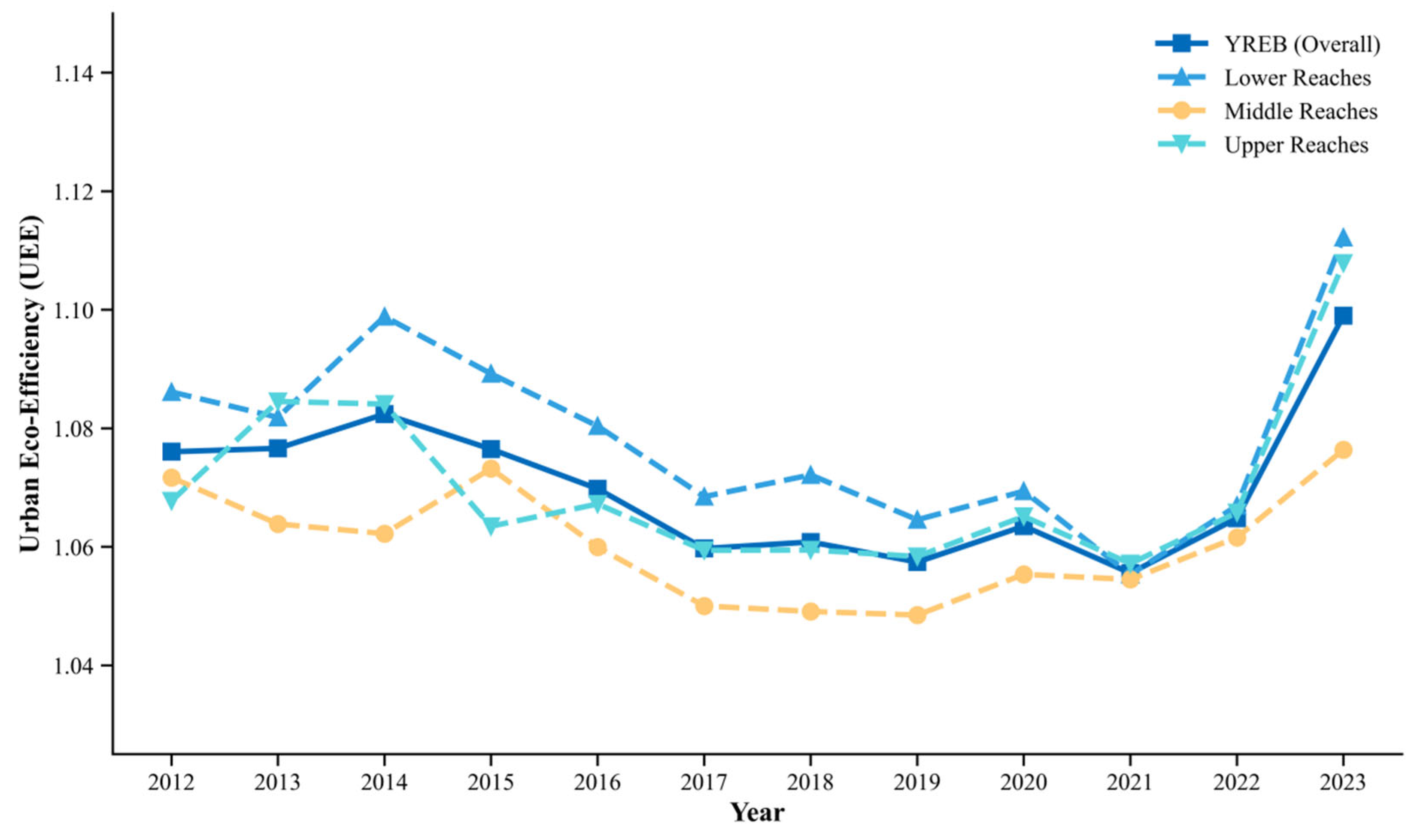
Figure 2.
3D kernel density evolution of the UEE in the YREB, 2012–2023.
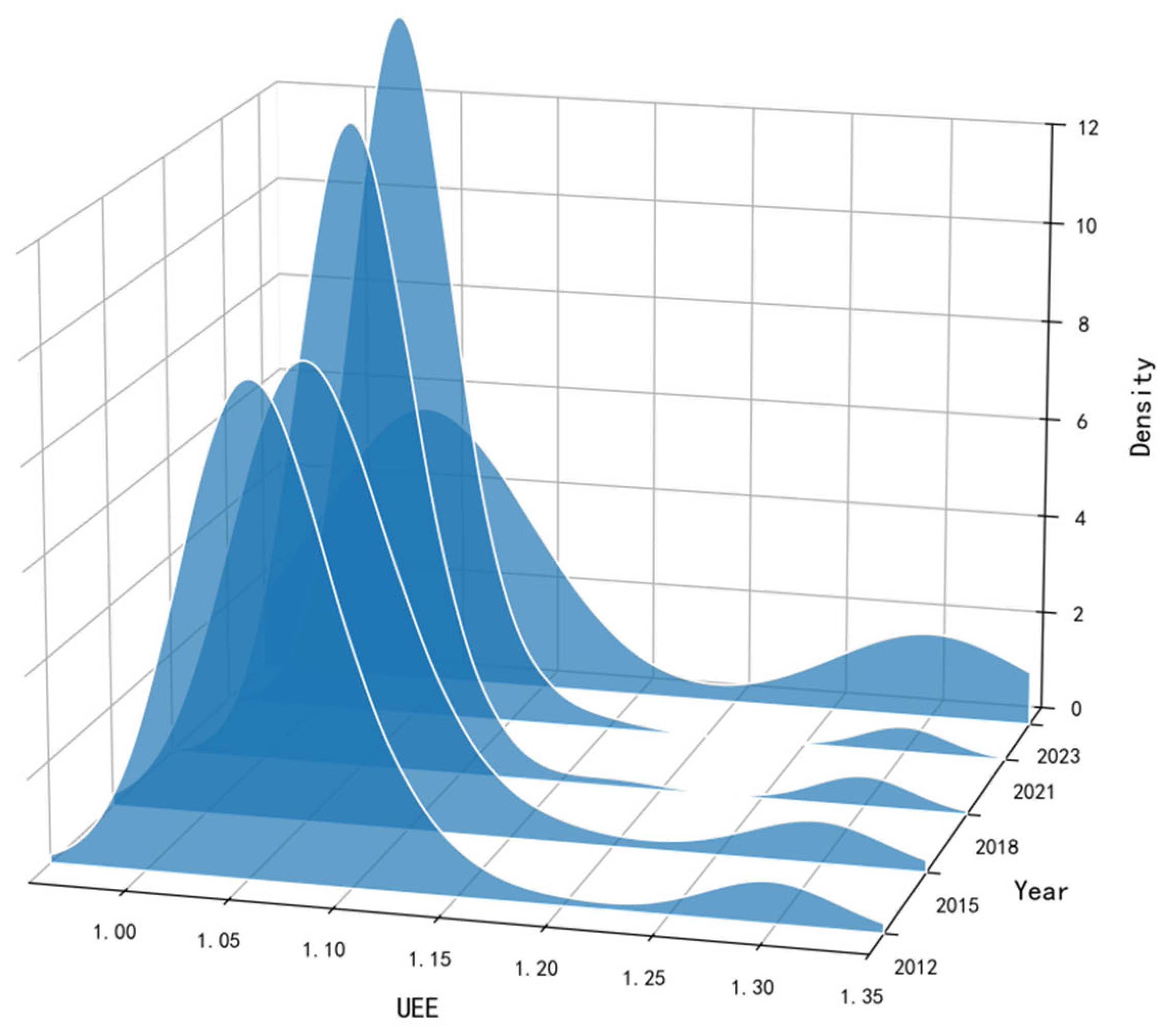
Figure 3.
Global driving feature importance analysis based on XGBoost-SHAP.
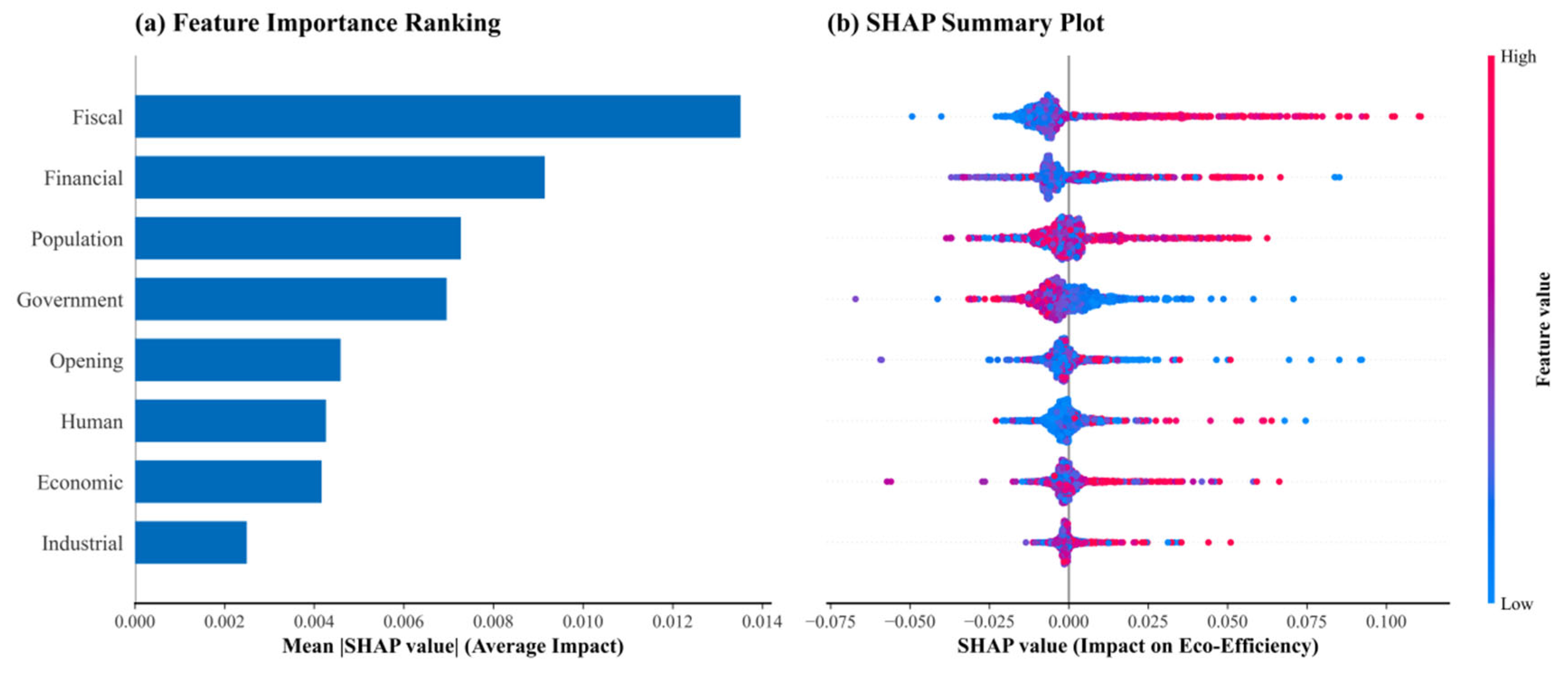
Figure 4.
SHAP dependence plots illustrating the nonlinear threshold and interactive effects.
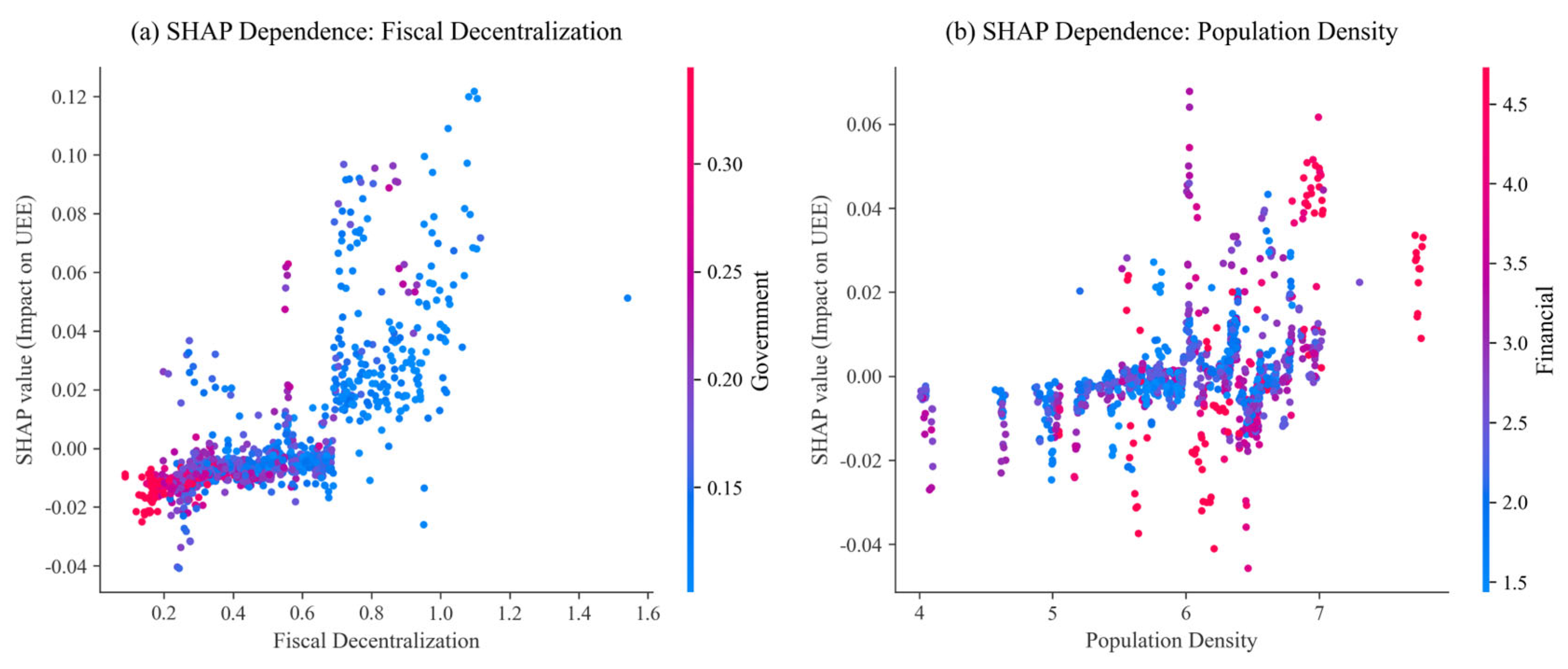
Figure 5.
Spatiotemporal evolution of regression coefficients for fiscal decentralization and population density in the YREB.
Figure 5.
Spatiotemporal evolution of regression coefficients for fiscal decentralization and population density in the YREB.
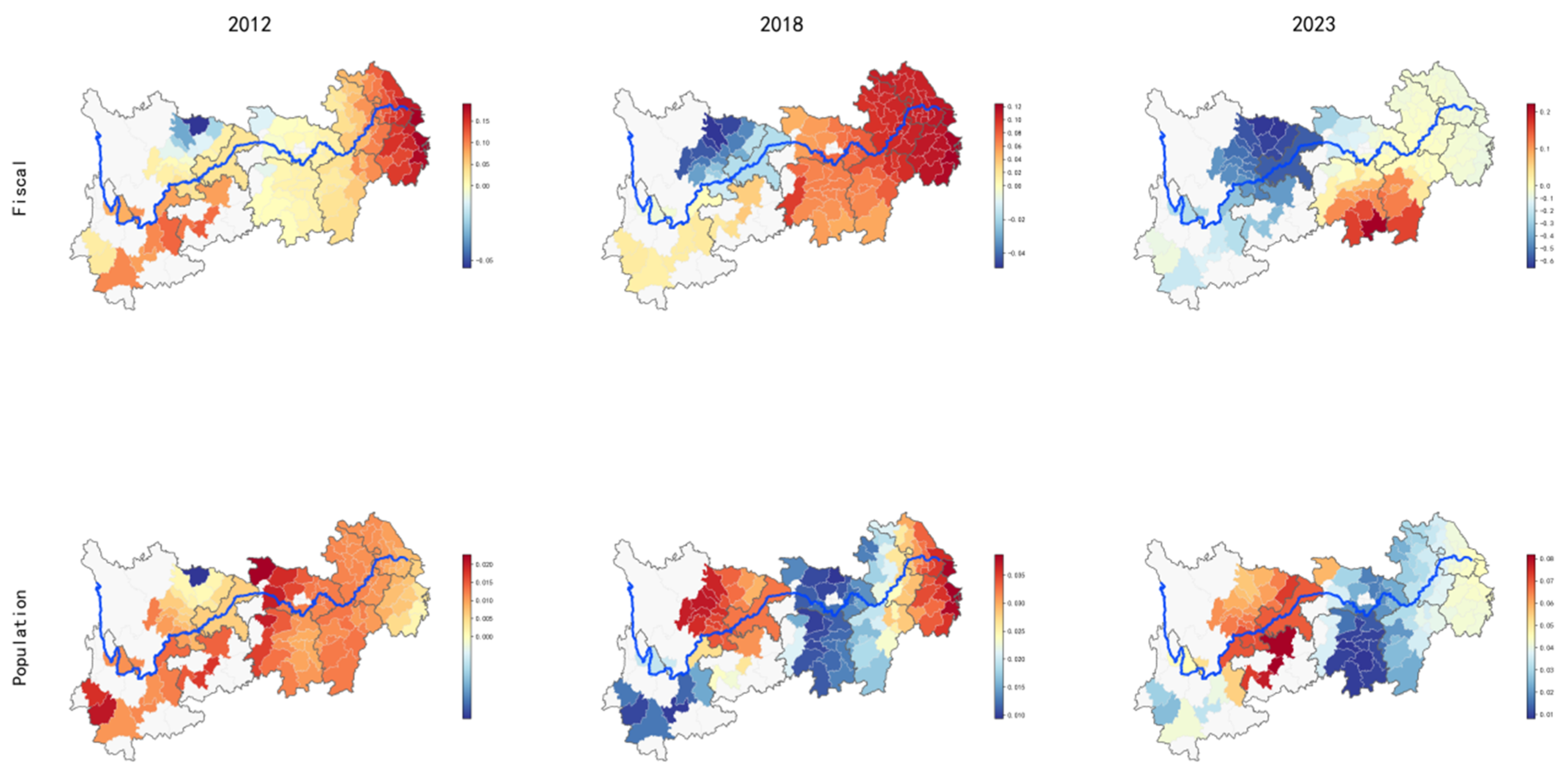

Table 1.
Descriptive statistics of input-output indicators for measuring UEE.
| Dimension | Variable | Symbol | Units | Obs. | Mean | Std. Dev. | Min | Max |
| Inputs | Labor force | Lab | 10,000 persons | 1296 | 110.297 | 726.682 | 6.974 | 22764.851 |
| Urban construction land | Land | 10,000 tce | 1296 | 176.975 | 315.712 | 0.5 | 2705.31 | |
| Capital stock | Cap | km2 | 1296 | 10853.075 | 11862.488 | 734.363 | 112430.89 | |
| Electricity consumption | Ene | 100 million CNY | 1296 | 174.884 | 243.788 | 3.736 | 1848.808 | |
| Water supply | Wat | 10,000 tons | 1296 | 2.099 | 3.941 | 0.111 | 32.038 | |
| Desirable Outputs | Real GDP | GDP | 100 million CNY | 1296 | 2759.058 | 4036.261 | 165.83 | 47218.97 |
| Urban carbon sink | UCS | hm2 | 1296 | 13.387 | 17.63 | 0.396 | 147.034 | |
| Undesirable Outputs | Wastewater emissions | Was | 10,000 tons | 1296 | 0.619 | 0.783 | 0.006 | 7.075 |
| SO₂ emissions | SO2 | 10,000 tons | 1296 | 2.547 | 4.064 | 0.007 | 50.979 | |
| Dust emissions | Dus | 10,000 tons | 1296 | 2.179 | 4.262 | 0.049 | 134.737 | |
| CO₂ emissions | CO2 | 10,000 tons | 1296 | 3276.331 | 3438.82 | 190.878 | 20527.074 |
Table 2.
Descriptive statistics and multicollinearity diagnostic results of main variables.
| Variable | Symbol | Definition | Units | Obs | Mean | Std.Dev | Min | Max | Tolerance | VIF |
| Economic development | Economic | Real GDP per capita | CNY/person | 1296 | 10.847 | 0.685 | 9.133 | 12.655 | 0.226 | 4.423 |
| Industrial structure upgrading | Industrial | Value added of tertiary industry / Value added of secondary industry | % | 1296 | 0.472 | 0.218 | 0.088 | 1.541 | 0.307 | 3.26 |
| Opening-up level | Opening | Actual utilized foreign direct investment / GDP | % | 1296 | 0.194 | 0.081 | 0.076 | 0.675 | 0.312 | 3.206 |
| Population density | Population | Year-end total population / Land area | persons/km2 | 1296 | 2.584 | 1.004 | 0.779 | 7.174 | 0.34 | 2.939 |
| Financial development | Financial | Year-end loan balance of financial institutions / GDP | % | 1296 | 0.438 | 0.092 | 0.207 | 0.752 | 0.428 | 2.337 |
| Human capital | Human | Number of college students / Total population | % | 1296 | 0.02 | 0.025 | 0 | 0.144 | 0.471 | 2.125 |
| Government intervention | Government | General public budget expenditure / GDP | % | 1296 | 6.016 | 0.638 | 4.009 | 7.778 | 0.595 | 1.679 |
| Fiscal decentralization | Fiscal | Local budgetary revenue / Local budgetary expenditure | % | 1296 | 0.003 | 0.003 | 0 | 0.02 | 0.768 | 1.302 |
Table 3.
Global Moran's I Index of UEE in the YREB.
| Year | Moran's I | Z-score | P-value | Year | Moran's I | Z-score | P-value |
| 2012 | 0.0011 | 0.5455 | 0.585 | 2018 | -0.0094 | -0.0019 | 0.998 |
| 2015 | -0.0125 | -0.1665 | 0.868 | 2023 | -0.0123 | -0.1549 | 0.877 |
Table 4.
Performance comparison of driving mechanism regression models.
| Model Category | Model | Adjusted | RSS | AICc | |
| Global Benchmark | OLS | 0.1795 | 0.1744 | 4.7674 | -3568.35 |
| Temporal-only | TWR | 0.2476 | 0.2429 | 4.3753 | -3630.64 |
| Spatial-only | GWR | 0.4245 | 0.3651 | 3.3441 | -3776.34 |
| Spatiotemporal Coupling | GTWR | 0.4494 | 0.4460 | 3.2015 | -3828.72 |
Table 5.
Statistical characteristics of local regression coefficients from the GTWR model.
| Variable | Mean | positive values | Min | Max | Lower | Middle | Upper |
| Economic | 0.0369 | 74.69% | -0.0354 | 0.3464 | 0.008 | 0.0137 | 0.1022 |
| Industrial | 0.0926 | 78.47% | -0.2514 | 0.5495 | 0.0434 | 0.1344 | 0.1092 |
| Opening | 1.4373 | 52.01% | -6.8913 | 19.1371 | -1.3662 | -0.7727 | 7.7115 |
| Population | 0.0222 | 99.15% | -0.0022 | 0.0818 | 0.0226 | 0.0147 | 0.0305 |
| Financial | 0.0056 | 73.77% | -0.0514 | 0.0885 | 0.0064 | 0.0055 | 0.0047 |
| Human | 0.0776 | 59.95% | -2.8899 | 2.0532 | 0.6601 | -0.0737 | -0.5171 |
| Government | 0.044 | 60.03% | -0.4992 | 0.7319 | 0.113 | -0.1214 | 0.1447 |
| Fiscal | 0.0048 | 65.05% | -0.6548 | 0.2217 | 0.0682 | 0.0337 | -0.1125 |
Disclaimer/Publisher’s Note: The statements, opinions and data contained in all publications are solely those of the individual author(s) and contributor(s) and not of MDPI and/or the editor(s). MDPI and/or the editor(s) disclaim responsibility for any injury to people or property resulting from any ideas, methods, instructions or products referred to in the content. |
© 2026 by the authors. Licensee MDPI, Basel, Switzerland. This article is an open access article distributed under the terms and conditions of the Creative Commons Attribution (CC BY) license (http://creativecommons.org/licenses/by/4.0/).
Copyright: This open access article is published under a Creative Commons CC BY 4.0 license, which permit the free download, distribution, and reuse, provided that the author and preprint are cited in any reuse.


