

Submitted:
21 April 2026
Posted:
22 April 2026
You are already at the latest version
Abstract
Understanding human disease requires frameworks that can connect molecular and cellular perturbations to systems-level dysfunction and clinical phenotype across time. Recent advances in single-cell and spatial profiling have revealed that cellular identity is dynamic and distributed across continuous state landscapes, while developments in electrophysiology, neuroimaging, and circuit analysis have underscored the importance of distributed neural dynamics in health and disease. In parallel, artificial intelligence (AI) has emerged as a powerful approach for analyzing high-dimensional, multimodal biomedical data and reconstructing biological relationships that are difficult to resolve using conventional methods alone. In this narrative review, we examine how AI-based methods can be used to map cellular and neural circuit state transitions in human disease and how these approaches may be integrated to support multiscale models of disease progression. We discuss current strategies for characterizing cellular state landscapes, including single-cell, spatial, trajectory-based, graph-based, and multimodal approaches, and we review AI-driven methods for decoding neural circuit dynamics from electrophysiological, imaging, and large-scale functional datasets. We further highlight bidirectional interactions linking cellular states, synaptic and microcircuit remodeling, circuit-level dysfunction, and behavioral or clinical outcomes, emphasizing disease progression as a sequence of coupled transitions across molecular, cellular, synaptic, and network scales. Finally, we discuss the implications of AI-integrated multiscale medicine for biomarker discovery, disease trajectory modeling, therapeutic window identification, and adaptive precision intervention, while addressing challenges related to causality, interpretability, validation, ethics, and clinical translation. Together, these developments support a shift from static classifications of disease toward dynamic, multiscale, and clinically relevant models that better reflect the evolving behavior of biological systems.
Keywords:
artificial intelligence
; cellular state transitions
; neural circuit dynamics
; multiscale disease modeling
; single-cell omics
; multimodal integration
; disease trajectory modeling
; precision medicine
1. Introduction
Understanding the mechanisms underlying human disease remains a central challenge in biomedical science. Traditional approaches have largely relied on reductionist and static models, in which biological systems are decomposed into discrete components such as genes, proteins, or cell types. While these frameworks have provided important mechanistic insights, they often do not fully capture the dynamic and multiscale nature of disease progression, which involves coordinated changes across molecular, cellular, tissue, and system-level processes [1,2]. Increasing evidence suggests that many diseases evolve through temporally structured transitions rather than fixed pathological states, indicating that static representations may be insufficient to explain disease initiation, progression, and therapeutic response.
Recent experimental and computational studies indicate that cellular identity is not fixed, but instead exists along continuous and context-dependent state spaces. Technologies such as single-cell transcriptomics, spatial transcriptomics, and lineage tracing have revealed that cells transition between functional states in response to developmental signals, environmental cues, and pathological perturbations [3,4,5,6]. These findings have led to a conceptual shift in which disease processes are increasingly interpreted as trajectories through cellular state space, rather than static deviations from a normal baseline. This perspective emphasizes the importance of identifying not only cellular compositions but also the dynamic pathways that connect cellular states over time.
In parallel, a growing body of work highlights the importance of neural circuits as fundamental units of brain function and dysfunction. Neural activity arises from coordinated interactions within distributed networks of neurons and glial cells, and disruptions at the circuit level have been associated with a range of neurological and psychiatric conditions, including neurodegenerative disorders, epilepsy, and mood disorders [7,8,9,10]. However, cellular and circuit-level processes are frequently investigated in isolation, limiting our ability to understand how molecular and cellular alterations propagate to system-level dysfunction. Bridging this gap remains a key challenge in contemporary neuroscience and systems medicine.
Artificial intelligence (AI) has emerged as a powerful set of computational approaches for analyzing complex, high-dimensional biological data. Machine learning and deep learning methods have demonstrated the ability to extract meaningful patterns from diverse datasets, including single-cell omics, spatial profiling, electrophysiological recordings, and neuroimaging data [11,12,13,14]. Importantly, these approaches enable the integration of heterogeneous data types and support the reconstruction of dynamic biological processes across multiple scales. As such, AI provides a potential framework for linking cellular state dynamics with higher-order functional organization.
Despite these advances, existing reviews have largely focused on either cellular-level analyses, such as single-cell omics and trajectory inference, or circuit-level investigations, including neural decoding and brain imaging, often treating these domains as distinct areas of study. There remains a relative lack of integrative frameworks that explicitly connect cellular state transitions with neural circuit dynamics, particularly in the context of AI-driven analysis [11,15,16,17]. This gap limits the development of comprehensive models capable of explaining how local cellular changes contribute to system-level dysfunction and clinical phenotypes.
In this narrative review, we aim to address this gap by synthesizing current advances in AI-driven cellular state mapping and neural circuit analysis within a unified conceptual framework. Specifically, we examine how AI-based methods can be used to map cellular and neural circuit state transitions in human disease, and how these approaches can be integrated to support multiscale models of disease progression. We discuss methodologies for modeling cellular state landscapes, approaches for decoding neural circuit dynamics, and emerging strategies for linking these levels across biological scales. By doing so, this review provides a conceptual foundation for future work aimed at developing integrative, AI-enabled models of human disease.
The importance of this review lies in its focus on connecting previously fragmented domains into a coherent framework. By integrating cellular and circuit-level perspectives and highlighting the role of AI as an enabling technology, this work outlines a path toward more comprehensive and predictive models of disease. Such models may ultimately support improved diagnostic strategies, more precise therapeutic interventions, and a deeper understanding of the dynamic processes that underlie human health and disease.
2. Cellular State Landscapes in Human Disease
2.1. Technologies Enabling Cellular State Profiling
Advances in single-cell and spatial profiling technologies have substantially refined our understanding of cellular organization in both healthy and diseased tissues. Techniques such as single-cell RNA sequencing (scRNA-seq) enable the measurement of gene expression at the resolution of individual cells, revealing extensive cellular heterogeneity and identifying previously unrecognized subpopulations within complex tissues [18,19,20,21]. These approaches have demonstrated that cellular populations previously considered homogeneous often consist of diverse functional states with distinct molecular profiles.
Complementary methods, including spatial transcriptomics and multiplexed imaging technologies, preserve the spatial context of gene expression, allowing the mapping of cellular states within intact tissue architectures [22,23,24,25]. This spatial information is particularly important in disease contexts, where cellular behavior is influenced by local microenvironments, gradients of signaling molecules, and cell–cell interactions. Together, these technologies provide a multidimensional view of tissue organization by integrating molecular identity with spatial and contextual information.
2.2. Cellular State Continuums and Landscape Frameworks
Traditional biological models have classified cells into discrete types defined by stable molecular markers. However, accumulating experimental evidence indicates that cellular identity is more accurately represented as a continuum of states, rather than fixed categories. Cells can transition between functional states in response to developmental programs, environmental signals, and pathological perturbations [26,27,28,29].
Lineage tracing and trajectory-based analyses further support this view, suggesting that cellular populations are organized along continuous developmental and functional pathways. These observations have led to the concept of cellular state landscapes, in which cells occupy positions within a high-dimensional space defined by transcriptional, epigenetic, and functional features.
Within this framework, biological processes such as differentiation, activation, and stress adaptation can be interpreted as movements through state space. This perspective allows for the identification of intermediate and transitional states that may not be captured by traditional classification systems but may play critical roles in disease initiation and progression.
2.3. Disease as a Perturbation of Cellular State Landscapes
In disease contexts, cellular state landscapes are often altered, reflecting shifts in population distributions and transitions between functional states. Rather than representing a single abnormal state, many diseases involve dynamic and progressive changes across multiple cellular states.
For example, tumor progression has been associated with transitions between proliferative, invasive, and therapy-resistant cellular states, with evidence suggesting that cancer cells can dynamically adapt to environmental pressures and therapeutic interventions [30,31,32,33]. Similarly, in inflammatory and immune-mediated conditions, immune cells transition between activation states that influence tissue damage and repair processes.
In neurological disorders, both neuronal and glial populations exhibit progressive changes in gene expression and functional properties that may precede overt pathology. Disease-associated cellular states, particularly among microglia and astrocytes, have been implicated in neurodegenerative processes and may contribute to circuit-level dysfunction [34,35,36,37]. These observations support the interpretation of disease as a trajectory through a perturbed cellular state landscape.
2.4. Dynamics, Quantification, and Transition Modeling
Cellular state transitions are often nonlinear and context-dependent, reflecting the influence of multiple interacting factors, including microenvironmental signals, immune interactions, metabolic conditions, and systemic inputs [28,38,39]. These dynamics can give rise to complex transition patterns, including branching trajectories, reversible states, and critical transition points.
Quantitatively, cellular states are often represented within high-dimensional feature spaces derived from gene expression or multimodal data. Dimensionality reduction techniques, such as principal component analysis and manifold learning approaches, are commonly used to project these data into lower-dimensional representations that preserve key structural relationships. Methods such as pseudotime analysis attempt to order cells along inferred trajectories, providing a temporal framework for studying state transitions.
In addition, probabilistic and graph-based models have been used to describe cellular state transitions as networks, where nodes represent states and edges represent transition probabilities. These approaches allow for the identification of stable states, transitional intermediates, and potential tipping points within cellular systems. However, it is important to recognize that these models are often based on snapshot data and rely on assumptions regarding temporal relationships, which may not fully capture underlying biological dynamics.
The progression from cellular heterogeneity to disease-perturbed cellular states is illustrated schematically in Figure 1.
2.5. Limitations and Challenges in Cellular State Mapping
Despite significant advances, several limitations remain in current approaches to cellular state mapping. Many single-cell and spatial profiling techniques capture static snapshots of dynamic biological processes, making it challenging to directly infer temporal relationships and causal mechanisms [6,40,41]. Trajectory inference methods, while informative, often rely on computational assumptions that may not reflect true biological progression.
Technical challenges, including batch effects, variability in data quality, and limitations in spatial resolution, can also affect the interpretation of results. Additionally, integrating multimodal datasets across platforms and scales remains a complex task, requiring robust computational frameworks and standardized methodologies.
Another important challenge lies in translating cellular state information into functional and clinical insights. While changes in gene expression can indicate shifts in cellular states, linking these changes to functional outcomes and disease phenotypes requires further experimental validation.
Addressing these limitations will be essential for advancing the field and for enabling more accurate and predictive models of disease based on cellular state landscapes.
3. Artificial Intelligence for Cellular State Mapping
3.1. Computational Challenges in Cellular State Analysis
The analysis of cellular state landscapes presents substantial computational challenges due to the high dimensionality, sparsity, and heterogeneity of single-cell and spatial datasets. Modern profiling technologies generate measurements across thousands of molecular features per cell, often spanning large and diverse cellular populations. These datasets are further complicated by technical variability, batch effects, and incomplete sampling of biological states [42,43,44].
In addition, cellular state transitions are inherently dynamic, whereas most experimental measurements represent static snapshots. Reconstructing trajectories and inferring relationships between cellular states therefore requires computational approaches capable of extracting structure from high-dimensional, partially observed data. These challenges have motivated the increasing application of artificial intelligence (AI) and machine learning methods in the analysis of cellular systems.
3.2. Machine Learning for Representation and Feature Extraction
Machine learning approaches have been widely applied to identify latent structures within high-dimensional single-cell datasets. Dimensionality reduction techniques, such as principal component analysis and nonlinear manifold learning methods, are commonly used to project gene expression data into lower-dimensional spaces that preserve meaningful relationships between cells [45,46,47].
More recently, deep learning approaches, including autoencoders and variational autoencoders, have been employed to learn compact and denoised representations of cellular states. These models are capable of capturing nonlinear relationships within the data and have been used to improve clustering, visualization, and characterization of cellular populations [48,49,50].
Such representations facilitate the identification of cellular subpopulations, gradients of variation, and rare or transient states. However, the biological interpretability of learned features remains an ongoing challenge, as latent representations do not always correspond directly to well-defined molecular or functional variables.
3.3. Trajectory Inference and Modeling of State Transitions
A central objective in cellular state analysis is the reconstruction of developmental and disease-related trajectories. Trajectory inference algorithms aim to order cells along pseudotemporal axes, providing a computational framework for studying dynamic processes such as differentiation, activation, and disease progression [28,51,52,53].
These methods typically rely on assumptions of continuity between cellular states and use graph-based, probabilistic, or geometric approaches to model transitions. Because many datasets are cross-sectional, temporal relationships must be inferred indirectly, often through the structure of the data manifold.
While trajectory inference has provided valuable insights into cellular dynamics, several limitations should be considered. Pseudotime does not necessarily correspond to real biological time, and inferred trajectories may be sensitive to preprocessing steps, sampling density, and modeling assumptions. Consequently, trajectory-based findings are most robust when supported by complementary experimental approaches, such as lineage tracing or time-resolved measurements.
3.4. Graph-Based and Network Modeling Approaches
Graph-based methods have emerged as a powerful framework for modeling relationships between cellular states. In these approaches, cells are represented as nodes within a graph, and edges represent similarities or inferred transitions between states. This structure enables the analysis of both local and global relationships within cellular populations [54,55,56,57].
Graph neural networks (GNNs) extend this framework by enabling the learning of representations that incorporate both node-level features and network topology. These models have been applied to tasks such as cell classification, trajectory inference, and the integration of spatial and molecular data.
Network-based approaches also support the analysis of interactions between cells and their microenvironments, facilitating the identification of signaling pathways and regulatory relationships that influence state transitions. However, the construction of biologically meaningful graphs remains nontrivial, as outcomes may depend on the choice of similarity metrics, neighborhood definitions, and graph structure.
3.5. Multimodal Integration and Inference of Cellular State Transitions
A major strength of contemporary AI-based approaches lies in their capacity to integrate multimodal datasets, including transcriptomic, epigenomic, proteomic, and spatial measurements, into unified analytical frameworks. Because cellular states are shaped by multiple layers of regulation, analyses based on a single modality may provide only partial representations of underlying biological processes. Integrative computational models therefore aim to construct joint representations of cellular identity that capture complementary information across data types [58,59,60,61].
In practice, multimodal integration involves several computational tasks, including cross-modal alignment of cells measured in different assays, joint embedding of heterogeneous datasets into shared latent spaces, imputation of missing modalities, and inference of regulatory relationships linking molecular layers [55,58,60,62]. Deep learning architectures, matrix factorization approaches, and graph-based integration frameworks have increasingly been applied to these problems, particularly in studies seeking to connect transcriptional states with chromatin accessibility, protein expression, or spatial organization.
These approaches are particularly relevant for studying cellular state transitions, as they can improve the resolution of intermediate states and help distinguish transient from more stable phenotypic changes. Multimodal models may also support the inference of lineage relationships, differentiation pathways, and activation programs by incorporating complementary regulatory information. In disease contexts, this can facilitate the identification of transition-associated programs that may not be apparent from transcriptomic data alone [38,59,62,63].
At the same time, multimodal integration remains technically and conceptually challenging. Different data modalities vary in scale, resolution, sparsity, and noise characteristics, and many datasets do not measure all features within the same cells. As a result, integrated models rely on assumptions regarding correspondence between modalities and require careful normalization and alignment strategies. These factors can influence downstream biological interpretation, and AI-derived inferences are most informative when supported by independent experimental validation. A summary of major technologies, data modalities, and AI approaches used to map cellular and circuit state transitions is provided in Table 1.
Taken together, AI-based approaches have expanded the analytical capacity of cellular state research from descriptive profiling toward more integrative and predictive modeling. By enabling the reconstruction of cellular trajectories, the identification of latent structures, and the integration of multimodal data, these methods provide new insights into the organization and dynamics of cellular systems.
However, an important next step lies in extending these approaches beyond cellular-level analysis to incorporate higher-order functional organization. In particular, linking cellular state transitions to neural circuit dynamics represents a critical and relatively underexplored direction. Understanding how molecular and cellular changes propagate to network-level dysfunction is essential for developing comprehensive models of disease, especially in the context of neurological and psychiatric disorders. The following section therefore examines neural circuits as dynamic systems and considers how AI-based approaches can be applied to decode circuit-level organization and dysfunction.
4. Neural Circuits as Dynamic Disease Networks
4.1. Organization and Functional Principles of Neural Circuits
In parallel with advances in cellular biology, substantial progress has been made in understanding the organization and function of neural circuits. Neural circuits consist of interconnected networks of neurons and glial cells, whose coordinated activity underlies perception, cognition, and behavior. Rather than acting as isolated units, individual neurons participate in distributed networks, where information is encoded through patterns of connectivity and activity across populations of cells [75,84,85].
Circuit function is shaped by multiple interacting factors, including synaptic connectivity, intrinsic cellular properties, neuromodulatory signaling, and interactions with non-neuronal cell types such as astrocytes and microglia. These components collectively determine how information is processed and transmitted within the nervous system. Importantly, neural circuits are dynamic and adaptable, exhibiting plasticity in response to experience, environmental changes, and physiological conditions.
4.2. Experimental Mapping of Circuit Structure and Dynamics
Technological developments have enabled increasingly detailed characterization of neural circuit structure and activity. Connectomic approaches, including high-resolution anatomical reconstruction and viral tracing methods, have provided insights into the organization of neural networks across scales [86,87,88,89]. These structural data define the connectivity patterns that constrain circuit function.
Functional measurements, including in vivo calcium imaging, electrophysiological recordings, and neuroimaging approaches such as functional MRI, allow the observation of neural activity across populations of cells and brain regions [75,84,90]. These studies indicate that neural circuits exhibit complex, time-dependent patterns of activity, often involving coordinated dynamics across distributed regions.
Together, structural and functional approaches provide complementary perspectives on neural circuits. However, integrating these data to obtain a unified understanding of circuit organization and dynamics remains a significant challenge, particularly in the context of large-scale datasets.
4.3. Neural Circuit Dysfunction and Disease Signatures
Disruptions in neural circuit organization and activity have been implicated in a wide range of neurological and psychiatric disorders. Many conditions are increasingly understood not solely as disorders of individual cell types, but as disturbances of network-level function that affect information processing across distributed systems.
For example, in Parkinson’s disease, degeneration of dopaminergic neurons alters activity patterns within basal ganglia circuits, leading to motor dysfunction [91,92,93]. In mood disorders such as depression, dysregulation of limbic and prefrontal networks has been associated with altered emotional processing and cognitive control [94,95,96]. In epilepsy, abnormal synchronization of neuronal populations results in recurrent seizure activity, reflecting pathological network dynamics [97,98].
In neurodegenerative diseases, circuit dysfunction often emerges prior to widespread neuronal loss, suggesting that early alterations in network activity may contribute to disease progression [99,100,101]. These observations support the concept of circuit-level disease signatures, in which specific patterns of connectivity and activity are associated with distinct disease states.
4.4. Dynamic Circuit States, Cellular Interactions, and Challenges
Neural circuits can be understood as dynamic systems that transition between functional states over time. These circuit states are characterized by coordinated patterns of activity across neuronal populations and may reflect distinct modes of information processing. Transitions between such states can occur over multiple timescales and are influenced by both intrinsic cellular properties and external inputs [102,103].
Importantly, circuit dynamics are closely linked to underlying cellular and molecular processes. Changes in neuronal excitability, synaptic strength, and cellular stress responses can alter network activity, while glial cells—including astrocytes and microglia—actively modulate synaptic transmission, metabolic support, and inflammatory signaling [104,105,106,107,108]. These interactions highlight the bidirectional relationship between cellular states and circuit-level function.
Despite advances in experimental and analytical approaches, several challenges remain. Neural circuits operate across multiple spatial and temporal scales, and their behavior cannot be fully captured by any single measurement modality. Integrating structural connectivity, functional activity, and cellular-level information remains complex, and many datasets provide only partial views of circuit dynamics.
Furthermore, linking circuit-level observations to underlying biological mechanisms continues to be a major challenge. Understanding how changes in cellular states propagate to network dysfunction requires integrative frameworks capable of connecting molecular, cellular, and systems-level processes.
Taken together, these considerations suggest that neural circuits should be viewed as dynamic, multiscale systems that evolve over time and are shaped by interactions across biological levels. Characterizing circuit state transitions, and understanding how they relate to underlying cellular processes, remains essential for developing integrative models of disease. The complexity and scale of neural circuit data, however, present significant analytical challenges, particularly in capturing nonlinear and time-dependent relationships across distributed networks.
5. AI-Driven Neural Circuit Decoding
5.1. Decoding, Classification, and Prediction of Neural Activity
Artificial intelligence has been increasingly applied to the analysis of neural circuit data, particularly in tasks involving the decoding, classification, and prediction of neural activity patterns. Machine learning algorithms can process high-dimensional datasets generated by electrophysiological recordings, calcium imaging, and related techniques, enabling the identification of relationships between neural activity and behavioral or cognitive variables [73,109,110].
Decoding approaches aim to infer external or internal variables—such as sensory stimuli, motor outputs, or cognitive states—from patterns of neural activity. These methods are often implemented using supervised learning models trained on labeled datasets. In parallel, classification tasks involve distinguishing between discrete conditions, such as behavioral states or disease categories, based on neural data. Predictive modeling extends these approaches by attempting to forecast future neural states, behavioral outcomes, or transitions between functional states [110,111].
Recent work has employed deep learning architectures to capture complex and nonlinear relationships within neural population activity, improving performance in decoding and prediction tasks [73,111]. These approaches have contributed to a more detailed understanding of how information is represented across neural circuits. However, model performance is influenced by data quality, sampling density, and inter-individual variability, and high predictive accuracy does not necessarily imply mechanistic interpretability.
5.2. AI Analysis of Brain Imaging and Large-Scale Circuit Data
AI-based methods have been widely used to analyze large-scale neural datasets derived from brain imaging modalities such as functional magnetic resonance imaging (fMRI), electroencephalography (EEG), and magnetoencephalography (MEG). These techniques capture activity across distributed brain regions and generate complex, time-resolved datasets that require advanced computational approaches for analysis [112,113].
Machine learning models have been applied to identify patterns of functional connectivity, characterize network organization, and classify disease states based on imaging data [113,114,115]. For example, AI approaches have been used to distinguish patient populations from healthy controls, identify biomarkers associated with neurological and psychiatric disorders, and stratify individuals based on disease subtypes or progression trajectories.
In addition to classification, predictive models have been developed to estimate disease progression, treatment response, and transitions between clinical states [112]. Unsupervised and representation learning methods have further enabled the identification of latent structures within imaging data, revealing patterns of network organization that may not be captured by conventional analyses.
Despite these advances, challenges remain in terms of reproducibility, generalizability across datasets, and sensitivity to confounding factors such as demographic variability and acquisition protocols. These limitations highlight the need for careful validation and standardization in AI-based analyses of large-scale neural data.
5.3. Brain–Machine Interfaces, Closed-Loop Systems, and Modeling of Circuit Dynamics
Artificial intelligence plays a central role in the development of brain–machine interfaces (BMIs), which aim to decode neural signals in real time and translate them into control outputs for external devices. Machine learning algorithms are used to map neural activity to motor commands or communication signals, enabling applications such as prosthetic control and assistive technologies for individuals with neurological impairments [82,116].
Beyond open-loop decoding, there is increasing interest in closed-loop systems, in which AI models continuously monitor neural activity and adapt system outputs in real time. Such approaches have been explored in contexts including adaptive neurostimulation, seizure detection and intervention, and modulation of pathological circuit activity [82,117]. These systems represent an important step toward dynamic interaction with neural circuits, where interventions are informed by ongoing circuit states.
AI methods are also increasingly used for the computational modeling of neural circuit dynamics. Approaches such as recurrent neural networks and dynamical systems models have been employed to simulate patterns of neural activity, characterize network stability, and predict responses to perturbations [118]. These models can provide insights into how circuit-level dynamics emerge from underlying interactions and may support hypothesis generation for experimental studies.
However, several challenges remain. Many AI models function as high-dimensional systems that are difficult to interpret, raising questions about their biological relevance. In addition, translating model outputs into mechanistic insights about neural circuits requires careful integration with experimental data and domain knowledge. Generalizability across individuals and conditions remains a further limitation, particularly in clinical applications. Addressing these challenges will be essential for advancing the use of AI in neural circuit research.
The relationship between cellular and circuit-level analytical streams, and their convergence within AI-enabled multiscale modeling, is illustrated schematically in Figure 2.
6. Linking Cellular States and Neural Circuits
6.1. Cellular–Circuit Interactions Across Scales
A major challenge in biomedical research is understanding how processes at the cellular level relate to circuit-level function across space and time. Increasing evidence suggests that these levels are closely interconnected and evolve through coupled dynamics, in which cellular states and circuit activity influence one another over time [119,120,121]. In this view, biological systems are not static but are characterized by continuous transitions, where changes at one level can propagate across scales and shape system-level behavior.
Neural activity has been shown to regulate stem-cell behavior, including proliferation, differentiation, and integration into existing circuits. Activity-dependent signaling mechanisms—mediated through neurotransmitter release, calcium dynamics, and downstream transcriptional programs—link circuit activity to cellular state transitions [122,123,124,125,126]. Conversely, changes in cellular states, including neuronal stress responses, alterations in excitability, and synaptic remodeling, can influence network dynamics and shift circuits between functional states.
Between the cellular and circuit levels, synapses and local microcircuits represent critical intermediate scales. Synaptic strength, plasticity mechanisms, and local connectivity patterns determine how signals are transmitted and transformed within networks. Changes at this mesoscopic level can amplify or buffer cellular perturbations, shaping how local alterations propagate into larger-scale circuit dynamics [120,125,127,128]. Thus, understanding disease-related processes requires considering not only individual cells and global circuits but also the intermediate structures that link them.
Glial cells play a central role in mediating these multiscale interactions. Astrocytes regulate synaptic transmission and metabolic support, while microglia contribute to immune surveillance, synaptic remodeling, and inflammatory signaling [104,121,129]. Transitions in glial states—such as reactive astrocytosis or microglial activation—can influence both synaptic function and network-level activity, thereby coupling cellular responses to circuit behavior.
In addition, neuroimmune signaling represents an important interface between cellular and circuit processes. Cytokines and other signaling molecules can modulate neuronal excitability and synaptic function, while neural activity can influence immune responses within the central nervous system [130,131]. These interactions contribute to a dynamic system in which cellular states, synaptic processes, and circuit activity are tightly interdependent and evolve over time.
6.2. Toward Integrative Multiscale Models of Disease
The bidirectional and temporally coupled interactions between cellular states and neural circuits highlight the need for integrative models that capture disease processes across multiple biological scales. Within such models, disease progression can be conceptualized as a sequence of linked transitions, in which cellular state changes, synaptic remodeling, and circuit-level dynamics co-evolve over time.
Alterations at the cellular level—such as changes in gene expression, metabolic state, or immune activation—can influence synaptic function and local microcircuit organization, which in turn affect large-scale network activity. These circuit-level changes can feed back to modulate cellular behavior, creating dynamic loops that shape disease trajectories [93,119,132,133]. This framework suggests that disease is not confined to a single level of organization but emerges from coupled state transitions across molecular, cellular, and network scales.
A schematic overview of coupled multiscale disease progression from cellular perturbation to circuit dysfunction and clinical phenotype is provided in Figure 3.
These multiscale interactions can be illustrated in specific disease contexts. In Parkinson’s disease, degeneration of dopaminergic neurons is associated with shifts in cellular states, including altered metabolic and stress responses, which propagate to changes in synaptic transmission and basal ganglia circuit dynamics, ultimately leading to motor dysfunction. Similarly, in Alzheimer’s disease, transitions in glial states—particularly microglial activation and astrocytic reactivity—are associated with synaptic alterations and progressive disruption of large-scale network activity, contributing to cognitive decline [92,93,134,135]. These examples highlight how cellular, synaptic, and circuit-level processes are interconnected and evolve together over the course of disease progression.
Such multiscale interactions are particularly relevant in conditions including neurodegenerative diseases, epilepsy, and neuroinflammatory disorders, where progressive changes in cellular states are closely linked to alterations in circuit dynamics [135,136,137]. In these contexts, early cellular perturbations may lead to subtle changes in synaptic and network activity that precede overt clinical symptoms, while later-stage disease may involve reinforcing feedback between cellular dysfunction and circuit instability.
Artificial intelligence provides a potential framework for integrating data across these scales and modeling their interactions. By combining information from single-cell profiling, spatial mapping, synaptic and circuit-level measurements, and longitudinal data, AI-based approaches may enable the reconstruction of disease trajectories that span multiple levels of biological organization [83,132,138,139]. Such models may support the identification of key transition points and the prediction of how perturbations at one scale influence outcomes at another. Representative examples of how cellular state changes propagate through synaptic and circuit-level dysfunction to clinical phenotypes across disease contexts are summarized in Table 2.
However, significant challenges remain. Multiscale datasets are heterogeneous and often difficult to align, and causal relationships between cellular, synaptic, and circuit-level processes are not always clearly defined. In addition, interpreting model outputs in biologically meaningful ways requires careful integration with experimental evidence. Addressing these challenges will be essential for advancing multiscale models of disease and for translating these approaches into clinical applications.
7. Toward AI-Integrated Multiscale Medicine
7.1. Multiscale Organization of Disease and the Need for Integration
The integration of cellular and circuit-level analyses points toward the development of multiscale models of disease, in which biological processes are understood across interconnected levels of organization. Increasing evidence suggests that disease does not arise from isolated perturbations at a single level, but rather from coordinated changes that propagate across molecular, cellular, tissue, and systems-level processes [152,153,154,155].
Within this framework, disease can be conceptualized as a process that unfolds across multiple interacting domains, including cellular state landscapes, tissue and microenvironment organization, neural circuit dynamics, and behavioral or clinical outcomes. These levels are not independent; instead, they are linked through dynamic interactions and feedback mechanisms [153,154,156,157]. Changes in cellular states may alter tissue organization and local signaling environments, which in turn influence circuit-level activity and ultimately affect behavior and clinical presentation.
Importantly, these multiscale interactions unfold over time, suggesting that disease may be more accurately described as a trajectory through interconnected state spaces rather than as a sequence of independent events. Capturing these temporal relationships across scales remains a key challenge for current models.
7.2. Artificial Intelligence as a Framework for Multiscale Integration
Artificial intelligence provides a computational framework for integrating heterogeneous datasets and identifying patterns that span multiple biological scales. Machine learning and deep learning approaches are particularly well suited to handling high-dimensional, multimodal data and have been increasingly applied to problems involving data integration, representation learning, and predictive modeling [156,158,159,160].
In the context of multiscale medicine, AI-based approaches can be used to combine information from single-cell and spatial profiling, synaptic and circuit-level measurements, and clinical datasets [156,157,159]. By constructing joint representations of these data, AI models may enable the identification of relationships between cellular state transitions, tissue organization, and circuit dynamics. Such models can support the inference of disease trajectories, linking early molecular and cellular changes to later functional and clinical outcomes.
AI methods may also facilitate the identification of multiscale biomarkers, defined as features that integrate information across levels of biological organization. These biomarkers have the potential to provide more robust indicators of disease state and progression compared to single-modality measures.
While these approaches are effective in identifying patterns and associations across scales, it is important to distinguish between predictive performance and causal understanding. Many AI models capture correlations within data without explicitly resolving the underlying biological mechanisms, highlighting the need for integration with experimental and mechanistic studies.
7.3. Implications for Diagnosis, Prediction, and Therapeutic Strategies
AI-integrated multiscale approaches have the potential to influence several areas of biomedical research and clinical practice. One important application lies in the development of more precise diagnostic tools based on multiscale signatures that reflect coordinated changes across cellular, circuit, and behavioral levels [157,161,162]. Such approaches may improve early detection and enable more accurate differentiation between disease subtypes.
Predictive modeling represents another promising direction. By integrating longitudinal data across multiple scales, AI-based models may enable the prediction of disease progression, including transitions between clinical states and responses to therapeutic interventions [156,158,161,163]. These models may provide insight into the timing and sequence of disease-related changes, supporting more informed and adaptive clinical decision-making.
In addition, multiscale frameworks may inform the development of targeted therapeutic strategies that act across different levels of biological organization. Interventions may be designed to modulate molecular pathways, cellular states, synaptic function, or circuit dynamics, either individually or in combination [164,165,166,167]. Understanding how these levels interact may improve the design of therapeutic approaches that account for feedback between scales.
A schematic translational roadmap for AI-integrated multiscale medicine is shown in Figure 4.
Despite these opportunities, several challenges remain. Multiscale datasets are often heterogeneous, incomplete, and collected across different temporal and spatial resolutions, complicating their integration into unified models. Aligning cellular, circuit, and clinical data requires careful consideration of scale mismatches and temporal dynamics. In addition, translating computational findings into clinically actionable insights remains a significant hurdle, particularly given issues related to model interpretability, reproducibility, and validation across patient populations. Addressing these challenges will be essential for realizing the full potential of AI-integrated multiscale medicine.
8. Future Directions
Future developments in this field are likely to be driven by continued advances in both data generation and computational methodologies, enabling more comprehensive and temporally resolved representations of biological systems. Emerging technologies in single-cell and spatial profiling, high-resolution connectomics, and large-scale neural recording are expanding the ability to capture biological processes across multiple levels of organization. At the same time, improvements in artificial intelligence and computational modeling are providing new tools for integrating these datasets and extracting meaningful patterns from increasingly complex and high-dimensional data [161,168,169,170].
One promising direction involves the development of digital twins of biological systems, in which computational models are used to simulate individual disease trajectories based on patient-specific data. Such models may incorporate information across molecular, cellular, synaptic, circuit, and clinical levels, enabling the exploration of how perturbations at one scale influence outcomes at others. In parallel, AI-based approaches may support real-time analysis of neural activity, enabling adaptive and responsive interventions informed by ongoing circuit dynamics. A major future objective will be the ability to identify and model critical state transitions across these interconnected levels, including transition points that may represent opportunities for earlier or more effective therapeutic intervention [171,172,173].
The integration of longitudinal and multimodal datasets represents another critical area of progress. By combining data collected over time and across multiple modalities, it may become possible to construct more accurate models of disease progression that capture both temporal dynamics and multiscale interactions. Such approaches could support earlier detection of disease-related changes, improved prediction of clinical trajectories, and more precise identification of intervention windows. In this context, personalized modeling of disease may enable strategies tailored to individual patients, taking into account variability in genetic, cellular, and circuit-level factors [174,175,176].
Despite these opportunities, several challenges remain. Multiscale datasets are often heterogeneous, incomplete, and collected across different temporal and spatial resolutions, complicating their integration into unified models [177,178,179]. Data standardization and harmonization across platforms and institutions will be necessary to enable robust and reproducible analyses. Model validation is also critical, particularly in ensuring that computational predictions are reliable and generalizable across diverse patient populations [169,180,181,182]. Issues related to interpretability remain central, as complex AI models must be linked to biologically meaningful mechanisms to support scientific understanding and clinical trust. In addition, ethical considerations—including data privacy, algorithmic bias, and equitable access to emerging technologies—must be carefully addressed as these approaches move toward clinical implementation. Key challenges, emerging opportunities, and future priorities for AI-integrated multiscale medicine are summarized in Table 3.
Addressing these challenges will require coordinated efforts across experimental, computational, and clinical disciplines, as well as the development of shared infrastructures for data integration and model evaluation. Prospective validation in clinically relevant settings will be essential to determine whether these models can improve decision-making and patient outcomes in real-world practice. As these efforts progress, they may contribute to a shift toward more predictive, dynamic, and personalized approaches to understanding and treating human disease, grounded in the ability to map and modulate biological state transitions across scales.
Conclusions
Artificial intelligence is providing new tools for understanding the dynamic and multiscale nature of human disease. By enabling the integration of cellular state mapping and neural circuit analysis, AI-based approaches support a shift from static representations of pathology toward models that capture how disease emerges, evolves, and propagates across biological systems over time. In this context, disease can be conceptualized not as a fixed condition, but as a trajectory through interconnected cellular and circuit state spaces, shaped by continuous interactions across molecular, cellular, synaptic, and network levels.
Advances in single-cell and spatial profiling have revealed the complexity and plasticity of cellular state landscapes, while developments in circuit-level recording and analysis have underscored the importance of distributed network dynamics in shaping function and dysfunction. Artificial intelligence provides a unifying analytical framework capable of integrating these domains, enabling the analysis of high-dimensional, multimodal datasets and supporting the reconstruction of disease-related transitions across scales. These approaches offer new insights into how localized cellular changes may influence circuit behavior, and how alterations in network dynamics may, in turn, modulate cellular processes.
This review proposes a conceptual framework in which cellular and neural circuit state transitions are viewed as interconnected components of disease progression across scales. Within this framework, disease is understood as a sequence of coupled transitions spanning multiple levels of organization, rather than as a collection of isolated abnormalities. Such a perspective may facilitate the identification of critical transition points, improve the prediction of disease trajectories, and inform the development of therapeutic strategies that account for interactions between cellular and circuit-level processes.
At the same time, it is important to recognize that current AI-based methods primarily capture patterns and associations within complex datasets, and that linking these findings to underlying biological mechanisms remains an ongoing challenge. Continued progress will depend on advances in data generation, computational modeling, and experimental validation, as well as on the development of frameworks capable of reliably integrating information across scales and over time. Addressing challenges related to data heterogeneity, model interpretability, and clinical translation will be essential for realizing the full potential of these approaches.
As these methodologies mature, they have the potential to redefine how disease is conceptualized, shifting from static classifications toward dynamic, multiscale models that capture the evolving behavior of biological systems.
References
- Chen, J. Towards time-resolved multiscale and multimodal imaging. Npj Imaging 2025, 3, 67. [Google Scholar] [CrossRef]
- Khan, A.F.; Iturria-Medina, Y. Beyond the usual suspects: multi-factorial computational models in the search for neurodegenerative disease mechanisms. Transl Psychiatry 2024, 14, 386. [Google Scholar] [CrossRef]
- Liu, L.; Chen, A.; Li, Y.; Mulder, J.; Heyn, H.; Xu, X. Spatiotemporal omics for biology and medicine. Cell 2024, 187, 4488–4519. [Google Scholar] [CrossRef]
- Rafelski, S.M.; Theriot, J.A. Establishing a conceptual framework for holistic cell states and state transitions. Cell 2024, 187, 2633–2651. [Google Scholar] [CrossRef] [PubMed]
- Short, S.; Garcia-Tejera, R.; Schumacher, L.J.; Coutu, D.L. Next generation lineage tracing and its applications to unravel development. NPJ Syst Biol Appl 2025, 11, 60. [Google Scholar] [CrossRef]
- Zhang, Z.; Wang, Z.; Sun, Y.; Shen, J.; Peng, Q.; Li, T.; Zhou, P. Deciphering cell-fate trajectories using spatiotemporal single-cell transcriptomic data. NPJ Syst Biol Appl 2025, 12, 2. [Google Scholar] [CrossRef]
- Demmings, M.D.; da Silva Chagas, L.; Traetta, M.E.; Rodrigues, R.S.; Acutain, M.F.; Barykin, E.; Datusalia, A.K.; German-Castelan, L.; Mattera, V.S.; Mazengenya, P.; et al. (Re)building the nervous system: A review of neuron-glia interactions from development to disease. J Neurochem 2025, 169, e16258. [Google Scholar] [CrossRef]
- Tizabi, Y.; Getachew, B.; Hauser, S.R.; Tsytsarev, V.; Manhaes, A.C.; da Silva, V.D.A. Role of Glial Cells in Neuronal Function, Mood Disorders, and Drug Addiction. Brain Sci 2024, 14. [Google Scholar] [CrossRef]
- Zhang, W.; Xiao, D.; Mao, Q.; Xia, H. Role of neuroinflammation in neurodegeneration development. Signal Transduct Target Ther 2023, 8, 267. [Google Scholar] [CrossRef] [PubMed]
- Naffaa, M.M. Significance of the anterior cingulate cortex in neurogenesis plasticity: Connections, functions, and disorders across postnatal and adult stages. Bioessays 2024, 46, e2300160. [Google Scholar] [CrossRef] [PubMed]
- Bunne, C.; Roohani, Y.; Rosen, Y.; Gupta, A.; Zhang, X.; Roed, M.; Alexandrov, T.; AlQuraishi, M.; Brennan, P.; Burkhardt, D.B.; et al. How to build the virtual cell with artificial intelligence: Priorities and opportunities. Cell 2024, 187, 7045–7063. [Google Scholar] [CrossRef]
- Nam, Y.; Kim, J.; Jung, S.H.; Woerner, J.; Suh, E.H.; Lee, D.G.; Shivakumar, M.; Lee, M.E.; Kim, D. Harnessing Artificial Intelligence in Multimodal Omics Data Integration: Paving the Path for the Next Frontier in Precision Medicine. Annu Rev Biomed Data Sci 2024, 7, 225–250. [Google Scholar] [CrossRef]
- Onciul, R.; Tataru, C.I.; Dumitru, A.V.; Crivoi, C.; Serban, M.; Covache-Busuioc, R.A.; Radoi, M.P.; Toader, C. Artificial Intelligence and Neuroscience: Transformative Synergies in Brain Research and Clinical Applications. J Clin Med 2025, 14. [Google Scholar] [CrossRef]
- Tchatchoua Ngassam, B.; Niu, H.; Pang, S.; Shydlouskaya, V.; Andrews, T.S. Applications of AI to single-cell and spatial transcriptomics: current state-of-the-art and challenges. Front Bioinform 2025, 5, 1715821. [Google Scholar] [CrossRef]
- Bonev, B.; Castelo-Branco, G.; Chen, F.; Codeluppi, S.; Corces, M.R.; Fan, J.; Heiman, M.; Harris, K.; Inoue, F.; Kellis, M.; et al. Opportunities and challenges of single-cell and spatially resolved genomics methods for neuroscience discovery. Nat Neurosci 2024, 27, 2292–2309. [Google Scholar] [CrossRef] [PubMed]
- Chang, E.H. Bridging complexity through integrative systems neuroscience. Front Syst Biol 2024, 4, 1487298. [Google Scholar] [CrossRef] [PubMed]
- Hanchate, N.K. Single-cell genomics meets systems neuroscience: Insights from mapping the brain circuitry of stress. J Neuroendocrinol 2025, 37, e70005. [Google Scholar] [CrossRef] [PubMed]
- Barnett, S.N.; Cujba, A.M.; Yang, L.; Maceiras, A.R.; Li, S.; Kedlian, V.R.; Pett, J.P.; Polanski, K.; Miranda, A.M.A.; Xu, C.; et al. An organotypic atlas of human vascular cells. Nat Med 2024, 30, 3468–3481. [Google Scholar] [CrossRef]
- Lai, Y.; Ramirez-Pardo, I.; Isern, J.; An, J.; Perdiguero, E.; Serrano, A.L.; Li, J.; Garcia-Dominguez, E.; Segales, J.; Guo, P.; et al. Multimodal cell atlas of the ageing human skeletal muscle. Nature 2024, 629, 154–164. [Google Scholar] [CrossRef]
- Lake, B.B.; Menon, R.; Winfree, S.; Hu, Q.; Melo Ferreira, R.; Kalhor, K.; Barwinska, D.; Otto, E.A.; Ferkowicz, M.; Diep, D.; et al. An atlas of healthy and injured cell states and niches in the human kidney. Nature 2023, 619, 585–594. [Google Scholar] [CrossRef] [PubMed]
- Walchli, T.; Ghobrial, M.; Schwab, M.; Takada, S.; Zhong, H.; Suntharalingham, S.; Vetiska, S.; Gonzalez, D.R.; Wu, R.; Rehrauer, H.; et al. Single-cell atlas of the human brain vasculature across development, adulthood and disease. Nature 2024, 632, 603–613. [Google Scholar] [CrossRef]
- Carstens, J.L.; Krishnan, S.N.; Rao, A.; Sorace, A.G.; Seeley, E.H.; Ferri-Borgogno, S.; Burks, J.K. Spatial Multiplexing and Omics. Nat Rev Methods Primers 2024, 4. [Google Scholar] [CrossRef] [PubMed]
- Chelebian, E.; Avenel, C.; Wahlby, C. Combining spatial transcriptomics with tissue morphology. Nat Commun 2025, 16, 4452. [Google Scholar] [CrossRef] [PubMed]
- Wang, H.; Huang, R.; Nelson, J.; Gao, C.; Tran, M.; Yeaton, A.; Krishna, S.; Felt, K.; Pfaff, K.L.; Bowman, T.; et al. Systematic benchmarking of imaging spatial transcriptomics platforms in FFPE tissues. Nat Commun 2025, 16, 10215. [Google Scholar] [CrossRef] [PubMed]
- Yapp, C.; Nirmal, A.J.; Zhou, F.; Wong, A.Y.H.; Tefft, J.B.; Lu, Y.D.; Shang, Z.; Maliga, Z.; Llopis, P.M.; Murphy, G.F.; et al. Highly multiplexed 3D profiling of cell states and immune niches in human tumors. Nat Methods 2025, 22, 2180–2193. [Google Scholar] [CrossRef]
- Hutton, A.; Meyer, J.G. Trajectory Inference for Single Cell Omics; 2025. [Google Scholar]
- Sashittal, P.; Zhang, R.Y.; Law, B.K.; Schmidt, H.; Strzalkowski, A.; Bolondi, A.; Chan, M.M.; Raphael, B.J. Inferring cell differentiation maps from lineage tracing data. Nat Methods 2026, 23, 532–541. [Google Scholar] [CrossRef]
- Weiler, P.; Lange, M.; Klein, M.; Pe'er, D.; Theis, F. CellRank 2: unified fate mapping in multiview single-cell data. Nat Methods 2024, 21, 1196–1205. [Google Scholar] [CrossRef]
- Zhou, Y.; Hou, S.; Miao, X.; Zhang, G.; Li, Z.; Zhang, D.; Lin, Y.; Lin, Y. Decoding cell fate: integrated experimental and computational analysis at the single-cell level. Bioinformatics 2025, 41. [Google Scholar] [CrossRef]
- Ianevski, A.; Nader, K.; Driva, K.; Senkowski, W.; Bulanova, D.; Moyano-Galceran, L.; Ruokoranta, T.; Kuusanmaki, H.; Ikonen, N.; Sergeev, P.; et al. Single-cell transcriptomes identify patient-tailored therapies for selective co-inhibition of cancer clones. Nat Commun 2024, 15, 8579. [Google Scholar] [CrossRef]
- Jeong, D.; Danielli, S.G.; Maass, K.K.; Ghasemi, D.R.; Tetzlaff, S.K.; Reyhan, E.; Jiang, L.; Katiyar, S.; Sundheimer, J.K.; Lo Cascio, C.; et al. Multidimensional profiling of heterogeneity in supratentorial ependymomas. Nature 2026. [Google Scholar] [CrossRef]
- Otsuji, K.; Takahashi, Y.; Osako, T.; Kobayashi, T.; Takano, T.; Saeki, S.; Yang, L.; Baba, S.; Kumegawa, K.; Suzuki, H.; et al. Serial single-cell RNA sequencing unveils drug resistance and metastatic traits in stage IV breast cancer. NPJ Precis Oncol 2024, 8, 222. [Google Scholar] [CrossRef] [PubMed]
- Tirosh, I.; Suva, M.L. Cancer cell states: Lessons from ten years of single-cell RNA-sequencing of human tumors. Cancer Cell 2024, 42, 1497–1506. [Google Scholar] [CrossRef] [PubMed]
- Ferrari-Souza, J.P.; Povala, G.; Rahmouni, N.; Bellaver, B.; Ferreira, P.C.L.; De Bastiani, M.A.; Leffa, D.T.; Lussier, F.Z.; Aguzzoli, C.S.; Brum, W.S.; et al. Microglia modulate Abeta-dependent astrocyte reactivity in Alzheimer's disease. Nat Neurosci 2026, 29, 81–87. [Google Scholar] [CrossRef]
- Martins-Ferreira, R.; Calafell-Segura, J.; Leal, B.; Rodriguez-Ubreva, J.; Martinez-Saez, E.; Mereu, E.; Pinho, E.C.P.; Laguna, A.; Ballestar, E. The Human Microglia Atlas (HuMicA) unravels changes in disease-associated microglia subsets across neurodegenerative conditions. Nat Commun 2025, 16, 739. [Google Scholar] [CrossRef]
- Prater, K.E.; Green, K.J.; Mamde, S.; Sun, W.; Cochoit, A.; Smith, C.L.; Chiou, K.L.; Heath, L.; Rose, S.E.; Wiley, J.; et al. Human microglia show unique transcriptional changes in Alzheimer's disease. Nat Aging 2023, 3, 894–907. [Google Scholar] [CrossRef]
- Serrano-Pozo, A.; Li, H.; Li, Z.; Munoz-Castro, C.; Jaisa-Aad, M.; Healey, M.A.; Welikovitch, L.A.; Jayakumar, R.; Bryant, A.G.; Noori, A.; et al. Astrocyte transcriptomic changes along the spatiotemporal progression of Alzheimer's disease. Nat Neurosci 2024, 27, 2384–2400. [Google Scholar] [CrossRef]
- Almet, A.A.; Tsai, Y.C.; Watanabe, M.; Nie, Q. Inferring pattern-driving intercellular flows from single-cell and spatial transcriptomics. Nat Methods 2024, 21, 1806–1817. [Google Scholar] [CrossRef]
- Sun, Y.; Shao, C.; Duan, H.; Wang, Z.; Xu, S.; Wang, C.; Xiu, J.; Liu, J.; Wang, X.; Yao, X.; et al. Dynamic Evolution of the Tumor Immune Microenvironment in Malignant Tumors and Emerging Therapeutic Paradigms. MedComm (2020) 2025, 6. [CrossRef]
- Lim, H.S.; Qiu, P. Quantifying the clusterness and trajectoriness of single-cell RNA-seq data. PLoS Comput Biol 2024, 20, e1011866. [Google Scholar] [CrossRef]
- Ranek, J.S.; Stallaert, W.; Milner, J.J.; Redick, M.; Wolff, S.C.; Beltran, A.S.; Stanley, N.; Purvis, J.E. DELVE: feature selection for preserving biological trajectories in single-cell data. Nat Commun 2024, 15, 2765. [Google Scholar] [CrossRef] [PubMed]
- Millard, N.; Chen, J.H.; Palshikar, M.G.; Pelka, K.; Spurrell, M.; Price, C.; He, J.; Hacohen, N.; Raychaudhuri, S.; Korsunsky, I. Batch correcting single-cell spatial transcriptomics count data with Crescendo improves visualization and detection of spatial gene patterns. Genome Biol 2025, 26, 36. [Google Scholar] [CrossRef]
- Nguyen, H.C.T.; Baik, B.; Yoon, S.; Park, T.; Nam, D. Benchmarking integration of single-cell differential expression. Nat Commun 2023, 14, 1570. [Google Scholar] [CrossRef]
- Zhu, Q.; Jiang, Z.; Zuckerman, B.; Weinberger, L.; Thomson, M.; Gartner, Z.J. Revealing a coherent cell-state landscape across single-cell datasets with CONCORD. Nat Biotechnol 2026. [Google Scholar] [CrossRef]
- Hevdeli, O.; Petrenko, E.; Aran, D. CellMentor: cell-type aware dimensionality reduction for single-cell RNA-sequencing data. Nat Commun 2025, 17, 396. [Google Scholar] [CrossRef]
- Hughes, S.; Hamilton, T.; Kolokotrones, T.; Deeds, E.J. DeepAtlas: a tool for effective manifold learning. bioRxiv 2025. [Google Scholar] [CrossRef]
- Nicol, P.B.; Miller, J.W. Model-based dimensionality reduction for single-cell RNA-seq using generalized bilinear models. Biostatistics 2025, 26. [Google Scholar] [CrossRef] [PubMed]
- Cao, Y.; Zhao, X.; Tang, S.; Jiang, Q.; Li, S.; Li, S.; Chen, S. scButterfly: a versatile single-cell cross-modality translation method via dual-aligned variational autoencoders. Nat Commun 2024, 15, 2973. [Google Scholar] [CrossRef]
- Joas, M.J.; Jurenaite, N.; Prascevic, D.; Scherf, N.; Ewald, J. AUTOENCODIX: a generalized and versatile framework to train and evaluate autoencoders for biological representation learning and beyond. Nat Comput Sci 2026, 6, 96–108. [Google Scholar] [CrossRef]
- Kang, M.; Gulati, G.S.; Brown, E.L.; Qi, Z.; Avagyan, S.; Armenteros, J.J.A.; Gleyzer, R.; Zhang, W.; Steen, C.B.; D'Silva, J.P.; et al. Improved reconstruction of single-cell developmental potential with CytoTRACE 2. Nat Methods 2025, 22, 2258–2263. [Google Scholar] [CrossRef] [PubMed]
- Klein, D.; Palla, G.; Lange, M.; Klein, M.; Piran, Z.; Gander, M.; Meng-Papaxanthos, L.; Sterr, M.; Saber, L.; Jing, C.; et al. Mapping cells through time and space with moscot. Nature 2025, 638, 1065–1075. [Google Scholar] [CrossRef] [PubMed]
- Sha, Y.; Qiu, Y.; Zhou, P.; Nie, Q. Reconstructing growth and dynamic trajectories from single-cell transcriptomics data. Nat Mach Intell 2024, 6, 25–39. [Google Scholar] [CrossRef] [PubMed]
- Sumanaweera, D.; Suo, C.; Cujba, A.M.; Muraro, D.; Dann, E.; Polanski, K.; Steemers, A.S.; Lee, W.; Oliver, A.J.; Park, J.E.; et al. Gene-level alignment of single-cell trajectories. Nat Methods 2025, 22, 68–81. [Google Scholar] [CrossRef]
- Ali, M.; Richter, S.; Erturk, A.; Fischer, D.S.; Theis, F.J. Graph neural networks learn emergent tissue properties from spatial molecular profiles. Nat Commun 2025, 16, 8419. [Google Scholar] [CrossRef] [PubMed]
- Yang, W.; Wang, P.; Xu, S.; Wang, T.; Luo, M.; Cai, Y.; Xu, C.; Xue, G.; Que, J.; Ding, Q.; et al. Deciphering cell-cell communication at single-cell resolution for spatial transcriptomics with subgraph-based graph attention network. Nat Commun 2024, 15, 7101. [Google Scholar] [CrossRef] [PubMed]
- Zhang, T.; Zhang, Z.; Li, L.; Dong, B.; Wang, G.; Zhang, D. GTAD: a graph-based approach for cell spatial composition inference from integrated scRNA-seq and ST-seq data. Brief Bioinform 2023, 25. [Google Scholar] [CrossRef]
- Ritter, M.; Blume, C.; Tang, Y.; Patel, A.; Patel, B.; Berghaus, N.; Kada Benotmane, J.; Kueckelhaus, J.; Yabo, Y.; Zhang, J.; et al. Spatially resolved transcriptomics and graph-based deep learning improve accuracy of routine CNS tumor diagnostics. Nat Cancer 2025, 6, 292–306. [Google Scholar] [CrossRef]
- Chen, S.; Zhu, B.; Huang, S.; Hickey, J.W.; Lin, K.Z.; Snyder, M.; Greenleaf, W.J.; Nolan, G.P.; Zhang, N.R.; Ma, Z. Integration of spatial and single-cell data across modalities with weakly linked features. Nat Biotechnol 2024, 42, 1096–1106. [Google Scholar] [CrossRef]
- Dong, C.; Meng, X.; Zhang, T.; Guo, Z.; Liu, Y.; Wu, P.; Chen, S.; Zhou, F.; Ma, Y.; Xiong, H.; et al. Single-cell EpiChem jointly measures drug-chromatin binding and multimodal epigenome. Nat Methods 2024, 21, 1624–1633. [Google Scholar] [CrossRef]
- He, Z.; Hu, S.; Chen, Y.; An, S.; Zhou, J.; Liu, R.; Shi, J.; Wang, J.; Dong, G.; Shi, J.; et al. Mosaic integration and knowledge transfer of single-cell multimodal data with MIDAS. Nat Biotechnol 2024, 42, 1594–1605. [Google Scholar] [CrossRef]
- Koladiya, A.; Good, Z.; Varra, S.R.; Bendall, S.C.; Davis, K.L. CellFuse Enables Multi-modal Integration of Single-cell and Spatial Proteomics data. bioRxiv 2025. [Google Scholar] [CrossRef]
- Mitra, S.; Malik, R.; Wong, W.; Rahman, A.; Hartemink, A.J.; Pritykin, Y.; Dey, K.K.; Leslie, C.S. Single-cell multi-ome regression models identify functional and disease-associated enhancers and enable chromatin potential analysis. Nat Genet 2024, 56, 627–636. [Google Scholar] [CrossRef]
- Ma, Y.; Yao, Y.; Zhou, Y.; Dai, W.; Li, J.; Gui, Y.; Sun, H.; Zhu, Z.; Jiang, D.; Chen, C.; et al. Integrating polygenic signals and single-cell multiomics identifies cell-type-specific regulomes critical for immune- and aging-related diseases. Nat Aging 2026, 6, 270–289. [Google Scholar] [CrossRef] [PubMed]
- Boyeau, P.; Hong, J.; Gayoso, A.; Kim, M.; McFaline-Figueroa, J.L.; Jordan, M.I.; Azizi, E.; Ergen, C.; Yosef, N. Deep generative modeling of sample-level heterogeneity in single-cell genomics. Nat Methods 2025, 22, 2264–2274. [Google Scholar] [CrossRef] [PubMed]
- Song, K.; Zheng, Y.; Zhao, B.; Eidelman, D.H.; Tang, J.; Ding, J. DOLPHIN advances single-cell transcriptomics beyond gene level by leveraging exon and junction reads. Nat Commun 2025, 16, 6202. [Google Scholar] [CrossRef] [PubMed]
- Schuster, V.; Dann, E.; Krogh, A.; Teichmann, S.A. multiDGD: A versatile deep generative model for multi-omics data. Nat Commun 2024, 15, 10031. [Google Scholar] [CrossRef]
- Tayyebi, Z.; Pine, A.R.; Leslie, C.S. Scalable and unbiased sequence-informed embedding of single-cell ATAC-seq data with CellSpace. Nat Methods 2024, 21, 1014–1022. [Google Scholar] [CrossRef]
- Chen, Y.; Fan, X.; Shi, C.; Shi, Z.; Wang, C. A joint analysis of single cell transcriptomics and proteomics using transformer. NPJ Syst Biol Appl 2025, 11, 1. [Google Scholar] [CrossRef]
- Liu, C.; Ding, S.; Kim, H.J.; Long, S.; Xiao, D.; Ghazanfar, S.; Yang, P. Multitask benchmarking of single-cell multimodal omics integration methods. Nat Methods 2025, 22, 2449–2460. [Google Scholar] [CrossRef]
- Yang, Y.; Cui, Y.; Zeng, X.; Zhang, Y.; Loza, M.; Park, S.J.; Nakai, K. STAIG: Spatial transcriptomics analysis via image-aided graph contrastive learning for domain exploration and alignment-free integration. Nat Commun 2025, 16, 1067. [Google Scholar] [CrossRef]
- Magness, A.; Colliver, E.; Enfield, K.S.S.; Lee, C.; Shimato, M.; Daly, E.; Moore, D.A.; Sivakumar, M.; Valand, K.; Levi, D.; et al. Deep cell phenotyping and spatial analysis of multiplexed imaging with TRACERx-PHLEX. Nat Commun 2024, 15, 5135. [Google Scholar] [CrossRef]
- Zohora, F.T.; Paliwal, D.; Flores-Figueroa, E.; Li, J.; Gao, T.; Notta, F.; Schwartz, G.W. CellNEST reveals cell-cell relay networks using attention mechanisms on spatial transcriptomics. Nat Methods 2025, 22, 1505–1519. [Google Scholar] [CrossRef] [PubMed]
- Zhu, F.; Grier, H.A.; Tandon, R.; Cai, C.; Agarwal, A.; Giovannucci, A.; Kaufman, M.T.; Pandarinath, C. A deep learning framework for inference of single-trial neural population dynamics from calcium imaging with subframe temporal resolution. Nat Neurosci 2022, 25, 1724–1734. [Google Scholar] [CrossRef]
- Gosztolai, A.; Peach, R.L.; Arnaudon, A.; Barahona, M.; Vandergheynst, P. MARBLE: interpretable representations of neural population dynamics using geometric deep learning. Nat Methods 2025, 22, 612–620. [Google Scholar] [CrossRef]
- Angelaki, D.; Benson, B.; Benson, J.; Birman, D.; Bonacchi, N.; Bougrova, K.; Bruijns, S.A.; Carandini, M.; Catarino, J.A.; et al.; International Brain; L A brain-wide map of neural activity during complex behaviour. Nature 2025, 645, 177–191. [Google Scholar] [CrossRef]
- Ajmera, S.; Khan, R.A.; Jain, N.; Kim, G.; Castro, A.; Berenbaum, H.; Husain, F.T. Sparse machine learning of resting-state fMRI reveals brain-wide dysconnectivity in hyperacusis. Commun Med (Lond) 2025, 6, 55. [Google Scholar] [CrossRef]
- Brown, J.A.; Lee, A.J.; Fernhoff, K.; Pistone, T.; Pasquini, L.; Wise, A.B.; Staffaroni, A.M.; Mandelli, M.L.; Lee, S.E.; Boxer, A.L.; et al. Functional network collapse in neurodegenerative disease. Nat Commun 2025, 16, 10273. [Google Scholar] [CrossRef]
- Rassoulou, F.; Sharma, A.; Steina, A.; Butz, M.; Hartmann, C.J.; Bahners, B.H.; Vesper, J.; Schnitzler, A.; Hirschmann, J. Electrophysiological signatures predict the therapeutic window of deep brain stimulation electrode contacts. NPJ Digit Med 2025, 8, 635. [Google Scholar] [CrossRef]
- Waldthaler, J.; Comarovschii, I.; Lundqvist, D. Magnetoencephalography-based prediction of longitudinal symptom progression in Parkinson's disease. NPJ Parkinsons Dis 2026, 12, 29. [Google Scholar] [CrossRef]
- Oby, E.R.; Degenhart, A.D.; Grigsby, E.M.; Motiwala, A.; McClain, N.T.; Marino, P.J.; Yu, B.M.; Batista, A.P. Dynamical constraints on neural population activity. Nat Neurosci 2025, 28, 383–393. [Google Scholar] [CrossRef] [PubMed]
- Merk, T.; Kohler, R.M.; Brotons, T.M.; Vossberg, S.R.; Peterson, V.; Lyra, L.F.; Vanhoecke, J.; Chikermane, M.; Binns, T.S.; Li, N.; et al. Invasive neurophysiology and whole brain connectomics for neural decoding in patients with brain implants. Nat Biomed Eng 2025. [Google Scholar] [CrossRef] [PubMed]
- Topalovic, U.; Barclay, S.; Ling, C.; Alzuhair, A.; Yu, W.; Hokhikyan, V.; Chandrakumar, H.; Rozgic, D.; Jiang, W.; Basir-Kazeruni, S.; et al. A wearable platform for closed-loop stimulation and recording of single-neuron and local field potential activity in freely moving humans. Nat Neurosci 2023, 26, 517–527. [Google Scholar] [CrossRef]
- Tejada-Lapuerta, A.; Schaar, A.C.; Gutgesell, R.; Palla, G.; Halle, L.; Minaeva, M.; Vornholz, L.; Dony, L.; Drummer, F.; Richter, T.; et al. Nicheformer: a foundation model for single-cell and spatial omics. Nat Methods 2025, 22, 2525–2538. [Google Scholar] [CrossRef] [PubMed]
- Khilkevich, A.; Lohse, M.; Low, R.; Orsolic, I.; Bozic, T.; Windmill, P.; Mrsic-Flogel, T.D. Brain-wide dynamics linking sensation to action during decision-making. Nature 2024, 634, 890–900. [Google Scholar] [CrossRef] [PubMed]
- Safaai, H.; Wang, A.Y.; Kira, S.; Blanco Malerba, S.; Panzeri, S.; Harvey, C.D. Specialized structure of neural population codes in parietal cortex outputs. Nat Neurosci 2025, 28, 2550–2560. [Google Scholar] [CrossRef]
- Consortium, M.I. Functional connectomics spanning multiple areas of mouse visual cortex. Nature 2025, 640, 435–447. [Google Scholar] [CrossRef]
- Jin, L.; Sullivan, H.A.; Zhu, M.; Lavin, T.K.; Matsuyama, M.; Fu, X.; Lea, N.E.; Xu, R.; Hou, Y.; Rutigliani, L.; et al. Long-term labeling and imaging of synaptically connected neuronal networks in vivo using double-deletion-mutant rabies viruses. Nat Neurosci 2024, 27, 373–383. [Google Scholar] [CrossRef] [PubMed]
- Rivera, J.F.; Huang, H.; Weng, W.; Sohn, H.; Girasole, A.E.; Li, S.; Albanese, M.A.; Qin, M.; Tao, C.; Klug, M.E.; et al. ATLAS: a rationally designed anterograde transsynaptic tracer. Nat Methods 2025, 22, 1101–1111. [Google Scholar] [CrossRef]
- Shapson-Coe, A.; Januszewski, M.; Berger, D.R.; Pope, A.; Wu, Y.; Blakely, T.; Schalek, R.L.; Li, P.H.; Wang, S.; Maitin-Shepard, J.; et al. A petavoxel fragment of human cerebral cortex reconstructed at nanoscale resolution. Science 2024, 384, eadk4858. [Google Scholar] [CrossRef]
- Vafaii, H.; Mandino, F.; Desrosiers-Gregoire, G.; O'Connor, D.; Markicevic, M.; Shen, X.; Ge, X.; Herman, P.; Hyder, F.; Papademetris, X.; et al. Multimodal measures of spontaneous brain activity reveal both common and divergent patterns of cortical functional organization. Nat Commun 2024, 15, 229. [Google Scholar] [CrossRef]
- Ren, J.; Zhang, W.; Dahmani, L.; Gordon, E.M.; Li, S.; Zhou, Y.; Long, Y.; Huang, J.; Zhu, Y.; Guo, N.; et al. Parkinson's disease as a somato-cognitive action network disorder. Nature 2026, 651, 1030–1038. [Google Scholar] [CrossRef]
- Sumarac, S.; Youn, J.; Fearon, C.; Zivkovic, L.; Keerthi, P.; Flouty, O.; Popovic, M.; Hodaie, M.; Kalia, S.; Lozano, A.; et al. Clinico-physiological correlates of Parkinson's disease from multi-resolution basal ganglia recordings. NPJ Parkinsons Dis 2024, 10, 175. [Google Scholar] [CrossRef]
- Wang, Y.; Jiang, Z.; Chu, C.; Zhang, Z.; Wang, J.; Li, D.; He, N.; Fietkiewicz, C.; Zhou, C.; Kaiser, M.; et al. Push-pull effects of basal ganglia network in Parkinson's disease inferred by functional MRI. NPJ Parkinsons Dis 2024, 10, 224. [Google Scholar] [CrossRef]
- Jamieson, A.J.; Leonards, C.A.; Davey, C.G.; Harrison, B.J. Major depressive disorder associated alterations in the effective connectivity of the face processing network: a systematic review. Transl Psychiatry 2024, 14, 62. [Google Scholar] [CrossRef] [PubMed]
- Myers, J.; Xiao, J.; Mathura, R.K.; Shofty, B.; Gates, V.; Adkinson, J.; Allawala, A.B.; Anand, A.; Gadot, R.; Najera, R.; et al. Intracranial directed connectivity links subregions of the prefrontal cortex to major depression. Nat Commun 2025, 16, 6309. [Google Scholar] [CrossRef] [PubMed]
- Zhang, H.; Li, C.; Shi, K.; Xia, Y.; Song, Y.; Feng, J.; Wang, Z.; Wang, K.; Yang, Y. Early treatment-related changes in dorsolateral prefrontal cortex activity and functional connectivity as potential biomarkers for antidepressant response in major depressive disorder. Transl Psychiatry 2025, 15, 350. [Google Scholar] [CrossRef]
- Chari, A.; Hernan, A.E.; Mahoney, J.M.; Thornton, R.; Tahir, M.Z.; Tisdall, M.M.; Scott, R.C. Single unit-derived connectivity networks in tuberous sclerosis complex reveal propensity for network hypersynchrony driven by tuber-tuber interactions. Sci Rep 2024, 14, 31654. [Google Scholar] [CrossRef]
- Raghavan, M.; Pilet, J.; Carlson, C.; Anderson, C.T.; Mueller, W.; Lew, S.; Ustine, C.; Shah-Basak, P.; Youssofzadeh, V.; Beardsley, S.A. Gamma amplitude-envelope correlations are strongly elevated within hyperexcitable networks in focal epilepsy. Sci Rep 2024, 14, 17736. [Google Scholar] [CrossRef]
- Ereira, S.; Waters, S.; Razi, A.; Marshall, C.R. Early detection of dementia with default-mode network effective connectivity. Nat Ment Health 2024, 2, 787–800. [Google Scholar] [CrossRef]
- Rodemer, W.; Ra, I.; Gujral, J.; Jia, E.; Juul, H.; Zhang, B.; Hoxha, K.; Xing, B.; Mehta, S.; Farag, M.; et al. Network Dysfunction Precedes Neurodegeneration in a dox-Regulatable TDP-43 Mouse Model of ALS-FTD. J Neurosci 2025, 45. [Google Scholar] [CrossRef] [PubMed]
- Yan, Y.; Song, D.; Li, G.; Li, J.; Tang, Y.; Li, D.; Mao, J.; Li, H.; Liu, X.; Yu, D.; et al. The dynamic impairment of synaptic transmission in the PCx-IL engram circuit contributes to early olfactory memory decline in Alzheimer's disease. Mol Psychiatry 2026. [Google Scholar] [CrossRef]
- Akella, S.; Ledochowitsch, P.; Siegle, J.H.; Belski, H.; Denman, D.D.; Buice, M.A.; Durand, S.; Koch, C.; Olsen, S.R.; Jia, X. Deciphering neuronal variability across states reveals dynamic sensory encoding. Nat Commun 2025, 16, 1768. [Google Scholar] [CrossRef]
- Luo, T.Z.; Kim, T.D.; Gupta, D.; Bondy, A.G.; Kopec, C.D.; Elliott, V.A.; DePasquale, B.; Brody, C.D. Transitions in dynamical regime and neural mode during perceptual decisions. Nature 2025, 646, 1156–1166. [Google Scholar] [CrossRef]
- Faust, T.E.; Lee, Y.H.; O'Connor, C.D.; Boyle, M.A.; Gunner, G.; Duran-Laforet, V.; Ferrari, L.L.; Murphy, R.E.; Badimon, A.; Sakers, K.; et al. Microglia-astrocyte crosstalk regulates synapse remodeling via Wnt signaling. Cell 2025, 188, 5212–5230 e5221. [Google Scholar] [CrossRef]
- Kim, E.; Du, H.; Tan, Y.; Brown, B.L.; Chang, Y.; Diaz-Castro, B.; Sweedler, J.V.; Yu, X. Prefrontal cortex astrocytes modulate distinct neuronal populations to control anxiety-like behavior. Nat Commun 2025, 16, 7819. [Google Scholar] [CrossRef]
- Marty-Lombardi, S.; Lu, S.; Ambroziak, W.; Schrenk-Siemens, K.; Wang, J.; DePaoli-Roach, A.A.; Hagenston, A.M.; Wende, H.; Tappe-Theodor, A.; Simonetti, M.; et al. Neuron-astrocyte metabolic coupling facilitates spinal plasticity and maintenance of inflammatory pain. Nat Metab 2024, 6, 494–513. [Google Scholar] [CrossRef]
- Sancho, L.; Boisvert, M.M.; Eddy, T.; Burgado, J.; Contreras, M.; Labarta-Bajo, L.; Wang, E.; Tatsumi, L.; Allen, N.J. Astrocyte CCN1 stabilizes neural circuits in the adult brain. Nature 2026, 649, 948–958. [Google Scholar] [CrossRef] [PubMed]
- Naffaa, M.M. Mechanisms of astrocytic and microglial purinergic signaling in homeostatic regulation and implications for neurological disease. Exploration of Neuroscience 2025, 4. [Google Scholar] [CrossRef]
- Findling, C.; Hubert, F.; Acerbi, L.; Benson, B.; Benson, J.; Birman, D.; Bonacchi, N.; Buchanan, E.K.; Bruijns, S.; et al.; International Brain; L Brain-wide representations of prior information in mouse decision-making. Nature 2025, 645, 192–200. [Google Scholar] [CrossRef] [PubMed]
- Mathis, M.W.; Perez Rotondo, A.; Chang, E.F.; Tolias, A.S.; Mathis, A. Decoding the brain: From neural representations to mechanistic models. Cell 2024, 187, 5814–5832. [Google Scholar] [CrossRef] [PubMed]
- Zhang, Y.; Lyu, H.; Hurwitz, C.; Wang, S.; Findling, C.; Wang, Y.; Hubert, F.; Pouget, A.; Varol, E.; et al.; International Brain; L Exploiting correlations across trials and behavioral sessions to improve neural decoding. Neuron 2026, 114, 536–551 e511. [Google Scholar] [CrossRef]
- Luppi, A.I.; Gellersen, H.M.; Liu, Z.Q.; Peattie, A.R.D.; Manktelow, A.E.; Adapa, R.; Owen, A.M.; Naci, L.; Menon, D.K.; Dimitriadis, S.I.; et al. Systematic evaluation of fMRI data-processing pipelines for consistent functional connectomics. Nat Commun 2024, 15, 4745. [Google Scholar] [CrossRef]
- Safari, M.; Shalbaf, R.; Bagherzadeh, S.; Shalbaf, A. Classification of mental workload using brain connectivity and machine learning on electroencephalogram data. Sci Rep 2024, 14, 9153. [Google Scholar] [CrossRef]
- Bruin, W.B.; Abe, Y.; Alonso, P.; Anticevic, A.; Backhausen, L.L.; Balachander, S.; Bargallo, N.; Batistuzzo, M.C.; Benedetti, F.; Bertolin Triquell, S.; et al. The functional connectome in obsessive-compulsive disorder: resting-state mega-analysis and machine learning classification for the ENIGMA-OCD consortium. Mol Psychiatry 2023, 28, 4307–4319. [Google Scholar] [CrossRef]
- Mocilnik, V.; Rutar Gorisek, V.; Sajovic, J.; Pretnar Oblak, J.; Drevensek, G.; Rogelj, P. Integrating EEG and Machine Learning to Analyze Brain Changes during the Rehabilitation of Broca's Aphasia. Sensors (Basel) 2024, 24. [Google Scholar] [CrossRef]
- Dong, Y.; Wang, S.; Huang, Q.; Berg, R.W.; Li, G.; He, J. Neural Decoding for Intracortical Brain-Computer Interfaces. Cyborg Bionic Syst 2023, 4, 0044. [Google Scholar] [CrossRef] [PubMed]
- Pontes, E.D.; Pinto, M.; Lopes, F.; Teixeira, C. Concept-drifts adaptation for machine learning EEG epilepsy seizure prediction. Sci Rep 2024, 14, 8204. [Google Scholar] [CrossRef] [PubMed]
- Sourmpis, C.; Petersen, C.C.H.; Gerstner, W.; Bellec, G. Biologically informed cortical models predict optogenetic perturbations. Elife 2026, 14. [Google Scholar] [CrossRef] [PubMed]
- Ng, B.; Tasaki, S.; Greathouse, K.M.; Walker, C.K.; Zhang, A.; Covitz, S.; Cieslak, M.; Weber, A.J.; Adamson, A.B.; Andrade, J.P.; et al. Integration across biophysical scales identifies molecular and cellular correlates of person-to-person variability in human brain connectivity. Nat Neurosci 2024, 27, 2240–2252. [Google Scholar] [CrossRef]
- Sharf, T.; van der Molen, T.; Glasauer, S.M.K.; Guzman, E.; Buccino, A.P.; Luna, G.; Cheng, Z.; Audouard, M.; Ranasinghe, K.G.; Kudo, K.; et al. Functional neuronal circuitry and oscillatory dynamics in human brain organoids. Nat Commun 2022, 13, 4403. [Google Scholar] [CrossRef]
- Verduzco Espinoza, A.P.; Na, N.; Campanati, L.; Ngo, P.; Baldwin, K.K.; Cline, H.T. Microglia-to-neuron signaling links APOE4 and inflammation to enhanced neuronal lipid metabolism and network activity. Proc Natl Acad Sci U S A 2025, 122, e2516103122. [Google Scholar] [CrossRef]
- He, X.; Chen, J.; Zhong, Y.; Cen, P.; Shen, L.; Huang, F.; Wang, J.; Jin, C.; Zhou, R.; Zhang, X.; et al. Forebrain neural progenitors effectively integrate into host brain circuits and improve neural function after ischemic stroke. Nat Commun 2025, 16, 5132. [Google Scholar] [CrossRef] [PubMed]
- Rasetto, N.B.; Giacomini, D.; Berardino, A.A.; Waichman, T.V.; Beckel, M.S.; Di Bella, D.J.; Brown, J.; Davies-Sala, M.G.; Gerhardinger, C.; Lie, D.C.; et al. Transcriptional dynamics orchestrating the development and integration of neurons born in the adult hippocampus. Sci Adv 2024, 10, eadp6039. [Google Scholar] [CrossRef] [PubMed]
- Yee, C.; Xiao, Y.; Chen, H.; Reddy, A.R.; Xu, B.; Medwig-Kinney, T.N.; Zhang, W.; Boyle, A.P.; Herbst, W.A.; Xiang, Y.K.; et al. An activity-regulated transcriptional program directly drives synaptogenesis. Nat Neurosci 2024, 27, 1695–1707. [Google Scholar] [CrossRef]
- Naffaa, M.M.; Yin, H.H. A cholinergic signaling pathway underlying cortical circuit activation of quiescent neural stem cells in the lateral ventricle. Sci Signal 2024, 17, eadk8810. [Google Scholar] [CrossRef]
- Naffaa, M.M.; Khan, R.R.; Kuo, C.T.; Yin, H.H. Cortical regulation of neurogenesis and cell proliferation in the ventral subventricular zone. Cell Rep 2023, 42, 112783. [Google Scholar] [CrossRef]
- Chater, T.E.; Eggl, M.F.; Goda, Y.; Tchumatchenko, T. Competitive processes shape multi-synapse plasticity along dendritic segments. Nat Commun 2024, 15, 7572. [Google Scholar] [CrossRef]
- Kim, C.M.; Finkelstein, A.; Chow, C.C.; Svoboda, K.; Darshan, R. Distributing task-related neural activity across a cortical network through task-independent connections. Nat Commun 2023, 14, 2851. [Google Scholar] [CrossRef]
- Theparambil, S.M.; Kopach, O.; Braga, A.; Nizari, S.; Hosford, P.S.; Sagi-Kiss, V.; Hadjihambi, A.; Konstantinou, C.; Esteras, N.; Gutierrez Del Arroyo, A.; et al. Adenosine signalling to astrocytes coordinates brain metabolism and function. Nature 2024, 632, 139–146. [Google Scholar] [CrossRef]
- Heir, R.; Abuzgaya, M.; Adaidi, H.; Franquin, M.; Abbasi, Z.; Stellwagen, D. A screen of immune signaling molecules regulated by neuronal activity identifies interferon-gamma as a modulator of synaptic function and anxiety-like behavior. Brain Behav Immun 2025, 130, 106066. [Google Scholar] [CrossRef]
- Jin, H.; Li, M.; Jeong, E.; Castro-Martinez, F.; Zuker, C.S. A body-brain circuit that regulates body inflammatory responses. Nature 2024, 630, 695–703. [Google Scholar] [CrossRef] [PubMed]
- Song, L.; Chen, W.; Hou, J.; Guo, M.; Yang, J. Spatially resolved mapping of cells associated with human complex traits. Nature 2025, 641, 932–941. [Google Scholar] [CrossRef]
- Naffaa, M.M.; Yin, H.H. Lateral Ventricular Neural Stem Cells Provide Negative Feedback to Circuit Activation Through GABAergic Signaling. Cells 2025, 14. [Google Scholar] [CrossRef]
- Frigerio, I.; Morella, M.L.; Winkelaar, A.B.; Vorgia, D.T.; Breve, J.J.; Boiten, W.A.; van der Gaag, B.L.; Calandri, I.L.; Jonker, A.J.; Berendse, H.W.; et al. Synaptic enrichment of pSer129 alpha-synuclein correlates with dopaminergic denervation in early-stage Parkinson's disease. Nat Commun 2025, 16, 6630. [Google Scholar] [CrossRef] [PubMed]
- Rodriguez-Aller, R.; Romero-Quineche, B.; Morissette, M.; Sheta, R.; Di Paolo, T.; Saghatelyan, A.; Oueslati, A. Optogenetic-induced alpha-synuclein accumulation reveals early synaptic dysfunction in experimental models of Parkinson's disease. NPJ Parkinsons Dis 2025, 11, 356. [Google Scholar] [CrossRef] [PubMed]
- Fagiani, F.; Pedrini, E.; Martire, M.S.; Gastoldi, G.; Vanden Bulcke, C.; Lin, J.P.; Maric, D.; Brambilla, E.; Ruffini, F.; Peri, C.; et al. Spatially-restricted inflammation-induced senescent-like glia in multiple sclerosis and patient-derived organoids. Nat Commun 2025, 16, 8477. [Google Scholar] [CrossRef]
- Miquel-Rio, L.; Jerico-Escolar, J.; Sarries-Serrano, U.; Yanes-Castilla, C.; Torres-Lopez, M.; Argibay, U.; Paz, V.; Casal, C.; Munoz-Moreno, E.; Lopez-Gil, X.; et al. Early synaptic changes and reduced brain connectivity in PD-like mice with depressive phenotype. NPJ Parkinsons Dis 2025, 11, 242. [Google Scholar] [CrossRef]
- Bahl, E.; Chatterjee, S.; Mukherjee, U.; Elsadany, M.; Vanrobaeys, Y.; Lin, L.C.; McDonough, M.; Resch, J.; Giese, K.P.; Abel, T.; et al. Using deep learning to quantify neuronal activation from single-cell and spatial transcriptomic data. Nat Commun 2024, 15, 779. [Google Scholar] [CrossRef] [PubMed]
- Caporale, N.; Castaldi, D.; Rigoli, M.T.; Cheroni, C.; Valenti, A.; Stucchi, S.; Lessi, M.; Bulgheresi, D.; Trattaro, S.; Pezzali, M.; et al. Multiplexing cortical brain organoids for the longitudinal dissection of developmental traits at single-cell resolution. Nat Methods 2025, 22, 358–370. [Google Scholar] [CrossRef]
- Kam, T.I.; Hinkle, J.T.; Dawson, T.M.; Dawson, V.L. Microglia and astrocyte dysfunction in parkinson's disease. Neurobiol Dis 2020, 144, 105028. [Google Scholar] [CrossRef]
- Carrasco-Gomez, M.; Garcia-Colomo, A.; Cabrera-Alvarez, J.; Bruna, R.; Santos, A.; Maestu, F. Dynamics of brain connectivity across the Alzheimer's disease spectrum through magnetoencephalography. Sci Rep 2026, 16, 3905. [Google Scholar] [CrossRef]
- Rohden, F.; Ferreira, P.C.L.; Bellaver, B.; Ferrari-Souza, J.P.; Aguzzoli, C.S.; Soares, C.; Abbas, S.; Zalzale, H.; Povala, G.; Lussier, F.Z.; et al. Glial reactivity correlates with synaptic dysfunction across aging and Alzheimer's disease. Nat Commun 2025, 16, 5653. [Google Scholar] [CrossRef]
- Thergarajan, P.; O'Brien, T.J.; Jones, N.C.; Ali, I. Ligand-receptor interactions: A key to understanding microglia and astrocyte roles in epilepsy. Epilepsy Behav 2025, 163, 110219. [Google Scholar] [CrossRef] [PubMed]
- Zhang, S.; Zhou, Y.; Ren, Y.; Shang, J.; Jiang, A.; Hong, Y.; Hong, S.; Wang, C.; Wang, W.; Chen, J. Microglial activation drives neuronal dysregulation in alcohol-induced seizure susceptibility. Sci Rep 2025, 15, 38389. [Google Scholar] [CrossRef]
- Liang, Q.; Zhou, Z.; Chen, S.; Lin, S.; Lin, X.; Li, Y.; Zhang, Y.; Peng, B.; Hou, G.; Qiu, Y. Symptom-based depression subtypes: brain dynamic specificity and its association with gene expression profiles. Transl Psychiatry 2025, 15, 33. [Google Scholar] [CrossRef] [PubMed]
- Wang, J.; Chen, C.; Zhang, X.; Wang, S.; Hao, R.; Xu, Y.; Fang, N.; Teng, H.; Zhang, B. Symptom-specific neural circuits and corresponding transcriptomic profiles in depression. Behav Brain Res 2026, 500, 115966. [Google Scholar] [CrossRef] [PubMed]
- Garton, T.; Gadani, S.P.; Gill, A.J.; Calabresi, P.A. Neurodegeneration and demyelination in multiple sclerosis. Neuron 2024, 112, 3231–3251. [Google Scholar] [CrossRef]
- Luoma, A.; Matilainen, M.; Tuisku, J.M.; Aarnio, R.; Nikkila, T.; Laaksonen, S.; Koivumaki, M.; Honkonen, E.; Nylund, M.; Wahlroos, S.; et al. Synaptic Density in Multiple Sclerosis: An In Vivo Study Using [(11)C]UCB-J-PET Imaging. Neurol Neuroimmunol Neuroinflamm 2025, 12, e200435. [Google Scholar] [CrossRef]
- Abou-El-Hassan, H.; Yahya, T.; Zusman, B.E.; Albastaki, O.; Imkamp, H.T.; Ye, J.J.; Percopo, F.; Christenson, J.R.; Al Mansi, M.H.; Lu, K.J.; et al. Astrocyte activation persists one year after TBI: a dynamic shift from inflammation to neurodegeneration. Commun Biol 2025, 8, 1745. [Google Scholar] [CrossRef]
- Leskinen, S.; Mehta, N.H.; Shah, H.A.; Quelle, M.; Woodworth, R.; Dituri, G.; Balucani, C.; D'Amico, R.S. Functional Connectivity Changes in Traumatic Brain Injury: A Systematic Review and Coordinate-Based Meta-Analysis of fMRI Studies. Neurology 2025, 105, e214298. [Google Scholar] [CrossRef]
- Kale, M.B.; Wankhede, N.L.; Bishoyi, A.K.; Ballal, S.; Kalia, R.; Arya, R.; Kumar, S.; Khalid, M.; Gulati, M.; Umare, M.; et al. Emerging biophysical techniques for probing synaptic transmission in neurodegenerative disorders. Neuroscience 2025, 565, 63–79. [Google Scholar] [CrossRef]
- Hickey, J.W.; Agmon, E.; Horowitz, N.; Tan, T.K.; Lamore, M.; Sunwoo, J.B.; Covert, M.W.; Nolan, G.P. Integrating multiplexed imaging and multiscale modeling identifies tumor phenotype conversion as a critical component of therapeutic T cell efficacy. Cell Syst 2024, 15, 322–338 e325. [Google Scholar] [CrossRef]
- Shi, Q.; Chen, Y.; Li, Y.; Qin, S.; Yang, Y.; Gao, Y.; Zhu, L.; Wang, D.; Zhang, Z. Cross-tissue multicellular coordination and its rewiring in cancer. Nature 2025, 643, 529–538. [Google Scholar] [CrossRef]
- Wang, E.; Yu, K.; Cao, J.; Wang, M.; Katsel, P.; Song, W.M.; Wang, Z.; Li, Y.; Wang, X.; Wang, Q.; et al. Multiscale proteomic modeling reveals protein networks driving Alzheimer's disease pathogenesis. Cell 2025, 188, 6186–6204 e6113. [Google Scholar] [CrossRef]
- Wang, Q.; Antone, J.; Alsop, E.; Reiman, R.; Funk, C.; Bendl, J.; Dudley, J.T.; Liang, W.S.; Karr, T.L.; Roussos, P.; et al. Single cell transcriptomes and multiscale networks from persons with and without Alzheimer's disease. Nat Commun 2024, 15, 5815. [Google Scholar] [CrossRef]
- Ge, Q.; Wang, Z.; Wang, Y.; Chu, T.; Wang, Z.; Zhu, W.; Zhang, Y.; Chen, Y.; Ye, D.; Xu, W.; et al. Integrative single-cell and spatial transcriptomics with explainable AI reveal lethal prognostic axis in prostate cancer. NPJ Digit Med 2026, 9, 119. [Google Scholar] [CrossRef]
- Klughammer, J.; Abravanel, D.L.; Segerstolpe, A.; Blosser, T.R.; Goltsev, Y.; Cui, Y.; Goodwin, D.R.; Sinha, A.; Ashenberg, O.; Slyper, M.; et al. A multi-modal single-cell and spatial expression map of metastatic breast cancer biopsies across clinicopathological features. Nat Med 2024, 30, 3236–3249. [Google Scholar] [CrossRef]
- Gao, Y.; Ventura-Diaz, S.; Wang, X.; He, M.; Xu, Z.; Weir, A.; Zhou, H.Y.; Zhang, T.; van Duijnhoven, F.H.; Han, L.; et al. An explainable longitudinal multi-modal fusion model for predicting neoadjuvant therapy response in women with breast cancer. Nat Commun 2024, 15, 9613. [Google Scholar] [CrossRef] [PubMed]
- Li, Z.; Li, Y.; Xiang, J.; Wang, X.; Yang, S.; Zhang, X.; Eweje, F.; Chen, Y.; Luo, X.; Li, Y.; et al. AI-enabled virtual spatial proteomics from histopathology for interpretable biomarker discovery in lung cancer. Nat Med 2026, 32, 231–244. [Google Scholar] [CrossRef]
- Mataraso, S.J.; Espinosa, C.A.; Seong, D.; Reincke, S.M.; Berson, E.; Reiss, J.D.; Kim, Y.; Ghanem, M.; Shu, C.H.; James, T.; et al. A machine learning approach to leveraging electronic health records for enhanced omics analysis. Nat Mach Intell 2025, 7, 293–306. [Google Scholar] [CrossRef] [PubMed]
- Jasodanand, V.H.; Kowshik, S.S.; Puducheri, S.; Romano, M.F.; Xu, L.; Au, R.; Kolachalama, V.B. AI-driven fusion of multimodal data for Alzheimer's disease biomarker assessment. Nat Commun 2025, 16, 7407. [Google Scholar] [CrossRef] [PubMed]
- Xue, C.; Kowshik, S.S.; Lteif, D.; Puducheri, S.; Jasodanand, V.H.; Zhou, O.T.; Walia, A.S.; Guney, O.B.; Zhang, J.D.; Poesy, S.; et al. AI-based differential diagnosis of dementia etiologies on multimodal data. Nat Med 2024, 30, 2977–2989. [Google Scholar] [CrossRef]
- Akbarialiabad, H.; Pasdar, A.; Murrell, D.F.; Mostafavi, M.; Shakil, F.; Safaee, E.; Leachman, S.A.; Haghighi, A.; Tarbox, M.; Bunick, C.G.; et al. Enhancing randomized clinical trials with digital twins. NPJ Syst Biol Appl 2025, 11, 110. [Google Scholar] [CrossRef]
- Estrada, H.; Chen, Y.; Lemaire, T.; Davoudi, N.; Ozbek, A.; Parduzi, Q.; Shoham, S.; Razansky, D. Holographic transcranial ultrasound neuromodulation enhances stimulation efficacy by cooperatively recruiting distributed brain circuits. Nat Biomed Eng 2026, 10, 6–15. [Google Scholar] [CrossRef] [PubMed]
- McCallum, S.; Suresh, K.B.; Islam, T.S.; Tripathi, M.K.; Saustad, A.W.; Shelest, O.; Patil, A.; Lee, D.; Kwon, B.; Leitholf, K.; et al. Lesion-remote astrocytes govern microglia-mediated white matter repair. Nature 2026, 649, 959–970. [Google Scholar] [CrossRef]
- Provenza, N.R.; Reddy, S.; Allam, A.K.; Rajesh, S.V.; Diab, N.; Reyes, G.; Caston, R.M.; Katlowitz, K.A.; Gandhi, A.D.; Bechtold, R.A.; et al. Disruption of neural periodicity predicts clinical response after deep brain stimulation for obsessive-compulsive disorder. Nat Med 2024, 30, 3004–3014. [Google Scholar] [CrossRef]
- Yeh, C.Y.; Aguirre, K.; Laveroni, O.; Kim, S.; Wang, A.; Liang, B.; Zhang, X.; Han, L.M.; Valbuena, R.; Bassik, M.C.; et al. Mapping spatial organization and genetic cell-state regulators to target immune evasion in ovarian cancer. Nat Immunol 2024, 25, 1943–1958. [Google Scholar] [CrossRef]
- Gabitto, M.I.; Travaglini, K.J.; Rachleff, V.M.; Kaplan, E.S.; Long, B.; Ariza, J.; Ding, Y.; Mahoney, J.T.; Dee, N.; Goldy, J.; et al. Integrated multimodal cell atlas of Alzheimer's disease. Nat Neurosci 2024, 27, 2366–2383. [Google Scholar] [CrossRef]
- Xiang, H.; Xiao, Y.; Li, F.; Li, C.; Liu, L.; Deng, T.; Yan, C.; Zhou, F.; Wang, X.; Ou, J.; et al. Development and validation of an interpretable model integrating multimodal information for improving ovarian cancer diagnosis. Nat Commun 2024, 15, 2681. [Google Scholar] [CrossRef] [PubMed]
- Yang, P.; Jin, K.; Yao, Y.; Jin, L.; Shao, X.; Li, C.; Lu, X.; Fan, X. Spatial integration of multi-omics single-cell data with SIMO. Nat Commun 2025, 16, 1265. [Google Scholar] [CrossRef] [PubMed]
- Busch, J.L.; Kaplan, J.; Behnke, J.K.; Witzig, V.S.; Drescher, L.; Habets, J.G.V.; Kuhn, A.A. Chronic adaptive deep brain stimulation for Parkinson's disease: clinical outcomes and programming strategies. NPJ Parkinsons Dis 2025, 11, 264. [Google Scholar] [CrossRef]
- De Domenico, M.; Allegri, L.; Caldarelli, G.; d'Andrea, V.; Di Camillo, B.; Rocha, L.M.; Rozum, J.; Sbarbati, R.; Zambelli, F. Challenges and opportunities for digital twins in precision medicine from a complex systems perspective. NPJ Digit Med 2025, 8, 37. [Google Scholar] [CrossRef]
- Sadee, C.; Testa, S.; Barba, T.; Hartmann, K.; Schuessler, M.; Thieme, A.; Church, G.M.; Okoye, I.; Hernandez-Boussard, T.; Hood, L.; et al. Medical digital twins: enabling precision medicine and medical artificial intelligence. Lancet Digit Health 2025, 7, 100864. [Google Scholar] [CrossRef]
- Dehghanghanatkaman, A. Dynamic context-aware multi-modal deep learning for longitudinal prediction of Parkinson's disease progression. Sci Rep 2025, 16, 2104. [Google Scholar] [CrossRef]
- Korbmacher, M.; Lie, I.A.; Wesnes, K.; Westman, E.; Espeseth, T.; Specht, K.; Andreassen, O.A.; Westlye, L.T.; Wergeland, S.; Myhr, K.M.; et al. Multimodal predictors of disability progression and processing speed decline in relapsing-remitting multiple sclerosis. Sci Rep 2025, 15, 36156. [Google Scholar] [CrossRef]
- Shmatko, A.; Jung, A.W.; Gaurav, K.; Brunak, S.; Mortensen, L.H.; Birney, E.; Fitzgerald, T.; Gerstung, M. Learning the natural history of human disease with generative transformers. Nature 2025, 647, 248–256. [Google Scholar] [CrossRef] [PubMed]
- Acosta, J.N.; Falcone, G.J.; Rajpurkar, P.; Topol, E.J. Multimodal biomedical AI. Nat Med 2022, 28, 1773–1784. [Google Scholar] [CrossRef] [PubMed]
- Azarfar, G.; Naimimohasses, S.; Rambhatla, S.; Komorowski, M.; Ferro, D.; Lewis, P.R.; Gates, D.; Shara, N.; Gascon, G.M.; Chang, A.; et al. Responsible adoption of multimodal artificial intelligence in health care: promises and challenges. Lancet Digit Health 2025, 7, 100917. [Google Scholar] [CrossRef]
- Park, W.Y.; Sippel Schmidt, T.; Salvador, G.; O'Donnell, K.; Genereaux, B.; Jeon, K.; You, S.C.; Dewey, B.E.; Nagy, P.; Alzheimer's Disease Neuroimaging, I. Breaking data silos: incorporating the DICOM imaging standard into the OMOP CDM to enable multimodal research. J Am Med Inform Assoc 2025, 32, 1533–1541. [Google Scholar] [CrossRef]
- Lekadir, K.; Frangi, A.F.; Porras, A.R.; Glocker, B.; Cintas, C.; Langlotz, C.P.; Weicken, E.; Asselbergs, F.W.; Prior, F.; Collins, G.S.; et al. FUTURE-AI: international consensus guideline for trustworthy and deployable artificial intelligence in healthcare. BMJ 2025, 388, e081554. [Google Scholar] [CrossRef] [PubMed]
- Mousavi, R.; Mustafa Ali, M.K.; Lobo, D. Discovery of Dynamic Models for AML Disease Progression from Longitudinal Multi-Modal Clinical Data Using Explainable Machine Learning. medRxiv 2025. [Google Scholar] [CrossRef]
- Soladoye, A.A.; Aderinto, N.; Osho, D.; Olawade, D.B. Explainable machine learning models for early Alzheimer's disease detection using multimodal clinical data. Int J Med Inform 2025, 204, 106093. [Google Scholar] [CrossRef]
- Zhang, S.; Cornet, R.; Benis, N. Cross-Standard Health Data Harmonization using Semantics of Data Elements. Sci Data 2024, 11, 1407. [Google Scholar] [CrossRef]
- Zhang, S.; Yuan, J.; Sun, Y.; Wu, F.; Liu, Z.; Zhai, F.; Zhang, Y.; Somekh, J.; Peleg, M.; Zhu, Y.C.; et al. Machine learning on longitudinal multi-modal data enables the understanding and prognosis of Alzheimer's disease progression. iScience 2024, 27, 110263. [Google Scholar] [CrossRef]
- Rood, J.E.; Hupalowska, A.; Regev, A. Toward a foundation model of causal cell and tissue biology with a Perturbation Cell and Tissue Atlas. Cell 2024, 187, 4520–4545. [Google Scholar] [CrossRef]
- Weinstock, J.S.; Arce, M.M.; Freimer, J.W.; Ota, M.; Marson, A.; Battle, A.; Pritchard, J.K. Gene regulatory network inference from CRISPR perturbations in primary CD4(+) T cells elucidates the genomic basis of immune disease. Cell Genom 2024, 4, 100671. [Google Scholar] [CrossRef]
- Chen, V.; Yang, M.; Cui, W.; Kim, J.S.; Talwalkar, A.; Ma, J. Applying interpretable machine learning in computational biology-pitfalls, recommendations and opportunities for new developments. Nat Methods 2024, 21, 1454–1461. [Google Scholar] [CrossRef]
- Wu, X.; Zhang, S.; Zhang, Z.; He, Z.; Xu, Z.; Wang, W.; Jin, Z.; You, J.; Guo, Y.; Zhang, L.; et al. Biologically interpretable multi-task deep learning pipeline predicts molecular alterations, grade, and prognosis in glioma patients. NPJ Precis Oncol 2024, 8, 181. [Google Scholar] [CrossRef] [PubMed]
- Kang, J.; Park, H.J. Integration of partially observed multimodal and multiscale neural signals for estimating a neural circuit using dynamic causal modeling. PLoS Comput Biol 2024, 20, e1012655. [Google Scholar] [CrossRef] [PubMed]
- Sourlos, N.; Vliegenthart, R.; Santinha, J.; Klontzas, M.E.; Cuocolo, R.; Huisman, M.; van Ooijen, P. Recommendations for the creation of benchmark datasets for reproducible artificial intelligence in radiology. Insights Imaging 2024, 15, 248. [Google Scholar] [CrossRef] [PubMed]
- Yang, J.; Dung, N.T.; Thach, P.N.; Phong, N.T.; Phu, V.D.; Phu, K.D.; Yen, L.M.; Thy, D.B.X.; Soltan, A.A.S.; Thwaites, L.; et al. Generalizability assessment of AI models across hospitals in a low-middle and high income country. Nat Commun 2024, 15, 8270. [Google Scholar] [CrossRef]
- Ong Ly, C.; Unnikrishnan, B.; Tadic, T.; Patel, T.; Duhamel, J.; Kandel, S.; Moayedi, Y.; Brudno, M.; Hope, A.; Ross, H.; et al. Shortcut learning in medical AI hinders generalization: method for estimating AI model generalization without external data. NPJ Digit Med 2024, 7, 124. [Google Scholar] [CrossRef]
- Zhu, H.; Bai, J.; Li, N.; Li, X.; Liu, D.; Buckeridge, D.L.; Li, Y. FedWeight: mitigating covariate shift of federated learning on electronic health records data through patients re-weighting. NPJ Digit Med 2025, 8, 286. [Google Scholar] [CrossRef]
- Sokol, K.; Fackler, J.; Vogt, J.E. Artificial intelligence should genuinely support clinical reasoning and decision making to bridge the translational gap. NPJ Digit Med 2025, 8, 345. [Google Scholar] [CrossRef] [PubMed]
- You, J.G.; Hernandez-Boussard, T.; Pfeffer, M.A.; Landman, A.; Mishuris, R.G. Clinical trials informed framework for real world clinical implementation and deployment of artificial intelligence applications. NPJ Digit Med 2025, 8, 107. [Google Scholar] [CrossRef]
- Finster, M.; Wenzel, M.; Taghizadeh, E. Common data models and data standards for tabular health data: a systematic review. BMC Med Inform Decis Mak 2025, 25, 422. [Google Scholar] [CrossRef]
- Gilani, K.; Wei, W.; Peters, C.; Verket, M.; Rocca, H.B.; Nicolis, E.; Colombo, M.; Marx-Schutt, K.; Urovi, V.; Dumontier, M. CMEO: a metadata-centric ontology for clinical studies exploration and harmonization assessment. BMC Med Inform Decis Mak 2025, 26, 8. [Google Scholar] [CrossRef]
- Wang, E.H.; Myles, P.; Foraker, R.; Toh, S.; Mosquera, L.; El Emam, K.; Burcu, M. Crossing borders securely: synthetic data and federated networks for privacy-preserving access to real-world data and emerging use cases. NPJ Digit Med 2025, 8, 758. [Google Scholar] [CrossRef] [PubMed]
- Welzel, C.; Ostermann, M.; Smith, H.L.; Minssen, T.; Kirsten, T.; Gilbert, S. Enabling secure and self determined health data sharing and consent management. NPJ Digit Med 2025, 8, 560. [Google Scholar] [CrossRef] [PubMed]
- Alderman, J.E.; Palmer, J.; Laws, E.; McCradden, M.D.; Ordish, J.; Ghassemi, M.; Pfohl, S.R.; Rostamzadeh, N.; Cole-Lewis, H.; Glocker, B.; et al. Tackling algorithmic bias and promoting transparency in health datasets: the STANDING Together consensus recommendations. Lancet Digit Health 2025, 7, e64–e88. [Google Scholar] [CrossRef]
- Hasanzadeh, F.; Josephson, C.B.; Waters, G.; Adedinsewo, D.; Azizi, Z.; White, J.A. Bias recognition and mitigation strategies in artificial intelligence healthcare applications. NPJ Digit Med 2025, 8, 154. [Google Scholar] [CrossRef]
- Badani, A.; de Moraes, F.Y.; Vollmuth, P.; Chung, C.; Mansouri, A. AI and innovation in clinical trials. NPJ Digit Med 2025, 8, 683. [Google Scholar] [CrossRef] [PubMed]
- Wells, B.J.; Nguyen, H.M.; McWilliams, A.; Pallini, M.; Bovi, A.; Kuzma, A.; Kramer, J.; Chou, S.H.; Hetherington, T.; Corn, P.; et al. A practical framework for appropriate implementation and review of artificial intelligence (FAIR-AI) in healthcare. NPJ Digit Med 2025, 8, 514. [Google Scholar] [CrossRef] [PubMed]
Figure 1.
Cellular state landscapes and disease-related state transitions. Cellular populations can be understood as heterogeneous systems distributed across a continuum of functional states rather than fixed cell types. Cells move through transition trajectories that may include differentiation, activation, branching, and reversible changes. In disease, these trajectories become perturbed, resulting in altered state distributions and maladaptive cellular states. These transitions are shaped by contextual influences including the microenvironment, immune signaling, and stress-related or therapeutic perturbations.
Figure 1.
Cellular state landscapes and disease-related state transitions. Cellular populations can be understood as heterogeneous systems distributed across a continuum of functional states rather than fixed cell types. Cells move through transition trajectories that may include differentiation, activation, branching, and reversible changes. In disease, these trajectories become perturbed, resulting in altered state distributions and maladaptive cellular states. These transitions are shaped by contextual influences including the microenvironment, immune signaling, and stress-related or therapeutic perturbations.
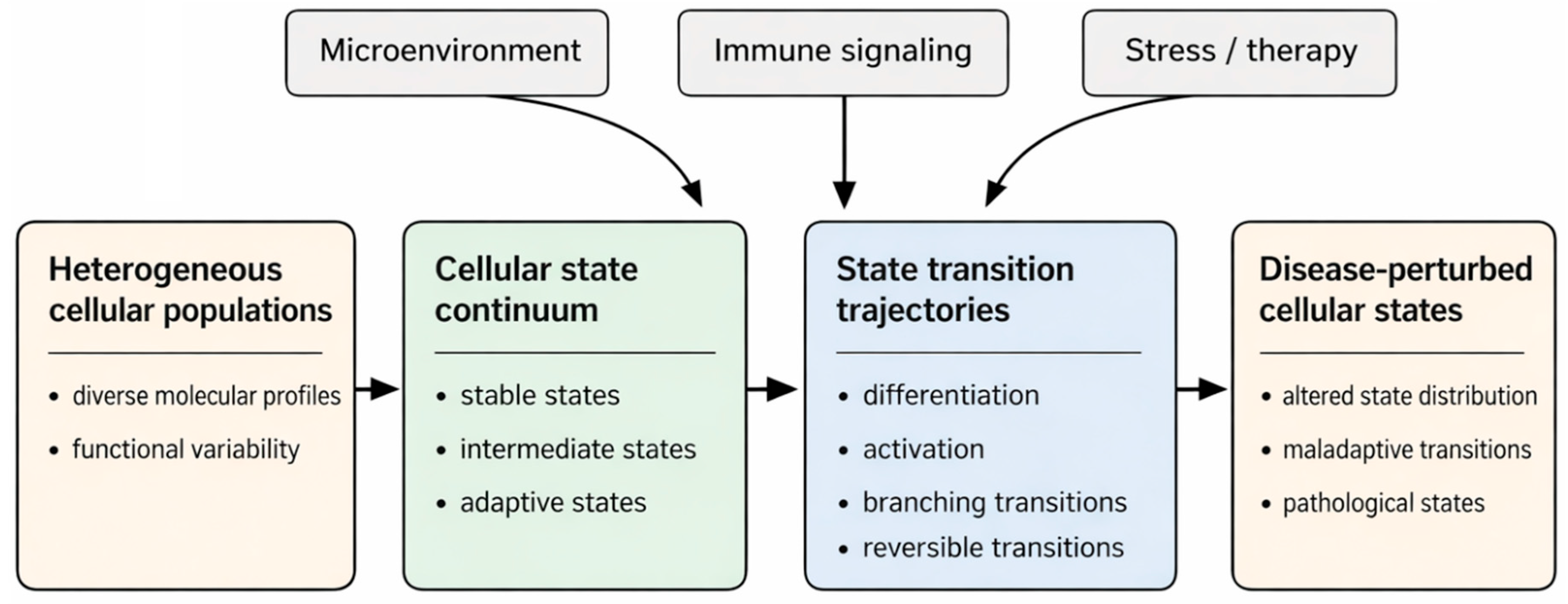
Figure 2.
AI approaches for mapping cellular and circuit state transitions across biological scales. AI methods are increasingly used to analyze both cellular and circuit-level data across biological scales. On the cellular side, approaches including single-cell omics, spatial profiling, trajectory inference, and graph-based or multimodal integration support the characterization of cellular heterogeneity and state transitions. On the circuit side, electrophysiology, calcium imaging, and large-scale neuroimaging can be analyzed using AI-based decoding, prediction, and closed-loop models to characterize neural dynamics and dysfunction. These analytical streams can be integrated within AI-enabled multiscale frameworks to support disease trajectory inference and clinically relevant diagnostic, predictive, and therapeutic insights.
Figure 2.
AI approaches for mapping cellular and circuit state transitions across biological scales. AI methods are increasingly used to analyze both cellular and circuit-level data across biological scales. On the cellular side, approaches including single-cell omics, spatial profiling, trajectory inference, and graph-based or multimodal integration support the characterization of cellular heterogeneity and state transitions. On the circuit side, electrophysiology, calcium imaging, and large-scale neuroimaging can be analyzed using AI-based decoding, prediction, and closed-loop models to characterize neural dynamics and dysfunction. These analytical streams can be integrated within AI-enabled multiscale frameworks to support disease trajectory inference and clinically relevant diagnostic, predictive, and therapeutic insights.
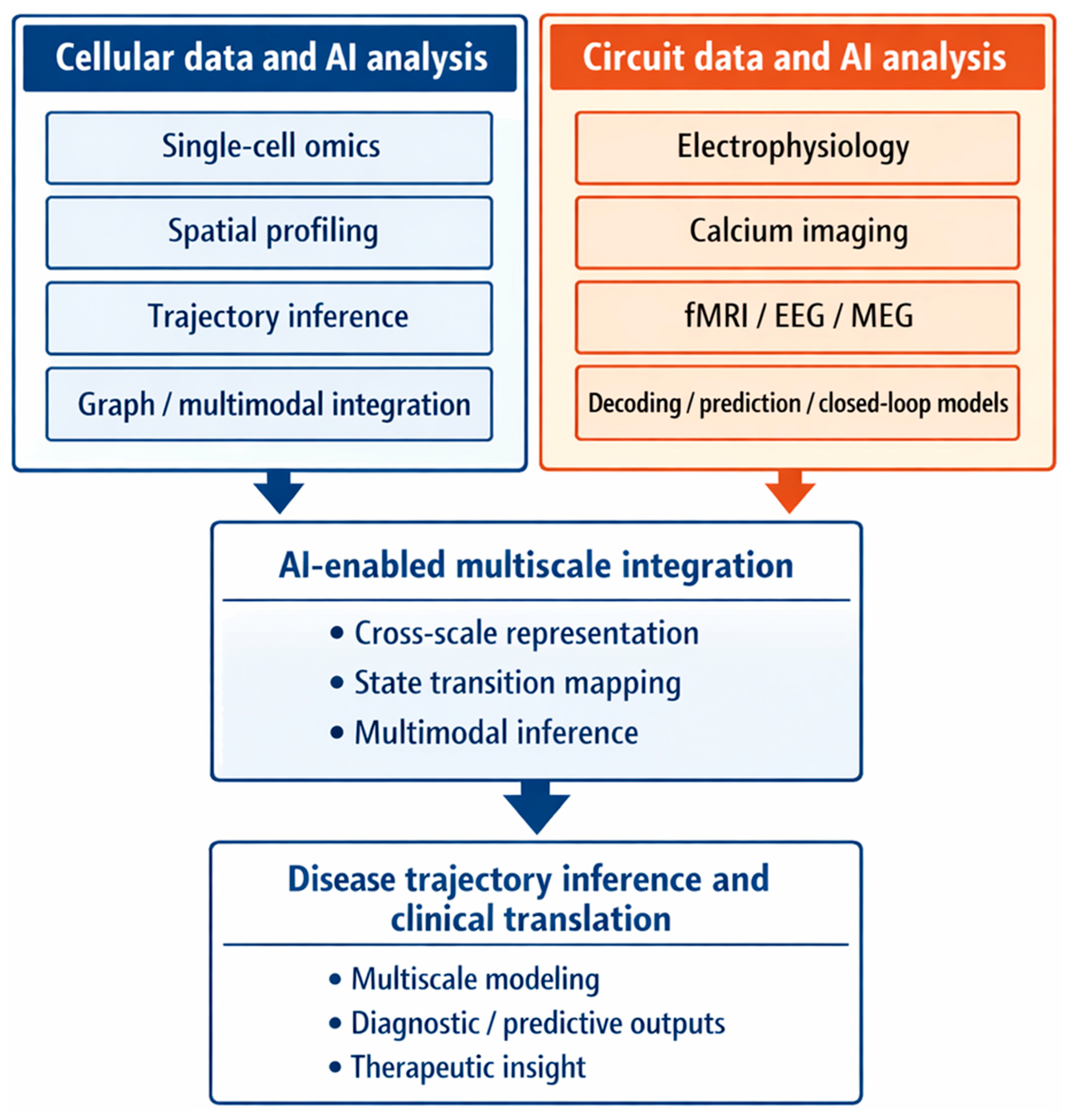
Figure 3.
Coupled multiscale disease progression from cellular perturbation to circuit dysfunction and clinical phenotype. Disease progression can be understood as a multiscale process in which perturbations at the cellular level propagate through synaptic and microcircuit remodeling to produce circuit-level dysfunction and, ultimately, behavioral or clinical manifestations. Cellular perturbations may include altered cellular states, inflammatory responses, and metabolic or transcriptional dysregulation. These changes can reshape synaptic transmission and local connectivity, contributing to abnormal network activity, impaired synchronization, and disrupted circuit integration. Feedback relationships across scales may further reinforce disease progression over time. Representative disease contexts include Parkinson’s disease, Alzheimer’s disease, and epilepsy.
Figure 3.
Coupled multiscale disease progression from cellular perturbation to circuit dysfunction and clinical phenotype. Disease progression can be understood as a multiscale process in which perturbations at the cellular level propagate through synaptic and microcircuit remodeling to produce circuit-level dysfunction and, ultimately, behavioral or clinical manifestations. Cellular perturbations may include altered cellular states, inflammatory responses, and metabolic or transcriptional dysregulation. These changes can reshape synaptic transmission and local connectivity, contributing to abnormal network activity, impaired synchronization, and disrupted circuit integration. Feedback relationships across scales may further reinforce disease progression over time. Representative disease contexts include Parkinson’s disease, Alzheimer’s disease, and epilepsy.
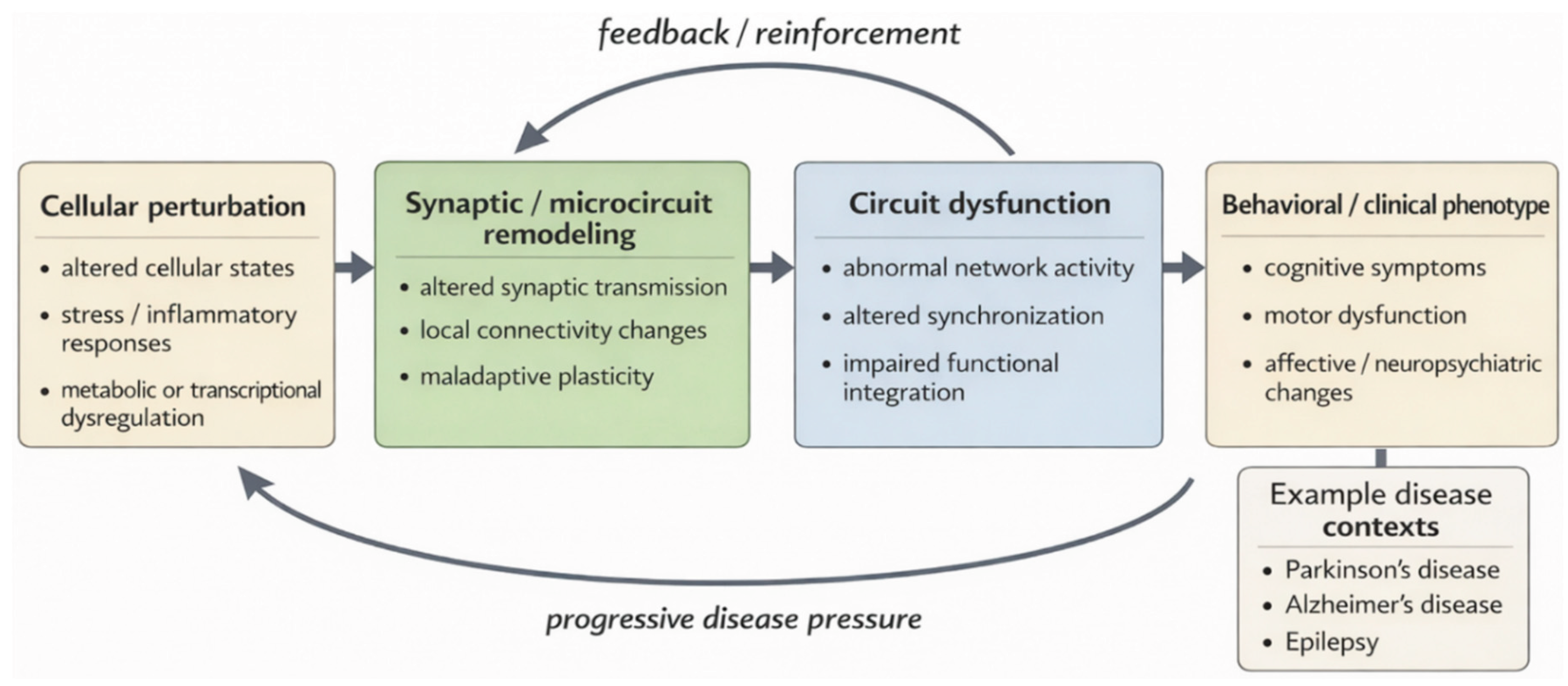
Figure 4.
Translational roadmap for AI-integrated multiscale medicine. Future applications of AI-integrated multiscale medicine may be conceptualized as a translational pipeline beginning with multimodal data generation across cellular, circuit, and clinical domains. These data can be integrated using AI-based methods to derive multiscale biomarkers and model disease trajectories over time. Such models may support the identification of therapeutic windows and enable adaptive, personalized interventions informed by patient-specific disease dynamics. This flowchart summarizes a potential translational path from multiscale data integration to precision medicine.
Figure 4.
Translational roadmap for AI-integrated multiscale medicine. Future applications of AI-integrated multiscale medicine may be conceptualized as a translational pipeline beginning with multimodal data generation across cellular, circuit, and clinical domains. These data can be integrated using AI-based methods to derive multiscale biomarkers and model disease trajectories over time. Such models may support the identification of therapeutic windows and enable adaptive, personalized interventions informed by patient-specific disease dynamics. This flowchart summarizes a potential translational path from multiscale data integration to precision medicine.
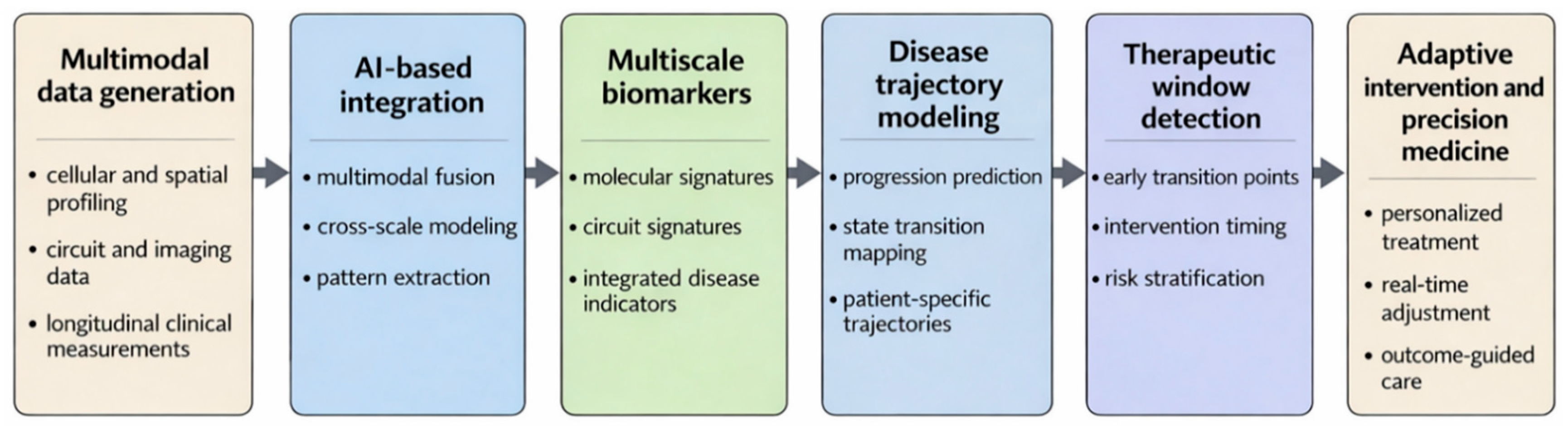

Table 1.
Technologies and AI methods for mapping cellular and circuit state transitions.
| Domain | Data modality | Method / AI approach | Primary analytical purpose | What it can reveal | Main limitations | References |
|---|---|---|---|---|---|---|
| Cellular state profiling | Single-cell RNA sequencing (scRNA-seq) | Dimensionality reduction, deep latent embedding, autoencoders, variational autoencoders | Representation of cellular heterogeneity and state structure | Cellular subpopulations, rare states, gradients of cellular variation, latent state organization | Sparsity, batch effects, snapshot nature of data, limited direct temporal information | [64,65] |
| Cellular state profiling | Single-cell ATAC-seq / epigenomic profiling | Multimodal integration, latent variable models, matrix factorization, deep generative models | Characterization of chromatin-defined cell states and regulatory landscapes | Regulatory programs, chromatin accessibility dynamics, epigenetic constraints on state transitions | Sparse signal, noisy data, integration challenges with transcriptomic modalities | [66,67] |
| Cellular state profiling | Single-cell proteomic / multimodal assays | Joint embedding, multimodal deep learning, probabilistic integration | Integration of protein and transcript features for refined cellular state definition | Concordance or divergence between transcriptional and protein states, functional phenotype refinement | Limited feature depth, cross-platform variability, incomplete multimodal correspondence | [68,69] |
| Spatial state mapping | Spatial transcriptomics | Graph-based integration, spatially aware deep learning, neighborhood modeling | Mapping cellular states within tissue architecture | Spatial organization of states, tissue niches, local cellular interactions, state–environment relationships | Resolution limits, mixed spots in some platforms, complex spatial normalization | [57,70] |
| Spatial state mapping | Multiplexed imaging / spatial proteomics | Graph neural networks, image-based feature extraction, spatial clustering | Identification of state distributions and cell–cell interactions in situ | Tissue microenvironment structure, signaling neighborhoods, spatial coupling of phenotypes | Imaging noise, segmentation errors, limited multiplexing in some platforms | [54,71] |
| Trajectory reconstruction | Cross-sectional single-cell datasets | Trajectory inference, pseudotime modeling, diffusion-based methods, graph trajectory models | Reconstruction of developmental or disease-related state transitions | Differentiation pathways, branching trajectories, transitional intermediates, candidate progression routes | Pseudotime may not reflect true biological time, sensitivity to preprocessing and sampling density | [51,52] |
| Lineage and transition modeling | Lineage tracing + omics integration | Probabilistic lineage inference, graph modeling, multimodal temporal alignment | Reconstruction of lineage relationships and directional transitions | Cell fate relationships, clonal dynamics, validation of inferred trajectories | Experimental complexity, incomplete lineage capture, integration difficulty across modalities | [27,51] |
| Cellular interaction modeling | Single-cell + spatial neighborhood data | Graph neural networks, cell–cell interaction inference, network learning | Modeling relationships among cells and their microenvironments | Local signaling structure, interaction networks, microenvironmental regulation of state transitions | Dependency on graph construction choices, uncertainty in inferred interactions | [54,72] |
| Neural population decoding | Calcium imaging | Supervised learning, deep neural networks, temporal decoding models | Decoding behavioral or cognitive variables from neural activity | Population-level activity patterns, behavioral state prediction, stimulus representation | Indirect measurement of activity, temporal resolution constraints, signal preprocessing dependencies | [73] |
| Neural population decoding | Electrophysiological recordings | Supervised decoding, recurrent neural networks, state-space models | Mapping neural firing patterns to behavior, cognition, or circuit states | High-temporal-resolution representations of neural dynamics, transitions between functional states | Limited sampling of full networks, variability across sessions and individuals | [74,75] |
| Brain-wide functional analysis | fMRI | Machine learning classifiers, representation learning, connectivity modeling | Identification of large-scale functional signatures and disease-associated patterns | Functional connectivity structure, distributed network states, disease classification signals | Indirect hemodynamic signal, limited temporal resolution, susceptibility to confounds | [76,77] |
| Brain-wide functional analysis | EEG / MEG | Time-series classification, spectral feature learning, deep temporal models | Characterization of neural dynamics across time and disease states | Oscillatory signatures, transient network states, seizure-related or disease-related patterns | Noise sensitivity, source localization ambiguity, inter-subject variability | [78,79] |
| Circuit modeling | Neural population time series / multimodal neural data | Recurrent neural networks, dynamical systems models, latent state models | Simulation and prediction of circuit dynamics over time | Temporal state transitions, network stability, responses to perturbation, hidden dynamic structure | Limited biological interpretability, possible mismatch between model structure and circuit biology | [74,80] |
| Closed-loop circuit analysis | Real-time neural recordings | Adaptive decoding, reinforcement learning, closed-loop control algorithms | Real-time detection of circuit states and adaptive intervention | Online state estimation, seizure detection, adaptive stimulation targets, responsive modulation | Generalizability, safety, interpretability, dependence on real-time signal quality | [81,82] |
| Multiscale integration | Single-cell, spatial, synaptic, circuit, and clinical datasets | Multimodal deep learning, shared latent space models, cross-modal alignment, integrative graph frameworks | Linking biological information across scales | Relationships between cellular state transitions, tissue organization, circuit dynamics, and clinical outcomes | Heterogeneous data structures, temporal misalignment, incomplete sampling, limited causal interpretability | [58,83] |
Table 2.
Cellular states, synaptic/microcircuit changes, circuit dysfunction, and clinical outcomes across disease contexts.
Table 2.
Cellular states, synaptic/microcircuit changes, circuit dysfunction, and clinical outcomes across disease contexts.
| Disease context | Cellular state changes | Synaptic / microcircuit alterations | Circuit-level dysfunction | Behavioral / clinical consequence | Relevance to multiscale modeling | References |
|---|---|---|---|---|---|---|
| Parkinson’s disease | Degeneration of dopaminergic neurons; altered neuronal stress-response and metabolic states; reactive astrocytic and microglial changes | Altered nigrostriatal and corticostriatal synaptic transmission; disturbed inhibitory–excitatory balance within basal ganglia microcircuits | Abnormal basal ganglia network activity, disrupted oscillatory dynamics, and impaired motor circuit coordination | Bradykinesia, rigidity, tremor, and progressive motor dysfunction | Illustrates how neuronal state changes propagate through synaptic and microcircuit disruption to large-scale motor circuit abnormalities and clinical symptoms | [134,140] |
| Alzheimer’s disease | Neuronal stress and degeneration; microglial activation; astrocytic reactivity; altered inflammatory and homeostatic cellular states | Synaptic loss, impaired synaptic plasticity, and disruption of local hippocampal and cortical microcircuits | Progressive disruption of large-scale network connectivity and reduced functional integration across memory-related circuits | Memory impairment, cognitive decline, and progressive loss of executive function | Demonstrates how glial and neuronal state transitions interact with synaptic degeneration and network disorganization during disease progression | [141,142] |
| Epilepsy | Altered neuronal excitability states; reactive astrocytes and microglia; inflammatory and metabolic shifts in local tissue environments | Enhanced excitatory transmission, impaired inhibitory control, maladaptive synaptic remodeling, and destabilized local microcircuits | Pathological hypersynchrony, recurrent seizure-generating network states, and impaired circuit stability | Recurrent seizures, cognitive impairment, and variable neuropsychiatric symptoms | Highlights how cellular and inflammatory state changes can reduce network stability and drive recurrent pathological circuit transitions | [143,144] |
| Depression | Altered neuronal and glial functional states; stress-associated transcriptional changes; impaired cellular resilience; neuroimmune dysregulation | Reduced synaptic plasticity, altered local connectivity within limbic and prefrontal microcircuits, and disturbed neuromodulatory balance | Dysregulated limbic–prefrontal circuit activity and altered functional connectivity in mood-related networks | Persistent low mood, anhedonia, cognitive slowing, and affective dysregulation | Supports a model in which stress-related cellular changes scale upward to synaptic and circuit dysfunction underlying behavioral symptoms | [145,146] |
| Neuroinflammatory disorders | Immune cell activation; reactive microglial and astrocytic states; altered neuronal homeostasis under inflammatory conditions | Cytokine-driven modulation of synaptic transmission, impaired synaptic stability, and disrupted local circuit interactions | Abnormal network activity, reduced circuit adaptability, and impaired functional integration across affected regions | Cognitive impairment, sensory or motor dysfunction, fatigue, and neurobehavioral abnormalities | Emphasizes the role of immune–neural coupling in linking inflammatory cellular states to synaptic and circuit-level dysfunction | [147,148] |
| Traumatic brain injury / injury-related disorders | Neuronal stress responses; glial activation; altered repair-associated and inflammatory cellular programs | Synaptic disruption, loss of local connectivity, maladaptive plasticity, and unstable microcircuit reorganization | Impaired network communication, abnormal circuit reconfiguration, and altered activity propagation | Cognitive deficits, sensory–motor impairments, mood changes, and persistent neurological dysfunction | Illustrates how acute cellular injury responses can evolve into persistent multiscale dysfunction affecting circuit organization and behavior | [149,150] |
| Neurodegenerative disorders broadly | Progressive neuronal vulnerability states; glial activation; metabolic and proteostatic dysregulation | Synaptic weakening or loss, impaired local plasticity, and deterioration of microcircuit integrity | Large-scale circuit disconnection, reduced adaptability, and abnormal functional dynamics | Cognitive, motor, and behavioral decline depending on the affected systems | Provides a general framework for understanding disease progression as coupled transitions across cellular, synaptic, and network scales | [77,151] |
Table 3.
Challenges, opportunities, and future priorities for AI-integrated multiscale medicine.
| Challenge | Significance | Current limitations | Future opportunities | Potential clinical implications | References |
|---|---|---|---|---|---|
| Data heterogeneity across modalities | Multiscale disease modeling depends on integrating molecular, cellular, circuit, imaging, and clinical datasets that differ substantially in format, scale, and resolution | Data are generated using different platforms, preprocessing pipelines, feature spaces, and quality standards, limiting comparability and joint analysis | Development of harmonized preprocessing workflows, cross-platform integration methods, and shared multimodal data standards | More robust biomarker discovery, improved generalizability of predictive models, and stronger cross-study reproducibility | [183] |
| Temporal misalignment across biological scales | Disease progression unfolds over time, but cellular, synaptic, circuit, and clinical data are often collected at different and nonaligned timepoints | Cross-sectional designs and uneven sampling make it difficult to reconstruct temporal relationships and state transitions across scales | Longitudinal multimodal study designs, time-aware computational models, and improved temporal alignment strategies | Earlier detection of disease transitions, better prediction of progression, and improved identification of therapeutic windows | [158,184] |
| Limited causal inference | Predictive associations across scales are informative, but mechanistic understanding requires distinguishing correlation from causation | Many AI models infer statistical relationships from observational data without resolving directional or mechanistic dependencies | Integration of AI with perturbation experiments, causal inference frameworks, and mechanistically informed modeling | More reliable target identification and greater confidence in intervention strategies | [185,186] |
| Model interpretability | Scientific and clinical adoption depends on understanding how model outputs relate to biological mechanisms and disease processes | Complex deep learning models may achieve strong performance while remaining difficult to interpret biologically | Development of interpretable AI methods, biologically constrained architectures, and explanation tools linked to experimental validation | Improved clinician trust, clearer biological insight, and stronger translational potential | [187,188] |
| Incomplete multiscale coverage | Disease processes often span levels that are incompletely sampled, leaving important gaps between molecular, cellular, synaptic, circuit, and clinical domains | Many studies capture only one or two biological levels, limiting the construction of integrated disease models | Expanded multimodal datasets spanning multiple scales, including synaptic, microcircuit, and longitudinal clinical measurements | More complete disease modeling and better linkage between mechanistic biology and patient outcomes | [157,189] |
| External validation and reproducibility | Models that perform well in one dataset or institution may not generalize to independent cohorts or real-world settings | Independent validation is often limited, and results may be sensitive to site-specific protocols, cohort composition, and analytic choices | Multi-center validation studies, benchmark datasets, transparent reporting practices, and reproducible computational pipelines | Greater reliability of AI tools in biomedical research and stronger readiness for clinical deployment | [190,191] |
| Generalizability across patient populations | Multiscale AI models must perform across diverse individuals, disease stages, and healthcare environments | Many models are trained on restricted cohorts that do not adequately represent biological, demographic, or clinical diversity | Inclusion of more diverse patient populations, stratified evaluation, and federated or distributed learning approaches | Fairer and more broadly applicable models for diagnosis, prognosis, and therapeutic guidance | [192,193] |
| Clinical workflow integration | Even accurate models have limited value if they do not align with clinical workflows, decision timing, and interpretability needs | Model outputs are often not presented in formats that support routine clinical use or time-sensitive decision-making | Development of clinician-facing decision-support systems, workflow-aware interfaces, and prospective implementation studies | Greater adoption in practice, improved decision support, and more effective patient management | [194,195] |
| Standardization of multimodal data infrastructure | Scalable multiscale medicine requires interoperable data ecosystems across research and healthcare settings | Fragmented databases, inconsistent metadata, and lack of shared ontologies hinder integration, reuse, and comparison across studies | Shared repositories, interoperable metadata standards, and common data models across modalities and institutions | Faster model development, stronger collaboration, and improved reproducibility across settings | [196,197] |
| Ethical, legal, and privacy considerations | Multiscale AI models often rely on sensitive, longitudinal, and potentially identifiable datasets, raising governance and trust concerns | Risks include insufficient consent frameworks, privacy breaches, data misuse, and limited clarity around governance responsibilities | Privacy-preserving learning, transparent governance structures, and ethically informed data-sharing frameworks | More responsible implementation, stronger public trust, and safer clinical adoption | [198,199] |
| Algorithmic bias and equity | Unequal representation in training data can produce systematic underperformance for certain populations | Bias may arise from cohort selection, measurement variability, social determinants of health, and healthcare system disparities | Bias auditing, fairness-aware modeling, representative datasets, and continuous monitoring after deployment | Reduced inequities in AI-supported diagnosis, prognosis, and treatment recommendations | [200,201] |
| Prospective clinical translation | Clinical value depends on demonstrating benefit in real-world patient care rather than only retrospective performance | Many AI models remain proof-of-concept and lack prospective evaluation in clinically relevant environments | Prospective clinical studies, adaptive evaluation frameworks, and integration with patient outcome analyses | Stronger evidence for clinical utility and improved translation from computational modeling to therapeutic benefit | [202,203] |
Disclaimer/Publisher’s Note: The statements, opinions and data contained in all publications are solely those of the individual author(s) and contributor(s) and not of MDPI and/or the editor(s). MDPI and/or the editor(s) disclaim responsibility for any injury to people or property resulting from any ideas, methods, instructions or products referred to in the content. |
© 2026 by the authors. Licensee MDPI, Basel, Switzerland. This article is an open access article distributed under the terms and conditions of the Creative Commons Attribution (CC BY) license (http://creativecommons.org/licenses/by/4.0/).
Copyright: This open access article is published under a Creative Commons CC BY 4.0 license, which permit the free download, distribution, and reuse, provided that the author and preprint are cited in any reuse.


