
Submitted:
21 April 2026
Posted:
22 April 2026
You are already at the latest version
Abstract
Pathogenic variants in the CLCN4 gene are associated with a rare X-linked neurodevelopmental disorder, Raynaud–Claes syndrome, characterized by intellectual disability, epilepsy, language impairment, motor deficits, stereotypies, and structural brain abnormalities. Although heterozygous females are often considered to be only mildly affected, severe phenotypes have also been reported, and the clinical presentation shows considerable heterogeneity. The present study aims to summarize the current knowledge on CLCN4-related neurodevelopmental disorders through a review of the available literature and to describe two additional patients carrying pathogenic CLCN4 variants, one male and one female. The female patient was found to carry a de novo heterozygous variant (c.2152C>T), while the male patient harbored a de novo hemizygous variant (c.949G>A). Clinical data were compared with those reported in the literature in order to identify phenotypic similarities and differences among patients previously described with the same mutations. Furthermore, in light of the literature review and the clinical data collected from our patients, we propose considering Raynaud–Claes syndrome as a Rett-like condition. This perspective expands the scope of differential diagnosis and underscores the importance of multidisciplinary and longitudinal diagnostic evaluation to improve clinical characterization, therapeutic management, and genetic counseling.
Keywords:
CLCN4-related neurodevelopmental disorder
; X-linked intellectual disability
; epilepsy
; ASD
Introduction
Raynaud–Claes syndrome (MRXSRC, MIM#300114), also known as CLCN4-related neurodevelopmental disorder, is a rare X-linked condition caused by pathogenic variants in the CLCN4 gene located on chromosome Xp22.2 [1].
This disorder has been associated with both loss-of-function (LoF) and gain-of-function (GoF) variants in CLCN4 [2]. Missense variants appear to be absolutely prevalent among those reported, although frameshift, truncating, splice-site, and nonsense variants have also been described [1,2,3,4,5,6,7,8,9,10,11]. Missense variants are related to a more severe phenotype, both regarding functional aspects (in particular ID) and epilepsy outcome, while frameshift or intragenic deletion variants were associated with relatively mild pictures compared with the majority of individuals with missense variants [10].
Pathogenic variants in CLCN4 are associated with global developmental delay, intellectual disability (ID) ranging from mild to profound, and a spectrum of seizure types that may be difficult to control. Additional common features include autistic behaviors, anxiety or aggression, movement abnormalities (such as ataxia or dystonia), microcephaly, gastrointestinal dysmotility, and variable dysmorphic features [11].
CLCN4 encodes the voltage-dependent Cl−/H+ exchanger ClC-4, which is essential for neuronal morphogenesis and dendritic maturation, as well as for endosomal ion homeostasis, intracellular vesicle trafficking, degradation, and autophagy—all processes that are critical for neuronal function and survival [2,11].
The first description of this syndromic X-linked condition dates back to 1996, when Raynaud et al. reported a two-generation French family with five affected males presenting severe to profound intellectual disability and variable behavioral difficulties [12]. In the same year, Claes et al. described a Belgian family with five affected males across two generations, characterized by intellectual disability, challenging behaviors, and autistic features [13]. Heterozygous females in these families were either neurotypical or exhibited mild neurocognitive or psychiatric manifestations. Based on these observations, a distinct entity of X-linked intellectual disability, later termed Raynaud–Claes syndrome, was proposed.
The association between CLCN4 mutations and neurodevelopmental disorders was first reported in 2013, when a de novo loss-of-function mutation was linked to epileptic encephalopathy and severe developmental delay. Three years later, protein-truncating and missense variants identified in five unrelated families were also associated with X-linked intellectual disability [4].
To date, approximately 130 individuals from 75 families with CLCN4-related disorders have been described in the literature, encompassing more than 70 distinct variants of this gene [2].
Despite the growing number of identified cases, genotype–phenotype correlations remain only partially understood, and CLCN4-related disorders are still frequently underdiagnosed. Notably, heterozygous females may present with severe neurodevelopmental impairment, including profound deficits in verbal communication and social interaction [1,2,3,4,5,6,7]. This observation challenges the traditional assumption that females are typically only mildly affected in X-linked disorders.
In this narrative review, we collected reported CLCN4 mutations along with their associated phenotypes in order to summarize current knowledge on CLCN4-related neurodevelopmental disorders. Additionally, we describe two new patients carrying pathogenic CLCN4 variants, with the aim of comparing them to previously reported cases, refining genotype–phenotype correlations, and expanding the known phenotypic spectrum. We also provide detailed longitudinal clinical, neurophysiological, neuroimaging, ophthalmological, and rehabilitative data.
Finally, we propose that CLCN4 missense mutations may underlie a Rett-like phenotype.
Methods
We conducted a systematic literature review on CLCN4-related neurodevelopmental disorders by searching the PubMed database using the keywords “CLCN4 mutation,” “Raynaud–Claes syndrome,” and “CLCN4-related neurodevelopmental disorder.”
In addition, we evaluated two patients at our Department of Developmental Neuroscience who presented with developmental delay, significant language impairment, intellectual disability, and epilepsy. Genetic analyses were performed after obtaining informed consent from the patients’ legal guardians and included array comparative genomic hybridization (array-CGH), target multigene panel for epilepsy and brain malformations, and clinical exome sequencing in both cases.
The genomic DNA of the patients was isolated from peripheral blood by standard methods. Array-CGH analysis was performed in both patients using the Agilent 8 × 60 K microarray oligonucleotide platform with a median resolution of 100 Kbp, following manufacture’s protocol (Agilent Technologies, Santa Clara, CA, USA). DNA from healthy subjects (one male and one female) was used as the control (Agilent Technologies, Santa Clara, CA, USA). The genomic imbalance coordinates refer to the Genome Reference Consortium Human Build 37 (GRCh37/hg19).
Target multigene panel including 373 genes associated with epilepsy was performed in both patients. Target enrichment and library preparation were performed using a custom-designed Paired-End 150 bp on NextSeq (Illumina, San Diego, CA). Variants were annotated and filtered using the ANNOVAR tool. Putative causative variants were analyzed by Sanger sequencing to confirm the next-generation sequencing (NGS) results in probands and investigated in the parents to check the inheritance status. We classified variants according to the international guidelines of the American College of Medical Genetics and Genomics (ACMG) Laboratory Practice Committee Working Group [14].
Whole exome sequencing (WES) has been performed in patient 1 using paired-end technology (150 bp) on the Illumina NextSeq 500 platform, following enrichment of the coding regions of the human genome using a clinical exome kit (SureSelect XT2 Clinical Research Exome, Agilent Technologies, Santa Clara, CA, USA and/or Twist Human Core Exome Kit, Twist Bioscience), in accordance with the manufacturer’s specifications. The quality of the libraries and sequencing was assessed using standard metrics, with an average coverage of target regions exceeding 100×. The following quality parameters were achieved: >95% of target bases covered at ≥20× and >91% at ≥30×.The sequences were aligned to the human reference genome (GRCh37/hg19) using BWA-mem (v0.7.17). Variant calling was performed using GATK HaplotypeCaller (v4.0.2.1). Variants annotation and filtering were carried out using VarSeq (Golden Helix) and proprietary software (Personal Genomics, University of Verona), followed by the removal of sequencing and alignment artefacts. Non-synonymous exonic variants and variants at canonical splicing sites (±2 nucleotides from the exons) with an allelic frequency of less than 1% in major population databases were included in the analysis. Variants were interpreted in accordance with the guidelines of the American College of Medical Genetics and Genomics (ACMG) and the Association for Molecular Pathology (AMP) [14]. Pathogenic, likely pathogenic or variants of uncertain significance (VUS) were reported and, where indicated, confirmed by Sanger sequencing. Variants filtering was guided by the proband’s clinical phenotype. The analysis was performed in a trio-based context (proband and parents).
WES has been performed in patient 2 using the SureSelect Human All Exon V7 kit (Agilent Technologies, Santa Clara, CA, USA), which covers approximately 60 Mb of the coding regions of the human genome. Paired-end sequencing (150 bp) was performed on a NovaSeq 6000 platform (Illumina Inc., San Diego, CA, USA), in accordance with the manufacturer’s instructions. Sequencing quality was assessed using standard metrics, with ≥20× coverage of at least 98% of the target regions. Raw reads were aligned to the human reference genome (GRCh37/hg19) using the Burrows–Wheeler Aligner (BWA, v0.7.15). Variants calling was performed using the Haplotype Caller algorithm from the Genome Analysis Toolkit (GATK, v4.0). Variant annotation was carried out using Variant Interpreter (v2.6).Variants were filtered to exclude sequencing artefacts and prioritized according to the following criteria: (i) location in exonic regions or canonical splicing sites (±15 nucleotides from exon–intron boundaries); (ii) predicted functional impact (non-synonymous variants); (iii) minor allele frequency <1% in population databases, including the Genome Aggregation Database (gnomAD); and (iv) read depth ≥20×. A trio-based analysis was performed to assess inheritance patterns, including de novo, autosomal recessive and X-linked variants. Variants that were inconsistent with the expected segregation pattern were excluded. Variants prioritization focused on genes known to be associated with the proband’s phenotype. The classification and interpretation of variants were carried out in accordance with the guidelines of the ACMG and the AMP [14].
Clinical assessment included a detailed neurodevelopmental history, comprehensive neurological examination, and structured cognitive and adaptive evaluations using the Griffiths Developmental Scales (third edition), the Bayley Scales of Infant and Toddler Development (third edition), and the Vineland Adaptive Behavior Scales, Second Edition [15,16,17]. Additional evaluations comprised behavioral and ophthalmological assessments, as well as longitudinal neuroimaging.
Epilepsy was characterized through detailed clinical descriptions of seizure types, serial electroencephalogram (EEG) and video-EEG recordings, and documentation of pharmacological management. All assessments were conducted longitudinally to capture developmental trajectories. Rehabilitation programs were also documented, including physical, occupational, speech, and educational interventions.
Results
Literature review: See Table 1 and 2A and B
Case Presentations
Patient 1
Patient 1 is a 9-year-6-month-old female born at term, small for gestational age. At birth, weight was 2520 g, length 45 cm, and occipito-frontal circumference (OFC) 32.5 cm. Apgar scores were 9 at 1 minute and 10 at 5 minutes. Intrauterine growth restriction was detected at 32 weeks of gestation.
Motor development was markedly delayed: head control was achieved at 6 months, independent sitting at 13 months, crawling at 14 months, and autonomous ambulation at 2 years. Language development was severely impaired, with absence of early verbal output; babbling and vowel vocalizations emerged at 3 years without further progression. Request pointing appeared at 9 years, and no additional communicative gestures were observed.
Cognitive assessment at 23 months, performed using the Bayley Scales of Infant and Toddler Development, Third Edition, showed a developmental level below 12 months, with absence of object permanence. At 9 years and 6 months, formal cognitive assessment was not feasible. Adaptive functioning, assessed with the Vineland Adaptive Behavior Scales, Second Edition (VABS-II), was consistent with profound intellectual disability (Adaptive Quotient [AQ] 20), while socialization (AQ 31) and daily living skills (AQ 26) were in the severe intellectual disability range. Epilepsy onset occurred at 4 months, with clusters of episodes characterized by hypertonia and staring during febrile episodes; initial EEG was normal. At 15 months, a generalized seizure with gaze deviation was observed, followed by recurrent seizures during febrile episodes. From 18 months, additional events occurred, characterized by erratic clonic movements and head deviation followed by hypotonia, in both febrile and afebrile conditions. EEG recordings showed normal background activity during wakefulness and diffuse fast activity with anterior predominance and mild paroxysmal abnormalities during sleep. Treatment with valproate (up to 500 mg/day) resulted in seizure remission from 2 years of age. At 9 years and 6 months, EEG demonstrated anterior theta activity and diffuse epileptiform abnormalities during sleep (Figure 1).
Neurological examination revealed independent ambulation with reduced motor fluidity and gait instability, including a tendency to equinus foot posture. Muscle tone and strength were normal. Deep tendon reflexes were brisk in the lower limbs, with bilateral extensor plantar responses and no clonus. Microcephaly was present (OFC 46 cm, <1st percentile).
Behavioral features included frequent stereotypies (midline movements, hand-to-mouth behaviors) and bruxism, with markedly impaired functional use of objects. Verbal comprehension was limited to simple, context-supported commands, and response to name was inconsistent.
Ophthalmological evaluation revealed exotropia, hypermetropia, reduced visual acuity, and absence of stereopsis. Early feeding difficulties included impaired swallowing of liquids and gastroesophageal reflux.
Brain MRI at 3 years showed bilateral frontoparietal and periventricular white matter hyperintensities and thinning of the corpus callosum.
Previous genetic investigations included array-CGH, which was negative, and a targeted epilepsy gene panel identifying a heterozygous FLNA variant of uncertain significance (c.7144G>C, p.Val2382Leu), inherited from her father. WES subsequently identified a de novo heterozygous pathogenic variant in CLCN4 (c.2152C>T, p.Arg718Trp).
The patient is currently enrolled in a comprehensive multidisciplinary rehabilitation program, including speech therapy, neuropsychomotor therapy, occupational therapy, and full-time educational support. Gradual improvements in attention and shared attention have been observed in structured settings despite severe communication impairment.
Patient 2
Patient 2 is a 6-year-old male born at 41 + 5 weeks of gestation. At birth, weight was 3900 g, length 52 cm, and OFC 36 cm. Due to a double nuchal cord, ventilatory support was required at birth. Apgar scores were 6 at 1 minute and 8 at 5 minutes.
Motor development was delayed: independent sitting was achieved at 12 months, standing at 15 months, and autonomous ambulation at 20 months. Language development was also delayed, with babbling at 15 months and first words at 2 years. Receptive language corresponded to approximately 17 months of age, and at 6 years expressive language consisted mainly of two-word combinations.
Cognitive assessment at 30 months, performed using the Bayley Scales of Infant and Toddler Development, Third Edition and the Griffiths Developmental Scales, Third Edition, showed a developmental level corresponding to a mental age of 18 months. Re-evaluation at 6 years with the Griffiths scales indicated a developmental level of approximately 24 months. Adaptive functioning (VABS-II) was consistent with moderate-to-severe intellectual disability (AQ 34), with more pronounced impairment in motor (AQ 28) and communication (AQ 38) domains, while socialization (AQ 57) and daily living skills (AQ 59) were in the mild intellectual disability range.
Epilepsy onset occurred at 11 months with an apparently generalized seizure during a febrile episode, followed by clusters of myoclonic jerks predominantly affecting the upper limbs, mainly during febrile illnesses. A further febrile myoclonic seizure was documented at 5 years. He had never assumed cronic pharmacotherapy, only clonazepam and diazepam at the occurrence. EEG and video-EEG recordings showed slowed background activity with angular slow waves over the occipito-temporal regions, predominantly on the right, persisting during sleep, with rare sharp waves in the right posterior temporal region and no clear epileptiform paroxysms.
Neurological examination showed generalized hypotonia, ligamentous laxity, valgus-pronated feet, and marked impairment in both gross and fine motor skills. OFC was within normal limits.
Behavioral features included attention deficit and hyperactivity.
Ophthalmological evaluation revealed an immature visual profile, with central hyperfixation, non-smooth visual pursuit, dysmetric saccades, occasional mild vertical misalignment, reduced contrast sensitivity (down to 2.5%), and preserved visual acuity for age. Feeding difficulties with liquids were reported during the first year of life.
Brain MRI at 1 year demonstrated a mildly shortened corpus callosum with an unrecognizable rostrum and mild ectasia of the temporal horns associated with incomplete hippocampal inversion. Follow-up MRI at 5 years confirmed dysmorphic temporal horns with hippocampal eversion, corpus callosum abnormalities, a thin optic chiasm (Figure 2), and small focal subcortical and juxtacortical white matter hyperintensities.
Neurometabolic investigations were unremarkable.
Array-CGH was normal. Genetic testing included a targeted epilepsy gene panel identifying variants of uncertain significance in CACNA1A (maternally inherited), ATP1A2, and GRIN1 (paternally inherited), with negative SCN1A analysis. WES identified a de novo hemizygous likely pathogenic variant in CLCN4 (c.949G>A, p.Val317Ile), confirmed by parental testing.
The patient is currently enrolled in a multidisciplinary rehabilitation program, including psychomotor therapy, speech and language therapy, physiotherapy, and full-time educational support. Plantar orthoses are in use, and ongoing interventions target motor, cognitive, communicative, and social domains.
Discussion
Pathogenic variants in the CLCN4 gene are increasingly recognized as a cause of rare X-linked neurodevelopmental disorders, affecting both hemizygous males and heterozygous females [2,5,6]. Across reported cases, a relatively consistent neurodevelopmental phenotype emerges, characterized by global developmental delay, ID of variable severity, heterogeneous epileptic manifestations, motor impairment, and behavioral disturbances, often meeting diagnostic criteria for attention deficit hyperactivity disorder (ADHD) and autism spectrum disorder (ASD).
In males, the most common clinical feature is moderate-to-severe ID. However, a male with a normal verbal Intelligence Quotient (IQ) has been reported in association with the p.(Phe319Ser) missense loss-of-function (LoF) mutation (Table 1, [6]). Predicting cognitive outcomes in females with CLCN4-related conditions remains challenging, as the phenotype spans a wide spectrum, ranging from severely affected individuals to apparently asymptomatic carriers [6]. Notably, and in contrast to what is typically observed in X-linked disorders, females carrying de novo variants may exhibit a severity comparable to that of affected males [16]. Furthermore, cognitive, linguistic, and autistic regression has been described in both sexes and appears to be independent of the specific genetic variant, mutation type, or the presence of epilepsy (Table 1).
Epilepsy represents a major feature of CLCN4-related neurodevelopmental disorders and appears to be up to three times more frequent in males than in females (Table 1, [6,8]). The most common seizure types include focal seizures and generalized tonic–clonic seizures, followed by infantile spasms, myoclonic seizures, atypical absences, eyelid myoclonus, tonic and atonic seizures, myoclonic–atonic seizures, and Lennox–Gastaut syndrome (Table 1, [6,8]). Seizures may also be triggered by fever.
Most patients with CLCN4-associated epilepsy present with moderate-to-profound ID and marked language impairment. Pharmacoresistant epilepsy may negatively affect cognitive outcomes [2]. However, in most cases, seizure control does not lead to significant cognitive improvement, suggesting that CLCN4 dysfunction may directly cause irreversible neurodevelopmental impairment independently of epileptic activity [6,8,10]. This hypothesis is supported by evidence that CLCN4 mutations disrupt dendritic development during neuritogenesis, potentially impairing synaptic function and altering neurodevelopment irrespective of seizures [10].
Consistent with these observations, both of our patients—one female and one male—carrying de novo variants (heterozygous c.2152C>T, p.(Arg718Trp), and hemizygous c.949G>A, p.(Val317Ile), respectively) presented with early-onset epilepsy within the first year of life. Seizures were frequently associated with fever or intercurrent inflammatory events and showed variable semiology. In both patients, seizures were well controlled during early childhood. Despite this, their overall clinical presentations differed significantly: the female patient was more severely affected than the male and showed a phenotype more consistent with that reported in individuals carrying the same genetic variant, regardless of epilepsy status (Table 2 A and B). In both cases, developmental delay preceded seizure onset, in line with previous reports [10]. Moreover, moderate-to-severe ID has been described even in patient without epilepsy, while individuals with borderline cognitive impairment or normal verbal IQ may present with seizures (Table 1, [6]).
Both variants identified in our patients have been previously reported, and their phenotypes are consistent with those described in the literature.
The p.(Arg718Trp) variant identified in our female patient has been reported in nine additional individuals (four females, two males, and three of unknown sex) [6,10,11,18]. This recurrent missense variant likely represents a mutational hotspot in CLCN4, as previously suggested [10]. It has been classified as a missense LoF variant [6] and, similarly to other variants of this type, can result in severe clinical manifestations in both sexes [9]. Among reported female patients (Table 1), one shared features with our patient, including epilepsy, developmental regression, ID, ASD, and significant language impairment [6]. Other reported cases include a female with severe ID, regression, and absence seizures [11], and another with hypotonia, epilepsy, ASD, feeding difficulties, and verbal dyspraxia (ID not specified) [19]. Our patient additionally presented with microcephaly. Two male patients with this variant also showed early-onset epilepsy (Table 2A, [6,11,18]). De novo occurrence was confirmed in three previously reported females as well as in our patient, while inheritance was unknown in one case.
The male patient in our cohort carried the p.(Val317Ile) variant, previously reported in four other male individuals [6,19]. All exhibited moderate-to-severe ID; epilepsy and ADHD were present in two out of four cases, autistic features in two, and swallowing difficulties in three. Hypotonia, delayed ambulation, and language delay were observed in all patients, with one remaining non-verbal. None presented with microcephaly. Neuroimaging consistently revealed corpus callosum abnormalities (dysplastic or hypoplastic), and three out of four patients also showed a thin optic chiasm or optic atrophy. These findings, also observed in our patient, suggest a possible preferential involvement of visual pathways associated with this variant (Table 2B, [6]), which may thus have a remarkable and recognizable neuroimaging pattern. De novo occurrence was confirmed in three previously reported males as well as in our patient, while another male inherited the variant from his mother (Table 1, [6,19]).
As previously noted, de novo variants tend to be associated with more severe phenotypes compared to inherited variants [10].
The p.(Val317Ile) variant has been classified as a missense gain-of-function (GoF) variant [6]. Although the most functionally severe GoF CLCN4 variants have been reported exclusively in females—likely due to embryonic lethality in males [6,9]—the functional impact of this specific variant appears to be milder [6]. Feeding difficulties, commonly observed in patients with GoF variants [2,6], were also present in our patients (especially swallowing difficulties), with the female patient carrying instead a LoF variant. These difficulties may reflect broader oral–motor dysfunction, consistent with the prominent language impairment observed in CLCN4-related disorders, which ranges from complete absence of speech to phonetic and articulatory deficits [19].
In a study specifically investigating speech and language abilities, a female patient carrying the same p.(Arg718Trp) variant presented with verbal apraxia, dysarthria, slow speech rate, limited vocabulary, and comprehension difficulties, along with feeding issues, epilepsy, ASD, hypotonia, and mega cisterna magna [19]. In contrast, our patient was non-verbal, suggesting an even more severe language impairment despite sharing the same mutation. In the same study, a male patient sharing the same p.(Val317Ile) variant of ours, exhibited slow and unclear speech, limited vocabulary, social difficulties, feeding issues, hypotonia, agenesis of the corpus callosum, and cerebellar vermis hypoplasia [19].
Among other key features of CLCN4-related disorders, ADHD and ASD (or autistic traits) are common comorbidities, affecting approximately 60% and 55% of males, respectively, and about 47% and 40% of females with de novo variants [1,2,6,11,20]. In our cohort, the female patient exhibited severe communicative and relational impairment with stereotypies, whereas the male patient presented with ADHD. Progressive microcephaly, more frequently reported in females with de novo variants (approximately 80% vs. 20% in males) [6], was observed in our female patient but not in the male. Progressive spasticity, reported in about 40% of affected females, was also present in our female patient, who showed pyramidal signs. Developmental regression has been described in both sexes, independent of variant type or functional mechanism (LoF vs. GoF).
Based on the available literature and the detailed clinical characterization of our patients, we propose that CLCN4-related neurodevelopmental disorders may be considered within the spectrum of Rett-like conditions. Key overlapping features include developmental regression, microcephaly, intellectual disability, severe language impairment, ASD with midline stereotypies (including hand stereotypies and hand-to-mouth behaviors), epilepsy, a history of hypotonia, and pyramidal signs with ataxic gait [21].
This perspective broadens the differential diagnosis and highlights the importance of multidisciplinary and longitudinal evaluation to improve clinical characterization, management, and genetic counseling. Further detailed clinical reports are needed to better define the phenotypic spectrum of this rare disorder.
Conclusions
CLCN4-related neurodevelopmental disorder is a rare X-linked condition with highly variable clinical manifestations, including intellectual disability, epilepsy, motor and language impairment, behavioral and psychiatric features, and ophthalmological abnormalities. The two patients described here expand the known phenotypic spectrum, particularly by highlighting a severe early-onset neurodevelopmental and communicative phenotype in a heterozygous female.
Although epilepsy is a frequent feature, it shows variable onset and semiology, with persistent EEG abnormalities reflecting underlying network instability. Structural neuroimaging often reveals subtle abnormalities that do not reliably predict functional outcomes, supporting the hypothesis that CLCN4 variants primarily affect neuronal connectivity and synaptic organization.
Our findings underscore the importance of early recognition, comprehensive longitudinal assessment, and individualized multidisciplinary management, including neurodevelopmental, neurophysiological, neuroimaging, behavioral, ophthalmological, and rehabilitative evaluations and also support the hypothesis that CLCN4-related disorders should be considered within the spectrum of Rett-like neurodevelopmental conditions, independently of epilepsy severity. By integrating detailed clinical observations with existing literature, this study contributes to refining genotype–phenotype correlations and supports the inclusion of CLCN4-related disorders within the spectrum of Rett-like conditions.
Author Contributions
Conceptualization: R.M. and A.O.; methodology: R.M., V.R., G.M. and L.M.; validation: A.O. and R.B.; formal analysis: R.M., A.O. and R.B.; investigation: R.M., A.O., V.R., G.M., R.P., L.M. and R.B.; data curation: R.M., A.O., R.P. and R.B.; writing—original draft preparation: R.M. and V.R.; writing—review and editing R.M., A.O. and R.B.; supervision, R.M., A.O. and R.B.; project administration, A.O. and R.B.; funding acquisition, A.O. and R.B. All authors have read and agreed to the published version of the manuscript.
Funding
This work was funded by the Italian Ministry of Health Grant RC 2026, Linea di ricerca 1 (to R.M., G.M., R.P., R.B.), supporting activities in neurogenetics and rare disease research.
Informed Consent Statement
Informed consent has been obtained from the patients’ guardians for genetic analysis and clinical description.
Conflicts of Interest
Authors declare no conflict of interest.
References
- Li, S.; Zhang, W.; Liang, P.; Zhu, M.; Zheng, B.; Zhou, W.; Wang, C.; Zhao, X. Novel variants in the CLCN4 gene associated with syndromic X-linked intellectual disability. Frontiers in Neurology 2023, 14, 1096969. [Google Scholar] [CrossRef] [PubMed]
- He, H.; Li, X.; Guzman, G.A.; Bungert-Plümke, S.; Franzen, A.; Lin, X.; Zhu, H.; Peng, G.; Zhang, H.; Yu, Y.; et al. Expanding the genetic and phenotypic relevance of CLCN4 variants in neurodevelopmental condition: 13 new patients. Journal of Neurology 2024, 271, 4933–4948. [Google Scholar] [CrossRef] [PubMed]
- Veeramah, K.R.; Johnstone, L.; Karafet, T.M.; Wolf, D.; Sprissler, R.; Salogiannis, J.; Barth-Maron, A.; Greenberg, M.E.; Stuhlmann, T.; Weinert, S.; et al. Exome sequencing reveals new causal mutations in children with epileptic encephalopathies. Epilepsia 2013, 54, 1270–1281. [Google Scholar] [CrossRef] [PubMed]
- Hu, H.; Haas, S.A.; Chelly, J.; Van Esch, H.; Raynaud, M.; de Brouwer, A.P.; Weinert, S.; Froyen, G.; Frints, S.G.; Laumonnier, F.; et al. X-exome sequencing of 405 unresolved families identifies seven novel intellectual disability genes. Molecular Psychiatry 2016, 21, 133–148. [Google Scholar] [CrossRef] [PubMed]
- Xu, X.; Lu, F.; Zhang, L.; Li, H.; Du, S.; Tang, J. Novel CLCN4 variant associated with syndromic X-linked intellectual disability in a Chinese girl: A case report. BMC Pediatrics 2021, 21, 384. [Google Scholar] [CrossRef] [PubMed]
- Palmer, E.E.; Pusch, M.; Picollo, A.; Forwood, C.; Nguyen, M.H.; Suckow, V.; Gibbons, J.; Hoff, A.; Sigfrid, L.; Megarbane, A.; et al. Functional and clinical studies reveal pathophysiological complexity of CLCN4-related neurodevelopmental condition. Molecular Psychiatry 2023, 28, 668–697. [Google Scholar] [CrossRef] [PubMed]
- Li, L.; Luo, S.; Mei, S.; Shang, Q.; Zhang, W.; Zhang, X.; Liu, L.; Lei, Z.; Zhang, Y. Analysis of CLCN4 gene variant in a child with Raynaud-Claes syndrome. Zhonghua Yi Xue Yi Chuan Xue Za Zhi 2023, 40, 1280–1283. [Google Scholar] [PubMed]
- Sahly, A.N.; Sierra-Marquez, J.; Bungert-Plümke, S.; Franzen, A.; Mougharbel, L.; Berrahmoune, S.; Dassi, C.; Poulin, C.; Srour, M.; Guzman, R.E.; et al. Genotype–phenotype correlation in CLCN4-related developmental and epileptic encephalopathy. Human Genetics 2024, 143, 667–681. [Google Scholar] [CrossRef] [PubMed]
- Tettey-Matey, A.; Picollo, A.; Sbrana, F.; Coppola, M.A.; Rubino, E.; Giusto, A.; Festa, M.; Angeli, E.; Picco, C.; Barbieri, R.; et al. Dominant action of CLCN4 neurodevelopmental disease variants in heteromeric endosomal ClC-3/ClC-4 transporters. Cells 2025, 14, 1973. [Google Scholar] [CrossRef] [PubMed]
- He, H.; Guzman, R.E.; Cao, D.; Sierra-Marquez, J.; Yin, F.; Fahlke, C.; Peng, J.; Stauber, T. The molecular and phenotypic spectrum of CLCN4-related epilepsy. Epilepsia 2021, 62, 1401–1415. [Google Scholar] [CrossRef]
- Palmer, E.E.; Stuhlmann, T.; Weinert, S.; Haan, E.; Van Esch, H.; Holvoet, M.; Boyle, J.; Leffler, M.; Raynaud, M.; Moraine, C.; et al. De novo and inherited mutations in the X-linked gene CLCN4 are associated with syndromic intellectual disability and behavior and seizure disorders in males and females. Molecular Psychiatry 2018, 23(2), 222–230. [Google Scholar] [CrossRef]
- Raynaud, M.; Gendrot, C.; Dessay, B.; Moncla, A.; Ayrault, A.D.; Moizard, M.P.; Toutain, A.; Briault, S.; Villard, L.; Ronce, N.; et al. X-linked mental retardation with neonatal hypotonia in a French family (MRX15): Gene assignment to Xp11.22–Xp21.1. American Journal of Medical Genetics 1996, 64, 97–106. [Google Scholar] [CrossRef]
- Claes, S.; Gu, X.X.; Legius, E.; Lorenzetti, E.; Marynen, P.; Fryns, J.P.; Cassiman, J.J.; Raeymaekers, P. Linkage analysis in three families with nonspecific X-linked mental retardation. American Journal of Medical Genetics 1996, 64, 137–146. [Google Scholar] [CrossRef]
- Richards, S.; Aziz, N.; Bale, S.; Bick, D.; Das, S.; Gastier-Foster, J.; Grody, W.W.; Hegde, M.; Lyon, E.; ACMG Laboratory Quality Assurance Committee; et al. Standards and guidelines for the interpretation of sequence variants: A joint consensus recommendation of the American College of Medical Genetics and Genomics and the Association for Molecular Pathology. Genet Med 2015, 17, 405–424. [Google Scholar] [CrossRef] [PubMed]
- Green, E.; Stroud, L.; O’Connell, R.; Bloomfield, S.; Cronje, J.; Foxcroft, C.; Venter, D. Griffiths Scales of Child Development, 3rd ed.; Hogrefe, 2016. [Google Scholar]
- Bayley, N. Bayley Scales of Infant and Toddler Development, 3rd ed.; 2005. [Google Scholar]
- Sparrow, S.S.; Cicchetti, D.V.; Balla, D.A. Vineland Adaptive Behavior Scales, 2nd ed.; 2016. [Google Scholar]
- Zhou, P.; He, N.; Zhang, J.W.; Lin, Z.J.; Wang, J.; Yan, L.M.; Meng, H.; Tang, B.; Li, B.M.; Liu, X.R.; et al. Novel mutations and phenotypes of epilepsy-associated genes in epileptic encephalopathies. Genes, Brain and Behavior 2018, 17(8), e12456. [Google Scholar] [CrossRef] [PubMed]
- Garrett, A.; Kalscheuer, V.M.; Figueroa, R.R.; Palmer, E.E.; Morgan, A.T. CLCN4-related neurodevelopmental condition: Characterization of speech and language abilities. American Journal of Medical Genetics Part A 2025, 197(12), e64192. [Google Scholar] [CrossRef] [PubMed]
- Rossi, J.; Russo, M.; Gobbi, G.; Terracciano, A.; Zuntini, R.; Caraffi, S.G.; Novelli, A.; Garavelli, L.; Valzania, F.; Rizzi, R. Developmental and epileptic encephalopathy in a young Italian woman with a de novo missense variant in the CLCN4 gene: A case report. Brain and Development 2023, 45(8), 445–450. [Google Scholar] [CrossRef] [PubMed]
- Spagnoli, C.; Fusco, C.; Pisani, F. Rett Syndrome Spectrum in Monogenic Developmental-Epileptic Encephalopathies and Epilepsies: A Review. Genes 2021, 12(8), 1157. [Google Scholar] [CrossRef] [PubMed]
Figure 1.
Polygraphic-EEG recording (10-20 International System, 20 sec/page, low-pass band filter: 70 Hz, high-pass-band filter: 1 Hz, gain: 150 mcV/cm). Anterior bilateral spikes (white arrow) during drowsiness (A) and sleep (B).
Figure 1.
Polygraphic-EEG recording (10-20 International System, 20 sec/page, low-pass band filter: 70 Hz, high-pass-band filter: 1 Hz, gain: 150 mcV/cm). Anterior bilateral spikes (white arrow) during drowsiness (A) and sleep (B).
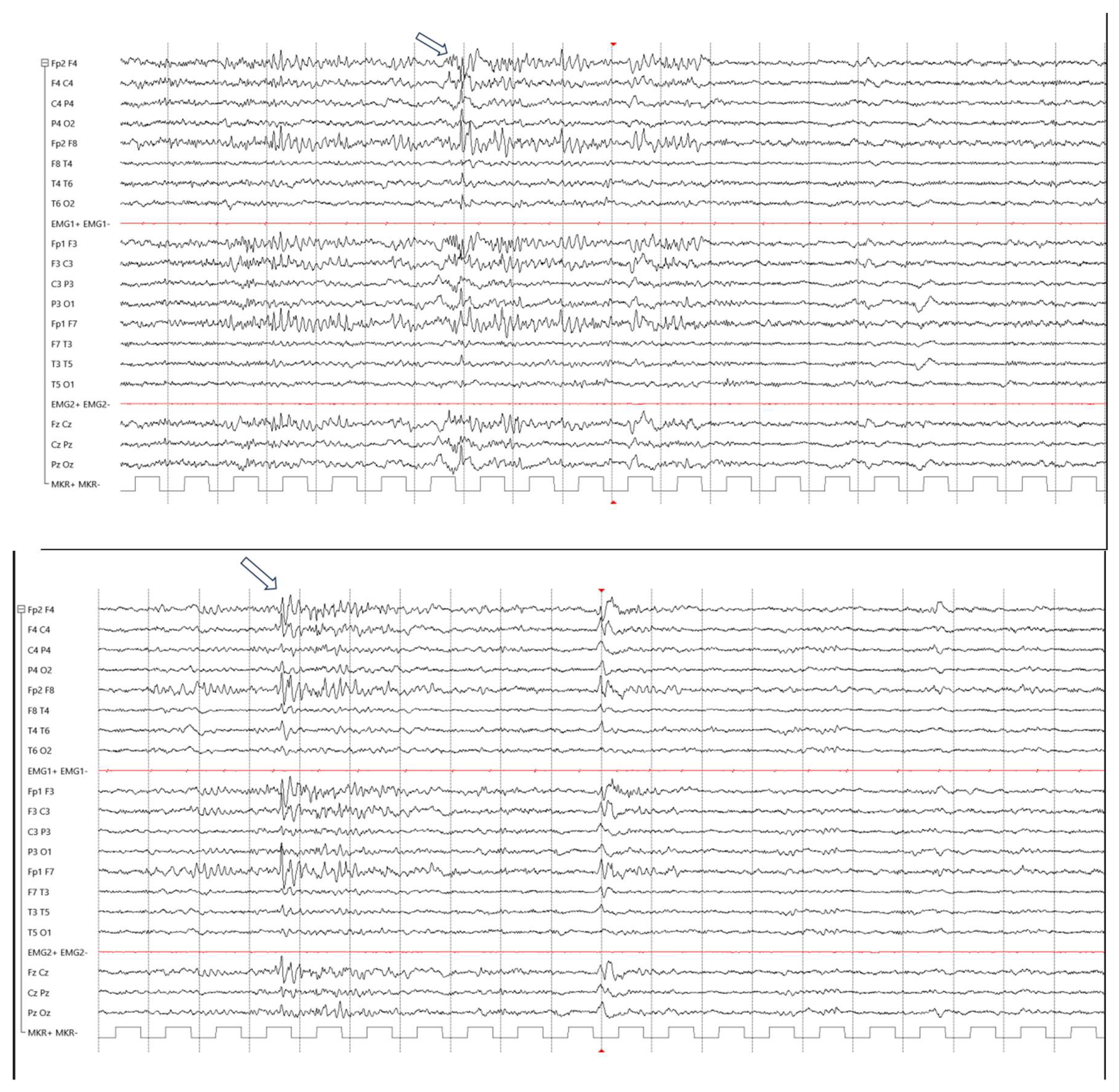
Figure 2.
A: Sagittal T1-weighted image demonstrates a reduced anteroposterior diameter of the corpus callosum, hypoplasia of the splenium (thick arrow), poor visualization of the rostrum (arrowhead), and marked thinning of the anterior commissure (thin arrow). B: Coronal T1-weighted image demonstrates mild thinning of the optic chiasm.
Figure 2.
A: Sagittal T1-weighted image demonstrates a reduced anteroposterior diameter of the corpus callosum, hypoplasia of the splenium (thick arrow), poor visualization of the rostrum (arrowhead), and marked thinning of the anterior commissure (thin arrow). B: Coronal T1-weighted image demonstrates mild thinning of the optic chiasm.
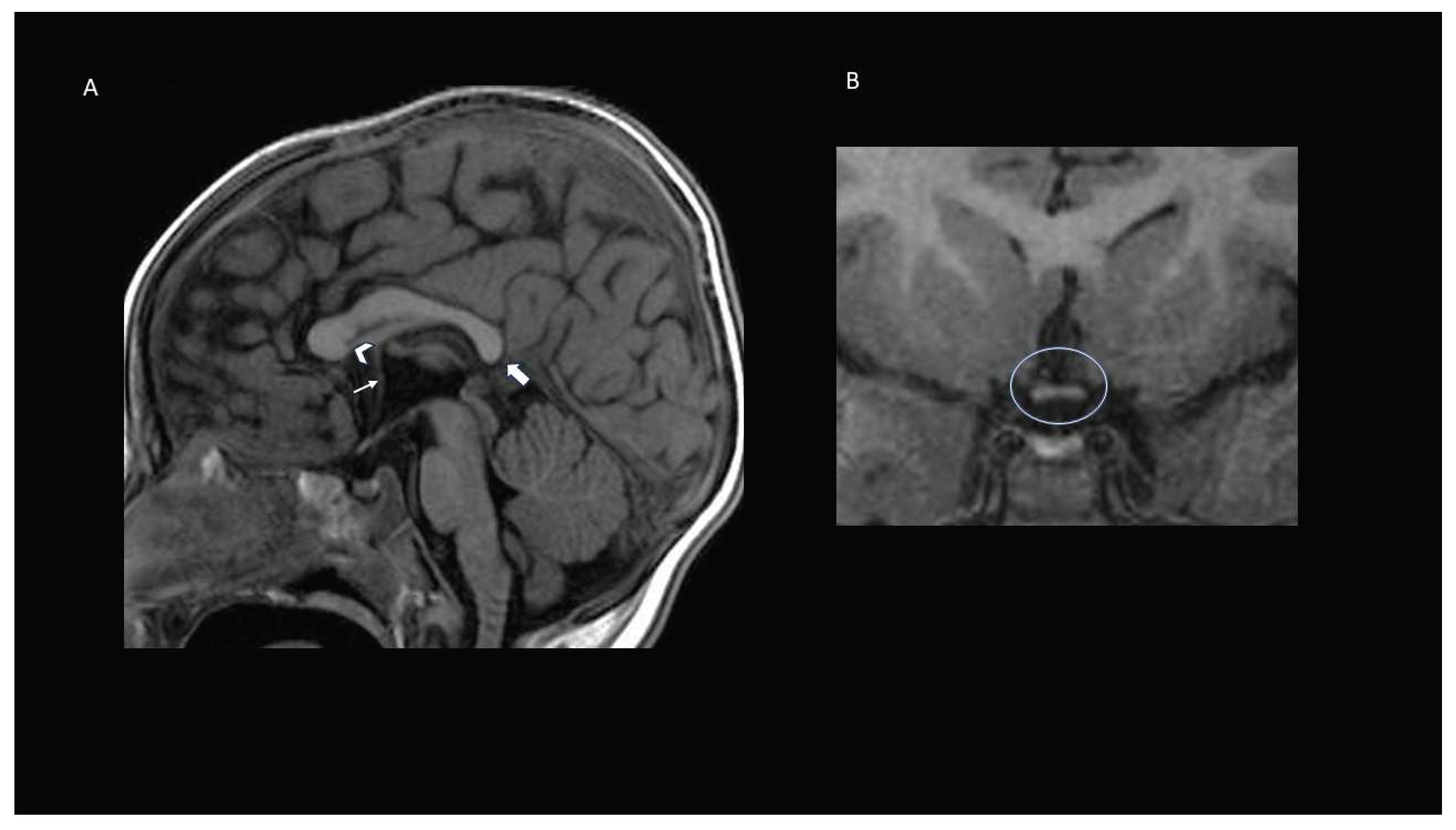

Table 1.
Summary of CLCN4 genetic variants and their corresponding phenotypic descriptions reported in the literature and in this study.
Table 1.
Summary of CLCN4 genetic variants and their corresponding phenotypic descriptions reported in the literature and in this study.
| Genetic Variant | Type of Variant | Gender | Age (years if not Specified) | Epilepsy | Neurologic Signs | Intellectual Disability | Language | ASD/Autistic Traits | Dysmorphisms | Brain MRI | Reference |
|---|---|---|---|---|---|---|---|---|---|---|---|
| c.1390-12(IVS9) T>G | Splicing | M | 6 | No | No | Yes (not specified the level) | Non-verbal | Yes | No | Right temporal arachnoid cyst and slightly wide left temporal subcranial plate gap | Li et al., 2023 |
| c.1576+5G>A | Splicing | M | 19 | Yes | walking | Borderline | Sentences (regression) | Yes | NR | NA | He et al., 2024 |
| p.(Ala448Val) | Missense LoF | F | 3 | No | Hypotonia, walking at 28 months | Severe | Non-verbal | Yes | Bushy eyebrows, downslanted palpebral fissures, esotropia, depressed nasal bridge, sparse teeth | Thin corpus callosum, mega cisterna magna, ventriculomegaly | Xu et al., 2021 |
| p.(Ala555Val) | Missense GoF | F | 3 | No | Hypertonia, walking at the age of 2 | Moderate | Severe delay | No | Microcephaly | Widened bilateral frontal-temporal extra brain space and enlarged the left ventricle | Li et al.,2023 |
| p.(Ala555Val) | Missense GoF | F | 5 | No | Hypertonia, non-ambulatory, swallowing difficulties | Severe | Non-verbal | No | Microcephaly | Small cranial volume, slightly thin the posterior of the corpus callosum, and widened ventricles | Li et al., 2023 |
| p.(Ala555Val) | Missense GoF | F | 9 | No | Non-ambulatory, swallowing difficulties with gastrostomy feeding | Yes, not specified the level | Non-verbal | No | Microcephaly | Diffuse cortical volume loss with mild lateral and third ventricular enlargement | Palmer et al., 2023 |
| p.(Ala555Val) | Missense GoF | F | 4 | No | Non-ambulatory, swallowing difficulties with gastrostomy feeding | Moderate | Non-verbal | Stereotypical hand movements | Microcephaly, positional plagiocephaly, deep-set and wide-spaced eyes, broad bulbous nose, large ears, small jaw, and high palate | Agenesis of the corpus callosum and anterior commissure (complete commissural agenesis) and abnormal orientation of the hippocampi | Palmer et al., 2023 |
| p.(Ala555Val) | Missense GoF | F | 4 | No | Non-ambulatory feeding difficulties | Yes, not specified the level | Non-verbal | No | Microcephaly | Small pons, immature myelination | Palmer et al., 2023 |
| p.(Ala555Val) | Missense GoF | F | 10 | No | Hypotonia, walking at 18 months | Yes, not specified the level | Two-to-three-word phrases | No | Microcephaly, posteriorly rotated ears, slightly arched eyebrows, slightly depressed nasal bridge, decreased muscle bulk, prominent columella, fifth finger clinodactyly | Normal | Palmer et al., 2023 |
| p.(Ala555Val) | Missense GoF | F | 18 months | No | Hypertonia, Non-ambulatory | Severe | Non-verbal | NR | Microcephaly, depressed nasal bridge | Dilation of the cerebral ventricles, thin corpus callosum, delayed myelination | He et al., 2024 |
| p.(Ala555Val) | Missense GoF | F | 5 | No | Walking | Severe | Few words | NR | NR | NA | He et al., 2024 |
| p.(Ala555Val) | Missense GoF | F | 28 | No | Walking | Severe | Simple sentences | NR | NR | NA | He et al., 2024 |
| p.(Arg41Trp) | Missense LoF | M | 4 | No | Non-ambulatory, autonomic, paroxysmal involuntary eye movements, tic disorder | Severe | Single words | NR | NR | NA | He et al., 2024 |
| p.(Arg360Ser) | Missense LoF | M | 18 | No | No | Severe (regression) | Non-verbal (regression) | Yes | Elongated face, long nose, mildly anteverted ears, prominent chin, and a pre-auricular pit at base of left helix. 5th finger proximal interphalangeal joint camptodactyly, mild pectus excavatum, thoracolumbar kyphosis and mild scoliosis with leg length discrepancy | Non-specific bilateral small punctate frontal white matter hyperintensities, mildly prominent Virchow-Robin spaces. Slightly bulky corpus callosum | Palmer et al., 2023 |
| p.(Arg603Trp) | Missense LoF | M | 2 | Infantile spasms, focal seizures | Non-ambulatory | Severe | Non-verbal | No | Depressed nasal bridge, small chin | Enlargement of subarachnoid spaces, dilation of the cerebral ventricles | He et al., 2024 |
| p.(Arg694Gln) | Missense LoF | M | 5 | No | Feeding difficulties, poor vision | Yes (not specified the level) | Non-verbal | Traits | No | Normal | Li et al., 2023 |
| p.(Arg718Trp) |
Missense LoF | F |
6 | Yes, blank stares, cyanosis, and emesis | No | Yes (not specified the level, regression) | Very limited expressive language | Yes, echolalia, stereotyped or repetitive motor movements, | No | NA | Palmer et al., 2023 |
| p.(Arg718Trp) |
Missense LoF | F |
9 | Hypertonia and staring during hyperpyrexia, erratic clonic movements and leftward head deviation followed by diffuse hypotonia, occurring during febrile and afebrile states | Hypotonia, walking at 24 months, gait instability, pyramidal signs, feeding difficulties | Profound (regression) | Non-verbal | Yes, midline stereotypies, hand-to-mouth movements, bruxism | Microcephaly | Bilateral frontal-parietal and periventricular white matter hyperintensities and corpus callosum thinning | This study |
| p.(Arg718Trp) |
Missense LoF | F |
8 | Absence seizures | Hypotonia | Severe, regression | NR | NR | NR | NR | Palmer et al., 2018 |
| p.(Arg718Trp) |
Missense LoF | F |
NR | NR | NR | NR | NR | NR | NR | NR | Palmer et al., 2023 |
| p.(Arg718Trp) |
Missense LoF | M | 1 month | Intractable epilepsy | NR | Severe | NR | NR | NR | NR | He et al., 2021 |
| p.(Arg718Trp) |
Missense LoF | M | 3 | Intractable epilepsy | NR | NR | NR | NR | NR | NR | Zhou et al., 2018 |
| p.(Arg718Trp) |
Missense LoF | NR (3) | NR | NR | NR | NR | NR | NR | NR | NR | Palmer et al., 2023 |
| p.(Arg718Trp) |
Missense LoF | F | 4 | Yes | Hypotonia, feeding difficulties | NR | First words at 12-15 months, CAS, dysarthria | Yes | NR | Mega cisterna magna | Garrett et al., 2025 |
| p.(Asn141Ser) | Missense LoF | M | 3 | No | NR | Moderate | Non-verbal | Yes | NR | NA | Li et al., 2023 |
| p.(Asn309Ser) | Missense LoF | M | 13 | Possible absence seizures | Hypotonia, walking at the age of 23 months, ataxia | Moderate-severe | Sentences | Yes | Long face with square chin and upslanting palpebral fissures, long fingers, pes planus, and joint hyperextensibility | Complete agenesis of the corpus callosum | Palmer et al., 2023 |
| p.(Asn309Ser) | Missense LoF | M | 21 | Focal seizures with secondary generalization | Hypotonia, ataxia | Moderate-severe | NR | No | Long face with square chin, distinct philtrum and tented upper lip, bilateral strabismus, long fingers, camptodactyly pes planus, and joint hyperextensibility | Complete agenesis of the corpus callosum | Palmer et al., 2023 |
| p.(Asp15Serfs*18) | Frameshift | M (5) | NR | NR | NA | Borderline (1/5), Mild (3/5), Moderate (1/5) | NR | No | No | NA | Hu et al. 2016 |
| p.(Gln392Ter) | Nonsense | M | 4 | No | NR | Global developmental delay | Speech disorder | NR | Yes | NA | Yi et al. 2023 |
| p.(Gln489Lys) | Missense LoF | F | 32 | No | Migraines, tremors, poor balance | No, IQ 131 (WAIS-IV) | Normal | Traits | No | Rathke cleft cyst | Palmer et al., 2023 |
| p.(Glu280Asp) | Missense LoF | M | 8 | Tonic-clonic and focal seizures, associated with fever or not | Hypotonia | Moderate | Sentences | Yes | No | NA | Palmer et al., 2023 |
| p.(Gly269Asp) | Missense LoF | F | 15 | No | Hypotonia, swallowing difficulties requiring gastrostomy | Mild | First words at 30 months | No | Microcephaly, elongated and narrow face, sloping forehead, prominent nose with high nasal bridge, long philtrum, thin upper lip vermillion, micrognathia, high arched palate, dental crowding, and bilateral 5th finger clinodactyly, spina bifida occulta | Mild prominence of the lateral ventricles with septation through the right lateral ventricle at the base of the frontal horn | Palmer et al., 2023 |
| p.(Gly342Arg) | Missense LoF | M | 5 | Focal epilepsy with recurrent status epilepticus | Walking with support | Moderate | 8 words | Yes | No | Small foci of T2-FLAIR hyperintensity, mostly within the bifrontal white matter (prominent perivascular spaces) | Sahly et al. 2024 |
| p.(Gly342Arg) | Missense LoF | M | 2 | Tonic and versive seizures with loss of consciousness, easily triggered by fever, often presenting in clusters | No | Mild | Sentences | No | No | Slightly widening of the left ventricle | Mao et al., 2025 |
| p.(Gly342Glu) | Missense LoF | M | 3 | One focal seizure | Walking at the age of 2 years | Yes, not specified the level | 3 inconstant words | No | No | Normal | Palmer et al., 2023 |
| p.Gly480Arg | Missense LoF | M | 2 | Febrile seizures | Walking | Moderate | Non-verbal (regression) | No | No | Normal | He et al., 2024 |
| p.(Gly484Arg) | Missense LoF | NR | NR | NR | NR | NR | NR | NR | NR | NR | Palmer et al., 2023 |
| p.(Gly526Ser) | Missense LoF | M | 17 | Focal onset seizures with secondary generalized seizures and myoclonic seizures | Severe feeding difficulties | Mild | NR | NR | Microcephaly, hypoplastic upper maxilla and dental malocclusion | NA | Palmer et al., 2023 |
| p.(Gly544Arg) | Missense LoF | F | 24 | Myoclonic, tonic-clonic seizure, atypical absences, and focal impaired awareness seizures | Hypotonia, walking at 18 months | Yes, not specified the level | Non-verbal | Autistic regression | Obesity, short stature, round face, round and flat nasal tip, fleshy lips, and posteriorly rotated ears, small hands and feet | Asymmetry of the mesial temporal lobes and lateral ventricles due to a smaller size of the left hippocampus | Rossi et al., 2023 |
| p.(Gly544Arg) | Missense LoF | M | NR | Early onset epileptic encephalopathy | NR | Severe | NR | NR | NR | NR | Veeramah et al., 2013 |
| p.(Gly544Arg) (mosaic) | Missense LoF | M | NR | Early onset epileptic encephalopathy | NR | Severe | NR | NR | NR | NR | Palmer et al., 2023 |
| p.(Gly545Asp) | Missense LoF | NR | NR | NR | NR | NR | NR | NR | NR | NR | Palmer et al., 2023 |
| p.(Gly545Ser) | Missense LoF | NR | NR | NR | NR | NR | NR | NR | NR | NR | Palmer et al., 2023 |
| p.(Gly731Arg) | Missense LoF | M (3) | NR | No | Hypotonia (3/3) | Severe(1/3) profound (2/3) | NR | No | Strabismus (2/3), scoliosis (3/3) | Cortical atrophy (1/2 studied) | Hu et al. 2016 |
| p.(Gly731Val) | Missense LoF | M | 11 | No | No | No | Mildly delayed | No | Synophrys, straight eyebrows, a high nasal bridge and enophthalmia | Normal | Palmer et al., 2023 |
| p.(Gly78Ser) | Missense LoF |
M (3) | NR | Yes | NA | Moderate | NR | No | No | NA | Hu et al. 2016; Palmer et al., 2023 |
| p.(Ile272Val) | Missense LoF | NR | NR | NR | NR | NR | NR | NR | NR | NR | Palmer et al., 2023 |
| p.(Ile374Thr) | Missense LoF | NR (2) | NR | NR | NR | NR | NR | NR | NR | NR | Palmer et al., 2023 |
| p.(Ile549Leu) | Missense LoF | M | 20 | Myoclonic, atonic epilepsy which evolved to Lennox-Gastaut syndrome | Wheel-chaired | Severe | Non-verbal | No | NR | Normal | Sahly et al., 2024 |
| p.(Ile549Leu) | Missense LoF | NR | NR | NR | NR | NR | NR | NR | NR | NR | Palmer et al., 2023 |
| p.(Leu221Val) | Missense LoF | M (4) | Yes (1/4) | Hypotonia (1/4 studied) | Mild (1/4), profound (2/4), not known (1/4) | No | No | Normal (1 studied) | Hu et al. 2016 | ||
| p.(Leu276Phe) | Missense LoF | M | 3 | Generalized tonic-clonic seizures | central hypotonia and peripheral spasticity, swallowing difficulties with gastrostomy | Profound | Non-verbal | No | Microcephaly, hyperpigmented lesions on the trunk | Severe cerebral and cerebellar atrophy with thinning of the corpus callosum, mild atrophy of bilateral thalami, abnormal cerebral white matter signal and mild bifrontal cerebral collections | Palmer et al., 2023 |
| p.(Leu279Val) | Missense LoF | F | 39 | Atypical and recurrent tonic- clonic convulsions associated with fevers | Generally increased tone and brisk reflexes | Moderate | Regression | Yes | Broad mouth and short philtrum with minimal micrognathia | NA | Palmer et al., 2023 |
| p.(Leu348Val) | Missense LoF | M | 5 | No | Walking, auditory nerve injury | Moderate | Non-verbal (regression) | Yes | Right groin hernia | Normal | He et al., 2024 |
| p.(Lys560Glu) | Missense LoF | NR | NR | NR | NR | NR | NR | NR | NR | NR | Palmer et al., 2023 |
| p.(Lys62Arg) | Missense LoF | M |
14 | Mixed seizure semiology including absences, eye blinking, tonic-clonic seizures, and episodes can be associated with nausea, vomiting and tremor | Balance difficulties | Mild | Delayed | Yes | High palate, macrodontia of the central incisors and restricted extension at the elbows | NA | Palmer et al., 2023 |
| p.(Phe319Ser) | Missense LoF | M | 20 | Drug-resistant epilepsy (tonic-clonic, absence seizures, sometimes provoked by fevers | Hypotonia, walking at 40 months | Moderate | First words at 54 months | Yes | No | Normal | Palmer et al., 2023 |
| p.(Phe319Ser) | Missense LoF | M | 12 | Tonic-clonic seizures often associated with febrile illnesses, absence seizures associated with eyelid myoclonus | Hypotonia, unstable gait | Mild, mainly non-verbal, verbal IQ in the normal range | Speech articulation difficulties | No | No | Normal | Palmer et al., 2023 |
| p.(Pro226Leu) | Missense LoF | M | 20 | Generalized tonic-clonic, absences, sometimes provoked by fevers | Walking at 3.5 years | Moderate | Firs words at 54 months | Yes | No | Normal | Palmer et al., 2023 |
| p.(Pro635Arg) | Missense LoF | F | 8 | Focal and generalized tonic clonic seizures | NA | Moderate | NA | Yes | Hypertelorism with epicanthal folds and full cheeks | Underdevelopment of the sulci in the left frontal region | Palmer et al., 2023 |
| p.(Ser278Arg) | Missense LoF | NR (2) | NR | NR | NR | NR | NR | NR | NR | NR | Palmer et al., 2023 |
| p.(Ser283Asn) | Missense LoF | F | 37 | No | Hypotonia, walking at the age of 2, Progressive spastic diplegia from this age | Moderate | Sentences | Yes | Cushingoid features | NA | Palmer et al., 2023 |
| p.(Thr203Ile) | Missense LoF | M | 3 | No | Hypotonia, walking at 26 months, ataxia | Mild | Some words after the age of 4 | Yes | Microcephaly, mild malar flatness, long philtrum, left-sided single palmar crease | Corpus callosum hypoplasia | Palmer et al., 2023 |
| p.(Thr203Ile) | Missense LoF | F | 11 months | Infantile spasms | Not walking | Yes, not specified the level | Non-verbal | No | No | Delayed myelination | He et al., 2024 |
| p.(Val212Gly) | Missense LoF | M (2) | NR | NR | NR | NR | NR | NR | NR | NR | Hu et al. 2016; Palmer et al., 2023 |
| p.(Val275Leu) | Missense LoF | M | 4 | Absences, infantile spasms, focal seizures | Hypotonia, walking at 4.5 years | Severe | Non-verbal | No | Elongated face, facial hypotonia with an open mouth, full cheeks and micrognathia | Dysgenesis of the corpus callosum | Palmer et al., 2023 |
| p.(Val275Met) | Missense LoF | F | NR | NR | NR | NR | NR | NR | NR | NR | Palmer et al., 2023 |
| p.(Val275Met) | Missense LoF | M | 2 | Infantile spasms, tonic– clonic seizures | No ambulation, hypertonia, left-sided unilateral positive ankle clonus and babinski sig | Moderate | Single words | NR | No | Increased T2 signal in white matter, thin corpus callosum | He et al., 2024 |
| p.(Val275Met) | Missense LoF | M | 6 | Myoclonic, tonic, focal seizures | No ambulation | Severe (regression) | Non-verbal | NR | NA | Enlargement of subarachnoid spaces, dilation of bilateral lateral and third ventricle | He et al., 2024 |
| p.(Val275Met) | Missense LoF | M | 21 months | Tonic, focal, status epilepticus | No ambulation | Severe | Non-verbal | NR | Microcephaly | Dilation of the cerebral ventricles, thin corpus callosum, small hippocampi | He et al., 2024 |
| p.(Val275Met) | Missense LoF | M | 8 | Tonic–clonic, tonic, absence seizures | No ambulation | Profound (regression) | Non-verbal | NR | NA | N | He et al., 2024 |
| p.(Val533Met) | Missense LoF | M | 15 | Focal | NA | Moderate | NA | Traits | No | NA | Palmer et al., 2023 |
| p.(Val536Met) | Missense LoF | M (7), F (2) | NR | Yes (8/8, 1 NR) | Progressive spasticity (2/8, 1 NR) | Mild (4), moderate (2), profound (2) 1 NR |
NR | No | Coarse facial features, broad nasal tip, flat midface, prominent ears (4/4 studied) | NA | Hu et al. 2016, Palmer 2018 |
| p.(Val636Met) | Missense LoF | F | 4 | No | Walking at 23 months | Moderate | Few words | Yes | Microcephaly, down slanting palpebral fissures, telecanthus, small and widely spaced teeth, bilateral clinodactyly of the 5th fingers and slight oedema of the dorsum of the feet | Palmer et al., 2023 | |
| p.(Val92Met) | Missense LoF | F | 9 | No | No | Yes, not specified the level | Delayed | Synophrys and posteriorly rotated ears | No | Palmer et al., 2023 | |
| p.(Arg315His) | Missense GoF | F | 3 | One brief febrile seizure at 34 months | Hypotonia, walking at 21 months | Moderate | Delayed | Yes | No | NA | Palmer et al., 2023 |
| p.(Arg315His) | Missense GoF | NR (2) | NR | NR | NR | NR | NR | NR | NR | NR | Palmer et al., 2023 |
| p.(Arg364Gly) | Missense GoF | M | 27 | Absence seizures, focal seizures, and occasionally secondary generalized seizures | normal | Borderline to mild | Normal | No | No | NA | Palmer et al., 2023 |
| p.(Arg432Gln) | Missense GoF | NR | NR | NR | NR | NR | NR | NR | NR | NR | Palmer et al., 2023 |
| p.(Arg652Thr) | Missense GoF | NR | NR | NR | NR | NR | NR | NR | NR | NR | Palmer et al., 2023 |
| p.(Arg718Gln) | Missense GoF | M (1) NR (2) |
NR | NR | NR | NR | NR | NR | NR | NR | Palmer et al., 2023 |
| p.(Asp29Glu) | Missense GoF | M |
10 | No | Hypotonia, standing with support, few steps with waking frame | Severe | 4 words | Mannerisms/involuntary movements: hand regard, hand, and arm flapping, clapping, smiling, and laughing most of the time | Triangular/trapezoidal face shape, high anterior hairline, prominent forehead, deep-set eyes with straight eyebrows, long/large mouth with thin lips, square, widely spaced teeth | Multiple dilated perivascular spaces, delayed myelination, grey matter heterotopia | Palmer et al., 2023 |
| p.(Asp29Glu) | Missense GoF | M |
2 | Infantile spasms, myoclonic/tonic seizures | Hypotonia, not sitting up unaided, convergent strabismus, nystagmus, | Moderate | Babbling | Mannerisms/involuntary movements: hand regard, hand and arm flapping, clapping, smiling, and laughing most of the time | Triangular/trapezoidal face shape, high anterior hairline, prominent forehead, deep-set eyes with straight eyebrows, long/large mouth with thin lips, square, widely spaced teeth | Normal | Palmer et al., 2023 |
| p.(Asp29Glu) | Missense GoF | F |
NR | NR | NR | Mild | NR | NR | NR | NR | Palmer et al., 2023 |
| p.(Asp34Asn) | Missense GoF (VOUS) | M | 9 | Focal, atonic, and febrile seizures | Walking at 18 months | Yes, not specified the level | Sentences | Yes | Almond shaped eyes, pointed teeth and a short, upturned nose, rhizomelic limb shortening consistent with Desbuquois Dysplasia | Normal | Palmer et al., 2023 |
| p.(Asp621Gly) | Missense GoF | NR | NR | NR | NR | NR | NR | NR | NR | NR | Palmer et al., 2023 |
| p.(Asp89Asn) | Missense GoF | M | 5 | Tonic-clonic seizures | Not sitting independently, no purposeful movements | Profound (regression) | Non-verbal | Yes | Microcephaly and microsomia | complete agenesis of the corpus callosum and cerebellar and brainstem hypoplasia | Sahly et al., 2024 |
| p.(Asp89Asn) | Missense GoF | F | 13 | No | Ataxia | Mild | Delayed | No | Microcephaly, broad nasal root, high palate, fifth finger clinodactyly, pectus carinatum | N | Palmer et al., 2023 |
| p.(Asp89Asn) | Missense GoF | F | 3 | No | Ataxia, hypertonia, not walking until the age of 2 | Mild | Delayed | Microcephaly, right eye internal strabismus and low hairline | Delayed myelination | Li et al., 2023 | |
| p.(Asp89Asn) | Missense GoF | M | Fetus | - | - | - | - | - | Bilateral talipes equino-varus | Agenesis of the corpus callosum, hypoplastic pons, absent septum pellucidum, colpocephaly | Lam et al., 2023 |
| p.(Asp89Asn) | Missense GoF | M | Fetus | - | - | - | - | - | - | Agenesis of the corpus callosum, hypoplastic pons, absent septum pellucidum, colpocephaly | Lam et al., 2023 |
| p.(Ile549Asn) | Missense GoF | F | 7 | No | Walking at the age of 5 | Regression | Regression, single words | Yes | Microcephaly, short palpebral fissures, and a prominent lower lip | Delayed myelination and considerable white matter deficiency with enlarged lateral ventricles and a thin corpus callosum | Palmer et al., 2023 |
| p.(Ile646Thr) | Missense GoF | NR (2) | NR | NR | NR | NR | NR | NR | NR | NR | Palmer et al., 2023 |
| p.(Ile655Val) | Missense GoF | NR | NR | NR | NR | NR | NR | NR | NR | NR | Palmer et al., 2023 |
| p.(Phe238Leu) | Missense GoF | NR | NR | NR | NR | NR | NR | NR | NR | NR | Palmer et al., 2023 |
| p.(Phe268Leu) | Missense GoF | F | 8 | No | Hypotonia, walking at the age of 2, swallowing difficulties | Mild-moderate | Delayed | Yes | Microcephaly | Lipoma, dysgenesis of the corpus callosum | Palmer et al., 2023 |
| p.(Pro310Ser) | Missense GoF | F | 7 | Yes | Hypotonia, walking at the age of 2 | Yes, not specified the level | 20 words | No | Microcephaly with ridged metopic suture, strabismus, left-sided ptosis, slight ocular telecanthus, lateral fullness of the nose, mild bilateral limited elbow extension, transverse palmer crease | Normal | Palmer et al., 2023 |
| p.(Pro369Leu) | Missense GoF | M | 13 | Yes | Walking at 48 months, wide-based gait, sensorineural hearing loss, optic nerve hypoplasia, swallowing difficulties with gastrostomy feeding | Moderate | Sentences | Yes | Diaphragmatic hernia, left lung hypoplasia, bilateral cryptorchidism, full cheeks, long philtrum, micrognathia, wide nasal bridge, anteverted nares, frontal bossing, exaggerated cupid’s bow, downturned corners of mouth, high anterior hairline, prominent forehead, lagophthalmos, hypertelorism, preauricular pit, posteriorly rotated ears | NA | Palmer et al., 2023 |
| p.(Ser105Cys) | Missense GoF | NR (2) | NR | NR | NR | NR | NR | NR | NR | NR | Palmer et al., 2023 |
| p.(Ser395Arg) | Missense GoF | F | 13 | No | Walking at 24 months | Mild | Sentences | No | No | Arachnoid cyst | Palmer et al., 2023 |
| p.(Ser69Leu) | Missense GoF (VOUS) | M | 5 | No | 7th cranial nerve palsy, severe myopia, mild ataxia | Severe | Delayed | No | Hypospadias, long eyelashes, synophrys, thick eyebrows, low set ears, short but normal fifth digit phalanges in hands and feet, second toe longer than the hallux on the left side | Normal | Palmer et al., 2023 |
| p.(Thr629Ile) | Missense GoF | F | 14 | No | Walking at the age of 3 | Moderate-severe | Delayed, short sentences | No | Long face and arched eyebrows, 2-vessel umbilical cord at prenatal ultrasound | Small remote lacunar infarct and dilated perivascular space, mild prominence of fourth ventricle | Palmer et al., 2023 |
| p.(Val317Ile) | Missense GoF | M | 5 | No | Hypotonia, walking at 5 years | Severe | Non-verbal | Yes | Mildly flat face, everted lower lip, anteverted nares | Partial corpus callosum agenesis (posterior part of the corpus and splenium) with colpocephaly, and mild third ventricle dilation | Palmer et al., 2023 |
| p.(Val317Ile) | Missense GoF | M | 13 | Focal onset frontal lobe hypermotoric epilepsy | Hypotonia, walking at 3.5 years, bilateral optic nerve hypoplasia, strabismus | Moderate | Delayed, first words at the age of 2 | No | Elevated finger pads, fifth finger clinodactyly, right preauricular skin tag | Mildly small optic chiasm and optic nerves bilaterally suggestive of optic hypoplasia as well as a dysplastic corpus callosum | Palmer et al., 2023 |
| p.(Val317Ile) | Missense GoF | M | 18 | No | Hypotonia, walking at the age of 3 years, bilateral optic atrophy, swallowing difficulties, gastrostomy feeding | Severe | Delayed, first words at the age of 4 | No | Bilateral ptosis, widely spaced teeth, slightly simple ears, malar flatness with long face and pointed chin | Bilateral optic atrophy, hypoplasia of the corpus callosum, prominent subarachnoid spaces | Palmer et al., 2023 |
| p.(Val317Ile) | Missense GoF | M | 6 | No | Hypotonia, feeding difficulties | Severe | First words at 15-18 months, unclear and slow rate speech, limited vocabulary | Traits | NR | Agenesis corpus callosum and hypoplasia of cerebellar vermis | Garrett et al., 2025 |
| p.(Val317Ile) | Missense GoF | M | 6 | Generalized/myoclonic mainly during febrile episodes or intercurrent illnesses | Hypotonia, walking at the age of 20 months, swallowing difficulties for liquids | Moderate-to-severe | Delayed, first word wat the age of 2; At the age of 6 years two-words associations | No | No | White matter hyperintensities, temporal horns dysmorphism with hippocampal eversion, dysmorphic corpus callosum and thin optic chiasma. | This study |
| p.(Val317Phe) | Missense GoF | NR | NR | NR | NR | NR | NR | NR | NR | NR | Palmer et al., 2023 |
| p.(Val550Leu) | Missense GoF | F | 20 | No | Walking at 18 months | Moderate | Mixed receptive-expressive language disorder | Traits | Round face, deep-set eyes, bulbous nose with small nares, partial cutaneous syndactyly of the 2nd and 3rd toes, joint hypermobility | NA | Palmer et al., 2023 |
| p.(Asn309Profs) | Truncating | M | 52 | No | No | Mild-moderate | Delayed | Yes | Prominent ears with simple helix, prominent nose |
NA | Palmer et al., 2023 |
| p.(Gln663Glyfs) | Truncating | M | 18 | Generalized seizures | No | Mild-moderate | Delayed | No | Microcephaly, long face, straight eyebrow, thin lips |
NA | Palmer et al., 2023 |
| p.(Tyr675Ter) | Truncating | M | 13 | Febrile seizure, tonic-clonic seizures | Hypotonia, walking at 18 months |
Severe | Severely delayed, few words | No | No | Bilateral mesial temporal sclerosis, asymmetric, right side more affected |
Palmer et al., 2023 |
Legend and abbreviations: ASD: autism spectrum disorder. CAS: Childhood apraxia of speech. F: Female. IQ: Intelligence Quotient. M: Male. MRI: Magnetic Resonance Imaging. In brackets the number of patients reported or studied. NR: Not Reported. NA: Not Available. WAIS-IV: Wechsler Adult Intelligence Scale - Fourth Edition.
Disclaimer/Publisher’s Note: The statements, opinions and data contained in all publications are solely those of the individual author(s) and contributor(s) and not of MDPI and/or the editor(s). MDPI and/or the editor(s) disclaim responsibility for any injury to people or property resulting from any ideas, methods, instructions or products referred to in the content. |
© 2026 by the authors. Licensee MDPI, Basel, Switzerland. This article is an open access article distributed under the terms and conditions of the Creative Commons Attribution (CC BY) license.
Copyright: This open access article is published under a Creative Commons CC BY 4.0 license, which permit the free download, distribution, and reuse, provided that the author and preprint are cited in any reuse.


