

Submitted:
20 April 2026
Posted:
22 April 2026
You are already at the latest version
Abstract
Background: Physical activity is a recommended first‑line treatment for chronic low back pain, yet adherence to structured exercise remains poor due to pain, fear, fatigue, and contextual barriers. Snacktivity™, which promotes brief, frequent bouts of movement embedded in daily routines, has emerged as a potentially feasible alternative. However, it remains unclear how, why, and for whom Snacktivity supports engagement in people living with chronic low back pain. Objective: To develop and refine programme theories explaining how Snacktivity‑type interventions support physical activity engagement and related outcomes in adults with chronic low back pain. Methods: A realist review was conducted following RAMESES standards. Initial programme theories were developed and iteratively refined through synthesis of quantitative, qualitative, and mixed‑methods evidence from Snacktivity and related sedentary‑reduction interventions in low back pain and transferable adult populations. Evidence was analysed to identify context–mechanism–outcome (CMO) configurations. Results: Forty‑two studies contributed evidence to programme theory refinement. Five refined programme theories were supported. Snacktivity appears to enable engagement by lowering perceived burden and threat rather than eliminating fear, generating mastery experiences that enhance self‑efficacy, and reducing symptom interference through brief, distributed activity. Education and coaching components supported meaning‑making by reframing movement as legitimate and achievable, while environmental cues and routines promoted habit formation. Psychosocial outcomes (confidence, mood, vitality) and habit formation were more consistently improved than performance‑based outcomes, and engagement was sustained even when pain or fatigue persisted. Conclusions: Snacktivity functions as a participation‑enabling intervention rather than a traditional exercise prescription. Its effectiveness in chronic low back pain is explained by psychosocial and contextual mechanisms that support psychological safety, mastery, and habit formation. These findings support a shift from dose‑response exercise models toward interventions that prioritise feasibility, meaning, and sustained participation in daily life.
Keywords:
snacktivity
; exercise snacking
; low back pain
; sedentary behaviour
; habit formation
; self‑efficacy
; realist review
; physical activity
Introduction
Low back pain is the leading cause of disability worldwide, accounting for more years lived with disability than any other health condition across most age groups and regions. Globally, low back pain affects approximately 7–10% of the population at any one time, corresponding to over 600 million people, and nearly 70–80% of individuals will experience low back pain at some point during their lifetime (Ferreira et al., 2023). Prevalence of low back pain has the highest number of cases in the age group between 50-55 years and is more prevalent in women (GBD, 2019). Low back pain prevalence is particularly high in specific occupational groups; for example, estimates among office workers range between 31% and 51% (Akkarakittichoke et al., 2022), similar rates have been seen in construction workers (Latza et al., 2000), and health care professionals have a consistently high prevalence (Almmari et al., 2025), for instance nurses have been reported to have a higher life time prevalence of 82% (Abu Saitoon et al., 2024)
Physical activity and exercise are one recommended non-invasive treatment for low back pain (NICE, 2016;2020). Physical activity is important because movement supports improvements in pain, function, confidence, and long-term self-management for people with low back pain (Hartvigsen et al., 2018; Qaseem et al., 2017). Despite these recommendations, adherence to prescribed or structured exercise programmes remains inconsistent, with barriers such as time constraints, fluctuating symptoms, pain sensitivity, fear of pain exacerbation, social factors and low motivation commonly reported (Alschuler et al., 2011; Buchbinder et al., 2018). It is important to note that complex and interacting factors may limit engagement in physical activity, for instance fear of movement has been associated with greater levels of pain during activity and negative associations with specific aspects of quality of life such as social function, roles and physical function (Altuğ et al., 2016).
These challenges have prompted growing interest in alternative ways of promoting physical activity that are more flexible and easier to integrate into daily life. Review based evidence has identified that any movement is preferable to prolonged inactivity (Roen et al., 2023) and that long periods of sedentary behaviour are associated with greater level of disability (Alzahrani et al., 2022). One approach has been identified as exercise snacking or Snacktivity™. Snacktivity is a novel “whole-day” approach to physical activity promotion that encourages the accumulation of moderate-to-vigorous activity through frequent, brief (2–5 minute) bouts embedded within everyday routines, rather than through structured or prolonged exercise sessions (Gokal et al., 2022; Daley et al., 2023). Snacktivity, which encourages the accumulation of short, frequent bouts of physical activity embedded within everyday routines, represents a potentially promising approach that aligns with guideline recommendations to stay active while addressing common behavioural and contextual barriers to sustained engagement. Further review evidence has identified consistence evidence for improvements in physical function and physiological markers as well as respiratory fitness in adult and older adults populations (Alexe et al., 2025).
To understand this area further it is important to use research approaches which can address the complex problems faced by people with low back pain and understand why, how and for whom the Snacktivity intervention work. A realist synthesis is designed specifically to address this (Pawson et al., 2005; Wong et al., 2013;2016). The realist approach focuses on what causes outcomes and equates this to specific contexts (background, situated, or specific conditions) and mechanisms (biopsychosocial, environmental or political that create change) (Rycroft-Malone et al., 2012). This means the processes involved in a realist review go beyond just considering results from randomised control trials, or in this case just evidence from Snacktivity interventions for people with low back pain.
A theory driven realist review can develop understanding based on other forms of past evidence, this could include; the experience of the condition, for instance, review evidence (Cheung et al., 2025; McMillan and Soundy, 2025) highlights psychosocial considerations for people with low back pain, including the importance of understanding emotional responses to the condition and emotional regulation that affects participation and decisions around behaviour. Another example could be understanding how people with low back pain respond to physical activity interventions is also important, for instance post exercise soreness or temporary increases in pain require consideration (Comachio et al., 2025). Further to this evidence around theories or mechanisms which could be applied and need consideration, for instance review evidence highlights consideration like confidence, fear of movement pain catastrophising or depression and ability to function, within this self-efficacy has been identified as a mediator of psychosocial factors and future pain and disability (Alhowimel et al., 2021).
However, a too narrow focus on such factors has been highlighted for instance social identity, emotional complexity and relational dynamics, culture and ethnicity or access to systems often receive less consideration despite being important (Mescouto et al., 2022). Further to this clear evidence of education or psychological treatments like CBT cannot be ignored for their potential impact and value in understanding why Snacktivity interventions with specific element may be more effective (Ho et al., 2022), other review evidence supports this for instance, education, motivational interviewing, activity or goal setting as a part of coaching were well received for people with low back pain (Amorim et al., 2019). Finally, understanding broader evidence could help identify causal mechanism, for instance, reviews on similar or related population who have undertaken Snacktivity interventions may provide evidence for biopsychosocial benefits or allow challenge to theory (Jones et al., 2024).
In summary, using a realist review to go beyond basic interventional information and consider contextual and mechanistic information that creates change will contribute to the development of understanding around how, when and for whom the Snacktivity intervention works. Limited intervention studies have been identified using Snacktivity. For instance, in older adults living in nursing homes or long term care facilities there is no interventions currently (Agbangla et al., 2022) and more broadly there is a call for research around chronic conditions (Jones et al., 2024). To the best of the authors knowledge, only one past review (Wood et al., 2024) has been conducted which developed findings around communication and trust as important mechanism and outcomes for people with low back pain. Beyond, this review no past realist review has considered Snacktivity and low back pain and given the above complexity of the condition and uniqueness of the interview further review-based research is needed.
Methods
A realist review will be undertaken in the traditional 5 steps including; (1) identification of scope and initial program theories (2) searching for evidence, (3) appraise primary studies and extract data, (4) synthesis of evidence and draw conclusions, and (4) disseminate, implement and evaluate. The review was registered with PROSPERO before commencing: CRD420261356919.
Step 1. Review Scope and Initial Program Theories
The scope of the current realist review was to consider and develop ideas for how, why and for whom Snacktivity interventions work when considering individuals with low back pain. This was undertaken by developing initial program theories (IPTs; PTs). These theories provide information around the context (C), mechanism of action (M) and outcomes that result (O). Five initial IPTs were identified and included:
IPT 1: Snacktivity supports engagement in physical activity and improves outcomes by reducing perceived threat and fear. The CMO for IPT1 is that the brief flexible bouts of physical activity (c) reduce the perceived physical or emotional threat or fear of activity and generate feelings of possibility rather than uncertainty (M) and this will provide a willingness to participate.
IPT 2: Snacktivity enhances self-efficacy through repeated mastery experiences. By achieving successful achievable bouts of physical activity and being able to integrate this into daily life (c) individual will experience enhanced self-efficacy from mastery experiences (m) and this will lead to increase confidence and contribute to sustained functional outcomes (o)
IPT3: Snacktivity minimises the impact of post-exercise pain and soreness. Brief sessions of concentrated activity (c) mean individual experience fewer severe symptom exacerbations (m)which limits negative reinforcement and avoidance behaviours allowing continued participation (o).
IPT4: Education and coaching elements achieve meaning making mechanism. Snacktivity interventions can incorporate education and motivational interviewing or coaching related elements (c) this may active cognitive reframing, understanding of activity benefit and increase motivation (m) and this can lead to greater adherence and value of activity (o)
IPT5: Environments or daily routines that allow or are conductive to spontaneous movement opportunities (c) help and allow autonomy and habit formation (m) which will increase effectiveness and outcomes of the intervention (o).
These IPTS were supported by past evidence. See Table 1 for a summary of this support evidence.
Step 2: Searching for Evidence
The search processes blended the requirements of realist inquiry with the processes required by the PRISMA 2020 checklist and PRISMA-S search tool.
Eligibility Criteria
The PICOS acronym was used to identify the following eligibility criteria:
P - Population
Studies were included if they included; Adults (18+) with low back pain (acute, subacute, chronic, persistent, nonspecific). Mixed musculoskeletal samples if low back pain data or mechanisms are extractable. Healthy adults only if the study provides transferable mechanism insights relevant to Snacktivity (e.g., feasibility, acceptability, habit formation). Studies were excluded if they involved children or adolescents, athletes (unless there was an identification of low back pain), surgical LBP populations (unless micro-bouts were a part of rehabilitation process), non musculoskeletal conditions (for instance fibromyalgia or neuropathic pain). Studies on conditions unrelated to low back
I - Intervention
Include studies that involve: Snack-based physical activity, defined as short, frequent bouts of movement (e.g., 1–5 minutes), including: exercise snacks, microbouts, movement breaks, sedentary interruptions, brief activity breaks, accumulated micro-exercise, Interventions that function like Snacktivity even if not labelled as such (e.g., hourly movement prompts, micro-mobility tasks). Interventions were excluded if they included longer or structured exercise sessions (e.g., 30–60 min workouts) without a microbout/Snacktivity component. General physical activity interventions with no short-bout or sedentary-break element were excluded. Pharmacological, surgical, or passive treatments (unless combined with Snacktivity). High-intensity interval training (unless delivered as micro-bouts). Interventions that are purely educational with no movement component. The following intervention settings were included; clinical settings (physiotherapy, MSK clinics, community settings, workplace settings, home-based interventions and digital/app-based interventions
C- Control
Studies were included where active and inactive controls were used. Studies were included whether they had a control group or not.
O – Outcomes
Studies were included if they provided experiential, perceptual, or explanatory data, such as: Experiences of using Snacktivity, perceptions of feasibility, acceptability, usefulness, Barriers and facilitators, motivation, adherence, engagement, behaviour change processes (self-efficacy, habit formation, identity, fear reduction), mechanistic insights relevant to C–M–O patterns, perceptions of pain, movement confidence, or functional change, physiological or functional outcomes only if linked to mechanisms or context. Studies were excluded that provided no insight into acceptability, feasibility or behavioural change and did not contribute to the CMO development.
S - Study Design
The following design types were included; qualitative studies (interviews, focus groups, ethnography, thematic analysis), quantitative studies reporting (RCTs, feasibility trials, pilot studies, observational studies), mixed-methods studies, process evaluations, feasibility and pilot studies, observational studies with experiential data, randomised control trials or experimental research.
O - Other - including relevance to realist inquiry and publication type
Include studies that could provide data that can inform contexts, mechanisms, or outcomes. Offer insight into how and why Snacktivity works (or doesn’t). Contribute to developing or refining the IPTs and offer data on; motivation, capability, opportunity, identity, habit formation, self-efficacy, graded exposure, movement confidence, environmental/contextual influences. Publication types included peer review journals only.
Information Sources and Search Strategy
A comprehensive and iterative search strategy was developed to identify evidence capable of informing the development and refinement of IPTs within a realist review framework. Consistent with realist methodology, the search aimed to identify diverse sources of data that could contribute to understanding of CMO associated with Snacktivity-type physical activity interventions in adults with low back pain, rather than being restricted to effectiveness-focused trials alone.
Information Sources
The following electronic databases were searched from inception to the most recent search date of April 2026: MEDLINE (via PubMed), Embase, CINAHL, PsycINFO, Scopus and Web of Science Core Collection. These databases were selected to ensure coverage of rehabilitation, physical activity, behavioural science, psychology, and qualitative health research. Reference list screening and forward citation tracking of included studies and key reviews were undertaken to identify additional relevant papers not captured by database searching, which is consistent with realist and PRISMA-S guidance.
Search Concepts and Strategy Development
The search strategy was structured around four core concepts derived from the eligibility criteria and IPTs. Search terms were developed iteratively with input from existing review evidence, theoretical frameworks relevant to physical activity behaviour, and pilot scoping searches. Both controlled vocabulary (e.g. MeSH terms) and free-text terms were used. Truncation, phrase searching, and synonym grouping were applied to maximise sensitivity.
Screening and Selection Process
A team of four reviewers using Covidence © management software undertook independent searching of databases and uploaded results to Covidence. The screening and selection process was undertaken within Covidence required two independent reviews through each stage of screening. Disagreements resolved through team meetings and agreements across team members. Study inclusion decisions were guided by the potential contribution to understanding how, why, for whom, and under what circumstances Snacktivity-type interventions may influence physical activity behaviour in adults with low back pain. During this process it was identified that several groups of papers could be included. A grouping schedule was identified initially as research focusing on Snacktivity for people with low back pain. Following this further consideration to related evidence will be made and groups to test and refine the IPTs.
Results
Search Output
A total of 4 articles met the inclusion criteria. However, from the output of 140 others were included for the refinement of IPTs. See PRISMA flow diagram Figure 1.
| Medline terms used for data base searching |
| Population: (low back pain OR back pain OR lumbar pain OR nonspecific low back pain OR persistent low back pain OR chronic low back pain OR chronic musculoskeletal pain OR musculoskeletal pain OR chronic pain OR persistent pain OR arthritis OR rheumatoid arthritis OR osteoarthritis OR chronic disease OR long-term condition* OR cardiometabolic disease OR metabolic syndrome OR type 2 diabetes OR cancer survivor* OR cancer-related pain OR chronic respiratory disease OR COPD OR older adult* OR ageing OR frail* OR pre-frail OR physically inactive adult* OR sedentary adult*) Intervention: (snacktivity OR "exercise snack*" OR microbout* OR "movement break*" OR "activity break*" OR "sedentary break*" OR "brief physical activity" OR "intermittent physical activity" OR "accumulated physical activity" OR "micro exercise" OR "short bouts of exercise") Mechanisms and behavioural processes (self-efficacy OR mastery OR confidence OR fear OR "fear of movement" OR kinesiophobia OR pain-related fear OR threat appraisal OR motivation OR engagement OR adherence OR habit formation OR habit* OR automaticity OR autonomy OR capability OR identity OR psychological safety OR perceived burden OR meaning-making OR reframing OR behaviour change OR acceptability OR feasibility OR tolerance OR pacing OR symptom exacerbation) Study design (qualitative OR interview* OR focus group* OR mixed-method* OR process evaluation OR feasibility OR pilot OR observational OR realist OR experimental) |
Low back pain Demographics
Group 1: Snacktivity intervention and low back pain
Four studies were included in this group; Barone Gibbs et al (2018) Hergenroeder et al (2022). Ellingson et al., (2026) and Lansing et al (2021). Two studies from the same experiment reported outcomes on low back pain and disability (Barone Gibbs et al., 2018) and then later (Hergenroeder et al., 2022) reported on secondary outcome measures from the original dataset on presenteeism, health related quality of life, mood, productivity and sleep. A third study was identified (Ellingson et al., 2026) this reported on physical activity, pain symptoms, depressive symptoms, compliance, quality of life and sedentary habits. The final study by Lansing et al. (2021) identified qualitative findings together with actively, health, habit questionnaires as well as physical activity monitoring. All studies were undertaken in the USA and three as randomised control trials and one as a pre-experimental trial (Lansing et al., 2021). Two studies (Gibbs et al., 2018; Hergenroeder et al., 2022) were stratified by Oswestry Disability Index scores and included a total of 27 participants (21 female, 6 male) were enrolled part in the study with an average age of 52 (SD 11) years. Ellingson et al., (2023;2026) included a total of 37 individuals (25 female, 12 male) who completed the trial with had an average age of 40.2 (SD 9.9) for the intervention group and 41.1 (10.9 SD) for the control. Lansing et al., (2021) included a total of 20 into the intervention but only reported demographics for the 11 interviewed participants (5 female and 6 male) with an average age of 42 (IQR: 32;45).
Further demographics break down was for the Gibbs et al., (2018) was only reported in Hergenroeder et al (2022) from a total of 24 individuals, the majority of individuals included were white (n=19/24), black (n=2/24) or Asian (n=1/24). Within this sample more people had a masters or doctoral degree (n=13/24), than bachelors degree (n=6/24) and less with some college experience or associated degree (n=5/24). Ellingson et al. (2026) identified the majority of people as white 15 (79%) in the intervention group and 16 (89%) in the control. Further break down was not given. Education was reported as those with a college degree which was high 17 (89%) in the intervention group and 15(83%) in the control. Lansing et al (2021) identified a majority as white (9/11, 82%) and 4 with a higher degree (4/11, 36%). The above identifies a total sample mainly represented as white female participants mostly with a college degree.
Two studies (Barone Gibbs et al., 2018; Hergenroeder et al., 2022) used an intervention which had active elements of bimonthly behavioural counselling, a sit to stand desk, a wrist worn activity promoting device, and cognitive behavioural therapy for low back pain. A similar format was employed by Ellingson et al. (2026) which employed a health coach to provide motivational intervening with a focus on breaking up and reducing sedentary behaviour, an education booklet was identified, and identification was considered for internal and external cues for breaking up behaviour. A Fitbit was used to identify step related goals and support the exercise snacking approach. Lansing et al (2021) utilised a Fitbit, motivational interviewing, the main task was supported by prompts of when to accumulate small numbers of steps. All studies used prompts and an activity device with some form of counselling motivational guidance.
Results
Sedentary Behaviour and Physical Activity Outcomes
Self-Reported Sitting Time
Across studies, self-reported sitting consistently decreased following Snacktivity interventions.
Lansing et al. (2021) reported large median reductions in: Weekday sitting (−2.8 hours/day), weekend sitting (−2.0 hours/day), total sitting time (−2.6 hours/day). Similarly with slightly different measures Ellingson et al. (2026) showed substantial within-intervention reductions in: occupational sitting (−73 min/day), leisure screen time (−82 min/day), total sedentary time (−153 min/day). Between-group differences favoured the intervention but did not reach statistical significance. Finally, Barone Gibbs et al. (2018) demonstrated statistically significant between-group reductions: −1.4 hr/day total sitting (p = 0.02, d = 0.78) and −1.5 hr/day work sitting (p < 0.001, d = 1.36).
Synthesis of evidence:
Snacktivity and reduced sedentary time interventions reliably reduce self-reported sitting, particularly workplace and screen-based sedentary time, with moderate to large effects. Effects are strongest when structural supports (e.g., sit–stand desks) are included.
Objectively Measured Sedentary Time and Activity
Objective measures showed smaller and more variable effects. Lansing et al. (2021) found minimal objective change in sitting time and prolonged sitting bouts, despite large self-reported reductions. Ellingson et al. (2026) showed a clinically relevant but non-significant reduction in prolonged sedentary bouts (−53 min/day). Barone Gibbs et al. (2018) did not focus on device-based outcomes but reported strong behavioural effects indirectly through sitting reductions.
Synthesis of evidence:
Snacktivity appears to influence how and where people sit more than total objectively measured sitting time, suggesting behaviour is redistributed across contexts rather than eliminated.
Objectively Measured Physical Activity
Moderate to vigorous physical activity showed small or non-significant increases across studies: Ellingson et al. (2026) identified a very small but non-significant change between: +1.6 min/day. Barone Gibbs et al. (2018) identified a greater change but still non-significant: +56 min/week (d = 0.32,). Lansing et al (2021) identified an increase in light activity and steps (+555 steps/day).
Synthesis of evidence:
Snacktivity appears to primarily modify sedentary patterns and light activity, not sustained moderate to vigorous physical activity.
Habit Formation and Behavioural Automaticity
Habit outcomes showed the most consistent and robust intervention effects. Between group analysis identified consistent differences. Lansing et al. (2021) identified the following outcomes including standing up more frequently (+13 times/day), breaking up prolonged sitting (+16 times/day), and reduced “sitting when could stand” (−12 times/day). Ellingson et al. (2026) demonstrated moderate-to-large between-group effects for: Sitting habit reduction (g = 0.71 [follow up] – 0.84 [post intervention]), standing habit formation (g = 0.64 [follow up]–0.76 [post intervention]) and breaking up sitting habit (g = 0.74–0.84)
Synthesis of evidence:
Snacktivity interventions produce clinically meaningful habit change, even when changes in total sitting time are modest. Habit change appears to be a key mechanism of action.
Health-Related Outcomes
Pain and Disability
Two studies identified some evidence of reduction in disability. Barone Gibbs et al. (2018) identified a significant reduction in low back pain disability (ODI): −8 points (d = 0.73). Ellingson et al. (2026) identified an improvement within intervention groups and a clinical meaningful but non-significant change in SF-36 bodily pain subscale at post (g=0.81) and at follow up (g = 0.70).
Synthesis:
Snacktivity yields consistent improvements in pain-related quality of life and disability, even when pain intensity itself changes modestly.
Sleep
Hergenroeder et al. (2022) identified a significant improvement in Pittsburgh Sleep Quality Index sleep disturbance domain (the ability sleep through the night and not being distrubed or waking up too early (d = 0.77), with no change in global sleep score.
Synthesis:
Snacktivity may improve influence sleep continuity and night-time disruption, rather than total sleep quality.
Qualitative Findings: Factors Influencing Outcomes
Qualitative data (Lansing et al., 2021; Barone Gibbs et al., 2018) provides some contextual and mechanistic information of why and when interventions work. Barriers were identified by both studies as; (a) work demands requiring sustained sitting (b)time pressure and cognitive focus, (c) social norms discouraging standing, (d) environmental constraints (no sit–stand desk), (e) weather and commuting barriers. Facilitators were identified by both studies as: (a) education about sedentary risk, (b) external cues (activity prompts, reminders), (c) self-monitoring (steps, sitting data), (d) physical environment supports (standing desks, stools), (e) leadership and organisational endorsement, (f) reframing productivity to include movement
Integrated interpretation:
Snacktivity works best when individual habit cues are reinforced by environmental and social permission. Without these, behaviour change is harder to sustain.
Refinement of PTs
The current evidence can provide initial support and consideration for the IPTs that are proposed. The most directly supported IPT were IPT2, IPT4, IPT5 when applied, most often from the demographics of middle aged white females.

Table 2.
A summary of support from initial evidence and refined IPTs to be tested further.
| PT | Status | Rationale | Refined IPT |
|---|---|---|---|
| IPT1 (Snacktivity supports engagement in physical activity and improves outcomes by reducing perceived threat and fear) | Partially supported → refine | Supported indirectly via indications of improvements in pain, perception of the condition, mood, social functioning. This means it is possible that fear or threat is reduced but not explicit from current evidence. | Snacktivity supports engagement by lowering the perceived burden and risk of activity, increasing psychological safety and feasibility rather than eliminating fear directly. |
| IPT2 (Snacktivity enhances self-efficacy through repeated mastery experiences.) | Strongly supported | Strongly supported by directly by habit outcomes indicators and changes in sitting, sedentary time and light physical activity changes and supported by psychosocial confidence/esteem/perc/perception of living with the condition indicators. | Repeated, achievable Snacktivity bouts generate mastery experiences that enhance self-efficacy and confidence, supporting sustained engagement through habit formation rather than performance gains. |
| IPT3 (Pain/soreness minimisation) | Supported → context-dependent | Evidence supports this indirectly by identifying benefits on disability, pain interference, adherence. However, not pain elimination | Brief, distributed activity reduces symptom exacerbation and functional interference, disrupting negative reinforcement cycles and enabling continued participation despite ongoing symptoms. |
| IPT4 (Education/coaching → meaning-making) | Strongly supported | Consistent combination of counselling based approached used and identification of emotional role functioning improvement, mood and energy change and confidence as well as life satisfaction indicators, combined with mechanism of education about sedentary risk, refarming productivity and social permission support this process theory. | Education and coaching components activate meaning-making and motivational mechanisms (e.g., reframing movement as legitimate, valuable, and achievable), increasing adherence and perceived value of activity. |
| IPT5 (Environment/routine → autonomy/habit) | Strongly supported | One of the clearest explanatory mechanisms is provided by this from qualitative evidence of factors which influence the program. This is supported by habit change identified in outcome domains and the direct benefits link to | Environments and routines that afford spontaneous movement provide cues, permission, and autonomy that support habit formation, amplifying intervention effectiveness. |
Testing PTs further
To test PTs further evidence was compared to other groups located by the initial search.
Additional search output
Further evidence from different groups to support and developed PTs is required. From the initial search output the below grouping of included studies was identified including; 12 qualitative studies (André and Lundberg, 2022; Boutevillain et al., 2017; Christensen et al., 2023; Cook and Hassenkamp, 2000; Cool et al., 2010; Curran et al., 2023; Gokal et al., 2023; Krouwel et al., 2023; Lainsing et al., 2021; Manaenkova and Santanna, 2025; Pronk et al., 2012; Tyldesley-Marshall et al., 2022), eight older adult studies (Fyfe et al., 2022; Graham et al., 2025; Hu et al., 2026; Liang et al., 2023; Laing et al., 2024; Oppezzo et al., 2021; Perkin et al., 2019; Stawarz et al., 2023), eight studies where individual were identified as inactive (Babir et al., 2025; Daley et al., 2025; Jenkins et al., 1995;Krouwel et al., 2023; Mues et al., 2025; Thøgersen-Ntoumani et al., 2023; Tyldesley-Marshall et al., 2022; Yin et al., 2024), five healthy individuals studies (Chandran et al., 2023; Foley et al., 2016; Gallaher et al., 2019; Sanders et al., 2023; Stork et al., 2024) and seventeen studies focusing on individual with chronic illnesses (Babir et al., 2026; Cheng et al., 2021; Jakicic et al., 1995; Jansons et al., 2023; Lynch et al., 2019; Lynch et al., 2014; Maxwell-Smith et al., 2019; Norha et al., 2022; Norha et al., 2025; Patterson et al., 2023; Poppe et al., 2019; Sjoros et al., 2023; Sjoros et al., 2023; Thomsen et al., 2020; Thomsen et al., 2017; van Bakel et al., 2023; Western et al., 2023)
Demographics of Additional Samples
A total of 42 studies were represented in the additional group data. This included at total of 3064 (1439, women 1540, no gender information 94). The aggregate mean age across these studies was 54.6 years. Across 18 chronic illness studies (14 without duplicate information) there was a total of 1312 (428 women, 884 men). There was a total of 6 conditions identified with cardiometabolic conditions (n=5) and cancer (n=4) being the most represented groups. Australia had the most studies (n=6) with other studies having 1 each. The majority of studies were community or home based (n=9). The aggregate mean age was 59.9 years. Across the eight qualitative studies (n= 1050, 351 men, 632 women, 67 gender not reported). The majority of the group was made up by one study of 724 individuals from the general public, after this 6 studies included individuals with low back pain and 2 included inactive individuals. The aggregate mean age was 45.3 years. Most studies were undertaken in the United Kingdom (n=5) followed by the USA (n=3) followed by China (n=2). Seven studies were home based, four were home and workplace, 3 were primary care settings. Across eight older adult studies (n = 342, 103 men, 214 women, 25 gender not reported), participants were recruited from home-based and community settings across six countries (Australia, Ireland, China, UK, Taiwan, USA). The aggregate mean age was 71.2 years, with most studies focusing on adults in their early-to-mid seventies, including several cohorts described as pre-frail. Across the eight inactive group studies (n = 360, 101 men, 266 women, 2 not identified) there were two studies from the United Kingdom and Canada and one from China, Australia and Germany. There were 6 community based studies (3 within the workplace), there was also two laboratory studies. Most designs were randomised control trials (n=5) or qualitative duplicates (n=3) from above that fit within this group. The aggregated mean age was 45.8 years
Mapped Results
The above studies were mapped to the evidence for previous results from the low back interventions. Table 3 provides a complete comparison of evidence against other conditions. This table provides evidence that Psychosocial outcomes (confidence, mood, vitality) change more consistency that performance related outcomes and that habit formation is more often expressed as a substitution (e.g., standing more or moving more) rather than increased break frequency. Perceived feasibility and legitimacy of movement is more important than fear reduction. Objective sitting reduction is helpful but not required for engagement and behaviour change occurs even when pain, fatigue or disease symptoms persist. This table suggests a shift from a dose-response exercise model or a participation enablement model.
Based on this evidence a final refinement of each PT is possible. See Table 4 for context mechanism and outcome information. Together with embedded qualitative illustrations from qualitative evidence
Final PTs
PT1 now has evidence which shows confidence improves without fear being explicitly target and whilst pain could remain present adherence is still high. Qualitative evidence suggest that is it because it is doable. The refined program theory is:
Final PT1: Snacktivity works not by changing fear beliefs, but by bypassing them through low-threat action.
PT2 has good evidence around the value and impact of confidence resulted from Snacktivity interventions and that low self-efficacy is a primary context needed to change for improvement.
Final PT2: Mastery arises from successful repetition of achievable actions, not from improvement in strength, fitness, or pain.
PT3 has support from evidence around meaningful pain reduction and fatigue improvement as well as improved tolerance and vitality, people feeling less stiff, having more energy, perceiving better days are identified
Final PT3: Snacktivity works by interrupting negative reinforcement cycles, not by removing symptoms.
PT4 identified that education can help reframe movement as legitimate and not trivial. Coaching helps validate that shout bouts count and movement is valuable even without fitness gains and finally that mood improves alongside reframing through support.
Final PT4: Education works not by increasing information, but by changing what movement means.
PT5 identifies the importance of habit relevant evidence and identifies the cues, prompts, routines aid consistence and adherence. When movement is embedded in daily context and when wen no scheduling or preparation if required habit formation is possible.
Final PT5: Snacktivity succeeds when environments make movement easy, not when people are motivated to plan it.
Discussion
This realist review sought to explain how, why, and for whom Snacktivity-type interventions support engagement in physical activity among adults with chronic low back pain, rather than focusing solely on effectiveness. The synthesis indicates that Snacktivity operates primarily as a participation-enabling intervention, with psychosocial and contextual mechanisms consistently explaining engagement and sustained behaviour change, even when pain, fatigue, or symptoms persist (Barone Gibbs et al., 2018; Ellingson et al., 2026; Lansing et al., 2021).
Across studies, engagement was maintained without explicit fear reduction, supporting the refinement of PT1. Rather than eliminating fear, Snacktivity appears to lower perceived burden and threat, increasing psychological safety and feasibility (Fyfe et al., 2022; Krouwel et al., 2023; Tyldesley-Marshall et al., 2022). This aligns with contemporary pain literature suggesting that avoidance is more effectively addressed through safe action and feasibility than cognitive challenge alone (Vlaeyen & Linton, 2012; George et al., 2022).
The strongest and most consistent evidence supported PT2 and PT5. Repeated, achievable activity bouts generated mastery experiences, enhancing self-efficacy and confidence independently of performance gains (Ellingson et al., 2026; Thomsen et al., 2017; Bandura, 1997). Habit formation was most commonly expressed as behavioural substitution (standing or moving more) rather than increased activity volume, particularly when cues, routines, and environmental affordances were present (Lansing et al., 2021; Gardner et al., 2012; Jones et al., 2024). These findings reinforce that habit formation, not fitness change, is a central mechanism of Snacktivity.
Evidence also supported PT3, though in a context-dependent manner. Snacktivity did not consistently eliminate pain; instead, brief and distributed activity appeared to reduce symptom interference, fatigue, and post-exertional exacerbation, disrupting negative reinforcement cycles that typically drive avoidance (Thomsen et al., 2017; Norha et al., 2025; Comachio et al., 2025). Improvements in vitality and fatigue were among the most consistent health-related outcomes across chronic pain and comorbid populations, even when objective physical activity change was modest (Hergenroeder et al., 2022; Sjöros et al., 2023).
Finally, PT4 was strongly supported. Education and coaching components did not simply increase knowledge but reframed movement as legitimate, valuable, and achievable, enhancing meaning-making and perceived benefit (Amorim et al., 2019; Keefe et al., 2018; Ho et al., 2022). Improvements in mood, emotional role functioning, confidence, and life satisfaction occurred alongside this reframing, suggesting that psychosocial change precedes and sustains behavioural change (Hergenroeder et al., 2022; Ellingson et al., 2026).
Overall, this review suggests a shift away from a dose–response exercise model toward a participation enablement model, in which Snacktivity supports sustained engagement through psychological safety, mastery, habit formation, and contextual fit. These mechanisms appear particularly well-suited to chronic low back pain, where fluctuating symptoms, fear, and fatigue commonly undermine traditional exercise approaches (Hartvigsen et al., 2018; Wood et al., 2024).
References
- Abu Zaitoon, R.; Said, N. B.; Snober, R. H.; Hussein, R. F.; Abdoon, A. H.; Abu Shehadeh, A. M.; Battat, M. M.; Sakleh, I. R. Low back pain prevalence and associated factors among nurses: A cross-sectional study from Palestine. BMC Public Health 2024, 24, 3076. [Google Scholar] [CrossRef]
- Agbangla, N. F.; Séba, M.-P.; Bunlon, F. Snacktivity™, giant games and immersive virtual reality exercises: A rapid narrative review of these new physical activity practices among older people living in nursing homes and long-term care facilities. Healthcare 2022, 10(10), 1897. [Google Scholar] [CrossRef]
- Akkarakittichoke, N.; Jensen, M. P.; Newman, A. K.; Waongenngarm, P.; Janwantanakul, P. Characteristics of office workers who benefit most from interventions for preventing neck and low back pain: A moderation analysis. Pain Reports 2022, 7(3), e1014. [Google Scholar] [CrossRef]
- Alammari, M. A.; Alammari, A. A.; Alammari, A. A.; Alammari, A.; Alammari, N. A.; Alabdali, M. Y. I. Psychosocial and occupational factors associated with low back pain among healthcare professionals: A systematic review. Cureus 2025. [Google Scholar] [CrossRef] [PubMed]
- Altuğ, F.; Ünal, A.; Kılavuz, G.; Kavlak, E.; Çitışlı, V.; Cavlak, U. Investigation of the relationship between kinesiophobia, physical activity level and quality of life in patients with chronic low back pain. Journal of Back and Musculoskeletal Rehabilitation 2016, 29, 527–531. [Google Scholar] [CrossRef]
- Alhowimel, A. S.; Alotaibi, M. A.; Alenazi, A. M.; Alqahtani, B. A.; Alshehri, M. A.; Alamam, D.; Alodaibi, F. A. Psychosocial predictors of pain and disability outcomes in people with chronic low back pain treated conservatively by guideline-based intervention: A systematic review. Journal of Multidisciplinary Healthcare 2021, 14, 3549–3559. [Google Scholar] [CrossRef]
- Alschuler, K. N.; Hoodin, F.; Murphy, S. L.; Rice, J.; Geisser, M. E. Factors contributing to physical activity in a chronic low back pain clinical sample: A comprehensive analysis using continuous ambulatory monitoring. Pain 2011, 152(11), 2521–2527. [Google Scholar] [CrossRef] [PubMed]
- Alzahrani, H.; Alshehri, M. A.; Alzhrani, M.; Alshehri, Y. S.; Al Attar, W. S. A. The association between sedentary behavior and low back pain in adults: A systematic review and meta-analysis of longitudinal studies. PeerJ 2022, 10, e13127. [Google Scholar] [CrossRef]
- André, M.; Lundberg, M. Thoughts on pain, physical activity, and body in patients with recurrent low back pain and fear: An interview study. Physical Therapy 2022, 102(2), 1–9. [Google Scholar] [CrossRef]
- Amorim, A.B.; Pappas, E.; Simic, M.; Ferreira, M.L.; Jennings, M.; Tiedemann, A.; Carvalho-E-Silva, A.P.; Caputo, E.; Kongsted, A.; Ferreira, P.H. Integrating Mobile-health, health coaching, and physical activity to reduce the burden of chronic low back pain trial (IMPACT): a pilot randomised controlled trial. BMC Musculoskelet Disord 2019, 20(1), 71. [Google Scholar] [CrossRef] [PubMed]
- Babir, F. J.; Islam, H.; McCreary, S.; Vaz, E.; Falkenhain, K.; Cranston, K.; Jung, M.; Singer, J.; Sandilands, R.; Marcotte-Chénard, A.; Stamatakis, E.; Richards, D. L.; Gibala, M. J.; Little, J. P. Technology-enabled exercise “snacks” are feasible to perform in a real-world setting: A randomized controlled trial. Scandinavian Journal of Medicine & Science in Sports 2025, 35(8), e70117. [Google Scholar] [CrossRef]
- Babir, F. J.; Marcotte-Chénard, A.; Sandilands, R. E.; Falkenhain, K.; Mulkewich, N.; Islam, H.; McCarthy, S. F.; Richards, D. L.; Madden, K.; Singer, J.; Riddell, M. C.; Jung, M. E.; Gibala, M. J.; Little, J. P. Exercise snacks are feasible to perform in the real world and improve physical capacity for adults living with non-insulin treated type 2 diabetes: A randomized trial. medRxiv (preprint) 2026. [Google Scholar] [CrossRef]
- Babir, F. J.; Islam, H.; McCreary, S.; Vaz, E.; Falkenhain, K.; Cranston, K.; Jung, M.; Singer, J.; Sandilands, R.; Marcotte-Chénard, A.; Stamatakis, E.; Richards, D. L.; Gibala, M. J.; Little, J. P. Technology-enabled exercise “snacks” are feasible to perform in a real-world setting: A randomized controlled trial. Scandinavian Journal of Medicine & Science in Sports 2025, 35, e70117. [Google Scholar] [CrossRef]
- Barone Gibbs, B.; Hergenroeder, A. L.; Perdomo, S. J.; Kowalsky, R. J.; Delitto, A.; Jakicic, J. M. Reducing sedentary behaviour to decrease chronic low back pain: The Stand Back randomised trial. Occupational and Environmental Medicine 2018, 75(5), 321–327. [Google Scholar] [CrossRef] [PubMed]
- Bandura, A. Self-efficacy: The exercise of control; W. H. Freeman, 1997. [Google Scholar]
- Boutevillain, L.; Dupeyron, A.; Rouch, C.; Richard, E.; Coudeyre, E. Facilitators and barriers to physical activity in people with chronic low back pain: A qualitative study. PLOS ONE 2017, 12(7), e0179826. [Google Scholar] [CrossRef]
- Buchbinder, R.; van Tulder, M.; Öberg, B.; Costa, L. M.; Woolf, A.; Schoene, M.; Croft, P. Low back pain: A call for action. The Lancet 2018, 391(10137), 2384–2388. [Google Scholar] [CrossRef]
- Bunzli, S.; Watkins, R.; Smith, A.; Schütze, R.; O’Sullivan, P. Lives on hold: A qualitative synthesis exploring the experience of chronic low back pain. Clinical Journal of Pain 2013, 29(10), 907–916. [Google Scholar] [CrossRef]
- Cheung, C. K. C.; Cheung, E. T. C.; Schoeb, V.; Opsommer, E.; Chong, D. Y. K.; Lee, J. L. C.; Kumlien, C.; Wong, A. Y. L. Lived experiences of older adults with chronic low back pain and implications on their daily life: A metasynthesis of qualitative research. Archives of Rehabilitation Research and Clinical Translation 2025, 7(2), 100456. [Google Scholar] [CrossRef]
- Cheng, S. W. M.; Alison, J. A.; Stamatakis, E.; Dennis, S.; McNamara, R.; Spencer, L.; McKeough, Z. Six-week behaviour change intervention to reduce sedentary behaviour in people with chronic obstructive pulmonary disease: A randomised controlled trial. Thorax 2022, 77, 231–238. [Google Scholar] [CrossRef] [PubMed]
- Christensen, M. N.; Johansen, S. K.; Sloth, S. R.; Madsen, E.; Carlsen, A.; Rathleff, M. S. Exploring self-management barriers and facilitators experienced by people with chronic musculoskeletal pain: A qualitative study (Preprint). European Journal of Pain 2023. [Google Scholar] [CrossRef]
- Comachio, J.; Beckenkamp, P. R.; Ho, E. K.-Y.; Abdel Shaheed, C.; Stamatakis, E.; Ferreira, M. L.; Lan, Q.; Mork, P. J.; Holtermann, A.; Wang, D. X. M.; Ferreira, P. H. Benefits and harms of exercise therapy and physical activity for low back pain: An umbrella review. Journal of Sport and Health Science 2025, 14, 101038. [Google Scholar] [CrossRef]
- Coole, C.; Drummond, A.; Watson, P. J.; Radford, K. What concerns workers with low back pain? Findings of a qualitative study of patients referred for rehabilitation. Journal of Occupational Rehabilitation 2010, 20(4), 472–480. [Google Scholar] [CrossRef] [PubMed]
- Curran, F.; Brennan, C.; Matthews, J.; O’Donoghue, G. A qualitative study of perceived barriers and facilitators to interrupting sedentary behavior among adults living with obesity. Obesity Science & Practice 2024, e721. [Google Scholar] [CrossRef]
- Daley, A. J.; Griffin, R. A.; Moakes, C. A.; Sanders, J. P.; Skrybant, M.; Ives, N.; Parretti, H. M.; Biddle, S. J. H.; Greaves, C.; Maddison, R.; Mutrie, N.; Esliger, D. W.; Sherar, L. B.; Edwardson, C. L.; Yates, T.; Frew, E.; Tearne, S.; Jolly, K.; Moakes, C. A. Snacktivity™ to promote physical activity and reduce future risk of disease in the population: Protocol for a feasibility randomised controlled trial and nested qualitative study. Pilot and Feasibility Studies 2023, 9, 45. [Google Scholar] [CrossRef]
- Daley, A. J.; Griffin, R. A.; Sanders, J.; Gokal, K.; Ives, N.; Skrbant, M.; Jarrett, H. M.; Edwardson, C. L.; Biddle, S. J. H.; Joll, K.; Greaves, C. J.; Greenfield, S. M.; Maddison, R.; Esliger, D. W.; Sherar, L. B.; Frew, E.; Murtre, N.; Mallor, B.; Yates, T.; Tearne, S.; Moakes, C. A. Snacktivity™ to promote physical activity in primary care, community health and public health settings: A feasibility randomised controlled trial. International Journal of Behavioral Medicine 2025, 32, 702–716. [Google Scholar] [CrossRef]
- Deci, E. L.; Ryan, R. M. The “what” and “why” of goal pursuits: Human needs and the self-determination of behavior. Psychological Inquiry 2000, 11(4), 227–268. [Google Scholar] [CrossRef]
- Ding, D.; Lawson, K. D.; Kolbe-Alexander, T. L.; Finkelstein, E. A.; Katzmarzyk, P. T.; van Mechelen, W.; Pratt, M. The economic burden of physical inactivity: A global analysis of major non-communicable diseases. The Lancet 2020, 388(10051), 1311–1324. [Google Scholar] [CrossRef] [PubMed]
- Ellingson, L. D.; Lansing, J. E.; Phillips, L. A.; Meyer, J. D. Efficacy of breaking up sedentary time on pain and mood in chronic low back pain. Medicine & Science in Sports & Exercise 2023, 55, 899. [Google Scholar] [CrossRef]
- Ellingson, L. D.; Connolly, M. L.; Lansing, J. E.; Phillips, L. A.; Meyer, J. D. Evaluating the effects of a sedentary time reduction intervention on pain, mood, and quality of life in chronic low back pain: A pilot randomized controlled trial. Journal of Behavioral Medicine 2026. [Google Scholar] [CrossRef]
- Ferreira, M. L.; de Luca, K.; Haile, L.; et al. Global, regional, and national burden of low back pain, 1990–2020, its attributable risk factors, and projections to 2050: A systematic analysis of the Global Burden of Disease Study 2021. The Lancet Rheumatology 2023, 5(6), e316–e329. [Google Scholar] [CrossRef]
- Foster, N. E.; Anema, J. R.; Cherkin, D.; Chou, R.; Cohen, S. P.; Gross, D. P.; Ferreira, P. H.; Fritz, J. M.; Koes, B. W.; Peul, W.; Turner, J. A.; Maher, C. G. Prevention and treatment of low back pain: Evidence, challenges, and promising directions. The Lancet 2018, 391(10137), 2368–2383. [Google Scholar] [CrossRef]
- Fyfe, J. J.; Dalla Via, J.; Jansons, P.; Scott, D.; Day, R. M. Feasibility and acceptability of a remotely delivered, home-based, pragmatic resistance ‘exercise snacking’ intervention in community-dwelling older adults: A pilot randomised controlled trial. BMC Geriatrics 2022, 22, 521. [Google Scholar] [CrossRef] [PubMed]
- Gokal, K.; Amos-Hirst, R.; Moakes, C. A.; Sanders, J. P.; Esliger, D. W.; Sherar, L. B.; Ives, N.; Biddle, S. J. H.; Edwardson, C.; Yates, T.; Frew, E.; Greaves, C.; Greenfield, S. M.; Jolly, K.; Skrybant, M.; Maddison, R.; Mutrie, N.; Parrett, H. M.; Daley, A. J. Views of the public about Snacktivity™: A small changes approach to promoting physical activity and reducing sedentary behaviour. BMC Public Health 2022, 22, 618. [Google Scholar] [CrossRef] [PubMed]
- Graham, J.; Murphy, C.; Montgomery, C.; Twomey, B.; Timmons, J.; Egan, B. Feasibility and effectiveness of exercise snacking in older adults: A pilot randomized controlled trial. PM&R 2025, 17, S2–S175. [Google Scholar] [CrossRef]
- Hartvigsen, J.; Hancock, M. J.; Kongsted, A.; Louw, Q.; Ferreira, M. L.; Genevay, S.; Hoy, D.; Karppinen, J.; Pransky, G.; Sieper, J.; Smeets, R. J.; Underwood, M. What low back pain is and why we need to pay attention. The Lancet 2018, 391(10137), 2356–2367. [Google Scholar] [CrossRef] [PubMed]
- Hergenroeder, A. L.; Quinn, T. D.; Perdomo, S. J.; Kline, C. E.; Barone Gibbs, B. Effect of a 6-month sedentary behavior reduction intervention on well-being and workplace health in desk workers with low back pain. Work: A Journal of Prevention, Assessment & Rehabilitation 2022, 71(4), 1003–1014. [Google Scholar] [CrossRef]
- Hu, Z.; Li, S.; Shi, X.; Huang, K.; Huang, H.; Yuan, X. Feasibility and acceptability of a remotely delivered, home-based “exercise snacking” to improve physical function in community-dwelling older adults: A 28-day pilot study. Frontiers in Medicine 2026, 13, 1755508. [Google Scholar] [CrossRef]
- Gardner, B.; Lally, P.; Wardle, J. Making health habitual: The psychology of “habit-formation” and general practice. British Journal of General Practice 2012, 62(605), 664–666. [Google Scholar] [CrossRef]
- Gallagher, K. M.; Payne, M.; Daniels, B.; Caldwell, A. R.; Ganio, M. S. Walking breaks can reduce prolonged standing-induced low back pain. Human Movement Science 2019, 66, 31–37. [Google Scholar] [CrossRef]
- GBD 2019 Diseases and Injuries Collaborators. Global burden of 369 diseases and injuries in 204 countries and territories, 1990–2019: A systematic analysis for the Global Burden of Disease Study 2019. The Lancet 2020, 396(10258), 1204–1222. [Google Scholar] [CrossRef]
- Geneen, L. J.; Moore, R. A.; Clarke, C.; Martin, D.; Colvin, L. A.; Smith, B. H. Physical activity and exercise for chronic pain in adults: An overview of Cochrane Reviews. Cochrane Database of Systematic Reviews 2017, CD011279. [Google Scholar] [CrossRef] [PubMed]
- George, S. Z.; Goossens, M. E. J. B.; Vlaeyen, J. W. S.; Fritz, J. M. Psychological factors, physical activity, and pain-related fear in low back pain: Implications for rehabilitation. Journal of Orthopaedic & Sports Physical Therapy 2022, 52(9), 515–525. [Google Scholar] [CrossRef]
- Chandran, O.; Shruthi, P.; Sukumar, S.; Kadavigere, R.; Chakravarthy, K.; Rao, C. R.; Chandrasekaran, B. Effects of physical activity breaks during prolonged sitting on vascular and executive function: A randomised cross-over trial. Journal of Taibah University Medical Sciences 2023, 18(5), 1065–1075. [Google Scholar] [CrossRef] [PubMed]
- Gokal, K.; Amos-Hirst, R.; Moakes, C. A.; Sanders, J. P.; Esliger, D. W.; Sherar, L. B.; Ives, N.; Biddle, S. J. H.; Edwardson, C.; Yates, T.; Frew, E.; Greaves, C.; Greenfield, S. M.; Jolly, K.; Skrybant, M.; Maddison, R.; Mutrie, N.; Parretti, H. M.; Daley, A. J. Views of the public about Snacktivity™: A small changes approach to promoting physical activity and reducing sedentary behaviour. BMC Public Health 2022, 22, 618. [Google Scholar] [CrossRef]
- Hartvigsen, J.; Hancock, M. J.; Kongsted, A.; Louw, Q.; Ferreira, M. L.; Genevay, S.; Hoy, D.; Karppinen, J.; Pransky, G.; Sieper, J.; Smeets, R. J.; Underwood, M. What low back pain is and why we need to pay attention. The Lancet 2018, 391(10137), 2356–2367. [Google Scholar] [CrossRef]
- Ho, E. K.-Y.; Chen, L.; Simic, M.; Ashton-James, C. E.; Comachio, J.; Wang, D. X. M.; Hayden, J. A.; Ferreira, M. L.; Ferreira, P. H. Psychological interventions for chronic, non-specific low back pain: Systematic review with network meta-analysis. BMJ 2022, 376, e067718. [Google Scholar] [CrossRef]
- Holden, M. A.; Haywood, K. L.; Potia, T. A.; Gee, M.; McLean, S. The role of exercise self-efficacy in people with chronic musculoskeletal pain: A systematic review. Rheumatology 2010, 49(5), 967–976. [Google Scholar] [CrossRef]
- Jansons, P.; Fyfe, J. J.; Dalla Via, J.; Daly, R. M.; Scott, D. Barriers and enablers associated with participation in a home-based pragmatic exercise snacking program in older adults delivered and monitored by Amazon Alexa: A qualitative study. Aging Clinical and Experimental Research 2023, 35, 561–569. [Google Scholar] [CrossRef]
- Jakicic, J. M.; Wing, R. R.; Butler, B. A.; Robertson, R. J. Prescribing exercise in multiple short bouts versus one continuous bout: Effects on adherence, cardiorespiratory fitness, and weight loss in overweight women. International Journal of Obesity and Related Metabolic Disorders 1995, 19, 893–901. [Google Scholar]
- Jenkins, E. M.; Nairn, L. N.; Skelly, L. E.; Little, J. P.; Gibala, M. J. Do stair climbing exercise “snacks” improve cardiorespiratory fitness? Applied Physiology, Nutrition, and Metabolism 2019, 44(6), 681–684. [Google Scholar] [CrossRef]
- Jones, M. D.; Clifford, B. K.; Stamatakis, E.; Gibbs, M. T. Exercise snacks and other forms of intermittent physical activity for improving health in adults and older adults: A scoping review of epidemiological, experimental and qualitative studies. Sports Medicine 2024, 54(4), 813–835. [Google Scholar] [CrossRef]
- Keefe, F. J.; Main, C. J.; George, S. Z. Advancing psychologically informed practice for patients with persistent musculoskeletal pain: Promise, pitfalls, and solutions. Physical Therapy 2018, 98(5), 398–407. [Google Scholar] [CrossRef]
- Krouwel, M.; Greenfield, S. M.; Chalkley, A.; Sanders, J. P.; Parretti, H. M.; Gokal, K.; Jolly, K.; Skrybant, M.; Biddle, S. J. H.; Greaves, C.; Maddison, R.; Mutrie, N.; Ives, N.; Esliger, D. W.; Sherar, L.; Edwardson, C. L.; Yates, T.; Frew, E.; Tearne, S.; Daley, A. J. Promoting participation in physical activity through Snacktivity™: A qualitative mixed methods study. PLOS ONE 2023, 18(9), e0291040. [Google Scholar] [CrossRef]
- Liang, I. J.; Francombe-Webb, J.; McGuigan, P. M.; Perkin, O. J.; Thompson, D.; Western, M. J. The acceptability of home-based exercise snacking and Tai-chi snacking amongst high- and low-function UK and Taiwanese older adults. Frontiers in Aging 2023, 4, 1180939. [Google Scholar] [CrossRef]
- Liang, I. J.; Perkin, O. J.; Williams, S.; McGuigan, P. M.; Thompson, D.; Western, M. J. The efficacy of 12-week progressive home-based strength and Tai-Chi exercise snacking in older adults: A mixed-method exploratory randomised controlled trial. Journal of Frailty & Aging 2024, 13(4), 572–581. [Google Scholar] [CrossRef]
- Lally, P.; van Jaarsveld, C. H. M.; Potts, H. W. W.; Wardle, J. How are habits formed: Modelling habit formation in the real world. European Journal of Social Psychology 2010, 40(6), 998–1009. [Google Scholar] [CrossRef]
- Lansing, J. E.; Ellingson, L. D.; DeShaw, K. J.; Cruz-Maldonado, G.; Hurt, T. R.; Meyer, J. D. A qualitative analysis of barriers and facilitators to reducing sedentary time in adults with chronic low back pain. BMC Public Health 2021, 21, 215. [Google Scholar] [CrossRef]
- Latza, U.; Karmaus, W.; Stürmer, T. alCohort study of occupational risk factors of low back pain in construction workers. Occupational and Environmental Medicine 2000, 57, 28–34. [Google Scholar] [CrossRef] [PubMed]
- Lynch, B. M.; Courneya, K. S.; Sethi, P.; Patrao, T. A.; Hawkes, A. L. A randomized controlled trial of a multiple health behavior change intervention delivered to colorectal cancer survivors: Effects on sedentary behavior. Cancer 2014, 120, 2665–2672. [Google Scholar] [CrossRef] [PubMed]
- Lynch, B. M.; Nguyen, N. H.; Moore, M. M.; Reeves, M. M.; Rosenberg, D. E.; Boyle, T.; Vallance, J. K.; Milton, S.; Friedenreich, C. M.; English, D. R. A randomized controlled trial of a wearable technology–based intervention for increasing moderate-to-vigorous physical activity and reducing sedentary behavior in breast cancer survivors: The ACTIVATE Trial. Cancer 2019, 125, 2846–2855. [Google Scholar] [CrossRef] [PubMed]
- Manaenkova, Z.; Santanna, E. Movement snacks as a non-pharmacological approach to symptom management and lifestyle adaptation in menopausal transition: A qualitative study. Frontiers 2025, 5(3), 150–158. [Google Scholar] [CrossRef]
- Maxwell-Smith, C.; Hince, D.; Cohen, P. A.; Bulsara, M. K.; Boyle, T.; Platell, C.; Tan, P.; Levitt, M.; Salama, P.; Tan, J.; Salfinger, S.; Makin, G.; Mohan, G. R. K. A.; Jiménez-Castuera, R.; Hardcastle, S. J. A randomized controlled trial of WATAAP to promote physical activity in colorectal and endometrial cancer survivors. Psycho-Oncology 2019, 28, 1420–1429. [Google Scholar] [CrossRef] [PubMed]
- McMillan, J.; Soundy, A. Exploration of How Uncertainty Tolerance, Emotion Regulation, and Hope Are Linked and Influenced in People with Chronic Low Back Pain: A Worked Example of a Social Constructivist Meta-Ethnography Study. Behavioral Sciences 2025, 15(10), 1399. [Google Scholar] [CrossRef] [PubMed]
- Mescouto, K.; Olson, R. E.; Hodges, P. W.; Setchell, J. A critical review of the biopsychosocial model of low back pain care: Time for a new approach? Disability and Rehabilitation 2022, 44(13), 3270–3284. [Google Scholar] [CrossRef]
- Michie, S.; Atkins, L.; West, R. The behaviour change wheel: A guide to designing interventions; Silverback Publishing, 2014. [Google Scholar]
- Mues, J. P.; Flohr, S.; Kurpiers, N. The influence of workplace-integrated exercise snacks on cognitive performance in sedentary middle-aged adults: A randomized pilot study. Sports 2025, 13(6), 186. [Google Scholar] [CrossRef]
- National Institute for Health and Care Excellence. Low back pain and sciatica in over 16s: Assessment and management (NICE Guideline NG59). 2016. updated 2020. Available online: https://www.nice.org.uk/guidance/ng59.
- Norha, J.; Sjöros, T.; Garthwaite, T.; Laine, S.; Saarenhovi, M.; Kallio, P.; Laitinen, K.; Houttu, N.; Vähä-Ypyä, H.; Sievänen, H.; Löyttyniemi, E.; Vasankari, T.; Knuuti, J.; Kalliokoski, K. K.; Heinonen, I. H. A. Effects of reducing sedentary behavior on cardiorespiratory fitness in adults with metabolic syndrome: A 6-month randomized controlled trial. Scandinavian Journal of Medicine & Science in Sports 2023, 33, 1452–1461. [Google Scholar] [CrossRef]
- Norha, J.; Sjöros, T.; Garthwaite, T.; Laine, S.; Laitinen, K.; Houttu, N.; Vähä-Ypyä, H.; Sievänen, H.; Löyttyniemi, E.; Vasankari, T.; Knuuti, J.; Kalliokoski, K. K.; Heinonen, I. H. A. Secondary analysis of a randomised controlled trial on reducing sedentary behaviour and its effects on quality of life and wellbeing. Scientific Reports 2025, 15, 36861. [Google Scholar] [CrossRef]
- Oppezzo, M. A.; Tremmel, J. A.; Kapphahn, K.; Desai, M.; Baiocchi, M.; Sanders, M.; Prochaska, J. J. Feasibility, preliminary efficacy, and acceptability of a Twitter-based social support group vs Fitbit-only to decrease sedentary behavior in women. Internet Interventions 2021, 25, 100426. [Google Scholar] [CrossRef]
- Patterson, K.; Davey, R.; Keegan, R.; Niyonsenga, T.; Mohanty, I.; Bowen, S.; Regan, E.; Lander, M.; van Berlo, S.; Freene, N. Testing the effect of a smartphone app on hospital admissions and sedentary behavior in cardiac rehabilitation participants: ToDo-CR randomized controlled trial. JMIR mHealth and uHealth 2023, 11, e48229. [Google Scholar] [CrossRef] [PubMed]
- Pawson, R.; Greenhalgh, T.; Harvey, G.; Walshe, K. Realist review—A new method of systematic review designed for complex policy interventions. Journal of Health Services Research & Policy 2005, 10, 21–34. [Google Scholar] [CrossRef]
- Perkin, O. J.; McGuigan, P. M.; Stokes, K. A. Exercise snacking to improve muscle function in healthy older adults: A pilot study. Journal of Aging Research 2019, 7516939. [Google Scholar] [CrossRef] [PubMed]
- Pincus, T.; Burton, A. K.; Vogel, S.; Field, A. P. A systematic review of psychological factors as predictors of chronicity/disability in prospective cohorts of low back pain. Spine 2002, 27(5), E109–E120. [Google Scholar] [CrossRef]
- Poppe, L.; De Bourdeaudhuij, I.; Verloigne, M.; Shadid, S.; Van Cauwenberg, J.; Compernolle, S.; Crombez, G. Efficacy of a self-regulation–based electronic and mobile health intervention targeting an active lifestyle in adults having type 2 diabetes and in adults aged 50 years or older: Two randomized controlled trials. Journal of Medical Internet Research 2019, 21(8), e13363. [Google Scholar] [CrossRef]
- Pronk, N. P.; Katz, A. S.; Lowry, M.; Payfer, J. R. Reducing occupational sitting time and improving worker health: The Take-a-Stand Project, 2011. Preventing Chronic Disease 2012, 9, 110323. [Google Scholar] [CrossRef]
- Qaseem, A.; Wilt, T. J.; McLean, R. M.; Forciea, M. A. Noninvasive treatments for acute, subacute, and chronic low back pain: A clinical practice guideline from the American College of Physicians. Annals of Internal Medicine 2017, 166(7), 514–530. [Google Scholar] [CrossRef]
- Roren, A.; Daste, C.; Coleman, M.; Rannou, F.; Freyssenet, D.; Moro, C.; Lefèvre-Colau, M.-M.; Nguyen, C. Physical activity and low back pain: A critical narrative review. Annals of Physical and Rehabilitation Medicine 2023, 66(2), 101650. [Google Scholar] [CrossRef]
- Sanders, J. P.; Gokal, K.; Thomas, J. J. C.; Rawstorn, J. C.; Sherar, L. B.; Maddison, R.; Greaves, C. J.; Esliger, D.; Daley, A. J.; on behalf of the Snacktivity Investigators. Development of a mobile health Snacktivity app to promote physical activity in inactive adults (SnackApp): Intervention mapping and user testing study. JMIR Formative Research 2023, 7, e41114. [Google Scholar] [CrossRef]
- Sallis, J. F.; Owen, N.; Fisher, E. B. Ecological models of health behavior. In Health behavior: Theory, research, and practice, 5th ed.; Glanz, K., Rimer, B. K., Viswanath, K., Eds.; Jossey-Bass, 2016; pp. 43–64. [Google Scholar]
- Sjöros, T.; Laine, S.; Garthwaite, T.; Vähä-Ypyä, H.; Löyttyniemi, E.; Koivumäki, M.; Houttu, N.; Laitinen, K.; Kalliokoski, K. K.; Sievänen, H.; Vasankari, T.; Knuuti, J.; Heinonen, I. H. A. Reducing sedentary time and whole-body insulin sensitivity in metabolic syndrome: A 6-month randomized controlled trial. Medicine & Science in Sports & Exercise 2023, 55(3), 342–353. [Google Scholar] [CrossRef]
- Sjöros, T.; Laine, S.; Garthwaite, T.; Vähä-Ypyä, H.; Koivumäki, M.; Eskola, O.; Löyttyniemi, E.; Houttu, N.; Laitinen, K.; Kalliokoski, K. K.; Sievänen, H.; Vasankari, T.; Knuuti, J.; Heinonen, I. H. A. The effects of a 6-month intervention aimed to reduce sedentary time on skeletal muscle insulin sensitivity: A randomized controlled trial. American Journal of Physiology – Endocrinology and Metabolism 2023, 325, E152–E162. [Google Scholar] [CrossRef] [PubMed]
- Stork, M. J.; Marcotte-Chénard, A.; Jung, M. E.; Little, J. P. Exercise in the workplace: Examining the receptivity of practical and time-efficient stair-climbing “exercise snacks”. Applied Physiology, Nutrition, and Metabolism 2024, 49, 30–40. [Google Scholar] [CrossRef] [PubMed]
- Stamatakis, E.; Gale, J.; Bauman, A.; Ekelund, U.; Hamer, M.; Ding, D.; Britton, A. Associations between vigorous intermittent lifestyle physical activity and mortality. Nature Medicine 2022, 28(12), 2521–2529. [Google Scholar] [CrossRef]
- Stawarz, K.; Liang, I. J.; Alexander, L.; Carlin, A.; Wijekoon, A.; Western, M. J. Exploring the potential of technology to promote exercise snacking for older adults who are prefrail in the home setting: User-centered design study. JMIR Aging 2023, 6, e41810. [Google Scholar] [CrossRef] [PubMed]
- Thomsen, T.; Aadahl, M.; Beyer, N.; Hetland, M. L.; Løppenthin, K.; Midtgaard, J.; Christensen, R.; Østergaard, M.; Jennum, P. J.; Esbensen, B. A. The efficacy of motivational counselling and SMS reminders on daily sitting time in patients with rheumatoid arthritis: A randomised controlled trial. Annals of the Rheumatic Diseases 2017, 76, 1603–1606. [Google Scholar] [CrossRef] [PubMed]
- Thomsen, T.; Aadahl, M.; Beyer, N.; Hetland, M. L.; Løppenthin, K. B.; Midtgaard, J.; Christensen, R.; Nielsen, S. M.; Østergaard, M.; Jennum, P.; Esbensen, B. A. Sustained long-term efficacy of motivational counseling and text message reminders on daily sitting time in patients with rheumatoid arthritis: Long-term follow-up of a randomized, parallel-group trial. Arthritis Care & Research 2020, 72(11), 1560–1570. [Google Scholar] [CrossRef]
- Thøgersen-Ntoumani, C.; Kritz, M.; Grunseit, A.; Chau, J.; Ahmadi, M.; Holtermann, A.; Koster, A.; Tudor-Locke, C.; Johnson, N.; Sherrington, C.; Paudel, S.; Maher, C.; Stamatakis, E. Barriers and enablers of vigorous intermittent lifestyle physical activity (VILPA) in physically inactive adults: A focus group study. International Journal of Behavioral Nutrition and Physical Activity 2023, 20, 78. [Google Scholar] [CrossRef]
- Tyldesley-Marshall, N.; Greenfield, S. M.; Parretti, H. M.; Gokal, K.; Greaves, C.; Jolly, K.; Maddison, R.; Daley, A. J. Snacktivity™ to promote physical activity: A qualitative study. International Journal of Behavioral Medicine 2022, 29, 553–564. [Google Scholar] [CrossRef]
- van Bakel, B. M. A.; Kroesen, S. H.; Bakker, E. A.; van Mierlo, R. V.; Güna, A.; Scheepmaker, A.; Aengevaeren, W. R. M.; Wiems, F. F.; Wondergem, R.; Pisters, M. F.; de Bruin, M.; Hopman, M. T. E.; Thijssen, D. H. J.; Eijsvogels, T. M. H. Effectiveness of an intervention to reduce sedentary behaviour as a personalised secondary prevention strategy for patients with coronary artery disease: Main outcomes of the SIT LESS randomised clinical trial. International Journal of Behavioral Nutrition and Physical Activity 2023, 20, 17. [Google Scholar] [CrossRef]
- Vlaeyen, J. W. S.; Linton, S. J. Fear-avoidance and its consequences in chronic musculoskeletal pain: A state of the art. Pain 2012, 153(6), 1144–1147. [Google Scholar] [CrossRef]
- Western, M. J.; Welsh, T.; Keen, K.; Bishop, V.; Perkin, O. J. Exercise snacking to improve physical function in pre-frail older adult memory clinic patients: A 28-day pilot study. BMC Geriatrics 2023, 23, 471. [Google Scholar] [CrossRef] [PubMed]
- Wong, G.; Greenhalgh, T.; Westhorp, G.; et al. RAMESES publication standards: realist syntheses. BMC Med 2013, 11, 21. [Google Scholar] [CrossRef]
- Wong, G.; Westhorp, G.; Manzano, A.; et al. RAMESES II reporting standards for realist evaluations. BMC Med 2016, 14, 96. [Google Scholar] [CrossRef] [PubMed]
- Wood, L.; Foster, N. E.; Dean, S. G.; Booth, V.; Hayden, J. A.; Booth, A. Contexts, behavioural mechanisms and outcomes to optimise therapeutic exercise prescription for persistent low back pain: A realist review. British Journal of Sports Medicine 2024, 58(4), 222–230. [Google Scholar] [CrossRef] [PubMed]
- Yin, M.; Deng, S.; Chen, Z.; Zhang, B.; Zheng, H.; Bai, M.; Li, H.; Zhang, X.; Deng, J.; Liu, Q.; Little, J. P.; Li, Y. Exercise snacks are a time-efficient alternative to moderate-intensity continuous training for improving cardiorespiratory fitness but not maximal fat oxidation in inactive adults: A randomized controlled trial. Applied Physiology, Nutrition, and Metabolism 2024. [Google Scholar] [CrossRef] [PubMed]
Figure 1.
An example search strategy.
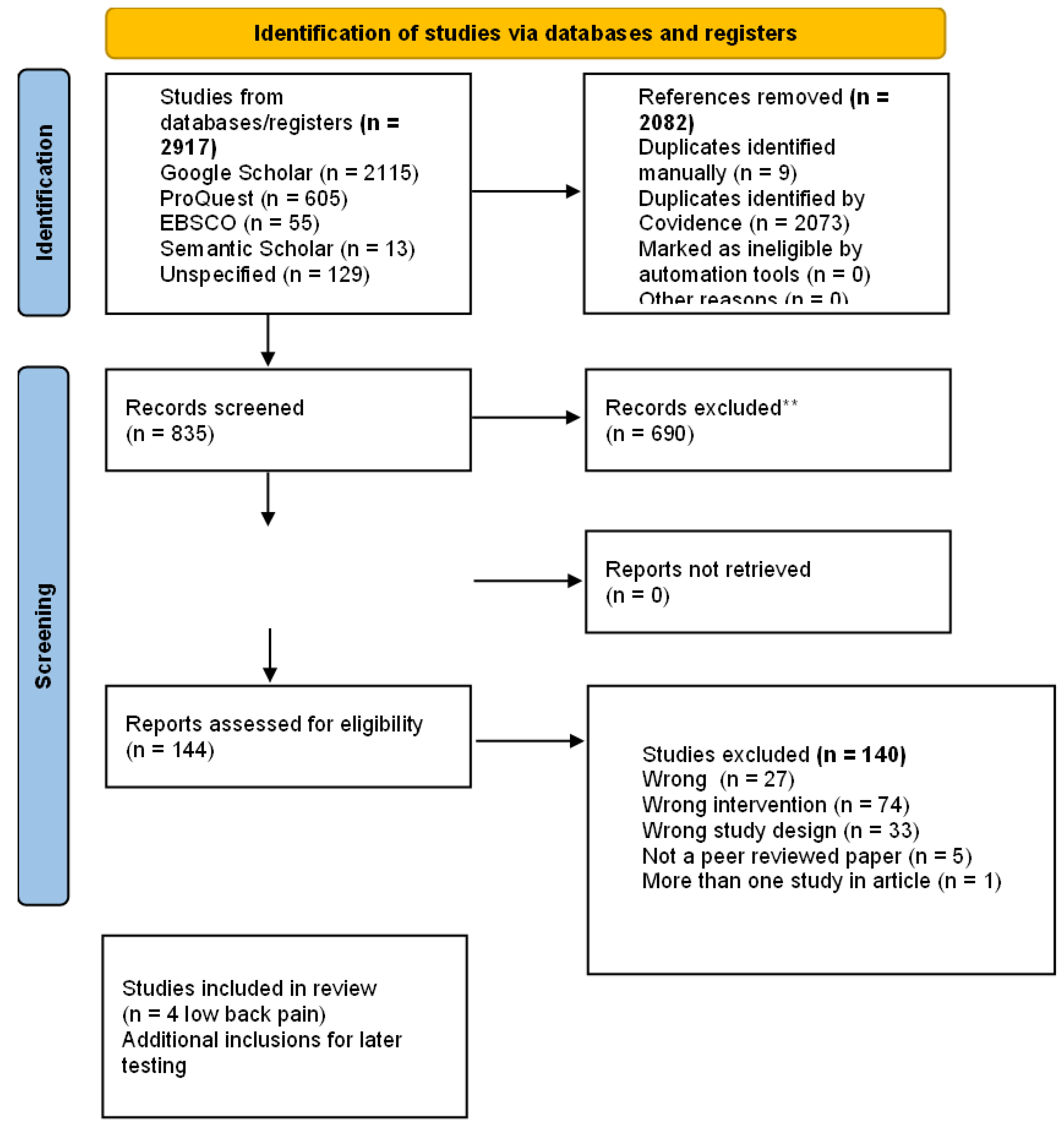
Table 1.
Identifying specific mechanisms supporting each IPT proposed.
| IPT | Key Mechanisms producing better engagement, health and adherence outcomes |
|---|---|
| 1 | Low back pain threat and fear
|
Exercise format and threat
| |
Snacktivity and intermitted activity
| |
| 2 | Importance of self-efficacy in LBP
|
The value of mastery experiences
| |
Snacktivity logic
| |
| 3 | The importance of post exercise pain
|
Activity Dosing
| |
Snacktivity plausibility
| |
| 4 | The value of psychological and educational interventions
|
The value of education and coaching
| |
The compatibility with Snacktivity
| |
| 5 | Environment and physical activity
|
Habit formation
| |
Autonomy
| |
The compatibility with Snacktivity
|
Table 3.
Evidence comparing outcomes from low back pain studies with evidence from other population groups.
Table 3.
Evidence comparing outcomes from low back pain studies with evidence from other population groups.
| Studies | Evidence for reduced sitting & light physical activity | Evidence for habit formation outcomes (standing more or breaking up prolonged sitting) | Quality of life Outcomes | Pain | Confidence | Mood and Energy or Fatigue |
|---|---|---|---|---|---|---|
| Chronic conditions |
Reduce sitting and sedentary behaviour • 6/15 studies @Sig with OE (reductions between 42-51 mins/day) • 5/15 meaningful within group reductions • 3/15 no meaningful effect Light physical activity • 6/15 studies @Sig with OE • 5/15 studies no group effect but meaningful changes • 4/15 with no light physical activity change noticed |
Direct habit Indicators • 5/15 studies identified significant changes (setting/standing) with 4/15 @Sig OE. • 10/15 with any habit relevant evidence • 2/15 with no evidence Habit mechanisms • 5/15 with supportive mechanisms • 3/15 with adherence driven evidence • 3/15 with cue-based intervention • 3/15 explicitly theory |
• 4/15 (4/5) identify @Sig with SR • 3/15 used SF-36 to quantify with clinically meaningful change across both physical and mental sub-domains • 10/15 did not measure the domain |
• 2/15 (2/6) identify @Sig with SR • 2/15 used VAS and identify clinically meaningful change • 2/15 identified no significant effect (although 1/15 identified association of reduced pain with decrease body mass index or body fat) • 1/15 reported worsening of COPD scores and or pain • 9/15 did not measure pain |
• 8/15 with some sort of confidence signal (qualitative and quantitative combined) • 4/15 (4/8) @Sig SR. using validated scale. 3/15 with moderate and large effect • 4/15 identified qualitative evidence of improvement - mechanisms identified as exercises perceived as manageable, reduced apprehension of activity, feeling in control of progression, reduced psychological barriers • 7/15 did not measure confidence |
Mood • 4/15 (4/9) @Sig SR • 2/15 with sustained effects • 3/15 with qualitative evidence • 1/15 with limited benefit • 6/15 did not report mood Energy or Fatigue • 3/15 (3/9) @Sig SR • 4/15 (4/9) reported positive energy or reduced fatigue evidence e.g., sit to stand repetition, tolerance for repeated movement, less tired during daily activities • 6/15 did not measure energy or fatigue |
| Older adults |
Reduce sitting and sedentary behaviour • 2/8 studies @Sig with OE(reductions between 40-50 minutes) • 2/8 qualitative supporting evidence • 3/8 supportive but sitting measurement (e.g., sit to stand) Light physical activity • 1/8 studies @Sig OE • 3/8 meaningful SR within group |
Direct habit indicators • 4/8 studies identifying significant change 1/8 with @Sig OE. Habit mechanisms • 7/8 with supportive mechanisms • 5/8 evidence of adherence • 4/8 routine establishment • 4/8 environmental cues • 3/8 prompts • 4/8 intention to continue post intervention |
• No studies reported quality of life outcomes | • 1/8 (1/1) provided qualitative evidence of reduced knee and hip stiffness, perceived reduction in joint discomfort • 7/8 did not measure pain |
• 1/8 identified significant improvement within study • 5/8 identified qualitative evidence of improvements • Mechanisms included: exercise being manageable and empowering, functional gains meant more confidence, improved safety or less threat, sense of achievement, actives that are achievable, improved capability of daily tasks |
Mood • 3/8 (3/6) with @Sig SR • 2/8 with sustained effects • 1/8 with limited benefit • 4/8 with qualitative evidence of improved emotional stability, better mood with exercise, better emotional regulation, • enjoyment following session • 2/8 did not report on mood Energy or Fatigue • Direct measurement not identified • 5/8 identified support from indirect measures e.g., sit to stand improvements or step count |
| Inactive adults |
Reduce sitting and sedentary behaviour • 4/8 of SR evidence • 1/8 no between group difference Light physical activity • 1/8 studies @Sig OE • 4/8 SR meaningful within group evidence • |
Direct habit indicators • 5/8 studies with positive/supportive change from SR. • 5/8 of explicit sitting to movement substitution from SR • 3/8 supportive evidence around automaticity from SR Habit formation mechanisms • 7/8 with supportive mechanism identified • 6/8 adherence • 5/8 routine scheduling • 5/8 behavioural substitution • 4/8 prompts or technology reminders • 4/8 environmental or contextual cues • 4/8 low effort burden • 3/8 intension to continue |
• No studies reported quality of life outcomes | • 2/8 (2/2) pain discussed as a barrier • 6/8 did not measure pain |
• 1/8 (1/1) provided qualitative evidence • 4/8 (4/7) identified qualitative evidence of improvements • Mechanisms identified: reduce fear of injury, physical activity now considered achievable, improved perception of capability, snack are easy and flexible, change in understanding of what counts as exercise, ability to adhere to a high level, ease of integrating movement into routines, repeated use of familiar environment • 1/8 did not measure |
Mood • 1/8 (1/4) @Sig SR • 3/8 identified qualitative improvements around feeling well, improved mood and feeling better because of intervention or just after • 4/8 did not measure Energy or Fatigue • 2/8 indirect @Sig SR • 5/8 qualitative reports of positive energy and less fatigue during tasks and when exercising and more energy after exercise |
| Healthy adults |
Reduce sitting and sedentary behaviour • 3/8 positive significant evidence (2/8 @Sig with OE) Light physical activity • 2/5 with between group evidence (1/5 with OE @Sig) • 2/5 SR meaningful within group change |
Direct habit indicators • 1/5 with @Sig OE Habit formation mechanism • 4/5 with supportive mechanism identified • 3/5 prompts or technology reminders • 3/5 behavioural substitution • 2/5 environmental restructuring • 2/5 anchoring routines and context • 2/5 self-monitoring or feedback |
• No studies reported quality of life outcomes | • 1/5 (1/2) with @Sig SR • 1/5 identified @Sig OE • 3/5 did not measure pain |
• 1/5 @Sig SR. • 1/5 improvements in SR • 1/5 with mechanisms identifying better awareness and knowledge and attitudes towards physical activity • 2/5 did not measure confidence |
Mood • 2/5 @Sig SR • 1/5 identified @Sig preservation of cognitive stage • 2/5 did not measure mood Energy or Fatigue • 3/5 @Sig SR via indirect measure e.g., improvement in RPE during exercise • 1/5 reduced discomfort • 1/5 did not measure fatigue |
Table 4.
CMO configurations for final PTs.
| PT | Context | Mechanism | Outcome |
| 1 |
|
|
Willingness to initiate movement
|
| 2 |
|
Mastery experiences from completion, not performance
|
|
| 3 |
|
|
|
| 4 |
|
|
|
| 5 |
|
|
|
Disclaimer/Publisher’s Note: The statements, opinions and data contained in all publications are solely those of the individual author(s) and contributor(s) and not of MDPI and/or the editor(s). MDPI and/or the editor(s) disclaim responsibility for any injury to people or property resulting from any ideas, methods, instructions or products referred to in the content. |
© 2026 by the authors. Licensee MDPI, Basel, Switzerland. This article is an open access article distributed under the terms and conditions of the Creative Commons Attribution (CC BY) license.
Copyright: This open access article is published under a Creative Commons CC BY 4.0 license, which permit the free download, distribution, and reuse, provided that the author and preprint are cited in any reuse.


