
Submitted:
20 April 2026
Posted:
21 April 2026
You are already at the latest version
Abstract
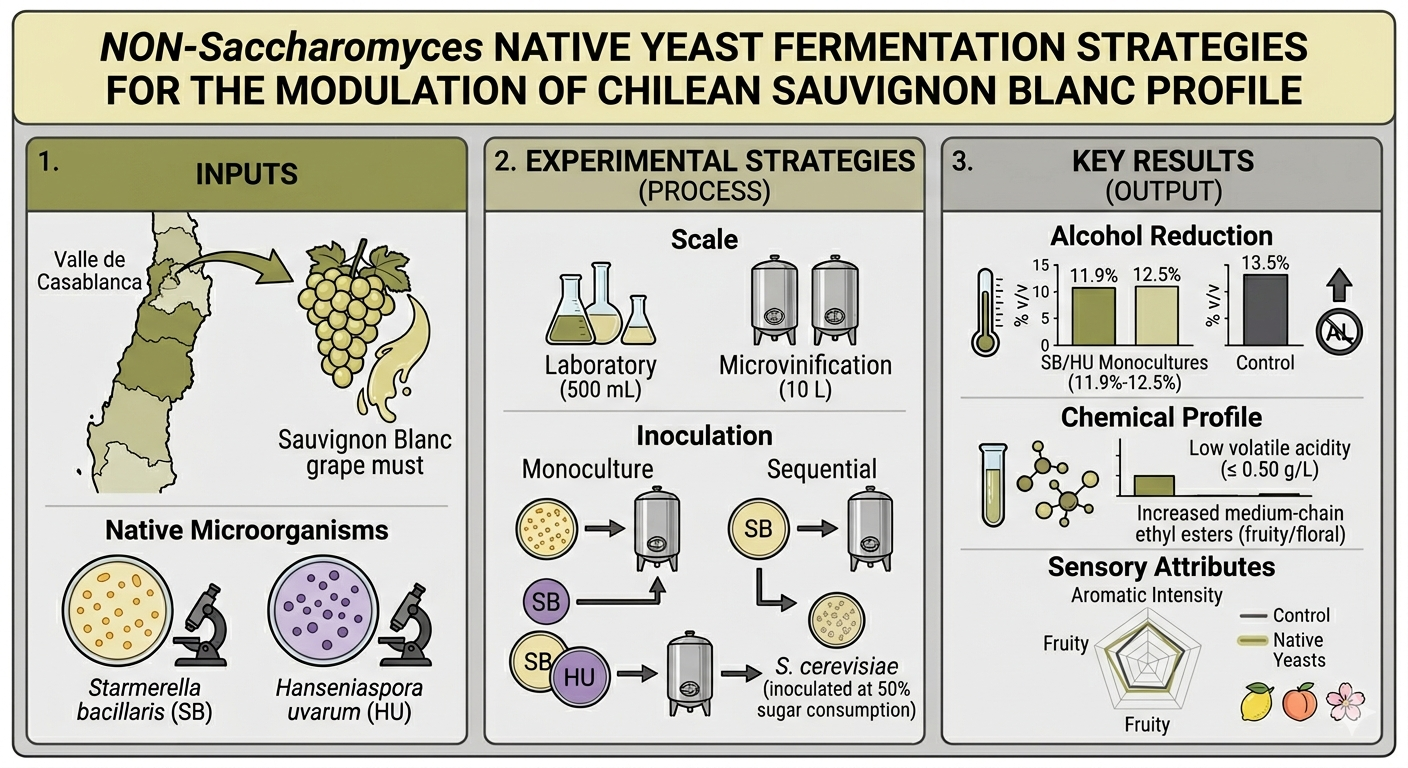
Non-Saccharomyces yeasts (NSY) are increasingly investigated as biotechnological tools to diversify wine profiles and modulate fermentation outcomes. This study evaluated the enological behavior of two Chilean isolates, Starmerella bacillaris (SB) and Hanseniaspora uvarum (HU), in Sauvignon Blanc must from the Casablanca Valley under monoculture and sequential inoculation (NSY → Saccharomyces cerevisiae) at laboratory (500 mL) and microvinification (10 L) scales. In synthetic medium (150 g/L sugars), SB and HU showed incomplete sugar consumption, producing 4.25% and 8.50% v/v ethanol, respectively, compared with 9.16% v/v for S. cerevisiae. In laboratory-scale fermentation in real must, both strains completed fermentation in monoculture, with moderate reductions in ethanol production relative to the control. At the microvinification scale, monocultures yielded lower ethanol concentrations (11.90–12.50% v/v) than S. cerevisiae (13.50% v/v), whereas sequential fermentations converged toward control values. NSY treatments showed higher relative abundances of medium-chain ethyl esters associated with fruity and floral sensory attributes while maintaining acetic acid concentrations ≤0.50 g/L. These findings indicate that the effects of SB and HU depended primarily on fermentation strategy and process scale under the evaluated conditions.
Keywords:
non-Saccharomyces fermentation
; sequential inoculation
; Sauvignon Blanc
; native yeast isolates
; aroma modulation
Copyright: This open access article is published under a Creative Commons CC BY 4.0 license, which permit the free download, distribution, and reuse, provided that the author and preprint are cited in any reuse.


