
Submitted:
18 April 2026
Posted:
21 April 2026
You are already at the latest version
Abstract
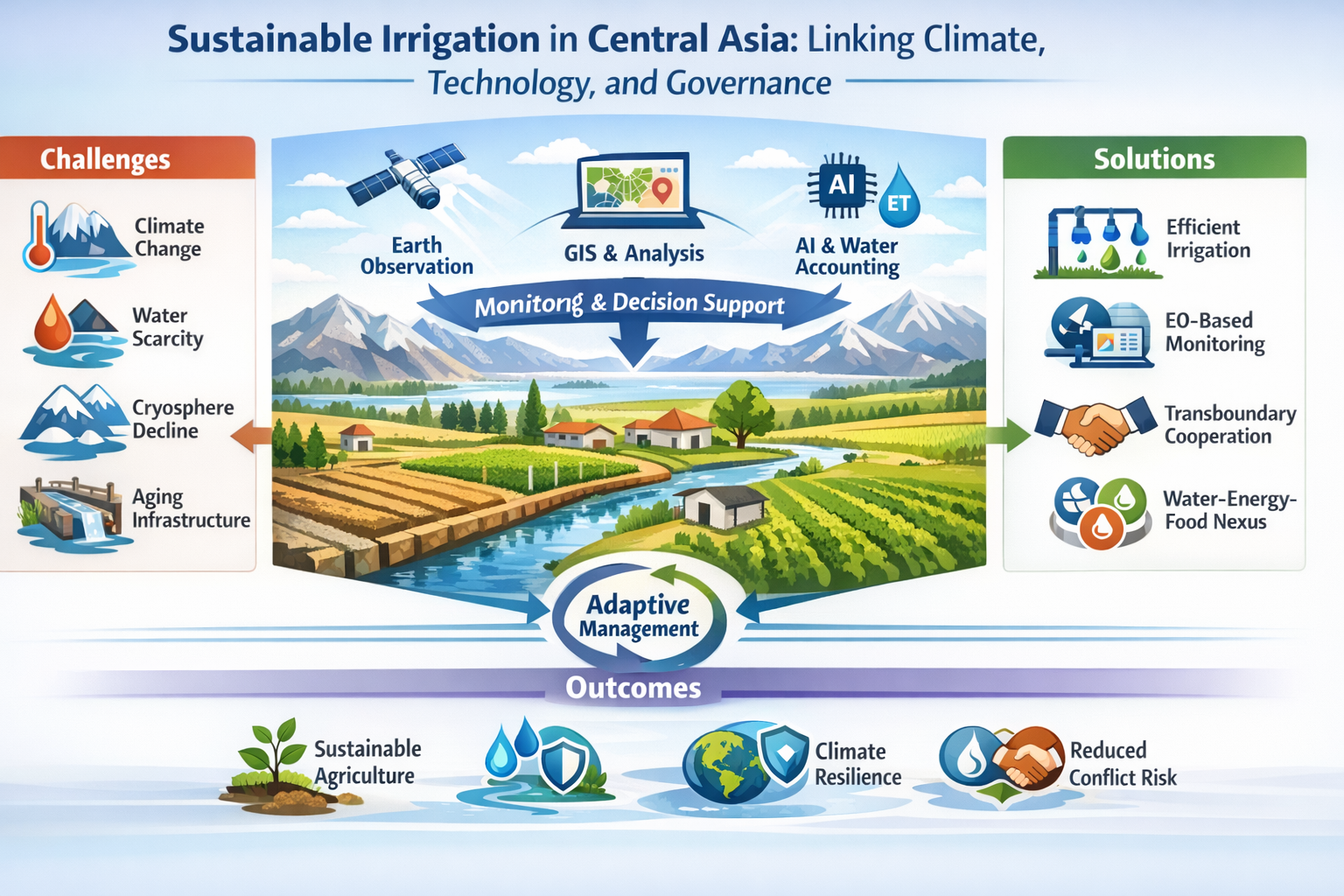
Irrigated agriculture is the dominant water user in Central Asia and is critical for regional food security and livelihoods. Much of the irrigation infrastructure, developed during the Soviet era, enabled large-scale agricultural expansion but contributed to environmental degradation, including the desiccation of the Aral Sea. Since 1991, countries have implemented reforms to improve water governance and efficiency. This review integrates historical policy analysis with Earth observation–based assessments of land use, vegetation dynamics, evapotranspiration, and hydroclimatic trends. Satellite evidence indicates that irrigation demand remains high and has intensified in some regions despite modernization efforts. Meanwhile, climate change—through rising temperatures, reduced snow storage, and increased variability—further pressures water resources. Although emerging technologies such as remote sensing and digital water management offer opportunities for improvement, achieving sustainable irrigation will require stronger institutional reforms, improved basin-scale water accounting, and enhanced transboundary cooperation.
Keywords:
Central Asia
; irrigated agriculture
; water resources management
; earth observation
; climate change
Copyright: This open access article is published under a Creative Commons CC BY 4.0 license, which permit the free download, distribution, and reuse, provided that the author and preprint are cited in any reuse.


