
Submitted:
18 April 2026
Posted:
20 April 2026
You are already at the latest version
Abstract
Active mobility in peri-urban areas is influenced by sprawl, limited public transportation, and reliance on private vehicles. This study redefines active mobility in peri-urban and low-density contexts from a territorial perspective informed by the Veneto Region and reframes micro-hubs as socially oriented, network-integrated elements rather than scaled-down urban hubs. This study adopts a qualitative, theory-driven methodology combining a multidisciplinary review of the active mobility concept with thematic analysis to identify mobility hub characteristics, followed by analytical synthesis, the classification of mobility hub types, and a set of social indicators for analyzing their performance. These methods are used to develop a framework for understanding mi-cro-hubs as socio-spatial components of active mobility networks. Results indicate that a network of minor roads and micro-hubs can support shifts toward active mobility when aligned with daily mobility patterns and supported by multi-level governance. The study outlines the socio-spatial roles of micro-hubs and defines them as nodes that link local networks and everyday mobility systems, distinguishing three roles: network, welfare, and civic. Socio-spatially integrated micro-hubs can be effective in reducing car dependence while providing transferable policy-oriented actions for similar peri-urban and low-density areas.
Keywords:
active mobility
; peri-urban areas
; micro-hubs
; socio-spatial
; thematic analysis
; car de-pendency
; mobility networks
1. Introduction
Active mobility has attracted considerable global interest to tackle the challenges of public health, environmental sustainability, and equitable transportation, which are part of a wider shift to design cities for people and places [1,2,3,4],Active mobility, which is generally understood to mean walking, cycling, and other non-motorized modes of daily transportation, is basic accessibility that provides co-benefits [5,6,7]. In terms of affordability, health, and spatial efficiency, this is a key aspect [8,9,10]. In the public health field, active mobility is generally recognized as a key solution to address physical inactivity and mitigate the adverse effects of sedentary lifestyles, and in urban planning studies, active mobility is now being recognized as a key solution to support sustainable cities. [11,12,13,14]Recent frameworks take a broad view, combining factors from the environment, society, and policies, while focusing on models that connect the features of our surroundings with people's preferences and daily travel habits [2,6,15,16]. Despite this expanded scope, definitions of active mobility still vary considerably across disciplines, leading to conceptual inconsistencies in how its advantages are understood and how related solutions are designed.[1,2,6] Most active travel research focuses on compact cities and centers. urban districts, where dense networks, short trip distances, and high destination Accessibility makes walking and cycling more possible [5,17,18]. Consequently, low-density and peri-urban territories remain under-theorized [19,20,21,22].In these contexts, car dependence remains high, long distances and dispersed land uses reduce the feasibility of active modes, and attractive car-oriented infrastructure reduces the attractiveness of walking and cycling.[19,22,23,24,25]
The concept of active mobility, as described in the previous literature, has inconsistent definitions, and most of the research has concentrated on dense urban fabric, with a little consideration and conceptualization in the peri-urban areas. [1,2,22]Although active mobility is often viewed as a combination of walking and cycling modes in previous literature, this research suggests that active mobility in low-density areas is not based on infrastructural support but rather on network organization and integration in daily life. Addressing the resulting gap between micro-mobility hub typologies, largely grounded in density, scale, and the behavioral-spatial realities of peri-urban areas, the article redefines the logic of the micro-hub. Rather than a scaled-down version of urban mobility hubs, micro-hubs are conceptualized as socially oriented elements embedded within local active mobility systems. Based on the territorial context of the Veneto Region, the study establishes a conceptual linkage between a reinterpreted understanding of active mobility and the redefined role of micro-hubs.
This study focused on analyzing micro-hubs in peri-urban and low-density areas through a multidisciplinary literature review, emphasizing mobility hub studies and employing thematic analysis to determine the role, typology, and socio-spatial characteristics of micro-hubs. The research presents novel insights into micro-hubs as components of mobility networks rather than transfer points and emphasizes the social and territorial aspects of micro-hubs in the areas, which are often overlooked. From the perspective of planning and policy, this study indicates that there is a need for intermediate-level governmental management and that cost-benefit analysis is insufficient for evaluating active mobility projects on a local scale. The overall research structure is illustrated in Figure 1, showing the link between the literature review, the analytical process, and the research outcomes.
2. Literature Review
The literature review is divided into two sections, which are complementary. On the one hand, the literature reviews the evolution of the concept of active mobility, with particular attention to the definition and the disciplinary approaches. On the other hand, it addresses existing studies on mobility hubs, from the transport and logistics node approach to the more recent attempt to rethink them as socio-spatial micro hubs, with particular attention to their typology, elements, and characteristics.
2.1. Evolution of Active Mobility: Beyond Pedestrian and Cycling
The initial step in the analysis outlined the most influential studies and authors within the active mobility contributions, according to citation rates. (Figure 2) Each circle in the graph embodies an influential study that is positioned according to the year of its publication on the x-axis and according to the citation rates on the y-axis. Generally, the graph indicates the rising importance of research on the topic from 2017 to 2025. There has been more significant research on active mobility that takes into account viewpoints like public health and sustainability concepts.
Various research works also include the definitions of active mobility by some prominent researchers within their analyses. Koszowski et al. (2019), for instance, describe active mobility in the context of walking and cycling for the purpose of transportation because of its importance in terms of its availability in cities.[1] Similarly, Mitra (2013) has conceptualized the idea of active mobility by focusing on the relationship between built space and mode of transport, locating it within behavioral frameworks that consider aspects such as neighborhood planning and provision of amenities. [7] In support of these views, Vale et al. (2015) explain active accessibility by linking what people need for mobility with the physical characteristics of the paths and places they go to, describing active travel as a complex issue that relies on both personal characteristics and the surrounding environment.[5] This viewpoint is further refined by Doorley et al. (2015), who define active travel as automobile-free modes of transportation that prioritizes human-powered movement, highlighting the essential health benefits of daily activities. [10] Building on these individual contributions, Götschi et al. (2017) provide a detailed framework that combines the definitions of the different researchers. The framework is detailed and divides the important aspects into environmental, social, and policy factors, combining different ideas into one complete model. [2]. In their discussion of how different disciplinary perspectives, from public health's emphasis on physical activity to transport planning's focus on system efficiency and urban planning's interest in city attractiveness, lead to multiple articulations of what constitutes active mobility, Koszowski et al. (2018) support this integrative approach[1]. Nocera and Attard (2021) propose additional insight, stating that active travel is an essential component of sustainable mobility strategies that aim to reduce dependence on cars by encouraging intermodal solutions [14]. Orellana et al. (2016)[6] highlighted the significance of active mobility by focusing on the non-motorized aspect of traveling. In another perspective, Petrunoff et al. (2016) integrated the concepts of public transportation and active mobility to offer yet another view of the concept of active mobility, considering the variety of its definitions when transit-based walking is considered.[26] The inconsistencies that are prevalent in the literature are addressed by Saunders et al. (2013), who point out that varying operational thresholds and cultural contexts lead to varying interpretations of active travel.[9] Schoeppe et al. (2013) emphasize how inconsistent definitions and measurement criteria, particularly in the context of children's mobility, make it more difficult to establish standardized associations, adding even more depth to this analytical fabric.[27] Scrivano et al.'s European perspectives (2023) describe active mobility as regular commuting activities that are considered health-promoting physical activity, but they also note that the different ways of defining active travel show that scholars are still debating whether to focus on specific modes of transport or a more integrated approach. [12]These studies, taken together, indicate that there is a comprehensive analytical section that summarizes the definitions of active mobility proposed by major scholars such as Koszowski and others. It appropriately characterizes the concept as both broad and complex.

Table 1.
Definitions and Concepts of Active Mobility.
| Author(s) & Year | Definitions and Concepts |
|---|---|
| Scrivano, Tessari, Marcora, Manners [12](2024) | Active mobility, such as walking or cycling for transportation, increases physical activity and promotes health. |
| Matteo Verzeroli et al. [28](2024) |
Active mobility includes walking and cycling, which can complement public transit. |
| Tim Jones and Ben Spencer. [24](2024) |
Active travel, encompassing walking and cycling, is promoted for its benefits to environmental sustainability and public health. |
| T. Lin, Dewei Fang, et al. [29](2024) | Active mobility, including walking and cycling, is essential for citizen transportation during public health events. |
| Correa et al.[4](2024) | Active mobility is described as human energy changes, specifically walking and cycling, used to reorganize urban ecosystems on a human scale. |
| Susanne Tittlbach et al. [13] (2023) |
Active travel (AT) is a domain of physical activity (PA) that integrates healthy and sustainable daily habits. |
| Sabet et al. [30](2022) |
Offer a rights-based approach to ON Time Mobility that highlights children's daily right to spend time being active and sees mobility as a social and developmental right, not just a way to get around. |
| Heather Allen and Henrik Nolmark [3](2022) |
Active transport is a recent term that has become popular in the last decade as a substitute for non-motorized transport (NMT). |
| Christian Brand [31](2021) |
Active travel (walking, cycling, or scootering) is seen as a healthy and environmentally friendly mode of transportation. |
| Nocera & Attard [14](2021) |
Presents active travel as a critical component of intermodal integration-based sustainable mobility schemes that aim to reduce reliance on automobiles. |
| P. Arbab, J. Martinez, S. Amer, K. Pfeffer [11](2020) |
Active mobility is most commonly defined as walking and cycling for transportation. |
| Mariangela Peruzzi et al. [32](2020) |
Active transportation refers to walking, bicycling, and other non-motorized transport modes, often combined with public transportation, as an alternative to driving a car. |
| C. Koszowski, R. Gerike, S. Hubrich, T. Götschi, M. Pohle, R. Wittwer [1](2019) |
Active mobility is described as using walking and cycling for transportation purposes. |
| Götschi et al. [1,2](2017) |
Presents a framework that integrates social, environmental, and policy dimensions of active travel into a behavioral model. |
| Orellana et al.[6](2016) | Argues that non-motorized movement is critical for improving environmental quality and promoting equitable urban access. |
| Petrunoff et al.[26](2016) | Analyzes the relationship between walking and public transportation while accounting for definitional concerns when walking is a component of multiple trips. |
| Vale et al. [5](2015) | Describes the concept of "active accessibility," which links the requirements of personal mobility in behavioral and spatial settings with the physical characteristics of routes and destinations. |
| Doorley et al [10](2015) | Active travel is defined as a human-powered transportation method that encourages sustainable practices and enhances overall physical health. |
| Todd Litman, [8](2014) | Active transportation, including walking and cycling, refers to non-motorized and human-powered travel. |
| Mitra, [7](2013) | Focuses on active mobility within behavioral and spatial decision-making frameworks, emphasizing the link between mode choice and the built environment. |
| Saunders et al. [9](2013) | Demonstrates conceptual inconsistencies in the literature by pointing to how cultural and contextual differences influence how active mobility is interpreted across studies. |
| Schoeppe et al. [27](2013) | The development of integrated analytical frameworks is restricted, particularly in the field of children's mobility research, by the presence of a variety of language and measuring standards. |
| Matthew Burke and Alan Brown [33](2007) | Active transport includes non-motorized transportation methods like walking and cycling. |
2.1.1. Active Mobility on a Disciplinary Perspective
This review reveals that diverse publications focusing on the characteristics of an active mobility concept repeat certain phrases or concepts (Figure 3). This subject matter includes walking, cycling, active travel, physical activity, health, sustainability, accessibility, and environmental quality. Walking and cycling are perhaps the most frequent descriptors since they represent the basic modes by which humans can travel under their own power. There is a strong relationship here between physical activity concepts and health enhancement: active mobility is often portrayed as a form of health-enhancing physical activity [9,12,32].In addition, environmental sustainability and transportation infrastructure are two other broad categories of issues with extensive debate. Non-motorized active transport is an example of low-carbon, energy-efficient Mobility can prevent urban pollution without destroying ecological balance.[3,31] The terms ‘equity,’ ‘accessibility,’ and ‘urban livability’ also frequently appear in definitions that frame active mobility through the lens of urban planning and policy.[5,34,35]
Active transportation serves as a social tool and design approach, promoting more open and equitable urban spaces [4,36]. The most recent definitions reflect that active mobility is not only a way of moving to places but also further develops as a multi-dimensional concept related not merely to individual behavior but also to public health, environmental sustainability, and policy innovation. Active mobility could be described as the consilience of non-motorized transportation, health enhancement, and sustainable cities [4,36]. This concept represents its evolution to a multidisciplinary area with three subjects: physical, social, and environmental.
Many studies have investigated and combined the definitions of active mobility from well-known experts in different fields, such as public health, sustainability, urban design, transportation, and policy, into clear and connected stories.[2,6] Early literature defines mobility with reference to the extent of space and the capability to move both within and outside the home environment, with or without support, which constitutes an underlying view of mobility [2]. More recent studies build this minimum base through the inclusion of aspects of active travel, like walking and cycling, highlighting not only the physical actions but also the effects that are anticipated from the provision of infrastructure and safety perception [2]. Some papers have framed active mobility within multidisciplinary concepts that highlight the importance of planning and policy at the city level to determine these behaviors. Researchers have pointed out that active travel policies should combine the design at the physical level, network improvements that increase connectivity, and mixed land use [1,2]. This viewpoint emphasizes the fact that active mobility is the outcome of enabling surroundings and policy contexts, rather than just an individual choice. Through this, the literature integrates the point that the built environment, comprising aspects like density, accessibility of the destinations, and pedestrian safety network, plays an imperative role in encouraging active journeys [1]. Additionally, forward-thinking policy efforts like the PASTA project [37] have created detailed models that combine factors at different levels, from individual actions to social and spatial influences, into a comprehensive understanding of how people travel actively. These studies indicate that active mobility is a broad idea that needs to be understood as a mix of personal behavior, public health guidelines, risk awareness, and infrastructure [1,2]. This combination shows that active mobility involves a careful balance between how people behave, their surroundings, and the policies in place. Later studies further build up the aspects associated with the health attributes of active mobility. According to the study, active travel, which encourages regular physical exercise such as walking and cycling, can improve health. Such a public health perspective is furthered by the support of international organizations that promote active mobility as an attractive, low-carbon alternative to motor transport, which further emphasizes this point. It highlights that active mobility is critical for enhancing the quality of life [1,38]. Complementary studies investigate active mobility from the angle of sociocultural and identity, proclaiming that active journeys not only endorse physical health but also social cohesion and the well-being of society. In these discussions, active mobility is considered an important factor that shapes how urban identities are formed and influences conversations about sustainable cities [6,15]. Furthermore, some studies emphasize that active mobility should be supported by public transport systems; this way, cities become more accessible, and sustainable waiting practices are promoted, which can help reduce issues like traffic jams and air pollution [6,14]. Lastly, certain researchers suggest multi-determination models that consist of socio-ecological models combined with pragmatic recommendations for the political agenda. These comprehensive ideas are explained in writings that look at both the personal factors that motivate people to be active and the broader city planning and environmental factors that support it, creating a complete analysis of active mobility[1].
Table 2.
Active Mobility Across Perspectives.
| Perspective | Core Definition |
|---|---|
| Public Health | Active travel refers to types of transportation that require physical activity. |
| Environmental Sustainability | Travel modes that use people instead of machines and lower emissions, noise, and land use per trip |
| Urban planning and design | Street and land use designs that include modes that make it easy to walk and bike. |
| Transport | In multimodal systems, modes and networks are crucial, with a focus on mode selection and network efficiency. |
| Policy and governance | Policy plans and institutional arrangements that put active modes first or make them possible |
| Socio-Cultural | Norms, engagement, and innovation influence active mobility as a social practice. |
| Economic | Active modes are evaluated in benefit–cost analysis, health-cost offset, and broader economic valuation. |
| Technological/Innovation | Using digital tools, smart planning, and route optimization to make active trips safe and fun. |
Overall, the literature reveals that rather than having a static definition, the concept of active mobility has undergone a series of chronological periods. Figure 4 reveals a general overview of the sequential development of the concept. It reveals the definition of the concept in a series of phases. The concept has grown to incorporate behavioral, social, and policy aspects after developing from non-motorized movement and physical activity. It has eventually led to its institutionalization in interdisciplinary paradigms and finally its transformation in terms of technology.
2.2. Peri-Urban Characteristics
It is challenging for researchers to provide a precise definition of peri-urban areas due to the fact that they demonstrate both rural and urban characteristics, making them impossible to be classified as either one or the other. The term is more than a physical definition and includes a particular conceptual framework in which different land uses, economies, and infrastructure systems combine in various ways [21,39]. This phenomenon causes the peri-urban area to be a confusing mix of suburban and rural characteristics, making it difficult to categorize, as it is a continuous system that does not conform to conventional zoning categories[21,39,40].This unique combination has special mobility effects that fundamentally contrast with urban transportation concepts. Peri-urban areas often have low population density combined with scattered and diverse land uses, resulting in medium-to-long travel distances that surpass pedestrian and conventional cycling thresholds[20,23]. The supply of public transport infrastructure continues to be a continuous issue, as certain route services are economically unfeasible due to low usage across sprawling areas[40].The resulting condition is one of ongoing car dependency, where inhabitants rely predominantly on private vehicles to satisfy their mobility needs [23]. This car-centered character is not irrelevant: it is a fundamental aspect of peri-urban areas. Car ownership and peri-urbanization are mutually reinforcing processes that influence social practice and physical-spatial configuration[40].These conditions fundamentally mismatch popular conceptualizations of active mobility and mobility hubs, which primarily emerged within dense urban contexts. Conventional models of active mobility presuppose continuous infrastructural networks, dedicated facilities, and spatial proximity that enable walking and cycling to function as everyday modes of transport. However, peri-urban territories are structurally characterized by spatial discontinuity, limited infrastructural provision, and extended travel distances. conditions that challenge the direct applicability of such models[21,40]. Similarly, traditional ideas about mobility hubs expect that they will be well-connected within large public transport systems and that there will be enough people living nearby to support different types. In peri-urban contexts, governance fragmentation across multiple authorities generates gaps in planning coordination and capacity, while overlapping administrative boundaries limit strategic infrastructure planning and implementation[23,40]. These territories remain unstable, uncertain, contested, and ambiguous, resisting the stable institutional frameworks upon which urban mobility planning depends[21,39]. Understanding this gap means realizing that in peri-urban areas, active mobility happens not through typical infrastructure but through informal paths, small routes, and flexible daily habits. Where specialized cycling lanes and pedestrian zones remain absent or fragmented, mobility develops through negotiated use of shared street space, requiring cultural shifts in how different users adjust speeds and navigate common routes. The design challenge goes beyond just creating specific areas for pedestrians or cyclists; it also involves finding better ways to improve space, manage traffic, and make transportation more accessible for everyone [20].Those without access to private vehicles face significant risks of social exclusion, while low-income and non-motorized populations significantly suffer transport disadvantages [23,40]. These structural traits include dispersed settlement patterns, unreliable public transportation, car-dependent characteristics, and governance fragmentation. Collectively, these findings suggest that standard urban-scale initiatives are inadequate for addressing peri-urban mobility challenges. Planning strategies must instead anticipate the dynamic, unplanned character of these territories and embrace flexibility in transport infrastructure provision [23]. What this analysis shows is that we need more than just smaller urban solutions; it highlights that peri-urban areas need medium-sized changes that work on a small scale: simple, flexible places that can help connect different transport options, offer rest areas, and support the daily interactions that make active mobility possible in mixed and varied environments.
2.3. Active Mobility hubs Performance
The literature has defined mobility hubs as places where different modes of transportation can easily connect with each other. Mobility hubs are commonly described as recognizable places that combine multiple connected transport modes with enhanced facilities aimed at supporting users[41]. Similarly, Aono[42] (2018) characterizes these hubs as spots that enhance connectivity by effectively integrating sustainable means of transportation. Hubs are nodes in a multimodal mobility network that connect "different transport modes, functions, their infrastructure, sizes, and scales" [43]. Arup [44](2021) defines future mobility hubs as interconnected systems that “bring together a full range of complementary transport modes, making it easy for people to switch from one to another.” Most conceptualizations remain transport-focused and efficiency-driven, emphasizing multimodal integration, technological innovation, and the optimization of first- and last-mile travel. This framing aligns with broader sustainable transportation visions that integrate alternative modes with land use considerations[45], although operational functionality continues to receive greater emphasis than social and experiential dimensions in dominant frameworks. Recent research, however, indicates that the concept of mobility hubs requires a shift away from its primary characterization as transport links. A more profound analysis of hub definitions shows that after transport-related terms, "space" is the next most important idea, meaning that while mobility hubs are designed to provide people with transportation options, the environment they create is also a key aspect of the hub[46]. Definitions that position hubs within areas reinforce this place-based dimension. where There is a high concentration of urban activity, and it emphasizes the importance of place-making strategies to create activity centers [42]. Research on how people view hubs shows they are important for behavior, with studies finding that "current urban transport interchanges can host other types of activities and act not only as transport nodes but also as meeting places within cities" [45] Planning objectives that prioritize equitable access, safety, and inclusivity reflect the social dimension of mobility hubs. [41]. Mobility hubs must address “transport, place, and societal” contexts simultaneously, recognizing their potential to “bring local communities together and encourage economic growth” [44]. Overall, these views suggest that mobility hubs are small nodes where transportation services meet people's needs, making them important parts of urban infrastructure instead of just places to switch transport.
This shift invites a move from urban mobility hubs toward micro-scale mobility hubs, where performance is shaped less by system efficiency and more by everyday use and spatial integration. Active mobility in peri-urban areas is an infrastructural process that simultaneously reveals and transforms the metropolitan context. Instead of merely serving as travel pathways, infrastructures shape areas by determining how people access places, how land is used, and how space is organized in spread-out communities. [47]This concept of active mobility emphasizes the value of micro-hubs, where infrastructure connects with daily activities.
The current theoretical paradigm uses the concept of the micro-hub in a narrow context. Although the term has been used explicitly in specific research areas, it has primarily been characterized in terms of urban logistics and cargo distribution, with little consideration of it as a social-spatial phenomenon in terms of people's daily mobility. In the context of urban transportation and logistics, the micro-hub is typically defined as a small-scale collection, transfer, or distribution point for goods. From this perspective, micro-hubs can be considered smaller options compared to urban collection centers, which have specific service areas and can encourage the use of lighter, eco-friendly transport vehicles to help reduce traffic jams and environmental problems linked to last-mile delivery [48].
As a result, micro-hubs are still in the conceptual phase as functional infrastructures, with their effectiveness influenced by societal variables, initial expenses, and service area characteristics. They have been identified as vital elements of intermodal urban transportation systems using spatial modeling approaches. The ideal location for micro-hubs is established to enable effective delivery while minimizing environmental consequences [49]. Recent works tried to integrate the concept of hubs into a more complicated structure that connects logistics, mobility, and energy. However, within these broader systems, the concept of a hub has remained centered on a system-oriented and functional infrastructure, primarily concerned with service integration and traffic management[50]. Conversely, the micro-hub concept is not used as a defined term in the field of active mobility, which includes walking, cycling, and other travel behaviors. However, in this area, small features like places to stop, rest areas, support services, connection points in networks, and facilities for different types of transport are practically considered fulfilling micro-hub roles in active mobility networks, even though they are usually viewed as separate infrastructure parts rather than as a unified concept at a small scale. In conclusion, while the concept of a micro-hub exists in current works, it is mostly associated with logistical systems, demonstrating that the field of active mobility lacks a clear definition for micro-hubs that particularly refers to walking and cycling as distinct components of social spaces. These interpretations consider hubs primarily as system-oriented and flow-driven infrastructures, with little emphasis on social practices, user experience, or spatial justice.
2.3.1. Typologies and Characteristics
Mobility hub typologies in current literature exhibit considerable heterogeneity in their classificatory logic, reflecting both the emergent character of the concept and the diversity of territorial contexts in which hubs are implemented. The absence of a unified definitional framework has led to the proliferation of case-specific classifications, each tailored to the operational requirements and spatial characteristics of particular urban regions [46]. While this contextual sensitivity responds to local conditions, it also reveals an underlying structural bias in how mobility hubs are conceptualized: existing typologies are predominantly organized around operational efficiency, modal integration capacity, and hierarchical urban-scale logic, with limited analytical attention to territories that fall outside densely networked metropolitan cores. The most prevalent classificatory dimension across reviewed typologies is urban context, which differentiates hubs according to their location within city centers, suburban transit nodes, emerging urban growth centers, historic centers, or unique destinations such as airports and university campuses [42,46]. This spatial categorization is frequently combined with hub size, distinguished as mini, light, medium, or large based on the number and diversity of shared mobility services offered [42,46]. A third recurring dimension is spatial scale or influence radius, which positions hubs as neighborhood, district, city, or regional according to their catchment area and target user base [42,43]. The transportation function represents another analytical layer, classifying hubs as entry points, transfer nodes, or destinations depending on the directionality and purpose of trip patterns[42,51]. Finally, some typologies incorporate the role of the hub within the broader transportation network, distinguishing between gateway hubs that connect multiple regional rapid transit lines, anchor hubs that serve as major regional destinations, and local hubs that function primarily as community focal points [42,51]. What becomes evident through comparative examination of these typologies is that they are structured primarily to serve metropolitan transit planning objectives. Gateway and anchor hubs, for instance, are defined not by the lived experience of mobility or by socio-spatial integration, but by forecasted density targets, boarding volumes, and proximity to rapid transit infrastructure [51]. The Shared Use Mobility Center categorizes small urban, medium-scale, and large suburban hubs based on transit shift and the availability of car-sharing spaces, thereby enhancing the modal integration paradigm in which the hub functions as a transfer point rather than a socio-spatial location[52]. Even typologies that acknowledge neighborhood-scale hubs tend to position them as derivative or residual forms, mini versions of larger interchange hubs, characterized by reduced modal offerings and minimal infrastructure[46]. This scalar reduction implies a conceptual hierarchy in which the urban mobility hub remains the normative reference, and smaller hubs are understood as simplified adaptations rather than qualitatively distinct spatial forms. This operational and urban-centric logic, while coherent within dense metropolitan environments, begins to lose explanatory power when applied to peri-urban and low-density territories. Van Rooij [45](2020) identifies a seventh category of hub not addressed in mainstream planning documents: the neighborhood hub without public transport connection, located approximately two kilometers from the nearest transit station and designed to support either first-mile access or entire journeys through shared mobility. This kind of hub, already implemented in practice, has its own spatial and functional logic that differs from that of transfer-based urban hubs. However, it is still not represented in typological studies and scientific literature. Likewise, Arup [44](2021) has conceptualized rural mobility hubs as gradual, scalable interventions, starting from simple shelters, to develop into complex socio-spatial infrastructure, focusing on safety, social interaction, and community integration, but not on modal interchange. These Examples suggest that The dominant typological paradigm, grounded in transit connectivity and operational efficiency, is insufficient for characterizing mobility provision in contexts where public transport networks are sparse, trip patterns are dispersed, and social infrastructure is geographically fragmented. Reinterpreting existing typologies through three alternative analytical lenses: network role, spatial context, and socio-spatial function, reveals both the conceptual gaps and the emergent logic that underpins distributed, adaptive hub forms. From the perspective of network role, the distinction is no longer merely between gateway, anchor, and local hubs as defined by transit volume but between hubs that function as connective nodes within integrated regional systems and those that operate as autonomous access points within fragmented or incomplete networks. In peri-urban settings, where regional rapid transit is often absent, hubs must assume a more self-contained role, providing mobility autonomy rather than facilitating transfers [45]. Spatial context, when reconsidered beyond the urban-suburban-rural gradient, becomes a question of territorial embeddedness: whether the hub is situated within a compact, mixed-use environment where mobility infrastructure can be embedded into existing street life[44], or whether it occupies a dispersed, low-density landscape where mobility provision must be deliberately constructed as a place of gathering. Finally, socio-spatial function shifts the focus from modal interchange to social cohesion and everyday life support. McIlroy[51] (2018) distinguishes local hubs as sites that prioritize social interaction and community connectivity over trip generation, acknowledging that in less dense areas, the hub's value lies not in its capacity to process passenger volumes but in its role as a reference point and meeting place. Arup[44] (2021) further expands this line of thinking with their discussion of how rural and suburban hubs are designed with community gardens, playgrounds, co-working spaces, and pocket parks, turning mobility infrastructure into socially active environments that facilitate extended dwell times and multifunctional use. This reordering of typological logic exposes a fundamental conceptual gap: existing frameworks are structured to describe mobility hubs as elements within already functioning urban transit systems, but they lack the analytical tools to address mobility provision in territories where such systems do not exist or operate at insufficient scale. Thus, peri-urban areas with low residential density, poor public transportation coverage, car dependency, and dispersed service provision can only be served through alternative means that go beyond scaled-down versions of urban interchange hubs. The peri-urban micro hub is not an operational mini hub but is instead conceptual in nature and emphasizes accessibility, autonomy, and integration within dispersed spatial networks. It operates not as a point of convergence within a transit hierarchy but as a node within a capillary system of local mobility that must function independently of high-capacity regional infrastructure. Its logic is destination-embedded and community-sustaining, rather than transfer-oriented and efficiency-maximizing. Recognizing this distinction is essential for developing mobility strategies that are responsive to the spatial and social realities of peri-urban life, where the challenge is not to optimize modal interchange but to establish reliable, human-centered access in contexts of territorial dispersion and infrastructural scarcity. As depicted in the Figure 5, the typology for the classification of the mobility hubs is based on five conceptual logics. Size relates to the service provision and infrastructural intensity, while scale relates to the territorial scope. Context relates to the spatial and morphological setting, function relates to the role of the hubs, and network relates to the structural position. All these aspects highlight the multidimensional nature of the classification.
The identification and characterization of mobility hub characteristic in the existing literature (Figure 6) reveal a pronounced orientation toward functional, operational, and infrastructural dimensions. From all the literature that is academic and practical in nature, there is emphasis on integration that is multimodal in nature, digital connectivity, and system-wide coherence as fundamental attributes. The mobility hubs are normally located in areas that have many homes and jobs that have access to advanced public transportation and shared and electric vehicle services that are digitally informed[42,45]. Design and policy frameworks emphasize the importance of being easily recognizable, using standard designs, and allowing for simple transfers as essential features that help people navigate the transportation network in a city. Within this context, mobility hubs are conceptualized as adaptable, process-based infrastructures capable of incremental growth and technological evolution, prioritizing scalability, operational flexibility, and system efficiency over fixed spatial configurations[44]. Overall, these discussions emphasize technical efficiency, how well the network works, and the ease of transferring between different transport modes as the main ways to evaluate systems, while aspects like location, population density, management structures, and support services like parking and charging are mainly talked about in terms of their basic functions. Accessibility is mainly described in practical terms, focusing on how straightforward it is to reach and use the hub, as well as how well different transport options work together, while aspects like partnerships and service coordination are considered advantageous for system performance rather than as important social processes. However, the literature also suggests significant social, behavioral, and experiential aspects that remain underexplored as primary areas of analysis. Several studies implicitly acknowledge that mobility hub characteristics vary according to user groups, everyday practices, and local contexts, suggesting that perceived comfort, safety, and ease of use influence the effectiveness of hubs beyond infrastructural capacity alone [45]. Aono[42] (2018) points out that goals like creating a sense of place, improving user experience, ensuring safety, and promoting fairness are important for developing hubs, but these goals are mentioned separately from key operational goals like smooth connections between different transport modes, and practice-oriented contributions further introduce pedestrian priority, legible wayfinding, waiting environments, and amenities that support lingering and everyday activities as means of improving user experience and encouraging a sense of belonging, even when these aspects are not foregrounded as central evaluative dimensions [51,53]. Placemaking-focused views clearly describe mobility hubs as places that should feel safe, comfortable, and welcoming for pedestrians, making them part of everyday city life instead of just functional spots. Similarly, the inclusion of community-oriented components, such as spaces for rest, care, work, and play, suggests that mobility hubs may operate as micro-public spaces where mobility, everyday life, and place-making intersect[44]. Taken together, these emerging social dimensions, encompassing comfort, belonging, security, and contextual embeddedness appears as marginal yet influential properties within the literature, signaling an incipient recognition that mobility hubs entail experiential and relational qualities not fully captured by prevailing efficiency-oriented characterizations.
2. Materials and Methods
This study adopts a qualitative, theory-driven, and interpretive methodological approach aimed at reframing active mobility in low-density and peri-urban contexts and developing a human-centered, network-based micro-hub framework. The methodology is grounded in the integration of thematic analysis with context-based interpretation and does not pursue quantitative testing or empirical validation. Rather, it focuses on the analytical reconstruction of dominant concepts and planning approaches emerging from both academic literature and applied practice. The research process was organized into three main stages (Figure 7).
In the first stage, a systematic and analytical review of multidisciplinary literature on active mobility and mobility hubs was conducted, encompassing urban planning, transport studies, public health, environmental sustainability, and socio-cultural research. Definitions and conceptual frameworks were examined not as fixed constructs but with the aim of identifying recurring dimensions, such as accessibility, behavior, health, equity, governance, and network structure, and tracing their evolution across disciplinary perspectives. To support this process, co-authorship patterns, key authors, and temporal publication trends were explored using the Research Rabbit platform. enabling the identification of influential research clusters and cross-disciplinary linkages shaping the concept of active mobility.
In the second stage, the conceptual insights derived from the literature were synthesized into an analytical framework intended to function as an interpretive lens, rather than as a prescriptive or indicator-based model. In parallel, practice-oriented sources related to mobility hubs, including project reports, policy documents, and analytical content presented at the expert event Verso Territori 30 km/h, were examined. This event was held on 19 November 2025 at IUAV University of Venice within the framework of research activities associated with the RECAP project[54] and focused on strategies for reducing car dependency in low-density territories. The roundtable discussions and expert presentations were treated as secondary qualitative material, supplying perspectives on operational challenges, spatial priorities, and decision-making logics relevant to peri-urban mobility in the Veneto Region. Elements drawn from academic literature and applied sources were subsequently subjected to an iterative process of reinterpretation and synthesis. The aim of this phase was not only to identify attributes but also to investigate how different kinds of mobility hubs are defined, distinguished, and conceptually framed in different contexts. In addition to this, due to the lack of proper and comprehensive exploration of the concept of micro-hubs in the existing literature, special focus was laid on comparing the typology and functionality of hubs to facilitate a more refined conceptualization of micro-hubs. In this process, dimensions related to user experience, everyday practices, accessibility as lived Experience, social Interaction, safety, identity, and spatial equity were highlighted as interpretive lenses for rethinking micro hubs as socio-spatial components within active mobility networks. In the final stage, the analytical framework was applied to the peri-urban context. This phase focused on micro-hub characteristics and the integration of social-behavioral approaches. Generative artificial intelligence tools helped explore literature and organize the findings, making the language clearer for the analysis that came from manual reviews. The authors carried out all data selection, conceptual analysis, source interpretation, and analytical framework development.
2.1. Social Dimensions and Characteristics of Mobility Hubs
Thematic analysis was used as a qualitative analytical method to determine the social aspects of the mobility hub features included in the literature. TA is one of the most commonly used approaches for the analysis of qualitative data, as it offers a systematic yet flexible approach for the analysis and reporting of data. Since its development, the Braun and Clarke six-phase approach has gained significant popularity across various research fields, such as social sciences. The approach does not associate any specific theory; hence, it can be used for both inductive and deductive approaches. The Braun and Clarke approach consists of six phases of data analysis, which are familiarization with the data, initial coding, searching for themes, reviewing the themes, defining and naming the themes, and writing the report. [55,56,57]
Figure 8.
Inductive thematic analysis of mobility hub literature.
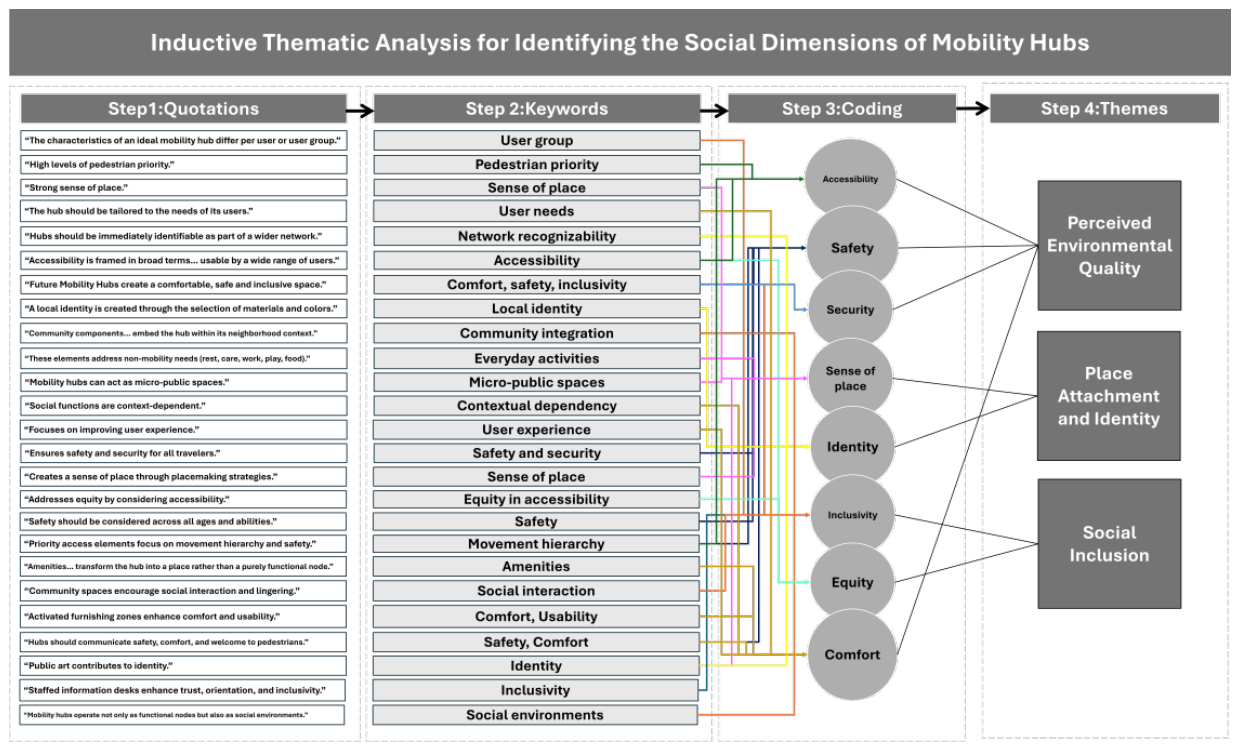
The process of inductive thematic analysis, as shown in Figure 5, has been used for the analysis of the characteristics of mobility hubs identified through literature. This process begins with the selection and collection of relevant quotes and statements from various literature sources regarding mobility hubs. In the second step, the quotes and statements obtained in the previous step were reduced to keywords that would represent the concepts and ideas obtained in the literature review. The keywords obtained in the previous step were combined and interpreted to derive the codes for the various concepts and ideas identified in the literature review. This phase is the analytical step in the thematic analysis, where the obtained concepts and ideas are related and structured. In the final step, codes were combined to develop themes. The themes represent broader concepts and ideas identified in the literature and form the basis for the interpretation of social dimensions related to mobility hubs discussed in the following sections.
The identification of social, behavioral, and experiential dimensions associated with mobility-related spatial configurations was conducted through a structured and iterative synthesis of the reviewed literature. Rather than assuming these dimensions as predefined analytical categories, the process began with a systematic extraction of all elements and properties explicitly or implicitly attributed to mobility hubs, systems, and spatial arrangements across both academic and practice-oriented sources. The characteristics identified in Figure 6 were derived from the overall set of mobility hub characteristics identified in the literature (Figure 4). Using inductive thematic analysis, the derived social themes served as a conceptual filter to identify the characteristics most relevant to the social aspect of mobility hubs. This allowed the study to progress from the identification of the overall characteristics to the identification of socially related mobility hub characteristics (Figure 9).
2.2. Mobility Hubs Through a Veneto Lens
The development of mobility hubs within the Veneto region needs to be understood within a wider planning context, which has determined the development of the region’s accessibility strategies recently. Within the Veneto region, the development of mobility hubs has taken place in association with the development of railway infrastructure, bus interchanges, urban centers, and the intersection of planned cycling routes, highlighting the governmental strategy to link various modes of transportation within the context of the polycentric built environment[54,58,59]. The main idea behind these efforts has focused on combining different types of transport, making it easier to switch between them, and improving connections between cities, with hubs designed to help people move smoothly between trains, buses, bikes, and walking.[58]
This section does not assess whether such implementations have succeeded or failed in achieving their stated objectives. Veneto is not employed as an actual evaluation area in this analysis to assess the operational success or failure of particular mobility hub projects. Rather, the region is treated as a territorial and analytical lens through which broader conceptual questions concerning mobility infrastructure in dispersed, car-dependent territories can be explored and refined. The purpose of this analysis is therefore not a performance evaluation but a conceptual clarification, understanding how the notion of a mobility hub transforms under conditions of low density, fragmented settlement, and structural automobile dependency. This territorial reading supports conceptual refinement rather than empirical validation, preparing the analytical transition from conventional urban mobility hub models toward a distributed micro-scale logic better suited to dispersed peri-urban territories. Within the Veneto context, a typological understanding of mobility hubs can be divided into three groups, as shown in the table 2.[54]
Table 2.
Typological classification of mobility hubs in the Veneto.
| Typology | Definition |
|---|---|
| Network Hub | Small-scale intermodal nodes providing basic infrastructure (shelter, seating, lighting, and secure bicycle parking) at transfer points between active mobility and public transport, ensuring network continuity. |
| Welfare Hub | Redesigned entry areas near schools, services, and workplaces, where traffic slowing and spatial redesign improve safety and accessibility. |
| Civic Hub | Border areas near urban centers that connect active mobility networks to public life, facilitating limited civic functions and transforming street space for pedestrians. |
Consider these three types as flexible and overlapping categories that demonstrate varying roles and levels of involvement in a space. [54]The range of characteristics recognizes that individual hubs can exhibit various features depending on their location, functional level, and accessibility to surrounding urban fabrics.
The main physical and operational features of mobility hubs that are currently in use or being planned in Veneto show a clear focus on being places for transferring between different modes of transport. Park-and-ride areas, bike parking, and layouts designed for easy transfers are the main features of most current hubs, showing that they primarily serve as points where different transport options meet within regional transport networks [54].Modular infrastructure elements, including sheltered waiting areas, wayfinding signage, lighting, and secure bicycle storage, are typically deployed according to standardized specifications, enabling replication across multiple sites while maintaining cost efficiency. Connecting different cities is the main focus, with hubs designed to direct commuters to trains and buses instead of promoting walking and biking for everyday local travel. This regional and transfer-oriented scale of conception means that many Veneto hubs are insufficiently embedded within the pedestrian and cycling networks that support proximity-based accessibility for daily routines such as home-to-school, home-to-work, and access-to-services trips [1]. A look at the Veneto peri-urban area shows features that make it difficult to use standard mobility hub models effectively. The peri-urban areas of Veneto, particularly within the Pedemonte system, are characterized by dispersed settlement patterns, functional mixing along linear road axes, a dense network of minor roads, weak or discontinuous conventional public transport, and historically consolidated car dependency [60,61]. Medium travel distances typical of this territorial structure exceed comfortable walking ranges while remaining within feasible cycling distances, yet fragmented cycling route continuity and the dominance of vehicular traffic on minor roads create barriers to sustained active mobility practices. As such, the historical development and consolidation of automobile dependency have created urban forms and mobility cultures that resist transformation through infrastructure-led intervention. In this context, existing mobility hubs often function more as transfer points or temporary transfer sites than as structuring elements for active mobility systems. The territorial logic that emerges from this condition is better characterized as a constellation of distributed centralities with porous and relational boundaries, where the effectiveness of the system depends not on a few large infrastructural anchors but on the cumulative performance of multiple small-scale nodes embedded across the territory [61].
The analysis presented here demonstrates that the prevailing transfer-oriented and urban-centric hub logic is only partially aligned with the territorial realities of peri-urban Veneto. Standard mobility hub models, conceived primarily for dense urban contexts with robust public transport networks, presuppose spatial conditions and travel behaviors that do not characterize dispersed, polycentric, car-dependent regions. The fragmentation of travel chains, the absence of continuous active mobility corridors, and the dominance of private vehicle use in everyday routines require a fundamentally different approach, one that positions mobility hubs not as terminal infrastructures but as micro-scale intermediary devices embedded within everyday territorial fabrics [61]. This conceptual refinement toward distributed, small-scale, network-embedded configurations emerges as the logical analytical outcome of engaging with the Veneto condition. Rather than validating or refuting the empirical performance of specific interventions, this territorial reading prepares the analytical ground for reconceptualizing mobility hubs in terms compatible with dispersed peri-urban realities, shifting from an urban mobility hub model toward a more territorially embedded and micro-scale interpretation capable of addressing the structural conditions of car dependency in low-density regions [2].
3. Result
3.1. Redefining Active Mobility in Peri-Urban Contexts
The conceptual framework of active mobility has a multi-dimensional character that acquires particular significance when contextualized within the context of the low-density regions of Veneto. The initial definitions emphasize human-powered movement, primarily focused on walking and cycling, as noted by Doorley[10] et al. in 2015.
Although these definitions primarily originated in densely populated areas, their relevance to Veneto is found in the ways that mobility behaviors interact with a unique spatial fabric that is defined by scattered settlement patterns, latent networks of minor paths, and mixed rural-urban ecologies. Active mobility has gradually developed into a socio-spatial concept linked to equitable access, sustainability of the environment, and health throughout the literature [1,12,27]. This general approach directly relates to and helps support Veneto’s need for mobility solutions that can promote the principles of accessibility, environmental continuity, and wellness. As far as the disciplinary approach used in this study is concerned, active mobility can be defined according to the framework of public health as the integration of physical activity in everyday movement [13]. These definitions can be applied in regions where the dispersal of services makes achieving physical activity difficult without environmental support. The goals of environmental sustainability are to reduce emissions and enhance the quality of the environment. [6,31]. In the Veneto region, green-blue routes lie parallel to agricultural and residential land, a concept that has been reinforced through the ecologically active role of minor paths and waterways. Transport-focused definitions highlight the importance of designing networks and combining different types of transport [14], linking to Veneto's lesser-known infrastructure. which includes a large network of small rural paths that can be appreciated as a connected system for simple, safe, and enjoyable travel, even though they weren't originally made for walking or biking. This transition from building new infrastructure to maximizing the usage of existing infrastructure is aligned with the theoretical considerations of efficiency, connectivity, and accessibility [2,5]. Another aspect refers to behavioral and socio-cultural viewpoints, which characterize active mobility as a socially integrated practice influenced by norms, trust, and community behavior[7,15]. These interpretations are very compatible with Veneto, where unplanned bike routes, informal walking groups, and shared school mobility or carpools already function as an informal layer of social infrastructure. This definition reflects views that describe active mobility as both an individual behavior and a socio-ecological outcome [2]. The emphasis on trust, community cohesion, and governance reflects the socio-cultural approach to the concept of mobility as not only movement but also a relational and collective process[9]. The concept of spatial justice discussed in the existing literature focuses on equity, accessibility, and the distribution of mobility resources[6].These factors are even more pertinent in the case of the Veneto region because of its motorized transport-dominated public realm. This aspect can be understood in the context of a wider body of research that discusses access to the public realm through walking and cycling infrastructure in terms of fairness and accessibility. [6,12]The challenges that Veneto has to address are the redistribution of opportunities regarding the transport of vulnerable groups: inhabitants without cars, elderly people, and children. In the theory of urban planning and design, the built environment’s density, land use mix, connectivity, and quality of public spaces are crucial factors regarding active mobility.[26,52]
Although the concept of research developed in compact urban areas, the fragmented structure of Veneto requires a restructuring of the same concepts. Active mobility relies on the functionality of minor path networks, green corridors, and micro-road infrastructures, such as protected waiting areas and micro-intermodal hubs, rather than on densification. All the above ideas comply with general theory models correlating the quality of the environment and behavior/physical health[2,33]. Governance-based perspectives in literature focus on institutional framework analysis and policy integration[3,11]. Applicability to the Veneto region indicates how major issues in mobilization emerge because each municipality needs to make its own policy while being involved in different mobility ecosystems. The case study indicates that problems with local decision-making and the lack of clear regional guidelines in the literature make it difficult to set up active mobility infrastructure. [30]
There is an increasing requirement for the existence of governance models that work beyond the boundaries of cities in low-density regions. At the same time, economic viewpoints concerning the cost-benefit paradigm in their evaluations also lose relevance for regions in which the outcomes on the social, environmental, and behavioral aspects surpass the economic aspect [8].Literature increasingly emphasizes multi-criteria analysis methods that integrate health, ecological value, safety, and social cohesion criteria. [12]. These methods provide a theoretical framework to evaluate interventions on minor streets and micro-hubs concerning infrastructural costs and investments in public health. From a peri-urban perspective, the theoretical literature on active mobility closely aligns with the Veneto situation. Concepts in the literature, such as network connections, behavioral factors, geographic equality, health outcomes, ecological integration, and governance complexity, all provide an effective framework. The Venetian spatiality, behavior, hidden infrastructure network, and Governance difficulties conform to the theoretical paradigms of active mobility. They, instead, offer an environment in which the variety of theoretical ideas on active mobility is relevant within the Veneto context.
Within the framework developed by the RECAP project, micro-hubs emerge as a distinctive conceptual and operational contribution to the discourse on active mobility in low-density territories. Unlike conventional transport nodes associated with metropolitan transit systems, these spatial elements are conceptualized as small-scale points of connection between local networks, everyday practices, and social spaces. This reconceptualization is particularly significant in peri-urban contexts where traditional hub-and-spoke models prove inadequate for addressing the mobility needs of residents. The approach clearly sets micro-hubs apart from regular transfer stations; instead of just being places to switch between transport modes, they are seen as areas where people can wait, stop, meet, and use them in their daily lives, making them an important part of the travel experience. This expanded definition positions micro-hubs at the intersection of transport planning and the socio-spatial dimensions of daily life, thereby aligning this broader interpretive approach that views car dependency as a phenomenon that is embedded in social and territorial conditions.
A key part of this analysis is recognizing hidden infrastructure, like small roads, local paths, riverbank routes, and unused structures, as important resources for active mobility systems.[62] Micro hubs acquire their operational significance precisely through their embedding within these existing territorial networks; they gain meaning when situated within minor roads, local paths, and low-speed corridors and when they contribute to the continuity of active mobility systems. This understanding shows that they are not just separate projects but important parts that help bring attention to and make use of neglected local structures. The framework promotes a smart strategy that focuses on using current networks instead of building new ones, with micro-hubs acting as important points that improve connections and usability in spread-out areas.
The concept of micro-hubs as centers of micro-generators of centrality is of great significance to spatial planning in low-density territories. Middle points for managing and directing the movement of people are of critical importance in encouraging active travel in areas where everything is far apart and spread out. These small, distributed focal points enable the organization of short, combined, and non-car-based trips, responding directly to the empirical observation that car dependency persists even in areas with relatively adequate access to services or public transport. By creating distributed centralities, micro-hubs facilitate trip-chaining behaviors and support the viability of walking and cycling as practical mobility options, thereby contributing to the reduction of car dependency through spatial rather than purely infrastructural means. A distinctive analytical contribution concerns the dual characterization of micro-hubs as both mobility infrastructure and social infrastructure. This duality is illustrated through concrete examples, including school plazas, small bus stops, waiting areas along local routes, and access points to walking and cycling paths. These types of places show how they can be spots where transportation, socializing, and local services come together, making the micro-hub more than just a technical feature but a part of daily life and the community's social fabric. This perspective aligns with the broader emphasis on self-organized user behaviors and communities of practice as integral components of mobility systems. By understanding the social aspects of micro-hubs, the framework shows that successful active mobility efforts need to connect with the real-life habits and social needs of people living there, instead of just focusing on traditional measures of accessibility or transport availability. Micro-hubs work best when they are part of a multi-scalar governance framework. Since active mobility networks often go beyond city borders, they need cooperation between different municipalities and common standards and policies that cover larger areas. This way of thinking shows that instead of seeing micro-hubs as separate projects, we should view them as connected parts of a larger system that can help reduce car use only when they are connected to wider policies, networks, and local communities. This systemic understanding implies that the effectiveness of individual micro-hubs depends upon their integration within coherent regional networks and supportive policy environments, highlighting the necessity of overcoming the limitations of single-municipality planning frameworks. Perhaps most significantly, micro-hubs are framed as a crucial tool for bridging active mobility theory with the realities of low-density territories. This bridging function positions them as instruments of translation, spatial interventions that enable the translation of latent networks, self-organized behaviors, and social needs into small-scale yet meaningful spatial interventions. This translational capacity addresses a gap concerning conventional evaluation models, which rely on time, distance, or traditional cost–benefit analyses and fail to capture the qualitative, behavioral, and social impacts of localized interventions. Micro-hubs represent precisely the type of small-scale intervention requiring socially oriented evaluation frameworks capable of assessing their contribution to safety, accessibility, and the quality of everyday mobility experiences. In synthesis, the framework advances micro-hubs as a central conceptual and operational contribution to active mobility planning in peri-urban and low-density contexts, positioning them as points of connection that integrate local networks, everyday practices, and social spaces; they serve as catalytic elements for activating latent infrastructure, including minor roads and local paths, and as generators of distributed centrality that enable non-car-based trip organization. At the same time, these spaces serve multiple purposes by combining mobility and social infrastructure functions, acting as interconnected elements that require governance at various scales and coordination between municipalities, and serving as tools to transform abstract mobility networks into concrete everyday locations. This complex idea sets this approach apart from traditional transport planning methods and provides a way to see how small changes in space can help lessen reliance on cars in areas where strategies focused on density or public transport don't work well.
3.2. Rethinking Micro-Hubs Typologies of Peri-Urban Contexts
The development of mobility hub initiatives throughout urban areas has produced a significant number of classification frameworks. However, closer examination reveals that these classifications remain conceptually fragmented and predominantly anchored in assumptions that do not necessarily translate across different territorial contexts. As Roukouni et al. (2023)[46] observe, the absence of a unified research paradigm has produced a landscape of case-specific typologies emphasizing factors such as urban context, hub size, spatial scale, transportation function, or network role. In practice, most classification frameworks are structured around logics such as service size, spatial scale of influence, and position within network hierarchies [42,43,46]. These logics largely emerge from dense urban environments where modal convergence, high passenger volumes, and high-capacity infrastructures constitute the implicit baseline for planning[46,51]. Within this paradigm, the hub is primarily conceptualized as a point of efficient modal transfer, and differentiation among hub types is typically defined according to service intensity, catchment radius, and hierarchical role within the transportation network. This configuration translates into a latent scalar hierarchy. Typologies based on urban context position city centers and major transit nodes as archetypal hub locations, associating them with extensive shared mobility provision and strong connections to high-capacity transit systems[42,46,51]. Suburban hubs are correspondingly characterized by reduced service levels and a diminished role within the broader mobility network. Similarly, classifications grounded in spatial scale or hub size place neighborhood or mini hubs at the lowest tier, defined primarily by what they lack relative to larger counterparts rather than by what they distinctively offer[42,43,46]. As a result, micro-hubs are commonly interpreted as scaled-down versions of urban mobility hubs, nodes offering fewer modes and occupying marginal positions within the network. Such scalar reasoning implicitly establishes the urban hub as the normative model while treating smaller facilities as incomplete or transitional forms.
However, comparison with active mobility practices in peri-urban and low-density territories reveals the reductionist nature of this assumption. In these contexts, mobility systems often rely on minor road networks, repurposed railway corridors, and lightweight infrastructures that structure everyday movement [44]. Neighborhood mobility hubs without direct connections to high-capacity public transport are already being implemented in practice, although they remain underrepresented in the scientific literature. In such territorial conditions, nodes do not operate primarily as transfer points within hierarchical transport systems.[45] Instead, they function as stabilizing elements within dispersed networks, providing opportunities for pause, legibility, safety, and coordination within everyday travel routines. The difference, therefore, is not merely a matter of scale but reflects a fundamentally different socio-spatial logic of mobility organization.
From this perspective, micro-hubs in peri-urban and low-density territories cannot be defined solely by the number of modes they accommodate or the intensity of services they provide. Their relevance lies in their embeddedness within capillary and discontinuous networks, their support for everyday mobility rhythms and localized trip chains, and their contribution to accessibility autonomy in contexts where public transport provision remains limited. This shift implies moving beyond a transfer-oriented understanding of hubs toward a socio-spatial interpretation of mobility nodes that foregrounds user experience, everyday practices, and localized mobility ecologies. Concepts such as the “local hub,” which prioritizes social interaction and community connectivity[51], together with typologies emphasizing neighborhood hubs embedded within residential environments and accessible within short walking distances [43], signal the emergence of this reorientation. Within this reframed analytical perspective, the micro-hub is no longer understood as a diminished urban hub but as a distinct conceptual form: a small-scale spatial device that stabilizes and connects local networks while organizing everyday mobility experiences. Its function is defined less by maximizing transfer efficiency and more by enabling meaningful accessibility within dispersed territories. In this sense, rethinking micro-hub typologies shifts the focus of analysis from what smaller hubs lack relative to metropolitan nodes toward what they uniquely enable within specific socio-spatial and territorial conditions.
3.3. Socio-Spatial Planning Actions for Peri-Urban Micro-Hubs
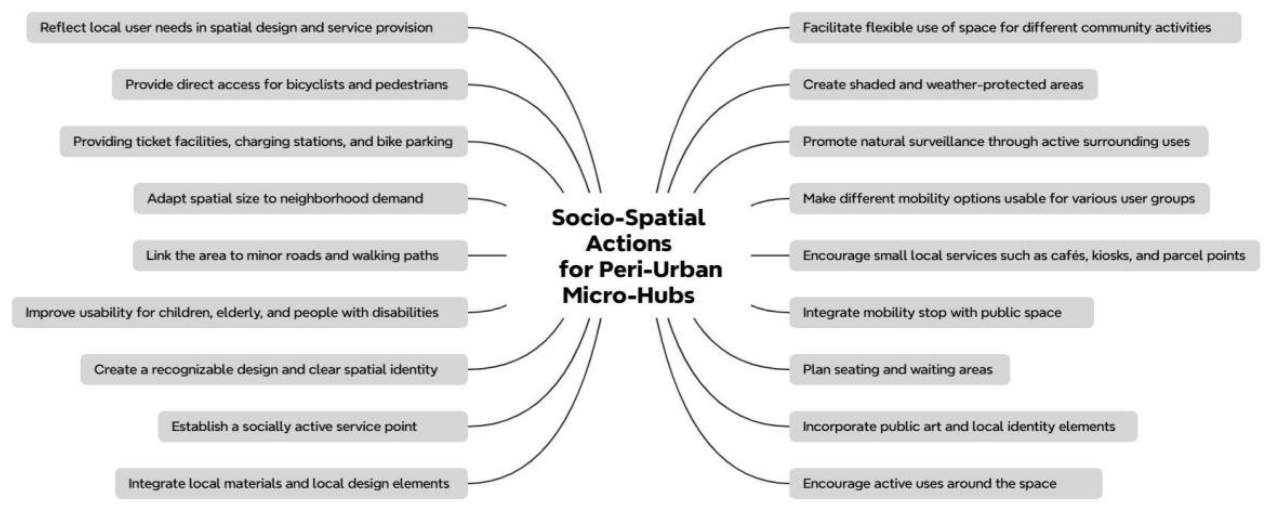
This section translates the characteristics of the mobility hub defined in the previous section (Figure 9) into operational socio-spatial planning actions (Appendix A) relevant to peri-urban and low-density areas. Rather than designing specific solutions, the process consisted in interpreting the characteristics extracted in the previous phase and rephrasing them in terms of spatial and functional actions to address the special issues provided by peri-urban locations, such as automobile dependency, distance, shortage of public transportation, lack of local services, loss of local identity, or the absence of community-oriented spaces. The outcome consists in a set of socio-spatial actions that articulate the operational role of micro-hubs as connectors between mobility, local services, and social infrastructure in dispersed territories.
Figure 10.
Operational Policy-Supported Socio-Spatial Actions for Addressing Peri-Urban Challenges through Micro-Hubs.
Figure 10.
Operational Policy-Supported Socio-Spatial Actions for Addressing Peri-Urban Challenges through Micro-Hubs.
4. Discussion
The research findings make a contribution to the debates on active mobility and planning for mobility hubs, particularly in challenging the dominant urban-centric paradigm, which continues to influence both theoretical debates and practical planning strategies. Although active mobility has been mostly thought of within urban context characterized by their density, proximity, and high accessibility of public transport, the findings of this research suggest that this is not directly applicable to peri-urban and low-density areas. This is a key aspect because it implies that the limitations of active mobility in sprawling territories are not necessarily related to a lack of infrastructure but rather to a lack of correspondence between planning models and territorial structures. In dispersed contexts, active mobility does not derive primarily from large infrastructure but rather from the organization, stabilization, and activation of existing territorial networks, especially minor roads, rural paths, ecological corridors, and local connectivity.
From this point of view, it is possible to define active mobility as a territorial and network condition rather than an infrastructural condition. This interpretation represents one of the main conceptual contributions of the study, as it changes the focus of planning from the supply of new infrastructures to the activation and improvement of existing territorial networks. The literature and practice-oriented sources studied in the present research suggest that the network of minor infrastructures is already working as a hidden mobility system for daily mobility needs such as ‘home-school,’ ‘home-work,’ and so on. In such a context, the strategy for planning should not be the development of new infrastructures, but rather the integration and improvement of the existing minor network in terms of safety and continuity. The recognition of minor roads as a form of strategic infrastructure also means a shift in the priorities of planning from large-scale to small-scale projects, such as traffic calming, safety, the continuity of cycling routes, and the implementation of micro hubs as nodes of local accessibility. This has important planning implications, as it suggests that improving active mobility in peri-urban areas is less a matter of developing new systems and more a matter of reorganizing and reinforcing existing ones. The incompatibility of the governmental scale of management and the functional scale of mobility networks is one of the major spatial and institutional barriers to the growth of active mobility in peri urban areas. In other words, the daily patterns of mobility tend to cover several municipalities, while planning tools and implementation instruments are usually bound to administrative limits, and strategic planning is usually defined at the regional level. As such, there is a gap in terms of governance due to the scalar contradiction. As such, the findings of this study emphasize the need for an intermediate scale between municipalities and regions as an essential scale for coordination and funding. This level of intermediacy could play a fundamental role in articulating the networks of territorial mobility with the tools of governance and planning. In this framework of scales, micro-hubs could be understood not only in terms of their spatiality but also in relation to their potential function as a tool of planning and governance at the intermediate level, articulating the potentialities of local actors and municipal technicians with regional strategies. Thus, the micro-hub is understood not only as a node of mobility but also as a tool of governance at the intermediate level.
From the policy point of view, the study also discusses the appropriateness of the commonly applied cost-benefit evaluation approaches for evaluating active mobility schemes in low-density territories. In fact, small-scale active mobility schemes such as micro-hubs and minor road improvements might not be justified in terms of the demand generated or the economic benefits gained. However, the commonly applied evaluation approaches do not account for the benefits in terms of the improvement of the general health of the population through walking and cycling, road safety, sustainability, and spatial equity. This finding also suggests that the assessment of active mobility projects in peri-urban territories should not be limited to economic efficiency criteria, as is commonly the case, but rather to more comprehensive and multi-criteria approaches that also account for social, environmental, and health-related benefits. This also implies that many of the small-scale projects currently regarded as minor might have high territorial and social value. Micro-hubs can also be considered a form of social and behavioral infrastructure. In this case, there is a combination of mobility services, information, and education, and community-based initiatives. There is also a focus on the social and behavioral dimension of mobility planning. In addition, there is a linking of active mobility with spatial justice concerns, particularly in dispersed territories where the elderly, youth, and those without private car ownership experience difficulties related to accessibility and mobility. This approach also transforms the micro-hub from a simple transport solution to a socio-spatial component of the daily mobility system. Overall, the results of this research highlight a new concept of urban and territorial planning, shifting from infrastructure-based transport planning to a more territorial approach based on network concepts and socio-spatial analysis in peri-urban and low-density territories. The main contribution of this research is therefore not to propose a new transport solution but rather to redefine the function of existing territorial networks, to introduce the concept of micro-hubs as a new component of urban and territorial governance, and to highlight the importance of the intermediate level of analysis for urban and territorial governance. In this sense, micro-hubs could be considered a new concept of spatial, social, and institutional nodes that connect minor networks and contribute to urban and territorial governance at the intermediate level of analysis. Therefore, further research could operationalize the proposed actions through empirical studies, spatial analysis, and the evaluation of pilot projects in peri-urban territories.
Author Contributions
Conceptualization, M.R. and L.V.; methodology, M.R.; formal analysis, M.R.; investigation, M.R.; resources, M.R. and L.V.; data curation, M.R.; writing—original draft preparation, M.R.; writing—review and editing, M.R., L.V., and S.M.; visualization, M.R.; supervision, L.V. and S.M.; project administration, L.V. and S.M.; funding acquisition, L.V. and S.M. All authors have read and agreed to the published version of the manuscript.
Funding
This research was carried out within the project RECAP (Ricerca PRIN_CTC), “Reducing Car Dependency through Tailored Policies to Improve Accessibility by Proximity in Highly Car-Dependent Territories," funded by the Italian Ministry of University and Research (MUR) under the PRIN 2022 program.
Data Availability Statement
No new quantitative data were created for this study. The research is based on literature review, territorial analysis, and qualitative inputs derived from research workshops and discussions conducted within the PRIN RECAP project.
Acknowledgments
This research was developed within the framework of the PRIN research project RECAP (Ricerca PRIN_CTC), “Reducing Car Dependency through Tailored Policies to Improve Accessibility by Proximity in Highly Car-Dependent Territories," coordinated by Università Iuav di Venezia in collaboration with Politecnico di Milano and Politecnico di Torino. The authors would like to acknowledge the research units of the three universities and the collaborative research environment developed within the project. The study also benefited from discussions developed during workshops and roundtables organized within the project, including the workshop “Verso territori 30 km/h – Linee guida per la riduzione della car dependency nei territori a bassa densità," which involved researchers, planners, and local administrators working on active mobility. These exchanges contributed to the development of the conceptual and territorial framework presented in this study.
Conflicts of Interest
The authors declare no conflicts of interest.
Abbreviations
The following abbreviations are used in this manuscript:
| PASTA | Physical Activity Through Sustainable Transport Approaches |
| TA | Thematic Analysis |
Appendix A
Table A1.
From Mobility Hub Social Characteristics to Operational Socio-Spatial Actions.
| Mobility Hub Social Characteristic | Equivalent Operational Policy-Supported Socio-Spatial Actions |
|---|---|
| Balance between user and developer priorities [45] | Reflect local user needs in spatial design and service provision |
| Physical and functional accessibility [45] | Provide direct access for bicyclists and pedestrians |
| Support services for mobility use [45] | Providing ticket facilities, charging stations, and bike parking |
| Scale-dependent spatial configuration [45] | Adapt spatial size to neighborhood demand |
| Pedestrian-oriented spatial layout and connections [51] | Link the area to minor roads and walking paths |
| Functional accessibility for diverse users [43] | Improve usability for children, elderly, and people with disabilities |
| Network-wide recognizability and identity [43] | Create a recognizable design and clear spatial identity |
| Shared design language with local identity [44] | Integrate local materials and local design elements |
| Incremental growth supporting community functions [44] | Facilitate flexible use of space for different community activities |
| Environmental design supporting comfort and livability [44] | Create shaded and weather-protected areas |
| Pedestrian-oriented safety and security [44] | Promote natural surveillance through active surrounding uses |
| Equity in mobility access [42] | Make different mobility options usable for various user groups |
| Amenities supporting social use [53] | Encourage small local services such as cafés, kiosks, and parcel points |
| Integration of transport and public space [53] | Integrate mobility stop with public space |
| Spaces encouraging social interaction [52] | Plan seating and waiting areas |
| Public art and identity features[52] | Incorporate public art and local identity elements |
| Human presence supporting trust and inclusion [52] | Encourage active uses around the space |
| Accessible information and ticketing points [52] | Establish a socially active service point |
References
- Koszowski, C.; Gerike, R.; Hubrich, S.; Götschi, T.; Pohle, M.; Wittwer, R. Active Mobility: Bringing Together Transport Planning, Urban Planning, and Public Health. In Towards User-Centric Transport in Europe: Challenges, Solutions and Collaborations; Müller, B., Meyer, G., Eds.; Springer International Publishing: Cham, 2019; pp. 149–171. ISBN 978-3-319-99756-8. [Google Scholar]
- Winters, M.; Buehler, R.; Götschi, T. Policies to Promote Active Travel: Evidence from Reviews of the Literature. Curr Envir Health Rpt 2017, 4, 278–285. [Google Scholar] [CrossRef] [PubMed]
- Allen, H.; Nolmark, H. Active Transportation, the Ultimate Low Carbon Way to Travel—A Review of International Research and Education. Front. Sustain. Cities 2022, 4. [Google Scholar] [CrossRef]
- Correa, F.; Bartorila, M.; Ribeiro-Palacios, M.; Pérez-Soto, G.I.; Rodríguez-Reséndiz, J. Toward the Human Scale in Smart Cities: Exploring the Role of Active Mobility in Ecosystemic Urbanism. Smart Cities 2024, 7, 4002–4024. [Google Scholar] [CrossRef]
- Vale, D.S.; Saraiva, M.; Pereira, M. Active Accessibility: A Review of Operational Measures of Walking and Cycling Accessibility. JTLU 2015. [Google Scholar] [CrossRef]
- Orellana, D.; Hermida, C.; Osorio, P. A Multidisciplinary Analytical Framework for Studying Active Mobility Patterns. Int. Arch. Photogramm. Remote Sens. Spatial Inf. Sci. 2016, XLI-B2, 527–534. [Google Scholar] [CrossRef]
- Mitra, R. Independent Mobility and Mode Choice for School Transportation: A Review and Framework for Future Research. Transport Reviews 2013, 33, 21–43. [Google Scholar] [CrossRef]
- Litman, T. Evaluating Benefits and Costs of Active Transportation: A Guide; 2015. [Google Scholar]
- Saunders, L.E.; Green, J.M.; Petticrew, M.P.; Steinbach, R.; Roberts, H. What Are the Health Benefits of Active Travel? A Systematic Review of Trials and Cohort Studies. PLoS ONE 2013, 8, e69912. [Google Scholar] [CrossRef]
- Doorley, R.; Pakrashi, V.; Ghosh, B. Quantifying the Health Impacts of Active Travel: Assessment of Methodologies. Transport Reviews 2015, 35, 559–582. [Google Scholar] [CrossRef]
- Arbab, P.; Pfeffer, K.; Martinez, J.; Amer, S. Active Mobility as a Response to Physical Inactivity in Cities. SHAPING URBAN CHANGE – Livable City Regions for the 21st Century. Proceedings of REAL CORP 2020, 25th International Conference on Urban Development, Regional Planning and Information Society; 2020; pp. 1031–1035. [Google Scholar]
- Scrivano, L.; Tessari, A.; Marcora, S.M.; Manners, D.N. Active Mobility and Mental Health: A Scoping Review towards a Healthier World. Glob Ment Health (Camb) 2024, 11, e1. [Google Scholar] [CrossRef] [PubMed]
- Tittlbach, S.; Brockfeld, A.; Kindig, S.; Herfet, M. Maintaining Health in Daily Life—Is Active Travel the Solution? Ger J Exerc Sport Res 2024, 54, 121–134. [Google Scholar] [CrossRef]
- Nocera, S.; Attard, M. Active Travel and Mobility Management. Research in Transportation Business & Management 2021, 40, 100663. [Google Scholar] [CrossRef]
- Biehl, Alec; Biehl; Chen, A.; Chen, Ying; Sanabria-Véaz, Y.; Karla; Sanabria-Veaz, K.; Uttal, David H.; Uttal, D.H.; Stathopoulos, Amanda; Stathopoulos, A. Where Does Active Travel Fit within Local Community Narratives of Mobility Space and Place. Transportation Research Part A-policy and Practice 2019, 123, 269–287. [Google Scholar] [CrossRef]
- Papageorgiou, G.; Tsappi, E.; Wang, T. Smart Urban Systems Planning for Active Mobility and Sustainability. IFAC-PapersOnLine 2024, 58, 261–266. [Google Scholar] [CrossRef]
- Scorza, F.; Fortunato, G. Active Mobility-Oriented Urban Development: A Morpho-Syntactic Scenario for a Mid-Sized Town. European Planning Studies 2024, 32, 320–344. [Google Scholar] [CrossRef]
- Paglione, L.; Donato, M.A.; Cofone, L.; Sabato, M.; Appolloni, L.; D’Alessandro, D. The Healthy City Reimagined: Walkability, Active Mobility, and the Challenges of Measurement and Evaluation. Urban Science 2024, 8, 157. [Google Scholar] [CrossRef]
- Pucci, P.; Colleoni, M.; Daconto, L.; Vendemmia, B. Accessibilità di prossimità in contesti a bassa densità: reti e servizi di mobilità per territori inclusivi; Il Mulino, 2021; ISBN 978-88-15-29228-5. [Google Scholar]
- Velo, L. On the Proximity Scale. How Can It Be Applied in Peri-Urban and Rural Areas? In Questioning Proximity - Opportunities and Challenges for Urban Planning and Mobility Policies. In SpringerBriefs in Applied Sciences and Technology; Pucci, P., Vecchio, G., Eds.; Springer Nature Switzerland: Cham, 2024; pp. 109–116. ISBN 978-3-031-66070-2. [Google Scholar]
- Sahana, M.; Ravetz, J.; Patel, P.P.; Dadashpoor, H.; Follmann, A. Where Is the Peri-Urban? A Systematic Review of Peri-Urban Research and Approaches for Its Identification and Demarcation Worldwide. Remote Sensing 2023, 15, 1316. [Google Scholar] [CrossRef]
- Pucci, P. Mobility Behaviours in Peri-Urban Areas. The Milan Urban Region Case Study. Transportation Research Procedia 2017, 25, 4229–4244. [Google Scholar] [CrossRef]
- Thao, V.T.; Imhof, S.; Von Arx, W. Demand Responsive Transport: New Insights from Peri-Urban Experiences. Travel Behaviour and Society 2023, 31, 141–150. [Google Scholar] [CrossRef]
- Jones, T.; Spencer, B. Far from the “Dreaming Spires”: Staging Active Travel in Suburban Oxford, UK. Applied Mobilities 2024, 9, 38–62. [Google Scholar] [CrossRef]
- Pucci, P.; Lanza, G.; Sierra Munoz, J.; Galbiati, G. Beyond Choice: Car Dependency and Transition to Sustainable Mobility in Peri-Urban Territories 2025.
- Petrunoff, N.; Rissel, C.; Wen, L.M. The Effect of Active Travel Interventions Conducted in Work Settings on Driving to Work: A Systematic Review. Journal of Transport & Health 2016, 3, 61–76. [Google Scholar] [CrossRef]
- Schoeppe, S.; Duncan, M.J.; Badland, H.; Oliver, M.; Curtis, C. Associations of Children’s Independent Mobility and Active Travel with Physical Activity, Sedentary Behaviour and Weight Status: A Systematic Review. J Sci Med Sport 2013, 16, 312–319. [Google Scholar] [CrossRef]
- Verzeroli, M.; Gaioni, L.; Galliani, A.; Ghislotti, L.; Lazzaroni, P.; Re, V. Advancing Sustainable Mobility: A Data Acquisition System for Light Vehicles and Active Mobility. Electronics 2024, 13, 4249. [Google Scholar] [CrossRef]
- Wang, X.; Fang, D.; Zhao, L.; Xue, Y.; Sun, S.; Lan, J.; Wang, X. Residents’ Travel Choice under Public Health Events and the Optimal Strategies of the Travel Environment for Active Mobility: A Case Study of Harbin, China 2024.
- Sabet, A.; Feldner, H.; Tucker, J.; Logan, S.W.; Galloway, J.C. ON Time Mobility: Advocating for Mobility Equity. Pediatr Phys Ther 2022, 34, 546–550. [Google Scholar] [CrossRef] [PubMed]
- Brand, C. Active Travel’s Contribution to Climate Change Mitigation: Research Summary and Outlook. Active Travel Studies 2021, 1. [Google Scholar] [CrossRef]
- Peruzzi, M.; Sanasi, E.; Pingitore, A.; Marullo, A.G.; Carnevale, R.; Sciarretta, S.; Sciarra, L.; Frati, G.; Cavarretta, E. An Overview of Cycling as Active Transportation and as Benefit for Health. Minerva Cardioangiol 2020, 68, 81–97. [Google Scholar] [CrossRef]
- Burke, M.; Brown, A.L. Active Transport in Brisbane: How Much Is Happening and What Are Its Characteristics? In Proceedings of the Proceedings of the State of Australian Cities National Conference 2007; Griffith University: Adelaide, 2007. [Google Scholar]
- Held, M.; Schindler, J.; Litman, T. Cycling and Active Mobility – Establishing a Third Pillar of Transport Policy. In Cycling Futures; Routledge, 2015. [Google Scholar]
- Paglione, L.; Donato, M.A.; Cofone, L.; Sabato, M.; Appolloni, L.; D’Alessandro, D. The Healthy City Reimagined: Walkability, Active Mobility, and the Challenges of Measurement and Evaluation. Urban Science 2024, 8, 157. [Google Scholar] [CrossRef]
- Reimers, A.K.; Demetriou, Y. Active Mobility—(Also) a Topic for Sport Science? Ger J Exerc Sport Res 2024, 54, 116–120. [Google Scholar] [CrossRef]
- European Commission Physical Activity through Sustainable Transport Approaches; Brussels, 2017.
- Wegener, S.; Raser, E.; Gaupp-Berghausen, M.; Anaya Boig, E.; Nazelle, A.; Eriksson, U.; Gerike, R.; Horvath, I.; Iacorossi, F.; Rothballer, C.; et al. Active Mobility – the New Health Trend in Smart Cities, or Even More? 2017. [Google Scholar]
- Ravetz, J.; Sahana, M. Where Is the Peri-Urban? Mapping the Areas ‘around, beyond and Between. Front. Sustain. Cities 2025, 7, 1436287. [Google Scholar] [CrossRef]
- Rajan, S. The Periurban Transport Challenge: Beyond Automobility Towards Access and Adaptive Governance 2025.
- Arnold, T.; Frost, M.; Timmis, A.; Dale, S.; Ison, S. Mobility Hubs: Review and Future Research Direction. Transportation Research Record: Journal of the Transportation Research Board 2023, 2677, 858–868. [Google Scholar] [CrossRef]
- Aono, S. Identifying Best Practices for Mobility Hubs.
- Heijningen, W. van Shared Mobility and Hubs in the City of Amsterdam. Presented at the Tomorrow Mobility World Congress – City Managers Meeting, 2022. [Google Scholar]
- Future Mobility Hubs - Arup. Available online: https://www.arup.com/insights/future-mobility-hubs/ (accessed on 28 March 2026).
- Rooij, V. Neighbourhood Mobility Hubs. Master’s Thesis, Delft University of Technology, 2020. [Google Scholar]
- Roukouni, A.; Junyent, I.A.; Casanovas, M.M.; Correia, G.H.D.A. An Analysis of the Emerging “Shared Mobility Hub” Concept in European Cities: Definition and a Proposed Typology. Sustainability 2023, 15, 5222. [Google Scholar] [CrossRef]
- Secchi, B. On mobility: infrastrutture per la mobilità e costruzione del territorio metropolitano : linee guida per un progetto integrato; Marsilio, 2010; ISBN 978-88-317-9990-4. [Google Scholar]
- Lozzi, G.; Iannaccone, G.; Maltese, I.; Gatta, V.; Marcucci, E.; Lozzi, R. On-Demand Logistics: Solutions, Barriers, and Enablers. Sustainability 2022, 14, 9465. [Google Scholar] [CrossRef]
- Castillo, C.; Panadero, J.; Alvarez-Palau, E.J.; Juan, A.A. Towards Greener City Logistics: An Application of Agile Routing Algorithms to Optimize the Distribution of Micro-Hubs in Barcelona. Eur. Transp. Res. Rev. 2024, 16, 44. [Google Scholar] [CrossRef]
- Fahlbusch, J.; Fischer, F.; Gegner, M.; Grahle, A.; Tasche, L. Towards a Concept for a Multifunctional Mobility Hub: Combining Multimodal Services, Urban Logistics, and Energy. Logistics 2025, 9, 92. [Google Scholar] [CrossRef]
- McIlroy, B. MOBILITY HUB POLICY REVIEW. 2018. [Google Scholar]
- Feigon, S.; Frisbie, T.; Halls, C.; Murphy, C. Shared Use Mobility: European Experience and Lessons Learned; Federal Highway Administration (FHWA), U.S. Department of Transportation: Washington, DC, 2018; p. 48. [Google Scholar]
- Crowther, J.; Mangle, K.; Abe, D.; Maines, K.; Hesse, E.; Sherman, J.; Hoyt-McBeth, S.; Falbo, N.; Berkow, M.; Igarta, D.; et al. Mobility Hub Typology Study; Portland Bureau of Transportation: Portland, 2020. [Google Scholar]
- Università Iuav di Venezia Reducing Car Dependency through Tailored Policies to Improve Accessibility by Proximity in Highly Car-Dependent Territories; RECAP Project (PRIN 2022), Linee Guida; Università Iuav di Venezia: Venice, Italy, 2025.
- Ahmed, S.K.; Mohammed, R.A.; Nashwan, A.J.; Ibrahim, R.H.; Abdalla, A.Q.; M. Ameen, B.M.; Khdhir, R.M. Using Thematic Analysis in Qualitative Research. Journal of Medicine, Surgery, and Public Health 2025, 6, 100198. [Google Scholar] [CrossRef]
- Naeem, M.; Ozuem, W.; Howell, K.; Ranfagni, S. A Step-by-Step Process of Thematic Analysis to Develop a Conceptual Model in Qualitative Research. International Journal of Qualitative Methods 2023, 22, 16094069231205789. [Google Scholar] [CrossRef]
- Braun, V.; Clarke, V. Using Thematic Analysis in Psychology. Qualitative Research in Psychology 2006, 3, 77–101. [Google Scholar] [CrossRef]
- Pinizzotto, R.; Mazzoni, L. Local Strategies for Sustainable Mobility. The Case of Veneto Region. Regional Studies and Local Development 2023, 4, 65–88. [Google Scholar]
- Montanari, A.; Paluzzi, E. Human Mobility and Settlement Patterns from Eight EU Countries to the Italian Regions of Lombardy, Veneto, Tuscany, Lazio and Sicily. Hungarian Geographical Bulletin 2016, 65, 331–344. [Google Scholar] [CrossRef]
- Munarin, S.; Velo, L.; Roman, F. Le trame minori nel pedemonte veneto. Indagini e strategie in un territorio multi-politano. TERRITORIO 2026, 104–114. [Google Scholar] [CrossRef]
- Università Iuav di Venezia Verso Territori 30 Km/h: Linee Guida per La Riduzione Della Car Dependency Nei Territori a Bassa Densità. Presented at the RECAP Project (PRIN 2022), 2025.
- Renzoni, C. Water and Asphalt: The Project of Isotropy. Planning Perspectives 2017, 32, 1–2. [Google Scholar] [CrossRef]
Figure 1.
Research design and analytical process of the study.
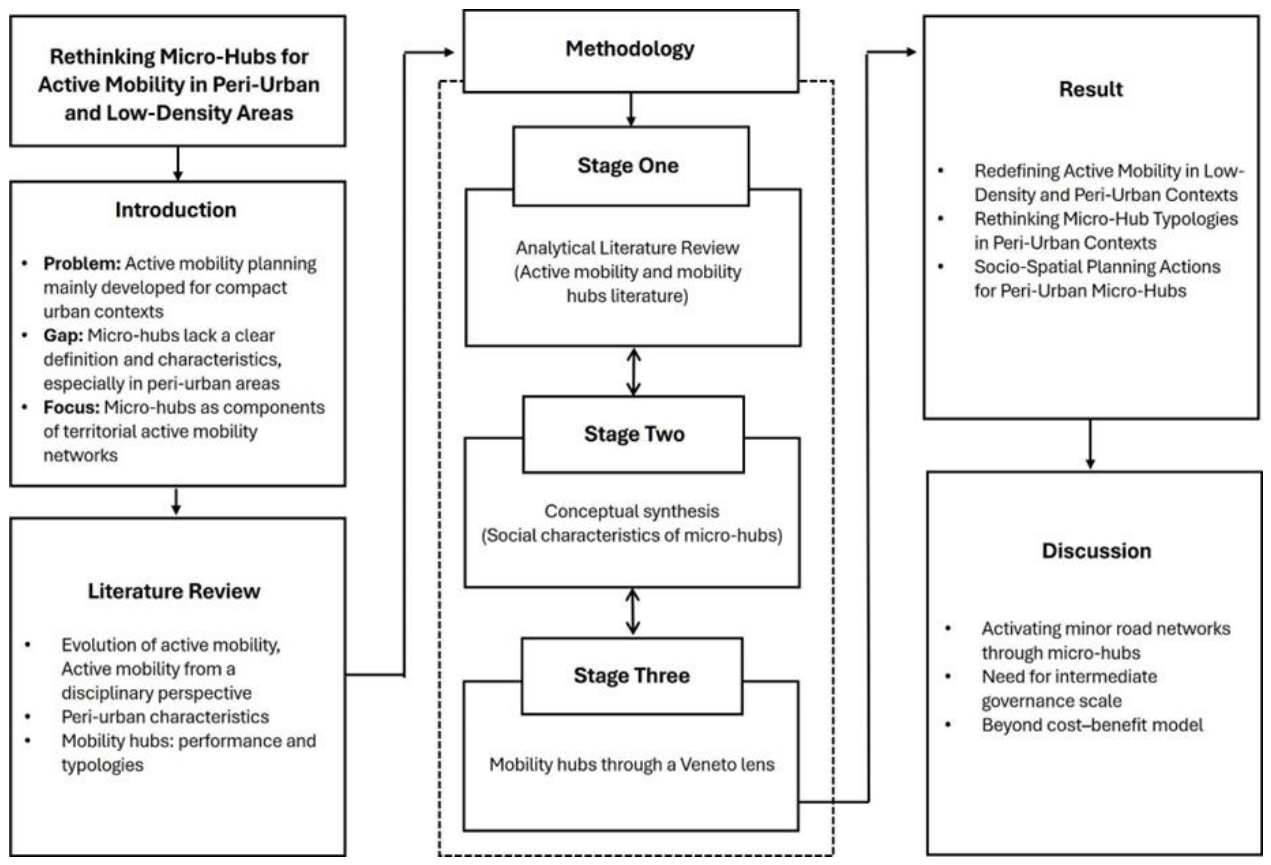
Figure 2.
Key authors' network of active mobility research, generated using the Research Rabbit visualization tool.
Figure 2.
Key authors' network of active mobility research, generated using the Research Rabbit visualization tool.
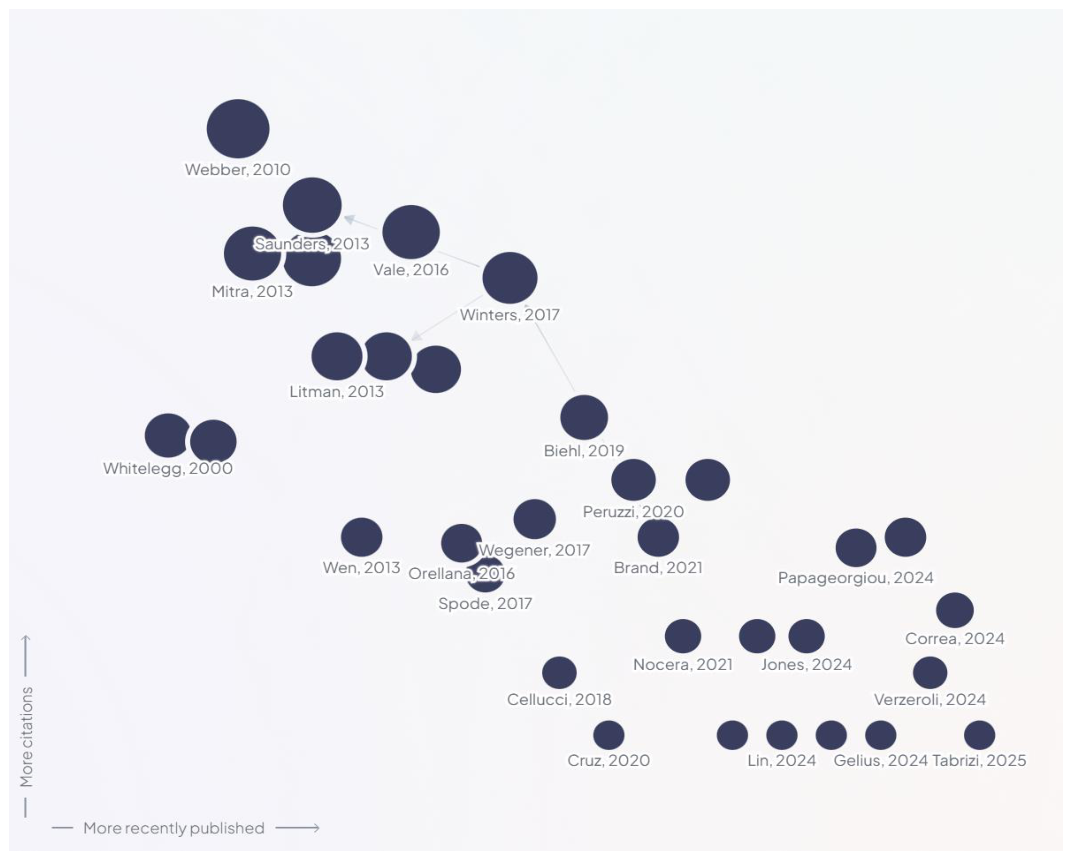
Figure 3.
Core keywords shaping the concept of active mobility.
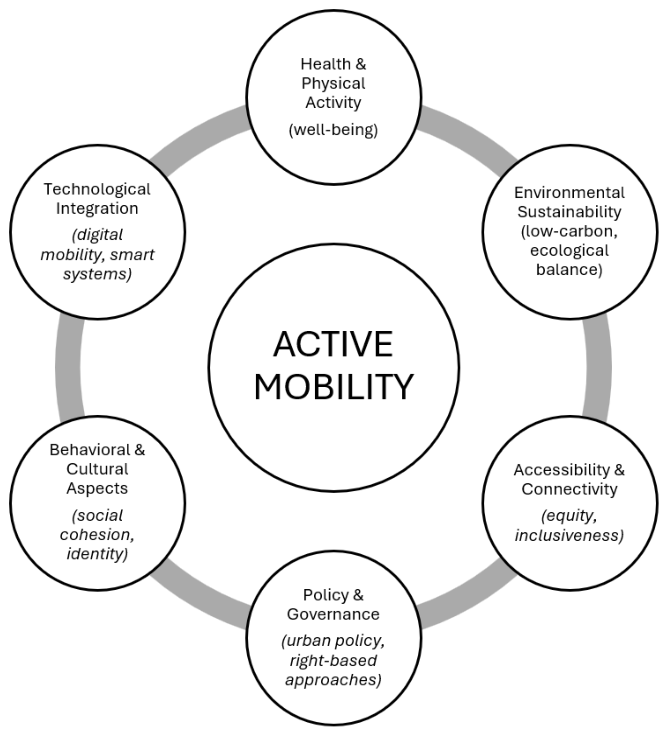
Figure 4.
َConceptual evolution of active mobility over time.
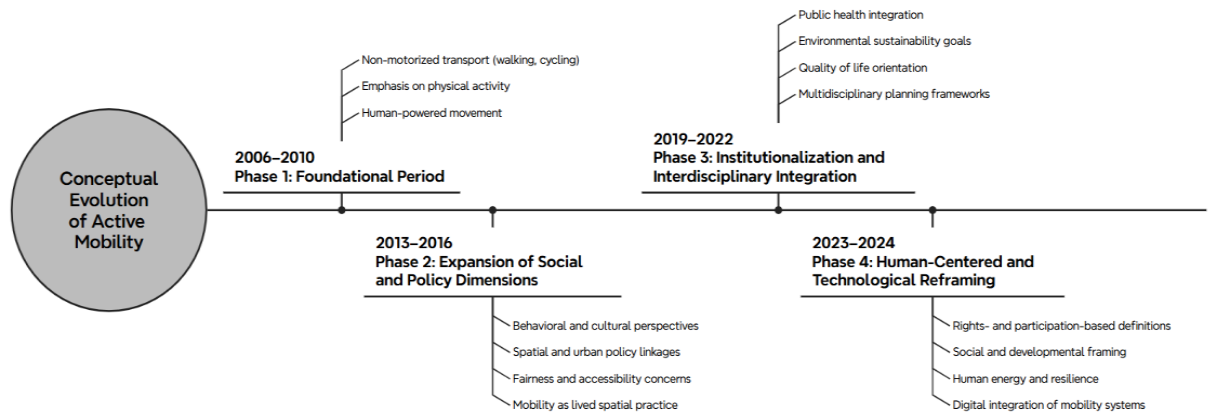
Figure 5.
َClassification of Mobility Hub Typologies.
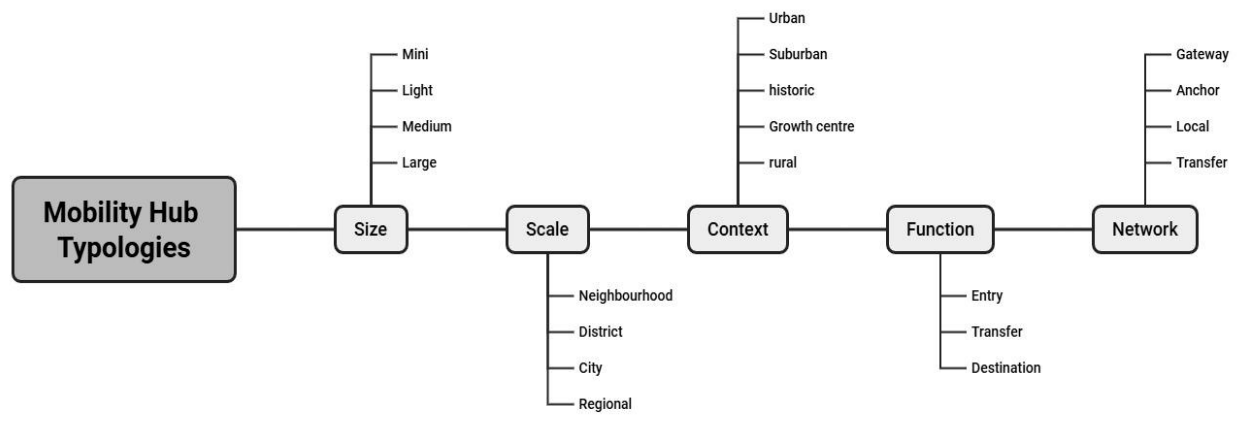
Figure 6.
overview of mobility hub characteristics across key literature sources.
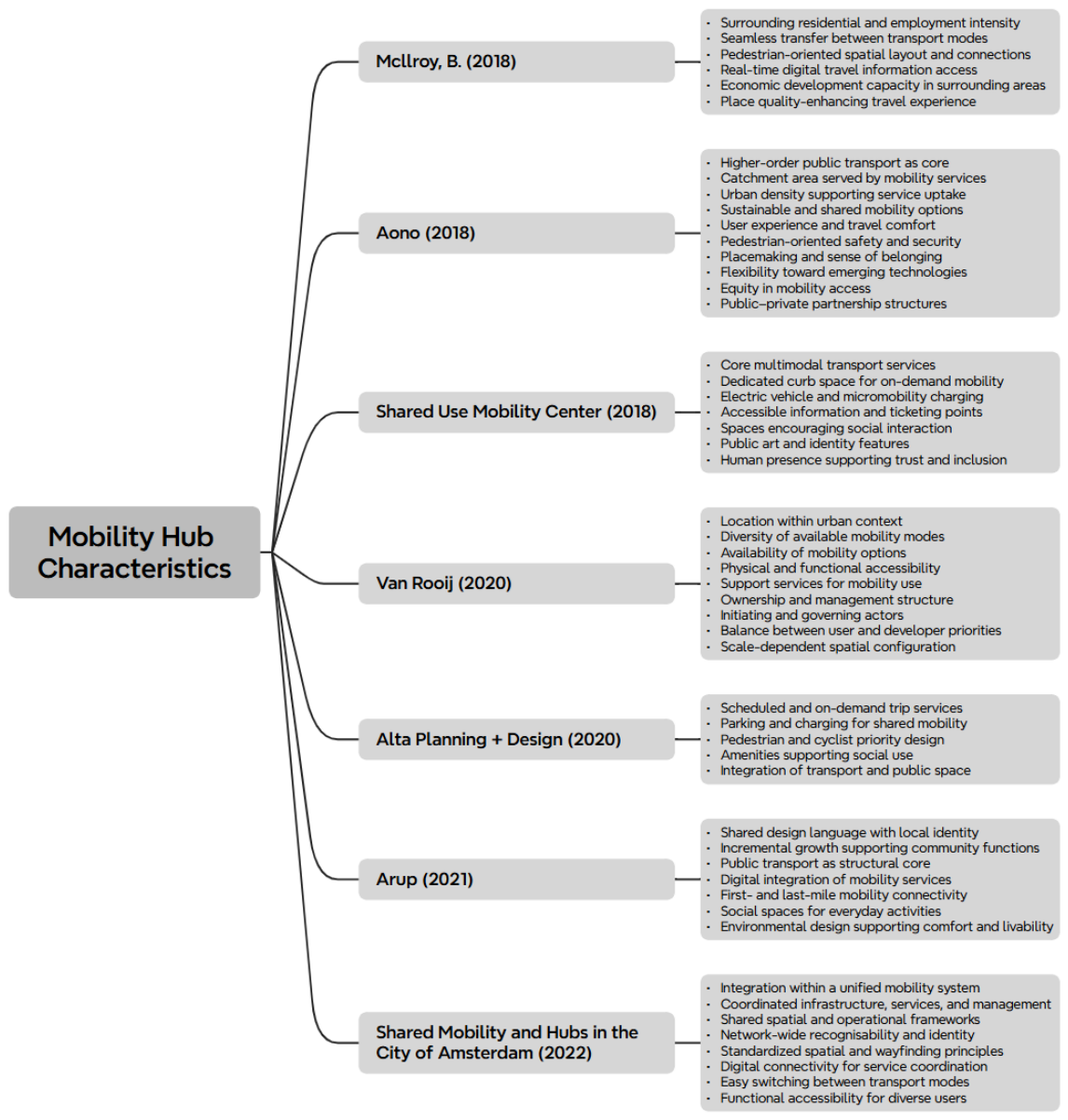
Figure 7.
َMethodological Framework of the study.
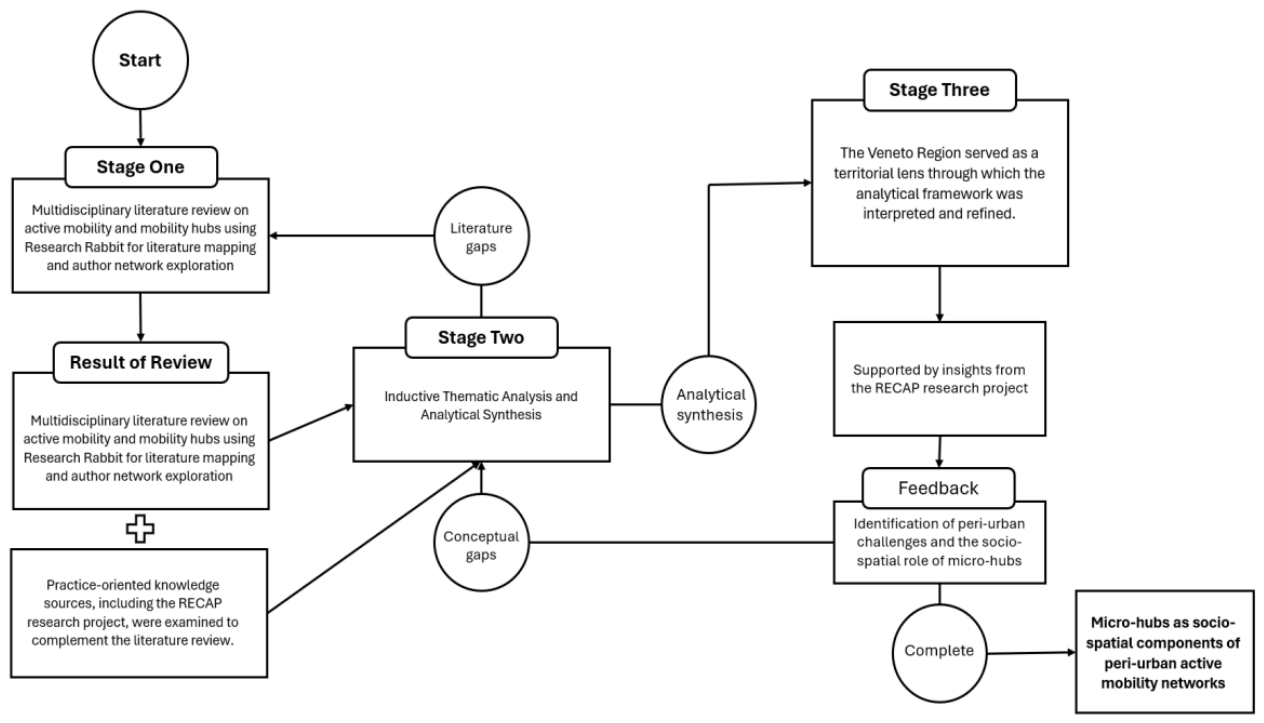
Figure 9.
From Social Themes to Mobility Hub Social Characteristics.
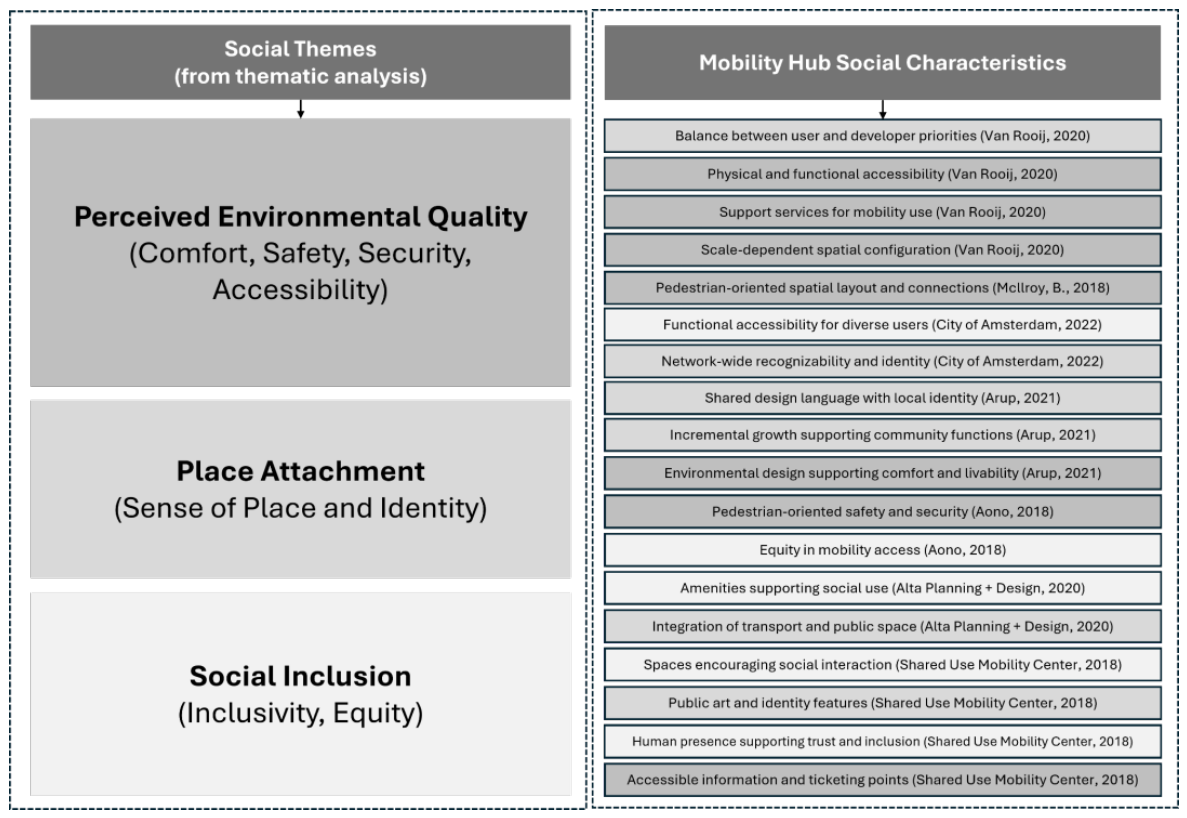
Disclaimer/Publisher’s Note: The statements, opinions and data contained in all publications are solely those of the individual author(s) and contributor(s) and not of MDPI and/or the editor(s). MDPI and/or the editor(s) disclaim responsibility for any injury to people or property resulting from any ideas, methods, instructions or products referred to in the content. |
© 2026 by the authors. Licensee MDPI, Basel, Switzerland. This article is an open access article distributed under the terms and conditions of the Creative Commons Attribution (CC BY) license (http://creativecommons.org/licenses/by/4.0/).
Copyright: This open access article is published under a Creative Commons CC BY 4.0 license, which permit the free download, distribution, and reuse, provided that the author and preprint are cited in any reuse.


