

Submitted:
17 April 2026
Posted:
20 April 2026
You are already at the latest version
Abstract
Aging is characterized by a progressive decline in physiological resilience and increased susceptibility to chronic diseases, including neurodegenerative disorders. Emerging evidence indicates that low-dose stressors (collectively termed hormetic stimuli) activate adaptive cellular responses that enhance stress resistance, promote repair mechanisms, and ultimately extend healthspan. This narrative review synthesizes current knowledge on hormesis in the context of aging, with a focus on key molecular pathways including nuclear factor erythroid 2–related factor 2 (Nrf2), sirtuins, autophagy, and mitohormesis. We examine how lifestyle interventions (physical exercise, caloric restriction, mild thermal stress) and emerging pharmacological agents induce beneficial adaptive responses, while critically evaluating their translational potential in clinical and public health settings. Special emphasis is placed on the role of hormesis in counteracting neurodegeneration, the utility of autophagy and systemic aging biomarkers (epigenetic clocks, inflammaging scores) for precision dosing, and the limitations imposed by inter-individual variability, age-related decline in adaptive capacity, and risks of overexposure. Understanding the delicate balance between beneficial and detrimental stress responses is essential for leveraging hormesis as a robust strategy to counteract aging and age-related diseases. We further propose a multilevel framework integrating molecular mechanisms with clinical outcomes, positioning hormesis as a key determinant of adaptive resilience in aging.
Keywords:
hormesis
; aging
; Nrf2
; sirtuins
; autophagy
; exercise
; caloric restriction
; thermal stress
; personalized hormesis
; longevity
; adaptive stress response
; mitohormesis
; adaptive homeostasis
; Precision hormesis
; neurodegeneration
; epigenetic clocks
; inflammaging
1. Introduction
Aging is increasingly understood not as a passive process of cumulative damage, but as a dynamic imbalance between damage generation and the organism’s capacity for adaptive stress responses. While classical frameworks such as the free radical theory (Harman, 1956) and the disposable soma theory (Kirkwood, 2005) emphasize stochastic damage accumulation and energy allocation trade-offs, these models have been substantially expanded by the integrative “hallmarks of aging” paradigm. The original framework (López-Otín et al., 2013) has recently been updated to encompass twelve hallmarks, with the inclusion of disabled macroautophagy, chronic inflammation (inflammaging), and dysbiosis (López-Otín et al., 2023). These additions reinforce the critical interplay between impaired proteostasis/autophagy and persistent low-grade stress responses as central drivers of aging.
However, a critical limitation of many aging theories remains their predominantly damage-centric perspective, which underestimates the role of adaptive resilience mechanisms. In this context, hormesis emerges not merely as an ancillary concept, but as a fundamental organizing principle of biological aging. Rather than viewing stress exclusively as deleterious, hormesis reframes it as a context-dependent signal capable of activating conserved survival pathways (Calabrese & Mattson, 2017; Mattson, 2008).
Importantly, the relevance of hormesis to aging is supported by converging evidence across phylogeny. In model organisms, mild stressors (including caloric restriction, thermal stress, and transient oxidative challenges) consistently extend lifespan and enhance stress resistance (Fontana et al., 2010; Ristow & Zarse, 2010). In humans, although direct lifespan data remain limited, analogous interventions improve metabolic health, reduce disease risk, and enhance functional capacity (Longo & Panda, 2016; Radak et al., 2008). Emerging evidence further demonstrates that hormetic principles apply to pharmacological agents and extend to clinical conditions such as neurodegeneration and dementia, where they mitigate protein aggregation and neuroinflammation.
Nevertheless, the field faces conceptual and translational challenges. First, hormesis is often invoked descriptively without sufficient mechanistic precision. Second, the boundary conditions that distinguish beneficial from harmful stress remain poorly defined. Third, inter-individual variability, age-related decline in adaptive capacity, and the need for reliable biomarkers of longevity and autophagic flux complicate clinical application.
This review addresses these gaps by critically examining hormetic stress responses through a multilevel framework, spanning molecular signaling networks (Nrf2, sirtuins, autophagy, mitohormesis), physiological adaptations (lifestyle and pharmacological interventions), and translational implications. Special attention is given to hormesis in dementia, the utility of systemic and longevity biomarkers for precision dosing, and the integration of lifestyle and pharmacological strategies. We emphasize mechanistic integration across biological scales and focus on how defined stressors elicit coordinated responses rather than isolated pathway activation.
A critical distinction in the context of hormesis is the difference between acute and chronic stress exposure. Acute stress refers to transient, time-limited perturbations that activate adaptive signaling pathways and are followed by recovery, thereby promoting resilience. In contrast, chronic stress involves sustained or repeated exposure without adequate recovery, leading to cumulative damage, dysregulation of homeostatic systems, and increased disease risk (McEwen, 2007).
Closely related is the distinction between hormesis and allostasis. While hormesis describes a beneficial adaptive response to low-dose stressors, allostasis refers to the process by which the body maintains stability through change, often involving prolonged activation of stress response systems. Importantly, chronic allostatic load (resulting from repeated or unregulated stress) can lead to physiological wear and tear, thereby opposing the beneficial effects associated with hormetic adaptation (Sterling & Eyer, 1988; McEwen & Wingfield, 2003).
These distinctions are essential for understanding why not all stress is beneficial and why the temporal dynamics, intensity, and recovery periods of stress exposure critically determine biological outcomes. This review advances the field by integrating molecular mechanisms of hormetic stress responses with clinically relevant outcomes and proposing a multilevel framework of adaptation in aging. By bridging mechanistic biology with translational perspectives, this work aims to position hormesis not only as a conceptual model but also as a clinically actionable strategy for promoting healthy aging and longevity.
2. Conceptual and Mechanistic Foundations of Hormesis
2.1. Beyond Biphasic Curves: Rethinking Hormesis
Hormesis is classically defined as a biphasic dose–response relationship characterized by low-dose stimulation and high-dose inhibition (Calabrese & Baldwin, 2002). While this framework is conceptually useful, it is increasingly clear that it oversimplifies the complexity of biological stress responses.
At the cellular level, hormetic effects are mediated by dynamic signaling networks rather than linear dose–response relationships. For instance, the magnitude and duration of pathway activation (e.g., Nrf2, AMPK) may be more relevant than absolute stress intensity. Moreover, temporal factos (such as intermittent versus continuous exposure) critically shape outcomes (Davies, 2016; Pomatto & Davies, 2018).
Recent work has proposed the concept of “adaptive homeostasis,” defined as the transient expansion of the homeostatic range in response to sublethal stress (Davies, 2016). This framework integrates hormesis into a broader systems biology perspective, emphasizing plasticity rather than static thresholds.
Recent bibliometric analyses further underscore the growing centrality of hormesis in aging research. Wan et al. (2024) identified oxidative stress and aging as the dominant hotspots in the hormesis literature, with emerging trends pointing toward dose-dependent mechanisms and translational applications. Their analysis of highly cited references predicts that future studies will increasingly focus on the quantitative boundaries of hormetic responses and their integration with multi-omics approaches, reinforcing the need for precision in defining beneficial versus detrimental stress thresholds.
2.2. Mitohormesis and Redox Signaling
The concept of mitohormesis represents a major paradigm shift in redox biology. Contrary to the traditional view of reactive oxygen species (ROS) as purely damaging, moderate increases in ROS can function as signaling molecules that activate adaptive pathways (Ristow & Zarse, 2010; Sena & Chandel, 2012).
Experimental evidence demonstrates that interventions such as caloric restriction and exercise increase mitochondrial ROS production, which in turn activates stress response pathways including Nrf2, FOXO, and AMPK (Merry & Ristow, 2016). Notably, antioxidant supplementation can blunt these beneficial effects, suggesting that ROS signaling is necessary for hormetic adaptation.
However, this model is not without controversy. Some studies indicate that excessive reliance on ROS signaling may contribute to long-term damage, particularly in aged or diseased systems where antioxidant defenses are compromised (Sohal & Orr, 2012). Thus, the balance between signaling and damage remains a critical unresolved issue.
Recent insights into mitochondrial hormesis further clarify this balance. Da et al. (2024) demonstrated that mild mitochondrial ROS bursts trigger a positive feedback loop involving Nrf2, PGC-1α, and the PINK1/Parkin pathway, simultaneously enhancing mitochondrial biogenesis, fission, and selective autophagy (mitophagy). This coordinated response improves mitochondrial quality control and delays age-related functional decline, reinforcing mitohormesis as a central mechanism linking redox signaling to longevity.
2.3. Network-Level Integration
A key limitation of reductionist approaches is the tendency to study individual pathways in isolation. In reality, hormetic responses emerge (Figure 1) from the integration of multiple signaling networks, including:
These systems are highly interconnected. For example, AMPK activation inhibits mTOR, thereby promoting autophagy, while also enhancing NAD+ levels and sirtuin activity (Cantó et al., 2009). Similarly, Nrf2 interacts with autophagic machinery through p62-mediated signaling (Komatsu et al., 2010).
This networked architecture suggests that hormesis should be conceptualized as a systems-level phenomenon, where emergent properties arise from coordinated pathway activation rather than isolated molecular events.
Despite its widespread use, hormesis lacks standardized operational criteria in experimental and clinical contexts. Operationally, hormesis can be defined as a quantifiable adaptive response characterized by (i) exposure to a low-dose stressor, (ii) activation of conserved stress response pathways (e.g., Nrf2, AMPK, sirtuins), and (iii) measurable improvements in functional outcomes, such as enhanced metabolic efficiency, stress resistance, or reduced disease risk. Importantly, the identification of hormesis requires demonstration of a biphasic or non-linear dose–response relationship, distinguishing beneficial adaptive responses from both insufficient stimulation and excessive damage (Calabrese & Mattson, 2017; Pomatto & Davies, 2018).
3. Molecular Mechanisms
3.1. Nrf2 Signaling: Central but Context-Dependent
The Nrf2 pathway is widely regarded as a cornerstone of hormetic responses due to its role in regulating antioxidant and cytoprotective genes (Kensler et al., 2007; Ma, 2013). Activation of Nrf2 enhances resistance to oxidative stress, xenobiotics, and inflammation — processes that are strongly implicated in aging.
However, the role of Nrf2 in longevity is complex and context-dependent. While moderate activation is protective, chronic or excessive activation may have unintended consequences, including potential promotion of tumorigenesis through enhanced cellular survival (DeNicola et al., 2011).
Moreover, age-related decline in Nrf2 responsiveness has been reported, suggesting that the efficacy of hormetic interventions targeting this pathway may diminish over time (Zhang et al., 2015). This decline in Nrf2 signaling with age is supported by both experimental and clinical evidence, indicating reduced inducibility of antioxidant defenses in older organisms (Ungvari et al., 2011; Bruns et al., 2015).
This raises important questions regarding therapeutic timing and the potential need for sensitization strategies.
3.2. Sirtuins: Metabolic Sensors or Longevity Regulators?
Sirtuins, particularly SIRT1 and SIRT3, are central mediators of metabolic adaptation and stress resistance (Haigis & Sinclair, 2010; Imai & Guarente, 2014). Their dependence on NAD+ links cellular energy status to gene regulation, making them key nodes in hormetic signaling.
Despite strong evidence in model organisms, the role of sirtuins in human longevity remains debated. While activation of sirtuins improves metabolic health and stress resistance, direct evidence for lifespan extension in humans is lacking (Guarente, 2013).
Furthermore, pharmacological activation of sirtuins (e.g., resveratrol) has yielded inconsistent results, highlighting the complexity of translating molecular insights into clinical outcomes. It is increasingly recognized that sirtuins function within broader metabolic networks, and their effects cannot be fully understood in isolation.
3.3. Autophagy: A Convergent Mechanism
Autophagy represents a central convergence point for multiple hormetic pathways. It is activated by diverse stressors, including nutrient deprivation, exercise, and oxidative stress, and plays a critical role in maintaining cellular integrity (Rubinsztein et al., 2011; Levine & Kroemer, 2019).
Importantly, autophagy declines with age, contributing to the accumulation of damaged proteins and organelles. Enhancing autophagy has been shown to extend lifespan in multiple model systems, supporting its role as a key mediator of hormesis.
However, excessive or dysregulated autophagy can also be detrimental, leading to cell death or tissue dysfunction. Thus, as with other hormetic mechanisms, balance is essential.
This convergence is now understood as part of the broader hallmark “disabled macroautophagy” in aging. Recent evidence shows that hormetic stimuli (exercise, caloric restriction, and thermal stress) can partially restore autophagic flux even in aged cells by upregulating TFEB and ATG genes, thereby counteracting the progressive impairment of lysosomal function and proteostasis (Ebata & Hansen, 2026).
4. Key Hormetic Interventions in Aging: Mechanistic Depth and Critical Integration
4.1. Physical Exercise: A Prototypical Hormetic Stimulus
Physical exercise represents the most extensively validated hormetic intervention in humans, providing a robust model to examine how transient stress can induce durable adaptive responses. Acute exercise imposes metabolic, oxidative, and mechanical stress, characterized by increased reactive oxygen species (ROS) production, transient inflammation, and perturbation of cellular energy homeostasis (Radak et al., 2008; Powers et al., 2011).
From a mechanistic perspective, exercise activates a coordinated network of signaling pathways, including AMPK, Nrf2, and PGC-1α, leading to enhanced mitochondrial biogenesis, antioxidant defense, and metabolic flexibility (Hood et al., 2019; Egan & Zierath, 2013). These adaptations collectively improve cellular resilience, which is central to delaying age-related decline.
A critical insight is that ROS generated during exercise are not merely by-products but act as essential signaling molecules. Studies have shown that antioxidant supplementation (e.g., vitamins C and E) can attenuate exercise-induced improvements in insulin sensitivity and mitochondrial biogenesis, supporting the concept of mitohormesis in humans (Ristow et al., 2009).
However, the relationship between exercise and aging is not uniformly beneficial. Excessive training, particularly in the absence of adequate recovery, can lead to chronic oxidative stress, immune suppression, and increased risk of injury (Gleeson et al., 2011). This highlights a central limitation in the field: the difficulty in defining optimal dosing parameters across different populations.
In older adults, exercise remains one of the most effective interventions for preserving functional capacity and reducing morbidity. Resistance and aerobic training improve muscle mass, cardiovascular health, and cognitive function (Pedersen & Saltin, 2015). Nevertheless, anabolic resistance and reduced adaptive capacity with age may blunt these responses, necessitating individualized protocols.
Moreover, emerging evidence suggests that different modalities of exercise (e.g., high-intensity interval training vs. endurance training) may differentially engage hormetic pathways. High-intensity exercise appears to produce stronger activation of mitochondrial and stress response pathways, but may also carry higher risk in vulnerable populations (Gibala et al., 2012).
Thus, while exercise exemplifies hormesis in action, its application requires careful calibration to balance efficacy and safety.
Resuming, in humans, the clinical relevance of exercise-induced hormesis is strongly supported by epidemiological and interventional data. Regular physical activity is associated with improvements in insulin sensitivity, cardiorespiratory fitness (VO2 max), and reductions in systemic inflammation, all of which are key predictors of morbidity and mortality (Pedersen & Saltin, 2015; Booth et al., 2012). Importantly, cardiorespiratory fitness has emerged as one of the strongest independent predictors of all-cause mortality, exceeding traditional risk factors such as hypertension and obesity (Blair et al., 1996; Kodama et al., 2009). These findings reinforce the concept that repeated exposure to controlled physiological stressors induces systemic adaptations with direct clinical relevance.
Importantly, these adaptations follow a hormetic dose–response pattern, whereby moderate and repeated exposure to physical stress maximizes beneficial outcomes, while insufficient or excessive exercise may fail to induce adaptive responses or even lead to maladaptation (Booth et al., 2012).
4.2. Caloric Restriction and Dietary Stress: Robust but Context-Dependent
Caloric restriction (CR) remains the most reproducible intervention for extending lifespan in model organisms, with effects observed across taxa including yeast, worms, flies, and mammals (Fontana et al., 2010; Colman et al., 2009). Mechanistically, CR modulates key nutrient-sensing pathways, including insulin/IGF-1 signaling, AMPK, mTOR, and sirtuins, thereby promoting metabolic efficiency and stress resistance.
One of the central effects of CR is the induction of a metabolic shift from anabolic to catabolic processes, enhancing autophagy and mitochondrial function (Madeo et al., 2019). This shift is accompanied by reduced oxidative damage, improved proteostasis, and decreased inflammation — hallmarks of delayed aging.
However, the translational relevance of CR in humans remains debated. While studies such as CALERIE (Comprehensive Assessment of Long-term Effects of Reducing Intake of Energy) demonstrate improvements in cardiometabolic risk factors, the magnitude of these effects is modest compared to those observed in animal models (Redman et al., 2018).
Furthermore, long-term adherence to CR is challenging and may have adverse consequences, including loss of lean mass, decreased bone density, and potential psychological stress (Villareal et al., 2016). These risks are particularly relevant in older populations, where maintaining muscle mass is critical.
As a result, alternative dietary strategies have gained attention, particularly intermittent fasting (IF) and time-restricted feeding (TRF). These approaches aim to replicate the metabolic and molecular effects of CR without continuous caloric reduction. Evidence suggests that IF and TRF improve insulin sensitivity, promote autophagy, and enhance metabolic flexibility (Longo & Panda, 2016; Anton et al., 2018).
These findings are further supported by mechanistic frameworks proposing that fasting-induced metabolic switching (from glucose to lipid utilization) triggers adaptive cellular responses associated with improved stress resistance and longevity pathways (Di Francesco et al., 2018).
Controlled feeding studies further demonstrate that time-restricted feeding improves insulin sensitivity and β-cell responsiveness independently of weight loss, suggesting a direct effect on metabolic regulation (Sutton et al., 2018). However, these findings are not universally consistent, and variability across protocols and populations remains a significant limitation.
Nevertheless, not all studies show consistent benefits, and some indicate that the effects of IF may be largely attributable to overall caloric reduction rather than timing per se (Liu et al., 2022). This highlights ongoing uncertainty regarding the relative contributions of energy intake versus temporal patterns.
In summary, while dietary hormesis is mechanistically compelling, its practical implementation requires careful consideration of individual context, long-term sustainability, and potential trade-offs.
However, despite these promising findings, long-term adherence and sustainability remain significant challenges, particularly in free-living human populations. Additionally, inter-individual variability in response to dietary interventions underscores the need for personalized approaches to maximize efficacy and minimize potential risks.
4.3. Thermal Stress: Emerging but Heterogeneous Evidence
Thermal stress, encompassing both heat and cold exposure, represents a less established but increasingly investigated hormetic intervention. Unlike exercise and dietary restriction, the evidence base for thermal stress is more heterogeneous, particularly in humans.
4.3.1. Heat Exposure
Heat stress induces the expression of heat shock proteins (HSPs), which function as molecular chaperones that stabilize protein structure, prevent aggregation, and facilitate repair (Kampinga & Bergink, 2016). These proteins play a critical role in maintaining proteostasis, which is compromised during aging.
Epidemiological studies, particularly from Finland, have reported strong associations between regular sauna use and reduced cardiovascular and all-cause mortality (Laukkanen et al., 2015). Proposed mechanisms include improved endothelial function, reduced blood pressure, and enhanced autonomic regulation.
However, these findings are observational and may be confounded by lifestyle factors. Additionally, the generalizability of sauna studies to other populations and forms of heat exposure remains uncertain.
4.3.2. Cold Exposure
Cold stress activates thermogenic pathways, particularly through brown adipose tissue (BAT), leading to increased energy expenditure and improved metabolic regulation (Cannon & Nedergaard, 2004). It also induces catecholamine release and may enhance mitochondrial function.
Experimental studies in humans demonstrate that repeated cold exposure activates brown adipose tissue and improves glucose metabolism, although the magnitude and sustainability of these effects remain variable (Blondin et al., 2014; van der Lans et al., 2013). Moreover, the tolerability and safety of repeated cold exposure vary widely between individuals.
4.3.3. Critical Perspective
A key challenge in the thermal hormesis literature is the lack of standardized protocols and mechanistic clarity. Unlike exercise or CR, where dose–response relationships are relatively well characterized, thermal interventions vary widely in intensity, duration, and modality.
Additionally, the interaction between thermal stress and other hormetic interventions is poorly understood. For example, combining sauna use with exercise may amplify stress responses, but could also increase risk if not properly managed.
Thus, while thermal stress holds promise as a hormetic strategy, further mechanistic and clinical research is needed to establish its role in aging interventions.
A related but distinct form of mild environmental stress (hypoxia at moderate altitudes) has also been proposed as a hormetic stimulus with promising anti-aging effects (Burtscher & Samaja, 2024). Low-level hypoxic conditioning appears to activate overlapping pathways with thermal stress, including HIF-1α, Nrf2, and mitochondrial biogenesis, thereby enhancing cellular resilience and metabolic flexibility. These findings expand the repertoire of accessible hormetic interventions beyond traditional exercise, caloric restriction, and thermal exposure, although dose optimization and individual tolerability remain critical considerations.
Complementing heat-based interventions, cold-water immersion has emerged as another hormetic modality capable of improving cardiovascular and metabolic health (Kunutsor et al., 2025). Transient cold exposure activates brown adipose tissue thermogenesis, catecholamine release, and antioxidant defenses, while simultaneously inducing mild oxidative stress that triggers adaptive mitohormetic responses. When incorporated regularly into lifestyle routines, these protocols may contribute to healthy aging by enhancing mitochondrial function and systemic resilience, although long-term randomized trials are still needed to establish optimal protocols and safety margins in older populations.
Beyond molecular adaptations, thermal stress interventions have also been associated with improvements in cardiovascular function and reduced risk of mortality, particularly in the context of regular sauna use, suggesting that these hormetic responses extend to clinically meaningful outcomes (Laukkanen et al., 2015).
4.4. Pharmacological Hormetic Interventions
In parallel with lifestyle-based stimuli, several pharmacological agents have been shown to elicit hormetic responses through the same core pathways (Nrf2, sirtuins, and autophagy). Low-dose rapamycin and its analogs selectively inhibit mTORC1, inducing autophagy and extending lifespan across model organisms while improving metabolic health in humans (Madeo et al., 2019; Mundo Rivera et al., 2024). Spermidine, a natural polyamine, promotes autophagy via epigenetic regulation of ATG genes and has demonstrated increases in Beclin-1 and ULK1 in pilot human trials (Bruno et al., 2025). Similarly, selective SIRT2 inhibitors (e.g., AK7) enhance autophagic flux and restore cognitive function in aged mice by modulating mTOR-dependent pathways (Zhang et al., 2025).
Natural Nrf2 activators such as quercetin and fisetin also operate in a hormetic manner, providing cytoprotection at low doses while avoiding pro-oxidant effects at high concentrations. These compounds illustrate the translational potential of pharmacological hormesis: they can be titrated to individual biomarker profiles and combined with lifestyle interventions to amplify adaptive responses. However, as with all hormetic strategies, dose, timing, and patient-specific factors remain critical to avoid shifting from beneficial adaptation to toxicity.
4.5. Clinical Outcomes of Hormetic Interventions
A critical step toward translating hormesis into clinical practice is the identification of measurable physiological and clinical outcomes associated with adaptive stress responses. Across multiple interventions, hormetic stimuli have been consistently linked to improvements in key biomarkers and predictors of healthspan.
In metabolic regulation, both exercise and dietary interventions such as caloric restriction and intermittent fasting have been shown to enhance insulin sensitivity and glucose homeostasis, thereby reducing the risk of type 2 diabetes (Sutton et al., 2018; Redman et al., 2018). These effects are mediated through improved mitochondrial function, increased metabolic flexibility, and modulation of insulin signaling pathways.
Cardiorespiratory fitness, commonly assessed via maximal oxygen uptake (VO2 max), represents one of the most robust predictors of health outcomes. Increases in VO2 max induced by regular exercise are strongly associated with reduced cardiovascular risk and all-cause mortality (Kodama et al., 2009). Notably, even modest improvements in fitness can translate into significant reductions in mortality risk.
Hormetic interventions also exert anti-inflammatory effects. Regular physical activity and caloric restriction reduce circulating levels of pro-inflammatory markers such as C-reactive protein (CRP), interleukin-6 (IL-6), and tumor necrosis factor-alpha (TNF-α), which are central components of age-related chronic inflammation (“inflammaging”) (Gleeson et al., 2011; Franceschi et al., 2018).
Ultimately, these physiological improvements converge on clinically meaningful endpoints, including reduced incidence of cardiovascular disease, improved functional capacity, and lower all-cause mortality. Long-term observational studies demonstrate that individuals engaging in regular hormetic stressors, particularly physical activity, exhibit significantly lower mortality risk compared to sedentary populations (Blair et al., 1996; Pedersen & Saltin, 2015).
Large-scale meta-analytic evidence further confirms a dose–response relationship between physical activity and all-cause mortality, with even moderate levels of activity significantly reducing mortality risk compared to sedentary behavior (Ekelund et al., 2019).
Cardiorespiratory fitness and physical activity levels are among the strongest predictors of all-cause mortality, with robust evidence demonstrating a clear dose–response relationship between activity and survival outcomes (Blair et al., 1996; Kodama et al., 2009; Ekelund et al., 2019).
Together, these findings support the notion that hormesis is not only a molecular phenomenon but also a clinically relevant framework with measurable impacts on human health and longevity.
Collectively, these findings position hormesis as a clinically actionable framework that extends beyond theoretical biology, offering practical strategies for reducing disease risk and enhancing healthspan in aging populations.
5. Comparative and Integrative Perspective
A critical question in the field is whether different hormetic interventions converge on common mechanisms or produce distinct adaptive signatures. Current evidence suggests both convergence and specificity.
All major hormetic interventions (exercise, CR, and thermal stress) activate overlapping pathways, including AMPK, Nrf2, and autophagy. This convergence supports the idea of a conserved “core stress response network” that mediates resilience across different contexts (Merry & Ristow, 2016; Pomatto & Davies, 2018).
However, each intervention also has unique features. Exercise uniquely engages mechanical and neuromuscular systems, CR primarily affects metabolic pathways, and thermal stress targets proteostasis and thermoregulation. These differences may have important implications for designing combined interventions.
Another key issue is diminishing returns and potential redundancy. If multiple interventions activate similar pathways, combining them may not produce additive benefits and could increase cumulative stress load. Conversely, strategic combinations targeting complementary mechanisms may yield synergistic effects.
5.1. A Multilevel Model of Hormetic Adaptation in Aging
Based on the evidence discussed, we propose a multilevel model of hormetic adaptation in aging that integrates molecular, cellular, and systemic responses into a unified framework.
This model comprises three interconnected layers:
(i) Molecular Sensing Layer:
At the initial level, cells detect stress signals through redox-sensitive and energy-sensing pathways, including Nrf2, AMPK, and sirtuins. These pathways function as primary sensors that translate environmental perturbations into intracellular signals.
(ii) Cellular Reprogramming Layer:
Activation of these sensors triggers coordinated downstream responses, including enhanced antioxidant defenses, induction of autophagy, mitochondrial biogenesis, and metabolic reprogramming. This layer reflects the core adaptive machinery that restores cellular homeostasis and enhances stress resistance.
(iii) Systemic Resilience Layer:
At the organismal level, repeated activation of these adaptive processes leads to improved physiological function, including enhanced metabolic flexibility, reduced inflammation, and increased functional capacity. These systemic adaptations are reflected in clinically relevant outcomes such as improved insulin sensitivity, higher cardiorespiratory fitness, and reduced disease risk.
Importantly, the effectiveness of this multilevel adaptation depends on the presence of a “hormetic window,” defined by the optimal intensity, duration, and frequency of stress exposure. Outside this window, insufficient stress fails to activate adaptive pathways, while excessive stress leads to maladaptation and damage.
This framework (Figure 2) provides a conceptual basis for understanding how diverse interventions converge on shared biological mechanisms, while also highlighting the importance of dose, timing, and individual variability in determining outcomes.
This model provides a scalable and integrative framework applicable across different biological systems and clinical contexts, highlighting the central role of adaptive stress responses in promoting resilience and longevity.
6. Discussion: Toward a Critical and Integrative Framework of Hormesis in Aging
The concept of hormesis offers a compelling counterpoint to damage-centric models of aging by emphasizing the role of adaptive stress responses in maintaining biological function. However, despite substantial progress, the field remains characterized by conceptual ambiguities, translational gaps, and unresolved controversies that warrant critical examination.
6.1. Hormesis as a Unifying but Overextended Concept
One of the strengths of hormesis lies in its broad applicability across biological systems and stressors. From oxidative stress to nutrient deprivation and thermal exposure, diverse stimuli appear to converge on conserved adaptive pathways. This universality has led to the positioning of hormesis as a unifying framework in aging biology (Calabrese & Mattson, 2017).
However, this breadth also introduces conceptual risks. The term “hormesis” is sometimes applied too loosely, encompassing any beneficial effect of stress without rigorous characterization of dose–response relationships or mechanistic specificity. As a result, there is a need for greater precision in defining what constitutes a hormetic response versus a general adaptive process.
Moreover, the reliance on biphasic dose–response curves may obscure more complex dynamics, including threshold effects, temporal variability, and nonlinear feedback loops. Systems biology approaches are therefore essential to refine the conceptual foundations of hormesis and move beyond simplified models.
6.2. The Antioxidant Paradox and Redox Complexity
One of the most illustrative controversies in the field is the so-called “antioxidant paradox.” While oxidative stress has long been implicated in aging, interventions aimed at reducing ROS through antioxidant supplementation have generally failed to extend lifespan or improve health outcomes in humans (Bjelakovic et al., 2012).
In contrast, hormetic models suggest that moderate ROS production is necessary for adaptive signaling, particularly in the context of exercise and caloric restriction (Ristow et al., 2009). This has led to a reevaluation of ROS as dual-function molecules—both damaging and signaling.
However, this reinterpretation raises important questions. For instance, the threshold at which ROS shift from signaling to damage is not well defined and likely varies across tissues and individuals. Additionally, chronic low-grade oxidative stress, as observed in aging (“inflammaging”), may not confer the same benefits as acute, transient ROS spikes (Franceschi et al., 2018).
Thus, while the mitohormesis framework is conceptually powerful, its application requires nuanced understanding of redox dynamics rather than simplistic dichotomies.
6.3. Sirtuins and the Longevity Debate
Sirtuins have been widely promoted as key mediators of longevity, particularly following early studies in yeast and lower organisms. However, their role in mammalian and human aging remains contested.
While activation of sirtuins improves metabolic function and stress resistance, direct evidence for lifespan extension in mammals is inconsistent (Burnett et al., 2011). Notwithstanding these limitations, other studies support a conserved role of sirtuins in metabolic regulation and stress resistance, particularly through modulation of mitochondrial function and inflammatory pathways (Guarente, 2013; Satoh et al., 2013).
Furthermore, pharmacological activators such as resveratrol have shown variable efficacy, raising questions about target specificity and bioavailability.
This controversy highlights a broader issue: the difficulty of translating molecular findings from model organisms to humans. It also underscores the importance of distinguishing between healthspan and lifespan effects, as many interventions improve functional outcomes without necessarily extending lifespan.
6.4. Caloric Restriction vs. Intermittent Fasting: Mechanistic Overlap or Distinction?
The debate between caloric restriction (CR) and intermittent fasting (IF) exemplifies the complexity of dietary hormesis. While both interventions activate similar pathways (such as AMPK, autophagy, and sirtuins) their relative contributions remain unclear.
Some studies suggest that the benefits of IF are largely attributable to reduced caloric intake, while others indicate that fasting-induced metabolic switching confers unique advantages independent of calorie reduction (Longo & Panda, 2016; Liu et al., 2022).
Adding further complexity, recent human studies show that the effects of IF vary widely depending on protocol, duration, and population characteristics. This variability challenges the notion of a one-size-fits-all dietary intervention and highlights the need for personalized approaches.
6.5. Decline of Hormetic Capacity with Age
A critical but often overlooked issue is that the capacity to mount hormetic responses declines progressively with age. This age-related attenuation of adaptive plasticity is now recognized as a direct manifestation of the newly defined hallmark of aging “disabled macroautophagy” (López-Otín et al., 2023). With advancing age, autophagic flux becomes increasingly impaired at multiple steps of the pathway, limiting the cell’s ability to efficiently clear damaged proteins, organelles, and protein aggregates generated in response to hormetic stressors (Lim et al., 2024; Aman et al., 2021). As a result, the beneficial downstream activation of key adaptive pathways (including Nrf2-mediated antioxidant responses, sirtuin signaling, and mitohormesis) is significantly blunted, despite the initial low-level stress signal (Pomatto & Davies, 2017; Martins et al., 2016; Zhang et al., 2015).
This mechanistic link between disabled macroautophagy and diminished hormetic capacity has important implications for intervention timing. Hormetic strategies may be most effective when initiated earlier in life, while autophagic machinery remains responsive, thereby preventing or delaying the progressive loss of stress resilience. In older or frail individuals, even mild stressors may exceed the narrowed physiological capacity, shifting the response from adaptation toward maladaptive outcomes such as chronic inflammation or cellular senescence.
Therefore, the concept of the “hormetic window” must be understood as dynamic and age-dependent rather than fixed, underscoring the need for precision hormesis approaches that incorporate biomarkers of autophagic function to personalize timing, intensity, and modality of interventions.
6.6. Toward Precision Hormesis
Given the variability in responses to hormetic interventions, there is increasing interest in the concept of “precision hormesis” — the tailoring of stress exposures based on individual characteristics such as genetics, age, metabolic status, and environmental context.
Advances in biomarkers, wearable technologies, and systems biology may enable real-time monitoring of stress responses, allowing for more precise calibration of interventions. For example, tracking heart rate variability, metabolic markers, or inflammatory signals could inform individualized exercise or fasting protocols.
Calabrese et al. (2024) recently quantified these limits, showing that hormetic responses typically produce maximum adaptive increases of 30–60% above baseline and that this “hormetic window” narrows markedly with age. These findings support the shift toward precision hormesis, in which individual biomarkers (e.g., autophagic flux, Nrf2 activity, or circulating miRNAs) are used to define personalized dosing regimens and avoid crossing the threshold into maladaptive stress.
The practical implementation of precision hormesis critically depends on reliable biomarkers of autophagic activity. Beyond static measures such as the LC3-II/LC3-I ratio and p62/SQSTM1 levels, dynamic indicators (including TFEB nuclear translocation, ULK1 phosphorylation, and Beclin-1 expression) provide real-time insight into autophagic flux and lysosomal function (Lim et al., 2024; Aman et al., 2021; Moreno et al., 2025). Circulating exosomes carrying autophagy-related miRNAs and proteins have also emerged as promising non-invasive biomarkers in human aging cohorts. Incorporating these markers into wearable-monitored or point-of-care assays would allow clinicians to define an individual’s “hormetic window” before initiating interventions, thereby maximizing benefit while minimizing the risk of crossing into maladaptive stress responses (Palacios-Ramírez et al., 2025).
Complementing cellular biomarkers of autophagy, systemic indicators of biological aging — such as epigenetic clocks (e.g., DNAmPhenoAge, GrimAge) and composite inflammaging scores (IL-6, CRP, TNF-α) — provide a higher-order readout of hormetic efficacy across tissues. Recent integrative approaches, including the EpInflammAge clock, combine DNA methylation patterns with inflammatory proteomics to predict disease-associated acceleration more accurately than single-domain clocks (Kalyakulina et al., 2025; Meier et al., 2023). Hormetic interventions have been shown to slow epigenetic age acceleration by 1–3 years in human trials of caloric restriction and exercise, primarily through reduced inflammaging and restored NAD+/sirtuin signaling. Monitoring these systemic biomarkers before and during interventions would enable true precision hormesis, allowing real-time adjustment of intensity and frequency to maintain the individual within the adaptive zone.
True longevity biomarkers extend beyond cellular autophagy to integrative measures of organismal resilience. Epigenetic clocks (e.g., GrimAge, DunedinPACE, and PhenoAge) quantify biological age acceleration by integrating DNA methylation patterns at CpG sites, while inflammaging indices (composite scores of IL-6, CRP, TNF-α, and CXCL9) capture chronic low-grade inflammation. Hormetic interventions have been shown to decelerate epigenetic aging by 1–3 years in randomized trials of caloric restriction and exercise, primarily through restored NAD+/sirtuin signaling and reduced meta-inflammation (Kalyakulina et al., 2025; Meier et al., 2023). Longitudinal data further link slower epigenetic aging to lower all-cause mortality and delayed onset of dementia. Incorporating these longevity biomarkers into clinical protocols would enable dynamic monitoring of hormetic efficacy, allowing real-time personalization of lifestyle and pharmacological interventions to maximize healthspan extension.
However, this approach also raises practical and ethical challenges, including accessibility, standardization, and long-term adherence.
6.7. Hormesis in Neurodegenerative Diseases
Hormetic principles have gained particular traction in the context of neurodegenerative diseases, where chronic oxidative stress, protein misfolding, impaired autophagy, and neuroinflammation converge to accelerate neuronal loss. In Alzheimer’s and Parkinson’s disease models, low-dose stressors (exercise, caloric restriction, mild thermal exposure, and pharmacological Nrf2 activators) activate mitohormesis and autophagy, reducing amyloid-β and α-synuclein aggregation while enhancing mitochondrial quality control and synaptic resilience (Mattson & Leak, 2024; Calabrese et al., 2024).
Importantly, these interventions operate through the same core pathways already discussed (Nrf2, sirtuins, and autophagy), but with tissue-specific outcomes in the brain: moderate ROS signaling upregulates BDNF and PGC-1α, promoting neuroplasticity and counteracting the “disabled macroautophagy” hallmark. Clinical translation remains early, yet pilot studies with spermidine and hydroxytyrosol-rich extracts demonstrate reduced neuroinflammation and improved cognitive scores in older adults at risk for mild cognitive impairment. However, the narrow hormetic window in the aging brain (exacerbated by blood–brain barrier alterations and declining adaptive homeostasis) underscores the need for biomarker-guided dosing to avoid shifting from neuroprotection to neurotoxicity.
6.8. Hormesis in Dementia
Dementia, particularly Alzheimer’s disease (the most common form), exemplifies a clinical context where hormetic strategies may offer disease-modifying potential by targeting the intersection of oxidative stress, protein misfolding, impaired autophagy, and chronic neuroinflammation. In preclinical models and early human trials, mild hormetic stressors — including exercise, intermittent fasting, thermal conditioning, and bioactive nutraceuticals (e.g., curcumin, resveratrol, and omega-3 fatty acids) — activate Nrf2/HO-1 signaling and mitohormesis, thereby reducing amyloid-β and tau pathology while enhancing mitochondrial bioenergetics and synaptic plasticity (Butterfield et al., 2023; Mattson & Leak, 2024).
These interventions operate within the hormetic dose–response window: low-level ROS or energy restriction upregulates BDNF, PGC-1α, and autophagic flux, counteracting the “disabled macroautophagy” hallmark and slowing cognitive decline. Pilot studies with spermidine supplementation and multimodal lifestyle protocols have shown modest improvements in cognitive scores and reduced neuroinflammatory markers in patients with mild cognitive impairment. However, the narrow hormetic window in the aged brain (exacerbated by blood–brain barrier dysfunction and declining adaptive homeostasis) demands careful biomarker-guided titration to prevent transition from neuroprotection to neurotoxicity (Ricciardi, 2024; Lim et al., 2025).
6.9. Hormesis in Cancer
Hormesis in cancer presents a paradigmatic double-edged sword: low-dose stressors can paradoxically enhance tumor cell survival and therapy resistance, yet the same biphasic principle offers opportunities for therapeutic exploitation in healthy tissue or tumor sensitization. Recent evidence frames stress granules (SGs) as a hormetic adaptive response in tumorigenesis, whereby mild, repeated tumor-associated stressors precondition cancer cells, tuning SG formation to regulate proteostasis, translation, and survival pathways in a manner ultimately beneficial to malignant progression (Redding & Grabocka, 2023). Similarly, glutamine stress in cancer cells follows a hormetic response model: moderate glutamine restriction activates adaptive metabolic reprogramming (including mitohormesis and autophagy), while severe deprivation triggers cell death, suggesting that glutamine-targeting therapies must be dosed within a narrow hormetic window to avoid unintended tumor adaptation (Grenier & Commisso, 2025).
These findings underscore the context-dependent nature of hormesis in oncology. While chemotherapeutic hormesis (low-dose cisplatin or paclitaxel) can induce tumor microenvironment-mediated resistance in refractory ovarian cancer (Chang et al., 2025), controlled hormetic stimuli (e.g., mild oxidative or metabolic stress) may protect non-malignant cells during treatment. Thus, precision hormesis approaches (guided by biomarkers of autophagic flux and redox status) will be essential to harness beneficial effects while minimizing protumorigenic risks.
6.10. Hormesis in Alzheimer’s Disease
Alzheimer’s disease (AD) represents one of the most compelling clinical arenas for hormetic interventions, where oxidative stress, mitochondrial dysfunction, impaired autophagy, and neuroinflammation converge to drive amyloid-β and tau pathology. Bioactive nutraceuticals and lifestyle stressors (exercise, caloric restriction, thermal conditioning) elicit hormetic cellular stress responses that upregulate Nrf2/HO-1, sirtuins, and autophagic flux, thereby reducing protein aggregation, enhancing mitochondrial bioenergetics, and improving synaptic plasticity (Butterfield et al., 2023).
In preclinical models and early human trials, these interventions operate within the hormetic dose–response curve: low-level ROS or energy restriction activates BDNF and PGC-1α, counteracting the “disabled macroautophagy” hallmark and slowing cognitive decline. Pilot studies with spermidine, resveratrol, and omega-3 supplementation have shown modest improvements in cognitive scores and reduced neuroinflammatory markers in patients with mild cognitive impairment. However, the narrow hormetic window in the aged brain (exacerbated by blood–brain barrier alterations and declining adaptive homeostasis) demands biomarker-guided titration to prevent transition from neuroprotection to neurotoxicity (Mattson & Leak, 2024; Lim et al., 2025).
6.11. Hormesis in Parkinson’s Disease
Parkinson’s disease (PD) offers a compelling clinical model for hormetic interventions, given the central role of mitochondrial dysfunction, oxidative stress, impaired autophagy, and neuroinflammation in dopaminergic neuron loss. Preclinical and early clinical evidence indicates that mild hormetic stressors (including exercise, caloric restriction, thermal conditioning, and nutraceuticals) activate mitohormesis, Nrf2/HO-1 signaling, and autophagic flux, thereby enhancing mitochondrial quality control, reducing α-synuclein aggregation, and preserving nigrostriatal function (Phillips & Picard, 2024; Mattson & Leak, 2024).
These responses operate within a classic biphasic dose–response curve: low-level ROS or energy restriction upregulates PGC-1α and BDNF, counteracting the “disabled macroautophagy” hallmark and slowing motor and cognitive decline. Pilot studies with hydroxytyrosol-rich extracts and multimodal lifestyle protocols have demonstrated improvements in Unified Parkinson’s Disease Rating Scale scores and reduced neuroinflammatory markers. However, the narrow hormetic window in the aging brain (exacerbated by declining adaptive homeostasis and blood–brain barrier alterations) requires biomarker-guided titration (e.g., autophagic flux or epigenetic clocks) to prevent transition from neuroprotection to neurotoxicity (Lim et al., 2025; Calabrese et al., 2024).
6.12. Hormesis in Cardiovascular Diseases
Cardiovascular diseases (CVD) represent another major arena where hormetic strategies show strong translational potential by improving endothelial function, reducing chronic inflammation, and enhancing cardiac resilience. Lifestyle interventions such as time-restricted eating, moderate exercise, and mild thermal stress (sauna or cold exposure) elicit hormetic responses that activate Nrf2, sirtuins, and autophagy, thereby decreasing oxidative damage, improving vascular compliance, and lowering atherosclerotic plaque progression (Epstein et al., 2025; Subramanian et al., 2025).
These effects follow a clear biphasic pattern: low-to-moderate stressors expand the homeostatic range (“adaptive homeostasis”), promoting mitochondrial biogenesis and anti-inflammatory resolvin pathways, while excessive stress exacerbates pathology. Recent meta-analyses further support low-dose ionizing radiation as a hormetic modulator of CVD progression in certain contexts, although caution is warranted. Clinical trials of time-restricted eating and sauna therapy have shown reductions in blood pressure, improved lipid profiles, and lower CVD event rates, particularly in older adults. Nevertheless, inter-individual variability (age, baseline fitness, genetic background) and the risk of crossing into maladaptive stress highlight the need for precision hormesis guided by systemic biomarkers (e.g., inflammaging scores and epigenetic clocks).
7. Future Directions and Open Questions
Despite substantial progress, several critical questions remain unresolved in the field of hormesis and aging.
First, there is a need for standardized methodologies to quantify hormetic responses in both experimental and clinical settings. The lack of validated biomarkers and dose–response frameworks limits comparability across studies and hinders translation into practice.
Second, the heterogeneity of aging populations presents a major challenge. Genetic background, sex, metabolic status, and environmental exposures all influence the capacity to mount adaptive stress responses. Future research should prioritize the identification of biomarkers that can guide personalized hormetic interventions.
Third, the temporal dynamics of hormesis remain poorly understood. The distinction between acute and chronic stress, as well as the role of recovery periods, requires further investigation, particularly in the context of long-term interventions.
Fourth, large-scale randomized controlled trials are needed to establish the efficacy and safety of hormetic strategies in humans. While observational and mechanistic studies provide strong support, definitive evidence for long-term clinical benefits remains limited.
Finally, the integration of hormetic principles into clinical practice will require interdisciplinary approaches combining molecular biology, physiology, and systems medicine. Advances in digital health technologies and real-time monitoring may enable the development of precision hormesis strategies tailored to individual profiles.
Addressing these challenges will be essential for establishing hormesis as a foundational principle in preventive and longevity medicine, with the potential to transform current approaches to aging and age-related disease.
8. Conclusions
Taken together, these advances highlight hormesis not as a single pathway but as a systems-level adaptive strategy whose efficacy depends on precise calibration across biological scales — from molecular redox signaling to systemic inflammaging and epigenetic trajectories.
Hormesis represents a paradigm shift in the biology of aging, reframing stress from a purely detrimental factor to a potent driver of resilience, proteostasis, and longevity. By activating conserved pathways (including Nrf2 signaling, sirtuin-mediated regulation, autophagy, and mitohormesis) controlled low-level stressors (exercise, caloric restriction, thermal stress, and pharmacological agents) can restore cellular maintenance and functional capacity even in aged systems, with promising applications in neurodegenerative diseases where they counteract protein aggregation and neuroinflammation.
Nevertheless, the field must move beyond descriptive frameworks toward mechanistic precision and translational rigor. Key challenges include defining optimal dosing parameters, understanding inter-individual variability, addressing the age-dependent decline in hormetic capacity (largely driven by disabled macroautophagy), and identifying reliable biomarkers of autophagic flux and systemic aging for personalized interventions. Emerging pharmacological hormetic agents (e.g., spermidine, rapamycin analogs, and selective SIRT2 inhibitors) offer promising avenues to amplify these responses, yet their long-term safety and efficacy in humans remain to be fully established.
Importantly, hormesis should not be viewed as a universal solution but as a context-dependent strategy that requires careful calibration through precision-medicine approaches. Future research should prioritize integrative studies combining molecular insights, dynamic biomarkers (epigenetic clocks, inflammaging scores), and clinical outcomes, ultimately enabling the development of tailored hormetic protocols that are safe and effective across the lifespan. By bridging the gap between basic biology and clinical application, hormesis has the potential to play a central role in extending healthspan and mitigating the burden of age-related diseases, including neurodegeneration.
Author Contributions
Conceptualization, J.M.A.F., S.T.; methodology, J.M.A.F., S.T.; software, J.M.A.F., S.T.; validation, J.M.A.F., S.T.; formal analysis, J.M.A.F., S.T.; investigation, J.M.A.F., S.T.; resources, J.M.A.F., S.T.; data curation, J.M.A.F., S.T.; writing—original draft preparation, J.M.A.F., S.T.; writ-ing—review and editing, J.M.A.F., S.T.; visualization, J.M.A.F., S.T.; supervi-sion, J.M.A.F.; project administration, J.M.A.F.; funding acquisition, J.M.A.F., S.T. All authors have read and agreed to the published version of the manuscript.”.
Funding
This research received no external funding.
Institutional Review Board Statement
Not applicable.
Informed Consent Statement
Not applicable.
Data Availability Statement
Data is contained within the article.
Acknowledgments
We thank MDPI Stresses for all the support provided, organization and excellent work.
Conflicts of Interest
The authors declare no conflicts of interest.
References
- Aman, Y.; Schmauck-Medina, T.; Hansen, M.; Morimoto, R.I.; Simon, A.K.; Bjedov, I.; Palikaras, K.; Simonsen, A.; Johansen, T.; Tavernarakis, N.; Rubinsztein, D.C.; Partridge, L.; Kroemer, G.; Labbadia, J.; Fang, E.F. Autophagy in healthy aging and disease. Nature Aging 2021, 1(8), 634–650. [Google Scholar] [CrossRef]
- Anton, S.D.; Moehl, K.; Donahoo, W.T.; Marosi, K.; Lee, S.A.; Mainous, A.G., 3rd; Leeuwenburgh, C.; Mattson, M.P. Flipping the Metabolic Switch: Understanding and Applying the Health Benefits of Fasting. Obesity (Silver Spring, Md.) 2018, 26(2), 254–268. [Google Scholar] [CrossRef]
- Bjelakovic, G.; Nikolova, D.; Gluud, L.L.; Simonetti, R.G.; Gluud, C. Antioxidant supplements for prevention of mortality in healthy participants and patients with various diseases. The Cochrane Database of Systematic Reviews 2012, 2012(3), CD007176. [Google Scholar] [CrossRef]
- Blair, S.N.; Kampert, J.B.; Kohl, H.W., 3rd; Barlow, C.E.; Macera, C.A.; Paffenbarger, R.S., Jr.; Gibbons, L.W. Influences of cardiorespiratory fitness and other precursors on cardiovascular disease and all-cause mortality in men and women. JAMA 1996, 276(3), 205–210. [Google Scholar] [CrossRef]
- Blondin, D.P.; Labbé, S.M.; Tingelstad, H.C.; Noll, C.; Kunach, M.; Phoenix, S.; Guérin, B.; Turcotte, E.E.; Carpentier, A.C.; Richard, D.; Haman, F. Increased brown adipose tissue oxidative capacity in cold-acclimated humans. The Journal of Clinical Endocrinology & Metabolism 2014, 99(3), E438–E446. [Google Scholar] [CrossRef] [PubMed]
- Booth, F.W.; Roberts, C.K.; Laye, M.J. Lack of exercise is a major cause of chronic diseases. Comprehensive Physiology 2012, 2(2), 1143–1211. [Google Scholar] [CrossRef]
- Bruno, G.; La Monica, M.; Ziegenfuss, T.N. Effects of Spermidine-Rich Rice Germ Extract Supplement on Biomarkers of Healthy Aging and Autophagy-Proof-of-Concept Pilot Study. Alternative Therapies in Health and Medicine 2025, 31(6), 9–13. [Google Scholar] [PubMed]
- Bruns, D.R.; Drake, J.C.; Biela, L.M.; Peelor, F.F., 3rd; Miller, B.F.; Hamilton, K.L. Nrf2 Signaling and the Slowed Aging Phenotype: Evidence from Long-Lived Models. Oxidative Medicine and Cellular Longevity 2015, 2015, 732596. [Google Scholar] [CrossRef]
- Burnett, C.; Valentini, S.; Cabreiro, F.; Goss, M.; Somogyvári, M.; Piper, M.D.; Hoddinott, M.; Sutphin, G.L.; Leko, V.; McElwee, J.J.; Vazquez-Manrique, R.P.; Orfila, A.M.; Ackerman, D.; Au, C.; Vinti, G.; Riesen, M.; Howard, K.; Neri, C.; Bedalov, A.; Kaeberlein, M.; Gems, D. Absence of effects of Sir2 overexpression on lifespan in C. elegans and Drosophila. Nature 2011, 477(7365), 482–485. [Google Scholar] [CrossRef] [PubMed]
- Burtscher, J.; Samaja, M. Healthy Aging at Moderate Altitudes: Hypoxia and Hormesis. Gerontology 2024, 70(11), 1152–1160. [Google Scholar] [CrossRef]
- Butterfield, D.A.; Boyd-Kimball, D.; Reed, T.T. Cellular Stress Response (Hormesis) in Response to Bioactive Nutraceuticals with Relevance to Alzheimer Disease. Antioxidants & Redox Signaling 2023, 38(7-9), 643–669. [Google Scholar] [CrossRef]
- Calabrese, E.J.; Baldwin, L.A. Defining hormesis. Human & Experimental Toxicology 21 2002, 91–97. [Google Scholar] [CrossRef]
- Calabrese, E.J.; Mattson, M.P. How does hormesis impact biology, toxicology, and medicine? NPJ Aging and Mechanisms of Disease 3 2017, 13. [Google Scholar] [CrossRef] [PubMed]
- Calabrese, E.J.; Nascarella, M.; Pressman, P.; Hayes, A.W.; Dhawan, G.; Kapoor, R.; Calabrese, V.; Agathokleous, E. Hormesis determines lifespan. Ageing Research Reviews 2024, 94, 102181. [Google Scholar] [CrossRef] [PubMed]
- Cannon, B.; Nedergaard, J. Brown adipose tissue: function and physiological significance. Physiological Reviews 2004, 84(1), 277–359. [Google Scholar] [CrossRef]
- Cantó, C.; Gerhart-Hines, Z.; Feige, J.N.; Lagouge, M.; Noriega, L.; Milne, J.C.; Elliott, P.J.; Puigserver, P.; Auwerx, J. AMPK regulates energy expenditure by modulating NAD+ metabolism and SIRT1 activity. Nature 2009, 458(7241), 1056–1060. [Google Scholar] [CrossRef] [PubMed]
- Chang, X.; Tamauchi, S.; Nakagawa, A.; Xinyuan, W.; Yoshida, K.; Yokoi, A.; Yoshikawa, N.; Kajiyama, H. Chemotherapeutic hormesis induced by the tumor microenvironment in refractory ovarian cancer. Scientific Reports 2025, 15(1), 596. [Google Scholar] [CrossRef]
- Colman, R.J.; Anderson, R.M.; Johnson, S.C.; Kastman, E.K.; Kosmatka, K.J.; Beasley, T.M.; Allison, D.B.; Cruzen, C.; Simmons, H.A.; Kemnitz, J.W.; Weindruch, R. Caloric restriction delays disease onset and mortality in rhesus monkeys. Science 2009, 325(5937), 201–204. [Google Scholar] [CrossRef]
- Da, W.; Chen, Q.; Shen, B. The current insights of mitochondrial hormesis in the occurrence and treatment of bone and cartilage degeneration. Biological Research 2024, 57(1), 37. [Google Scholar] [CrossRef]
- Davies, K.J.A. Adaptive homeostasis. Molecular Aspects of Medicine 49 2016, 1–7. [Google Scholar] [CrossRef]
- DeNicola, G.M.; Karreth, F.A.; Humpton, T.J.; Gopinathan, A.; Wei, C.; Frese, K.; Mangal, D.; Yu, K.H.; Yeo, C.J.; Calhoun, E.S.; Scrimieri, F.; Winter, J.M.; Hruban, R.H.; Iacobuzio-Donahue, C.; Kern, S.E.; Blair, I.A.; Tuveson, D.A. Oncogene-induced Nrf2 transcription promotes ROS detoxification and tumorigenesis. Nature 2011, 475(7354), 106–109. [Google Scholar] [CrossRef]
- Di Francesco, A.; Di Germanio, C.; Bernier, M.; de Cabo, R. A time to fast. Science 2018, 362(6416), 770–775. [Google Scholar] [CrossRef]
- Ebata, H.; Hansen, M. Links between autophagy and healthy aging. Journal of Molecular Biology 2026, 438(6), 169656. [Google Scholar] [CrossRef]
- Egan, B.; Zierath, J.R. Exercise metabolism and the molecular regulation of skeletal muscle adaptation. Cell Metabolism 17 2013, 162–184. [Google Scholar] [CrossRef]
- Ekelund, U.; Tarp, J.; Steene-Johannessen, J.; Hansen, B.H.; Jefferis, B.; Fagerland, M.W.; Whincup, P.; Diaz, K.M.; Hooker, S.P.; Chernofsky, A.; Larson, M.G.; Spartano, N.; Vasan, R.S.; Dohrn, I.M.; Hagströmer, M.; Edwardson, C.; Yates, T.; Shiroma, E.; Anderssen, S.A.; Lee, I.M. Dose-response associations between accelerometry measured physical activity and sedentary time and all cause mortality: systematic review and harmonised meta-analysis. BMJ (Clinical research ed.) 2019, 366, l4570. [Google Scholar] [CrossRef] [PubMed]
- Epstein, E.; Xu, I.; Patel, N.; Taub, P.R. Time-restricted eating: A tool for hormesis in cardiovascular risk reduction. Conditioning Medicine 2025, 7(2), 48–61. Available online: https://www.conditionmed.org/Data/View/16927.
- Fontana, L.; Partridge, L.; Longo, V.D. Extending healthy life span--from yeast to humans. Science 2010, 328(5976), 321–326. [Google Scholar] [CrossRef] [PubMed]
- Franceschi, C.; Garagnani, P.; Parini, P.; Giuliani, C.; Santoro, A. Inflammaging: A new immune–metabolic viewpoint for age-related diseases. Nature Reviews Endocrinology 2018, 14(10), 576–590. [Google Scholar] [CrossRef]
- Gibala, M.J.; Little, J.P.; Macdonald, M.J.; Hawley, J.A. Physiological adaptations to low-volume, high-intensity interval training in health and disease. The Journal of Physiology 2012, 590(5), 1077–1084. [Google Scholar] [CrossRef]
- Gleeson, M.; Bishop, N.C.; Stensel, D.J.; Lindley, M.R.; Mastana, S.S.; Nimmo, M.A. The anti-inflammatory effects of exercise: Mechanisms and implications for the prevention and treatment of disease. Nature Reviews Immunology 2011, 11(9), 607–615. [Google Scholar] [CrossRef]
- Grenier, S.F.; Commisso, C. A hormetic response model for glutamine stress in cancer. Trends in Cancer 2025, 11(3), 196–203. [Google Scholar] [CrossRef]
- Guarente, L. Calorie restriction and sirtuins revisited. Genes & Development 2013, 27(19), 2072–2085. [Google Scholar] [CrossRef] [PubMed]
- Haigis, M.C.; Sinclair, D.A. Mammalian sirtuins: biological insights and disease relevance. Annual Review of Pathology 2010, 5, 253–295. [Google Scholar] [CrossRef] [PubMed]
- Harman, D. Aging: A theory based on free radical and radiation chemistry. Journal of Gerontology 1956, 11(3), 298–300. [Google Scholar] [CrossRef]
- Hood, D.A.; Memme, J.M.; Oliveira, A.N.; Triolo, M. Maintenance of Skeletal Muscle Mitochondria in Health, Exercise, and Aging. Annual review of physiology 2019, 81, 19–41. [Google Scholar] [CrossRef]
- Imai, S.; Guarente, L. NAD+ and sirtuins in aging and disease. Trends in Cell Biology 2014, 24(8), 464–471. [Google Scholar] [CrossRef]
- Kalyakulina, A.; Yusipov, I.; Trukhanov, A.; Franceschi, C.; Moskalev, A.; Ivanchenko, M. EpInflammAge: Epigenetic-Inflammatory Clock for Disease-Associated Biological Aging Based on Deep Learning. International Journal of Molecular Sciences 2025, 26(13), 6284. [Google Scholar] [CrossRef]
- Kampinga, H.H.; Bergink, S. Heat shock proteins as potential targets for protective strategies in neurodegeneration. The Lancet Neurology 2016, 15(7), 748–759. [Google Scholar] [CrossRef] [PubMed]
- Kensler, T.W.; Wakabayashi, N.; Biswal, S. Cell survival responses to environmental stresses via the Keap1-Nrf2-ARE pathway. Annual Review of Pharmacology and Toxicology 2007, 47, 89–116. [Google Scholar] [CrossRef]
- Kirkwood, T. B. Understanding the odd science of aging. Cell 2005, 120(4), 437–447. [Google Scholar] [CrossRef]
- Kodama, S.; Saito, K.; Tanaka, S.; Maki, M.; Yachi, Y.; Asumi, M.; Sugawara, A.; Totsuka, K.; Shimano, H.; Ohashi, Y.; Yamada, N.; Sone, H. Cardiorespiratory fitness as a quantitative predictor of all-cause mortality and cardiovascular events in healthy men and women: A meta-analysis. JAMA 2009, 301(19), 2024–2035. [Google Scholar] [CrossRef]
- Komatsu, M.; Kurokawa, H.; Waguri, S.; Taguchi, K.; Kobayashi, A.; Ichimura, Y.; Sou, Y.S.; Ueno, I.; Sakamoto, A.; Tong, K.I.; Kim, M.; Nishito, Y.; Iemura, S.; Natsume, T.; Ueno, T.; Kominami, E.; Motohashi, H.; Tanaka, K.; Yamamoto, M. The selective autophagy substrate p62 activates the stress responsive transcription factor Nrf2 through inactivation of Keap1. Nature Cell Biology 2010, 12(3), 213–223. [Google Scholar] [CrossRef]
- Kunutsor, S.K.; Lehoczki, A.; Laukkanen, J.A. The untapped potential of cold water therapy as part of a lifestyle intervention for promoting healthy aging. GeroScience 2025, 47(1), 387–407. [Google Scholar] [CrossRef] [PubMed]
- Laukkanen, T.; Khan, H.; Zaccardi, F.; Laukkanen, J.A. Association between sauna bathing and fatal cardiovascular and all-cause mortality events. JAMA Internal Medicine 2015, 175(4), 542–548. [Google Scholar] [CrossRef]
- Levine, B.; Kroemer, G. Biological Functions of Autophagy Genes: A Disease Perspective. Cell 2019, 176(1-2), 11–42. [Google Scholar] [CrossRef]
- Lim, S.H.Y.; Hansen, M.; Kumsta, C. Molecular Mechanisms of Autophagy Decline during Aging. Cells 2024, 13(16), 1364. [Google Scholar] [CrossRef]
- Lim, V.J.T.; Tabassum, N.I.; Orian, J.M.; Arumugam, T.V.; Weng, E.F. Hormesis and brain diseases. Progress in Brain Research 2025, 295, 229–258. [Google Scholar] [CrossRef]
- Liu, D.; Huang, Y.; Huang, C.; Yang, S.; Wei, X.; Zhang, P.; Guo, D.; Lin, J.; Xu, B.; Li, C.; He, H.; He, J.; Liu, S.; Shi, L.; Xue, Y.; Zhang, H. Calorie Restriction with or without Time-Restricted Eating in Weight Loss. The New England Journal of Medicine 2022, 386(16), 1495–1504. [Google Scholar] [CrossRef]
- Longo, V.D.; Panda, S. Fasting, Circadian Rhythms, and Time-Restricted Feeding in Healthy Lifespan. Cell Metabolism 2016, 23(6), 1048–1059. [Google Scholar] [CrossRef] [PubMed]
- López-Otín, C.; Blasco, M.A.; Partridge, L.; Serrano, M.; Kroemer, G. The hallmarks of aging. Cell 2013, 153(6), 1194–1217. [Google Scholar] [CrossRef] [PubMed]
- López-Otín, C.; Blasco, M.A.; Partridge, L.; Serrano, M.; Kroemer, G. Hallmarks of aging: An expanding universe. Cell 2023, 186(2), 243–278. [Google Scholar] [CrossRef] [PubMed]
- Ma, Q. Role of nrf2 in oxidative stress and toxicity. Annual Review of Pharmacology and Toxicology 2013, 53, 401–426. [Google Scholar] [CrossRef]
- Madeo, F.; Carmona-Gutierrez, D.; Hofer, S.J.; Kroemer, G. Caloric Restriction Mimetics against Age-Associated Disease: Targets, Mechanisms, and Therapeutic Potential. Cell Metabolism 2019, 29(3), 592–610. [Google Scholar] [CrossRef]
- Martins, R.; Lithgow, G.J.; Link, W. Long live FOXO: unraveling the role of FOXO proteins in aging and longevity. Aging cell 2016, 15(2), 196–207. [Google Scholar] [CrossRef]
- Mattson, M.P. Hormesis defined. Ageing Research Reviews 2008, 7(1), 1–7. [Google Scholar] [CrossRef]
- Mattson, M.P.; Leak, R.K. The hormesis principle of neuroplasticity and neuroprotection. Cell Metabolism 2024, 36(2), 315–337. [Google Scholar] [CrossRef] [PubMed]
- McEwen, B.S. Physiology and neurobiology of stress and adaptation: Central role of the brain. Physiological Reviews 2007, 87(3), 873–904. [Google Scholar] [CrossRef] [PubMed]
- McEwen, B.S.; Wingfield, J.C. The concept of allostasis in biology and biomedicine. Hormones and Behavior 2003, 43(1), 2–15. [Google Scholar] [CrossRef]
- Meier, H.C.S.; Mitchell, C.; Karadimas, T.; Faul, J.D. Systemic inflammation and biological aging in the Health and Retirement Study. GeroScience 2023, 45(6), 3257–3265. [Google Scholar] [CrossRef]
- Merry, T.L.; Ristow, M. Mitohormesis in exercise training. Free radical biology & medicine 2016, 98, 123–130. [Google Scholar] [CrossRef]
- Moreno, T.M.; Nieto-Torres, J.L.; Kumsta, C. Monitoring Autophagy in Human Aging: Key Cell Models and Insights. Frontiers in Bioscience (Landmark edition) 2025, 30(3), 27091. [Google Scholar] [CrossRef]
- Mundo Rivera, V.M.; Tlacuahuac Juárez, J.R.; Murillo Melo, N.M.; Leyva Garcia, N.; Magaña, J.J.; Cordero Martínez, J.; Jiménez Gutierrez, G.E. Natural Autophagy Activators to Fight Age-Related Diseases. Cells 2024, 13(19), 1611. [Google Scholar] [CrossRef]
- Palacios-Ramírez, R.; Francés, D.E.; Motiño, O. Autophagy in age-related liver disease. Geromedicine 2025, 1, 202509. [Google Scholar] [CrossRef]
- Pedersen, B.K.; Saltin, B. Exercise as medicine—evidence for prescribing exercise as therapy in 26 different chronic diseases. Scandinavian Journal of Medicine & Science in Sports 2015, 25 Suppl 3, 1–72. [Google Scholar] [CrossRef]
- Phillips, M.C.L.; Picard, M. Neurodegenerative disorders, metabolic icebergs, and mitohormesis. Translational Neurodegeneration 2024, 13(1), 46. [Google Scholar] [CrossRef]
- Pomatto, L.C.D.; Davies, K.J.A. The role of declining adaptive homeostasis in ageing. The Journal of Physiology 2017, 595(24), 7275–7309. [Google Scholar] [CrossRef]
- Pomatto, L.C.D.; Davies, K.J.A. Adaptive homeostasis and the free radical theory of ageing. Free Radical Biology & Medicine 2018, 124, 420–430. [Google Scholar] [CrossRef]
- Powers, S.K.; Nelson, W.B.; Hudson, M.B. Exercise-induced oxidative stress in humans: cause and consequences. Free Radical Biology & Medicine 2011, 51(5), 942–950. [Google Scholar] [CrossRef]
- Radak, Z.; Chung, H.Y.; Koltai, E.; Taylor, A.W.; Goto, S. Exercise, oxidative stress and hormesis. Ageing Research Reviews 2008, 7(1), 34–42. [Google Scholar] [CrossRef] [PubMed]
- Redding, A.; Grabocka, E. Stress granules and hormetic adaptation of cancer. Trends in Cancer 2023, 9(12), 995–1005. [Google Scholar] [CrossRef]
- Redman, L.M.; Smith, S.R.; Burton, J.H.; Martin, C.K.; Il’yasova, D.; Ravussin, E. Metabolic Slowing and Reduced Oxidative Damage with Sustained Caloric Restriction Support the Rate of Living and Oxidative Damage Theories of Aging. Cell Metabolism 2018, 27(4), 805–815.e4. [Google Scholar] [CrossRef]
- Ricciardi, N.R. Hormesis as a Therapeutic Mechanism in Alzheimer’s Disease and Memory Formation University of Miami). University of Miami eScholarship Repository. Doctoral dissertation, 2024. Available online: https://scholarship.miami.edu/esploro/outputs/doctoral/Hormesis-as-a-Therapeutic-Mechanism-in/991032075814602976.
- Ristow, M.; Zarse, K. How increased oxidative stress promotes longevity and metabolic health: The concept of mitochondrial hormesis (mitohormesis). Experimental Gerontology 2010, 45(6), 410–418. [Google Scholar] [CrossRef]
- Ristow, M.; Zarse, K.; Oberbach, A.; Klöting, N.; Birringer, M.; Kiehntopf, M.; Stumvoll, M.; Kahn, C.R.; Blüher, M. Antioxidants prevent health-promoting effects of physical exercise in humans. Proceedings of the National Academy of Sciences of the United States of America 2009, 106(21), 8665–8670. [Google Scholar] [CrossRef] [PubMed]
- Rubinsztein, D.C.; Mariño, G.; Kroemer, G. Autophagy and aging. Cell 2011, 146(5), 682–695. [Google Scholar] [CrossRef]
- Satoh, A.; Brace, C.S.; Rensing, N.; Cliften, P.; Wozniak, D.F.; Herzog, E.D.; Yamada, K.A.; Imai, S. Sirt1 extends life span and delays aging in mice through the regulation of Nk2 homeobox 1 in the DMH and LH. Cell Metabolism 2013, 18(3), 416–430. [Google Scholar] [CrossRef] [PubMed]
- Sena, L.A.; Chandel, N.S. Physiological roles of mitochondrial reactive oxygen species. Molecular Cell 2012, 48(2), 158–167. [Google Scholar] [CrossRef]
- Sohal, R.S.; Orr, W.C. The redox stress hypothesis of aging. Free Radical Biology & Medicine 2012, 52(3), 539–555. [Google Scholar] [CrossRef]
- Sterling, P.; Eyer, J. Fisher, S., Reason, J., Eds.; Allostasis: A new paradigm to explain arousal pathology. In Handbook of life stress, cognition and health; John Wiley & Sons, 1988; pp. 629–649. [Google Scholar]
- Subramanian, V.; Tucker, W.J.; Peters, A.E.; Upadhya, B.; Kitzman, D.W.; Pandey, A. Cardiovascular Aging and Exercise: Implications for Heart Failure Prevention and Management. Circulation Research 2025, 137(2), 205–230. [Google Scholar] [CrossRef]
- Sutton, E.F.; Beyl, R.; Early, K.S.; Cefalu, W.T.; Ravussin, E.; Peterson, C.M. Early Time-Restricted Feeding Improves Insulin Sensitivity, Blood Pressure, and Oxidative Stress Even without Weight Loss in Men with Prediabetes. Cell Metabolism 2018, 27(6), 1212–1221.e3. [Google Scholar] [CrossRef] [PubMed]
- Ungvari, Z.; Bailey-Downs, L.; Sosnowska, D.; Gautam, T.; Koncz, P.; Losonczy, G.; Ballabh, P.; de Cabo, R.; Sonntag, W.E.; Csiszar, A. Vascular oxidative stress in aging: a homeostatic failure due to dysregulation of NRF2-mediated antioxidant response. American Journal of Physiology. Heart and Circulatory Physiology 2011, 301(2), H363–H372. [Google Scholar] [CrossRef]
- van der Lans, A.A.; Hoeks, J.; Brans, B.; Vijgen, G.H.; Visser, M.G.; Vosselman, M.J.; Hansen, J.; Jörgensen, J.A.; Wu, J.; Mottaghy, F.M.; Schrauwen, P.; van Marken Lichtenbelt, W.D. Cold acclimation recruits human brown fat and increases nonshivering thermogenesis. The Journal of Clinical Investigation 2013, 123(8), 3395–3403. [Google Scholar] [CrossRef]
- Villareal, D.T.; Chode, S.; Parimi, N.; Sinacore, D.R.; Hilton, T.; Armamento-Villareal, R.; Napoli, N.; Qualls, C.; Shah, K. Weight loss, exercise, or both and physical function in obese older adults. The New England Journal of Medicine 2011, 364(13), 1218–1229. [Google Scholar] [CrossRef] [PubMed]
- Wan, Y.; Liu, J.; Mai, Y.; Hong, Y.; Jia, Z.; Tian, G.; Liu, Y.; Liang, H.; Liu, J. Current advances and future trends of hormesis in disease. NPJ Aging 2024, 10(1), 26. [Google Scholar] [CrossRef] [PubMed]
- Zhang, H.; Davies, K.J.A.; Forman, H.J. Oxidative stress response and Nrf2 signaling in aging. Free Radical Biology & Medicine 2015, 88 Pt B, 314–336. [Google Scholar] [CrossRef]
- Zhang, Z.; Zhang, L.; Zhang, Y.; Zhao, Y.; Gao, Y.; Zhang, C.; Li, D.; Zhang, X.; Yang, G.; Zhang, J. Inhibition of Sirtuin 2 enhances autophagy and restores neuronal function in aged hippocampal neurons. Brain Research Bulletin 2025, 230, 111501. [Google Scholar] [CrossRef]
Figure 1.
Emergence of hormetic responses.
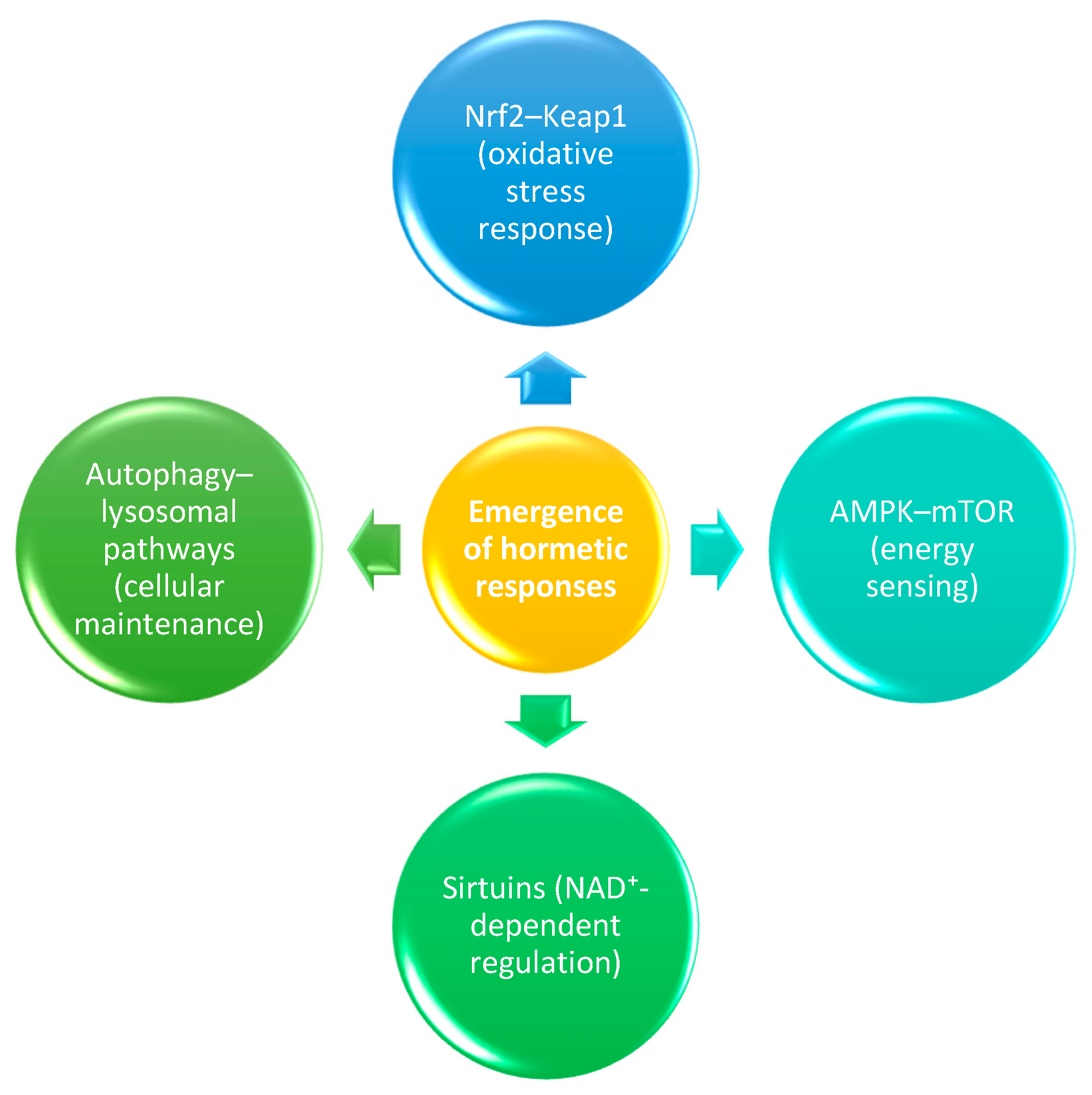
Figure 2.
Multilevel Model of Hormetic Adaptation in Aging: From Stress Exposure to Clinical Outcomes. Note: Exposure to low-dose, intermittent stressors activates molecular sensing pathways, including AMPK, Nrf2, and sirtuins. These pathways initiate coordinated cellular adaptive responses such as autophagy, mitochondrial biogenesis, and enhanced antioxidant defenses. At the systemic level, these adaptations translate into improved metabolic function, reduced inflammation, and increased physiological resilience, ultimately leading to reduced disease risk and mortality. The concept of a hormetic window highlights the importance of stress intensity and duration in determining beneficial versus detrimental outcomes.
Figure 2.
Multilevel Model of Hormetic Adaptation in Aging: From Stress Exposure to Clinical Outcomes. Note: Exposure to low-dose, intermittent stressors activates molecular sensing pathways, including AMPK, Nrf2, and sirtuins. These pathways initiate coordinated cellular adaptive responses such as autophagy, mitochondrial biogenesis, and enhanced antioxidant defenses. At the systemic level, these adaptations translate into improved metabolic function, reduced inflammation, and increased physiological resilience, ultimately leading to reduced disease risk and mortality. The concept of a hormetic window highlights the importance of stress intensity and duration in determining beneficial versus detrimental outcomes.
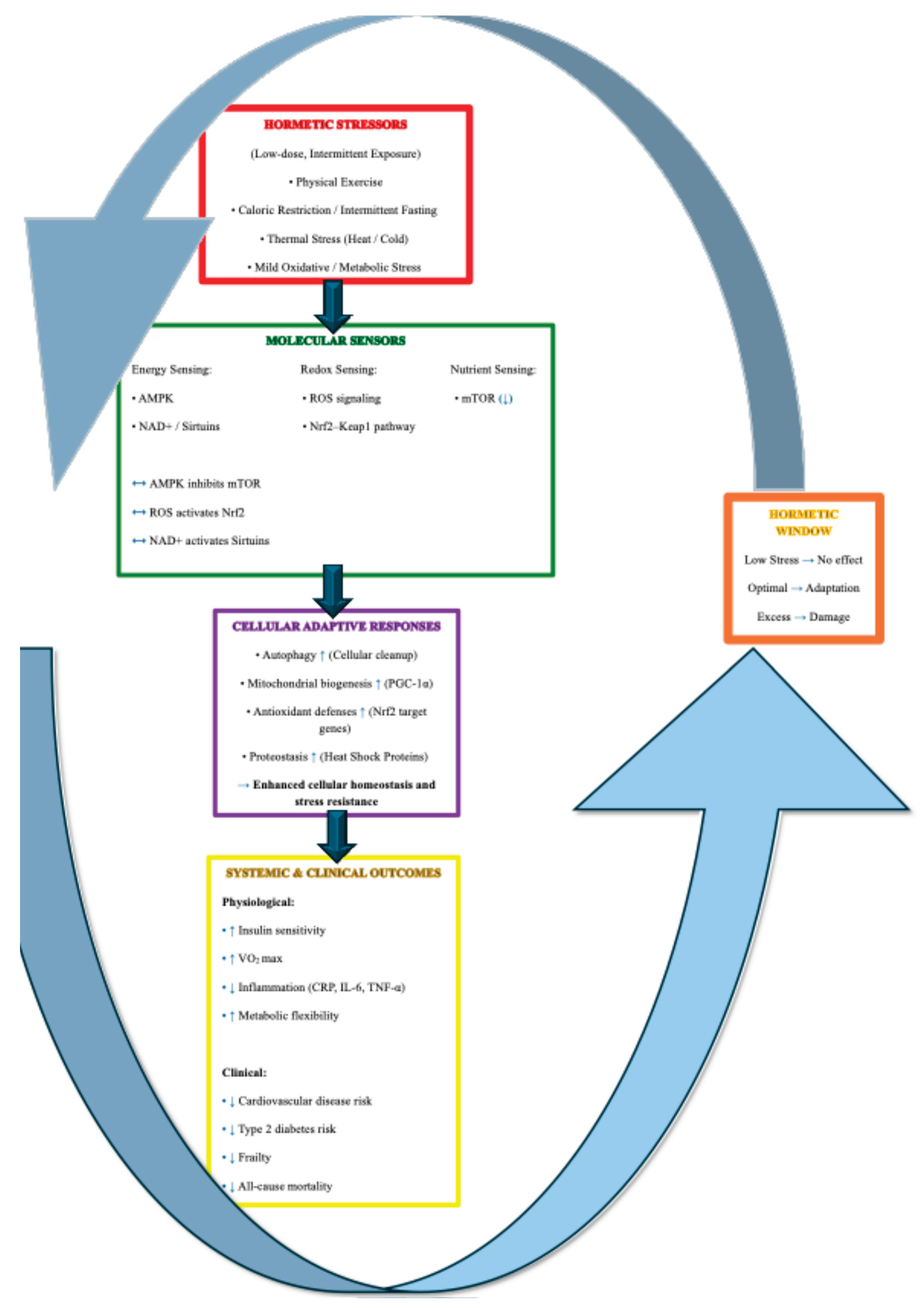
Disclaimer/Publisher’s Note: The statements, opinions and data contained in all publications are solely those of the individual author(s) and contributor(s) and not of MDPI and/or the editor(s). MDPI and/or the editor(s) disclaim responsibility for any injury to people or property resulting from any ideas, methods, instructions or products referred to in the content. |
© 2026 by the authors. Licensee MDPI, Basel, Switzerland. This article is an open access article distributed under the terms and conditions of the Creative Commons Attribution (CC BY) license (http://creativecommons.org/licenses/by/4.0/).
Copyright: This open access article is published under a Creative Commons CC BY 4.0 license, which permit the free download, distribution, and reuse, provided that the author and preprint are cited in any reuse.