

Submitted:
17 April 2026
Posted:
20 April 2026
You are already at the latest version
Abstract
In this paper, all the integrals and their solutions are given for the analytical calculation of all six area and moments values of the arbitrary ellipse region given in trigonometric parametric form, based on the general moment form of Green’s theorem curve integral obtained from the discrete and differential vector product methods. The actual area and moments values of the arbitrary ellipse regions are then calculated by application of Boolean algebra on the ellipse parts and their remaining sector triangles, in the multi-step calculation procedure that consists of the generation of belonging ellipse integrals and their simple solution for unknown parameter of a standard Cartesian, parametric representation of ellipse, whose bounds are calculated a posterior, by substitution of ellipse parameter with known central polar angle values. In order to enable the final posterior substitution, a single relation between that parameter and central polar angle is established, based on equaling their scaled tangent function values, thus confirming geometric meaning of that parameter as an angle of auxiliary circles in the known La Hire’s ellipse construction method. In this way, it is possible to analytically calculate the area and moments of an arbitrary central or focal sector of ellipse, as well as their belonging arbitrary segments, with integrals and solutions for: areas, their static moments, area centroids and moments of inertia of ellipse parts, for ellipse defined parametrically, by trigonometric functions. And here, in Part 1 of the paper, the results of calculation are shown for the general central ellipse sector.
Keywords:
ellipse
; area
; moments
; General Green’s theorem
; parameter – central polar angle relation
; central sector
; Boolean algebra
1. Introduction
1.1. General
One of not fully recognized and solved problems in mathematics is giving analytical solutions of all of the area and moment integrals of arbitrary sectors and segments of ellipse. Although the problem of determining the area value of the arbitrary ellipse region is not fully solved, because of its general importance in mathematics and science in general, its partial analytical and numerical, approximate, iterative solutions are addopted as valid, without setting analytical equations that fully govern that problem. While the area values of some ellipse regions are partially known, their general solvable analytical moment equations and solutions in differential form are unknown and not have been given so far. And here, those integrals are generated from the single uniform moment form of General Green’s theorem curve integral derived by the author in his previous work in [1].
Therefore, except for the area values, the governing integrals for the general calculation of its belonging moments and their direct solutions are here given for the rest of the unknown ellipse area quantities also, such as its static moments and moments of inertia, together with the position of its area centroid; with all six area integrals given for a parameter of a standard Cartesian, parametric representation of ellipse. Then, in order to determine unknown parameter values of the integral bounds, their posterior substitution with central polar angle values has to be done, obtained from a single relation between them based on their tangent function values scaled by an ellipse semi-axes ratio. With all above, the full title of this paper is: “Analytic Multi-Step Solution of All Six Area and Moments Integrals for Arbitrary Central Sector of Parametrically defined Ellipse given in General Moment Form of Green’ Theorem Curve Integral with Posterior Substitution of Ellipse Parameter with Central Polar Angle”.
Two main applications and problems to be solved here are then: the calculation of the area and moments integrals for the central ellipse defined for the origin of coordinate system, and for the focal definition of ellipse defined for one of its two foci. Altogether, above problems can be divided in three connected parts of determining the features of the area of the arbitrary ellipse region, for: Part 1: Central Sector, Part 2: Segment, and Part 3: Focal Sector; where here in Part 1, all of them are solved from the solution of the central sector area integrals for Cartesian, parametric definition of ellipse by trigonometric functions. The final solution for arbitrary segment and focal sector of ellipse is then obtained by applying Boolean algebra on the triangular parts of observed ellipse sectors.
1.2. Terminology
Now, at a beginning, a terminology for observed geometrical shape of the ellipse area is re-examined for the basic elements of the parts of its area that are the topic of this paper. Unexpectedly, the author of this paper faces the problem of setting terminology for a lot of elements of ellipse, where many of the terms regarding the parts or regions of the area of ellipse do not exist. The reasons for this may come from the unsolved problem of determination the values of the area and moments for arbitrary ellipse region itself, as already mentioned, but also the fact that the geometrical meaning of the parametric ellipse definition by trigonometric functions is still not fully recognized and explained; where both of the problems are solved in this paper. Also, the basic terminology for the ellipse elements is set at the beginning of the 17th century in the field of orbital mechanics, where the terms for the ellipse parts are set in the works of the astronomers of that time, mainly from the work of Kepler in his famous paper “Astronomia Nova”, [5]. Although the main topic of the second Kelper’s law is the area portion below ellipse curve that occurs from the motion of the planet around the sun in elliptic orbit between two moments in time, the name of that area portion or its elements are not given in mathematical theory, thus making the terminology regarding the area of the ellipse regions obsolete or empty, with many terms not been given.
Since the main topic of this paper are the regions of the ellipse area, obtained for different polar angles, the author of this paper used the basic terminology of the polar coordinate system to give names of the parts of the ellipse area, dividing them regarding the position of the pole of the polar coordinate system to following two coordinate systems:
- Central polar coordinate system, with its origin set in the center of the ellipse, having central polar angle and central polar radius as coordinates; and
- Focal polar coordinate system, with its origin set in one focus of the ellipse, with focal polar angle and focal polar radius as coordinates.
Therefore, the parts of the ellipse area, observed in the paper, are divided into:
- Central sector of ellipse, with belonging central sector area and central sector moments, having the vertex of the ellipse sector set to the center of the ellipse shape, being the point of the origin of the central polar coordinate system, with a central polar angle set as its angular coordinate name and a central radius set as its radial coordinate,
- Segment of ellipse, with belonging segment area and segment moments; as a part of its belonging central sector; and
- Focal sector of ellipse, with belonging focal sector area and focal sector moments, having the vertex of this sector set to one of ellipse foci that represents the origin of translated focal polar coordinate system set to the point of the focus of ellipse, with a focal polar angle term set for its angular coordinate name and a focal radius set as its radial coordinate.
Above terminology set here is then used further in the paper, with a definition for the central ellipse sector set first in Subsection 1.7, below.
1.3. Description of Calculation Procedure
In order to calculate the area and moments values of the arbitrary part of the general ellipse, this paper uses multi-step calculation procedure that consists of:
- The generation of the calculation integrals in general moment form of Green's theorem, [1],
- The solution of given integrals for defined parameter of the Cartesian, parametric representation of ellipse by trigonometric functions,
- A posterior substitution of unknown parameter values of the integrals bounds with the values of given central polar angle.
- Application of Boolean algebra on the complement triangles of observed segments and sectors to the enclosing central sector (optional).
Therefore, the calculation integrals are generated first from the moment form of Green's theorem given by the author in his previous paper, [1], that is derived from the discrete and differential vector products, in the parametric form of ellipse parametric definition by trigonometric functions. In this way, all the six calculation integrals for the calculation of the area and moments for observed part of ellipse are given in the same form of initial Green’s theorem curve integral.
In the second step the results of all the six area and moments integrals of arbitrary ellipse region are given in the simplest possible form, where the initial Green’s theorem for area calculation reduces to identity of the parameter value for which the integrals are given.
In the third step, unknown parameter values of the integrals bounds are substituted with known values of the central polar angle that are obtained from their tangent function relation.
At the final, optional, step, for the case of ellipse segments and focal sectors as the parts of central sector of ellipse, the calculations of their belonging area and moments values are done by applying the Boolean algebra on their respective complement triangles as the elements of the initial central sector area of ellipse.
At the final, optional, step, the area and moments values of arbitrary segments and focal sectors of ellipse are calculated by applying the Boolean algebra on their respective complement triangles as the elements of the initial central sector area of ellipse.
In general, the Green's theorem integral for the calculation of the area of the region enclosed by a general parametrically defined curve resembles the equation for calculating the area of a triangle obtained by the vector product of position vectors placed at the points of the observed part of the polygon as given by Allgower and Schmidt in [8], Hally in [9] and Steger in [10], that represents the basis for the generation of the integrals of moments. From that, all the six integrals and their solutions for the calculation of: area, static moments, sector centroids and moments of inertia of the area of the arbitrary region of ellipse are derived here, for the Cartesian, parametric representation of ellipse by trigonometric functions that were not known so far. Then, in order to calculate the values of area and moments of the observed ellipse region, it is necessary to, a posterior, substitute the parameter values of integral bounds with known central polar angle values, obtained from their single tangent function relation in an arbitrary point of ellipse. With that, additionally, a geometric meaning of that parameter is confirmed as a central angle of the auxiliary circles for the ellipse construction method that was not clearly accepted and recognized in previous works of al Tusi, [4], and de La Hire, [6]. From the discovery of ellipse curve in antiquity, in the works of Appolonius, [2], Archimedes, [3], and others, the problem of calculating ellipse area was recognized by many scientists in middle ages like Kepler, [5], Newton, [7], and others, with recent works on calculating the area of an ellipse parts done numerically for arbitrary segment, by Vallo et al. in [17], and for the intersection of two ellipses, Hughes and Chraibi in [16], or analytically for horizontal ellipse segment, by Weinstein in [15]. And here, this problem of calculating the values of the area and moments is solved analytically for arbitrary ellipse parts, by using above described multi-step calculation procedure. Based on the solutions in Part 1 of the paper for a general central sector of an ellipse, it is then possible to give similar solutions for the calculation of the values of area and moments of arbitrary ellipse segment or focal sector, with respective papers for them given in Parts 2 and 3 of this work.
1.4. General Ellipse Equations
There are several representations of ellipse curve usually used today, as shown in [12], with belonging explicit form, most commonly used for her area calculations, given as
where a is horizontal semi-axis and b is vertical semi-axis of ellipse.
But, that ellipse equation with irrational form, in (1), gives complicated expression of the solution of belonging area integral, thus making calculation of its moments more difficult to establish, with limited success in practice.
On the other hand, the equation of the ellipse curve c(t) in Cartesian, rectangular coordinate system Oxy, defined in standard parametric form by trigonometric functions, [12], for parameter t as argument, can be given as
that is much simpler form and therefore more suitable for the calculations of the area value of the arbitrary central sector of ellipse shown in Figure 1, bellow.
x = a·cos(t), t ∈ [-2π, 4π],
y = b·sin(t), t ∈ [-2π, 4π],
(It is to notice here that the range of the parameter t widened from [0, 2π] for the calculation reasons of possible negative values that can be used in practical calculations.)
However, the geometric meaning of the parameter t has not yet been unambiguously confirmed in mathematics, or related to some other ellipse property or definition form; although, according to the geometric method for the construction of ellipse given by de La Hire [5], and al-Tusi, [4], the parameter t represents a central polar angle of two auxiliary circles of radii equal to the semi-axes a and b of the ellipse, by means of which it is possible to construct an ellipse, as shown in Figure 2a), below.
But here, a simple way to relate the parameter t to the central polar angle ϕ is given in next subsection below, thus enabling the usage of parametric representation ellipse in (2) and (3) for further calculations.
1.5. Relation Between Parameter t and Polar Angle ϕ
The basic idea for setting the relation between parameter t and central polar angle ϕ is to connect above two coordinate equations (2) and (3) from parametric representation of an ellipse with a central polar angle ϕ, in just one condition. Since the ellipse is defined by using trigonometric sine and cosine functions, the relation that connects them with a polar angle ϕ is simple, a tangent function. Then, it easy to notice from Figure 1 above, that it is possible to simply set an equation that connects parameter t and central polar angle ϕ in arbitrary point P(x, y) by expression:
tan(ϕ) = y(t)/x(t)
Then, by inserting the coordinates of the parametric ellipse equation from (2) and (3) in equation (4) for the calculation of the angle ϕ (ϕ and t in the same direction) one gets:
with inverse relation that can be defined also.
tan(ϕ) = b·sin(t)/[a·cos(t)]
tan(ϕ) = b/a·tan(t),
Then, a definition for their relation can be set now with:
Definition 1:
Relation between parameter t and central polar angle ϕ
The tangent function of a parameter of the parametric representation of ellipse defined in trigonometric form is equal to the tangent function of a central polar angle scaled by horizontal and vertical ellipse semi-axes ratio as
tan(t) = a/b·tan(ϕ).
The equation for a direct calculation of a parameter t value from central polar angle ϕ value is then:
where the argument of arcus tangent function can have values in the range (-∞, ∞), i.e. from the whole space of real numbers ℝ, and coefficient k must be determined for the arcus tangent function branch observed.
t = arctan(a/b·tan(ϕ)) + k·π, k ∈ ℤ,
The relation in (6) finally confirms the geometric meaning of the parameter t in the parametric representation of the ellipse curve c(t) using trigonometric functions, where the parameter t represents the central polar angle of the corresponding auxiliary circles for construction of the ellipse according to de la Hire [6], as shown in Figure 1 and Figure 2a) below, with radii equal to the semi-axes a and b of the ellipse given in the Cartesian, parametric form.
A single point of the ellipse is then obtained using the points: P1'(x, y) on the circle with a radius equal R1 = b and P2'(x, y) on the circle with a radius equal R2 = a, by equalizing the values of y and x coordinates of the circle and ellipse. The Figure 2b), below, then shows the deviation of the parameter t = f(ϕ) value from the line of the polar angle ϕ distribution.
Now, the equations with the integrals needed for the calculation of the area quantities of the ellipse sector can be further set directly for a parameter t, by using above equations (5 - 7), in different manner, i.e. opposite to the settings of it set in [13,14]. This is the fundamental difference from the solutions used so far to calculate the area of an ellipse in theory, which directly and accurately solve this problem, as shown further in Section 2.
1.6. Ellipse Equation in Central Polar Form
After determination of the expressions for the relation between parameter t and central polar angle ϕ in equations (5) and (6), the ellipse equation in parametric form for a polar angle ϕ as argument can be set for coordinates x and y by using trigonometric relations as:
x = a·cos(t) = a/(1+tan2(t))0.5 = a/(1+a2/b2·tan2(ϕ))0.5
x = a/(1+a2·sin2(ϕ)/(b2·cos2(ϕ)))0.5 = a/((b2·cos2(ϕ)+a2·sin2(ϕ))/(b2·cos2(ϕ)))0.5
y = b·sin(t) = b·tan(t)/(1+tan2(t))0.5 = b·a/b·tan(ϕ)/(1+a2/b2·tan2(ϕ))0.5
y = a·tan(ϕ)/(1+a2·sin2(ϕ)/(b2·cos2(ϕ)))0.5 = a·tan(ϕ)/((b2·cos2(ϕ)+a2·sin2(ϕ))/(b2·cos2(ϕ)))0.5
Finally, the expression for the ellipse equation in the parametric form for a central polar angle ϕ can be set, similar to [13], with:
x = ab·cos(ϕ)/(b2·cos2(ϕ)+a2·sin2(ϕ))0.5
y = ab·sin(ϕ)/(b2·cos2(ϕ)+a2·sin2(ϕ))0.5
Now, it is easy to determine the distance ρ of the position vector of the point on the ellipse P(x, y), in Figure 1, from ρ = (x2 + y2)0.5, with
ρ = ab/(b2·cos2(ϕ)+a2·sin2(ϕ))0.5
Belonging distances ρ1 and ρ2 of the ellipse points P1(x, y) and P2(x, y) from the c.s. origin O are then:
ρ1 = ab/(b2·cos2(ϕ1)+a2·sin2(ϕ1))0.5, ρ2 = ab/(b2·cos2(ϕ2)+a2·sin2(ϕ2))0.5
Now, a direct solution of the area of an ellipse sector can be given for central polar angle also, while in this paper, because of simplicity, a solution is given based on the parametric definition of the ellipse using the parameter t, as follows below.
1.7. Definition of Arbitrary Central Sector of Ellipse
Now, in analogy with similar definition for circle in [15], a definition of the arbitrary central sector of ellipse shown in Figure 1 can be set with:
Definition 2: Central sector of ellipse
A central sector of ellipse is a wedge portion of area of ellipse enclosed by two radius vector side lines drawn from the vertex of the wedge set to the center of the ellipse, and the arc of ellipse between side vectors having two additional vertex bounding points of the sector, thus having central polar angle width obtained from two bounding central polar angles.
Then, immediately, the basic elements of the central sector of ellipse can be set with: a general triangle inside central sector of ellipse, and remaining segment area of ellipse, for which all calculations are done in the Part 2 of the paper.
Therefore, the central polar angles ϕ in Definition 2 has to be related to their corresponding parameter t angles by using their relation equations in (6) and (7), in order to solve general area and moment integrals of arbitrary area regions of ellipse, as follows.
2. Derivation of Area and Moments Calculation Integrals
2.1. General
The necessary integrals for the calculation of the area and moments of arbitrary ellipse region can be derived from the single moment form of Green's theorem curve integral derived from discrete and differential vector products by the author in [1], [11], given by
where indices are representing the zero-th, the first and the second order moments of observed enclosed area for coordinates and .
Now, all the integrals of the area and its moments can be given in parametric form for: area, static area moments and moments of inertia of the area of observed general ellipse central sector, as shown below.
2.2. Area Integral of Ellipse Sector
The general integral form for the calculation of the area of arbitrary region D enclosed by boundary ∂D of an ellipse sector can be now given from the moment form of Green’s theorem, [1], curve integral in (12), above, with indices m, n = 0, as
For the parametric definition of ellipse, its related differentials of the coordinates x and y as a function of the parameter t can be calculated as:
dx/dt = – a·sin(t), dy/dt = b·cos(t)
dx = – a·sin(t)·dt , dy = b·cos(t)·dt
By their insertion in (12) it is then:
Now, a simple integral form for the calculation of the area of ellipse can be obtained with
that represents the basic indefinite integral form used for determination of all other integrals necessary for further calculation of the ellipse sector area values.
I.e., the calculation integral for the area of the central sector of ellipse is from (15) equal to:
On the basis of above integral in (16), all other integrals for calculation of ellipse area properties can be then written as follows below.
2.3. Integrals of Area Moments of Ellipse Sector
Except the value of the area of the ellipse sector, its general properties include belonging static moments and moments of inertia values that have to be calculated in general case also, forming six integrals to be determined in general. Therefore, the remaining integrals, according to above area integral in (16) and moment form of Green’s theorem curve integral in (12), can be set are as follows.
For the horizontal static area moment Mx of the central sector of ellipse, the indices of the equation (12) are Belonging integral is then:
After substitution ofand coordinates of ellipse with their parametric equations for parameter t as argument from (2) and (3), and their differentialsand in (13) and (14), it is
The final integral for the calculation of the horizontal static area momentof the central sector of ellipse is
For the vertical static area momentthe indices of the integral in (12) areBelonging integral is then:
After substitution with equations (2) and (3), and equations (13) and (14), it is
The final integral for the calculation of the horizontal static area momentof the central sector of ellipse is
For the horizontal moment of inertia of areaof the central sector of ellipse, the indices of the equation (12) are Belonging integral is then:
After substitution with equations (2) and (3), and equations (13) and (14), it is
The final integral for the calculation of the horizontal area moment of inertiaof the central sector of ellipse is
For the vertical area moment of inertiaof the central sector of ellipse, the indices of the equation (12) are Belonging integral is then:
After substitution with equations (2) and (3), and equations (13) and (14), it is
The final integral for the calculation of the vertical area moment of inertiaof the central sector of ellipse is
For the centrifugal area moment of inertiaof the central sector of ellipse, the indices of the equation (12) are Belonging integral is then:
After substitution with equations (2) and (3), and equations (13) and (14), it is
The final integral for the calculation of the centrifugal area moment of inertiaof the central sector of ellipse is
And, as it can be seen from above definite integrals (16) - (21) for the calculation of the area and moments of arbitrary ellipse sector, they are all very simple integrals having simple solutions that are given below as follows.
2.4. Solutions of All Six Ellipse Sector Area Integrals
The solutions of above definite integrals (16) - (21) from Subsection 2.3, for lower and upper bound t1 and t2 values of parameter t are all simple with tabular solutions, as follows.
For the area A of the central sector of ellipse, the solution of the integral I1 in (16) is:
For the horizontal static area moment Mx of the central sector of ellipse, the solution of the integral I2 in (17) is:
For the vertical static area moment My of the central sector of ellipse, the solution of the integral I3 in (18) is:
For the horizontal area moment of inertia Ix of the central sector of ellipse, the solution of the integral I4 in (19) is:
For the vertical area moment of inertia Iy of the central sector of ellipse, the solution of the integral I5 in (20) is:
For the centrifugal area moment of inertia Ixy of the central sector of ellipse, the solution of the integral I6 in (21) is:
The solutions of definite integrals in equations (22) to (27) now can be used to establish equations for the calculation of the ellipse sector area and moments, by setting integration bounds of observed ellipse sectors as follows below.
3. Equations for Calculation of All Ellipse Sector Area and Moments
3.1. General
General features of some enclosed, bounded area below general curve consist of six quantities overall that can be here, in the case of ellipse, calculated from the integral solutions in equations (22) to (27). Respectively, they are: area, horizontal static area moment, vertical static area moment, horizontal moment of inertia, vertical moment of inertia and centrifugal moment of inertia of observed area of general central sector of ellipse, as shown below.
3.2. Area
The equation for the calculation of the positive area value of the central sector of ellipse, for the lower and upper bounds of integration of parameter t from t1 to t2, is from (22) equal to:
As shown in Figure 1, the complementary area Ᾱ value of the area of observed ellipse sector can be now given as: Ᾱ = abπ − A.
By inserting the relation between parameter t and a central polar angle ϕ, in (7), into above equation in (28), the final expression for calculating the area of an ellipse sector for central polar angle ϕ is obtained with:
As shown in equation (7), every integration bound value in (29) has its own coefficient k which determines the branch of the arcus tangent function to which the bound angle ϕ belongs. Therefore, for calculation of the ellipse sector area it is first necessary to determine the values of k1 and k2, according to the initial polar angle ϕ or parameter t values.
Now, the validity of the expression in (29) can be checked on several examples of calculation angles t, ϕ and θ as shown below.
Examples
General symmetrical ellipse sector with angle width 2θ (right half of ellipse):
A = ab/2·|t – (–t)| = ab/2·|2t| = ab·|t|
A = ab·arctan(a/b·tan(θ))
For θ = π/2 ⟶ t2 = t = arctan(∞) + 0·π = π/2 + 0 ⟶ t = π/2:
A = ab·|π/2 − 0| = ab·π/2
For circle is then: a = b = r ⟶ A = r2π/2, and above result is correct.
It is then:
a) Symmetrical ellipse sector with angle width 2θ (lower half of ellipse):
ϕ1 = 3π/2 − θ, ϕ2 = 3π/2 + θ
t1 = 3π/2 − t, t2 = 3π/2 + t
A = ab/2·|t2 – t1| = ab/2·|3π/2 + t – 3π/2 + t| = ab/2·|2t| = ab·|t| =ab·|arctan(a/b·tan(θ))|
For t = π/2: A = ab·π/2. For circle is then: a = b = r ⟶ A = r2π/2, and above result is correct.
b) Symmetrical ellipse sector with angle width 2θ (lower half of ellipse):
For polar angle measured from the x axis: θ = π/2 − ϕ
ϕ1 = 3π/2 − θ = π + ϕ, ϕ2 = 3π/2 + θ = 2π − ϕ
t1 = π + t , t2 = 2π − t
A = ab/2·|t2 – t1| = ab/2·|2π − t –π − t| = ab/2·|π − 2t| = ab·|π − 2·arctan(a/b·tan(ϕ))|
For θ = π/2 ⟶ ϕ = 0: A = ab/2·|π − 0| = ab·π/2, which is the same as above in a).
Additional examples
c) Area value for the angle ϕ (from angle 0°):
ϕ1 = 0 ⟶ k = 0, t1 = arctan(tan(0)) + 0·π ⟶ t1 = 0
ϕ2 = ϕ ⟶ k = 0, 1, 2, ... ⟶ t2 = t = arctan(tan(ϕ)) + k·π
A = ab/2·|t2 – t1| ⟶ A = ab/2·|t – 0| = ab/2·|t|
d) Quarter of ellipse:
ϕ2 = ϕ =π/2 ⟶ k = 0, t2 = t = arctan(tan(π/2)) + 0·π = arctan(∞) + 0 =π/2 ⟶ A = ab/2·π/2 = ab·π/4
For circle is then: a = b = r ⟶ A = r2π/4, and above result is correct.
e) Half of ellipse:
ϕ2 = ϕ = π ⟶ k = 1, t2 = t = arctan(0) + 1·π = 0 + π ⟶ t = π : A = ab/2·π = ab·π/2
Or two times quarter of ellipse (according to Figure 1).
f) Whole ellipse:
θ = 2π ⟶ k = 2, t = arctan(0) + 2π = 0 + 2π ⟶ t = 2π : A = ab/2·(2π) ⟶ A = ab·π
For circle is then: a = b = r ⟶ A = r2π, and above result is correct.
It can be concluded from above examples from a) to f) that all results are correct, and equation (34) is valid and accurate.
3.3. Horizontal Static Area Moment and Area Centroid
The equation for the calculation of the horizontal static area moment of the central sector of ellipse, for the lower and upper bounds of integration of parameter t from t1 to t2, is from (23) equal to:
By inserting the relation between parameter t and polar angle ϕ, in (7), into above equation in (30), the final expression for calculating the horizontal area moment of an ellipse sector for central polar angle ϕ can be then given as:
Further, by substitution of the cosine functions in (30) with tangent functions, an expression for the calculation of the horizontal static area moment of ellipse sector for the integration bounds from t1 to t2 can be set as:
By inserting the relation between parameter t and polar angle ϕ, (6), into equation (32) above, it is then:
After reduction of above and rearranging, the final equation for the calculation of the horizontal static area moment of ellipse sector with polar angle ϕ as argument can be set now as:
This expression in (33) is also used further in paper for calculation of the horizontal static area moment of an arbitrary ellipse sector.
Based on the above calculated values of the area of the central ellipse sector and its horizontal component of its static moment, belonging vertical component of a centroid can be easily determined as:
with additional check of the results with below and in Section 4.
yC = Mx/A
It can be noticed here also that the position of the vertical centroid of the sector can be determined from the Figure 1, also.
Examples.
For the ellipse sector it is:
Mx = ab2·(–cos(t2) + cos(t1))/3
Different cases of the central polar angle values can be observed now for ellipse sector as follows.
a) For central polar angle ϕ = 0
sin(θ + 0) = sin(θ)cos(0) + cos(θ)sin(0) = sin(θ),
sin(0 − θ) = sin(0)cos(θ) – cos(0)sin(θ) = –sin(θ),
cos(θ + 0) = cos(θ)cos(0) – sin(θ)sin(0) = cos(θ),
cos(0 − θ) = cos(0)cos(θ) + sin(0)sin(θ) = cos(θ).
Then, it is:
Mx = ab3/3·[–cos(θ + 0)/(b2cos2(θ + 0) + a2sin2(θ + 0))0.5 + cos(0 − θ)/(b2cos2(0 − θ) + a2sin2(0 − θ))0.5]
Mx = 2a3b/3·(–cos(θ) + cos(θ))/(b2cos2(θ) + a2sin2(θ)))0.5
Mx = 0 ⟶ yC = 0 as expected for ellipse.
b) For central polar angle ϕ = π/2
sin(θ + π/2) = sin(θ)cos(π/2) + cos(θ)sin(π/2) = cosθ,
sin(π/2 − θ) = sin(π/2)cos(θ) – cos(π/2)sin(θ) = cos(θ),
cos(θ + π/2) = cos(θ)cos(π/2) – sin(θ)sin(π/2) = –sinθ,
cos(π/2 − θ) = cos(π/2)cos(θ) + sin(π/2)sin(θ) = sin(θ).
It is then:
Mx = a3b/3·[–cos(θ + π/2)/(b2cos2(θ + π/2) + a2sin2(θ + π/2))0.5
+ cos(π/2 − θ)/(b2cos2(π/2 − θ) + a2sin2(π/2 − θ))0.5]
Mx = ab3/3·(−(−sin(θ)) + sin(θ))/(b2sin2θ + a2cos2θ))0.5
Mx = 2/3·ab3·sin(θ)/(b2sin2(θ) + a2cos2(θ)))0.5
For θ = π/2:
Mx = 2/3·ab3·sin(π/2)/(b2sin2(π/2) + a2cos2(π/2)))0.5 = 2/3·ab3·1/(b2·1 + a2·0))0.5 = 2/3ab3/b = 2/3ab2
⟶ yC = Mx/A = 2/3·ab2/(abπ/2) = 4b/(3π)
When applied for circle it is: r = b ⟶ yC = 4r/(3π) and above result is confirmed.
c) For central polar angle ϕ = π
sin(θ + π) = sin(θ)cos(π) + cos(θ)sin(π) =−sin(θ),
sin(π − θ) = sin(π)cos(θ) − cos(π)sin(θ) = sin(θ),
cos(θ + π) = cos(θ)cos(π) − sin(θ)sin(π) = −cos(θ),
cos(π − θ) = cos(π)cos(θ) + sin(π)sin(θ) = −cos(θ).
It is:
Mx = ab3/3[-cos(θ + π)/(b2cos2(θ + π) + a2sin2(θ + π))0.5 + cos(π − θ)/(b2cos2(π − θ) + a2sin2(π − θ))0.5]
Mx = ab3/3(−(−cos(θ)) − cos(θ))/(b2sin2(θ) + a2cos2(θ)))0.5
Mx = ab3/3(cos(θ) − cos(θ))/(b2sin2θ + a2cos2θ))0.5 = 0
⟶ yC = 0 as expected for symmetrical ellipse.
sin(θ + 3π/2) = sin(θ)cos(3π/2) + cos(θ)sin(3π/2) = −cos(θ),
sin(3π/2 − θ) = sin(3π/2)cos(θ) − cos3π/2sin(θ) = −cos(θ),
cos(θ + 3π/2) = cos(θ)cos(3π/2) − sin(θ)sin(3π/2) = sin(θ),
cos(3π/2 − θ) = cos(3π/2)cos(θ) + sin(3π/2)sin(θ) = −sin(θ).
Mx = ab3/3[−cos(θ + 3π/2)/(b2cos2(θ + 3π/2) + a2sin2(θ + 3π/2))0.5
+ sin(3π/2 − θ)/(b2cos2(3π/2 − θ) + a2sin2(3π/2 − θ))0.5]
Mx = ab3/3·(−sin(θ) + (−sin(θ)))/(b2sin2(θ) + a2cos2(θ)))0.5
Mx = −2/3·ab3·sin(θ)/(b2sin2(θ) + a2cos2(θ)))0.5
For θ = π/2:
Mx = −2/3·ab3·sin(π/2)/(b2sin2(π/2) + a2cos2(π/2)))0.5 = −2/3·ab3·1/(b2·1 + a2·0))0.5
Mx = −2/3·ab3/b = −2/3ab2
⟶ yC = Mx/A = −2/3ab2/(abπ/2) = −4b/(3π)
When applied for circle it is: r = b ⟶ yC = −4r/(3π) and above result is confirmed.
It can be seen form the examples a) to d) that observed results have expected values. Those results are additionally checked for the value of the horizontal area centroid, where, additionally, the formulas for the calculation of the arbitrary ellipse sector area centroids are given that were unknown before.
3.4. Vertical Static Area Moment and Area Centroid
The equation for the calculation of the vertical static area moment of the central sector of ellipse, for the lower and upper bounds of integration of parameter t from t1 to t2, is from (24) equal to:
By inserting the relation between parameter t and polar angle ϕ in (7) into equation in (35), the final expression for calculating the vertical static area moment of an ellipse sector for central polar angle ϕ is obtained by:
Above can be obtained in another form too, by substitution of sine functions in (36) with tangent functions, an expression for the calculation of vertical static area moment of ellipse sector for the integration bounds from t1 to t2 can be given then as:
By inserting the relation between parameter t and polar angle ϕ, in (6), in equation (37) above, the final expression for calculating the vertical static area moment of an ellipse sector for central polar angle ϕ can be now obtained by:
After reduction of above and rearranging, the final equation for the calculation of the vertical static area moment of ellipse sector with polar angle ϕ as argument can be set now as:
This expression in (38) is used further in paper for calculation of the vertical static area moment of an arbitrary ellipse sector.
Based on the above calculated values of the area of the central ellipse sector and its vertical component of its static moment, belonging horizontal component of a centroid can be easily determined as:
with additional check of the results below and in Section 4.
xC = My/A
Again, tt can be noticed here also that the position of the horizontal centroid of the sector can be determined from the Figure 1, also.
Examples.
For symmetrical part of ellipse sector with angle width 2θ, for an arbitrary central polar angle ϕ of ellipse sector it is:
ϕ2 = θ + ϕ, ϕ1 = ϕ – θ
My = a3b/3·[sin(θ + ϕ)/(b2cos2(θ + ϕ) + a2sin2(θ + ϕ))0.5 – sin(ϕ − θ)/(b2cos2(ϕ − θ) + a2sin2(ϕ − θ))0.5]
Different cases of the central polar angle values can be observed now for ellipse sector as follows.
b) For central polar angle value ϕ = 0
sin(θ + 0) = sin(θ)cos(0) + cos(θ)sin(0) = sin(θ),
sin(0 − θ) = sin(0)cos(θ) – cos(0)sin(θ) = –sin(θ),
cos(θ + 0) = cos(θ)cos(0) – sin(θ)sin(0) = cos(θ),
cos(0 – θ) = cos(0)cos(θ) + sin(0)sin(θ) = cos(θ).
It is then:
My = a3b/3·[sin(θ + 0)/(b2cos2(θ + 0) + a2sin2(θ + 0))0.5 – sin(0 − θ)/(b2cos2(0 − θ) + a2sin2(0 − θ))0.5]
My = a3b/3·[sin(θ)/(b2cos2(θ) + a2sin2(θ))0.5 – (–sin(θ))/(b2cos2(–θ) + a2sin2(–θ))0.5]
My = 2a3b/3·sin(θ)/(b2cos2(θ) + a2sin2(θ))0.5
Or, with t it is:
My = a2b·(sin(t) – sin(–t))/3 = a2b·(sin(t) + sin(t))/3 = 2a2b·sin(t)/3 ⟶ Mx = 2a2b·sin(arctan(a/b·tg(θ)))/3
For θ = π/2:
My = 2a3b/3·sin(π/2)/(b2cos2(π/2) + a2sin2(π/2))0.5 = 2a3b/3·1/(b2·0+a2·1)0.5 = 2a3b/3/a = 2a2b/3
⟶ xC = My/A = 2/3·ab2/(abπ/2) = 4a/(3π)
When applied for circle it is: r = a ⟶ xC = 4r/(3π) and above result is confirmed.
c) For central polar angle value ϕ = π/2
sin(θ +π/2) = sin(θ)cos(π/2) + cos(θ)sin(π/2) = cos(θ),
sin(π/2 − θ) = sin(π/2)cos(θ) – cos(π/2)sin(θ) = cos(θ),
cos(θ + π/2) = cos(θ)cos(π/2) – sin(θ)sin(π/2)= –sin(θ),
cos(π/2 − θ) = cos(π/2)cos(θ) + sin(π/2)sin(θ) = sin(θ).
It is then:
My = a3b/3·[sin(θ + π/2)/(b2cos2(θ + π/2) + a2sin2(θ + π/2))0.5
– sin(π/2 − θ)/(b2cos2(π/2 − θ) + a2sin2(π/2 − θ))0.5]
My = a3b/3·(cos(θ) − cos(θ))/(b2sin2(θ) + a2cos2(θ)))0.5 = 0
⟶ xC = 0, as expected for ellipse.
d) For central polar angle value ϕ = π
sin(θ + π) = sin(θ)cos(π) + cos(θ)sin(π)= –sin(θ),
sin(π − θ) = sin(π)cos(θ) – cos(π)sin(θ) = sin(θ),
cos(θ + π) = cos(θ)cos(π) – sinθ sin(π) = –cos(θ),
cos(π − θ) = cos(π)cos(θ) + sin(π)sin(θ) = –cos(θ).
It is then:
My = a3b/3·[sin(θ +π)/(b2cos2(θ +π) + a2sin2(θ +π))0.5 – sin(π − θ)/(b2cos2(π − θ) +a2sin2(π − θ))0.5]
My = a3b/3·(–sin(θ) – sin(θ))/(b2sin2(θ) + a2cos2(θ)))0.5 = –2/3·a3b·sin(θ)/(b2sin2(θ) + a2cos2(θ)))0.5
For θ = π/2:
My = –2a3b/3·sin(π/2)/(b2cos2(π/2) + a2sin2(π/2))0.5 =
–2a3b/3·1/(b2·0 + a2·1)0.5= –2a3b/3/a= –2a2b/3
⟶ xC = My/A = −2/3ab2/(abπ/2) = −4a/(3π)
When applied for circle it is: r = a ⟶ xC = −4r/(3π) and above result is confirmed.
sin(θ + 3π/2) = sin(θ)cos(3π/2) + cos(θ)sin(3π/2) = –cos(θ),
sin(3π/2 − θ) = sin(3π/2)cos(θ) – cos(3π/2)sin(θ) = –cos(θ),
cos(θ + 3π/2) = cos(θ)cos(3π/2) – sin(θ)sin(3π/2) = sin(θ),
cos(3π/2 − θ) = cos(3π/2)cos(θ) + sin(3π/2)sin(θ) = –sin(θ).
It is then:
My = a3b/3·[sin(θ + 3π/2)/(b2cos2(θ + 3π/2) + a2sin2(θ + 3π/2))0.5
– sin(3π/2 − θ)/(b2cos2(3π/2 − θ) + a2sin2(3π/2 − θ))0.5]
My = a3b/3·(–cos(θ) – (–cos(θ)))/(b2sin2(θ) + a2cos2(θ)))0.5 = 0
⟶ xC = 0, as expected for symmetrical ellipse.
It can be seen form the examples a) to d) that observed values have expected results. Those results are additionally checked for the value of the horizontal area centroid, where, additionally, the formulas for the calculation of the arbitrary ellipse sector area centroids are given that were unknown before.
3.5. Horizontal area moment of inertia
Similar to above, by substitution of sine and cosine functions in (25) with tangent function, indefinite integral for the calculation of the horizontal area moment of inertia of the central sector of ellipse, for the origin O of the coordinate system, can be set now as:
For integration bounds from t1 to t2 is then:
Now, by introducing the relation between parameter t and polar angle ϕ, (6) and (7), into (41), it is:
The final expression for the calculation of the horizontal inertia moment of ellipse sector area for central polar angle ϕ as argument, for origin O, is then:
Now, the equation (43) contains two terms from the equation (29) for the calculation of the sector area, and it can be written in simpler form with
With this equation in (44) the final expression for the calculation of the horizontal moment of inertia of the area of arbitrary ellipse sector for origin of c.s. is given, unknown before.
The final equation for the calculation of the horizontal inertia moment of ellipse sector area has to be corrected for area centroid position by using Stainer’s correction of parallel axis theorem, also, with:
3.6. Vertical Area Moment of Inertia
Further, by substitution of sine and cosine functions in (26) with tangent function, an indefinite integral for the calculation of the vertical area moment of inertia of the central sector of ellipse, for the origin O of the coordinate system, can be set as:
For integration bounds from t1 to t2 is then:
Now, by inserting the relations between parameter t and polar angle ϕ, (6) and (7), into (47), it is:
The final expression for the calculation of the vertical inertia moment of ellipse sector area for central polar angle ϕ as argument, for origin O, is then:
Again, similar to the horizontal inertia moment, the equation (49) contains two terms from the equation (29) for the calculation of the sector area, it can be written in the simpler form with
With this equation in (50) the final expression for the calculation of the vertical area moment of inertia of the arbitrary central sector of ellipse for origin of c.s. is given, unknown before.
The final equation for the calculation of the vertical area moment of inertia of the central sector of ellipse has to be corrected for the area centroid position by using Stainer’s correction of parallel axis theorem as:
3.7. Centrifugal Area Moment of Inertia
Once more, as above, by substitution of cosine with tangent functions, an indefinite integral for the calculation of the centrifugal area moment of inertia of the central sector of ellipse in (27), for the origin O of the coordinate system, can be set as:
For integration bounds from t1 to t2 is then:
Again, by inserting the relation between parameter t and polar angle ϕ, in (6), into (53), it is:
The final expression for the calculation of the centrifugal area moment of inertia of the central sector of ellipse for central polar angle ϕ as argument is then:
At the end, finally, with above, all ellipse sector area integrals are solved now, and all area features of a general ellipse sector can be calculated directly, as shown further with example in Section 4.
4. Example of Arbitrary Central Sector of Ellipse
Let there is an example of ellipse defined with horizontal semi-axis a = 4.35 and vertical semi-axis equal b = 2.5. Its belonging central sector area part is bounded by angles ϕ1 and ϕ2, as shown in Figure 3, below, with values:
ϕ1 = -60° = -60·arctan(1)/45 = -1.047197551 rad
ϕ2 = 15° = 15·arctan(1)/45 = 0.261799388 rad
(These values can be given with all positive values by adding 2π to them also.)
Corresponding parameter t1 and t2 values with inversed tangent functions coefficients values k1 = 0 and k2 = 0 are then according to (7) equal to:
t1 = arctan(a/b·arctan(ϕ2)) - 0·π = -1.25041694838 rad = -71.64361377382°
t2 = arctan(a/b·arctan(ϕ1)) + 0·π = 0.436269833235 rad = 24.996420173218°
By inserting them into parametric expressions for parameter t in (2) and (3), for the calculation of the ellipse coordinates x and y, the coordinates of the ellipse sector bounding points P1 and P2 can be obtained as:
x1 = a·cos(t1) = 4.35·cos(-1.25041694838) = 1.36993096 (m)
y1 = b·sin(t1) = 2.5·sin(-1.25041694838) = -2.37279003 (m)
x2 = a·cos(t2) = 4.35·cos(0.436269833235) = 3.94255373 (m)
y2 = a·sin(t2) = 2.5·sin(0.436269833235) = 1.05640409 (m)
I.e., by inserting central polar angle ϕ into belonging parametric expressions in (8) and (9), the coordinates of the points P1 and P2 are:
x1 = ab·cos(ϕ1)/(b2·cos2(ϕ1) + a2·sin2(ϕ1))0.5 = 1.36993096 (m)
y1 = ab·sin(ϕ1)/(b2·cos2(ϕ1) + a2·sin2(ϕ1))0.5 = -2.37279003 (m)
x2 = ab·cos(ϕ2)/(b2·cos2(ϕ2) + a2·sin2(ϕ2))0.5 = 3.94255373 (m)
y2 = ab·sin(ϕ2)/(b2·cos2(ϕ2) + a2·sin2(ϕ2))0.5 = 1.05640409 (m)
with the same values as obtained by equations (2) and (3), above.
According to (29), the area of ellipse sector can be now calculated as:
A = 4.35·2.5·|0.436269833235 + 0·π - (-1.25041694838) - 0·π)/2| = 9.171359 (m2)
Belonging horizontal static moment of ellipse sector area for a parameter t is then according to (30) equal to:
Mx = -1/3·4.35·2.52·[cos(0.436269833235) - cos(-1.25041694838)]
Mx = -5.359631 (m3)
The same value of the horizontal static moment of ellipse sector area for a central polar angle ϕ is then according to (33) equal to:
Mx = -1/3·4.35·2.53·[cos(0.261799388)/(2.52·cos2(0.261799388) +4.352·sin2(0.261799388))0.5
- cos(-1.047197551)/(2.52·cos2(-1.047197551) + 4.352·sin2(-1.047197551))0.5]
Mx = -5.359631 (m3)
Belonging vertical static moment of ellipse sector area is then according to (35) equal to:
My = 1/3·4.352·2.5·[sin(0.436269833235) - sin(-1.25041694838)]
My = 21.629642 (m3)
The same value of belonging vertical static moment of ellipse sector area can now according to (38) be calculated as:
My = 1/3·4.353·2.5·[sin(0.261799388)/(2.52·cos2(0.261799388) + 4.352·sin2(0.261799388))0.5
- sin(-1.047197551)/(2.52·cos2(-1.047197551) + 4.352·sin2(-1.047197551))0.5]
My = 21.629642 (m3)
It is now possible to determine the centroid of the ellipse sector area from (34) and (39) as:
xC = My/A = 2.3584(m)
yC = Mx/A = -0.5844(m)
with a centroid position point C shown in Figure 4.
Now, the values of the central sector of ellipse, calculated above, are additionally verified by numerical calculation by using vector product formulas for calculation of the area and static moments of closed, bounded polygon, from [8], marked in red color in Figure 4, above. The ellipse is here formed from N = 2001 equidistant lines of connected Chebyshev points for equally distributed parameter values t = [0, 2π] with step Δt = 2π/2000. The results of the calculation with their belonging difference from above analytically calculated values are shown in Table 1 below.
It can be seen from the results in Table 1 that the values of numerical calculation confirm analytical results obtained in this paper.
Except above, the results of the calculation can be checked for moments of inertia too, with results shown below.
The value of the horizontal inertia moment according to (40) is now:
Ix = 1/8·4.35·2.53·(0.436269833235-(-1.25041694838) - tan(0.436269833235)/(1+ tan2(0.436269833235))
+ tan(-1.25041694838))/(1+ tan2(-1.25041694838)))
Ix = 8.536899 (m4).
The same value of the horizontal inertia moment according to (44) is then:
Ix = 1/8·4.35·2.53·[2·9.171359/(4.35·2.5) - 4.35·2.5·tan(0.261799388)/(2.52 + 4.352·tan2 (0.261799388))
+ 4.35·2.5·tan(-1.047197551)/(2.52 + 4.352·tan2 (-1.047197551))]
Ix = 8.536899 (m4),
giving the same value as above as expected.
The value of the actual horizontal inertia moment for the centroid yC position from (45) is now:
Ix = Ix,0 – yC2·A = 8.536899 - (-0.5844)2·9.171359 = 5.404796 (m4)
And the value of the vertical inertia moment according to (46) is now:
Iy = 1/8·4.353·2.5·(0.436269833235-(-1.25041694838) + tan(0.436269833235)/(1+ tan2(0.436269833235))
- tan(-1.25041694838))/(1+ tan2(-1.25041694838)))
Iy = 60.926209 (m4)
The same value of the vertical inertia moment according to (50) is then:
Iy = 1/8·4.353·2.5·[2·9.171359/(4.35·2.5) + 4.35·2.5·tan(0.261799388)/(2.52 + 4.352·tan2 (0.261799388))
- 4.35·2.5·tan(-1.047197551)/(2.52 + 4.352·tan2 (-1.047197551))]
Iy = 60.926209 (m4),
giving the same value as above as expected.
The value of the actual vertical inertia moment for the centroid xC position from (51) is now:
Iy = Iy,0 – xC2·A = 60.926209 - 2.35842·9.171359 = 9.915079 (m4)
And the value of the centrifugal inertia moment according to (53) is:
Ixy = -1/8·4.352·2.52·(1/(1+tan2(0.436269833235)) - 1/(1+ tan2(-1.25041694838)))
Ixy = -10.677359 (m4).
The same value of the horizontal inertia moment according to (55) is then:
Ixy = -1/8·4.352·2.54·(1/(2.52+4.352tan2(0.261799388)) - 1/(2.52+ 4.352tan2(-1.047197551)))
Ixy = -10.677359 (m4)
giving the same value as expected also.
Finally, except above, the values of the moments of inertia of the area of the central sector of ellipse are additionally verified by numerical calculation by using vector product formulas for calculation of the inertia moments of closed, bounded polygon, from [9,10]. The results of the calculation with their belonging difference from above analytically calculated values are shown in Table 2 below.
It can be seen from the results in Table 2 that the values of numerical calculation confirm analytical results obtained in this paper, too, thus confirming the accuracy of all calculations for the central sector of ellipse.
5. Conclusions
In this paper, all the six governing integrals and their solutions are given for a direct, analytic calculation of all of the area and moments of the general central sector of ellipse, based on the differential vector product as the basis for the application of the moment form of Green’ theorem, for ellipse curve defined in Cartesian, parametric form by using trigonometric functions. The final solution is then obtained by a posterior substitution of their belonging integral bounds parameter values with respective central polar angle values, derived from their unrecognized relation where the value of the tangent function for the parameter is set equal to the tangent function value for the central polar angle scaled by horizontal and vertical ellipse semi-axes ratio. In this way, a geometrical meaning of the parameter of the standard Cartesian, parametric definition of ellipse defined by using trigonometric functions is finally confirmed as the central polar angle of the corresponding auxiliary circles for the construction of the ellipse according to de La Hire [6].
While the attempts for the analytical calculation of the ellipse central sector area values were known in theory, the calculations of their static and inertia moments of arbitrary ellipse sector area were not complete and here they are given in analytical form for arbitrary ellipse sector case, so the contribution of the paper to foundations of mathematical science is with this even larger.
Then further, based on the equations for the calculation of the ellipse central sector area and moments, it is possible to calculate an arbitrary ellipse segment area features as well, together with arbitrary ellipse focal sector area and moments, by simple subtracting or adding the triangles that form ellipse segment or focal sector, and that is the topics of the Parts 2 and 3 of this paper.
The application of obtained solutions for arbitrary ellipse area region will further enable theoretical examination of various theorems in different science fields, i.e. their analytical calculation and verification.
Except ellipse, a differential vector product method can be used for the calculation of the area sectors of other curves, especially for other quadratic functions, and that will be the topic of the next papers of the author, also.
References
- Ban, D. Derivation of General Moment Form of Green’s Theorem Curve Integral from Vector Product. 2026. [Google Scholar] [CrossRef]
- de Pergae, Appolonius. Treatise on conic sections; Heath, T. L., Ed.; Cambridge University Press, 1896. [Google Scholar]
- Archimedes. On Conoids and Spheroids, from “The works of Archimedes”, Edited in modern notation by T. L. Heath; Cambridge University Press, 1897. [Google Scholar]
- Al-Din al-Tusi, N. Tahrir al-Majisti; (Commentary on the Almagest); p. 1287.
- Kepler, J. Astronomia nova, AΙΤΙOΛOΓHΤOΣ seu physica coelestis, tradita commentariis de motibus stellae Martis exobservationibus G.V. Tychonis Brahe; 1609. [Google Scholar]
- de La Hire, P.; Paris; Michallet, Stéphane. Sectiones Conicae; 1685. [Google Scholar]
- Newton, I. Philosophiæ Naturalis Principia Mathematica; London, 1687. [Google Scholar]
- Allgower, E. L.; Schmidt, P. H. Computing Volumes of Polyhedra. Math. Comput. 1986, 46(173), 171–174. [Google Scholar] [CrossRef]
- Hally, D. Calculation of the Moments of Polygons. Technical Memorandum, Defense Research Establishment Atlantic, Canada, 1987; 87/209. [Google Scholar]
- Steger, C. Technical Report FGBV-96-05; On the Calculation of Arbitrary Moments of Polygons. Technische Universität München, 1996.
- Green, G. An Essay on the Application of mathematical Analysis to the theories of Electricity and Magnetism; Originally published as book in; Fellow of Gonville and Cains-Colleges at Cambridge: Nottingham, 1828. [Google Scholar]
- Ferréol, R.; Mandonnet, J.; Esculier, A. Ellipse. Encyclopédie des formes mathématiques remarquables, 2025. Available online: https://mathcurve.com/courbes2d.gb/ellipse/ellipse.shtml (accessed on 24th June 2025).
- Weisstein, E. W. Ellipse. 2025. Available online: https://mathworld.wolfram.com/Ellipse.html (accessed on 24th October 2025).
- Weisstein, E. W. Green's Theorem. 2025. Available online: https://mathworld.wolfram.com/GreensTheorem.html (accessed on 21st December 2025).
- Weinstein, E. W. Circular Segment. 2025. Available online: https://mathworld.wolfram.com/CircularSegment.html (accessed on 21st December 2025).
- Hughes, G. B.; Chraibi, M. Calculating ellipse overlap areas. Comput. Vis. Sci. 2012, 15, 291–301. [Google Scholar] [CrossRef]
- Vallo, D.; Fulier, J.; Rumanova, L. Numerical Calculation of Area of Elliptical Segments. Mathematics 2020, 8, 1411. [Google Scholar] [CrossRef]
Figure 1.
Description of central sectors of ellipse.
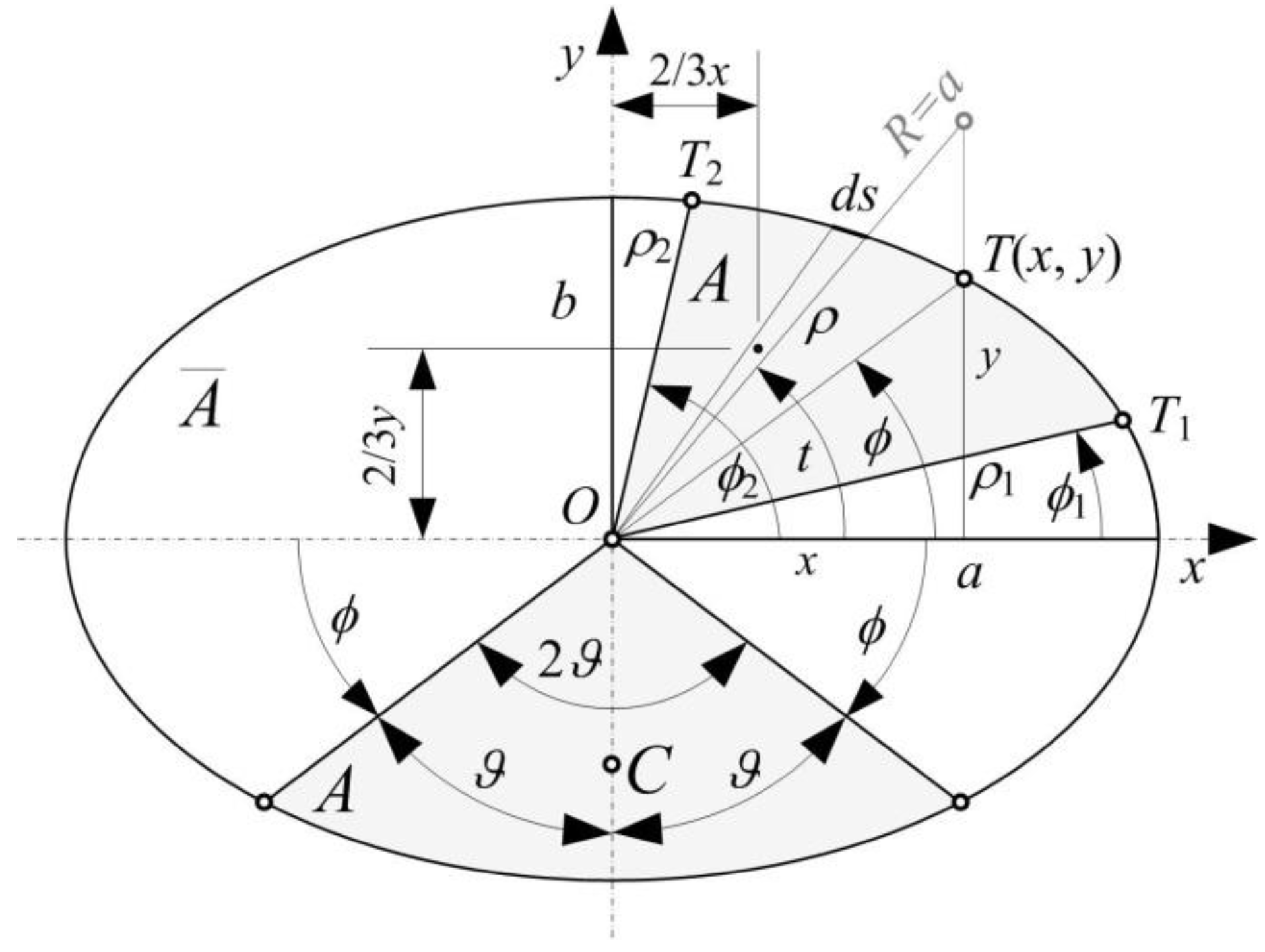
Figure 2.
a) La Hire’s ellipse construction method, b) Relation between polar angle ϕ and parameter t.
Figure 2.
a) La Hire’s ellipse construction method, b) Relation between polar angle ϕ and parameter t.
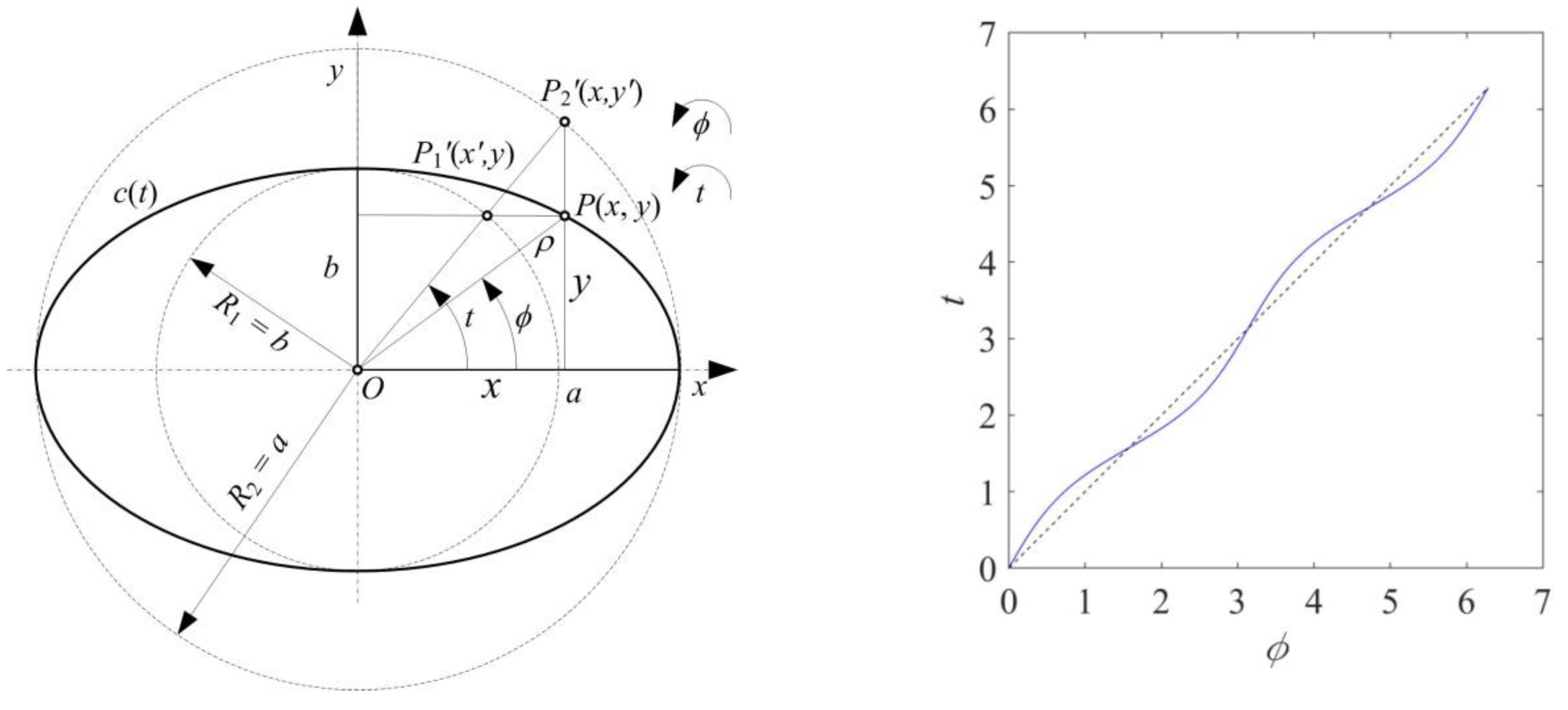
Figure 3.
Example of arbitrary central sector of ellipse.
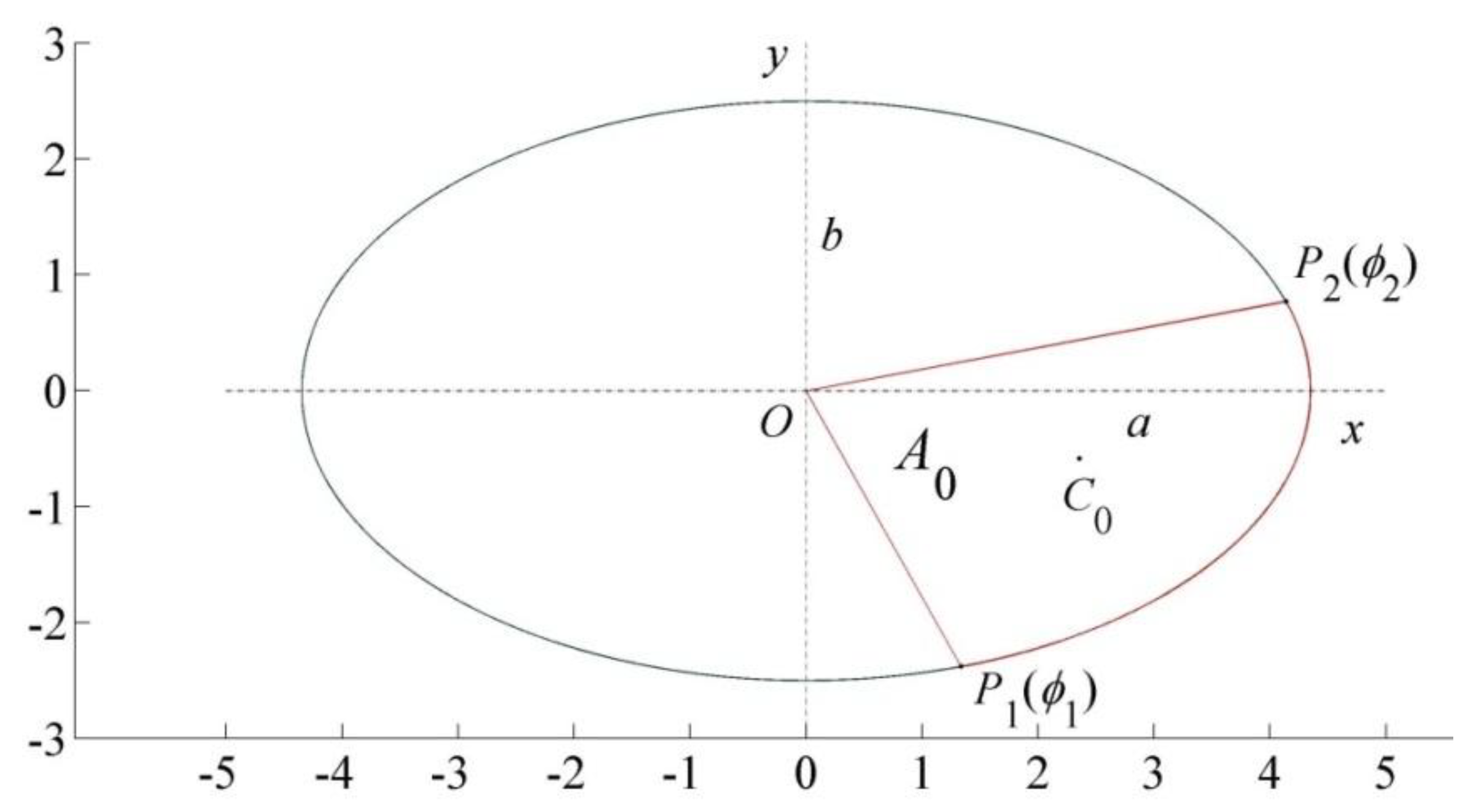

Table 1.
Numerical calculation of closed polygon of ellipse sector with N = 2001 points.
| A’(m2) | Mx’ (m3) | My’ (m3) | xC’ (m) | yC’ (m) | |
| Value | 9.1714 | -5.3596 | 21.6296 | 2.3584 | -0.5844 |
| Difference | 1.508·10−5 | 5.334·10−5 | -1.323·10−5 | 1.939·10−6 | -4.816·10−7 |
Table 2.
Numerical calculation of closed polygon of ellipse sector with N = 2001 points.
| Ix’(m4) | Iy’ (m4) | Ixy’ (m4) | |
| Value | 8.536871 | 60.926009 | -10.677323 |
| Difference | 2.003·10−4 | 2.808·10−5 | -3.515·10−5 |
Disclaimer/Publisher’s Note: The statements, opinions and data contained in all publications are solely those of the individual author(s) and contributor(s) and not of MDPI and/or the editor(s). MDPI and/or the editor(s) disclaim responsibility for any injury to people or property resulting from any ideas, methods, instructions or products referred to in the content. |
© 2026 by the authors. Licensee MDPI, Basel, Switzerland. This article is an open access article distributed under the terms and conditions of the Creative Commons Attribution (CC BY) license (http://creativecommons.org/licenses/by/4.0/).
Copyright: This open access article is published under a Creative Commons CC BY 4.0 license, which permit the free download, distribution, and reuse, provided that the author and preprint are cited in any reuse.


