

Submitted:
19 April 2026
Posted:
21 April 2026
You are already at the latest version
Abstract
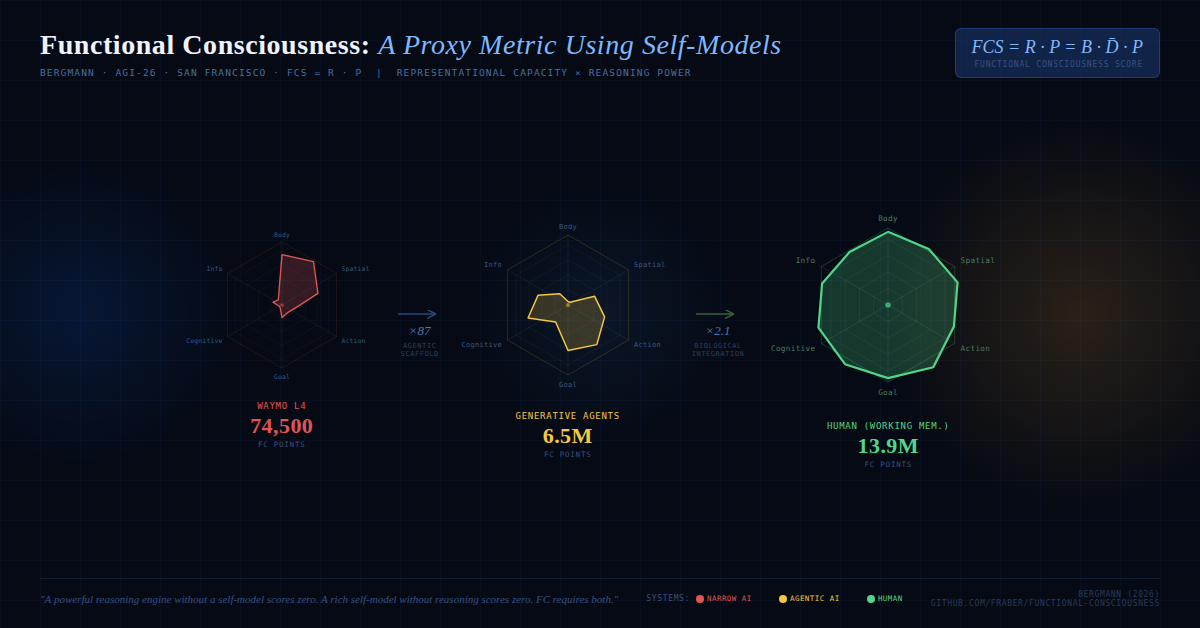
This paper proposes Functional Consciousness (FC) as a measurable architectural property: the observable capacity of a system to access and reason about internal representations of its own states. We introduce a computationally tractable metric on FC that operationalizes core tenets of major consciousness theories through self-models and their associated reasoning power, measured through informational richness and state-space expansion under inference. The resulting Functional Consciousness Score (FCS) is applied to benchmark systems with known internal structure, including a Waymo L4 autonomous vehicle. To extend the framework to black-box systems, we present Functional Self-Model Analysis (FSMA), an abductive methodology for inferring self-models from behavioral evidence. Applied to stream-of-consciousness literature, FSMA yields a catalog of self-models that serves as a reference for estimating functional consciousness in more complex biological and artificial agents. The resulting scores align with intuitive gradients of cognitive sophistication while remaining operationally grounded. Finally, we compare FC with major theories of consciousness and argue that several of their central functional claims become partially measurable within this framework.
Keywords:
AI benchmarking
; AGI
; cognitive architectures
; consciousness
; IIT
; information theory
; machine consciousness
; philosophy of mind
Copyright: This open access article is published under a Creative Commons CC BY 4.0 license, which permit the free download, distribution, and reuse, provided that the author and preprint are cited in any reuse.


