

Submitted:
17 April 2026
Posted:
20 April 2026
You are already at the latest version
Abstract
Medical schools play a significant role in cultivating an inclusive health system. In 2019, the University of Miami Miller School of Medicine was ranked as the 6th best graduate school in the U.S. for Diversity when the Racial Justice Report Card assigned this institution lowest grade possible. To better understand perceptions of inclusivity among students, faculty, and staff, a campus-wide evaluation was conducted. A mixed-methods survey was administered to query perceptions of on-campus discrim-ination and overall campus climate. In addition to multiple choice items, participants were invited to detail their experiences in an open-ended format. Among 1,612 re-spondents, the majority were women (67%) over the age of 60-years (60%). Two-thirds of respondents were staff, 20% faculty, and 12% students. Quantitative analyses showed significant associations among race, gender, and perception of campus cli-mate. Three major themes emerged from analysis of the open-ended items: (1) inclu-sion & belonging; (2) upward mobility; and (3) the minority tax. A lacking sense of be-longing was reported across all demographic groups, with Black respondents express-ing the ‘minority tax’ was disproportionately imposed, burdening them with the un-compensated task of fostering an inclusive culture. Results demonstrate the value of U.S. Medical Schools’ assessing the cultural climate to yield findings that guide devel-opment and implementation of institutional strategies that advance an inclusive cul-ture. Progress evaluations from external reviewers would further support future inclu-sivity-enhancement efforts and may ultimately lead to an improved cultural climate at U.S. medical schools.
Keywords:
U.S. medical schools
; diversity at U.S. medical school
; White Coats for Black Lives
; US medical school culture
; Racial Justice Report Card
1. Introduction
Medical schools play a significant role in cultivating an inclusive health system [1]. In recent years, the AAMC and other leaders in medical education have made significant strides towards preparing future providers to deliver care with cultural humility [2]. Such changes reflect evidence that shows culturally relevant care improves outcomes in diverse patients [3]. Despite these findings, cultural incongruence between patients and providers is normalized and significantly associated with lower levels of patient satisfaction, quality care, and provider trust, ultimately contributing to worse outcomes in culturally-distinct populations, especially Black and Latine Americans [4,5].
As diversity-promoting policies at U.S. medical schools largely influence the racial and ethnic makeup of the Nation’s physician workforce, it is critically important to examine the impact of such policies on efforts to cultivate a representative physician workforce. While Black Americans represent nearly 15% of the U.S. population, they account for less than 6% of physicians and just 10% of medical students [6,7]. Similarly, Latin people account for 19% of the U.S. population, but just 6% of the physician workforce and less that 13% of U.S. medical students [6,7]. Though many medical students perceive their institutional policies as supportive of diversity, fewer students, especially underrepresented minorities, feel their university values having a diverse student body [8].
As an institution, the University of Miami Miller School of Medicine (UMMSM) has long been a leader in promoting a diverse and inclusive campus and currently ranks No. 6 in the U.S. News & World Report’s Best Graduate School for Diversity [9]. Nearly 70% of staff and 30% of faculty and students are from an underrepresented minority (URM) group in medicine [10].
Results from the Racial Justice Report Card (RJRC) initiative, however, have highlighted critical gaps in inclusion. Developed by the student-led organization White Coats For Black Lives (WC4BL), the RJRC sought to articulate ways in which medical schools could promote anti-racism in medicine by assigning institutions a grade based on specific metrics, such as campus climate and culturally competent research protocols [11]. This was a novel initiative because campus climate has been a longtime focus of studies examining diversity at the undergraduate level, yet little attention has been paid to diversity issues in graduate or medical schools [12]. While having one of the highest Hispanic/Latine enrollment rates in the Nation, UMMSM received the lowest grade possible, highlighting the institution’s failure to infuse the campus climate with adequate racial justice initiatives [10,11].
In response to the suboptimal grade, researchers from the Office of Diversity, Inclusion, and Community Engagement (ODICE) initiated a deeper investigation to better understand the unmet needs related to racial justice across campus. Specifically, an evaluation was developed to examine the perceptions and experiences of students, faculty, hospital staff, and administrators. Herein, we describe and discuss findings regarding their racial, ethnic, and gender-related experiences, and its impact on the institution’s sociocultural climate.
2. Materials and Methods
Established by medical students in 2015, “White Coats for Black Lives (WC4BL) aims to dismantle racism in medicine and fight for the health of Black people and other people of color” [11].Recognizing medical schools as the gatekeepers to health professions, WC4BL developed the Racial Justice Report Card to encourage academic medical centers to play an active role in fighting racism in medicine. Each metric on the RJRC is scored individually with a grade of A, B, or C, with A indicating the metric is fully met, and C indicating the metric is not met. The institution’s overall grade is an average of the scores received on each individual metric, with C representing the lowest score an institution could receive. According to the WC4BL grading system, UMMSM received a C+.
2.1. Study Setting
This study was reviewed and approved by the University of Miami Institutional Review Board (IRB ID 20160306). UMMSOM is part of a shared medical complex with Jackson Memorial Hospital, the University’s affiliate teaching hospital and one of the largest safety net hospitals in the nation. Located in a majority-minority county in which nearly 70% of the population identifies as an ethnoracial minority, UMMSOM serves one of the most racially diverse populations in the US [13,14]. By comparison, one-third of institutional faculty and medical students are members of an underrepresented minority group, the majority of whom identify as Hispanic/Latino [10].
2.2. Survey Development
Aligned with the WC4BL mission to promote the perspectives and leadership of students, the study team developed a 19-question mixed-methods survey in partnership with medical students from the Health Equity Pathway, an academic concentration focused on training medical students with actionable skills to attenuate disparities in the healthcare system. Survey items queried perceptions and experiences of discrimination on campus and were modeled from RJRC constructs targeting representation, recruitment, access and protections for marginalized patients, etc.[11].
The 19-item survey was developed and distributed using REDCap, a secure web application for online data management. A simple consent paragraph was included at the beginning of the survey to inform participants of the survey procedures and their right to voluntary and confidential participation. This survey included fourteen statements on attitudes and perceptions towards campus climate, scored on a 5-point Likert scale with 1 for “Strongly Disagree” and 5 for “Strongly Agree.” The remaining five items were dichotomous (yes-no) statements querying experiences with on-campus bias and discrimination, both witnessed and firsthand. Participants had the option to detail the experience for each of these items in a free-response box if they felt comfortable doing so.
2.3. Procedure
From September through November 2019, participants were recruited through voluntary response sampling via email from the University’s All-Medical Listserv, a formal email distribution list used by university leadership to reach all members of the campus community – approximately 13,400 students, faculty, and staff (e.g., administrators, health providers/clinical staff, research support, etc.) enrolled in or employed by UMMSOM in 2019. As UMMSOM faculty practice at the County’s largest public health center, Jackson Memorial Hospital (JMH), the survey questions described UMMSOM’s clinical facilities as UM-JMH. The email body included information on the study’s aims and the REDCap generated link to the online survey questionnaire. The first recruitment email was sent in September, with a reminder email sent the following month. The research team also sent requests between September and October to the departments within the Miller School of Medicine to further promote participation.
2.4. Data Analysis
Data analysis was conducted using a mixed-methods cross-sectional approach [15]. Quantitative data were analyzed using SPSS to identify potential demographic differences in campus climate perception [16]. Chi-square analyses and ANOVA tests were performed to examine associations between perception of campus climate and sociodemographic characteristics, such as race/ethnicity, gender, etc.
Responses to the open-ended experience prompts were examined using NVivo12 software [17]. Four graduate-level researchers used a thematic analytic approach as the primary data reduction strategy. Codes were continuously developed and modified throughout the analysis to ensure participant reports were captured and accurately represented. Ten percent of participant responses were randomly selected and independently coded to develop the initial codebook. Following codebook agreement, an additional five percent of responses were randomly selected and coded by all members of the evaluation team to ensure intercoder agreement [18].
3. Results
3.1. Quantitative
A total of 2,228 individuals responded to the survey; incomplete surveys were removed, resulting in a final sample of 1,612 participants (Table 1). The majority of participants were women (67%) and over the age of 60-years (60%). There was an even distribution of Hispanic (37%) and non-Hispanic White (37%) participants, and two-thirds of respondents were staff, followed by 20% faculty, and 12% students. Additional demographic data can be found in Table 1.
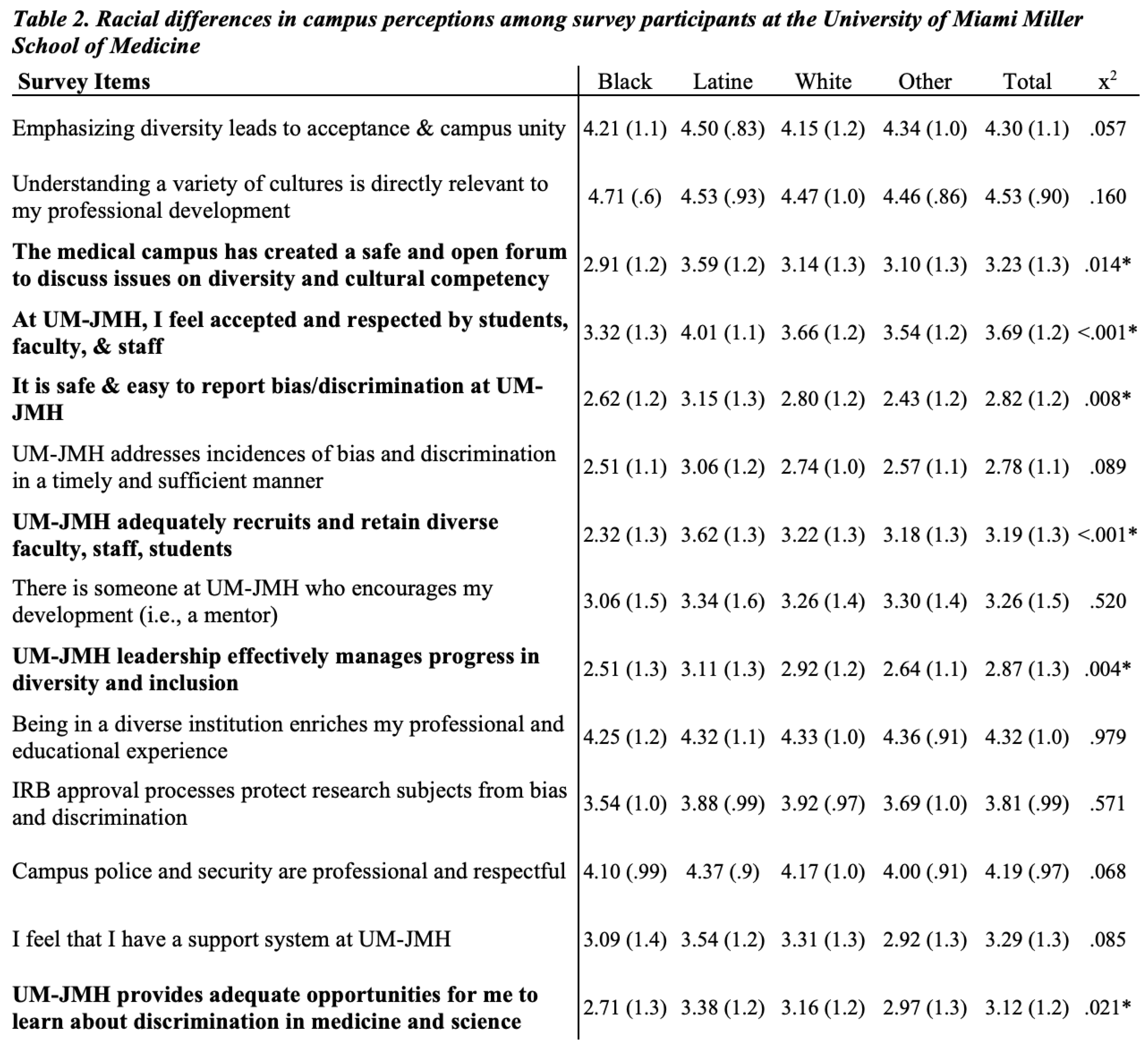
Chi-square analyses show significant associations among race, gender, and perception of campus climate for several items. For example, statements on perceived institutional capacity, such as “leadership effectively manages progress in diversity and inclusion” were significantly associated with both race and gender. One-way ANOVA was also used to examine differences in average perception score differs by race or gender. Similar to the chi-square results, there were significant race and gender differences in perception for several survey items, such as “I feel that I have a support system at UM-JMH” (prace <.001; pgender = .02).
As shown in Table 2, for all survey statements, Black participants reported the lowest average scores, indicating a greater proportion of this group did not agree with the statements on the campus survey. Conversely, Hispanic participants reported the highest average scores compared to other racial groups, suggesting a largely positive view on the University’s culture surrounding diversity and inclusion at the time of the survey. Notably, the three survey items with the lowest scores all relate to institutional responses to bias and discrimination, including: safety and ease of reporting; timely action by university leadership; and institutional progress on diversity. Hispanic participants also reported the least amount witnessed (25%) or experienced (18%) discrimination on campus. Reports of biased and discrimination were highest among participants in the Other Races group (including Asian, Middle Eastern, Native, and Multiracial), with 42% witnessing discrimination and 38% reporting personal experience.
3.2. Qualitative
Free-response survey items were analyzed to further characterize and expand upon the results of the quantitative analysis. Of the 1,612 participants in our sample, 435 completed the free-response prompts. The demographic composition of this sample participants is comparable to the full quantitative sample. Three major themes emerged from this analysis: (1) inclusion & belonging; (2) upward mobility; and (3) the minority tax.
3.3. Inclusion & Belonging
Across all races, ethnicities, and genders, a significant portion of qualitative responses reflected a lacking sense of belonging. Specifically, these reports were characterized by feelings or experiences of exclusion, derision, or prejudice based on one or more facets of personal identity. As one surgeon wrote,
“Several times a month, I express an idea only to meet a lukewarm response, but within the same meeting a male will express the same opinion, and everyone agrees and acknowledges it. […] Male leadership surgeons dismiss me and my ideas b/c of the way I look.”
As with the quantitative results, qualitative feedback spanned across the majority of racial and gender groups, highlighting a heightened sense of exclusion or otherness” for all members of the University regardless of social identity. For example, one White male faculty member reported awareness of his status as a member of the “majority” group, but felt this served as a disadvantage, writing,
“People from groups underrepresented in academia like women and minorities, can gang up together on other individuals and have very hurtful impact on the careers of others. […] When individuals underrepresented in academia complain, people listen but when others complain, it is not given as much importance.”
This perception extends beyond faculty and staff, as students also reported a lack of effort to retain diverse members of the institution once they are successfully recruited.
“I think UM likes to use the words diversity and inclusion […]. However, I have not seen any system put in place to address the needs of a diverse student body. Instead, students are meant to feel that they are only recruited to provide faculty with an opportunity to apply for minority supplements on grants.”
3.4. Upward Mobility
Several participants shared instances in which they felt their access to opportunities for growth at the institution was inhibited because of their identity. As demonstrated in the quantitative data, these findings were found across racial and gender identities but were most commonly observed among Black participants. In discussing the presence of Black faculty leaders, a participant described a lack of tangible opportunities for development, writing
“Blacks are treated more like tokens and do not get placed in leadership positions even when they are more qualified. Mentors may be assigned but tends to stifle talents and withhold opportunities. Promises are made for advancement, but these don’t materialize.”
3.5. Minority Tax
While the University has vocalized efforts to establish a campus culture that fosters diverse representation and inclusion across the institution, many participants felt this message of representation did not align with their experiences at the department- or division-level. Staff, faculty, and students indicated workforce diversity did not appear as a priority and many were skeptical about the institution’s true efforts to increase diverse representation.
As one student writes, “Overt racial discrimination happens too often, but the institution is far more complicit in burdening underrepresented students (and employees without additional pay) to do the work they should be paying for. It is additional work and stress at the time, but also an opportunity cost that leaves already privileged students that much more advantaged to spend those same hours on tasks more directly valued by the field (e.g., testing and/or *medicine*). It is a classic pattern, and very much an optional one.”
4. Discussion
This study explored faculty, student, and staff perceptions regarding issues of diversity, equity, and inclusion at one of the most diverse medical institutions in the U.S. Despite this national ranking, results in this study parallel the findings from many other medical schools and have revealed several areas for improvement as expressed by our campus community. Quantitative findings suggest University personnel from diverse racial and gender backgrounds have a negative perception of the institution’s commitment to diversity and inclusion. These findings are further supported by the qualitative results, in which a varied sample of university members reported feelings of isolation and otherness. These results highlight the need for greater focus on the intersectional groupings of multiple identities, including race, gender, and belief system, as they relate to equity and professional development. Further, research exploring the complexities of these experiences and their impact on workplace culture is needed [19].
Notably, the most positive responses were among Hispanic respondents. A mentioned above, this is likely related to Miami-Dade’s designation as a majority-minority region, in which 70% of residents identify as Hispanic/Latino. Similarly, this demographic also forms the majority at UMMSOM. Consistent with prior studies, minority populations are less likely to experience feelings of isolation and otherness when surrounded by persons from similar backgrounds, which may account for their higher scores.
While perceived inclusion was low among several ethnoracial groups, Black participants had the lowest average scores on perceived campus climate. This outcome was better illuminated by the experiences shared in their qualitative feedback, as reports relating to the minority tax and stunted upward mobility became more frequent. Importantly, this survey was conducted a year prior to the 2020 presidential election, during which discussions of equity, inclusion, and antiracism became more socially prominent. While this context may have influenced participants’ qualitative and quantitative feedback, the findings are aligned with other literature on the Black experience in academia [20].
These findings were limited by the design of the study. Specifically, additional interviews and focus groups would have provided valuable information during data analysis. However, the anonymous design of the survey prevented follow-up. Future studies should include an option for participants to elect to be contacted for further research. Additionally, the small sample of student respondents limited the ability to make statistical inferences on intersectional campus climate experiences. Future research should make a targeted effort to recruit a more diverse sample of participants.
Steps to Further Promote Equity
Since this research was conducted, UMMSOM has made several strides to enhance the institutional climate of diversity and inclusion. Most notably, in June 2020, a call to action was submitted by the UMMSOM Student National Medical Association (SNMA), resulting in the formation of the Task Force on Racial Justice (TFRJ). The TFRJ was created with the primary goal of developing campus-wide strategies to address issues of systemic racism within the university and ultimately create a sustainable culture of inclusion and diversity [21]. Within the first 90-days, subcommittees were created, a root cause analysis for each of the problem areas, and short- and intermediate-term recommendations were developed to promote the aforementioned goals [21]
For example, among the short-term recommendations proposed by the Faculty Affairs Subcommittee was community building through staff networking events and the development of a Society of Black Physicians and Scientists to further encourage opportunities for interdisciplinary collaboration and promote the mentoring, promotion, and retention of Black faculty. Faculty Affairs has further organized campus-wide events highlighting the achievements of minority faculty and hosted celebrations to honor culturally-distinct holidays, such as Juneteenth.
Similarly, while members of the TFRJ were working with institutional leadership to monitor short-term progress to measure potential changes resulting from the taskforce, continued documentation of these efforts has since fallen out of practice. In consideration of future efforts to assess campus climate, it is important to note that many institutions overinflate their self-rated performance of campus diversity, suggesting that many may not recognize the disparity in diversity during recruitment or enrollment efforts [22]. Accordingly, evaluations on institutional progress from external reviewers would further support future diversity-enhancement efforts and ultimately lead to an improved cultural climate at our institution [23]. The research reported herein serves as a step forward for our UMMSOM on our journey to create a culture of belonging for every member of our learning community.
Author Contributions
For research articles with several authors, a short paragraph specifying their individual contributions must be provided. The following statements should be used “Conceptualization, S.K., B.Y.,A.M.R.L., S.S. methodology, S.K., B.Y. A.M.R.L.; software, B.Y.; validation, A.G. and A.R.; formal analysis, S.K., B.Y., investigation, S.K., N.V., O.C.; resources N.V.; data curation, B.Y.; writing—original draft preparation, S.K., and B.Y.; writing—review and editing, S.K., O.C., and A.G; supervision, S.K.; project administration, B.Y. All authors have read and agreed to the published version of the manuscript.
Funding
This research received no external funding.
Institutional Review Board Statement
The study was conducted in accordance with the Declaration of Helsinki, and approved by the Institutional Review Board (or Ethics Committee) of University of Miami (protocol code ID 20160306 10/4/2016).
Informed Consent Statement
Informed consent was obtained via a simple consent paragraph at the beginning of the survey to inform participants of the survey procedures and their right to voluntary and confidential participation.
Data Availability Statement
Access to data generated during the study can be obtained by emailing authors at skenya@miami.edu.
Conflicts of Interest
The authors declare no conflicts of interest.
Abbreviations
The following abbreviations are used in this manuscript:
| RJRC | Racial Justice Report Card |
| WC4BL | White Coats For Black Lives |
| ODICE | Office of Diversity, Inclusion, and Community Engagement |
References
- Fernandez, A. Further incorporating diversity, equity, and inclusion into medical education research. Academic Medicine 2019, 94(11S), S5–6. [Google Scholar] [CrossRef] [PubMed]
- Association of American Medical Colleges. The anatomy of cultural competence. AAMC Students & Residents. (n.d.). https://students-residents.aamc.org/anatomy-applicant/anatomy-cultural-competence, accessed April 2, 20026.
- Cipta, D.A.; Andoko, D.; Theja, A.; Utama, A.V.E.; Hendrik, H.; William, D.G.; Reina, N.; Handoko, M.T.; Lumbuun, N. Culturally sensitive patient-centered healthcare: a focus on health behavior modification in low and middle-income nations-insights from Indonesia. Front Med (Lausanne) 2024, 11, 1353037. [Google Scholar] [CrossRef] [PubMed]
- Takeshita, J.; Wang, S.; Loren, A. W.; Mitra, N.; Shults, J.; Shin, D. B.; Sawinski, D. L. Association of racial/ethnic and gender concordance between patients and physicians with patient experience ratings. JAMA Network Open accessed April 2, 20026. 2020, 3(11), e2024583. [Google Scholar] [CrossRef] [PubMed]
- Schoenthaler, A.; Ravenell, J. Understanding the patient experience through the lenses of racial/ethnic and gender patient–physician concordance. JAMA Network Open 2020, 3(11), e2025349. [Google Scholar] [CrossRef] [PubMed]
- AAMC.org New AAMC Data on Medical School Applicants and Enrollment in 2024. Available online: https://www.aamc.org/news/press-releases/new-aamc-data-medical-school-applicants-and-enrollment-2024 (accessed on 10 April 2026).
- AAMC.org U.S. Physician Workforce Data Dashboard. Available online:https://www.aamc.org/data-reports/data/2024-key-findings-and-definitions#:~:text=In%202023%2C%2056.3%25%20of%20active,Native%20Hawaiian%20or%20Other%20Pacific Accessed online April 10, 2026.
- Hung, R.; McClendon, J.; Henderson, A.; Evans, Y.; Colquitt, R.; Saha, S. Student perspectives on diversity and the cultural climate at a U.S. medical school. Academic Medicine 2007, 82(2), 184–192. [Google Scholar] [CrossRef] [PubMed]
- University of Miami Miller School of Medcine. Miller School Moves Up in U.S. News & World Report’s Best Medical School Ranking. 2022, https://news.med.miami.edu/miller-school-moves-up-in-u-s-news-world-reports-best-medical-school-rankings/#:~:text=Miller%20School%20of%20Medicine%20rose,6%20spot%20for%20Diversity.
- Office of Institutional Research and Strategic Analytics. 2022, University of Miami 2021 – 2022 Fact Book. https://www.irsa.miami.edu/_assets/pdf/factbook.pdf.
- White Coats 4 Black Lives. Racial Justice Report Cart 2019. https://whitecoats4blacklives.org/wp-content/uploads/2019/08/RJRC-2019-Full-Report-Final-8.28.19.pdf. Accessed April 2, 20026.
- Griffin, K.; Muñiz, A.; Espinosa, M. M.; L. 2012, The Influence of Campus Racial Climate on Diversity in Graduate Education. The Review of Higher Education 35(4), 535–566. [CrossRef]
- Pew Research Center. In a rising number of U.S. counties, Hispanic and black Americans are the majority. 2019, https://www.pewresearch.org/fact-tank/2019/11/20/in-a-rising-number-of-u-s-counties-hispanic-and-black-americans-are-the-majority/. Accessed April 2, 20026.
- Pew Research Center. Ranking the Latino population in metropolitan areas. Available online:. https://www.pewresearch.org/hispanic/2016/09/08/5-ranking-the-latino-population-in-metropolitan-areas/ Accessed April 2, 20026.
- Creswell, J.W. A concise introduction to mixed methods research; SAGE Publications, 2014. [Google Scholar]
- IBM Corp. IBM SPSS Statistics for Mac, 2023, (Version 27.0)[Computer Software];
- QSR International. NVivo 12 Qualitative Data Analysis Software [Computer Software], 1999, https://qsrinternational.com/nvivo/nvivo-products/.
- Thomas, D. R. (A General Inductive Approach for Analyzing Qualitative Evaluation Data. American Journal of Evaluation 2006, 27(2), 237–246. [Google Scholar] [CrossRef]
- Zambrana, R.E.; Harvey Wingfield, A.; Lapeyrouse, L.M.; Dávila, B.A.; Hoagland, T.L.; Valdez, R.B. Blatant, subtle, and insidious: URM faculty perceptions of discriminatory practices in predominantly White institutions. Sociological Inquiry 2017, 87(2), 207–232. [Google Scholar] [CrossRef]
- Garvey, J. C.; Sanders, L. A.; Flint, M. A. Generational perceptions of campus climate among LGBTQ undergraduates. Journal of College Student Development 2017, 58(6), 795–817. [Google Scholar] [CrossRef]
- Reid, L. D.; Radhakrishnan, P. (Race matters: The relation between race and general campus climate. Cultural Diversity and Ethnic Minority Psychology 2003, 9(3), 263–275. [Google Scholar] [CrossRef] [PubMed]
- University of Miami Miller School of Medicine Office of Diversity, Inclusion, and Community Engagement. 2020 University of Miami Miller School of Medicine Task Force on Racial Justice Executive Summary. https://med.miami.edu/-/media/millerschool/offices/diversity/documents/accessible_tfrj-report-11-16-2020-final-(1).ashx?la=en&hash=226722F331F9C21B765FD4FE57657E57B5B38DCD.
- Woodruff, J.N.; Vela, M.B.; Zayyad, Z.; Johnson, T.A.; Kyalwazi, B.; Amegashie, C.; Silverman, R.; Levinson, D.; Blythe, K.; Lee, W.W.; Thomas, S. Supporting Inclusive Learning Environments and Professional Development in Medical Education Through an Identity and Inclusion Initiative. Academic Medicine 2020, 95(12S), S51–S57. [Google Scholar] [CrossRef] [PubMed]
- Agrawal, J.R.; Vlaicu, S.; Carrasquillo, O. Progress and pitfalls in underrepresented minority recruitment: perspectives from the medical schools. Journal of the National Medical Association 2005, 97(9), 1226–1231. [Google Scholar] [PubMed]

Table 1.
Demographic characteristics of climate survey respondents at the University of Miami Miller School of Medicine (N = 1612).
Table 1.
Demographic characteristics of climate survey respondents at the University of Miami Miller School of Medicine (N = 1612).
| Qualitative Respondents | Full Sample | ||||
| Age | N | % | N | % | |
| 20-24 | 18 | 4.15% | 108 | 6.7% | |
| 25-29 | 52 | 11.98% | 206 | 12.8% | |
| 30-39 | 113 | 26.04% | 348 | 21.6% | |
| 40-55 | 159 | 36.64% | 591 | 36.7% | |
| Over 55 | 92 | 21.20% | 358 | 22.2% | |
| Race | |||||
| Asian/Pacific Islander | 21 | 4.8% | 77 | 4.8% | |
| Black/African American | 69 | 15.9% | 196 | 12.2% | |
| Indigenous/Native American | 2 | 0.5% | 3 | 0.2% | |
| Latino/Hispanic | 126 | 29.0% | 589 | 36.5% | |
| Middle Eastern | 5 | 1.2% | 11 | 0.7% | |
| Multiracial | 15 | 3.5% | 44 | 2.7% | |
| Other | 19 | 4.4% | 45 | 2.8% | |
| Prefer not to answer | 18 | 4.1% | 47 | 2.9% | |
| White | 159 | 36.6% | 600 | 37.2% | |
| Gender | |||||
| Female | 291 | 67.1% | 1108 | 68.7% | |
| Male | 127 | 29.3% | 469 | 29.1% | |
| Transgender/Non-Conforming | 3 | 0.7% | 5 | 0.3% | |
| Prefer not to answer | 13 | 3.0% | 29 | 1.8% | |
| LGBT | |||||
| Yes | 47 | 10.8% | 150 | 9.3% | |
| No | 296 | 68.2% | 277 | 17.2% | |
| No, but I identify as an Ally | 83 | 19.1% | 1169 | 72.5% | |
| Prefer not to answer | 7 | 1.6% | 14 | 0.9% | |
| Country | |||||
| Country Outside the United States | 153 | 35.3% | 563 | 34.9% | |
| United States & Territories | 281 | 64.7% | 1049 | 65.1% | |
| Belief | |||||
| Agnostic | 34 | 7.8% | 93 | 5.8% | |
| Atheism | 20 | 4.6% | 71 | 4.4% | |
| Buddhism | 9 | 2.1% | 23 | 1.4% | |
| Christian | 205 | 47.2% | 890 | 55.2% | |
| Hinduism | 7 | 1.6% | 22 | 1.4% | |
| Judaism | 33 | 7.6% | 118 | 7.3% | |
| Muslim | 4 | 0.9% | 13 | 0.8% | |
| Nonreligious | 58 | 13.4% | 153 | 9.5% | |
| Other | 35 | 8.1% | 144 | 8.9% | |
| Prefer not to Answer | 27 | 6.2% | 80 | 5.0% | |
| Degree | N | % | N | % | |
| High School Diploma / GED | 13 | 3.00% | 115 | 7.1% | |
| Associate Degree | 37 | 8.53% | 189 | 11.7% | |
| Bachelor’s Degree | 117 | 26.96% | 470 | 29.2% | |
| Master’s Degree | 119 | 27.42% | 392 | 24.3% | |
| Doctoral Degree | 140 | 32.26% | 409 | 25.4% | |
| Other | 8 | 1.84% | 115 | 7.1% | |
| Institutional Position | |||||
| Fellow | 2 | 0.46% | 9 | 0.6% | |
| Other | 13 | 3.00% | 47 | 2.9% | |
| Resident | 2 | 0.46% | 7 | 0.4% | |
| Staff (JMH or UM) | 267 | 61.52% | 1067 | 66.2% | |
| Student | 45 | 10.37% | 188 | 11.7% | |
| Faculty | 105 | 24.19% | 294 | 18.2% | |
| Instructor | 2 | 0.5% | 5 | 0.3% | |
| Assistant Professor | 37 | 8.5% | 104 | 6.5% | |
| Associate Professor | 34 | 7.8% | 102 | 6.3% | |
| Professor | 32 | 7.4% | 83 | 5.1% | |
Disclaimer/Publisher’s Note: The statements, opinions and data contained in all publications are solely those of the individual author(s) and contributor(s) and not of MDPI and/or the editor(s). MDPI and/or the editor(s) disclaim responsibility for any injury to people or property resulting from any ideas, methods, instructions or products referred to in the content. |
© 2026 by the authors. Licensee MDPI, Basel, Switzerland. This article is an open access article distributed under the terms and conditions of the Creative Commons Attribution (CC BY) license (http://creativecommons.org/licenses/by/4.0/).
Copyright: This open access article is published under a Creative Commons CC BY 4.0 license, which permit the free download, distribution, and reuse, provided that the author and preprint are cited in any reuse.


