
Submitted:
17 April 2026
Posted:
20 April 2026
You are already at the latest version
Abstract
Histoplasmosis, blastomycosis, and coccidioidomycosis - the three major endemic mycoses - have long been taught as geographically confined diseases requiring travel to classic endemic zones for clinical consideration. Emerging epidemiologic data challenges this paradigm. National surveillance studies now document clinically significant incidence of all three fungi across 47–94% of US states, with locally acquired cases confirmed well outside historical boundaries. Climate-driven range expansion, rising immunosuppressed populations, and improved diagnostics are converging drivers. The diagnostic delay - averaging 29 days, with 42% of patients initially misdiagnosed - carries measurable clinical and economic cost. This mini review synthesizes contemporary data on geographic redistribution, identifies key drivers of expansion, and proposes a risk-stratified, geography-independent diagnostic framework centered on immune status and clinical pattern rather than zip code.
Keywords:
endemic mycoses
; histoplasmosis
; coccidioidomycosis
; blastomycosis
; geographic expansion
; pulmonary fungal infection
; diagnostic delay
; immunosuppression
; climate change
; urine antigen
1. Introdcution
For decades, clinicians have been taught to consider the three thermally dimorphic endemic fungi - Histoplasma capsulatum, Blastomyces dermatitidis/gilchristii, and Coccidioides immitis/posadasii - primarily in the context of travel to specific endemic regions. These teaching zones, largely derived from histoplasmin skin-test surveys conducted in the mid-20th century, became codified in clinical guidelines and, more enduringly, in the mental models of practicing physicians [1,2]. The consequence has been a diagnostic filter that excludes geography-naïve patients from timely testing, perpetuates diagnostic delays averaging 29 days, and results in preventable morbidity.
A convergence of modern surveillance data, climate modeling, and immunosuppression epidemiology has rendered the classic geographic framework increasingly obsolete. This review summarizes current evidence on the shifting landscape of endemic mycoses, examines the drivers behind geographic expansion, quantifies the cost of diagnostic delay, and proposes a practical, geography-independent approach for pulmonologists and critical care physicians. It further incorporates updated guidance from the 2025 IDSA Histoplasmosis Guideline Update — the first revision since 2007 [12].
2. The Classic Endemic Zone Framework: How It Was Built and Why It Fails
The geographic boundaries taught in medical schools were constructed from limited early-20th-century skin-test surveys and soil sampling biased toward clinical case clusters in the Ohio and Mississippi River Valleys for histoplasmosis, the Great Lakes basin for blastomycosis, and the Lower Sonoran Life Zone for coccidioidomycosis [1,3]. Crucially, these maps reflect where investigators looked and where reporting infrastructure existed - not the true distribution of these organisms. Inconsistent state-level reporting requirements (blastomycosis is not reportable in most US states even today) have compounded this undercount for decades.
The practical consequence is that geography has functioned as a diagnostic pre-filter: a negative travel history to a classic endemic zone reduces clinical suspicion before testing is even considered. For an immunosuppressed patient in Houston, Seattle, or New York, this filter may be the single greatest barrier to timely diagnosis.
3. Contemporary Epidemiology: A Paradigm Shift
3.1. Histoplasmosis
Mody et al. (Annals of Internal Medicine, 2023) analyzed Medicare beneficiary claims from 2007–2016 and documented clinically significant histoplasmosis incidence in 47 of 50 US states [4]. States outside the classic endemic zone - including Florida, Texas, Georgia, and New York - demonstrated incidences previously considered negligible. Approximately 30% of cases diagnosed in non-endemic states had no identifiable travel history to traditional endemic areas, suggesting true locally acquired disease. Histoplasma capsulatum has now been documented on all seven continents, including Antarctica [4,13].
3.2. Coccidioidomycosis
Caceres et al. (Clinical Infectious Diseases, 2023) identified 29 counties with significant coccidioidomycosis burden outside the classically defined Arizona and Central California zones, including newly recognized foci in the Pacific Northwest, central Utah, and Colorado [5]. Three autochthonous cases were confirmed in Washington State — more than 1,000 miles from the nearest classic endemic area. Climate modeling by Gorris et al. (GeoHealth, 2019) projects that under moderate warming scenarios (RCP 4.5), the Coccidioides-endemic range will expand from 12 to 17 states by 2035, potentially exposing 17 million additional people and generating up to $1.8 billion in additional annual healthcare costs by 2100 [6]. Under high-emissions projections (RCP 8.5), endemicity may extend to 28+ states by 2100.
3.3. Blastomycosis
EHR-based national analyses (2013–2023) document a doubling of blastomycosis incidence over a single decade, with extraordinary hotspot rates in Wisconsin (9.9/100,000), Arkansas (10.7/100,000), and Michigan [7]. The 2022–2023 Michigan paper mill outbreak - the largest documented blastomycosis outbreak in US history - involved 136 confirmed cases and 6 deaths in a largely indoor industrial workplace [8]. New signals are now emerging from Tennessee, Virginia, and North Carolina.
4. Drivers of Geographic Expansion
4.1. Climate Change
Rising temperatures and shifting precipitation patterns directly expand the ecological niches hospitable to Coccidioides and Histoplasma. The Gorris climate model demonstrates a strong, quantifiable relationship between temperature, drought severity, and Coccidioides range expansion already observed in real-world case data [6]. Temperature projections from IPCC AR6 suggest median surface warming of 1.5–4.0 °C across the continental US by 2100 [15].
4.2. Expanding Immunosuppressed Host Populations
TNF-α inhibitors confer a 25–100-fold increased risk of disseminated histoplasmosis and coccidioidomycosis compared to the general population [14]. The rapid growth of biologic therapy, solid organ and hematopoietic stem cell transplantation, CAR-T cell therapy, and checkpoint inhibitor use has created an expanding population of profoundly vulnerable hosts distributed across every geographic region. Between 2015 and 2023, the number of US patients receiving biologic immunomodulatory therapy increased by approximately 40%, reaching an estimated 3.5 million individuals [16].
4.3. Improved Diagnostics and Detection Bias
Urine antigen enzyme immunoassay (EIA) testing (MVista Histoplasma Quantitative EIA; IMMY) now offers same-day results with sensitivities of 85–90% for pulmonary disease and >95% for disseminated disease [13]. Wider availability of these tests has unmasked previously missed cases. Importantly, Blastomyces antigen cross-reacts with the Histoplasma antigen assay in approximately 90% of cases; both antigens should therefore always be ordered simultaneously [13].
5. The Cost of Delayed Diagnosis
Azar et al. (Open Forum Infectious Diseases, 2025) examined 384 confirmed endemic mycosis cases presenting to a non-endemic referral center between 2010 and 2022 [10]. The median time from symptom onset to correct diagnosis was 21 days (range 3–180 days); 62% of patients experienced a clinically meaningful delay. Forty-two percent were initially misdiagnosed - most commonly as bacterial pneumonia (28%), malignancy (10%), or sarcoidosis (4%). Patients with delayed diagnosis accumulated an average of $15,648 in excess healthcare costs. Absence of documented travel to a classic endemic zone was the strongest independent risk factor for delay (OR 4.2, 95% CI 2.1–8.3) [10].
A particularly dangerous pathway is the steroid cascade: a patient with unrecognized endemic fungal infection is diagnosed with sarcoidosis or inflammatory lung disease and started on corticosteroids. High-dose steroids in the context of active histoplasmosis or blastomycosis accelerate dissemination and worsen outcomes; this pattern has been documented in approximately 40% of initially misdiagnosed histoplasmosis cases [11]. Interrupting the steroid cascade through earlier fungal testing is among the highest-yield clinical interventions available to pulmonologists.
6. A Geography-Independent Diagnostic Framework
Contemporary evidence supports shifting the clinical diagnostic trigger from “Did the patient travel to an endemic zone?” to a risk-based framework anchored on immune status and clinical pattern. The following patients warrant urine antigen testing regardless of geographic history:
TIER 1 Test Immediately:
- • Any immunocompromised patient (TNF-α inhibitor, transplant recipient, HIV/AIDS, hematologic malignancy) presenting with community-acquired pneumonia or pulmonary infiltrates
TIER 2 Test Early:
- • CAP failing to respond to appropriate antibiotics after 2 weeks
- • Subacute or chronic pulmonary infiltrates with systemic features (weight loss, fever, night sweats)
TIER 3 Consider Testing:
- • Mediastinal lymphadenopathy with pulmonary infiltrate being worked up for sarcoidosis before antifungal testing
- • Significant occupational soil/dust exposure: construction, agriculture, excavation, landscaping

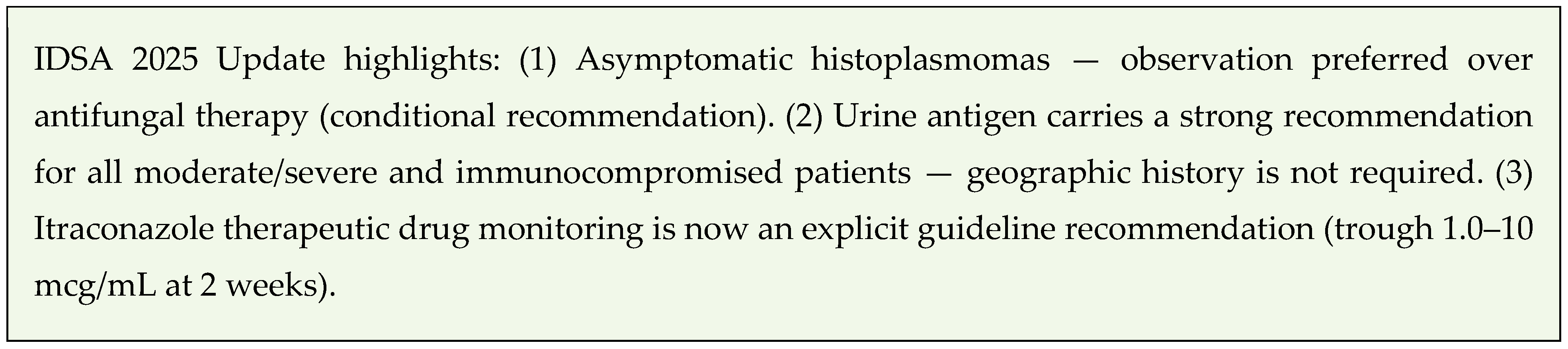
Urine antigen should be the first-line test for histoplasmosis and blastomycosis given its non-invasive nature, rapid turnaround, and high sensitivity in moderate-to-severe disease [13]. Coccidioides lacks a validated urine antigen; IgM and IgG serology (ID and CF methods) remain the cornerstone of cocci diagnosis. The IDSA 2025 Histoplasmosis Update explicitly moves away from geographic history as a prerequisite for testing, endorsing urine antigen as a strong recommendation for moderate/severe and immunocompromised patients [12].
7. Diagnostic Toolkit

Table 1.
Diagnostic toolkit for endemic mycoses.
| Test | Pathogen | Sensitivity | Clinical Notes | Ref. |
| Urine antigen EIA (MVista/IMMY) | Histoplasma | 85–90% pulm.; >95% dissem. | First-line; same-day; cross-reacts with Blastomyces | [13] |
| Urine antigen EIA | Blastomyces | ~90% moderate-severe | Always order with Histo antigen simultaneously | [13] |
| IgM + IgG serology (ID, CF) | Coccidioides | 75–90% | No validated urine antigen: serology is cornerstone | [2,5] |
| CF + immunodiffusion | Histoplasma | 60–80% | May be negative early in immunocompromised | [13] |
| BAL GMS stain + culture | All three | Variable; culture = gold standard | Moderate-severe disease; slow turnaround | [11] |
| Tissue biopsy + GMS | All three | High (specimen-dependent) | Nodules or focal disease; inconclusive antigen/serology | [11] |
| PCR (emerging) | Histo, Blasto | Variable | Not yet guideline-endorsed; investigational | [13] |
8. Treatment Principles
Treatment selection is driven by disease severity, organism, and host immune status. Table 2 summarizes current guideline recommendations incorporating the 2025 IDSA Histoplasmosis Update [12].
9. Climate Projections and Future Burden
The Gorris et al. climate niche model - validated against 60 years of epidemiologic data - provides the most granular projection available for Coccidioides range expansion [6]. Under RCP 4.5 (moderate warming), 17 states are projected to be endemic by 2035; under RCP 8.5 (high emissions), endemicity may extend to 28+ states by 2100, exposing tens of millions of additional people. Analogous temperature-sensitivity data for Histoplasma suggest that even moderate warming will permit soil colonization in previously unsuitable northern latitudes.
10. Conclusions
The geographic boundaries that have governed clinical suspicion for endemic mycoses for half a century no longer reflect epidemiologic reality. All three major endemic fungi are now documented across virtually every US state, with locally acquired cases confirmed far outside historic zones. The drivers - climate change, expanding immunosuppressed populations, and improved diagnostics - are unlikely to reverse.
Three clinical imperatives emerge from this review: (1) test based on immune status - not zip code; (2) send urine antigen early and simultaneously for both Histoplasma and Blastomyces; and (3) break the steroid cascade before it begins. A urine antigen test costs $50–150; a missed diagnosis costs far more.

Author Contributions
M.A.A and Z.H conceptualization, literature review, writing, and final approval.
Funding
This research received no external funding.
Conflicts of Interest
The author declares no conflict of interest.
References
- Edwards LB, et al. An atlas of sensitivity to tuberculin, PPD-B, and histoplasmin in the United States. Am Rev Respir Dis. 1969.
- Galgiani JN, et al. Clinical practice guidelines for the treatment of coccidioidomycosis. Clin Infect Dis. 2016;63:e112–e146. [CrossRef]
- Chapman SW, et al. Clinical practice guidelines for the management of blastomycosis. Clin Infect Dis. 2008;46:1801–1812. [CrossRef]
- Mody GN, et al. Expanding geographic distribution of histoplasmosis. Ann Intern Med. 2023. [CrossRef]
- Caceres DH, et al. Geographic distribution of dimorphic mycoses for the modern era. Clin Infect Dis. 2023;76:1302–1310. [CrossRef]
- Gorris ME, et al. Expansion of coccidioidomycosis endemic regions in the United States in response to climate change. GeoHealth. 2019. [CrossRef]
- EHR-Based National Surveillance. US blastomycosis incidence 2013–2023. MMWR Suppl. 2024.
- Centers for Disease Control and Prevention. Blastomycosis outbreak among paper mill workers — Michigan, 2022–2023. MMWR. 2024;73:450–455.
- Wheat LJ, et al. Clinical practice guidelines for the management of patients with histoplasmosis. Clin Infect Dis. 2007;45:807–825.
- Azar MM, et al. Impact of diagnostic delays on healthcare costs in endemic mycoses outside classic zones. Open Forum Infect Dis. 2025. [CrossRef]
- Limper AH, et al. An official American Thoracic Society statement: treatment of fungal infections in adult pulmonary and critical care patients. Am J Respir Crit Care Med. 2011;183:96–128.
- Chapman SW, et al. IDSA 2025 Clinical Practice Guideline Update: Histoplasmosis. Clin Infect Dis. 2025. [CrossRef]
- Hage CA, et al. Diagnosis of endemic mycoses: a multicenter experience. Ann Intern Med. 2015;162:566–574. [CrossRef]
- Winthrop KL, et al. Histoplasmosis and tumor necrosis factor alpha inhibitor therapy. Clin Infect Dis. 2005;40:1618–1622. [CrossRef]
- IPCC. Climate Change 2021: The Physical Science Basis. Sixth Assessment Report. Cambridge University Press; 2021.
- Steinberg BE, et al. Growth of biologic immunosuppression prescribing in the United States, 2015–2023. J Rheumatol. 2024;51:342–349.
- Benedict K, et al. Estimation of direct healthcare costs of fungal diseases in the United States. Clin Infect Dis. 2019;68:1791–1797.
- Thompson GR III, et al. Global guideline for the diagnosis and management of coccidioidomycosis. Lancet Infect Dis. 2021;21:e368–e379.
- Sondermeyer Cooksey GL, et al. Coccidioidomycosis in California: resolving trends in disease incidence. Emerg Infect Dis. 2019;25:1273–1281.
- Linder JA, et al. Diagnostic stewardship in endemic mycoses: a call to action. Chest. 2024;165:1450–1460.
Table 2.
Antifungal treatment recommendations.
| Organism | Severity | Preferred Regimen | Duration | Monitoring |
| Histoplasma | Mild-moderate | Itraconazole 200 mg TID ×3d → BID | 6–12 weeks | Trough 1–10 mcg/mL at 2 wk; LFTs; DDIs [12] |
| Severe / disseminated | LAmB 3 mg/kg/day → itraconazole step-down | ≥12 months | Renal function during LAmB | |
| Blastomyces | Mild-moderate | Itraconazole 200 mg TID ×3d → BID | 6–12 months | Serum trough; LFTs [3] |
| Severe / ARDS | LAmB 3 mg/kg/day → itraconazole | ≥12 months | Renal monitoring during LAmB | |
| Coccidioides | Mild-moderate | Fluconazole 400–800 mg/day | 3–6 months | LFTs; CXR response [2] |
| Severe / disseminated | LAmB 3–5 mg/kg/day → fluconazole step-down | ≥12 months | Renal function | |
| CNS meningitis | Fluconazole 400–800 mg/day indefinitely | Indefinite | MRI; CSF; avoid azoles in pregnancy |
Disclaimer/Publisher’s Note: The statements, opinions and data contained in all publications are solely those of the individual author(s) and contributor(s) and not of MDPI and/or the editor(s). MDPI and/or the editor(s) disclaim responsibility for any injury to people or property resulting from any ideas, methods, instructions or products referred to in the content. |
© 2026 by the authors. Licensee MDPI, Basel, Switzerland. This article is an open access article distributed under the terms and conditions of the Creative Commons Attribution (CC BY) license (http://creativecommons.org/licenses/by/4.0/).
Copyright: This open access article is published under a Creative Commons CC BY 4.0 license, which permit the free download, distribution, and reuse, provided that the author and preprint are cited in any reuse.


