

Submitted:
21 April 2026
Posted:
22 April 2026
You are already at the latest version
Abstract
This position paper argues for a rebuttable presumption against AI-attributed layoffs, challenging the hardening managerial default that equates model-addressable task exposure with inevitable worker redundancy. We demonstrate that while generative AI compresses routine workflow substrate, it simultaneously expands a role's elevation space---the critical human layer of judgment, exception handling, orchestration, and institutional accountability. We formalize this dynamic to show that apparent automation ceilings are frequently local artifacts of frozen job designs rather than immutable technological frontiers. Driven by an emerging strategic pattern where firms explicitly use labor cuts to self-fund AI investments, we advance an elevate-first rule: organizations must systematically attempt workflow redesign, paid upskilling, internal mobility, and apprenticeship preservation before declaring headcount redundant. To operationalize this standard within the AI research and deployment community, we propose the Workplace AI Transition Card for transparent transition reporting and introduce an Elevation Impact Factor (EIF). Ultimately, we argue that beneficial AI must be evaluated not merely by throughput or substitution rates, but by its capacity to move the human value frontier outward and sustain long-term epistemic resilience.
Keywords:
generative AI
; AI-attributed layoffs
; job redesign
; workforce transition
; AI governance
; automation exposure
; human capital reporting
; social sustainability
; elevation space
; organizational resilience
Figure 1.
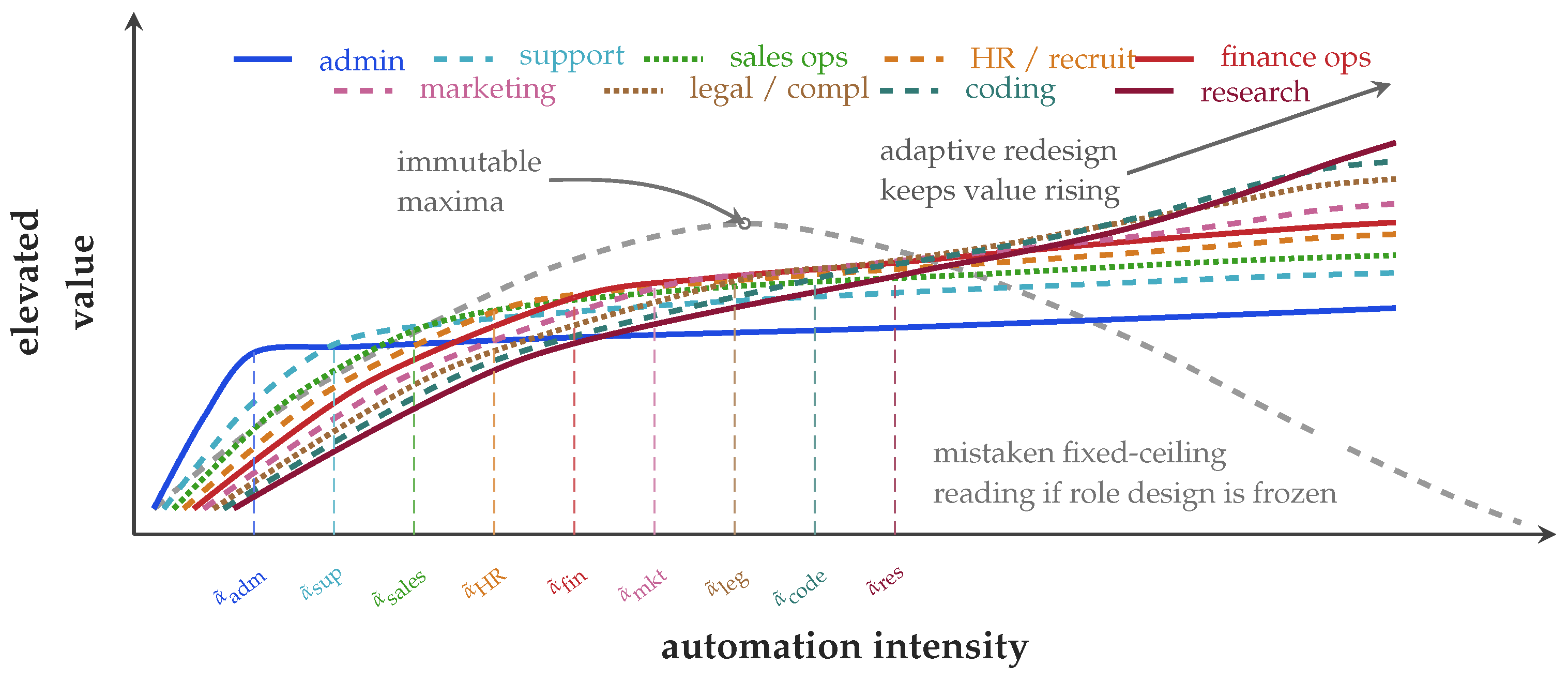
From fixed ceilings to moving frontiers. The gray dashed arc shows the mistaken frozen-role reading, with its peak marking the immutable-maximum interpretation. Colored curves show design-sensitive role paths, and the vertical markers are local redesign checkpoints rather than immutable maxima.
Figure 1.
From fixed ceilings to moving frontiers. The gray dashed arc shows the mistaken frozen-role reading, with its peak marking the immutable-maximum interpretation. Colored curves show design-sensitive role paths, and the vertical markers are local redesign checkpoints rather than immutable maxima.
1. Introduction
Across the AI economy, a managerial default is hardening: once a role is shown to contain draftable, classifiable, or otherwise model-addressable tasks, it is increasingly treated as cuttable headcount. Exposure is translated—publicly, strategically, and financially—into elimination. Reuters updated a running factbox of AI-linked layoffs in April 2026, while Challenger, Gray & Christmas separately tracked AI as a stated reason in 54,836 announced U.S. job cuts during 2025 and 12,304 more by the end of February 2026 [1,2,3]. This trend is sharpened by a financing logic. As demonstrated by recent restructuring cases across the technology sector, labor cuts are increasingly functioning not only as direct task automation, but as a capital-reallocation mechanism to self-fund AI infrastructure and AI-linked go-to-market expansion [4,5,6,7].
The core analytical mistake in this layoff-first approach is treating task exposure as job destiny. Exposure maps successfully identify routinized task bundles, but they fail to account for the work that remains, expands, or newly emerges once AI is embedded into a workflow. When AI absorbs the clerical first pass, it reveals an elevated human layer comprised of contextual judgment, exception handling, cross-functional coordination, trust repair, and the assumption of liability. Furthermore, what organizations often perceive as a role’s final automation ceiling is typically a local bottleneck caused by a frozen job design. With widened decision rights, deliberate workflow redesign, and new human-owned task creation, the frontier of human value can continuously shift outward [8,9,10].
We argue for a rebuttable presumption against AI-attributed layoffs: firms must elevate high-risk roles through targeted redesign before eliminating headcount. Rather than treating AI automation as a mandate for immediate workforce reduction, organizations must first systematically capture a role’s “elevation space”—reallocating released routine substrate upward into more accountable human work.
This paper advances four linked claims to reorient how the AI community evaluates deployment success. Descriptively, we show that exposure scores identify vulnerable subsets of work rather than whole-job obsolescence. Analytically, we formalize the tension between displacement pressure and elevation space, demonstrating that an apparent maximum in elevated value is highly sensitive to design choices. Normatively, we establish the elevate-first rule, a governance standard requiring firms to demonstrate rigorous attempts at redesign, paid upskilling, and apprenticeship preservation before declaring a role redundant. Finally, to bridge the gap between labor theory and AI deployment practice, we operationalize this framework for the machine learning community. We propose the Workplace AI Transition Card as a standardized reporting artifact for field studies and organizational audits, and introduce the Elevation Impact Factor (EIF) as a composite profile to track oversight burden, novice lift, and frontier movement. If AI success continues to be narrativized exclusively as payroll compression, the industry will optimize for brittle substitution. By shifting the evaluative focus toward worker elevation and long-term epistemic resilience, this framework provides a rigorous basis for deploying AI that expands reliable human capability.
2. The New Financing Logic: AI Is Increasingly Being Paid for Through Labor Reallocation
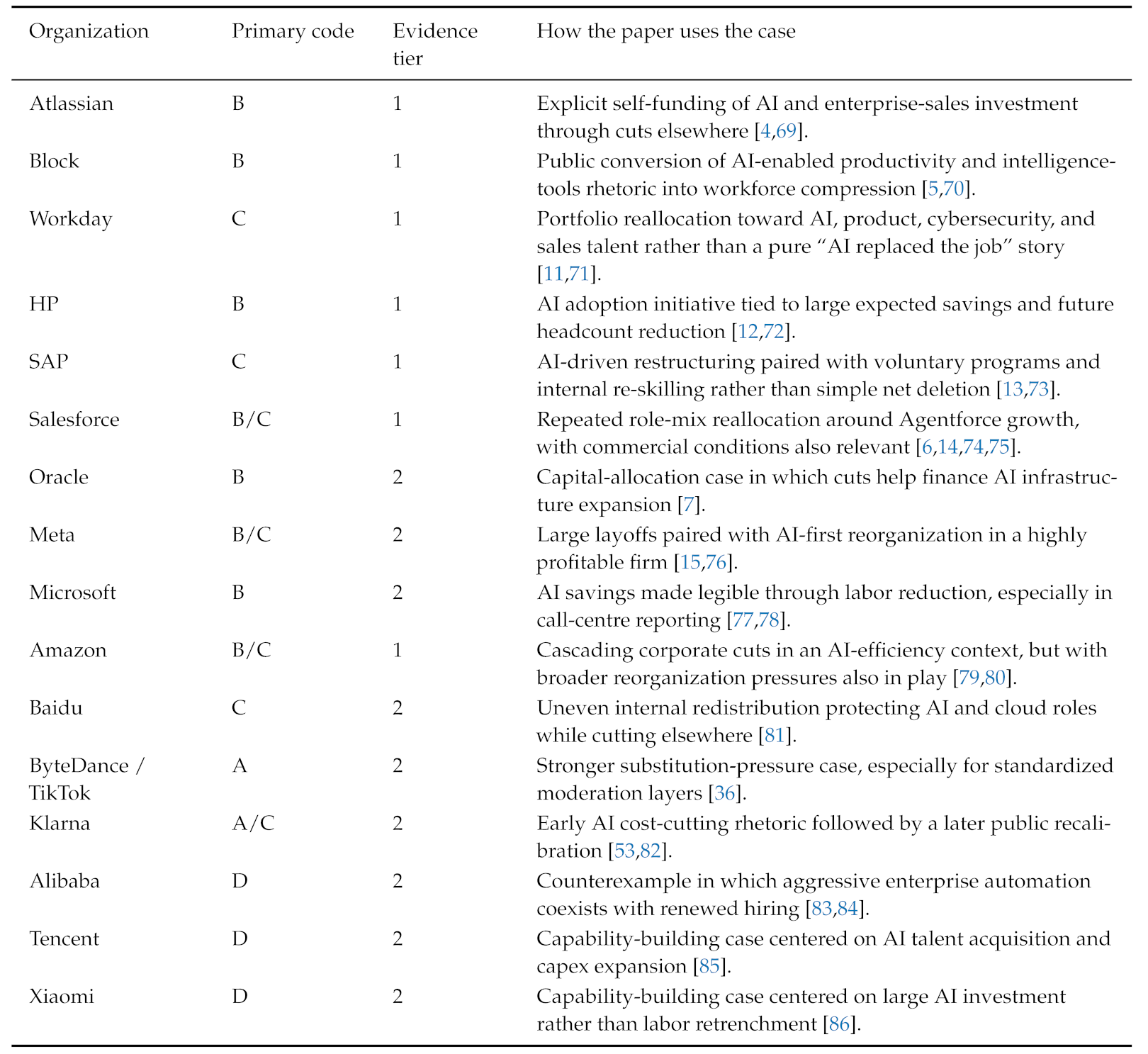
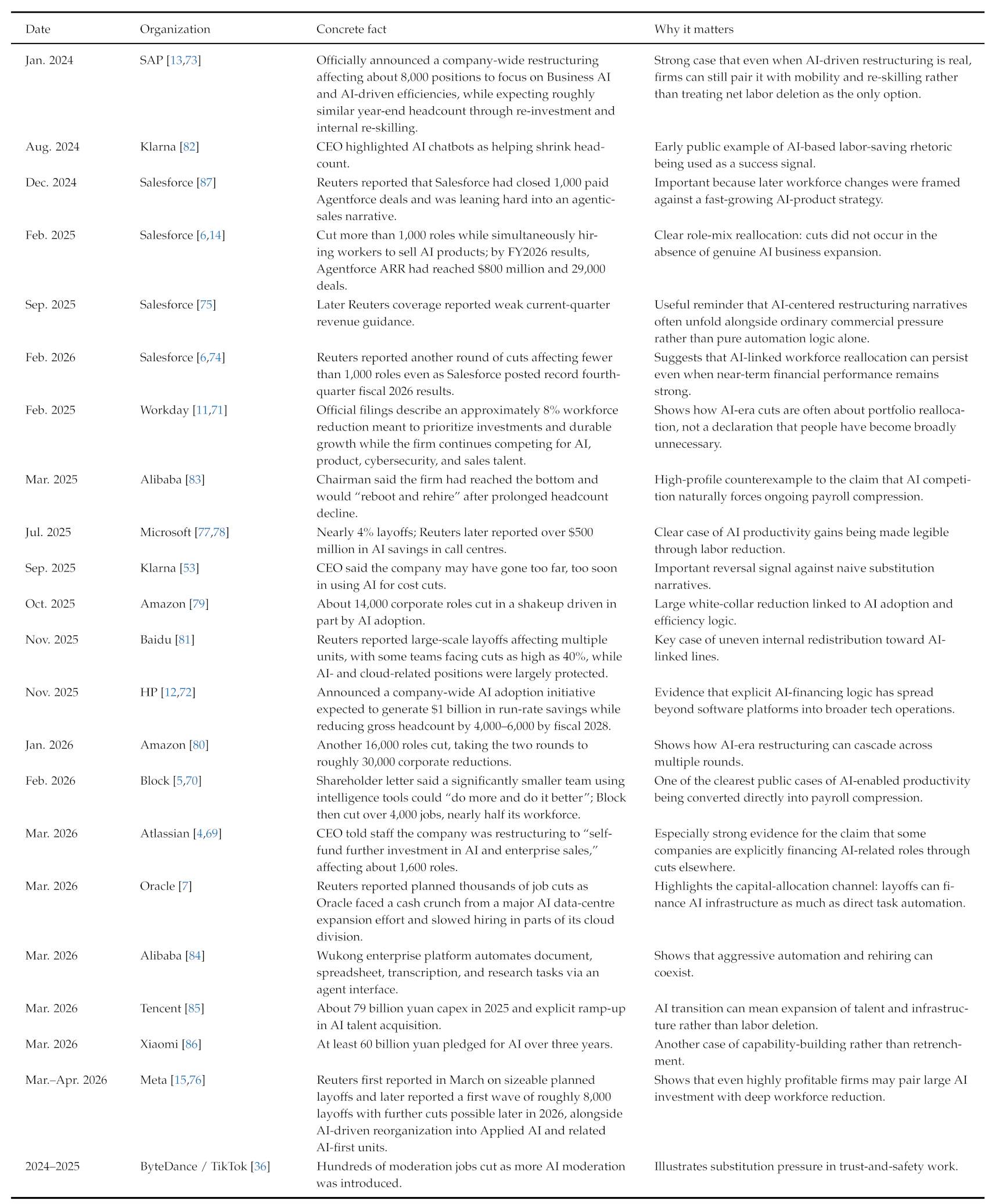
A stronger version of the layoff-first case has now become visible. For several firms, payroll savings and role reshuffling are being explicitly used right now to self-fund AI capacity and AI-linked go-to-market expansion. Recent restructuring cases at Atlassian, Block, Workday, HP, SAP, Salesforce, Oracle, and Meta demonstrate that labor cuts are increasingly functioning as a capital-reallocation mechanism rather than pure task automation [4,5,6,7,11,12,13,14,15]. To avoid conflating distinct mechanisms, Appendix I codes the company evidence into four classes: direct automation displacement, AI-financing or role-mix reallocation, mixed restructuring, and counterexamples with rehiring or re-skilling. Appendix J then provides the extended catalog of cases.
This distinction matters because it changes the burden of proof. When firms openly state that cuts are being used to finance AI or rebalance toward AI-linked growth, the relevant question is no longer whether AI played some background role. It clearly did. The relevant question becomes whether payroll compression was the least-destructive financing instrument, whether the newly funded roles could have been filled through internal mobility, and whether the firm attempted to convert released routine work into elevated ownership before eliminating the people who held that work. In other words, once AI becomes part of the financing story, AI governance must evaluate transition design, not only model performance.
We therefore do not claim that all AI-linked layoffs are fictitious, nor that every cut announced alongside AI spending is pure opportunism. Some cases are explicit self-funding moves; some are mixtures of real technological reallocation and ordinary restructuring; some combine large cuts with internal reskilling or renewed hiring in adjacent areas. But that heterogeneity strengthens rather than weakens the elevate-first position. When the financing and skill-mix logic is real, the need for role-specific frontier measurement, transition disclosure, and apprenticeship preservation becomes more urgent, not less. Recent theory sharpens the point: competition can produce an automation arms race in which firms rationally over-displace labor relative to the social optimum, even when they understand the demand-side harms of doing so [16]. A presumption against AI-attributed layoffs is therefore not an appeal to nostalgia. It is a governance response to a live strategic equilibrium.
3. From Exposure to Elevation Space
3.1. Exposure indices identify vulnerable task bundles, not whole-job destiny
The exposed-role evidence is real and should not be minimized. GPT-style systems affect a large share of white-collar task bundles across the labor market [17]. The ILO finds that clerical occupations are the most exposed, while professional and technical work is increasingly exposed as systems improve; yet it also concludes that most exposed jobs are more likely to be transformed than eliminated [18,19]. OECD work similarly shows that highly exposed occupations include administrative assistants, accountants and financial analysts, software developers, managers, and HR professionals, but that the skill demand in those roles is already broader than raw automation narratives imply [20]. The World Economic Forum likewise reports that routine clerical roles, administrative assistants, and accountants are under pressure, even as employers simultaneously report rising demand for more analytical, managerial, and technology-complementary capabilities [21,22].
The problem is how these exposure signals are used. In both popular reporting and internal management rhetoric, exposed roles are often treated as if their economically meaningful content were exhausted by the routine slice that current models compress. But jobs are not single tasks. They are bundles of production, assurance, escalation, communication, coordination, and accountability. The task-based literature has made this point for years: technological change usually displaces some tasks while reinstating others and changing the boundary between them [23,24,25]. Current generative AI evidence strengthens rather than weakens that logic.
3.2. The overlooked layer is the elevated human layer
Once AI handles the first pass, the remaining human work does not disappear. It often changes level. Current AI can draft a response, generate variants, write boilerplate, summarize a dossier, propose code, or screen a set of candidates, but someone still has to own policy fit, exception handling, contextual judgment, stakeholder trust, and the consequences of being wrong. That “elevated” layer is not a moral decoration around the system. It is part of the production function.
Evidence from multiple domains points in this direction. Generative AI often lifts less experienced workers most on tasks within the model’s capability frontier [26,27,28,29]. Dell’Acqua et al. show that knowledge workers perform better with AI on tasks inside a jagged technological frontier but can do worse outside it, which implies that human value shifts toward recognizing frontier boundaries, validating outputs, and taking responsibility for outside-frontier cases [30]. Anthropic’s large-scale Claude usage evidence likewise suggests a mixed pattern of automation and augmentation rather than replacement [31]. In other words, the question is not whether AI touches a role, but how much judgment-heavy, exception-heavy, and coordination-heavy work surrounds the part that AI touches.
This reframing is especially important for roles that many observers now describe as disposable. Consider HR, marketing, sales, administration, legal, coding, and research. In each case, AI compresses a real substrate of search, drafting, formatting, scheduling, or boilerplate production. But in each case, the remaining work can be elevated upward into more valuable functions: calibration, orchestration, experimentation, architecture, synthesis, and institutional accountability. The fact that this elevated layer is less routinized is exactly why it is easy to miss in exposure scores and easy to destroy in layoff-first restructuring.
3.3. The frontier itself is endogenous
The larger correction is that the frontier is not fixed. Many discussions implicitly assume a one-shot hump: AI first raises the value of the remaining human layer, then eventually drains it. Recent organizational evidence points to a more dynamic process. The World Economic Forum argues that the larger gains from AI come from end-to-end workflow redesign rather than isolated use cases, and its 2026 organizational-transformation synthesis reports that only a small minority of organizations are yet redesigning work at that depth [32,33]. Recent theory points in the same direction. Agrawal et al. model AI that enhances worker productivity without automating tasks; Demirer et al. show that AI changes how steps are chained into tasks and jobs; Farach argues that coordination compression can generate endogenous task creation; and Loaiza and Rigobon find that tasks emerging in 2024 are more human-intensive on their EPOCH measure [8,9,10,34]. The IMF likewise stresses that technological change creates new tasks or occupations and that the diffusion of new skills requires worker movement across occupations and regions [35].
This matters for governance. A first observed plateau in a role is often a local organizational bottleneck—a sign that the role has not yet been redesigned far enough—not proof that the elevated layer must now shrink. Some roles will still face genuine displacement pressure. But the burden of proof should rest on the claim that the frontier cannot be moved further, not on the assumption that the first apparent ceiling is technologically final.
4. Local Ceilings, Moving Frontiers, and Design Capacity
We model a role family r as a bundle of four value-weighted task masses: routine substrate , judgment and problem framing , exception and oversight work , and coordination or relational work . Let automation intensity index the degree to which a workflow’s routine substrate has been delegated to AI, and let index feasible redesign choices and transition investments for role family r, including workflow redesign, widened decision rights, paid upskilling, service expansion, and apprenticeship preservation. For empirical use, we recommend measuring all task masses in either value-weighted weekly labor minutes or normalized shares of total weekly task mass, with the unit held fixed within a study. The purpose of the notation is not to imply universal parameter values. It is to define estimands that can be approximated from workflow logs, time-allocation audits, escalation records, quality reviews, and redesign documents over a stated observation window.
AI primarily compresses , but deployment can also expand or reveal additional higher-level human work , , and , while also creating new human-owned task mass through model steering, quality assurance, customer recovery, knowledge curation, cross-functional coordination, and newly viable service scope [8,9,10,25,35]. We therefore define the role’s elevation space (that is, the share of released routine substrate that can plausibly be reallocated upward into more accountable human work) and the corresponding displacement pressure as shown in Equation 1:
If is large, AI can shrink drudgery while preserving or deepening the human role through redesign. If remains large even after serious redesign attempts, then genuine shrinkage pressure may exist. Under this interpretation, and are workflow-level estimands. A firm should therefore disclose the baseline window used to estimate pre-deployment task mass, the post-stabilization window used to estimate task reallocation after deployment, and the evidence sources used to classify routine, elevated, and newly created work. Appendix B provides a cross-role estimation template, and Appendix C works through one customer-support protocol.
A narrow, frozen job design may still generate a local ceiling. Let the role’s local redesign checkpoint under design state d, and the best frontier attainable over feasible redesigns, be defined respectively as:
The checkpoint is the largest automation intensity for which the role can still be elevated fast enough under that specific design. But the relevant governance object is not just for today’s narrow job description; it is the best frontier attainable over feasible redesigns. Job cuts may indeed occur beyond for a frozen design . But that should be read as evidence that the role has reached a local bottleneck, not automatically as proof that the role has no further future. Under successful redesign, the realized elevated value need not peak at all over the relevant automation range; it can plateau, kink upward, or continue rising.
4.1. A workflow-level estimation protocol
The most important empirical question is not whether a role is exposed in the abstract, but whether redesign captures the released routine substrate in practice. A workable protocol has five steps. First, decompose the workflow into tasks and record current decision rights, escalation points, and quality gates. Second, estimate released routine substrate from the reduction in human time spent on draftable, classifiable, retrievable, or otherwise first-pass work after deployment. Third, estimate captured elevation from newly observed time in judgment, exception handling, coordination, and newly created human-owned tasks. Fourth, measure oversight burden directly rather than treating it as invisible residual labor. Fifth, re-measure service quality, error severity, novice progression, and internal mobility before drawing a redundancy conclusion. The point is not to force one universal metric on every workplace. It is to make the burden of proof concrete enough to audit.
Table 1 summarizes the frontier logic for the main role families discussed in the paper.
5. High-Risk Role Families and Worked Elevation Paths
To keep the argument concrete, we use three running examples in the main paper—recruiting coordination, junior software engineering, and customer support—because they span people operations, technical production, and service work while remaining concrete enough to audit. Appendix A catalogs additional role families, Appendix D adds executive-assistance and research-analysis examples, and Appendix C gives one workflow-level protocol in more operational detail. The point is not that every exposed role can be preserved. It is that many roles cannot be evaluated honestly without first testing whether redesign captures the routine substrate.
Worked example 1: Recruiting coordination. A recruiting coordinator’s role shrinks if leadership treats it as a throughput machine after AI compresses scheduling and outreach drafts; however, if treated as talent architecture, the role can move upward into interviewer calibration, candidate-experience design, and internal mobility support. The elevated coordinator helps hiring managers refine job requirements dynamically, identifies edge cases that automated screening misses, and becomes partially responsible for whether the interview funnel is fair, interpretable, and useful.
Worked example 2: Junior software engineering. Reducing boilerplate and search-heavy debugging provides the capacity for juniors to shift toward supervised architecture mapping, system integration, code review participation, and reliability work [28]. Instead of spending hours writing redundant unit tests, junior developers can be mentored on evaluating AI-generated code for security vulnerabilities, on understanding how local patches affect system boundaries, and on learning the reliability consequences of seemingly small changes.
Worked example 3: Customer support. Agent acceleration and generative routing [26] should purposefully redirect human time from simple queries toward complex escalations, retention saves, empathetic intervention, and knowledge-base curation. Freed from copying and pasting FAQ answers, the support agent can resolve multi-layered customer frustrations, repair broken institutional trust, and identify systemic product flaws that are invisible when support is treated as a narrow ticket-closing function. Appendix C shows how this case can be measured without relying on stylized percentages.
A useful boundary case is a narrow, highly standardized queue with low discretion and little service-recovery scope. These are the settings in which a rebuttal is most likely to succeed after redesign attempts, because the room to widen decision rights or create new human-owned task mass may truly be limited. Reported shifts toward AI-heavy moderation at ByteDance/TikTok are at least consistent with this lower-frontier class [36]. The point is not that such cases do not exist. It is that firms should have to show that a role belongs to this class rather than infer it directly from exposure. What matters is not whether a role is broadly exposed, but whether the firm has honestly tested frontier-moving redesigns and adjacent transfer opportunities. A local ceiling appears not when AI can complete the clerical first pass, but when the organization has stopped expanding the higher-discretion work around it. Further detailed breakdowns across exposed role families are cataloged in Appendix A.
6. The Elevate-First Rule
By AI-attributed layoffs, we mean reductions justified by AI-driven efficiency or reallocations specifically meant to fund AI growth. Such layoffs should face a rebuttable presumption, requiring firms to pass an elevate-first test encompassing six core rules to demonstrate responsible transition governance. We propose that this test be instantiated as a compact Workplace AI Transition Card: a reporting framework for field studies, board materials, and public disclosures. The framework does not settle normative questions on its own, but it makes the transition legible enough to audit.
Rule 1: Task-level proof. Firms must decompose automation claims into changed task boundaries, residual human accountability, and newly created oversight layers instead of relying on role-level slogans. This requires a precise accounting of what the AI system reliably handles, what exceptions it predictably generates, and which human workers are ultimately responsible for validating the outputs and assuming the liability of errors.
Rule 2: Paid upskilling. Firms must offer paid upskilling by providing structured, on-the-clock domain and AI-literacy training [20,32,37,38,39]. Rather than merely offering optional after-hours course libraries, organizations must actively invest in teaching affected workers how to orchestrate these new systems, evaluate their outputs, and redesign their own daily workflows.
Rule 3: Internal mobility. Wage-protected pathways to adjacent elevated work, such as quality assurance or AI-system supervision, must be guaranteed before executing layoffs. If the routine production in one department shrinks permanently, the firm must map the displaced talent to areas where human oversight is expanding, treating internal redeployment as a primary operational objective rather than an afterthought.
Rule 4: Apprenticeship preservation. Organizations must redesign junior roles for supervised judgment instead of collapsing the talent pipelines through which future experts are formed [22,26,40,41,42]. If entry-level execution is automated, firms must deliberately construct new cognitive scaffolding, allowing junior employees to safely learn the underlying causal logic of their domain while managing AI tools under senior mentorship.
Rule 5: Worker consultation. Active worker consultation is required to map failure modes, transition metrics, and required redesigns in direct dialogue with frontline staff. Frontline operators possess the tacit knowledge required to identify where AI models confidently fail in practice; their input is indispensable for designing realistic transition plans and ensuring that safety and service quality do not quietly degrade.
Rule 6: Financing transparency. Firms must ensure financing transparency by disclosing the full financing chain and the alternatives considered if claiming that cuts are necessary to fund AI investments. When headcount reductions are explicitly framed as a mechanism to self-fund AI infrastructure or product teams, the company must demonstrate that it exhausted less destructive cost-saving measures—such as contractor rationalization or phased capital expenditure—first.
Table 2 synthesizes these requirements into a practical disclosure format.
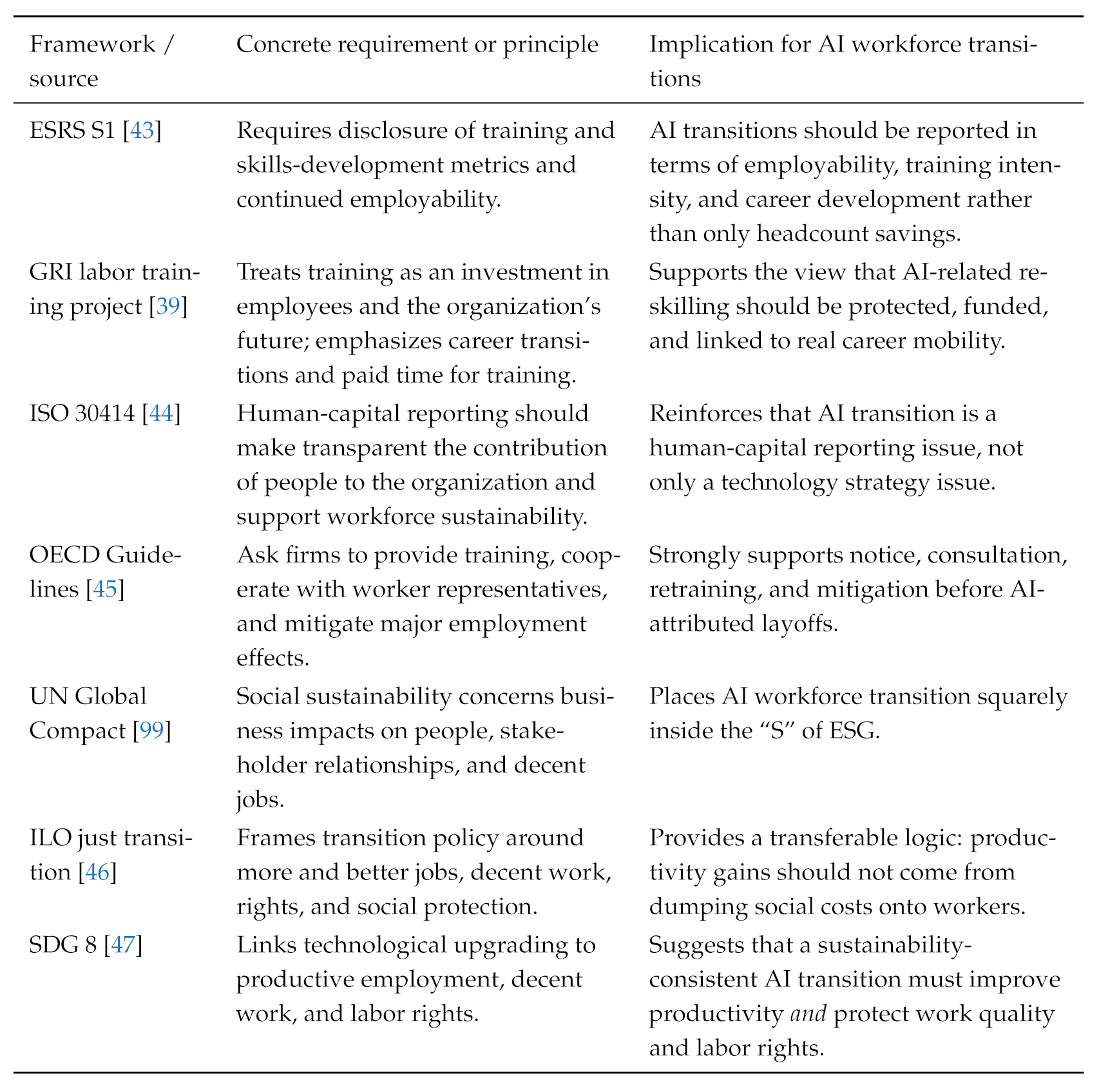
This standard is economically sound and aligns natively with core ESG and human-capital frameworks [39,43,44,45,46,47]. Replacing experienced local knowledge with external hires is a wasteful loop in tight talent markets [20,37,38]. Alternatively, utilizing staged capex, slower backfills, or transition reserves to fund redeployment acknowledges that AI-powered wages and revenue often rise concurrently [48]. Short-term cost discipline should not be allowed to obscure the long-run losses in skill formation, trust, and adaptive capacity when firms bypass redesign for immediate payroll compression [4,5,7,12].
The position is also falsifiable in a concrete sense. It would weaken if firms could show, across broad role classes, that post-deployment workflows sustain quality, trust, safety, apprenticeship formation, and organizational adaptability even after substantial role deletion; or if elevate-first firms systematically underperform layoff-first firms on both productivity and resilience. Appendix O states the fuller conditions.
7. Alternative Views
These alternative views are not peripheral objections. They identify the precise conditions under which the rebuttable presumption should fail, narrow, or be qualified.
View 1: What if adaptive frontiers are genuinely low?
In hyper-optimized, low-margin sectors, the cost of retaining staff for marginal oversight may exceed the economic value of the elevated tasks. Some transactional clerical layers and heavily standardized queues may hit their adaptive frontier quickly. Response: Elevate-first does not deny this; it requires firms to show, with task-level evidence, that redesign and adjacent transfer were seriously attempted before elimination, and that they are pointing to a genuinely low adaptive frontier rather than to a frozen local bottleneck. When the frontier is genuinely low, the emphasis should shift to structured severance and external transition support rather than artificial job preservation. Narrow moderation or FAQ queues are the clearest candidates for this lower-frontier class [36].
View 2: Does role redesign concede first-mover advantage?
Organizations argue that delaying workforce restructuring to execute complex role redesigns cedes first-mover advantage to more aggressive rivals. Markets move fast, and firms may argue they cannot afford friction. Response: Rapid AI integration without capability retention can yield brittle systems. Durable advantage often relies on the contextual knowledge embedded in the retained workforce, especially when models require ongoing policy adaptation, exception handling, and service recovery. Recent theory also suggests that competition itself can produce an automation arms race that overshoots the socially efficient level of displacement [16,32].
View 3: Doesn’t this simply delay the hollowing out of middle management?
Critics might contend that elevate-first merely delays the inevitable hollowing out of middle management. If routine reporting and coordination are automated, the remaining oversight roles may be too few to absorb the displaced middle layer. Response: The framework addresses this by redefining middle management: if a middle layer is automated, the relevant question is what higher-order ownership remains—cross-functional risk orchestration, exception governance, and continuous AI alignment—effectively shifting the value proposition from operational bottlenecks to strategic control.
View 4: Does this mandate the retention of low-value jobs?
Skeptics warn that mandating role elevation could institutionalize low-value monitoring roles where humans are kept merely to watch capable agents out of compliance rather than necessity. Some firms may also use AI as a convenient narrative for ordinary restructuring. Response: Both points reinforce the need for rigorous disclosure. The framework is not a blanket jobs guarantee; it asks firms to distinguish high-value oversight and exception handling from needless bureaucracy, ensuring that preserved roles genuinely contribute to institutional accountability.
View 5: Should AI-enabled flexible work be the default mode instead?
Another perspective suggests that rather than full-time redesign, the residual elevated tasks should facilitate a transition toward alternative employment models. As routine tasks compress, AI-enabled flexible work could naturally become the default mode for knowledge work [49]. Response: This allows firms to retain essential human oversight, institutional memory, and complex reasoning capabilities on a fractional or decentralized basis rather than executing binary layoffs or forced full-time retention.
View 6: What if exposed workers cannot or do not want to elevate?
A fundamental assumption of the elevate-first rule is that workers in highly exposed roles possess the baseline capacity or desire to transition into judgment-heavy, orchestrating roles. Detractors argue this ignores the reality of varied worker aptitudes and preferences; not every administrative assistant wants to become a workflow architect. Response: Transition frameworks should therefore account for horizontal mobility into high-touch, AI-resistant, or differently skilled roles rather than assuming that every worker should move vertically into the same kind of elevated work.
8. Broader Implications for AI Evaluation and Deployment
If the elevate-first position holds, organizations must rethink how they define “beneficial AI.” Currently, AI is evaluated largely by automation rates, benchmark scores, and raw throughput. For the broader industry ecosystem, this implies a necessary shift: workplace AI should be evaluated by worker elevation, frontier movement, and long-term sustainability.
First, evaluations should capture oversight burden: the monitoring, verification, escalation, and accountability work that safe deployment inevitably creates. A benchmark that ignores these residual costs systematically overstates substitution potential. We therefore recommend a reporting profile rather than an unqualified single-number story. For a deployment d, let the core profile be
where is novice lift, is quality improvement, is redeployment capacity, is role-frontier movement, is oversight burden, and is entry-ladder loss. Where a single internal comparison score is useful, that profile can be scalarized as an optional Elevation Impact Factor (Equation 3):
with the important caveat that the substantive recommendation is the disclosed profile and its components, not the claim that a universal scalar can settle redundancy decisions. The weights should therefore be pre-registered or at least justified, and the component metrics should always be reported alongside the scalar.
Second, reporting should capture the financing topology of deployment. Did productivity gains fund service improvement, worker elevation, and broader access, or were they immediately translated into payroll compression used to finance AI investment? By analogy to model cards, datasheets, and internal audit documentation in ML [50,51,52], we propose a Workplace AI Transition Card as a standardized reporting framework for workplace deployments. Internal audits and industry case studies should report which role bundles are accelerated, which human responsibilities remain, whether the deployment moved the frontier outward, what oversight burdens were introduced, whether junior pathways were preserved, and whether the gains support redesign or merely justify substitution.
9. Operationalizing Workforce Elevation - A Research Agenda
To operationalize the elevate-first framework, organizations must pursue a targeted agenda focused on capability measurement, longitudinal evaluation, interface design, and epistemic resilience. For rigorous empirical evaluation, this means reporting oversight burden, novice lift, apprenticeship effects, redeployment pathways, and whether measured performance gains came from redesign or from role deletion elsewhere.
First, organizations should prioritize the development of frontier-aware metrics that estimate elevation space, residual displacement pressure, frontier movement, and supervision burden at a granular, role-specific level. Rather than evaluating AI purely on benchmark completion of isolated tasks, analysts should design evaluation protocols that distinguish local bottlenecks from genuinely low adaptive frontiers and that measure the specific human capital required to oversee, correct, and orchestrate these models in production.
Second, internal evaluations should shift from short-term throughput analyses to longitudinal tracking of workforce dynamics. This involves tracking redeployment flows, the preservation of entry-level apprenticeship ladders, the evolution of decision rights over time, and whether the observed frontier keeps moving after initial deployment. By observing self-evolving evaluation and deployment protocols within live agentic workflows, longitudinal studies can map how human expertise evolves alongside continuous model updates.
Third, there should be tighter integration between system design and labor strategy. Interfaces should be explicitly designed to scaffold the transition from routine execution to supervised judgment, providing workers with the telemetry needed to act as effective operators. Concurrently, economic analyses of AI transitions should incorporate comprehensive transition accounting, comparing the true cost of immediate layoffs against alternatives like phased capital expenditure or transition reserves.
Fourth, organizations must monitor their long-term epistemic resilience when aggressively compressing their cognitive substrate. As AI absorbs the foundational layers of drafting and analysis, firms risk eroding the uncodified, tacit knowledge that workers traditionally acquire through routine practice. Future evaluations should model the capability friction necessary to sustain human mastery, exploring how deliberate cognitive scaffolding can be integrated into AI architectures and deployment routines to prevent institutional forgetting at the frontier.
10. Conclusion
The wrong question for an AI transition is not “how many workers can now be removed?” but “how much of the released routine substrate can be converted into more accountable human work, how far can the frontier still be moved, and how is the transition being financed?” Firms should elevate high-risk roles before executing AI-attributed layoffs by redesigning jobs upward, funding paid upskilling, preserving apprenticeship ladders, opening wage-protected internal mobility, and disclosing when labor cuts are being used to finance AI investment. The deeper choice facing industry is between narrow productivity accounting—which converts AI gains quickly into headcount reduction while obscuring transition costs—and sustainable productivity, which uses those gains to build robust organizational capability. The necessary correction is therefore conceptual as much as policy-oriented. A first apparent ceiling is often a local redesign checkpoint, not a final technological verdict. Layoff-first AI strategy is a managerial choice, not a technological inevitability. An elevate-first presumption helps steer deployment toward expanding reliable human expertise rather than simply compressing payroll, and it keeps organizations focused on the harder but more valuable task: moving the frontier outward instead of declaring it closed.
Acknowledgments
Funding in direct support of this work: RIE2025 Industry Alignment Fund (Award I2301E0026) and the Alibaba–NTU Global e-Sustainability CorpLab.
Appendix A. Extended Role Catalog
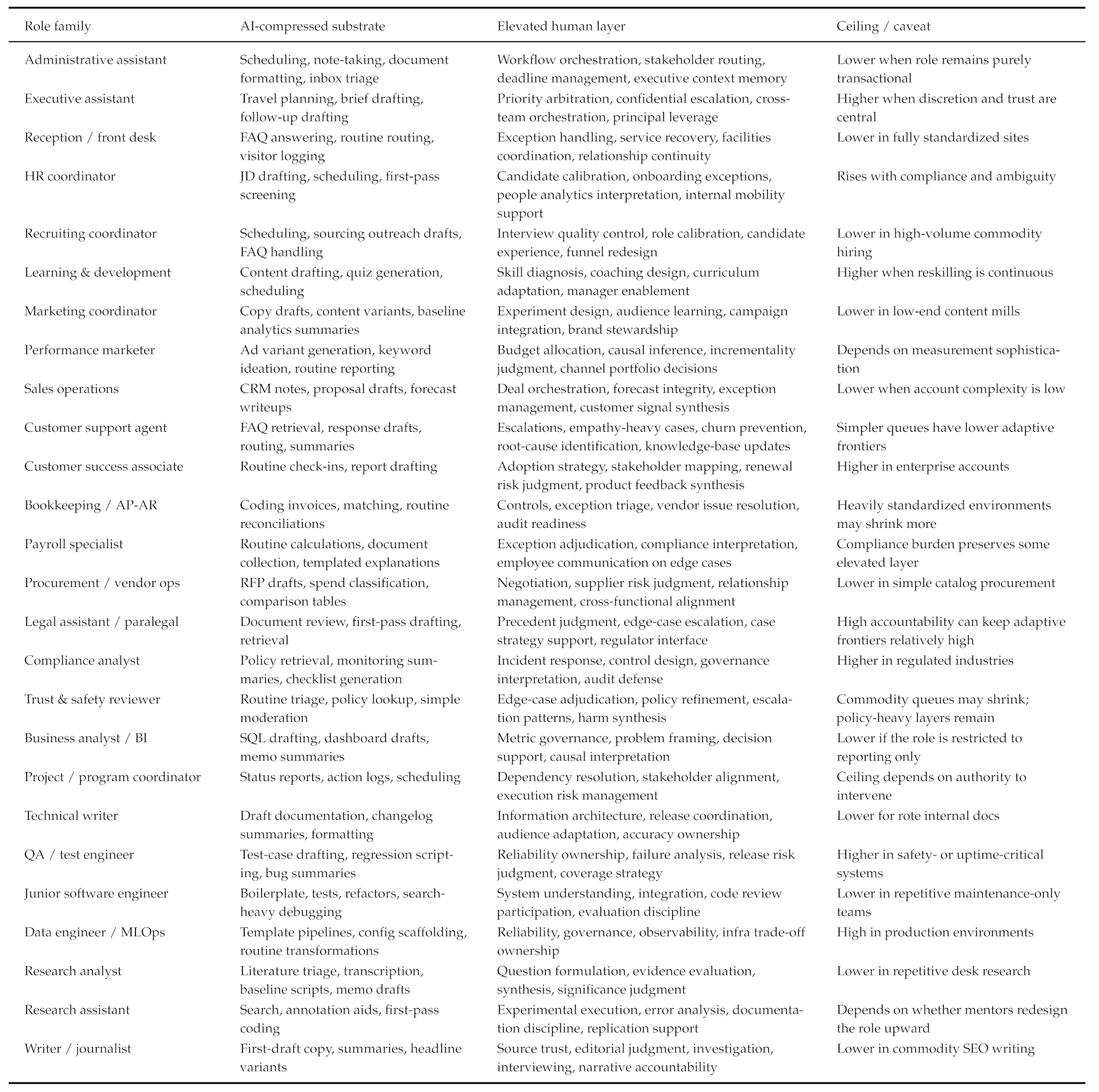
The roles in Table Appendix A are drawn from occupations commonly flagged as exposed in ILO, OECD, WEF, and GPT-based exposure analyses, combined with our elevation-frontier lens [17,18,19,20,21,22]. The point is not that every role can be preserved intact. It is that many exposed roles still contain a meaningful elevated layer that is ignored when exposure is treated as destiny.

Table A1.
Broader catalog of exposed roles and their potential elevation space.
 |
Appendix B. Workflow-Level Estimation Template
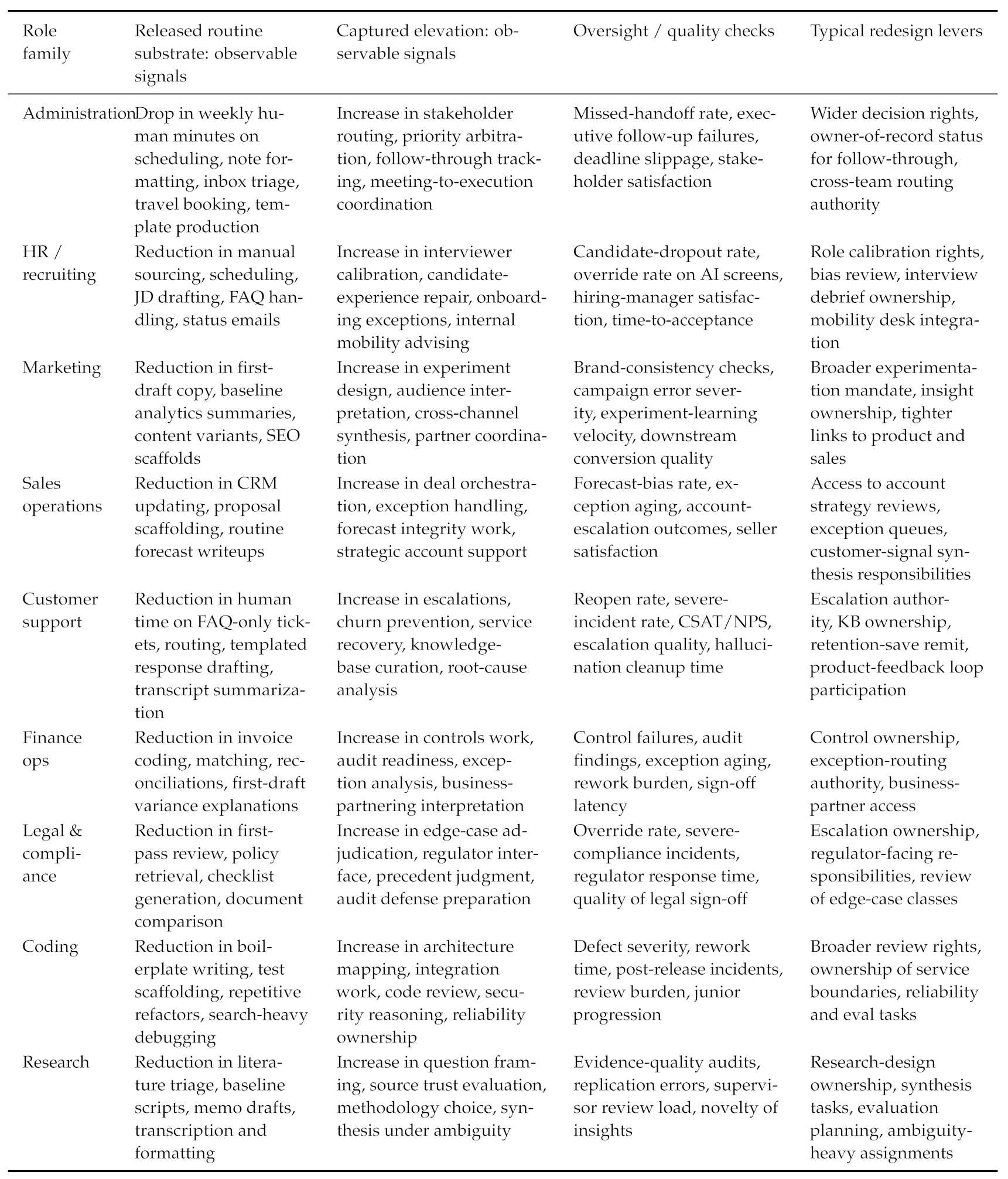
The earlier stylized simulation table is replaced here with an operational template. The point is not to assign universal percentages to roles. It is to show what should be observed, logged, and compared before a firm concludes that a workflow has reached a genuine adaptive frontier. Table Appendix B translates the main-text notation into observable workflow evidence.
Table A2.
Workflow-level estimation template for the main role families. The point is to operationalize what should be measured before claiming a role has reached a genuine adaptive frontier.
Table A2.
Workflow-level estimation template for the main role families. The point is to operationalize what should be measured before claiming a role has reached a genuine adaptive frontier.
 |
Appendix C. Illustrative Workflow Audit: Customer Support
Customer support is a useful anchor workflow because it combines routinized first-pass work with clearly auditable escalation, retention, and service-recovery layers. The protocol below is deliberately operational: it asks what a firm would have to measure before it could credibly claim that a support layer had reached a genuine adaptive frontier.
Figure A1.
Workflow-transition decision pipeline. A credible redundancy claim should come only after the workflow has been mapped, measured, redesigned, and re-measured.
Figure A1.
Workflow-transition decision pipeline. A credible redundancy claim should come only after the workflow has been mapped, measured, redesigned, and re-measured.
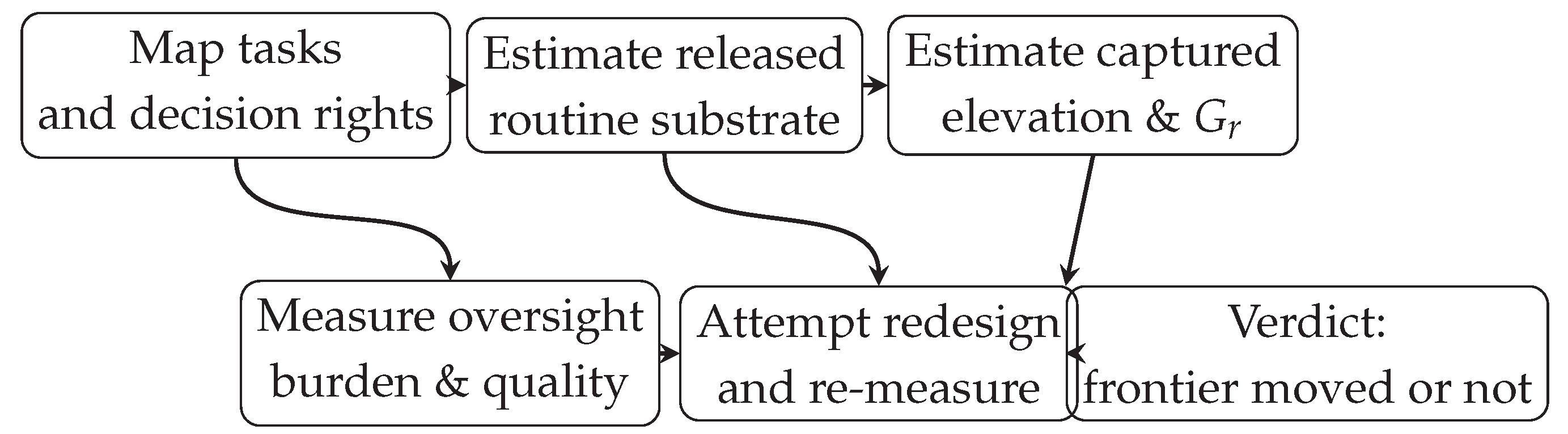
Table A3.
One workflow-level protocol for operationalizing the main-text constructs. The key move is to estimate released routine substrate, captured elevation, and oversight burden from auditable traces rather than from stylized role percentages.
Table A3.
One workflow-level protocol for operationalizing the main-text constructs. The key move is to estimate released routine substrate, captured elevation, and oversight burden from auditable traces rather than from stylized role percentages.
| Construct | Observable definition in customer support | Typical evidence source |
|---|---|---|
| Released routine | Reduction in weekly human minutes on FAQ-only tickets, simple routing, templated replies, and transcript summarization after rollout | Ticket timestamps, handle-time logs, queue tags, time-motion audit |
| Captured judgment | Increase in human time on retention saves, exception resolution, ambiguous policy decisions, and root-cause diagnosis | CRM outcomes, escalation tags, save-rate workflows, manager review notes |
| Captured oversight | Increase in AI-output review, policy overrides, escalation validation, and severe-case ownership | QA review logs, override records, incident trackers |
| Captured coordination | Increase in cross-team handoffs, knowledge-base updates, callbacks to product or operations, and follow-through on recurring defects | Knowledge-base edit history, issue tracker, cross-functional tickets |
| New human-owned tasks | Tasks created by deployment itself, such as prompt/eval maintenance, gap analysis, escalation taxonomy upkeep, or service-recovery playbook maintenance | Evaluation logs, documentation repos, quality-program records |
| Oversight burden | Review time, hallucination cleanup, false escalations, duplicated contacts, and rework introduced by the system | QA queue, reopen rate, duplicate-contact logs, postmortem records |
| Quality guardrails | Changes in reopen rate, severe-incident rate, CSAT/NPS, first-contact resolution, and complaint severity | Support analytics, trust-and-safety logs, customer-survey systems |
| Entry-ladder effects | Whether novice agents progress to higher-complexity queues, what supervisor load changes, and whether promotion pathways remain intact | Training logs, queue-allocation rules, mentor ratios, promotion records |
A support deployment moves the frontier outward only if released routine time is matched by captured elevation and new human-owned task mass without hidden deterioration in quality, safety, trust, or apprenticeship formation. In practice, that means using a disclosed baseline window, a disclosed post-stabilization window, and a redesign log that records what the organization actually changed between measurement rounds. The same logic can be adapted to recruiting, finance operations, coding, and other role families; the point of the support example is simply to show that the paper’s notation can be turned into an auditable protocol.
Appendix D. Additional Worked Examples
Executive assistance.
Automating baseline scheduling, note-taking, and travel planning allows the role to be redesigned into complex cross-team orchestration, priority routing, and context memory. A local ceiling only appears if the firm refuses to widen the role’s discretion. By delegating transactional scheduling to agents, the assistant becomes an information router who anticipates executive bottlenecks, manages stakeholder relationships, and ensures strategic follow-through on meeting outcomes.
Research analysis.
As AI absorbs literature triage and baseline drafting, the elevated human layer can expand into problem framing, methodological choice, source trust evaluation, and synthesis under ambiguity [30]. The analyst moves from data gathering toward epistemic gatekeeping, taking ownership of causal validity, source quality, and the interpretation of conflicting evidence.
Appendix E. Supplementary Discussion: How Firms Can Finance AI Without Defaulting to Layoffs
The strongest practical objection to elevate-first is budgetary: firms may say that models, compute, and product integration are expensive, so labor cuts are the only realistic source of funding. Recent cases from Atlassian, Block, HP, and Oracle make this objection concrete, because executives have explicitly or implicitly used labor cuts as a financing mechanism for AI expansion [4,5,7,12]. That logic is weaker than it first appears. The question is not whether AI investment is costly. It is whether layoffs are the best financing instrument once one accounts for hiring frictions, organizational memory, transition risk, and the value of preserving complementary capabilities. In labor markets where AI-relevant skills are scarce, firing experienced employees only to rehire adjacent talent later can be an unusually wasteful loop [20,37,38]. Even when a firm truly needs to reduce cost growth, it has more instruments available than immediate job deletion, and those instruments can buy time to move the frontier outward.
One instrument is time. Many firms can phase AI investment over several quarters and use natural attrition, slower backfills, and tighter external hiring to create budget room while redesign proceeds. Another is composition. Companies often spend heavily on contractors, duplicated software, consulting, real estate, or low-value coordination layers that can be reduced before eliminating workers whose local process knowledge is hard to replace. A third is allocation of gains. If AI reduces cycle time or expands service capacity, part of the resulting surplus can be booked into a transition reserve that funds paid training, wage protection, and temporary redeployment pools. That reserve is not charity; it is a way of converting short-run efficiency into long-run absorptive capacity.
The sequencing matters. When firms cut first and redesign later, they remove exactly the people most able to explain which steps can safely be automated, which customers or cases are atypical, where compliance risk sits, and what new roles should exist after deployment. By contrast, when firms keep workers in the loop during transition, they gain a richer source of local knowledge and a more credible path to adoption. This is one reason public-sector and sectoral responses are focusing on mobility and job redesign rather than only on replacement. The aim is not to freeze every role in place, but to avoid paying for AI by destroying the organizational complements that make AI useful.
Firms also have choices about what they do with the productivity that AI creates. One option is extractive: convert most gains into thinner payroll. Another is expansive: use those gains to raise service quality, shorten response times, widen product coverage, improve compliance, or move workers upward into judgment-heavy tasks. The expansive path is often under-appreciated because managers can count headcount savings immediately, whereas the value of better quality, stronger resilience, and broader capability arrives less theatrically. But that does not make the latter less real. Klarna’s public recalibration is instructive here: after aggressively leaning into cost-cutting narratives, its CEO later said the company may have gone too far, too soon [53]. That is exactly the kind of reversal we should expect when firms discover that customer trust, service quality, and organizational learning are complements rather than leftovers.
In other words, elevate-first is not a demand that firms ignore cost. It is a claim about cost accounting. The relevant comparison is not “layoffs versus no discipline.” It is “layoffs versus alternative financing and redesign strategies once transition costs are counted honestly.” On that comparison, layoff-first often looks less like necessity and more like the easiest item to justify on a spreadsheet because its savings are immediate while its long-run losses are organizationally diffuse. A stronger governance rule is therefore warranted precisely because the short-run accounting is biased toward visible payroll savings and against invisible losses in skill formation, trust, and adaptive capacity.
Appendix F. Supplementary Discussion: What Would Count as a Genuine Rebuttal?
Our claim is intentionally strong, so it should also be clear about what would count against it. An employer could legitimately argue for AI-attributed layoffs if it could show, with evidence rather than slogans, that a role family’s core responsibilities had truly contracted after accounting for oversight, exception handling, quality control, and accountability; that structured paid training and internal mobility had been offered and measured; that apprenticeship effects had been considered; and that service quality, trust, safety, and legal compliance were not being quietly offloaded onto a smaller residual workforce. In other words, the rebuttal standard is demanding but not impossible.
This standard is stricter than today’s public discourse, where it is often enough to announce that AI has improved productivity and then infer that labor is now dispensable. Productivity alone is not enough. A firm can become more productive and still owe stronger transition support to workers precisely because the productivity gain gives it more room to finance redesign responsibly. Nor is it enough to point to isolated successful automations. The relevant unit is the post-deployment workflow as a whole: what work disappeared, what work intensified, who now bears risk, and whether the organization has preserved the capacity to learn from mistakes.
A serious rebuttal would also need to reckon with distribution. If a firm’s AI deployment raises throughput but reduces junior hiring, weakens promotion ladders, concentrates remaining work into higher-stress exception handling, or shifts monitoring burdens onto a smaller set of employees, then the gain is not well described as simple efficiency. It is a redistribution of risk and opportunity inside the organization. That redistribution may sometimes be justified, but it should be named and defended rather than hidden behind a generic story that “AI can do more now.” This is exactly why human-capital and social-sustainability disclosure belongs near the center of the debate: it makes the transition legible enough to evaluate rather than merely admire.
The same logic clarifies why we frame elevate-first as a rebuttable presumption rather than an absolute prohibition. There will be cases in which a product line is closed, a workflow genuinely disappears, or a firm’s financial condition is too weak to support a long transition. But those are arguments for transparent exception handling, not for treating payroll compression as the default definition of AI success. The more visible and normalized AI-attributed layoffs become, the more important it is to distinguish a genuine rebuttal from a convenient managerial narrative.
Appendix G. Supplementary Discussion: Why Entry-Ladder Preservation Is a Technical Issue, Not Only a Social One
One reason the elevate-first rule may sound more radical than it is that many firms still treat entry-level work as expendable by default. But in AI-intensive organizations, the entry ladder is not merely a social obligation or a recruiting nicety. It is part of the technical capability stack. Junior roles are where firms build future evaluators, operators, managers, policy owners, and domain experts. If AI removes a large share of routine production from those roles, the right response is not automatically to delete them. The better response is often to redesign them so that juniors spend less time on mechanical production and more time on supervised verification, synthesis, escalation, and customer or stakeholder context. That is exactly the kind of redesign that lets AI broaden expertise rather than concentrate it [26,28,29,54].
The alternative is a brittle organizational structure in which firms keep a thinner layer of already-experienced workers while starving the pipeline that would produce the next cohort. That is risky even on narrow business grounds. Many AI deployments require persistent local adaptation: prompts change, interfaces evolve, policies shift, customer expectations move, and model behavior is non-stationary. Organizations need people who can learn these systems from the inside and gradually take on more judgment-heavy tasks. If the junior layer disappears, the firm can become dependent on external hiring for roles that used to be developed internally. In markets where AI-relevant talent is already scarce, that dependence is expensive and unstable [20,37,38].
Entry-ladder erosion is also a measurement problem. Public evidence already suggests that the pressure is real: the World Economic Forum reports a substantial global decline in entry-level postings, and the World Bank finds especially sharp reductions in substitutable entry-level white-collar roles alongside growth in AI-related postings [22,40,42]. Yet most discussions of AI productivity still stop at the individual task or worker. They rarely ask whether the deployment preserves a credible training path into expert work. That omission matters. A system that makes one experienced worker faster while reducing the opportunities through which future experienced workers are formed may look efficient in the short run while degrading capability over a longer horizon.
This is why entry-ladder preservation belongs inside the technical evaluation agenda. A well-designed workplace-AI system should ideally let organizations trust juniors with more responsibility under appropriate oversight, not render juniors unnecessary altogether. That is a directly testable proposition. Researchers and deploying firms can examine whether the system raises novice quality, reduces time-to-proficiency, improves supervisor leverage without hollowing out supervision, and sustains promotion pipelines over time. Once framed this way, preserving apprenticeships and junior roles is not peripheral to beneficial AI. It is one of the clearest ways to tell whether a deployment is actually expanding reliable human capability or merely compressing payroll.
Appendix H. Related Work
While not an exhaustive review, this framework builds on several adjacent bodies of scholarship. The first is the task-based view of technological change. Classic work by Autor, Levy, and Murnane, followed by Autor and by Acemoglu and Restrepo, argues that technology changes task composition and the division of labor more often than it cleanly deletes occupations [23,24,25]. Recent AI-specific exposure work from the ILO and large-scale usage evidence from Claude conversations reinforce the importance of distinguishing task exposure from full-job elimination [18,19,31].
A second adjacent literature studies AI productivity, complementarity, and organizational redesign. Field and experimental evidence shows that generative AI can lift worker productivity, often with especially large gains for less experienced workers or for narrower workflow components [26,27,28,29]. More recent theory makes the dynamic point explicit: AI can enhance worker productivity without automating tasks, change how steps are chained into jobs, and create new human-owned work by compressing coordination costs [8,9,10]. Loaiza and Rigobon add complementary empirical evidence that newly emerging tasks are more human-intensive on their EPOCH measure [34]. That literature is often read as support for substitution. Our argument is that it more naturally supports redesign and elevation when the complementary oversight, exception handling, coordination, and new-task channels are made visible.
An adjacent methodological stream asks what workplace-AI evidence should count as evidence in the first place. One contribution argues that human–AI productivity claims should be reported as time-to-acceptance under explicit acceptance tests rather than by raw draft speed alone [55]. Related work on harness engineering makes a complementary point: measured language-agent performance depends heavily on the surrounding harness layer of control, agency, and runtime rather than on the base model alone [56]. In our terms, both contributions reinforce the idea that apparent substitution is workflow-dependent and that residual verification and oversight labor must be measured directly.
Another adjacent stream examines how agentic systems reshape research work and public AI ecosystems. Recent work on automated research argues that AI can move human contribution upward from direct experiment execution toward question selection, evaluation, and research direction [57]. OpenClaw surveys a public agent ecosystem in the wild, while Let Papers Flow considers how autonomous review pipelines could reshape scientific throughput and the organization of scholarly labor [58,59]. These works are more infrastructural than our argument here, but they are consistent with the broader claim that AI often changes the locus of human work rather than simply deleting it.
A further adjacent literature develops auditable knowledge and reporting infrastructure for sustainability-related AI systems. ESGenius and MMESGBench benchmark language and multimodal models on ESG tasks [60,61]. SSKG Hub and KG4ESG construct expert-guided knowledge-graph infrastructure for sustainability standards and ESG semantics, and ESGlass argues for more glass-box, provenance-aware sustainability reports [62,63,64]. At a more general ML-governance level, model cards, datasheets, and internal algorithmic-audit documentation show how compact reporting frameworks can improve transparency around deployment assumptions and failure modes [50,51,52]. Although these works are not labor-market papers, they support our emphasis on inspectability, expert oversight, and governance-bearing workflow frameworks in high-stakes deployment.
A third body of work concerns organizational complements and human-capital formation. Prior evidence on information technology and workplace organization shows that returns from digital tools depend strongly on complementary practices and skilled labor [65]. Deming’s work on the growing importance of social skills helps explain why communication, coordination, and judgment remain valuable complements even when routine production is partly automated [66]. Autor’s recent middle-class-jobs argument can be read in a similar spirit: AI can be deployed to broaden expertise rather than merely to compress payroll [54].
Finally, there is a growing policy and practice literature on AI, skills, and responsible transition. OECD’s 2025 skills brief, IMF’s 2026 analysis, the UK DSIT labour-market survey, and related public-sector materials all frame the AI transition as a workforce-development challenge as much as an automation challenge [20,37,38,67]. OECD’s broader synthesis work on AI and work points in the same direction [68]. Our contribution is to convert that emerging descriptive literature into a stronger prescriptive claim: firms should adopt a rebuttable presumption against AI-attributed layoffs.
Appendix I. Case-Coding Taxonomy for Company Evidence
The company cases used in the main text do not all instantiate the same mechanism. Table Appendix I therefore codes them into four classes: (A) direct automation displacement, (B) AI-financing or role-mix reallocation, (C) mixed restructuring with re-skilling or renewed hiring, and (D) counterexample or capability-building case. The coding is interpretive rather than mechanical, but it makes explicit what claim each case is doing in the argument. Evidence-tier labels distinguish cases grounded mainly in official filings, official memos, earnings materials, or government documents (Tier 1) from those relying primarily on high-quality secondary reporting (Tier 2).
Table A4.
Case-coding taxonomy for the company evidence used in the paper. The goal is to distinguish direct automation stories from financing, mixed restructuring, and counterexample cases rather than treating all AI-linked workforce changes as identical.
Table A4.
Case-coding taxonomy for the company evidence used in the paper. The goal is to distinguish direct automation stories from financing, mixed restructuring, and counterexample cases rather than treating all AI-linked workforce changes as identical.
 |
Appendix J. Selected 2024–2026 Company Evidence on Explicit AI-Financed Cuts, Reallocation, Rehiring, and Capability-Building
The cases in Table Appendix J are used to distinguish at least four patterns: explicit self-funding of AI through layoffs; selective cuts combined with AI hiring; AI-driven restructuring paired with internal re-skilling; and counterexamples in which firms expand talent while automating workflows. Wherever possible, the table prioritizes company filings, shareholder letters, earnings releases, or official memos, using Reuters when primary materials are not public.
Table A5.
Selected company cases used in the paper.
 |
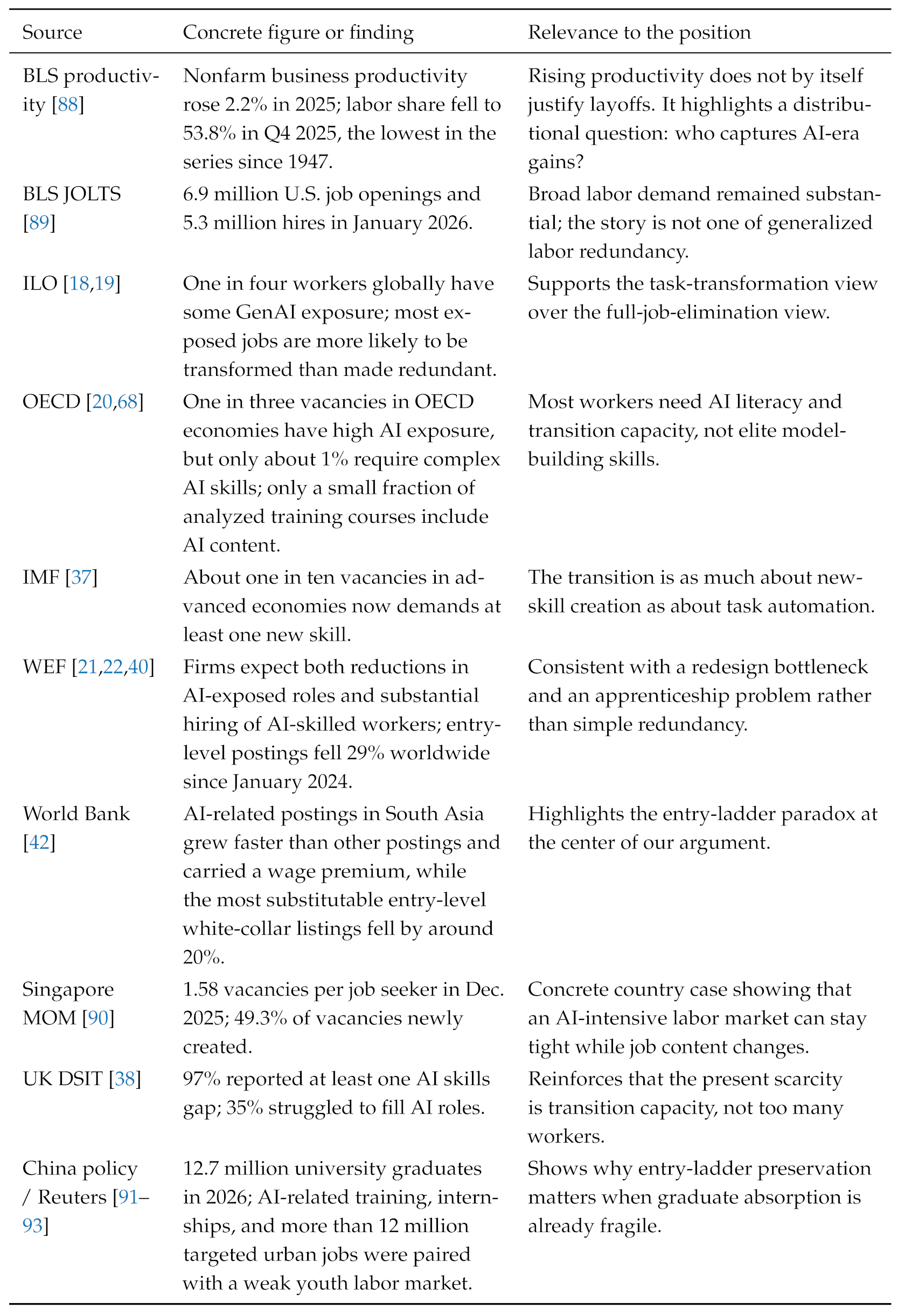
Appendix K. Labor-Market, Productivity, and Skills Evidence
Table Appendix K summarizes key labor-market, productivity, and skills evidence showing that the transition bottleneck is redesign rather than broad redundancy.
Table A6.
Selected company cases used in the paper.
 |
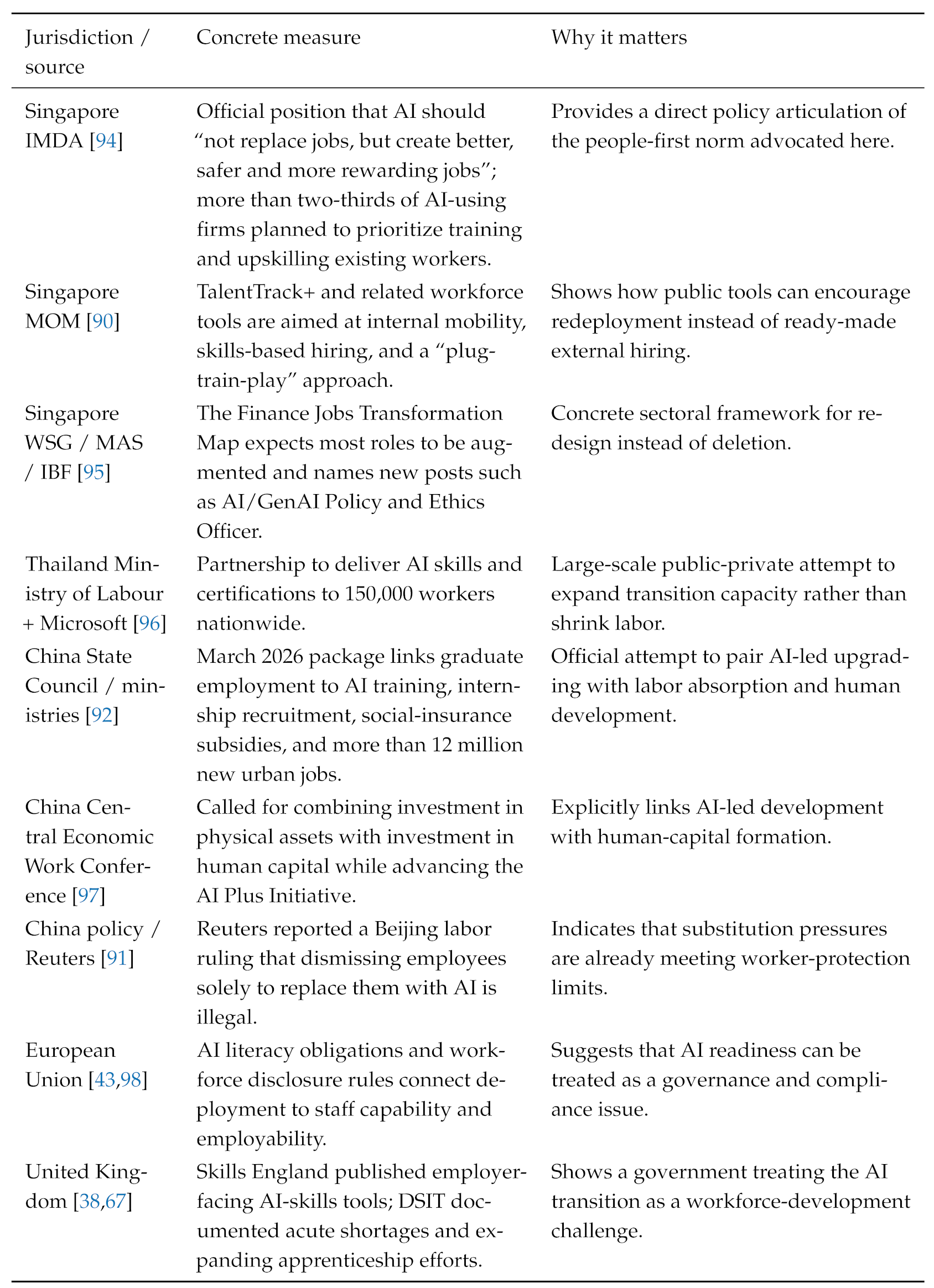
Appendix L. Government and Public-Institution Cases Showing an Alternative Path
Table Appendix L outlines concrete measures from governments and public institutions treating AI transition as a redesign, literacy, and mobility problem.
Table A7.
Examples of governments and public institutions treating AI transition as a redesign, literacy, and mobility problem.
Table A7.
Examples of governments and public institutions treating AI transition as a redesign, literacy, and mobility problem.
 |
Appendix M. Elevate-First as a Social Sustainability and Human-Capital Reporting Standard
Table Appendix M maps existing ESG, sustainability, and human-capital frameworks to workforce transitions, supporting an elevate-first rule.
Table A8.
How existing ESG, sustainability, and human-capital frameworks support an elevate-first rule.
Table A8.
How existing ESG, sustainability, and human-capital frameworks support an elevate-first rule.
 |
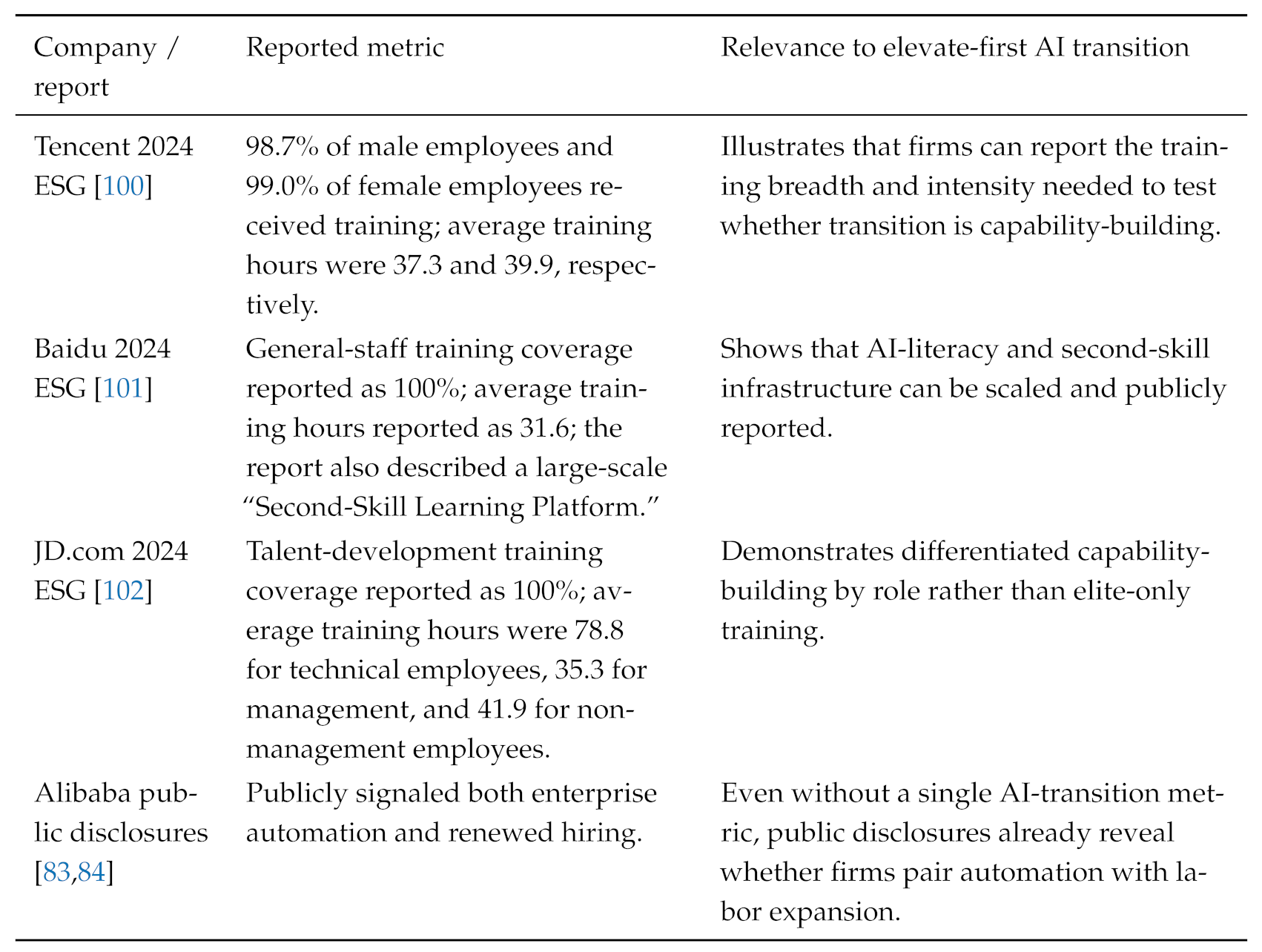
Appendix N. Illustrative Chinese Company Human-Capital and Upskilling Disclosures
Table Appendix N highlights reported metrics from recent Chinese technology-company ESG reports, illustrating how such transitions can be made auditable.
Table A9.
Examples from recent Chinese technology-company ESG reports showing that worker-development metrics are already auditable.
Table A9.
Examples from recent Chinese technology-company ESG reports showing that worker-development metrics are already auditable.
 |
Appendix O. Why the Position Is Falsifiable
This framework would be invalidated, or at least weakened, under several conditions. If future evidence showed that broad classes of firms can reliably delete large role families after AI deployment without meaningful losses in quality, trust, safety, learning, entry-ladder formation, or long-run organizational adaptability, the elevate-first presumption would weaken. If firms that pursue layoff-first strategies systematically outperform elevate-first firms on both productivity and resilience over time, that would also count against the thesis. Conversely, if job redesign, retraining, and internal mobility repeatedly prove cheaper and more durable than external hiring plus layoffs, the case for elevate-first grows stronger.
References
- Reuters. Companies Cutting Jobs as Investments Shift Toward AI. 2026. Updated April 15, 2026. Available online: https://www.reuters.com/business/world-at-work/companies-cutting-jobs-investments-shift-toward-ai-2026-04-15/ (accessed on 18 April 2026).
- Challenger, Gray & Christmas. Challenger Report: January Job Cuts Surge; Lowest January Hiring on Record. 6 February 2026. Available online: https://www.challengergray.com/blog/challenger-report-january-job-cuts-surge-lowest-january-hiring-on-record/ (accessed on 22 March 2026).
- Challenger, Gray & Christmas. Challenger Report: February Cuts Plunge, YTD Hiring Falls 56%. https://www.challengergray.com/blog/challenger-report-february-cuts-plunge-hiring-falls-56-percent/, 2026. Published. 5 March 2026. (accessed on 18 April 2026).
- Atlassian. An Important Update on Our Team. 11 March 2026. Available online: https://www.atlassian.com/blog/announcements/atlassian-team-update-march-2026 (accessed on 18 April 2026).
- Block, Inc. Q4 2025 Shareholder Letter. Available online: https://investors.block.xyz/financials/quarterly-earnings-reports/default.aspx (accessed on 18 April 2026).
- Salesforce. Salesforce Delivers Record Fourth Quarter Fiscal 2026 Results. 25 February 2026. Available online: https://investor.salesforce.com/news/news-details/2026/Salesforce-Delivers-Record-Fourth-Quarter-Fiscal-2026-Results/default.aspx (accessed on 18 April 2026).
- Reuters. Oracle Plans Thousands of Job Cuts as Data Center Costs Rise, Bloomberg News Reports. 5 March 2026. Available online: https://www.reuters.com/business/oracle-plans-thousands-job-cuts-data-center-costs-rise-bloomberg-news-reports-2026-03-05/ (accessed on 18 April 2026).
- Agrawal, A.K.; McHale, J.; Oettl, A. Enhancing Worker Productivity Without Automating Tasks: A Different Approach to AI and the Task-Based Model. In Working Paper 34781; National Bureau of Economic Research, 2026. Issued January 2026; Available online: https://www.nber.org/papers/w34781. [CrossRef]
- Demirer, M.; Horton, J.J.; Immorlica, N.; Lucier, B.; Shahidi, P. Chaining Tasks, Redefining Work: A Theory of AI Automation. In Working Paper 34859; National Bureau of Economic Research, 2026. Issued February 2026; Available online: https://www.nber.org/papers/w34859. [CrossRef]
- Farach, A. AI as Coordination-Compressing Capital: Task Reallocation, Organizational Redesign, and the Regime Fork. arXiv. 2026. Available online: https://arxiv.org/abs/2602.16078.
- Workday, Inc. Form 10-K for the Fiscal Year Ended January 31, 2025. 2025. Available online: https://investor.workday.com/financials/sec-filings/default.aspx (accessed on 18 April 2026).
- HP, Inc. HP Inc. Reports Fiscal 2025 Full Year and Fourth Quarter Results. 2025. Available online: https://investor.hp.com/news-events/news/news-details/2025/HP-Inc–Reports-Fiscal-2025-Full-Year-and-Fourth-Quarter-Results/default.aspx (accessed on 18 April 2026).
- SAP. SAP Updates Its Ambition 2025 and Announces Transformation Program for 2024. 2024. Available online: https://news.sap.com/2024/01/sap-updates-its-ambition-2025-and-announces-transformation-program-for-2024/ (accessed on 18 April 2026).
- Reuters. Salesforce to Cut 1,000 Roles, Bloomberg News Reports. 2025. Available online: https://www.reuters.com/technology/salesforce-cut-1000-roles-bloomberg-news-reports-2025-02-04/ (accessed on 21 March 2026).
- Reuters. Exclusive: Meta Targets May 20 for First Wave of Layoffs; Additional Cuts Later in 2026. 17 April 2026. Available online: https://www.reuters.com/world/meta-targets-may-20-first-wave-layoffs-additional-cuts-later-2026-2026-04-17/ (accessed on 18 April 2026).
- Falk, B.H.; Tsoukalas, G. The AI Layoff Trap. arXiv. 2026. Available online: https://arxiv.org/abs/2603.20617.
- Eloundou, T.; Manning, S.; Mishkin, P.; Rock, D. GPTs are GPTs: Labor Market Impact Potential of LLMs. Science 2024, 384, 1306–1308. [Google Scholar] [CrossRef] [PubMed]
- International Labour Organization. Generative AI and Jobs: A Refined Global Index of Occupational Exposure. In ILO Working Paper 140, International Labour Organization; 2025. [Google Scholar] [CrossRef]
- International Labour Organization. Generative AI and Jobs: A 2025 Update, 2025. Research Brief.
- Organisation for Economic Co-operation and Development. Bridging the AI Skills Gap: Is Training Keeping Up? https://www.oecd.org/en/publications/bridging-the-ai-skills-gap_66d0702e-en.html. accessed. 2025. (accessed on 18 April 2026). [CrossRef]
- World Economic Forum. The Future of Jobs Report 2025. 2025. Available online: https://www.weforum.org/publications/the-future-of-jobs-report-2025/ (accessed on 21 March 2026).
- World Economic Forum. The Top Jobs and Labour Market Stories of 2025. 15 January 2026. Available online: https://www.weforum.org/stories/2026/01/top-jobs-and-labour-market-stories-2025/ (accessed on 21 March 2026).
- Autor, D.H.; Levy, F.; Murnane, R.J. The skill content of recent technological change: An empirical exploration. The Quarterly journal of economics 2003, 118, 1279–1333. [Google Scholar] [CrossRef]
- Autor, D.H. Why are there still so many jobs? The history and future of workplace automation. Journal of economic perspectives 2015, 29, 3–30. [Google Scholar] [CrossRef]
- Acemoglu, D.; Restrepo, P. Automation and new tasks: How technology displaces and reinstates labor. Journal of economic perspectives 2019, 33, 3–30. [Google Scholar] [CrossRef]
- Brynjolfsson, E.; Li, D.; Raymond, L. Generative AI at Work. The Quarterly Journal of Economics 2025, 140, 889–942. [Google Scholar] [CrossRef]
- Noy, S.; Zhang, W. Experimental evidence on the productivity effects of generative artificial intelligence. Science 2023, 381, 187–192. [Google Scholar] [CrossRef] [PubMed]
- Peng, S.; Kalliamvakou, E.; Cihon, P.; Demirer, M. The Impact of AI on Developer Productivity: Evidence from GitHub Copilot. arXiv. 2023. Available online: https://www.microsoft.com/en-us/research/publication/the-impact-of-ai-on-developer-productivity-evidence-from-github-copilot/.
- Cruces, G.; Fernández Meijide, D.; Galiani, S.; Gálvez, R.H.; Lombardi, M. Does Generative AI Narrow Education-Based Productivity Gaps? Evidence from a Randomized Experiment; National Bureau of Economic Research, 2026. Issued February 2026; Available online: https://www.nber.org/papers/w34851. [CrossRef]
- Dell’Acqua, F.; McFowland, E., III; Mollick, E.R.; Lifshitz, H.; Kellogg, K.C.; Rajendran, S.; Krayer, L.; Candelon, F.; Lakhani, K.R. Navigating the Jagged Technological Frontier: Field Experimental Evidence of the Effects of AI on Knowledge Worker Productivity and Quality. Organization Science 2026, 37, 403–423. [Google Scholar] [CrossRef]
- Handa, K.; Tamkin, A.; McCain, M.; Huang, S.; Durmus, E.; Heck, S.; Mueller, J.; Hong, J.; Ritchie, S.; Belonax, T.; et al. Which Economic Tasks Are Performed with AI? Evidence from Millions of Claude Conversations. arXiv. 2025. Available online: https://arxiv.org/abs/2503.04761.
- World Economic Forum. AI at Work: From Productivity Hacks to Organizational Transformation. World Economic Forum story summarizing the community paper. 2026. Available online: https://www.weforum.org/stories/2026/01/ai-at-work-insights/ (accessed on 18 April 2026).
- World Economic Forum. Organizational Transformation in the Age of AI: How Organizations Maximize AI’s Potential. 2026. Available online: https://www.weforum.org/publications/organizational-transformation-in-the-age-of-ai-how-organizations-maximize-ais-potential/ (accessed on 18 April 2026).
- Loaiza, I.; Rigobon, R. The EPOCH of AI: Human-Machine Complementarities at Work. 21 November 2024. Available online: https://papers.ssrn.com/sol3/papers.cfm?abstract_id=5028371 (accessed on 18 April 2026). [CrossRef]
- Jaumotte, F.; Kim, J.; Koll, D.; Li, E.Z.; Li, L.; Melina, G.; Song, A.; Tavares, M.M. Bridging Skill Gaps for the Future: New Jobs Creation in the AI Age. January 2026. Available online: https://www.imf.org/en/publications/staff-discussion-notes/issues/2026/01/09/bridging-skill-gaps-for-the-future-new-jobs-creation-in-the-ai-age-572136 (accessed on 18 April 2026).
- Reuters. ByteDance’s TikTok Cuts Hundreds of Jobs in Shift Towards AI Content Moderation. 11 October 2024. Available online: https://www.reuters.com/technology/bytedance-cuts-over-700-jobs-malaysia-shift-towards-ai-moderation-sources-say-2024-10-11/ (accessed on 22 March 2026).
- International Monetary Fund. New Skills and AI Are Reshaping the Future of Work. https://www.imf.org/en/blogs/articles/2026/01/14/new-skills-and-ai-are-reshaping-the-future-of-work, 2026. IMF Blog. accessed. 14 January 2026. (accessed on 21 March 2026).
- Department for Science; Innovation and Technology; UK. AI Labour Market Survey 2025 Report: Executive Summary. 28 January 2026. Available online: https://www.gov.uk/government/publications/ai-labour-market-survey-2025-report/ai-labour-market-survey-2025-report-executive-summary (accessed on 22 March 2026).
- Global Reporting Initiative. GRI Topic Standard Project for Labor: Training and Education. Available online: https://www.globalreporting.org/standards/standards-development/topic-standards-project-for-labor/ (accessed on 18 April 2026).
- World Economic Forum. How AI Is Reshaping the Career Ladder, and Other Trends in Jobs and Skills on Labour Day. 2025. Available online: https://www.weforum.org/stories/2025/04/ai-jobs-international-workers-day/ (accessed on 21 March 2026).
- World Economic Forum. How AI Is Changing Early Careers: A View from Entry. World Economic Forum initiative page referencing the briefing, 2026. Available online: https://initiatives.weforum.org/reskilling-revolution/learning-to-earning (accessed on 18 April 2026).
- World Bank. South Asia Development Update – Chapter 2 Highlights: Artificial Intelligence, Real Impact: Labor Market Implications of AI Adoption in South Asia. 2025. Available online: https://openknowledge.worldbank.org/entities/publication/94725cf6-f681-42c9-acc7-63a076e0fc2b (accessed on 18 April 2026).
- EFRAG. ESRS S1: Own Workforce ESRS Set 1 landing page. 2023. Available online: https://www.efrag.org/en/sustainability-reporting/esrs-workstreams/sector-agnostic-standards-set-1-esrs (accessed on 18 April 2026).
- International Organization for Standardization. 2018. Available online: https://www.iso.org/standard/69338.html (accessed on 22 March 2026).
- Organisation for Economic Co-operation and Development. OECD Guidelines for Multinational Enterprises on Responsible Business Conduct. 2023. Available online: https://www.oecd.org/en/publications/oecd-guidelines-for-multinational-enterprises-on-responsible-business-conduct_81f92357-en.html (accessed on 18 April 2026).
- International Labour Organization. Just Transition Towards Environmentally Sustainable Economies and Societies. 2025. Available online: https://www.ilo.org/topics-and-sectors/just-transition-towards-environmentally-sustainable-economies-and-societies (accessed on 22 March 2026).
- United Nations Department of Economic and Social Affairs. Goal 8: Promote sustained, inclusive and sustainable economic growth, full and productive employment and decent work for all. 2025. Available online: https://sdgs.un.org/goals/goal8 (accessed on 22 March 2026).
- PwC. The Fearless Future: PwC’s 2025 Global AI Jobs Barometer. 2025. Available online: https://www.pwc.com/gx/en/services/ai/ai-jobs-barometer.html (accessed on 18 April 2026).
- He, C.; Zhou, X.; Wang, D.; Xu, H.; Liu, W.; Miao, C. Remote-Capable Knowledge Work Should Default to AI-Enabled Flexibility, 2026; Preprint.
- Mitchell, M.; Wu, S.; Zaldivar, A.; Barnes, P.; Vasserman, L.; Hutchinson, B.; Spitzer, E.; Raji, I.D.; Gebru, T. Model Cards for Model Reporting. In Proceedings of the Proceedings of the Conference on Fairness, Accountability, and Transparency, 2019; Association for Computing Machinery; pp. 220–229. [Google Scholar] [CrossRef]
- Gebru, T.; Morgenstern, J.; Vecchione, B.; Vaughan, J.W.; Wallach, H.; Iii, H.D.; Crawford, K. Datasheets for datasets. Communications of the ACM 2021, 64, 86–92. [Google Scholar] [CrossRef]
- Raji, I.D.; Smart, A.; White, R.N.; Mitchell, M.; Gebru, T.; Hutchinson, B.; Smith-Loud, J.; Theron, D.; Barnes, P. Closing the AI accountability gap: Defining an end-to-end framework for internal algorithmic auditing. In Proceedings of the Proceedings of the 2020 conference on fairness, accountability, and transparency, 2020; pp. 33–44. [Google Scholar]
- Reuters. Sweden’s Klarna Shifts AI Focus from Cost Cuts to Growth. 2025. Available online: https://www.reuters.com/business/swedens-klarna-shifts-ai-focus-cost-cuts-growth-2025-09-10/ (accessed on 21 March 2026).
- Autor, D. Applying AI to Rebuild Middle Class Jobs; Technical report; National Bureau of Economic Research, 2024. [Google Scholar]
- He, C.; Zhou, X.; Wang, D.; Xu, H.; Liu, W.; Miao, C. Human-AI Productivity Claims Should Be Reported as Time-to-Acceptance under Explicit Acceptance Tests, 2026; TechRxiv preprint.
- He, C.; Zhou, X.; Wang, D.; Xu, H.; Liu, W.; Miao, C. Harness Engineering for Language Agents: The Harness Layer as Control, Agency, and Runtime, 2026; Preprint.
- He, C.; Zhou, X.; Wang, D.; Xu, H.; Liu, W.; Miao, C. The AutoResearch Moment: From Experimenter to Research Director, 2026; Preprint.
- He, C.; Zhou, X.; Wang, D.; Xu, H.; Liu, W.; Miao, C. OpenClaw as Language Infrastructure: A Case-Centered Survey of a Public Agent Ecosystem in the Wild, 2026; Preprint.
- He, C.; Zhou, X.; Wang, D.; Xu, H.; Liu, W.; Miao, C. Let Papers Flow: AI Conferences Should Embrace Submission Explosion via Autonomous Review Pipelines, 2026; Preprint.
- He, C.; Zhou, X.; Wu, Y.; Yu, X.; Zhang, Y.; Zhang, L.; Wang, D.; Lyu, S.; Xu, H.; Wang, X.; et al. ESGenius: Benchmarking LLMs on Environmental, Social, and Governance (ESG) and Sustainability Knowledge. Proceedings of the Proceedings of the 2025 Conference on Empirical Methods in Natural Language Processing 2025, 14623–14664. [Google Scholar]
- Zhang, L.; Zhou, X.; He, C.; Wang, D.; Wu, Y.; Xu, H.; Liu, W.; Miao, C. MMESGBench: Pioneering Multimodal Understanding and Complex Reasoning Benchmark for ESG Tasks. In Proceedings of the Proceedings of the 33rd ACM International Conference on Multimedia, 2025; pp. 12829–12836. [Google Scholar]
- He, C.; Zhou, X.; Yu, X.; Zhang, L.; Zhang, Y.; Wu, Y.; Xiao, L.; Li, L.; Wang, D.; Xu, H.; et al. SSKG Hub: An Expert-Guided Platform for LLM-Empowered Sustainability Standards Knowledge Graphs. arXiv 2026, arXiv:2603.00669. [Google Scholar]
- He, C.; Zhou, X.; Wang, D.; Yu, X.; Xiao, L.; Li, L.; Xu, H.; Liu, W.; Miao, C. KG4ESG: The ESG Knowledge Graph Atlas, 2026; Preprint.
- He, C.; Zhou, X.; Wang, D.; Xu, H.; Liu, W.; Miao, C. ESGlass: Glass-Box ESG and Sustainability Reports; Preprint, 2026. [Google Scholar]
- Bresnahan, T.F.; Brynjolfsson, E.; Hitt, L.M. Information technology, workplace organization, and the demand for skilled labor: Firm-level evidence. The quarterly journal of economics 2002, 117, 339–376. [Google Scholar] [CrossRef]
- Deming, D.J. The growing importance of social skills in the labor market. The quarterly journal of economics 2017, 132, 1593–1640. [Google Scholar] [CrossRef]
- England, Skills. AI Skills for the UK Workforce. 2025. Published October 29, 2025. Available online: https://www.gov.uk/government/publications/ai-skills-for-the-uk-workforce (accessed on 22 March 2026).
- Organisation for Economic Co-operation and Development. AI and Work Topic page. 2026. Available online: https://www.oecd.org/en/topics/sub-issues/ai-and-work.html (accessed on 21 March 2026).
- Reuters. Atlassian to Cut Roughly 10% Jobs in Pivot to AI. 2026. Available online: https://www.reuters.com/technology/atlassian-lay-off-about-1600-people-pivot-ai-2026-03-11/ (accessed on 18 April 2026).
- Reuters. Block Shares Soar as Dorsey Leans on AI to Trim Workforce. https://www.reuters.com/sustainability/sustainable-finance-reporting/block-shares-soar-dorsey-leans-ai-trim-workforce-2026-02-27/, 2026. Published. 27 February 2026. (accessed on 18 April 2026).
- Reuters. Workday to Cut 1,750 Jobs in AI Push. 2025. Available online: https://www.reuters.com/business/workday-cut-85-its-workforce-2025-02-05/ (accessed on 21 March 2026).
- Reuters. HP to Cut About 6,000 Jobs by 2028, Ramps Up AI Efforts. 2025. Available online: https://www.reuters.com/business/hp-cut-about-6000-jobs-by-2028-ramps-up-ai-efforts-2025-11-25/ (accessed on 18 April 2026).
- Reuters. SAP to Restructure 8,000 Jobs in Push Towards AI, Shares Hit Record. 24 January 2024. Available online: https://www.reuters.com/technology/sap-announces-company-wide-restructuring-updates-2025-outlook-2024-01-23/ (accessed on 18 April 2026).
- Reuters. Salesforce Cuts Fewer Than 1,000 Jobs, Business Insider Reports. https://www.reuters.com/business/world-at-work/salesforce-cuts-less-than-1000-jobs-business-insider-reports-2026-02-10/, 2026. Published. 10 February 2026. (accessed on 21 March 2026).
- Reuters. Salesforce Forecasts Weak Current-Quarter Revenue, Shares Fall. 2025. Available online: https://www.reuters.com/sustainability/sustainable-finance-reporting/salesforce-forecasts-weak-current-quarter-revenue-shares-fall-2025-09-03/ (accessed on 22 March 2026).
- Reuters. Meta Shares Jump After Reuters Report on Plans for Layoffs of 20% or More. 16 March 2026. Available online: https://www.reuters.com/business/meta-shares-jump-after-reuters-report-plans-layoffs-20-or-more-2026-03-16/ (accessed on 21 March 2026).
- Reuters. Microsoft to Cut About 4% of Jobs Amid Hefty AI Bets. 2025. Available online: https://www.reuters.com/business/world-at-work/microsoft-lay-off-many-9000-employees-seattle-times-reports-2025-07-02/ (accessed on 21 March 2026).
- Reuters. Microsoft Racks Up over $500 Million in AI Savings While Slashing Jobs, Bloomberg News Reports. 9 July 2025. Available online: https://www.reuters.com/business/microsoft-racks-up-over-500-million-ai-savings-while-slashing-jobs-bloomberg-2025-07-09/ (accessed on 22 March 2026).
- Reuters. Amazon to Cut About 14,000 Corporate Jobs in AI Push. 2025. Available online: https://www.reuters.com/sustainability/amazon-lay-off-about-14000-roles-2025-10-28/ (accessed on 21 March 2026).
- Amazon. Update on Our Organization. 28 January 2026. Available online: https://www.aboutamazon.com/news/company-news/amazon-layoffs-corporate-jan-2026 (accessed on 22 March 2026).
- Reuters. China’s Baidu Starts Layoffs After Reporting Third-Quarter Loss - Sources. 2025. Available online: https://www.reuters.com/business/world-at-work/chinas-baidu-starts-layoffs-after-reporting-third-quarter-loss-sources-2025-11-28/ (accessed on 22 March 2026).
- Reuters. Sweden’s Klarna Says AI Chatbots Help Shrink Headcount. 27 August 2024. Available online: https://www.reuters.com/technology/artificial-intelligence/swedens-klarna-says-ai-chatbots-help-shrink-headcount-2024-08-27/ (accessed on 21 March 2026).
- Reuters. Alibaba Says to Restart Hiring, Sees Signs of Start of AI Bubble in the US. 2025. Available online: https://www.reuters.com/technology/alibaba-chairman-says-china-business-more-confident-since-xis-tech-summit-2025-03-25/ (accessed on 22 March 2026).
- Reuters. Alibaba Launches AI Platform for Enterprises as Agent Craze Sweeps China. 2026. Available online: https://www.reuters.com/world/asia-pacific/alibaba-launches-new-ai-agent-platform-enterprises-2026-03-17/ (accessed on 22 March 2026).
- Reuters. Tencent Pledges Higher AI Investment in 2026 After Chip Curbs Hit Capex Plans. 18 March 2026. Available online: https://www.reuters.com/world/asia-pacific/tencent-books-13-rise-quarterly-revenue-gaming-ai-demand-2026-03-18/ (accessed on 22 March 2026).
- Reuters. Xiaomi to Invest at Least $8.7 Billion in AI Over Next Three Years, CEO Says. 19 March 2026. Available online: https://www.reuters.com/world/asia-pacific/xiaomi-invest-least-87-billion-ai-over-next-three-years-ceo-says-2026-03-19/ (accessed on 22 March 2026).
- Reuters. Salesforce Closes 1,000 Paid `Agentforce’ Deals, Looks to Robot Future. 17 December 2024. Available online: https://www.reuters.com/technology/artificial-intelligence/salesforce-closes-1000-paid-agentforce-deals-looks-robot-future-2024-12-17/ (accessed on 22 March 2026).
- U.S. Bureau of Labor Statistics. Productivity and Costs, Fourth Quarter and Annual Averages 2025. Available online: https://www.bls.gov/bls/news-release/prod.htm (accessed on 18 April 2026).
- U.S. Bureau of Labor Statistics. Job Openings and Labor Turnover – January 2026. Available online: https://www.bls.gov/bls/news-release/jolts.htm (accessed on 18 April 2026).
- Ministry of Manpower; Singapore. Job Vacancies 2025: Labour Demand Gradually Shifting to Growth Areas as Firms Adjust Hiring Plans. 20 March 2026. Available online: https://www.mom.gov.sg/newsroom/press-releases/2026/0320-job-vacancies-report-2025 (accessed on 22 March 2026).
- Reuters. China Pins Hopes on Society-Wide AI Push to Add Jobs, Rejuvenate Economy. 10 March 2026. Available online: https://www.reuters.com/business/world-at-work/china-pins-hopes-society-wide-ai-push-add-jobs-rejuvenate-economy-2026-03-10/ (accessed on 22 March 2026).
- State Council of the People’s Republic of China. Chinese Authorities Roll Out Measures to Boost Employment for Graduate Job Seekers. 20 March 2026. Available online: https://english.www.gov.cn/news/202603/20/content_WS69bd46c3c6d00ca5f9a0a070.html (accessed on 22 March 2026).
- Reuters. China’s February Youth Jobless Rate Dips to 16.1%. 19 March 2026. Available online: https://www.reuters.com/world/asia-pacific/chinas-february-youth-jobless-rate-dips-161-2026-03-19/ (accessed on 22 March 2026).
- Infocomm Media Development Authority. Singapore to Build AI-Fluent Workforce to Accelerate National AI Ambition. 29 August 2025. Available online: https://www.imda.gov.sg/resources/press-releases-factsheets-and-speeches/press-releases/2025/sg-to-build-ai-fluent-workforce-to-accelerate-national-ai-ambition (accessed on 21 March 2026).
- Workforce Singapore. Jobs Transformation Map – Generative AI in Finance. 2026. Page updated January 2, 2026. Available online: https://www.wsg.gov.sg/home/employers-industry-partners/jobs-transformation-maps/jobs-transformation-map-generative-ai (accessed on 22 March 2026).
- Microsoft Source Asia. Ministry of Labour and Microsoft Join Forces to Accelerate AI Skill Development for 150,000 Thai Workers, Driving Thailand Towards Becoming “Creator” Nation in Digital Economy. 2025. Available online: https://news.microsoft.com/source/asia/2025/11/25/ministry-of-labour-and-microsoft-join-forces-to-accelerate-ai-skill-development-for-150000-thai-workers-driving-thailand-towards-becoming-creator-nation-in-digital-economy/ (accessed on 21 March 2026).
- State Council of the People’s Republic of China. China Holds Central Economic Work Conference to Plan for 2026. 2025. Published December 11, 2025. Available online: https://english.www.gov.cn/news/202512/11/content_WS693a9c0dc6d00ca5f9a08098.html (accessed on 22 March 2026).
- European Commission. AI Talent, Skills and Literacy. 2025. Page updated January 16, 2026. Available online: https://digital-strategy.ec.europa.eu/en/policies/ai-talent-skills-and-literacy (accessed on 22 March 2026).
- United Nations Global Compact. Social Sustainability. 2025. Available online: https://unglobalcompact.org/what-is-gc/our-work/social (accessed on 22 March 2026).
- Tencent Holdings. Environmental, Social and Governance Report. 2024. Available online: https://www.tencent.com/en-us/esg/esg-reports.html (accessed on 18 April 2026).
- Baidu. 2024 Environmental, Social and Governance Report. 2025. Available online: https://esg.baidu.com/en_reports.html (accessed on 18 April 2026).
- JD.com. 2024 Environmental, Social and Governance Report. Available online: https://ir.jd.com/esgcsr (accessed on 18 April 2026).
Table 1.
High-exposure role families still contain an elevated human layer, and the key question is whether redesign keeps the frontier moving.
Table 1.
High-exposure role families still contain an elevated human layer, and the key question is whether redesign keeps the frontier moving.
| Role family | AI-compressed substrate | Elevated human layer | Local redesign checkpoint |
|---|---|---|---|
| Administration | Scheduling, note-taking, travel plans, template documents, inbox triage | Workflow orchestration, stakeholder routing, priority arbitration, meeting-to-execution follow-through | Stalls early only if the role is kept narrow and low-discretion |
| HR / recruiting | JD drafting, sourcing, screening, scheduling, FAQ handling | Interview calibration, talent advising, internal mobility, onboarding exceptions, employee relations | Moves outward with ambiguity, regulation, and people judgment |
| Marketing | First-draft copy, campaign variants, segmentation ideas, SEO baselines | Brand stewardship, experiment design, cross-channel learning, partner alignment, customer interpretation | Stalls in commodity content factories; rises in strategy-rich functions |
| Sales operations | CRM updates, proposal drafts, routine pipeline reporting | Deal orchestration, forecast integrity, strategic account planning, exception management | Stalls earlier when account complexity is low and highly transactional |
| Customer support | FAQ retrieval, routing, response drafts, transcript summaries | Escalations, emotion-rich cases, churn prevention, knowledge-base curation, root-cause analysis | Simple queues stall earlier; complex service layers retain more frontier movement |
| Finance ops | Invoice coding, reconciliations, reporting drafts, variance explanations | Controls, exception analysis, audit readiness, business partnering, scenario interpretation | Moves outward with compliance burden and exception intensity |
| Legal & compliance | Document review, first-pass drafting, policy retrieval, checklist generation | Precedent judgment, edge-case escalation, regulator interface, audit defense | Moves outward in regulated industries where accountability cannot be delegated |
| Coding | Boilerplate, unit tests, refactors, API glue, search-heavy debugging | Architecture, integration, security, eval design, code review, reliability ownership | Moves outward in complex systems; stalls sooner in repetitive maintenance |
| Research | Literature triage, summaries, baseline scripts, transcription, memo drafts | Question selection, evaluation design, source trust, synthesis, causal identification, significance judgment | High in frontier or ambiguous work; stalls sooner in repetitive desk research |
Table 2.
A Workplace AI Transition Card for AI-attributed layoffs.
| Dimension | Minimum disclosure | Illustrative metrics or evidence |
|---|---|---|
| Task map | What tasks were automated, accelerated, or reallocated; what human-accountable work remains; and what baseline / post-stabilization windows were used. | Residual exception rates, escalation ownership, quality-control steps, customer handoff rules, workflow scope, and rollout milestones. |
| Training | What protected, paid training affected workers received. | Hours per worker, completion and application rates, role-specific AI literacy versus supervisory skill [20,39]. |
| Mobility | What elevated roles were opened before any layoffs. | Share of affected workers receiving internal offers, wage protection, transition duration, placement outcomes. |
| Apprenticeship | Whether junior, internship, or graduate-intake pathways were preserved or redesigned. | Intake numbers, junior-to-mid promotion rates, apprentice conversion, mentor ratios. |
| Consultation | Whether workers and managers were consulted and what design changes followed. | Documented consultations, appeal channels, incident reporting, redesign decisions. |
| Distribution of gains | How productivity improvements benefited workers and service quality. | Promotion pathways, reduced drudgery, better staffing for higher-order work, stability of quality metrics. |
| Financing logic | What AI investment or AI-role expansion the workforce change is funding, and what alternatives were considered first. | AI capex or product spend, AI-role openings, internal-fill rate, share of savings ring-fenced for training/wage protection, and non-layoff financing options evaluated. |
| Public reporting | Whether the transition was disclosed through human-capital and social-sustainability metrics. | ESRS S1, GRI labor training, ISO 30414, OECD responsible-business conduct alignment [39,43,44,45]. |
Disclaimer/Publisher’s Note: The statements, opinions and data contained in all publications are solely those of the individual author(s) and contributor(s) and not of MDPI and/or the editor(s). MDPI and/or the editor(s) disclaim responsibility for any injury to people or property resulting from any ideas, methods, instructions or products referred to in the content. |
© 2026 by the authors. Licensee MDPI, Basel, Switzerland. This article is an open access article distributed under the terms and conditions of the Creative Commons Attribution (CC BY) license (http://creativecommons.org/licenses/by/4.0/).
Copyright: This open access article is published under a Creative Commons CC BY 4.0 license, which permit the free download, distribution, and reuse, provided that the author and preprint are cited in any reuse.


